



Diamond Hair Clinic in Istanbul
This is a private, focused hair transplant clinic in Istanbul, founded and medically led by Dr. Mehmet Demircioglu. The clinic emphasizes personalized surgical planning, careful preservation of the donor area, and a quality focused approach, operating on only one patient per day. The clinic is dedicated only to hair transplantation and was built around a simple clinical idea. A hair transplant should be planned as surgery, not as a high volume commercial package.
Since 2012, Diamond Hair Clinic has treated more than 2,000 international patients, including patients from the United States, Canada, the United Kingdom, New Zealand, Australia, and many other countries. The clinic is known for surgeon-led hair transplantation, one patient per day, direct doctor communication, donor protection, and long term postoperative follow up.
In a large market like Turkey, those details matter. The stronger questions are who carries the medical responsibility, who designs the plan, who performs the critical surgical steps, and who remains available after surgery.
A focused hair transplant clinic in Istanbul
The clinic is focused on hair restoration, not a broad cosmetic center. It does not divide its attention between unrelated aesthetic procedures. This focus allows the clinic to keep its clinical attention on hair transplantation, donor management, hairline design, graft handling, and recovery follow up.
Hair transplantation is not a simple beauty service. It is a surgical redistribution of limited donor hair. A clinic that treats it as one item inside a large cosmetic menu may not give the procedure the discipline it deserves.
For international patients, this focus also makes the clinic easier to understand. The patient is not entering a large menu of cosmetic services. He is contacting a clinic built around one field, one surgeon’s hair restoration philosophy, and one clinical structure.
No clinic model guarantees a good result by itself, but a focused clinic makes the core issue clearer. The daily structure either supports careful surgery or mainly supports volume.
The clinic model is explained in more detail on the page about why patients choose Diamond Hair Clinic.
Surgeon-led planning protects the medical plan
Surgeon-led planning matters because the most important hair transplant decisions are medical decisions. The donor area must be assessed, the hairline must be planned, the graft number must be chosen carefully, and the recipient area incisions must be created with the final direction and density in mind.
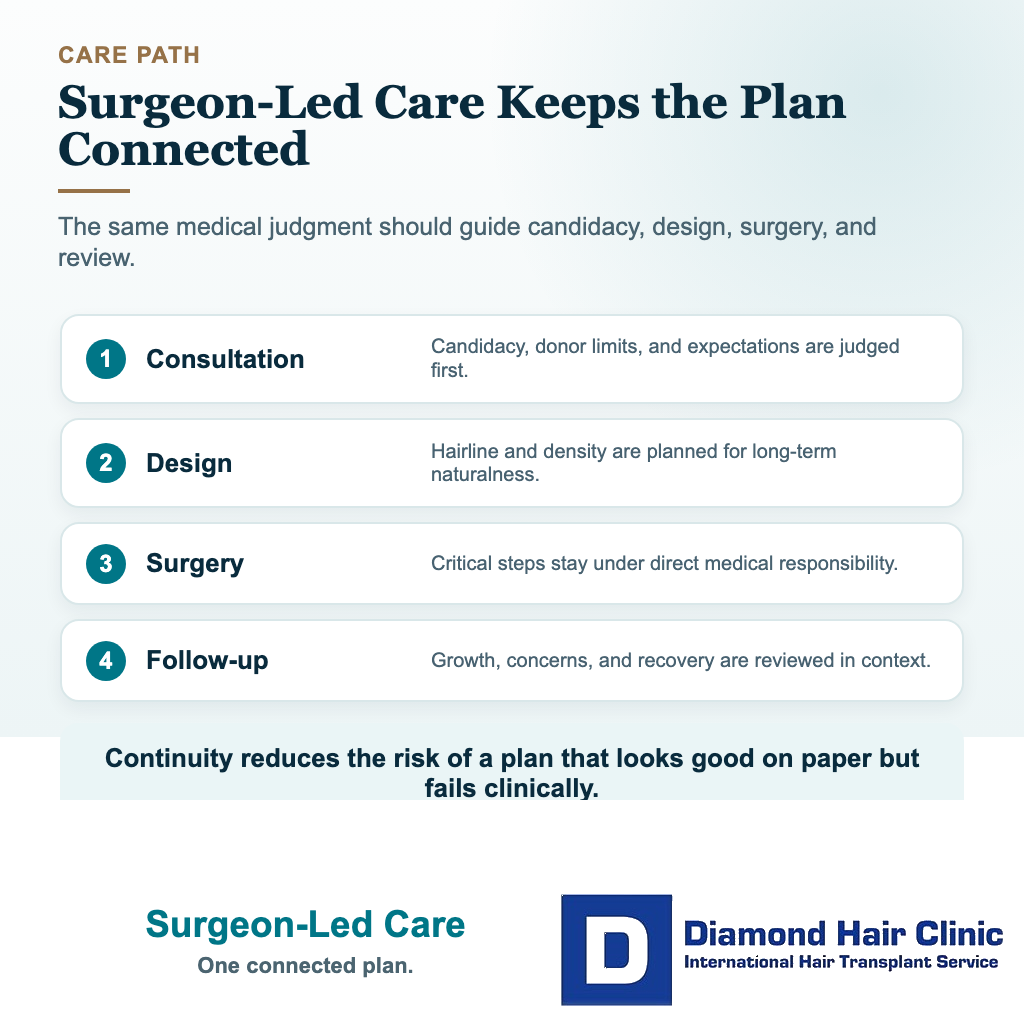
In this clinic model, Dr. Mehmet Demircioglu leads the medical planning and personally performs the recipient area incisions with a sapphire blade. This step is not treated as a routine technical detail. The angle, depth, direction, distribution, and density of these incisions influence how natural the final result can look.
This structure matters in medical tourism. In some clinics, the person selling the package is more visible than the doctor who carries the medical responsibility. At Diamond Hair Clinic, the medical plan stays with the surgeon who must stand behind it.
The clinic’s approach to candidacy is also connected to this. A patient is not accepted only because hair loss is visible. The case must be medically suitable, and the donor area must support the goal. Hair transplant candidacy depends on this same selection process.
One patient per day keeps the planning focused
Diamond Hair Clinic accepts only one patient per day because hair transplantation needs attention, continuity, and careful decision making. When several surgeries are handled at the same time, the process can become fragmented and rushed.
A one patient per day structure allows the clinic to give each case a slower and more focused surgical day. It supports direct surgeon involvement, careful graft handling, and better communication during the day of surgery.
The point is not only comfort. A hair transplant can require adjustments during the day. The donor area may look different in person than in photos. The hairline may need refinement. The graft number may need to be confirmed carefully. A crowded daily schedule makes these decisions harder to handle with patience.
That difference becomes clearer beside the high volume clinic model discussed in red flags of Turkish hair transplant clinics.
Direct surgeon involvement in the operation
Direct surgeon involvement begins before surgery. It includes reviewing the patient’s photos, medical background, hair loss pattern, donor area, expectations, and whether surgery is appropriate. It also includes explaining where surgery can help and where it may be better to wait.
During surgery, the critical planning decisions remain under Dr. Mehmet Demircioglu’s responsibility. This includes hairline design and recipient area incision creation. The purpose is not only to place grafts, but to create a direction and distribution that can grow naturally.
Direct involvement also continues after surgery through follow up communication, photo review, and guidance during the recovery period.
Patients often focus on who extracts or places grafts, but the medical responsibility is broader than one technical step. The clinic needs a clear answer for who evaluates candidacy, who decides the safe graft number, who changes the plan if donor reserve is weaker than expected, and who answers if recovery becomes confusing.
Recipient area incisions shape the result
Recipient area incisions guide how the transplanted hair will grow. They influence angle, direction, density, depth, and the way the transplanted hair blends with existing hair. For that reason, Diamond Hair Clinic does not view this step as something to delegate casually.
A natural result depends on irregular and patient specific placement, not visible row patterns. The front hairline, temples, and mid scalp are especially sensitive because small errors in direction can become obvious when the hair grows.
Diamond Hair Clinic avoids mechanical row pattern planning because natural hair does not grow like a grid. The goal is to create a softer distribution that supports natural movement and does not expose the transplant under normal light, short hairstyles, or close viewing.
The clinic’s approach to hairline design is built around this same principle. Naturalness comes from planning, not from graft number alone.
Donor reserve protection in the clinic model
Donor hair is treated as a limited reserve. A patient may want the maximum possible graft number, but the safe number depends on donor density, hair caliber, future hair loss, extraction pattern, and the size of the recipient area.
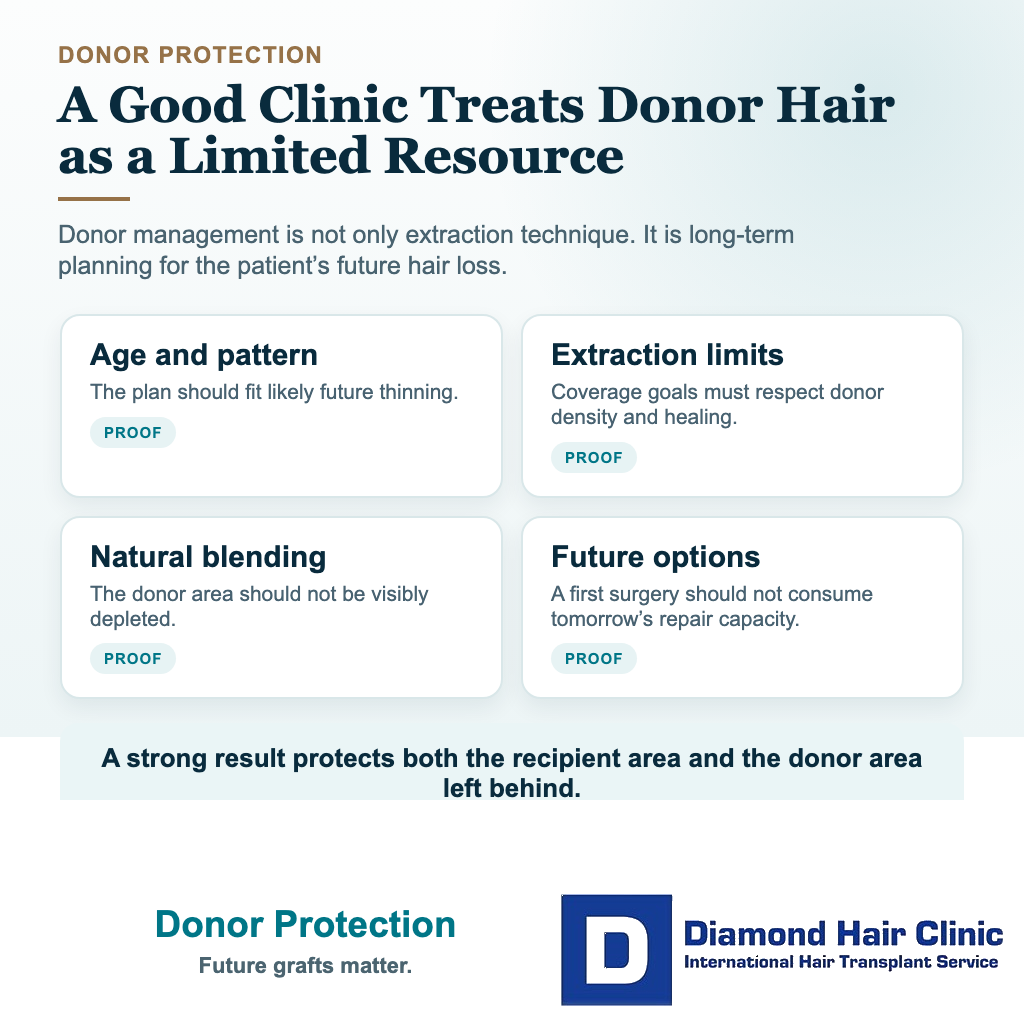
Diamond Hair Clinic does not view a larger graft number as automatically better. A responsible plan should improve coverage while preserving enough donor capacity for the future. This is especially important for younger patients, advanced hair loss, crown cases, and repair cases.
For some patients, the consultation may lead to a smaller plan than expected. A conservative plan is not a lack of ambition when donor reserve is limited. It can be the decision that protects the patient’s appearance years later.
The same donor planning philosophy runs through the donor area guide.
Communication with international patients
Clear communication is important for international patients because hair transplant planning includes many details. Patients need to discuss hairline shape, density expectations, donor limits, travel timing, recovery, and what the surgery cannot achieve.
Dr. Mehmet Demircioglu is fluent in English, which allows patients to communicate directly with the surgeon rather than relying only on a translator. This can make consultation, expectation setting, and recovery communication clearer.
This matters most when the patient needs nuance. A patient may want to explain why a lower hairline worries him, why the crown bothers him more than the front, or why a previous clinic promise created confusion. Direct communication makes these conversations more precise.
Patients can begin the process through the clinic’s consultation page, where the medical review begins before travel.
Before a patient travels to Istanbul
Before travel, a useful review includes more than a price quote. It covers the photos, medical background, donor capacity, likely graft range, and the areas to treat first.
The patient also needs to understand the travel rhythm, preparation instructions, medication discussion, and what will happen if the plan changes after examination at the clinic. These details need to be clear before arrival.
Diamond Hair Clinic uses the early consultation to make the surgery more predictable. The aim is not to pressure the patient into a date. The aim is to decide whether the case makes sense and whether the patient understands the plan.
Follow up after surgery
Diamond Hair Clinic considers follow up part of the treatment itself. After surgery, patients receive direct WhatsApp access to Dr. Mehmet Demircioglu. During the first 10 days, patients send daily photos so early healing can be reviewed closely.
After the first recovery period, patients continue with monthly photo follow up for 18 months. This allows the surgeon to monitor shedding, early growth, uneven stages, maturation, and patient concerns over time.
Aftercare is not treated as an administrative extra. It is part of the medical responsibility. The general hair transplant aftercare guide explains why recovery instructions and communication matter so much after surgery.
This long follow up matters because hair transplant growth is slow. Patients often worry during shedding, early redness, patchy growth, or the quiet months before visible density appears. A clinic should be present during those phases, not only on the surgery day.
Hair transplant methods used at the clinic
Diamond Hair Clinic’s surgical foundation is FUE, where follicular units are extracted individually from the donor area. FUE avoids the linear scar associated with FUT and allows flexible donor management when performed responsibly.
Dr. Mehmet Demircioglu’s main focus is Sapphire FUE. He has preferred this technique since 2016 because it supports precise recipient area incisions and controlled planning when used by an experienced surgeon.
DHI may be considered in selected situations, but the clinic does not treat method names as sales labels. The choice of technique should serve the patient’s case, not the clinic’s marketing.
In carefully selected cases, body hair may be considered as an additional donor source. PRP may also be used as a supportive treatment when expectations are realistic.
The important point is that technique is chosen after diagnosis. A modern sounding method is not enough reason to push the plan toward FUE, Sapphire FUE, DHI, body hair use, or PRP. Each option has limits. The method needs to support the plan, not replace it.
Natural results need more than growth
A natural result is not only a matter of growth. Hair can grow and still look artificial if the hairline is too low, the graft direction is wrong, the density is placed in rows, or the donor looks visibly weakened.
Diamond Hair Clinic judges a result by how it fits the face, how it behaves in normal light, how it ages with the patient, and how much donor reserve remains after surgery. For that reason, the clinic does not view maximum density everywhere as the goal.
This approach also guides the clinic’s policy for natural, stable hair transplant results.
Dr. Mehmet Demircioglu’s role
Dr. Mehmet Demircioglu is the founder, medical director, and hair transplant surgeon of Diamond Hair Clinic. He has been performing hair transplant surgery since 2012 and has built his practice around careful donor management, natural hairline design, realistic graft planning, and long term thinking.
He graduated from Istanbul University Cerrahpasa Medical Faculty and continued his development in hair restoration by working with experienced surgeons in the field.
He is also connected to international FUE education through the World FUE Institute, and has organized workshops for other surgeons on Sapphire FUE.
His clinical philosophy is visible in the way Diamond Hair Clinic presents itself. The clinic emphasizes fewer patients, direct surgeon responsibility, natural hairline design, and donor protection rather than fast scheduling or maximum graft marketing.
When the clinic model means slowing down or saying no?
A focused clinic must also be willing to slow the process when the medical answer is not clear yet. I do not want a patient to travel just because a date is convenient when we still need to decide whether surgery is right, how much donor hair can be used safely, or whether the expectations are realistic.
The plan may become smaller, staged, delayed, or refused when donor reserve is weak, hair loss is unstable, scalp disease is active, the requested hairline would not age well, or the patient expects density the graft supply cannot support.
This is part of the clinic promise. One patient per day matters because it gives the medical decision room to stay medical. It is not only a scheduling detail.
Patients best suited for this clinic model
This clinic model is best suited for patients who value careful planning, direct surgeon communication, realistic density expectations, donor protection, and long term follow up. It is not designed for patients whose only priority is the cheapest possible package.
The clinic may be a good fit for patients who want a low volume clinical structure, one patient per day, direct English communication with the surgeon, careful hairline design, and a plan that respects future hair loss.
It may not be the right fit for patients who only want the lowest price, the fastest available date, or the largest possible graft number without discussing donor limits. Diamond Hair Clinic is intentionally not structured as a factory style operation.
Patients who compare clinics mainly by price should also compare the real hair transplant cost in Turkey, because a cheaper procedure can become expensive if repair is needed later.
Price alone is a weak way to choose a clinic
Price matters, but it should not be the only comparison. A low price can look attractive before surgery, but the real cost of a weak transplant may include repair surgery, donor depletion, emotional stress, and years of trying to hide an unnatural result.
A serious comparison should ask what is included behind the price. Is the doctor directly involved? Is the clinic treating one patient or several patients that day? Is aftercare real? Is the graft number realistic? Is the donor area protected?
Diamond Hair Clinic aims to stay more affordable than several high level surgeon-led clinics in Turkey, but the clinic does not want to compete as a budget hair mill. The value is in the structure of care.
Comparing this clinic with other clinics
A serious comparison should look beyond price, hotel package, graft promise, and before and after photos. Patients should ask who performs the critical steps, how many patients are treated per day, how donor reserve is protected, and how follow up works after returning home.
Hair transplantation in Turkey is often discussed as if all clinics are similar. They are not. Hair transplantation in Turkey can be excellent when the clinic model is serious, but weak when volume and sales pressure replace medical responsibility.
Diamond Hair Clinic represents a focused clinic model built around surgeon-led planning, one patient per day, direct communication, Sapphire FUE, donor protection, and long term accountability.
For the right patient, this model offers a quieter but more serious kind of value. It is not built around dramatic promises. It is built around a surgical plan that can be explained clearly before the operation and followed responsibly afterward.