


World FUE Institute Meaning for Patients
The World FUE Institute matters only when it improves surgical judgment, donor protection, graft handling, repair thinking, and long-term planning. A membership logo alone does not protect the donor area, design a natural hairline, or decide whether surgery is appropriate for the case.
For me, WFI is meaningful because it keeps FUE hair transplantation close to education, case discussion, and professional exchange. The person choosing surgery does not attend workshops or compare punch designs, but the quality of these discussions can still influence what happens in the operating room.
At Diamond Hair Clinic, professional connection is not decoration. It has to support better planning, safer donor management, and more disciplined decisions. That is the part patients should care about.
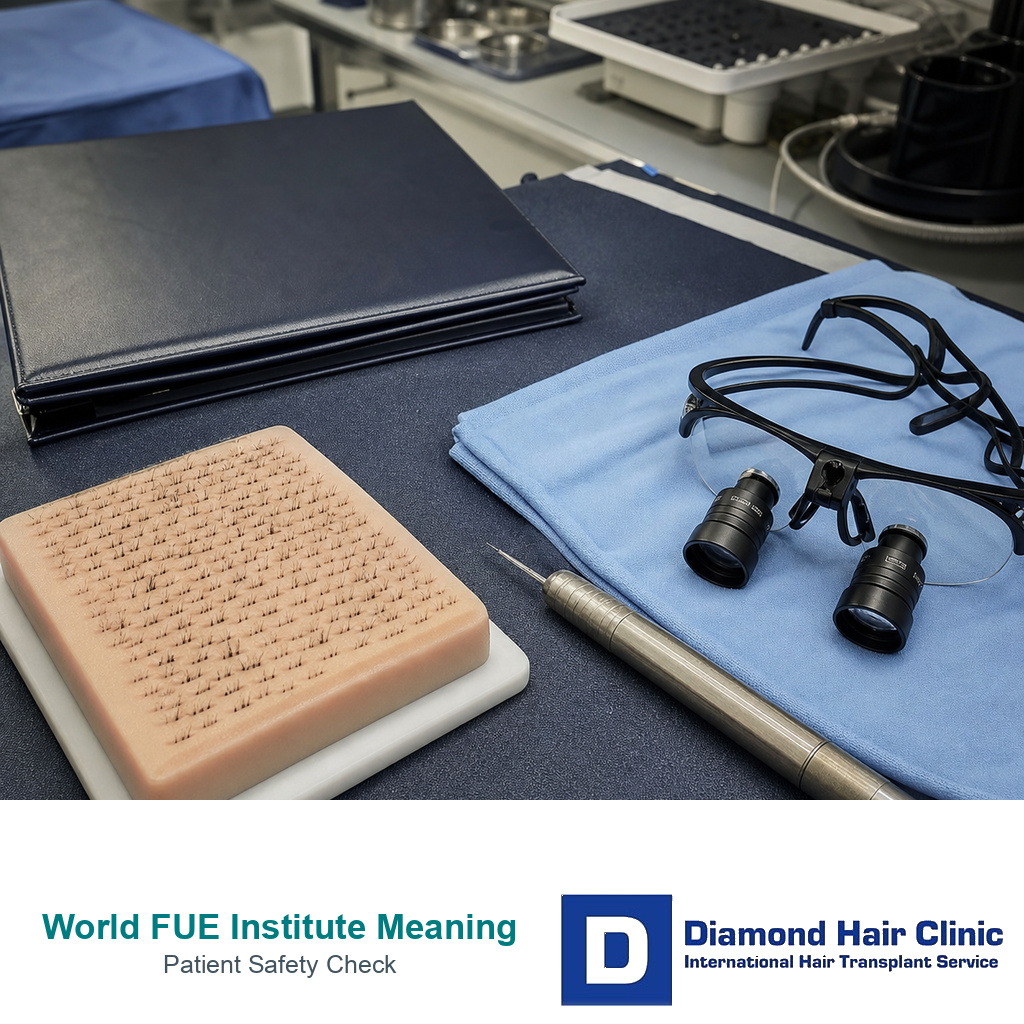
Professional society value must show in surgery
A society matters only when it connects to real surgical behavior. FUE is not a simple package. It is a surgical discipline that depends on donor assessment, extraction spacing, graft handling, recipient area design, and realistic expectations.
The value of a professional society comes from education and accountability. It reminds surgeons that hair transplantation is not only about placing many grafts. The practical value is choosing the right graft number, protecting future options, and avoiding avoidable repair problems.
Professional education matters when it changes what happens in the clinic, not when the badge looks impressive on a website.
Membership is only a starting signal
No membership can prove that a surgeon is good by itself. A professional connection can be a positive signal, but research should not stop there. The patient still needs to understand the actual surgical plan.
When a clinic mentions WFI, check the operating surgeon’s name and whether the claim refers to current membership, workshop attendance or both. Membership is personal, and a WFI logo on a clinic website or a workshop photo alone does not confirm that surgeon’s current membership.
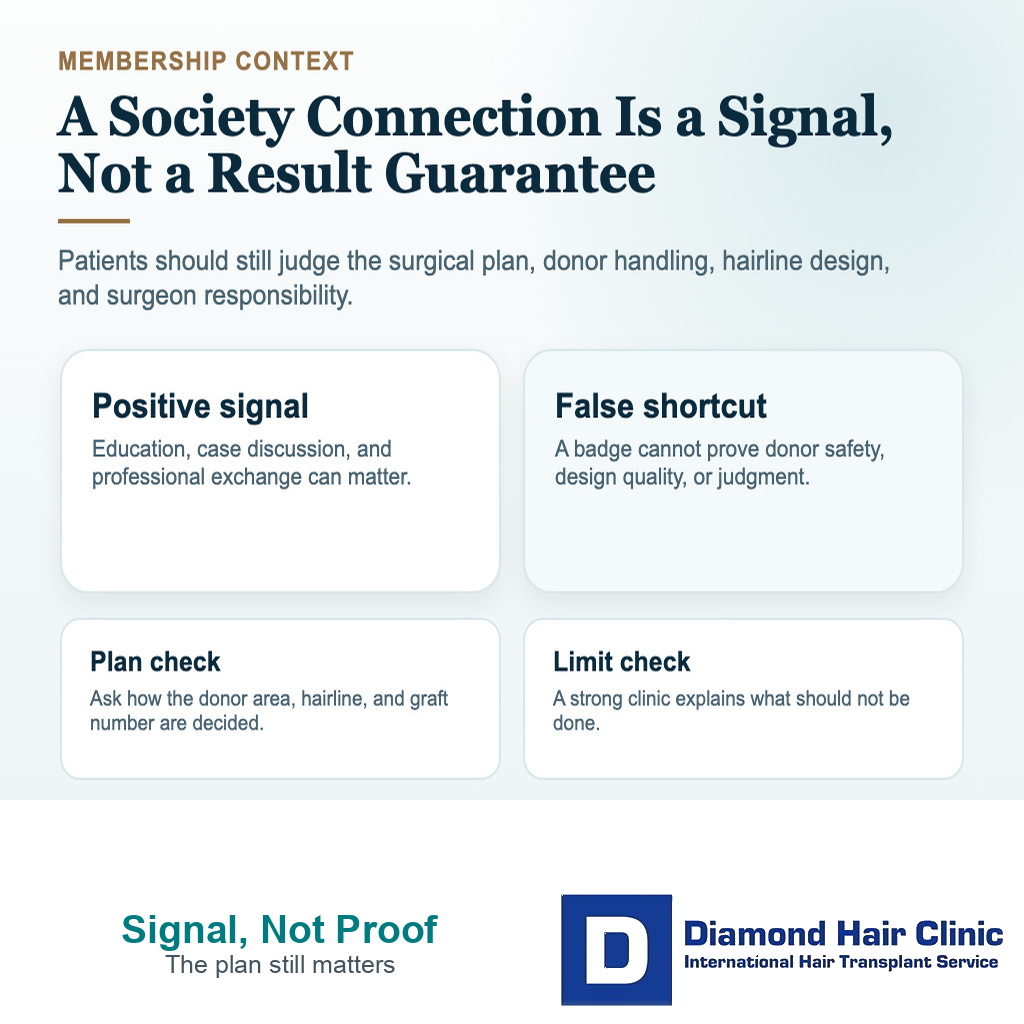
The useful comparison is mature results, donor area handling, hairline design, case selection, and whether the clinic gives realistic limitations. A membership may show interest in professional education, but the operation still has to be planned and performed responsibly.
These signals can help when comparing how to choose a hair transplant clinic in Turkey, as long as they do not replace case-specific questions.
Recent WFI workshops focus on practical FUE problems
Recent WFI workshops have focused on practical FUE problems that matter in real cases. The Istanbul meeting in 2022 was important because Istanbul is one of the busiest cities in the world for hair transplantation.
The São Paulo meeting in 2025 continued the same practical direction, with attention to repair cases, donor management, punch choice, graft placement, long-term outcomes, and difficult FUE decisions. These topics may sound technical, but they are directly connected to patient results.
The 2026 Cyprus workshop continues that international pattern. The useful value is not simply that surgeons gather. The value is that they gather around the problems that make FUE safer, more transparent, and more refined.
Workshops reveal what marketing hides
Marketing often shows the most attractive part of a hair transplant. It shows a strong result, a large graft number, a hotel package, or a low price. Workshops force surgeons to look at the less visible decisions behind the result.
Someone may see 5,000 grafts and think it must be better than 3,000 grafts. The surgeon has to ask whether the donor area can safely support that number, whether crown treatment belongs in the first plan, whether the hairline will age naturally, and whether the grafts are being used wisely.
Workshop culture matters because it keeps the discussion closer to surgery and farther away from sales language.
WFI and ISHRS have different educational cultures
WFI can feel more open in the FUE world because it gives space to the practical side of FUE surgery. Surgeons can discuss extraction, donor safety, repair cases, and the small decisions that shape a patient’s result.
This does not mean WFI is superior to the International Society of Hair Restoration Surgery. ISHRS has its own history and educational role in the wider hair restoration field. The difference is more about atmosphere and focus.
The difference is cultural, not a claim that one society has all the value. ISHRS can feel more closed from the outside. WFI can feel more accessible to surgeons who want to join the FUE conversation and contribute from direct surgical experience.
Open discussion helps surgical lessons travel
Hair transplantation changes over time. Instruments change. Extraction patterns are debated. Repair cases reveal old mistakes. Patient expectations evolve. If professional discussion becomes too closed, useful lessons travel slowly.
Openness does not mean accepting every new idea. Surgery still needs discipline. A new punch, motor, implanter, or dense packing claim needs questioning. A dramatic result needs to be judged against donor safety and future hair loss.
The healthiest professional culture is open but demanding. Surgeons need room to share, debate, and improve without turning the field into a private circle.
WFI is not a shortcut for choosing a clinic
WFI is not a shortcut in patient decision making. No one can assume that every clinic connected to a professional organization has the same standards, the same surgical involvement, or the same donor management discipline.
It is also not a marketing shield. If a clinic talks about education but cannot explain who performs the critical surgical steps, how grafts are counted, how the donor area is protected, or how aftercare works, keep asking questions.
In hair transplantation, impressive words are easy. What matters is whether the surgery behind them is careful.
The same patient worries return in consultation
The same concerns keep returning. A patient may worry about an overused donor area, temporary shock loss, confusing graft promises, or a cheaper and faster plan that ignored future hair loss.
Many repair questions start after a poor first surgery. A pluggy hairline may need softening, a depleted donor area may limit the repair, beard or body hair may help selected cases, and scalp micropigmentation may hide some patchiness. These questions show why responsible planning is not optional.
The better answer is not to repair every avoidable mistake later. The better answer is to avoid that mistake in the first operation.
Donor budgeting matters more than a large graft number
The donor area is a limited reserve. Once a graft is removed, it is no longer available in the donor area. If too many grafts are removed, the patient may gain coverage in one area and lose natural density in another.
I think of the donor area as a long-term budget. Every graft used today affects what can be done later. A young patient with progressive hair loss may need reserves for future loss. A patient with weak donor density may need a more limited plan from the beginning.
A sound hair transplant avoids creating a new problem while trying to solve the first one.
Repair cases show the cost of weak first planning
Repair cases show what happens when the first surgery was too aggressive, too commercial, or too careless. A low hairline can be difficult to soften. A depleted donor area can be hard to improve. Poor graft angles can make hair look unnatural even when growth is present.
Many repair cases are not only about density. They also carry emotional fatigue because the patient trusted a plan that did not protect them.
When WFI workshops discuss difficult cases and long-term outcomes, that is not a small academic exercise. It is a reminder that the first operation carries a heavy responsibility.
Sapphire FUE still needs responsible planning
Sapphire FUE can be valuable when it is used inside a careful plan. The instrument can help create refined recipient area incisions, but the tool does not make the result by itself.
The final result still depends on hairline design, graft direction, density planning, donor management, and surgical judgment. A precise instrument inside a weak plan is still a weak plan.
Diamond Hair Clinic does not present Sapphire FUE as a magic phrase. The real value comes from patient evaluation, donor protection, and knowing what should not be done.
Istanbul makes standards more important
Istanbul is one of the most recognized cities in the world for hair transplantation. This creates opportunity for patients, but it also creates confusion. A patient can find excellent surgeons, average clinics, aggressive advertising, low prices, and very different levels of doctor involvement in the same city.
Standards matter in Istanbul because volume alone should not define the city. Istanbul should be associated with careful planning, ethical graft use, and surgeon responsibility, not only with the number of operations performed.
My position is simple. I do not aim to promise the largest graft number. The plan should create natural improvement while protecting the patient’s long-term appearance.
Questions that matter before choosing a FUE surgeon
Look beyond membership logos, before and after photos, and graft package promises. These details can help, but they do not answer the most important questions.
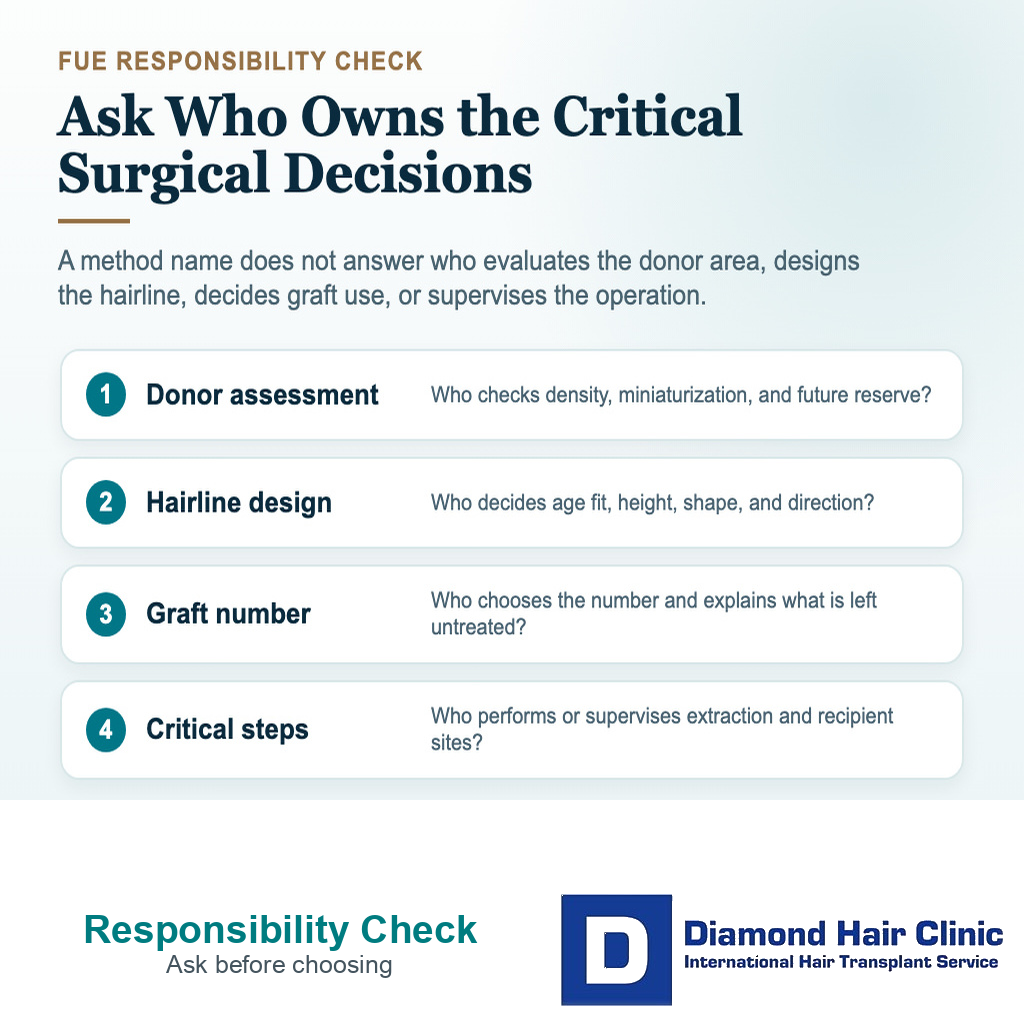
The practical questions are who evaluates the donor area, who designs the hairline, who decides the graft number, who creates the recipient area incisions, who supervises the critical steps, and how many patients are treated that day.
The same chain of responsibility matters more than a badge in who performs hair transplant surgery.
What makes a WFI connection meaningful at Diamond Hair Clinic?
For Diamond Hair Clinic, the WFI connection is meaningful when it supports a serious surgical attitude. It should support better planning, more careful donor management, and stronger awareness of long term responsibility.
This is closely connected to the clinic’s view of natural, stable hair transplant results. Growth alone is not enough. A good result needs to fit the face, protect the donor area, and remain natural as the patient ages.
When professional education, patient clarity, and careful technique come together, FUE becomes more than a popular procedure. It becomes a controlled surgical plan.
The standard WFI should support
The standard is not complicated. FUE needs medical responsibility, not only commercial ambition. Surgeons need to respect the donor area, explain limitations, avoid unsafe density promises, and treat each case as a separate plan.
WFI is valuable when it supports this kind of standard. Workshops, case discussions, and open professional exchange can remind surgeons that progress is not only about new tools. The real progress is better decisions.
For patients, that is the central point. The best hair transplant is not the one with the most impressive slogan. It is the one planned with the clearest understanding of what the patient can safely achieve.
Professional standards push against hair mill thinking
Hair mill thinking reduces surgery to volume, price, graft count, and speed. A professional education culture has to push in the opposite direction. It brings the discussion back to surgical responsibility, careful donor use, and natural planning.
This matters in Istanbul because patients can see very different clinic models in the same city. A serious FUE clinic should be able to explain why it will not use every possible graft, why one patient may need to wait, and why a natural hairline may be more modest than the patient expected.
The clinic model is often more important than the method name, especially when patients compare red flags of Turkish hair transplant clinics.

Who is Dr. Mehmet Demircioglu at Diamond Hair Clinic?
Dr. Mehmet Demircioglu is the founder and hair restoration surgeon of Diamond Hair Clinic in Istanbul, Turkey. His work focuses on FUE hair restoration with careful planning, donor safety, natural hairline design, and one patient per day.
The clinic appreciates WFI because it represents a more open international discussion around FUE. That openness matters when it helps serious surgeons learn, question, contribute, and keep the patient’s long-term result at the center of the conversation.

Read this review excerpt
He was very thorough in every little detail and I never felt pressure to do anything I wasn’t sure of.