Silent Success Shapes Hair Transplant Reviews in Turkey
Good hair transplant results in Turkey often stay quiet because many satisfied patients simply want to move on with their lives. They do not want to explain surgery to friends, colleagues, or strangers online. At the same time, negative experiences deserve to be taken seriously because a poor hair transplant can create real medical, emotional, and financial damage.
This is the balanced answer. Quiet success does not prove that every clinic is good. Loud disappointment does not prove that every clinic is bad. A patient needs to read the pattern behind reviews, photos, timing, clinic response, donor management, and surgical responsibility.
Dramatic stories are not enough. Ordinary case follow-up after the excitement has passed is the review pattern that matters, including stable healing, donor appearance, patient communication, and what happened when a concern was raised.
Turkey has excellent hair transplant surgeons and also high volume clinic models that can harm patients. The country’s reputation should make a patient curious, not careless. The safest patient is neither impressed by every positive story nor frightened by every negative one. The safest patient learns how to judge evidence.

Satisfied Hair Transplant Patients Often Stay Private
Hair loss is personal. Many men do not speak openly about it before surgery, so they also do not want to explain the solution after surgery. If the result looks natural, the patient may prefer that others simply think he looks better, healthier, or more rested.
This privacy is understandable. A successful hair transplant is often successful partly because it does not call attention to itself. If people cannot easily see that surgery was done, the patient may feel no need to announce it.
Some patients also worry about judgment. They may fear being called vain, insecure, or artificial. Others work in professional environments where appearance matters, but personal medical decisions are not something they want to discuss. Silence can therefore be a sign of satisfaction, not shame.
At Diamond Hair Clinic, many referrals come through private conversations. A brother tells a brother. A friend tells a friend. A patient sends photos quietly to someone he trusts. That kind of result may never become a public review, but it can still be very real.
Negative Hair Transplant Stories Travel Faster
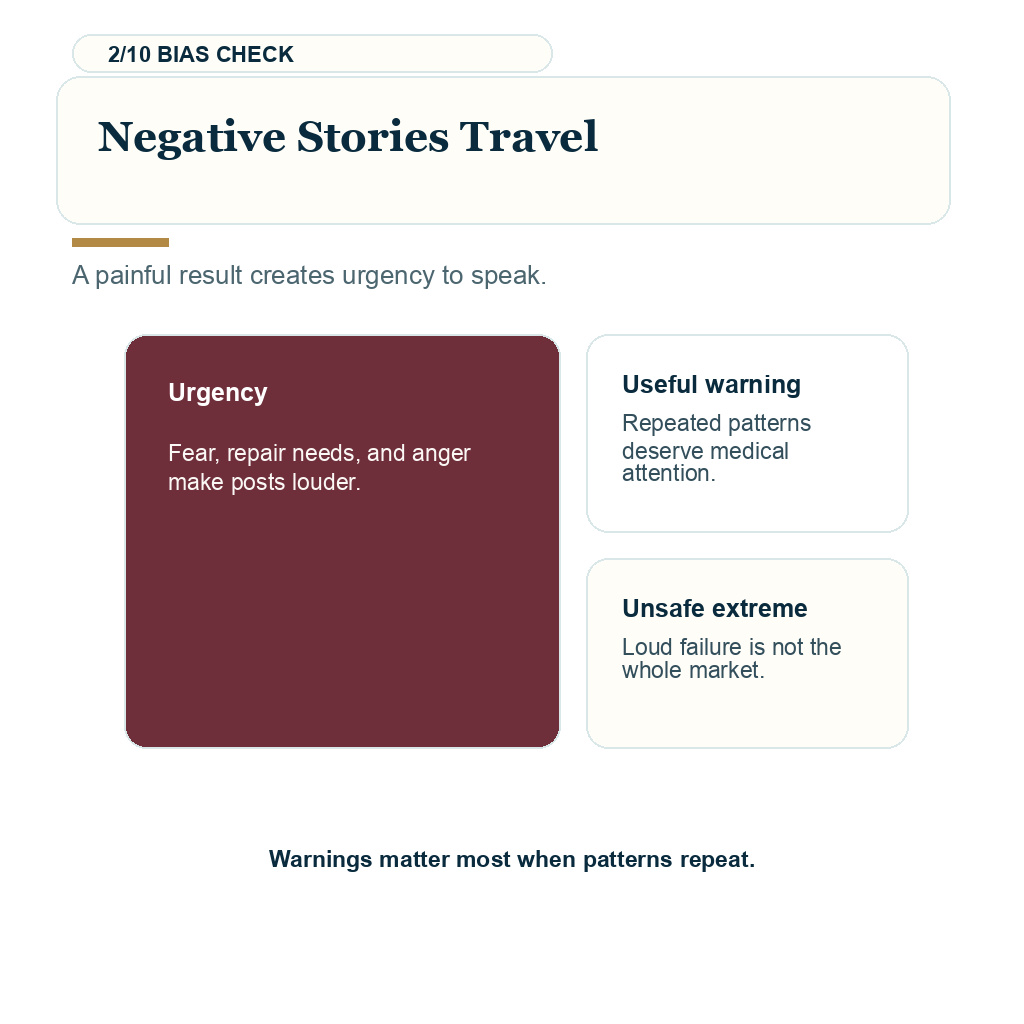
A patient with a poor result usually has a stronger need to speak. He may be angry, frightened, embarrassed, or looking for help. He may want to warn others. He may also want the clinic to respond. That emotional pressure naturally creates more public activity.
A satisfied patient often has less urgency. He may enjoy the result privately and stop thinking about hair transplant surgery. The disappointed patient may continue searching every day, comparing photos, asking for repair opinions, and trying to understand what went wrong.
This does not make negative stories false. Many negative stories are important warnings. The risk comes when the loudest failures start to look like the usual outcome. If a patient reads only those cases, he may become afraid of every clinic. If he reads only polished clinic marketing, he may underestimate the real risks. Both extremes are unsafe.
Lessons From Negative Reviews
Negative reviews are useful when they show a pattern. A single complaint may be emotional, incomplete, or case specific. Repeated complaints about the same clinic problem are different. If many patients describe rushed planning, technician led surgery, poor communication, unnatural hairlines, donor depletion, or no proper follow up, that deserves attention.
I do not tell patients to ignore negative reviews. I ask them to read negative reviews with structure. What was the graft number? What was the hair loss stage? Who designed the hairline? Who made the recipient area incisions? Was the donor area shown? Was the review written one week after surgery or one year later? Did the clinic answer medically or only defensively?
The strongest reviews usually include clear photos, timeline, donor area views, hairline close ups, growth stage, lighting, and a specific explanation of what happened. The weakest reviews are often extreme in emotion but thin in evidence, whether they are positive or negative.
Early Positive Reviews Need Time
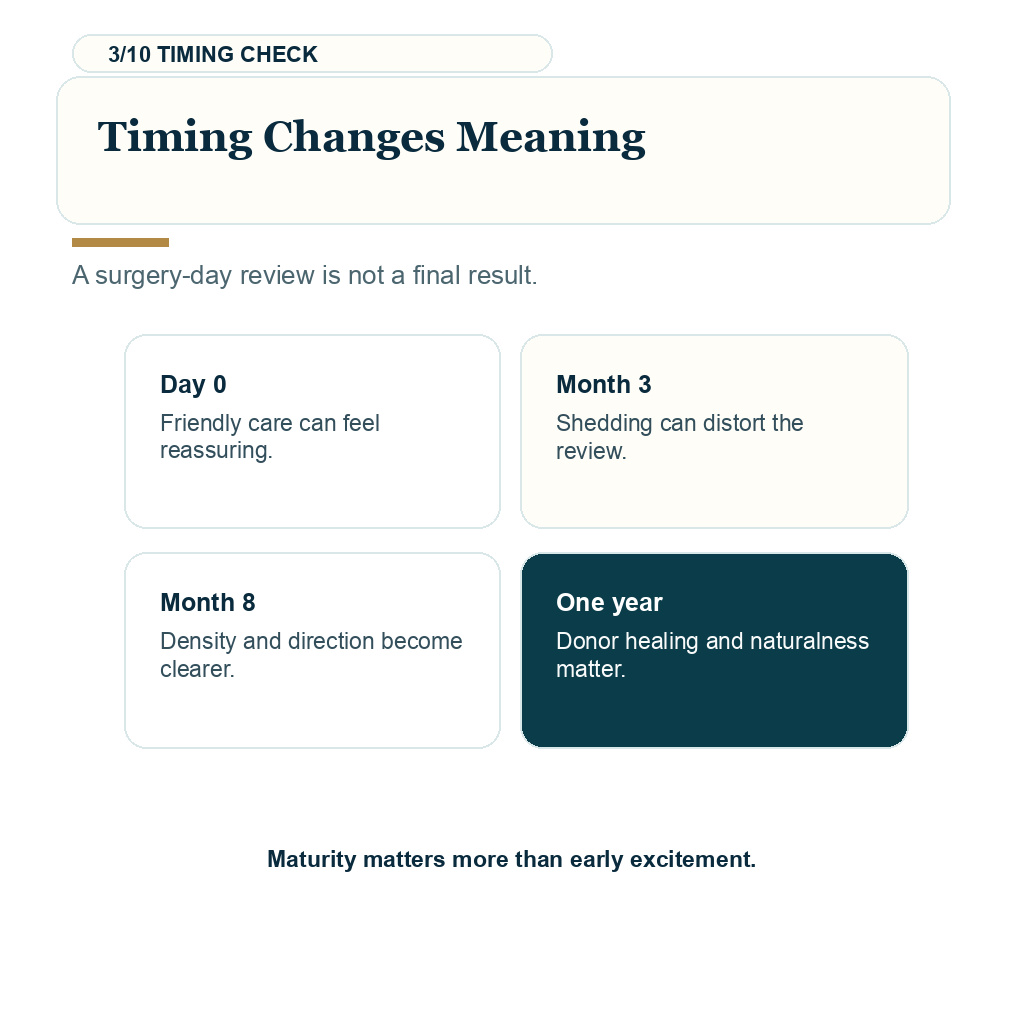
A review written immediately after surgery is not a result review. It can describe travel, hotel, transfer, staff kindness, pain control, and general organization. Those details matter, but they do not prove growth, density, naturalness, donor safety, or long term planning.
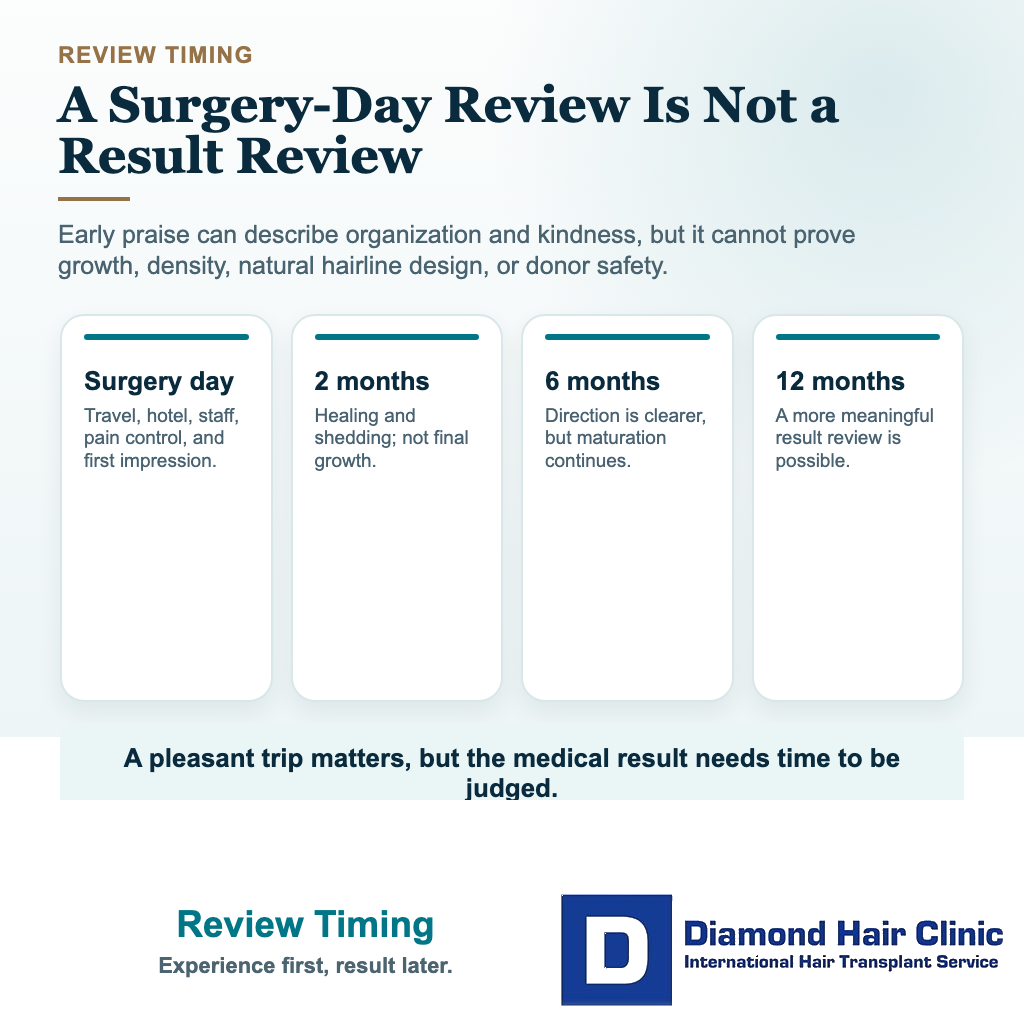
A patient may feel happy on surgery day because the team was friendly and the graft number sounded impressive. The real medical judgment comes later, when the hairline grows, the donor area heals, the density is visible, and the patient sees whether the plan still looks natural in normal life.
The most useful reviews separate experience from outcome. A pleasant trip is good. A clean operation day is good. But a natural hair transplant result still has to be judged by hairline design, direction, density, donor management, and the patient’s future hair loss.
Positive Reviews Can Still Need Caution
A positive review should make you cautious when it was written before growth could be judged, when it mentions only the hotel and driver, when every sentence sounds like sales language, or when many reviews appear in the same style with very little medical detail.
I am not saying these reviews are always fake. A patient can be genuinely happy with the organization. But surgery quality needs different evidence. The evidence I look for is the hairline at maturity, the donor area after healing, and the way the clinic responds when the patient has a real concern.
Patients also need caution when a clinic uses pressure to collect reviews immediately after surgery. The patient is tired, relieved, and grateful at that moment. That is not the best time to judge the result.
Reading Turkey Hair Transplant Reviews More Safely
Read reviews as clues, not verdicts, and separate the patient journey from evidence of surgical quality. Look for consistency across time. A clinic with one angry story and many detailed mature results is different from a clinic with repeated complaints about the same medical failure. A clinic with hundreds of very short early praise messages but few mature results also deserves caution.
When public stories feel divided, sort them by the problem being described. A mixed review is more useful when it names timing, donor condition, doctor involvement, aftercare response, and mature photos.
Pay special attention to the details that affect surgery quality. Did a doctor assess the donor area? Was the hairline drawn conservatively or pushed too low? Were grafts taken from the safe donor area? Was the patient told who would perform each step? Was aftercare direct and medically useful?
Hair transplant reviews in Turkey need quality signals, not only star counts. The aim is not to find a clinic with no criticism at all. The aim is to understand what the criticism means.
Balanced Reviews Include More Than Praise
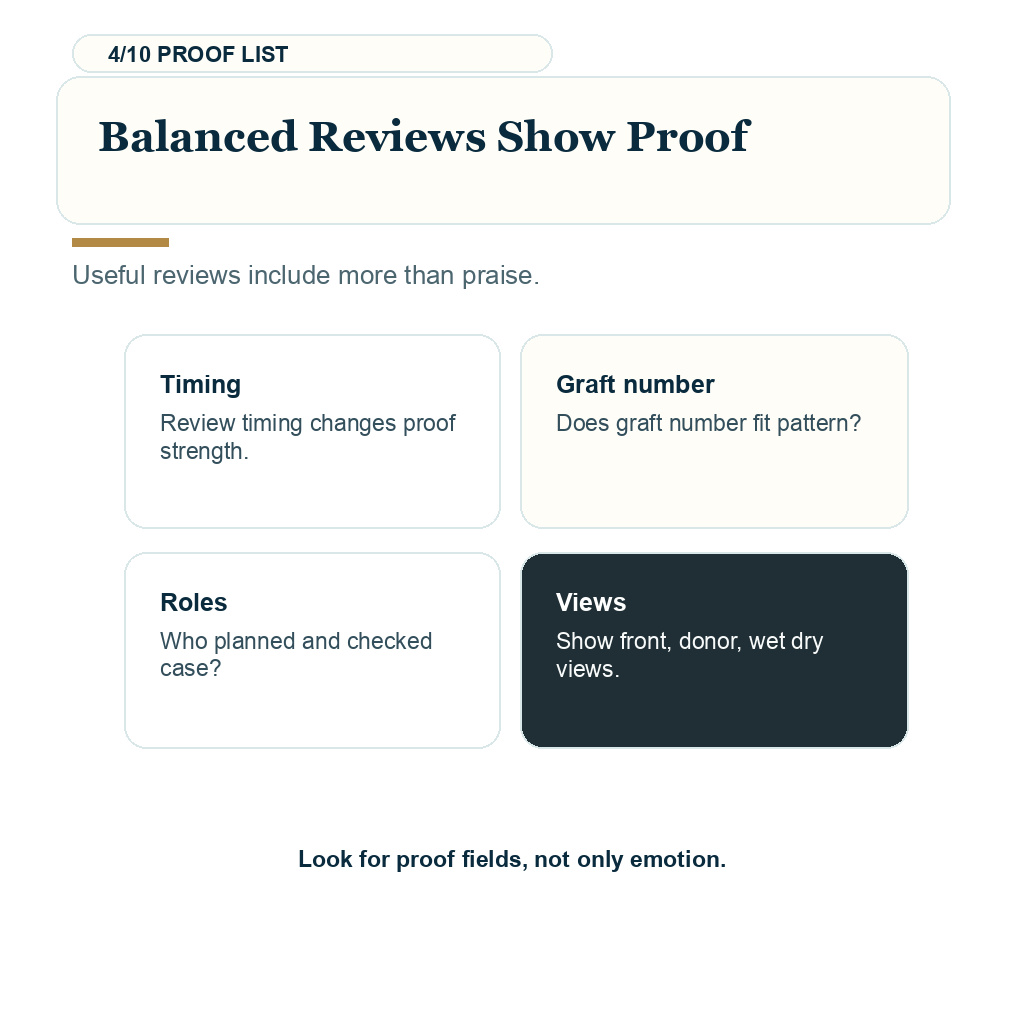
A balanced review usually gives timing, graft number, clinic role, surgeon role, donor view, recipient area view, lighting, and whether the photos are wet or dry. It may describe what went well and what was difficult. It does not need to be perfectly positive to be useful.
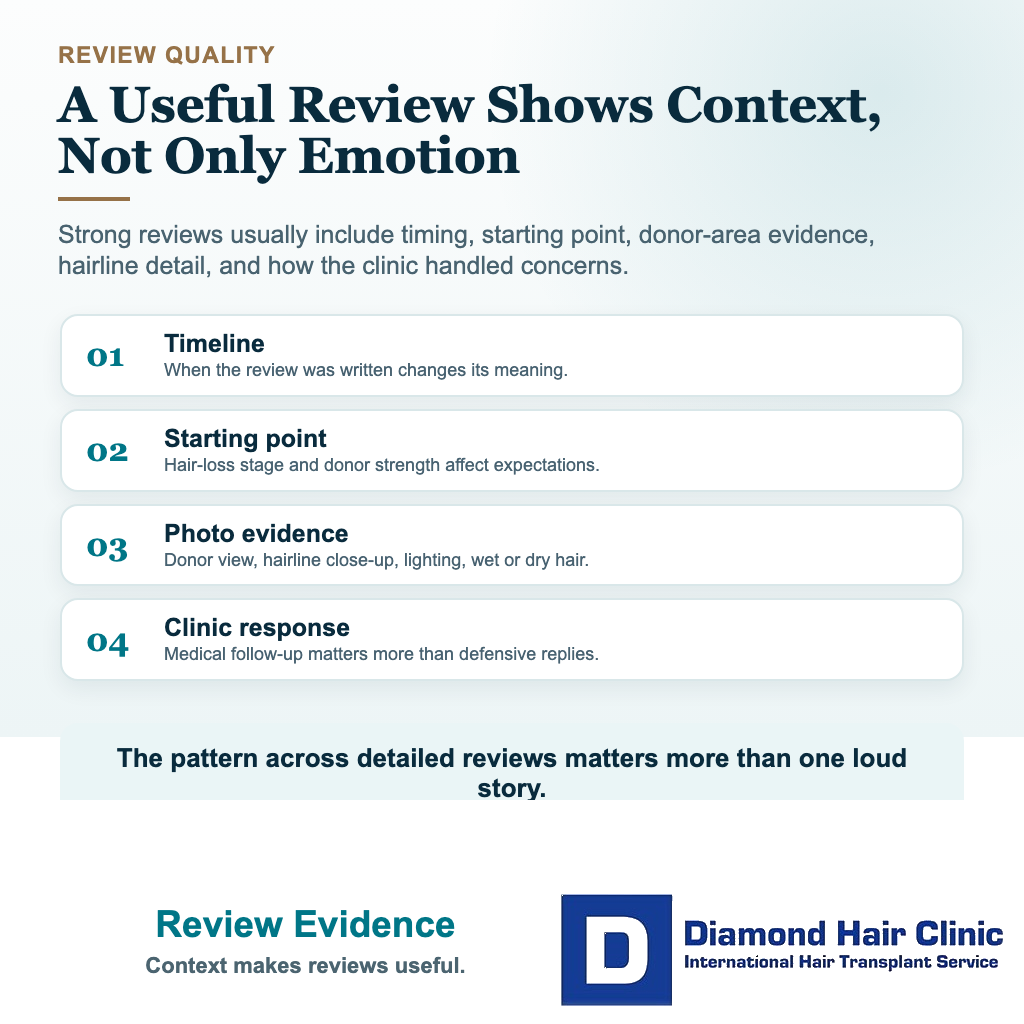
The best reviews also respect the hair transplant timeline. A two month review may be useful for healing, but it cannot judge final growth. A six month review can show direction, but many results still mature after that. A twelve month review is usually more meaningful for the visible outcome.
When I read a review, I also look for whether the patient understands his starting point. Advanced hair loss, weak donor density, or crown thinning makes the review a different case from a small frontal recession. The starting pattern changes what the result actually proves.
Turkey Has Both Excellent and Poor Clinics
Turkey became known for hair transplantation because Istanbul developed a large medical tourism ecosystem, experienced surgeons, competitive pricing, travel access, and clinics that adapted quickly to FUE based surgery. That reputation is real, but it does not protect the patient by itself.
A strong destination attracts serious doctors and commercial operators at the same time. This explains why hair transplant in Turkey can be a good decision in the right clinic and a poor decision in the wrong one.
The country name cannot replace clinic assessment. Medical step responsibility, daily case volume, donor protection, and surgery day plan changes matter more than the destination label.
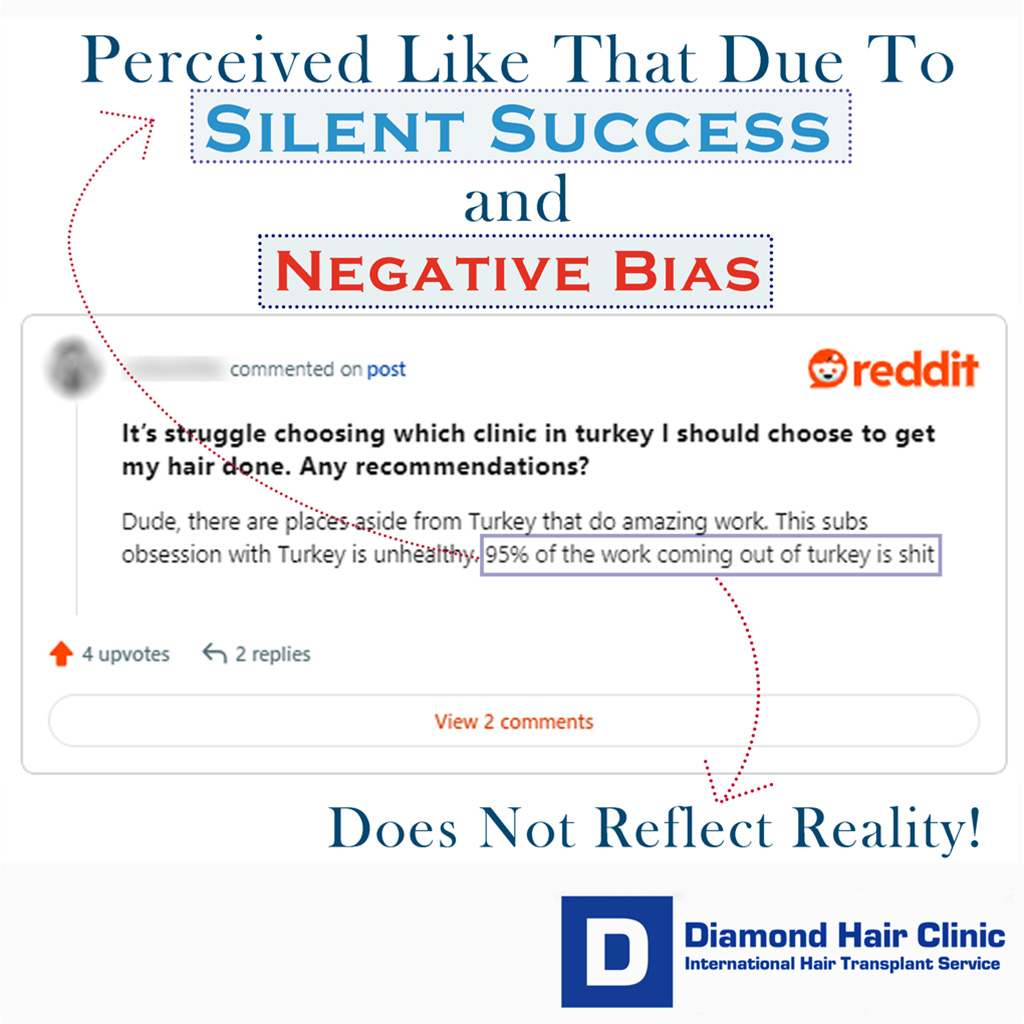
Hair Mill Results and Turkey’s Negative Image
High volume hair mills damage patient trust because one poor result can be shared widely and then attached to the whole country. Unnatural hairlines, pluggy grafts, poor angles, donor overharvesting, weak aftercare, and unclear responsibility are not small marketing problems. They are surgical problems.
When a clinic treats many patients at once, the patient may not know who is making the critical decisions. The clinic may focus on graft number, hotel, transfer, and price while giving little attention to donor capacity, hairline design, long term hair loss, and repair risk.
This topic connects with red flags of Turkish hair transplant clinics. Negative bias is not only psychology. Sometimes it is a response to real harm. The patient must learn the difference between an emotional complaint and a repeated medical warning.
Silent Success After Careful Surgery
Silent success usually looks ordinary from the outside. The patient returns to work. The hairline grows in gradually. Friends may notice that he looks better but cannot identify surgery. The donor area remains usable. The patient stops organizing his life around hair loss.
That is very different from a dramatic marketing result. I am less interested in making the hairline look impressive on the day of surgery and more interested in whether the result will still look natural in five or ten years.
At Diamond Hair Clinic, I emphasize one patient per day, direct surgeon involvement, careful donor management, and natural hairline design. A result does not need dramatic explanation. It has to fit the person.
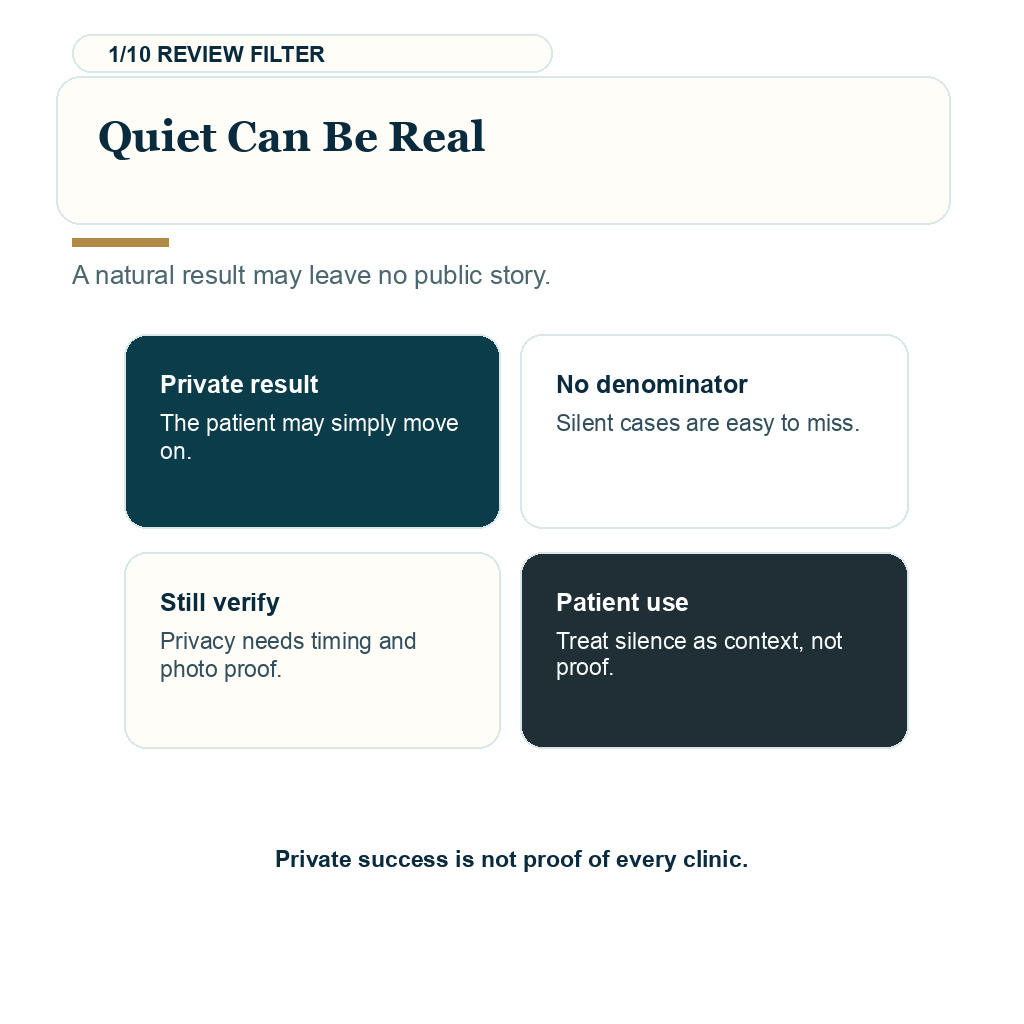
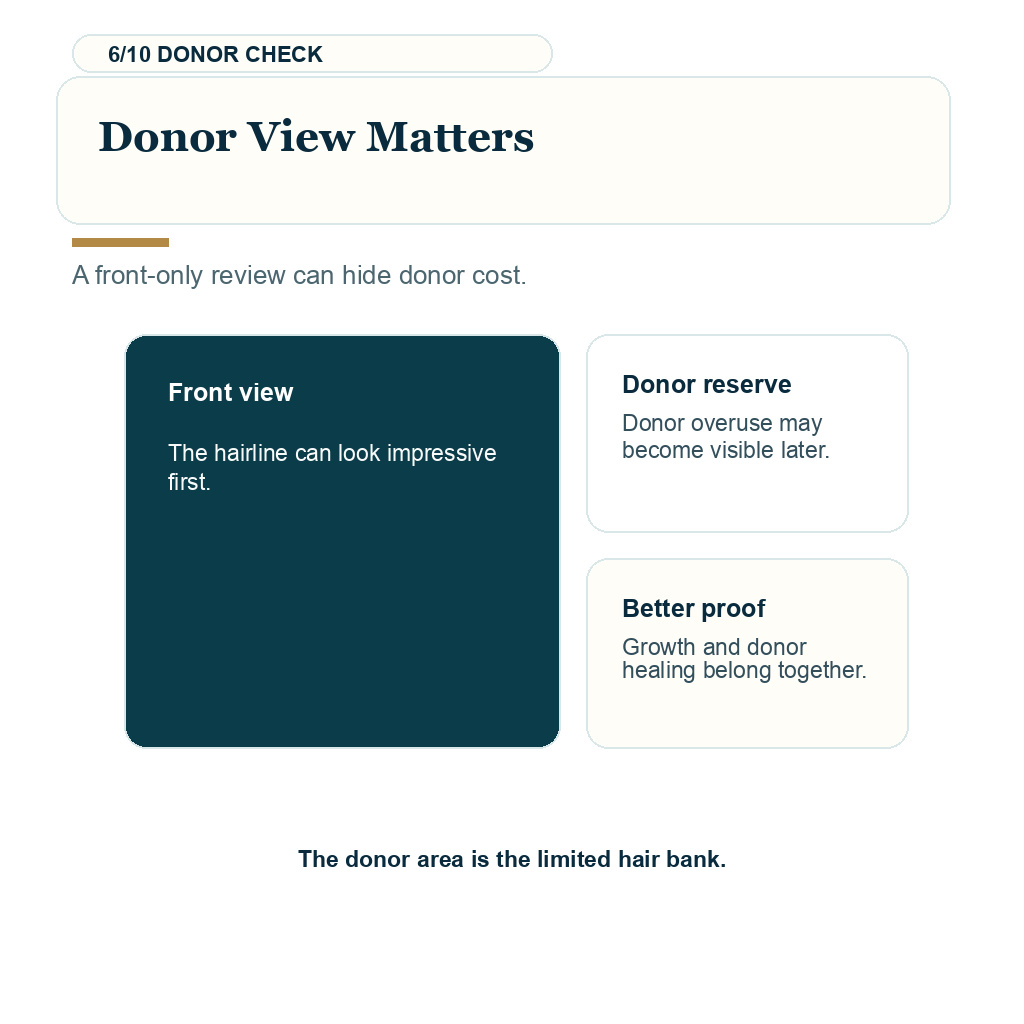
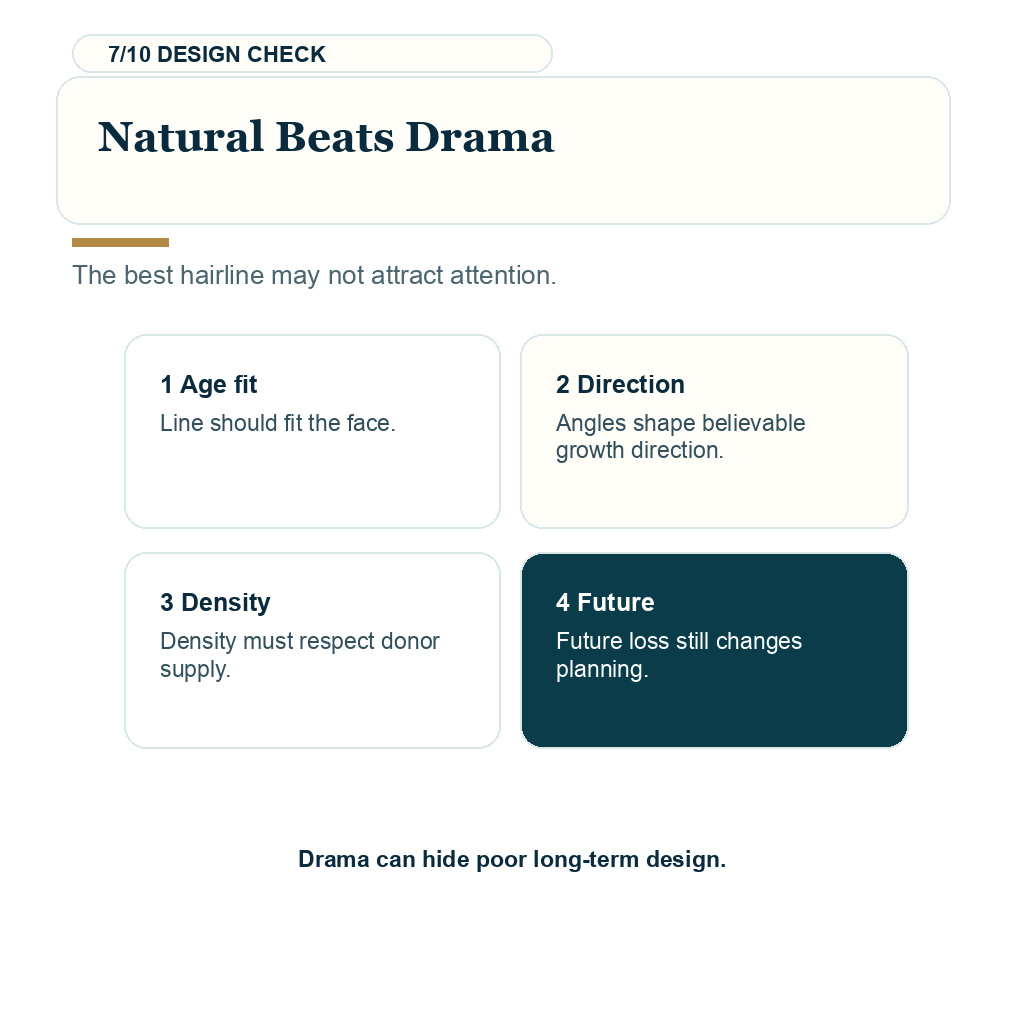
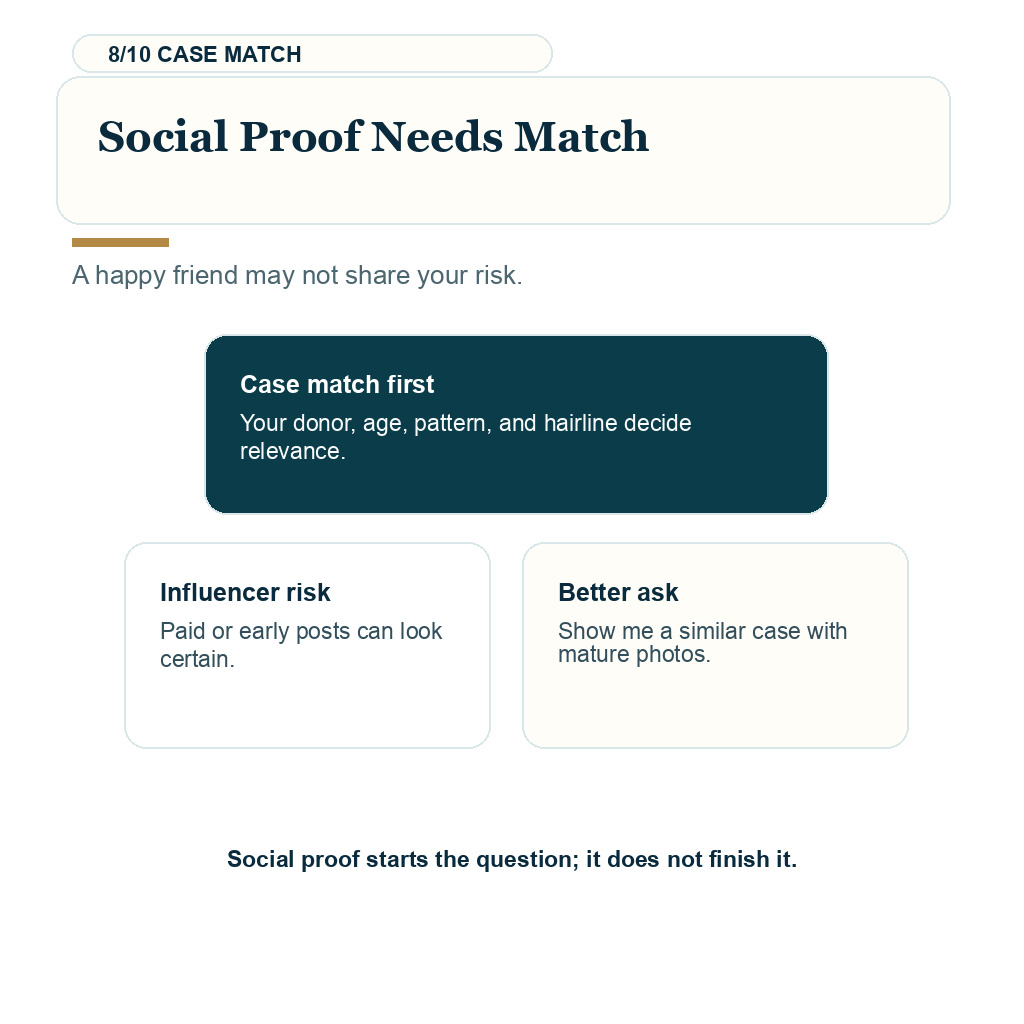
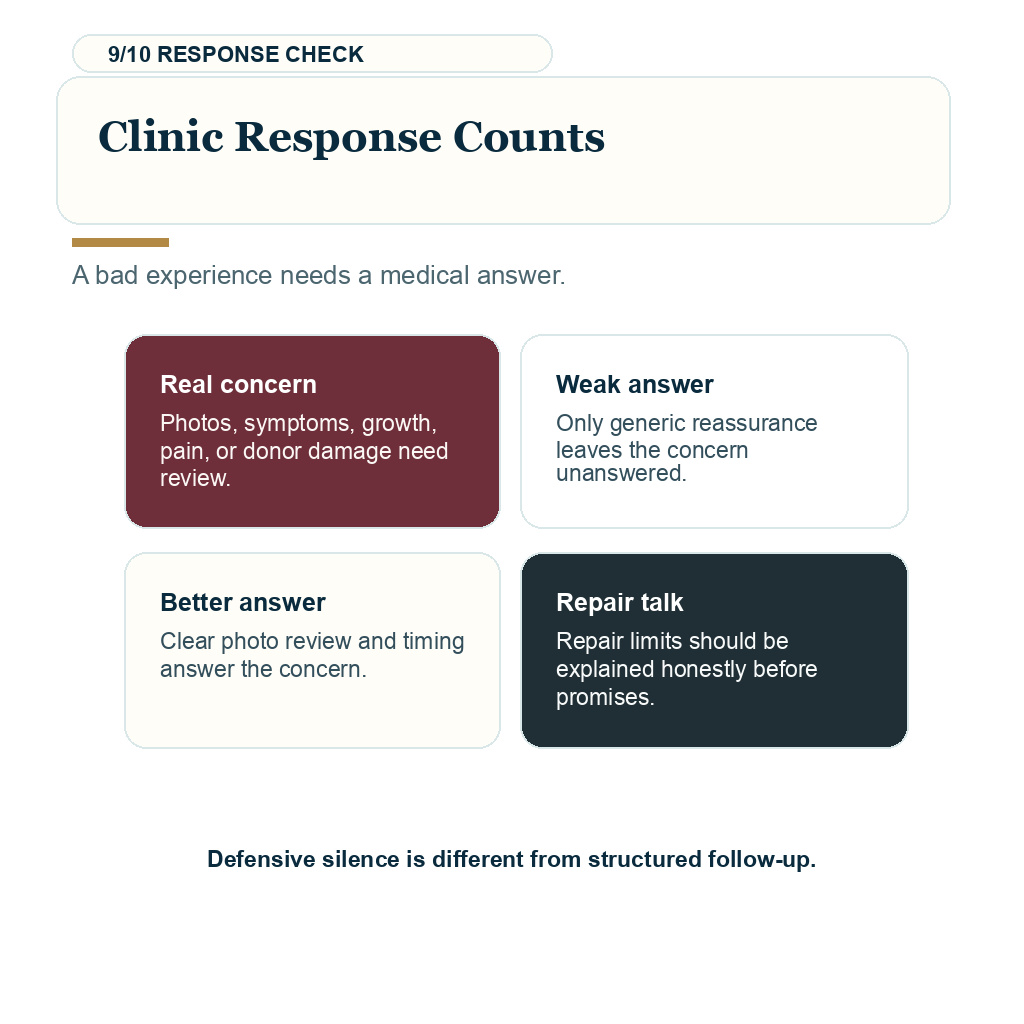
Use the 10 review evidence slides below to separate quiet success, negative bias visibility, timing, proof components, comparable photos, donor view, hairline naturalness, social proof limits, clinic response, and final decision structure. Swipe sideways, use the arrows, or choose a number below the image.
Donor Management and Review Quality
Many online reviews focus on the front because the hairline is what people see first. I also look at the donor area. A clinic can create a dense looking front while spending the donor reserve poorly. That may not be obvious in an early review.
The donor area is the patient’s limited hair bank. If too many grafts are removed, or if extraction is concentrated badly, the patient may pay for that decision later. A mature review is stronger when it shows both recipient growth and donor healing.
This is also why a very large graft number is not enough by itself to deserve trust. A number that sounds generous can be unsafe if it ignores long term donor capacity.
Hairline Naturalness Over Online Drama
Online attention often goes to dramatic transformations. In real life, the best hairlines are often quiet. They respect age, face shape, forehead proportion, graft direction, density, and future hair loss.
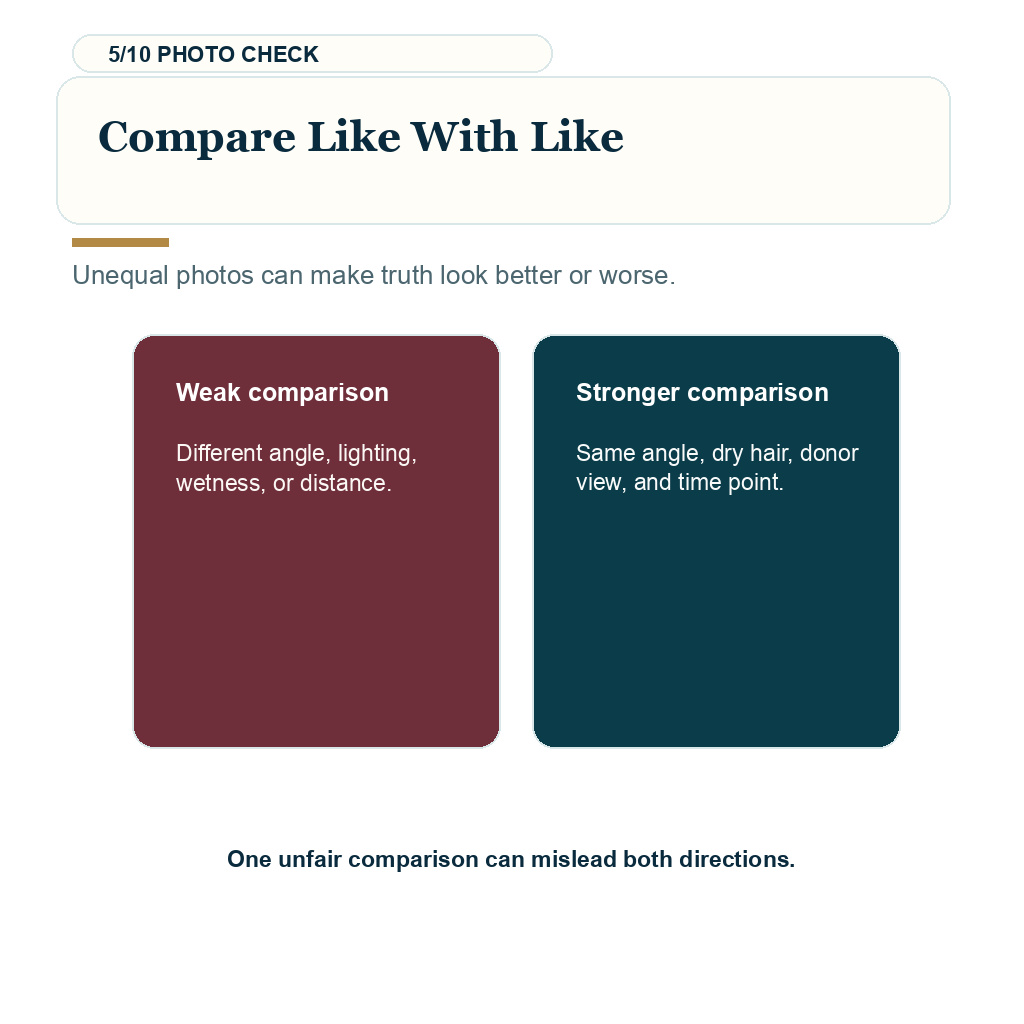
A hairline that looks exciting immediately after surgery may become a problem if it is too low, too flat, too dense in the wrong place, or filled with the wrong graft type. Review photos can mislead patients here. A wet surgery day photo is not the same as a mature natural result.
Hairline design in hair transplant shows why the safest design is not always the lowest design. Naturalness is not created by confidence alone. It is created by planning.
Using Social Proof Without Being Misled
Social proof can help, but it cannot replace medical judgment. Do not choose a clinic only because a friend is happy, an influencer looked good, or a review page has many stars. Those are starting points, not final proof.
Ask for evidence that matches your own case. A young patient with a small hairline recession is not the same as a patient with advanced hair loss, weak donor density, crown thinning, or previous surgery. The best review for someone else may not answer your risk.
Hair transplant influencers need context. Some are sincere, and some are paid. Some show early excitement before the result can be judged. The patient still needs a consultation that explains his own donor area, hairline, graft number, and future plan.
Before giving a recommendation much weight, I also check who benefits from it. A forum, comparison list, reviewer, or referral source may receive advertising fees, clinic membership payments, free treatment, discounts, or commissions. That relationship does not prove the recommendation is false, but it should be disclosed. When the financial link is hidden or unclear, I reduce the weight of the recommendation and return to named patient cases, consistent photos, and the clinic’s medical plan.
Clinic Responsibility After a Negative Experience
A clinic cannot treat a negative review as only a reputation problem. The first step is to determine whether the patient has a real medical concern, such as poor growth, infection, donor damage, pluggy grafts, wrong direction, pain, anxiety, or loss of trust. The response should start with patient support.
Sometimes a patient is impatient and needs reassurance about the timeline. Sometimes the criticism is unfair or incomplete. But sometimes the patient is right. A clinic that cannot admit limits or discuss repair directly is not protecting the patient.
If repair is needed, the discussion has to be realistic. Hair transplant repair can help selected patients, but repair is usually harder than doing the first surgery well. Prevention remains the stronger medical strategy.
Clinic Silence as a Warning Sign
Clinic silence becomes worrying when the patient sends clear photos, explains a real symptom or visible problem, and receives only generic reassurance. A clinic should not need to write a long answer every time, but it should show that someone medically responsible has looked at the concern.
Aftercare is part of surgery. If a clinic disappears after payment, the patient is left alone during the most anxious months. That silence can make even a normal recovery feel frightening, and it can make a real complication more dangerous.
Ask about follow up before committing, not after a problem appears. Who answers after surgery? Can the patient reach a doctor? What happens if redness, pain, infection signs, poor growth, or donor concerns appear? These questions matter as much as the advertised package.
Deciding After Mixed Stories
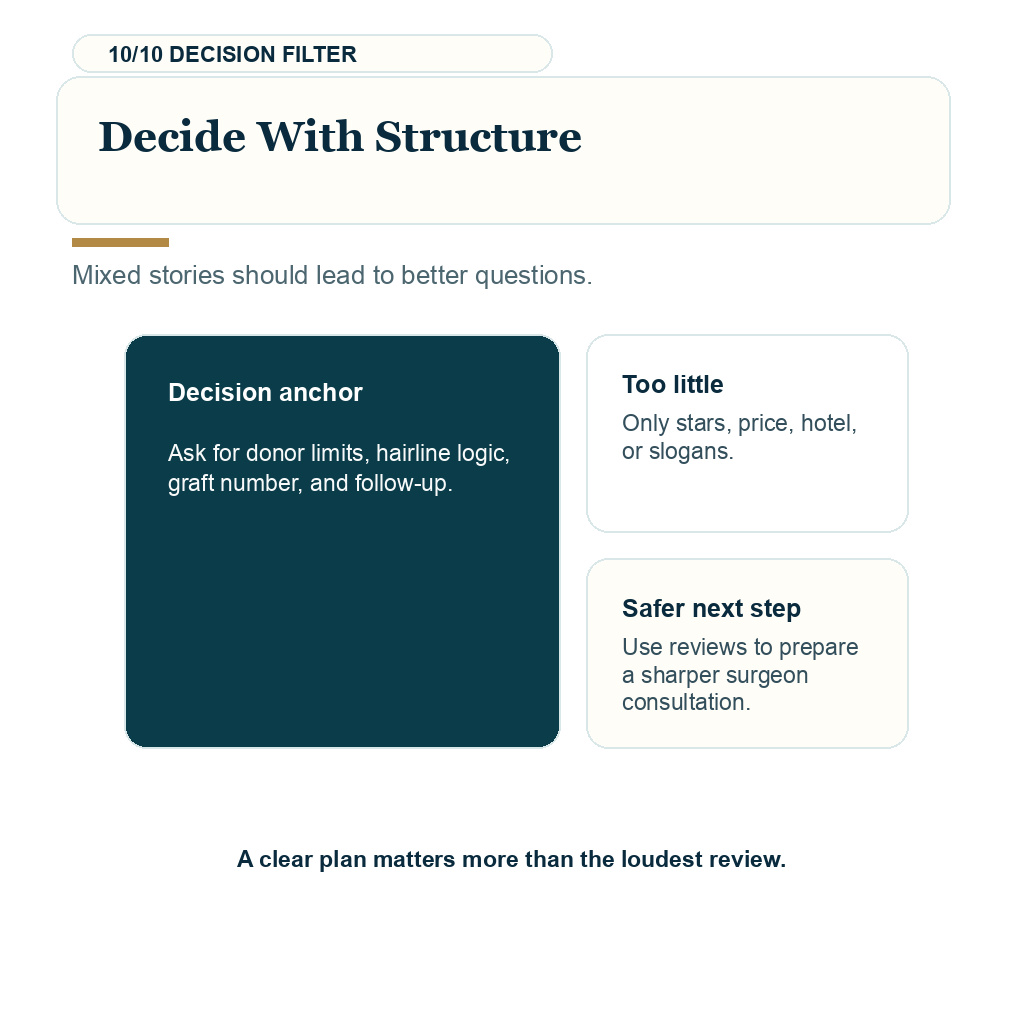
Mixed stories are normal in elective surgery. The answer is not to ignore them and not to drown in them. The answer is to ask better questions.
Before choosing a clinic, ask who will examine you, who designs the hairline, who makes the recipient area incisions, how the donor area is measured, how many patients are treated that day, what result timeline is realistic, and what happens if you are not a good candidate.
Choosing a hair transplant clinic in Turkey is a better decision tool than counting only positive and negative stories. Reviews matter, but they must lead to medical questions.
A Good Consultation Should Handle These Fears Directly
A good consultation should not mock the patient for being worried. Many patients arrive after seeing bad results, low hairlines, depleted donor areas, or angry stories. Their fear is understandable.
The surgeon’s job is to separate reasonable fear from unnecessary panic. That means explaining candidacy, donor capacity, hairline design, density limits, shock loss, growth timeline, medication support when relevant, and what surgery cannot promise.
A patient who understands the limits is often less uncertain. He may still decide to proceed, or he may decide to wait. Both can be good decisions when they are based on reality.
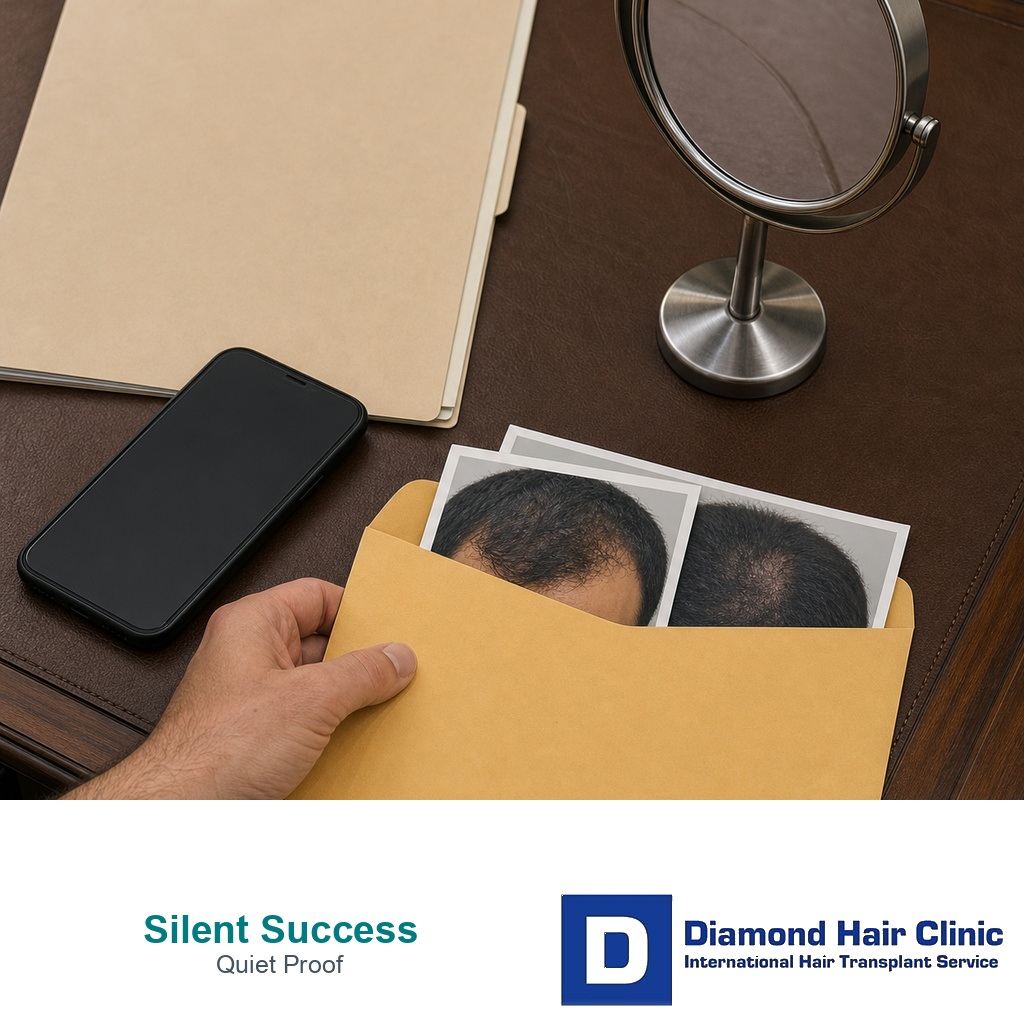
Quiet results can distort what patients see online
What matters here is not that Turkey is good or bad. Turkey is a large hair transplant market with very different clinic models. Some results stay quietly successful because patients are private. Some negative results become loud because patients were genuinely harmed or ignored.
Do not let quiet success make you careless. Do not let negative bias make you hopeless. Use both as reasons to investigate more carefully.
A sound hair transplant decision ends with a clear medical plan, not only a feeling created by reviews. If the clinic can explain donor management, hairline design, graft number, surgical responsibility, aftercare, and long term planning, the patient is much closer to a safer decision.

Read this review excerpt
Probably my only concern of the whole trip was when my transport pulled up to a different hotel than I had been told but this was solved instantly and was only due to the Covid situation.