


Hair Transplant Reviews in Turkey and What You Can Trust
Read every review as evidence to test, not as permission to book. Useful feedback shows how the clinic communicated, who was involved, what happened after surgery, and how the donor area and result looked over time. Weak feedback only gives a feeling, a star rating, or a promise that cannot be checked.
When online feedback starts to feel like a verdict, separate what it can reveal from what it cannot examine. I explain that boundary in online feedback should not decide your hair transplant plan, because reviews and comments are useful only when they lead back to case-specific questions.
When I read reviews with a patient, I first ask whether they make the clinic model clearer. The review has value when it helps you see who planned the surgery, who performed the important steps, how the donor area was handled, and how the clinic behaved when follow up was needed.
If you are comparing hair transplant in Turkey, this distinction matters because the online image of a clinic can look stronger than the medical structure behind it. A clinic can have many positive comments and still work like a high-volume hair mill. A smaller surgeon-led clinic may have fewer public reviews but a safer planning process.
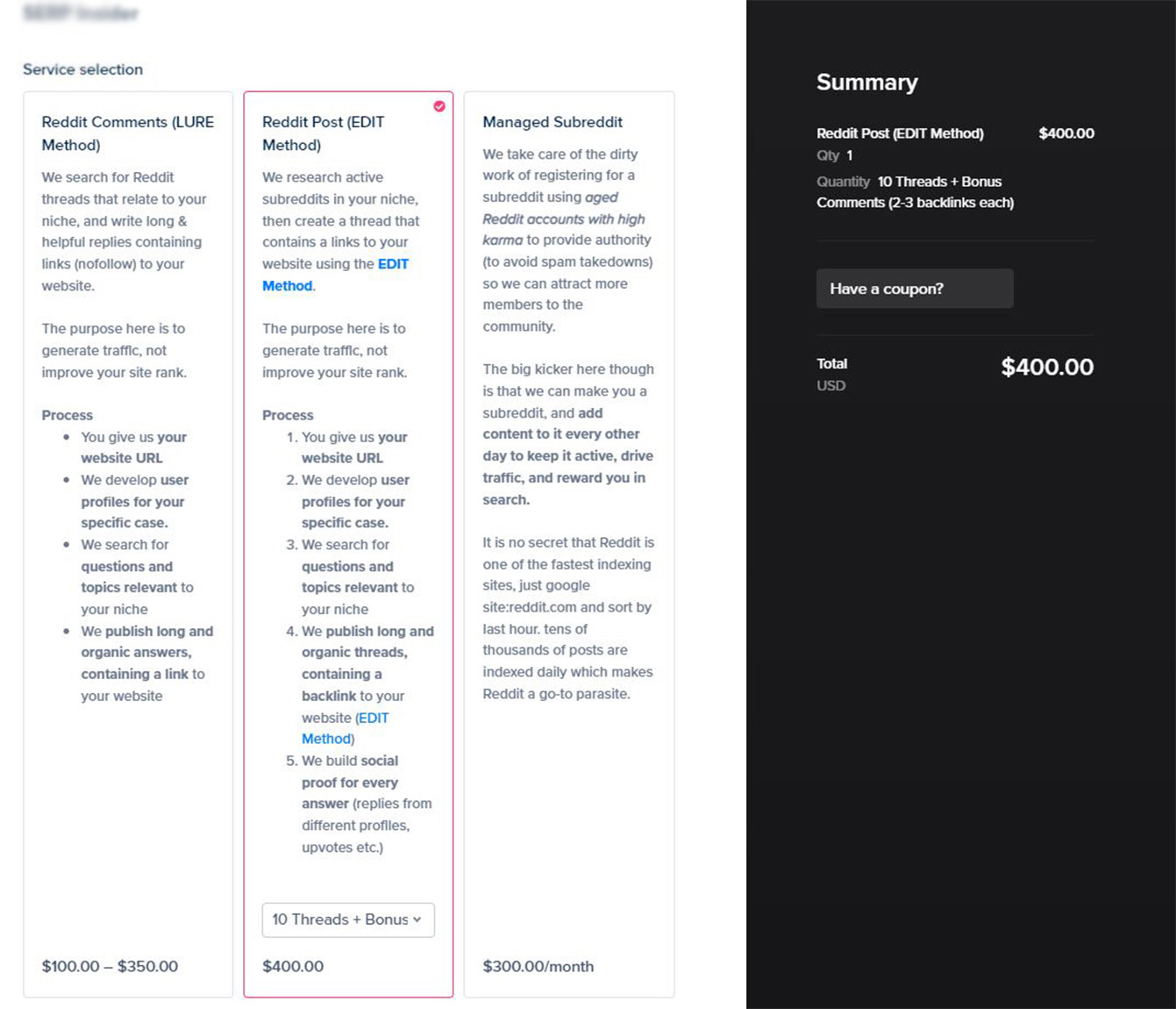
Diamond Hair Clinic has received direct offers from agencies promising fake review writing services. I keep the screenshot here because it shows why review numbers alone are not enough.

Review evidence in context
Use reviews as one piece of evidence, not as the decision itself. Read positive reviews, negative reviews, before and after photos, clinic replies, and longer patient stories, then compare that information with the medical consultation. Detailed ordinary timelines are more useful than perfect results with no context.
Prefer a review that begins with clear views before surgery, shows the donor and recipient areas immediately after surgery, and returns at comparable later milestones. If the sequence starts after healing or jumps straight to the most flattering final image, the starting point and treated areas are harder to verify. A complete sequence still does not prove quality, but it gives you stronger questions for the consultation.
If the review pattern says the clinic is fast, cheap, friendly, and easy to book, that may describe convenience. It does not prove safe surgery. If the review pattern says the surgeon explained donor limits, rejected an excessive graft number, corrected expectations, and remained reachable after surgery, that carries more medical value.
Reviews should never replace the hard questions. If a clinic is presented as the best option, use reviews to test the best clinic claim, not to accept it. Who designs the hairline? Who creates the recipient area incisions? Who evaluates the donor area? How many people are treated in one day? What happens if the plan changes when I examine you in person? These questions matter more than a star rating, especially when you are checking who performs hair transplant surgery.
The risky mistake is choosing the clinic that makes you feel safest online without checking whether medical responsibility is real. A review can describe another person’s experience. It cannot prove that your donor area can safely support the same plan.
The role of reviews before hair transplant surgery
Hair transplant surgery is permanent, visible, and emotionally important. People read reviews because they want more than advertising before they trust a clinic with their face and donor area.
That instinct is understandable. A review can reveal details that a clinic website may not show. It can tell you whether the communication was clear, whether the quote changed, whether the patient met the named doctor, whether the operation felt rushed, whether aftercare questions were answered, and whether the result still looked natural months later. A review about a surgery day change is stronger when it says who explained the change and what medical reason was given.
But reviews are not medical diagnosis. A happy patient may not know whether the donor area was overused. An unhappy patient may judge too early. A patient may love the front view but never show the donor area. Another patient may complain about shock loss that later improves. The review is a clue. The surgical assessment still has to come from a responsible doctor. A review that never shows donor healing should not carry the same weight as one that follows the whole course.
When I discuss choosing a hair transplant clinic in Turkey, I treat reviews as one clue inside the larger decision. This is not only about whether another person was happy. Your case depends on whether the clinic can explain your own plan safely.
Reviews matter even more with international surgery because the patient may not be able to visit the clinic easily before or after the procedure. If you are flying to Istanbul, you are trusting photos, messages, video calls, and reputation before you ever sit in the consultation room. That makes review judgment important, but it also makes overconfidence dangerous.
Reviews in Turkey are difficult to judge
Turkey has excellent hair transplant surgeons and clinics with strong surgical standards. It also has many clinics competing for international patients through advertising, package offers, review platforms, social media, and sponsored content. When a market becomes this competitive, reputation becomes a business tool.
Some reviews are real. Some are encouraged. Some are written too early, before growth can be judged. Some are written after a discount or a gift. Some are written by competitors. Some negative reviews are fair warnings, while others are emotional, premature, or used as pressure during a dispute.
You do not need to become suspicious of everything. Read patterns instead. If many different people describe the same strengths over time, that can be useful. If many different people describe the same problem, such as not meeting the surgeon, unexpected graft numbers, weak aftercare, or donor area thinning, that pattern should not be ignored.
I also separate service reviews from surgical reviews. Someone may praise the driver, hotel, translator, and quick replies, and those details can be real. But the medical decision still depends on donor assessment, graft handling, recipient area planning, hairline design, and follow up. A smooth trip can still lead to a weak result if the surgery itself was not planned carefully.

The danger is especially high when the clinic’s image is built mainly on visibility. Strong advertising does not prove strong surgery. Before trusting the online image, compare it with the warning signs described on red flags of Turkish hair mills.
Signs of a genuine hair transplant review
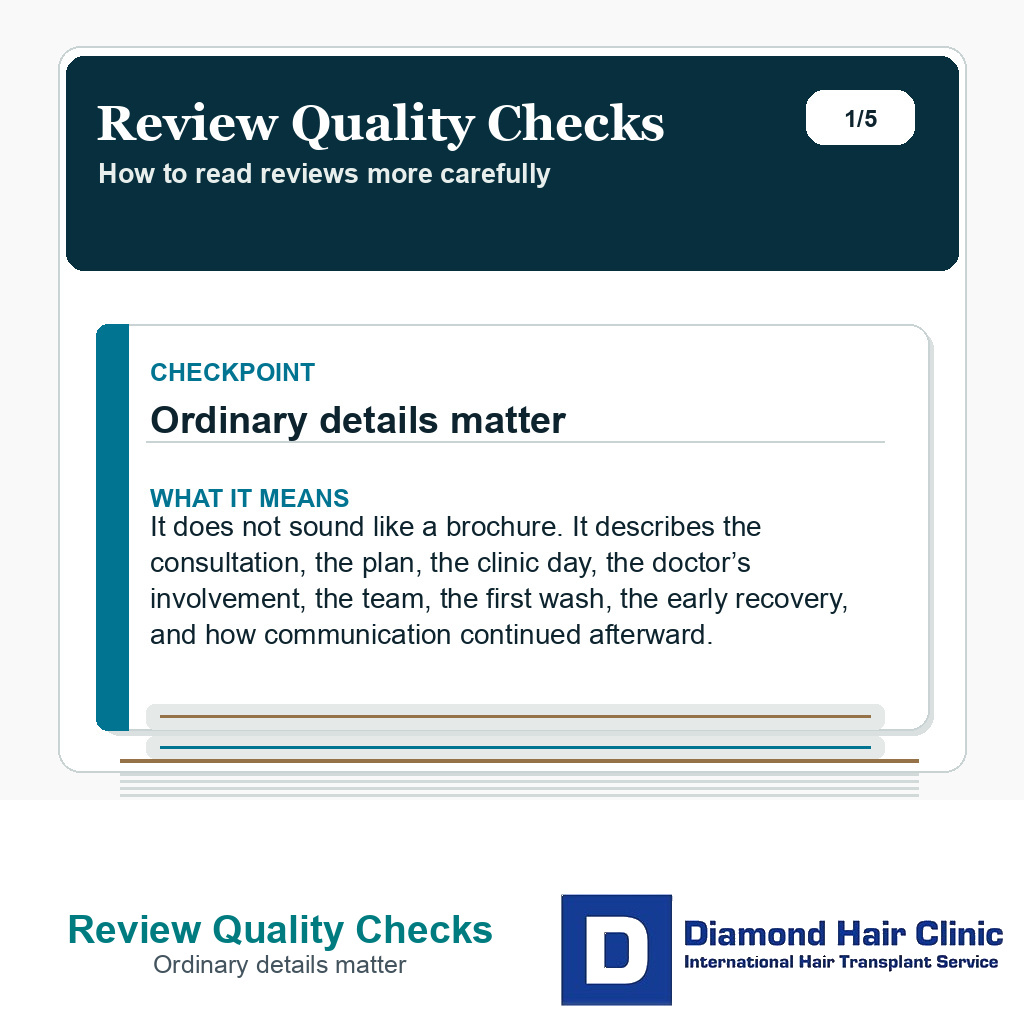
A genuine review usually includes ordinary details. It does not sound like a brochure. It describes the consultation, the plan, the clinic day, the doctor’s involvement, the team, the first wash, the early recovery, and how communication continued afterward.
I separate four dates when reading a result story. The age of the post is not necessarily the age of the transplant.
Surgery date
Starts the recovery and growth timeline. A review published today may describe an operation from much earlier.
Photo stage
Shows how far recovery or growth had reached when the image was taken. A clip reposted today can still show only early healing.
Review publication date
Dates the account on that platform. It does not tell you how long the grafts had been growing when the photos were taken.
Later edit date
Dates a change to the review. Updated text does not make the original photos later follow-up unless newer, dated images are included.
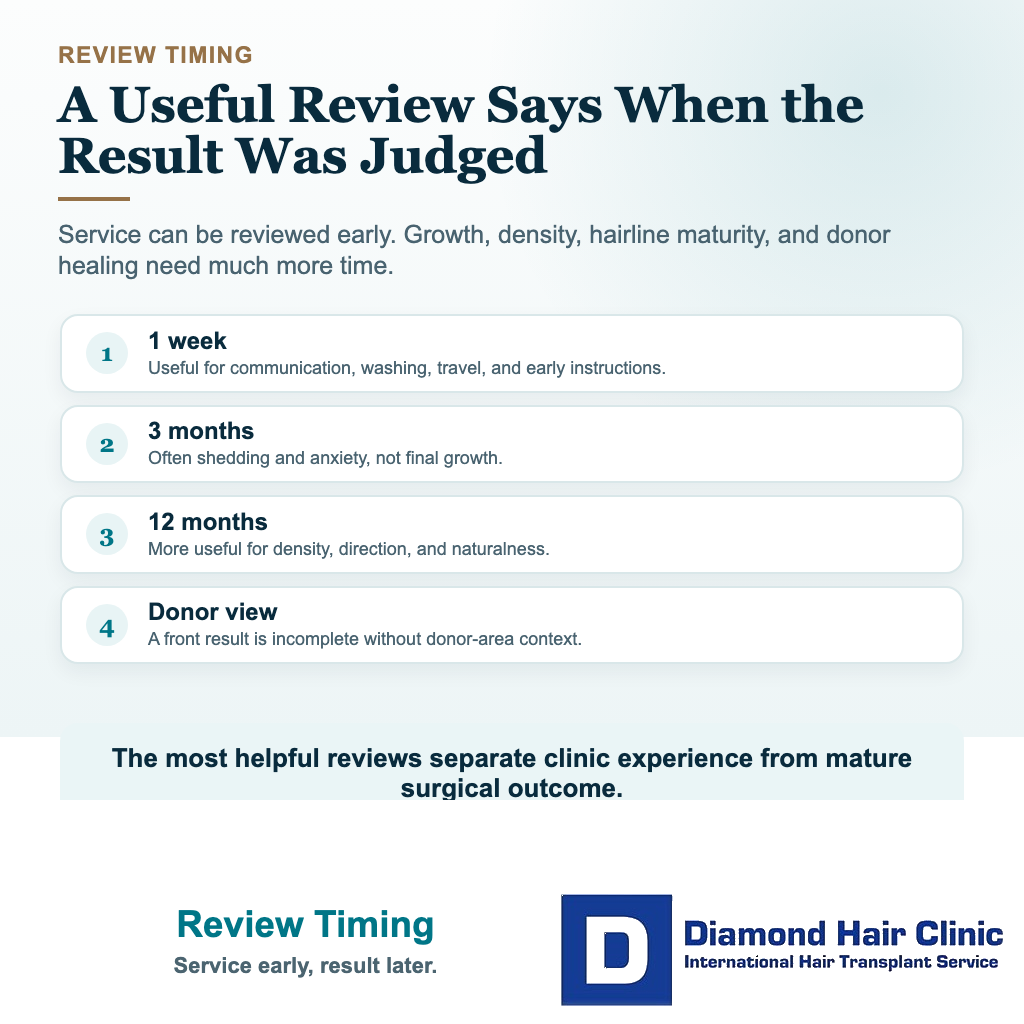
Early feedback can describe service and healing. Later comparable photographs are needed to judge the mature result. Read each image at the stage it actually shows.
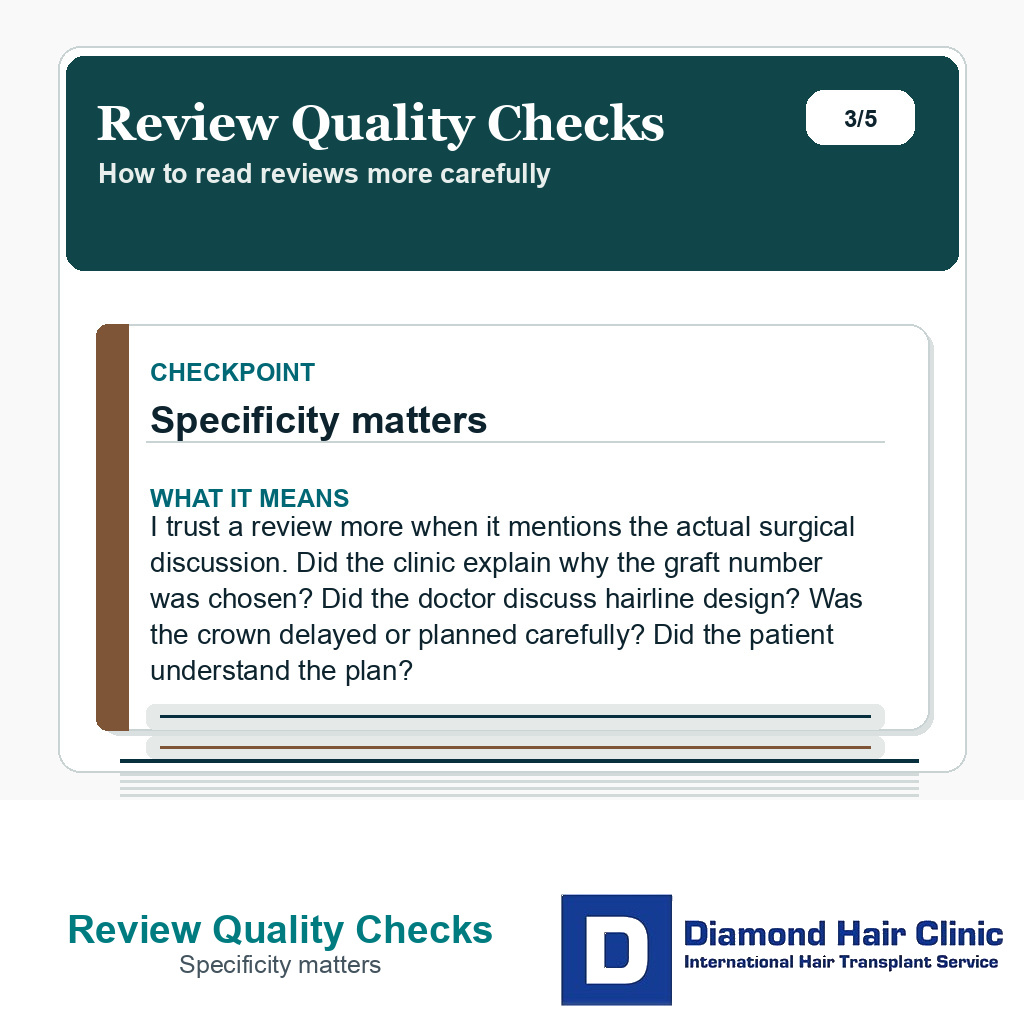
Specificity matters. I trust a review more when it mentions the actual surgical discussion. Did the clinic explain why the graft number was chosen? Did the doctor discuss hairline design? Was the crown delayed or planned carefully? Did the patient understand donor limitations? Did the clinic explain donor management instead of selling maximum grafts?
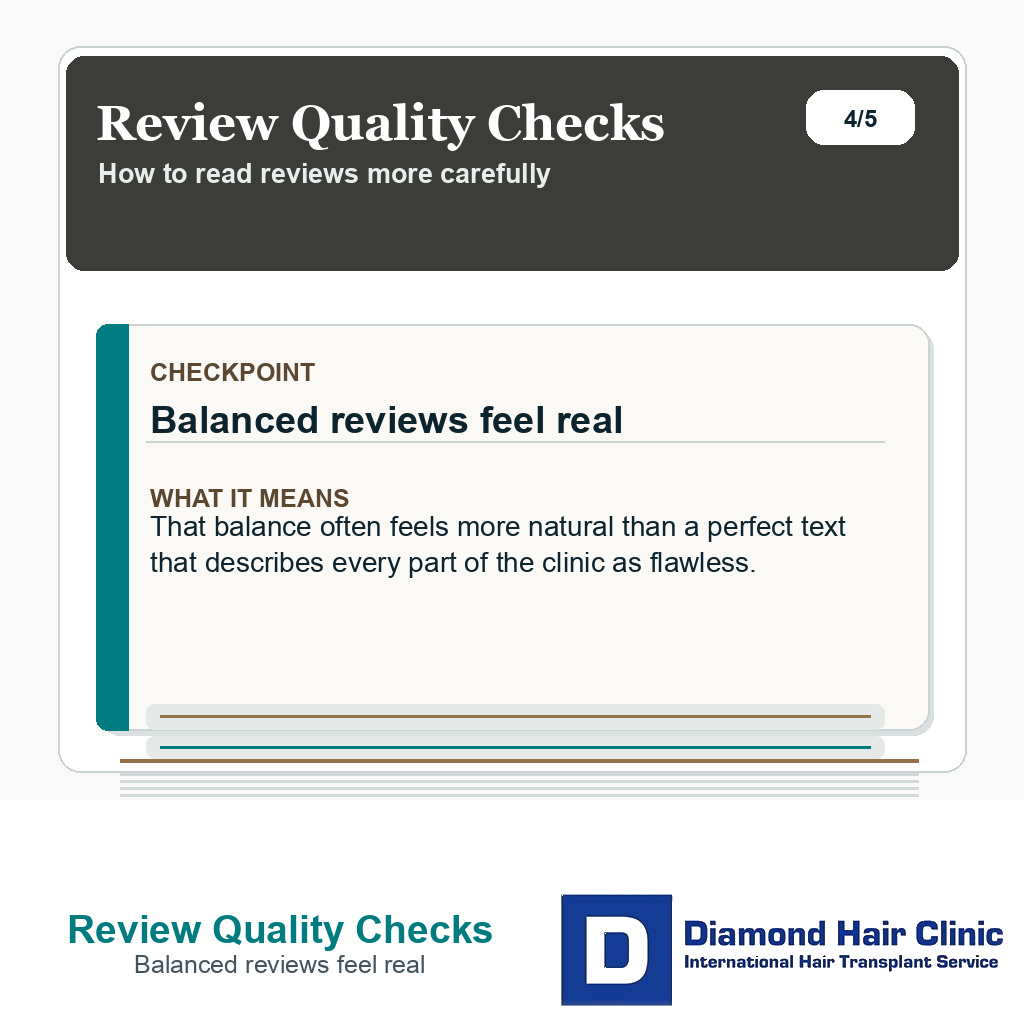
A real review may include both praise and small criticism. That balance often feels more natural than a perfect text that describes every part of the clinic as flawless.
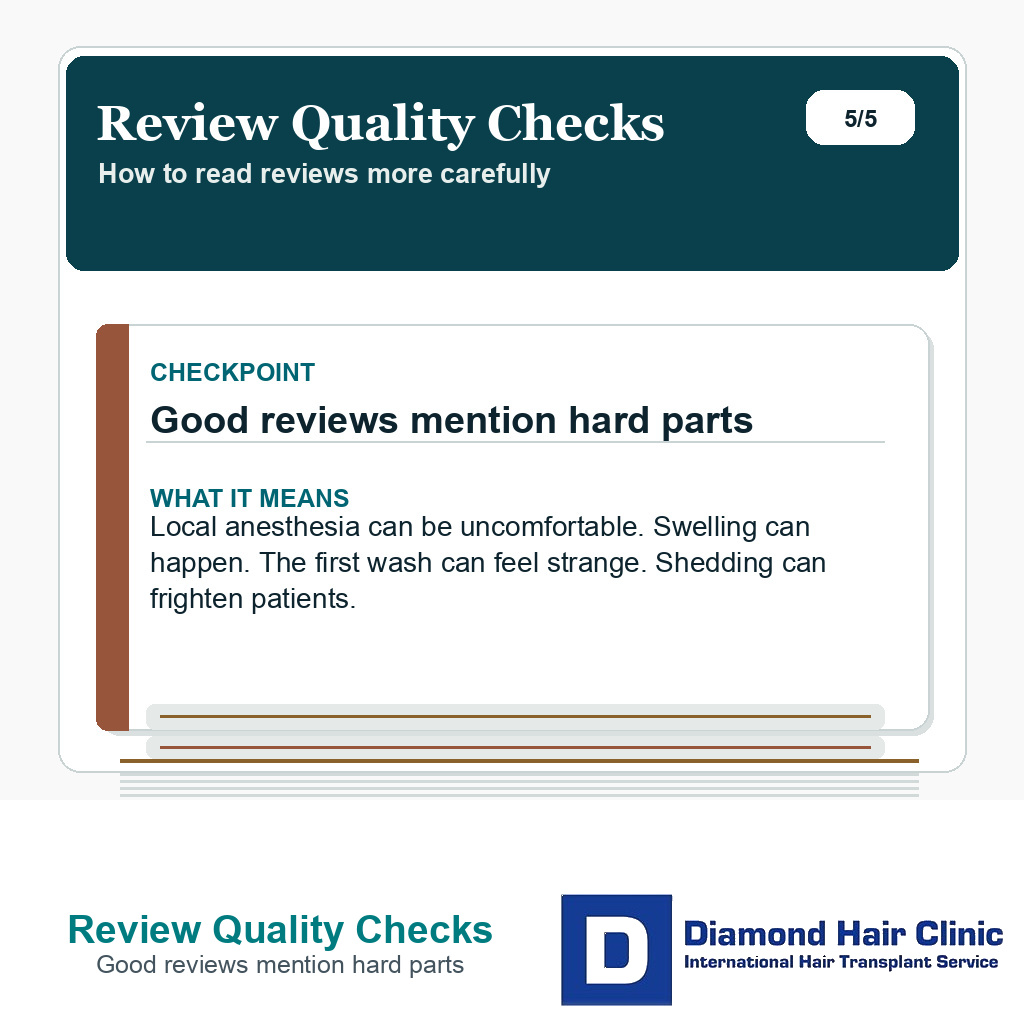
Good reviews also describe the difficult parts without panic. Local anesthesia can be uncomfortable. Swelling can happen. The first wash can feel strange. Shedding can frighten patients. If a review says everything was effortless from beginning to end, it may still be true for that person, but I look for more detail before accepting it as a complete picture.
The reviews I value most are measured and specific. They do not need to shout that the clinic is the best in the world. They explain what happened, what was planned, what changed, and how the result matured.
If a reviewer has had more than one transplant, I check the dates, treated areas, and surgeon’s name for each procedure before judging the latest photo. That image may include work from several clinics, and satisfaction with the result does not tell us which operation contributed what.
The five slides below turn this section into one practical point per image. Swipe sideways, use the arrows to move one slide at a time, or use the numbered controls under the image to jump to a specific slide.

Warning signs of a fake or misleading review
A fake or misleading review often sounds too polished, too vague, or too extreme. It may praise the clinic without describing the patient’s hair loss pattern, graft number, surgeon involvement, recovery, donor area, or result timing.
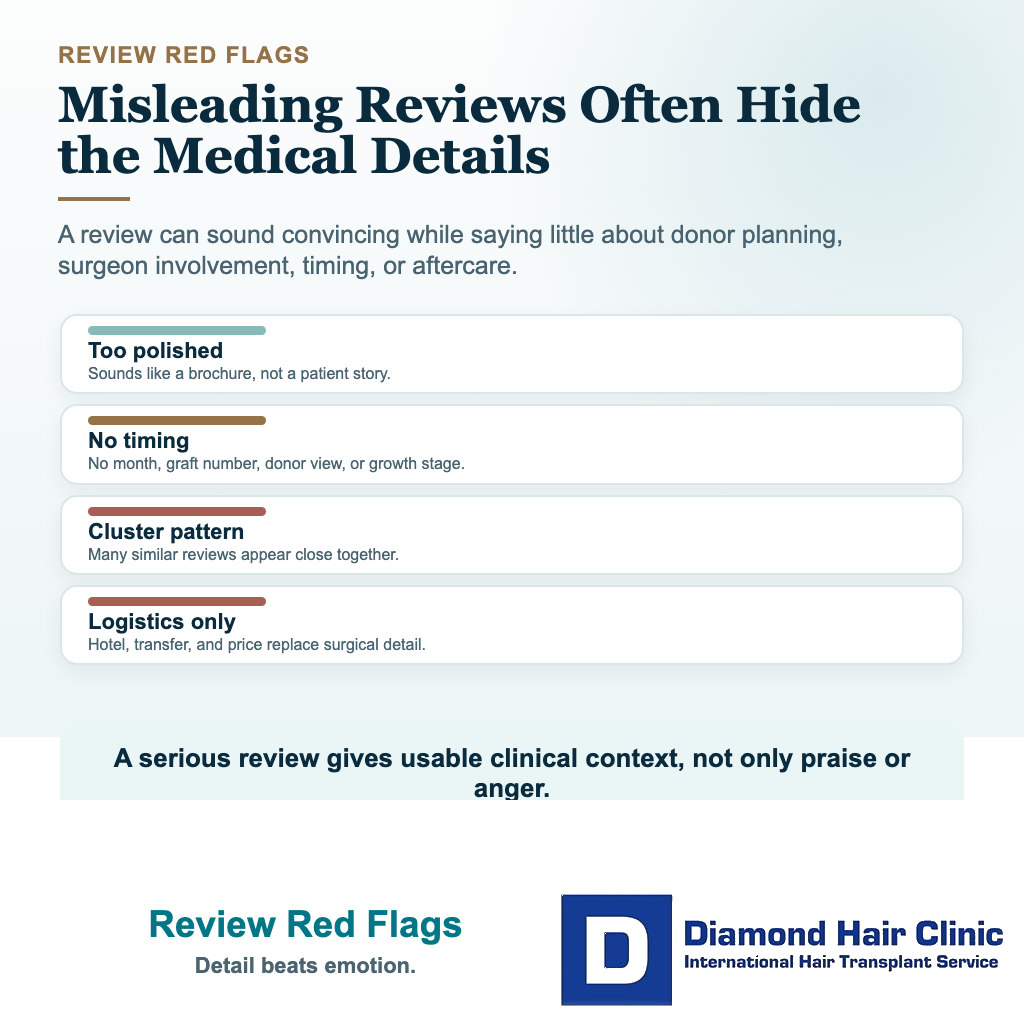
Be careful with clusters of reviews that appear in the same style. Many reviews posted close together, using similar phrases, with no clinical detail, can suggest a reputation campaign rather than patient experience. The same concern applies to very dramatic negative reviews that contain no usable detail and seem mainly designed to damage a clinic.
When I filter review manipulation, I look for behavior rather than one bad sign. Many short reviews in the same week, repeated emotional phrases, praise that talks only about hotel and transfer, a perfect result claimed too early, or a review tied to a discount should all make you ask better questions. The fair response is not to accuse a clinic from one pattern. It is to ask for dated photos, donor area views, surgeon role details, and a calm explanation of how the clinic handles unhappy patients.
A review is weak when it focuses only on hotel, transfer, price, and friendly coordinators. These details matter, but they do not tell you whether the hairline was natural, whether the recipient area incisions were made responsibly, or whether the donor area was protected.

The strongest warning sign is when reviews and marketing create certainty before the case is examined. A clinic that seems to guarantee perfect density, scarless surgery, unlimited grafts, or a fixed result for every patient is not speaking like a serious medical team. This language can mislead a worried person. That also matters for hair transplant guarantee claims.
Be cautious when every review uses the same emotional shape. For example, every review says the staff was amazing, the result was perfect, the price was the best, and the clinic changed a life, but nobody explains the plan. Real experiences usually contain different details. One person talks about the hairline. Another talks about swelling. Another talks about aftercare. Another talks about anxiety at month three. Variation often feels more human.
Judging before and after photos
Before and after photos are useful only when they are fair. The before photo and after photo should have similar lighting, angle, hair length, camera distance, styling, and scalp exposure. A harsh before photo and a soft, styled after photo can make a result look stronger than it is. When the photo comes from a promotion or influencer post, read what social media hair transplant results cannot prove before treating it as clinic proof.
Look for donor area photos as well as the front view. Many people focus only on the hairline, but the donor area tells you whether the grafts were removed carefully. A dense looking front with a visibly thinned donor area is not a complete success.
The timing of the after photo matters as much as the image itself. Early photos may show redness, scabs, or short implanted hair, but they do not show final growth. Later photos, when growth has matured, are more useful for judging density, direction, and natural hairline behavior.
I explain photo judgment in more detail on the page about whether you can trust hair transplant before and after photos. A photo should help you evaluate the surgical plan, not only excite you emotionally.
Hair length is one of the easiest ways to mislead. Longer hair can cover weak density. Wet hair can reveal gaps. Styling, fibers, powder, or harsh contrast can change the impression quickly. If a clinic shows only one flattering angle, ask for more views before you let the photo influence your decision.
I also have to see whether the result fits the patient’s face. A low hairline may look dramatic in a photo, but it may not age well. A natural result should match facial proportions, donor capacity, and future hair loss risk, not only create a strong immediate change.

Review platforms and trust
No platform should be trusted completely. Search results, business profiles, review company pages, social media, video platforms, clinic websites, and open patient communities can all contain useful information and misleading information.
No review platform is perfect. The strongest signal is whether the same pattern appears across different places, including surgeon involvement, aftercare quality, result style, or repeated complaints about the same issue.
Be careful with clinic websites that show only praise. A clinic will naturally choose positive material. That does not make every review false, but it means the patient needs to look beyond the clinic’s own selected examples.
Online patient experiences can also be shaped by influencers and sponsored content. A confident video should not replace direct medical accountability. That also matters for hair transplant influencers.
A few detailed reviews with consistent medical information are more useful than thousands of empty positive comments. Review quantity can create comfort, but review quality creates understanding. A clinic may have many strong reviews while the surgeon offered to you appears in very few of them. Check whether those reviews name that surgeon, describe the surgeon’s role, and show cases similar to yours before you rely on the clinic’s wider reputation.
Large follower counts, many likes, or a long line of short comments belong in the same filter. They can show visibility, but they do not show who planned the surgery, how the donor healed, or whether the result was checked after the first excitement faded.
If one platform removes negative comments easily, the picture may look too clean. If another platform allows anonymous claims without evidence, the picture may look too harsh. Compare both, then return to the medical facts.
A new account used only for a hair transplant journey can protect privacy, so account age cannot decide authenticity by itself. Give more weight to dates, procedure details, photos, and follow-up updates that remain consistent with one another. A polished testimonial with no traceable case detail carries less weight, even when it comes from an older account.
Reading negative reviews
Negative reviews deserve attention, but they also need judgment. A negative review can reveal serious problems such as poor growth, unnatural hairline design, wrong hair direction, donor area overharvesting, hidden costs, weak aftercare, or a clinic that disappeared after payment.
At the same time, not every negative review proves malpractice. Some people judge too early during shedding. Some have unrealistic density expectations. Some do not understand that crown growth can mature slowly. Some are angry about communication or logistics rather than the surgical result itself.
I pay most attention to repeated negative patterns. If several patients say they never met the named doctor, the graft number changed without proper explanation, the donor area looked depleted, or the clinic stopped responding after surgery, those are serious signals.
A negative review is useful only when the follow up becomes concrete. The clinic’s answer should explain how it handles poor growth, what follow up exists, how complications are managed, and what happens if the patient is unhappy.
When reading a negative review, check the timing. A patient at two weeks may be frightened by scabs, redness, or swelling. A patient at two months may be in the shedding phase. A patient at 12 months with poor growth, wrong angles, or a damaged donor area is describing a different level of concern.
The clinic’s response also matters. A defensive, aggressive, or dismissive reply worries me. A responsible reply should respect privacy, avoid public arguments, and invite the patient into proper follow up. The way a clinic handles criticism often reveals more than the perfect review does.
Reading very positive reviews
Very positive reviews can be genuine. A patient who finally feels comfortable with his hair may write with real emotion. I do not dismiss gratitude or enthusiasm. Hair restoration can change how a patient feels in daily life.
Still, a very positive review should be read for medical detail. Does it mention the surgeon’s role? Does it show the result at a meaningful time? Does it include donor area healing? Does it explain whether the hairline fits the patient’s age and facial proportions? Does it say anything about long term planning?
A review that says the clinic was amazing may be emotionally true, but medically incomplete. A review that explains why the plan was conservative, why fewer grafts were used, or why the crown was delayed may be more helpful to a serious patient.
The same balance appears in silent success and negative bias. Happy patients may move on quietly. Unhappy patients may write more loudly. That imbalance is one reason I avoid judging a clinic from one extreme story.
Very positive reviews written immediately after surgery should be read as service reviews, not result reviews. The patient can truthfully describe kindness, comfort, organization, and trust on surgery day. But growth, density, direction, and naturalness need time.
Also remember that some satisfied patients had easier cases. A patient with strong donor hair and limited frontal recession is not the same as a young diffuse thinner with crown involvement. Do not assume the same clinic result applies to your case without medical comparison.
Useful reviews should make the medical plan clearer
After reading reviews, do not ask only whether the clinic is good. Ask about your own case. The review belongs to another patient. Your donor area, hair loss pattern, hair caliber, age, crown risk, expectations, and medical history are different.
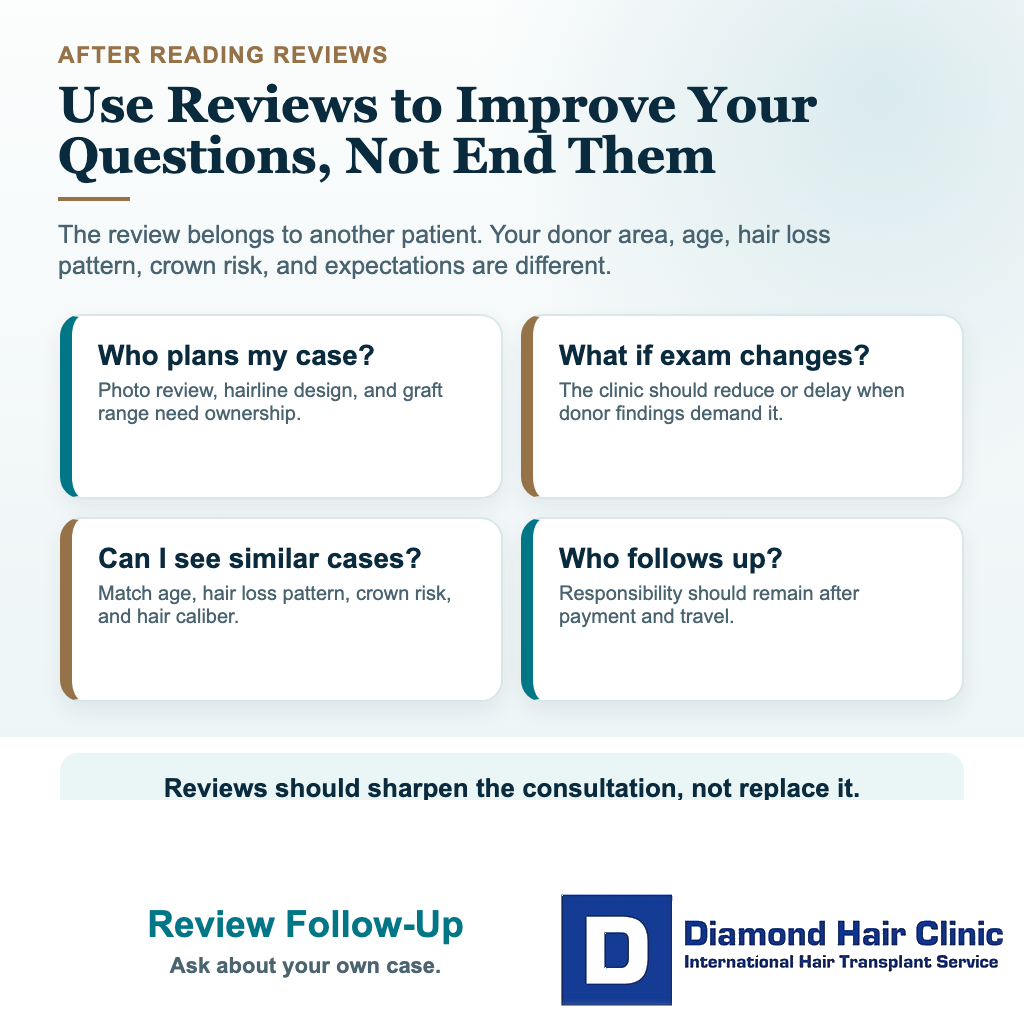
Photo review, graft number decisions, hairline drawing, recipient incisions, extraction supervision, daily patient volume, and the backup plan for an aggressive online quote should all be clear before reviews feel reassuring.
Result photos need to match your situation. A young patient with diffuse thinning should not rely on a photo of an older patient with stable frontal recession. A crown case should show crown maturity. A repair patient needs to see repair planning. A patient considering Turkey should also read the pros and cons of hair transplant in Turkey before making the decision from reviews alone.
If the clinic answers detailed questions with only reassurance, that is not enough. A good consultation should make the patient understand limits, not only feel excited.
Careful planning may reduce the graft number, raise the hairline, or delay surgery when the donor area demands it. If the team cannot say no before surgery, its positive reviews should not reassure you.
Aftercare after you leave Turkey needs to be clear before reviews reassure you. A review may say the clinic was responsive, but you still need to know who answers medical questions, how photos are reviewed, and what symptoms need local treatment. Good hair transplant aftercare is part of the result, not an extra courtesy.
If the review pattern sounds strong but the clinic still avoids these answers, trust the unanswered questions more than the star rating. Reviews can tell you how another patient felt. They cannot replace written role clarity, donor planning, realistic graft limits, and a clear way to follow up after you leave Turkey.
If a public discussion is mostly automated links, repeated clinic names, or a community spreadsheet, treat it as navigation rather than medical proof. It may help you decide what to investigate next, but it still does not show doctor involvement, donor measurement, complication handling, or whether the same plan fits your scalp.
What can reviews not prove?
A review can describe how someone felt, but it rarely proves the surgical chain of responsibility. It does not show who measured the donor area, who decided the graft number, who designed the hairline, who created the recipient area incisions, or who would change the plan if the examination at the clinic disagreed with the online quote.
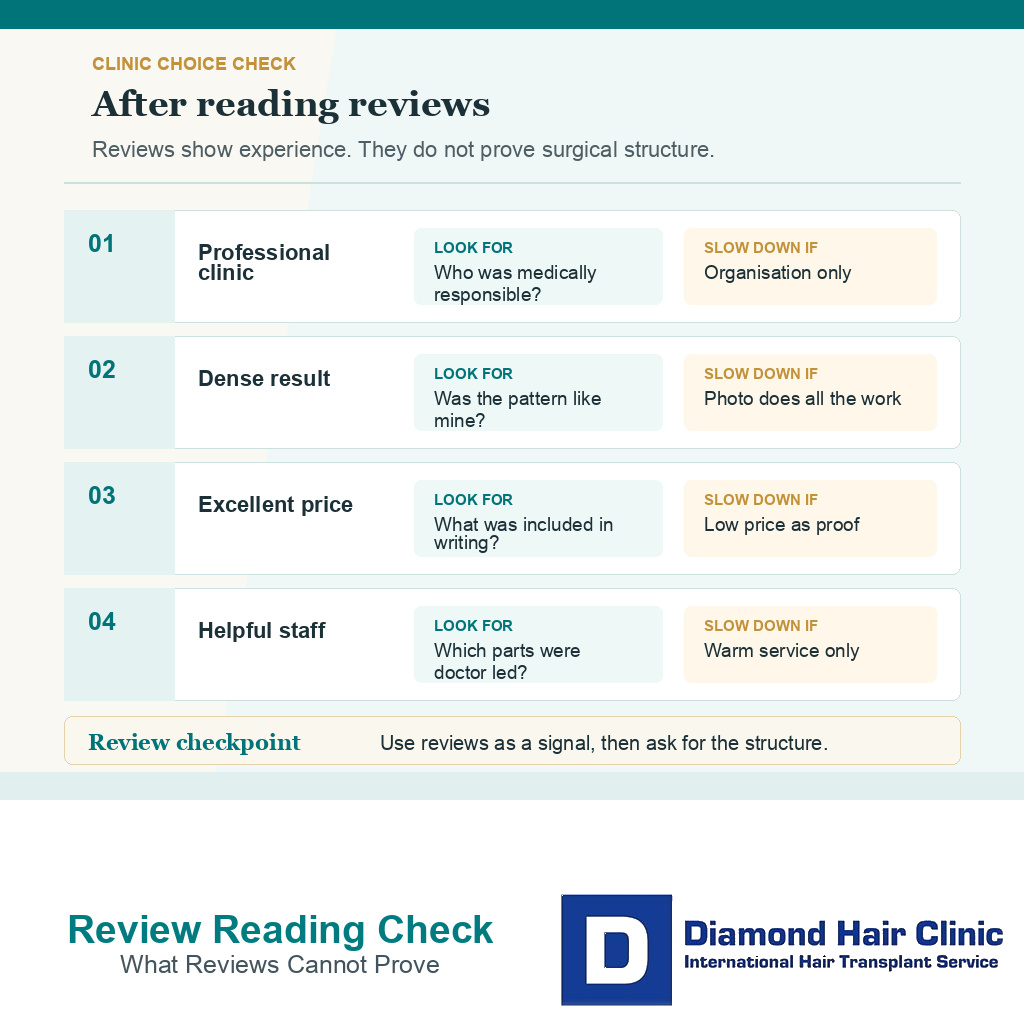
Good reviews can support confidence. They cannot replace written answers about the operation itself.
Writing a fair review helps the next patient
After surgery, a fair review can help someone else avoid a rushed or poorly informed decision. It is most useful when it is realistic, specific, and clear about timing. It should not be written only to punish a clinic or to advertise one.
A useful review explains timing. It says when surgery happened, what the graft estimate was, whether the doctor was involved, how recovery went, and when the photos were taken. If the result is still early, the review should say that clearly.
A balanced review can include both positive and negative details. For example, someone may praise the surgical team but explain that aftercare instructions were unclear. Another person may be unhappy with density but acknowledge that he was warned about donor limits. This kind of review helps future readers more than emotional extremes.
If the case involved a complication, poor growth, or regret, the review should explain what happened and how the clinic responded. If you are already dealing with a poor result, the warnings in hair transplant regret can help you slow the situation down and separate repair planning from panic.
Avoid reviewing final density too early. A useful early review can describe the consultation and recovery, but it should not announce the final result at one month. That helps other people understand the timeline and prevents unnecessary fear.

Reviews should lead to better questions
Reviews should influence your questions, not replace your judgment. If several patients describe careful planning and direct medical answers, look closer. If several people describe pressure, unclear surgeon involvement, or poor aftercare, take that warning seriously. The medical plan still has to do the heavier work.
A stronger check is whether the clinic has a clear surgeon, a realistic graft plan, proper donor protection, natural hairline design, direct aftercare, and the ability to say no when surgery is not right. A clinic that cannot explain these points should not be chosen only because it has many positive comments.
Price also needs medical context. A clinic with strong reviews may still be unsafe if the consultation is vague. A clinic with a lower price may still be responsible if the medical structure is clear. But if low cost, perfect reviews, maximum grafts, and fast booking all appear together, slow down. Compare the offer with hair transplant cost in Turkey and look at the medical responsibility the price actually supports.
At Diamond Hair Clinic, reviews matter, but reputation alone should not decide surgery. The consultation still has to show that you are a good candidate for a hair transplant, that the donor area can support the plan, and that the result can age naturally.
A trustworthy review helps you ask better questions. A trustworthy clinic answers those questions clearly before you travel, pay, or allow any graft to be removed.
If reviews make you curious about a clinic, continue the investigation. If reviews make you feel pressured to book quickly, step back. A serious surgical decision should become clearer as you gather information, not more rushed.
In our patients’ words
See all reviews on REVIEWS.io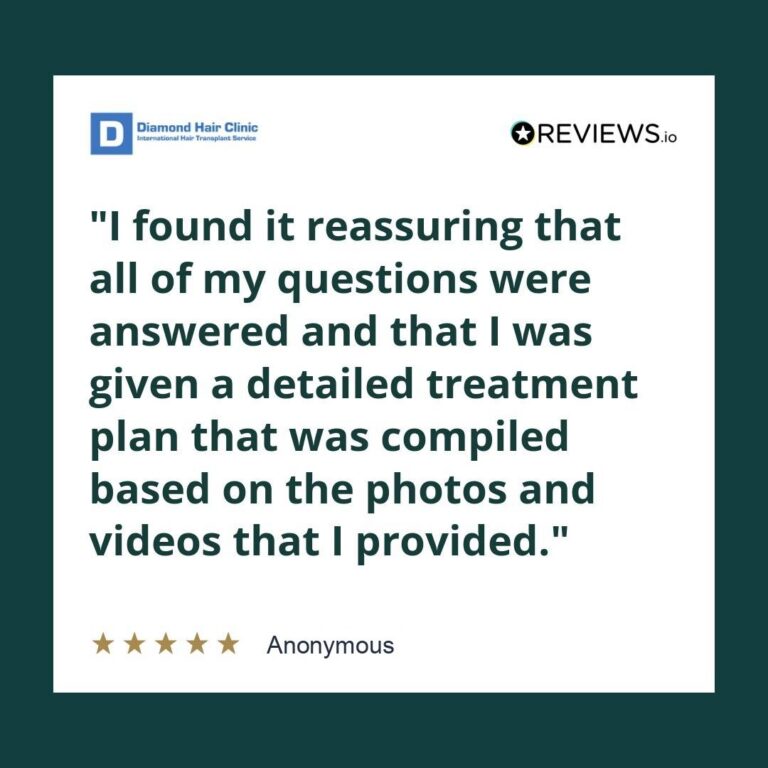
Read this review excerpt
“I found it reassuring that all of my questions were answered and that I was given a detailed treatment plan that was compiled based on the photos and videos that I provided.”
Read this review excerpt
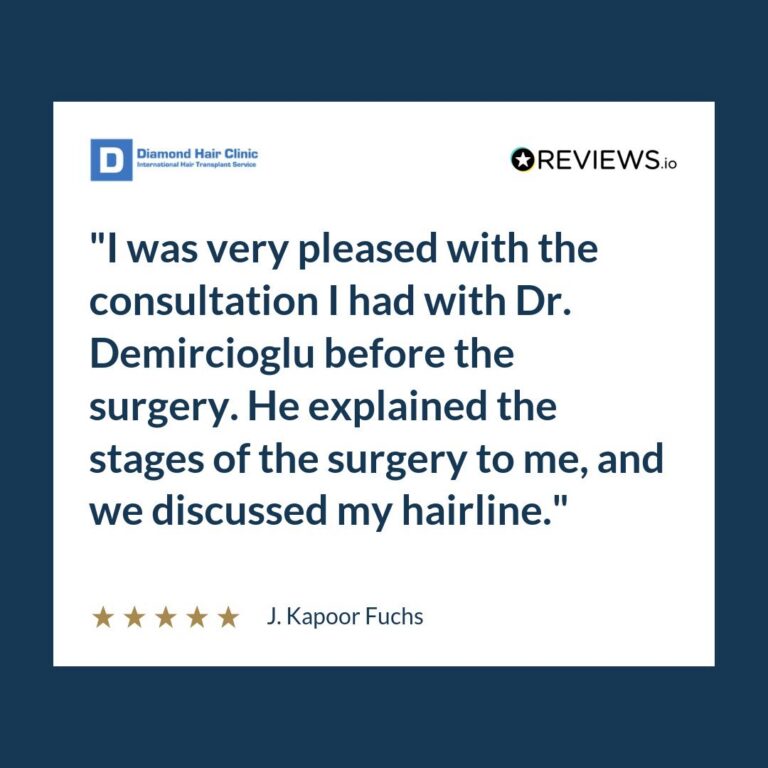
“I was very pleased with the consultation I had with Dr. Demircioglu before the surgery. He explained the stages of the surgery to me, and we discussed my hairline.”
Read this review excerpt
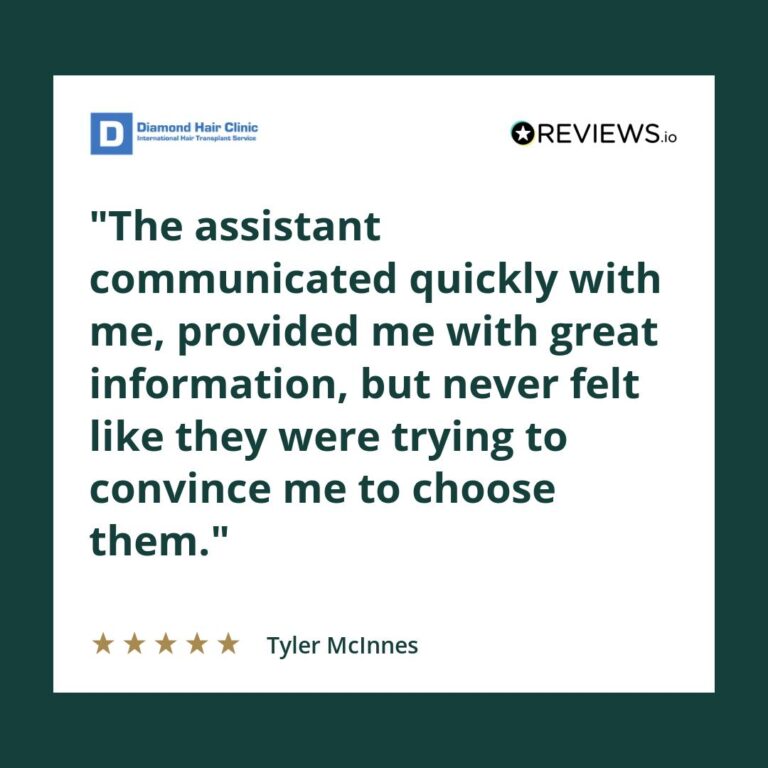
“The assistant communicated quickly with me, provided me with great information, but never felt like they were trying to convince me to choose them.”

Read this review excerpt
“After the booking process I was shown the face & vehicle reg of my taxi transfer driver who picked me up from Istanbul airport & took me to the hotel.”
Read this review excerpt
“The most challenging part was staying still during the extraction, but the clinic staff were considerate and offered breaks, though I chose to continue without interruption.”
Read this review excerpt
“When I eventually returned to my home country, I kept in continual contact with the surgeon, who attentively answered all questions that I had.”
More patient experiences
Planning and choices (6)
Read this review excerpt
“The breadth and depth of questions that he asked, the number of photos that he looked for, not only of my current condition but of what my hair looked like previous to hair loss, all filled me with reassurance.”
Read this review excerpt
“The doctor spoke English fluently, listened carefully, and was able to communicate everything clearly. I felt involved in every decision, and that gave me a lot of confidence moving forward.”
Read this review excerpt
“On the day of the surgery, I was quite nervous, but Dr. Demircioğlu was present most of the time and helped to reassure me. We spent an hour discussing the hairline design, and together we finalized the best approach.”

Read this review excerpt
“We tried different options for about an hour and a half until we had both agreed a surgery plan we were happy with. Dr. Mehmet was very knowledgeable but also very direct and honest with facts, and what was feasible and what was not.”
Read this review excerpt
“Dr Mehmet then came to the theatre to draw on my new hairline, took around 45 mins to make sure it was what I wanted.”
Read this review excerpt
“Perhaps the best part was the meticulous pre-op meeting I had with Dr. Demircioglu going over exactly what he was going to do and precisely how to design my new hairline and why.”
Consultations and explanations (6)
Read this review excerpt
“Post-procedure, he spent nearly two hours explaining aftercare: when to use what products, what I can and cannot do, and a general framework for recovery.”
Read this review excerpt
“Although Dr. Demircioğlu delegated the extraction and implantation to his highly skilled team, he remained closely involved throughout the procedure.”
Read this review excerpt
“Mehmet Demircioglu met me at the reception. This was a friendly and personalised touch. He spoke excellent English. He then took me to his office to discuss the schedule for the day, and the hairline that I wanted.”
Read this review excerpt
“Upon the day of the procedure Dr Mehmet Demircioğlu and his team walked me through everything, answered my questions and despite my squeamish nature around needles, blood and medical procedures generally, handled me with care and attentiveness.”
Read this review excerpt
“The biggest game changer for me was the Diamond Hair Clinic's one operation a day rule, which seemed very patient-friendly and boosted my confidence in the clinic.”
Read this review excerpt
“After arriving, I met with Dr. Mehmet directly. He spoke fluent English and was easy to understand and talk to.”
Questions and communication (3)
Read this review excerpt
“Dr Mehmet is fluent in English and this helped my comfort levels, and he is patient with answering questions.”
Read this review excerpt
“I must say dr.Mehmet and his staff are outstanding. They were very professional from the time I arrived in Istanbul till I left and continued to give quality instructions post surgery after my arrival back to the states.”

Read this review excerpt
“Every single one of my questions was answered and they made sure I had all the details I needed to make an informed decision.”
Arrival and travel arrangements (2)
Read this review excerpt
“I arrived in Istanbul the night before the procedure & was met by my driver in a Mercedes Vito, I knew exactly who I was meeting as I was sent a picture on the day of the driver, again very professional & very reassuring.”
Read this review excerpt
“Diamond Hair clinic booked me in at an excellent 5 star hotel and I booked my flights. Before arriving Istanbul I had already been contacted by my driver who took me to the hotel.”
Care and comfort during the visit (2)
Read this review excerpt
“It was a very long day which you have to prepare yourself for which is probably why I found it challenging. I was constantly being asked if I was alright and could request toilet breaks (thank goodness).”
Read this review excerpt
“The team was very kind and made me comfortable and they allowed me to pause the operation at any time. I had two main breaks, lunch and a dinner break and the delicious meals were provided by the clinic.”
Contact and aftercare (3)
Read this review excerpt
“After the operation the doctor explained the post operation instructions and gave me his direct number to contact him if I had any questions or concerns.”
Read this review excerpt
“What I appreciate most is that Dr. Mehmet and his team remain available for ongoing support and follow-up. That level of care after the surgery is just as important as the operation itself.”