






No clinic can guarantee final growth
No clinic can guarantee perfect growth in every graft, in every person, in every scalp condition. Hair transplantation is a medical procedure, and the final result depends on many biological and technical factors.
Graft handling matters. Recipient area blood supply matters. Skin quality matters. Smoking after a hair transplant, infection, inflammation, poor aftercare, shock loss, ongoing hair loss, and medication decisions can all influence the final appearance.
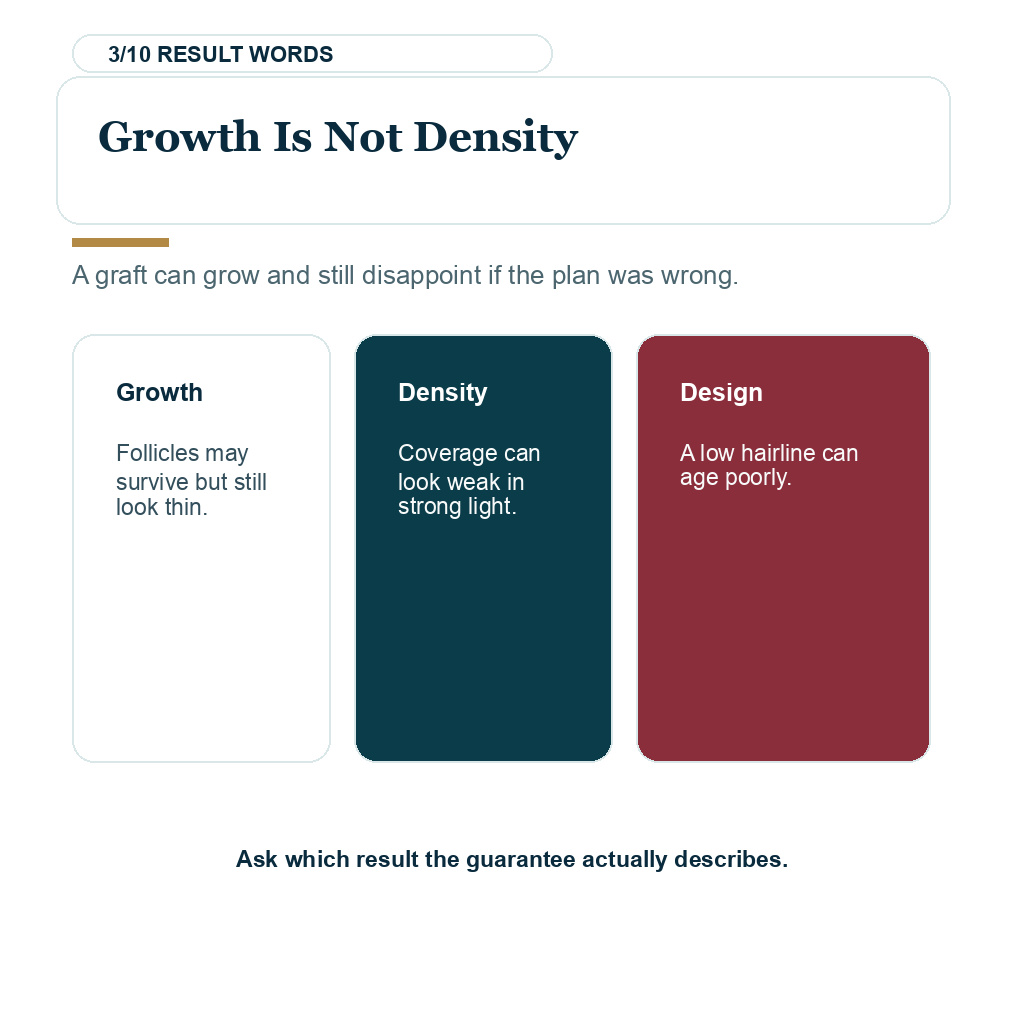
Even when graft survival is good, the final cosmetic result may still disappoint if the plan was wrong. A hairline can grow but still look too low. The grafts can survive but still point in the wrong direction. A crown can improve but still look thin under strong light.
Growth is not the same thing as a good result. This belongs among the biggest misunderstandings in hair transplantation.
A clinic may show a strong growth percentage, but you live with the design, the density distribution, the donor appearance, and the long term aging pattern. These are not small details. They are the result.
Consultation has to ask more than whether hair can be moved. It has to judge whether moving that hair will make sense over time.
A guarantee that focuses only on growth can ignore naturalness. People do not come to me only because they want hair to grow. They want the result to look natural, age appropriate, and stable as their native hair continues to change.
A very aggressive lowering of the hairline needs this kind of caution. The grafts may grow, but if the design does not match the face, age, donor reserve, and future hair loss pattern, the person may still feel disappointed.
It helps to understand what creates a natural, durable hair transplant result before comparing clinic promises. That outcome is not created by a guarantee. It is created by judgment before the first graft is removed.
Lifetime growth promises are not medical accountability
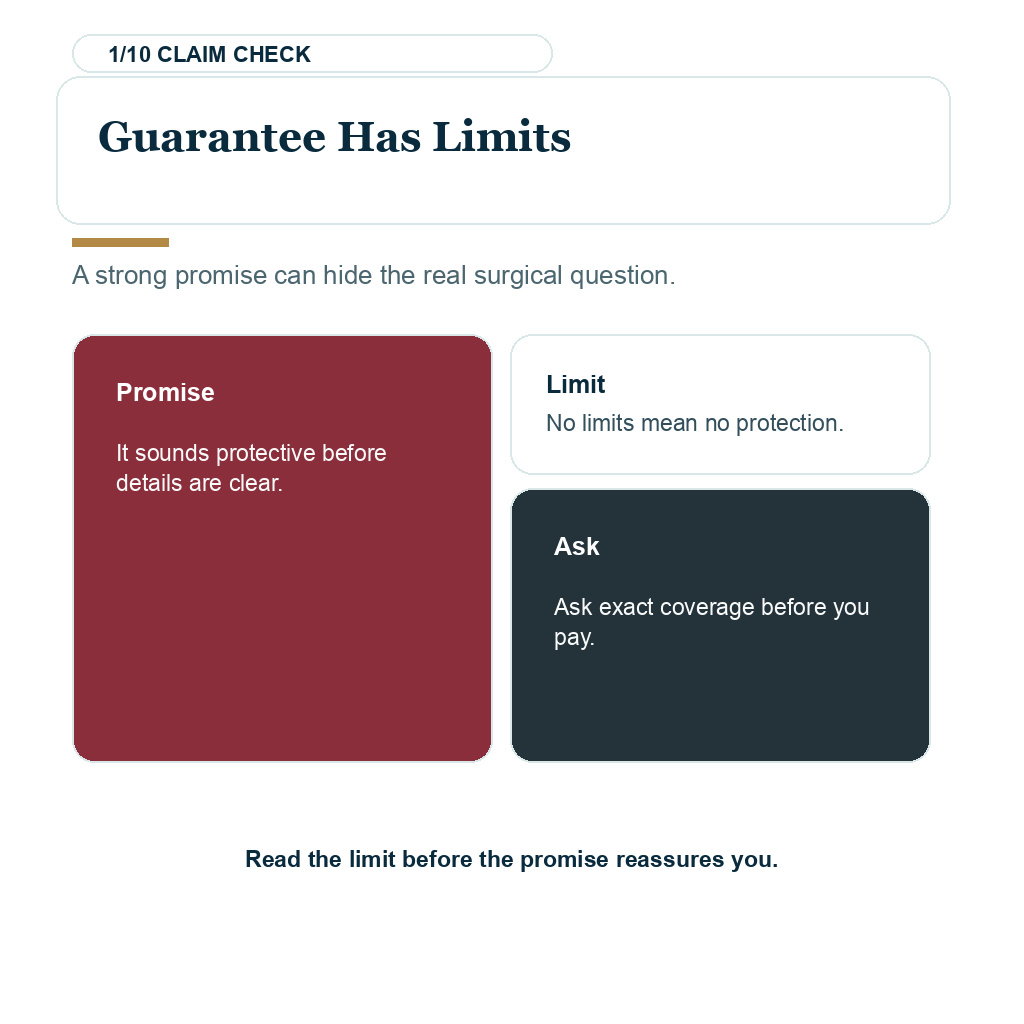
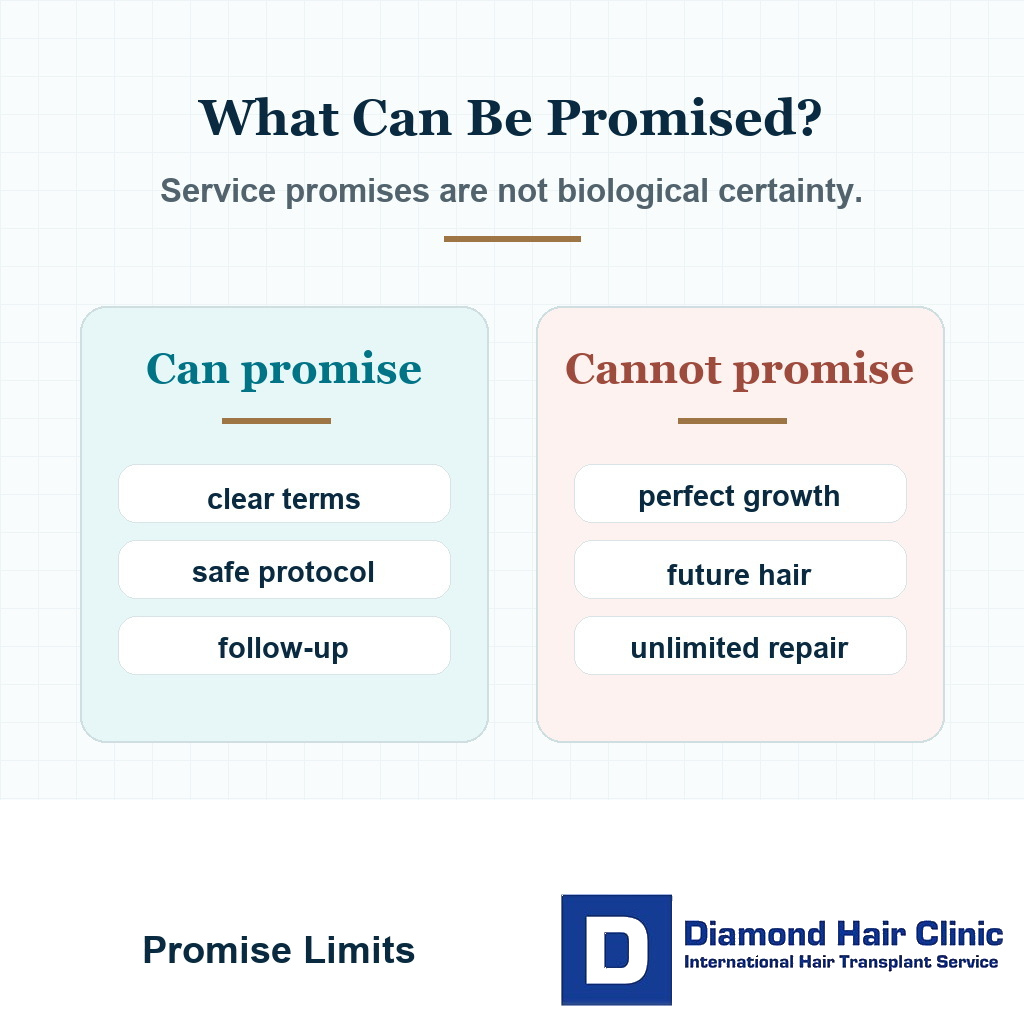
A lifetime growth guarantee sounds powerful, but the first question is what lifetime means. It may refer to transplanted follicles from the safe donor area. It may refer only to the clinic policy. It does not mean your whole appearance is frozen in time as native hair continues to change. These are very different claims.
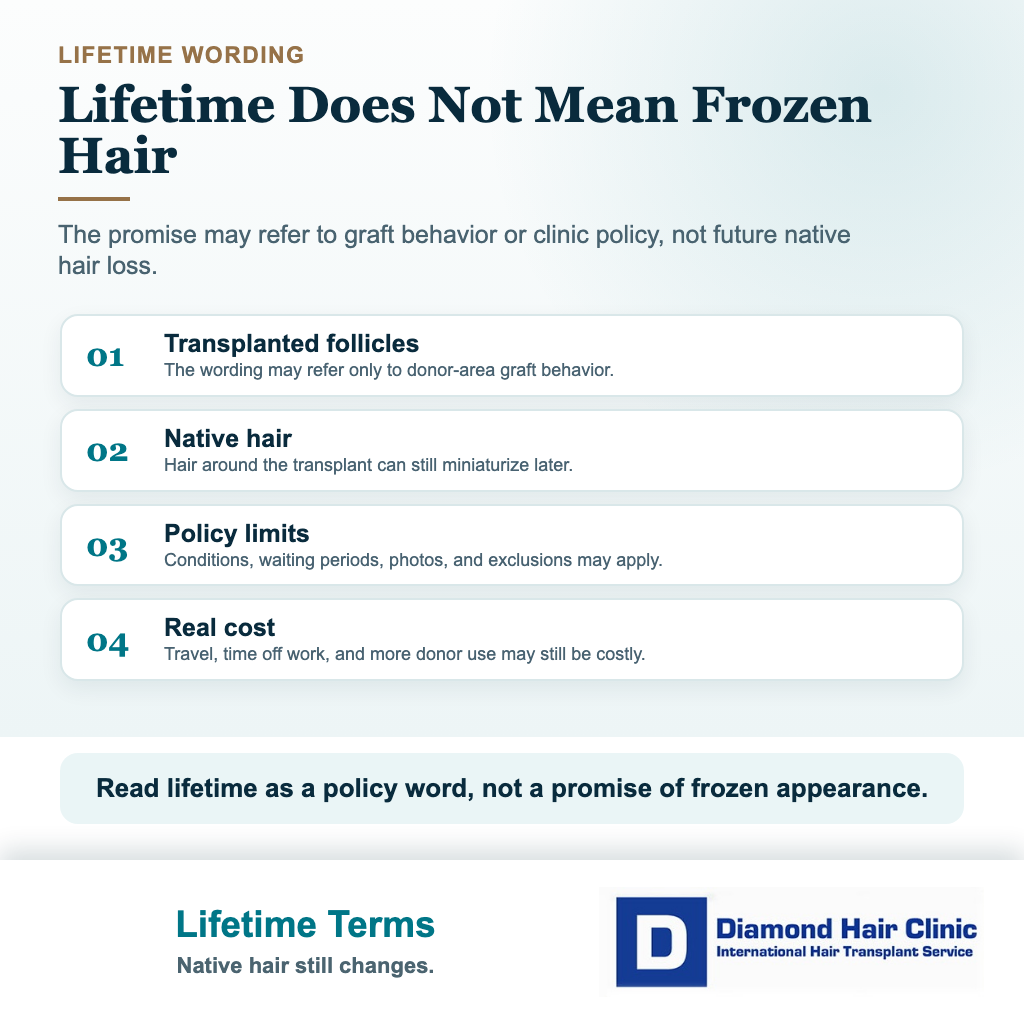
Most guarantees are not written in the language people imagine. They may have conditions, exclusions, waiting periods, photo requirements, medication requirements, and limits on what the clinic will actually provide.
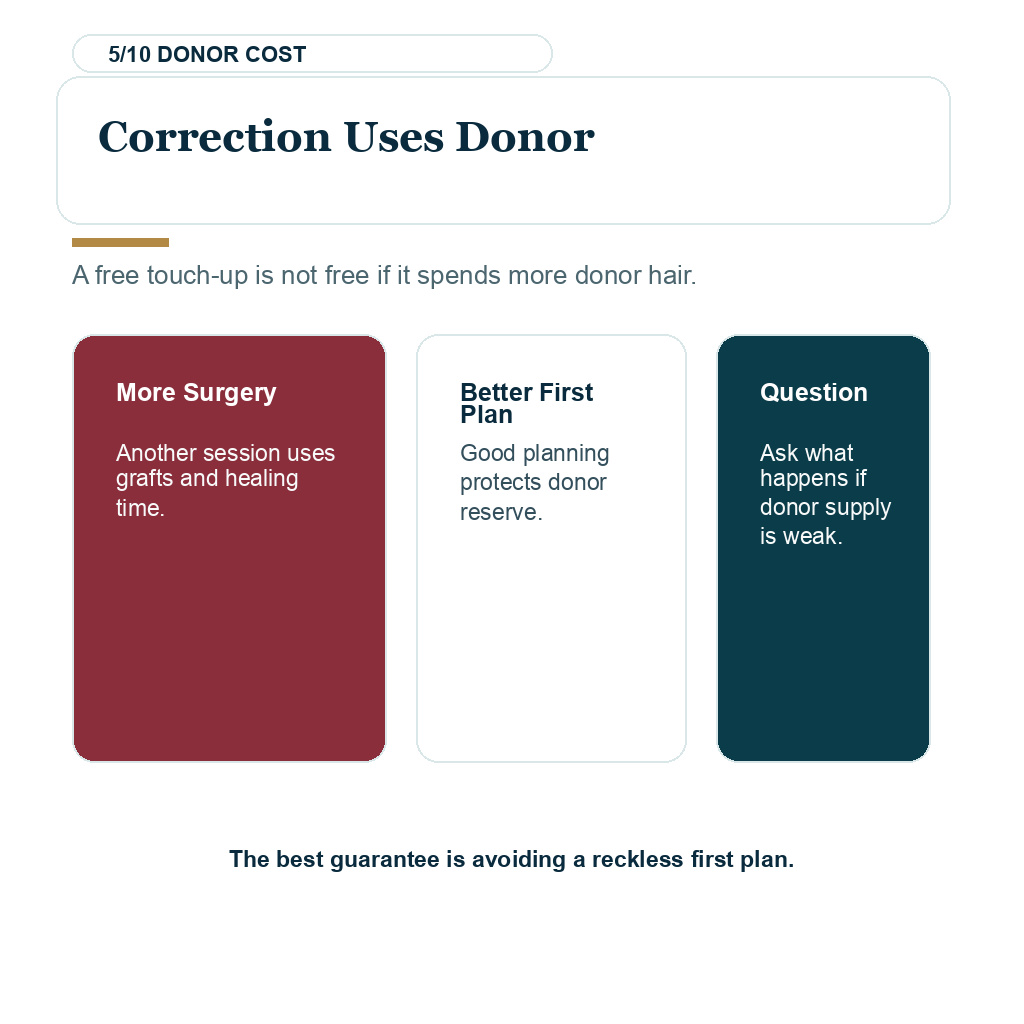
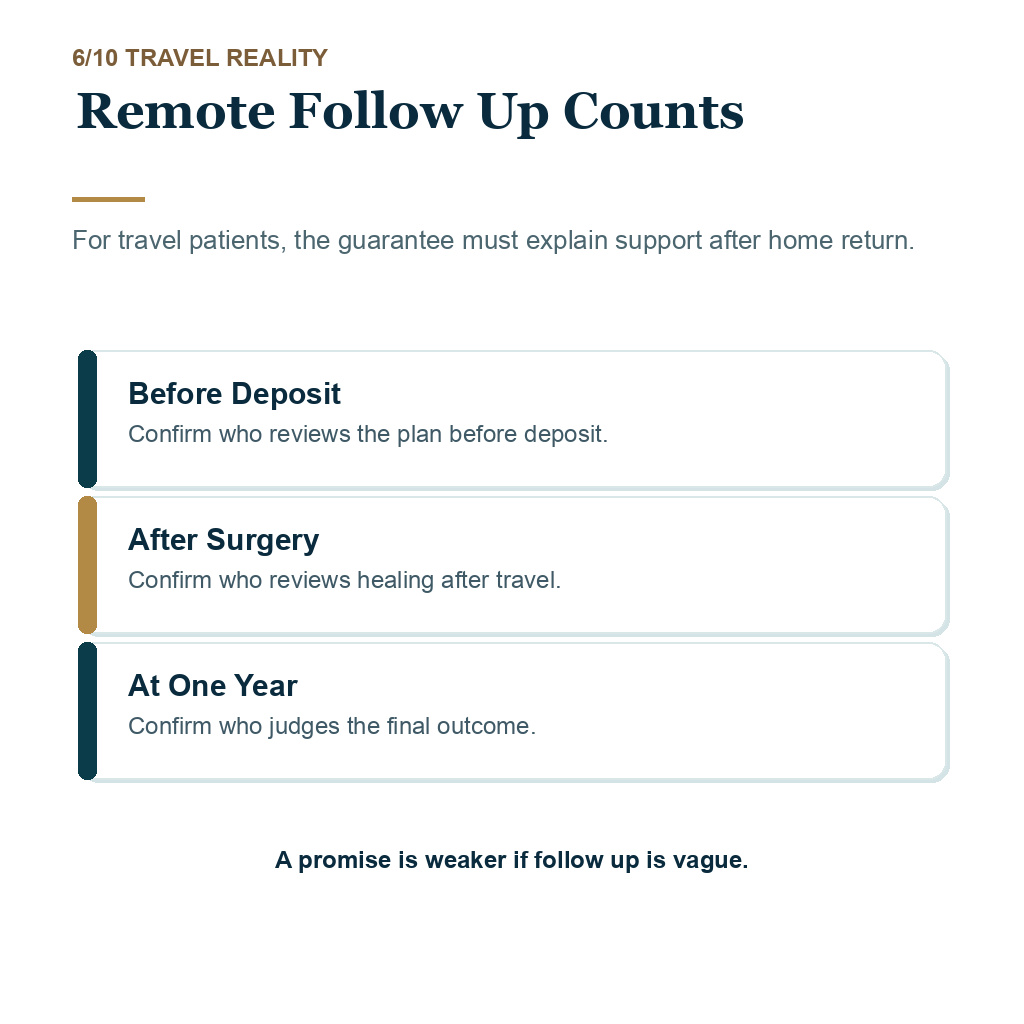
Some guarantees are also difficult to use in real life. If you live in another country, returning for a correction may require new flights, more time off work, another recovery period, and another emotional investment. A free correction is not truly free if it costs you donor hair, time, and trust.
There is also another issue. If the first operation was poorly planned, the same clinic may not be the right place to repair it. You may be offered a touch up, but the real problem may be wrong angle, poor hairline design, overharvesting, or multi hair grafts placed at the front.
In those cases, a guarantee can become a trap. You may feel obligated to return to the same system because the correction is included, even though the safest repair may require a different surgeon and a much more careful plan.
Medical accountability means more than offering another procedure. It means explaining what went wrong, whether the donor area is still safe, whether repair is possible, and whether doing more surgery would help or harm.
The red flags of Turkish hair mills matter because the unsafe part is not only a bad first result. The unsafe part is a system that makes repair harder because too much donor hair was used too quickly.
A strong clinic does not hide behind a certificate. It is accountable before surgery, during surgery, and after surgery.
Accountability is easier to promise than to practice. Real accountability takes time, documentation, careful photography, proper follow up, and the willingness to admit when the case needs a different solution than the clinic first expected.
Maximum graft promises can hide the real risk
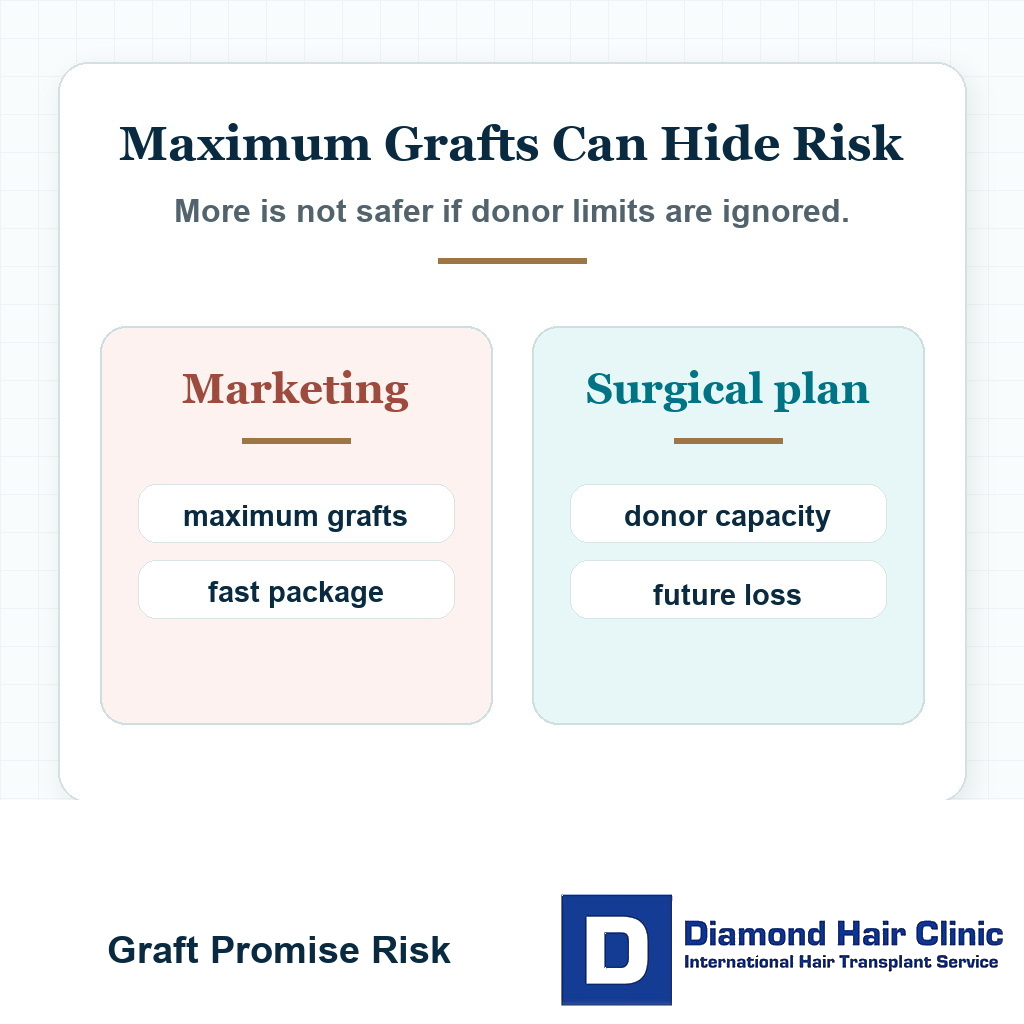
Many guarantee offers appear together with another phrase that worries me, maximum grafts. It is easy to hear this and think you are receiving better value. More grafts for the same price feels generous.
In responsible planning, maximum grafts must never be the starting point. Start with donor capacity, hair loss pattern, hair caliber, scalp contrast, future loss risk, and the priority of each recipient area.
You may want the hairline, mid scalp, and crown covered in one session. The clinic may want to sell a large number. But the donor area does not respond to marketing. It has limits.
If too many grafts are removed, the donor area can look thin, patchy, or exhausted. If too many grafts are placed too densely in an area with poor blood supply, healing can become more difficult. If the hairline is lowered too aggressively, the patient may need more grafts forever to maintain a design that should never have been created.
A large number promised before proper examination deserves caution. Photos can help, but they cannot replace a real assessment of donor density, miniaturization, scalp quality, and long term strategy.
Different graft estimates should be interpreted carefully. Different hair transplant graft numbers do not prove that one clinic is better or worse. The reasoning behind the number matters.
A high number can be correct in selected cases. A low number can also be correct when the donor area needs protection. The number itself is not the proof of quality.
The real proof is the reasoning behind the number. If the clinic cannot explain that reasoning in a way that makes sense, the guarantee cannot make you safe.
For patients worried about donor safety, donor area overharvesting can limit every repair option later.
In my planning, I leave some donor hair unused rather than spend it to make a hair transplant package look generous. You may not appreciate that decision on the booking day, but you may be grateful for it five or ten years later.
Surgeon involvement matters more than a certificate
A certificate can say many things. It can say the clinic promises growth. It can say you received a certain package. It can say the clinic has a policy for correction. But it cannot perform surgery, design a hairline, or decide when a plan needs to stop.
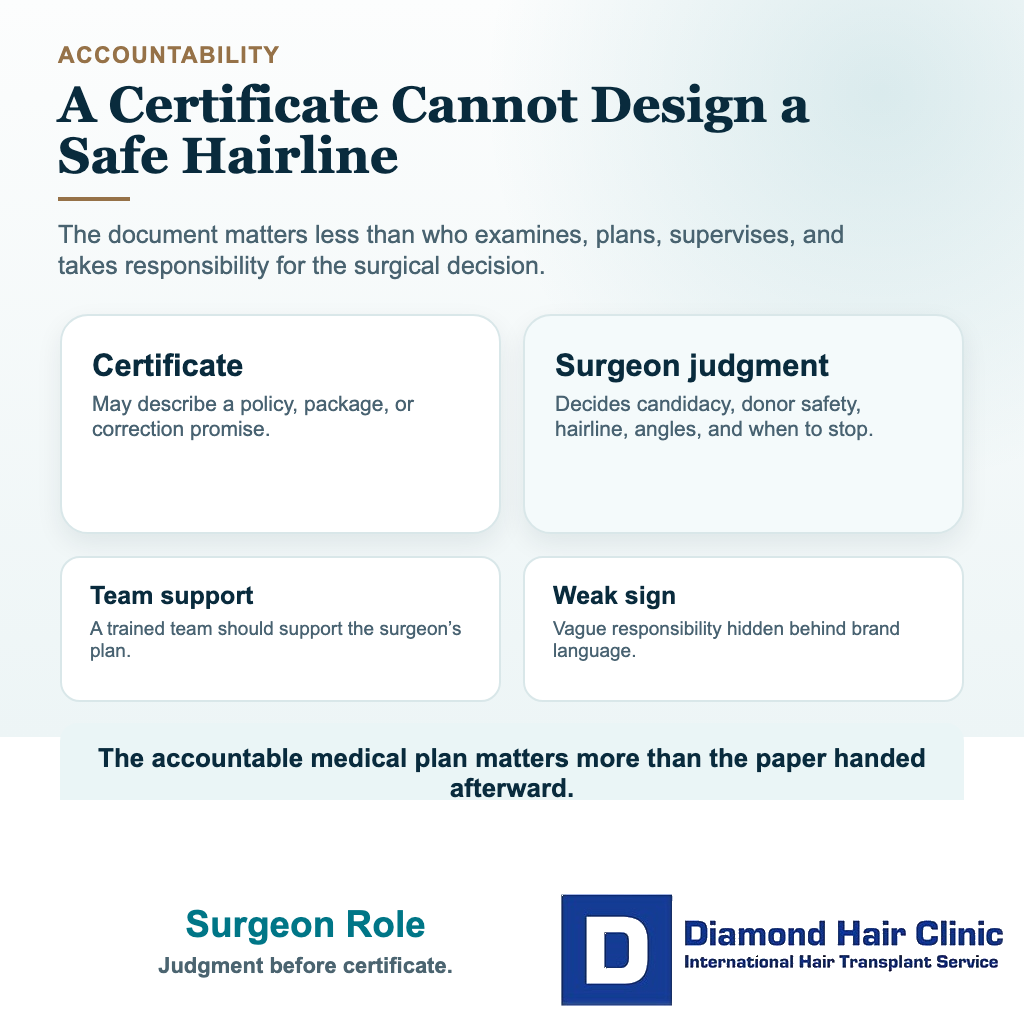
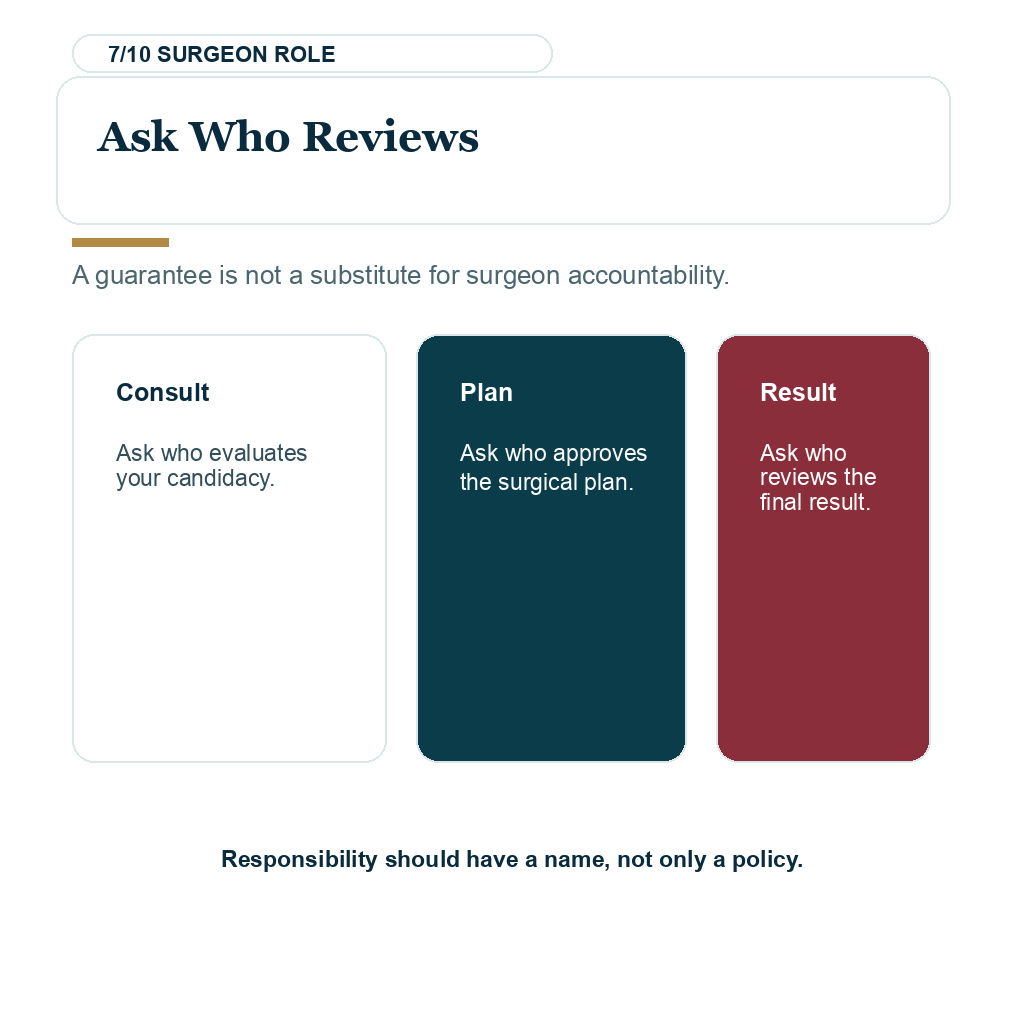
The person planning and performing the critical parts of the procedure matters more than the certificate handed to the patient afterward. Hair transplantation is not only extraction and implantation. It is diagnosis, candidate selection, donor mapping, hairline design, graft selection, recipient area planning, angle control, density distribution, and judgment about when to stop.
If the surgeon is not meaningfully involved in those decisions, you may be trusting a brand name more than a medical professional. I am not saying every assistant is a problem. A trained team is important in hair transplantation. But the team needs to support the surgeon’s plan, not replace the surgeon’s responsibility.
Instead of making the consultation feel like an interrogation, listen for whether the clinic explains responsibility naturally. You need to understand how the donor area is evaluated, how the hairline is designed, how the recipient area is created, how extraction is controlled, and who reviews healing if the result does not follow the expected path.
Before trusting a promise, understand who actually performs your hair transplant and who is responsible if healing or growth does not follow the expected path.
A surgeon led clinic must not make surgeon involvement feel like an upgrade. It needs to be the foundation of the procedure.
Decision points before trusting a guarantee
Before trusting a hair transplant guarantee, read the promise slowly and translate it into real clinical meaning. Is the clinic talking about growth only, correction, donor safety, naturalness, follow up, refund, or only a vague promise of support?
The timing and conditions also matter. Some policies begin only after a long waiting period. Some depend on medication use, aftercare compliance, smoking status, scalp health, or the clinic’s own judgment about whether the result qualifies. If one missed photo, one skipped message, or one medication change can weaken the promise, you need to know that before trusting it.
Clarity matters for unnatural hairline design, wrong angle, poor graft direction, overharvesting, visible plug like placement, or a donor area that looks damaged. If the promise only offers another session, remember that another session uses more donor hair.
Before you trust any guarantee, ask how the clinic would judge the result if it underperformed. The answer should include comparable photos, review timing, donor assessment, graft distribution, scalp health, repair limits, and who makes the medical judgment. Those details help you judge hair transplant results before choosing a clinic instead of relying only on guarantee language.
The most revealing part of the consultation is often what the clinic refuses to do. A clinic that never says no may feel comforting in the moment, but a surgeon who can say no may be protecting you from a permanent donor problem.
In a careful consultation, difficult questions must not make the clinic defensive. Clear questions are part of safe medical decision making.
If you feel pressured to trust the guarantee instead of understanding the plan, slow down. A responsible promise needs to make the plan clearer. It must not replace the plan.
Terms that should be written clearly
If a clinic offers a guarantee, the terms need to be clear before payment, not on the surgery day. A promise that appears only after you have already traveled or paid a deposit is not real protection.
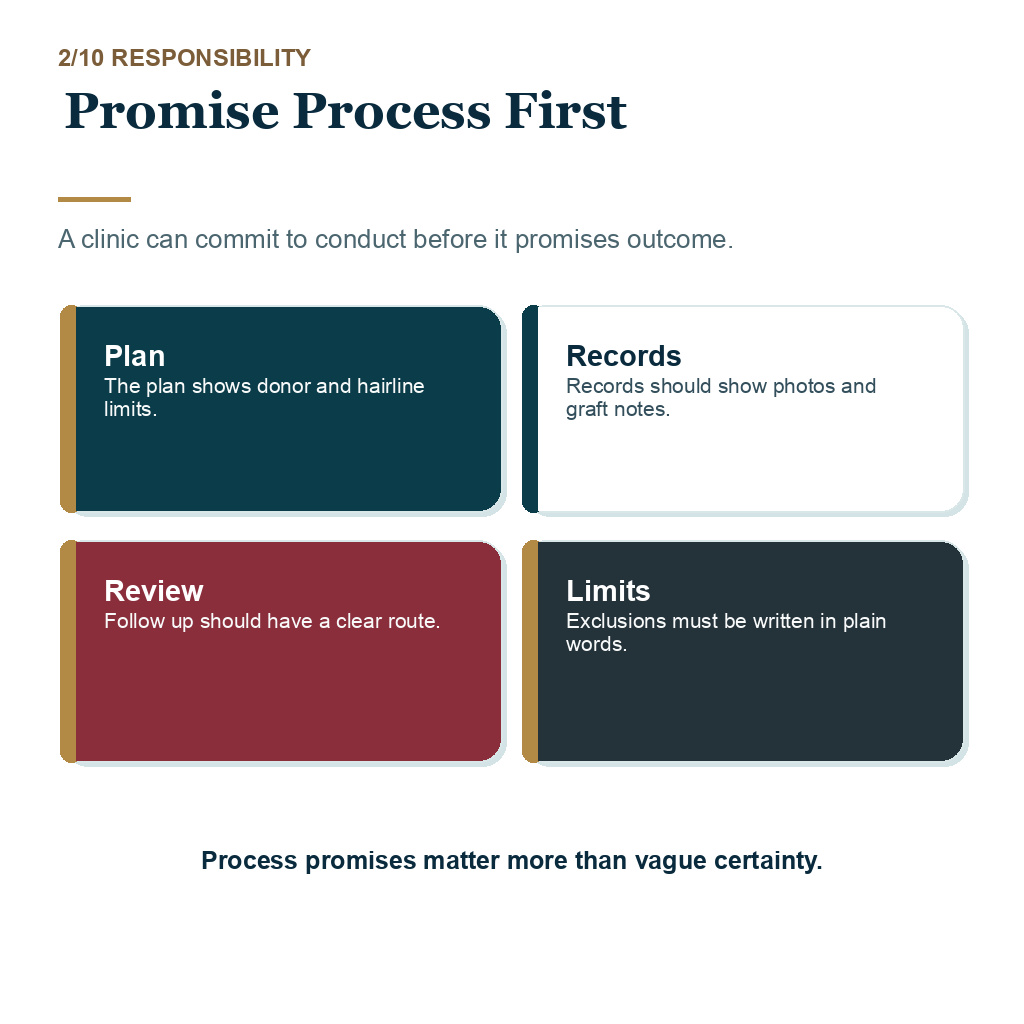
The document needs to explain what is being measured, when it will be judged, how the result will be reviewed, and who has medical responsibility for that review. It also needs to explain whether the promise covers poor growth only, or whether it includes wrong angle, unnatural hairline design, donor damage, scarring, or a result that cannot be repaired safely.
Also ask what is actually included if the guarantee is used. Is it only another surgery, or does it include travel, accommodation, medication, time away from work, and the extra donor hair that must be spent? These details matter because a free procedure can still be costly.
Any guarantee also needs to explain the patient side responsibility, including hair transplant aftercare, follow up communication, smoking, medication changes, and when photos or in person review are needed. A real policy needs to tell you what support is promised and what can void the support.
If the guarantee cannot be explained clearly before committing, do not use it as a safety signal.

A poor result needs careful review
If the result is poor, the first step is not another surgery. The first step is diagnosis before another surgery. You and the surgeon need to understand whether the issue is delayed growth, poor growth, shock loss, ongoing native hair loss, unrealistic expectation, wrong design, poor density planning, or technical error.
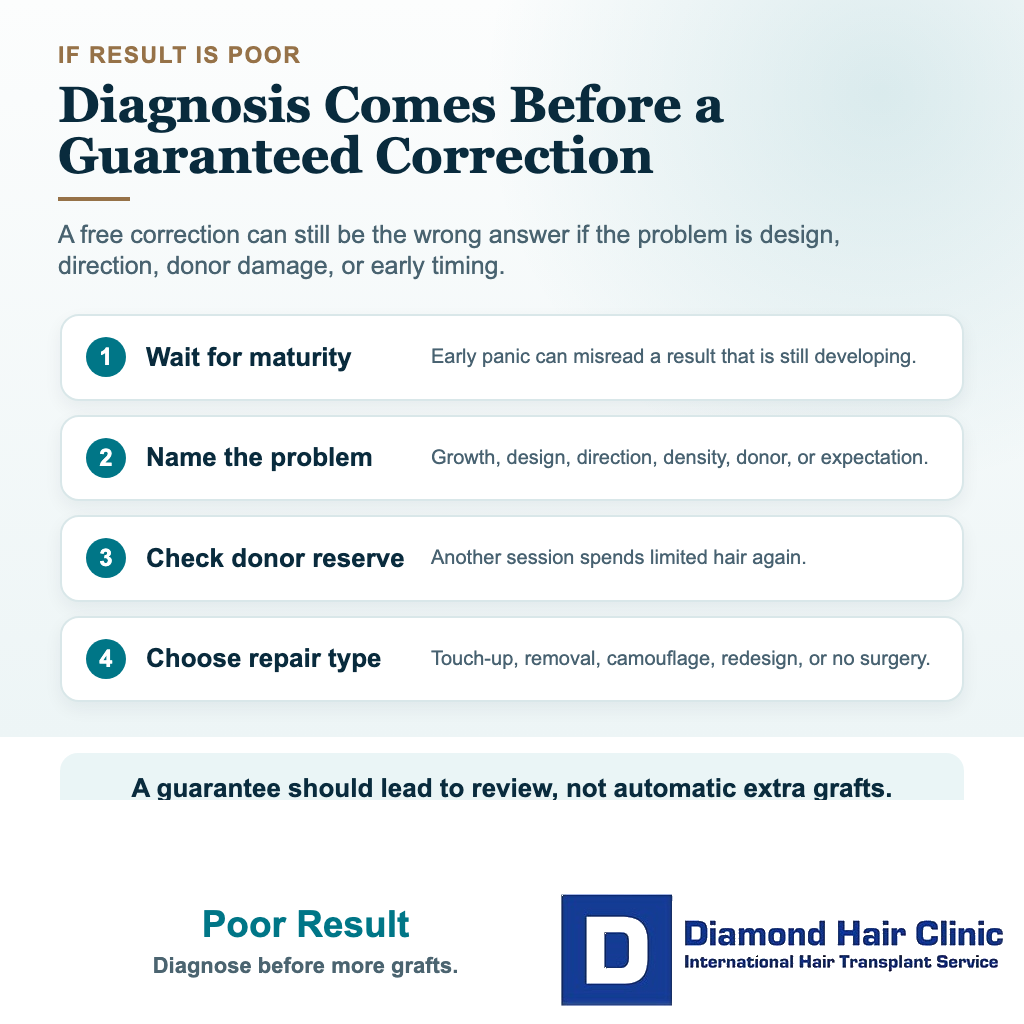
Timing matters. A result usually cannot be judged too early. Panic at four, five, or six months is common, even though the result is still developing. In other cases, by 12 to 18 months, the problem becomes clearer.
If the concern is simply a small area of weak density and the donor area is healthy, a minor touch up may be reasonable. If the concern is an unnatural hairline, bad angles, multi hair grafts at the front, or overharvested donor, repair becomes more complex.
A guarantee may offer more grafts, but more grafts are not always the solution. In some repair cases, removal, camouflage, conservative redesign, medical stabilization, or waiting until the scalp and result are mature enough to judge protects more donor hair than another dense session.
At this point, regret often begins. The original promise was easier to understand than the repair, and hair transplant regret after surgery becomes both an emotional and practical problem.
This is not meant to frighten you. It is a reason to think about repair before surgery, not only after a bad result.
If a clinic tells you that any problem can be fixed easily, be careful. Some problems can be improved, but repair surgery is usually more limited than first surgery because donor hair has already been used and the scalp has already been changed.
Repair also requires emotional patience. You may need to wait for full maturation, grow the hair longer for proper assessment, collect operative details, and accept that the best solution may be gradual rather than immediate.
The best guarantee is still prevention. It is better to avoid a poor plan than to depend on a correction policy later.
Judging a hair transplant guarantee
Judging a guarantee begins with responsibility before surgery. Do not feel protected only because something can be corrected later. The plan needs to be careful enough that correction is less likely to be needed.
Candidate selection comes first. Some people are ready for surgery. Some need medical treatment first. Some need a smaller plan. Some need to wait. Some need to avoid surgery until their hair loss pattern is clearer.
The donor area also needs long term thinking. A young person with aggressive hair loss should not be treated the same way as an older person with stable loss. Fine hair should not be promised the same visual density as thick hair.
For me, the promise is not maximum grafts. It is careful planning, clear explanation, and not treating the donor area as if it is unlimited.
No surgeon can responsibly guarantee perfection. No serious surgeon can promise a perfect outcome. What I can promise is personal evaluation, clear limits, natural design, and donor protection as much as the case allows.
This may sound less dramatic than a lifetime guarantee, but it is more useful. Hair transplantation needs clear planning more than dramatic wording.
A hair transplant guarantee must never make the decision for you. It can be a supporting detail, but only after the surgeon, plan, donor management, hairline design, surgical roles, aftercare, realistic expectations, and the guarantee terms are clear.
If a guarantee makes you stop asking questions, it is dangerous. If it helps you ask more precise questions and understand the clinic’s responsibility, it can be useful.
The strongest decision is not the loudest promise. It is the decision made after you understand that a natural and lasting result begins before surgery, with the quality of the plan itself.

Read this review excerpt
He was very thorough in every little detail and I never felt pressure to do anything I wasn’t sure of.