


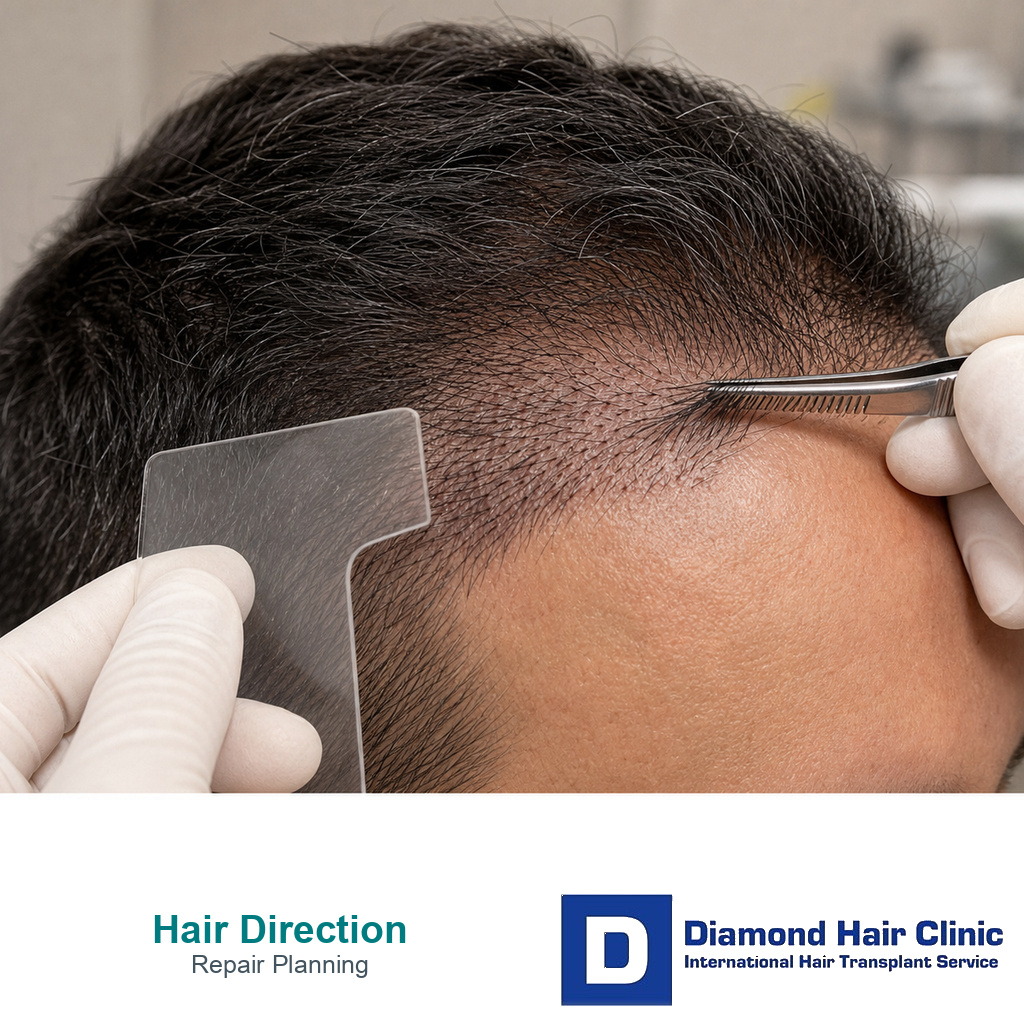
Wrong Hair Direction Needs Careful Repair Planning
Hair growing in the wrong direction is often repairable, but prevention is much easier than correction. A stiff or wiry hair shaft can soften with time. A follicle that was placed at the wrong exit angle usually cannot rotate itself later. I normally judge final direction at 12 months, unless the hair is clearly exiting the scalp in a severe structural pattern. In selected hairline cases, for that reason removing or thinning misplaced transplanted hairs may be discussed before adding more grafts. If laser is being considered for that thinning step, laser hair removal for transplanted hair explains why angle problems still need repair planning.
Start by separating true wrong direction from early wiry growth, poor styling control, or a design problem. For patients noticing the issue around month eight, a month eight hairline check helps separate wiry early texture from a persistent angle or design problem. A hair that sits badly at month 5 is different from a graft that exits the scalp against the native flow at month 12. These can look similar to a patient, but they are not treated the same way.
A proper direction review looks beyond density alone. It has to include the angle of the hair as it exits the scalp, the direction of the surrounding native hair, the shape of the hairline, the temple points, the caliber of the grafts, and the amount of donor hair that remains for correction. With wavy or curly hair, I separate that exit angle from the bend that appears after the shaft leaves the skin. The recipient incision guides the angle and direction at which the hair emerges, while the hair’s own curl can change its visible path above the scalp. A curl turning above the skin and a hair exiting against the native pattern are not the same repair finding. The repair review should name which finding is present before removal or camouflage is discussed. It should also separate hair angle from raised hairline texture, because direction and surface contour are different defects. If the patient sees a grid like placement pattern as well as direction worry, graft rows after FUE helps separate spacing from true angle problems. For patients still in the early wash stage, the early hair transplant review photos guide shows what evidence to send before treating the angle concern as final. For Afro textured repair cases, curl direction, hairline graft choice, and remaining donor reserve need to be read together because the same exit angle problem can become more obvious as curl returns.
Why hair direction matters so much?
Cowlick and crown whorl patterns are part of why hair direction matters so much. A result can have good survival and still look wrong if the hairs stand up, point forward, curve against the native pattern, or fight every hairstyle.
The front hairline is especially sensitive because the eye reads it first. If the frontal grafts are too upright, the hair can look stiff even when the density is modest. If the temple hairs point in the wrong direction, the face can look framed by transplanted hair rather than natural hair.
Temple points deserve their own review because they frame the face differently from the central hairline. If the hairs point too far forward, too upright, or against the native flow, adding density can make the problem heavier instead of softer.
Natural direction is not perfect symmetry. One side of the hairline may naturally angle differently from the other, especially when a cowlick, part line, or crown pattern influences the flow. The weak point is when transplanted hair fights the native direction or creates an obvious change that cannot be styled naturally.
Hairline design is not only about height or shape. Direction, angle, graft selection, and distribution all work together.
Timing before judging wrong direction
It is too early to judge final direction in the first few months. New transplanted hair can grow wiry, uneven, and difficult to control before it matures. The shaft may look coarse, the curl may feel strange, and the patient may feel that the hair refuses to sit properly. At this stage, change over time matters more than a final verdict.
In most cases, 12 months is the fair point for a final repair decision. In some cases the hair softens enough that styling becomes easier. A truly wrong angle does not disappear, but maturation can make a borderline concern less visible.
This needs to be separated from wiry or coarse transplanted hair, because texture maturation and wrong implantation direction are different problems.
Usual causes of wrong hair direction
Wrong direction begins during recipient area planning and placement when the surgical plan does not follow the natural flow. If the incision angle, exit direction, depth, or graft insertion is wrong, the hair can grow in a direction that looks separate from the rest of the scalp.
In the hairline, the angle should be flatter and softer in most patients. In the mid scalp, the flow must follow the surrounding hair. In the crown, direction becomes more complex because the spiral pattern changes across a small area.
Tool names are not proof of quality. Sapphire FUE, DHI style placement, or standard FUE can all look natural or unnatural depending on the surgeon’s planning and execution.
Styling and time may improve the appearance
Styling and time can improve the appearance when the main issue is shaft stiffness, length, or early maturation. Longer hair gives more control. Hair can soften after full maturation. Blow drying, careful cutting, and choosing a style that works with the new direction may reduce the visual problem.
A direction concern first noticed after a very short haircut may have been less visible when longer hair overlapped it. Compare the exit direction with your earlier photographs and current growth stage before deciding that the haircut reveals a permanent problem.
But styling can only influence the hair shaft. It does not change the root direction. If the follicle was placed too upright or angled against the native pattern, the hair may always try to grow that way from the scalp. Be careful with advice that says every wrong direction concern will simply settle by itself.
If the concern appears only in wet hair, flash photography, or very bright bathroom lighting, it should be compared with how hair transplants look under harsh light and wet hair. Some visibility is lighting. Some visibility is real surgical direction. The distinction matters.
Texture versus true wrong direction
Texture problems often improve as the hair matures. The hair may feel thick, wiry, or hard to style at first, but the root direction still broadly follows the intended flow. True wrong direction is different. The hair exits the scalp in a way that fights the native pattern.
The assessment should include the front, sides, and overhead view. It should also check how the hair behaves when it is dry, wet, brushed forward, brushed backward, and lifted away from the scalp. If the same wrong exit direction is visible in these different conditions, the concern is more likely structural. A single front photo can miss the problem.
For a review video, let the hair sit naturally before you brush it. The first seconds show whether the root direction already looks wrong or whether the problem appears only after styling.
If the patient can style the hair naturally with modest effort, waiting may be sensible. If the hair repeatedly sticks out from the root in the wrong direction, the issue is more likely structural.
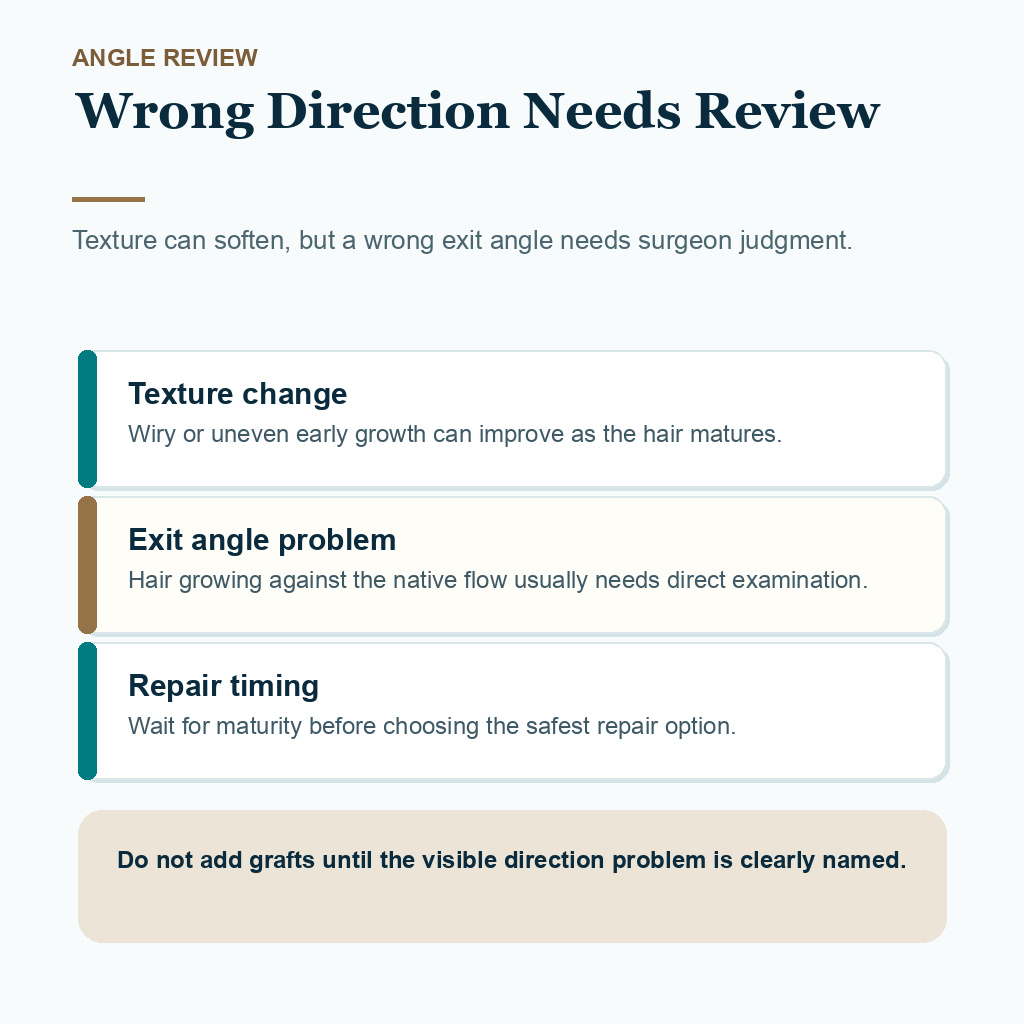
Temple points are especially unforgiving
Temple point hair grows at a very flat and specific direction. If grafts are placed too upright or too far forward in this area, the result can look artificial even with a small number of grafts.
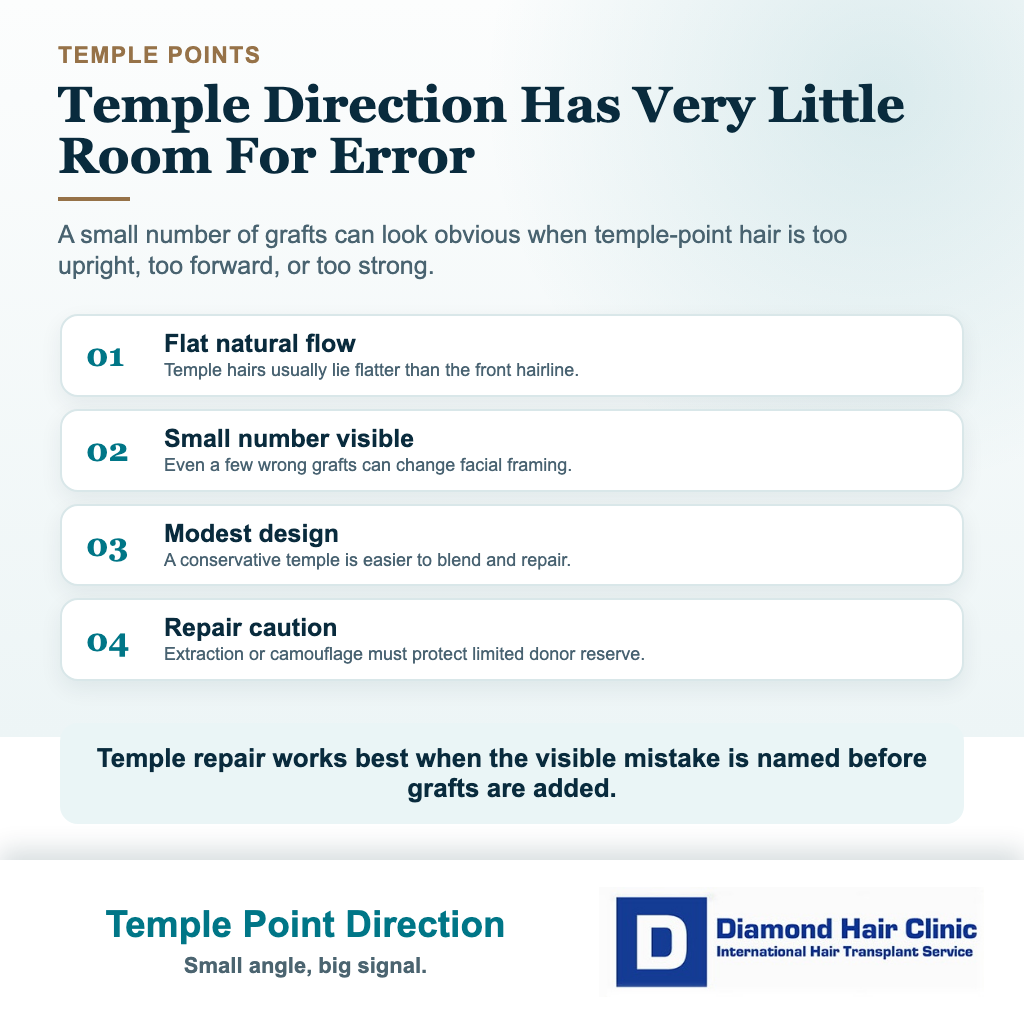
Temple repair can be difficult because the skin is visible, the angles are delicate, and there is very little room to hide an error. A modest temple point design is safer than a strong shape that later looks artificial.
Careful planning matters here because the temples can improve facial framing, but they can also expose poor technical judgment quickly. Small beard patches and facial scars need similarly precise direction planning, because the cheek and jawline leave little room to hide poor angles. The upper lip has even less visual margin, which is why mustache hair transplant planning needs exact direction before density is added.
Repair options for wrong hair direction
Repair may involve styling and haircut strategy, camouflage with new fine grafts, selective graft extraction, electrolysis in specific cases, or a staged redesign. The choice depends on how many grafts are wrong, where they sit, and how much donor reserve remains.
Camouflage can help when the wrong direction is mild and there is enough space to guide the visual flow with better placed grafts. Extraction is more relevant when the grafts are thick, low, pluggy, too upright, or impossible to hide.
If the problem includes a pluggy front edge, the case becomes closer to pluggy hairline repair than a small touch up.
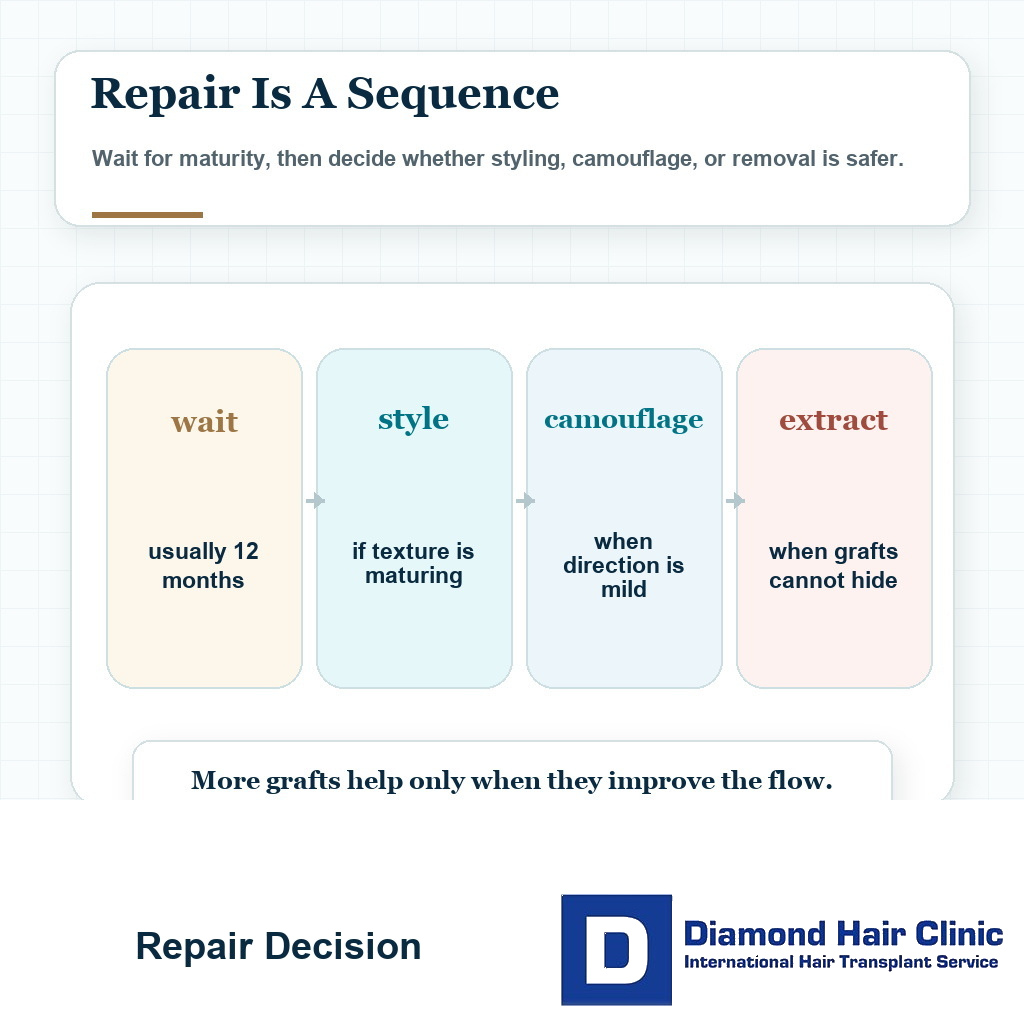
Adding more grafts is not always the fix
Sometimes it can be improved by adding more grafts, but adding density is not necessarily the answer. New grafts can redirect what the eye notices, but they do not change the direction of the old grafts. If the wrong hairs are very visible, more grafts can make the area heavier without correcting the unnatural flow.
A careful touch up graft plan may work when the direction problem is mild, the hairline design is basically sound, and the new grafts can soften the visible transition.
If the original direction is severely wrong, selected grafts may need to be removed before new ones are added. Otherwise the surgeon is building on a foundation that already points the wrong way.
Extraction can be better than camouflage
Extraction is more likely to be needed when the wrong grafts are thick, low in the hairline, placed in the wrong location, or pointing in a direction that cannot be hidden with styling.
Extraction is not a casual decision. It can leave small scars, change the skin texture, and create a gap that later needs careful rebuilding. The extracted grafts may sometimes be reused, but this depends on the tissue, handling, and condition of the grafts.
Removal should be chosen only after examining whether camouflage would be more conservative and whether the patient has enough donor hair for a proper staged plan.
Camouflage can be better than extraction
Camouflage is better when the wrong direction is mild, the grafts are not too thick, the hairline is not too low, and there is enough space for new grafts to soften the flow.
Camouflage does not physically rotate the old grafts. The aim is to reduce how much the wrong direction catches the eye. This can be done with fine single hair grafts, softer transition, and better angle control.
Camouflage should still be conservative. Adding too many grafts can spend donor hair without solving the real problem.
Repair is harder than prevention
Repair is harder because the surgeon is working around existing grafts, scar tissue, patient anxiety, and limited donor supply. A first surgery has more freedom. A repair surgery must improve the visible problem without creating another unnatural layer.
Before repair, the review should identify who diagnoses the angle problem, who decides whether removal or camouflage is safer, and who protects the remaining donor hair. The wrong second decision can be more damaging than the first mistake.
Wrong direction cases belong inside broader bad hair transplant repair planning. The visible complaint may be direction, but the real repair plan may include density, hairline shape, donor condition, and patient expectations.
Donor capacity shapes the repair plan
Every repair uses more donor hair or risks losing some existing transplanted hair during correction. Before repair, the donor area needs inspection, and the remaining safe reserve has to be weighed against future hair loss.
A patient with a strong donor area may have more correction options. A patient with overused donor hair needs more discipline. Sometimes the best repair is not the most aggressive one, but the one that improves the most visible detail while preserving future options.
Wrong direction can be emotionally frustrating, but the donor supply is still limited. Repair should not spend grafts just because the patient is understandably upset.
Preventing wrong hair direction before surgery
Patients can reduce the risk by choosing the surgeon for planning and execution, not only the clinic name or the tool name. Hairline design, recipient area creation, graft angle control, and placement supervision need direct responsibility.
In my own practice, one patient per day scheduling protects the attention these details require. Angle, direction, hairline design, and donor planning are not small details that can be rushed.
Who performs the hair transplant surgery matters here because wrong direction is often a planning and execution problem, not a marketing problem.






When an expert review makes sense?
An expert review becomes useful when the hairline grows upward, outward, sideways, or against the native pattern after maturation. It also belongs in the plan when the design looks pluggy, harsh, asymmetric, or impossible to style naturally.
If the weak point is very early, document it but do not rush into repair. Good photos from consistent angles are useful. A short video can also show how the hair moves when brushed. Before doing more surgery, understand the pattern, not only the worry in one photo.
If the issue overlaps with shape or symmetry, it should also be compared with uneven hairline after a hair transplant, because uneven shape and wrong direction can exist together.
What to inspect before planning repair?
The review includes angle, direction, hairline shape, graft thickness, density, scarring, donor reserve, and whether the wrong hairs are isolated or spread across the whole area. A repair plan based only on a front photo is not enough.
It also needs to test whether the patient’s desired hairstyle is realistic. Some direction problems are only visible with one difficult style. Others are visible in normal life and deserve correction.
The most difficult cases are not always the emptiest ones. Sometimes the weak point is that hair exists, but it grows in a way the patient cannot style naturally. That requires careful clinical judgment.
Waiting before direction repair
Most patients should wait until the result is mature enough to judge the final direction, texture, and density. For the patient, that usually means 12 months after surgery.
There are exceptions. If the hairline is obviously too low, the grafts are visibly pluggy, or the angle is clearly severe, planning may begin earlier, but corrective surgery should still wait until the tissue is ready.
Good repair timing protects the skin, the donor area, and the patient’s emotions. Acting too early can turn one problem into several.
What makes direction repair successful?
Successful direction repair comes from choosing the smallest correction that creates a visible improvement. Sometimes that means removing a few wrong grafts. Sometimes it means blending with new grafts. Sometimes it means waiting longer and changing the haircut.
A repair should not promise perfection under every light. It should make the hair easier to style, less visually strange, and more aligned with the natural flow of the scalp.
If transplanted hair grows in the wrong direction, do not panic early, but do not ignore a mature structural problem either. Wait long enough to judge whether the hair shaft is still maturing or whether the root direction is truly wrong. Then choose a repair plan that protects the donor area as carefully as it improves the hairline.

Read this review excerpt
Upon arriving home, I sent 4 photos (of each side of head) after every washing process to doctor for checking where I was given personal advice for how to take care of my healing head.