


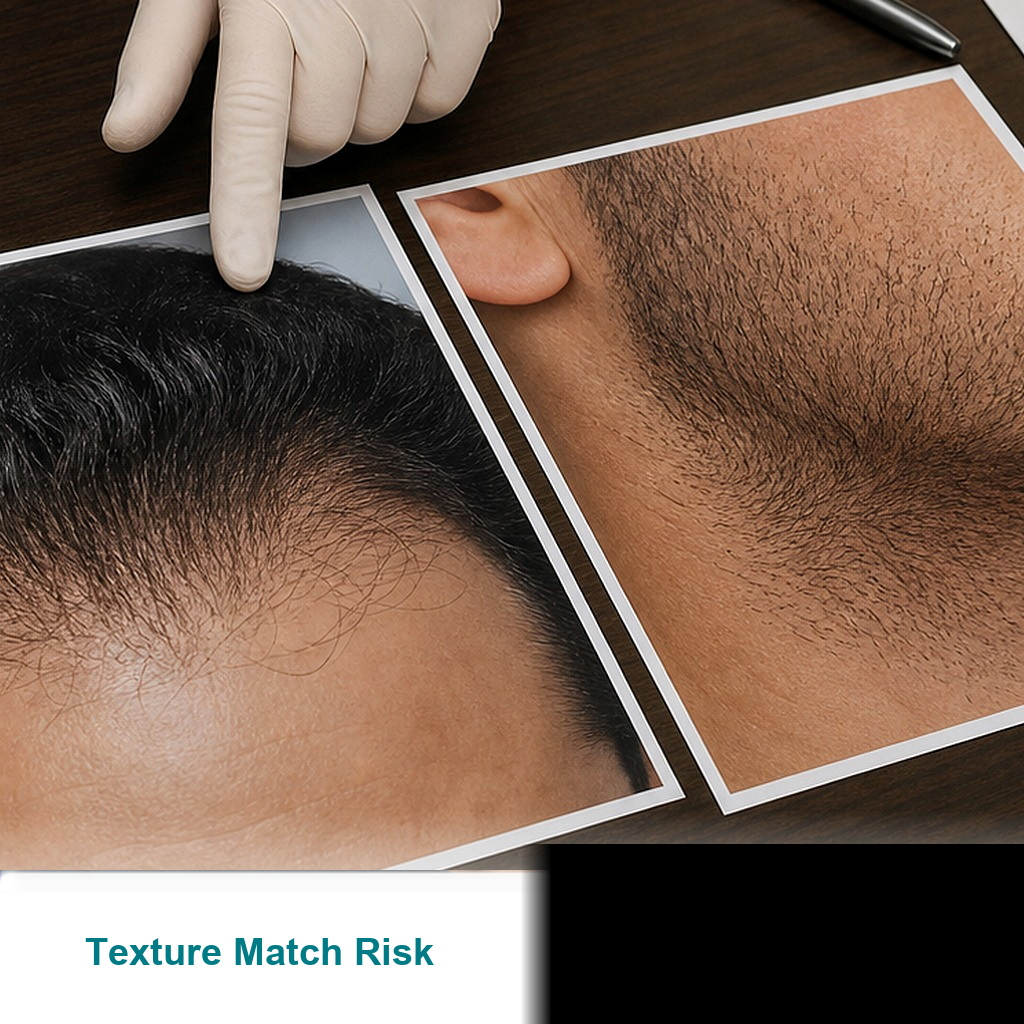
Can Beard or Body Hair Be Used in the Hairline?
Beard, chest, or other body hair can sometimes support a hair transplant, but they should usually not build the visible front edge. The first rows need soft single-hair scalp grafts, low angles, irregular spacing, and direction that fades into the forehead without looking heavy. I treat beard and body hair as reserve hair with a different character, not as a direct substitute for frontal scalp hair.
This distinction matters when the scalp donor area is limited. Extra supply is not the same as suitable hair for the front, where every coarse or misdirected graft is visible. Beard hair can be strong, dark, and wiry. Chest or other body hair may be shorter, curlier, lighter, or less predictable. The mismatch is easiest to see at the hairline, especially in daylight, under wet hair, or with a short haircut.
If beard or body hair is being discussed, the first visible row should still be built from the softest suitable hair. Extra donor supply is not the same as scalp hair, and a vague front row plan is a warning sign for hairline naturalness.
The front hairline has less forgiveness than the crown
The frontal hairline is judged from close distance. People see it when you speak, look down, sweat, style the hair back, or stand under strong light. A crown can tolerate more visual texture because hair crosses in different directions and the viewing angle is usually higher. The mid scalp can also hide mixed grafts more easily because surrounding hair gives cover.
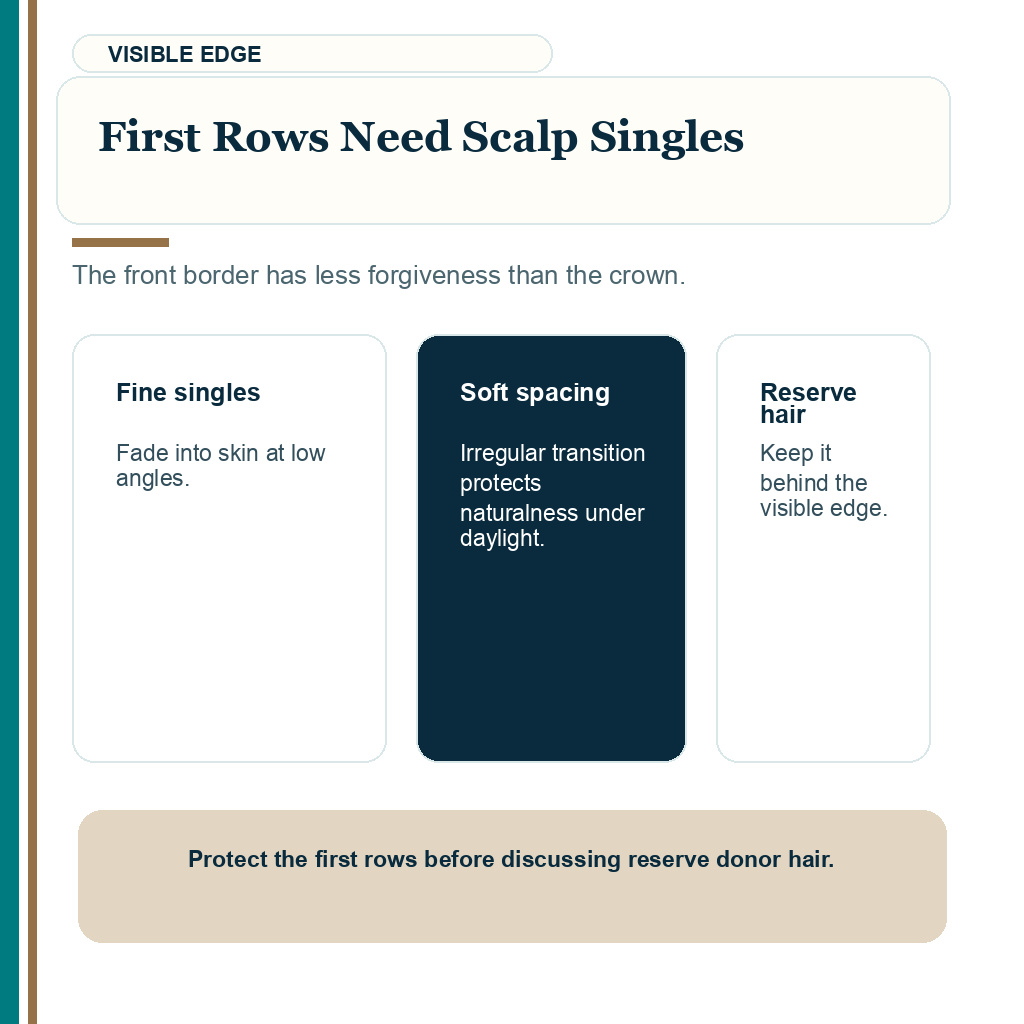
The hairline has less forgiveness. The first millimeters need irregular spacing, soft transition, and a gradual change from forehead skin to denser hair. Hairline design in hair transplant is not only a matter of drawing a low border. I have to decide which grafts belong in the front and which grafts should be kept away from it.
Soft scalp singles are usually the most suitable grafts for the first rows. If the first edge is built with coarse multi-hair grafts or visibly different hair, the line can look too dark, too regular, or too harsh. A pluggy hairline repair after hair transplant often comes back to the same problem. The front edge has to be softened, and the risk becomes greater when the proposed donor hair is not scalp hair. If nape hair can be used for a softer hairline, I still judge whether that lower donor border is stable enough. A softer appearance does not make the lower donor border safe.
When can beard or body hair support the plan?
Beard or body hair can help when the scalp donor reserve is limited and the target area can tolerate a different hair character. I usually think of it as support hair, not hairline hair. It may add coverage behind existing scalp hair in selected crown or mid scalp plans, which is why beard hair for crown transplant is a different discussion from building the visible front edge.
For the wider donor discussion, body hair, chest hair, and beard hair as donor sources still need to be judged by source character, not only by graft count. If cosmetic laser is being considered, permanent beard hair reduction before a future transplant should be decided only after the long-term donor plan is clear.
The reserve count matters less than where each source will sit. Ask how many scalp singles are protected for the visible edge, where beard grafts would begin, and whether chest or other body hair is being used only where its shorter growth and different curl can be hidden. A large total graft quote is not the same as having enough soft grafts for the first rows.
I do not accept beard or body hair as cosmetic freedom to lower a hairline beyond the scalp donor’s real capacity. Be careful with promises that reserve hair creates unlimited donor supply, automatically softens after transplant, or makes a low sharp hairline safe. Reserve hair should support the design, not force an artificial one.
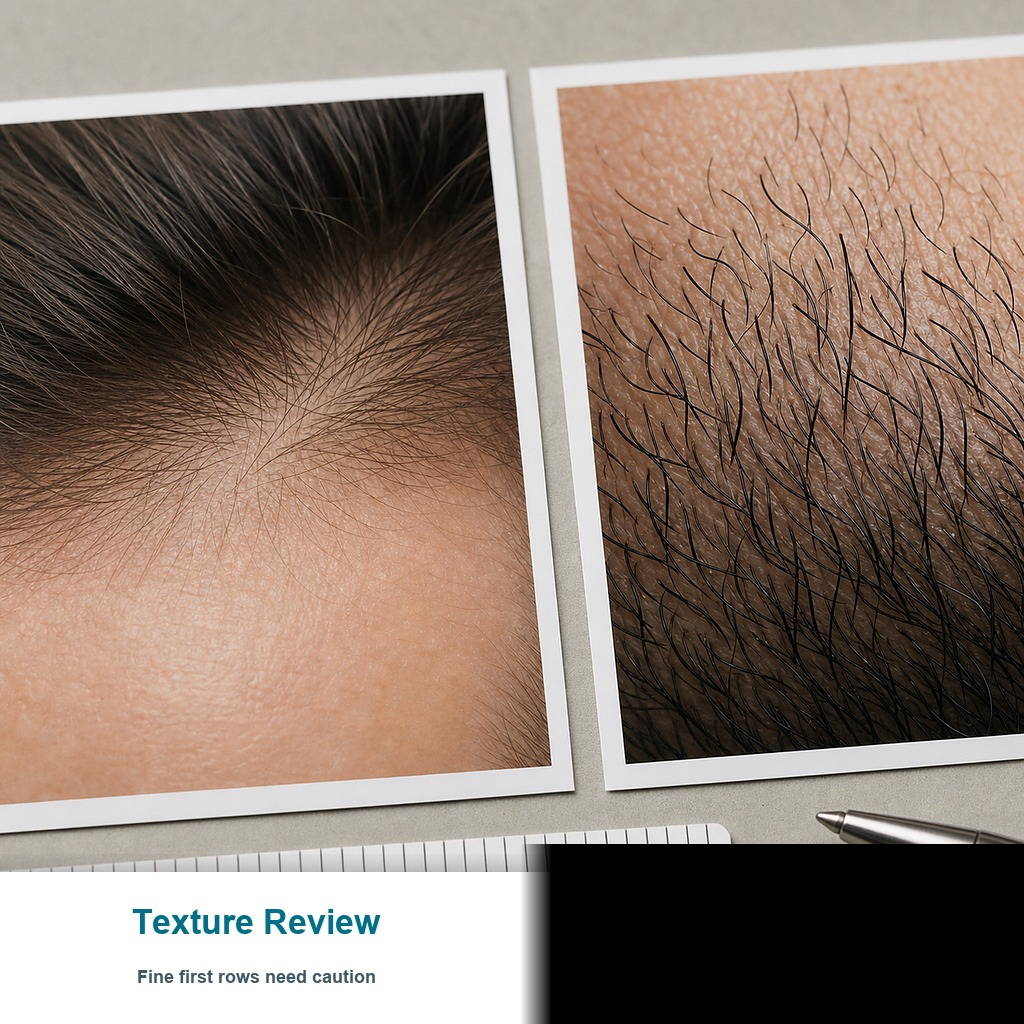
Texture, curl, and direction can decide whether reserve donor hair should stay behind the leading hairline edge.
Use reserve hair behind the visible edge, not as the front line
Beard and body hair can add useful reserve in selected cases, but a hairline is judged under close light. The first visible rows often need soft single hair scalp grafts with careful angle, spacing, and irregularity. Coarser reserve hair can make the front look heavy if it is placed where the eye reads the border.
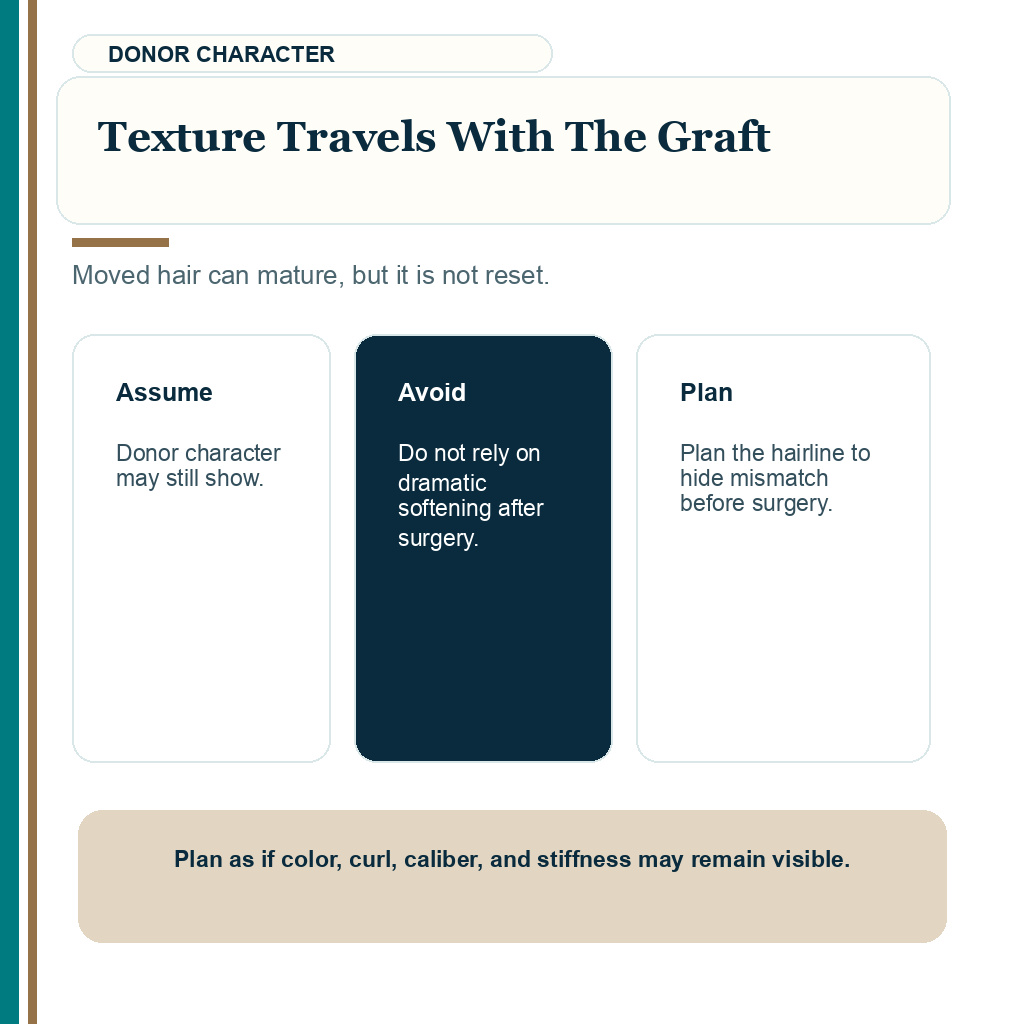
A graft keeps many source characteristics after it moves. Beard hair, chest hair, and scalp hair may differ in caliber, curl, color, growth length, and texture. Natural curl does not remove that source mismatch. It only changes how the mismatch appears.
Reserve hair belongs in a plan only after the leading edge and donor budget are protected. It may support density behind a scalp graft buffer, or it may be avoided if the contrast is too visible. Growth on the scalp is only the first test. The harder test is whether that graft source can sit in the chosen zone without making the hairline look artificial.
Can beard hair look too strong in the first rows?
Beard hair often has a larger shaft diameter than scalp hair. It may be darker, curlier, and more rigid. When it is placed behind scalp hair, that strength can sometimes help create coverage. When it is placed at the leading edge, the same strength can make the hairline look heavy.
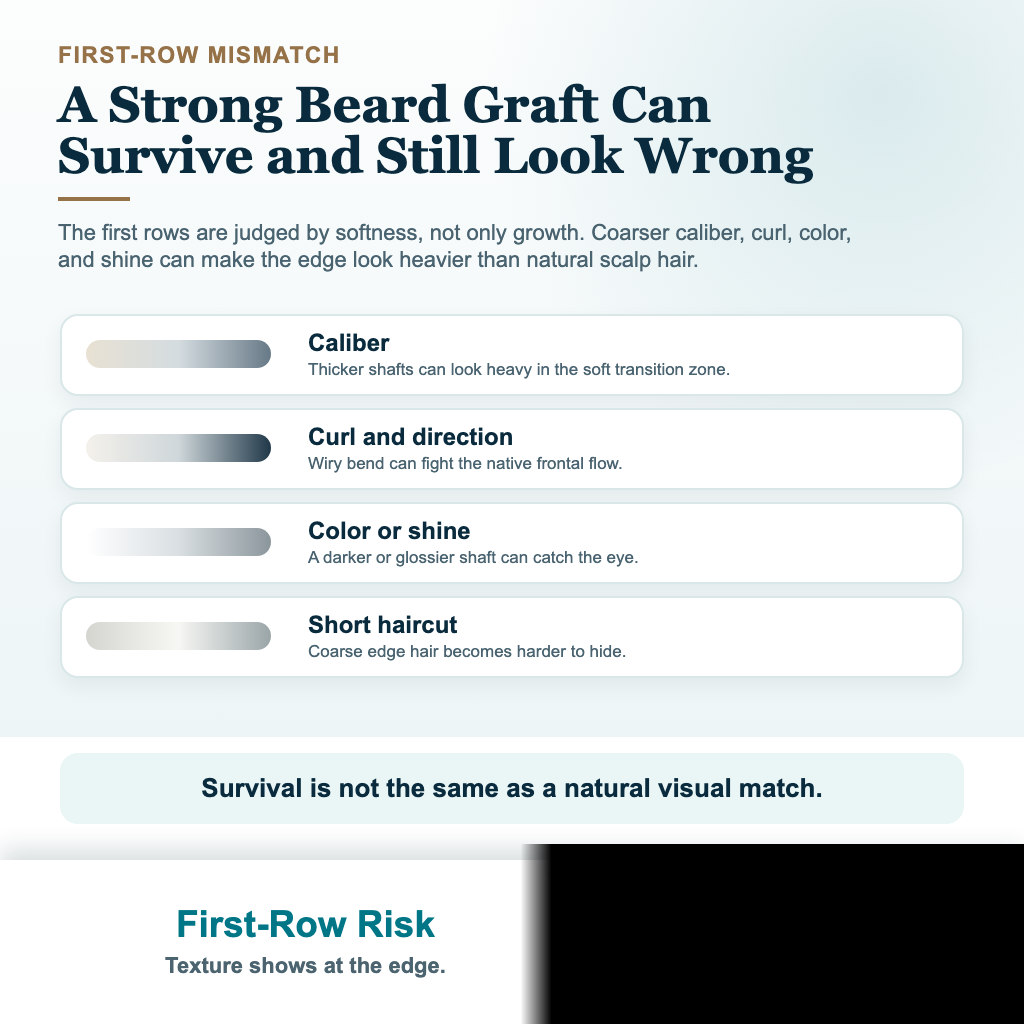
The practical trap is assuming that a transplanted graft changes character just because it has been moved. Beard or body hair may grow on the scalp, but it can keep important donor characteristics such as color, curl, and caliber. It does not simply become soft frontal scalp hair. Hair character travels with the graft, so donor selection matters before the first incision is made.
Natural curl does not remove the source mismatch. A curly beard graft, a curly chest graft, and a curly scalp graft can still differ in caliber, growth length, and direction. The visible front edge needs the source that looks softest at close distance, not simply the source that raises the count.
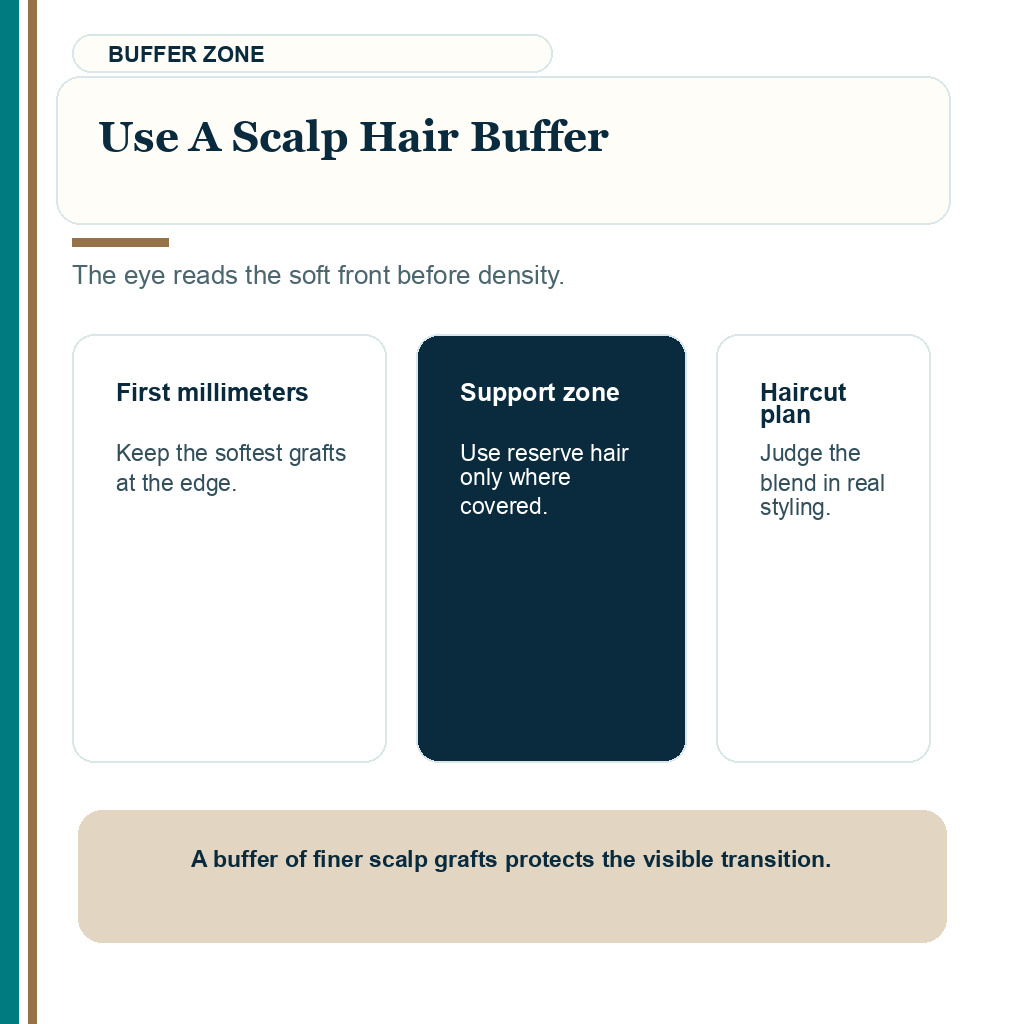
There are exceptions, but I keep the planning principle conservative. If beard hair is used near the front, it should usually sit behind a buffer of finer scalp singles. The buffer matters because the eye reads the front edge first. A few coarse grafts placed too far forward can be more visible than many grafts placed deeper in the pattern.
Extra beard or body hair can add coverage, but it should not be planned as the soft front edge unless the texture match is truly suitable.
Will moved grafts become frontal scalp hair?
Some change in length, styling, and how the hair sits on the scalp can happen, but I do not plan a hairline on the hope that beard, chest, or body hair will become identical to fine frontal scalp hair. The conservative assumption is that color, curl, caliber, stiffness, and growth behavior may remain visible enough to matter.
If a proposed hairline only looks acceptable after assuming the reserve hair will soften dramatically, the plan is too optimistic. Before accepting beard or body hair near the hairline, ask where the mismatch will be hidden if the hair keeps its original character. The plan should still look reasonable under that stricter assumption. If it does not, the better answer may be fewer reserve grafts, deeper placement, or a smaller hairline goal.
Chest and body hair need stricter predictability checks
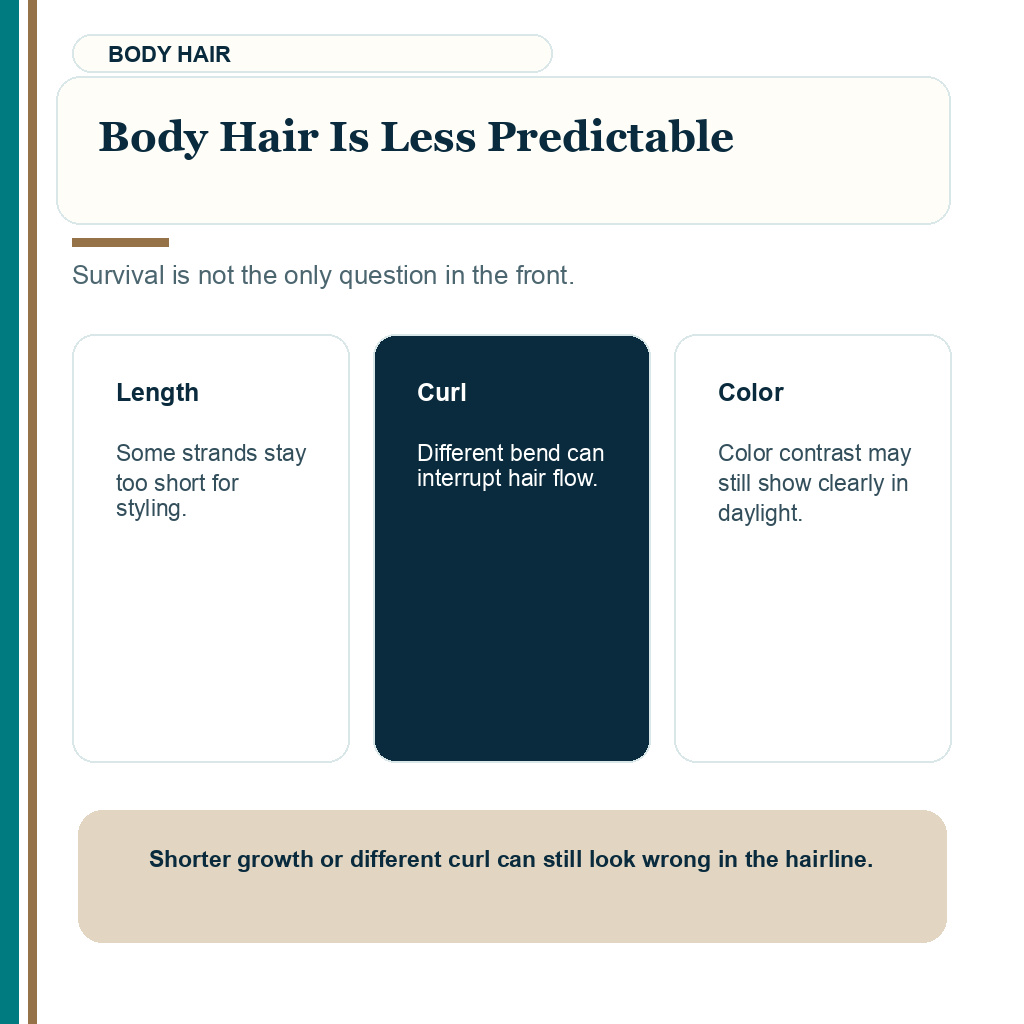
Chest and other body hair can differ from scalp hair in shaft diameter, curl, color, length potential, growth cycle, and exit angle. Some body hair stays shorter. Some curls quickly. Some grows with a softer appearance than beard hair but still does not behave like native frontal scalp hair. The issue is not only whether it survives. The issue is whether it creates the right visual transition.
A patient may think thinner chest hair sounds suitable for the front. Sometimes the texture seems softer than beard hair, but it may also have a shorter growth phase and a different curl pattern. If it cannot grow to the same styling length, it may stand apart from nearby scalp hair. If it curls differently, it may break the flow of the hairline.
Chest or other body hair also needs realistic growth planning. A graft that survives but stays shorter, curlier, or lighter may still fail as face framing hair. If it behaves that way, it should sit deeper as support hair, not in a place where every strand has to blend with the frontal edge.
Body hair for visible temple work needs caution too. Body hair transplant for temples carries the same problem because temple areas are unforgiving. The front hairline is at least as visible. A weak scalp donor does not make the front edge less important. It makes planning more disciplined.
A scalp hair buffer can hide reserve hair in selected plans
Selected reserve hair can sometimes be hidden behind scalp hair if the design leaves enough soft grafts at the front. A common strategy is to reserve fine scalp singles for the leading edge and use stronger hair farther back. The patient still needs realistic density expectations. The surgeon cannot create unlimited coverage just by mixing donor sources.
Blending depends on native hair, color contrast, curl, skin tone, planned haircut, and the amount of remaining scalp donor. If you want a brushed back style, every mismatch at the front becomes more visible. If you keep the hair longer and forward, deeper support grafts may be easier to hide. Planning should be based on how you will actually wear the hair, not only how it looks wet in the clinic.
If beard or body grafts would sit behind existing native hair, I also assess how the blend could look if that native hair thins later. A planned buffer of suitable fine scalp grafts is different from relying on hair that was already there before surgery. Loss of that existing cover may expose coarser support grafts even when they have grown well. The placement should make sense under that possibility, without assuming that another operation will always be available to hide the mismatch.
Donor accounting matters here. A patient with limited scalp reserve may need a staged plan, a smaller frontal goal, or a crown compromise. In lifetime hair transplant graft planning, protecting donor supply over decades matters more than filling every visible gap today. A smaller natural plan is often better than a larger mismatched one.
Repair surgery makes source placement stricter
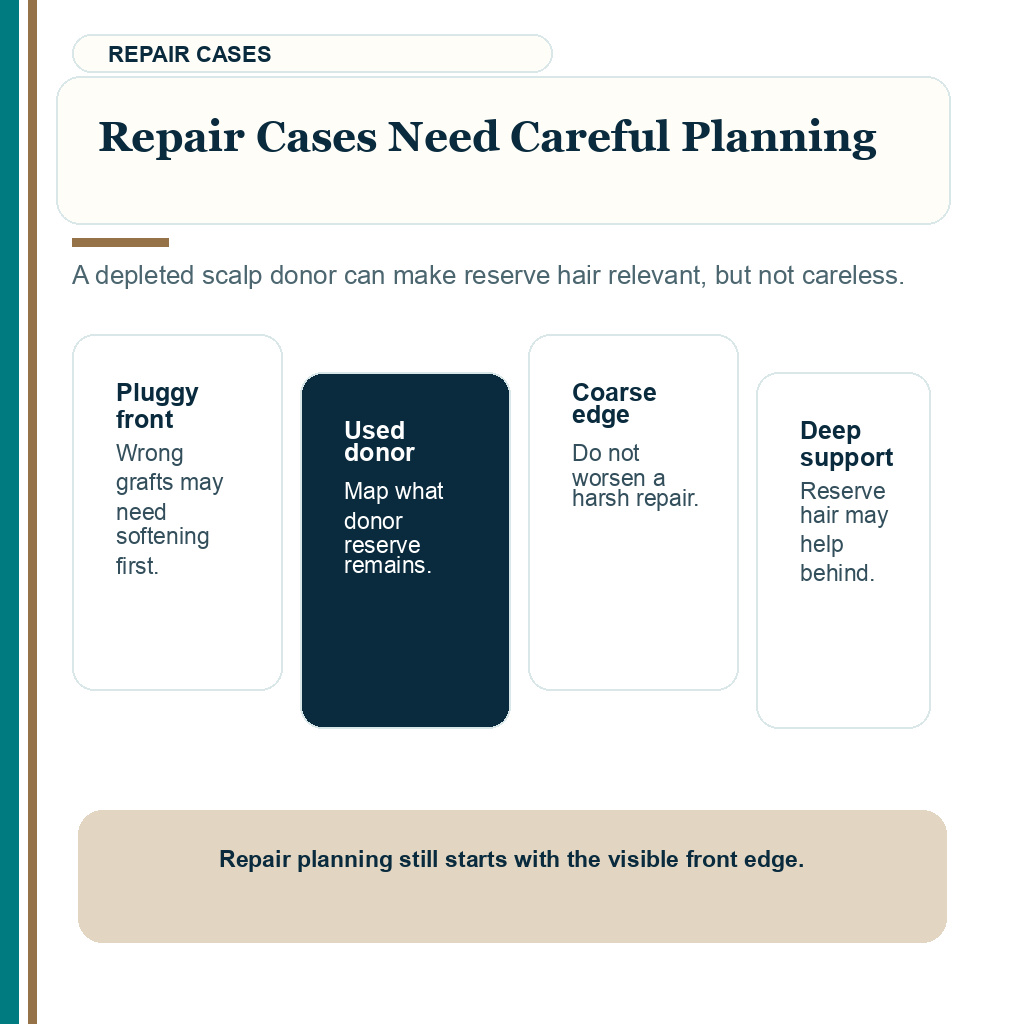
Repair cases can make beard or body hair more relevant because the scalp donor may already be reduced by previous surgery. A patient may have a pluggy front, overharvested donor area, low hairline, or depleted reserve after multiple operations. In that setting, beard or body hair may be discussed as part of a salvage strategy.
Repair work still does not remove the aesthetic rules of the hairline. If the front edge is already harsh, adding coarse hair into the first rows can worsen the problem. The better repair may involve removing, softening, or redistributing incorrect grafts, rebuilding the front with fine scalp singles, and using beard or body hair deeper in the pattern only when it blends. Bad hair transplant repair often means accepting the remaining donor reality, then choosing where reserve hair can safely blend.
After two or more procedures, the hope is often that one more session can fix everything. The answer depends on donor quality, scar pattern, skin condition, and the importance of each zone. Before accepting a plan that depends on every possible donor source, check whether the plan still respects third hair transplant safety.
Check donor details before the plan expands
The donor plan should be checked in person or with very clear photo and video documentation. The clinic should review scalp donor density, beard density, face and beard styling preferences, body hair character, skin healing, previous scars, and the patient’s styling goals. Extra donor options only help when the hair character fits the zone being planned.
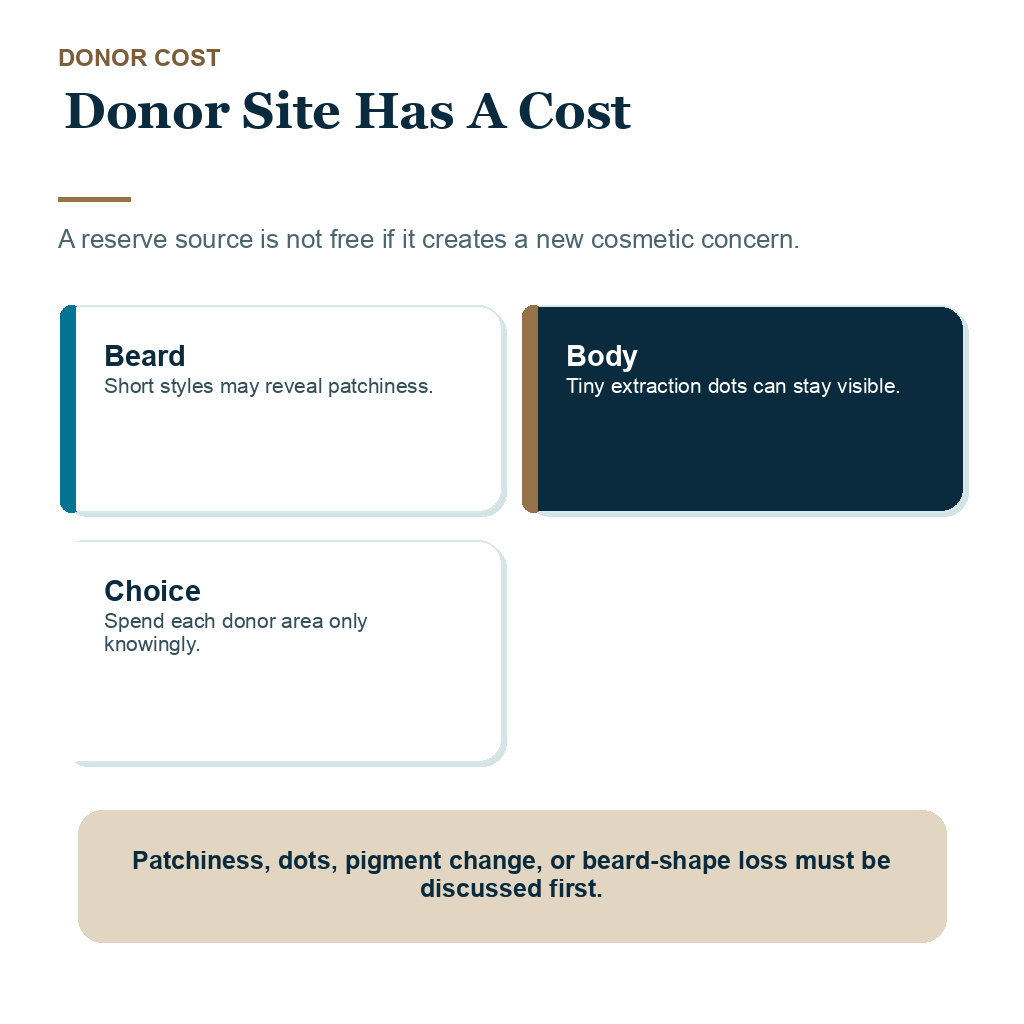
The donor area appearance also matters. Beard extraction can create visible patchiness or tiny marks if the patient keeps a short beard or clean neckline. Chest or body extraction can leave visible dots, pigment change, or uneven hair loss on the body. A reserve donor source is not free if the donor area becomes a new cosmetic concern.
The plan should separate the first hairline rows, the zone immediately behind them, the mid scalp, the crown, and any repair area. Each zone has a different tolerance for coarseness and direction. The first visible rows should be protected as a separate design problem, not treated as another place to spend spare grafts.
Good documentation is not just one close-up hairline photo. I want to see the hairline, donor area, beard, and body hair under normal lighting, with dry hair, wet hair if useful, side angles, temple points, views with short donor hair, and a brief movement video when possible. Those views show contrast, curl, scars, overharvesting, and styling habits more clearly than a single flattering frame.
A clear source map should be ready before surgery. It should show which grafts go into the first rows, which grafts sit behind them, and which grafts are reserved for crown or repair support. A single blended graft number is not enough when the donor sources have different texture and visibility risks.
Mixed donor plans should separate quantities as well as zones. The front rows, buffer, crown, and repair areas may need different hair sources, so one blended graft total hides the detail that decides whether the result will look natural.
The source map should show where reserve hair may help and where it can make the visible front too strong.


Ask these questions before body hair is placed near the hairline
The first two or three hairline rows need a source plan by zone, not only a total graft number. The plan should identify whether those rows use scalp singles only, where beard or body hair begins, how many reserve grafts are planned, and how the clinic will prevent a coarse or curly edge. If the explanation stays vague, the plan is not ready.
Ask to see results that match your donor situation and hairline goal, not only dramatic full head transformations. A case focused on the crown does not prove that beard hair should be placed in a frontal edge. A repair case shown only with long hair does not prove that the same plan will look natural with a short style. Useful proof should include close-up hairline views, side angles, temple points, donor area healing, daylight, wet or separated hair when relevant, and movement, not only a dense front photo.
Also discuss the fallback plan if the donor match looks poor. The fallback may need to reduce the hairline goal, stage the work, or prioritize the area that matters most. Discuss repair limits if a coarse graft becomes visible at the edge, because removal or redistribution can consume more donor reserve. If the drawing depends on adding more donor sources until it is filled, step back before accepting it.
When should the plan be reduced instead of expanded?
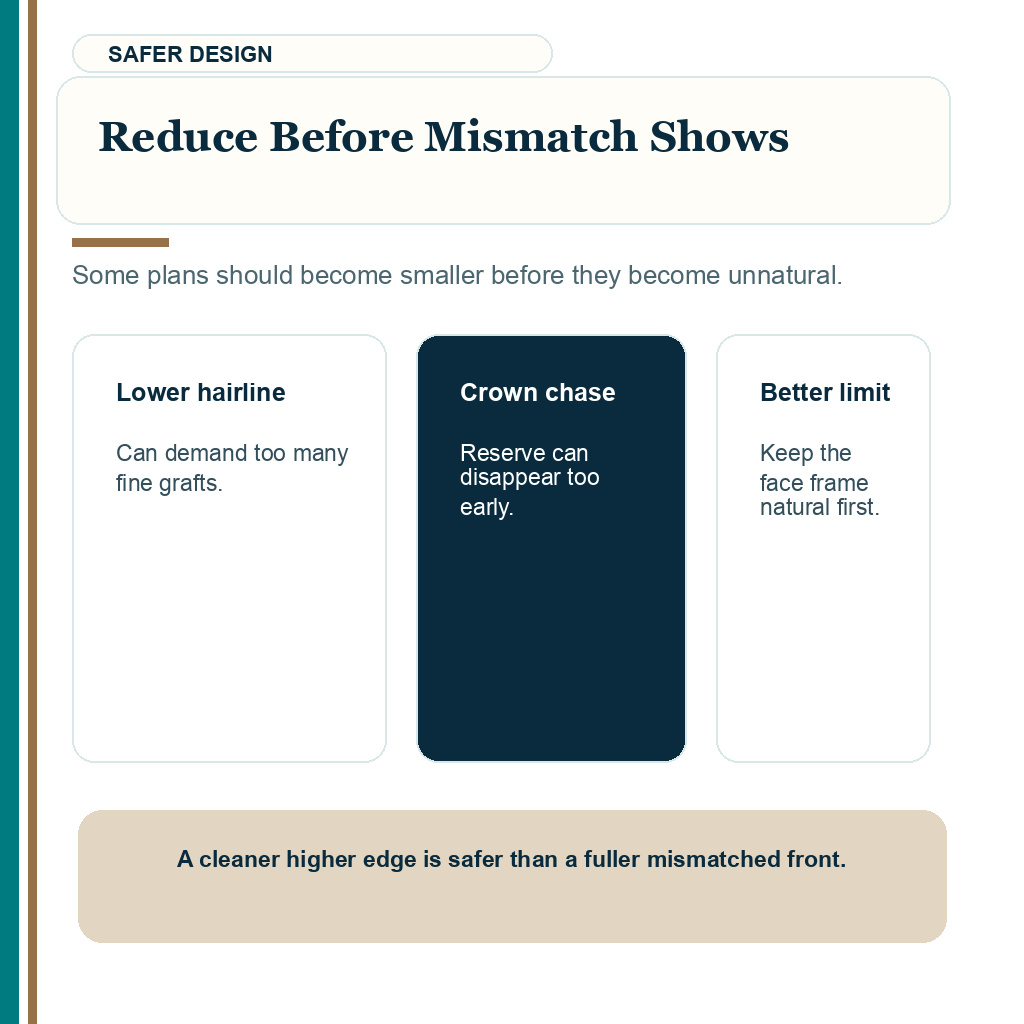
The plan should be reduced when a natural front cannot be built with suitable scalp hair. It should also be reduced when the proposed density requires too many coarse reserve grafts near the leading edge. The patient may want a lower or fuller hairline, but the donor supply sets limits. Ignoring those limits can create a result that is technically full but visually wrong.
Reduction can mean a slightly higher hairline, a more mature shape, fewer grafts in the crown, or a staged approach. It can also mean treating medication, stabilizing native hair, or waiting before repair surgery. Too many grafts in a hair transplant can become the problem when more grafts are used to chase a drawing instead of a natural result.
Sometimes the right decision is to protect the front and accept that the crown will remain thinner. In another case, the right decision is to improve the frame of the face while leaving density modest. Naturalness should outrank the urge to use every available graft.
Temples and temple points are stricter zones
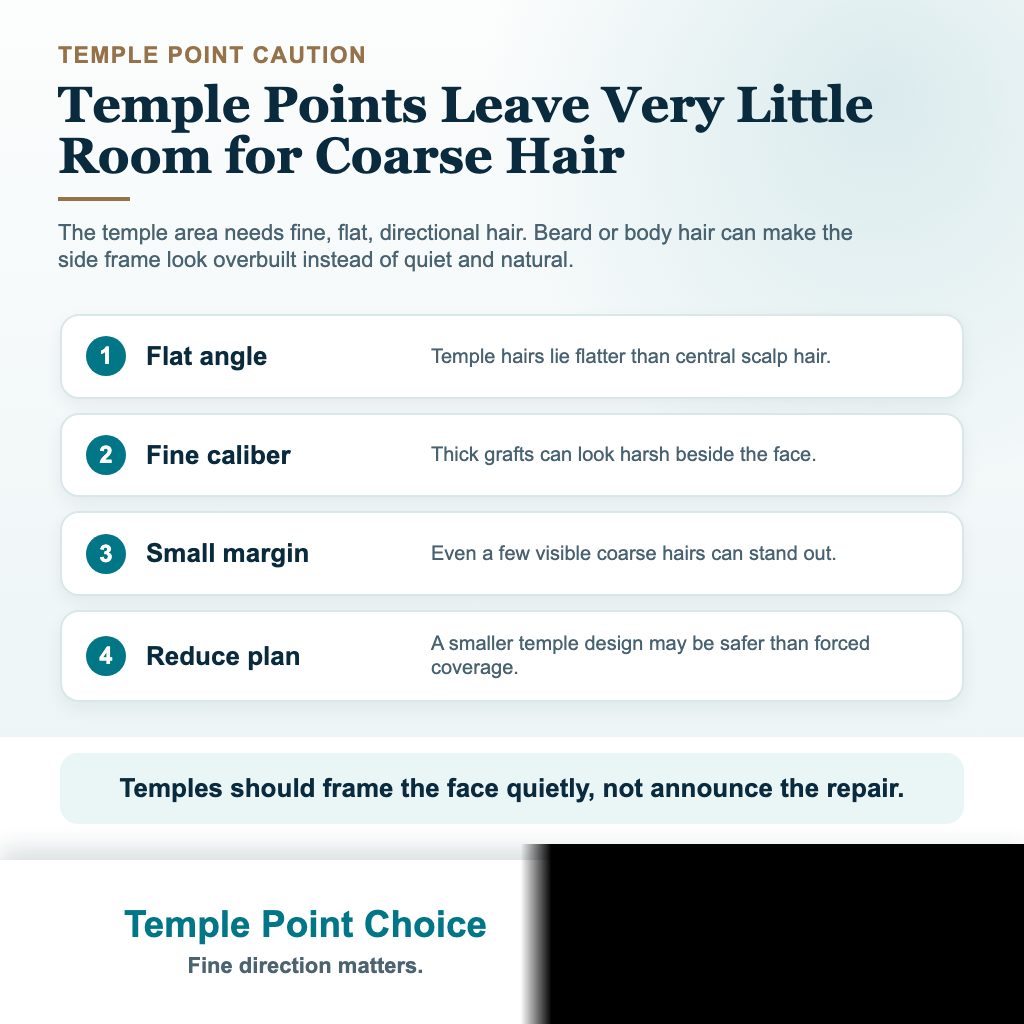
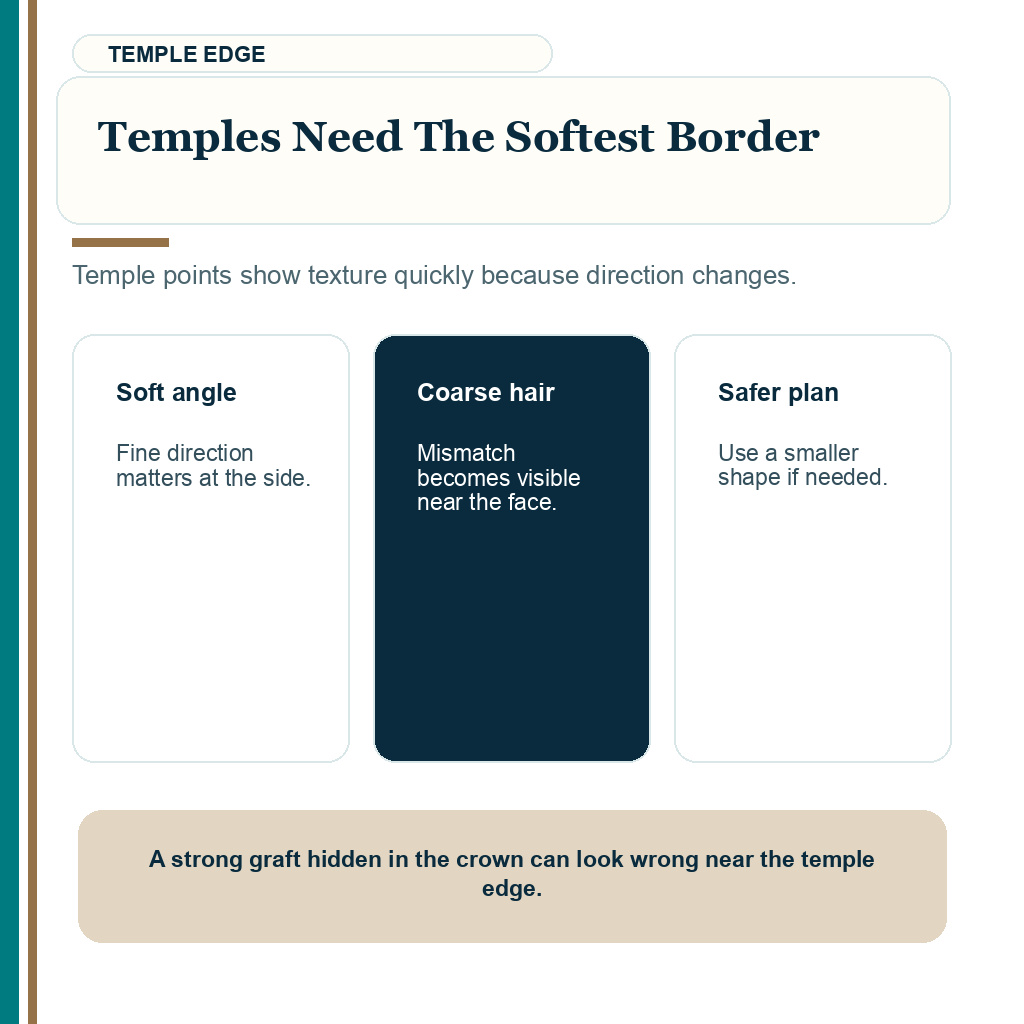
Temples and temple points make the decision stricter. These zones use fine angles and soft direction. Coarse or curly hair can look especially obvious there because temple hair sits on the side of the face and changes direction quickly. A strong graft that might be hidden in the crown can look wrong near the temple edge.
Temple point restoration should not be filled casually. If a clinic proposes body or beard hair for the temples or front corner, confirm that enough fine scalp singles remain to create the visible border. Without that soft border, the result can look like a patch rather than a transition.
Temple planning also affects age appropriateness. A very low, sharp, or closed temple plan may need more fine grafts than the donor can safely provide. Adding body hair may expand the drawing, but it can weaken the appearance if the visible border cannot be made soft enough. A more conservative shape may protect both the donor reserve and the final look.
The source map comes before the graft number
Start with the visible front. If soft scalp singles can build the first rows and reserve hair only supports behind them, the discussion can be reasonable in selected cases. If the plan depends on beard, chest, or other body hair at the leading edge, ask for a very clear explanation and matching proof.
The decision should include donor mapping, hair caliber comparison, expected haircut length, repair history, cosmetic tolerance for each donor area, and the patient’s tolerance for a less dense but more natural result. Body or beard hair can be useful, but it is not a direct substitute for scalp donor hair. It has to be placed where its character will not expose the design.
In my planning, this type of decision comes before graft numbers are discussed. A smaller, cleaner front is safer than a fuller edge created from mismatched hair. The deciding issue is not whether beard or body hair can grow on the scalp. It is whether that hair should be visible where the face is framed.

Read this review excerpt
told me the quality of my donor hair and what he could take out and advised me what will the be best outcome with what donor hair I had.