



Pluggy Hairline Repair and Graft Softening
A pluggy hairline after a hair transplant can often be repaired, but the right repair is rarely just adding more grafts. A natural repair may need selective graft removal, softer single hair graft placement, redesign of the hairline, correction of wrong direction, or a staged plan. If the first visible row is the problem, adding density behind it can make the line darker without making it look more natural. If the front row needs thinning before camouflage, review electrolysis, laser, and FUE punch removal options for bad hairline graft removal first. If the question is specifically whether laser can thin the visible front row, review laser hair removal for transplanted hair before choosing that route. With a buzz cut, pluggy grafts are harder to hide because longer hair is no longer softening the front row.
Diagnosis comes before repair planning. A temporarily wiry or immature hairline is different from a structurally pluggy hairline. A month eight hairline check can be useful when the patient is trying to decide whether the front edge is still maturing or already showing a design pattern. A pluggy edge, a hairline that is too low, wrong graft angle, thick multi-hair grafts, poor spacing, and weak density can all make the front look unnatural. They can look similar to a patient, but they may need very different solutions. A density problem has to be separated from a shape, angle, graft size, or position problem before repair is discussed.
If the worry is one or two sites becoming thicker with time, first separate that from the broader pattern described in hairline grafts that grow more than one hair later.
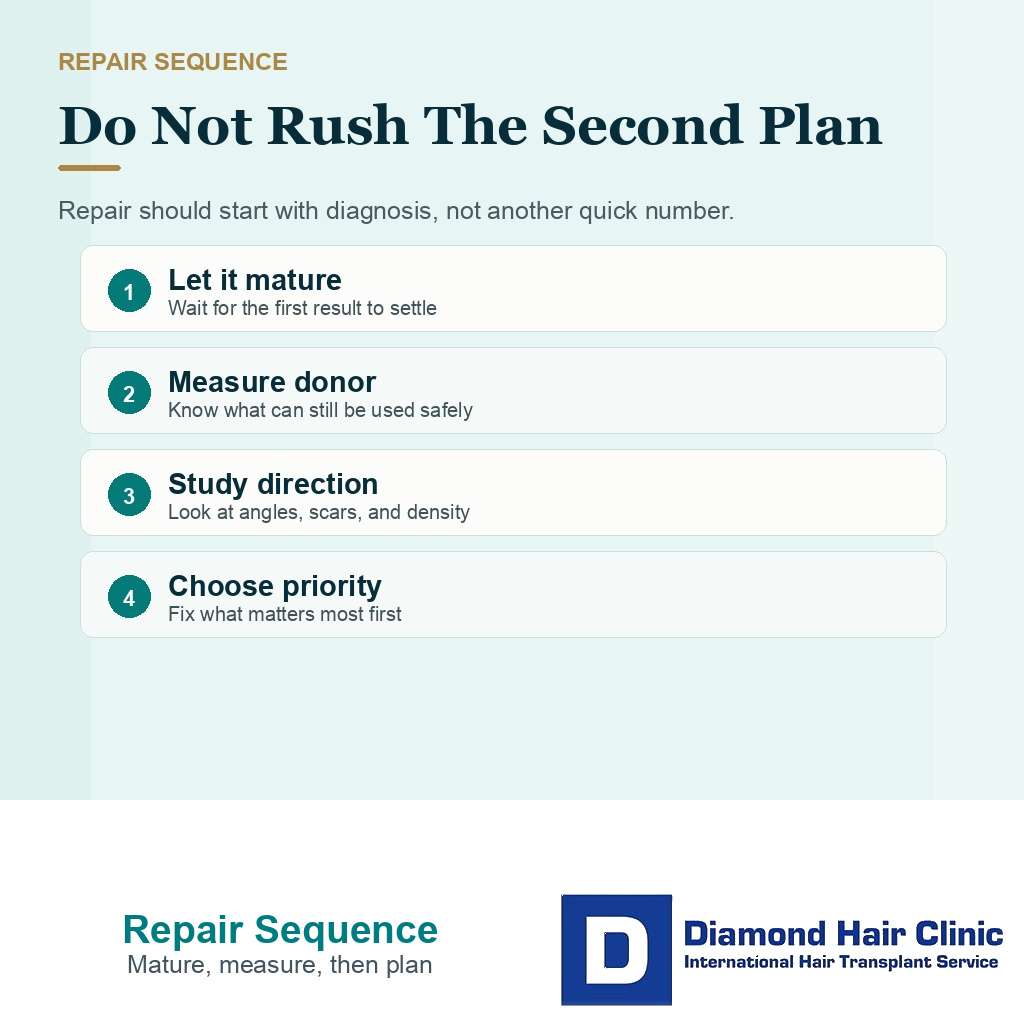
In most cases, it is usually safer to wait at least 12 months after the original surgery before final repair planning, unless there is a clear technical issue that needs earlier observation. The hair must mature, the skin must settle, and the real defect must be visible before making the decision whether to remove, camouflage, or rebuild. If the first row may need to be thinned rather than only camouflaged, review electrolysis, laser, and graft removal after hair transplant before choosing the sequence.
Planning a pluggy hairline repair
Practically, pluggy hairline repair begins with separating the visible problem from the emotional reaction to it. Panic is understandable when the hairline looks artificial. The front edge is seen every day in the mirror, in photos, and in conversation. But a rushed repair can create a second visible problem.
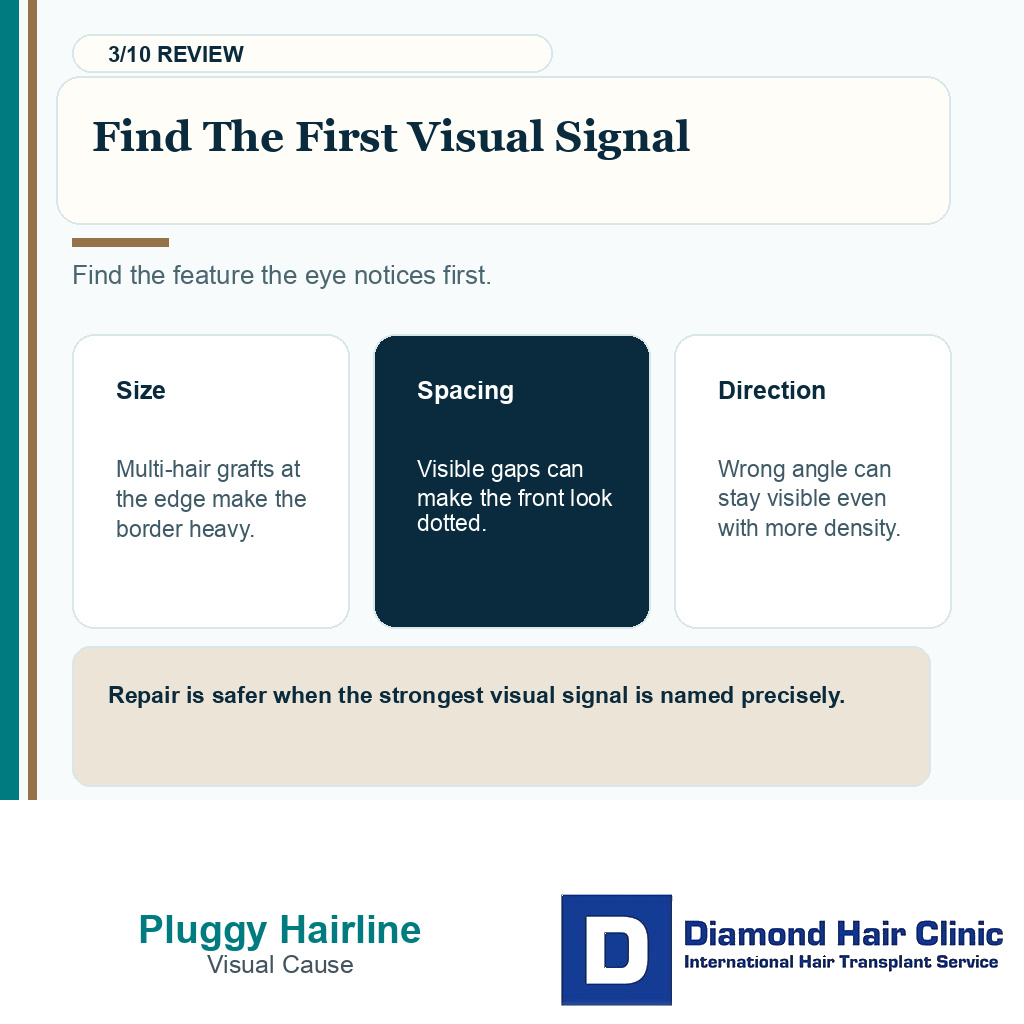
The starting question is not how many grafts should be added. It is what the eye is noticing first. The thickness of the grafts along the front edge, the height and shape of the line, the direction of growth, and the density behind the visible border all need review. A pluggy hairline can come from one of these problems or from several of them working together. In Afro textured cases, curl direction changes the repair review because a thick or upright front row can look harsher after a simple density pass. A useful repair plan names whether the first move is removal, camouflage, or waiting.
Graft removal is not only a number decision because it has to fit the repair sequence. Each removal site has to be weighed against scarring, empty gaps, and whether softer single hair grafts will be needed later. Removal and added singles should wait until the new front edge has been drawn. Some old grafts may be worth keeping if they help the new outline, so repair planning should not assume every visible hair has to be removed. The skin surface is part of that decision, because removing the wrong graft can still leave texture that needs its own plan.
After earlier removals, I judge the remaining grafts one by one. The next move may be softening the transition, leaving some useful hairs alone, or stopping further removal because the skin cost has become larger than the cosmetic gain.
Bad hair transplant repair becomes safer only when the defect is named precisely. The plan may need to soften the wrong visual signal, remove selected grafts, rebuild a transition zone, or leave some areas alone to protect the remaining donor area.
A hairline can look pluggy for several reasons
A hairline usually looks pluggy when grafts that are too large or too strong are placed in the most visible front rows. A natural hairline should begin softly, with finer single hair grafts and irregular transition. When thick grafts sit at the edge, the eye notices them quickly. If the skin edge itself is uneven, pitting or ridging after transplant surgery needs separate assessment.
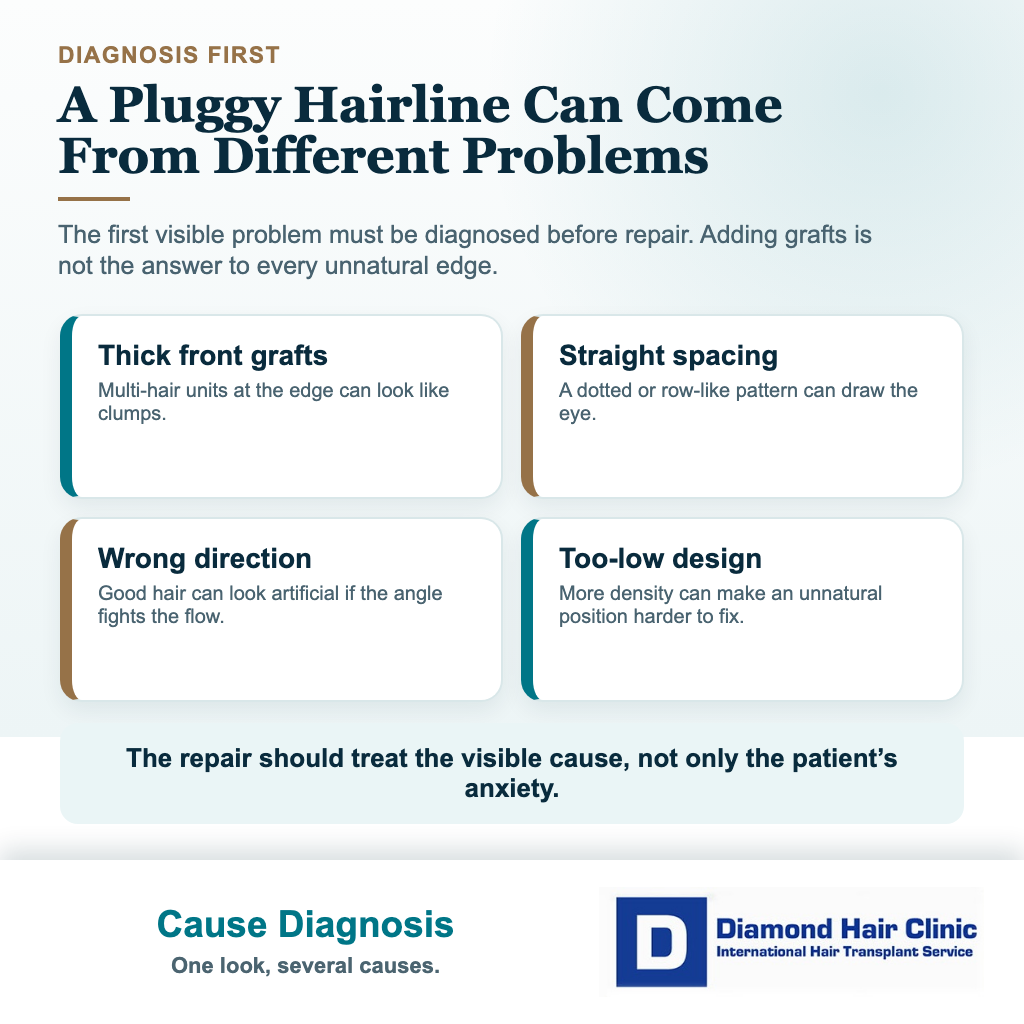
Pluggy appearance can also come from spacing. If large grafts are placed with visible gaps between them, the front can look dotted rather than soft. If the pattern is too straight, the hairline may look drawn on. If the grafts are placed at the wrong angle, even a good number of hairs can look unnatural.
Hair caliber matters too. Some patients have strong, coarse donor hair. That can be useful for coverage behind the front, but it can look harsh if placed at the leading edge. That texture issue is part of wiry or coarse transplanted hair. At the front, the softest possible hair selection and the most careful placement matter most.
Repair should be planned after the result has stabilized
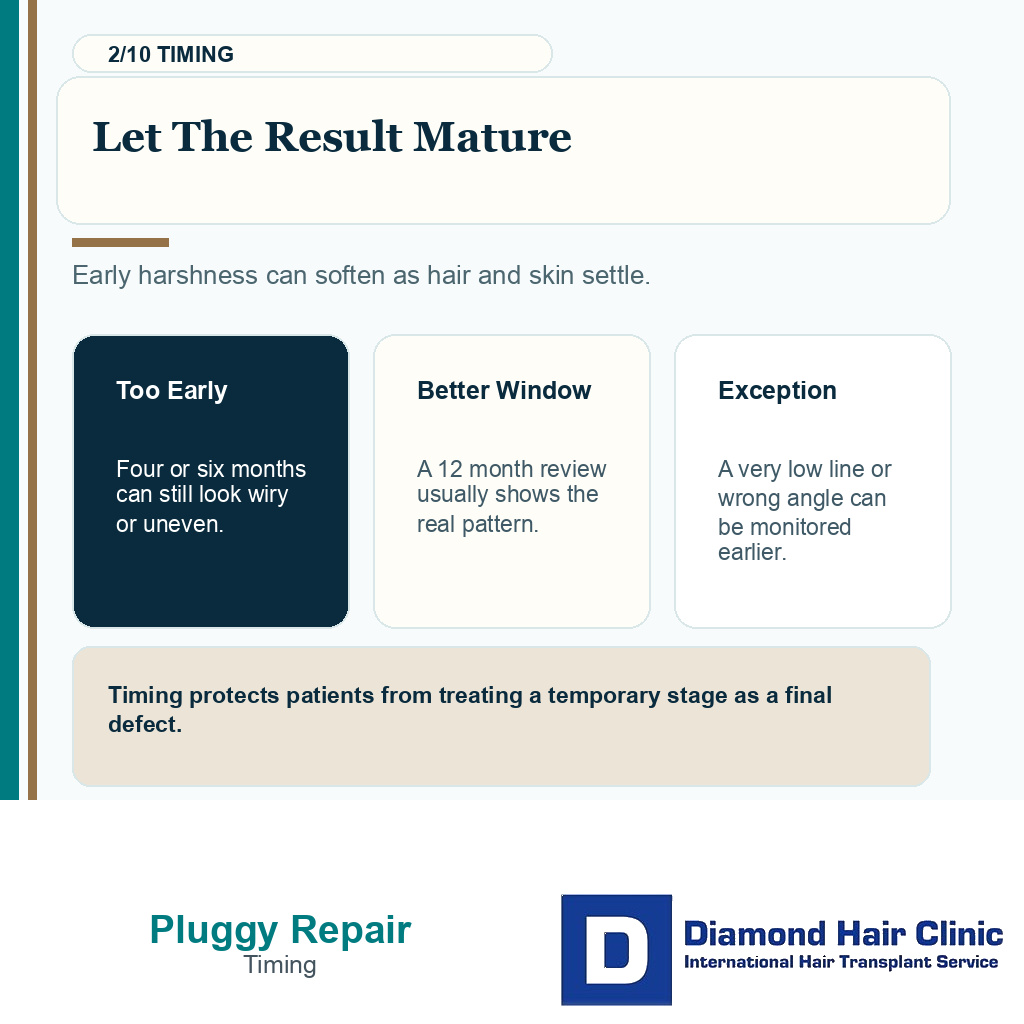
Most repair decisions should wait until the original transplant has matured. At 4 months or 6 months, a result can look strange, uneven, or thin without being final. The hair may still be short, wiry, or immature. The skin may still be changing. Repair planning too early can lead to treating a temporary stage as a permanent defect.
At 12 months, the frontal result is usually much easier to judge. It becomes clearer which grafts are truly wrong, which areas need softening, and whether density behind the hairline is helping or hurting the appearance. If the crown is involved, repair timing may be slower because crown maturation can take longer.
There are exceptions. If a hairline is obviously too low or the graft angle is clearly wrong, the repair conversation may start earlier, but that does not always mean surgery should happen immediately. Early review can explain the likely repair path without rushing into another procedure. It can also separate row regularity, hair angle, and true front row graft problems before density is discussed.
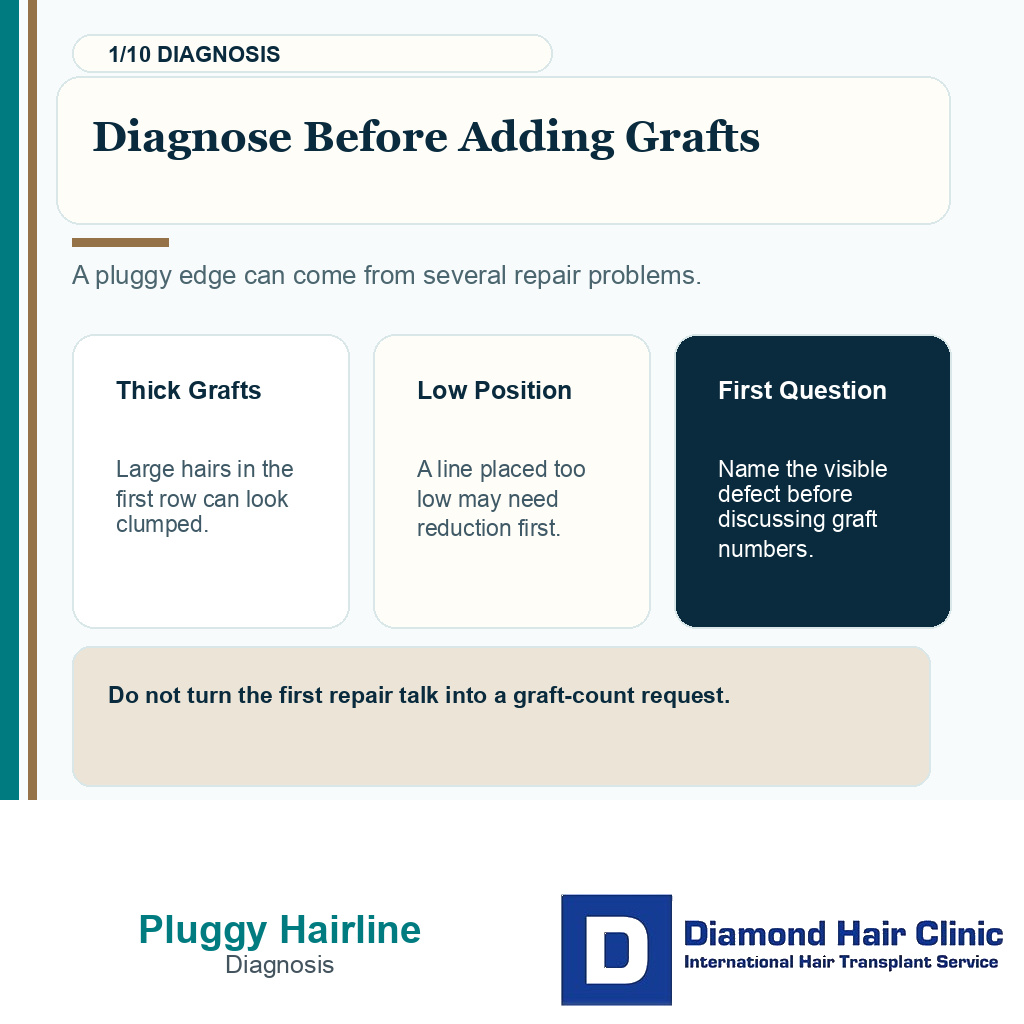
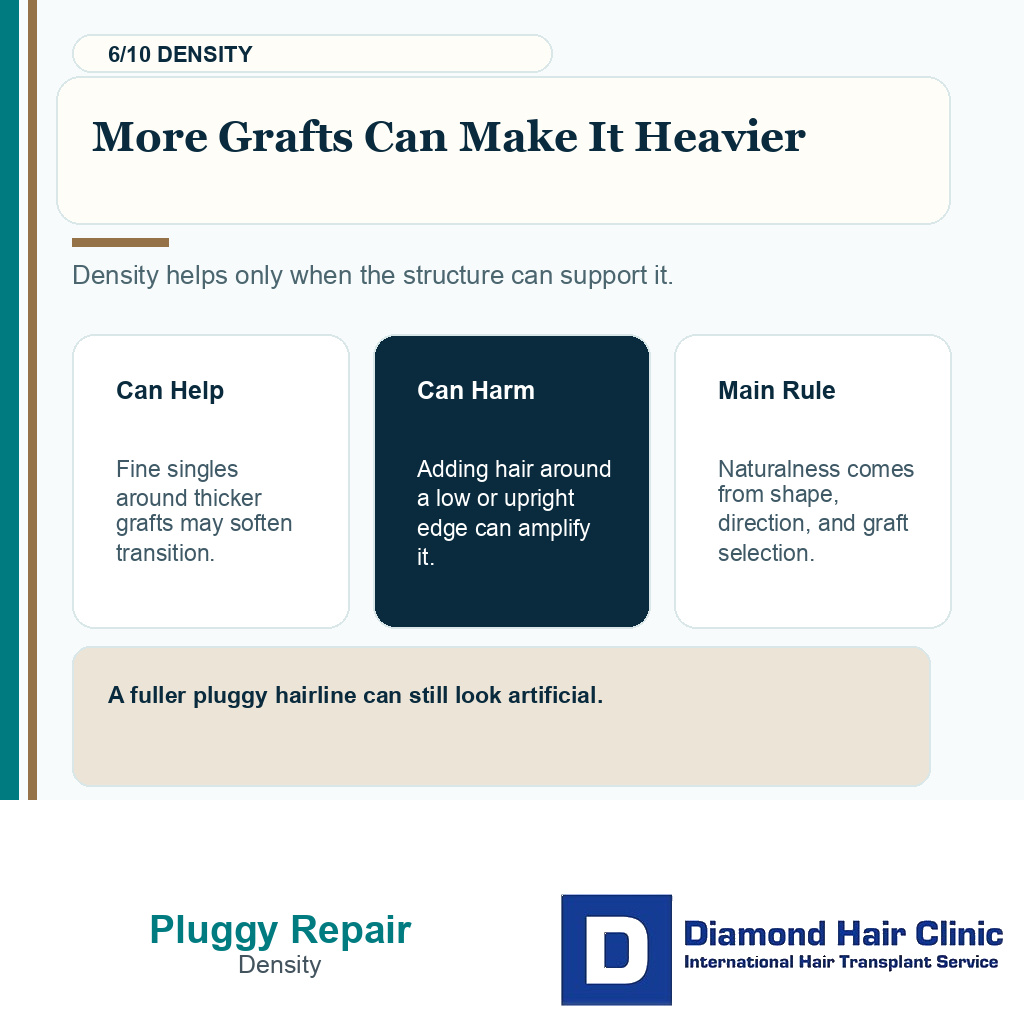
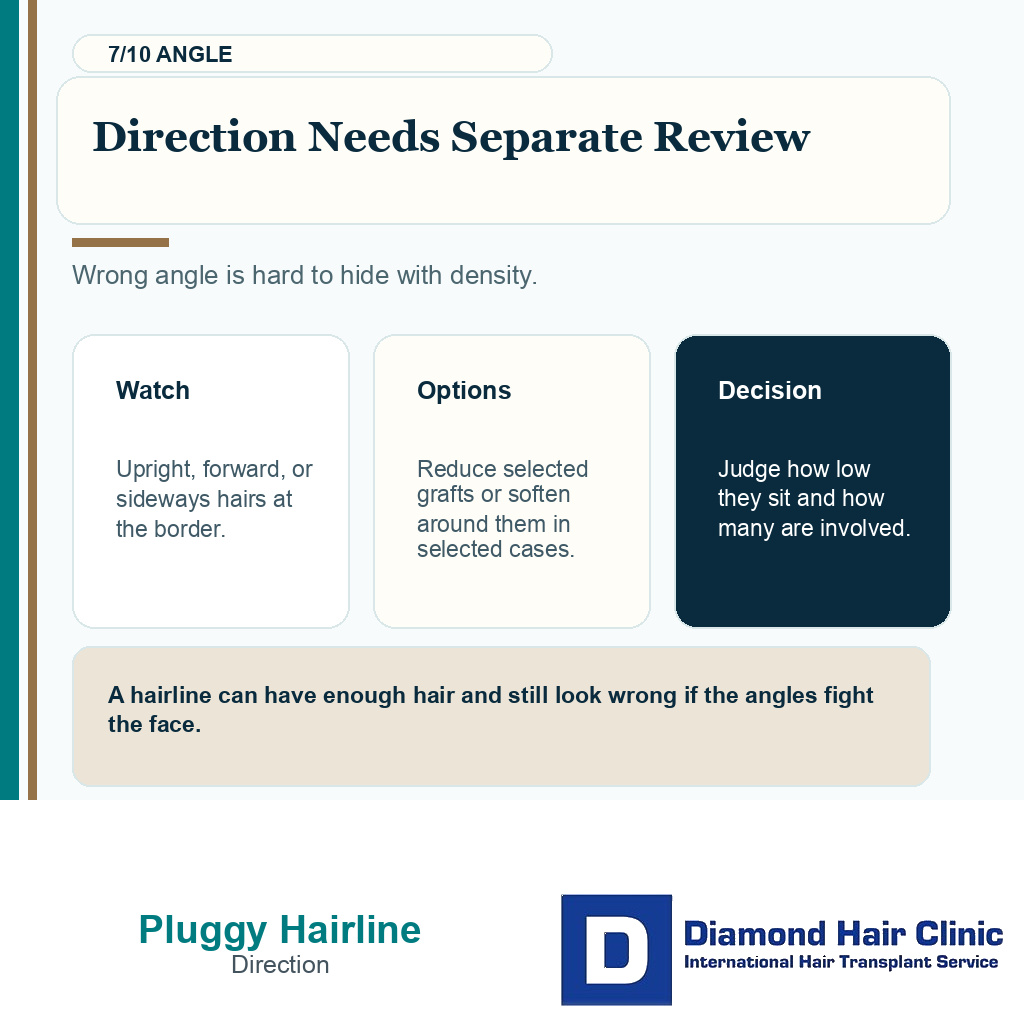
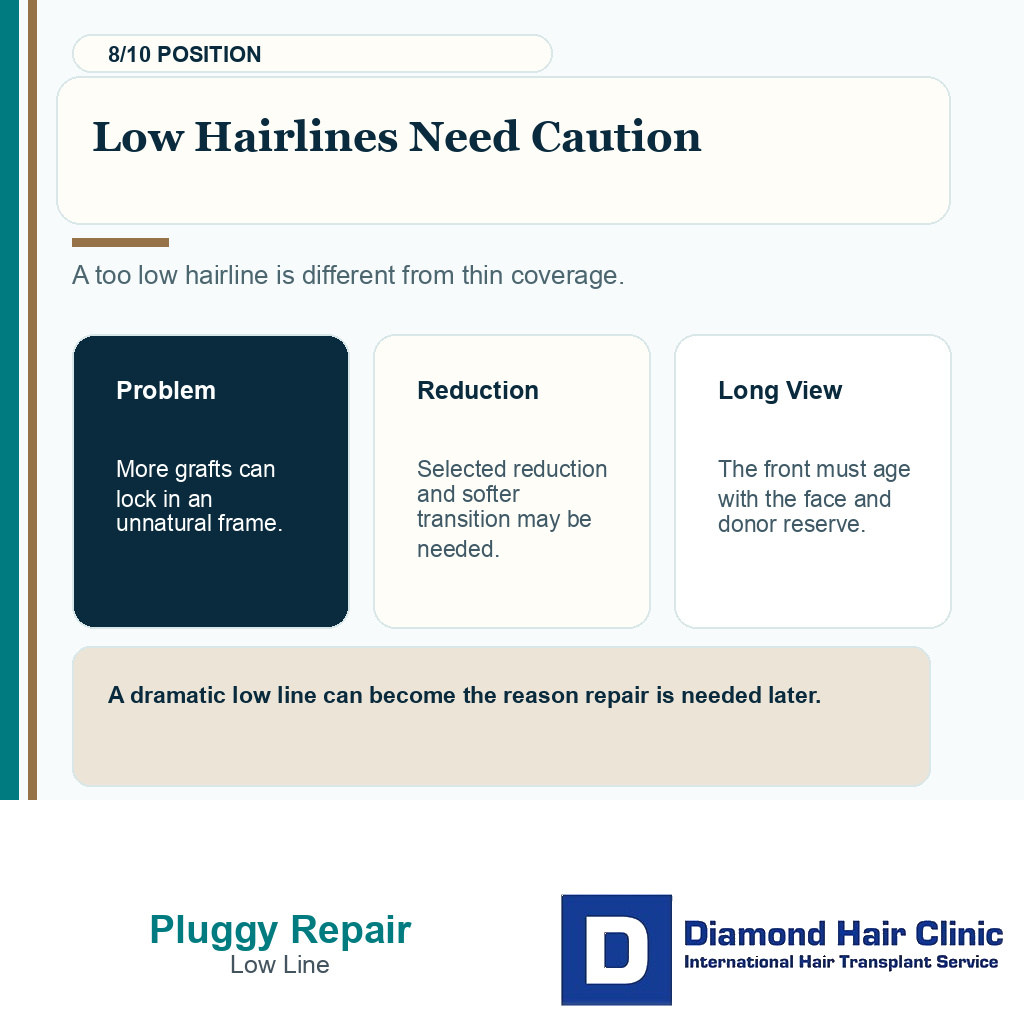
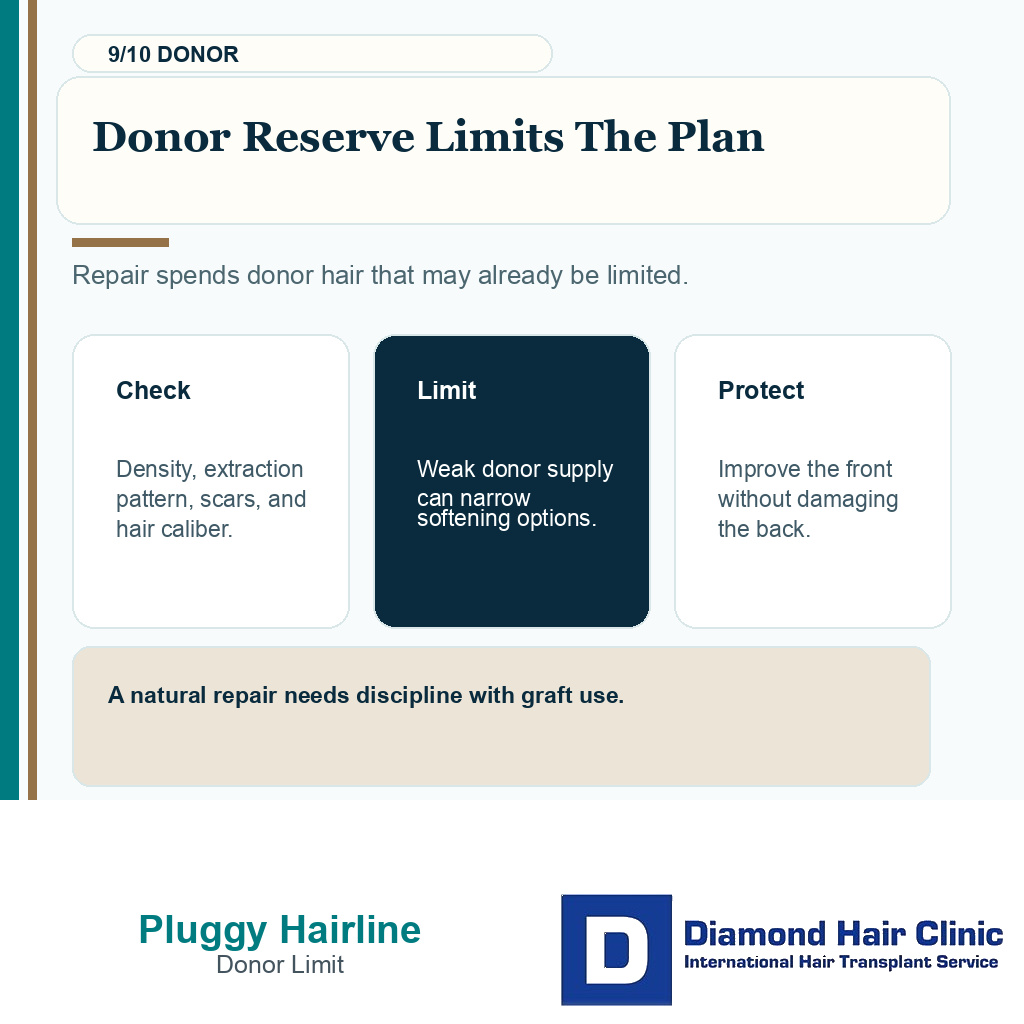
Use these 10 pluggy hairline repair slides to separate timing, removal, camouflage, direction, and donor limits before planning a repair. Swipe sideways, use the arrows to move one slide at a time, or choose a number below the image to jump to a specific slide.
Choosing between removal and camouflage
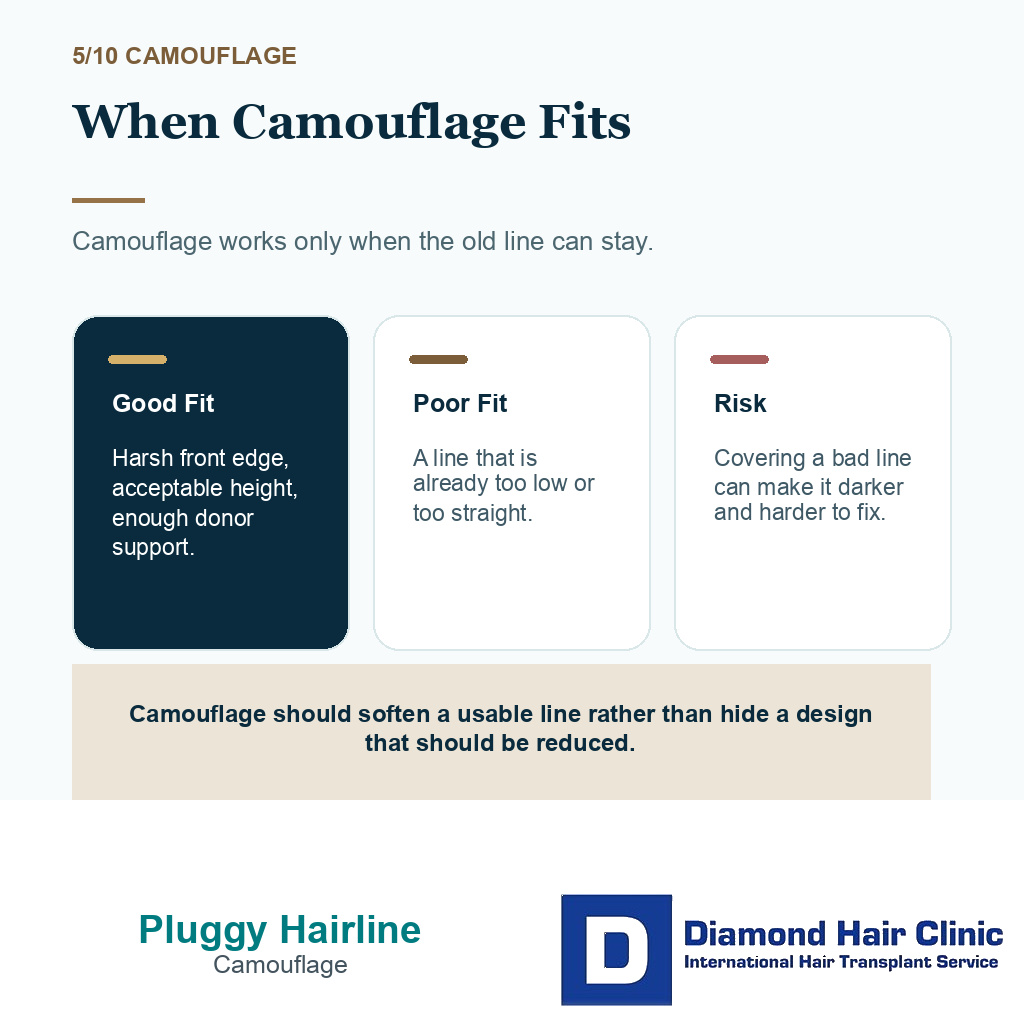
The choice between removal and camouflage depends on whether the old line can safely remain. If a few thick grafts are sitting in the front edge but the hairline position is reasonable, selective removal or reduction may help. If the front edge is harsh but the position is acceptable, carefully placed single hair grafts may soften it.
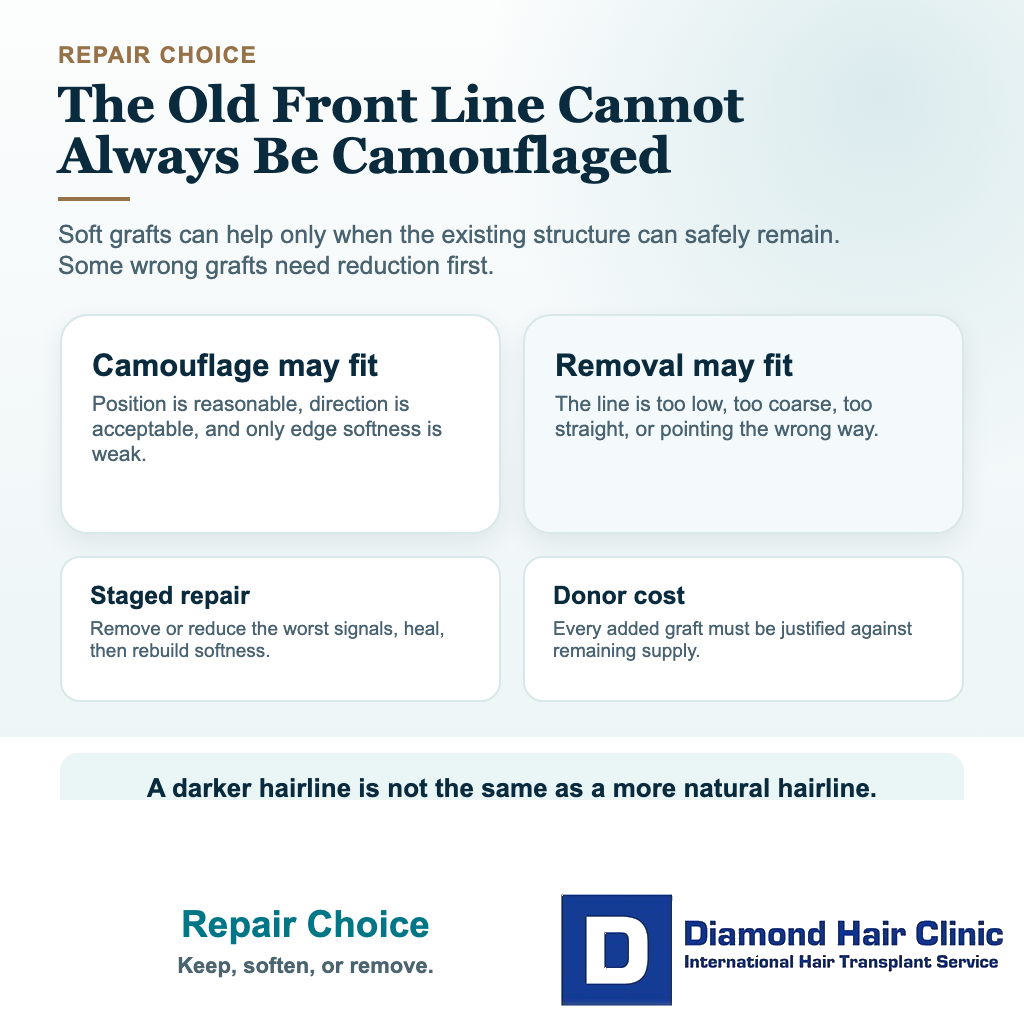
If the hairline is too low, camouflage alone may make the problem heavier. Adding more hair in front of a low, unnatural line can trap the patient in a design that should have been corrected. Then, removal or reduction may be needed before rebuilding.
If the main problem is weak density behind the edge, adding more grafts behind and around the hairline may help. But one photo is not enough for that decision. The plan needs close examination, different lighting, donor review, and a clear understanding of the patient’s future hair loss pattern.
When the old hairline does not connect naturally with the temples, fringe, or native density behind it, repair may need a transition plan rather than more grafts in the same border. Softening the edge can matter more than making the line darker.
Before choosing add, remove, reduce, or wait
The first decision is not the technique. It is whether the old front edge can stay in the final design. If the position and direction are usable, adding fine single hair grafts may soften the transition or improve weak density behind it.
If the old grafts are the reason the line looks artificial, removal or reduction may need to come before camouflage. This is more likely when thick hairs sit too low, point the wrong way, or make the front heavier when more grafts are added.
Waiting is also a decision when the result is still maturing or repeatable photos do not show the same defect. Rushing can spend donor hair before the real problem is clear.
If the worry has become a dispute about a poor result, refund, or repair, keep that conversation separate from the surgical plan. Records, timing, photos, donor review, hairline design, and skin texture should guide the next medical step.
Adding more grafts does not always solve a pluggy hairline
Sometimes adding more grafts can help, but only when the original structure is acceptable. Fine single hair grafts placed in front of and around thicker grafts can soften the transition. More density behind the hairline can also make isolated thick grafts less obvious.
But adding grafts is not a universal answer. If the existing grafts are too low, too coarse, too straight, or pointing in the wrong direction, more grafts may make the hairline heavier instead of more natural. It can turn a small unnatural edge into a larger unnatural edge.
In repair, hairline design becomes central. A good repair respects shape, height, irregularity, hair direction, and age-appropriate planning. Density alone does not create naturalness.
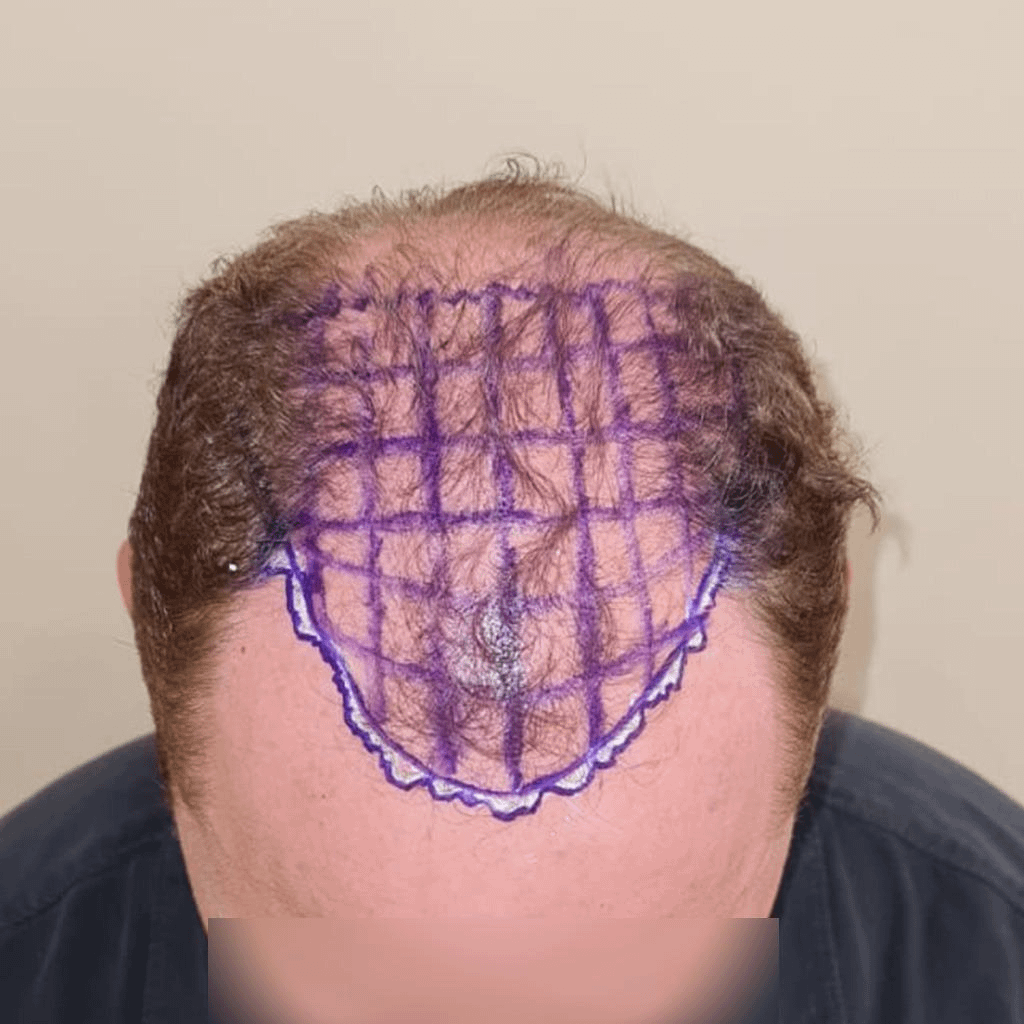
Repair complexity matrix
Four checks before repairing a pluggy hairline
Pluggy repair is not one operation. Timing, graft position, hair direction, donor reserve, and skin condition decide whether softening, removal, camouflage, or staged repair makes sense.
Maturity
Is the result mature enough to judge?
Early harshness can soften as growth, length, and styling change. Mature pluggy placement needs a different review than early concern.
Sometimes. Camouflage fits better when the old line is not too low, direction is acceptable, and enough fine grafts can soften the edge.
Use this as a planning frame, not a diagnosis or approval for surgery. The final plan still depends on donor reserve, recipient area anatomy, hair type, medical history, and future hair loss risk.
Graft removal is needed when camouflage would make the hairline worse
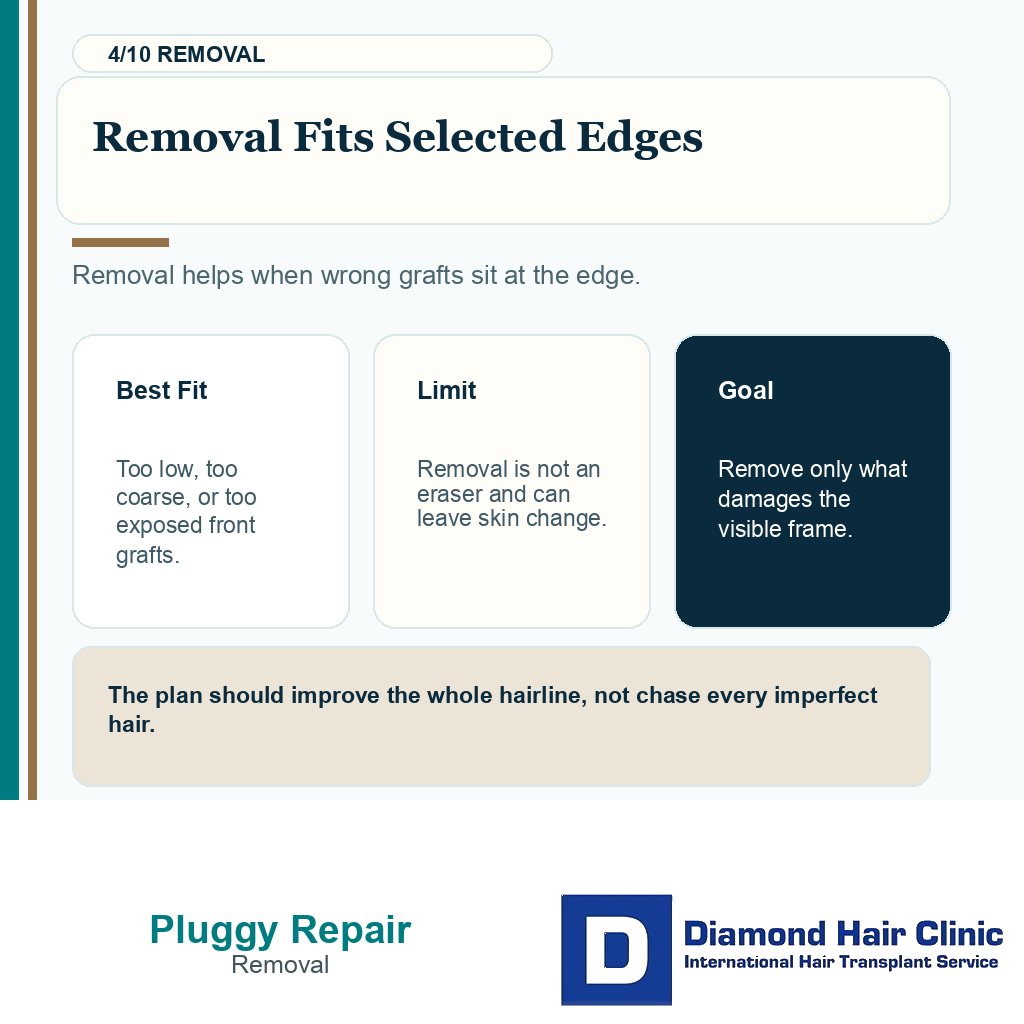
Graft removal may be needed when wrong grafts sit where a natural hairline should not have hair, when thick grafts create a visible pluggy edge, or when the hairline was placed too low. Removal can mean carefully extracting selected grafts, reducing selected hairs, or combining methods in selected cases.
Removal is not a casual step. Each removed graft can leave some skin change, especially in scarred or previously operated tissue. The plan should improve the overall visual impression, not chase every single imperfect hair. A repair plan should remove only what truly damages the appearance.
Sometimes removed grafts can be reused elsewhere, depending on their condition and the method used. Sometimes the priority is simply to reduce the harsh edge. This should be explained clearly before surgery because patients should not imagine removal as an eraser. It is a surgical decision with its own limits.
Possible role of electrolysis
Electrolysis can help in selected cases when a small number of wrong hairs need to be reduced. It may be useful for isolated hairs that sit too low or point in a distracting direction. It is not a complete repair plan for every pluggy transplant.
The advantage is that it can reduce specific hairs without another transplant session. The limitation is that it does not rebuild a natural hairline. If the difficulty is shape, density, donor depletion, many thick grafts, or raised graft texture, electrolysis alone may not be enough.
Any method that destroys hair needs caution. Once a follicle is gone, it may not be available later. The patient needs to understand whether the goal is softening a few wrong hairs or redesigning the whole frontal edge.
Single hair grafts matter in repair
The front line of a natural hairline should not look heavy. It needs single hair grafts, careful spacing, irregular transition, and correct direction. When multi-hair grafts sit at the very front, the hairline can look like small clumps instead of a soft border.
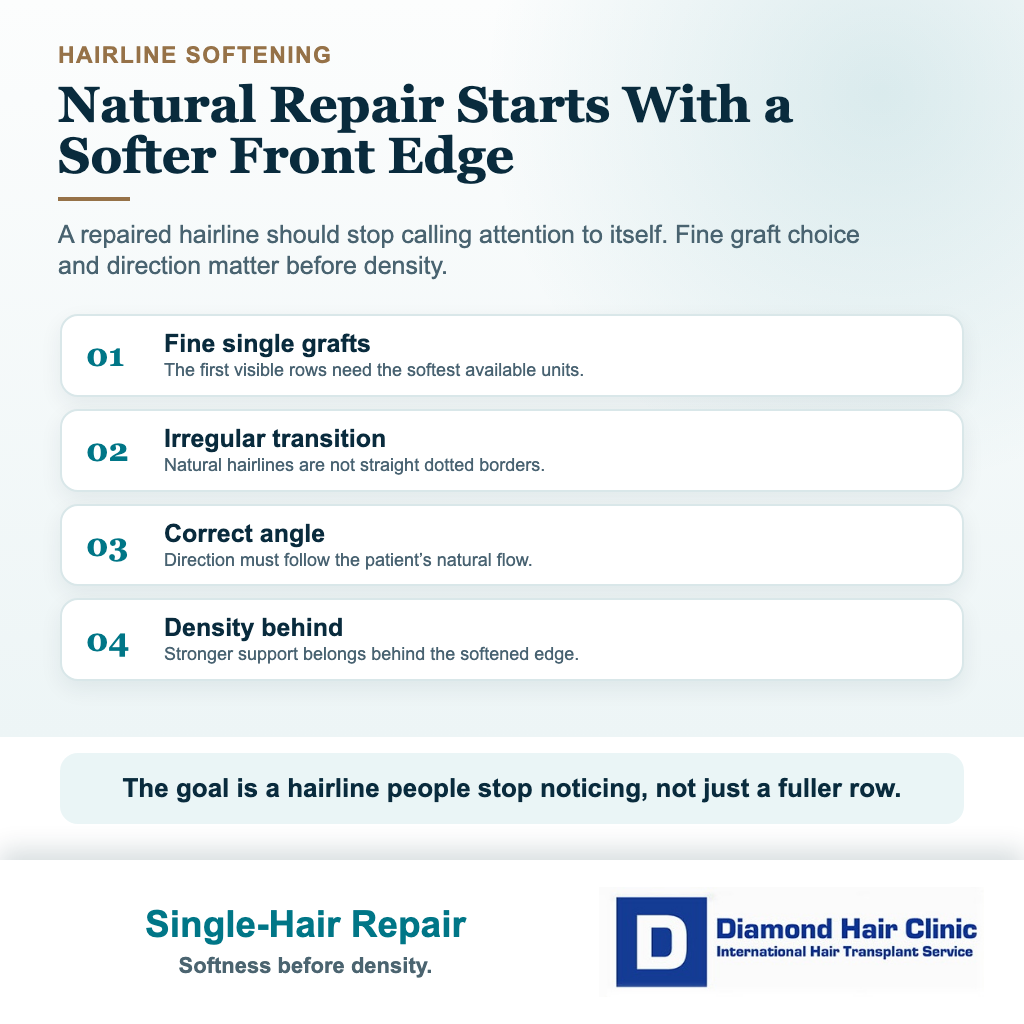
Repair often means rebuilding softness before chasing density. A natural edge can matter more than a bigger graft number, because the hairline is the part people notice first. If the front row is wrong, extra density behind it may make the hairline look fuller and still leave it looking artificial.
Donor hair selection matters. The finest available scalp hairs are usually preferred for the front. Stronger hairs may be useful behind the leading edge, but they should not dominate the most visible row. Beard hair or body hair near the hairline must be considered with extreme caution.
Handling wrong direction or angle
Wrong direction is one of the hardest problems to hide. If the transplanted hairs point upward, forward, or sideways in a way that does not match the natural hairline, adding density may not fix the visual issue. The eye can see direction even when the hair is thick.
In some cases, wrong angle grafts can be reduced or removed. In other cases, softer grafts can be placed around them to make the pattern less obvious. The best choice depends on how low the grafts sit, how many are involved, and whether the donor area can support repair.
That problem is part of wrong hair direction after a hair transplant. Direction is not a small detail. A hairline can have enough hair and still look unnatural if the angles fight the face.
Hairline that is too low needs a different repair plan
A hairline that is too low is more difficult than a hairline that is simply thin. If the design sits below a natural adult position, adding more grafts can make the problem worse. The patient may get more coverage, but the face can look framed in an unnatural way.
When a hairline is too low, selected grafts may need removal, the shape may need softening, and a new transition zone may need to be created. The entire hairline does not always have to be moved back perfectly. The plan should make the visible frame look more natural and easier to live with.
Age matters here. A low, dense hairline may look exciting in one early photo, but it may not age naturally. Whether a transplant will look natural as you get older depends on long-term planning at the front of the scalp.
SMP can hide some contrast but not poor hairline design
Scalp micropigmentation can sometimes reduce contrast behind a thin hairline, but it cannot correct a pluggy structure. If the difficulty is thick front grafts, wrong angle, or a low straight edge, pigment may make the area darker without making it softer.
SMP is more useful when the hairline shape is acceptable and the issue is mild scalp contrast. It is less useful when the structure itself is unnatural. In some repair cases, SMP may be considered later, after the hairline has been softened surgically.
That limitation is part of scalp micropigmentation after a thin hair transplant. Pigment can support a result, but it should not be used to hide a repair problem that needs surgical judgment.
Donor area still matters in pluggy repair
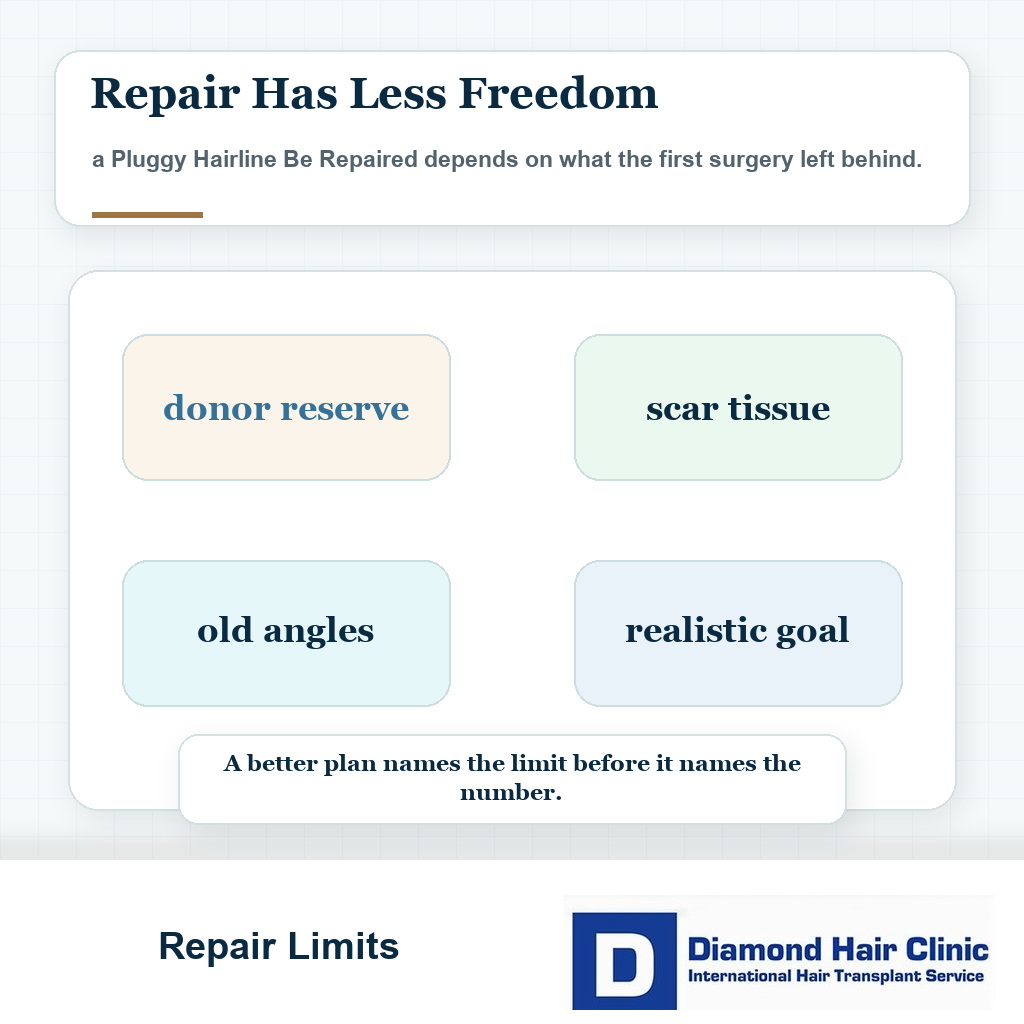
Repair depends on the remaining donor area and the lifetime graft supply that is still safe to use. If the first surgery used too many grafts, the repair options become narrower. A patient may need removal, redesign, and softening, but there may not be enough safe donor supply to do everything in one plan.
The donor should be examined before repair is promised. Density, extraction pattern, hair caliber, scar tissue, previous graft numbers, and future hair loss risk all matter. The repair should make the front more natural without damaging the back of the head.
If the donor already looks thin or patchy, the repair design may need to become smaller before the front line is changed. A soft front cannot be bought by creating a donor area that the patient can no longer wear at a normal haircut length. That limit should be named before any removal or camouflage plan is accepted.
The donor area is a limited resource. In repair surgery, it becomes even more precious because some of it has already been spent. A natural repair requires discipline with graft use, not only technical ability at the hairline.
Temple points make repair more delicate
Temple points make repair more delicate because they sit on the side of the face, where direction and softness are very visible. Thick or wrongly angled grafts in the temple point can look especially artificial. A small mistake can change the shape of the face.
If the pluggy problem involves the temples, it should not be treated as a simple density issue. Natural direction, facial frame, donor hair caliber, and whether any grafts need reduction all matter before more hair is added.
For temple point hair transplant, these small areas need careful planning. A repair around the temples should be conservative, because aggressive work can create a new problem on a very visible border.
Emotional side of pluggy hairline repair
A pluggy hairline is emotionally difficult because the patient cannot easily ignore it. The hairline sits at the center of identity, expression, and photographs. Even if other people do not comment, the patient may keep checking it in every mirror.
The surgeon’s role is to respect that distress without letting it drive a rushed decision. Some concerns are real and repairable. Some are amplified by early healing, harsh light, wet hair, or anxiety after a bad experience. The examination needs to separate what can be fixed from what should simply be monitored.
Hair transplant regret after surgery should be taken seriously. Repair should give the patient more peace, not create a new cycle of chasing perfection.
Mistakes to avoid before repair
Patients should avoid plucking, burning, needling, harsh chemicals, or trying to remove grafts without a clear medical plan. Poorly planned attempts can scar the skin, distort the hairline further, or make future repair more difficult.
Patients should also avoid booking a large second surgery only because they feel desperate. More grafts can help in the right case, but they can also make the pluggy appearance harder to correct if placed without a precise plan.
The better path is documentation, close examination, and a staged plan if needed. Take clear photos in normal light, avoid manipulating the grafts, and let the repair surgeon see the real pattern before any new procedure changes it.
Repair usually happens in stages
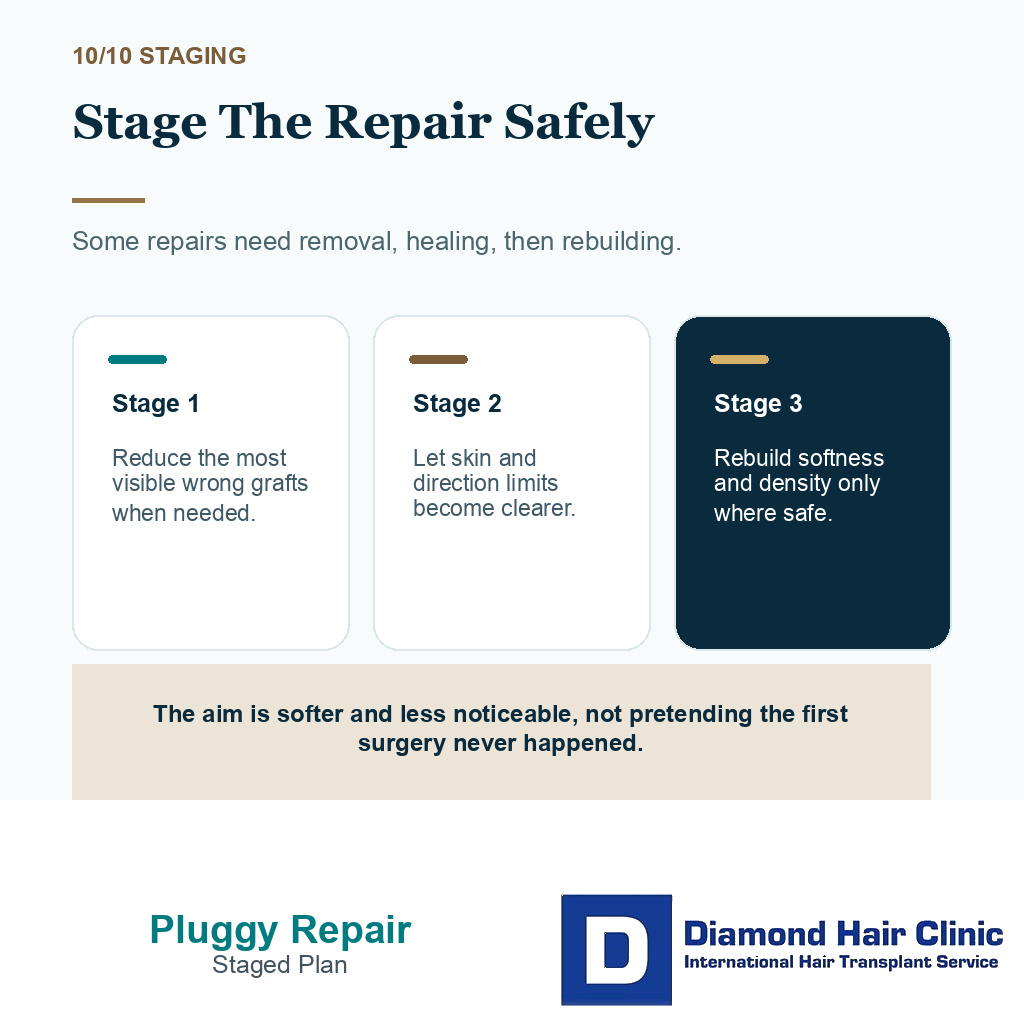
Repair can take more patience than a first transplant. Sometimes the first step is to remove or reduce the most visible wrong grafts. Sometimes the better step is to place finer grafts around them. In some patients, both steps are needed.
A staged repair does not mean the surgeon is uncertain. It often means the surgeon is protecting the patient. Removing, healing, reassessing, and then rebuilding can be safer than trying to solve every problem at once.
Between removal sessions, some old grafts or gaps may remain visible. I explain that temporary appearance before the first removal, rather than discussing only the intended final hairline.
Scar tissue, previous angles, donor limits, and emotional fatigue all matter. The aim is improvement and naturalness, not pretending the first surgery never happened. Realistic repair is usually more measured and more gradual than the patient hopes, but that patience can protect the final result.
Prevention starts in the first surgery
Prevention comes from natural hairline design, single hair graft selection, correct angle, careful irregularity, and surgeon involvement. A dense line is not always a natural line. The front edge needs judgment, not only graft placement.
Prevention starts with a hairline that fits the patient’s age, face, donor supply, and future hair loss pattern. A dramatic low outline can look attractive in a marketing photo and still leave less room for repair later. For that reason, low straight hairline planning matters before the first graft is placed.
If one side looks different, the concern should be separated from an uneven hairline after a hair transplant before assuming the problem needs another surgery. If direction is the concern, angle should be examined carefully. Good prevention means understanding these details before the first incision is made.
Natural repair should look softer, not just denser
A natural repair usually looks softer, less obvious, and easier to style. It may not look like a completely untouched hairline, but it should no longer call attention to itself. That is a realistic and valuable goal.
Repair is not always about perfect density. Sometimes the priority is removing the harshest visual signals. Sometimes the priority is building a softer transition. Sometimes a slightly higher, more conservative hairline protects the repair and helps the face look natural again.
The best pluggy hairline repair is often the one other people stop noticing. It should not look like a repair. It should simply look softer, less obvious, and more human.
Setting expectations before repair
Expectations should be set by being clear about what can improve and what cannot be fully erased. Some pluggy grafts can be removed. Some can be softened. Some scars may remain slightly visible. Some density limitations may stay because donor hair has already been spent.
A good repair plan should protect the patient from a second disappointment. It should explain the stages, the limits, the donor cost, the healing period, and the possibility that improvement may be gradual.
A pluggy hairline can often be repaired, but the safest repair starts with diagnosis, not with adding more grafts. When the plan respects hairline design, donor limits, graft size, direction, and timing, the result has a much better chance of looking natural. The patient needs to know what will be removed, what will be softened, what should be left alone, and how much donor reserve must stay protected.
Read this review excerpt
We also had a levelled conversation about my hairline and results I could expect based on my donor density area.