


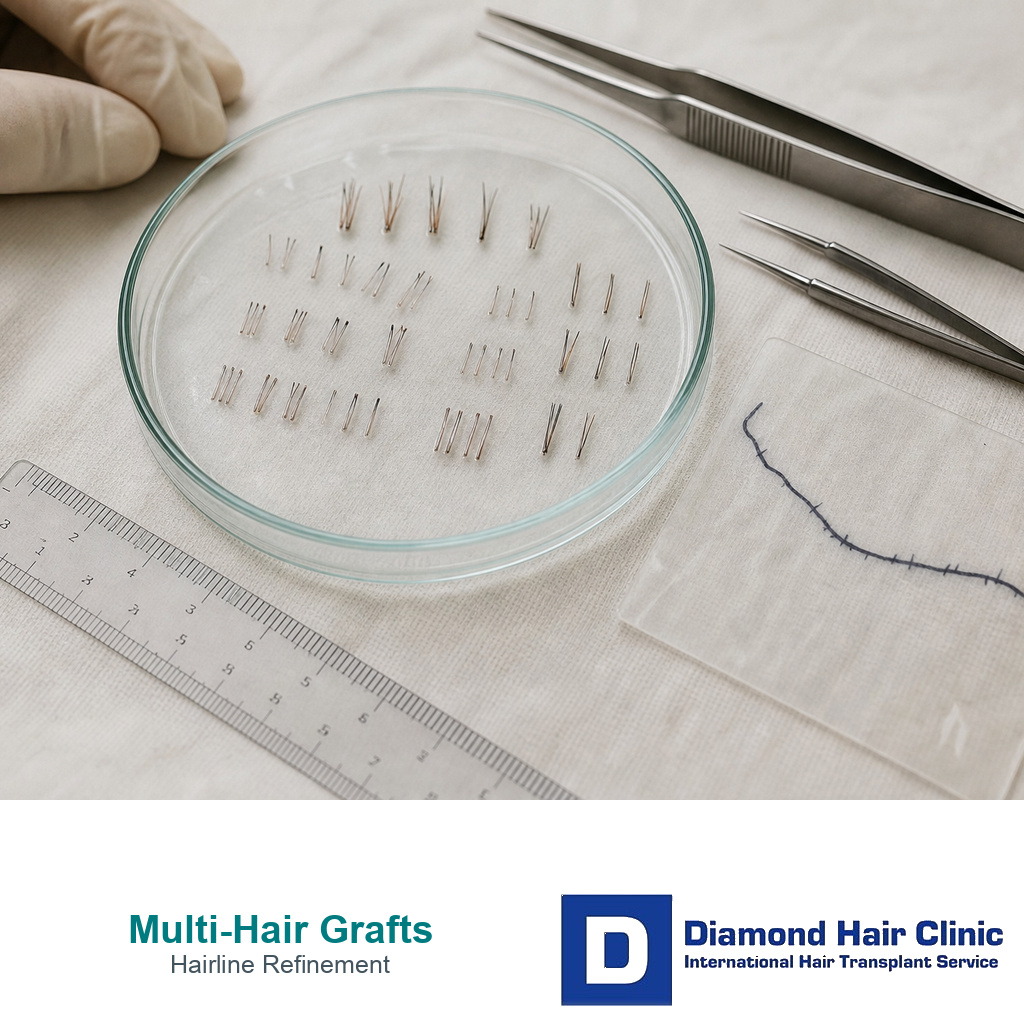
Grafts With Multiple Hairs in the Hairline
A graft carrying two or three hairs in the hairline becomes a problem mainly when it sits on the visible front border, grows coarse, repeats across several points, or exits in a direction that makes the edge look heavy. The same graft can be acceptable when it sits a little behind the first edge and supports density. This matters even more in low straight hairline planning, where a sharp border can exaggerate thick grafts at the edge.
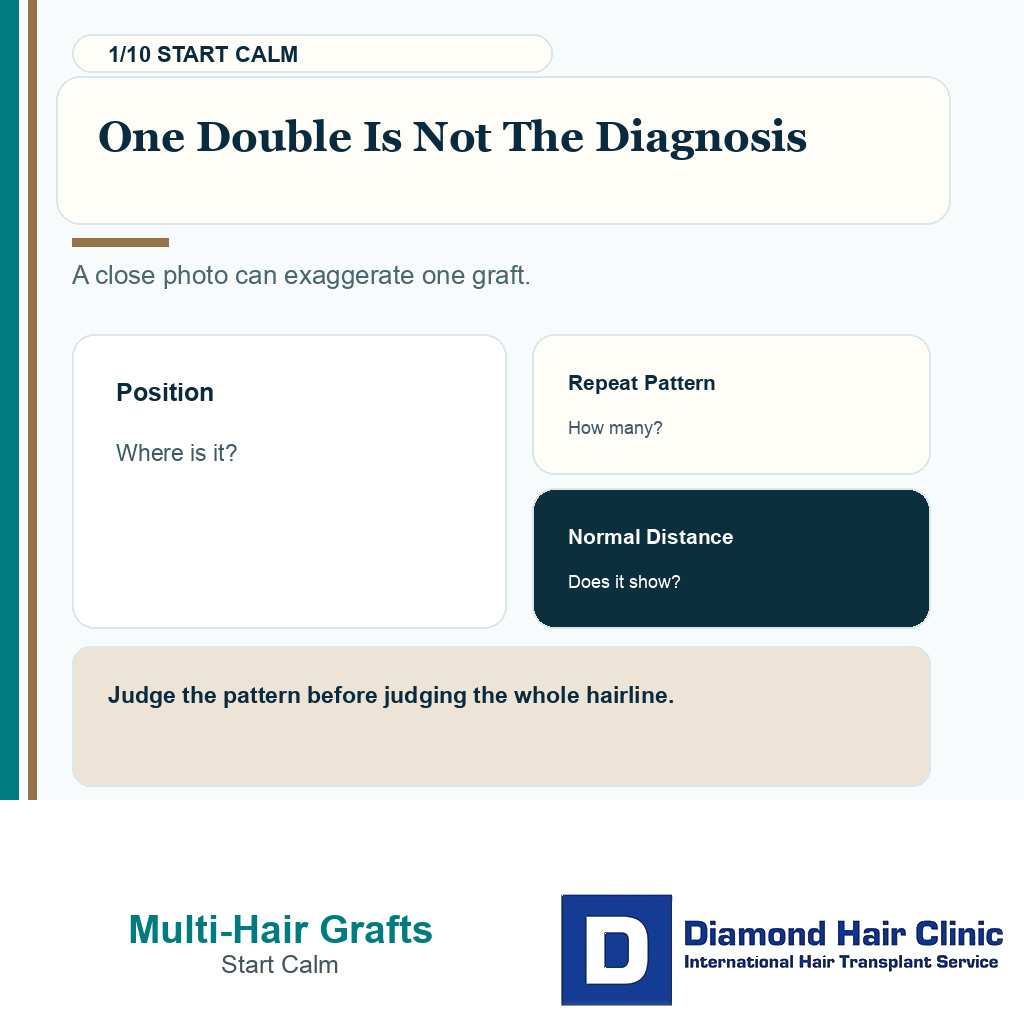
One harsh close photo is not enough for this judgment. I look at position, hair caliber, angle, timing, spacing, and what the hairline looks like from normal distance. One visible double in a magnified image is different from repeated thick units that make the hairline look pluggy in daily life. Repair becomes a stronger discussion when the grafts are noticeable at normal distance, not just inside a zoomed crop.
Show the hairline dry, wet, and from normal conversation distance before asking whether repair is really needed. The same double unit can be invisible in daily life or distracting when the surrounding row repeats the pattern.
Mark the specific grafts that bother you on one normal distance photo before asking about removal. A repair plan changes when the concern is one point, a short cluster, or the whole front edge. Name the visible pattern before choosing correction. A single coarse graft, a short repeated cluster, a temple transition, and a low dense border are different repair problems. The description should lead the review, not an assumption that every visible graft needs removal.
Multiple hairs in one graft are a planning detail, not something to pull out yourself. My first decision is where that unit belongs in the hairline. A coarse graft on the first visible edge, a few stronger grafts behind the edge, and a repeated line of thick units are three different findings. When a unit at the front edge truly needs removal, bad hairline graft removal planning helps separate temporary grooming from irreversible follicle treatment. When laser is suggested for thick front grafts, laser hair removal for transplanted hair should be reviewed before choosing a less precise reduction method.
Position matters more than hair count
A graft is not the same as one hair. In modern hair transplantation, we move follicular units. A follicular unit can naturally contain one, two, three, and sometimes more hairs. A larger unit can be useful behind the border, but it becomes visible when it is placed where the eye expects a softer transition. I do not ask only, “how many hairs are in the graft?” I ask, “where was that graft placed, and does it match that zone?”
The front edge has to stay soft
Hairline design is not only drawing a line on the forehead. I decide which grafts belong in the first visible edge, which grafts can sit behind them, how the angles change near the temples, and how much irregularity keeps the result natural. The front edge usually needs single-hair units and careful direction. Larger units are stronger behind the edge, not on the visible border.
For a hairline concern, I separate one isolated coarse graft from a repeated row of thick units, wrong direction, or a hairline placed too low. These findings do not have the same repair plan. Some need time and documentation, some need camouflage, and selected cases may need bad hairline graft removal.
Visible hair counts can change as a result matures, which is why hairline grafts that grow more than one hair later need to be judged with timing in mind. Here I am looking at whether graft size, position, and direction fit the zone where each graft was placed.
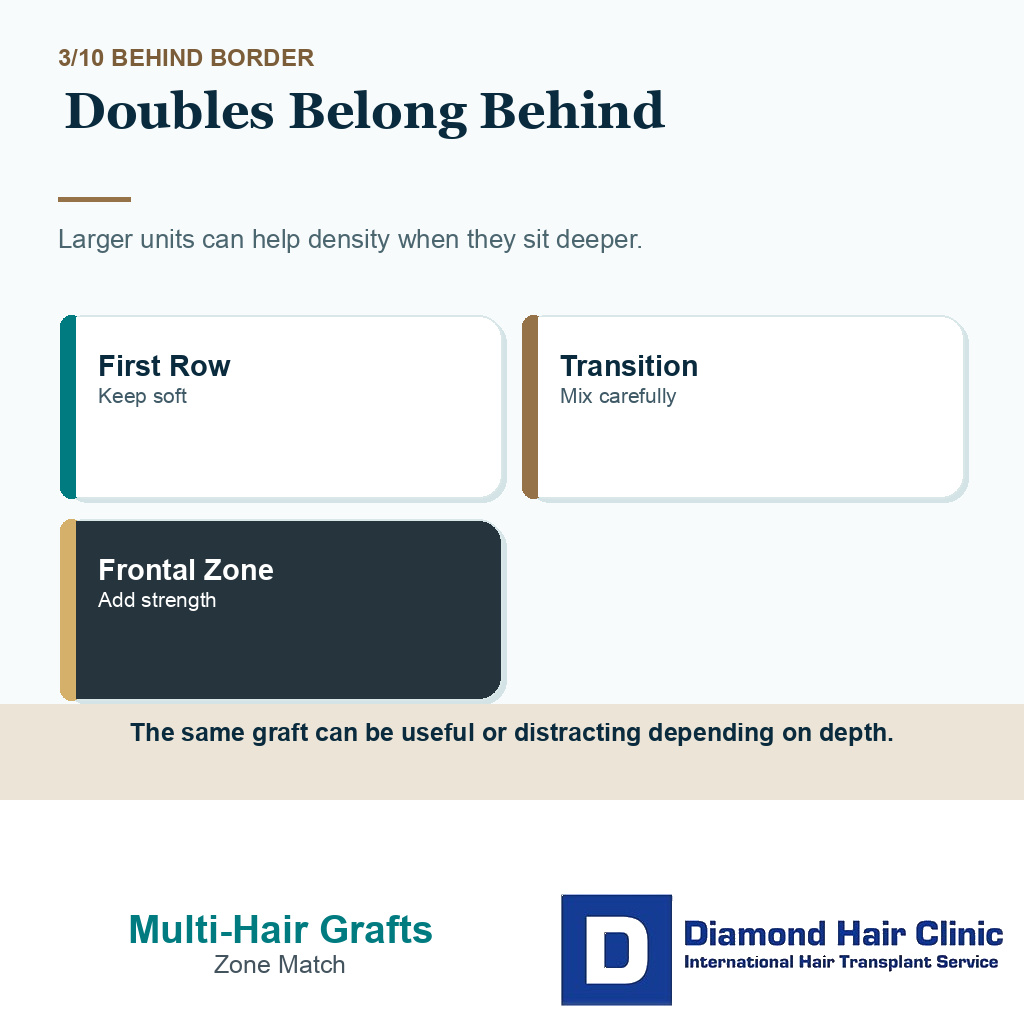
The front hairline is not one flat strip. I separate it into the very first edge, the transition just behind it, and the stronger frontal zone behind that. A double graft 8 or 10 millimeters behind the border may help coverage. A coarse double on the first visible point may catch the light every time the hair is short, wet, or combed back.
I avoid judging the whole result from a single zoomed image. The same visible graft can be harmless in one position and distracting in another. The diagnosis comes from where it sits, how many similar units repeat, and whether the surrounding design softens or exposes it.
Hairline planning lens
Four checks before a hairline plan looks natural
A natural hairline is not only a low line or a dense line. It needs a soft front edge, the right graft mix behind it, natural angle and direction, and enough donor reserve for future hair loss.
Soft front edge
Will the first visible line look soft?
Single hair grafts belong at the soft front edge, where harshness is easiest to notice.
The front edge should be planned before density is pushed behind it. If the first line is too heavy, the whole result can look less natural even when the grafts grow.
Use this as a planning frame, not a diagnosis of your hairline. The final design still depends on donor reserve, recipient area anatomy, hair type, and future hair loss risk.
The graft mix the first edge should have
At the front edge, the result should not look weak, but it should not look like a wall when the hair is short, wet, or combed back. A natural border has small irregularities, softer spacing, finer hairs, and a gradual build into density. Good hairline design is not only drawing a shape on the forehead. The real planning is choosing which grafts belong in each part of that shape.
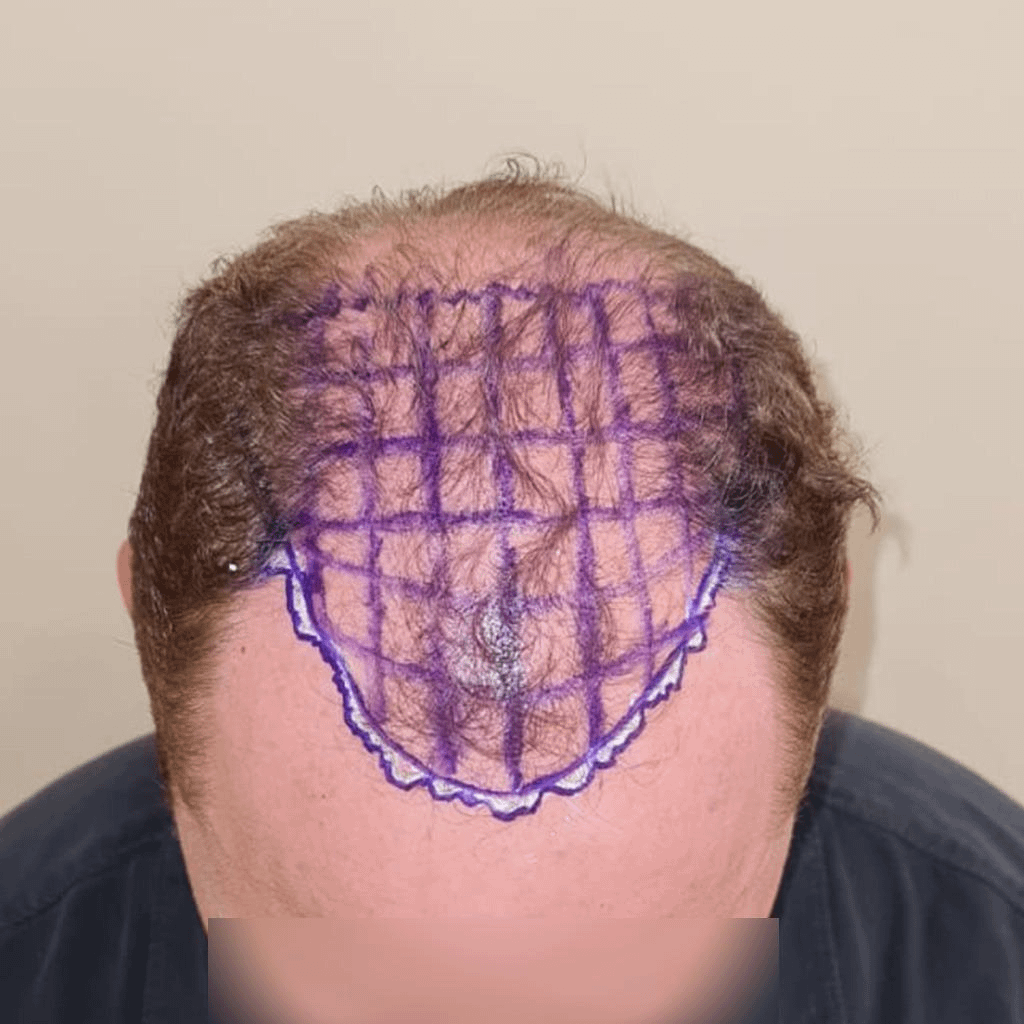
Single-hair grafts at the visible edge help create that softer fade. Larger follicular units can be useful behind the edge, where they create coverage without making the border blunt. Good planning uses both ideas together. It protects softness at the front and strength behind it.
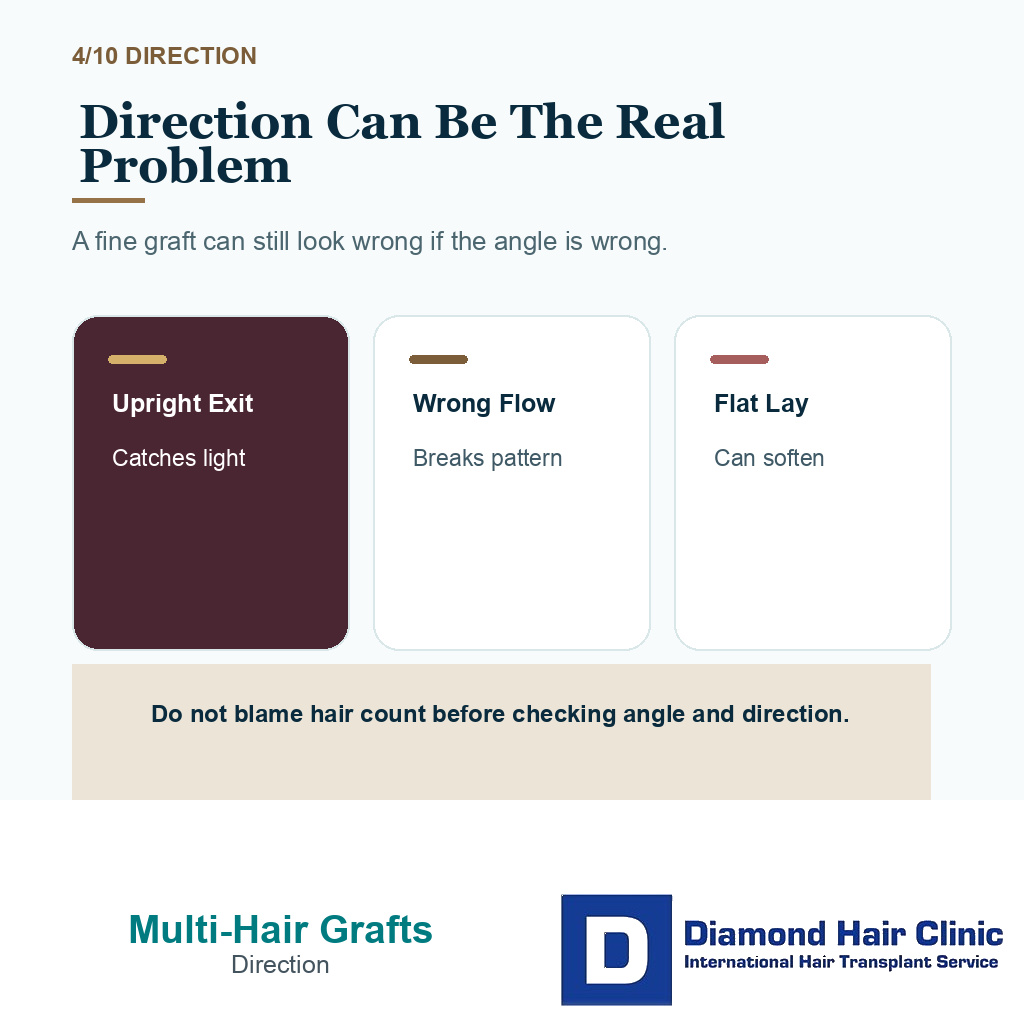
Direction can make the same graft look better or worse. A fine single hair graft can still look unnatural if it exits upright or fights the natural direction. A double graft can blend better if it lies flatter, sits behind the edge, and follows the surrounding flow. If the main problem is direction, I review wrong hair direction after hair transplant before blaming graft size alone. If the issue is a repeated placement pattern, graft rows after FUE may explain the visible rhythm more accurately.
Where do double- and triple-hair grafts belong?
Doubles and triples are not failed grafts. They often create the visual density that makes the frontal area look complete. A transplant built only from fine singles can look soft at the edge, but it may not give enough background fullness behind the hairline.
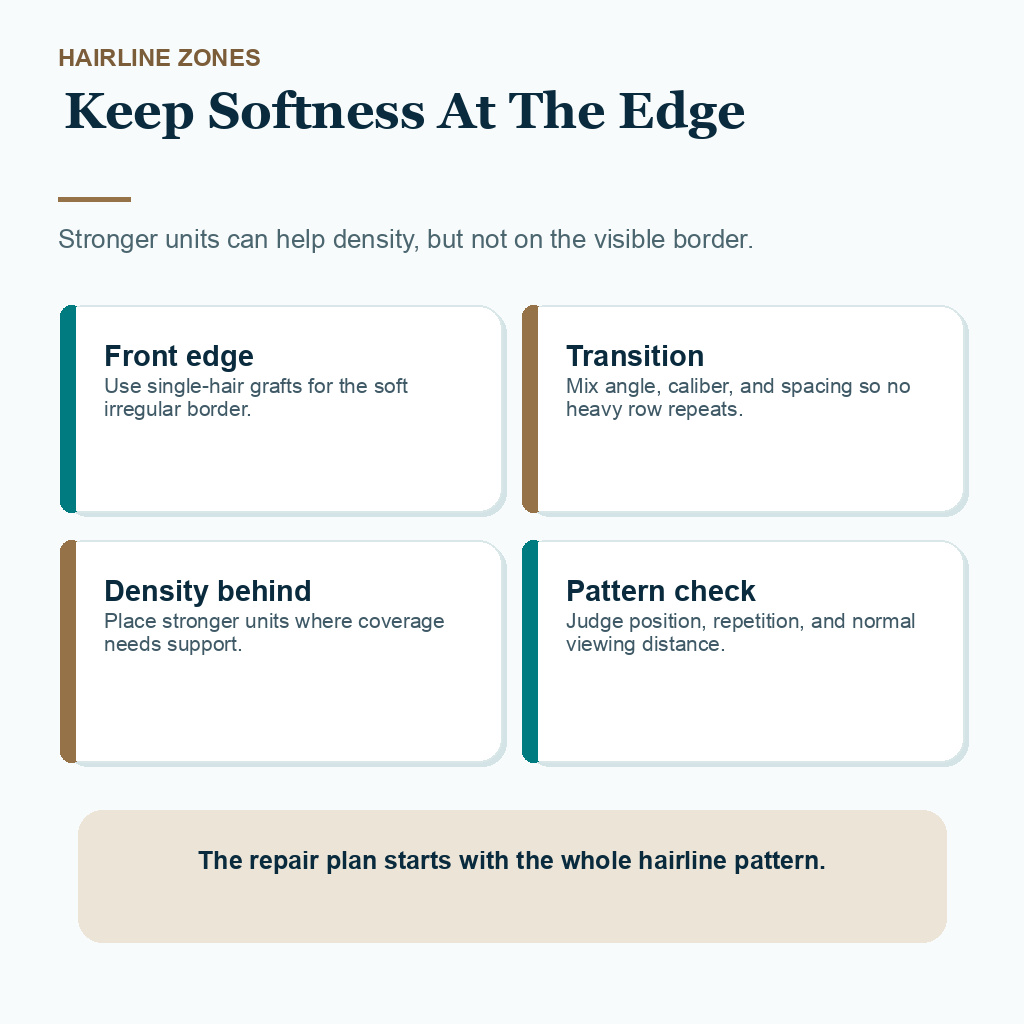
Zone matching matters here. The first visible edge needs fine selection and irregularity. The transition zone can accept careful mixing. The deeper frontal zone can use stronger follicular units for coverage. Hair shaft thickness, skin contrast, curl, styling, and lighting all change how visible those choices become.
If your donor hair is naturally thick, there may be fewer true single-hair units available than the ideal hairline would use. Then the surgeon has to select the finest available grafts, use spacing carefully, and keep larger units away from the front border. Random placement creates the unnatural look, not the existence of multi-hair follicular units.
Harvesting alone does not tell you which grafts belong at the front edge. After extraction, the team should inspect follicular units under magnification and sort them by hair count and shaft thickness before the surgeon selects the finest suitable grafts for the hairline.
A graft count sheet can show how many units carried one hair, two hairs, three hairs, or four hairs, but it does not show where those units were placed. That record becomes more useful when it also states how many of the finest singles were reserved for the visible edge and which units supported the zone behind it. The sorting totals and placement record should describe the same hairline.
If one side looks harsher than the other, the issue may not be graft size alone. Shape, spacing, density, and angle can all contribute. I separate that from graft selection because an uneven hairline after hair transplant can come from several design choices at once.
Early growth can make multi hair grafts look worse
The first months can be misleading. New hairs can be short, stiff, uneven in length, red around the base, or only partly grown. A phone camera held very close can make every unit look larger than it appears to another person.
At 3 or 4 months, strong conclusions are usually premature. At 6 months, angle and position start to show more clearly, but texture and length may still be changing. Around 9 to 12 months, the review becomes more reliable. Some results need longer, especially when growth is slow or the hair is kept very short.
Timing changes the diagnosis. A harsh early photo may show a temporary growth stage. A mature hairline with repeated thick bundles on the first edge is a different matter. If timing is your main worry, the concern may be closer to whether the result is a reason for a second hair transplant or only a stage that needs more time.
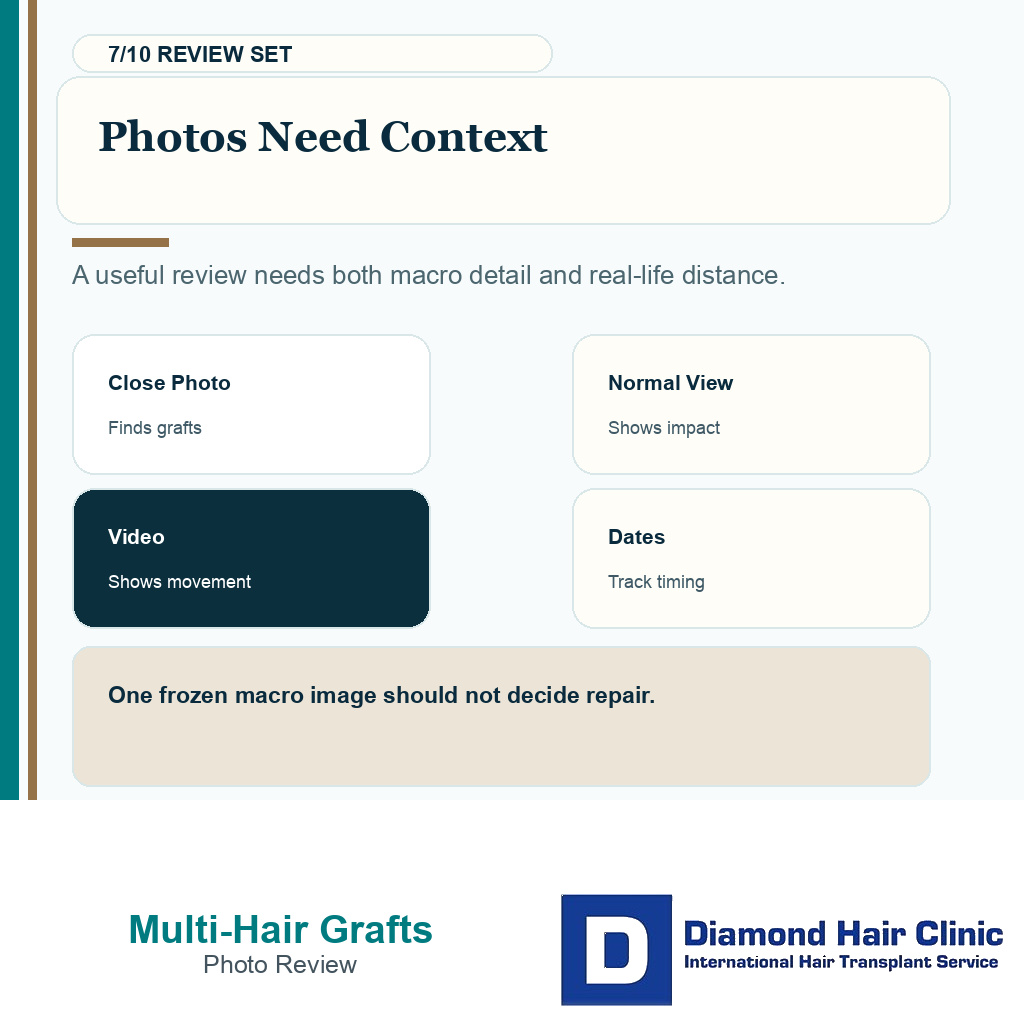
A practical test is distance. Look in the mirror from normal social distance, then in outdoor light, then in a short video while moving the hair. A close still image helps locate a graft, but it cannot be the only way you judge naturalness. Hair transplant combing videos can show whether the issue draws the eye in movement or only in one frozen frame.
Do not pluck visible grafts yourself?
Plucking is not a repair plan. It may remove the visible shaft for a while, but it does not reliably change the follicular unit under the skin. The same graft can regrow with the same number of hairs. Repeated pulling can irritate the skin, create inflammation, and make a later surgical review less clean.
There is also a design risk. You may dislike one visible double today, but that graft may be part of a larger pattern. Pulling random hairs can create small gaps, uneven density, or a new shape problem. A proper review of removing transplanted hair is different from pulling at the shaft in the bathroom.
If one or two hairs bother you and you are still months away from a mature review, document them instead. Photograph the hairline dry, wet, styled back, styled forward, and from normal distance. Keep the images dated. That record helps show whether the issue is fading with length, becoming less visible, or staying obvious as the result matures.
Include the haircut length that exposes the issue. A thick graft that disappears with longer styling may still matter if you normally wear a short front, wet look, or combed back style.
Photos and videos that make review useful
A useful review set has both detail and context. Use bright but not extreme light. Keep the camera level. Take one clear close photo to show location, then several views from normal distance so I can judge whether the graft is visible without magnification.
A strong review usually includes a front view with the hair dry and untouched, a front view with the hair gently lifted from the forehead, both temple angles, and a short combing video. If you have them, also send older hairline photos, immediate placement photos, the number of months since surgery, the graft count, and whether the clinic separated single-hair grafts during placement.
A proper second opinion before or after a hair transplant should do more than label the result good or bad. It should explain whether the concern comes from graft size, angle, position, density, hairline height, timing, expectation, or a combination.
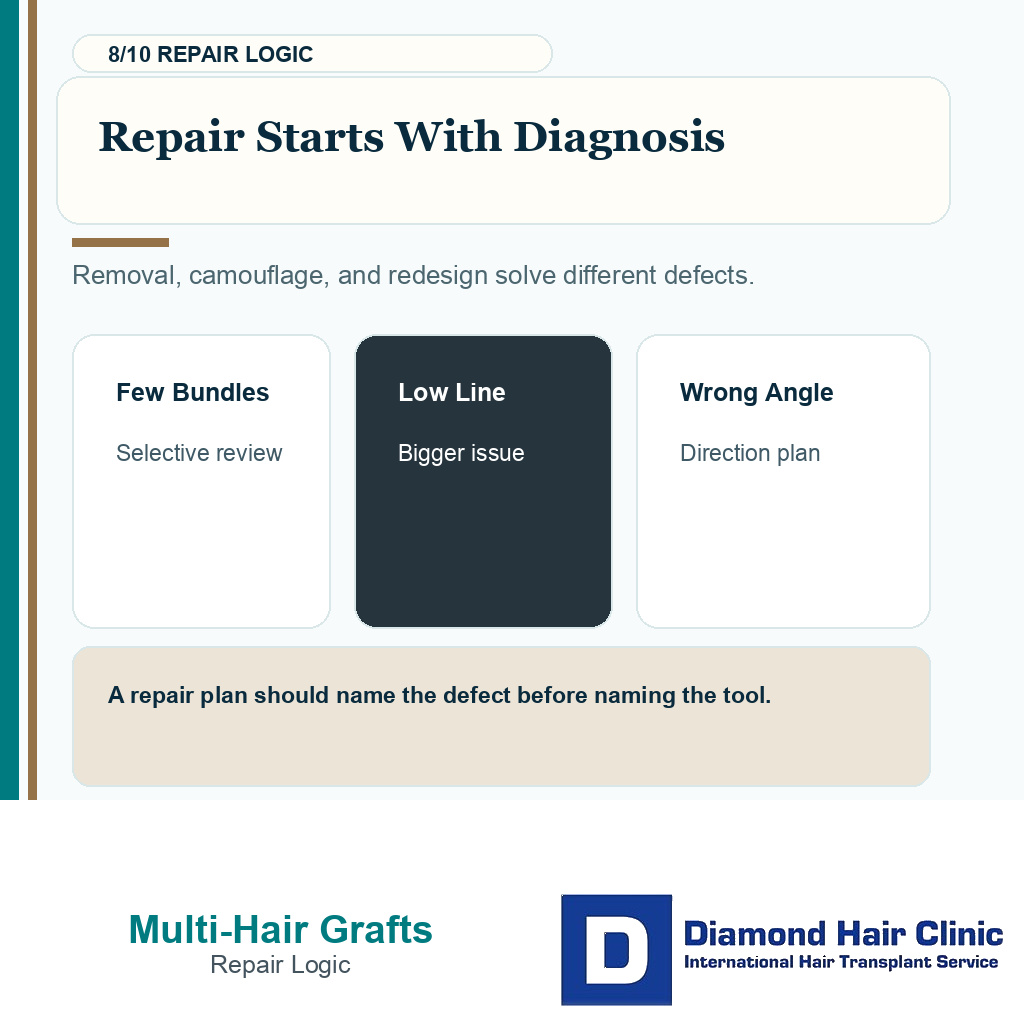
Repair should start with diagnosis, not removal
Repair depends on the exact defect. If the main issue is a few visible multi-hair grafts at an otherwise acceptable edge, selective refinement may be enough. If the issue is a straight, dense, low, or wrongly angled hairline, the repair may need a larger redesign. If the skin is scarred or donor reserve is limited, the plan becomes more conservative.
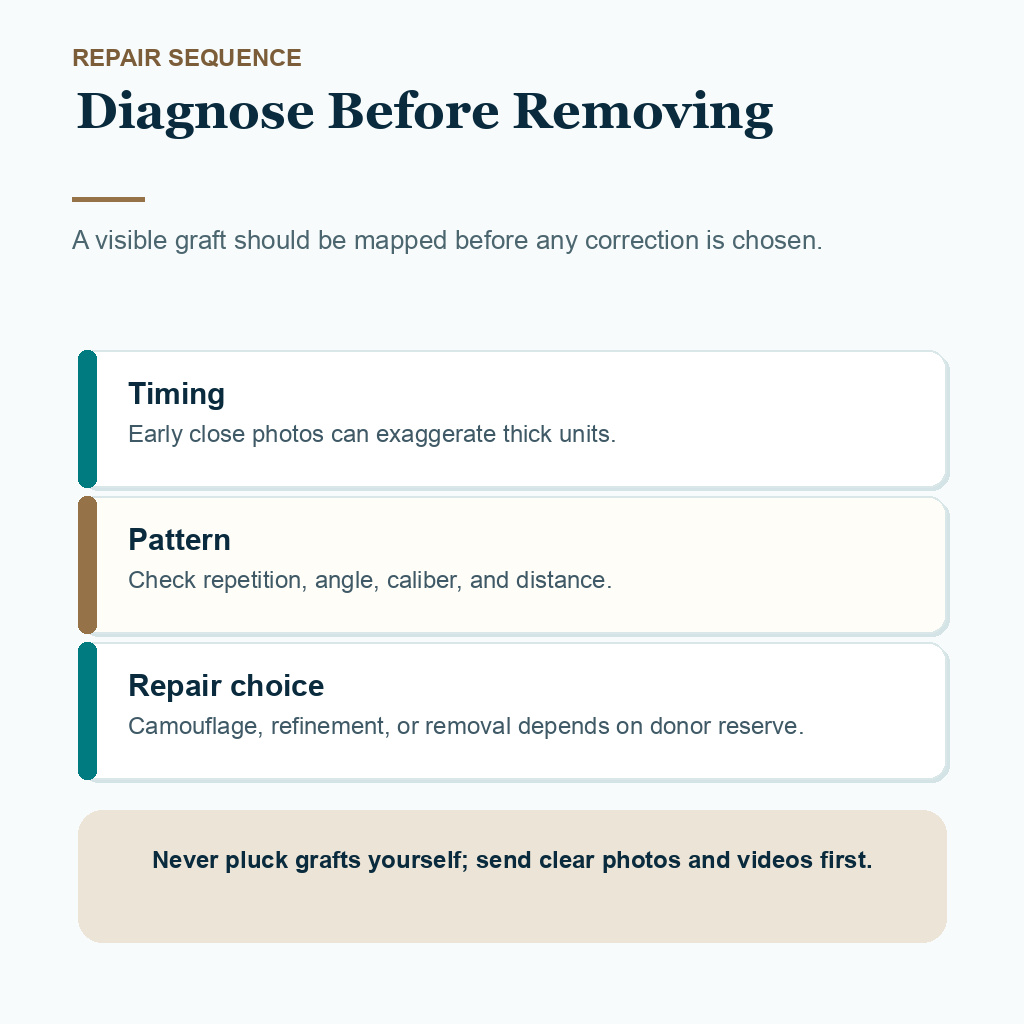
Repair may involve camouflage with fine single-hair grafts, selective punch removal of the most distracting units, splitting and reimplanting grafts when tissue quality allows it, laser hair removal for selected hairs, or staged redesign when the hairline is too low, too straight, or poorly angled. These choices are not interchangeable. One visible bundle, a row of coarse grafts, and a low hairline all leave different tradeoffs.
Patients often hope a coarse graft can be split and reused. Sometimes a removed unit can be dissected and reimplanted, but I would not promise that before seeing the graft, the scar tissue, and the skin response. The priority is a softer front edge, not proving that every removed hair can be saved.
With pluggy hairline transplant repair, this point applies. Repair has to be targeted. Removing every visible larger unit can create a thin front. Adding grafts without correcting the worst bundles may hide nothing. The plan has to match what is visible in real life and protect the donor reserve that remains.
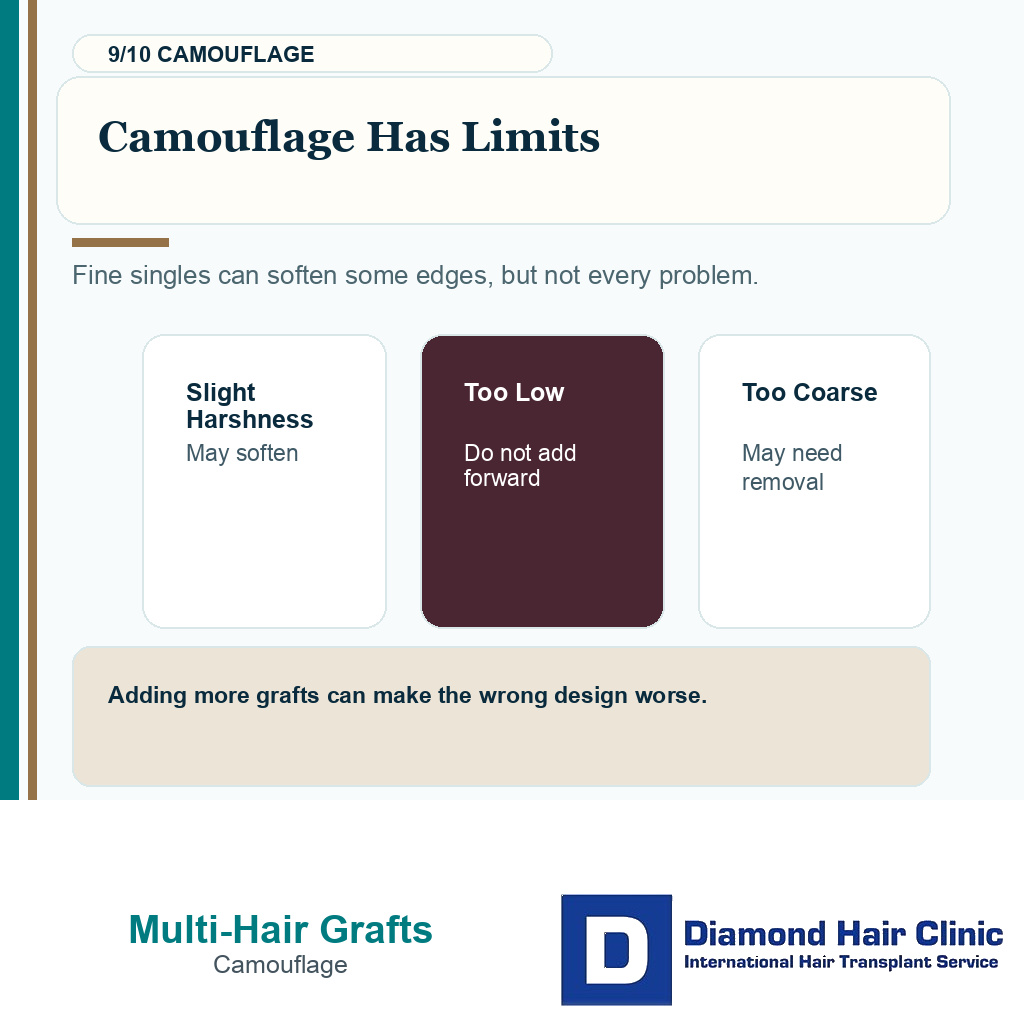
Camouflage can help a harsh hairline in selected cases
Sometimes adding fine single-hair grafts can soften a slightly harsh edge, especially when the hairline height, angle, and surrounding density are already close to acceptable. It can break up a straight line, create a lighter transition, and reduce attention on a few larger units. Hair transplant touch up grafts use similar camouflage logic, but repair is not simply adding more hair.
Adding grafts is not a universal fix. If the hairline is already too low, adding more grafts in front can make the design worse. If the existing grafts grow upright, extra singles may not hide the direction problem. If there are too many coarse units at the border, selective removal may need to come before or during camouflage.
Result examples matter. A clinic should be able to show repair cases that resemble your problem, not only dense first surgeries. When reviewing hair transplant results with hair like yours, look at hair caliber, skin contrast, lighting, short hair, wet hair, and videos, not only perfect styling.
Repair questions that protect donor reserve
Repair work needs more discipline than a first transplant. Before committing, the diagnosis should identify the grafts that actually cause the problem and separate graft size, direction, spacing, row placement, hairline height, or several of these together.
Useful questions are specific. How many grafts would be removed, and from exactly where? Would the surgeon add fine singles, remove coarse grafts, or do both? Would the repair be one stage or more than one? What small scars or gaps could remain after removal? How will donor reserve be protected for future hair loss? Can the clinic show repair cases with similar hair caliber and skin contrast?
Be careful with pressure. A repair decision made from embarrassment and one magnified image can create a second regret. If a clinic rushes you into a deposit before explaining the diagnosis, timing, and what each choice can leave behind, hair transplant booking pressure needs to slow the decision, not speed it up.
If the hairline also sits too low for your age, face, or future hair loss pattern, the repair discussion becomes larger. When the hairline sits too low, a transplanted hairline being too low may be the main problem, not only graft selection.
Use the 10 review slides below to separate normal variation in grafts with several hairs from a true hairline repair problem. Swipe the carousel, use the arrows for one step at a time, or choose a number below the image to jump to that point.




The front edge needs single-hair discipline
The best time to prevent a pluggy front is before the first surgery. A natural hairline comes from position, irregularity, direction, graft selection, incision angle, and donor planning, not density alone.
Before surgery, single-hair graft separation, hairline design, recipient incisions, and the backup plan for limited fine singles should be clear.
The front border cannot be treated as leftover work after density is planned. Larger units can help behind the hairline, but the visible edge needs softness and restraint.
If you already see grafts with more than one hair in the hairline, give the result enough time to mature and document it clearly. A surgeon-led review should separate mild visibility from a true repair problem. The aim is not a perfect microscopic edge. It is a hairline that looks natural in real life, wet or dry, while preserving donor reserve for the future.
Read this review excerpt
We also had a levelled conversation about my hairline and results I could expect based on my donor density area.