


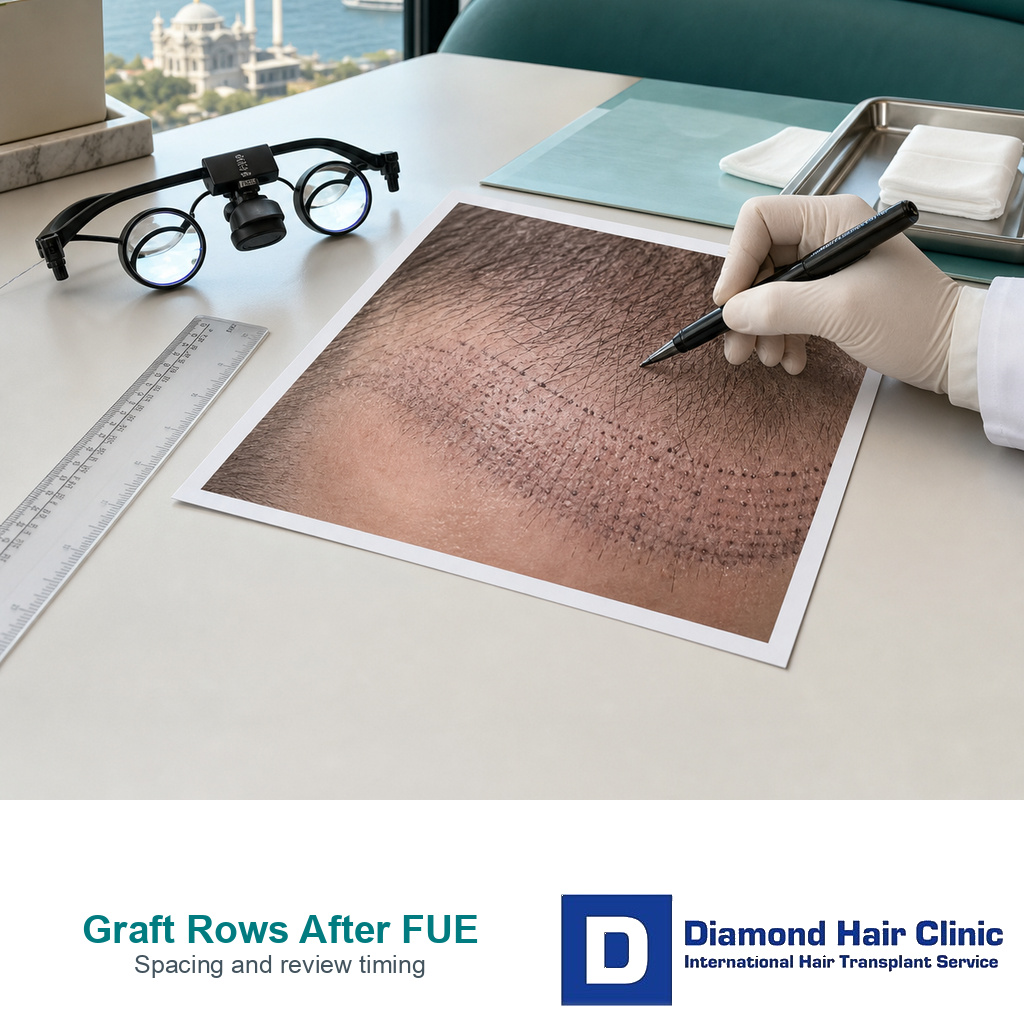
Visible Graft Rows Need Time Before Judging Results
Graft rows after FUE are not, by themselves, proof of a bad result. In the first days, the recipient area can look dotted, lined, or patterned because the scalp is shaved, the incisions are fresh, and every short hair shaft is visible.
The concern becomes more serious when the pattern still reads as mechanical after meaningful growth, especially in the frontal hairline, wet hair, short hair, or combing videos. A row pattern has to be judged by timing, zone, graft type, angle, direction, density, wet or dry styling, and donor planning together.
Visible rows are not something I dismiss, but timing changes what can be judged. Photos from the first week cannot prove final density or a permanent row pattern. A wet close photo at month three cannot prove failure. At the same time, a repeated mechanical pattern deserves structured review rather than blind reassurance.
Early rows are often a visibility problem
Freshly implanted grafts are easy to see because the surrounding skin is shaved, pink, swollen, scabbed, or shiny. Every recipient incision has a small mark around it. A pattern that longer hair would hide can look very obvious when the scalp is bare.
That early visibility is different from the way grown hair behaves. In the first days, you are mostly seeing incision sites, crusts, short shafts, and healing skin. You are not yet seeing mature hair length, layering, texture, or styling movement.
There is also a planning reason for some visible order. Recipient incisions are made one by one. The surgeon is choosing density, angle, direction, and spacing across a limited donor supply. The goal is controlled irregularity, not careless randomness. The work has to be organized enough to protect coverage and blood supply, but irregular enough that the eye does not read rows.
Natural scalp hair grows in follicular units with mixed hair counts, different spacing, and direction changes across the hairline, middle scalp, temples, and crown. In surgery, those details have to be translated into controlled variation, not a repeated planting grid.
First two weeks show healing, not final density
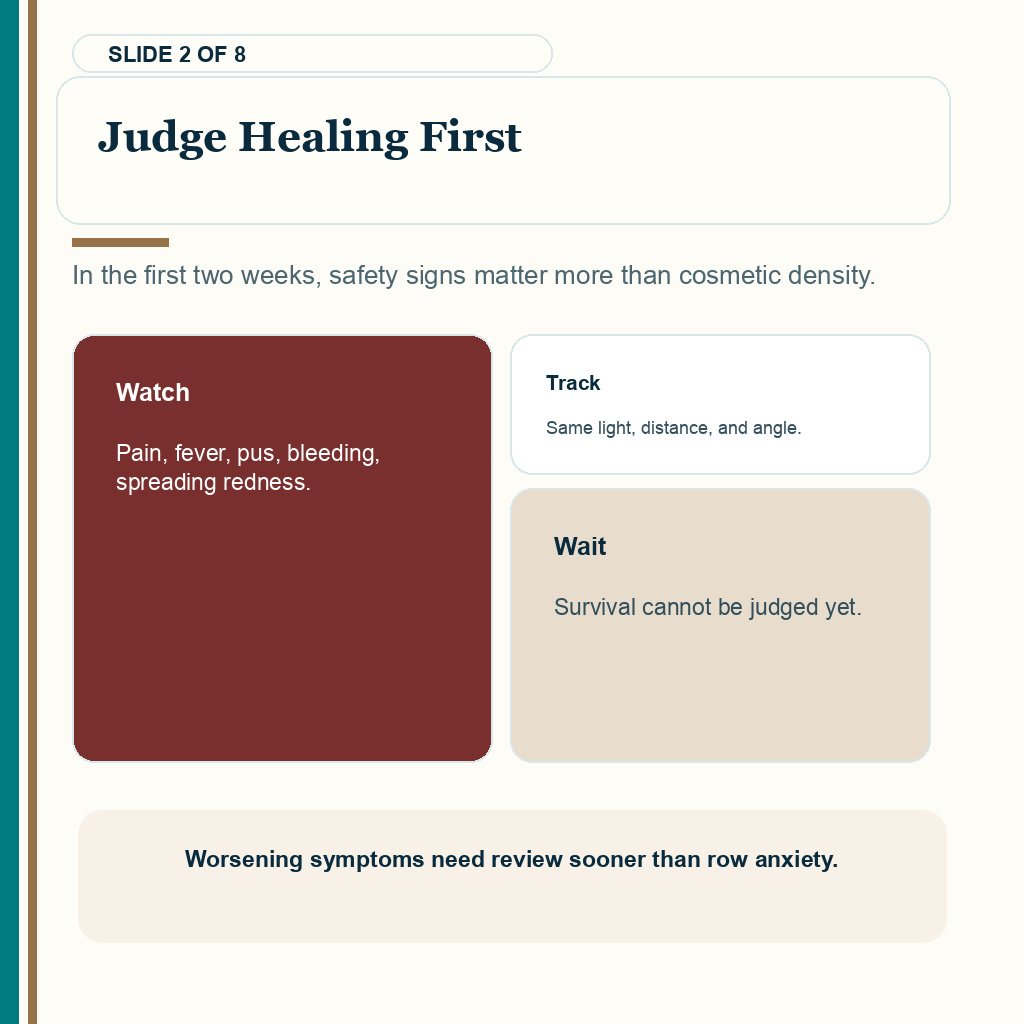
In the first two weeks, you can judge healing signs more reliably than cosmetic success. You can check whether the scalp is settling, whether scabs are clearing with the washing plan, and whether pain, redness, bleeding, fever, pus, or swelling is increasing instead of improving.
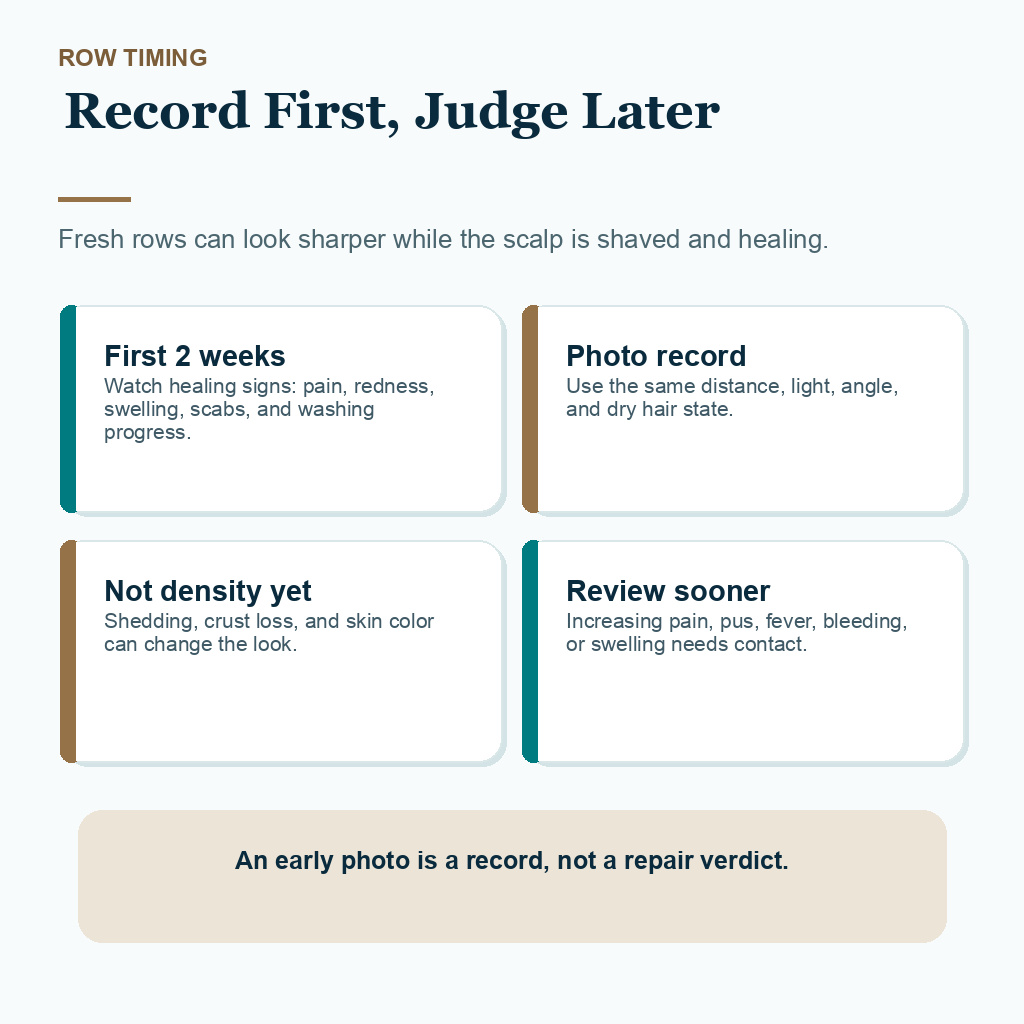
You can also document the recipient area with steady photos. Use the same distance, same light, and same angle. One harsh bathroom photo can make ordinary spacing look dramatic, especially when the scalp is shaved and every dot is exposed. The same photo discipline is explained in the early hair transplant review photos guide for patients worried about rows, density, or direction.
A short comb through video from normal distance can help later, but it should show how the hair moves rather than only one frozen angle. Rows that disappear with movement are judged differently from a fixed pattern that stays visible in several conditions.
Use normal distance as part of the review. A close crop can show every dot, while a short video from conversation distance shows whether the pattern still looks mechanical.
What you cannot judge is final survival. Implanted hairs may shed. Skin color may change. The area may look less dense after washing because crusts and short fragments are gone. That timing is part of the reason some patients notice less density after the first wash.
An early photo can document the pattern, but it should not decide the result. If the spacing looks worrying, keep steady images from the same distance and compare them over time. Repair planning should wait until the skin has healed and the follicles have reached a meaningful growth phase.
Patterns that deserve closer review
A row pattern deserves closer review when it remains visually obvious after meaningful growth, especially with short hair, wet hair, hair movement, or a buzzed style. Rows may run vertically from front to back, horizontally across the hairline, or as parallel or oblique tracks that become clearer when the hair is wet or combed forward. A repeated pattern can also make coverage look see through because the eye sees lines before it sees density. The concern is stronger in the frontal hairline because the front edge is the least forgiving part of the transplant.
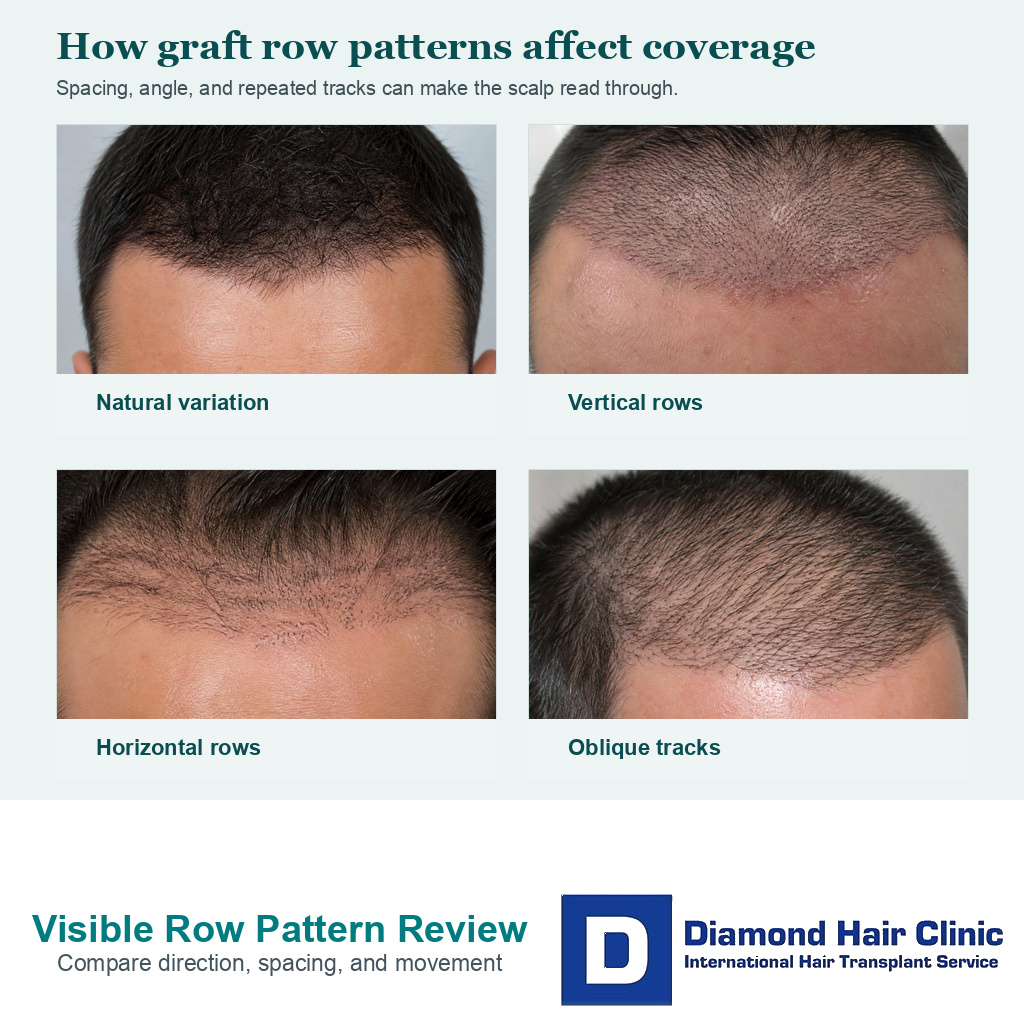
The hairline needs softness, single hair grafts, small irregularities, and natural direction. If larger follicular units are placed too far forward, or if spacing repeats in a visible sequence, the result can look artificial even when many grafts survive. In practice, hairline design, grafts with multiple hairs in the hairline, and pluggy hairline repair all come back to the same front edge planning problem.
Direction can be just as important as spacing. If hairs exit at an angle that fights the native flow, they can stand up, cross surrounding hair, or make styling difficult. When that is the problem, wrong hair direction after a hair transplant becomes more relevant than row spacing alone. A short video can help when the hair springs back after you smooth it down, because a still photo may show spacing without showing direction.
Rows, angles, and hairline shape are separate repair questions. A close image can show a concern, but I still separate alignment, exit direction, and design before deciding what needs correction.
The crown has a different standard. In the crown, a crown whorl has a spiral pattern rather than a flat forward direction. Short crown hair can look strange while it is still meant to rotate. The review question is whether the surgeon respected the existing whorl and hair flow, not whether the crown looks perfectly even in an early photo.
Spacing and graft numbers need context
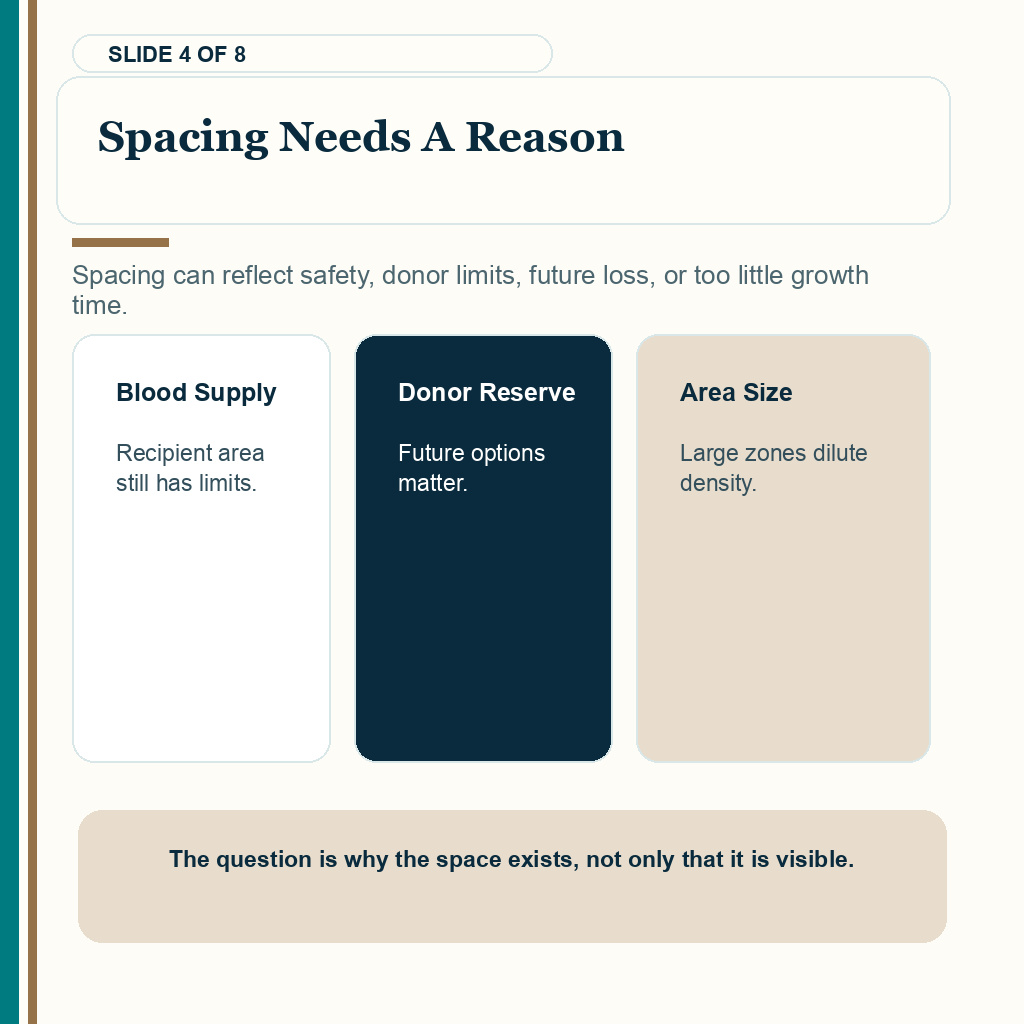
Spacing can mean several things. It may mean the surgeon protected blood supply and donor supply. It may mean the session was intentionally conservative because future hair loss is expected. It may mean the graft count was not enough for the area. It may also mean the visible dots are misleading because growth has not happened yet.
Graft numbers alone can mislead. A patient may hear “3,000 grafts” and expect one visual outcome, but density depends on recipient area size, hair caliber, curl, color contrast, graft survival, and distribution. Hair transplant graft count verification only becomes meaningful when the count is matched to the area covered and the hair characteristics.
Density per square centimeter is also not a universal promise. A dense plan in the wrong scalp can waste donor reserve or irritate the recipient area. Sometimes lower density keeps grafts available for future loss. That balance turns 45 grafts per cm2 in hair transplant into a planning discussion rather than a guarantee of appearance.
The right density is the density your donor area, skin, hair characteristics, and long-term plan can safely support. More grafts are not always better. A lower density can still be deliberate work when the distribution has a reason.
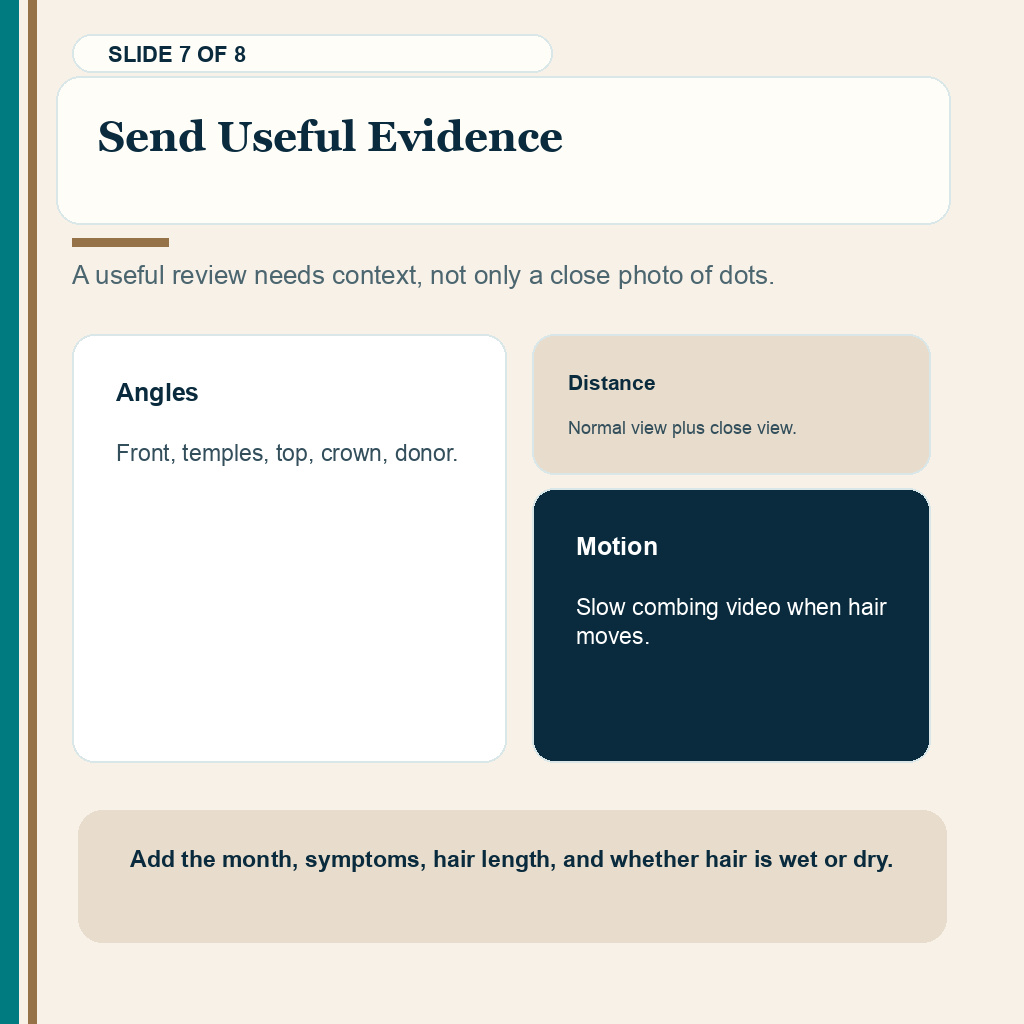
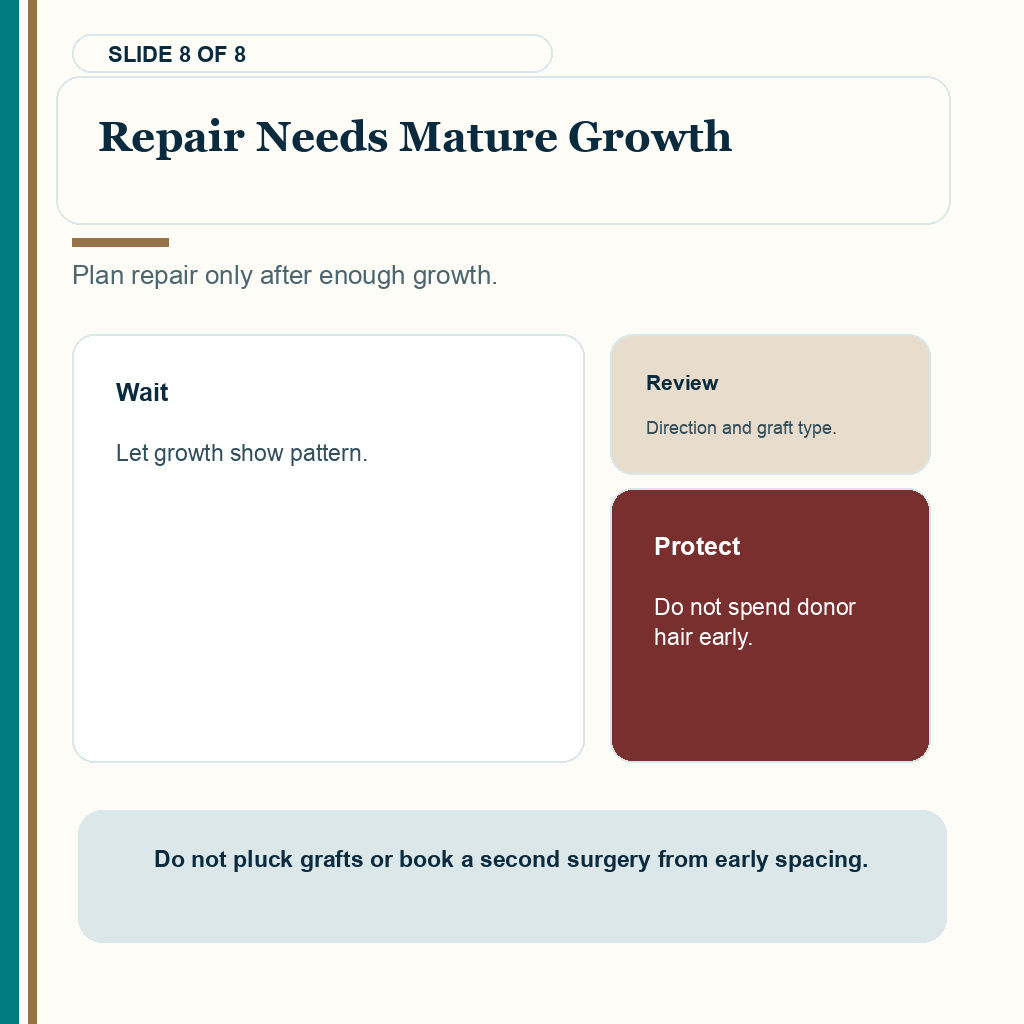
These 8 row review slides separate early visibility, the first two weeks, patterns that need review, spacing context, graft count limits, shedding, useful evidence, and mature repair timing. Swipe sideways, use the arrows one slide at a time, or choose a number below the image.




Shedding can make spacing look worse
After the early healing period, many transplanted hairs shed. The visible shaft may fall while the follicular unit remains under the skin. During that stage, the recipient area can look emptier than it did immediately after surgery.
I separate three ideas for patients. Spacing is where the recipient incisions were placed. Shedding is the loss of visible hair shafts after surgery. Survival is whether the follicular units eventually grow. They are related, but they are not the same.
At month three or month four, a sparse look is not enough to declare failure. Some areas start early, some areas lag, and native hair may shed around the transplant. Low density at 4 months has to be interpreted carefully.
By month six, review has more value, but it is still not final in every case. If density is low at that stage, I look at the pattern and the growth trend rather than only the emotional reaction. The timing behind low density at six months after a hair transplant still has to separate slow growth from a true placement or survival problem.
Photos and video that make review useful
To review visible rows properly, I need the graft count, recipient area size, donor quality, hair caliber, hairline design, whether crown work was done, and whether native hair was present between implanted areas.

I review the visible pattern from several distances. A macro photo can show technical details, but it can also exaggerate gaps. A normal distance photo shows how the pattern reads socially. Wet hair and combing videos can be more useful later because they show movement, layering, and transparent areas. At that stage, combing videos and real density matter more than one posed clinic image. The surgery day photo can still belong in the record. It shows whether the order was present at placement or became obvious only after shedding and short hair exposed it.
Once the result is mature enough to test, I check the row pattern in bright overhead light, outdoor light, wet hair, dry hair, short hair, and a simple video while the hair is combed. A pattern that fades in normal views is different from one that stays visible when the hair moves.
I also check whether placement matches the zone. A frontal hairline should not be treated like a dense wall. A middle scalp bridge should not spend grafts that may be needed later. A crown should not be promised full teenage density if the donor area cannot support it.
Finally, the transplant has to be compared with future hair loss risk. If surrounding native hair is likely to miniaturize, a pattern that looks acceptable today may expose gaps later. The plan has to age with the patient.
Clinic review timing for row concerns
Contact the clinic early if there is increasing pain, spreading redness, pus, fever, bleeding that does not settle, a large area of lifted grafts, or a sudden change after trauma. Those are healing and safety questions, not cosmetic perfection questions.
Use steady images from the same angle if the recipient pattern looks extremely mechanical, if the direction appears obviously wrong, or if the hairline contains visible thick grafts at the front. The clinic may still advise waiting, but consistent distance and lighting make the concern easier to judge.
Do not remove grafts yourself. Do not pluck visible grafts because they look misplaced. Do not book another surgery while you are still in the early growth phase. Premature repair can waste donor hair and make the final situation harder to correct.
A useful clinic response should separate expected healing from warning signs, explain what must wait, name the photos to send, and give the month when the result should be reviewed again.
Repair and touch up decisions need mature growth
Repair planning usually belongs later. If the main issue is low density, the surgeon needs enough time to see what actually grew. If the main issue is row placement, the surgeon still needs to see how visible it remains with grown hair.
A touch up may be reasonable when the first result is stable, the donor area can safely supply more grafts, and the weak area is specific. The decision behind hair transplant touch up grafts is medical and aesthetic, not a way to erase every early fear.
Repair is more complex when the concern is artificial direction, a pluggy hairline, or too many grafts in one area. Sometimes adding grafts can camouflage the pattern. Sometimes adding density only makes the rows darker. Removal, redistribution, or staged repair may be needed when the original problem is direction, graft type, or repeated placement.
Creating each site as a graft is placed and making recipient sites in advance are different ways to organize site creation and graft insertion, but neither label proves that follicles already in the recipient area will be protected. A repair plan should show how existing grafts will be mapped and how site depth, angle, spacing, sequence, and scarred tissue will be handled. It should also explain why adding grafts is preferable to removal, redistribution, waiting, or staging in that case.
The useful timing is months, not days. The patient deserves follow-up, but the scalp also deserves time. The right review at the wrong time can still lead to the wrong conclusion.
Natural placement avoids a row effect
At Diamond Hair Clinic, I plan recipient placement as part of the whole operation, not as a row of dots to fill. Hairline design, recipient area angle, graft selection, density, donor reserve, and future hair loss all have to fit the same plan.
The visible front needs the most delicate work. Single hair grafts, soft irregularity, and natural direction matter more there than a dramatic before and after promise. Behind that zone, density can be built differently, but it still has to blend with the patient’s natural pattern.
The day one scalp photo should never be the main target. The result has to grow, move, and age naturally. Placement should look irregular in a natural way. That does not mean careless work. It means the pattern is planned so the eye does not read rows, columns, or repeated spacing.
The same density cannot be promised to everyone. Fine hair, strong contrast between hair and skin, a large balding area, crown involvement, and future loss all change the plan. Some thin looking results are about biology and limits, not only surgical error. Why some hair transplant results look sparse is usually about donor strength, hair caliber, contrast, and the size of the area being covered.
A better way to judge row concerns
If grafts look like rows after FUE, do not decide the final result from one early photograph. Do not ignore the concern either. Document it, ask for structured review, and separate healing, shedding, density, direction, graft type, and donor planning.
Early photos are useful for records, but they do not answer every row concern. If the same hairs still stand in a mechanical direction after the result has matured, the review should look at angle, direction, graft type, and styling limits, not only density. That is a different question from temporary spacing during healing.
A transplant should not depend on camouflage tricks alone. It should be planned with natural irregularity, careful spacing, donor protection, and realistic expectations from the beginning. If a result only works with long hair, one camera angle, or heavy styling, the review is not finished. Short hair and wet hair are stricter tests, but they are meaningful only after enough growth has appeared.
If you are considering FUE and you are already worried about rows, spacing, or density, bring that concern into the consultation before surgery. It is easier to plan natural placement correctly than to repair a mechanical pattern after donor hair has already been spent.

Read this review excerpt
told me the quality of my donor hair and what he could take out and advised me what will the be best outcome with what donor hair I had.