


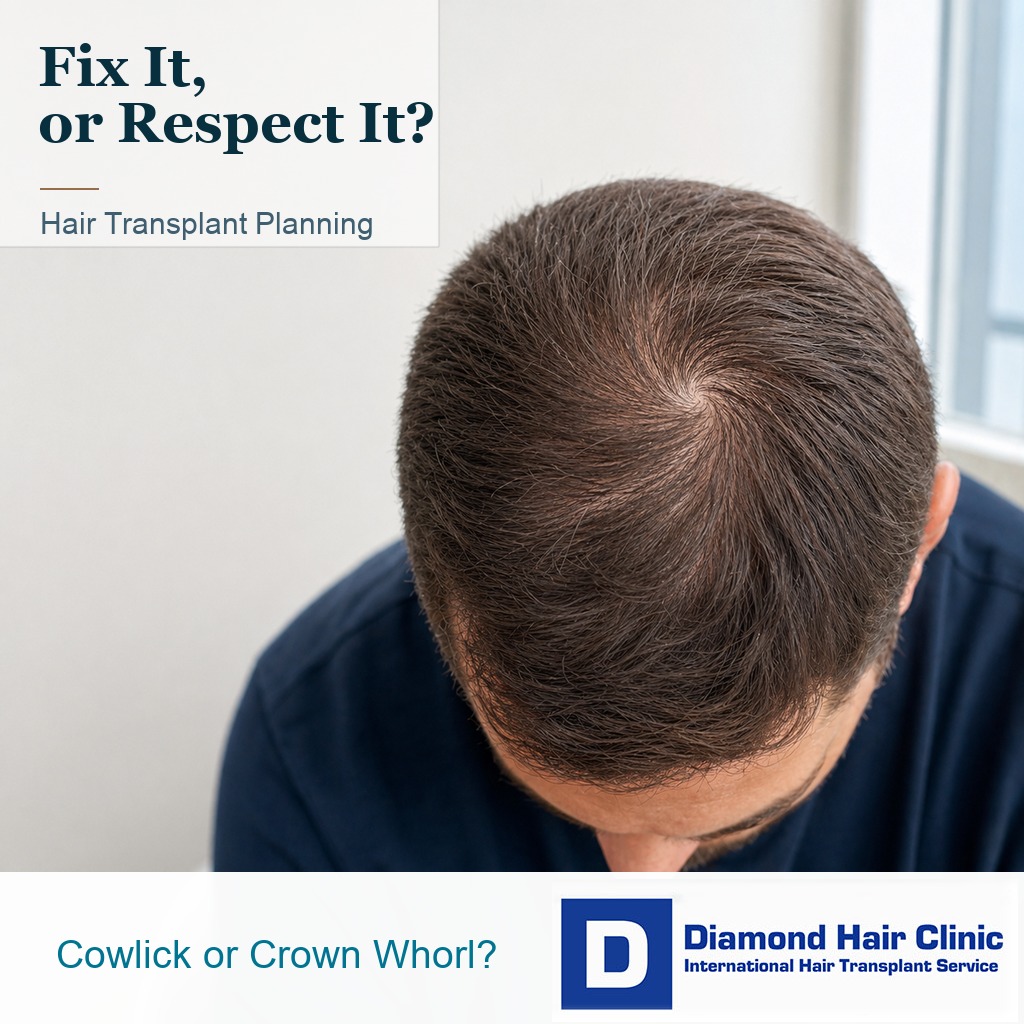
Cowlick, Crown Whorl, and Hair Transplant Planning
A hair transplant can sometimes soften the appearance of thinning around a cowlick or crown whorl, but it should not be planned as an attempt to erase a natural whorl. If the cowlick is simply your normal hair direction, surgery may be unnecessary and may even make the area look less natural. If there is real crown thinning around the whorl, a transplant can help only when the grafts are placed with the correct angle, direction, density, and long term donor plan. I do not draw an exaggerated swirl just to create the look of coverage. The direction pattern has to match the patient’s real hair and still look believable when the hair is wet, short, or seen from behind.
Keep one distinction in mind. A cowlick is not always baldness, and a crown whorl is not necessarily a surgical problem. I first need to know whether the patient has a normal swirl, early androgenetic hair loss, a weak previous transplant, or grafts that were placed in the wrong direction.
Cowlick, crown whorl, and balding are not the same
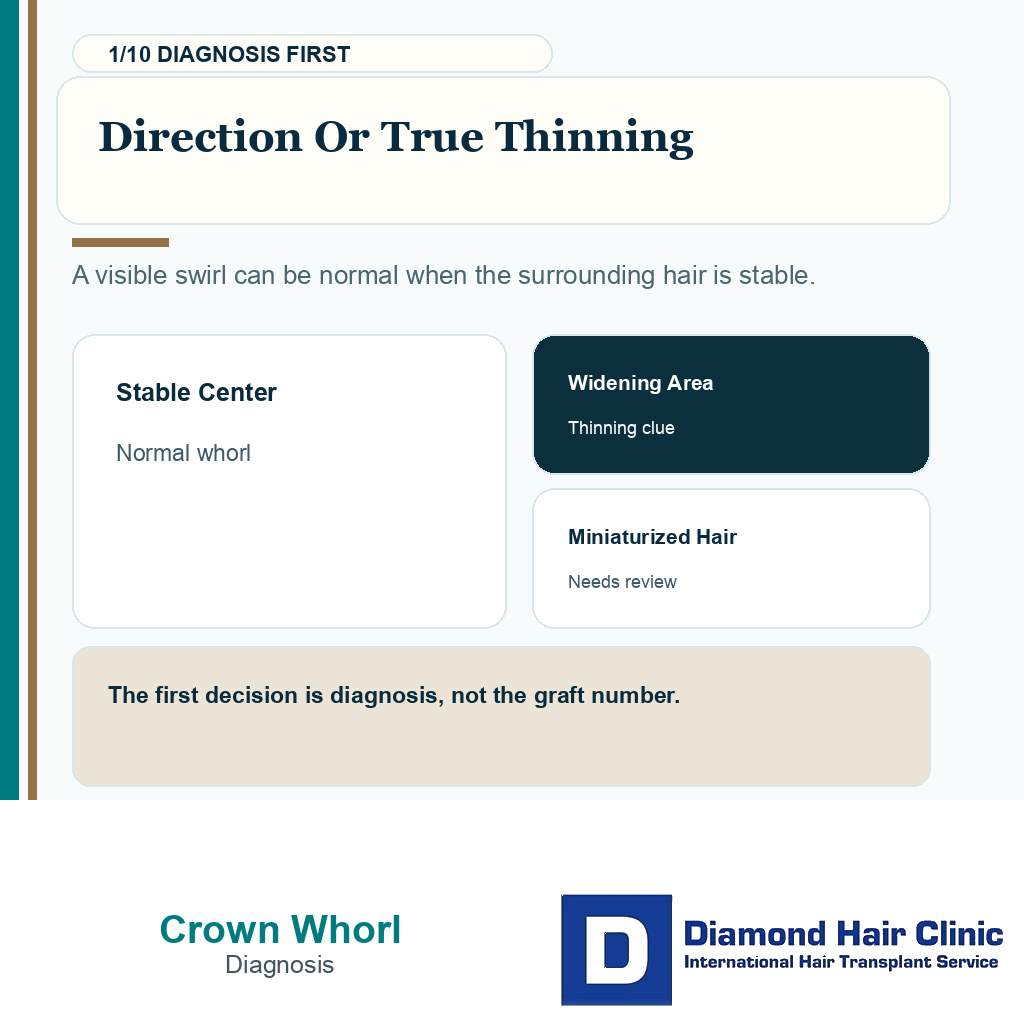
A cowlick is a natural change in hair direction. At the crown, this often appears as a spiral or whorl where the hair spreads in different directions from one center point. Because the hair parts around that center, the scalp can look more visible even when the density is normal.
Balding behaves differently. The diagnosis is not simply that you can see skin in the center. It is whether the visible area is widening and the hairs around the whorl are becoming finer, shorter, and weaker over time, especially in comparable photos.
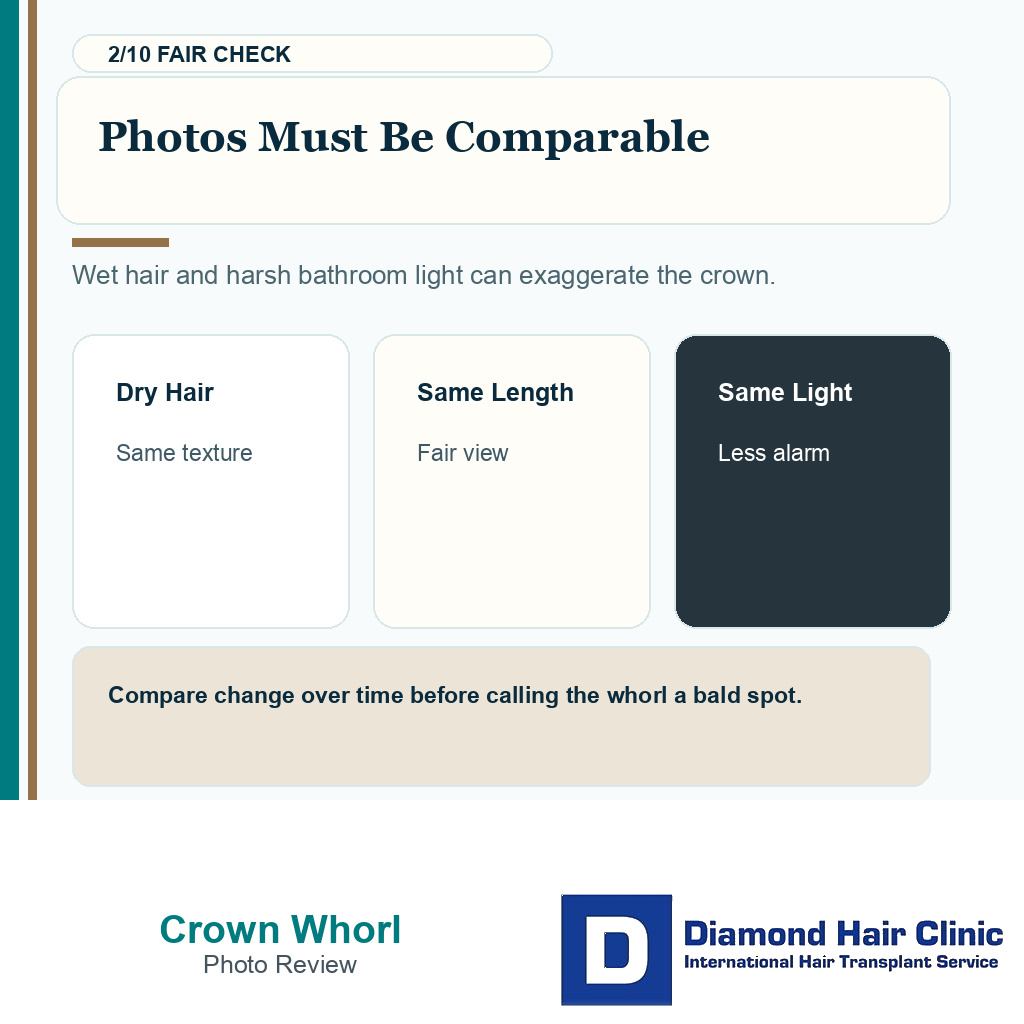
The comparison has to be fair. Under bathroom light, flash, slicked back hair, or a very short haircut, a normal swirl can look more alarming than it is. A useful comparison uses dry hair, similar length, similar lighting, and enough time between photos to see whether the visible center is stable or truly expanding.
Before counting grafts for the crown, find the center of the spiral in dry hair and then compare it with wet or parted photos. A whorl can expose scalp in one direction even when the surrounding hair is not truly thinning.
Part the hair around the swirl gently when you send photos. The clinic needs to see whether the hairs around the center are miniaturizing or simply changing direction.
When I examine this area, I do not assess it from one photo. I compare old photos, look at the pattern under consistent lighting, and check whether the hairs around the swirl are miniaturizing. A normal whorl should be respected. A thinning crown needs a different discussion.
This overlaps with crown hair transplant planning, but the decision is different. Crown restoration asks how to restore true thinning. For a cowlick or whorl, I first ask whether the patient is seeing hair loss or only the natural center of hair direction.
Natural cowlick usually should not be erased
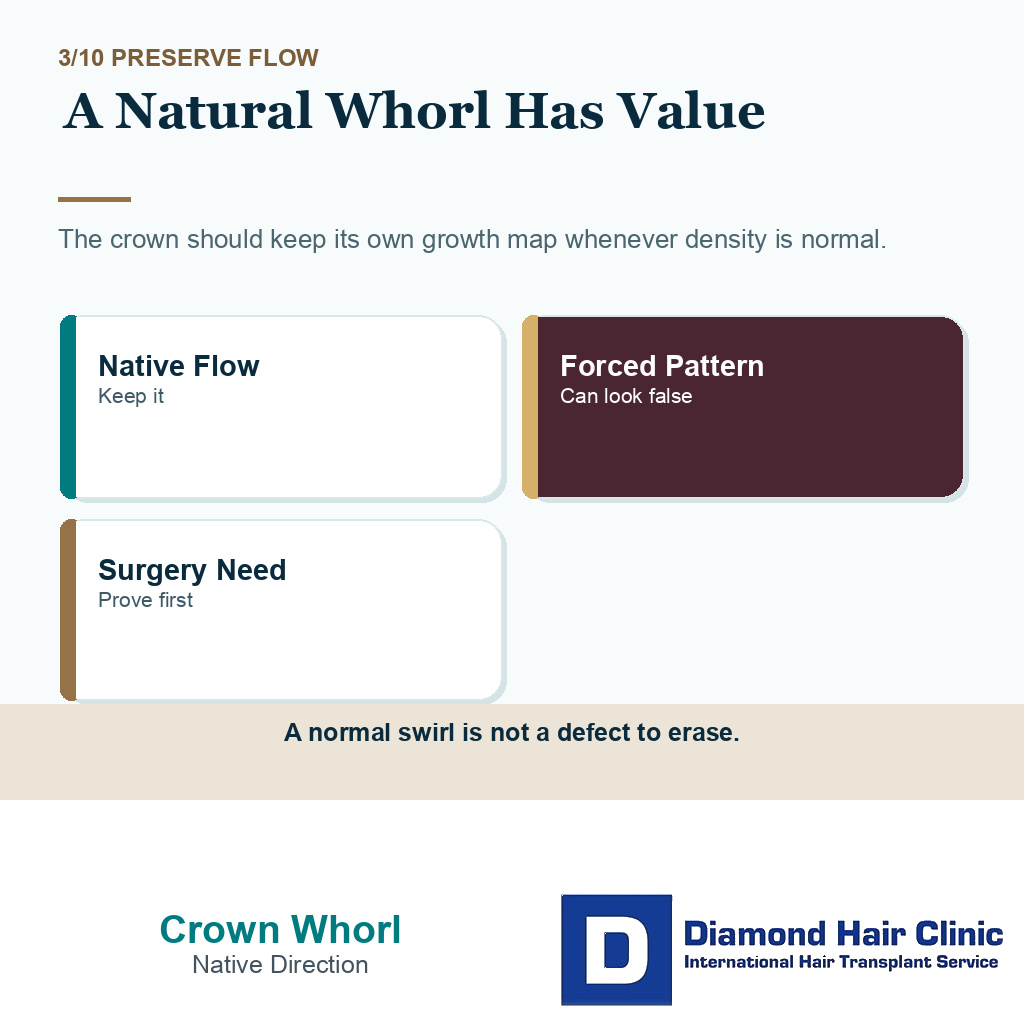
In most cases, I do not plan surgery just to remove a natural cowlick. The existing follicles already have their own direction. Placing new grafts against that direction can create conflict between the native hair and the transplanted hair.

A patient may think the aim is to make every hair lie in the same direction, but the scalp does not work that way. Natural hair has changes in angle, flow, and density. The crown especially needs a rotational pattern, not a flat blanket of hair.
If the cowlick is at the front hairline, direction still controls the design. A small change may be possible in selected cases, but the surgeon must work with the natural direction, not fight it. This is closely related to natural hairline design, where the smallest wrong angle can make a result look artificial.
I pause when the patient is not losing hair but feels distressed by the shape of the cowlick. Surgery is permanent. If the diagnosis is mainly styling frustration, it is better to discuss hair length, styling direction, and whether the concern is truly surgical before using donor grafts.
Haircut and styling may be enough when density is normal
Often, yes. If the crown is not truly thinning, the better first step may be a better haircut, more length, different drying direction, or lighter styling product rather than surgery. Very short hair can expose the center of the whorl more strongly, while a little more length can let the surrounding hair overlap the visible point.
Judge the crown under fair conditions before calling it baldness. Wet hair, oily hair, harsh bathroom light, flash photography, and a fresh short haircut can all exaggerate the swirl. If the area looks much better with dry hair, normal room light, and a slightly longer style, surgery is usually the wrong first answer.
This protects the donor area rather than dismissing the concern. A cowlick that can be managed with styling should not consume grafts that may be needed later if real crown thinning develops.
Crown whorl decision lens
Four checks before treating a cowlick or crown whorl
A whorl can look sparse even when the scalp is not truly thinning. The plan has to separate natural direction, real loss, styling limits, lighting, and donor cost before grafts are used.
Natural whorl
Is the pattern normal direction?
A crown whorl can expose scalp because hair changes direction, even when density is acceptable.
A transplant should respect the natural swirl and treat only thinning that is genuinely present.
Use this as a planning frame, not a diagnosis or approval for surgery. The final plan still depends on donor reserve, recipient area anatomy, hair type, medical history, and future hair loss risk.
Crown whorl surgery helps only when there is real thinning
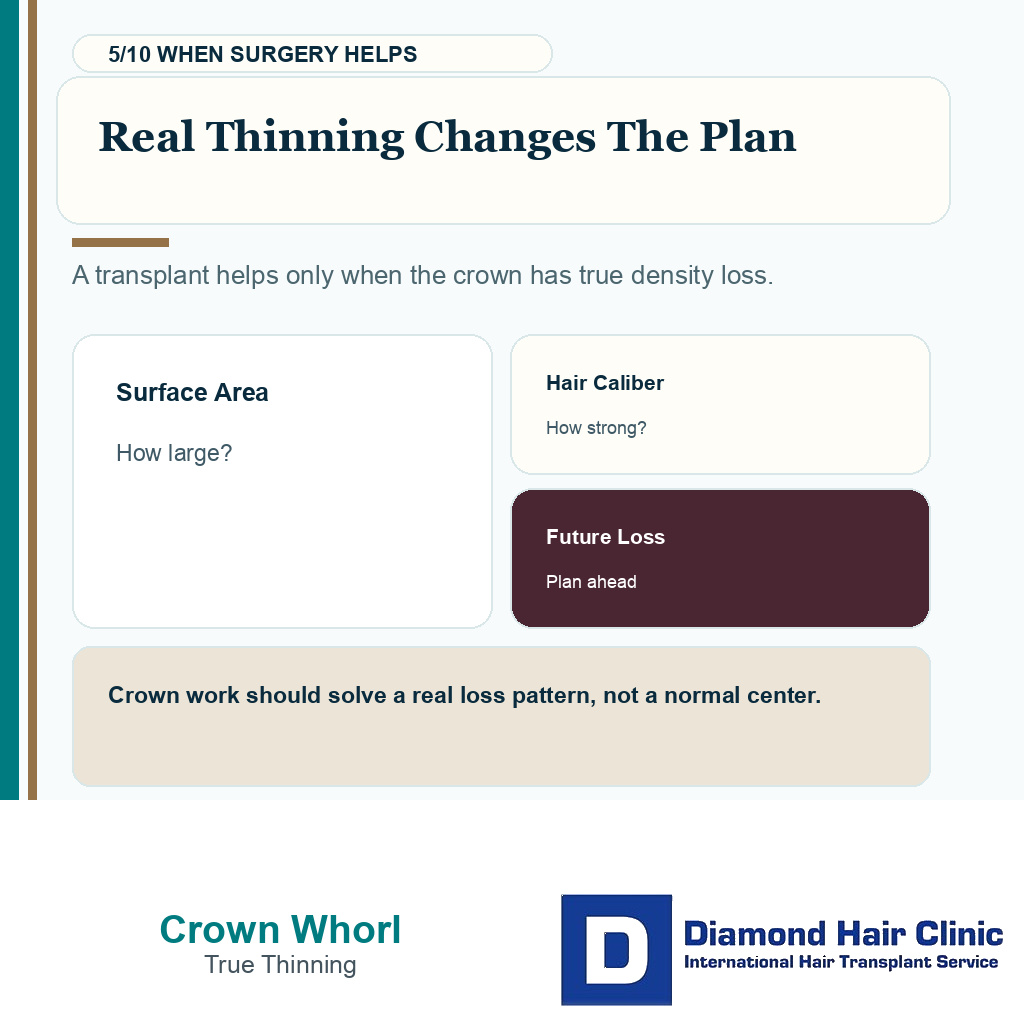
A crown whorl hair transplant can help when the whorl area is genuinely thinning and the patient has enough donor capacity for a meaningful improvement. I am not trying to cover the crown like paint. The aim is to rebuild enough direction, layering, and density so the scalp is less exposed while the crown still looks natural.
I am more comfortable when the hair loss pattern is stable enough to plan, the donor area is strong, and the patient understands that crown density is usually more limited than frontal density. The crown consumes grafts quickly because hair radiates in many directions instead of overlapping forward like roof tiles.
A good crown result often looks modest at first glance, but it behaves naturally under movement and light. A bad crown result may look dense in one photo but reveal strange direction, a pattern that looks like a wheel, or an obvious transplant look when the hair is short.
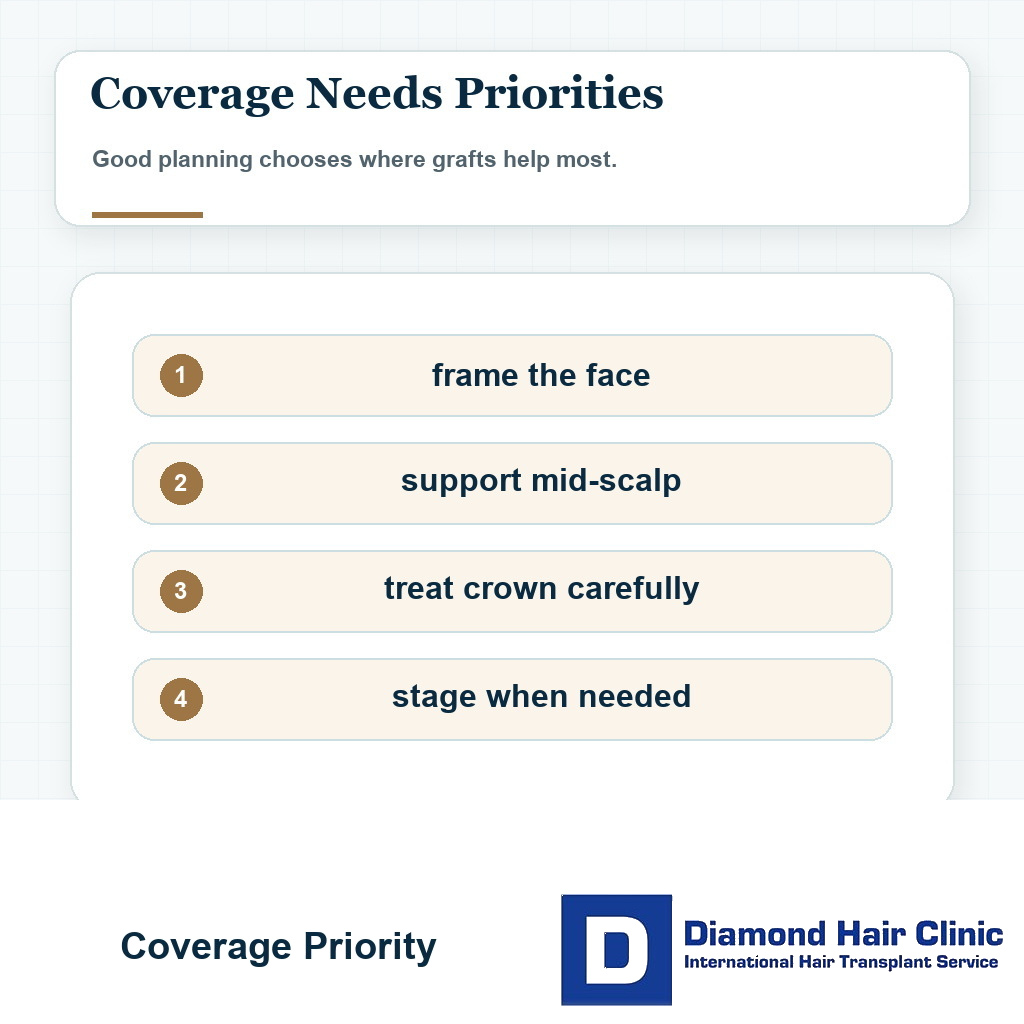
The surgical plan must also consider whether the front or crown should be prioritized. If the patient has limited donor supply, I may recommend solving the frontal frame first and delaying crown work. In that case, choosing between hairline and crown first can matter more than the patient’s preferred area on the day of consultation.
Use the 10 cowlick and crown whorl planning slides below to separate natural direction, true thinning, graft direction, donor limits, and treatment timing. Swipe the carousel, use the arrows for one step at a time, or choose a number below the image to jump to that point.



Crown surgery is harder because direction changes across a curved area
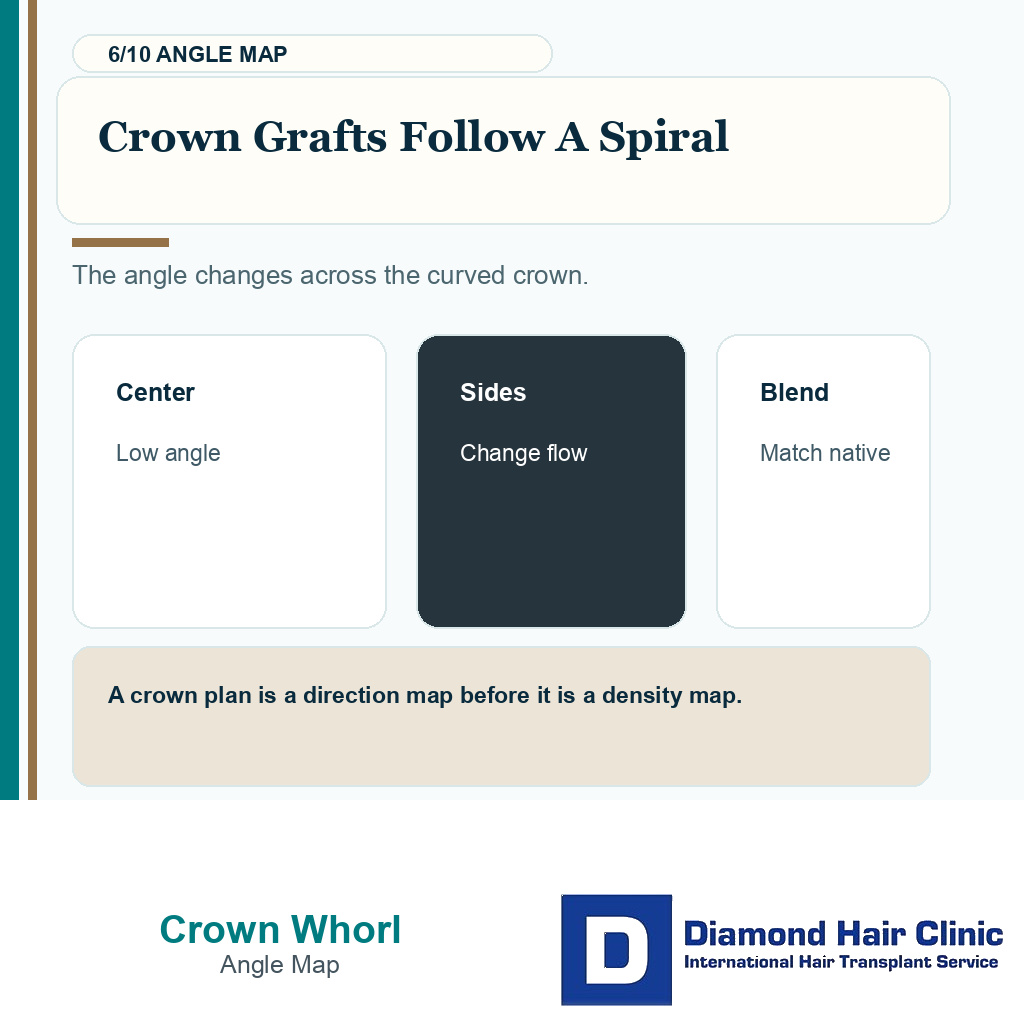
The crown is harder because the hair changes direction across a small curved area. In the hairline, most hairs can be planned with a forward and slightly irregular flow. In the crown, the surgeon has to recreate a spiral that blends with the patient’s existing hair.
Some patients have one clear whorl. Others have a double whorl or a center that sits slightly off to one side. I do not force every crown into the same pattern. I read the native direction first, then place grafts so the new hair supports that map instead of fighting it.
With curly hair or two whorls, I map both centers before discussing graft numbers. I follow where each direction begins and where the two patterns meet. That helps separate scalp exposure created by the curl and whorl from genuine thinning, and avoids forcing the crown into one borrowed spiral.
A simulator can help explain the shape a patient hopes for, but it cannot decide the graft angle, miniaturization pattern, donor budget, or how the whorl will behave under real light.
The crown also reflects light differently. When hair spreads away from the center, there is less overlapping coverage. Even with good growth, the same number of grafts can look thinner in the crown than in the frontal area.
Promises that make crown coverage sound easy deserve careful review. A clinic may show a dense crown result, but the real questions are how many grafts were used, how much donor reserve remains, how the whorl was designed, and whether the patient will continue to lose hair around it.
Why some hair transplant results look thin is often a density and planning problem, not only a graft number problem. Density depends on hair caliber, color contrast, angle, lighting, scalp area, and whether the grafts are placed where they create the strongest visual effect.
Wrong direction can make growing grafts look unnatural
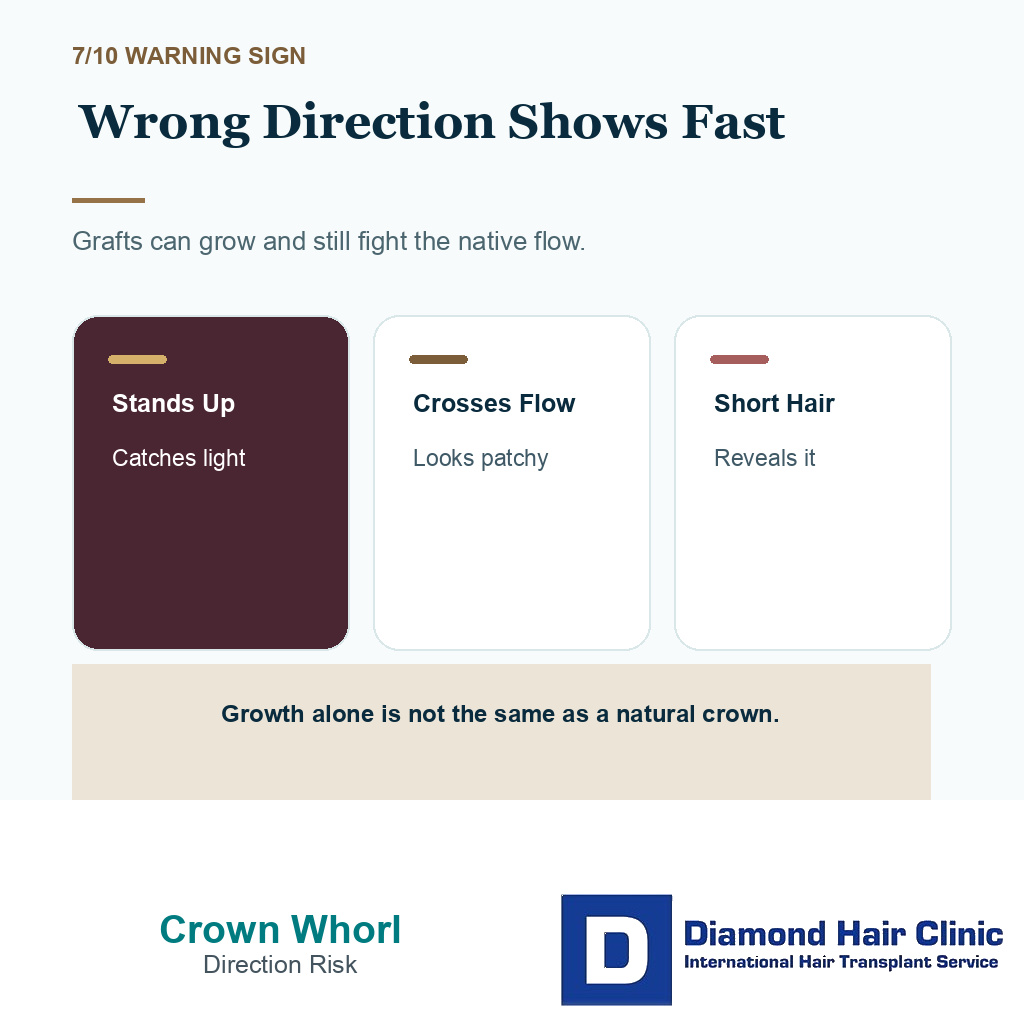
Wrong direction can make a technically successful transplant look unnatural. The grafts may grow, but they may point against the native hair, stand up too much, cross the natural flow, or make the crown look like separate patches instead of one pattern.
This is especially visible in short hair. The patient may feel that the density is acceptable, but the hair does not sit normally. In the crown, a wrong center point or wrong spiral direction can be harder to hide than plain low density.
Repair may be possible, but it is not always straightforward. Some grafts can sometimes be removed, camouflaged, or balanced with new grafts, but every repair uses more donor hair and every scarred or previously operated area is less predictable than a first operation.
If the concern is a previous transplant that now grows in an unnatural direction, my article on wrong hair direction after a hair transplant is more relevant. That is a repair question, not the same as treating a natural cowlick before any surgery has been done.
Graft numbers depend on surface area, caliber, and donor reserve
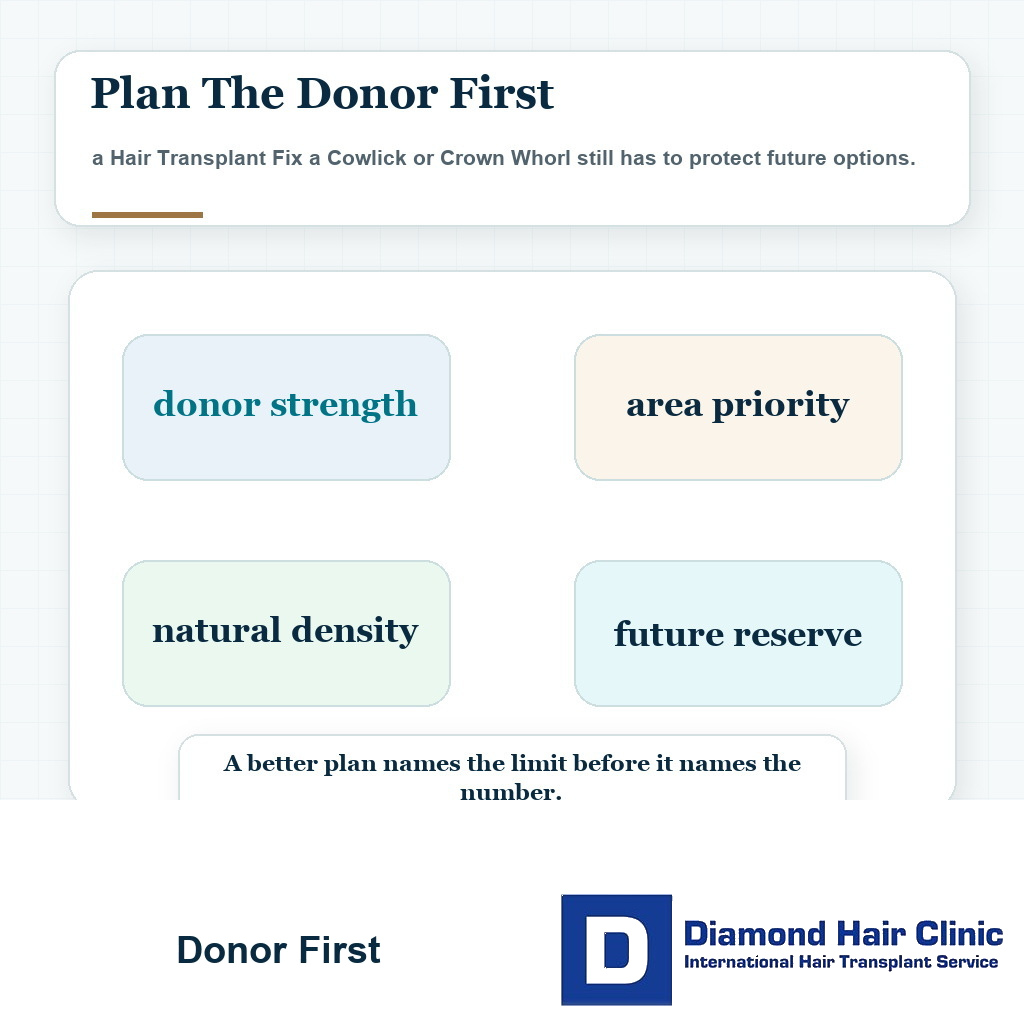
There is no responsible single graft number for every cowlick or crown whorl. A small area of thinning beside the whorl may need a limited number of grafts. A wider crown pattern may need a much larger plan, sometimes staged over time.
I avoid giving a number before I see the scalp, hair caliber, donor area, surface area, and the direction of the existing hair. Two patients can both say they have a crown cowlick, but one may have a normal whorl and the other may have progressive vertex loss.
The quiet risk is donor cost. If the patient uses many grafts in the crown too early, there may be fewer options later for the frontal area, middle scalp, or repair work. Here, donor area planning becomes central.
When I plan this area, I am not only asking how many grafts can be placed. I am asking whether those grafts will create enough visible benefit to justify their use. If the visible benefit is small, waiting or medical support may be better than surgery.
Medical treatment may change the crown plan
If the crown is actively thinning, treatment may change the surgical decision. Medication can sometimes improve or stabilize crown hair enough that surgery becomes smaller, delayed, or unnecessary. It can also protect native hair around a future transplant, which matters when longer hair, product, washing, or camera angle makes the crown look different from one photo to the next. For a crown that still has native hair, I also separate whether medication can improve crown thinning enough to avoid a transplant from the whorl decision itself.
I do not present minoxidil, finasteride, or dutasteride as guaranteed answers. They require medical judgment, side effect discussion, and realistic expectations. But in crown thinning, medication often deserves a serious conversation before spending donor grafts.
Patients often worry that a transplant is the only way to make the crown look better. Sometimes that is true. Other times, the smarter first step is to understand the diagnosis and see whether native hair can be supported.
The discussion around minoxidil after a hair transplant is relevant, even before surgery. Medication is not a substitute for surgical design, but it can change how aggressive or conservative the design should be.
Waiting is better when diagnosis or expectations are unclear
Waiting is better when the diagnosis is unclear, the patient is very young, the crown is still changing quickly, or the visible area may simply be a normal whorl under harsh light. Waiting can also be wiser when the donor area is limited or the patient wants complete crown coverage that surgery cannot provide.
Waiting is also better when the patient is judging the crown from one short haircut, wet hair, or a strong camera flash. Those conditions can exaggerate the whorl. A careful decision should be based on repeated observation, not a panic photo.
Another reason to wait is emotional urgency. If the patient is asking for surgery mainly because the crown looks bad from one angle, the first step is calmer documentation. Surgery should solve a real pattern, not chase every lighting condition.
A patient who is uncertain should be assessed as a whole candidate, not as a single crown photo. Whether someone is a good candidate for a hair transplant depends on age, donor strength, diagnosis, expectations, and future hair loss risk.
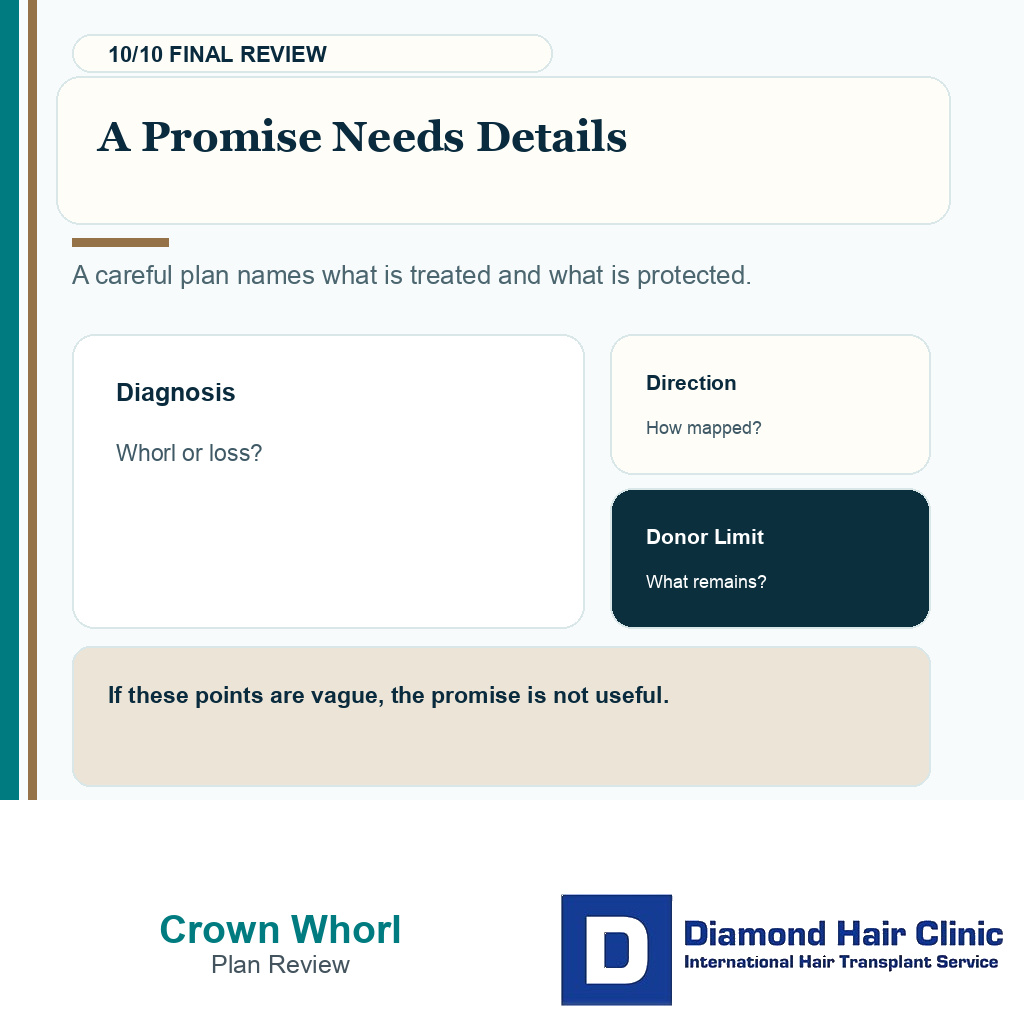
Clinic promises should explain diagnosis, direction, and donor limits
Be careful with any clinic that promises to fix a cowlick without first explaining whether it is normal hair direction or true hair loss. A natural whorl is not a defect. If the clinic treats it as an easy sales opportunity, the consultation is already too shallow.
A serious surgeon should talk about angle, direction, donor capacity, crown density limits, and future loss. The answer should not be only a graft number. It should explain what surgery can improve and what it should leave alone.
A plan that sounds too perfect deserves more questions. Phrases like full coverage, no visible scalp, or guaranteed density in the crown usually hide the real limits. The crown is a demanding area, and responsible planning often sounds more modest than marketing.
If the patient feels rushed, the better decision may be to pause. You should feel informed enough to decide without pressure, not pushed to reserve a date. Sometimes the most valuable step is to wait for the right hair transplant surgeon rather than accept a quick promise.
A careful plan starts with diagnosis and native direction
A careful plan starts with diagnosis. Is the patient seeing a normal whorl, male pattern crown thinning, diffuse thinning, a previous surgical problem, or a styling issue? These are not the same problem.
Then I look at the direction of the native hair. In the crown, every graft has to support the swirl instead of fighting it. The center point, the rotation, and the transition into surrounding hair all matter.
The plan should also include donor capacity, not only crown coverage. I check how many grafts may be needed now, how many should be protected for the future, and whether the visual improvement is worth the donor cost. A crown case can look tempting but still be strategically weak.
Finally, the follow up plan matters. Crown growth can be slower to judge than the front, and many patients panic too early. I explain how to track hair transplant growth without treating every month as a final result.
A cowlick is not always thinning
The crown has to be read in motion, in wet hair, in dry hair, and over time. A natural whorl can expose scalp because of direction alone. Early crown loss needs diagnosis and medical planning. A previous transplant with poor angle needs repair judgment.
Those are different problems. I do not treat a swirl with grafts unless the exam proves surgery belongs there. When grafts are needed, they must follow the existing direction and use donor hair carefully, because a crown that fights its own whorl rarely looks natural.

Read this review excerpt
We also had a levelled conversation about my hairline and results I could expect based on my donor density area.