


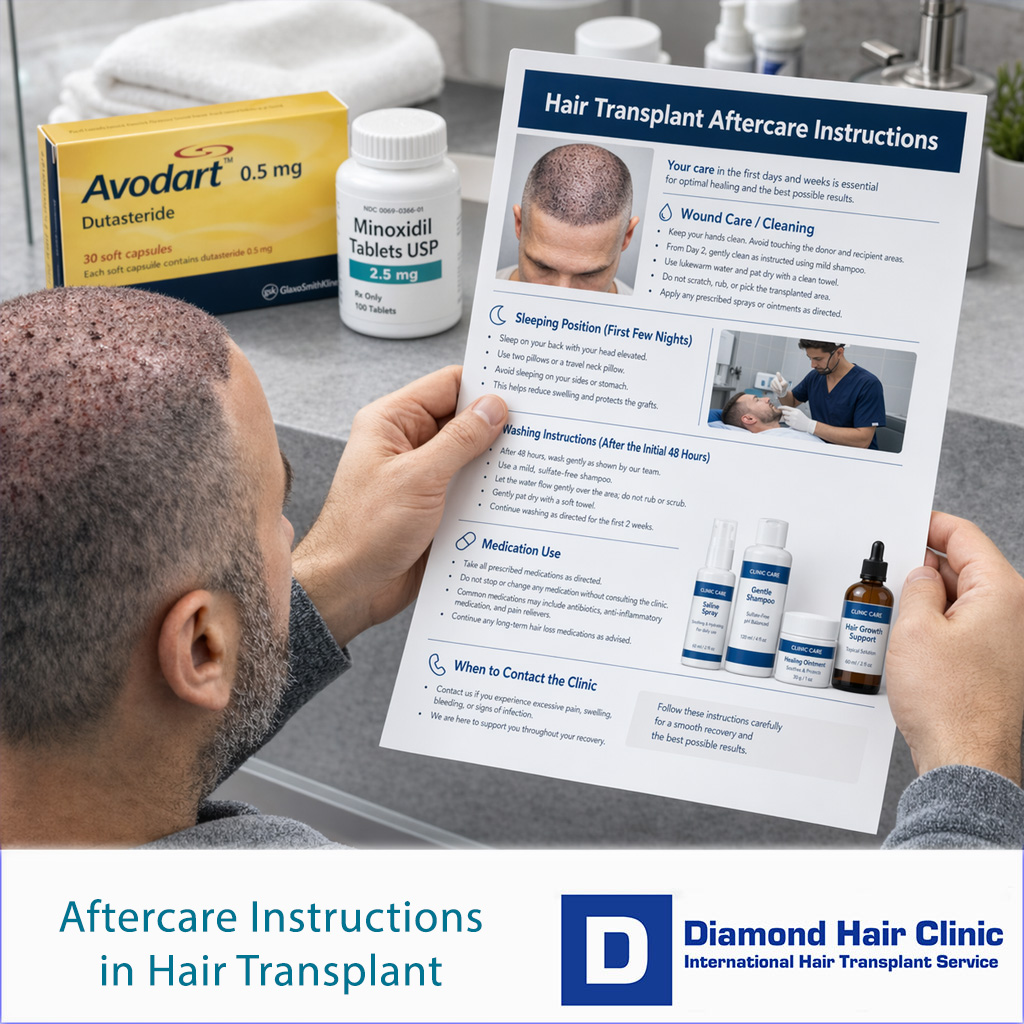
Aftercare Points That Protect Healing Grafts
Aftercare is where many international patients learn whether the clinic is still medically present after the operation. The first days need clear answers about what matters, what can wait, and which symptoms should be reviewed instead of guessed from photos online. A patient who is worried about hot shower and steam after FUE needs the same kind of simple sorting before changing the washing routine. For broader recovery and planning questions, I keep a separate hair transplant questions and answers guide. If you are receiving conflicting aftercare advice, start with one written surgical plan before changing washing, medicine, spray, or activity routines.
Hair transplant aftercare priorities
A hair transplant is not finished when the surgery ends. The first follow-up checks are not only formalities. I use them to see whether the grafts are protected, whether donor healing is settling, and whether the patient understands the next few days clearly.
I explain recovery in phases because the patient’s behavior should change as the scalp heals. The first 10 to 14 days are protected time. The next few weeks are controlled healing. Later, the job is patience and proper review, not constant panic over daily photos.
For patients who fly home, follow-up depends on good information. Clear photos, symptom timing, medication use, and direct reporting of contact, rubbing, swelling, bleeding, or pain help me decide whether the answer is reassurance, a change in routine, or medical review. For swelling centered at the donor area, the donor area swelling after FUE pattern is part of that same aftercare decision.
In the 10 to 14 day early healing window, graft protection matters more than convenience. This is also when what you wear after a hair transplant matters most because collars and pullovers can add avoidable friction. Daily routines such as prayer after a hair transplant also need that same graft protection mindset.
The first 3 to 4 weeks are about controlled healing and avoiding a rush back into normal life too quickly. Then comes the patience phase, because new growth usually becomes visible around month 4, becomes much more noticeable around months 6 to 9, and the more mature result is usually judged around 12 to 18 months, sometimes a little later.
A good result is not created only in the operating room. It is protected in the days after surgery, supported in the weeks after surgery, and judged properly only over the months that follow.
I also have written separately about why some hair transplants look thin, because a good transplant can easily look weaker if it is judged too early, before the growth has matured properly.
Importance of the first 10 to 14 days
This is the period when the grafts are still settling into place and the scalp is still fresh from surgery.

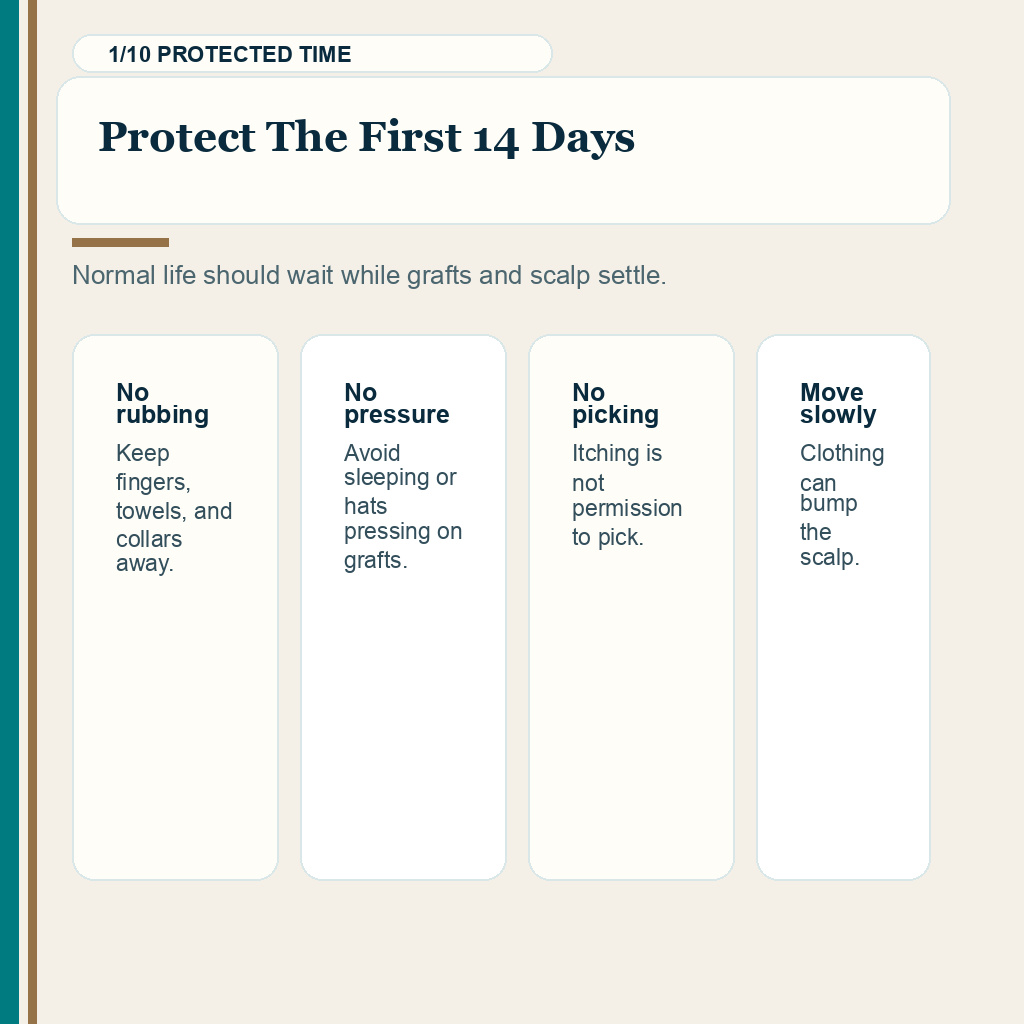
In those first 2 weeks, patients should behave carefully, not casually. No rubbing, no scratching, no pressing on the grafted area, and no careless contact while dressing, sleeping, entering a car, or moving through crowded places. Patients often worry about dramatic accidents, but small careless actions or a direct bump are often more relevant in the early days. Treat the first 10 to 14 days as a protected period. Scalp massage after a hair transplant should wait until the recipient area can tolerate pressure.
This is not meant to frighten the patient. I want him to understand that the first 10 to 14 days are not yet normal life. That is also why early going out after a hair transplant should stay short, shaded, and practical.
The first 24 to 48 hours after surgery
In the first 24 to 48 hours, I want you to stay calm and protect the grafts.
Protect the recipient area. Avoid unnecessary touching. Sleep carefully.
Take the prescribed medications correctly. If you are considering any extra painkiller after surgery, ask the clinic first. This also applies to antibiotics after a hair transplant, which should not be stopped, doubled, or changed without review. Do not create extra heat, sweating, bending, or physical agitation for no good reason. Botox or fillers after a hair transplant should also wait until the skin is calm enough for another procedure. Cannabis after a hair transplant needs the same early recovery caution if it affects coughing, sleep, or judgment. Hair dryer use after a hair transplant belongs in the same heat and friction conversation when the scalp is still healing. If swelling makes you consider a cold compress after a hair transplant, keep it away from the grafts and follow the clinic instructions.
Many patients feel generally okay quite quickly after surgery, but feeling okay and being healed are not the same thing.
In this early period, the scalp may feel tight, tender, sensitive, or slightly throbbing. A small amount of light bloody oozing from the donor area can also happen in the first 2 days. That can be normal.
The detail that matters is that the patient stays calm, follows instructions, and avoids creating unnecessary trauma. Temporary scalp pain, tightness, scabbing, itching, and some swelling are all common in the early recovery phase. This recovery discomfort should not be confused with the brief discomfort of anesthetic injections during the procedure.
The second day check in my clinic
My routine includes a post-operative check on the morning of the second day after surgery.
During this visit, I personally go through the first 10 day washing routine with the patient and perform the first wash together with him. When a patient is given saline spray after a hair transplant, I treat it as part of that protected early routine, not as a separate guarantee.
I also remove the donor area dressing that was placed at the end of the procedure to absorb the small amount of light bloody fluid that can come from the donor area during the first 2 days.
This second day appointment is an important part of my post-operative routine because it allows me to examine the scalp early, ensure everything looks as expected, and show the patient exactly how to wash rather than leaving him to guess. If he is recovering without a companion, practical help in the first days should come from clear clinic contact and organized logistics, not from improvising. Patients coming from abroad should also plan the first days in Turkey after a hair transplant so washing, checking, and travel do not become rushed.
In most cases, after this visit is completed, the patient heads straight to the airport with our driver for the return flight, without returning to the hotel.
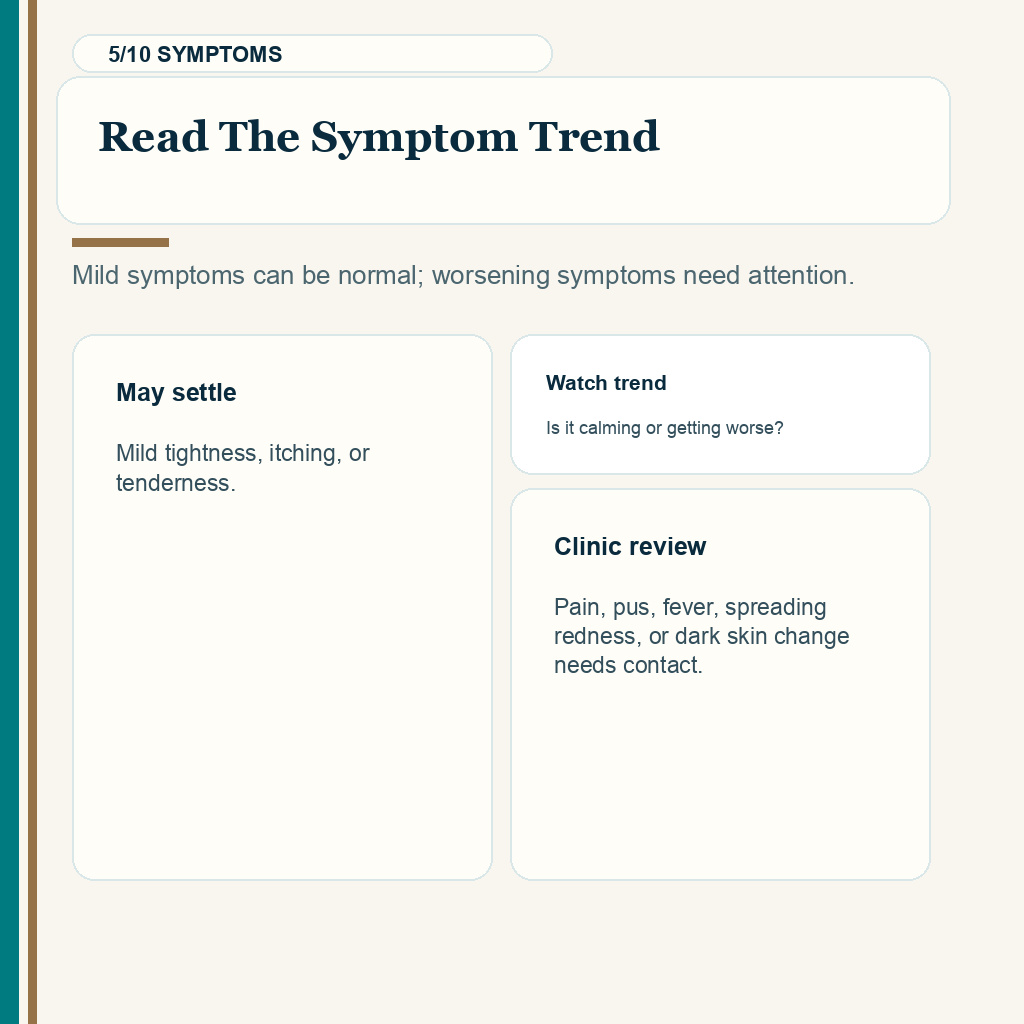
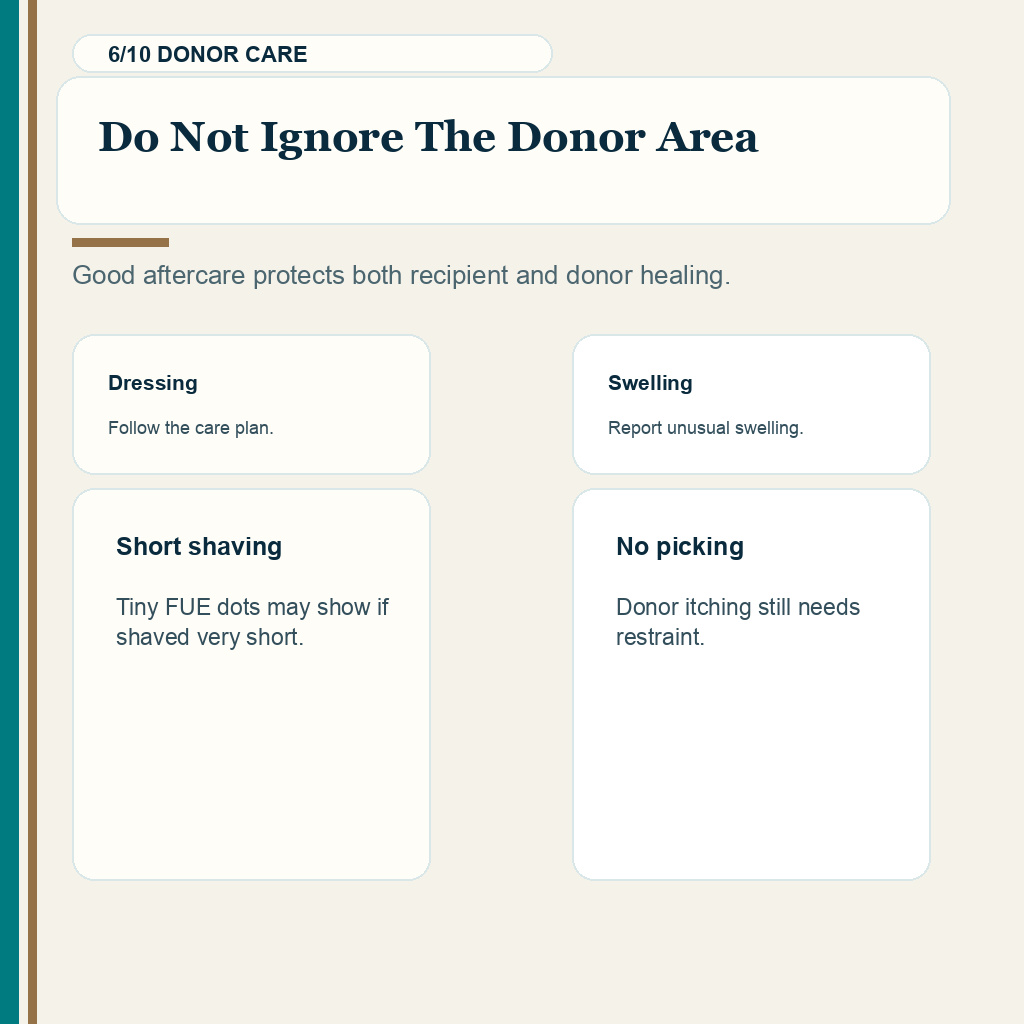
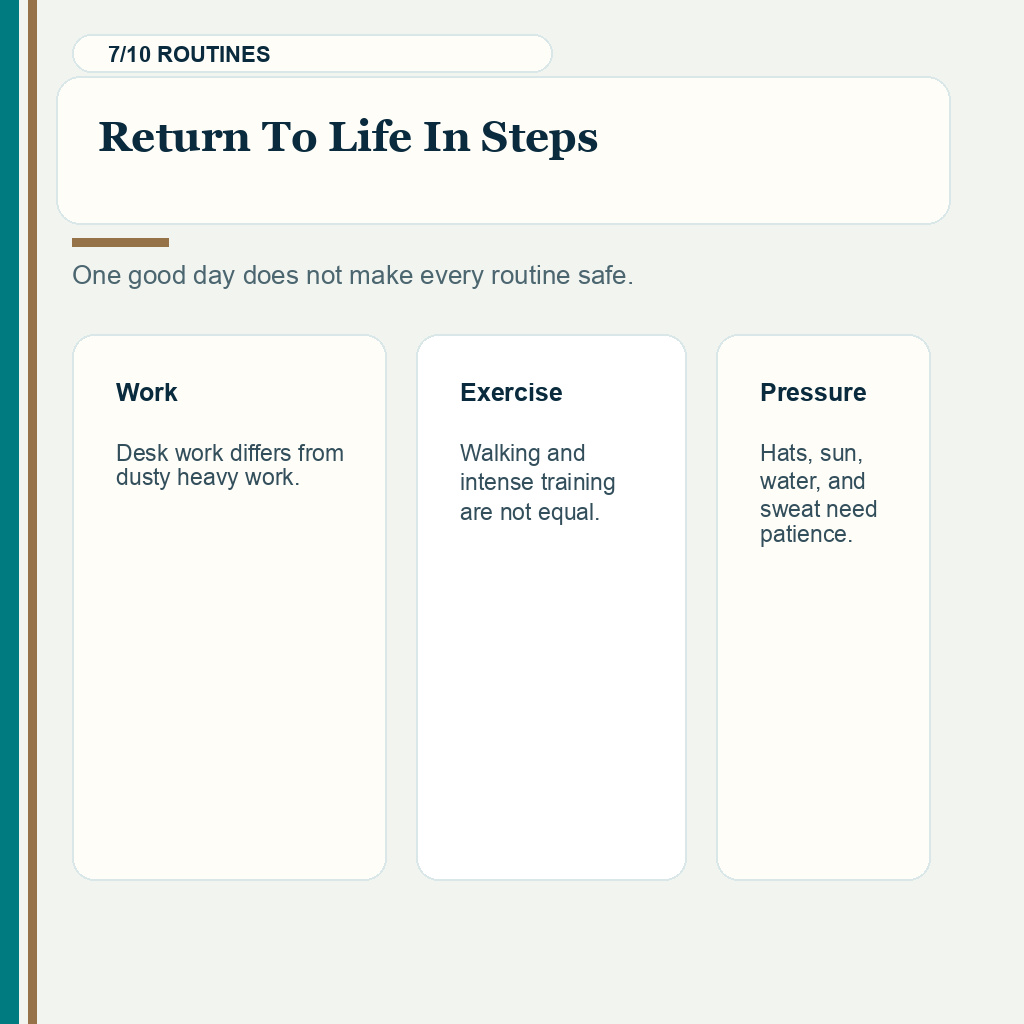
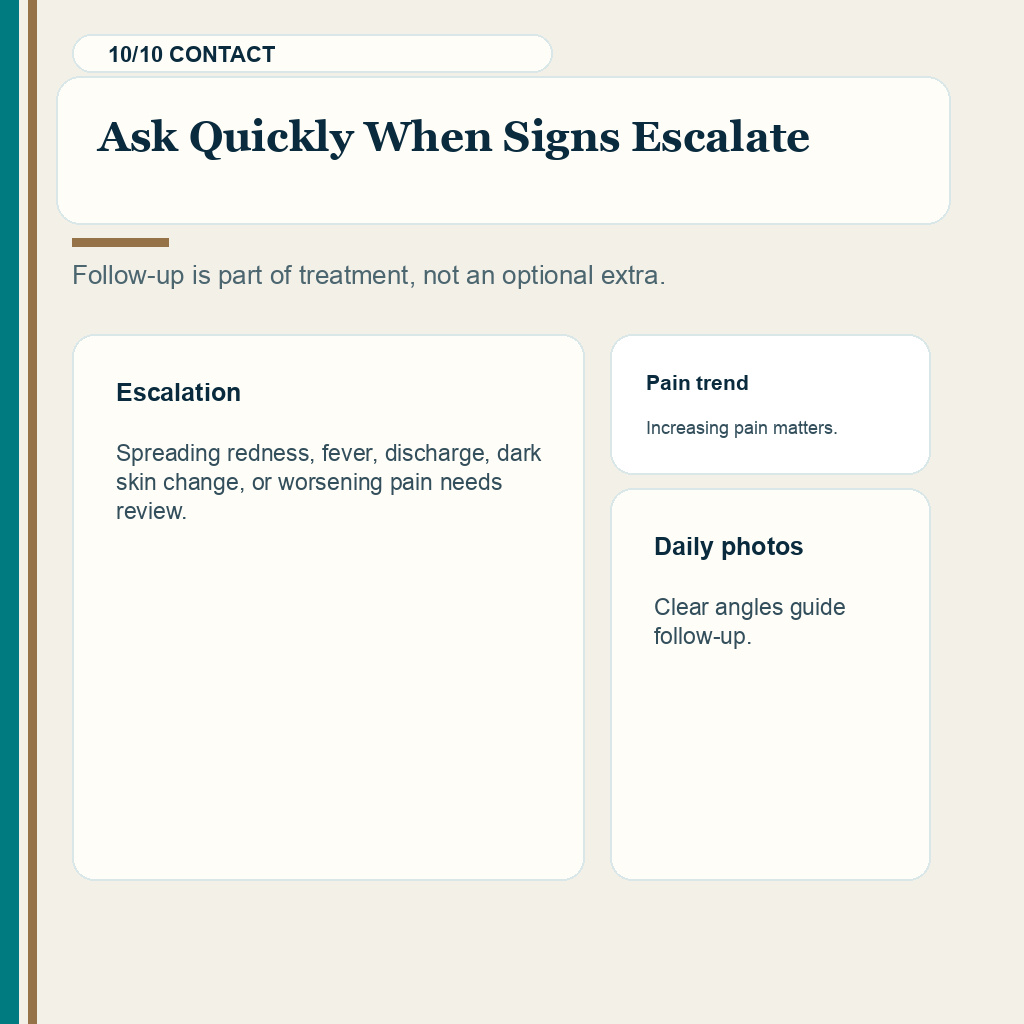
These 10 aftercare slides show how to protect the grafts, wash carefully, return to routines step by step, and recognize warning signs. Swipe the carousel, use the arrows for one slide at a time, or choose a number below the image to jump to that point.




Sleeping after a hair transplant
For the first few nights, you should sleep with your head elevated at 45 degrees or 90 degrees and avoid direct pressure on the grafted area. The first night after hair transplant needs the strictest version of this setup because the patient is tired, swollen, and still learning how to move safely.
Practically, patients sleep more upright than usual for the first 2 to 5 nights. I also stay cautious about sleep pressure on the operated areas for roughly the first 10 to 12 days. Elevation of the head helps reduce swelling, and avoiding friction helps protect the recipient area. A neck pillow after surgery can help with positioning only if it does not press on the donor area. If a patient uses CPAP after a hair transplant, the mask straps also need to be planned around the recipient area.
What matters here is clear. This is not about perfect comfort for a few nights. The goal is protection.
Returning to normal sleep
Most patients can start easing toward normal sleeping after the first several nights. I still protect the operated areas for about 5 to 10 days, and a fuller return to normal positions usually fits day 10 to day 14 if healing looks good.
So I do not think of this as a switch. It is a gradual transition. In the beginning, the scalp still benefits from protection. Later, as the grafts settle and swelling subsides, normal sleep becomes less risky.
Starting the first wash
You can usually start the first gentle wash on day 2, or as directed by your surgeon’s protocol.

Some surgeons begin as early as day 2. Others prefer day 3. The detail that matters most is not just the day, but the method.
The first washes should be gentle, controlled, and protective, not like a normal shower. No fingernails, no strong water pressure, no hot water, and no impatient scrubbing.
In my own practice, I personally begin the washing process with the patient on the morning of the second day after surgery.
Write the surgery date and the scheduled date of your first wash beside the washing instructions. That keeps the schedule clear without relying on a day zero or day one label.
Returning to normal washing
You should not treat your scalp as “normal” for at least the first 14 days.
In the beginning, washing should remain careful and controlled. Once the crusts have softened and cleaned on 12th day, and the grafts are much more secure, washing can gradually return to normal.
But I avoid treating one early wash as proof that the scalp is ready for casual shampooing. Normal washing does not return with one single wash. The question of normal shampoo after a hair transplant depends on the scabs, the skin, the product, and how much pressure is used.

Read this review excerpt
“When I was there he showed me the different shampoos/creams etc and explained how I should be using them and for how long.”
Crust removal timing
Crusts should come away gradually, not by force.
For many patients, they begin separating over roughly 7 to 10 days, and in some cases they can linger a little longer. That does not mean the patient can start scratching or aggressively rubbing on day 3 because he wants everything gone immediately.
Crusts should soften with proper washing and time. Picking, scratching, or scrubbing them off by force is not good aftercare. It is simply impatience.
In my clinic, I advise patients to begin gently massaging to remove crusts on the 12th day after surgery, which corresponds to the 10th washing day. Since the first wash takes place 2 days after surgery, the 10th wash falls on day 12.
Redness, swelling, tenderness, itching, and numbness
All of these symptoms can be normal to a certain degree.
Short-term effects commonly include crusts or scabs, itching, temporary tightness, tenderness, swelling, and some altered sensation or numbness in the donor or recipient area. The scalp has gone through a real procedure, so these early healing signs are not surprising. The more useful issue is the direction of change. Is the scalp gradually settling, or is it clearly becoming worse?
I always tell patients not to confuse still healing with something is wrong. Healing tissue often feels strange before it feels normal again.
Swelling timeline
Swelling is usually most noticeable in the first 2 to 4 days after surgery, and in most cases, it is much better by around day 5 to day 7.
In some patients, it stays mild. In others, it can move downward onto the forehead and around the eyes. That can look worrying, but it is often part of the normal early reaction. Keeping the head elevated and avoiding unnecessary bending or exertion usually helps.
Redness timeline
Redness can settle in as little as 7 to 14 days in some patients, but in others it can remain visible for several weeks.
This varies widely with skin type, scalp sensitivity, and overall skin reactivity. Patients with fair skin often notice lingering redness more than those with darker skin. That does not necessarily mean there is a problem. Patients should judge the trend, not the mirror on one particular morning.
Itching timeline
The stronger healing itch is usually worse in the first 7 to 14 days, especially while scabs are still present, but milder itching can continue for several weeks.
That does not necessarily mean there is a problem. It often means the scalp is healing. What matters here is clear. Do not scratch. Itching is annoying, but don’t scratch the grafted area.
Numbness timeline
Temporary numbness or reduced sensation often improves over weeks, but in some patients, small areas can take 1 to 3 months to feel fully normal again.
That does not necessarily mean something is wrong. Usually, it means the skin and small nerves are still recovering. Loss of feeling or altered sensation can be part of normal short-term recovery after hair transplant surgery.
Accidental touch or light impact
If it was a light touch or a minor brush, and there was no significant bleeding, no obvious graft loss, and no real trauma, panic is usually unnecessary.
Patients often have one anxious moment after surgery, where they lightly graze the area and then become convinced they have destroyed the whole result. Quite often, the fear is much bigger than the actual event.
But I also do not want patients guessing in silence after a more significant impact. If the hit was meaningful, if there was bleeding, or if something clearly looks wrong, contact your surgeon directly. This is exactly why I treat hair transplant follow-up after surgery as part of aftercare, not as an optional extra.
Touching grafts during early healing
I avoid unnecessary finger checking in the early healing period.
Patients are naturally curious. They want to feel the area, check whether the grafts are still there, or inspect every small detail with their fingertips. That habit is not helpful. In the early period, the less unnecessary touching, the better. Your fingers do not improve healing. They only add friction, irritation, and risk.
Donor area care after surgery
The donor area also deserves respect after surgery.
Many patients become almost completely focused on the recipient area because that is where they expect the final cosmetic change to occur. But the donor area has also been surgically worked on. It may feel tender, tight, numb, or uneven in the early period, and that does not necessarily mean anything is wrong.
The donor area should not be scratched, rubbed aggressively, or treated roughly. The donor area heals in stages. Even when the patient’s attention is on the front, the donor area still needs patience.
If discomfort becomes stronger instead of settling, severe donor area pain after hair transplant deserves closer attention instead of waiting for it to calm down on its own.
Bending, shoes, and lifting
In the first 48 hours, I want you to avoid repeated bending forward, and for at least the first 7 to 14 days, I want you to avoid heavy lifting or straining.
Bending deeply or lifting something heavy can increase pressure, encourage bleeding, and put unnecessary stress on a scalp that is still fresh from surgery. If you need to pick something up in the early period, bend at the knees rather than dropping your head forward. This is a small detail, but in the first few days, small details matter.
Parents should also plan childcare after a hair transplant before surgery, because lifting, bedtime, car seats, and sudden toddler contact are not the same as ordinary rest.
Returning to work
For an office job, many patients can return in about 5 to 10 days, but from a social point of view many feel more comfortable waiting 10 to 14 days.
If the job is physically demanding, dusty, dirty, hot, or involves heavy sweating, I usually want more caution. In those cases, 14 to 21 days is often more sensible, and sometimes longer, depending on the work itself.
Returning to social life
Most patients begin to look more socially comfortable between days 12 and 14, but “normal” does not return all at once.
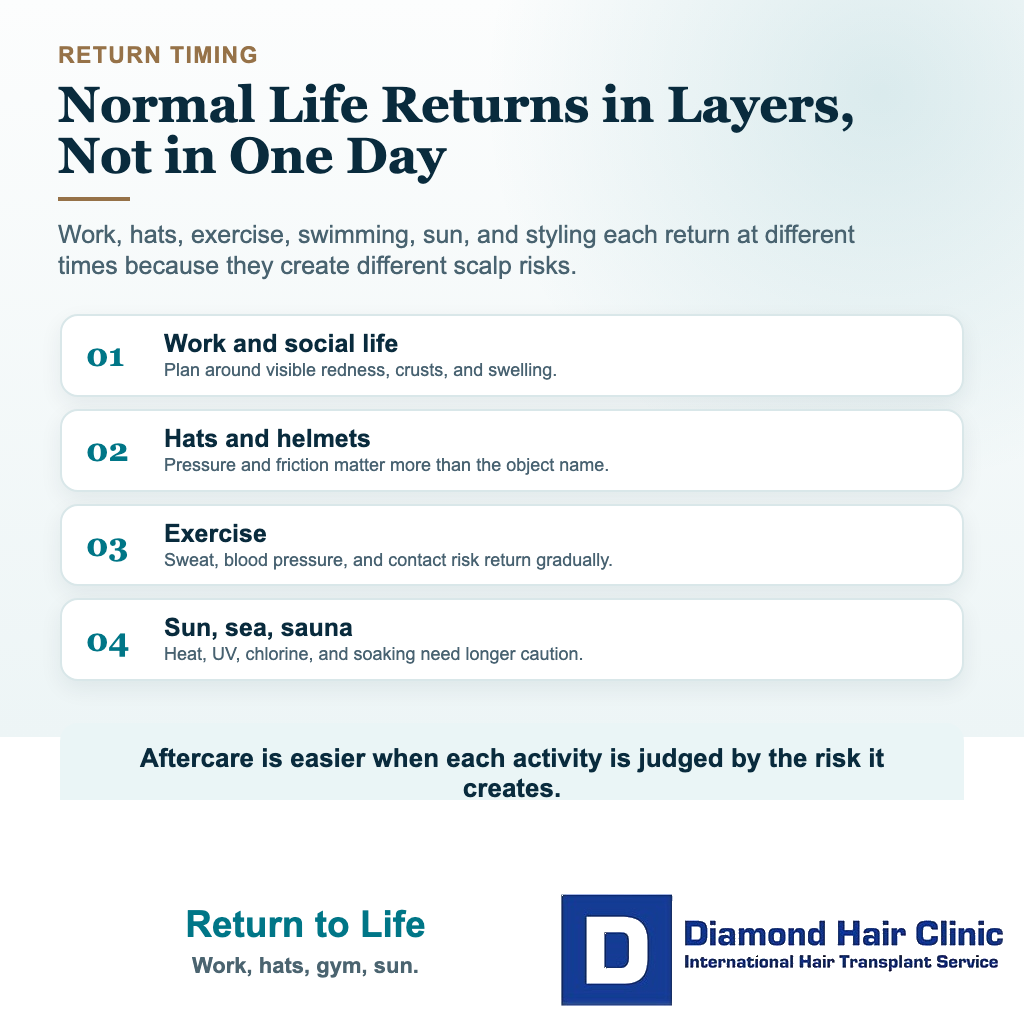
In the first several days, the scalp can look very clearly post-operative. Then the crusts soften, swelling settles, and the scalp becomes easier to show socially. But later, the shedding phase begins, and only then does visible regrowth begin. Patients should not expect immediate cosmetic normality.
Wearing a hat after surgery
A loose hat is often possible after the very early period, but I avoid tight hats or anything that rubs the grafted area during the first 14 days.
The real issue is not the hat itself. It is pressure, friction, and dragging across the recipient area. If a hat presses, rubs, or needs to be pulled tightly over the scalp, then it is the wrong hat, or it is too early.
Motorcycle helmets and hard hats
A motorcycle helmet should be avoided for the first 30 days, and in practical terms, 4 to 5 weeks is much safer.
If it is a tighter helmet or prolonged wear is expected, I am more comfortable closer to 5 to 6 weeks.
Helmets are not like loose hats. They create pressure, friction, sweat, and repeated contact when being put on and taken off. A construction hard hat may be a little more forgiving if it has more space inside and does not press directly on the grafted area, but I still do not like patients rushing back into helmet use too early.
Travel and flights after surgery
You can often fly quite soon after surgery, but the first 2 to 3 days should be handled very carefully.
The airplane itself is usually not the main issue. The bigger issue is the travel process around it, such as luggage, rushing, crowded areas, accidental bumps, tight hats, and fatigue.
Many of my patients leave for the airport directly after the second day post-operative check and first wash.
Before travel, the aftercare plan should also name who answers questions after you land, which photos are useful, and which symptoms need local medical care. A flight is easier to plan than a worry at home without knowing who to contact.
Cutting, shaving, and buzzing hair
Haircuts and buzzing need a long delay around the recipient area. I usually protect that zone for at least the first 6 months before allowing close cutting or shaving.
Even when the scalp looks calmer, haircuts still involve contact, pressure, vibration, and manipulation. I am more cautious than many clinics about early haircutting. I do not think the scalp should be rushed back into normal grooming too soon.
Normal hair products after surgery
Normal hair products should stay out of the early healing period.
I avoid gels, waxes, sprays, fibers, styling creams, or similar products on a freshly treated scalp in the first 90 days, and often advise even longer caution depending on healing. Early on, the scalp should be clean, calm, and undisturbed.
Hair fibers and concealers
Hair fibers or concealers on the scalp should stay out of the early healing phase. I usually ask patients to wait 4 to 6 weeks, sometimes longer if there is still redness, sensitivity, or residual crusting.
The scalp may look calmer before it is truly ready for cosmetic products. Fibers and concealers can irritate healing skin, sit in follicles, and prematurely turn a recovering scalp into a cosmetic surface. If the scalp is still healing, still red, or still sensitive, then it is too early.
Hairpieces, toppers, and scalp attachments
For anything that clips lightly into existing hair, I still prefer caution. Anything involving glue, adhesive, or direct scalp attachment should not be used in the early healing period.
If a patient absolutely needs cosmetic coverage later on, clip in options are safer than anything glued to the scalp. But in the first phase, my mindset is simple. A healing scalp should not be turned into a styling platform too early.
Hair dryer use
If you really need a hair dryer early on, use only cool air from a distance. Hot air should not be used on a freshly healing scalp.
Heat is the real problem, not the machine itself. In the early period, the scalp does not need heat, strong airflow, or dryness. If a dryer is used too early, it should be cool, gentle, and kept away from the scalp.
Hair dye timing
I avoid hair dye used during the early healing period, and I usually ask patients to wait at least 12 months, often longer if the scalp still looks sensitive.
Hair dye is a chemical treatment, and I do not think a freshly healing scalp should be exposed to it too early. This is among those areas where patience is more intelligent than haste.
Exercise after a hair transplant
Light walking is fine early, but I avoid vigorous exercise for at least 12 weeks.
Heavy sweating, weightlifting, intense cardio, swimming, and contact sports all impose unnecessary stress on the healing process.
Sex after a hair transplant
I usually want patients to wait about 10 days before resuming sexual activity.
The reason is exertion. In the very early period, I avoid sweating, elevated blood pressure, and accidental scalp trauma. I discuss coffee after a hair transplant separately because caffeine can affect sleep, blood pressure, and calm behavior. Meal choices also matter during recovery. Very spicy food after a hair transplant depends on whether it creates heat, sweating, stomach upset, or careless scalp contact.
Smoking and alcohol after a hair transplant
You should avoid alcohol for at least the first 14 days, and I strongly prefer that patients avoid smoking completely around surgery if possible.
Smoking works against wound healing. Alcohol is also not helpful in the immediate early period, especially if the patient is taking prescription pain medication. Less nicotine exposure and less alcohol always support better healing than more of either.
Patients who want the reasoning in more detail can also read the clinic guide to smoking after hair transplant.
Medication changes after surgery
I avoid patients making medication decisions on their own after surgery.
Any medication, lotion, shampoo, or supplement plan should come from the surgeon who performed the case. The scalp does not benefit from random experimentation, including pre workout after a hair transplant when it is tied to early training or stimulant use. Keep prescribed care separate from optional products in an extra recovery kit. The clinic name on a bottle does not tell you why you need it. If you buy a substitute elsewhere, the clinic should confirm its ingredients, strength and formulation, where to apply it and when to start. Declining optional products should leave your prescribed treatment and washing routine intact.
Supportive treatments after surgery
In most male pattern hair loss patients, supportive treatment is important, and for long-term maintenance, I consider a DHT blocker essential if the patient can safely use it.
A hair transplant moves hair. It does not halt the underlying progression of androgenetic alopecia elsewhere on the scalp. That means the transplanted hair can survive well, but the surrounding native hair that was not transplanted can continue to miniaturize and disappear over the years if the underlying process is not controlled.
I place so much importance on long-term medical support, especially DHT blocker treatment with finasteride or dutasteride in appropriate male patients.
Finasteride is commonly taken at 1 mg once daily, and its benefits are maintained only as long as treatment continues. Dutasteride, typically taken at 0.5 mg once daily, suppresses DHT more strongly than finasteride, with commonly cited serum DHT reductions of roughly 90 to 95% for dutasteride versus about 65 to 70% for finasteride 1 mg.
So in my own practice, for a man with androgenetic alopecia who has no medical contraindication, I do not see finasteride or dutasteride as an optional luxury if the aim is to get a good result and maintain it in the long term. I see it as practically mandatory.
If the patient wants to protect the native hair that was not transplanted and keep the overall result looking stable over the years, then a long-term, usually lifelong DHT blocker is the most important supportive treatment. If he stops it, the protective effect is lost and the original balding process can continue.
Minoxidil is also important, but I place it in a different category. Minoxidil can support regrowth and help maintain hair, and it often takes about 2 to 4 months of regular use before patients notice improvement. But, like finasteride, the benefit is not permanent if treatment is stopped. Practically, I see minoxidil as a valuable supportive treatment, often very useful, but DHT blocker therapy (Finasteride or Dutaseride) is more central for long-term maintenance in classic male pattern hair loss.
As for vitamins, hair supplements, I do think they have a place, especially when nutrition is poor, recovery support is needed, or there is a real deficiency. But I do not place them in the same league as DHT blockers. Vitamins support general hair health. They do not stop androgenetic miniaturization the way finasteride or dutasteride can.
Regarding PRP and other supportive procedures, I think they can be helpful in carefully chosen patients. But I do not place PRP above solid long-term medical maintenance. The hierarchy is very clear. For the typical male pattern hair loss patient, first protect the scalp medically, especially with a DHT blocker if he can use one safely, then consider adding minoxidil, vitamins, or selected supportive procedures on top of that foundation.
Sun protection after a hair transplant
Sun protection is very important after a hair transplant.
A freshly healing scalp does not benefit from strong direct sunlight. Once the skin is healed enough for using sunscreen after a hair transplant, broad spectrum, water resistant, SPF 30 or higher is a sensible standard. It should be reapplied every 2 hours outdoors and sooner after sweating or exposure to water, particularly in summer.
For seasonal planning, summer or winter timing for hair transplant can affect recovery habits.
But in the earlier stage, physical protection matters even more than sunscreen. Shade, avoiding intentional tanning, and not exposing a healing scalp to strong midday sun are the smarter choices.
Beach and sunny holiday timing
Beach style sun exposure is a poor choice in the early period. Patients should be especially careful for at least the first 1 month, with real respect for strong sun for about 2 to 3 months.
A beach holiday is not only about the sun. It usually involves heat, sweating, wind, saltwater, sand, swimming, and repeated sun exposure. That combination is not what a healing scalp needs. Even if the grafts are becoming more secure, the skin itself can remain sensitive for much longer.
Swimming, sea, and sauna timing
You should avoid these activities during the first 3 months.
Swimming pools and seawater, hot tubs, saunas, steam rooms, and similar environments are not what I want around a freshly operated scalp. They bring heat, irritation, sweating, a risk of contamination, and unnecessary stress to healing tissues. Healing first, leisure second. That is how I think about it.
Pimples or folliculitis after a hair transplant
Small pimples or folliculitis can occur after a hair transplant. Quite often, they are not dangerous, but they should still be handled correctly.
These bumps can appear in the donor area or the recipient area. Sometimes they are related to healing, sometimes to ingrown emerging hairs, and sometimes to mild follicle inflammation. Do not squeeze them, scratch them, or try to treat them aggressively on your own. Keep the scalp clean, leave them alone, and contact me if they become painful, persistent, pus filled, or increasingly inflamed.
Shedding after a hair transplant
Shedding is very normal after a hair transplant.
This is part of the biggest psychological turning points after surgery.
Transplanted hairs often begin shedding between 3 and 4 weeks after the procedure. By around month 3, the transplanted area may even look thinner than the patient expected. That does not necessarily mean failure. It is usually part of the normal cycle. The hair shaft sheds, while the follicle remains and later returns to the growth phase.
I explain this very clearly because patients who do not expect shedding can frighten themselves very quickly.
New growth timeline
New visible growth often begins around month 4.
More meaningful cosmetic change is commonly noticed between months 6 and 9. The fuller, more mature result is often judged around 12 to 18 months, and in some patients, the timeline can continue beyond that.
I repeatedly tell patients not to judge the surgery emotionally at month 2 or month 3. In hair transplantation, early healing is quick, but true cosmetic patience is long.
White dots in the donor area after very short shaving
White dots can be visible, especially if the hair is shaved very short, but this does not mean the donor area looks bad in normal daily life. For many patients, tiny FUE dot scars are difficult to notice unless the hair is cut very short or the donor was harvested aggressively.
How visible they are depends on factors such as the number of grafts, punch size, skin type, healing tendency, and how short the hair is kept afterward.
I focus so much on conservative donor management.
When should aftercare delay another surgery?
Aftercare also tells me when a future procedure should wait. If the donor has not healed evenly, the recipient area stays inflamed, infection is suspected, native hair is still changing quickly, or the patient cannot send comparable photos, I would not plan density work or repair from emotion alone.
The next surgery should be based on a settled scalp, a clear result pattern, and a donor reserve that still supports another step. Follow-up is not only about surviving the first days. It protects the decision about whether more surgery is safe later.
Scalp checks and result assessment
Patients will naturally look, but they should check less often than many do. There is a difference between observing reasonably and checking obsessively. Some patients inspect the scalp too closely and too emotionally. They compare one day to the next as if hair growth should be visible immediately.
That habit usually creates anxiety, not clarity.
I rely on proper photo follow up and broader time based evaluation, such as monthly or quarterly checks, rather than emotional daily judgment.
Reading aftercare photos after travel
After a patient leaves Istanbul, I do not read follow-up photos as isolated pictures. I compare them with the surgery record, grafted zones, donor healing, swelling pattern, crust removal, redness, symptoms, and medication history.
When a concern appears, I separate normal healing from a warning sign. The answer may be a steady routine, a washing adjustment, medication timing advice, or urgent local medical evaluation. Clear photos help the clinic choose the right route without repeated mirror checking.
The follow-up plan belongs before travel. I want the patient to know which photos to send, which symptoms to report, how direct contact works, and what would make me escalate the answer.
Contacting the surgeon after the procedure
You should contact your surgeon whenever something feels abnormal, worsening, or inconsistent with the instructions you were given.
I always prefer patients to ask rather than sit at home, building fear in their minds. Follow-up is part of treatment.
I take this very seriously in my own practice. At the end of the procedure day, I give my hair transplant patients my personal phone number. Even after they return to their home country, I remain in contact with them through WhatsApp. For the first 10 days, daily head photographs from all angles give me a clear healing record, followed by monthly photographs for 18 months. This allows me to monitor healing closely, stay connected to the patient, and answer questions directly.
For me, follow-up is not an optional courtesy. It is part of proper medical follow-up.
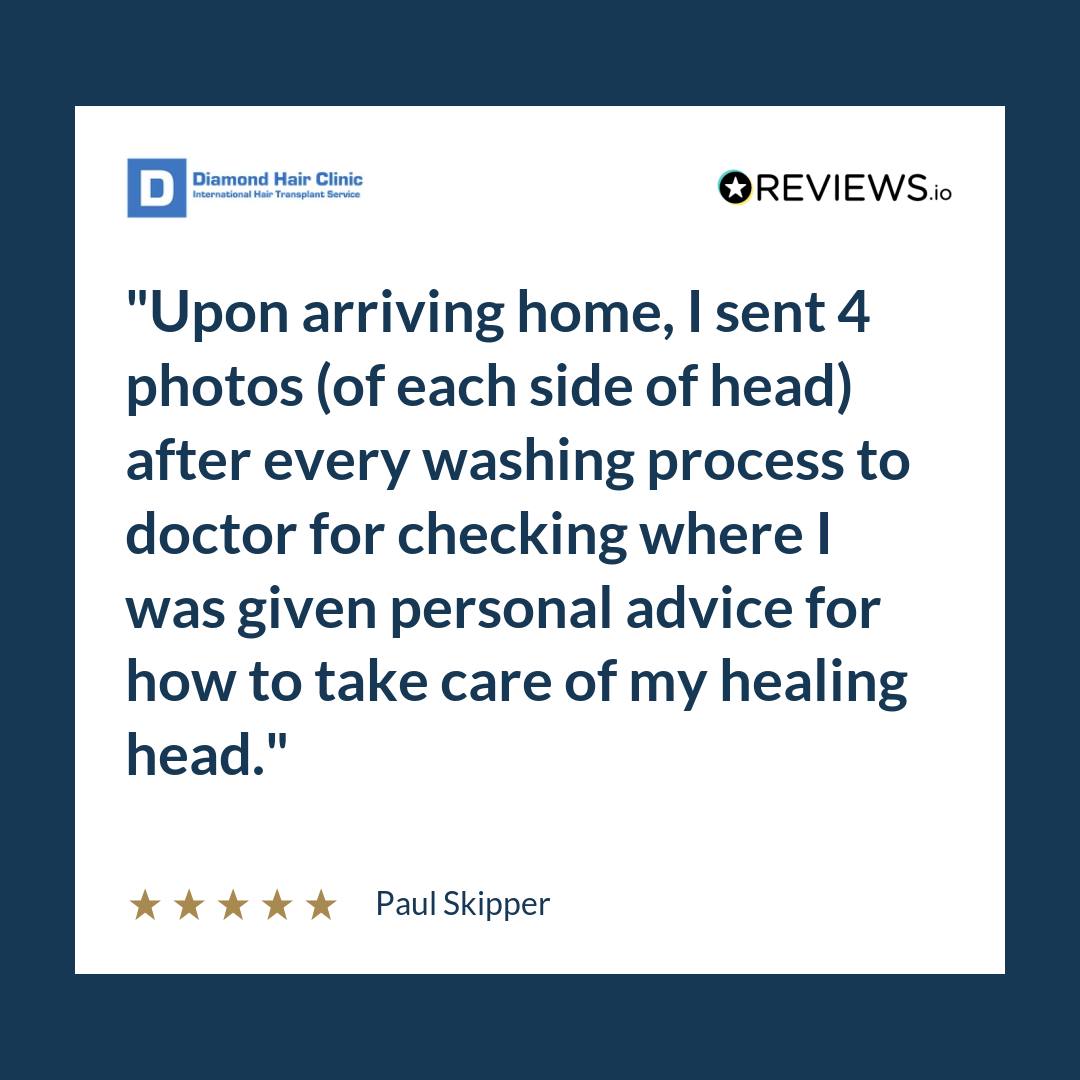
Read this review excerpt
Upon arriving home, I sent 4 photos (of each side of head) after every washing process to doctor for checking where I was given personal advice for how to take care of my healing head.
Warning signs that are not normal
Warning signs include pain that is clearly worsening rather than settling, excessive bleeding, severe or rapidly spreading redness, fever, and drainage that appears infected, especially green or yellow pus.

Mild tenderness, itching, crusting, and tightness can be normal. But symptoms that clearly escalate rather than calm down deserve attention.
That is the difference between normal healing and something that needs a closer look.
Myths to avoid after surgery
Online recovery stories can help you recognize questions to ask, but they should not replace the written plan from the surgical team that knows your case. Use them to note concerns about washing, medicine, swelling, or timing, then check those concerns against your own instructions and symptoms before changing anything.
Avoid believing that one frightening photo means something is wrong, that you can judge the final result too early, or that more touching, checking, or worrying will improve the outcome. The best thing a patient can do is follow the surgeon who actually performed the procedure and personally understands the case.
If you want a more specific answer on whether scabs pulled grafts out, why one side may grow more slowly, or whether a buzz cut can make the ugly duckling phase easier, I answer those recovery worries separately.
The most important aftercare mindset
Protect the grafts early, then give the cosmetic result time.
The first 2 weeks are about surface healing. Avoid rubbing, scratching, pressure, careless products, and situations where the scalp becomes hard to inspect. After that, the timeline still belongs to healing, shedding, and gradual growth. Follow the clinic instructions, report warning signs, and judge the final result only when the transplant has had enough months to mature.
For spring or high pollen travel, aftercare may need a more specific allergy plan. The pollen season recovery plan covers sneezing, tissue use, room air, and medicine disclosure after FUE.
Environmental exposure is another reason to keep aftercare simple. The guide to dust, wind, and pollution after FUE explains when ordinary outdoor movement is different from dusty work, rubbing, or warning signs.