



Workout Rules While Grafts Are Healing
For exercise, light walking is usually fine after the first 24 to 48 hours if you feel well. During the first 14 days, avoid gym training, running, heavy lifting, intense cardio, sport, swimming, sauna, steam rooms, hot tubs, and any activity that creates sweat, pressure, or friction on the scalp.
After day 15, ordinary walking and very light activity can increase if the scabs are gone and the scalp looks settled. Controlled gym work is a different step from full training, especially if sweat, tight headwear, or shared equipment would keep touching the scalp. Around 3 to 4 weeks, some patients can restart carefully with low intensity, clean conditions, no tight headwear, and no head contact.
Heavy lifting, intense cardio, training to failure, swimming, sauna, steam rooms, hot tubs, and contact sports after a hair transplant belong later. For swimming, sauna, steam rooms, hot tubs, and contact sport, I keep the timing closer to 3 months. Helmet timing depends on the type and fit, but I use at least 30 days, and often 4 to 6 weeks for tighter or longer helmet use.
This question can be frustrating if training is part of your normal life. You may feel physically ready within a few days, but the scalp does not heal at the same speed as the rest of the body feels.
A workout at home can still stress the graft area if it makes you sweat, bend, hold your breath, or keep wiping your scalp. I judge the movement pattern, not whether the activity happens inside a gym.
That difference matters because sweat, bending, pressure, and rushing too soon can all change the early recovery plan. A hair transplant is a small surface procedure in one sense, but the recipient area and donor area still need time, gentle washing, and protection from avoidable irritation.

Exercise is more than sweating
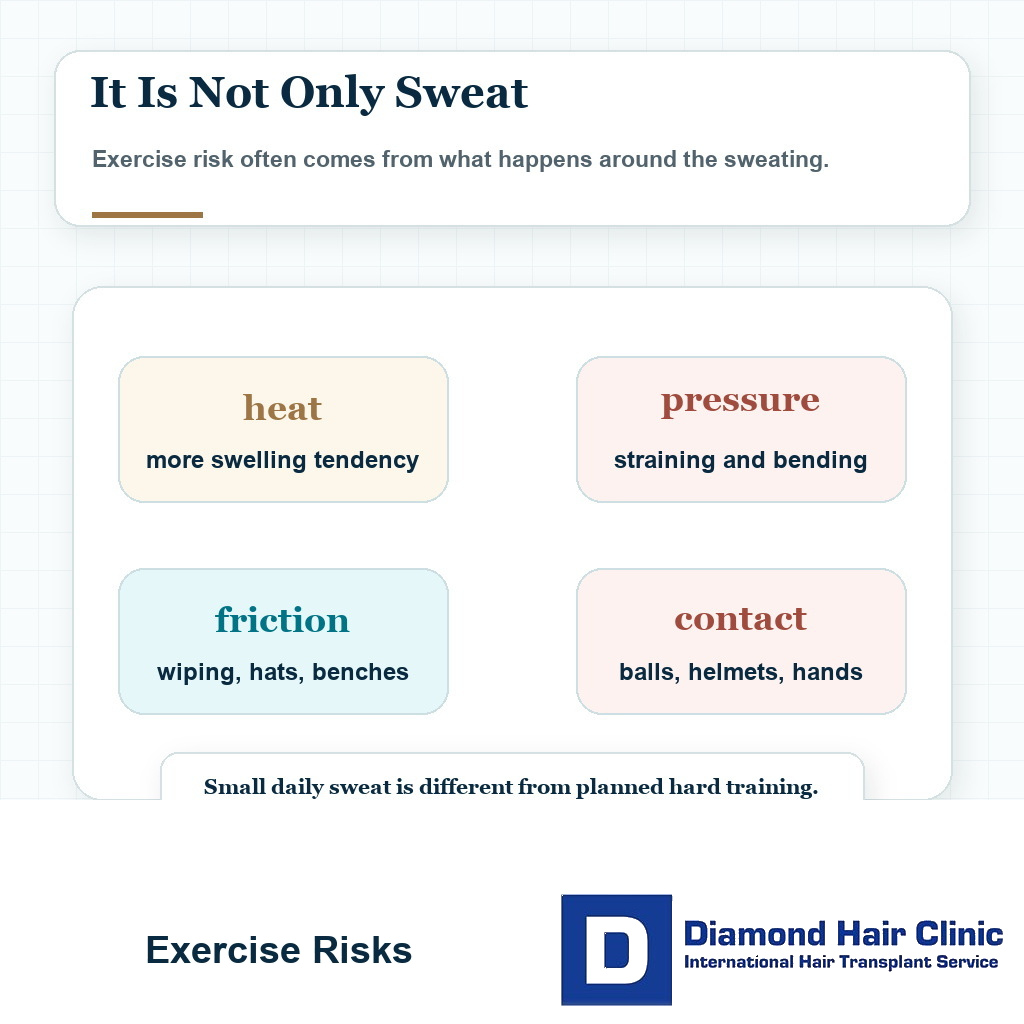
The common worry is whether sweat can damage grafts. Look at what happens around the sweating. Exercise raises body heat, heart rate, blood pressure, and swelling tendency. Strong caffeine, energy drinks, or stimulant workout products after a hair transplant can make the same restless pattern worse, so coffee after a hair transplant has its own timing. Exercise also makes people wipe the scalp, wear hats, shower more aggressively, and forget that they are still healing.
When you restart, choose something you can stop without embarrassment. A solo walk is easier to pause than a class, match, or group session where momentum makes you ignore the scalp.
Light sweat in daily life is not the same as a hard gym session. Before you restart, separate easy movement from heat, heavy breathing, tight headwear, shared equipment, and repeated wiping of the scalp.
In the first 10 to 14 days, the grafts need protection and the scalp should be kept quiet. This early protection period is central to hair transplant aftercare.
Exercise is not the enemy. Poor timing is. The body can feel ready before the scalp is ready for heat, rubbing, pressure, sweat, and accidental contact. If the same exertion is part of your job rather than a workout, also plan physical work after hair transplant before returning to shifts.
Judge exercise by the whole behavior, not only by the word exercise. Scalp contact, tight headwear, headphones after a hair transplant, heavy sweating, swelling, accidental impact, and the risk of falling all matter in the early recovery period. Active VR games after FUE belong in this same behavior check if the headset adds sweat, sudden movement, or repeated adjustment. A road or mountain bike return belongs in a separate cycling after hair transplant plan because cardio, helmet pressure, wind, sun, and fall risk overlap.
A good recovery plan reduces unnecessary contact with the scalp. Exercise returns in stages for that reason.
There is another mental reason to stage the return. Someone who trains hard too early often begins checking the scalp more often. They notice redness after the workout, touch the hairline, then start searching for reassurance. That creates a stressful recovery pattern that was avoidable.
The rules should be clear before the temptation appears. If the first 14 days are already understood as a protected period, you do not have to renegotiate the decision every morning.
The first 48 hours
In the first 24 to 48 hours, rest, walk gently if needed, and avoid anything that increases heat, sweating, bending, pressure, or swelling. This is not the time to test fitness.
A short, slow walk can be acceptable if you feel steady. But it should feel like movement, not training. No fast walking uphill. No treadmill session. No bodyweight circuit. No stretching routine that bends the head down repeatedly.
The first two days are also when swelling and donor sensitivity can be more noticeable. If you create extra heat and blood pressure, you may make the early recovery more uncomfortable.
Sleep also matters in these first nights. Poor sleep can make a patient feel restless and more likely to walk around, touch the scalp, or break instructions. The method in sleep after a hair transplant is meant to reduce friction and pressure during this period.
You do not need to lie completely still in fear. Gentle normal movement is fine. Exercise with a performance goal should wait.
If you feel dizzy, weak, swollen, or uncomfortable, rest. The gym will still be there after the scalp has passed the early healing window.
Do not confuse walking to move the body with walking to train the body. A short quiet walk around the hotel or home is one thing. A long fast walk under the sun is another.
In the first two days, also avoid bending repeatedly to pick up weights, shoes, bags, or luggage. Bending can increase pressure and swelling. Simple movements are fine, but repeated strain is not helpful.
Returning to gentle movement
For many patients, gentle movement can continue early, especially slow walking after the first 24 to 48 hours if they feel well. After day 15, some patients can increase ordinary walking and very light activity if healing looks normal, scabs are gone, and the scalp is not red, tender, or itchy.
A hard run, a spin class, intervals, heavy circuits, or a long workout where sweat runs across the grafted area is not gentle movement. Controlled reintroduction may begin around 3 to 4 weeks when the scalp is settled, but that is not the same as returning to full intensity.
If there are still scabs, active redness, pimples, tenderness, or irritation, wait longer. The calendar gives a starting point, but the scalp must agree.
After travel, it is tempting to return to normal routines immediately. Realistic recovery planning is one reason time off work after a hair transplant matters.
Cardio should restart like a test, not a declaration that everything is normal. Start short. Keep the room cool. Do not wear a tight cap. Wash gently afterward using the instructions your surgeon gave you.
If exercise leaves the scalp more red, itchy, sore, or irritated, step back and let the clinic review what changed.
Light cardio also needs common sense about environment. A cool clean room is better than a crowded humid gym. A short walk outside in mild weather is different from running in heat and sun.
If you train in a public gym, remember that benches, towels, mats, and equipment are not sterile. This matters less after full healing, but early recovery is not the right time to expose the scalp to unnecessary contact and sweat.
The gym is not a day 10 target
I do not treat day 10 as a gym target. Around the end of the first 2 weeks, the first check is whether the scabs are gone, the scalp looks calm, and the donor area is not tender. If those signs are present, the next step is still very gentle activity, not a normal workout.
Knowing yourself matters here. If you cannot enter the gym without pushing intensity, it is better to wait. Saying you will train lightly and then leaving drenched in sweat is not a staged return.
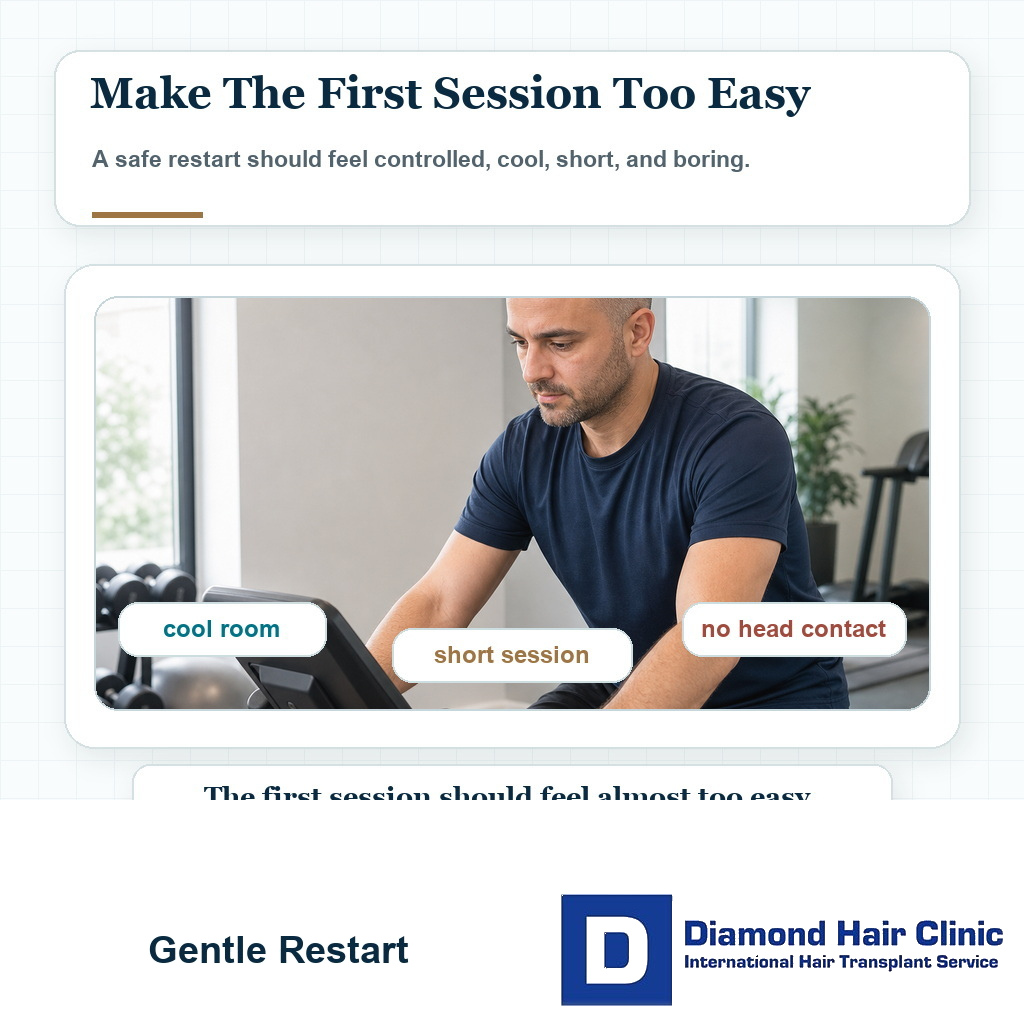
The first session should feel almost too easy. Keep it short, keep the room cool, avoid tight hats, avoid benches or machines that touch the head, and stop if the scalp becomes more red, itchy, swollen, or uncomfortable.
A safe return is not a test of toughness. It is a small trial of whether the scalp stays calm after the next step or becomes red, itchy, swollen, or sore.
Weeks 2, 3, and 4 for active patients
Week 2 is still mainly a protection week. If the scabs are gone after day 15 and the scalp looks calm, you can usually increase easy walking and very light mobility. I would not use reformer Pilates as a loophole if it means bending the head down, straining, stretching the scalp hard, sweating, or lying where the donor area rubs against the machine.
Week 3 can be a careful test for some patients. Keep the session short, cool, and easy enough that you could stop without frustration. Light machines, gentle mobility, or a flat walk are different from heavy weights, intervals, football, tennis, or a class that pushes you to sweat.
Week 4 is when many active patients feel ready to rebuild, but the return should still be layered. Add one thing at a time. Do not bring back weights, tennis, football, supplements, heat, and long sessions in the same week. The donor area counts too. FUE creates healing points in the back of the scalp, not only grafts in the front.
A safer return to exercise depends on the strain it creates. Heavy sweating, bending forward, scalp pressure, repeated wiping, or any risk of impact should wait until the healing area can tolerate it.
Weight lifting after a hair transplant
I treat weight training carefully during the first 14 days. Controlled light gym work may begin around 3 to 4 weeks if the scalp is settled, but this is not permission for heavy squats, deadlifts, intense cardio, or training to failure. Truly vigorous training should return later and gradually, often closer to the broader 12 week recovery window when the scalp has stayed quiet and your surgeon agrees.
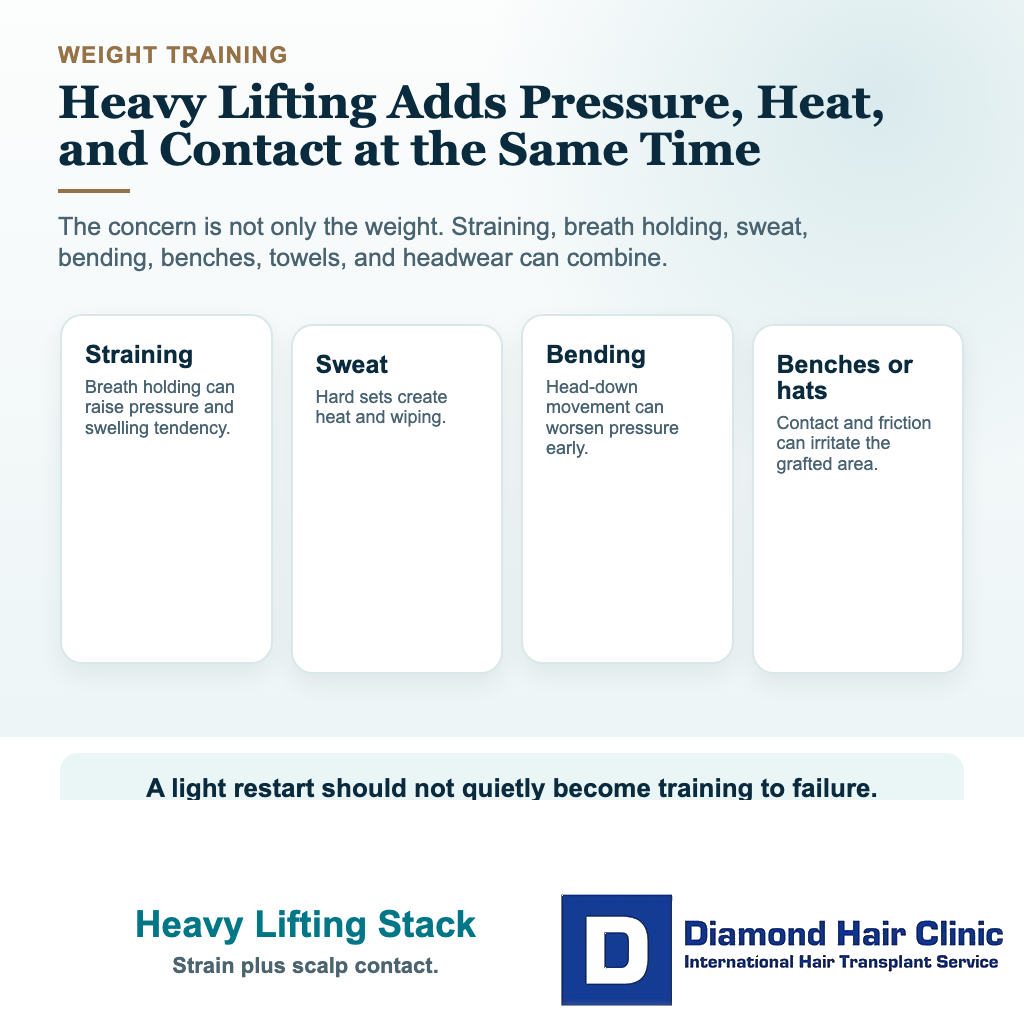
Heavy lifting creates more pressure than many patients realize. It often involves straining, breath holding, sweating, bending, and contact with benches, bars, towels, or headwear.
Some people say they will only do light weights, but then habit takes over. They add plates, chase a pump, and leave the gym sweating. A clear pause at the beginning is often safer than relying on willpower in the middle of a workout.
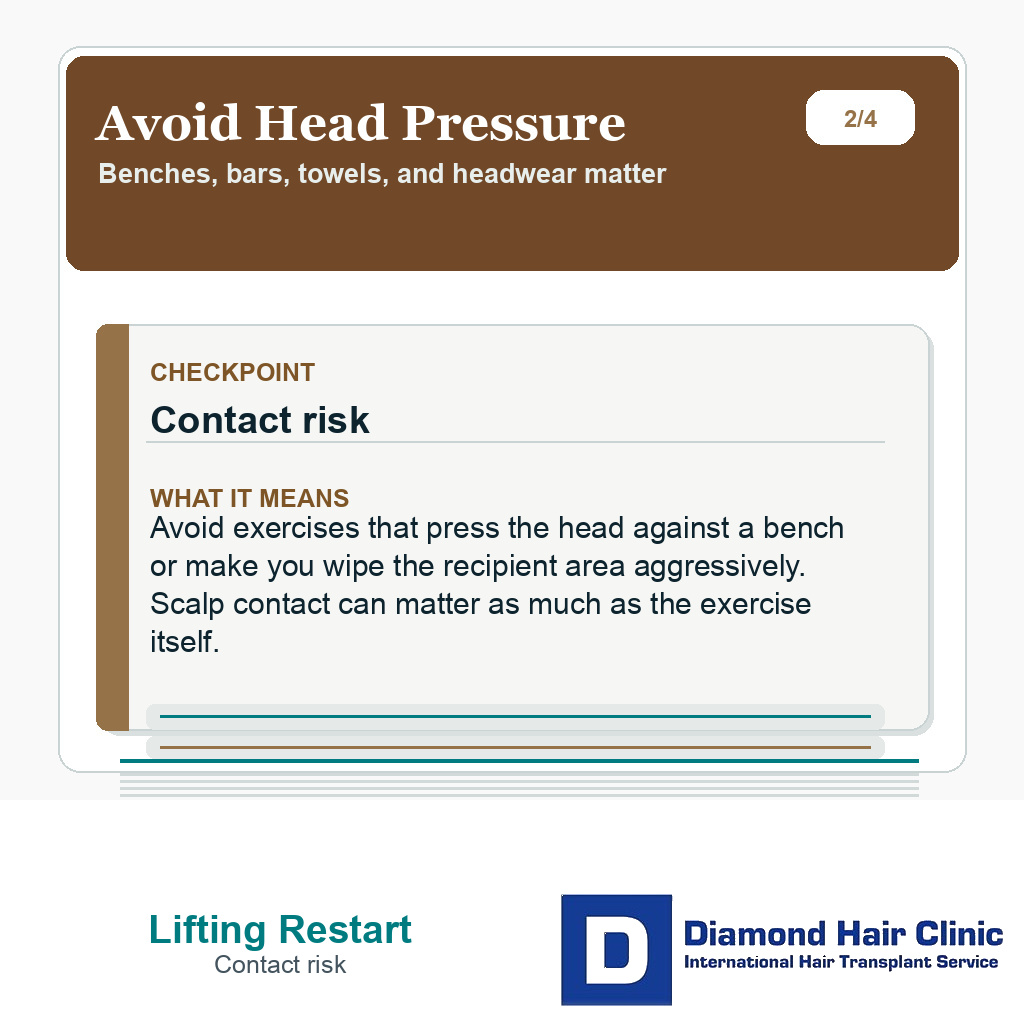
If you restart weights, begin well below your normal level. Avoid exercises that press the head against a bench. Avoid anything that makes you strain hard or hold your breath. Avoid wiping the recipient area aggressively.
The donor area also deserves respect. It may look closed, but the tissue is still settling. Donor healing and long term donor management are part of why I pay attention to the hair transplant donor area.
Returning to lifting too early usually gives you very little. Irritating the scalp gives you a new problem.
Lifting needs a more specific definition. For one patient, it means light machines and controlled breathing. For another, it means heavy squats, deadlifts, pushing to failure, and sweating through a shirt.
These are not the same risk. If you cannot reduce intensity, it may be safer to stay away from the gym a little longer.
Breathing also matters. Heavy lifting often makes patients hold their breath without noticing. This increases pressure and can make the face and scalp feel fuller. In early recovery, that is exactly the kind of unnecessary strain to avoid.
Use these 4 weight lifting restart slides to review the return to training rules one image at a time. Swipe sideways, use the arrows to move one slide at a time, or choose a number below the image to jump to a specific slide.

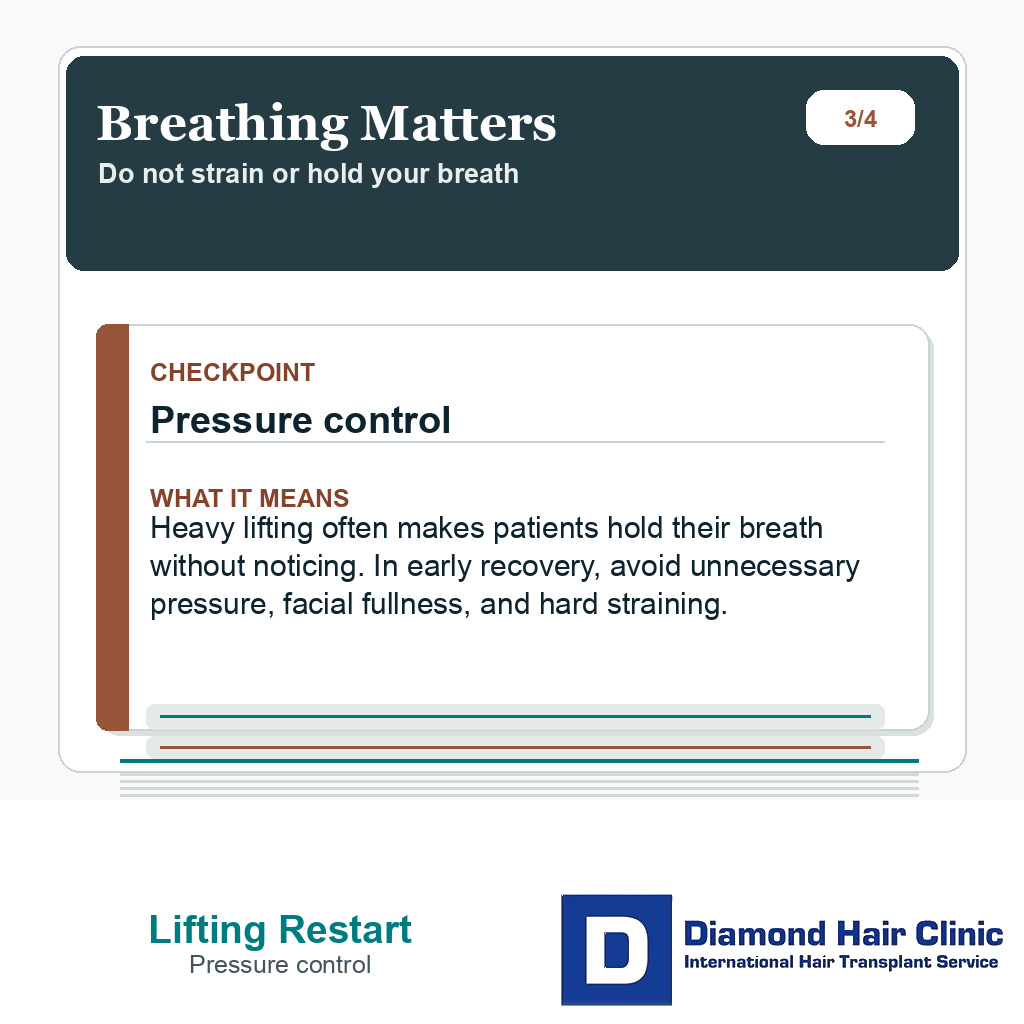

Sweating and scalp irritation
A small amount of sweat from normal life is usually not a disaster. Heavy sweating from exercise in the early healing period is different. It can irritate the scalp, soften crusts at the wrong time, increase itching, and make you touch or wipe the grafted area.
Separate accidental light sweating from planned hard training. If you sweat a little while walking slowly, do not panic. If you choose an intense workout in a warm gym, you are creating a different risk.
Every drop of sweat should not become a fear. Planned heavy sweating in the first 14 days should be avoided, and exercise that creates heavy sweat should return gradually only when the scalp has settled.
Sweat can also interact with hats, helmets, gym towels, pillows, and products. If sweat collects under pressure or friction, the risk of irritation is higher.
I also give separate guidance on wearing a hat after surgery and wearing a helmet after a hair transplant. Sweat plus pressure is not the same as clean air touching the scalp.
If you accidentally sweat a little, stay calm. Do not scrub. Do not panic wash with hot water. Follow the washing instructions after a hair transplant that you were given.
The safer approach is controlled healing. A cool room, gentle routine, and less scalp contact are better than trying to prove that sweat cannot hurt anything.
Sweat also becomes a problem when someone tries to clean it aggressively. Hot water, strong shower pressure, rough towels, fingernails, and impatient rubbing can create more irritation than the sweat itself.
So if you sweat lightly by accident, use gentle handling. Do not punish the scalp with aggressive washing because you are afraid you made a mistake.
Sports and contact training
For sport, martial arts, football, basketball, wrestling, or any activity where the head can be hit or grabbed, waiting at least 3 months is safer, and sometimes longer. Even sport without contact can create sweat, impact risk, and pressure sooner than many people expect.
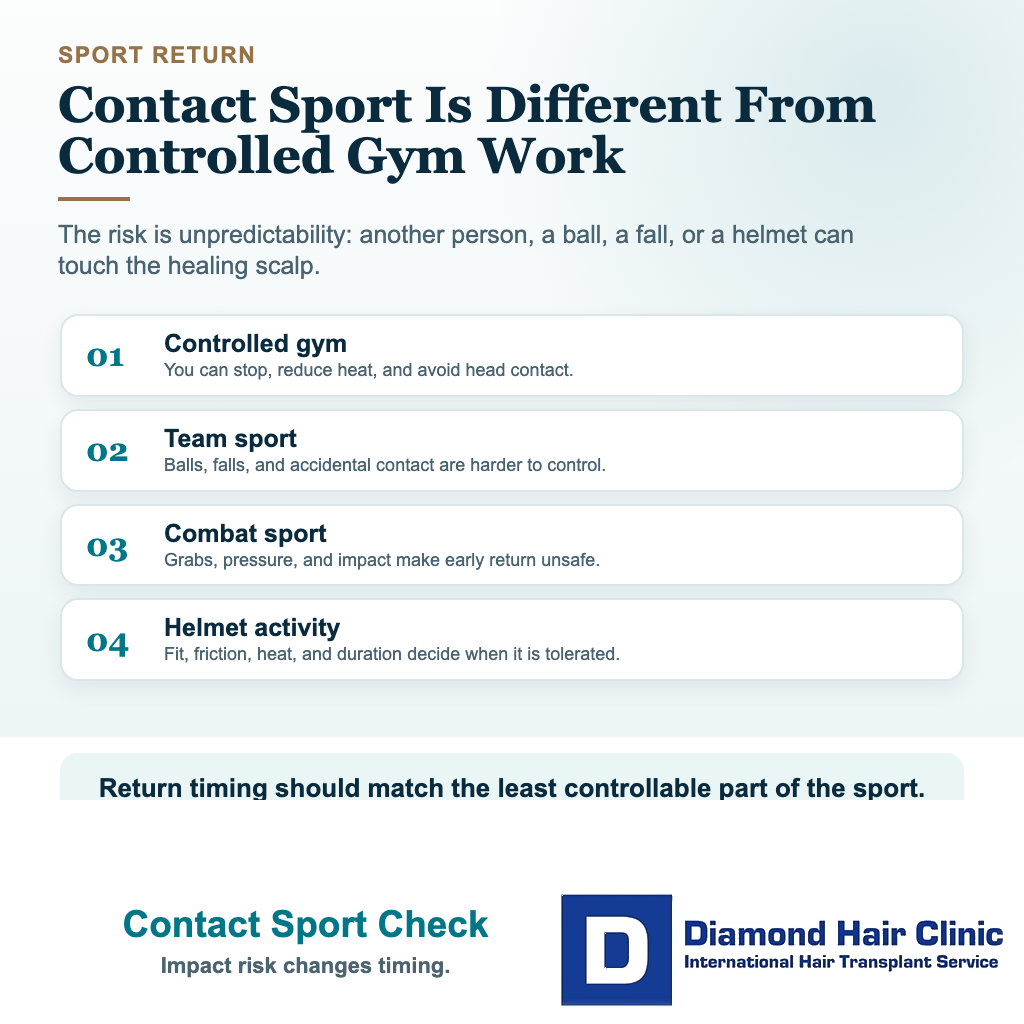
The scalp does not need impact during early healing. Even if the grafts are more secure after the first weeks, the skin is still recovering and the patient may still be emotionally sensitive about the result.
Contact sport also creates unpredictable situations. Another person may touch the head, a ball may hit the scalp, or the patient may fall. These are not controlled risks.
If you play a sport that requires a helmet, that adds another layer. Pressure, heat, and friction must be considered together. Do not restart because the calendar says one number while the helmet still feels tight or irritating.
Skiing after a hair transplant
Skiing brings several recovery issues together. These include exertion and sweat, a fitted helmet and goggles, ultraviolet light reflected by snow, cold wind, and the possibility of a fall. I do not clear it from the calendar alone. Before you return, the scalp needs to be closed and calm, the donor area comfortable, and the helmet and goggles easy to put on and remove without rubbing the treated areas. Your clinic should also clear the level of activity. Use sun protection that suits the healing stage, and wait rather than ski without the safety equipment the sport requires.
If your sport also involves swimming, the timing becomes stricter. I advise patients to wait 3 months before swimming, sauna, steam rooms, hot tubs, and similar environments. Water, heat, sweat, and public facilities add risk together, so the timing for swimming after a hair transplant should stay conservative.
Sport should return when the scalp can tolerate the activity, not when the patient misses competition.
If you train professionally or very seriously, this needs review before the operation. A person whose job or identity depends on sport needs a realistic calendar, not a vague promise that they will be fine soon.
Team sports create another issue. You may be careful, but the other person may not be. A sudden hand to the head, a collision, or a fall can happen before you have time to protect the recipient area.
If you cannot pause contact sport, the surgery date may need to be chosen more carefully. Sometimes the responsible decision is to schedule surgery in an off period rather than forcing recovery into a busy training season.
Swelling, redness, and exercise
Exercise can make swelling, redness, or tenderness feel worse, especially if it is resumed too early. Heat and increased blood flow can make the scalp look more reactive.
Some redness is common after surgery. Some swelling is also common. But if you train hard and then see more redness, you may panic and think something has gone wrong.
A conservative return helps avoid both real irritation and unnecessary fear.
If redness, pimples, tenderness, scabs, or discharge appear, ask for medical guidance instead of training harder. My guidance on redness, scabs, and pimples after a hair transplant explains what deserves attention.
Exercise can also make itching worse because sweat dries on the skin. If you then scratch the recipient area, the original workout was not worth it.
In recovery, this is not only about whether you can tolerate discomfort. The practical detail is whether the scalp benefits from what you are doing.
Some people reassure themselves by saying they are healthy and heal quickly. That may be true, but a healthy body can still irritate fresh skin by training too early. Good health is helpful, but it does not cancel the biology of healing.
Look at visible signs and time together. If the scalp looks settled and enough time has passed, the return is smoother. If the scalp looks angry, the date alone should not decide the plan.
Protein, creatine, and supplements
Most ordinary protein intake is not the issue, and a healthy diet supports recovery. When the question is a shake, I separate protein powder after a hair transplant from the rest of the gym stack. I review what someone is using, especially if they take creatine after a hair transplant, many supplements, stimulants, workout products, substances that may thin blood, or anything that affects sleep and blood pressure.
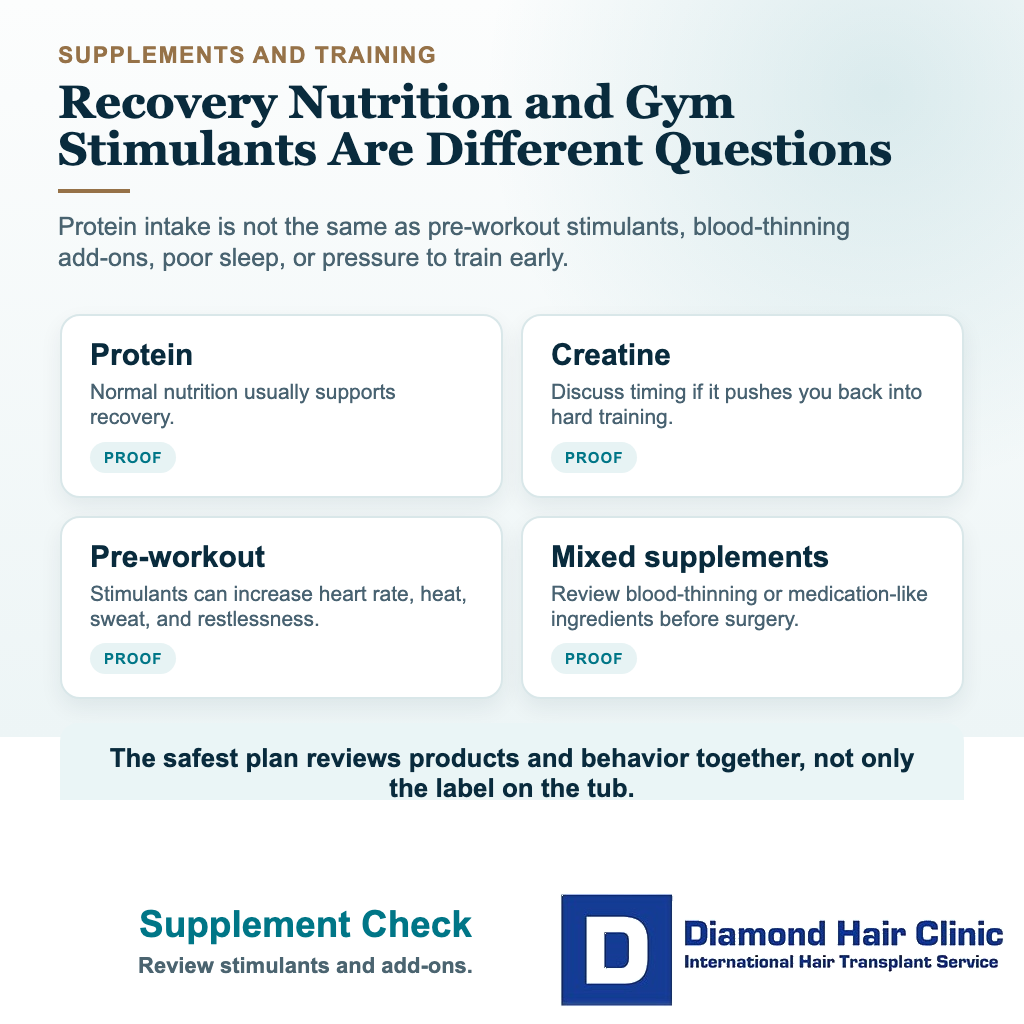
Some workout stimulant products increase heart rate, flushing, sweating, and restlessness. That is not helpful in the early healing period.
Medication and supplement decisions need to be clear before surgery. Medications after a hair transplant should not be mixed randomly with outside recovery routines. If a tablet such as Viagra or Cialis is part of the question, review medication timing after a hair transplant together with activity timing instead of treating them as separate decisions.
Ask about a supplement before using it. Do not assume that natural means harmless or that gym products have no relevance to surgery.
Avoid adding alcohol after training during early recovery. Alcohol can affect judgment, sleep, hydration, and aftercare choices. The safer timing belongs in alcohol after a hair transplant.
Recovery is not a bodybuilding challenge. For a short period, the better choice is doing less, not more.
I also advise patients to avoid adding new supplements immediately after surgery. If a new product causes flushing, itching, stomach upset, or poor sleep, it becomes harder to know what is part of normal recovery and what is caused by the new product.
Keep the routine simple in the early period. Food, hydration, prescribed medication, sleep, and proper washing matter more than a complicated supplement stack.
Restarting exercise safely
Restart in stages. Walk gently after 24 to 48 hours if you feel well. Keep the first 14 days especially quiet. After day 15, ordinary walking and very light activity can increase if healing is normal.
Around 3 to 4 weeks, controlled gym work can often return gradually if the scalp is settled. Full hard training belongs later. Swimming, sauna, steam rooms, hot tubs, and contact sport should stay closer to 3 months. Helmet timing should follow the helmet plan, usually at least 30 days, and often 4 to 6 weeks when the helmet is tight or worn for longer periods.
Do not restart everything in one week. If you return to weights, cardio, sauna, supplements, hats, and late nights at the same time, you still will not know what caused irritation if the scalp reacts.
When you restart, look at the scalp the next day, not every hour. If it looks calm, continue gradually. If it becomes more irritated, reduce intensity and ask for guidance.
Clinic choice also matters after surgery. Recovery instructions need to come from a team that understands the operation and can answer concerns after you go home. Real responsibility after the operation matters as much as the operation itself.
Read this review excerpt
Dr Mehmet had further consultation with me to go through the post op care, medications , advice about exercise, lifestyle.
Careful planning does not end when the grafts are placed. It continues through the choices a patient makes during recovery.
The gym can wait a short time. A careful result is meant to last years.
This answer can feel conservative, especially for someone who trains every day. But a hair transplant result depends on many small protected steps. Skipping the gym briefly is one of the easier sacrifices compared with the time, cost, and emotional investment of surgery.
If you are worried about losing fitness, remember that 2 to 4 weeks of controlled recovery is a small part of a long training life. You can rebuild intensity. You cannot redo the early healing days once they are gone.
Competitive athletes, manual workers, and people who train very intensely should discuss their schedule before surgery. The right surgery date should fit your real recovery needs, not only your flight or work calendar.
That kind of discipline serves the transplant better than one early workout.
Active patients and the return to training
Do not confuse feeling strong with being healed. You may feel ready to train before the grafted area, donor area, and healing skin are ready for heat, pressure, and friction.
For an active person, the hardest part is often mental. Exercise may be the way they handle stress, and recovery suddenly asks them to do the opposite. That is understandable, but this is a short pause for a long term goal.
Plan exercise restrictions before surgery. Arrange work, travel, gym expectations, and social activities around recovery rather than trying to negotiate with the scalp afterward.
The right return is not the fastest return. Protect the first 14 days, rebuild in layers, and do not turn fitness discipline into impatience.
Exercise after a hair transplant needs dates, but it also needs judgment. The dates guide you. The scalp confirms the plan.
If the scalp is clean, settled, and comfortable, the return becomes easier. If the scalp is still red, itchy, bumpy, tender, or scabbed, waiting is not weakness. It is surgical common sense.
Movement should come back without making the transplant the weakest part of your day. Keep your routine, but keep it quieter than your ambition until healing skin no longer needs protection.