



Contact Sports Need a Longer Healing Window
If the sport can hit, rub, pull, sweat heavily, or press on the scalp, I do not treat it like ordinary exercise after a hair transplant. Light movement can usually return earlier, but football, basketball, boxing, wrestling, jiu jitsu, rugby, and any sport with heading, tackling, sparring, helmets, or direct scalp contact should wait much longer.
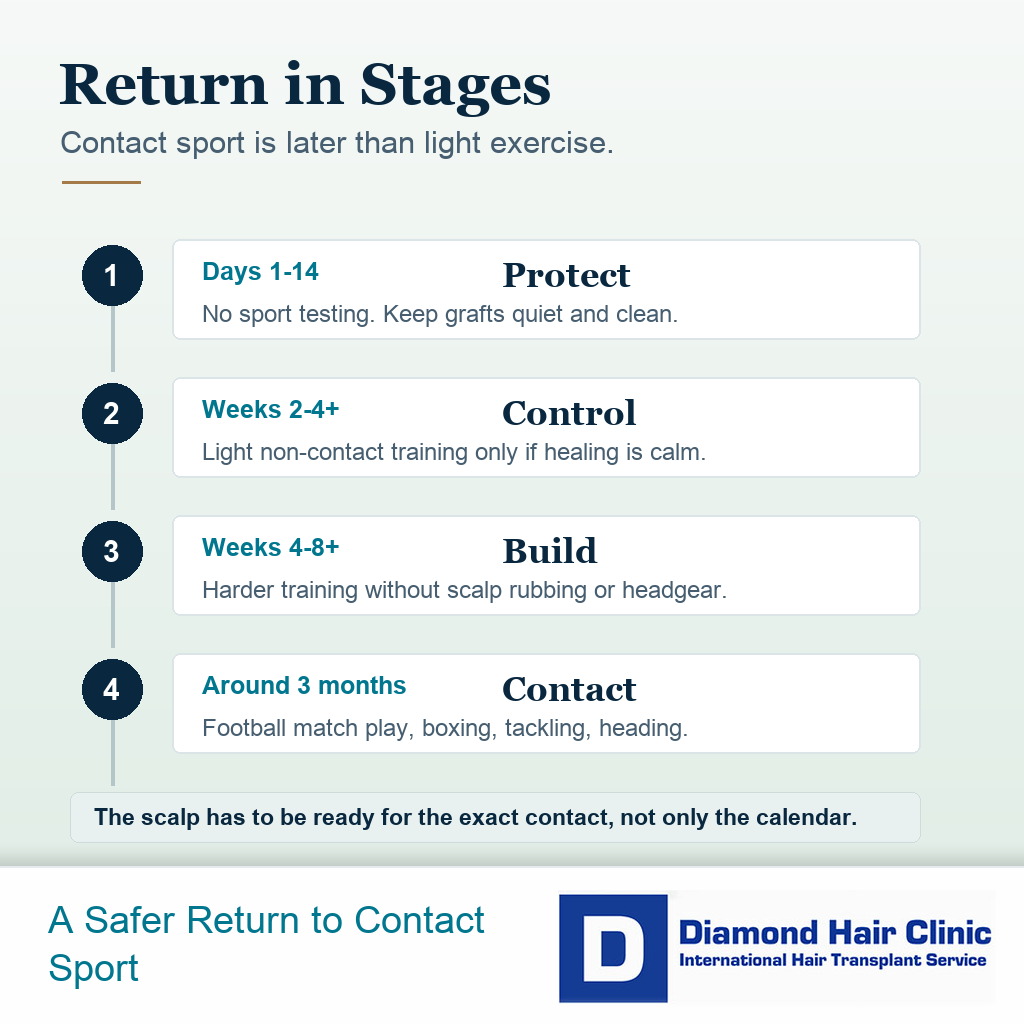
I separate the return into gentle walking, gym conditioning, solo drills, controlled practice, and finally full contact. Moving forward depends on clean, closed, settled skin and whether the exact activity can strike or rub either surgical area. Full contact usually belongs much later, often closer to three months, after the surgeon has reviewed the scalp.
Contact sports add impact to ordinary exercise
Normal exercise mainly raises blood pressure, heat, and sweat. Contact sport adds another problem. It brings impact, friction, sudden falls, grabbing, helmets, headgear, towels, sweat, dust, and the instinct to touch the scalp when something feels sore.
I separate this question from general exercise after a hair transplant for that reason. Walking outside carefully is not the same risk as heading a football, boxing, wrestling, or playing basketball under the basket where elbows and accidental head contact are common.
The early grafts are small biological units placed into fresh recipient area channels. They do not need panic, but they should not be tested by impact. A good recovery plan reduces avoidable trauma until the skin has healed enough to tolerate normal life again.
I also think about the donor area. Many people focus only on the front hairline, but contact sport can rub the donor area, stretch healing skin, or make swelling and tenderness worse. Surgery involves both areas, and both deserve protection.
FUT and FUE do not leave the donor area in the same condition. FUT has a linear closure, so pulling, twisting, and friction across the back of the scalp need separate clearance. FUE avoids that closure, but the extraction sites and recipient area still have to tolerate sweat and contact. A return date for light gym work is not permission to resume rolling or sparring.

First 10 to 14 days need scalp protection
In the first 10 to 14 days, the recipient area should be protected from rubbing, scratching, pressure, forced scab removal, sweat soaking, and accidental impact. This is the wrong period to test the scalp. It is also the wrong period to negotiate with yourself because you feel physically well.
In practical terms, the first few days are not the same as the second week. By around day 10, graft security is usually much better in uncomplicated healing, but secure does not mean fully healed or ready for sport impact.
Graft security timing matters here because anchoring and full sport tolerance are not the same thing. A graft that is difficult to dislodge during gentle care is still sitting in skin that can be irritated, inflamed, scraped, or reopened by sport.
During this period, the best sports decision is deliberately conservative. Walk gently if your clinic allows it. Keep the scalp clean and protected. Avoid anything that makes you bend, strain, sweat heavily, collide, or wear tight headgear. If your real worry is whether light handling is already safe, start with when it is safe to begin touching grafts after a hair transplant, not with sport advice.
If you protect the first two weeks, you usually have fewer reasons to panic later.
Controlled training can return before contact sport
Training without contact can often come back before contact sport, but the return should still be staged. If healing is clean, the scabs are gone or almost gone, and there is no fresh bleeding, discharge, open skin, increasing redness, or worsening pain, light controlled training can restart after the early protection period in some cases.
Full effort still needs more time. A careful first step may be light cycling, easy treadmill walking, controlled mobility, or easy training where nothing touches the scalp and you can stop quickly. Heavy lifting, sprinting, hot rooms, and training to failure belong later.
Lifting something heavy after a hair transplant is not the same risk as a punch or header, but straining can still increase head pressure, swelling, sweat, and the temptation to check the grafts repeatedly.
I also ask what you mean by training. A football player doing gentle footwork alone is not playing football. A boxer shadowboxing alone is not sparring. A basketball player shooting alone is not fighting for rebounds. The sport name is less important than the actual contact risk.
Ask about the first return to real contact, not only the first light workout. A drill where nobody touches your head is a different decision from a match, sparring round, or helmet session you cannot fully control.
Football, basketball, and combat sports need a separate timeline
Football becomes different when heading, tackles, shoulder contact, falls, and crowded play return. Basketball becomes different when elbows, sweat, fast turns, and accidental head contact become realistic. Boxing, wrestling, jiu jitsu, MMA, and rugby are different again because scalp impact or friction is part of the activity, not a rare accident.
For true contact and collision sport, I use a conservative timeline, often closer to 3 months, unless the case has been reviewed and the planned activity is clearly lower risk. Controlled drills without contact may return earlier for some patients. Full contact deserves a separate decision.
This may feel excessive if another person online returned sooner. I do not plan around the fastest story. I plan around the cost of being wrong. A missed match is temporary. A damaged recipient area, reopened skin, infection risk, or avoidable anxiety can cost much more.
If you are a professional athlete, I do not answer with one clearance sentence. The decision depends on the exact sport, position, helmet or headgear use, match schedule, training demands, sweating level, sun exposure, and whether you can genuinely avoid head contact during the return phase.
What if I accidentally headed a ball or took a hit?
First, stop playing and look at the scalp in good light. Do not keep wiping, rubbing, or testing the area. If there is fresh bleeding, an open spot, increasing pain, discharge, spreading redness, or a visible piece of tissue from the recipient area, contact your clinic and send clear photos. If the blow also caused confusion, repeated vomiting, severe or worsening headache, fainting, seizure, weakness, vision change, or trouble walking, treat that as an urgent head injury warning, not only a hair transplant question.
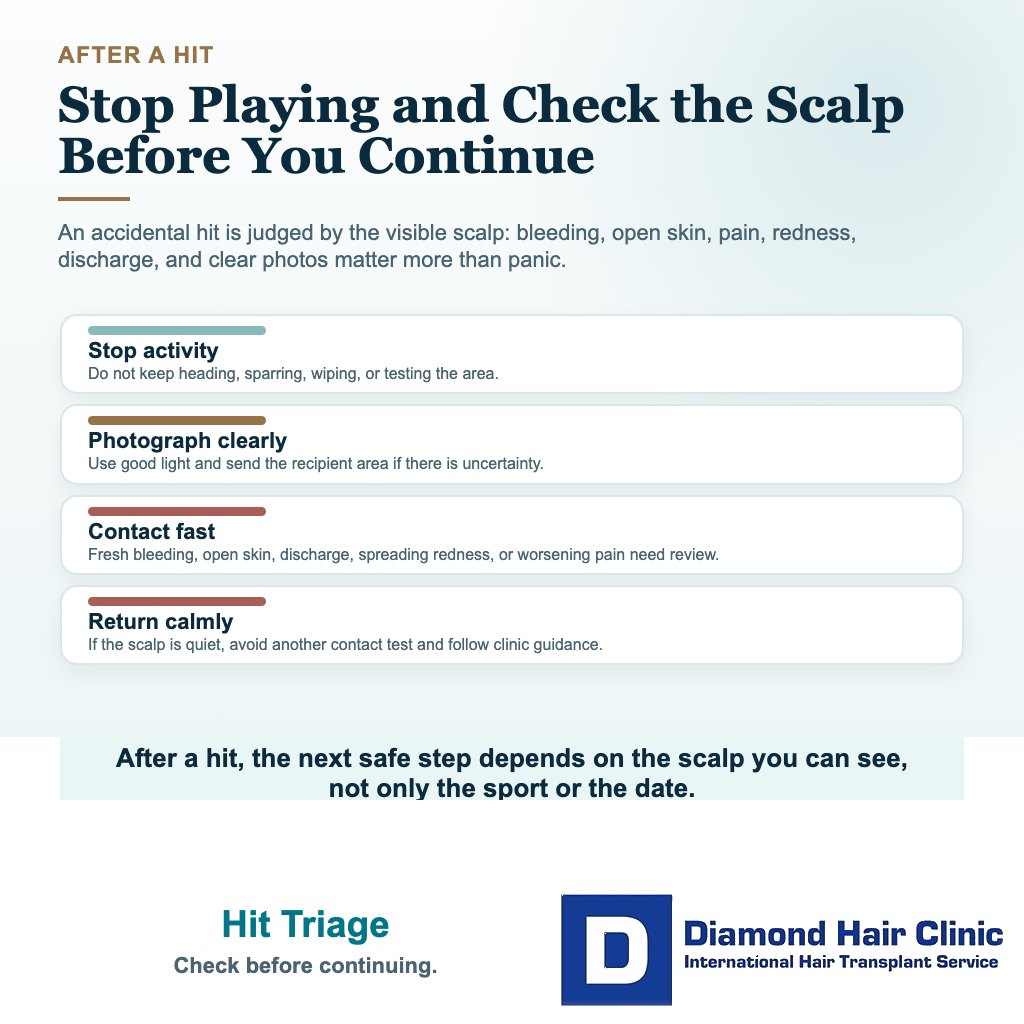
If the hit happened many weeks after surgery and the skin stayed closed, the risk of actually losing grafts is usually much lower than it feels in the moment. Pain or tenderness after impact does not by itself prove graft loss. After bumping your head after a hair transplant, timing, bleeding, and the appearance of the skin change the level of concern.
During the first 10 to 14 days, I take any direct impact more seriously. Even then, the answer depends on what happened to the skin. A light brush is different from a scrape. A ball touching the forehead is different from a hard header directly on the recipient area. A small panic should not turn into aggressive cleaning, because rough handling can create the damage you are trying to avoid.
One accidental event also differs from repeated exposure. If a player takes one mild contact and stops, that is one situation. If the same player continues a match, sweats heavily, heads the ball again, wipes the scalp, and showers roughly, the risk profile changes.
Does sweating during sport damage grafts?
Sweat alone is not usually the main reason grafts are lost. The bigger problem is what heavy sweating causes around healing skin. You wipe, scratch, remove a cap, press a towel, keep training in heat, or expose the scalp to dirt and friction.
Sweating after a hair transplant also needs this distinction. Daily mild sweat is not the same as a hard training session in a warm gym, outdoor football under sun, or boxing with headgear that traps heat.
Sport should wait if sweat is combined with scabs, pimples, folliculitis, spreading redness, or discomfort. A dry, settled scalp can tolerate more than an irritated scalp. If the recipient area is already irritated, the calendar alone is not enough reason to return.
There is also a hygiene issue. Shared mats, gloves, helmets, towels, turf, dust, and dirty hands do not belong near a newly healing scalp. Do not share towels or headwear during the return phase, and do not press a gym towel into the recipient area after sweating. Many people think about this only after the first session back, when itching or redness starts and they wonder whether they pushed too early.
Can I wear a helmet or head protection for sport?
A helmet or tight head protection changes the answer because it adds pressure, heat, sweat, and repeated removal friction. I do not judge a helmet like a loose clean hat. A helmet is designed to grip the head, and that grip can rub the recipient area, donor area, or both.
The guidance on wearing a helmet after a hair transplant uses at least 30 days as a minimum, often longer when the helmet is tight, heavy, or worn for long periods. For sport, I am even more careful because the helmet is not only sitting on the scalp. It may move during impact.
Protective headgear can sound reassuring, but it can create its own problem. If it presses, slides, heats the scalp, or catches the grafted hair when removed, it may be worse than no sport at all during early healing. Delaying the sport is safer than using uncomfortable protection to justify returning too soon.
In contact sports, test the exact helmet or headgear only after the recipient area has been cleared for that stage. Gear that feels loose in your hands can still rub once sweat, turns, and repeated movement begin.
Competitive athletes should plan surgery around the season
A professional or competitive athlete should plan the operation around the season, not squeeze surgery into a narrow gap and hope the scalp behaves perfectly. The best window is usually a period when the athlete can protect the scalp, avoid contact, avoid helmets, reduce sweat exposure, and attend follow-up without pressure.
If sport is part of your work, we should discuss the return plan before the operation. This is similar to planning time off work after a hair transplant, but the standard has to be stricter when work includes impact, sweat, helmets, or public visibility. Coaches, trainers, and medical staff need the actual restrictions. A hidden early return is harder to control safely.
The plan also has to respect donor management and the future result. An athlete may want the most convenient date, but the scalp needs the right conditions. If the only available surgery date forces contact training too soon, waiting may be the better surgical decision.
A rushed operation can create a false economy. You save a few weeks in the schedule, then spend months worrying about every bump, scab, and delayed growth. That is not a good trade.
Clinic advice should separate light activity from impact
I worry when clinic advice gives the same sport answer to every patient without asking about the actual sport. Someone returning to slow walking and someone returning to boxing are not asking the same medical question.
Casual advice also concerns me. If a clinic says all sport is fine after a few days, the next question is whether they mean walking, gym, football, heading, sparring, helmets, or competition. Clear instructions should separate light activity, hard training, and contact sport.
A better discussion should include the recipient area, donor area, scabs, swelling, redness, pain, sweat, helmet use, sun exposure, and what to do after accidental impact. This belongs inside broader hair transplant aftercare, not as a small lifestyle detail.
Patients sometimes want permission more than judgment. I understand that. But a good surgical plan should not only tell you what you want to hear. It should protect the result when your motivation to return is stronger than your healing.
Does outdoor sport change the timing?
Outdoor sport adds sun, heat, wind, dust, sweat, and longer exposure. Football training in cool shade is not the same as a match under strong sun. Tennis, running drills, and outdoor basketball may not involve direct scalp contact, but they can still combine heat, sweating, and wiping.
Direct sun is a separate recovery issue. Outdoor sport brings sun exposure after a hair transplant into the decision because healing skin can react badly to strong sun even when the grafts are no longer easy to dislodge.
If you must return to outdoor training, start with short, controlled sessions in cool conditions after your clinic clears you. Keep the scalp protected without tight pressure. Avoid peak sun. Do not use a tight cap or headband to force an early return if it rubs the grafted area.
Readiness depends on scalp condition and control
Do not decide only by counting days. Look at the scalp first. The recipient area should be closed, settled, and free from fresh bleeding, open skin, discharge, spreading redness, heavy crusts, or worsening pain. The donor area should also feel settled enough for movement, sweat, and normal washing.
The next question is whether the planned activity can be controlled. Solo ball drills are easier to control than a match. Shadowboxing is easier to control than sparring. Shooting baskets alone is easier to control than competitive play. Walking on a treadmill is easier to control than crowded sport. The first return session should be short enough that you can stop before sweat, fatigue, or pressure makes you careless.
Also ask whether you can stop if something feels wrong. If you are likely to push through pain, hide discomfort, or keep playing because teammates are waiting, you are not ready for contact sport. Your behavior during sport matters as much as the procedure date.
The last question is what happens if you are hit. If one accidental hit would make you panic for weeks, the return may be too early emotionally even if the medical risk is already lower. A controlled return is often better than a faster return.
My usual timing for contact sport is conservative
Use the return to play filter above to separate early protection, controlled training, headwear pressure, and full contact.
For most patients, the first 10 to 14 days should be strict protection. After that, light, controlled activity without contact can return only if the scalp is healing well. Harder training without contact should build gradually around the following weeks, without tight headwear or heavy scalp friction.
For true football match play, basketball contact, boxing, wrestling, jiu jitsu, rugby, MMA, heading a ball, or any sport where head impact is realistic, my usual timing is closer to 3 months unless the case has been reviewed and the sport can be modified safely. Some patients will be cleared differently by their own surgeon, but an impact sport should not become an early experiment.
If you returned too early once and nothing happened, do not use that as permission to repeat the risk. If you have already had a hit, stop, assess the scalp, send photos to your clinic when needed, and return to a more controlled plan. Plan the transplant around long-term growth, not one impatient week.
For contact sports, graft security alone is not enough. The skin must be healed enough for the exact sport, the exact contact, the exact headwear, and the exact conditions you will face. That protects the grafts, the donor area, and your peace of mind.
Read this review excerpt
First wash completed and visual instructions given to my daughter.