


Time Off Work Needs a Realistic Recovery Plan
For work where you must be seen in person, I usually advise planning 10 to 12 days away from work after a hair transplant. If the job is public, physical, dusty, hot, or difficult to control, 12 to 14 days is often more comfortable. Answering emails from home after 2 to 3 days is a different situation from returning to a normal workday outside the home. If the job is overnight, night shift work after a hair transplant needs its own sleep, commute, and duty plan. If the return involves manual labor, dust, sweat, or helmet pressure, plan it through physical work after hair transplant. A required hairnet or work cap after FUE also needs fit planning, because shift heat and elastic pressure can change the timeline. If the job involves rain or outdoor work, the first 10 to 14 days need stricter planning. International patients should also decide how long to stay in Turkey after a hair transplant before setting a date for returning to work.
Work timing is not only about whether the transplant will work. It is whether you can go back to work without feeling exposed, uncomfortable, or worried that you are damaging the grafts.
A hair transplant is a medical procedure, but it is also a visible recovery on the face and scalp. The first few days need more planning than many people expect.
I separate work ability from social comfort. Quiet desk work may be possible before you feel ready to be seen closely in public. The social timeline is different from work ability, and looking normal in public after a hair transplant covers that part more closely.
Make two return plans. One is the earliest quiet task you can do from home or away from clients. The other is the first day you can be seen, wear required equipment, commute, and answer questions without touching the scalp.
Workplace paperwork is best settled before travel. Confirm the document format and submission deadline with your employer, then tell the clinic what evidence is needed. A dated treatment confirmation or doctor’s note may record the procedure and advised recovery period, but the employer decides whether it meets the leave policy.
The first return day should protect the wash routine, commute comfort, photo review, and a private way to avoid touching or hiding the scalp.
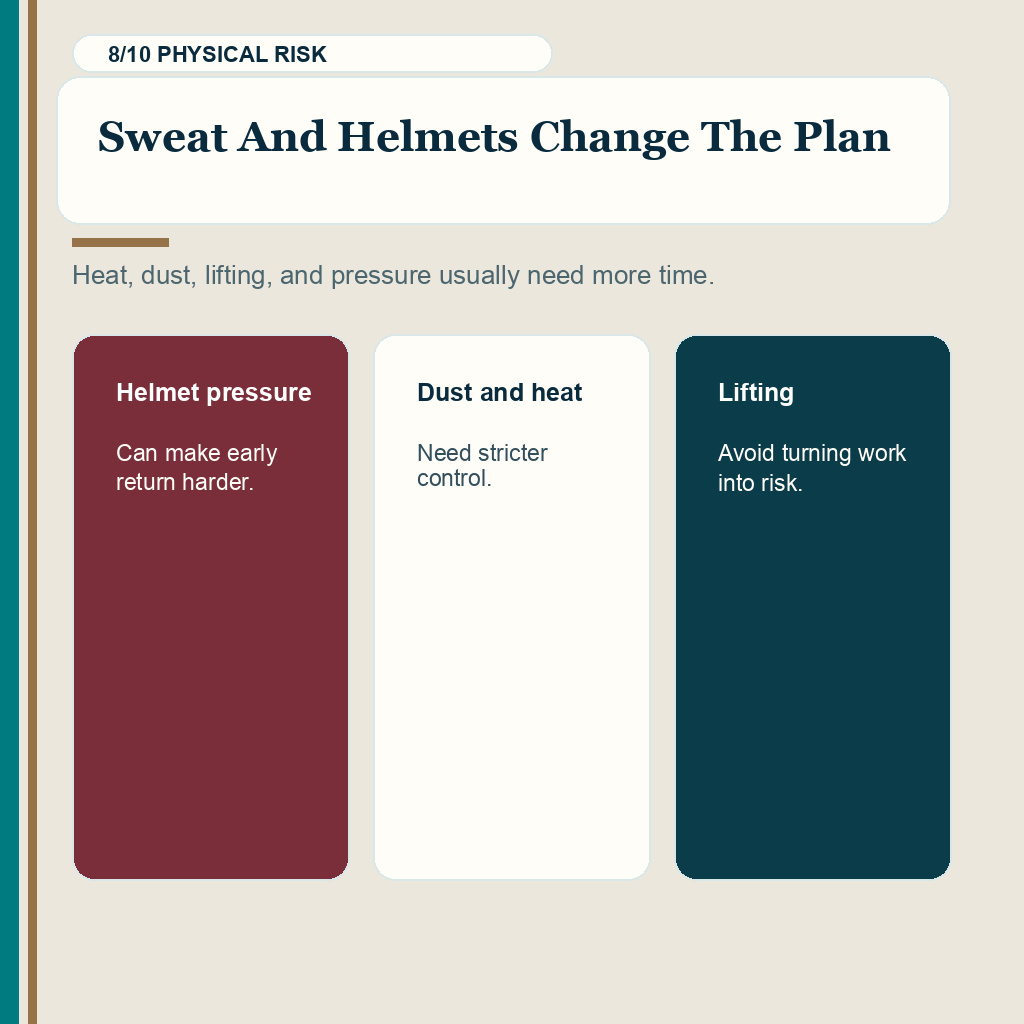
If your job requires a helmet, hairnet, cap, headset, or dusty changing room, treat the return date as a contact and hygiene question, not only a visibility question.
The right amount of time off work after hair transplant surgery depends on your job, your healing speed, your travel plan, your hair length, your skin reaction, and how comfortable you are with people seeing the early signs of surgery. If prescription frames are part of your normal workday, plan glasses or sunglasses after a hair transplant before surgery instead of improvising on day one. It also depends on whether your clinic has prepared you properly or only told you that everything will be easy.
The aim is a return plan that protects healing and reduces panic.
Good planning protects the grafts and makes the first week easier to manage.
Returning to work is often underestimated
Before surgery, most people think about the operation, the graft number, and the final result. They do not always picture the first video meeting, the first commute, the first lunch with colleagues, or the first time someone asks what happened to the scalp. A return that involves clients needs its own work recovery schedule for public settings when cameras, customers, or privacy are involved.
Discuss recovery before surgery, not after. When you understand the first 10 days, you are usually more careful and less likely to keep touching the grafts out of fear.
Physical recovery is often manageable. Visibility is the part many people misjudge.
Some people return after a few days and feel fine because they work from home or sit in a quiet office. Others have little pain, but feel very aware of redness, scabs, swelling, shaving, or the sudden change in appearance.
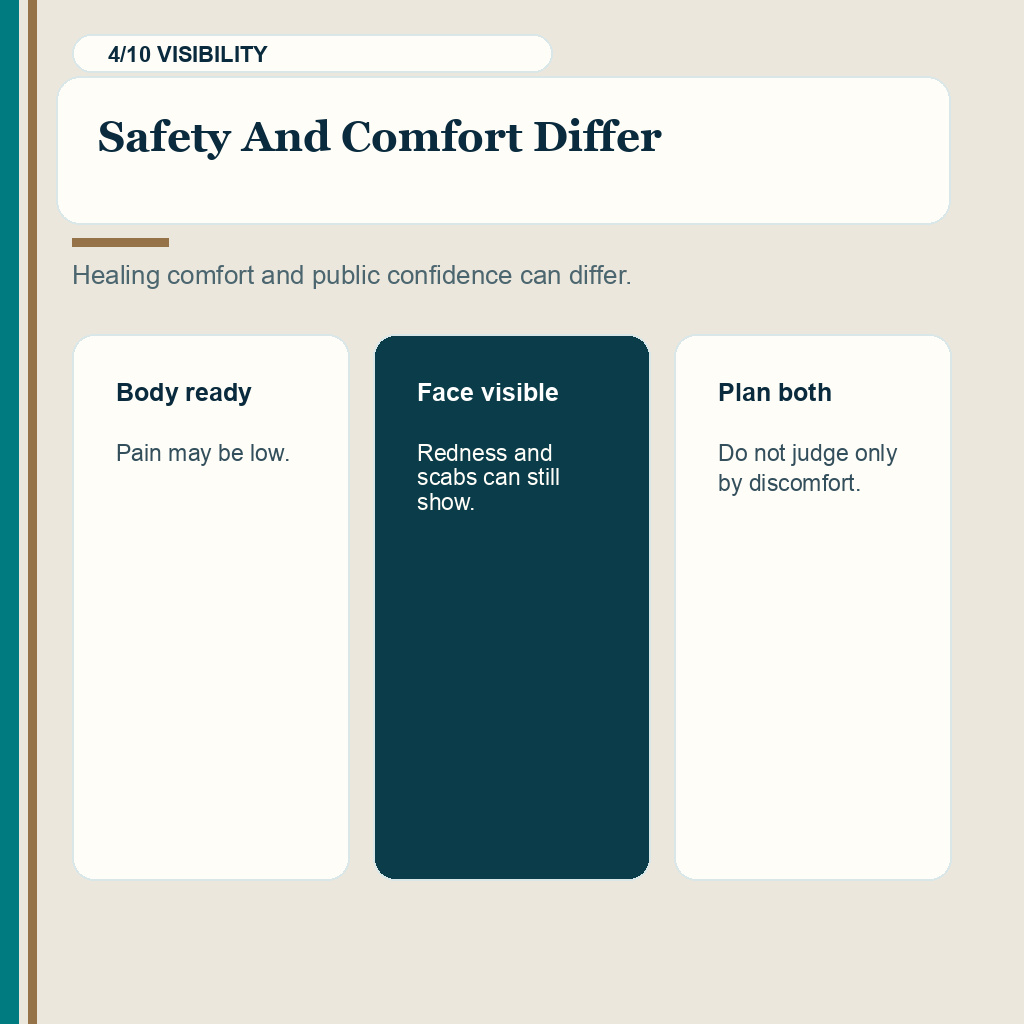
There is a real difference between looking medically normal and looking socially normal. Your scalp can be healing well and still look obvious to other people.
If a new job begins on a fixed date, choose the surgery date on the assumption that the transplant may still be noticeable when work starts. Do not schedule around a promise that your appearance will be back to baseline by a particular month.
Careless promises, such as going back to everything immediately, create the wrong expectation. When you choose time off, plan for what people may see, how you will wash, and how you will handle the awkward first return to work.
In a practice led by the surgeon, this discussion needs to be part of the plan.
In a high volume hair mill clinic model, patients may be moved quickly from consultation to booking, then receive generic instructions after the procedure. That is not enough when you still have to manage work, travel, sleep, swelling, and anxiety.
The amount of time off work I usually advise
For work that requires being seen in person, I usually advise planning at least 10 to 12 days away, if possible. This is not because everyone is disabled for that long. It is because the first week is when the grafts, scabs, washing routine, sleep position, swelling, and donor tenderness require the most attention.
If you work from home and can avoid stress, sweating, dust, direct sun, and accidental touching, you may be able to work earlier.
Answering emails after two or three days can be reasonable in selected cases, but the first week still needs to be treated as healing time, not a normal working week.
If you have a job in front of the public, work under bright lights, wear a helmet, bend forward often, lift heavy objects, or cannot control the work environment, a longer break is usually safer. This is not about pride. The point is to protect healing and avoid unnecessary worry.
For a shaved FUE case, the visual signs are usually more obvious in the first days. For a smaller or more discreet case, the return can sometimes be easier, but do not assume the early signs will be invisible.
Planning a little extra time is usually kinder than planning too little and spending the first week frightened.
If you can take 12 to 14 days, that is often a more comfortable window.
This is not advice to hide for two weeks. It gives you room for swelling, scab removal, proper washing, sleep adjustment, and a less rushed return.
If your clinic tells you that you can return immediately without asking about your job, travel, healing risks, or lifestyle, be careful.
The return to work should be planned with the same realism as the hairline design and graft plan.
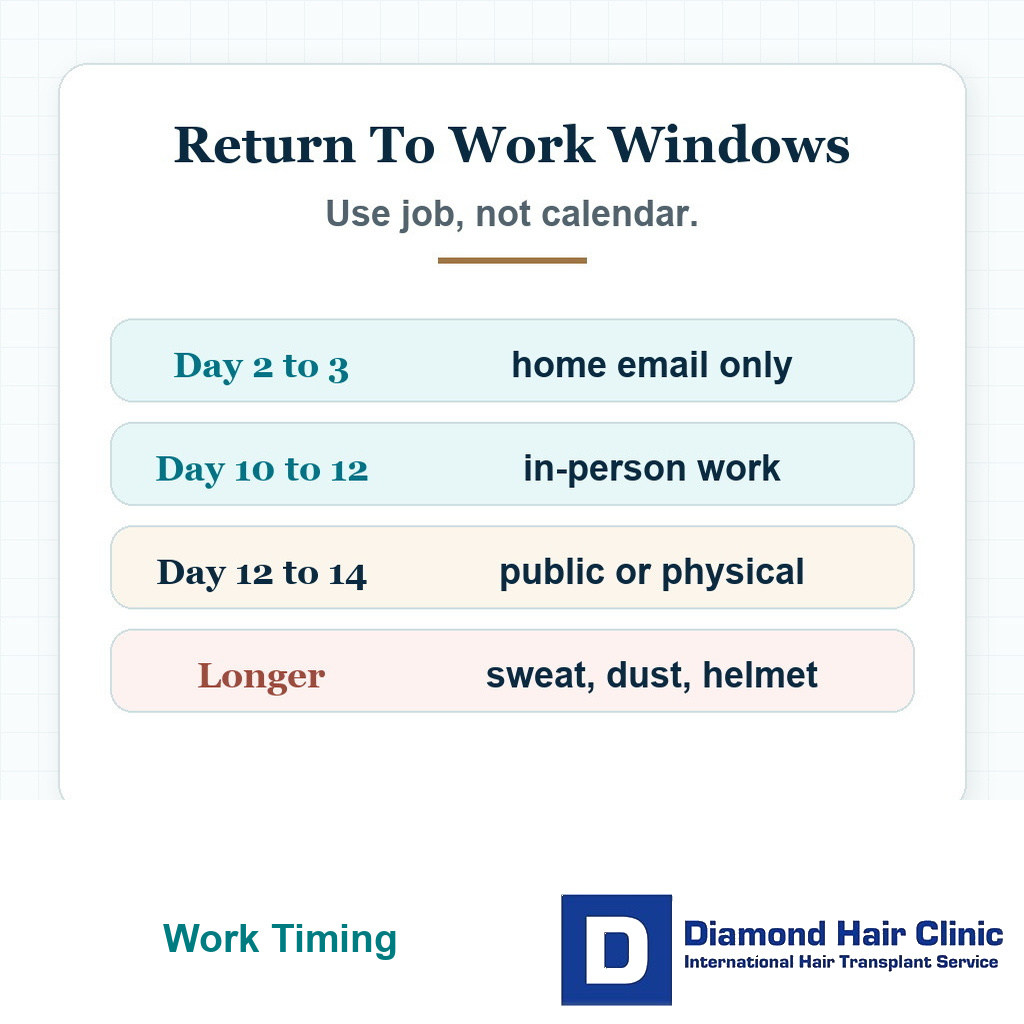
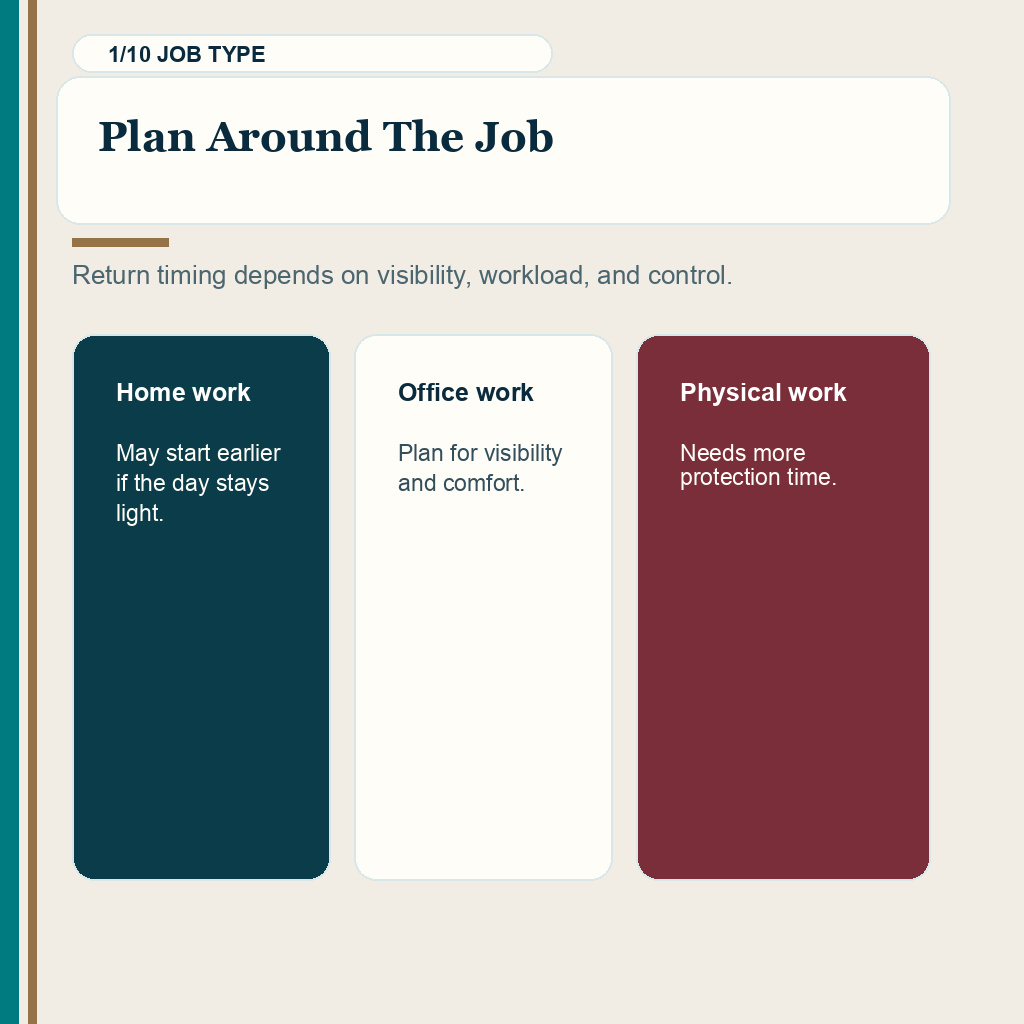
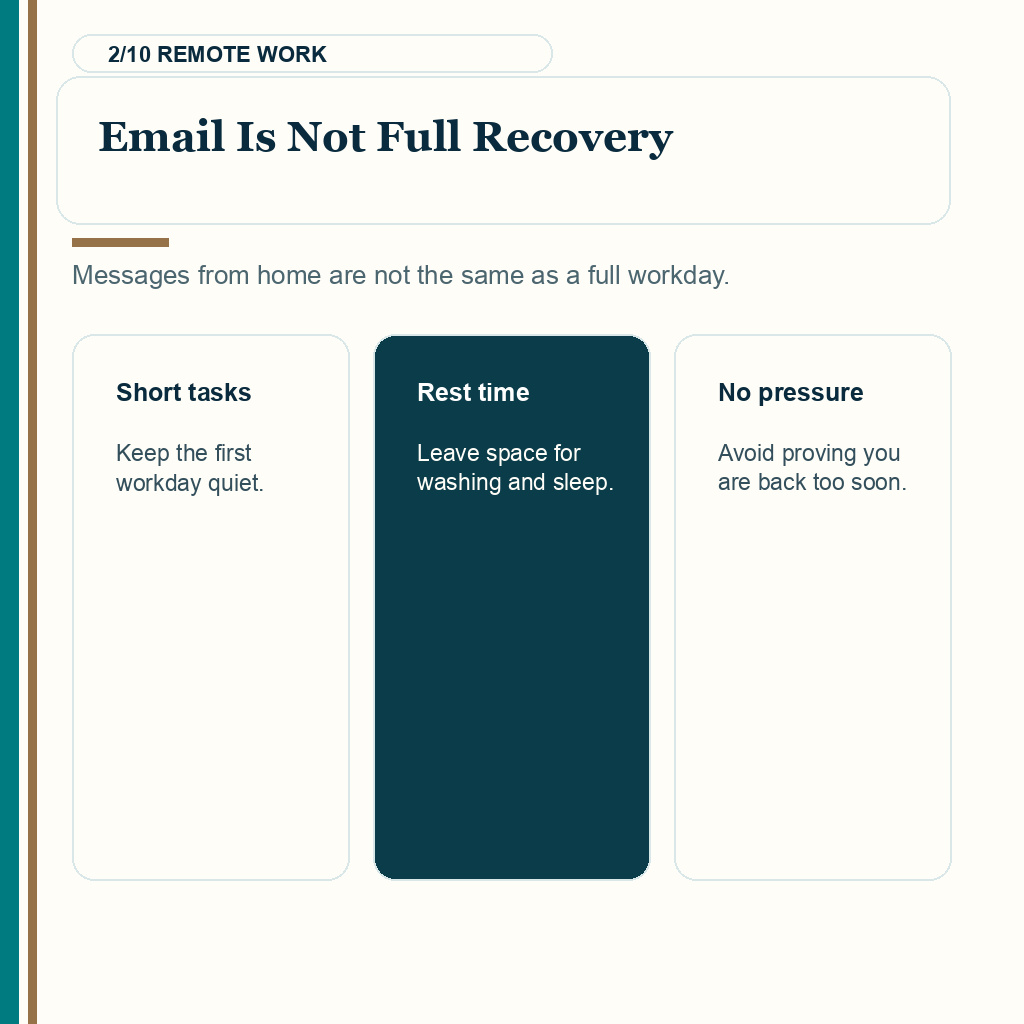
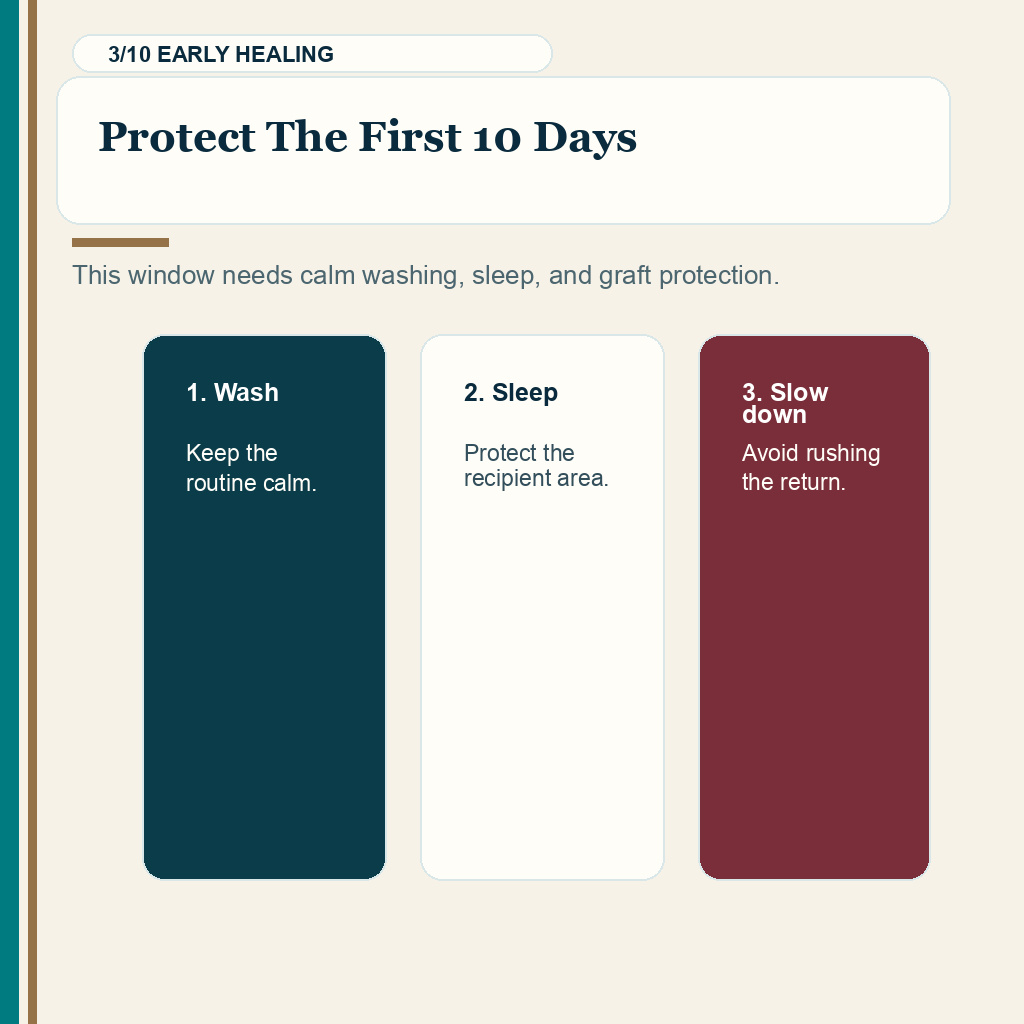
The 10 return to work slides below split the timing decision into one practical question at a time. Swipe sideways, use the arrows for one slide at a time, or choose a number below the image.

Planning when 10 to 14 days off is not possible
If you cannot take 10 to 14 days away from work, the plan needs to become more structured, not more careless. Start by separating what you can do remotely from what requires being physically present.
Answering messages from home after 2 to 3 days can be reasonable if you are comfortable, not using medication that makes you sleepy, and still able to wash, sleep, and protect the grafts. That is different from driving after a hair transplant, commuting, carrying bags, sweating, wearing head protection, or sitting under bright light with clients.
If you return remotely early, make the first workday deliberately quiet. Keep meetings short, avoid unnecessary video if possible, and leave time for washing, medication, food, and rest instead of pretending the day is normal.
If you must return early, the work setup should include camera off days, lighter duties, no heavy lifting, no bending, no dusty environment, no direct sun, and no helmet or tight head covering. This is not special treatment. It is basic protection while the recipient area is healing.
For hospital, kitchen, construction, factory, pool, gym, barber, military, or outdoor work, a short break can be unrealistic. Heat, sweat, hygiene exposure, chlorinated pool water, and repeated head movement change the risk. If your job involves pools or water exposure, swimming after a hair transplant becomes part of the work plan.
If the only way to return early is to hide the surgery in a way that breaks aftercare, the plan is wrong.

The first 10 days matter most for protection and healing
The first 10 days after surgery are important because the recipient area is still settling and the small crusts are forming, drying, and gradually loosening. During this period, be gentle and consistent with washing.
Mild swelling can appear in the forehead or around the eyes. It may look dramatic around the third or fourth day, but it often settles with time and proper instructions.
Scabs are also expected. They do not mean the result is bad, and a dry hair inside a scab is not the same as a lost graft. If you are worried about this, scabs with hairs during FUE healing explains the difference.
Redness can last longer than expected, especially in lighter skin types or when dense work has been performed. Some people are almost clear after two weeks, while others remain pink for longer.
There may also be itching, tightness, numbness, tenderness, or small pimples.
Most of these changes are not dangerous, but they need watching without repeatedly touching the grafts.
For healing signs that are difficult to judge, redness, scabs, or pimples after a hair transplant explains when normal healing becomes a reason to contact the clinic.
This early period is where aftercare matters most. Avoid unnecessary touching, scratching, sweating, direct sun exposure, dusty places, and any work situation that may cause accidental contact with the grafts.
A common mistake is returning to work too soon and then spending the whole day thinking about whether one bump, one drop of sweat, or one scab has ruined the result.
Most of the time, the fear is greater than the event itself, but the stress is real.
Good instructions reduce this stress. The broader guide to hair transplant aftercare explains the practical routine you need to know before you go home.
Physical readiness and social comfort can differ
This distinction matters. You may be physically able to work before you feel socially comfortable.
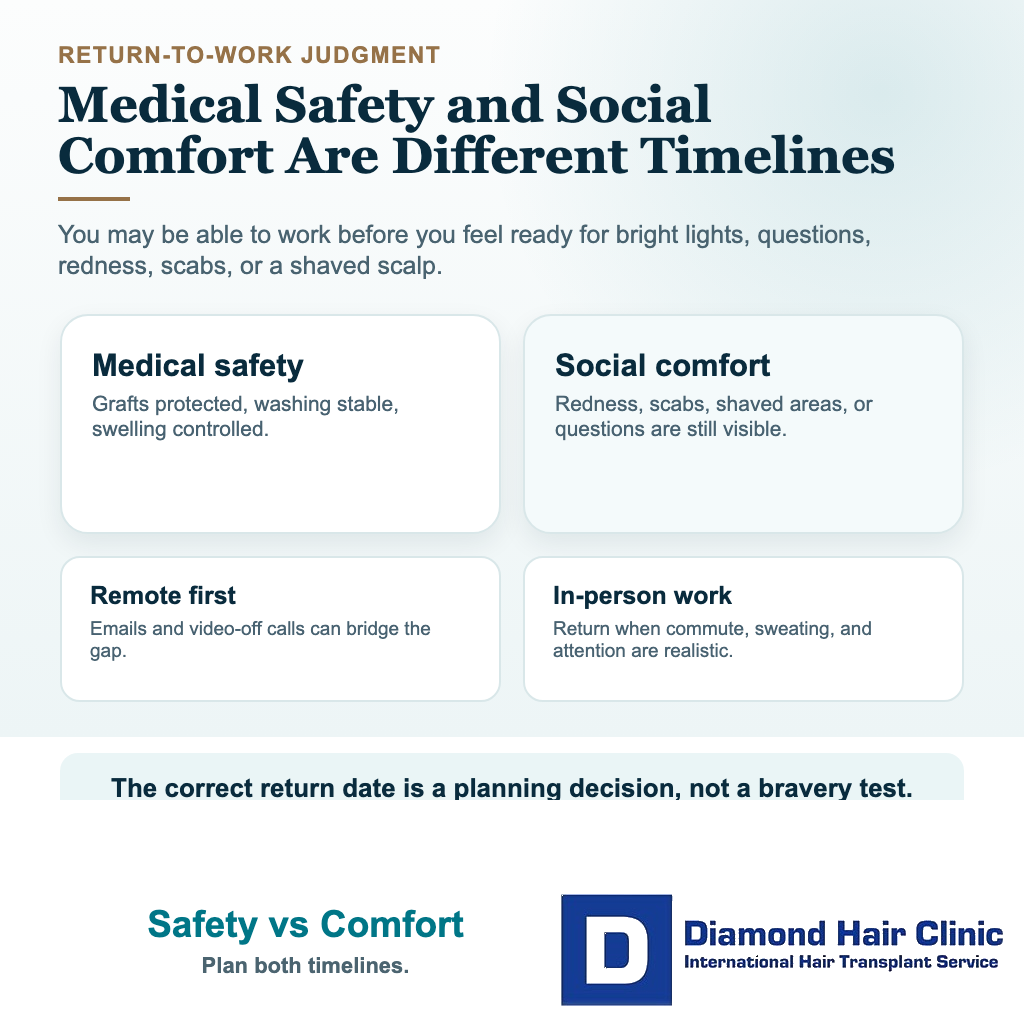
For quiet computer work, many people can function after a few days if they are not taking sedating medication, swelling is controlled, and washing and sleep instructions can still be followed. But working is not only typing or answering calls.
Screen time itself is usually not the main issue. What matters is how you set up the work around it. Avoid leaning forward for long stretches, resting your head on your hand, wearing a headset that presses near the grafts, skipping washing because a call runs late, or pushing through fatigue until you become careless. Keep the laptop high enough that you are not hunched over it, start with a short remote block, and take breaks before the workday starts to feel normal.
Plan the return around two dates. Medical readiness depends on graft protection, swelling, sleep, medicine, washing, commuting, and the demands of the job. Social readiness depends on visibility, client contact, and how much privacy you want.
Remote or non customer facing work may be possible earlier when breaks and aftercare still fit the day. A public facing return may need more time. Choosing to tell colleagues or keep the procedure private is personal, but the plan should not depend on the transplant being invisible on the first day back.
Do not plan your first workday around pretending the procedure is invisible. That expectation can create unnecessary anxiety when normal healing becomes visible.
Travel to Turkey changes the work plan
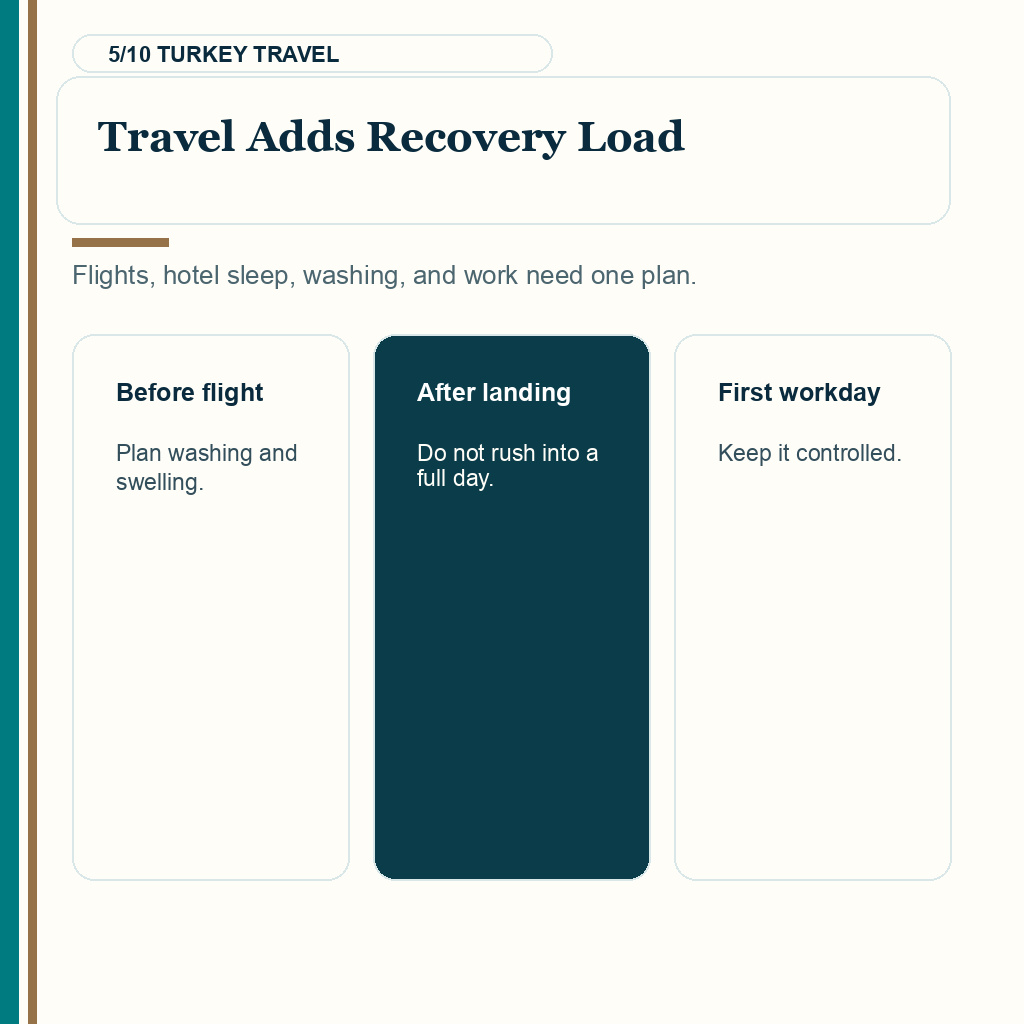
If you travel to Turkey for surgery, think beyond the operation date. The real schedule includes flights, hotel recovery, first washing, swelling, jet lag, aftercare communication, and the return home. Overseas surgery must not be sold as if the patient is only buying a package.

A hotel and transfer can make the trip easier, but they do not replace medical planning. If you are flying soon after surgery, you must protect the grafts from accidental contact, sun, sweating, rushing through the airport after a hair transplant, and poor sleep. You must also understand how to wash your scalp correctly once you are back home.
Many people underestimate how tired they feel after travel. Even when pain is mild, the combination of surgery, sleep position, airport movement, and emotional alertness can make the first days feel heavier than expected.
If your work requires you to be mentally sharp immediately after returning from Turkey, plan carefully. If you land late at night and join an important meeting the next morning, you may be medically safe, but not mentally rested.
For medical travel, getting a hair transplant in Turkey needs broader planning. Convenience must never replace medical responsibility.
You need to know both recovery timing and medical responsibility before you travel. That includes donor assessment, hairline approval, recipient area creation, extraction control, and aftercare once you are home. A hotel package can make travel easier, but it cannot replace that responsibility.
Hats, video calls, and concealment need realistic timing
Many people ask about hats because they want to return to normal life without explaining the procedure. The desire is understandable, but a hat is not just a cosmetic object during the early healing period.
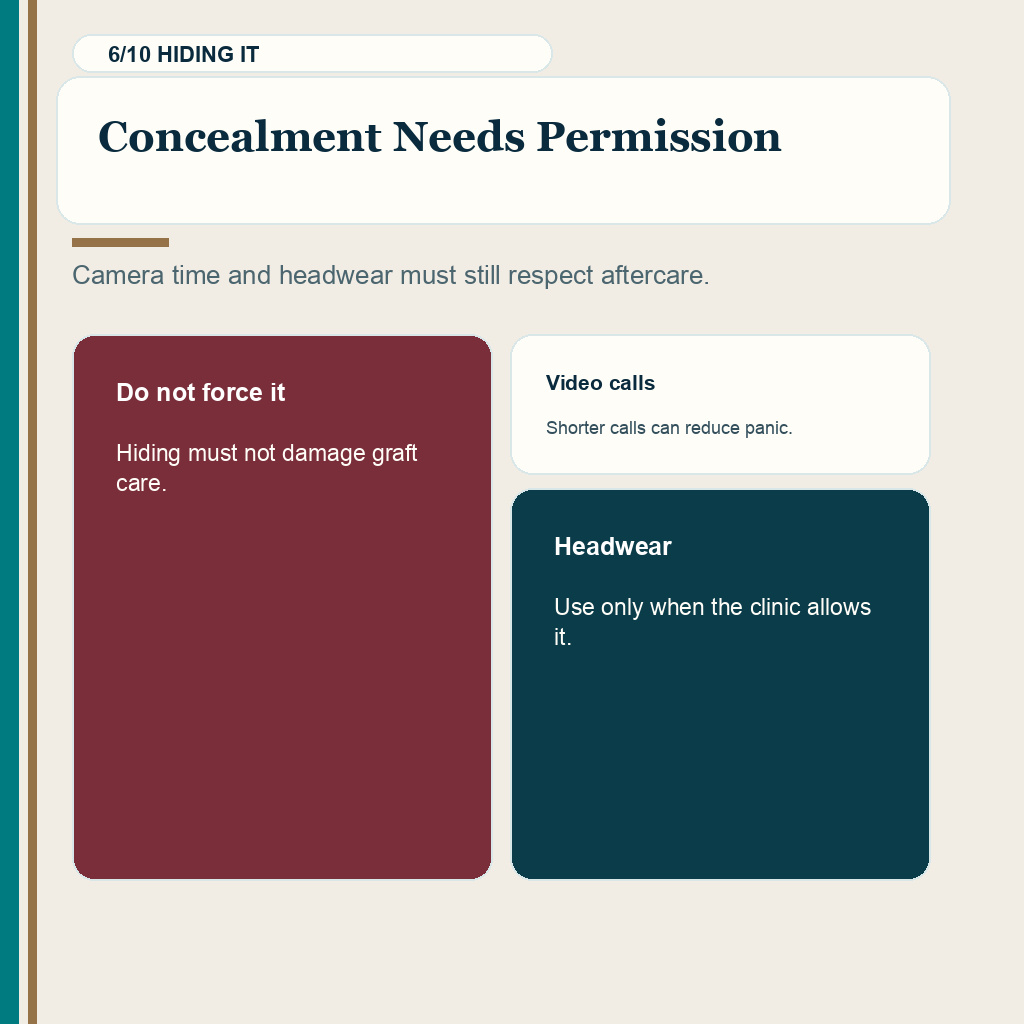
If your job has a no hat policy, do not build your return plan around a cap that the workplace may require you to remove during early healing. Plan your leave, video calls, or temporary duties around how visible the scabs and redness may be, so the plan still works if your scalp has to be uncovered.
A tight hat can rub the grafts, trap heat, increase sweating, or make you careless. A loose surgical cap may be allowed at certain times, depending on clinic instructions, but improvising with tight caps in the first few days is a bad idea.
After the grafts are more secure and the scabs are improving, a loose hat may become more reasonable, but timing needs to come from your surgeon. Do not blindly copy another patient’s timeline.
Video calls can be easier than returning to a workplace in person, especially if the camera angle is controlled and the lighting is soft. Still, the scalp can look red or patchy, and a newly shaved head may invite questions.
Some people use camera positioning, a plain explanation, or a few days without video. That is practical, but do not let hiding become obsessive.
Client meetings, teaching, presentations, or work where people focus on your face may require extra time away. The issue is not weakness. It is realistic planning.
Trying to hide everything can sometimes create more stress than being direct. Some people feel better after telling one or two trusted colleagues, rather than carrying the whole recovery alone.
What matters medically is that you do not use concealment in a way that harms healing. Do not rub makeup into the recipient area unless your surgeon has allowed it.
Do not use fibers too early. Do not scratch under a hat because the scalp itches.
A discreet return is possible for some patients, but a forced invisible return is not a safe promise.
The ugly duckling stage can affect work confidence
The first 10 days are not the only work challenge.
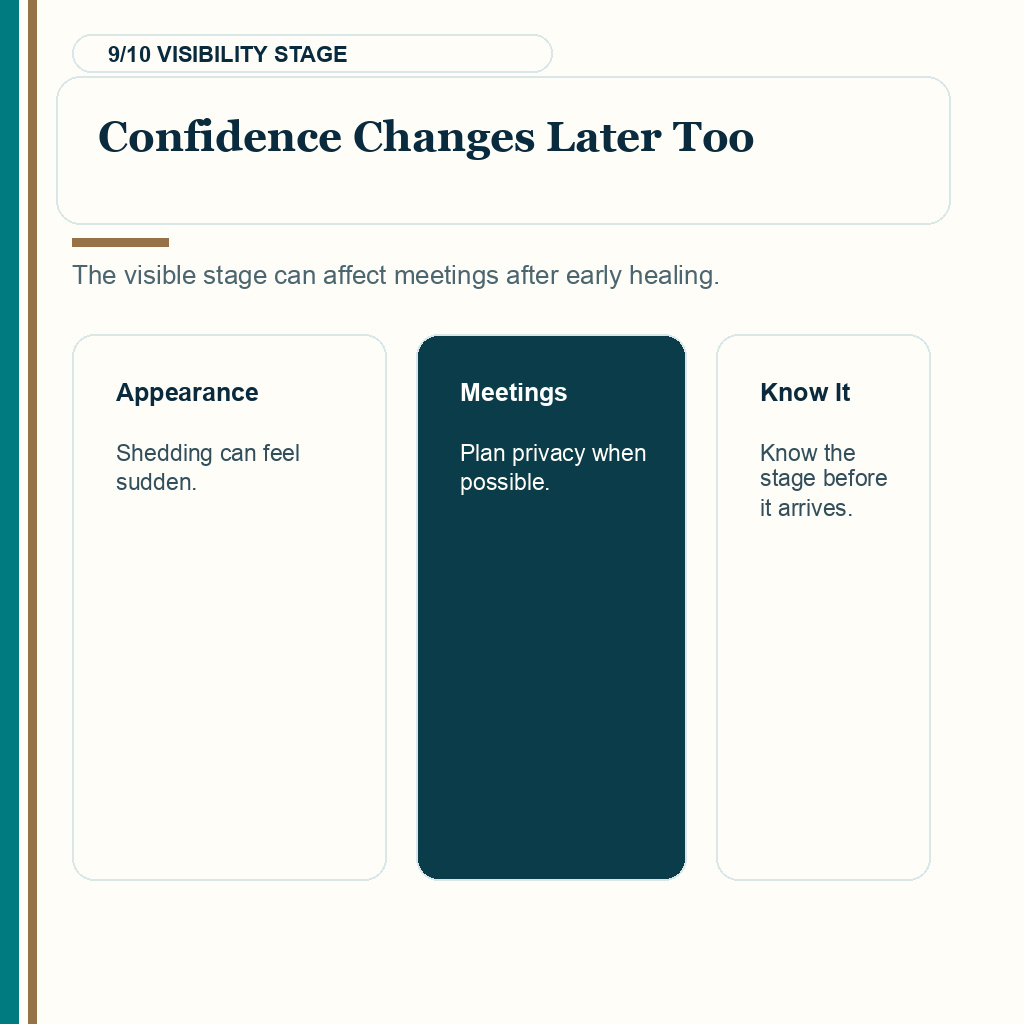
Some people are surprised when the difficult emotional period comes later, after the scabs are gone and the transplanted hairs begin to shed.
This is often called the ugly duckling stage. The phrase is imperfect, but it describes a real concern. The scalp can look patchy, transplanted shafts can shed, native hair may look weaker, and you may temporarily feel worse than before surgery.
This can be very hard at work. You may think you have survived the first week, only to suddenly feel exposed again between weeks three and eight.
Shedding at this stage does not necessarily mean failure. Hair transplant growth is not linear. Some people shed early, some later, and some keep more transplanted shafts for a while.
During this phase, it is easy to inspect the mirror too often. They compare themselves with online photos every week, check their hairline under harsh light, and worry that coworkers can see what they see.
At this point, good counseling before surgery protects you. If you know the ugly duckling stage is possible, you are less likely to panic when it arrives.
You need to know the difference between temporary shedding and true failure. When it is too early to call a hair transplant failed is mainly a timing question, not a constant panic check.
Anxiety during this stage is not proof that the surgery was a mistake. It often means the psychological timeline was not explained well enough.
If your work environment is stressful or image focused, plan not only for the first week but also for the months when the results are still developing.
A successful recovery still requires patience after you return to normal life.
Jobs that usually need more recovery time
A desk job in a clean, controlled environment is very different from physical work. Someone working on a laptop at home can often return earlier than someone working outdoors, wearing a helmet, lifting heavy objects, sweating heavily, or facing dust and heat. A dusty building site needs its own construction work after hair transplant plan because hard hats, lifting, sun, sweat, and dirty hands often happen together.
If your job involves kitchens, factories, gyms, surgery rooms, military work, police work, sports, delivery, or long hours under the sun, discuss a longer break with your surgeon. The scalp needs protection, not pressure to prove that you can manage.
Jobs that require helmets are especially important to discuss. Pressure and friction in the early period can be risky, and you must not guess.
Jobs that involve public speaking or close direct contact may not be physically dangerous, but they can be emotionally demanding. If you are thinking about your scalp every minute, you may not truly be ready to return.
Exercise routines also need planning. Many patients are eager to return to exercise after a hair transplant, but sweating, bending, pressure, and intense exertion may not be appropriate early on. Light walking is different from gym training, heavy lifting, or a workday that keeps your scalp hot and sweaty.
Other personal routines matter too. Questions about intimacy, alcohol, social events, and normal movement need clear answers. Sex after hair transplant is one common timing concern.
The more active your life is, the more carefully your recovery needs planning.
The same answer cannot be given to a remote accountant, a construction worker, a teacher, and a professional athlete.
The right return date is not the earliest date you can tolerate. It is the date that lets you heal without constant compromise.

Recovery mistakes that create unnecessary fear at work
Many people do not damage their grafts at work, but they create unnecessary fear by returning without a clear plan. They bump their head lightly, sweat during the commute, touch a scab, or forget a washing step, then spend the evening convinced they ruined the result.
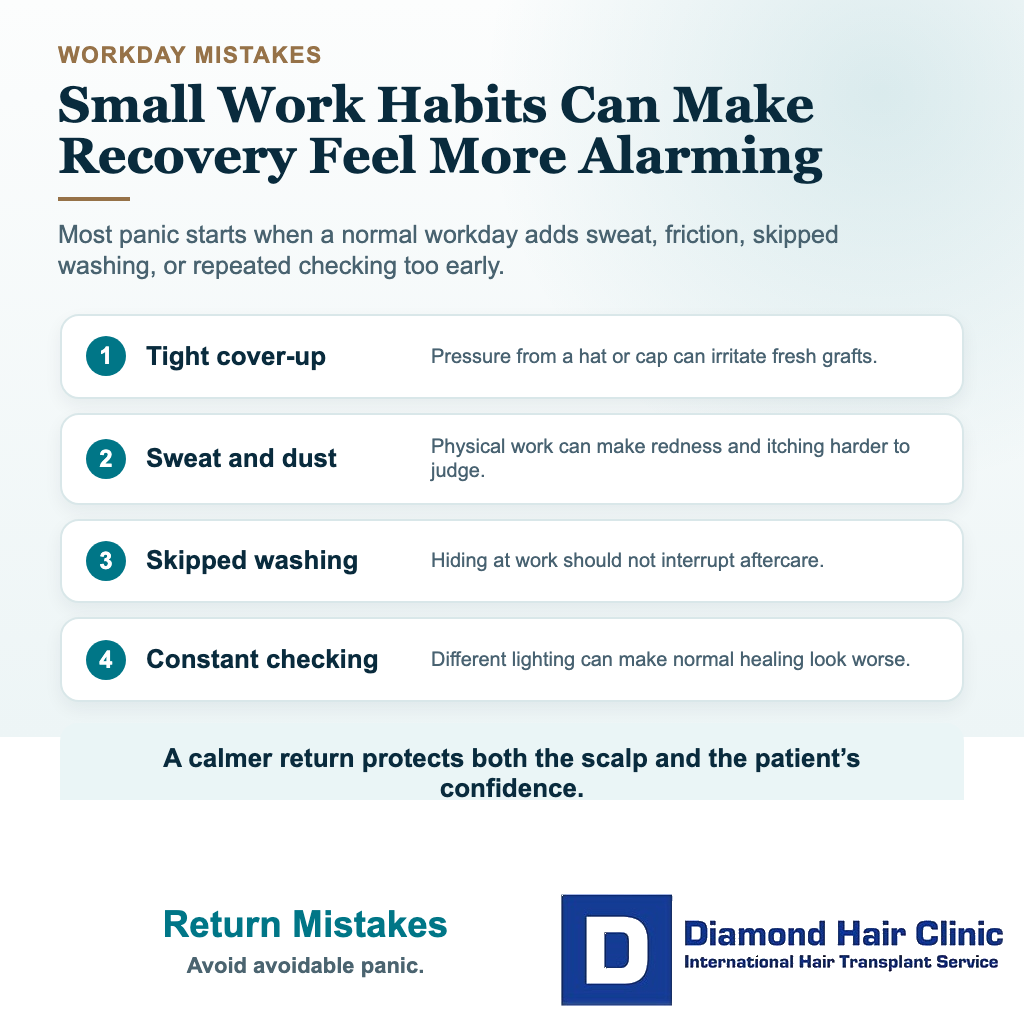
Most small events do not destroy a transplant. Poor planning increases anxiety, and anxiety leads to repeated checking, touching, photographing, and comparing.
The first mistake is wearing anything tight too early. If a hat, helmet, hood, or other head covering causes rubbing or pressure, avoid it until your surgeon says it is safe.
The second mistake is returning to intense exercise or heavy work too quickly. You may feel energetic, but the scalp is still healing.
The third mistake is hiding the procedure so aggressively that you cannot follow the aftercare correctly. For example, skipping a wash because you are embarrassed at work is not a good trade.
The fourth mistake is comparing your day 15 or day 45 appearance with someone else’s month six photo. This is unfair to your own healing.
The fifth mistake is stopping or starting hair loss medication without medical discussion. Some people need a plan for the native hair around the transplanted zone, and some cannot tolerate certain medications. A hair transplant without finasteride needs planning instead of a decision made from panic.
The sixth mistake is ignoring serious warning signs because the clinic has told you everything is always normal. Most healing changes are mild, but worsening pain, spreading redness, pus, foul odor, fever, unusual dark tissue, or worsening swelling need prompt assessment.
Do not test the grafts over and over, but do not ignore warning signs either.
You do not need to worry about everything. You need to know what is normal, what needs patience, and what needs medical attention.
Choosing your own return date
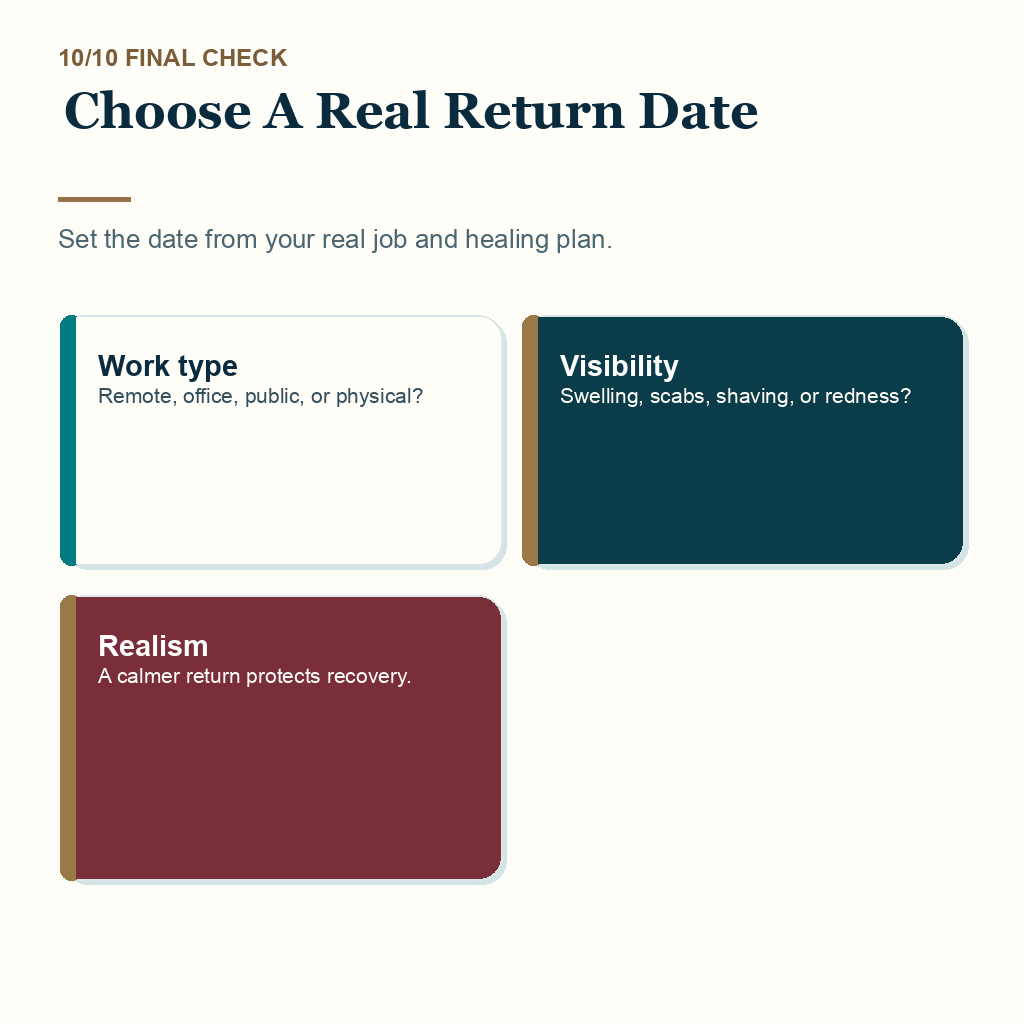
For many people, 10 to 12 days is a reasonable minimum before work that requires being seen in person, and 12 to 14 days is often more comfortable. But do not treat this as a rigid rule. The date needs to match your real job, your healing, and your temperament.
If your work involves sweat, bending, dust, a tight hat, public visibility, or a long commute, more time may be wise. If you can work quietly from home, wash properly, sleep enough, avoid sun and friction, and tolerate some visible healing, the return may be easier.
The type of procedure also matters. A large case, crown work, dense packing, repair surgery, limited donor capacity, or a full shave may create a different recovery experience than a smaller session. People often focus only on the number of grafts, but the whole situation matters.
If you are choosing a clinic, the recovery plan needs review before paying a deposit. The clinic needs to explain what happens if swelling is stronger than expected, when a hat is reasonable, when exercise can return, and who answers questions after you leave. Fear before surgery can also make recovery feel heavier, so anesthesia and comfort need review before the day of surgery. Anesthetic injections in hair transplant is part of that discussion.
Time off work belongs in the surgical plan, not as an afterthought. The best recovery plan does more than get you through the first week. It lets you return to work without constantly compromising graft protection, sleep, washing, privacy, or common sense.
Read this review excerpt
Upon arriving home, I sent 4 photos (of each side of head) after every washing process to doctor for checking where I was given personal advice for how to take care of my healing head.