


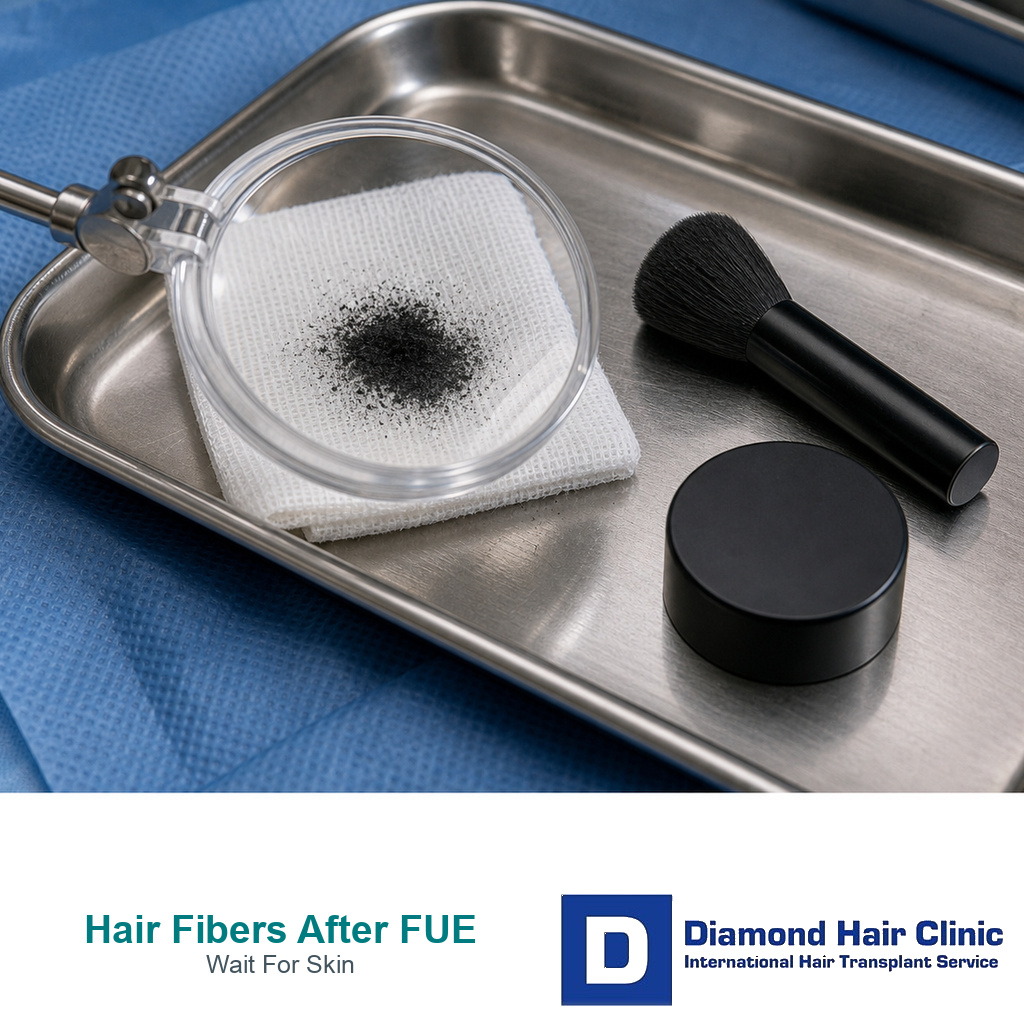
Hair Fibers and Concealer Need Safe Timing
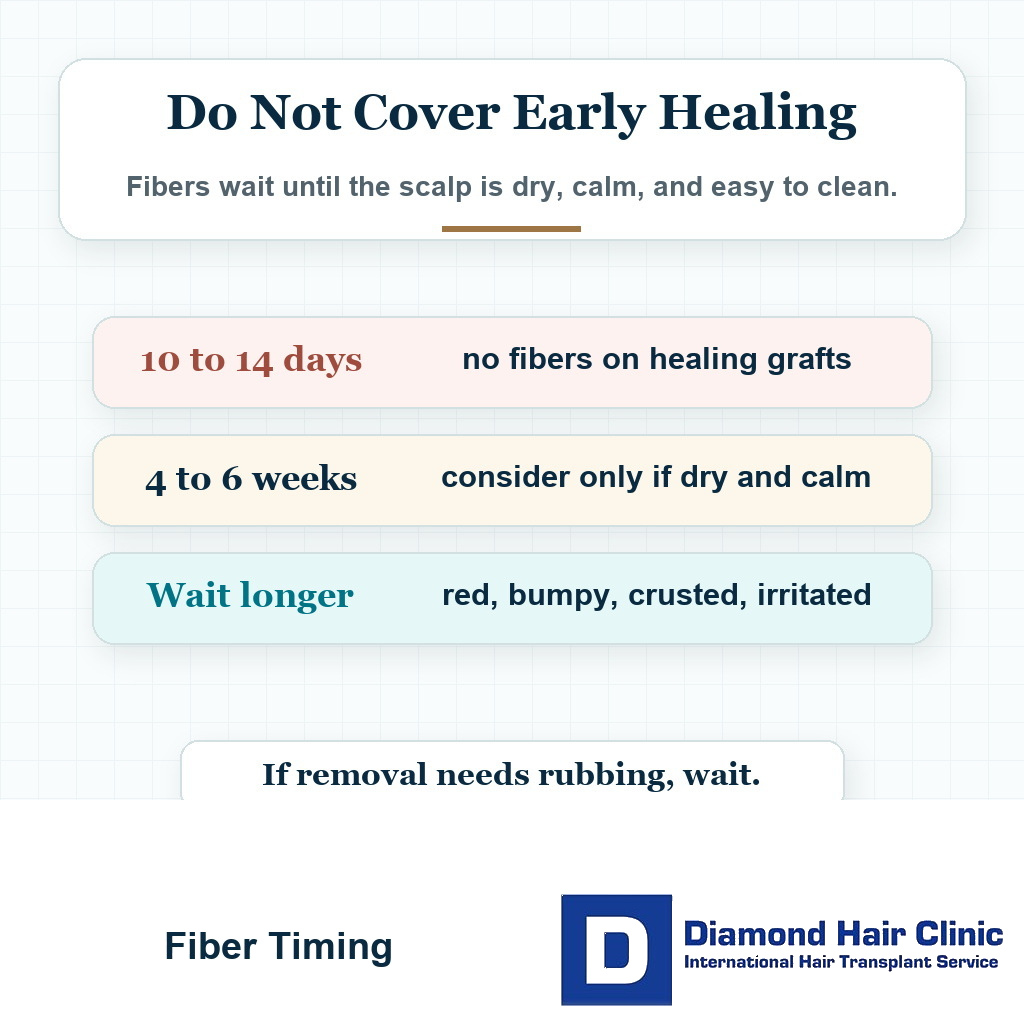
Hair fibers or concealers after a hair transplant usually need a 4 to 6 week wait, and you should wait longer if the scalp is still red, sensitive, bumpy, crusted, or irritated. During the first 10 to 14 days, fibers, powders, or products like Toppik should not sit on a healing recipient area. For gels, waxes, sprays, styling creams, and similar products on freshly treated scalp, I am more cautious, usually for the first 90 days. If you are still before surgery, I separate this from hair fibers before a hair transplant, where the main issue is whether concealer is hiding the planning baseline.
This question matters because recovery can feel very visible. The scalp may be red, shaved, patchy, or shedding, and many people want to return to work or social life without explaining the surgery to everyone. They want to feel normal again after a hair transplant.
Fibers, systems, and extensions are not the same recovery decision. For some people, the related question is whether a hair system after a hair transplant or hair extensions after FUE can hide recovery more safely than fibers. That is a separate decision because systems and extensions can create pressure, tension, adhesive, clips, and removal force.
Temporary hair fibers are also very different from synthetic hair implants. Fibers sit on the hair and scalp surface and wash out. Implants place artificial material through the skin.
The difficulty is that the scalp after surgery is not a normal styling surface. It is healing tissue. The safe timing depends on where the product will touch, whether the skin has settled, whether a locking spray is needed, how the product will be removed, whether combing will be needed, and whether you are trying to cover normal recovery or hide something that should be checked.
Do not use fibers to hide a problem the clinic still needs to review. If redness, bumps, crusts, or tenderness are the reason for covering the area, keep the scalp visible until it is reviewed.
Hair fibers and a healing recipient area
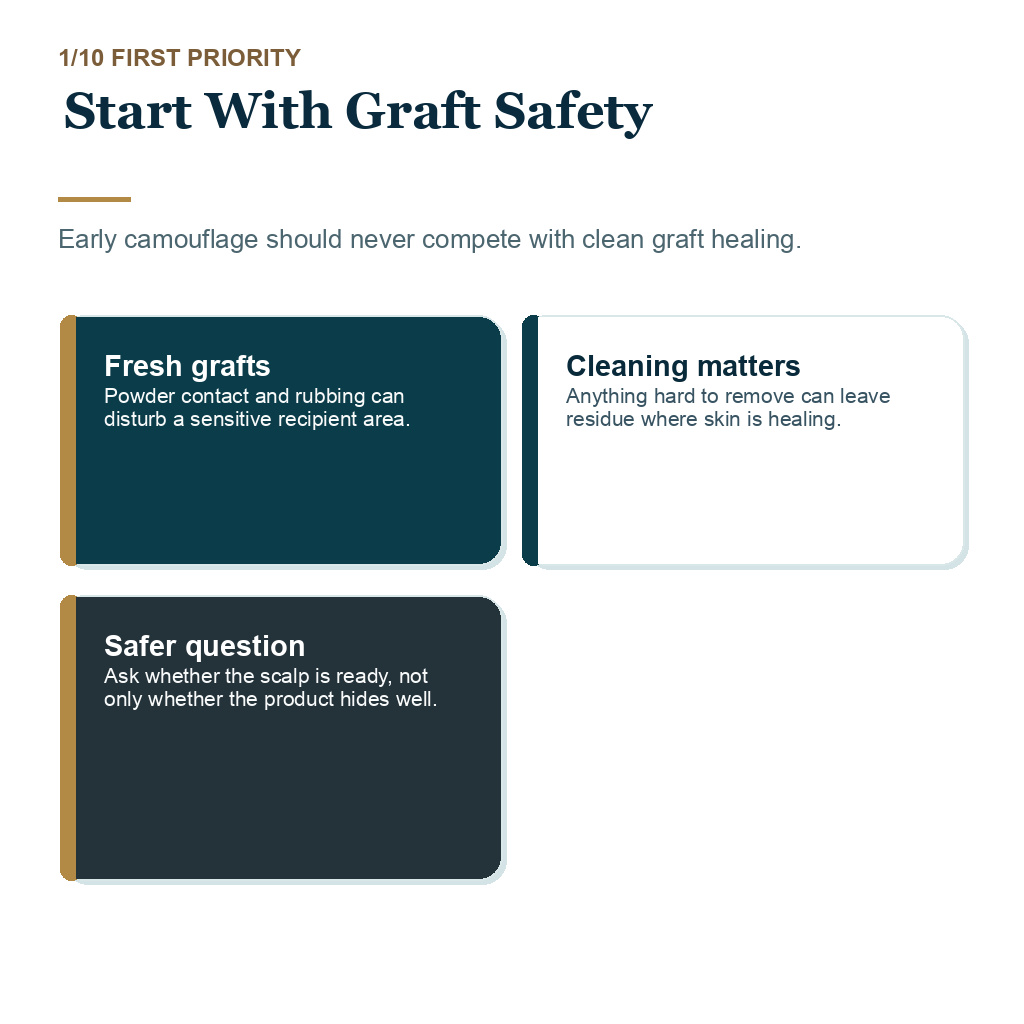
Hair fibers are unlikely to pull out secure grafts months later, but that is not the real early question. In the first weeks, I worry more about irritation, residue, rubbing, cleaning difficulty, and how often the product makes you touch the scalp.
During the first 10 to 14 days, the priority is protection. Keep the grafts clean, follow the washing routine, and avoid unnecessary contact. Proper hair transplant aftercare keeps the routine simple so fibers do not add friction, residue, or repeated checking.
Fibers are cosmetic particles. They can sit between short hairs, cling to scabs, mix with sweat, or fall from native hair onto the recipient area. If a locking spray is added, the routine becomes even less gentle.
Fibers need existing hairs to cling to. They work better between hairs than on a bare strip of scalp, so trying to draw a new hairline with extra powder can leave a sharper, less natural edge. Where there is no hair to hold the fibers, adding more product is not a substitute for waiting for growth or reassessing coverage.
The particle itself may not be dramatic. The routine around it can be. Applying it, checking it, fixing it, sweating under it, sleeping with it, and washing it away all create opportunities for friction.
The early recipient area is a healing surgical field, not a cosmetic surface. This matters most when there are still crusts, redness, tenderness, or small healing bumps.
People sometimes tell me that they only need a little product for one meeting. The emotion is understandable, but if the scalp is still healing, that meeting is not worth making recovery harder. The first weeks pass. The result matters for much longer.
If scabs are still present, fibers should stay off them. If there is itching, avoid a product that encourages rubbing. If there is redness, do not cover it so completely that a worsening pattern is missed.
Hair fibers are different from styling products
Different products deserve different timing because each one creates a different recovery problem. Hair fibers and concealers are mainly camouflage products. Gels, waxes, sprays, dry shampoo, styling creams, and many cosmetic products create hold, shine, coating, residue, stiffness, or build up.
A waterproof scalp dye is not the same as a temporary fiber. Even after the scalp has healed, check the ingredient list, whether the cream leaves a film or stain, and how it comes off. If removal needs a strong cleanser, solvent, repeated rubbing, or several washes, I would not treat it as a gentle camouflage option.
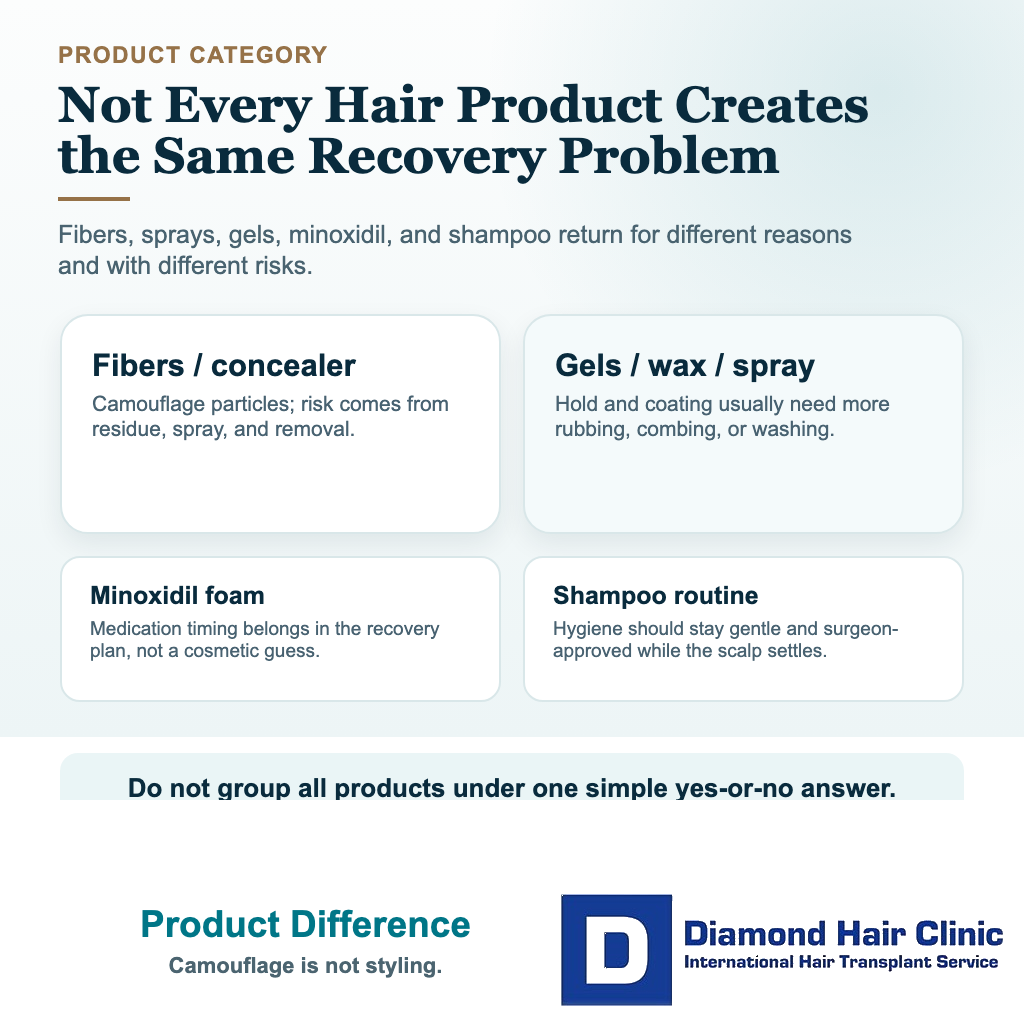
That difference matters after surgery. Fibers may be considered earlier in selected cases if the scalp is settled and the product is kept away from the healing recipient area. Styling products are different because they are often spread, massaged, combed, brushed, sprayed, or washed out with more force.
My general timing is that fibers and concealers need to wait 4 to 6 weeks, sometimes longer. Normal styling products on freshly treated scalp need much more caution during the first 90 days. This is not because every product will destroy grafts. It is because the scalp does not benefit from unnecessary chemicals, friction, and repeated styling during early recovery.
There is also the question of ingredients. Some products contain alcohols, fragrances, preservatives, propellants, resins, and strong cleansing agents. On normal scalp, you may tolerate these. On healing scalp, tolerance can be different.
If you already react easily to shampoos, sprays, gels, or cosmetic products, be more cautious. Recovery is not the time to experiment with unknown formulas, especially when judging harmful ingredients in hair products.
The more cautious plan is not complicated. Keep the scalp clean and settled first. Add cosmetic products only when healing is stable. Use as little as possible. Remove gently. Stop immediately if irritation appears.
Removal should feel boring. It should rinse away within the washing method your scalp already tolerates. If the product needs scrubbing, a locking spray, or repeated fixing with your fingers, it is too early.
I focus less on the brand name and more on the situation. A famous product used at the wrong time can still be a bad decision. A small amount used carefully at the right time may be reasonable.
Using fibers only on native hair
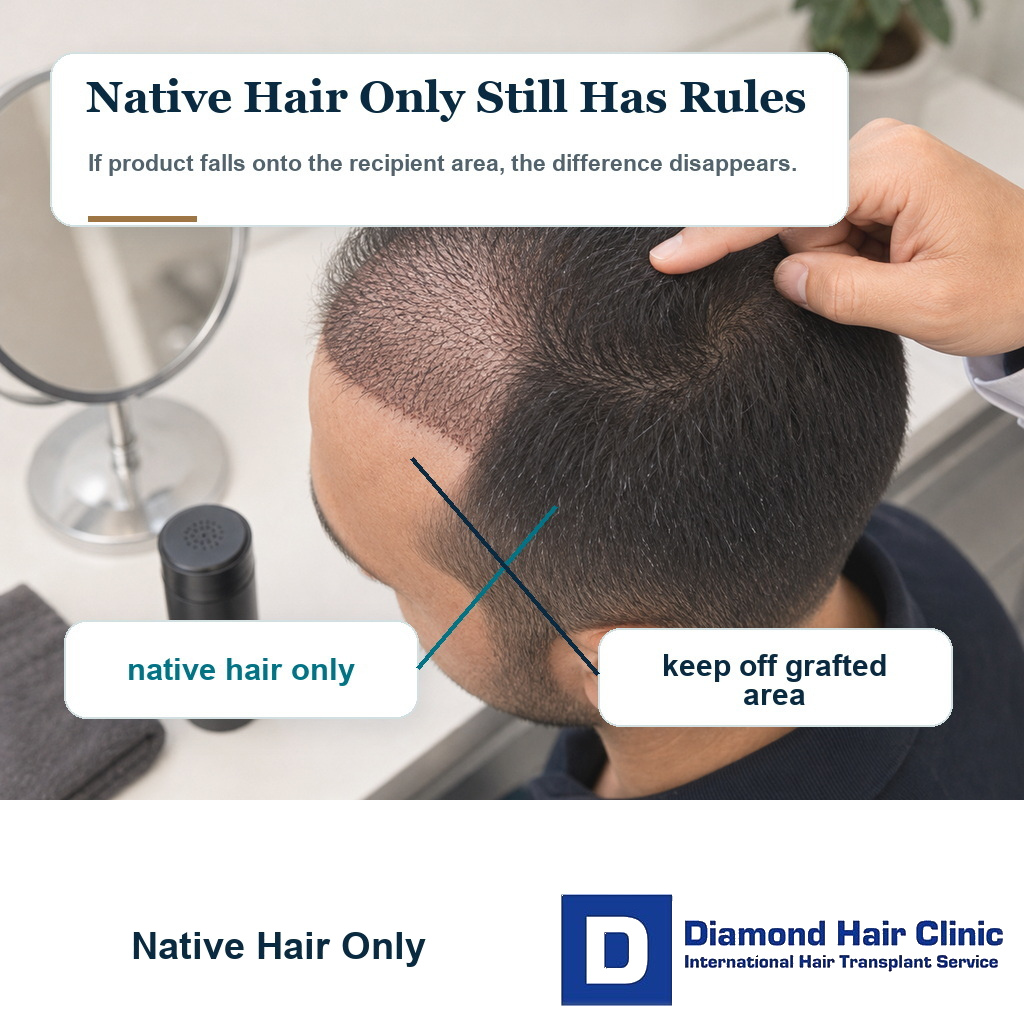
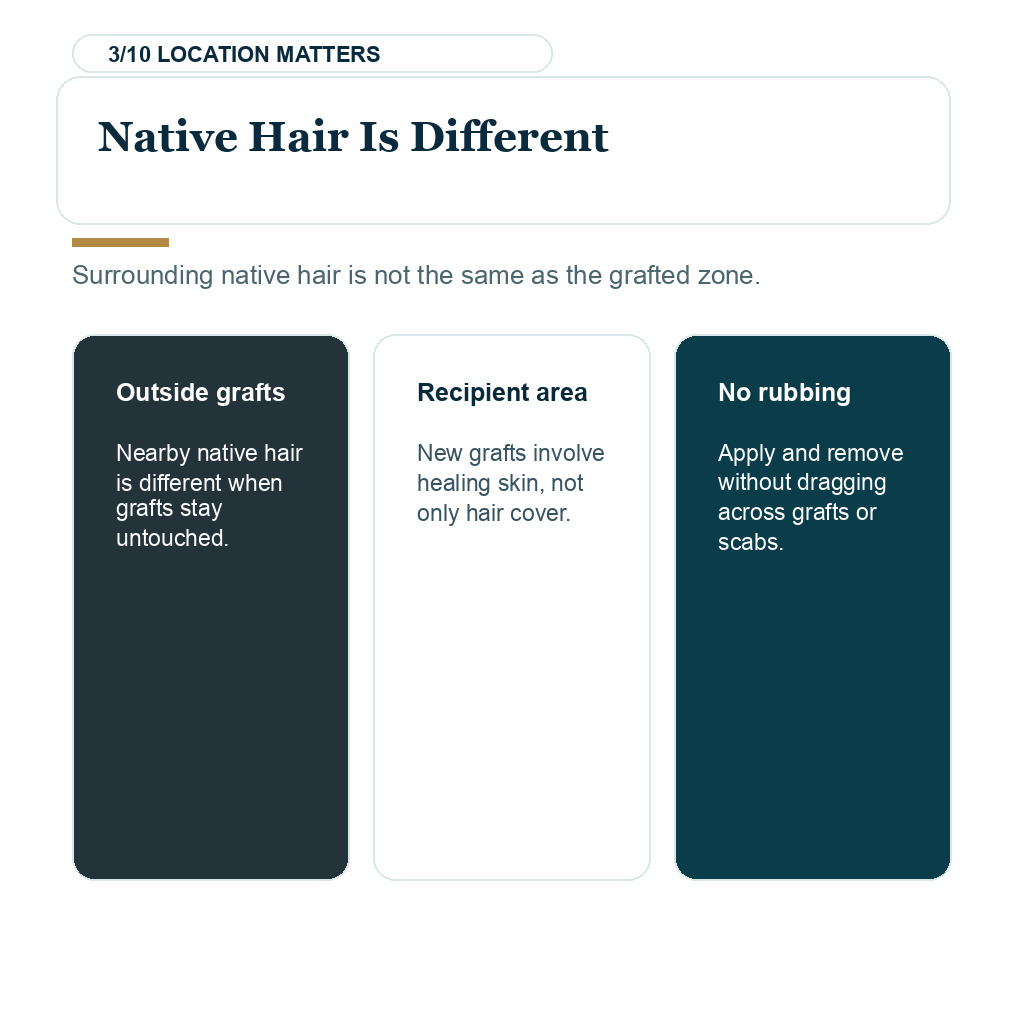
That distinction matters. Using a small amount of fibers on longer native hair around the transplanted area is not the same as covering a fresh recipient area directly. But even then, the details matter.
That distinction is lost if fibers drift onto the recipient area, if a locking spray covers the whole scalp, or if removal requires scrubbing. At that point, the product is no longer only on native hair.
For example, you may want to apply fibers behind the hairline or in the middle scalp while avoiding the grafted frontal area. If the surgery was only in the hairline and the surrounding native hair is long enough, this may become possible later in recovery. The scalp still needs to be settled first.
Timing is not only about the calendar. Day 30 in one person can look more settled than day 45 in another. Skin type, density, scabbing, sensitivity, and aftercare all matter.
If the goal is only to reduce contrast during the awkward phase, a safer haircut or careful styling of native hair may be better than fibers. The aim is to look more comfortable without creating another healing problem.
I stay similarly cautious during the ugly duckling phase after hair transplant. Many choices made during that period come from impatience. Some are harmless. Some create more anxiety.
If your surgeon has cleared you, start conservatively. Use a very small amount on a quiet day first, not for the first time before an important meeting. Keep it away from irritated areas. Do not combine it with heavy sprays. Do not sleep with it on. Wash gently.
Once fibers are suitable for your scalp, compare a small sample with your hair in daylight before buying a larger container.
Appearance is only half the test. If the fibers keep transferring to your pillow, clothing, or another person, they are not a dependable daily solution even when the scalp looks good. A routine that needs constant checking and cleanup may add more stress than it hides.
Donor area use may happen earlier than recipient area use
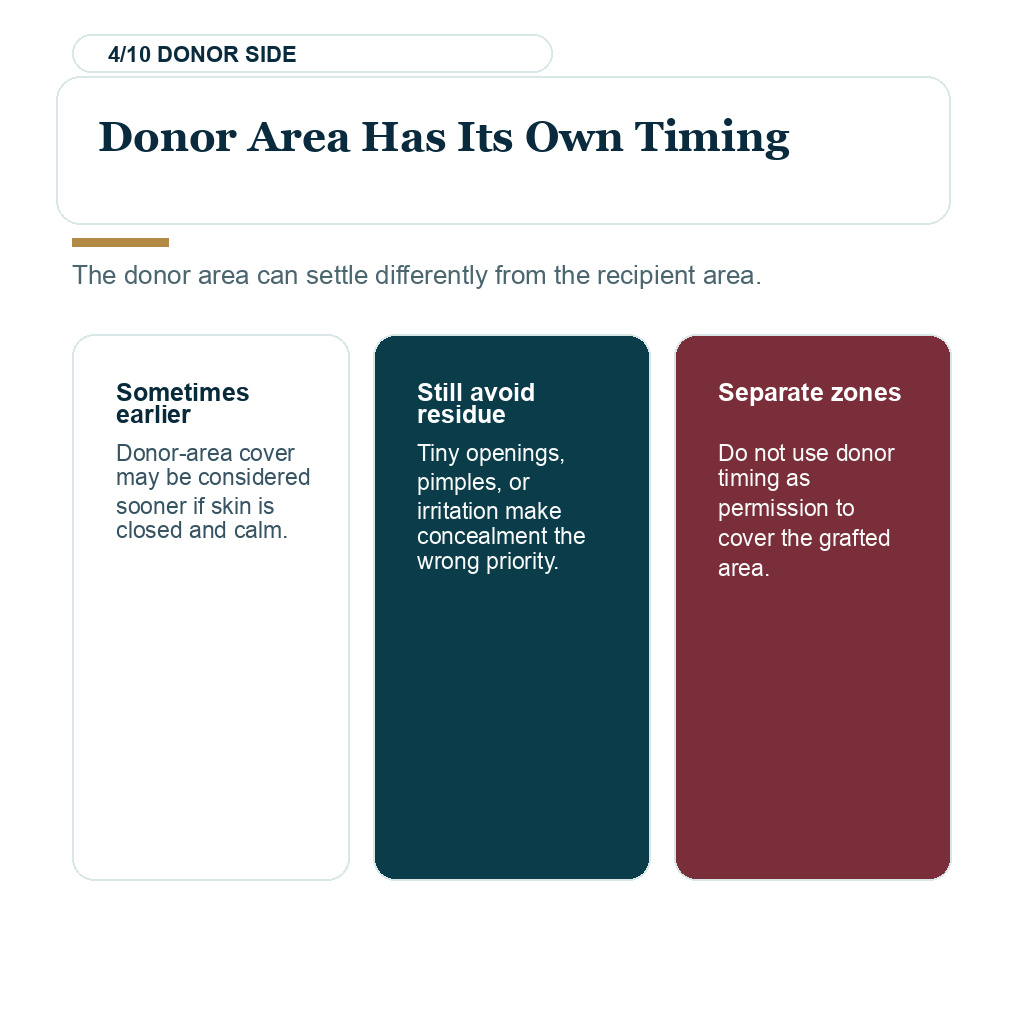
Sometimes the donor area becomes suitable earlier than the recipient area, but it still needs caution. These areas heal differently, and earlier donor healing does not mean product belongs on skin with small crusts, tenderness, redness, bumps, or open points.
If the purpose is to hide the donor area after FUE, the first question is whether the donor skin is closed, clean, and comfortable. If it is still irritated, wait. If there is folliculitis or sensitivity, I avoid fibers trapping sweat or residue there.
A small amount on longer surrounding donor hair may be reasonable later if it does not touch irritated skin and can be removed without rubbing. But if the product has to be scrubbed out, the timing is wrong.
I separate the donor area from the recipient area, but I do not treat either one casually. The donor area still deserves protection because it is the source of the grafts and part of the final cosmetic result. That broader point belongs to the way I think about the donor area in hair transplant.
The more careful decision is to photograph the scalp before product changes what the clinic can see. A few more days of waiting is often better than irritating skin that was almost healed.
Redness and scabs should stay visible
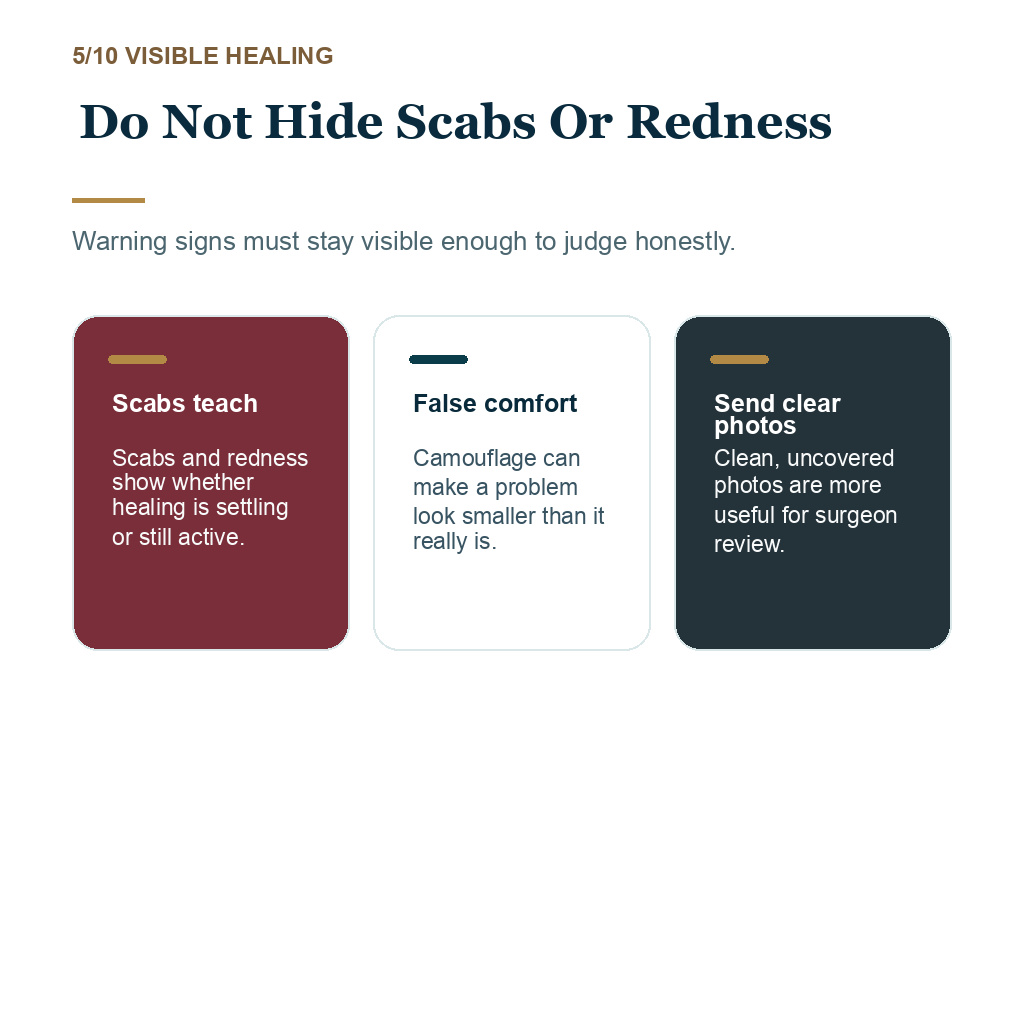
Toppik, fibers, powders, or concealers must not be used to hide redness and scabs in the early healing period. Redness and scabs are not cosmetic defects at that stage. They are part of the recovery picture that needs to remain easy to monitor.
If a scab is still attached, adding particles over it can make washing more difficult. If the scalp is red and irritated, concealer can hide whether the redness is improving or worsening. If there are pimples or folliculitis, product can make the area more congested.
You may feel better for a few hours because the scalp looks less obvious. But then the product has to be removed. That removal may require extra washing, rubbing, or checking. This is exactly what I avoid in a healing recipient area.
Understand what is normal and what is not before using fibers for cover. Some redness, scabbing, tenderness, itching, and small bumps can be part of healing. But certain patterns deserve attention, especially when symptoms are getting worse rather than settling. Understanding redness, scabs, and pimples after a hair transplant helps you avoid covering a warning sign just to feel comfortable for a few hours.
If the scalp has yellow discharge, bad smell, increasing pain, spreading redness, heat, thick painful crusts, or open areas, do not hide it. Contact your clinic. Cosmetic cover must never delay medical judgment.
The psychological side matters too. If you cover every healing sign too early, you may never learn what normal recovery looks like. Then each wash becomes frightening. Each shed hair becomes a crisis. Recovery becomes harder than it needs to be.
Keep the order clear. Scabs first. Healing first. Cosmetic cover later. That order protects both the scalp and your peace of mind.
Planning work when you need to look presentable
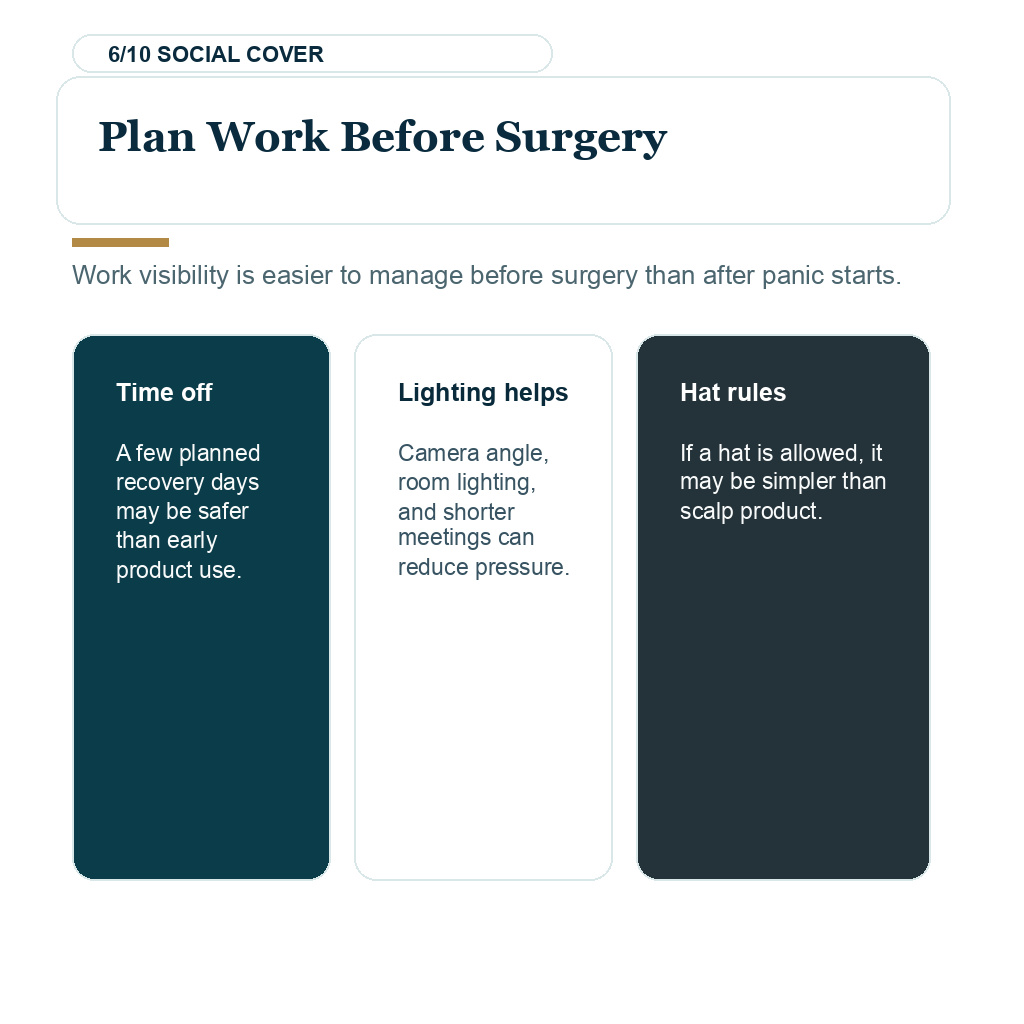
If work appearance is important, plan the timing before surgery. Fibers should not be the main recovery plan. For many people, the more realistic solution is time away from in person work, remote work, or accepting a short period where the scalp is visible.
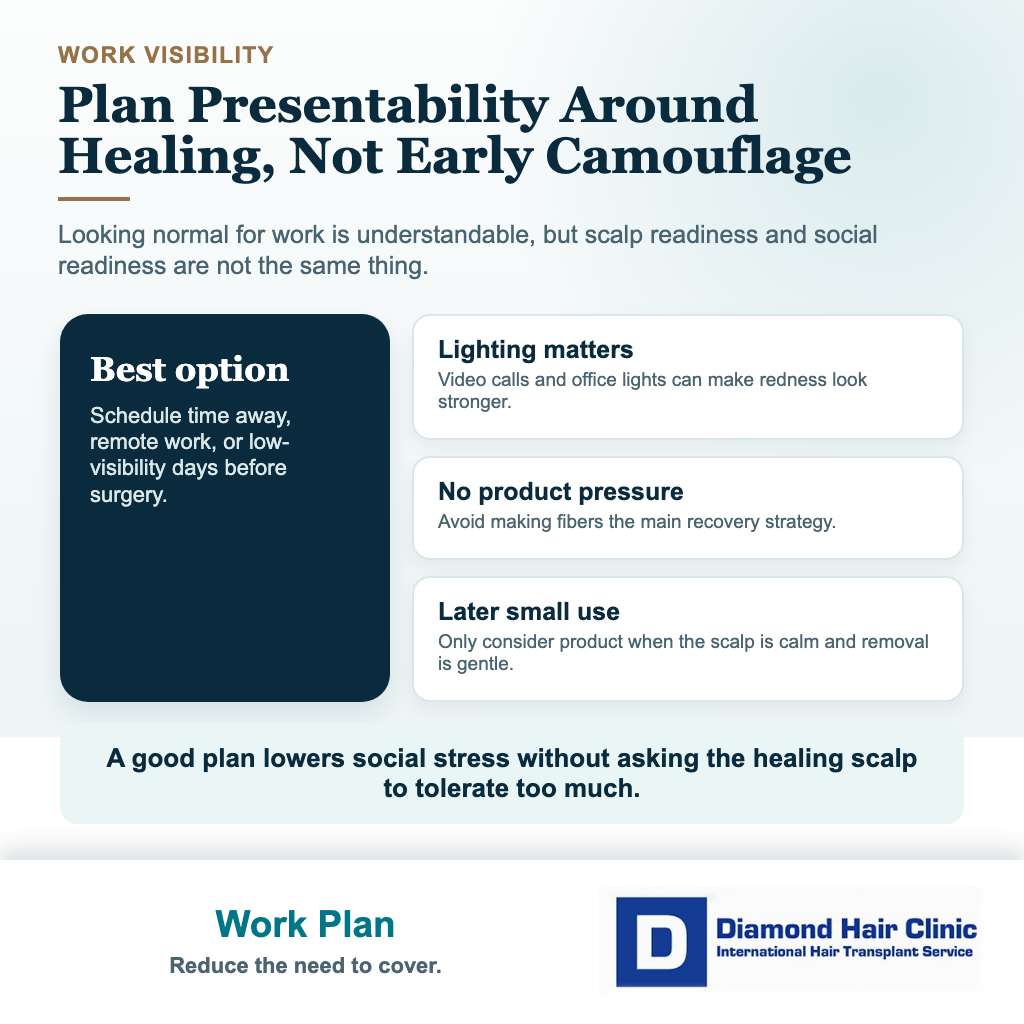
This can be uncomfortable. People worry about colleagues, video calls, office lighting, client meetings, and the first person who notices something different. But covering the scalp too early can create more risk than the social discomfort it solves.
Medical readiness and social readiness are not the same. You may feel well enough to answer emails after a few days, but the scalp may still not be ready for fibers, sprays, or strong styling. Planning time away from work after hair transplant should include how visible the scalp may be, not only how energetic you feel.
If you have a major event, meeting, or public appearance soon after surgery, that should be part of the consultation. A responsible plan may mean changing the surgery date. It may mean choosing a different vacation window. It may mean being clear that the first weeks will not be invisible.
Some people wonder if they can use fibers only for one special day. If the scalp is beyond the early phase, settled, dry, and cleared by the surgeon, very limited use may be possible. If it is within the first 10 to 14 days, my answer is usually no.
For work, a clean loose hat may sometimes be safer than product after the early graft protection period, but that depends on the job and the hat. For some offices, a hat draws more attention than a shaved scalp. The social answer and the medical answer are not always the same.
The best solution is often the least dramatic one. Give the scalp enough time, keep the explanation simple if someone asks, and avoid creating a healing problem to avoid a short conversation.
Fibers distort result evaluation
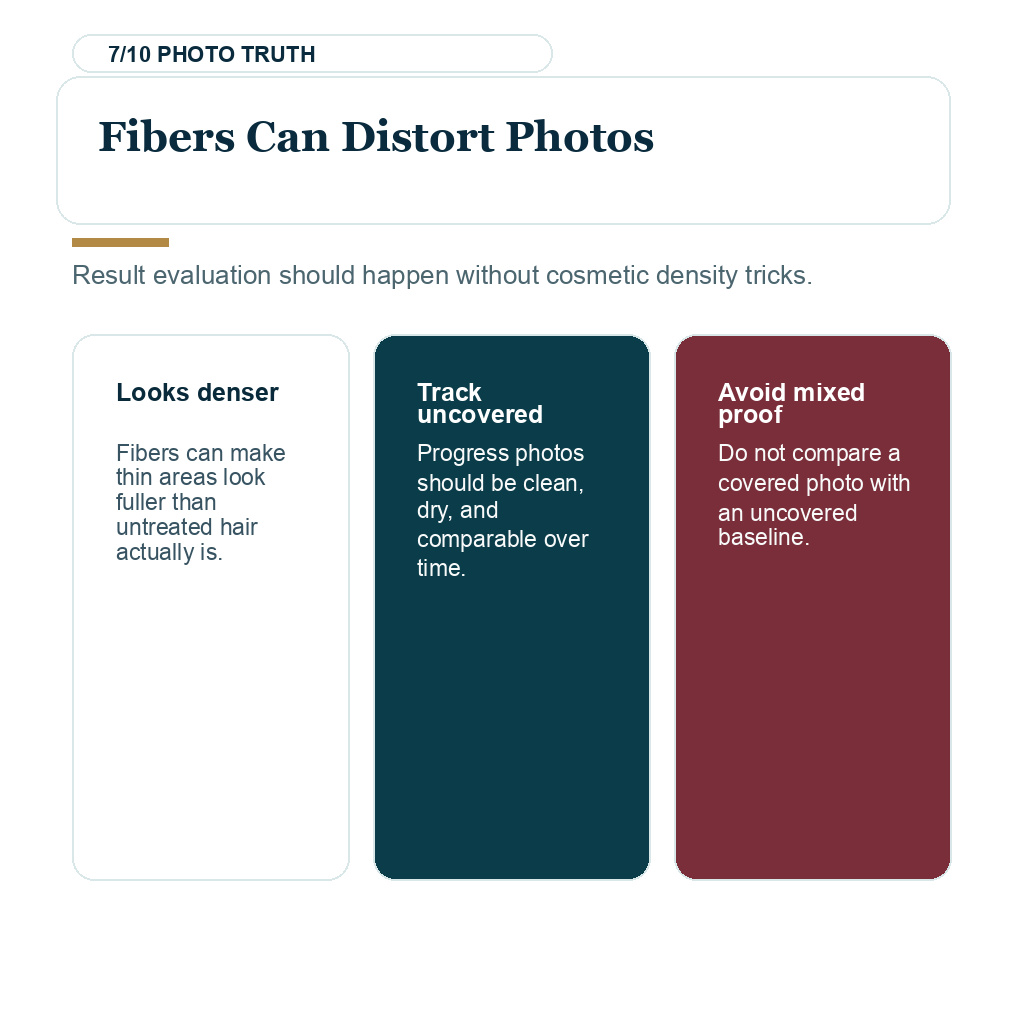
Fibers can make a result look denser than it really is, especially in photos, harsh lighting, and short videos. That can help daily appearance, but it can also confuse judgment.
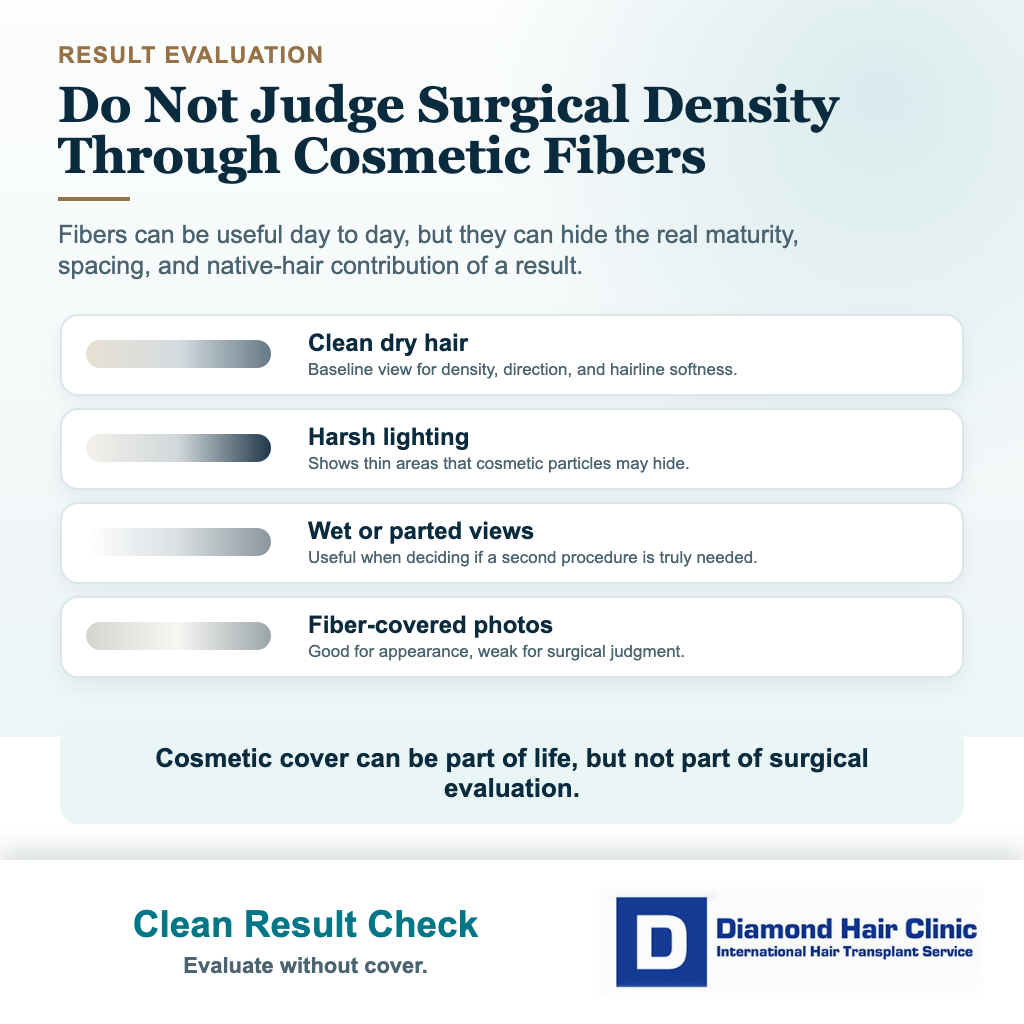
If you use fibers every day, you may not know how the transplant truly looks without cosmetic help. That can affect decisions about a second procedure, crown work, density expectations, or whether the result is actually mature.
I evaluate transplant results on clean hair, not while the scalp is covered with fibers. I need to see dry hair, wet hair when needed, normal lighting, harsh lighting, front, sides, crown, donor area, and close views. Cosmetic cover can be part of life, but it should not be part of surgical evaluation.
Swimming is a separate decision from covering the scalp for a normal day. Once the clinic has cleared swimming, keep the hair and scalp clean rather than mixing fibers with pool or sea water. If the skin is still irritated, crusted, tender, or hard to wash, cosmetic cover should wait until the scalp is calm again.
Many patients hope a transplant will free them from fibers forever. Whether that happens depends on hair characteristics, donor strength, hair loss pattern, graft distribution, and expectations. A good transplant can reduce dependence on fibers, but it should not be sold as a promise of perfect density under every condition.
The same realism applies to harsh light and wet hair after a hair transplant. A natural result should hold up in real life, but no surgery can recreate unlimited juvenile density.
There is another clinic selection issue. Before and after photos with fibers, styling tricks, or perfect lighting can mislead people. If you are comparing results, check whether the hair is clean, dry, wet, styled, powdered, or enhanced. A result should be strong enough to evaluate without cosmetic help.
Using fibers later is not a moral failure. Some people use them occasionally and feel happier. My concern is only when cosmetic help replaces clear diagnosis, clear assessment, and realistic planning.
Separate medication timing from styling products
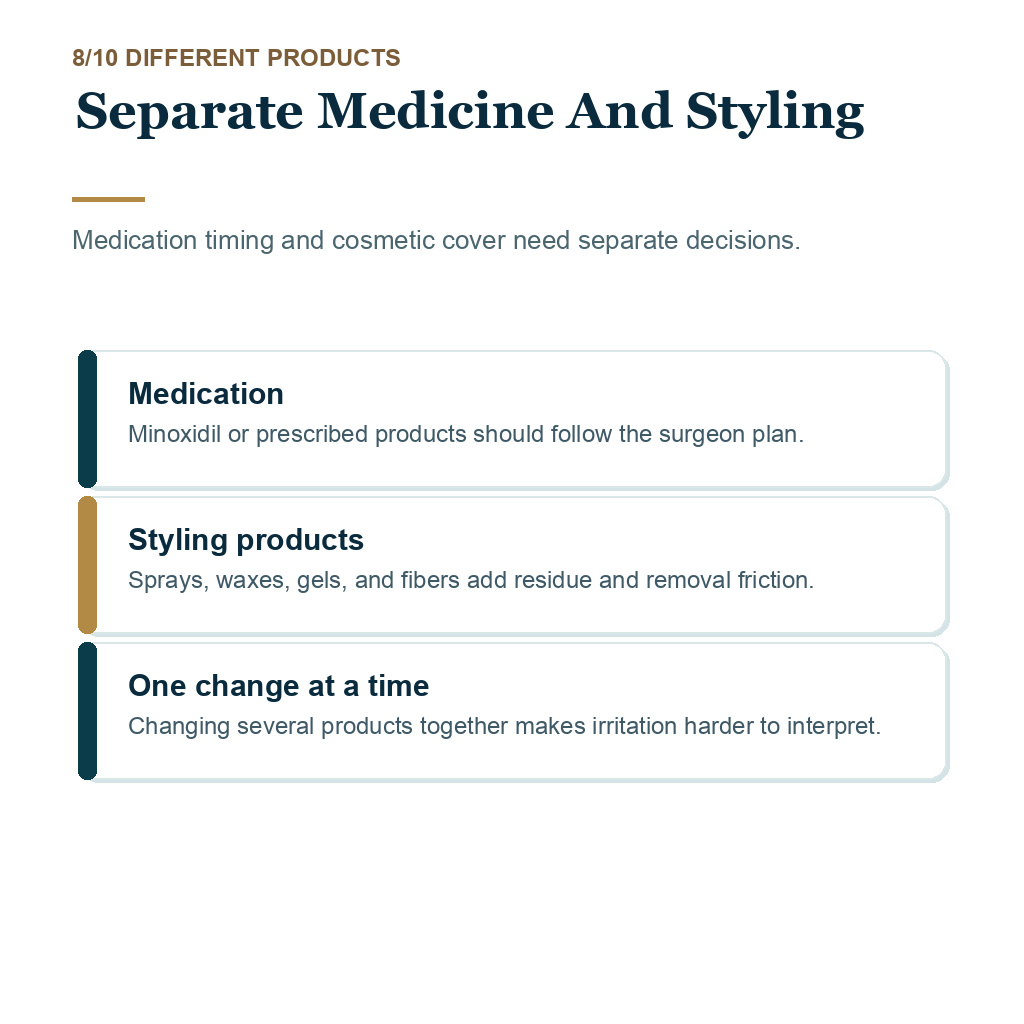
These products are not one recovery category. Minoxidil foam is a medical or supportive treatment. Hair spray, gel, and wax are styling products. Shampoo is part of hygiene. Fibers are camouflage.
After surgery, each product needs to return at the right time for the right reason. Random experimentation is the problem. If a medication, foam, lotion, shampoo, or supplement is part of the plan, it needs review with the surgeon who knows the case.
Minoxidil is a good example. Some people stop it suddenly. Some restart too quickly. Some start a new foam during recovery because they are anxious about shedding. That can create confusion, irritation, or unnecessary panic if shedding begins.
If the question is medication timing, the answer belongs in the medication plan, not in a cosmetic decision. If you are unsure about stopping minoxidil before a hair transplant, handle that separately from cosmetic cover.
For ordinary styling products, I stay conservative. Gels, waxes, sprays, fibers, styling creams, and similar products should not be used casually on freshly treated scalp in the first 90 days. If the product is only on longer surrounding hair and not touching the healing area, the decision can be more flexible, but it still needs common sense.
The reason I use different timelines is that people often use the word product too loosely. A gentle shampoo used as part of washing is not the same as a sticky wax rubbed into short grafted hair. A small amount of fiber dust on mature native hair is not the same as a spray that glues particles onto irritated skin.
The decision needs to be specific. Which product is it, where exactly will it touch, how will it be removed, and what does the scalp look like today? Without those details, the most responsible answer is to wait.
Shampoo is different because washing is part of aftercare. But even shampoo needs to be used as directed. Early washing needs to be gentle. Strong rubbing, strong water pressure, and harsh products are not helpful. If the timing is unclear, treat washing after a hair transplant as the recovery rule and keep cosmetic products out of the routine until the scalp is ready.
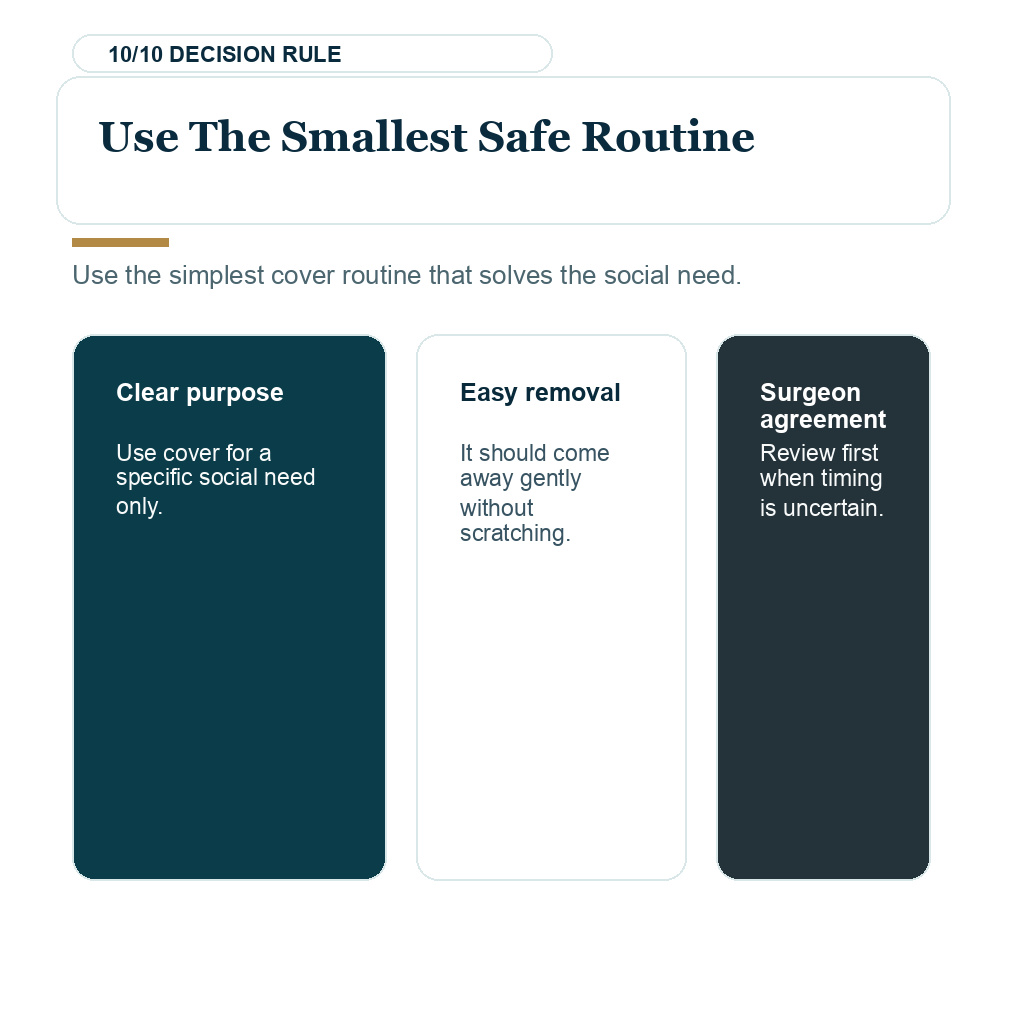
The rule needs to stay specific. Do not add a product just because you are anxious. Add it only when it has a clear purpose, the scalp is ready, and your surgeon agrees it makes sense.
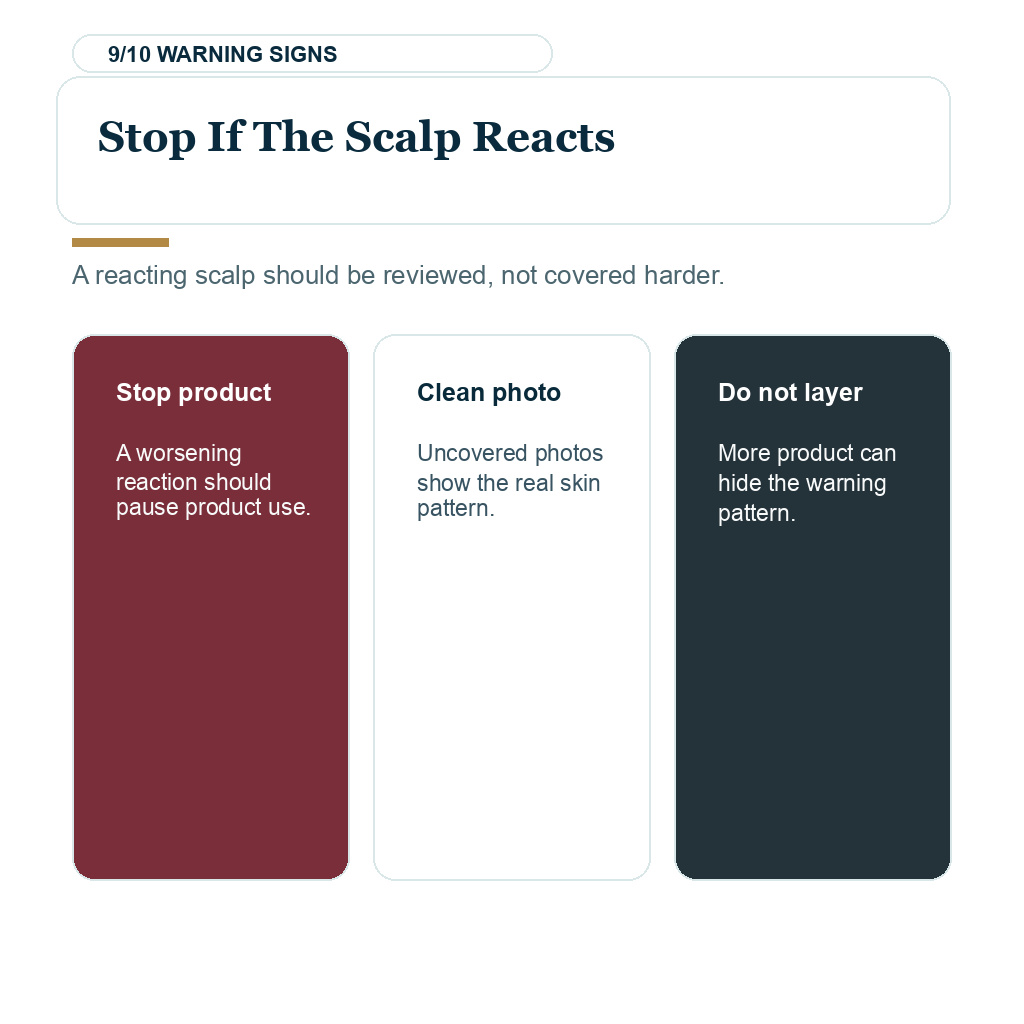
Use the 10 timing slides below to separate hair fibers from early graft protection, scalp readiness, native hair use, donor area use, redness and scabs, work planning, result photos, medication and styling differences, warning signs, and a safer decision rule. Swipe the carousel, use the arrows one step at a time, or choose a number below the image to jump to that point.
Symptoms that mean concealer should stop
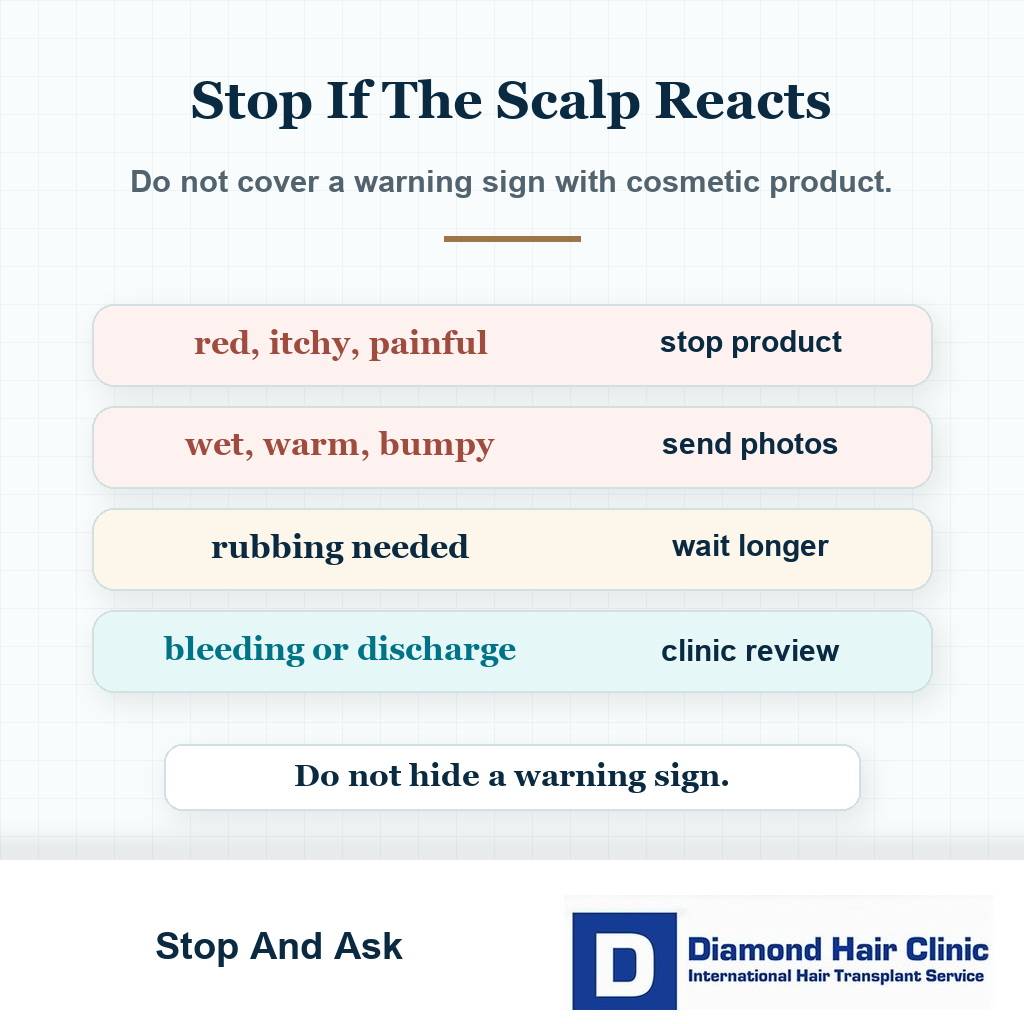
Stop using concealers and ask your surgeon if the scalp becomes more red, itchy, painful, swollen, warm, flaky, wet, or bumpy after use. Also stop if washing the product out requires rubbing or if the product sticks to crusts.
If you see fresh bleeding, discharge, bad smell, expanding redness, thick dark scabs, or open areas, do not cover the problem. The scalp needs assessment. A product that hides a warning sign can delay the right response.
Some people use fibers because they think the transplant is already failing. At month 1, month 2, or month 3, that fear is often premature. Shedding and low visible density can be part of the normal timeline. Covering the scalp every day may make the waiting period easier, but it can also keep you from understanding what stage you are actually in.
If hairs came away with scabs, do not judge it only by the hair shaft you see. Look for bleeding, tissue attached to the hair, an open spot, or a clear change in the skin. If surrounding native hair looks weaker, the issue may be different from the transplant itself.
Native hair can shed or look thinner temporarily after surgery. Sometimes that is native hair shock loss after hair transplant. Sometimes it is ongoing miniaturization behind the transplanted area.
Concealer should not hide a pattern that still needs diagnosis. If you need progressively more product because the result looks worse, pause and take comparable photos before camouflage obscures the change. Maturing growth and a true density problem require different responses, and neither is clarified by adding more fibers.
Cosmetic cover is acceptable only when it does not interfere with healing, hygiene, diagnosis, or accurate evaluation.
Cosmetic cover waits for calm skin
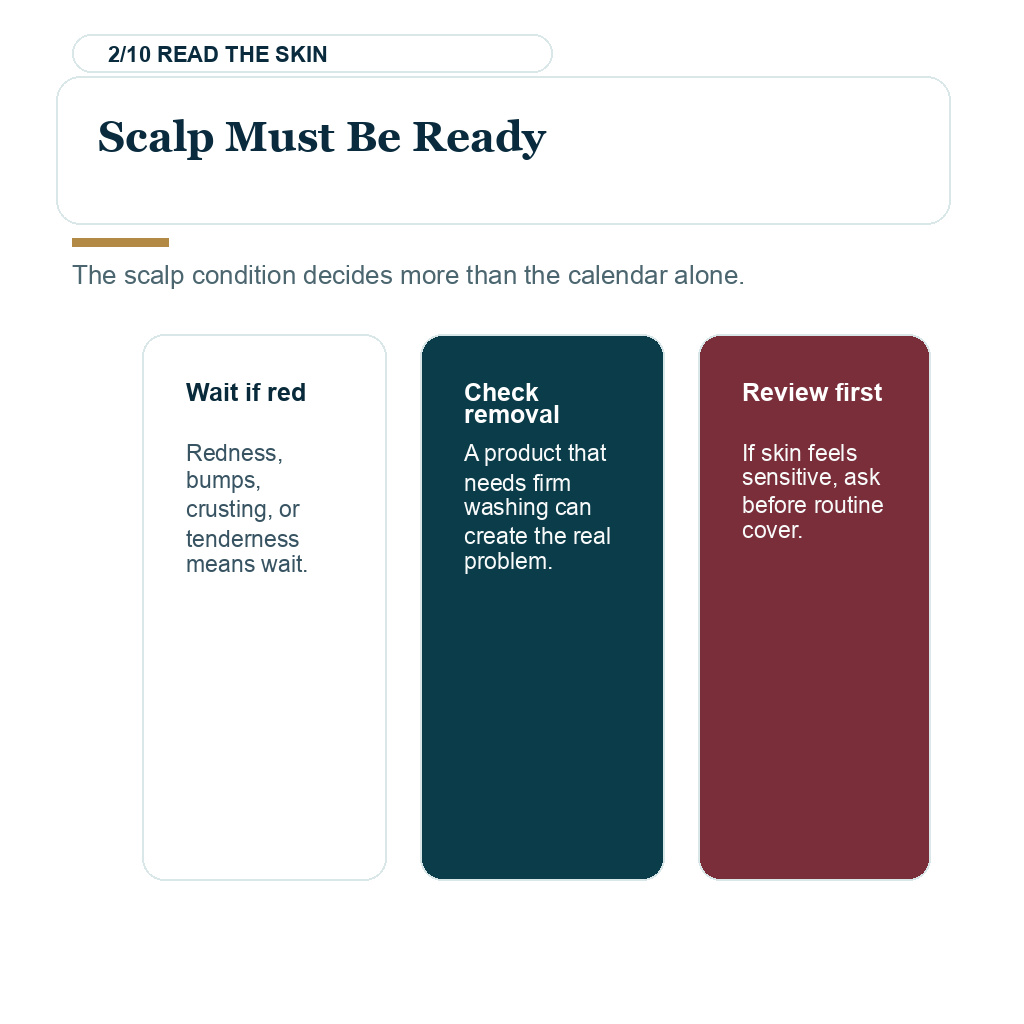
Hair fibers and concealers belong on skin that is closed, dry, and easy to wash without rubbing. During the first days, the scalp needs protection more than camouflage.
Later, a small amount can be reasonable when crusting, irritation, pain, folliculitis, and infection signs are absent. Heavy sprays, sleeping with product on, or using fibers to hide warning signs makes recovery signs less visible.
If removal friction leaves the recipient area redder, compare that change with the pink recipient area after FUE pattern before adding more product. Surgical decisions should be made from clean hair and clear skin, not from a scalp covered for confidence.

Read this review excerpt
Diamond Hair was the only clinic asking for medications, treatments I've done before, and other type of questions that make me feel confident on the professionalism that they practice with their clients.