



Itching Timeline and Warning Signs
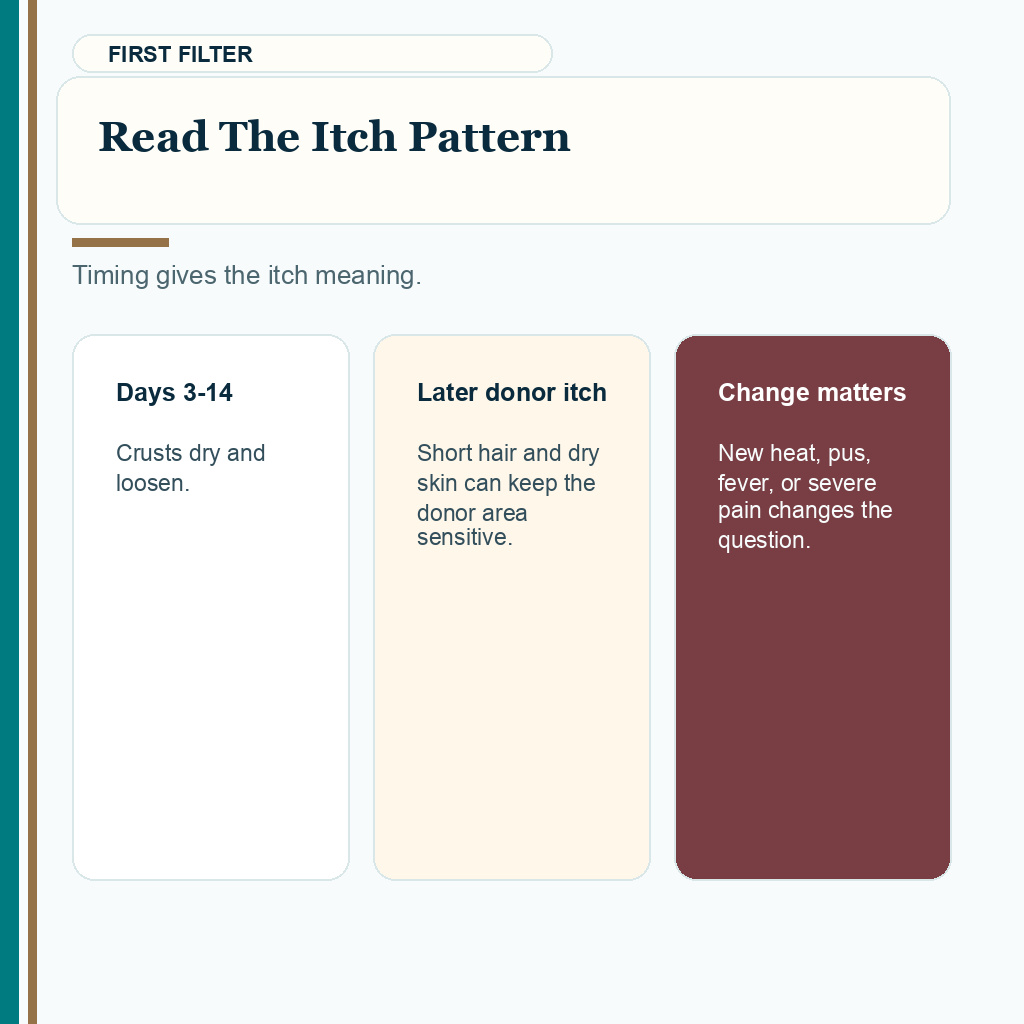
The strongest itching usually comes while crusts dry, loosen, and the skin begins to settle. Donor area itching can continue or return for several weeks, often around 4 to 6 weeks, especially when the hair is short and the skin is dry.
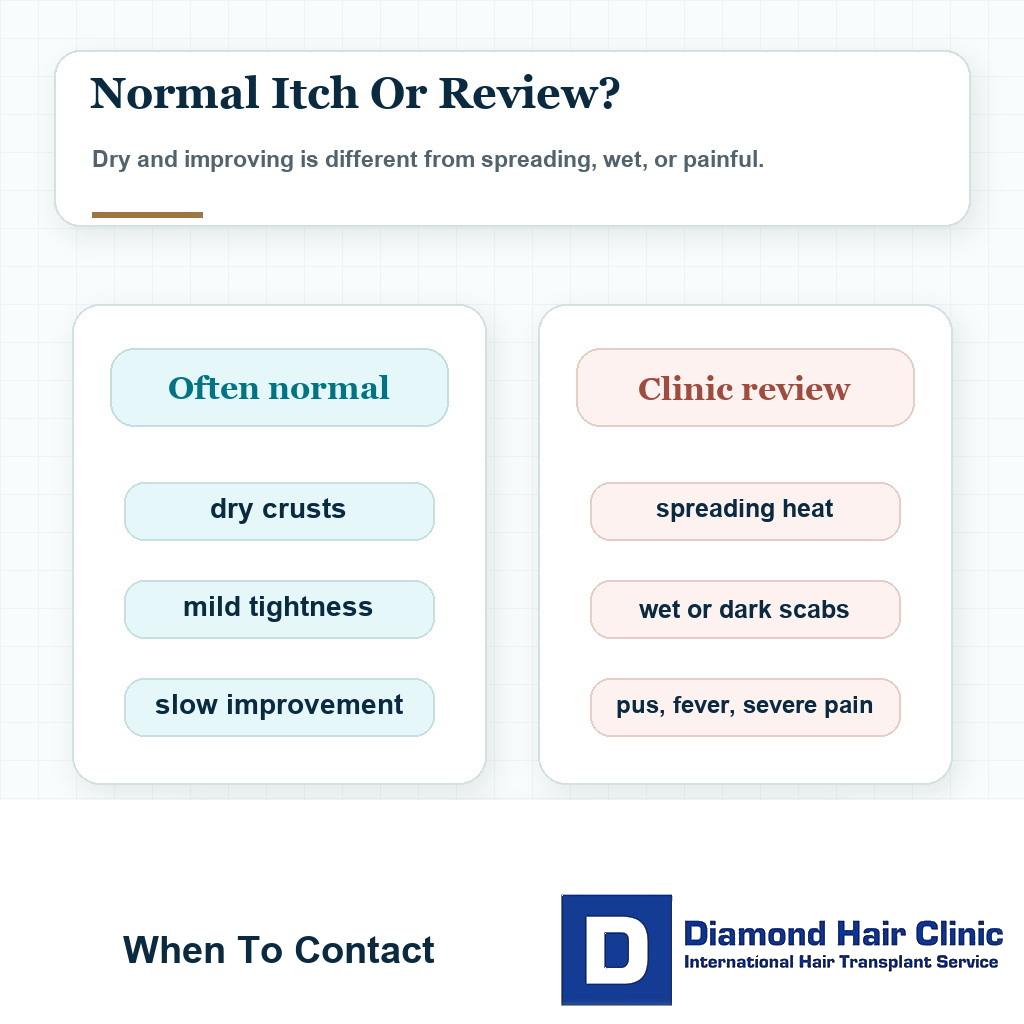
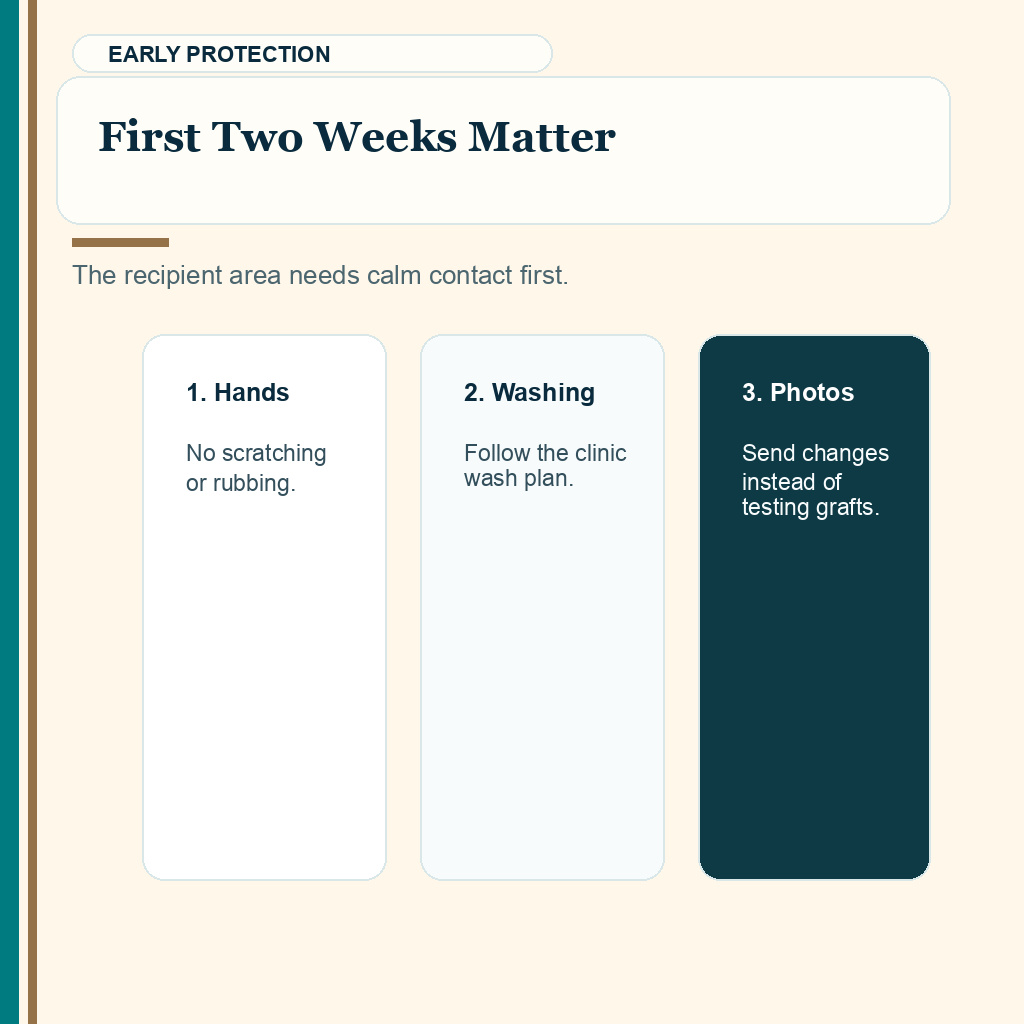
Do not scratch the recipient area while the grafts are still becoming secure. Do not use a comb as a scratching tool, even if you are already wondering when you can comb hair after a hair transplant. Spreading redness, heat, pus, fever, severe pain, thick wet scabs, black tissue, or worsening swelling needs clinic contact the same day, with clear photos when the clinic requests them.
Itching can feel more difficult than it sounds. It is not only a skin sensation. It creates a strong urge to touch the scalp, and that is exactly why it makes patients nervous after surgery. If medicine is being considered, the separate question is whether antihistamines after a hair transplant are appropriate for that patient. I separate normal healing itch from itching before hair transplant surgery, where active skin inflammation may need to be controlled first. If the urge to scratch is strongest at night, sleepless nights after FUE keeps the focus on protected rest instead of panic checking the grafts.
For itching, the distinction is simple. Itching can be normal. Scratching is the part that can create trouble, and timing matters if you are considering aloe vera or moisturizer after a hair transplant. The aim is to settle the scalp without disturbing the grafts, irritating the donor area, or turning a normal healing sign into a real problem.
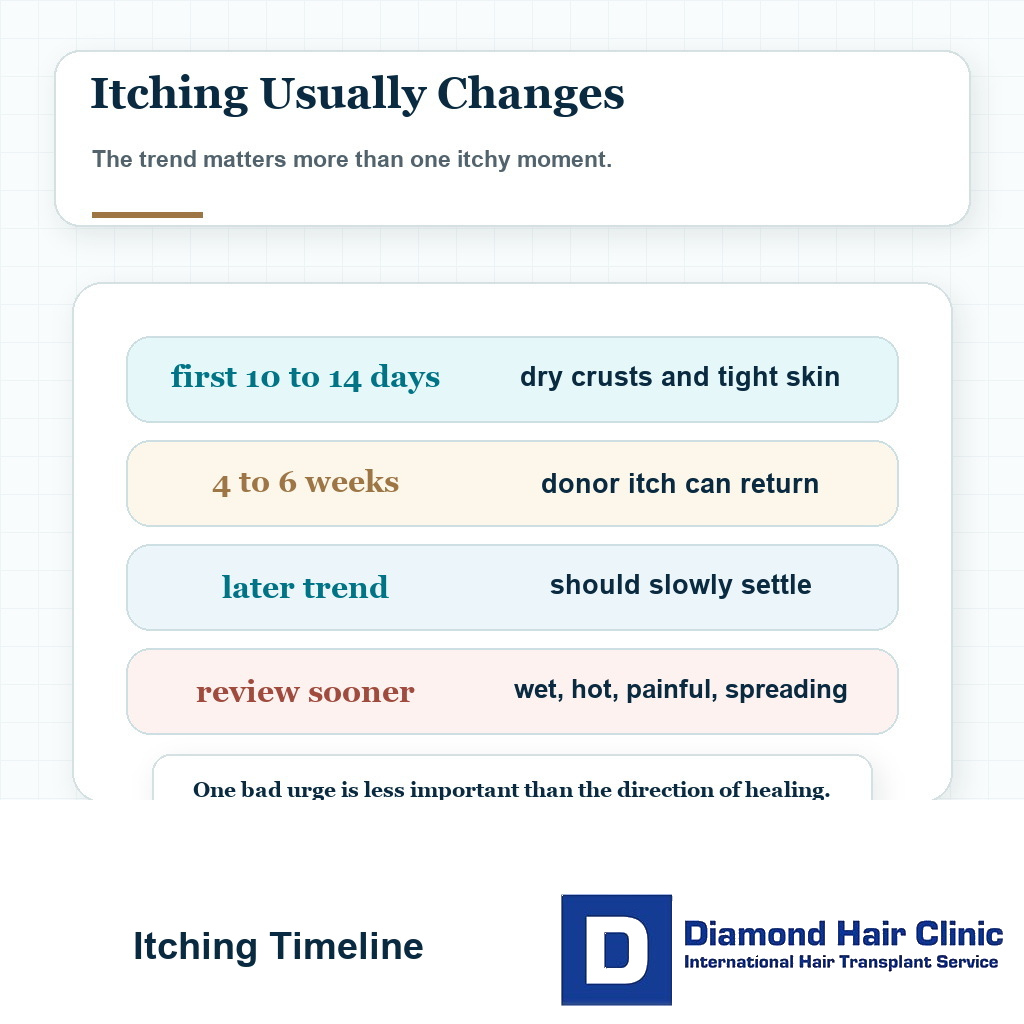
Itching happens during early healing
Itching usually happens because the scalp is healing. After FUE, the recipient area has many tiny openings around the implanted grafts, and the donor area has many small extraction points. These areas dry, tighten, form crusts, and then gradually settle. Dry room air can make that sensation feel sharper, so I explain air conditioning and fan use after FUE as a separate practical recovery issue.
Itching often appears together with tightness, scabbing, mild tenderness, and strange sensitivity. The wider healing process is covered in hair transplant aftercare, because the timing of washing, crust removal, sleeping, and activity all affect how irritated or settled the scalp feels.
The sensation can also come from dryness. A healing scalp can feel dry even when it looks oily in certain areas. The skin barrier is not completely normal yet, and small changes in washing, room temperature, pillow contact, or sweating can make the itching more noticeable. Hot airflow from a hair dryer after a hair transplant can add dryness and make the urge to scratch stronger. Scalp massage after a hair transplant can make itching worse if the patient is already close to scratching. If dryness becomes visible white scale, white flakes after hair transplant are a better comparison point than scratching or guessing.
Another part is nerve sensitivity. Tiny superficial nerves in the scalp are irritated during surgery, especially in the donor area. As the area settles, you may feel itching, tingling, numbness, or small electric sensations. These feelings are usually temporary, but they can be annoying.
Itching can also feel louder when you watch the scalp too closely. Every dry flake, every small red point, and every rough crust becomes a signal in the mind. The more you check, the more aware you become of every sensation. If itching appears together with firm bumps, rows, or a raised surface, raised skin after a hair transplant needs separate review from an ordinary itch.
Itching alone does not mean the transplant is failing. What matters is whether redness is improving or spreading, whether scabs are dry or wet, whether pain is settling or increasing, and whether you feel generally well. The pattern matters more than the itch by itself.
Read itching in context, not in isolation. Timing, appearance, pain level, washing routine, product use, donor area condition, and whether scratching has already happened give a much clearer picture than the symptom alone.
Itching by itself does not tell you whether transplanted hair is growing.
Donor and recipient itching feel different
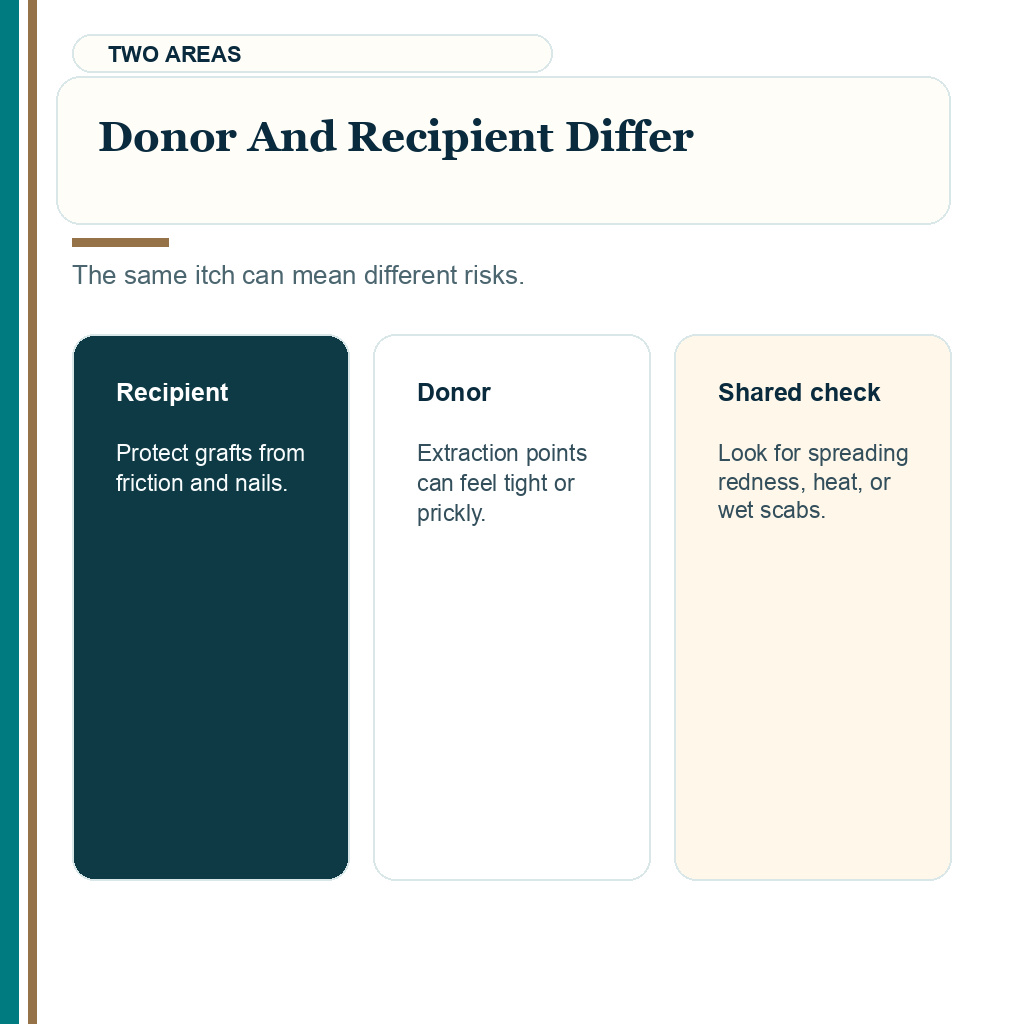
The donor area and recipient area need different handling. The recipient area contains the grafts, so friction, scratching, and picking need extra caution there. The donor area is more about extraction healing, pressure sensitivity, short hair regrowth, and skin irritation. An itch from adhesive marks should be photographed as a contact pattern, especially before scratching or adding product.
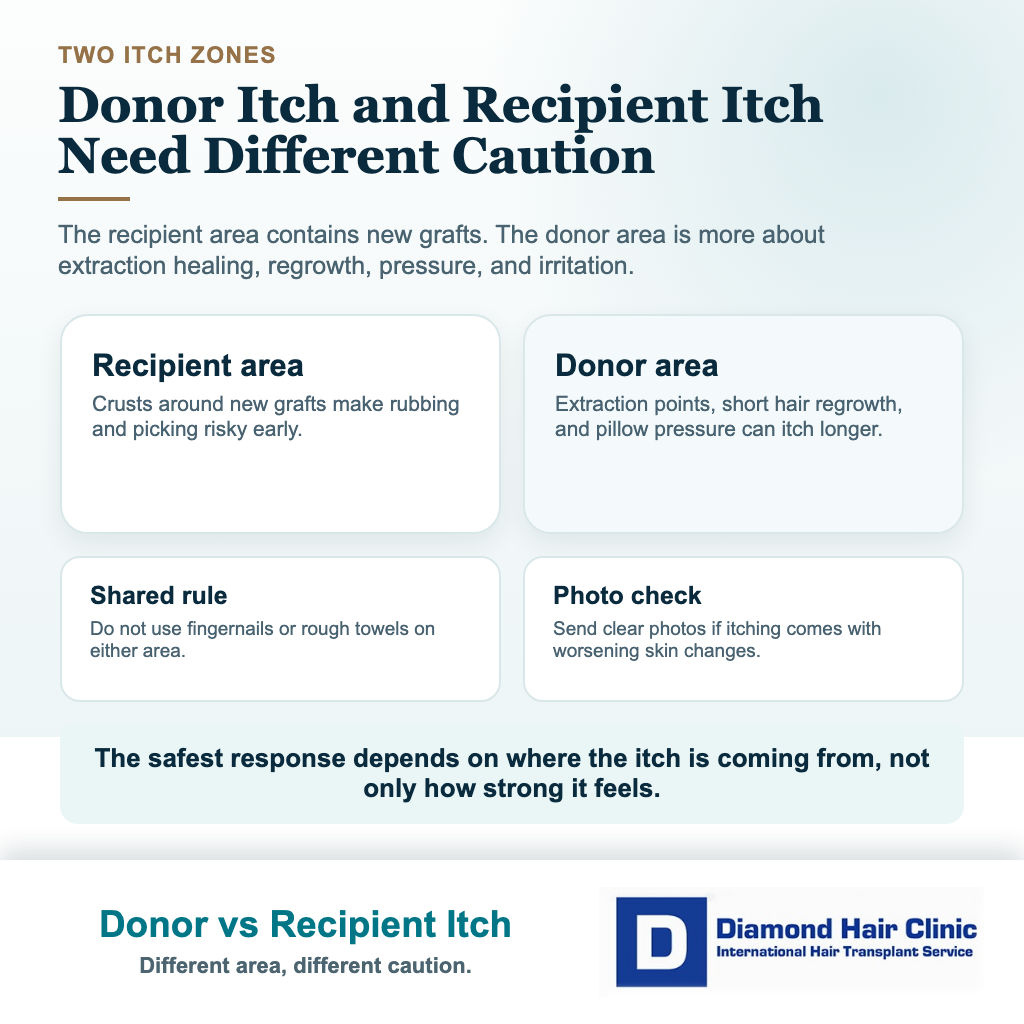
Recipient area itching is often linked with crusts drying around the grafts. Patients feel the roughness, see flakes, and become tempted to remove everything quickly. This is exactly when patience matters.
At Diamond Hair Clinic, the first wash is performed 2 days after surgery, and the 10th wash falls on day 12. Around this time, gentle massage for crust removal may begin when the clinic confirms the scalp is ready. Washing after a hair transplant is controlled handling, not forced crust removal.
The donor area can itch for a different reason. Hair begins to grow through healing skin, the shaved area feels prickly, and sleep pressure can make the back of the scalp more sensitive. Some patients describe this as itching, burning, or a crawling feeling.
The history of the scalp before surgery matters. A person with dandruff, seborrheic tendency, eczema, psoriasis, or strong dryness can feel more itching during recovery. In that case, the transplant may not be the only cause of the sensation.
This can overlap with altered sensation. If the donor area feels numb, tight, or oddly sensitive, numbness after hair transplant may take weeks and sometimes a few months to settle.
The recipient area deserves stricter protection in the first 10 to 14 days because the grafts are still becoming secure. The donor area can usually tolerate gentle handling sooner, but aggressive scratching still creates irritation. Irritated skin heals more slowly than settled skin.
Read this practically. If the donor area itches but looks clean, dry, and gradually better, aftercare adjustments may be enough. If it is painful, hot, swollen, wet, or producing discharge, that is a different situation.
Itching at 4 to 6 weeks can still be normal
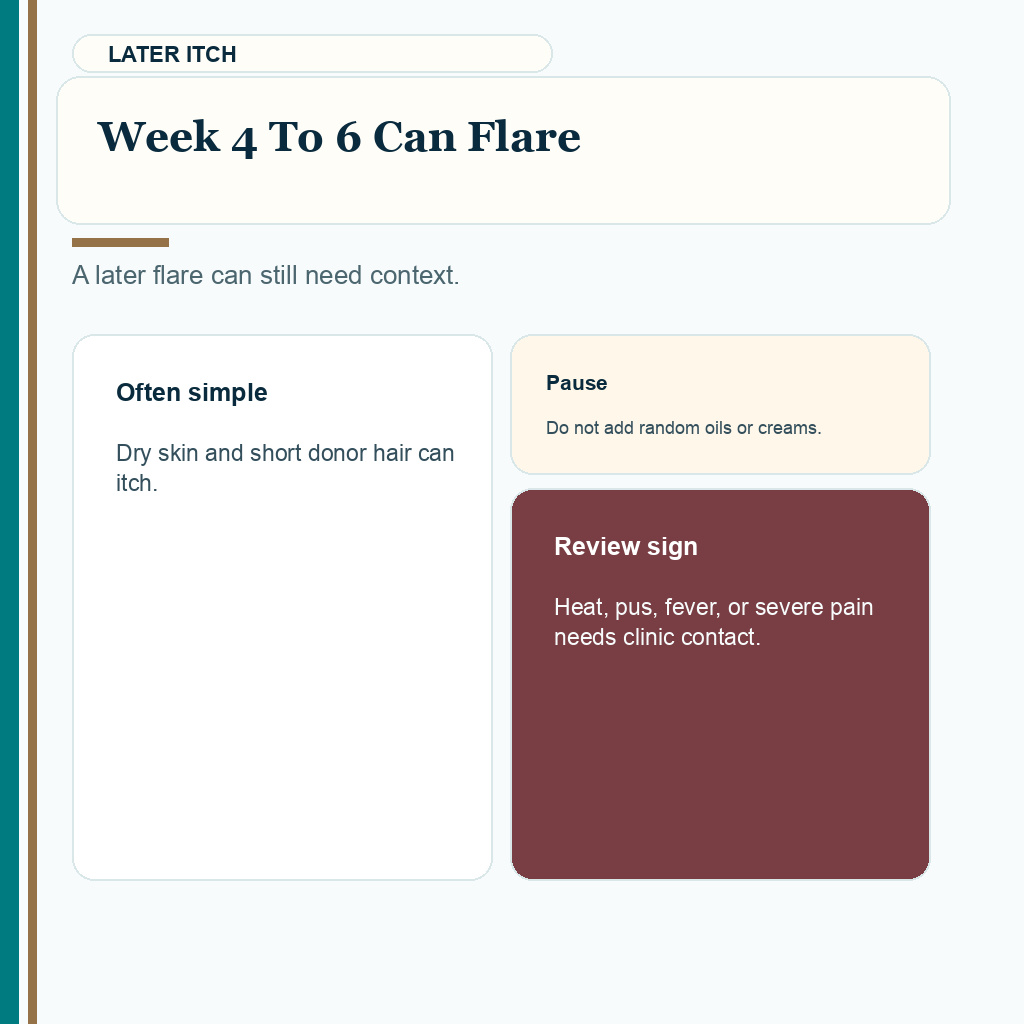
Itching at 4 to 6 weeks can still be normal, especially in the donor area. By that stage, the patient may no longer feel like they are in early recovery, but the skin and superficial nerves can still be settling.
Short hair regrowth, dryness, pillow pressure, and altered sensation can all make the donor area feel itchy after the recipient area already looks more settled. This does not always mean damage or poor growth.
It becomes more concerning when the itch is paired with worsening redness, heat, pus, strong pain, wet crusts, or spreading bumps. Timing matters, but the pattern matters more.
Normal itching and contact signs need separation
Itching is often normal when it appears during the first days and weeks, remains mild to moderate, and comes with dry crusting or healing tightness. It is also reassuring when the scalp looks a little better each day, even if the itching comes and goes.
Itching deserves review when it is part of a worsening pattern. Spreading redness, increasing heat, pus, bad smell, fever, strong swelling, severe pain, or wet dark scabs cannot be ignored. These signs need medical review, not guessing at home.
Small pimples or bumps need context before they are judged as dangerous. Sometimes they are small folliculitis-type bumps or irritation. Sometimes they are related to ingrown hairs, product use, sweating, or poor washing. The correct answer depends on how they look and how they change.
Do not decide that itching must be an allergy just because it feels intense. A true product or medication reaction usually has more than itch alone. Look for a pattern such as rash, swelling, widespread irritation, or a reaction that starts after a specific product or medicine. If you suspect this, the clinic needs to guide you rather than you stopping or adding treatments alone.
If itching comes with redness, crusts, bumps, or fluid, the question is whether the pattern still looks like common healing or whether redness, scabs, and pimples after hair transplant now need closer attention.
The direction of change matters. A scalp that itches less over time is usually reassuring. A scalp that becomes more painful, more swollen, more red, or more wet needs review.
There is another warning sign patients sometimes miss. Trouble stopping yourself from scratching, even lightly, deserves a clinic update with clear photos when they request them. The itch may be manageable, but repeated touching can irritate the recipient area and make healing more confusing.
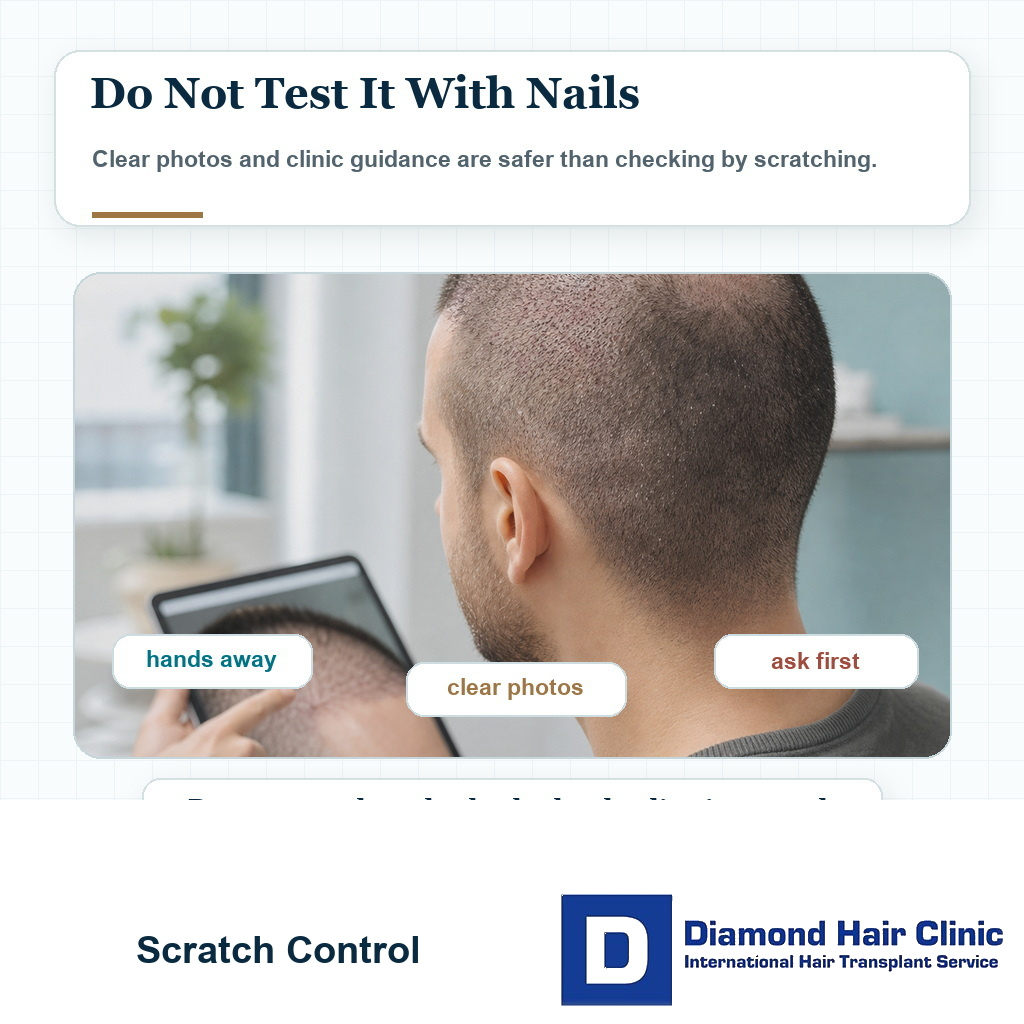
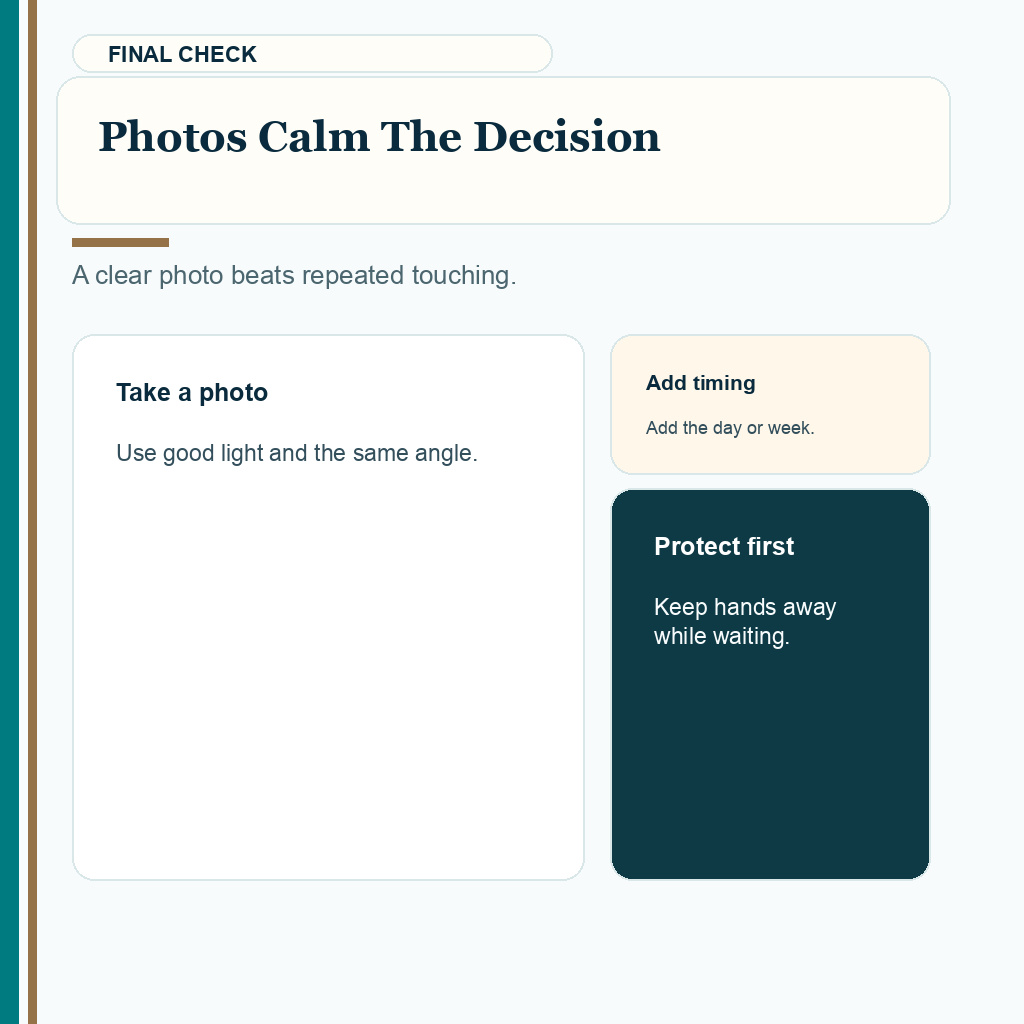
Use good light for the pictures. Include the donor area and recipient area. Do not send only one extreme close photo, because close photos can make normal healing look frightening. A clear distance photo and a close photo together are more useful.
Steps to take instead of scratching
Start with the rule that matters most. Do not use your fingernails on the recipient area. This sounds obvious, but many patients scratch half asleep or while distracted.
Follow the washing instructions given by your clinic. Controlled washing softens crusts, reduces dryness, and helps the scalp settle. Irregular washing can make crusts harder and itching worse. For some patients, saline spray after a hair transplant helps dryness enough to reduce the urge to scratch, but it still has to be used gently.
Keep the scalp environment simple. Avoid overheating, heavy sweating, dust, unapproved sprays, styling products, and rough towels. A clean scalp with less irritation usually itches less than a scalp exposed to unnecessary friction or product residue.
For donor area itching, your clinic can confirm whether a recommended moisturizer, lotion, or saline spray fits your stage of healing. Do not improvise with strong oils, perfumed products, products that contain alcohol, or medicated creams without permission.
Do not restart minoxidil, apply anti itch cream, or add a soothing lotion just because the scalp feels uncomfortable. The question is not whether the product works on normal skin. The question is whether that product is suitable for a healing recipient area at your current stage. Ask first, especially if redness, bumps, burning, or wet crusts are present.
Be careful with anything that creates a cooling or burning sensation. Many patients think this means the product is working. On healing skin, it can simply mean irritation.
If your clinic recommends a product, use the amount and timing they gave you. More is not always better. A thick layer of unapproved cream can trap residue, soften crusts in the wrong way, or make the area feel more uncomfortable.
If itching becomes uncomfortable at night, trim the fingernails and sleep in a position that reduces accidental contact. Sleeping after hair transplant involves head position, pillow choice, and early protection together.
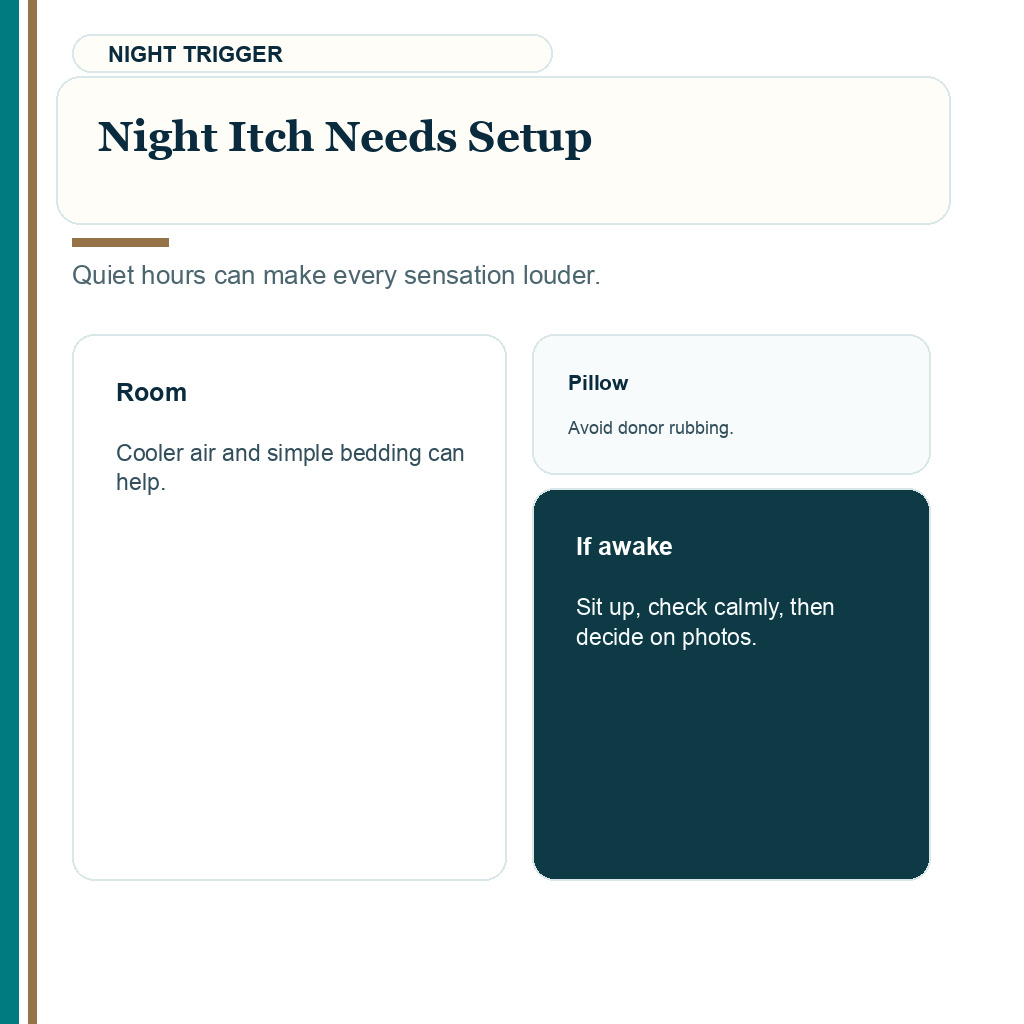
Night itching needs a plan before you are half asleep. Keep nails short, keep the scalp away from pillow friction, and avoid adding oils, alcohol sprays, or strong shampoos just to quiet the sensation.
Some patients try to solve itching by wearing a cap all day. The instinct is understandable, but friction and heat can make the situation worse if the timing is wrong. If you are covering the scalp, read the guidance on wearing a hat after hair transplant so the protection does not become irritation.
Keep the routine simple. Wash as instructed, keep the scalp clean, avoid trauma, sleep carefully, and check with the clinic before adding products. These ordinary aftercare choices do more for healing than clever home remedies.
Scratching can damage grafts early
Scratching can damage grafts if it happens too early or too forcefully, especially in the first 10 to 14 days. It would be wrong to read this as every accidental light touch ruins the transplant. It means repeated rubbing, picking, or nail scratching is not safe behavior around new grafts.
The first few days are the most delicate. By the end of the first week, grafts are usually more stable, but do not read that as the skin is ready for aggressive handling. Healing strength and normal skin strength are not the same thing.
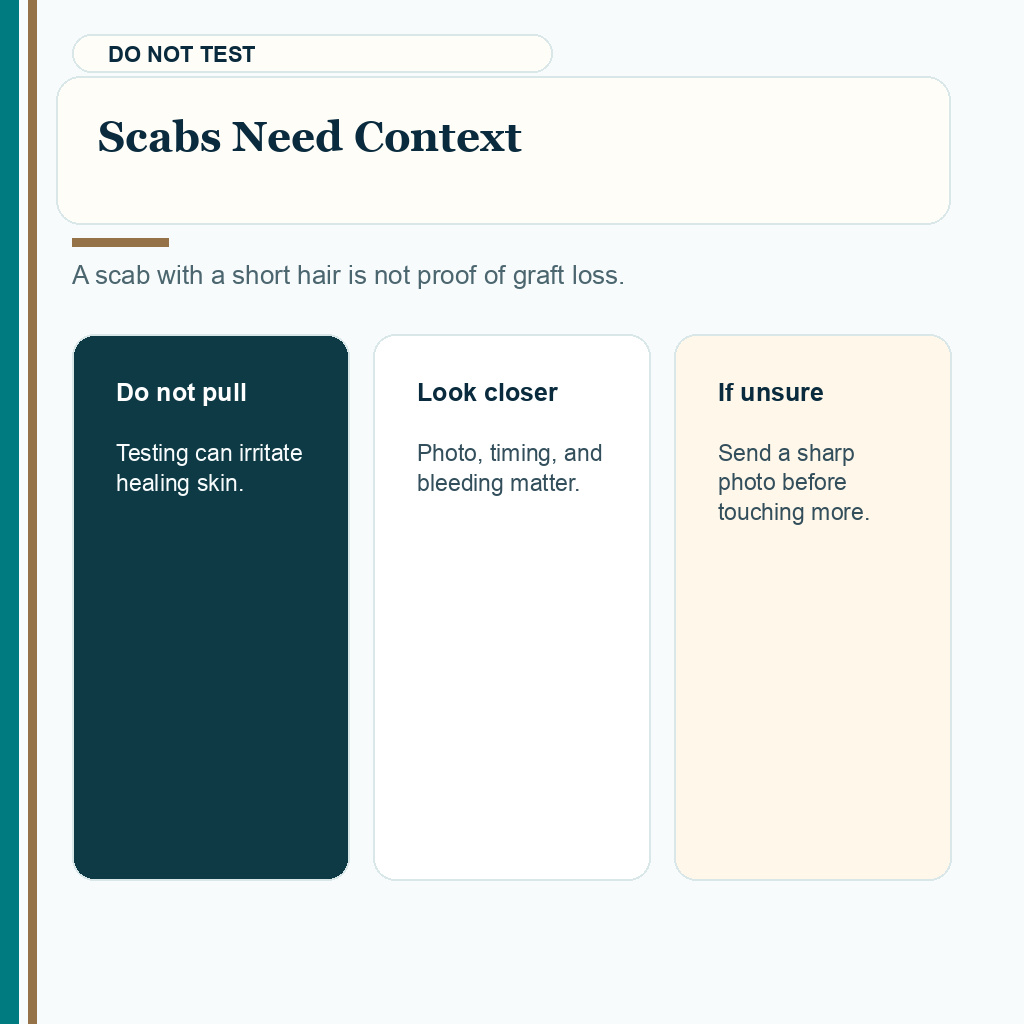
Patients often panic when they see small scabs with short hairs inside. Often, that is shedding of the hair shaft and crust material, not loss of the follicle. Small scabs can look like lost grafts with scabs, but the concern is different when a piece of tissue comes out with fresh bleeding from the exact spot.
A true dislodged graft usually looks more substantial than a dry flake. It may be associated with bleeding from the spot where it came out. Even then, one isolated event is not the same as ruining the whole result.
The bigger risk is behavior. Repeated scratching because the itch feels unbearable can create irritation, bleeding, delayed crust release, or unnecessary anxiety. If the scalp itches so much that you cannot control your hands, share that with the clinic.
Do not test whether the grafts are secure. There is no reliable reason to rub the area just to see what happens. A hair transplant result is protected by good judgment in the first days, not by experiments.
After crusts are ready to come away, removal needs to be gentle and guided. The aim is not to keep crusts forever, but the answer is not to remove them by force either. Timing and technique matter.
There is another difference between touching near the transplanted area and disturbing the grafts themselves. You may accidentally brush the forehead, adjust a pillow, or feel the edge of the scalp and then panic. Panic is understandable, but casual behavior should not be repeated many times.
Bleeding after scratching changes the priority. Take a clear photo for clinic review, then stop checking the same spot with your fingers. The next good decision is to stop the trauma and clean only as instructed.
The 10 itch protection slides below separate normal healing itch from warning signs and safe next steps. Swipe sideways, use the arrows one slide at a time, or choose a number below the image.



Night itching can feel stronger
Itching often feels worse at night because there are fewer distractions. During the day, patients walk, talk, check messages, and think about other things. At night, every scalp sensation becomes louder.
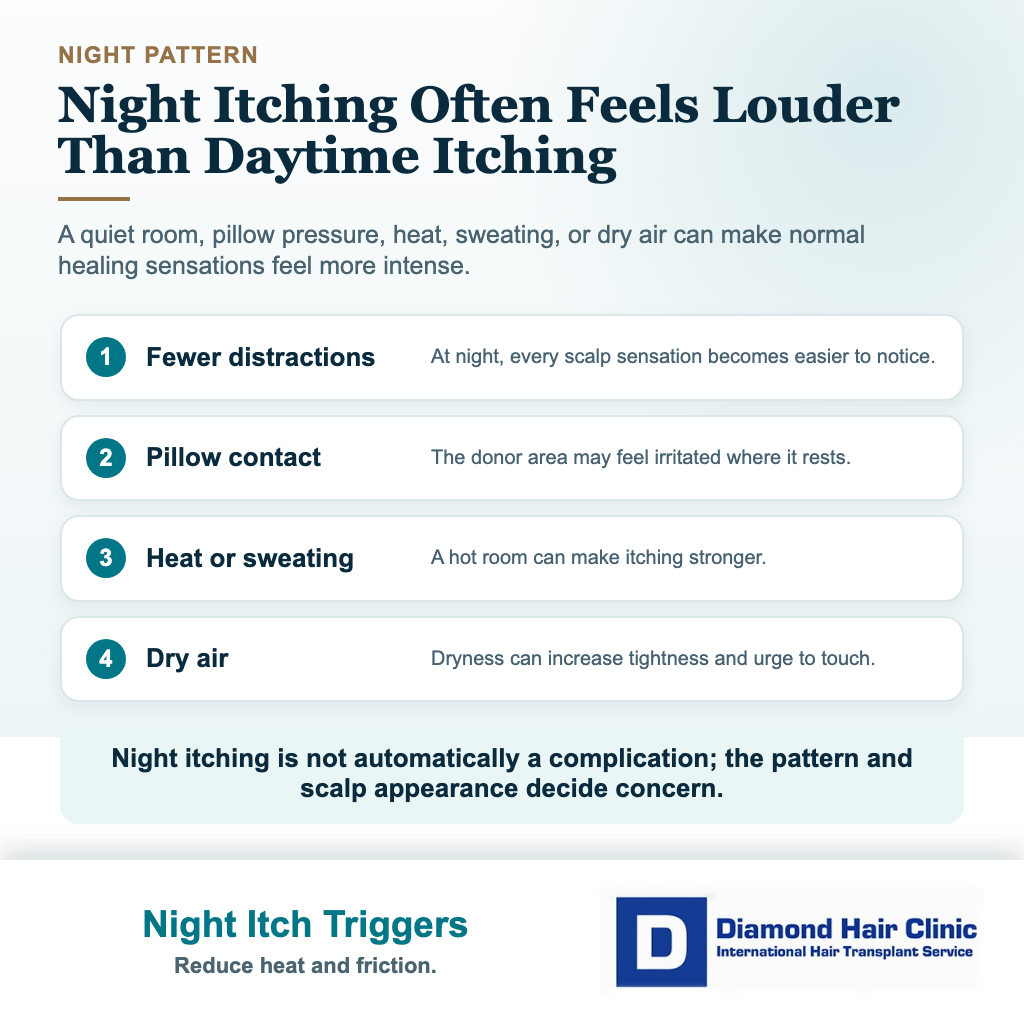
Sleep position can also increase awareness of the donor area. The back of the scalp may touch the pillow, and even gentle contact can feel irritating when extraction points are healing. This does not always mean there is a complication.
Room temperature matters. Heat and sweating can make itching stronger. A very dry room can also make the scalp feel tight. A cool, simple sleeping environment is better than heavy blankets, hot rooms, or restless movement.
Waking from itching is a cue to pause before touching the scalp. Sit up for a moment if needed, then check whether the pillow or hat is irritating the area. A strong urge needs clinic guidance on safe options instead of whatever product is nearby.
Alcohol can also make night scratching more likely because judgment becomes weaker. I advise caution with alcohol during early recovery. When the scalp is healing, good decisions matter even more than usual.
Night itching is usually more about sensitivity and awareness than danger. But if night symptoms include severe donor pain, worsening pressure, or strong burning, compare the situation with severe donor area pain after hair transplant and update your clinic.
Dryness, shampoo, and products can make itching worse
Dryness, shampoo, and products can make itching worse. Aftercare needs to be specific. A product that feels harmless on normal skin may irritate a healing recipient area.
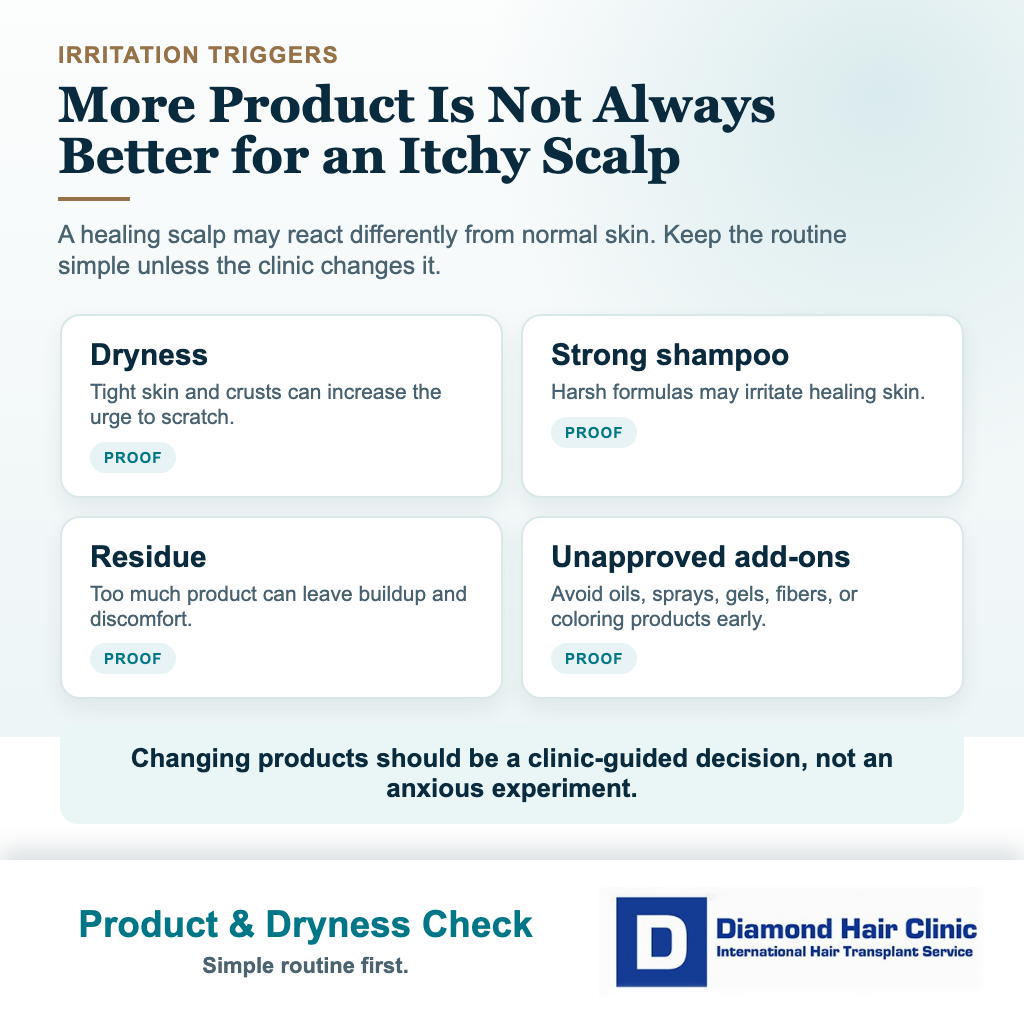
In the early period, do not experiment. Avoid perfumes, strong oils, styling gels, hair sprays, hair fibers, coloring products, and aggressive shampoos for dandruff unless your clinic has approved them for your stage of healing.
The scalp may feel dirty or uncomfortable, but more product is not always better. Too much product can leave residue. Too much washing force can irritate. Too little washing can allow crusts and oil to build up. Sharp stinging after a home spray or oil is a reason to stop that experiment, not a sign that the scalp needs a stronger product.
Generic product advice is not enough. One patient may need more careful washing because crusts are too dry. Another may need to reduce irritation because the washing is too aggressive. The correct guidance depends on the scalp itself.
If you are thinking about cosmetic coverage because itching and redness make the scalp socially difficult, be careful with timing. Hair fibers after hair transplant cannot be rushed onto healing skin.
Haircuts and clippers need a timing check. Short hair can make donor itching feel more obvious, but cutting too early or using clippers too aggressively can irritate healing skin. For haircut after hair transplant, the safer timing depends on how the donor and recipient areas look, not only the calendar.
Dry scalp needs a timing check before any product. A safe product at the correct time can help. The wrong product at the wrong time can make itching, redness, and bumps worse.
For the patient, the issue is not only comfort. Irritation can make you touch the scalp more, sleep worse, and worry more. Good aftercare reduces that chain reaction.
Protecting healing while returning to normal life
Return to normal life should be gradual. Many patients feel well before the scalp is ready for normal behavior. This is when mistakes happen.
Work can create itching triggers. Dust, stress, sweating, long commutes, hats, direct sun, and frequent mirror checking can all make you more aware of the scalp. Returning to work after hair transplant depends on the job environment as much as the number of days.
Exercise after a hair transplant can also worsen itching if it creates heat and sweat too early. Swimming, saunas, steam rooms, hot tubs, and similar environments must not be treated casually. Healing skin needs protection from irritation and contamination.
If your scalp itches during outdoor activity, do not assume the solution is simply to cover it tightly. Pressure, heat, and friction can all make itching worse. Protection has to be comfortable and appropriate for your stage of recovery.
Aftercare does not mean hiding at home forever. It means respecting the period when the scalp is still vulnerable. The first 10 to 14 days are the main graft protection phase, and the first few weeks are still a controlled healing period.
Beach, pool, and holiday activity need a stricter healing check because water, sun, sweating, and rubbing often arrive together. The scalp should be clean, settled, and ready for normal contact before those plans resume.
Return to life steadily, not fearfully. But the pace needs to come from healing, not impatience. When the scalp is clean, settled, and improving, daily routines can gradually become more normal.
Anxiety can make itching feel more alarming
Remember that itching after a hair transplant is common, especially in the first 10 to 14 days. Donor area itching may last longer, often several weeks, because extraction points, short hair regrowth, and nerve sensitivity can all contribute.
Do not look only at whether the scalp itches. Look at whether the scalp is healing in the right direction. Less redness, drier crusts, less swelling, and improving comfort are usually reassuring signs.
The itch itself is not always the main concern. Scratching, picking, experimenting, or ignoring warning signs is what can create trouble. Those behaviors can turn a manageable recovery into a stressful one.
Unclear itching patterns deserve a clinic review. A quick check is better than a week of worry. Early review is safer than repeated scratching while you try to solve the problem alone.
I also remind you that recovery symptoms do not all disappear on the same day. Scabs may settle first, redness may take longer, donor sensitivity may come and go, and itching may move from one area to another. That changing pattern can still be normal when the overall direction is improvement.
Itching is one of those recovery symptoms that tests patience. It is uncomfortable, but it usually passes. Protect the grafts, respect the donor area, follow the washing routine, and let the scalp heal without unnecessary interference.
A strong hair transplant result is not only created in the operating room. It is also protected in the ordinary moments afterward, especially when the scalp itches and your hand wants to reach for it.
Itching around the eyes and nose can also matter because the hand may cross the new hairline. The eye and nose itching during pollen season guide gives a practical way to control that risk without rubbing the grafts.
Read this review excerpt
First wash completed and visual instructions given to my daughter.