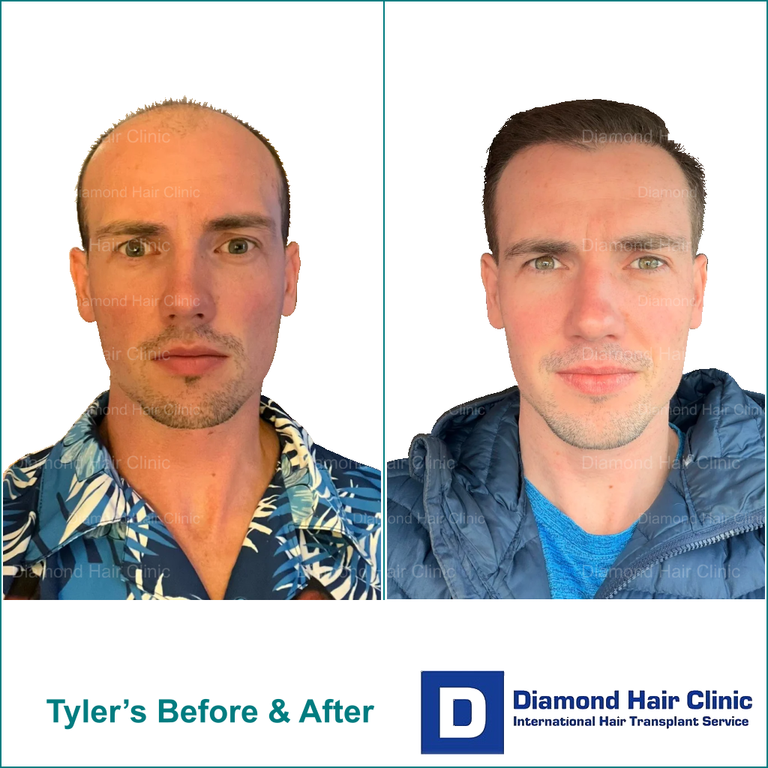
Hair Transplant Clinic Choice in Turkey Needs Medical Review
Choose a hair transplant clinic in Turkey by looking first at medical responsibility, not travel convenience. The stronger clinic choice is usually the clinic that can clearly explain who will examine you, who designs the hairline, who creates the recipient area incisions, how donor reserve is protected, how the graft number is chosen, and what follow-up exists after you return home.
I use the same order when I look at a Turkey offer without the sales lens. First I test the surgeon’s role, donor reserve, and follow-up. Only after that do I look at hotel, transfer, package, or travel details.
Turkey has excellent hair transplant surgeons and also many high-volume clinics that sell surgery like a package holiday. The country name alone should never reassure you. A low price, hotel transfer, attractive website, or impressive before and after photo can be part of the decision, but none of those things proves that the surgery itself is being planned well.
Country reputation is a weak safety filter on its own. Whether the clinic is in Turkey, India, or another market, the real test is who examines the donor, who designs the hairline, who controls extraction, how many patients are booked, and how the surgical design changes if the safe graft range is lower than expected.
The practical test is who makes the medical decision if surgery becomes difficult. If something becomes difficult during surgery, who is responsible for the medical decision? The clinic should be able to explain the medical reasoning before reviews, price, or travel details push you to commit.
Medical responsibility before price or travel
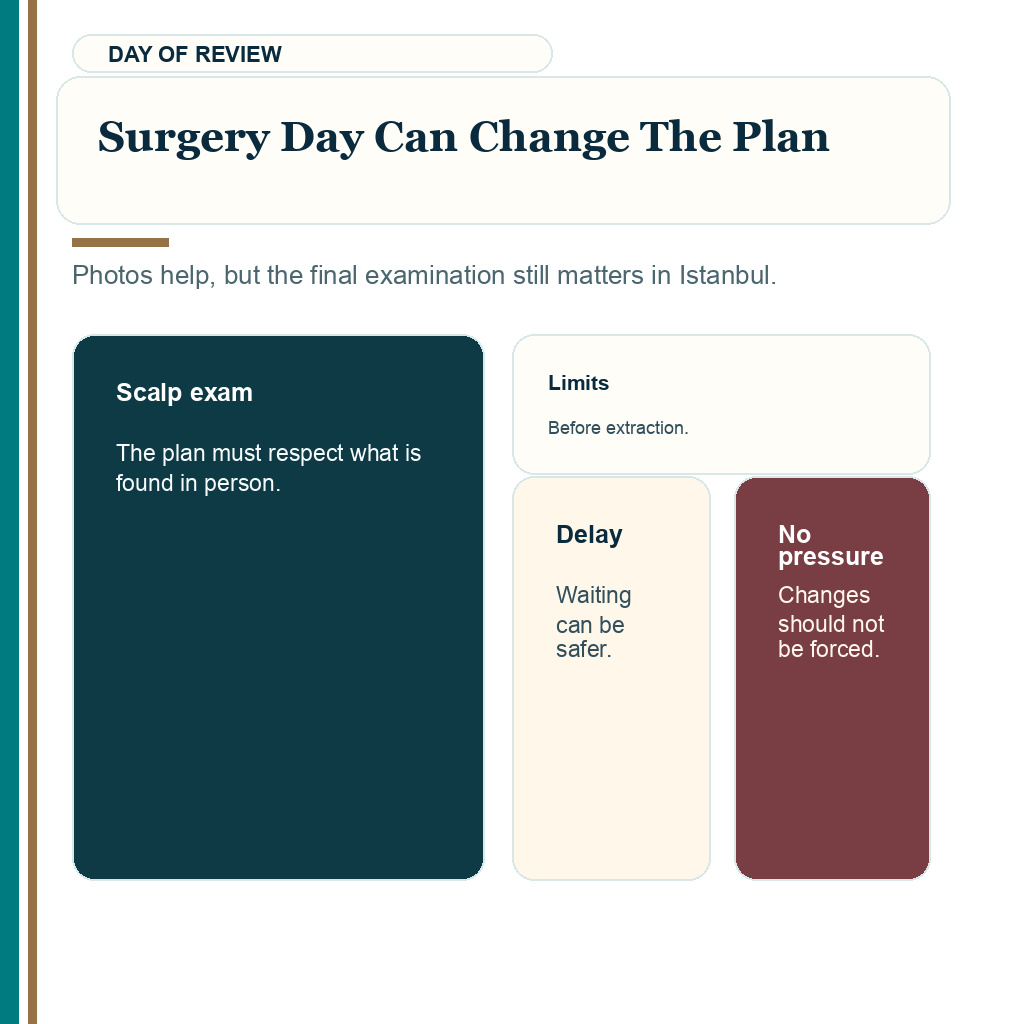
I compare the clinic model before hotels, airport transfers, and package details. The clinic should be able to explain the medical plan before asking you to commit. That includes donor assessment, recipient area planning, hairline design, graft distribution, density expectations, medication discussion when relevant, and aftercare. For international patients, the same plan should separate what can be judged from photos before travel from what must still be checked in Istanbul.
Offering several cosmetic procedures is a reason to look closer, but the menu alone does not make the clinic unsafe. A practice focused only on hair restoration still has to prove its quality. The useful details are how often the named surgeon performs hair restoration, whether the same trained team works together regularly, and who owns the donor and hairline decisions on your booked day. I would judge the clinic’s real focus through repeated case records, team continuity, and named medical responsibility, not through the word specialist alone.
If only a few complete cases are publicly available in a language you can assess, do not turn one strong result into certainty. A sound comparison needs more mature examples matched to your pattern of hair loss, donor quality, hair type, and planned technique, with each surgical role clearly named. A small evidence set leaves more uncertainty. It should lower your confidence in the comparison and place more weight on the direct consultation, even when the surgeon remains on your shortlist.
The medical standard behind that kind of review is explained in my process for case review before travel. A patient who feels rushed can also use hair transplant booking pressure before paying a deposit.
A hair transplant in Turkey can be a good decision when the clinic is surgeon-led and the plan is realistic. It becomes risky when the patient is guided mainly by sales pressure, low price, and promises of a large graft number.
Travel convenience is not a problem by itself. Many international patients choose Turkey because the logistics are easier and the cost can be more reasonable. The weak decision is treating logistics as proof of surgical quality. Airport pickup can feel reassuring, but it does not show whether the donor area, graft handling, or hairline design will be respected.
Research clinics without letting marketing lead
Start by making your own comparison, not by trusting ranking lists that describe every clinic as the best. If the phrase best hair transplant clinic in Turkey is part of your search, test it as a clinical claim, not a ranking label. A useful comparison should record the named surgeon, consultation quality, who performs each surgical step, patient volume per day, donor planning, hairline design approach, aftercare, price transparency, and how clearly the clinic answers difficult questions. Checking how many patients a clinic treats per day belongs in the comparison, not as an afterthought.
A comparison site or booking platform may organize options, but its business model matters. Paid referrals and ranking rules cannot answer surgical responsibility unless the clinic itself gives the named doctor’s plan.
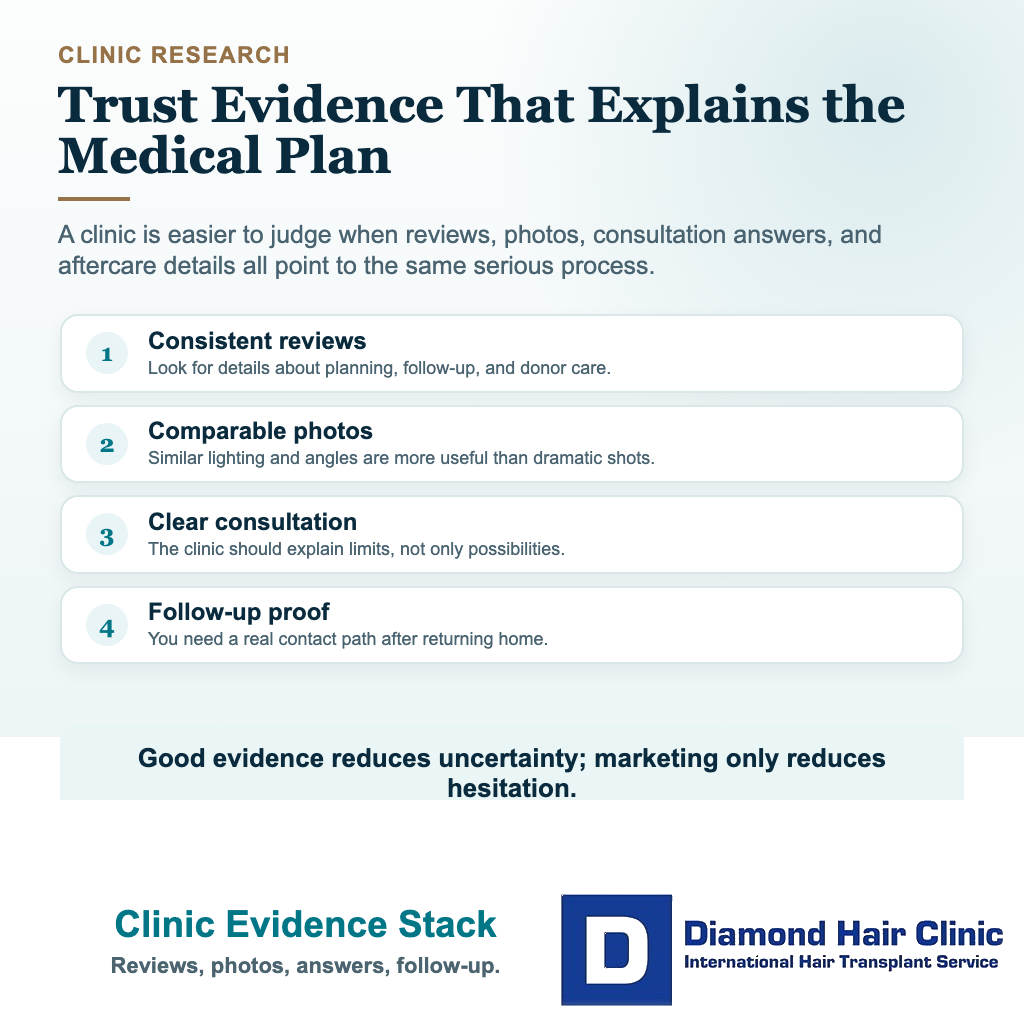
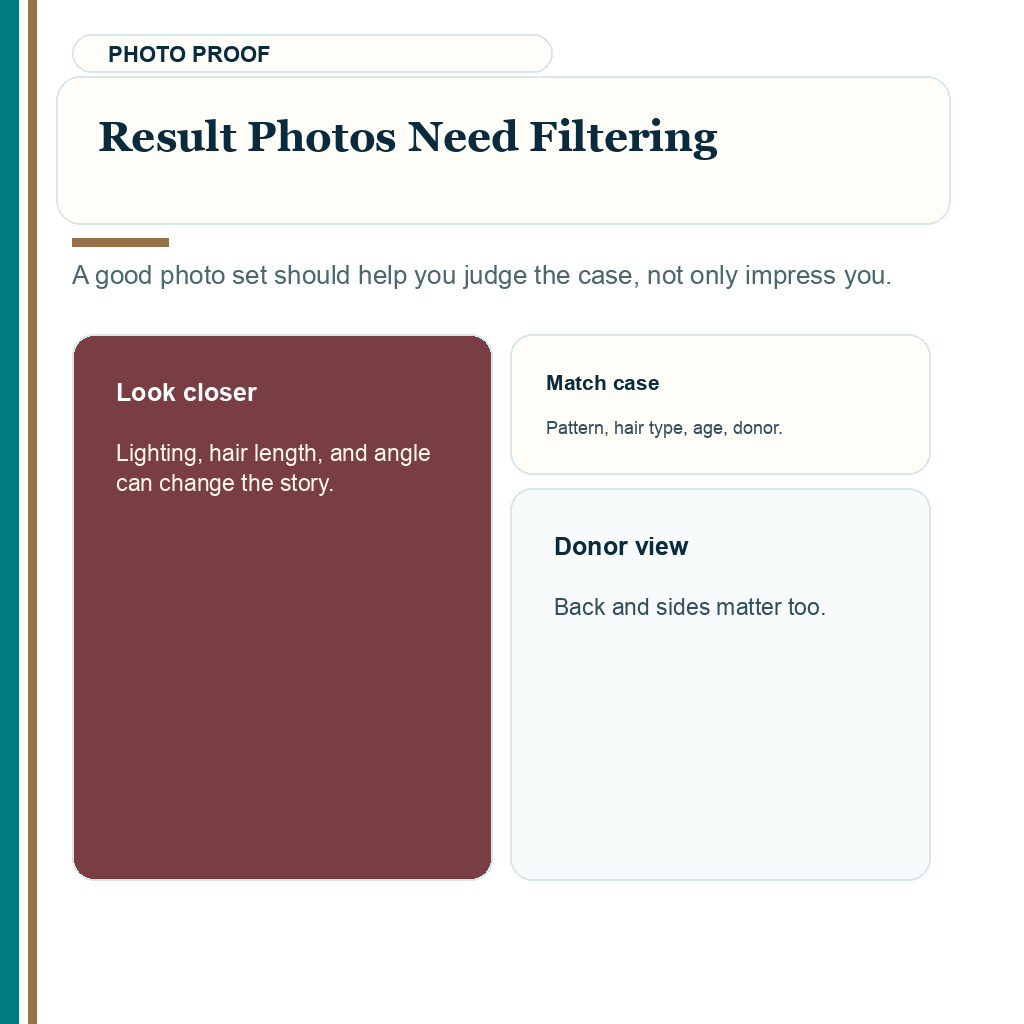
Be careful with polished marketing. A clinic can show a beautiful result and still be weak for your case. Photos need judgment for lighting, angle, hair length, wet versus dry hair, donor area appearance, and whether the same patient is shown clearly before and after. Before you trust hair transplant before and after photos, remember that photos can educate patients, but they can also hide weak density or donor damage if shown selectively.
Older clinic reviews need a date and a name beside them. A clinic team can change, so a strong result from several years ago may not describe the surgeon and team named in your booking today. Check when the case was performed, who planned it, and who carried out each surgical step. If the clinic cannot connect that evidence to its current operating team, treat the old review as background rather than proof for your operation. If the surgeon has moved clinics, search the previous clinic’s name for mature examples too, and confirm which parts of those operations the surgeon performed.
A detailed case with no clinic or surgeon name has another limit. It may show what one person experienced, but you cannot connect it to a provider, check who performed the operation, or compare it with other work by the same team. Let it shape your questions without letting it raise or lower a clinic on your shortlist.
Public feedback can help you notice patterns, but it should not become your only evidence. One angry comment does not prove a clinic is unsafe. One perfect comment does not prove it is excellent. Repeated patterns matter more, especially around surgeon involvement, communication after surgery, donor area appearance, naturalness, and whether the clinic takes responsibility when a concern appears. Promotional praise, repeated talking points, or vague replies that never explain surgical roles should become verification work, not proof for or against the clinic. A harsh story about a poor result should move the checklist forward, not replace it. The useful response is to verify the clinic model before surgery, rather than blame the patient after harm is done.
A city recommendation or clinic list can be a starting point, but it is not medical clearance. The stronger question is whether the clinic can explain your donor limits, medication assumptions, graft range, and refusal point before it asks you to protect a date.
A trusted friend can describe their own surgery and recovery. Their experience does not establish whether the same plan suits your donor hair, area of loss, or expectations.
Recommendation lists change, so check the current version close to booking and note when you checked it. A listed name is not permanent approval, while a missing name does not tell you why the status changed. Use the list as a dated lead, then confirm the current surgeon, team, relevant results, and case plan directly.
Do not let a large review count hide a vague surgical answer. When I read hair transplant reviews in Turkey, I compare the pattern with medical proof. I want to know who examined the donor area, who designed the hairline, whether the graft number fits the case, whether before and after photos are comparable, and how the clinic answers concerns after surgery. Official verification matters when a profile, phone number, payment request, or clinic identity feels unclear.
Questions to settle before payment
When I help a patient judge a clinic, I want the first questions to stay practical. Who evaluated the hair loss? Who accepted the treatment plan? Who will be medically involved if the plan changes? A clinic can look organised online while the real surgical responsibility remains unclear.
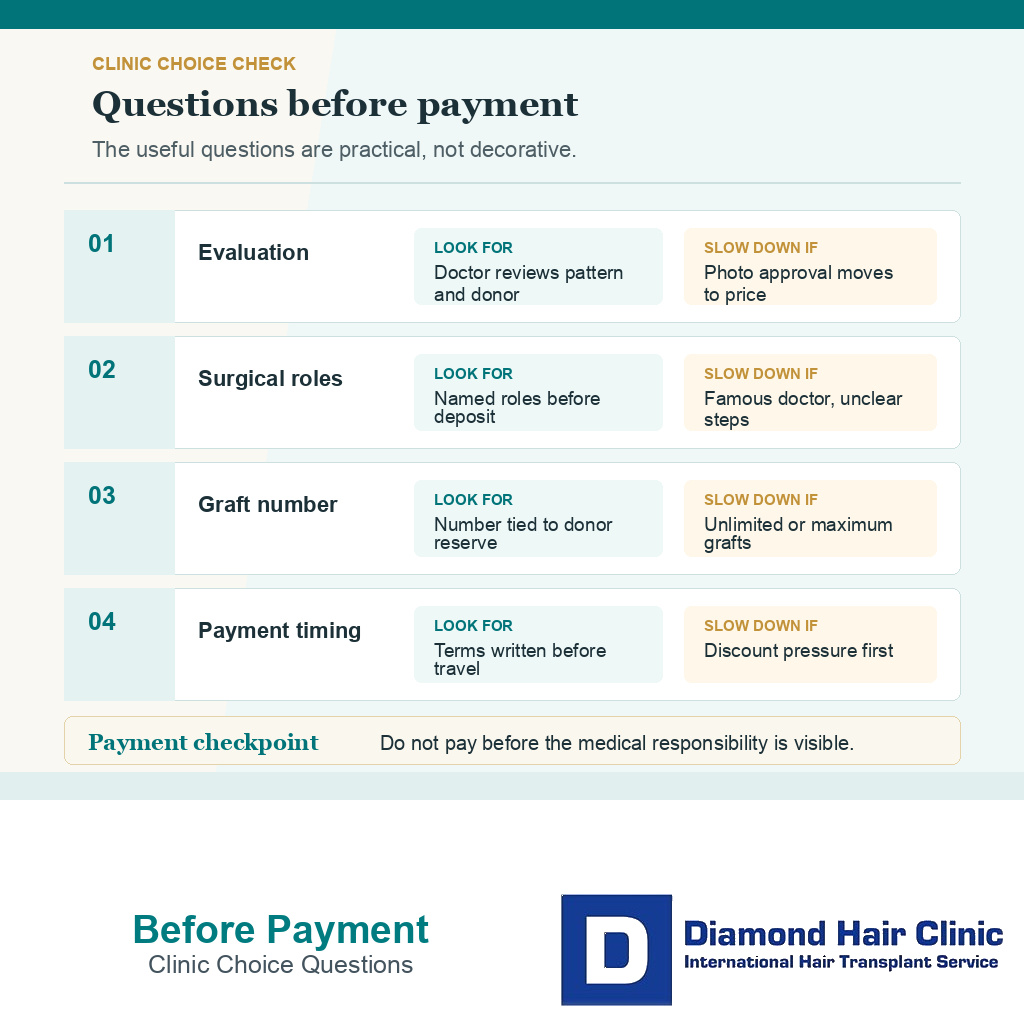
I trust the answer more when it survives these questions without pressure, slogans, or a bigger graft number being used as proof.
Difficult medical questions should be welcome before payment
The clinic should be ready for uncomfortable medical questions before it takes a deposit. You should be able to ask about donor safety, hairline design, graft range, anesthesia, surgeon involvement, and follow-up without the conversation turning into pressure.
Careful questions protect the surgical plan. If the clinic becomes vague, changes the answer, or treats normal medical questions as a problem, the plan is not ready for payment yet.
Read every consent form before the operation day, including any clause that limits public criticism. The clinic should explain how the wording affects truthful feedback, complaints, and your ability to seek advice. If the clause feels broader than ordinary medical privacy, pause before signing or paying more and obtain independent legal advice.
Proof to ask for before booking
Before you pay a deposit, ask the clinic to put the role answer in writing in the same channel where it sends the booking request. The answer should name the responsible doctor, where the surgery takes place, who examines the donor area, who designs the hairline, who creates recipient sites, who controls extraction, and who decides whether the graft number should change after the doctor examines you in the clinic. If the reply stays vague, the booking is not ready.
The role answer also needs a backup scenario. If the donor looks weaker in person or the hairline has to be raised, the clinic should say who has authority to change the plan before surgery starts.
Official health tourism authorization is only one first filter. It can help confirm that the provider is listed for international patients, but it cannot show whether the surgeon personally reviews your donor area, limits the graft number, designs the hairline, or manages complications after you fly home. Treat official status as the beginning of clinic research, not the end of it.
Real consultation requirements
A proper consultation should not begin with a fixed graft number. It should begin with diagnosis. The surgeon or medically responsible doctor should understand your age, hair loss pattern, family history, donor strength, crown involvement, medication situation, previous surgery, scalp condition, and expectations.
The clinic should then explain what can be treated safely and what should be left alone. A patient with a strong donor area and limited frontal recession is not the same as a young patient with aggressive diffuse thinning and crown loss. The same package cannot be responsible for both.
A useful consultation in Turkey should turn photos, donor limits, hairline goals, and medical history into a written plan. If it only confirms a date and a graft number, the most important surgical decisions are still unfinished.
Surgical responsibility and important steps
Do not assume that a doctor’s name on the website means that doctor owns the critical decisions. I want to see which decisions the doctor personally handles and which steps are carried out by the team under medical control.
Before choosing a clinic, surgical responsibility should be named for hairline design, graft extraction, recipient area incisions, implantation supervision, and medical decisions during the operation. Knowing who performs your hair transplant tells you who carries responsibility if the plan changes.
Clinic coordinators can help with communication, travel, and documents. That is different from diagnosis, hairline design, donor planning, recipient area incisions, and decisions made if the plan changes. If the plan is mostly created by sales staff, or if the named surgeon appears only briefly, it is time to slow down.

Read this review excerpt
The first and final part of the procedure was a collaborative effort between the Dr and his two technicians.
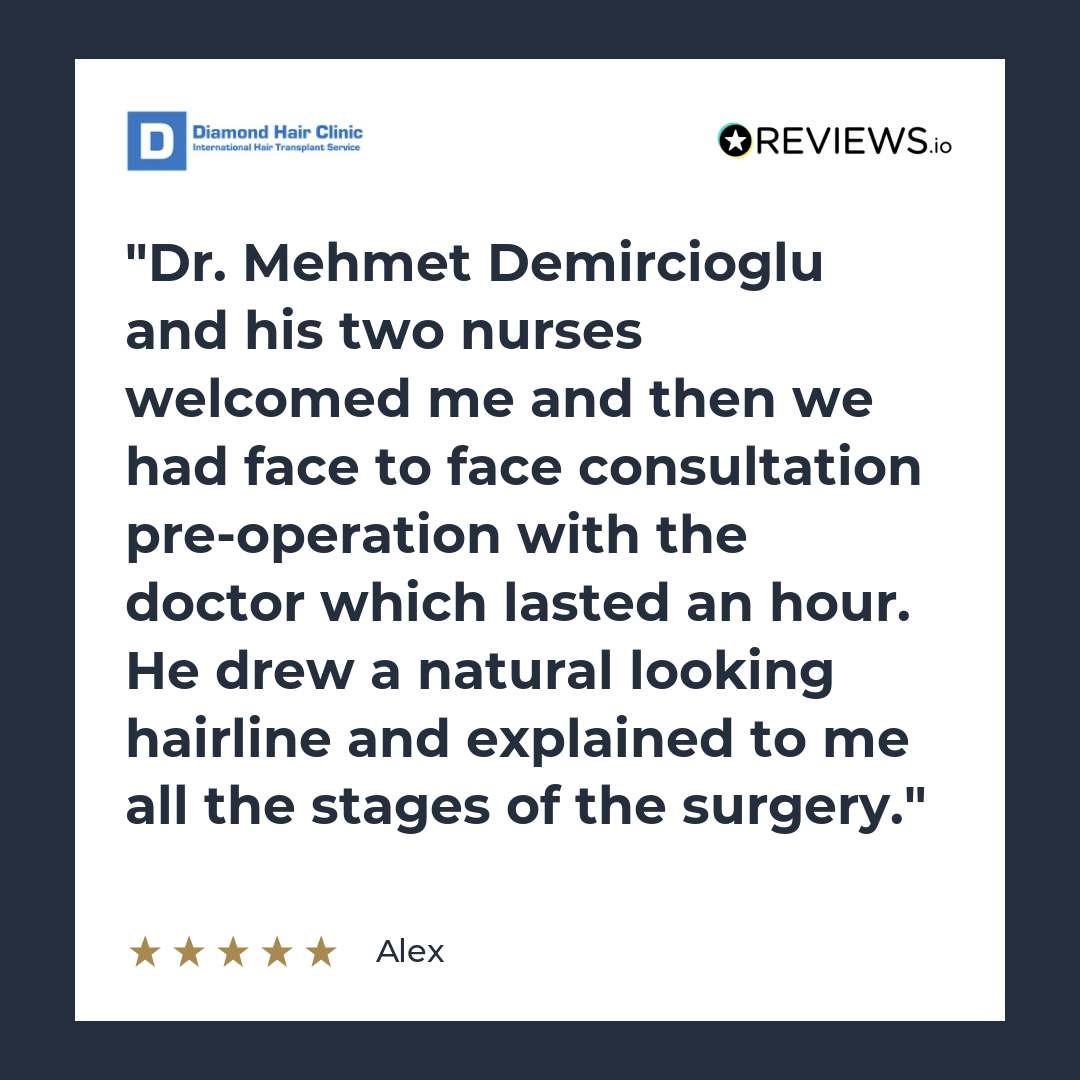
Read this review excerpt
Dr. Mehmet Demircioglu and his two nurses welcomed me and then we had face to face consultation pre-operation with the doctor which lasted an hour. He drew a natural looking hairline and explained to me all the stages of the surgery.
Graft, density, and donor planning
Donor reserve is a limited lifetime resource. A clinic that promises the highest number of grafts without explaining donor safety is not protecting the patient. Too many grafts from the wrong area can create visible thinning, patchiness, and a repair problem that may be difficult or impossible to fully correct.
For that reason, donor area overharvesting belongs in the clinic choice discussion before surgery, not after a bad result. You need to know whether the clinic is planning only the first result or thinking about future hair loss as well.
Graft number and density should be explained together. The clinic should be able to show why a certain number is appropriate for the size of the recipient area, the patient’s hair caliber, the donor capacity, and the visual priority of the case. How I calculate the graft number starts from the design, not from a sales target.
Judging hairline design before surgery
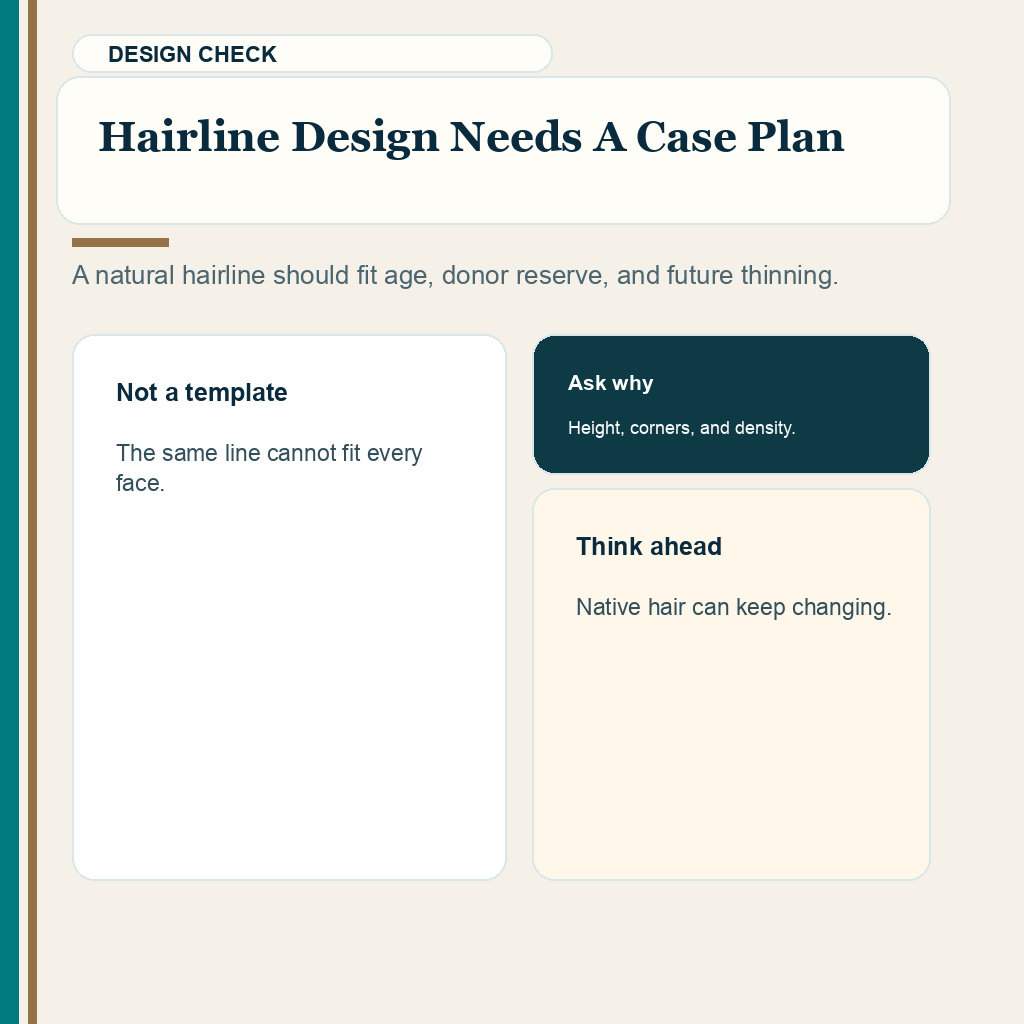
The hairline is not only a line on the forehead. It changes the face. A natural hairline has to fit the patient’s age, facial proportions, donor capacity, native hair direction, and future hair loss risk.
Be careful with clinics that draw the hairline quickly or make it very low because the patient asks for it. A low hairline may look exciting in a mirror before surgery, but it can consume too many grafts and age poorly if hair loss continues behind it.
The clinic should explain natural hairline design in practical terms. Which grafts will be used at the front? How will the transition behind the hairline be softened? How will the angles be controlled? What will happen if the patient loses more hair later?
When is the clinic plan not ready yet?
A clinic plan is not ready yet if the patient has no named doctor review, the hairline is promised before donor capacity is checked, the graft number changes with the price, or the clinic cannot explain what would make surgery unsafe.
The clinic should be able to say when a patient is not a good candidate, when medication or diagnosis should come first, and when a smaller or staged plan protects the donor better than a larger package. That answer belongs before payment and travel, not only on surgery morning.
Red flags that should slow the decision
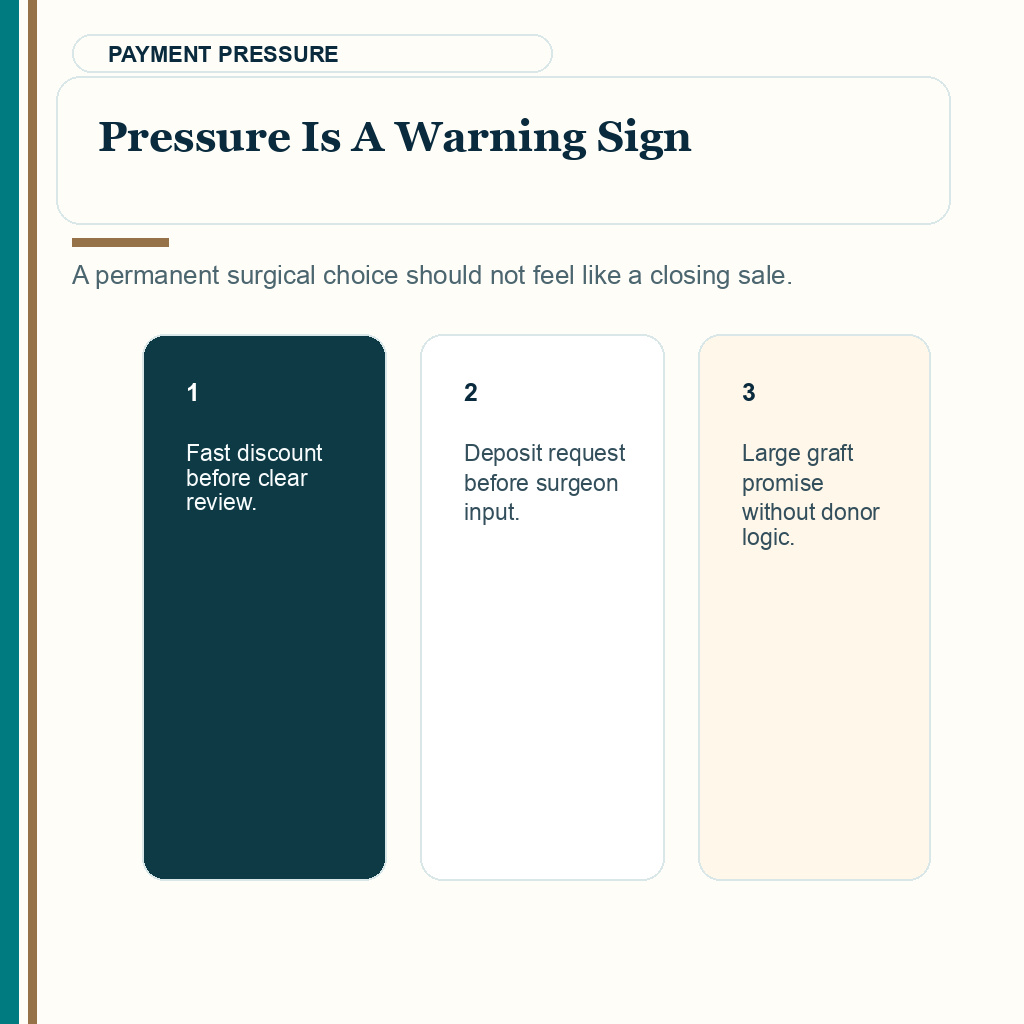
Some red flags are obvious. Promises of certainty, pressure to pay quickly, no named surgeon, unclear medical responsibility, no proper donor assessment, unrealistic graft numbers, and extreme discounts should all make the patient pause.
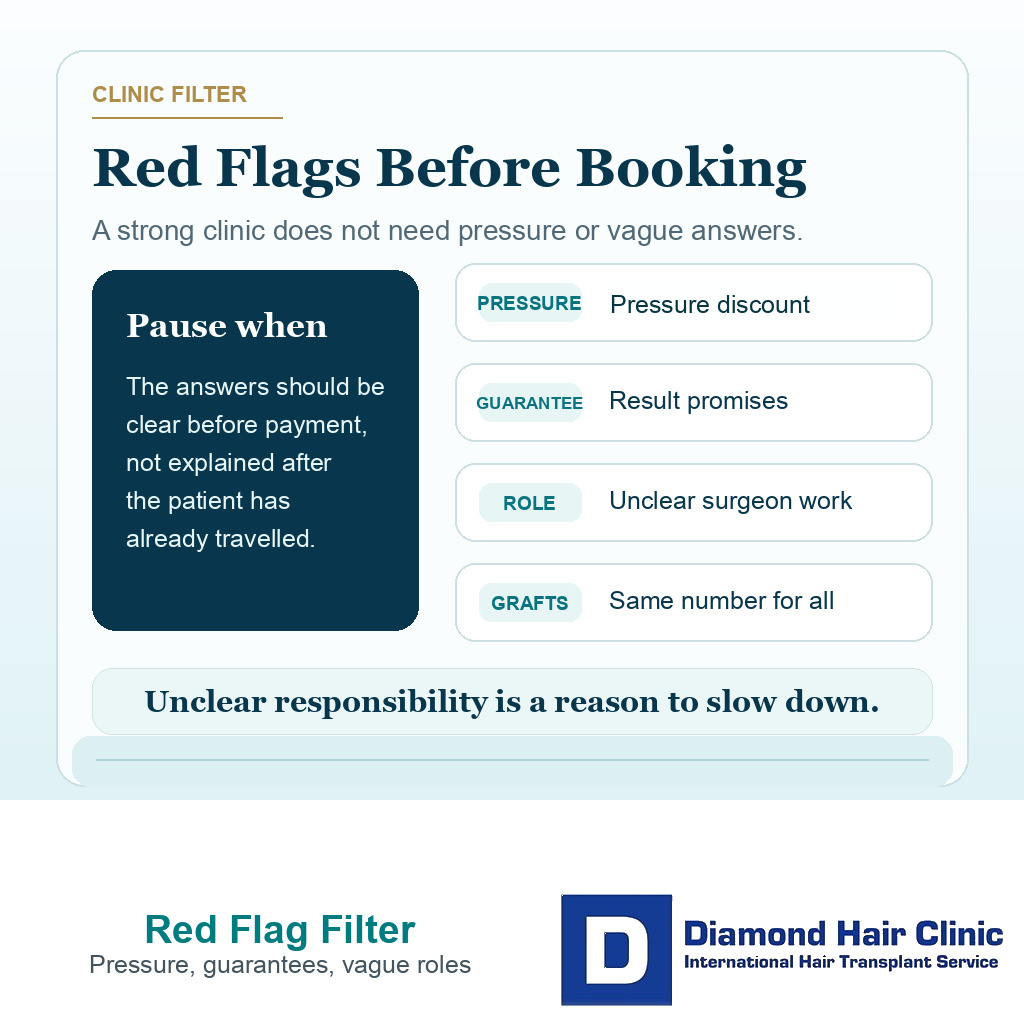
Pressure discounts, result guarantees, vague surgeon roles, and fixed graft numbers should slow the booking decision before any deposit.
Other red flags are quieter. The clinic may answer quickly but vaguely. The consultant may avoid explaining who performs each step. The plan may change every time the patient asks a more detailed question. The clinic may show only dramatic frontal photos and avoid donor area photos. These are not small issues. They tell you how the clinic thinks.
A clinic that behaves like a high-volume hair mill may still have a polished website. Judge the operating model, not only the presentation.
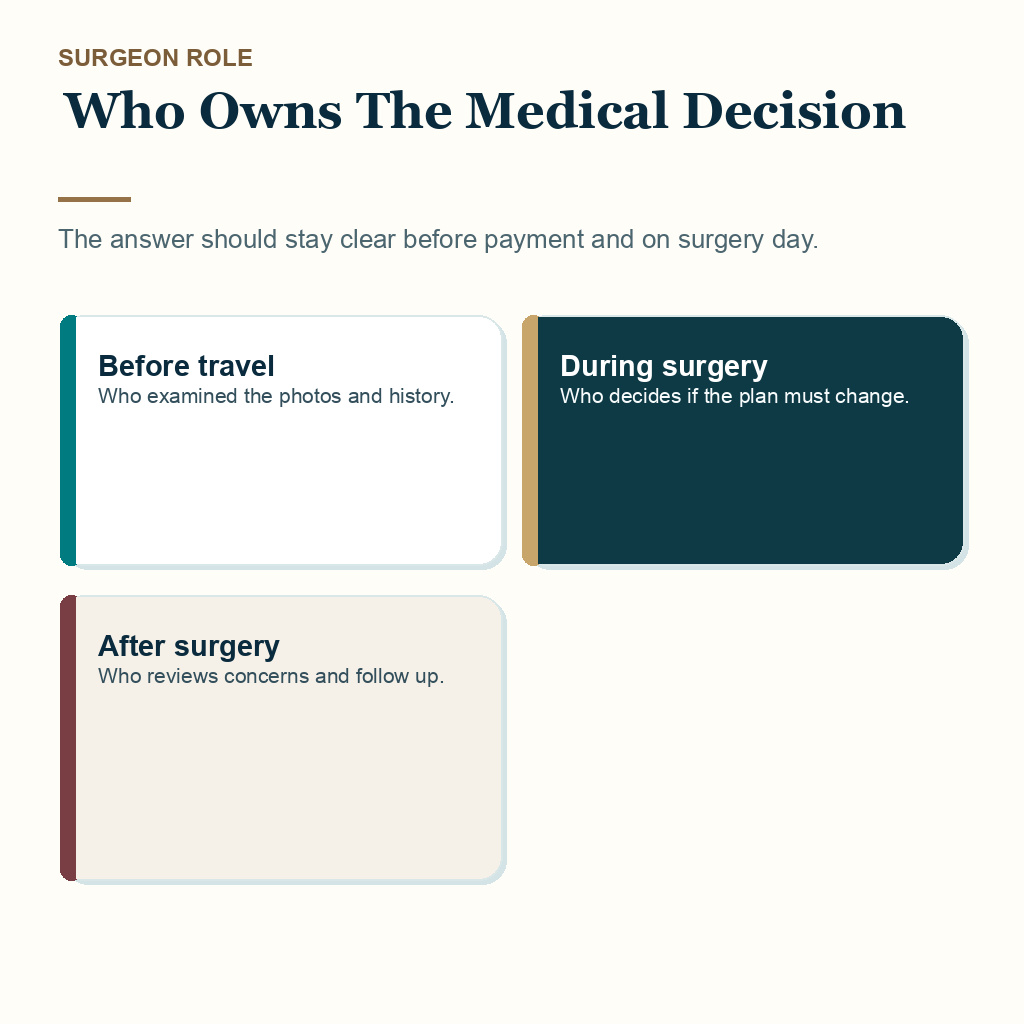
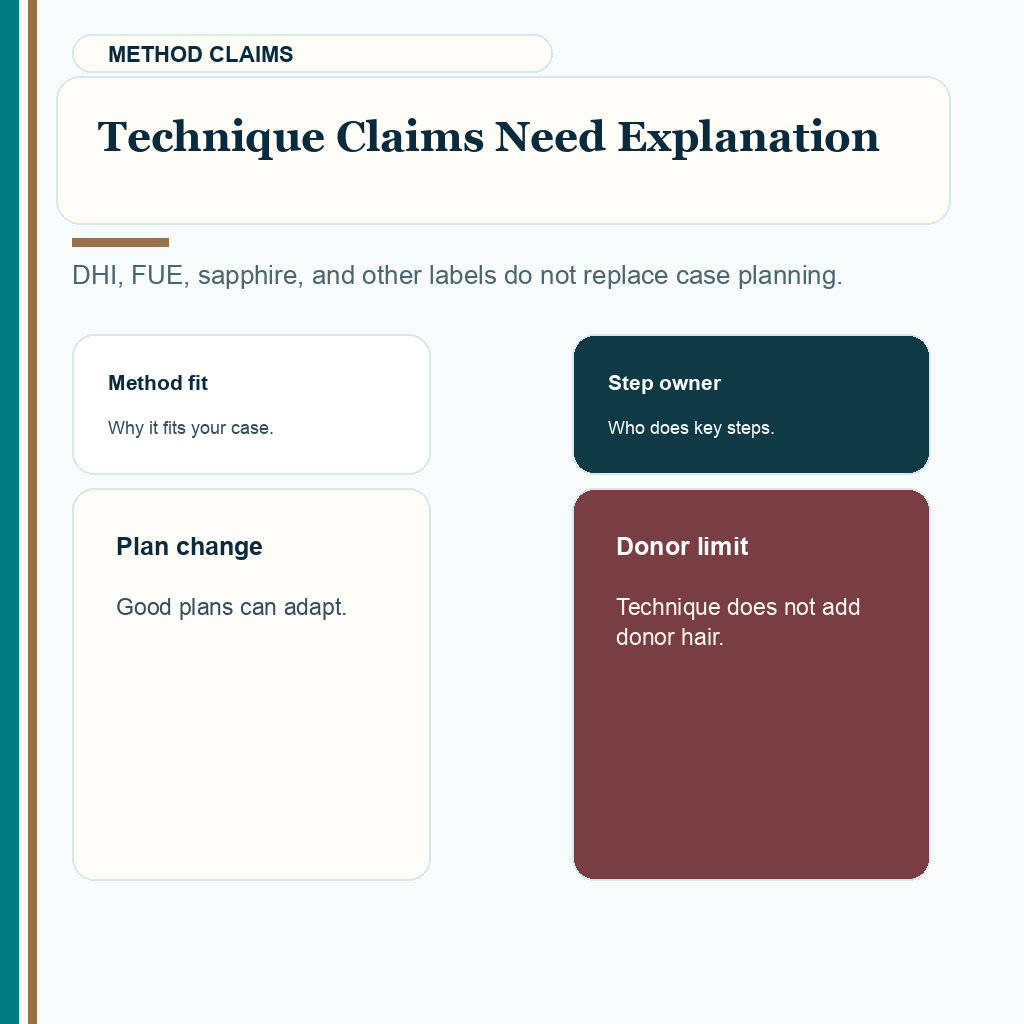
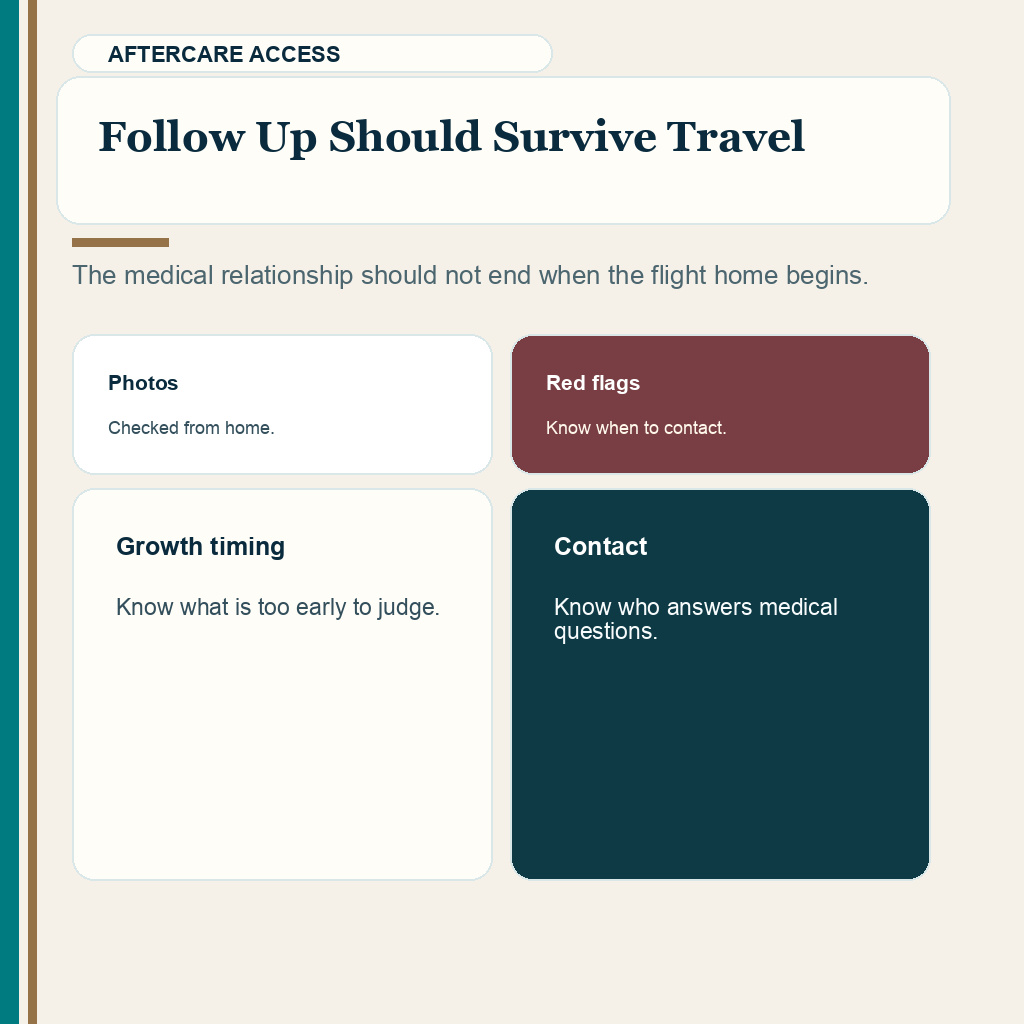
The 10 clinic choice slides below separate medical responsibility, donor planning, hairline design, result photo filtering, payment pressure, technique claims, surgery day review, follow up after travel, and the final clarity check. Swipe sideways, use the arrows one slide at a time, or choose a number below the image.



Result guarantees need careful reading
No clinic can responsibly guarantee perfection. Hair transplantation is surgery, and growth depends on patient biology, graft handling, tissue quality, aftercare, smoking, medical conditions, and future hair loss. A clinic can stand behind its work, but it should not pretend that biology can be controlled like a product warranty.
A hair transplant guarantee may sound comforting at first, but the wording matters. If the guarantee is vague, if the clinic does not define what happens after poor growth, or if the offer is mainly used to close the sale, it should not reassure you.
What reassures me more is transparent communication before surgery. A clinic should explain what is likely, what is uncertain, what cannot be promised, and when waiting or changing the plan would be safer.
Good outcomes can happen in weak systems, and bad outcomes can happen in good systems. Probability is the point.
A single outcome should not choose the clinic for you. A hair mill success story may be real, and a reputable clinic can still face a weak growth result. I use those exceptions as a reason to check the planning system, not as a reason to trust or reject a clinic too quickly.
If the clinic model still feels unclear, compare it with the red flags of Turkish hair transplant clinics before one success story starts to feel like proof. If price is pulling the decision, the real budget hair mill risk is whether surgeon responsibility becomes invisible.
Price and packages should not lead the decision
Price matters, but it should not lead the decision. A lower cost can be reasonable in Turkey because operating costs, travel structure, and medical tourism systems are different from many Western countries. But a very cheap operation can become expensive later if it damages the donor area or creates an unnatural result.
When you compare hair transplant cost in Turkey, the price should show what is included and what medical responsibility comes with it. The useful details are surgeon involvement, a medically justified graft number, clear aftercare, clear washing and medication instructions, follow-up responsibility, and written cash, card, transfer, receipt, and refund terms. If the price is being used to push a fast deposit, the plan is not ready.
If you plan to finance the operation, review the loan separately from the surgical consent. Use my guide to paying for a hair transplant in Turkey to compare the full repayment amount, fees, currency costs, and promotional terms. Loan approval does not make the medical plan suitable, and a clinic discount should not rush you into borrowing before the surgeon, graft plan, refund terms, and travel budget are clear.
Packages can make travel easier, but a package is not a surgical plan. Hotel quality and transfer convenience may make the trip smoother. They do not prove that the clinic will protect your donor area.
Technique claims need an explanation for your case
Technique names can confuse patients. FUE, Sapphire FUE, DHI, and FUT are often presented as if one name automatically means a better result. That is too simple.
FUE describes how grafts are harvested. Sapphire FUE describes the use of sapphire blades during recipient area incision creation. DHI usually describes implantation with an implanter pen. FUT is a strip method that leaves a linear scar and may still be discussed in selected donor planning situations, although it is not the modern preference for many patients.
The clinic should explain which method fits your case and why. If the discussion sounds like a technique label is being used to avoid deeper planning, a careful DHI and FUE comparison should show what is actually changing in the surgical process.
Aftercare and follow-up after returning home
A hair transplant is not finished when the patient leaves the clinic. The first days are about graft protection. The first weeks are about healing. The following months are about waiting for growth to mature.
A clinic should explain who will answer questions after surgery, how washing is handled, which signs are normal, which warning signs need attention, and how the patient can contact the medical team after returning home. In the early period, hair transplant aftercare is mainly practical. The patient needs to know what to do, what not to disturb, and when to send photos or seek help.
Direct follow-up is especially important for international patients because anxiety often begins after they return home. The follow-up plan should not leave you feeling abandoned once the payment and flight are finished. If you are planning the trip now, read the practical route on hair transplant follow-up after surgery and the timing guide on how many days to stay in Turkey after a hair transplant.
Read this review excerpt
Dr. Demircioglu stayed in close contact with me via WhatsApp, providing daily check-ins and quick responses to any questions, which made the healing process much less stressful.
Read this review excerpt
The Dr. gave his personal number to contact him directly
Clarity Before You Book
Before committing, you need to know the diagnosis, surgical goal, estimated graft range, donor limitations, hairline plan, who performs each surgical step, aftercare plan, price structure, and what happens if the clinic decides the plan should change on the day of surgery.
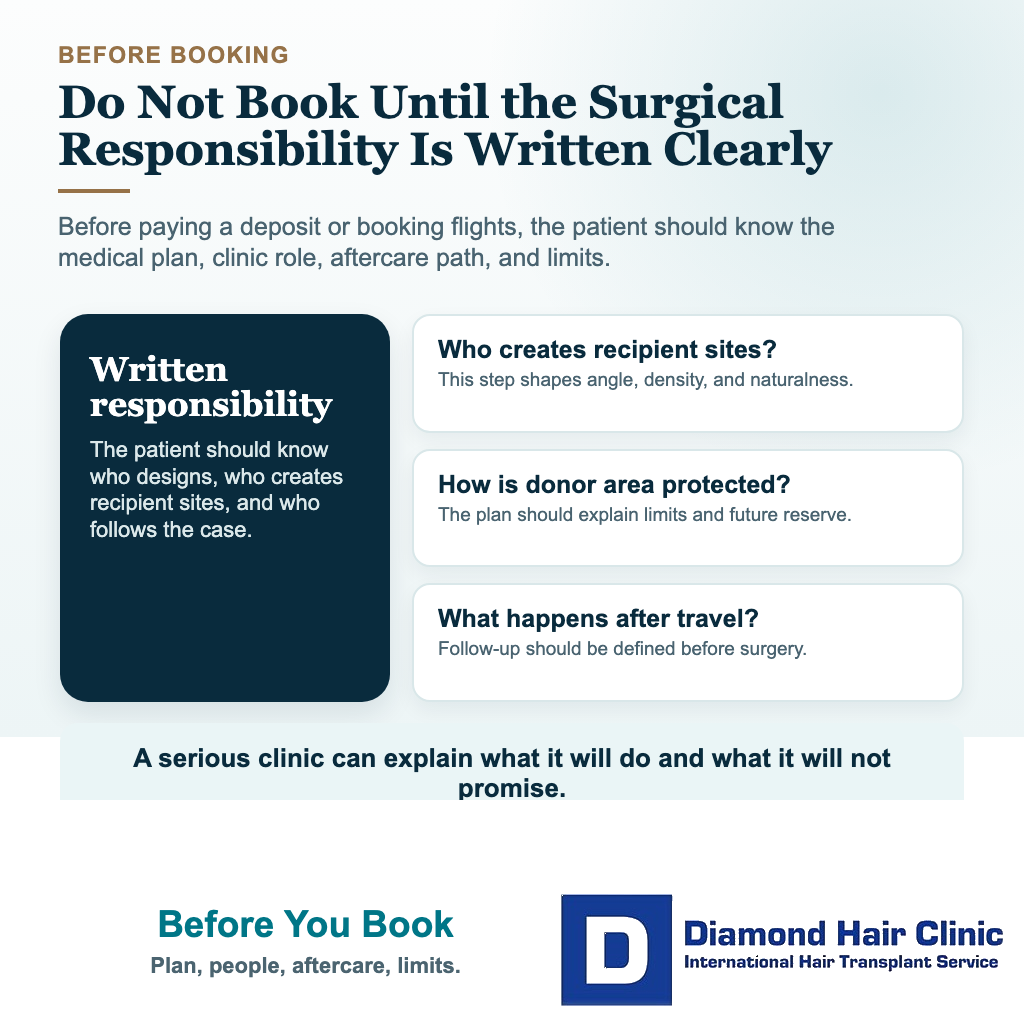
If those points are unclear, the patient is not ready to commit. What should be clear before you book a hair transplant belongs in the same decision, because many regrets begin before surgery, when the patient accepts uncertainty that should have been resolved earlier.
A clinic with a sound plan does not need to rush you. If the plan is medically sound, it can survive careful questions.
Choose the clinic with the clearest medical reasoning
In general, choose the clinic that gives you the clearest medical reasoning, not the clinic that gives you the most exciting promise. A safe clinic will explain limits. It will protect the donor area. It will design a hairline that can age well. It will discuss future hair loss directly. It will make surgeon responsibility clear.
Turkey can be an excellent place for hair transplantation when the clinic is chosen carefully. But the wrong clinic can turn a lower price into a lifelong problem. Take your time, compare the right details, and do not let travel convenience or discount pressure make the decision for you.
The safest clinic is not the one that promises the most. It is the one that explains the plan clearly enough that you understand both the benefit and the limits before surgery.