



Before Booking, the Surgical Plan Should Be Clear
Before you book a hair transplant, the medical plan needs to be clear enough that you can explain it back without guessing. You need to know why surgery is being recommended, which areas will be treated, what will be left alone, how the donor area will be protected, who is responsible for the critical surgical steps, and what could change after an in person examination.
A surgery date is not the treatment. The plan is the treatment. If the plan is still vague, a deposit, discount, available slot, hotel package, or impressive photo gallery must not push you forward.
I see many people reach this stage with mixed feelings. Surgery finally feels possible, but one part of the decision still feels unclear. That uneasiness is useful when it makes you slow down before money, flights, and expectations become harder to separate from the medical decision.
Before booking, you should be able to explain what the grafts are meant to achieve, why that range was proposed, and who is responsible for the surgical plan. You should also understand how the clinic will handle a change after the in person examination. If any of this is still vague, it is too early to book.
Get the change rule before you pay. If the donor looks weaker in person, the line has to move, or the graft target should shrink, you should know who explains that change and how the booking will be handled.
A serious surgical plan must have conditions that can change it after the in person exam. If nothing could make the surgeon postpone, reduce, or cancel the plan, the date is controlling the decision more than the diagnosis.
For an international case, the review also needs a written change rule before flights, payment, and time off work make the decision feel fixed. That answer has to include the surgical aim, provisional graft range, donor limit, surgeon responsibility, and the finding that would lead to a smaller session, staging, delay, or refusal.
When the unresolved question is donor suitability or whether newly started medication should change the timing, the available date should not become the answer. Booking should wait until those medical questions have a written answer.
Start With the Concern Behind Your Hesitation
People do not all arrive at the booking stage with the same doubt. Some are comparing clinics in Turkey. Some received a very high graft quote. Some worry that the doctor shown online may not be the person doing the operation. Others already paid a deposit and feel unsure.
Start by naming what is making you hesitate. It may be the donor estimate, the surgeon’s role, the hairline, pressure to pay, or whether the expected density has been described realistically.
If the fear underneath the hesitation is regret, the plan should answer more than the surgery date. Before booking, you should understand the written plan, donor limits, hairline design, medication and native hair risk, and the realistic density your hair characteristics can support.
These routes are useful because booking mistakes often begin with the wrong kind of certainty. A clinic can look popular, the price can feel attractive, the photos can look strong, and the date can be available soon. None of that proves that your diagnosis, donor reserve, hairline design, recovery plan, and surgeon responsibility have been checked properly.
Good booking clarity is not meant to create fear. It gives you a way to separate a real plan from a sales process.

Read this review excerpt
Every single one of my questions was answered and they made sure I had all the details I needed to make an informed decision.

Read this review excerpt
Dr Mehmet greeted me and we spent a good hour discussing the procedure and drawing my new hairline. Nothing that I asked for was too much and I never felt rushed or pressured.
Paying a Deposit Too Early Can Limit Your Choices
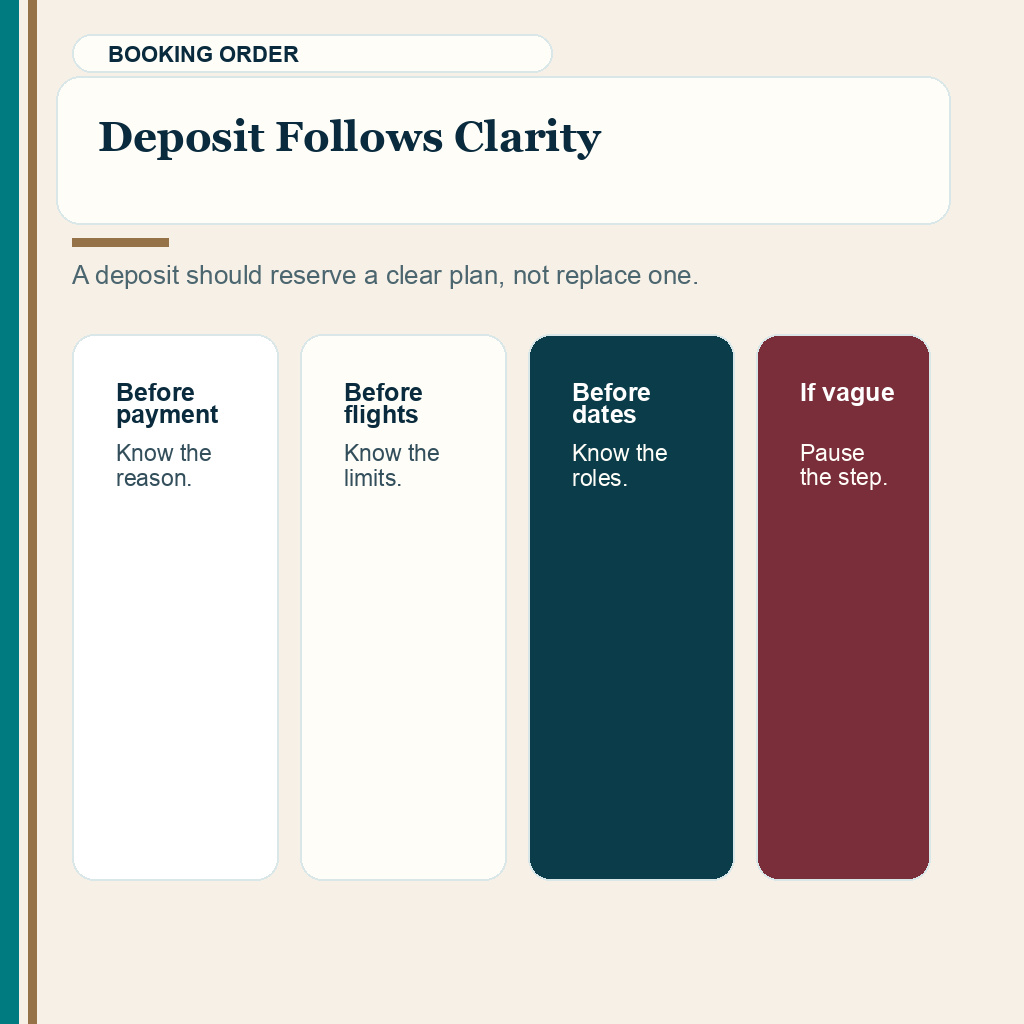
A deposit can be reasonable when the surgical plan is already clear. A properly planned surgical day takes time, staff preparation, and schedule protection. The problem begins when payment comes before you know what you are agreeing to.
A few photographs and a fast graft estimate may be enough for an early opinion. A deposit needs to reserve a decision you understand, not replace medical review or rush the questions you still have. Before booking, the diagnosis has to be reasonably clear, the donor area has to be assessed, and the proposed result has to match your age, hair loss pattern, hair type, and future risk.
A deposit needs to reserve a plan you understand, not replace the plan itself. If the clinic cannot explain why you are a candidate, what result is realistic, and what may need to wait, paying money can make a weak decision feel harder to question.
Fear often drives rushed booking. You may worry about losing the slot, the discount, the clinic, or the chance to fix the problem. Fear is a poor surgical adviser. It makes vague answers feel acceptable because starting the research again feels exhausting.
If a clinic pushes payment before answering basic medical questions, pause. A normal booking step protects a date after the plan is clear. Pressure asks you to protect the date before the plan has earned trust.
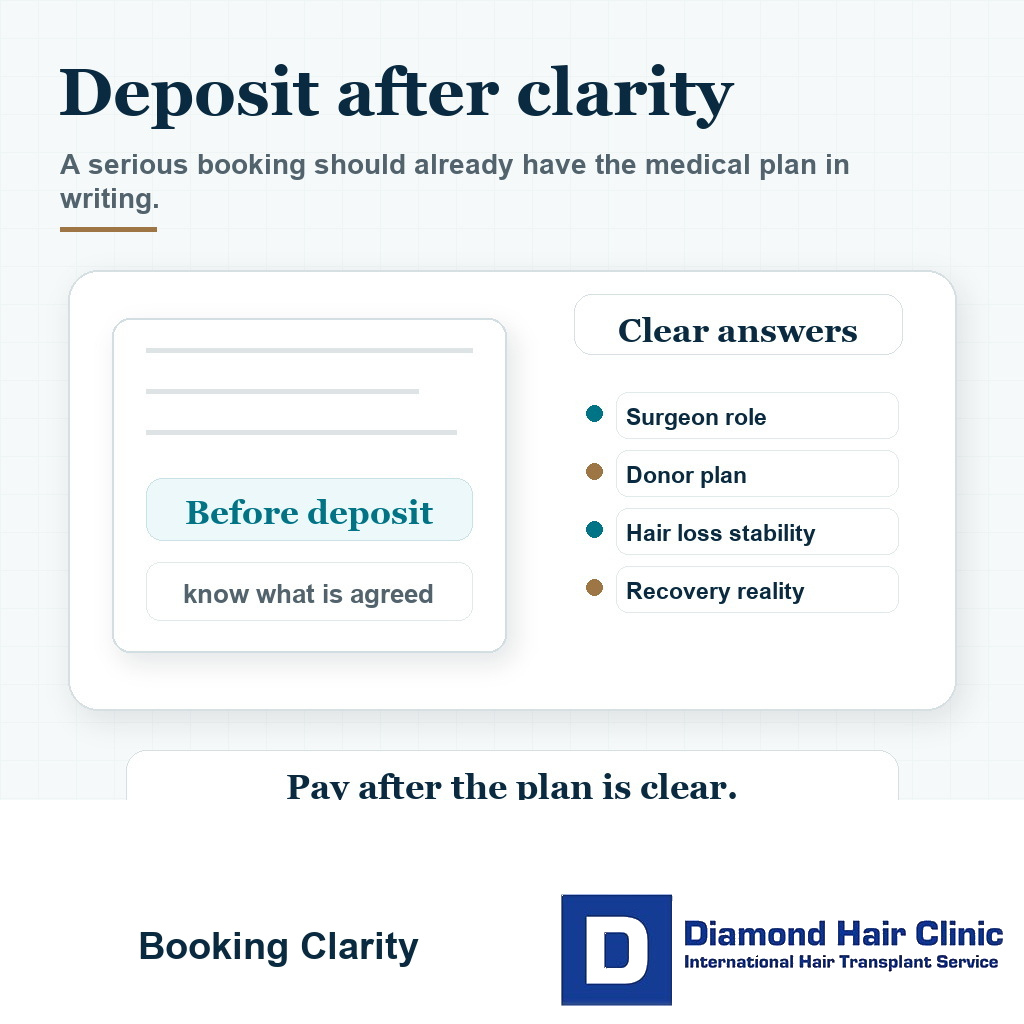
Details That Should Be Clear in Writing
The written plan does not need to pretend that every detail is final before the examination in person. A graft count can still be refined when I examine the scalp closely. But there is a difference between a detail that may change and a plan that was never explained. The reason for surgery cannot stay vague.
Before the date is fixed, you need a written explanation of the diagnosis, the areas planned for treatment, the estimated graft range, the areas that will be left untreated, how the donor area will be protected, and who is responsible for the critical surgical steps.
The practical side also matters. Recovery timeline, medication discussion, follow-up, payment terms, cancellation rules, language support, and what happens if the final examination changes the recommendation need to be clear before travel. Medical decisions still belong with the surgeon, while the service handoff must be just as clear. Before you arrange travel, know who confirms the date, sends the visit schedule, has access to the written plan and records, coordinates transfers, and answers routine questions. You should also be told how an unanswered message or urgent medical concern reaches the responsible clinician. For international surgery, language barriers during a hair transplant abroad need to be resolved before consent, not improvised after arrival.
A calendar invitation or a message offering a slot may still refer to a provisional date. At Diamond Hair Clinic, once the plan is accepted, sending your purchased flight ticket details is enough for us to reserve the surgery date without a deposit. The booking reply should say whether the date is reserved or which step is still outstanding.
If the written explanation is only a package name, a date, a graft number, or a regenerative treatment promise, it is not enough. Booking needs to come after medical clarity, donor limits, and plan responsibility, not before them.
Before the first surgery, protect your future choices
The written plan should also make space for choices that are difficult to undo later. If the hairline, graft number, donor strategy, or crown priority changes when you are already in the clinic, pause until the reason is explained before extraction begins. Travel, payment, and excitement should not push you into accepting a lower line, denser front, or larger session that you have not had time to understand.
I also want the plan to explain how donor hair will be spent. That means I need to look at the extraction pattern, the reserve for future hair loss, the risk of visible thinning in the donor area, and any scar or preference for very short hair before we treat the date as settled. If medication is part of the long-term plan, it should be clear how the plan changes if you cannot use it, do not tolerate it, or choose not to continue it.
For an international patient, travel timing needs the same level of planning. A little extra time can give room for washing, swelling, sleep, early questions, and a calmer review of any plan change. Reviews and photos can support your research, but they should not replace direct questions about cases like yours, healed donor areas, realistic density, and who is responsible for the surgical decisions.
Patient reviews are useful for patterns, not for deciding your surgical plan. Before booking, the stronger evidence is the written graft range, donor reasoning, doctor responsibility, and change policy, because a rating page cannot examine your scalp.
Dated updates and consistent details make a review easier to assess. A polished account or a new profile alone cannot establish whether the story is reliable.
When waiting is the medical answer before booking?
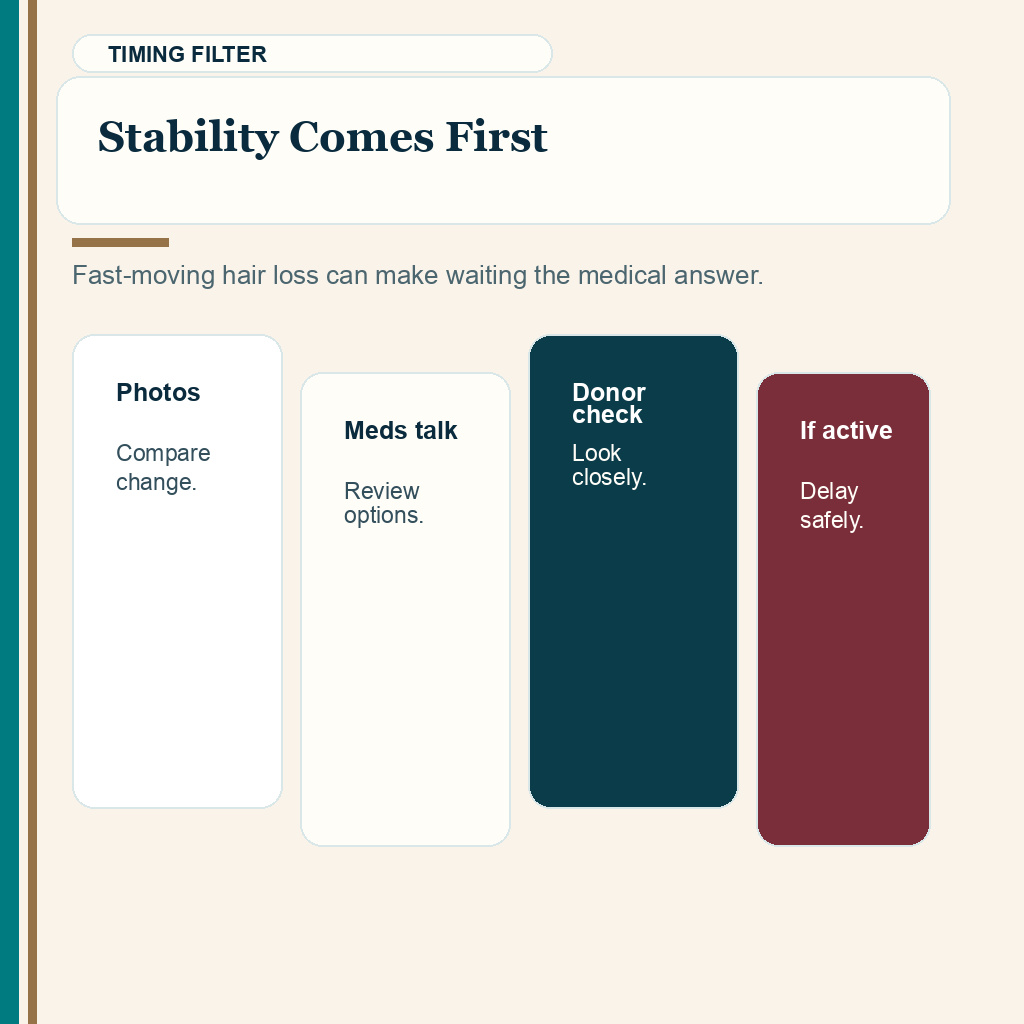
I pause the plan if the donor area looks weak, active hair loss is moving quickly, medical information is incomplete, the requested hairline is too low, or the clinic cannot explain who controls the surgical decisions.
Waiting is not failure when it prevents an unsafe operation. It may mean treating hair loss first, sending better donor photos, asking for an in person examination before final numbers, or accepting that the safer decision may be to delay surgery.
A recommendation to wait should be recorded with its medical reason. Pressure to secure a date cannot justify accepting avoidable risk. Some patients are therefore declined for hair transplant until the donor assessment, hair loss stability, or medical conditions support surgery.
The Surgical Roles Need to Be Clear
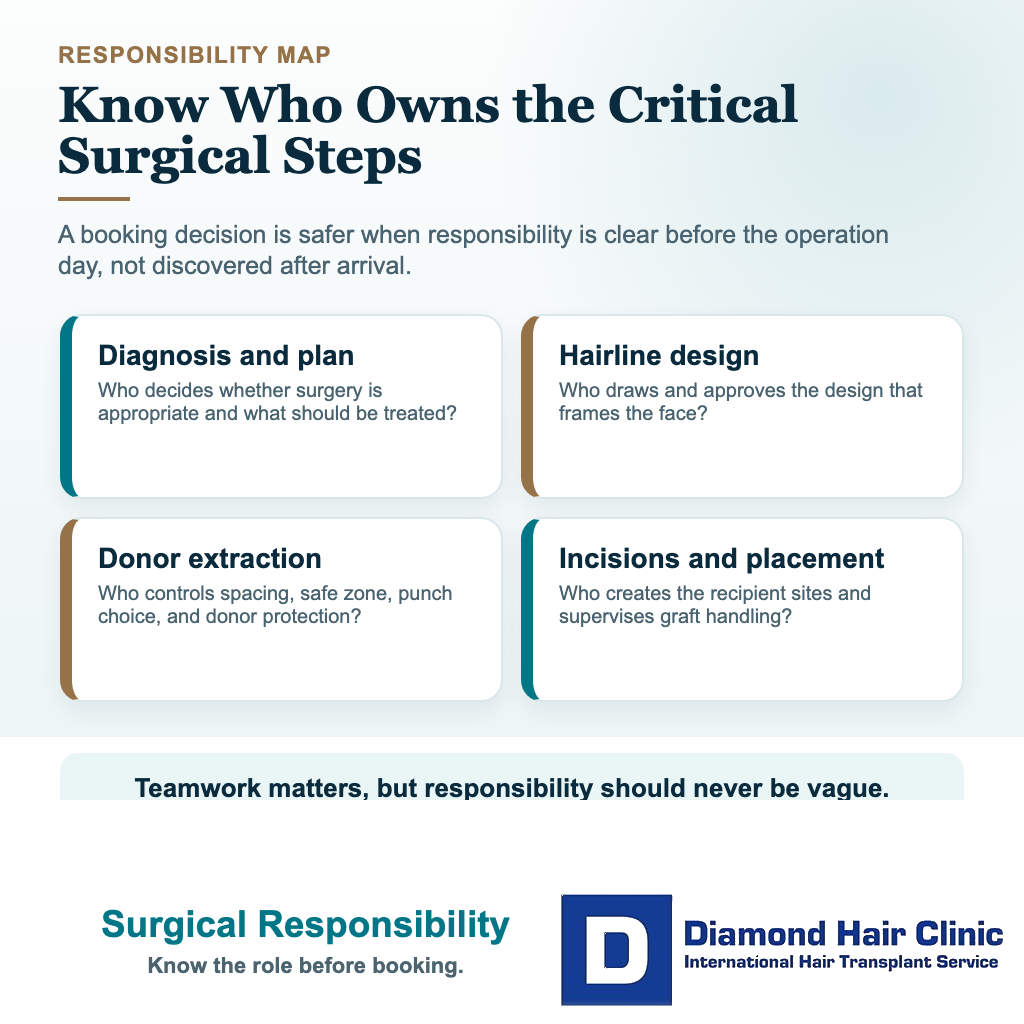
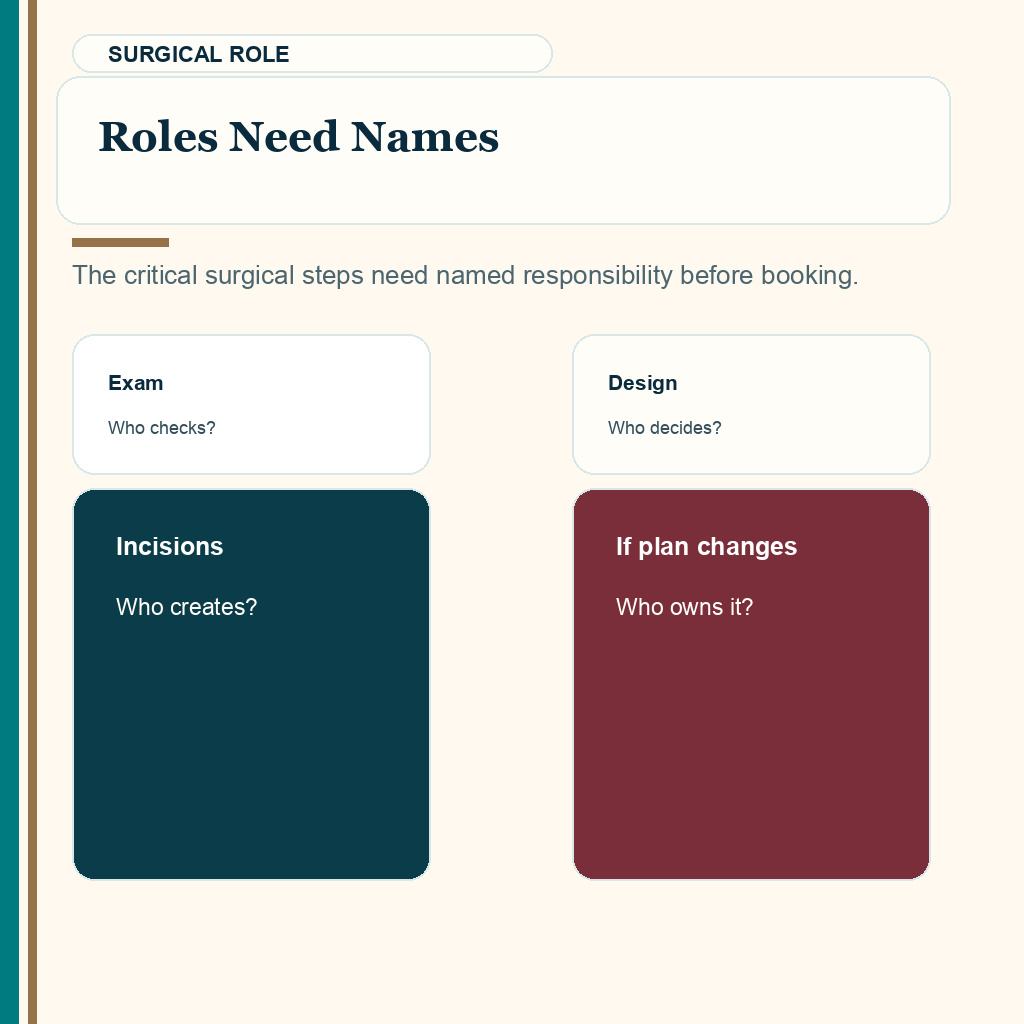
Surgeon responsibility deserves a direct discussion before payment. The doctor shown online may not be the person who designs the hairline, creates the recipient area incisions, or supervises the operation, and that difference should never be discovered on surgery morning.
Hair transplantation is a team procedure, and skilled assistants have a real role. I am not dismissing teamwork. A good team matters. But the medical responsibility must be clear before booking.
You need to know who will examine you, diagnose the pattern, design the hairline, plan the donor extraction, create the recipient area incisions, supervise graft placement, manage anesthesia, and handle complications. These decisions are not small details. They shape the result for life.
The surgeon-led model matters in my clinic because I personally design the hairline, plan the surgery, and create the recipient area incisions with a sapphire blade. We also work with one patient per day because the surgery cannot feel like a production line.
A vague answer is not enough. The plan should explain how the hairline will be designed, how recipient area direction will be controlled, how extraction will be distributed, and how the safe donor limit will be respected. If you wear very short sides or a skin fade, the plan should also explain how short hair after FUE may show donor changes before you accept surgery.
A clinic that is proud of its medical model can explain this clearly. When people later feel misled, the technical result is not always the only reason. Often, they expected one level of surgeon involvement and received another.
A Graft Number That Protects the Future
Graft numbers feel reassuring because they look precise. Four thousand grafts sounds more serious than two thousand, and five thousand can sound even more complete. That is exactly why the number can mislead people before booking.
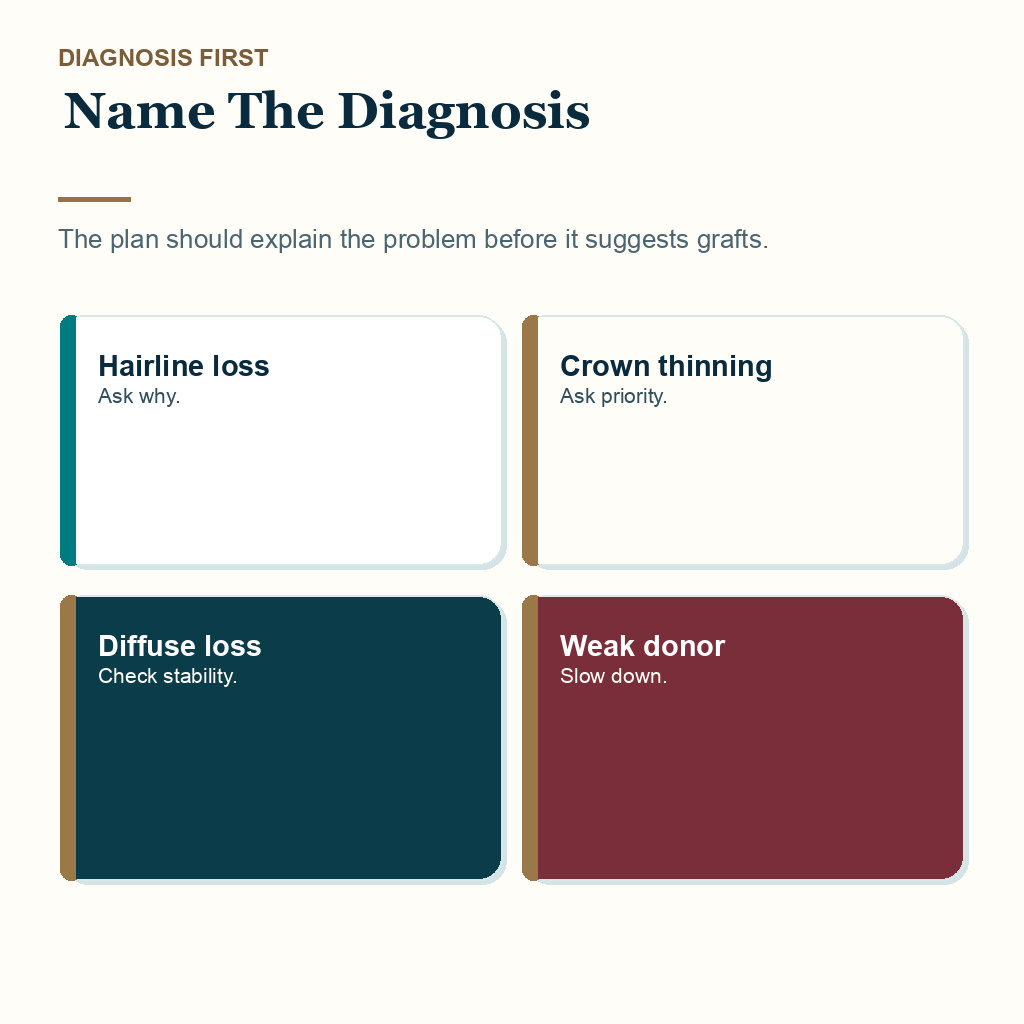
Without donor strategy, a graft number can be dangerous. Every graft removed from the donor reserve is permanently spent. This matters most for younger patients, advanced hair loss, crown cases, diffuse thinning, limited donor areas, and anyone who may need a second or third surgery later.
My donor examination covers density, miniaturization, hair caliber, extraction spacing, and the boundaries of the safe zone. It also accounts for the grafts that may be needed ten or twenty years later. A dramatic first operation becomes a liability if it spends that reserve too early.
Caution can reflect a sound donor strategy, but a clinic may also prefer a smaller session for less specific reasons. Judge the explanation against donor density, hair caliber, skin contrast, miniaturization, extraction distribution, and the size of the area that needs coverage.
A responsible surgeon can explain why the graft number was chosen and what is deliberately being left alone. Leaving the crown lighter in the first surgery may feel disappointing if nobody explained it. It may still be wise when the frontal frame needs priority and the donor supply is limited.
The opposite can also happen. A clinic may promise a very large number because it sounds attractive, while the extraction pattern damages donor appearance or weakens future options. One future option may be the ability to shave the head after hair transplant without feeling trapped by scars or donor thinning.
The right graft number is not the biggest number. It is the number that serves the whole lifetime plan. It helps to understand how a surgeon calculates graft numbers before clinic quotes are compared as if they are prices on the same product.
Hair Loss Stability Before Surgery
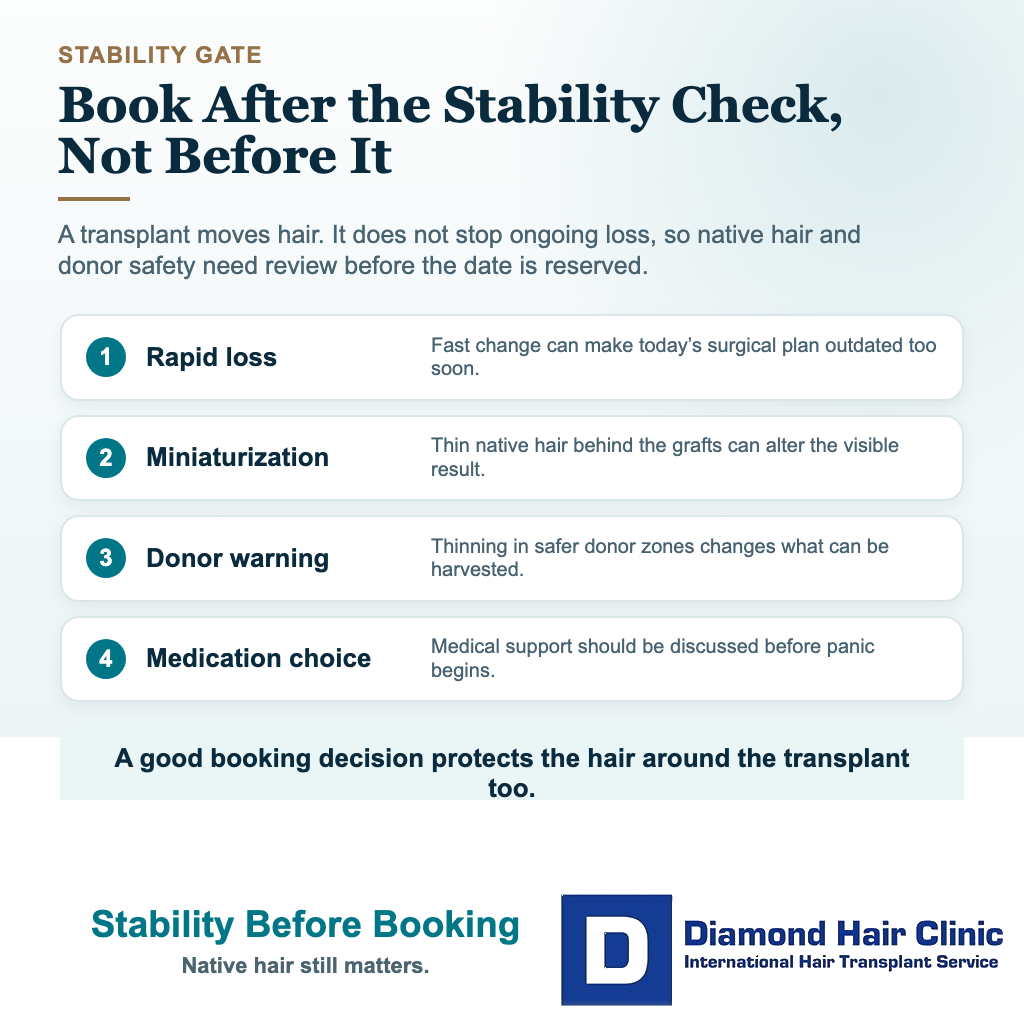
A hair transplant moves hair. It does not stop the original hair loss process.
I see this misunderstanding often. A person restores the frontal area, feels hopeful, and then watches native hair behind the transplant continue to thin. The transplanted hair may be growing well, but the surrounding hair has changed. The result then feels like a failure even when the operation did what it was designed to do.
Before a date is reserved, the clinic needs to discuss whether your hair loss is stable enough for surgery. This matters especially if you are young, thinning quickly, losing hair diffusely, or showing miniaturization in areas that should normally be part of the safer donor zone.
Medication decisions before a hair transplant also need a direct conversation. Finasteride, minoxidil, dutasteride, and other medical options are not the same for every patient. Some tolerate them well, some do not, and some need to avoid certain treatments.
If you feel overwhelmed and only want the first safe step, start with a medical assessment, not a surgery date. The consultation should decide whether surgery is appropriate now, whether the donor area can support the plan, what the current hair loss pattern is doing, and whether treating or observing the native hair first would give the result a better foundation. Finasteride is not an automatic booking step. Finasteride can be discussed or prescribed only when medically appropriate after your history, side effect concerns, risk tolerance, and preference about ongoing medication are reviewed.
The important point is that this discussion happens before surgery, not afterward in panic. If you do not want medication, the surgical plan has to respect that reality. Surgery cannot be sold as a single day cosmetic fix while the biology is still active.
A strong consultation plans for the possibility that hair loss continues. The frontal area, mid scalp, crown, and donor area have to be judged together. If the future pattern is ignored, the first result may look good while the long-term plan is already fragile.
The Real Tradeoff Between Hairline and Crown Coverage
Most people come with one emotional priority. For some it is the hairline. For others it is the crown. For some it is density under harsh light or the wish to stop hiding under hats.
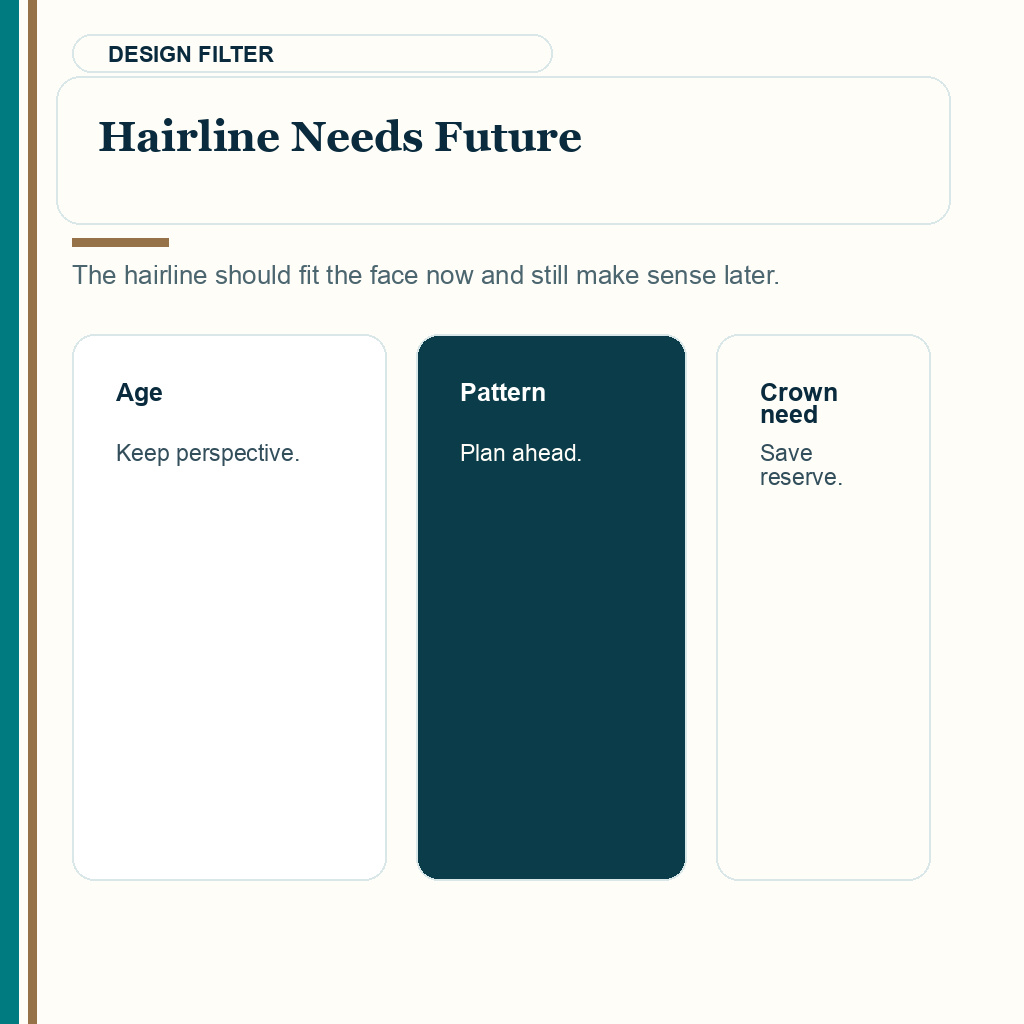
These concerns are real, but they are not equal from a planning point of view. The hairline frames the face. The crown can consume many grafts and still look thinner than expected because of its spiral pattern, light reflection, and larger visual surface.
The crown can still be treated. It simply needs unusual realism, especially when donor supply is not strong. A crown result may improve your appearance without ever looking like the dense frontal hairline shown in a polished photo.
The hairline has its own risk. If it is too low, too straight, too dense in the wrong way, or too juvenile for your age, it may look impressive early and artificial later. Naturalness depends on proportion, irregularity, angle, graft selection, and careful planning. If the frontal frame is your priority, understand hairline design in hair transplant before asking only for maximum density.
Many disappointments begin when the patient and clinic use the same word but mean different things. You may say “full” and mean strong daily coverage. The clinic may mean “improved.” You may say “natural” and the clinic may mean “not bald.”
Define success in practical terms before you reserve the date. Agree on the hairstyle you expect to wear, how much crown visibility may remain in bright light, and whether the hairline will still suit your face as you age. A technically sound result can still disappoint when the patient and clinic expected different things.
Recovery Details to Understand Before Surgery
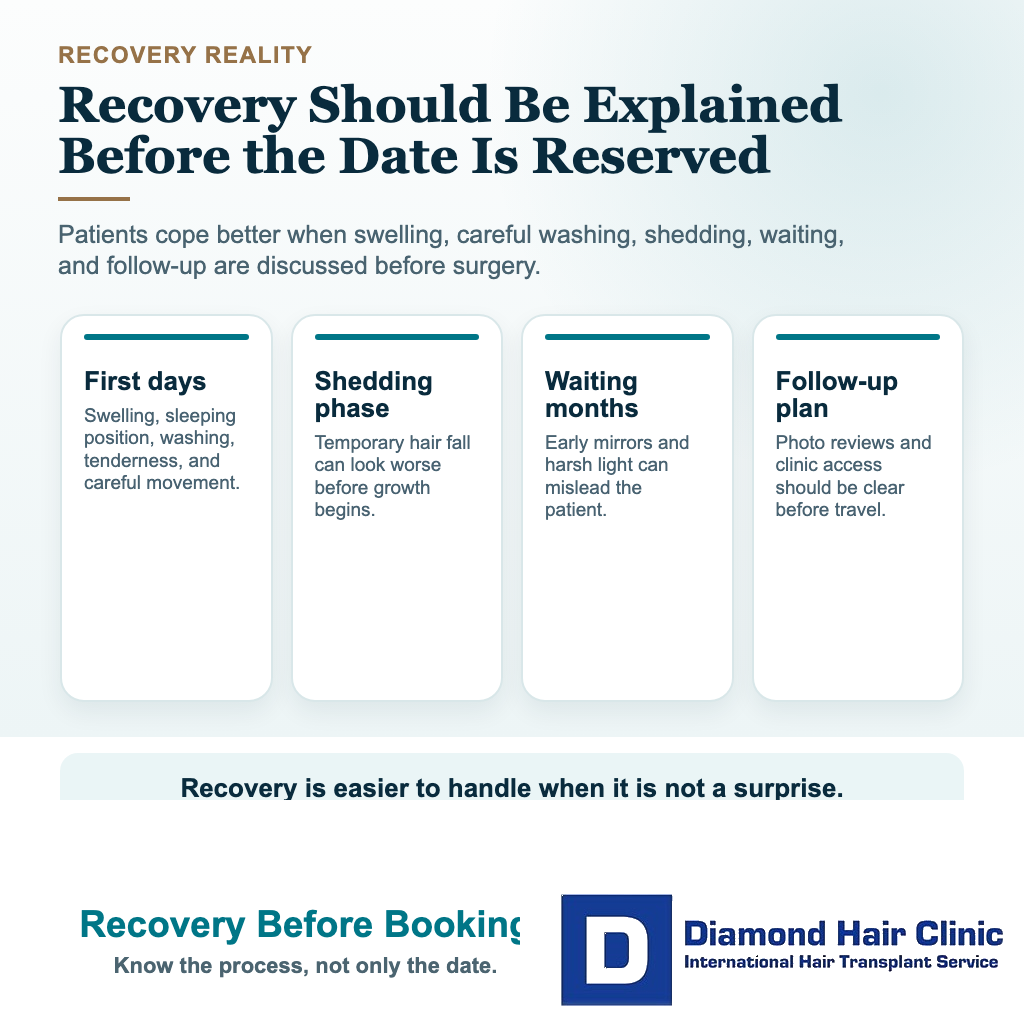
Recovery is often described too simply. People are told when to wash, when scabs fall, and when growth may begin, but they are not always prepared for how the process feels.
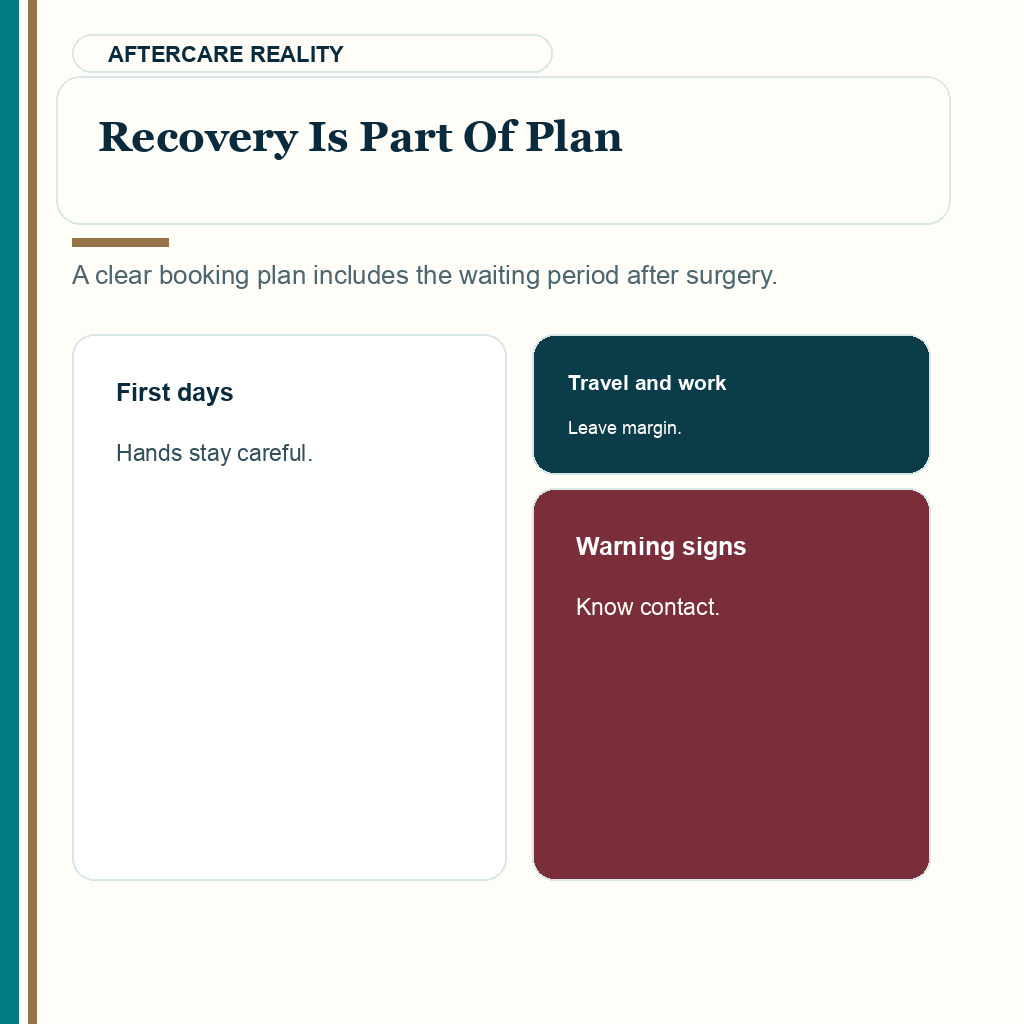
The first days can include swelling, tenderness, sleeping difficulty, itching, numbness, redness, and fear of touching the grafts. Some people underestimate how careful and isolated they may feel.
Then comes shedding. This can be emotionally harder than the operation itself because transplanted hairs may fall and the scalp may look worse before it looks better. If this was not explained clearly, normal shedding can be mistaken for failure.
The clinic needs to explain recovery before the date is reserved, in human language. Not only what happens to the grafts, but what you may feel, how long the uncertainty can last, and when to contact the clinic.
Hair transplant aftercare matters, but the instructions must also be realistic once you return home. Gentle washing, sun protection, avoiding unnecessary touching, and patience often matter more than expensive products sold as miracles.
The consultation also needs to cover work, exercise, travel, social events, and sleep. Returning too quickly to stress may not damage the transplant, but it can make aftercare harder to follow. If you have sleep apnea or use CPAP, that plan needs to be clear before surgery is booked.
Good surgery includes good preparation for the waiting period. Monthly progress is not always linear, and you need to know this before booking.
These 10 booking clarity slides separate diagnosis, deposit timing, surgical roles, donor reserve, hairline design, stability, recovery planning, price context, photo review, and when waiting protects the result. Swipe sideways, use the arrows one slide at a time, or choose a number below the image.



Reading Price Packages and Online Photos Calmly
Price matters. Many people save for a long time, compare countries, and try to make a responsible financial decision.
But hair transplantation is not a product where the lowest price and highest graft number automatically create real value. A cheap first surgery can become expensive if it creates an unnatural hairline, poor growth, donor depletion, or the need for repair.
The quoted surgery price is only one part of the hair transplant cost in Turkey. Medication, travel, hotel, follow-up, time away from work, possible local medical visits, and correction costs all affect the real decision.
Package offers can be convenient, but convenience is not the same as medical quality. A smooth hotel transfer does not tell you who extracts the grafts, who creates the recipient area incisions, or whether the donor plan is safe.
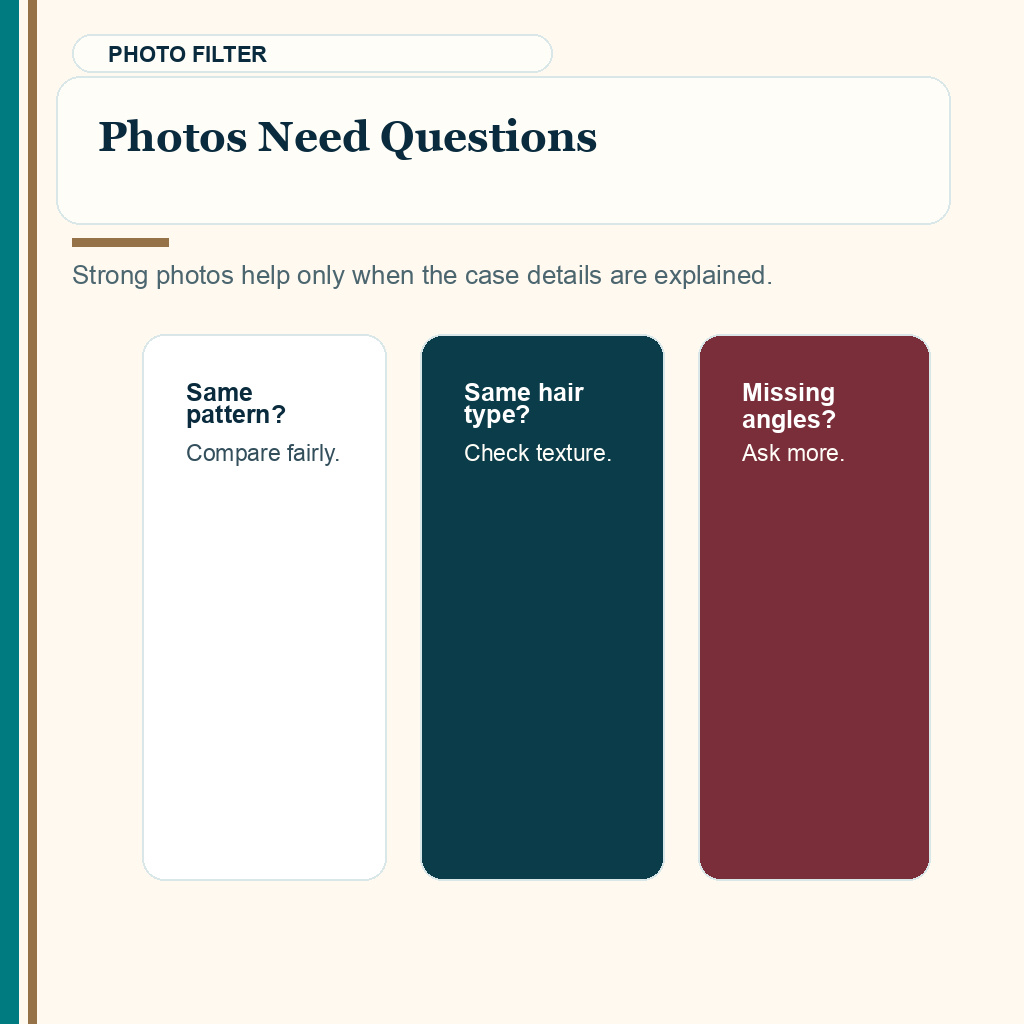
Online photos also need caution. Best case photos are not the same as average results. Dry hair, favorable lighting, styling products, camera angle, hair length, and selective presentation can make a result look stronger than it feels in daily life.
Results with similar hair type, skin contrast, curl pattern, donor quality, hair loss pattern, and goals should be part of the review. If the donor area worries you, healed donor photos matter too.
Marketing awards, celebrity names, high-volume surgery, and social media popularity can create trust, but they do not prove patient selection, graft survival, or long-term planning. If a clinic cannot answer direct questions about poor outcomes, surgeon involvement, or donor limits, that matters more than any polished photo gallery.
People researching Turkey need to know the red flags of Turkish hair mill clinics before a low price or limited slot decides for them.
A good price is not the cheapest surgery. It is the fairest cost for a plan you can trust.

A booking should still leave room to slow down
Booking is not the goal. A booking only becomes reasonable when the plan can survive uncomfortable information. If the donor looks weaker in person, the hairline needs to move, medication history is still unstable, or the crown would spend too much reserve, the plan has to be able to slow down.
Waiting for the right hair transplant surgeon is not passive when the question is medical. It gives time to understand why a graft number is chosen, why the donor area is being protected, and what should be left for future hair loss.
Once the reasons and limits are clear, choosing a date should be the final step. Book because the medical plan still makes sense, not because a discount is expiring or the flight happens to be convenient.
What should be clear before you pay?
Before payment, the written surgical decision should leave room for a safer answer. It should say who can reduce or stop the session if the donor looks weaker in person, who explains a higher or more conservative hairline before extraction begins, and what waits if crown coverage would spend too much reserve.
It should also explain how medication history, recent shedding, or a changed graft number will be reviewed. If the final recommendation differs from the online quote, a clear record matters more than a rushed verbal explanation. A deposit should not make a weak decision feel permanent.
When the concern is a high number or a fast approval, compare the booking pressure with a weak donor high graft quote before travel becomes the reason to continue.

Read this review excerpt
told me the quality of my donor hair and what he could take out and advised me what will the be best outcome with what donor hair I had.
Read this review excerpt
Afterwards Dr Demircioglu gave me his contact information along with detailed postoperative instructions