


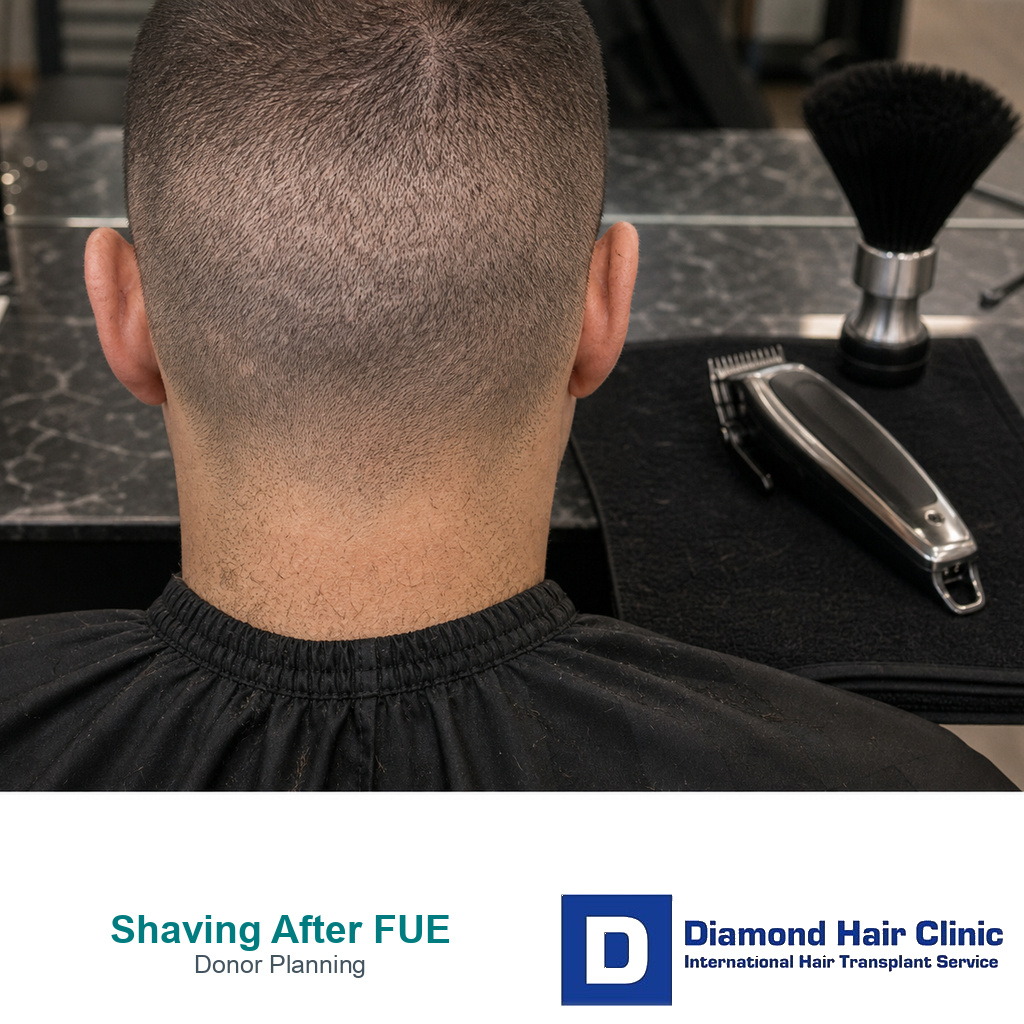
Shaved Head Goals Need Careful Donor Planning
You can still shave your head after a hair transplant once the scalp has healed, but the shaved scalp may not look exactly like a scalp that never had surgery. A number 2 or 3 buzz can leave enough hair to soften small donor marks. A zero guard or wet razor shave is less forgiving because FUE dot scars, donor thinning, or an old FUT line scar may become visible, especially under bright light or when the donor area was used too aggressively.
If the scalp is still healing, do not test close clippers or a razor until your surgeon has cleared the skin. Patients who prefer a fade rather than a full shave should also understand short hair after FUE donor scar limits before surgery.
Two separate questions often get mixed together. The first is recovery timing, which asks when clippers or a razor can safely touch the scalp. The second is the lifetime question, which asks whether shaving months or years later will still look natural enough for the patient.
If the immediate problem is hiding recovery, a hair system after surgery may sound attractive, but it needs a separate safety plan because adhesive and friction can affect healing.
This question often comes from men who are not fully sure whether they want a transplant forever, or who worry that they may still lose more native hair later. That concern is healthy. A hair transplant should give you more options, not make you dependent on one style.
Before surgery, a patient needs to understand both sides of the choice. A transplant may give better framing and a more natural appearance with short hair. But if the donor is used badly, the same patient may later feel that shaving reveals the surgical decision they hoped would stay invisible. Both questions need to be answered before grafts are removed, not after the patient has already paid, travelled, and started to regret the decision.
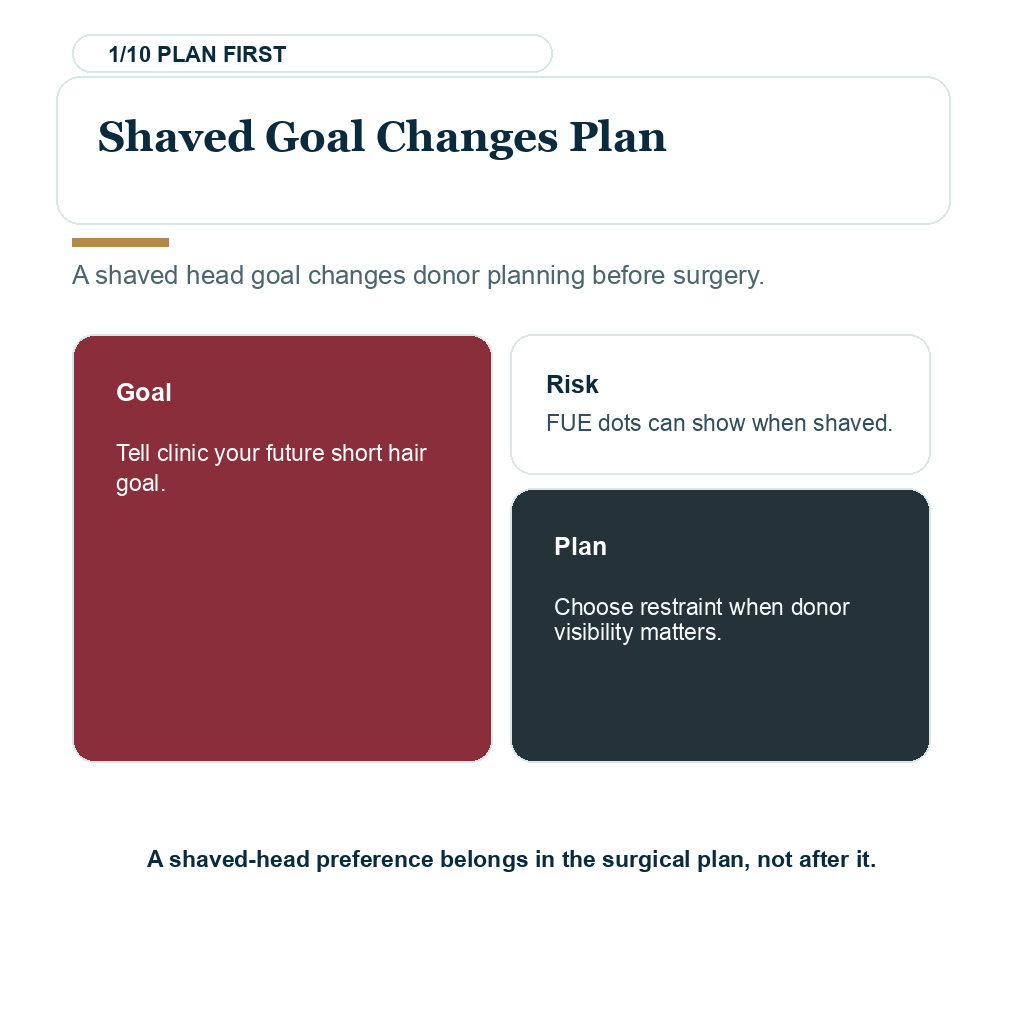
If a shaved option matters to you, bring donor photos at the clipper length you actually wear. Longer clinic photos do not answer whether your own lowest haircut will feel acceptable later. Bring up a future buzz cut or SMP plan before extraction density and donor spacing are chosen.
Decide the lowest guard you still want available before surgery. If zero guard freedom matters, donor extraction should be planned more cautiously than for someone who always keeps coverage.
Shaving after a hair transplant needs careful judgment
Shaving after a hair transplant is possible, but the cosmetic answer depends on the method used, the number of grafts taken, the quality of extraction, the donor density, the skin color, the hair color, and the patient’s tolerance for small visible marks. Some patients can shave very short and feel comfortable. Others notice pale dots, uneven density, or a contrast between the donor area and the surrounding scalp.
A hair transplant moves follicles. It does not erase the fact that follicles were removed from one area and placed into another. When the hair is longer, even a few millimeters, the surrounding hair can soften the appearance of the donor. When the scalp is shaved very close, there is less hair to disguise small changes.
The donor area in hair transplant has to be treated as a lifetime resource, not only as a source of grafts for today. If a patient tells me, “Doctor, if I am not comfortable with the result later, I may want to shave my head,” I do not ignore that sentence. I treat it as part of the surgical plan. The question of whether another transplant would still be wise belongs inside the first donor plan, not after the donor has already been spent.
There is also an emotional side to this question. Some patients think a transplant is reversible because the hair can be shaved. In reality, the hair can be shaved, but the surgery is still part of the scalp’s history. Surgery can still be the right decision, but it should be made with clear eyes before the first graft is removed.
Very short hair changes what the scalp reveals
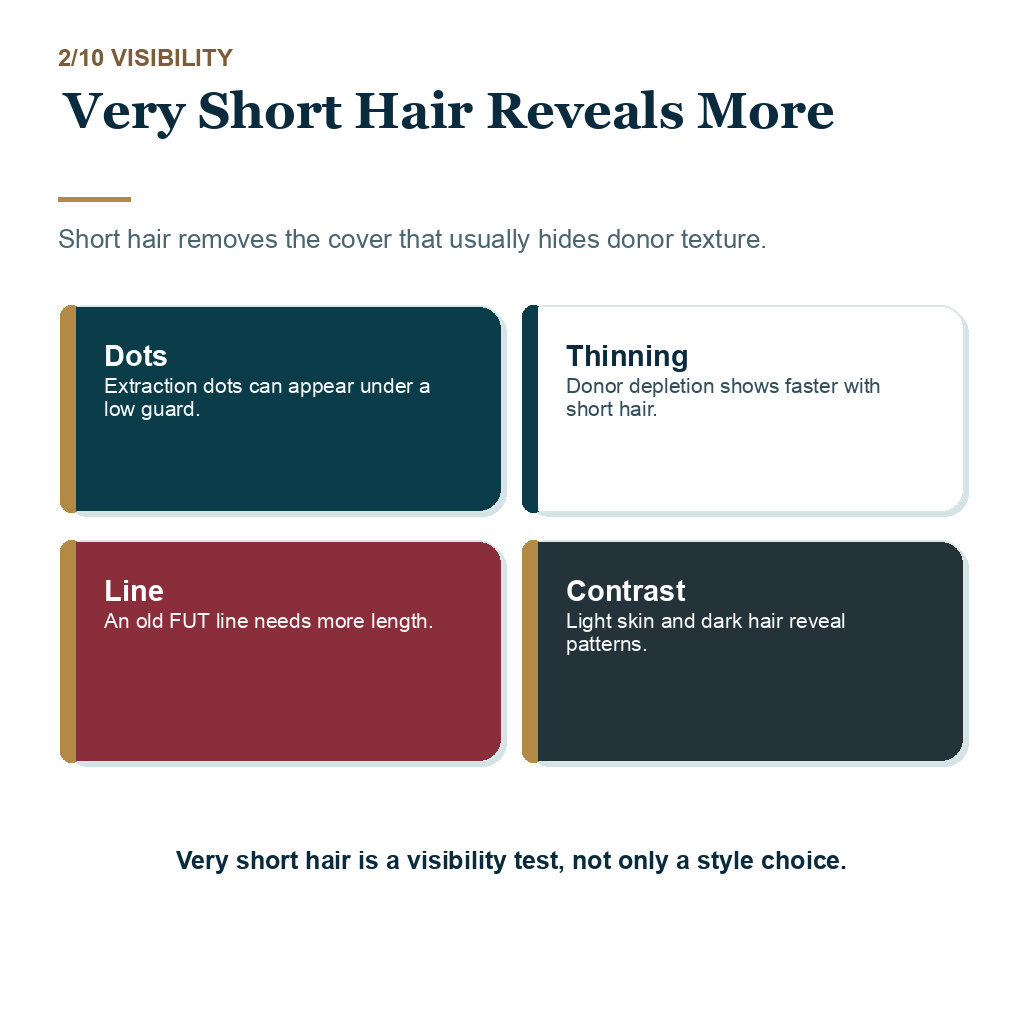
When hair is kept longer, it creates coverage, shadow, and softness. When it is cut very short, the scalp becomes clearer. The donor pattern, the extraction pattern, the density of remaining hair, and even small color differences in the skin can become easier to see.
This matters most with a clean shave, a zero guard cut, or a very tight buzz cut. The patient may not notice much under soft bathroom light, then suddenly see every detail under direct sun, phone flash, or harsh overhead lighting. Use lighting changes when judging a result as documentation, not as the only measure of the result.
In the recipient area, very short hair can also reveal planning choices. If the hairline was placed too low, too straight, or with thick grafts in the front, shaving will not hide the design. It may actually make the design easier to see. This helps explain why natural hairline design matters even for patients who say they only want a short hairstyle.
The recipient skin matters too. If grafts do not sit and heal flush with the surrounding skin, pitting, raised areas, or cobblestoning can remain visible. If shaving later is important to you, the discussion before surgery should cover the recipient surface as well as donor scarring.
A short style can look excellent when the plan is conservative and the donor is protected. It can also expose poor planning. Concentrated extraction, an overused donor area, or a hairline designed for a dramatic photo rather than normal life becomes much harder to hide with very short hair.

Realistic haircut lengths after FUE
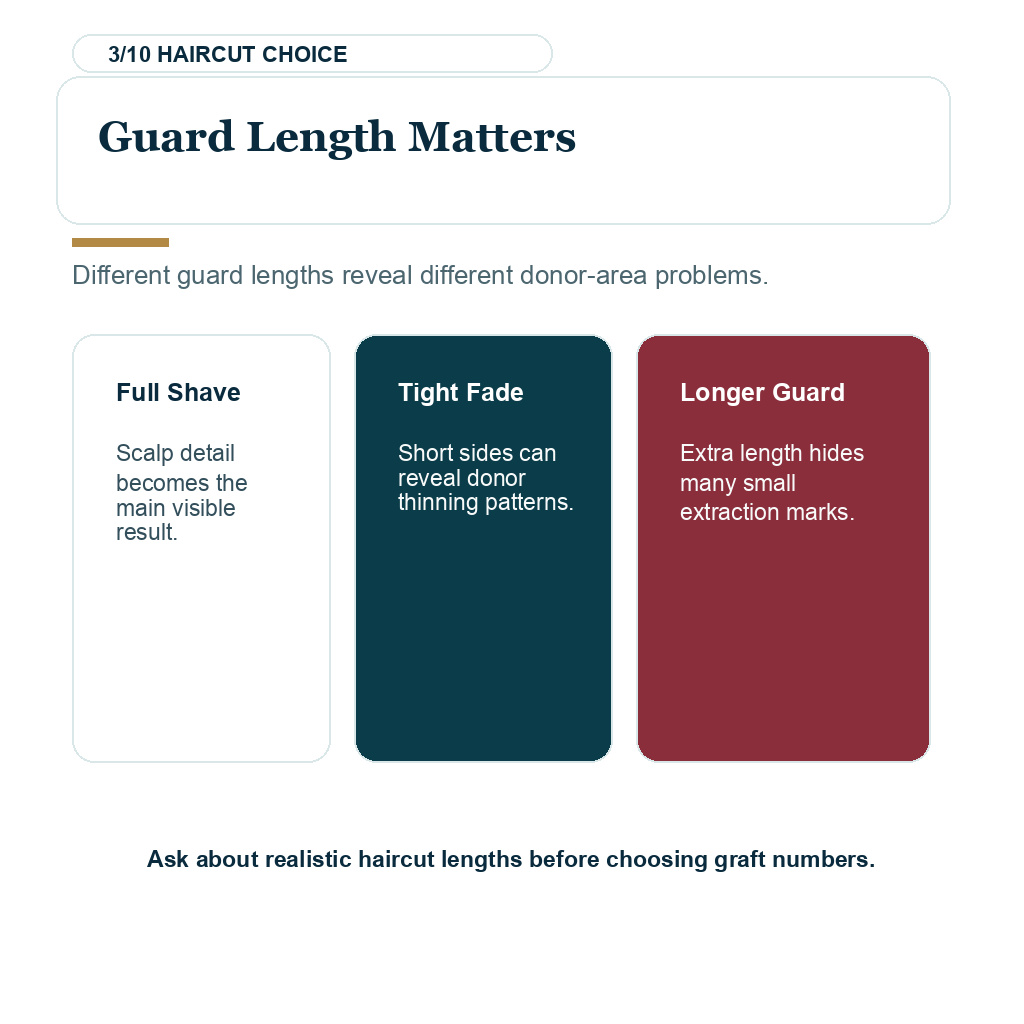
There is a big difference between a short buzz cut and a complete razor shave. Some patients may feel comfortable with a number 1 or number 2 guard after a carefully planned FUE procedure, especially if the donor was not overused and the extraction pattern healed evenly. But shaving the scalp completely to skin is a different matter.
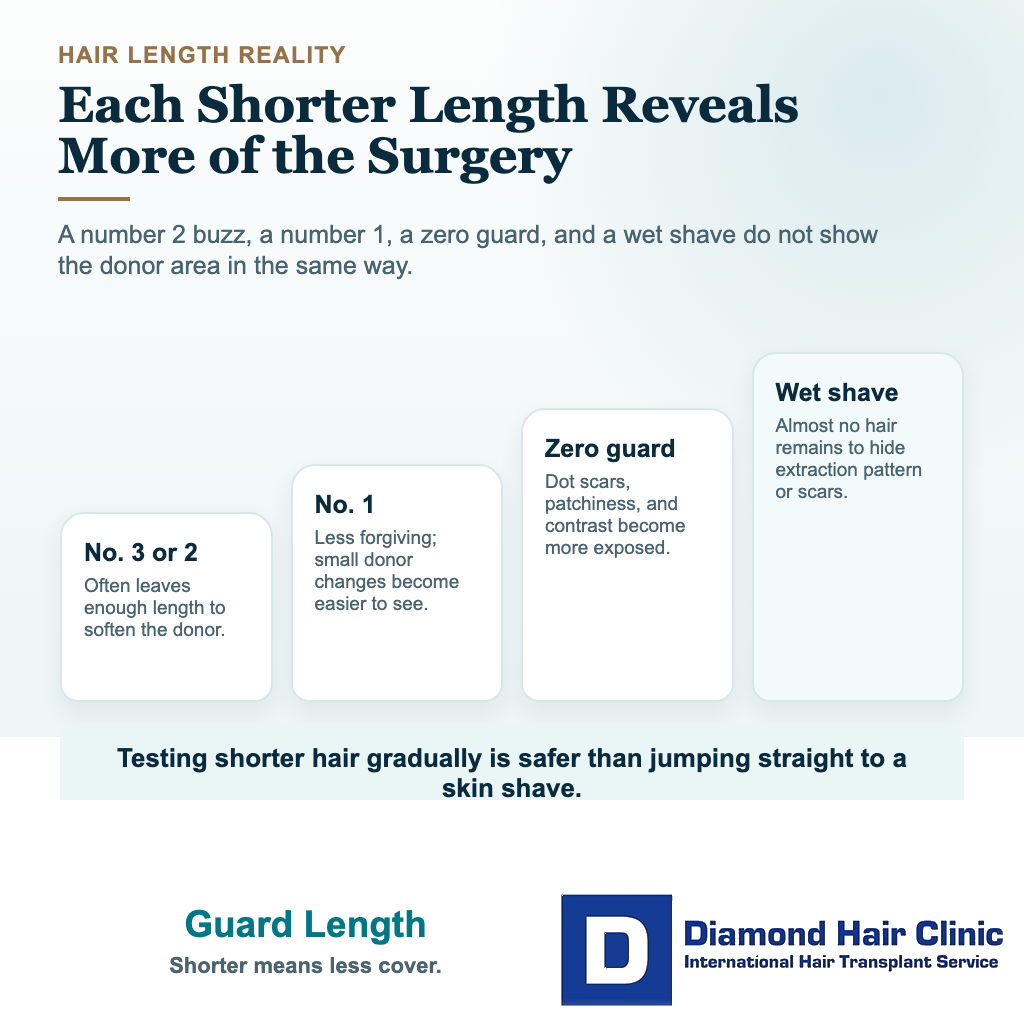
With a skin shave, there is almost no hair left to soften the donor area. Even small FUE dot scars can become easier to see. Some patients are not bothered by small marks, but that difference needs to be understood before surgery.
A number 2 guard may leave enough length to soften the donor. A number 1 guard is less forgiving. A zero guard or wet shave is much more revealing. The same donor area can look acceptable at one length and exposed at another length. Vague answers such as “you can always shave your head after FUE” are not precise enough.
A clearer answer is this. You may be able to keep the hair very short, but the closer you go to the skin, the less forgiving the donor area becomes. The safe expectation needs review before surgery, not after the donor pattern is discovered in a barber chair.
Testing shorter hair after the scalp has healed
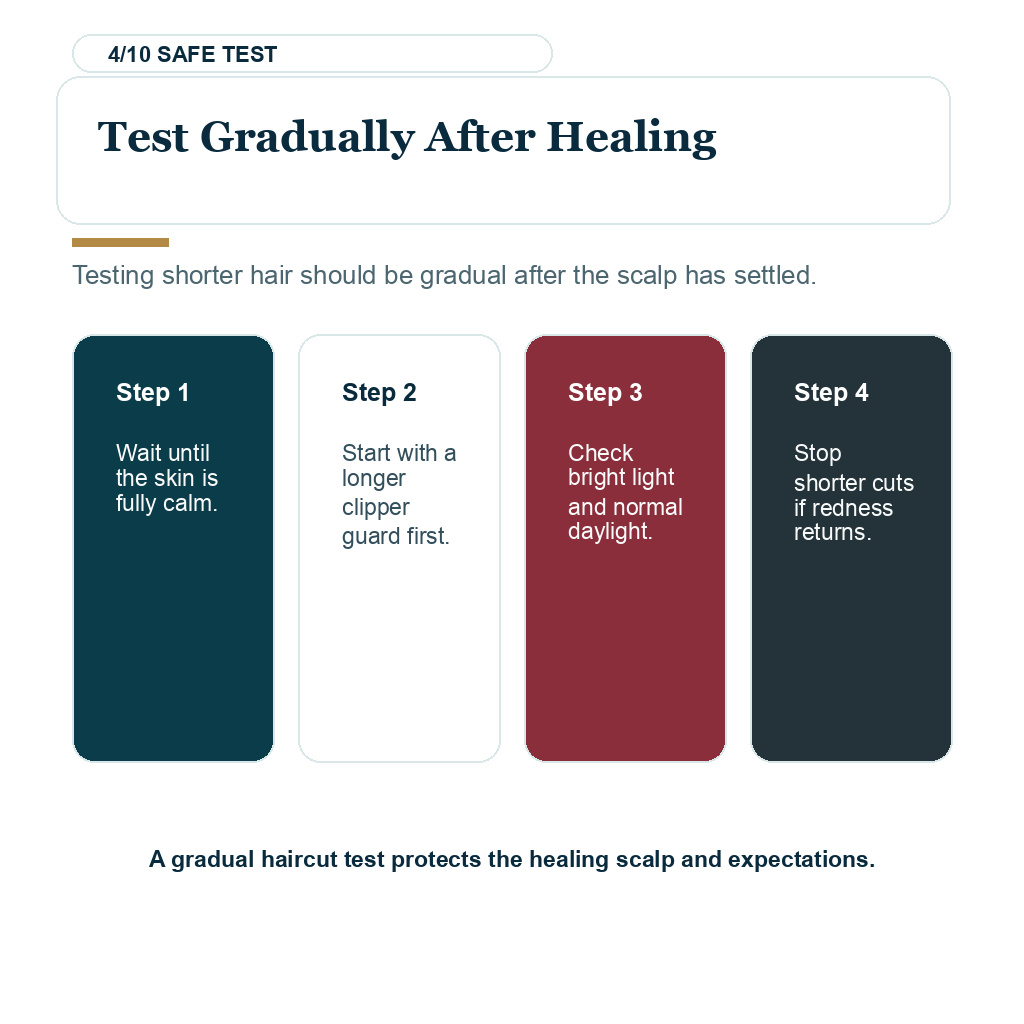
After the scalp has fully healed, shorter hair should be tested gradually instead of jumping from normal length to a skin shave in one appointment. This is not because cutting hair later damages the grafts. It is because the patient needs to see how the donor and recipient area behave at each length.
A number 3 guard may look completely comfortable. A number 2 may still look natural. A number 1 may start to reveal small donor changes. A zero guard or wet shave may show details that were invisible the week before. The same result can feel very different at different lengths.
Judge the result in normal daylight, bathroom light, and harsher overhead light before deciding whether a very short style suits you. Check the donor area from the back and sides, not only from the front mirror. The recipient area also matters, because a very short style can reveal hairline design, graft angle, and density transitions.
The same idea applies to whether the donor area looks normal after FUE. A donor that looks even at a moderate length may still show small extraction marks when shaved very close. That is not always a surgical failure, but it must be understood before the patient chooses the shortest possible haircut.
FUE scar visibility with a shaved head
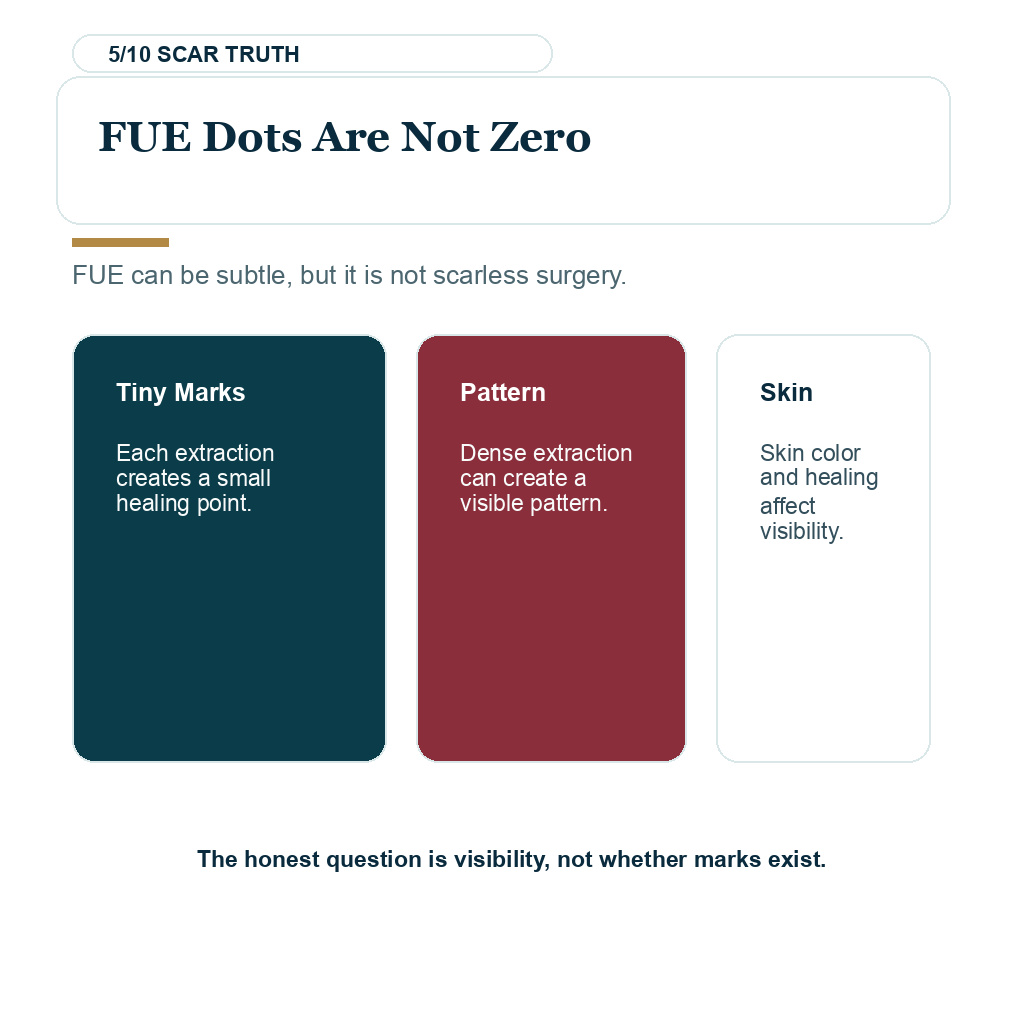
FUE does not usually create one long line scar, but it can create many small round or oval marks where follicles were removed. In a good case, these marks are tiny, scattered, and difficult to notice unless the hair is very short. In a poor case, they can look like pale dots, patchiness, or an uneven donor pattern.
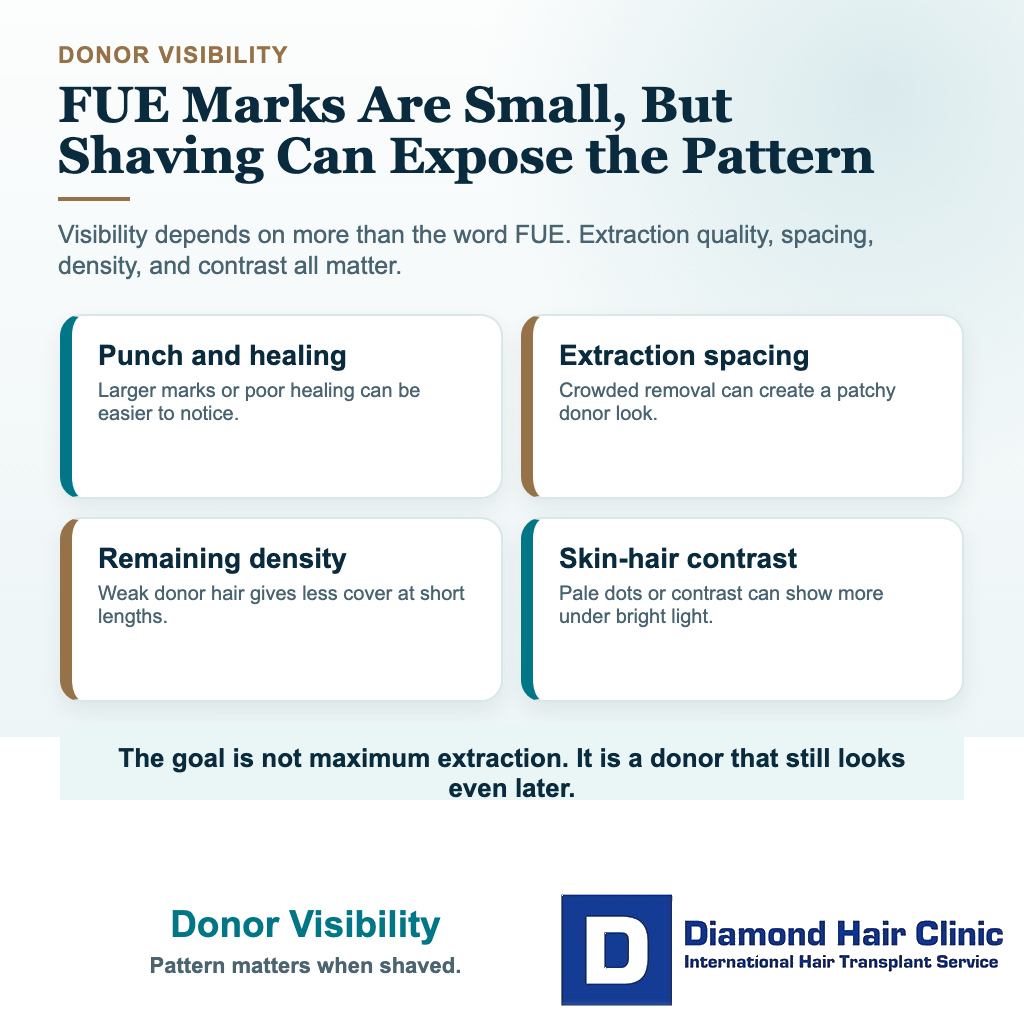
Whether FUE scars show depends on several details. A larger punch can leave larger marks. Poor spacing between extractions can make the donor look thinned out. Removing too many grafts from a limited area can create a see through effect. Healing quality also varies from patient to patient.
At Diamond Hair Clinic, FUE planning follows a clear principle. The goal is to take what the donor can give safely while still looking natural later, not the highest number that can be extracted in one day.
FUE hair transplant should be explained through planning and surgical judgment, not through tool marketing alone. A fine instrument does not protect the donor if the extraction plan is aggressive. The surgeon still has to decide where grafts come from, how many are safe, and what the donor should look like years later.
If you want the option of a very close shave after FUE, you should tell the surgeon before surgery. The plan may need to be smaller, more evenly distributed, or more conservative. A patient who wants to keep hair at medium length and a patient who wants the freedom to shave the head are not always planned in the same way.
Large FUE sessions can limit future shaving
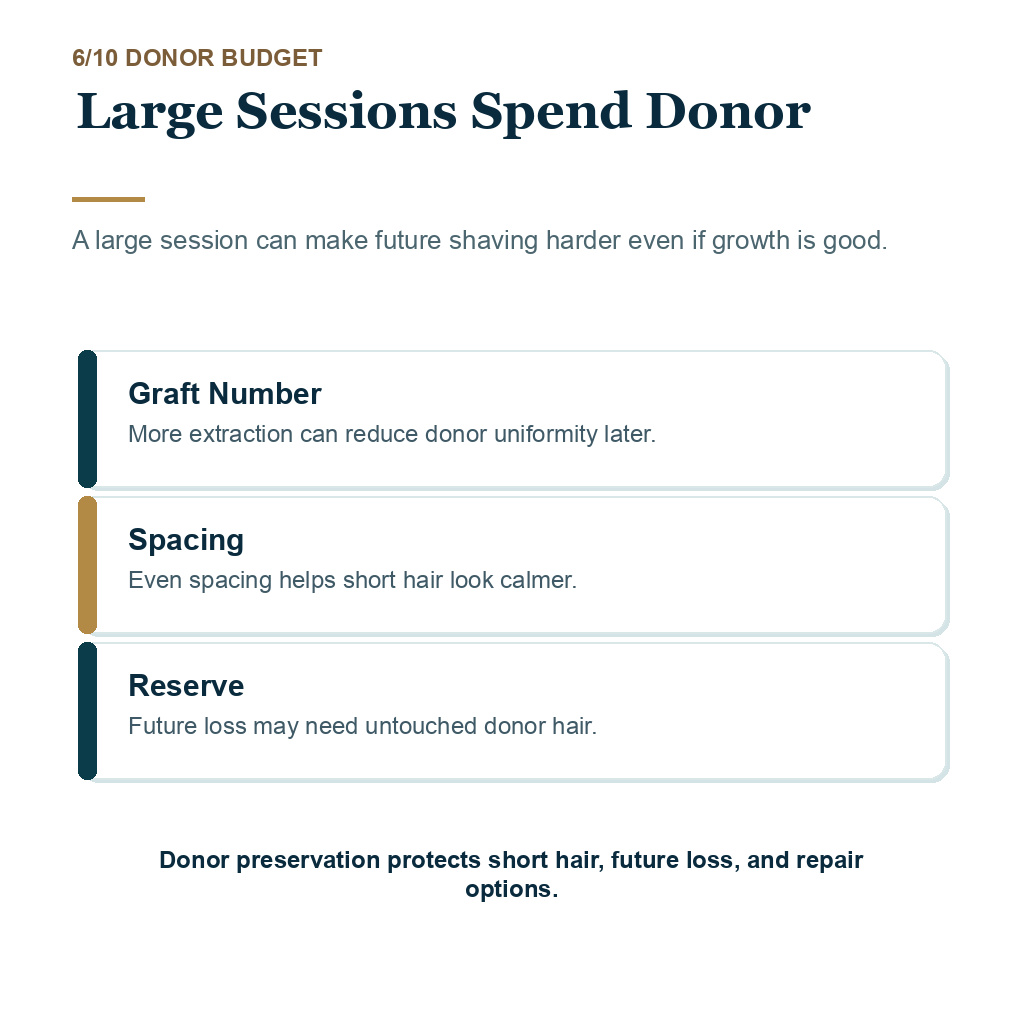
Large FUE sessions can be appropriate for specific cases, but they are less forgiving when the patient wants the option of shaving the head later. The issue is not only the number itself. The issue is whether that number is safe for that specific donor area.
If the plan is to create a subtle hairline, keep real stubble, and possibly use SMP later, I judge a very large graft plan more strictly. This is different from planning for a patient who will keep longer hair over the donor. The extraction pattern, hairline strength, crown restraint, and written stopping point all matter because the donor may be tested later under a short guard.
Sometimes the safer first move is a staged, more conservative operation. That does not mean doing too little. It means using enough grafts to improve facial framing while leaving the patient able to judge donor healing, FUE dot visibility, and whether SMP is still needed before more reserve is spent.
A small, carefully distributed extraction pattern may remain visually quiet under short hair. A very large extraction, especially if it is concentrated or pushed beyond the safe donor capacity, can make the donor look thinner when the hair is cut short. For a patient who values the option of shaving later, the graft number should be conservative enough to protect not only today’s result, but also tomorrow’s hairstyle freedom.
A very large graft number used as the main selling point deserves caution. A high graft count can sound exciting before surgery, but the patient lives with the donor area after surgery. If the back of the head becomes patchy or depleted, the patient may lose the simple option of cutting the hair short.
A responsible graft number is not the maximum number that can be removed. It is the number that can be removed while still respecting the donor, the future hair loss pattern, and the patient’s possible hairstyle choices later in life.
FUT scars are harder to hide with a shaved head
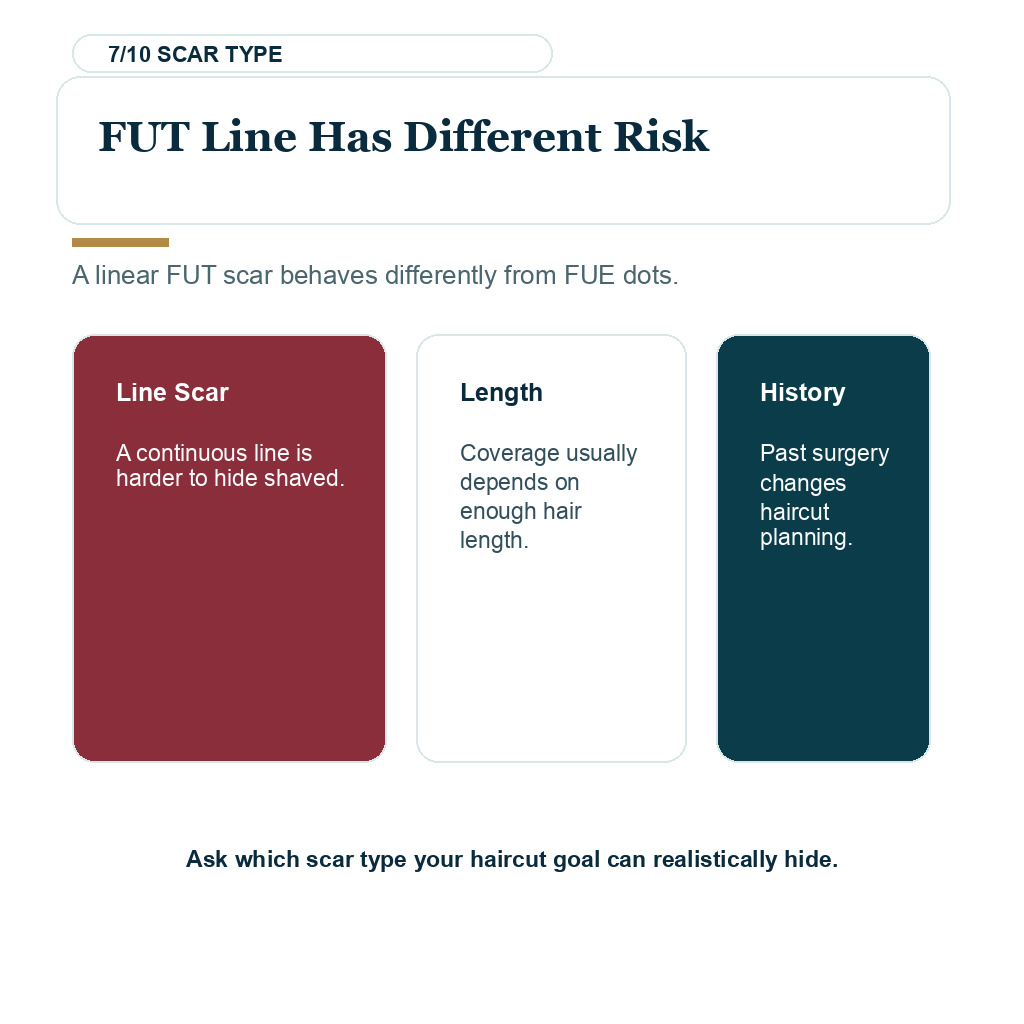
In general, yes. FUT can be harder to hide with a shaved head because it leaves a linear scar in the donor area. A good FUT scar may be very fine when the hair is kept at a reasonable length, but when the scalp is shaved close, a line is often easier to notice than small scattered FUE marks.
FUT can still have a role in specific cases, especially when donor preservation across multiple sessions is being discussed. But a patient who wants the option of shaving the head very short should be very careful before choosing any method that creates a linear scar.
FUT hair transplant is a real surgical method with advantages and disadvantages, not something to praise or dismiss blindly. Method choice is not only about which option gives more grafts. It has to fit the patient’s future lifestyle, donor capacity, scar tolerance, and long term hair loss pattern.
If a patient already knows they may return to a shaved head in the future, consent needs to include that goal. Even a well healed FUT scar can become visible with a very short shave. Scar revision, SMP, or longer hair may help, but they do not make the original decision disappear.
Hair transplant can make shaving harder later
It can, especially if the patient was not a good candidate, if the donor was overused, or if the hairline was designed without long term thinking. This helps explain why I do not treat hair transplantation as a simple cosmetic purchase.
A patient may have a transplant at 28, enjoy the result for several years, then continue to lose native hair behind the transplanted area. If the new hairline is low and strong but the mid scalp and crown continue to thin, shaving may reveal a pattern that does not look natural. The transplanted hairs may remain, but the overall scalp may no longer look balanced.
A front hairline shadow needs a future loss plan
Some patients ask for a different version of the shaved head plan. They do not want full coverage. They want a small amount of real hair in the front, then they plan to shave the whole scalp so the hairline leaves a shadow.
I understand the idea, but I would be careful. If the front is transplanted too strongly and the mid scalp or crown continues to thin, a shaved head can show a dark frontal border with weaker hair behind it. That can look less natural than a softer plan or no surgery at all.
Shaving can also reveal a dense or raised transplanted edge rather than hide it. If the front line looks too sharp, feels firm, or casts a visible border, I review the design and skin texture before advising SMP, laser, punch out, or another surgery. That is when the discussion may need to move from haircut planning into bad hairline graft removal or a separate raised texture review.
This question becomes more important when the patient does not want finasteride, minoxidil, or another long term treatment plan. I do not force medication on every patient, but hair transplant planning without finasteride usually needs a more conservative hairline, more donor reserve, and a clear answer about what happens if native hair keeps thinning.
SMP can sometimes soften scalp contrast, but it should not be used to justify a hairline that is too dense, too low, or too sharp for the patient’s future pattern. If the goal is a shaved style, the real test is not only whether grafts can create a shadow today. It is whether that shadow will still look natural when the rest of the scalp changes.
Another problem is donor depletion. If too many grafts were removed, shaving the donor short may reveal patchiness. This can make the patient feel that they lost the simple escape option of shaving everything down. The patient chose surgery to feel freer, but the surgery made them more dependent on a certain hairstyle.
When the donor looks thin after a very large FUE session, shaving closer can make the concern stronger instead of clearer. I first test a slightly longer guard and look at both sides in normal light. If the donor only looks acceptable at one exact length, that haircut dependency is part of the result and should be included in any repair or SMP discussion.
Donor area overharvesting is not a small technical detail. It can affect how the back of the head looks under short hair for many years. A high graft number may sound impressive before surgery, but an overused donor can become the part of the result that bothers the patient most.
The patient’s personality also matters. Some men can live peacefully with small FUE dots. Others inspect every mirror, every photo, and every haircut. Neither personality is wrong. But the surgeon must understand the patient’s expectations before choosing a plan that cannot be fully undone.
Donor management when shaving may matter later
If a patient may shave their head later, donor management becomes central to the plan. The extraction should be distributed intelligently, the graft number should be justified, and the donor should remain visually even under shorter hair. Surgery can still make sense, but only when the plan respects the donor as a limited lifetime graft supply.
The donor area is not a bank account that can be refilled. Once grafts are removed, they do not grow back in the same place. Careful planning is safer than aggressive harvesting, especially in younger patients, advanced baldness, fine hair, weak donor density, or patients who may need a second procedure later.
In consultation, donor density, hair caliber, contrast between hair and skin, future loss risk, family history, medication stability, and the size of the area that truly needs coverage all need review. The preferred future hairstyle also belongs in the discussion. A plan that works for longer hair may not be ideal for a shaved head.
An unsure patient needs time before a large session. Sometimes a smaller, more strategic surgery is safer. Sometimes medication deserves a trial first. Sometimes waiting protects the patient better than operating immediately. If the plan only makes sense when everything goes perfectly, it is not a strong plan.
This belongs inside the question of being a good candidate for a hair transplant. Candidacy is not simply hair loss plus the budget for surgery. The donor, expectations, age, hair loss pattern, and future options all have to support the plan.
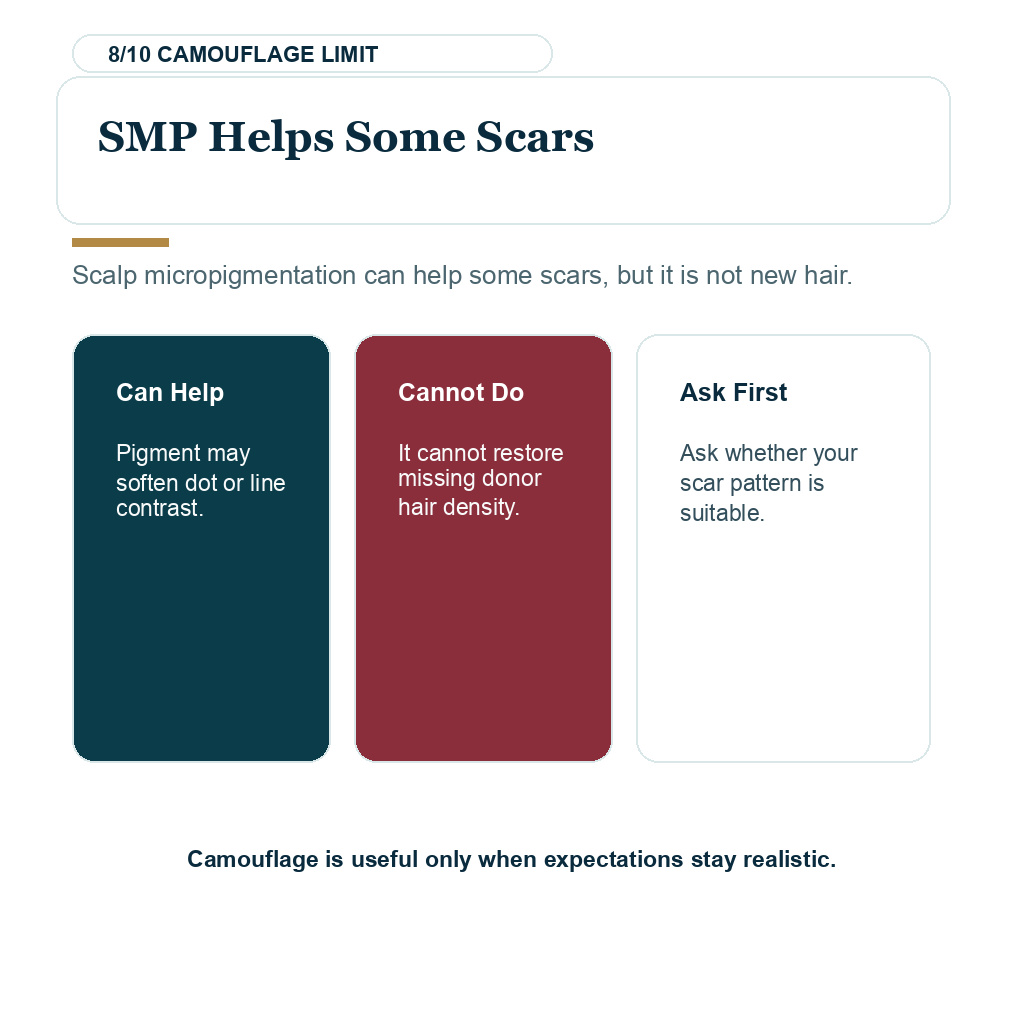
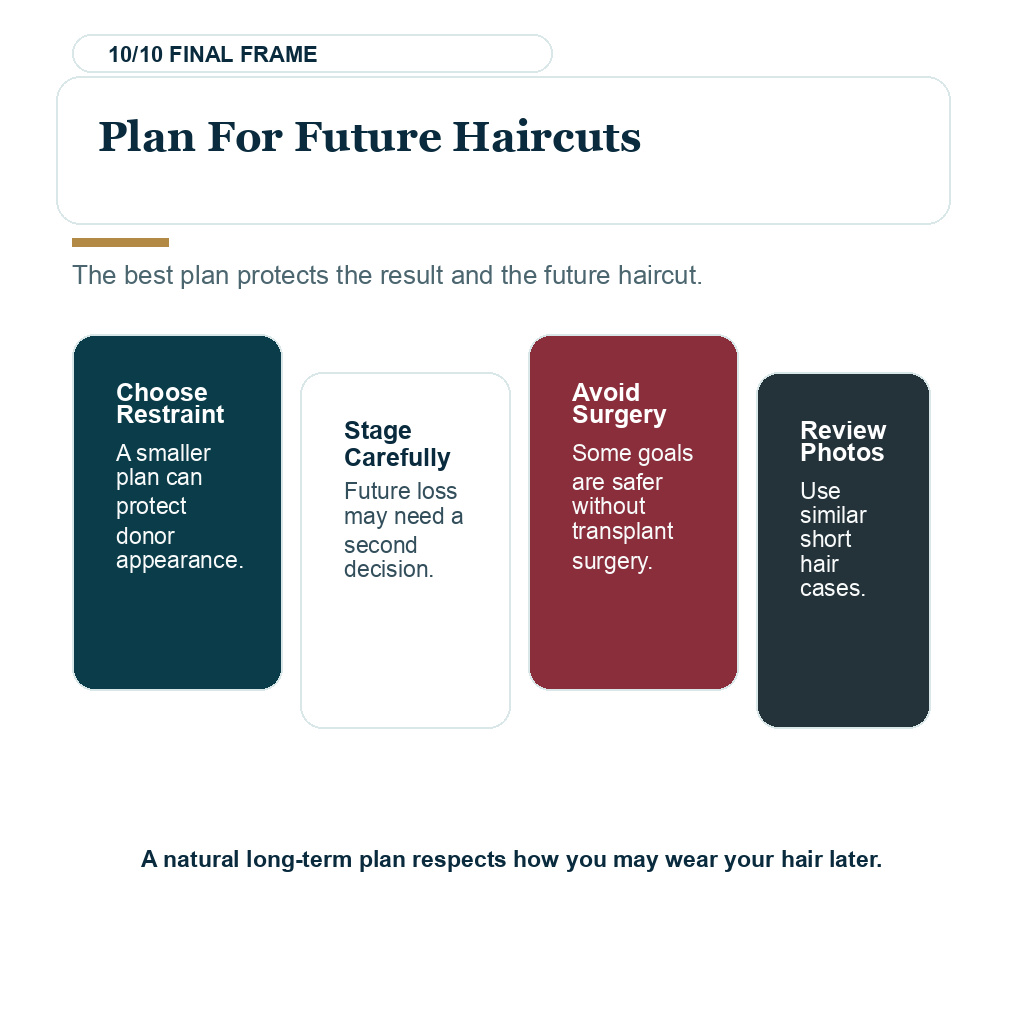
Use the 10 shaved head planning slides below to separate haircut length, FUE dot visibility, donor thinning, FUT line risk, large session donor spending, SMP limits, and the surgery planning decisions that matter before surgery. Swipe the carousel, use the arrows one step at a time, or choose a number below the image to jump to that point.

Early shaving is different from shaving years later
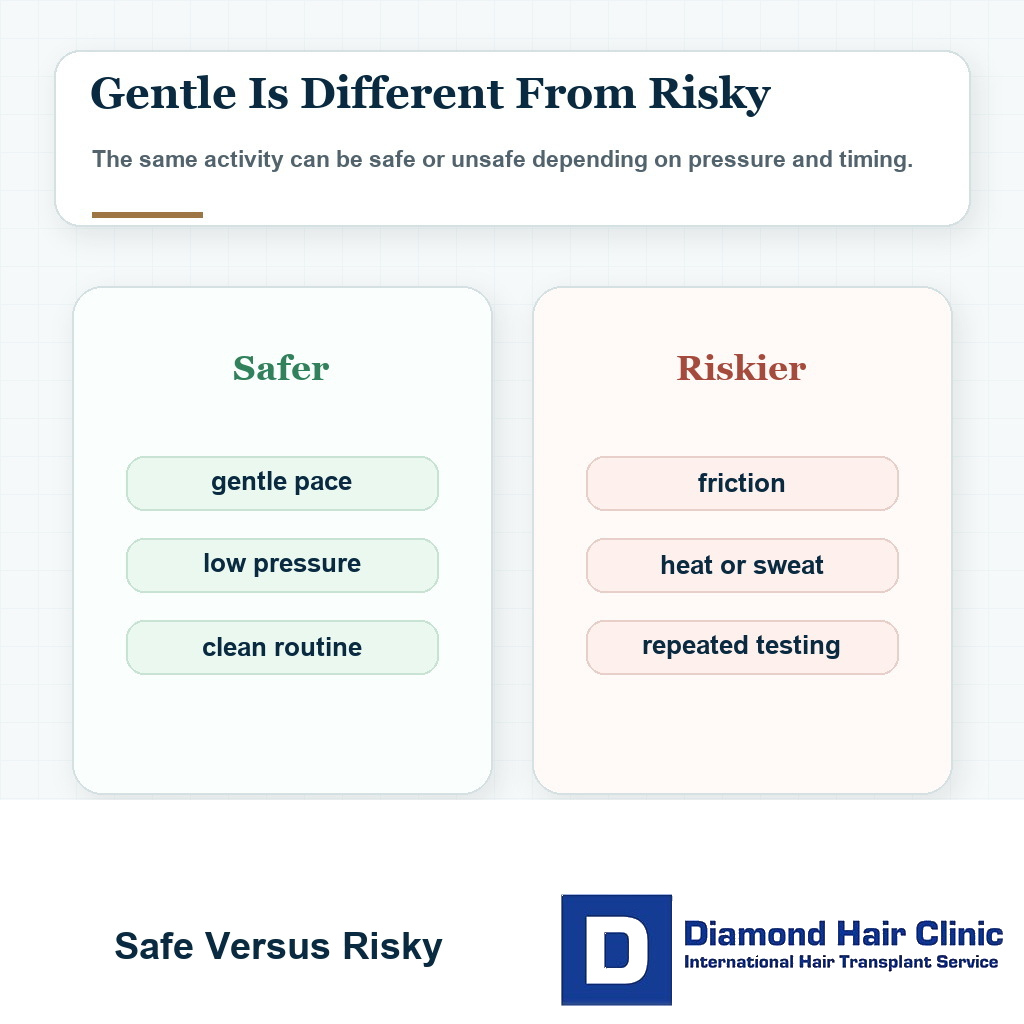
There is a difference between shaving the head years after a transplant and cutting the hair short during the early recovery period. The early scalp is still healing. The recipient area, donor area, and deeper tissues may not be ready for normal barber pressure, close clippers, or irritation.
Early haircuts need caution. The scalp needs protection while healing is active, especially in the first weeks. The exact timing can vary by healing, surgery extent, and clinic instructions. The hair transplant aftercare guidance explains why gentle handling matters, and when to get a haircut after a hair transplant gives the separate sequence for scissors, clippers, guards, and very close shaving. If there is any uncertainty, ask the surgeon who performed the operation before using clippers.
If your question is about the ugly duckling phase, uneven growth, or looking presentable while the transplanted hairs shed, buzz cut after hair transplant is the more relevant recovery topic. The bigger lifetime question is whether shaving remains a comfortable option after the scalp has fully healed.
Years later, the decision can also come from being tired of camouflage. A patient may have a transplanted hairline that still frames the face, while the top slowly becomes lighter despite finasteride, oral minoxidil, or careful styling. This alone does not prove the transplant failed. Native hair can keep miniaturizing even when transplanted grafts are growing, so continued hair loss after a hair transplant should be reviewed before deciding that stubble, SMP, or another operation is the answer.
In this situation, I want to see the scalp plainly. I ask for matched photos without fibers or powder, donor area photos, the medication history, timing since each operation, and any itching or irritation from topical products. A transplanted front can help frame the face at stubble length, but very short hair may also expose a darker front against a lighter midscalp or crown. If scalp is still visible through the top, the same judgment applies before deciding whether another surgery would help. Donor reserve, scalp health, and the haircut length the patient can realistically wear matter more than the wish to stop using concealer.
For some patients, the practical path is testing longer clipper guards before going shorter, reviewing medication with the prescribing doctor, discussing a conservative second session if the donor area allows it, SMP, a hair system, or accepting the shaved look. This is different from using hair fibers after a hair transplant to hide visible scalp for a while, and it is also different from the longer maintenance decision between wearing a hair system and choosing more transplant surgery.
The two topics are related, but they are not the same. Early haircut timing is about protecting healing grafts and skin. Lifetime shaving is about scars, donor management, hairline design, and whether the surgery still leaves you with choices later.
Scalp micropigmentation can help some visible scars
Scalp micropigmentation can sometimes help reduce the visual contrast of FUE dots, a thin donor area, or certain scars. It can make the scalp appear less pale between short hairs. For some patients who prefer a shaved look, it may improve the appearance enough to feel more comfortable.
But SMP is not a magic repair. It does not restore donor follicles. It does not reverse overharvesting. It does not make every scar invisible. It also needs skilled placement, good color matching, and maintenance over time. On scar tissue, pigment behavior can be less predictable than on normal skin.
Scalp micropigmentation after a thin hair transplant can be a possible camouflage tool, not permission to be careless during surgery. SMP can improve the illusion of uniformity, but it cannot give back the simple untouched shaved scalp appearance a patient had before surgery.
If a patient already has visible scars and wants to shave, SMP may be worth discussing. If a patient has not yet had surgery, protecting the donor from the outset is better. This is the difference between planning and rescue. Planning gives the patient more freedom. Rescue tries to reduce the damage after freedom has already been narrowed.
What the clinic should make clear before surgery
If shaving your head later matters to you, the consultation needs to be clear before surgery. The clinic needs to explain how short you are likely to cut the donor area after healing, whether FUE dot scarring may be visible with a close shave, and how the safe donor limit will be decided.
Surgical responsibility also needs to be clear before the patient chooses surgery. If shaving later matters, the donor extraction pattern, hairline design, recipient area creation, and safe stopping point all need surgeon-led judgment. That responsibility matters when you are judging who actually performs your hair transplant.
Be careful when the same graft number appears for almost everyone, the discussion focuses only on the front photo, or the clinic promises that you can always shave with no visible marks. Surgery always has a biological footprint.
Examples also need to match your situation. A patient with thick dark hair and medium length styling is not the same as a patient who wants a very close buzz cut. Look for similar donor density, similar hair color, similar skin contrast, and similar hairstyle goals.
Before paying a deposit, keep the option to pause. Donor limits, scar visibility, surgeon involvement, and long term planning need to be clear while there is still time to walk away. When choosing a clinic in Turkey, that same pause should protect the decision. Price, hotel, transfer, and a dramatic graft promise should never replace a serious surgical explanation.

Avoiding surgery can be wiser
It may be wiser not to have a hair transplant if you are only doing it because shaving makes you unhappy for a few months, but you are not ready for the permanent responsibilities of surgery. A transplant can improve the frame of the face, but it cannot remove every future uncertainty.
Caution increases when the patient has advanced hair loss, weak donor density, very high expectations, no willingness to consider medical stabilization, or a strong need for a perfect shaved appearance later. In these cases, the surgery may technically be possible, but still not wise.
Pause as well when the patient is already afraid they will regret surgery before they have even started. Fear alone does not mean surgery is wrong. But if the fear is about permanence, scars, future shaving, and loss of control, the consultation should slow down. The patient may need more education, more time, or a different plan.
Hair transplant regret after surgery is often connected to decisions that were not clear enough before surgery. Some regret comes from normal early anxiety. Some regret comes from real planning mistakes. The surgeon’s job is to reduce the second type as much as possible.
Sometimes the better path is a smaller hairline improvement. Sometimes it is medication first. Sometimes it is accepting a shaved head without surgery. Sometimes it is waiting until the hair loss pattern becomes clearer. Wanting surgery does not always mean operating immediately.
Short hair changes the donor discussion
If you may want very short hair in the future, say it before surgery. That changes how I think about donor harvesting, punch distribution, graft numbers, scar visibility, and how natural the hairline should look without styling.
A transplant can still fit a patient who may shave later, but only when the donor area, hair caliber, loss pattern, and expectations leave enough room. In other cases, the better answer may be to wait or avoid surgery.
The design should not leave you dependent on one careful hairstyle. It should still feel reasonable if your style changes, your hair loss progresses, or you decide one day that shorter is simpler.

Read this review excerpt
Upon arriving home, I sent 4 photos (of each side of head) after every washing process to doctor for checking where I was given personal advice for how to take care of my healing head.