


Scissors Clippers and First Haircut Timing
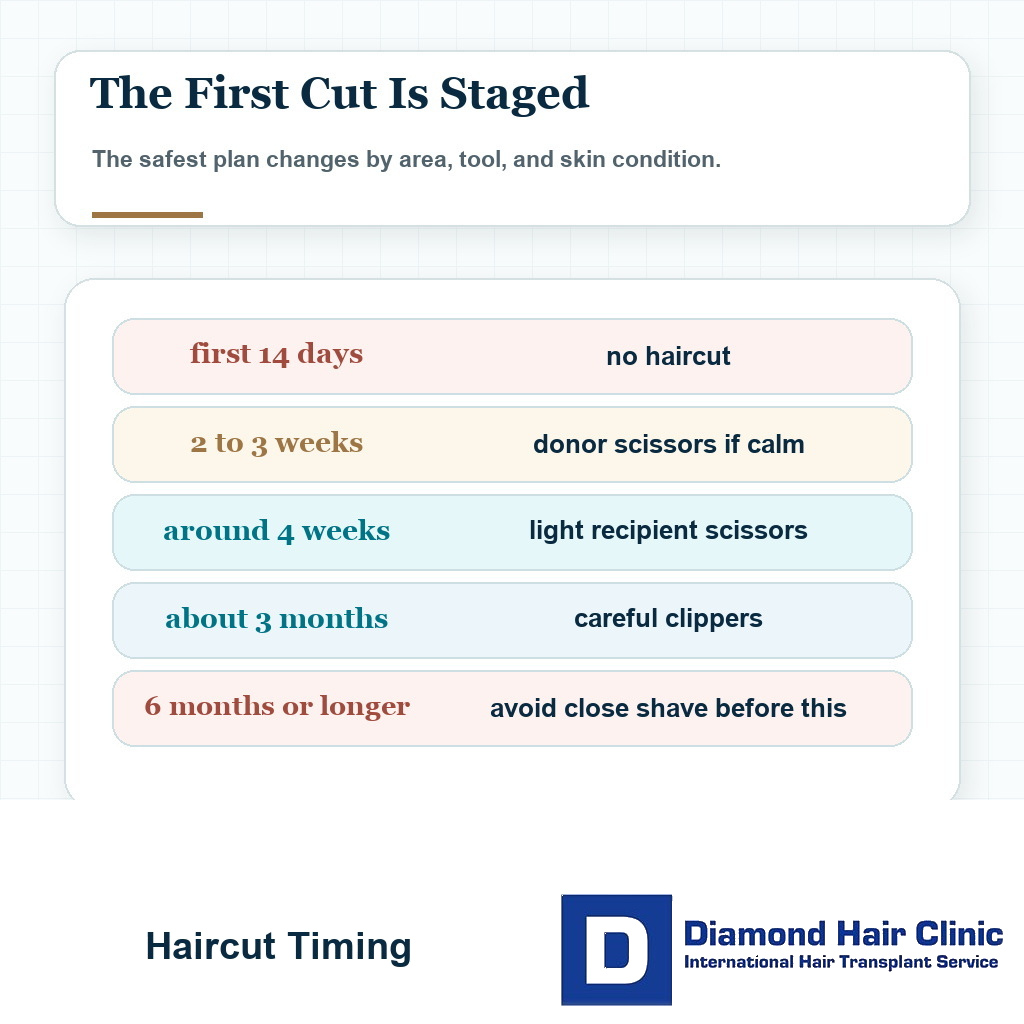
Start with a clear sequence. Do not get a haircut in the first 14 days after a hair transplant. If healing is normal, the donor area can often be tidied carefully with scissors after 2 to 3 weeks. The recipient area is usually better left until about 4 weeks for a light scissor trim.
Clippers on the recipient area are safer after about 3 months, and shaving the transplanted area very close should usually wait at least 6 months. Wait longer if there is redness, scabbing, pimples, irritation, poor healing, or donor sensitivity. The same delay matters for extensions after hair transplant, because clips or tension can disturb an irritated scalp. For braids after FUE, the issue is even more specific because tension and styling weight can matter more than the haircut calendar.
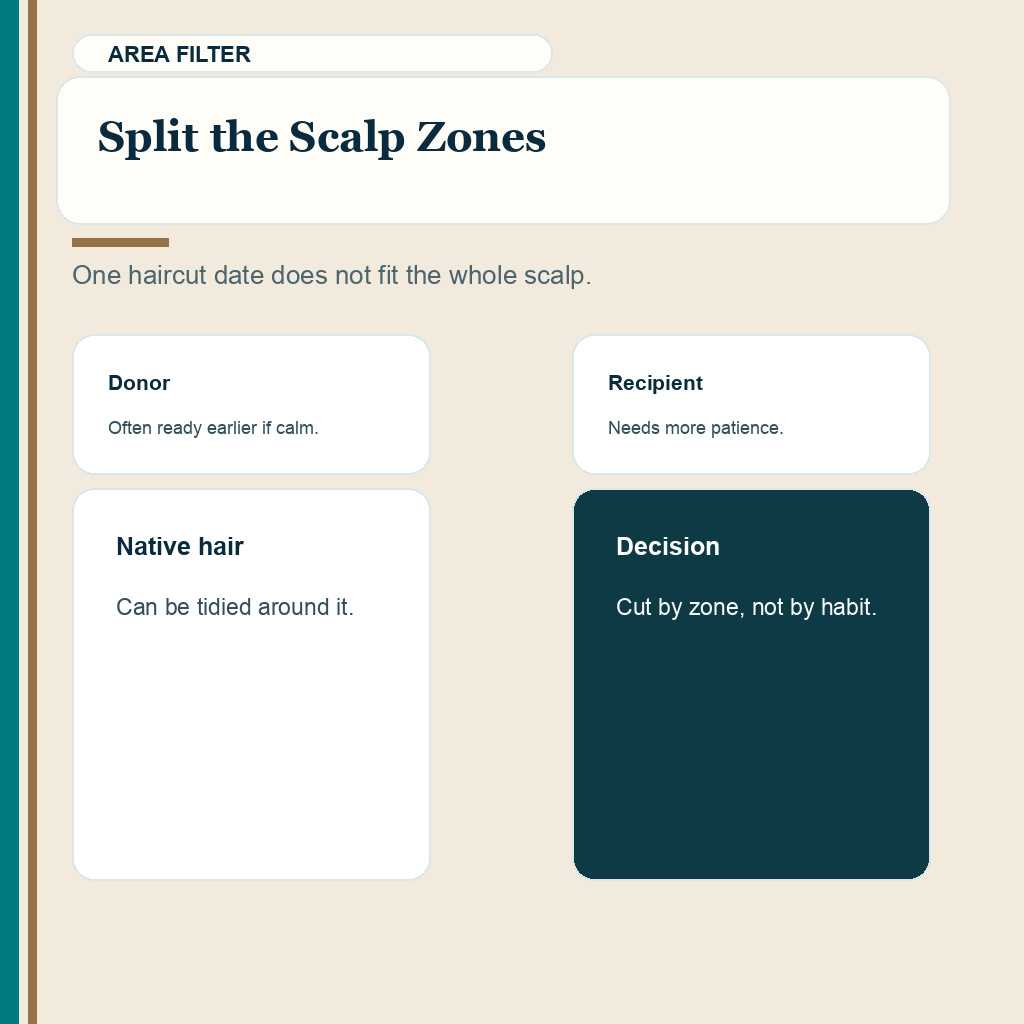
When advice conflicts, separate the donor, the recipient area, and untouched hair instead of asking for one haircut date. A tidy donor trim is a different decision from clipper teeth touching the grafted hairline, and the barber needs those boundaries before the chair reclines.
This question often comes early because recovery changes the way the hair looks. The donor area may be short, the recipient area may have crusts, and you may simply want to feel normal again or keep the recovery low profile.
A haircut is not only a cosmetic step after surgery. It can involve contact, vibration, friction, styling products, repeated combing, and pressure on healing skin. The first haircut needs planning, so the barber is not guessing near healing grafts. Include the timing for a hair dryer after a hair transplant in that first styling plan, because heat and airflow can add stress after the cut.
What matters is trimming hair length without disturbing the scalp versus using clippers, guards, razors, combing pressure, or repeated passes on healing skin.
By two weeks, uncomplicated grafts are normally much more secure than they were in the first days. That still does not mean every haircut tool is safe. A scissor tidy, a clipper fade, and a close shave are different levels of contact, so I do not treat them as the same decision.
Donor and recipient areas need different timing
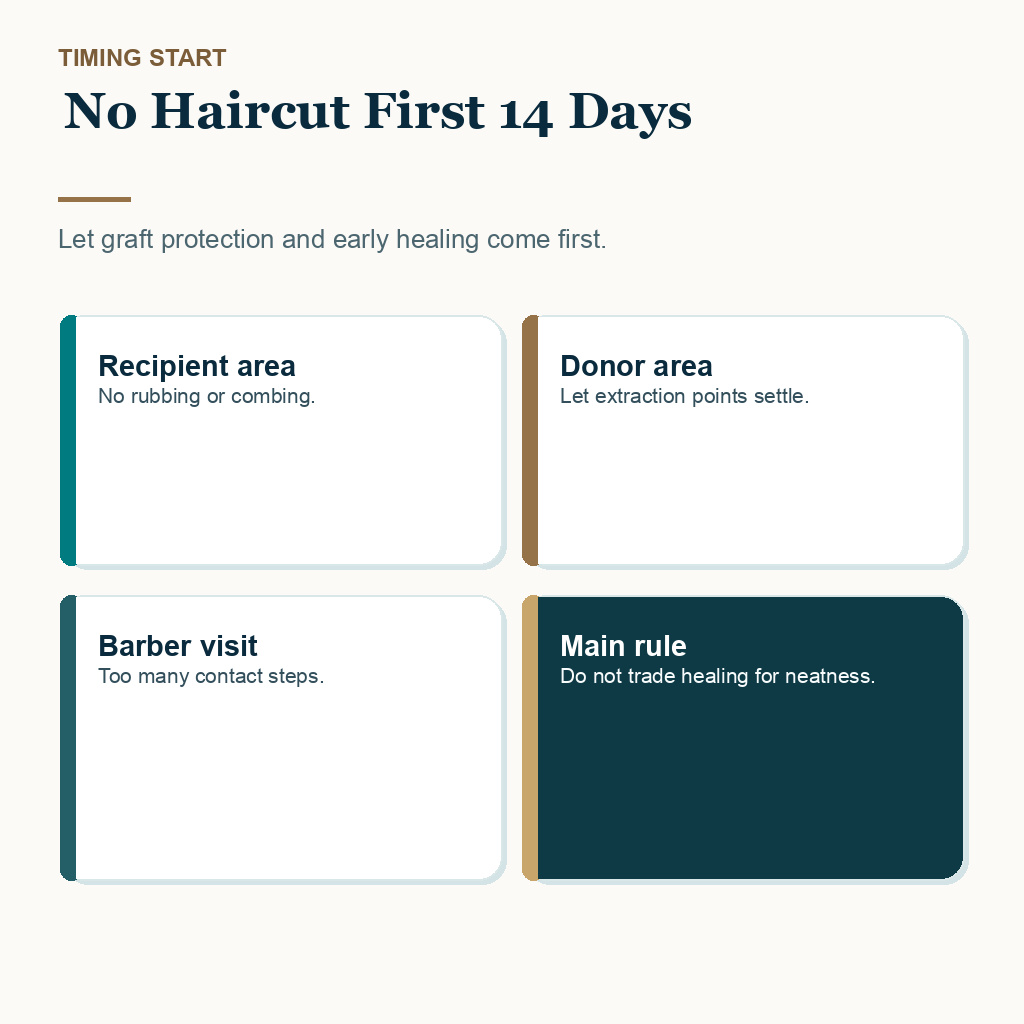
They are healing from different parts of the operation. The donor area has tiny extraction points. The recipient area has newly placed grafts that need protection, especially in the early period.
You may look in the mirror and see one head of hair, but surgically I see different zones. The back and sides, the frontal hairline, the mid scalp, and the crown do not all tolerate contact in the same way.
Advice that only says hair can be cut after two weeks is incomplete. The relevant details are the area being cut, the tool, the pressure, the hygiene of the guard, and whether the barber understands the transplanted and donor zones.
A barber who understands the surgery matters more than the date on the calendar. Explain which area was transplanted, where the donor was taken, and which tools must stay away from the skin.
Before the first haircut, explain the surgery zones before the barber reaches for tools. A comb, spray bottle, clipper guard, and neckline brush all need gentler handling when the scalp is still settling.
During the first 10 to 14 days, my priority is graft protection and controlled healing. That same early recovery logic is central to hair transplant aftercare.
The donor area often looks ready earlier because it does not contain newly implanted grafts. But ready does not mean careless. A clipper blade, strong fade, dirty guard, or aggressive rubbing can still irritate healing skin.
The recipient area deserves more patience. It is where the final cosmetic result is being built. Uneven hair for a few weeks is usually easier to accept than unnecessary trauma for the sake of a cleaner look.
Haircut timing before surgery needs review too, not only the first cut afterward. Some patients are planning a hair transplant before a wedding, business meeting, family visit, or return to office date. These details can change how we prepare the patient emotionally for the first month.
If someone needs to look presentable quickly, they should not discover the haircut limits after the operation. They should understand the recovery window before they book travel and work plans. This type of planning belongs in what should be clear before committing to a hair transplant.
If your job or training requires a very short haircut, make the required length and return date part of the recovery plan before booking. Show the surgeon how short the hair must be and the date it will be cut. When that schedule would bring clippers or a razor onto healing skin, the operation date may need to move rather than assuming the haircut can be delayed.
Donor area haircuts can come earlier
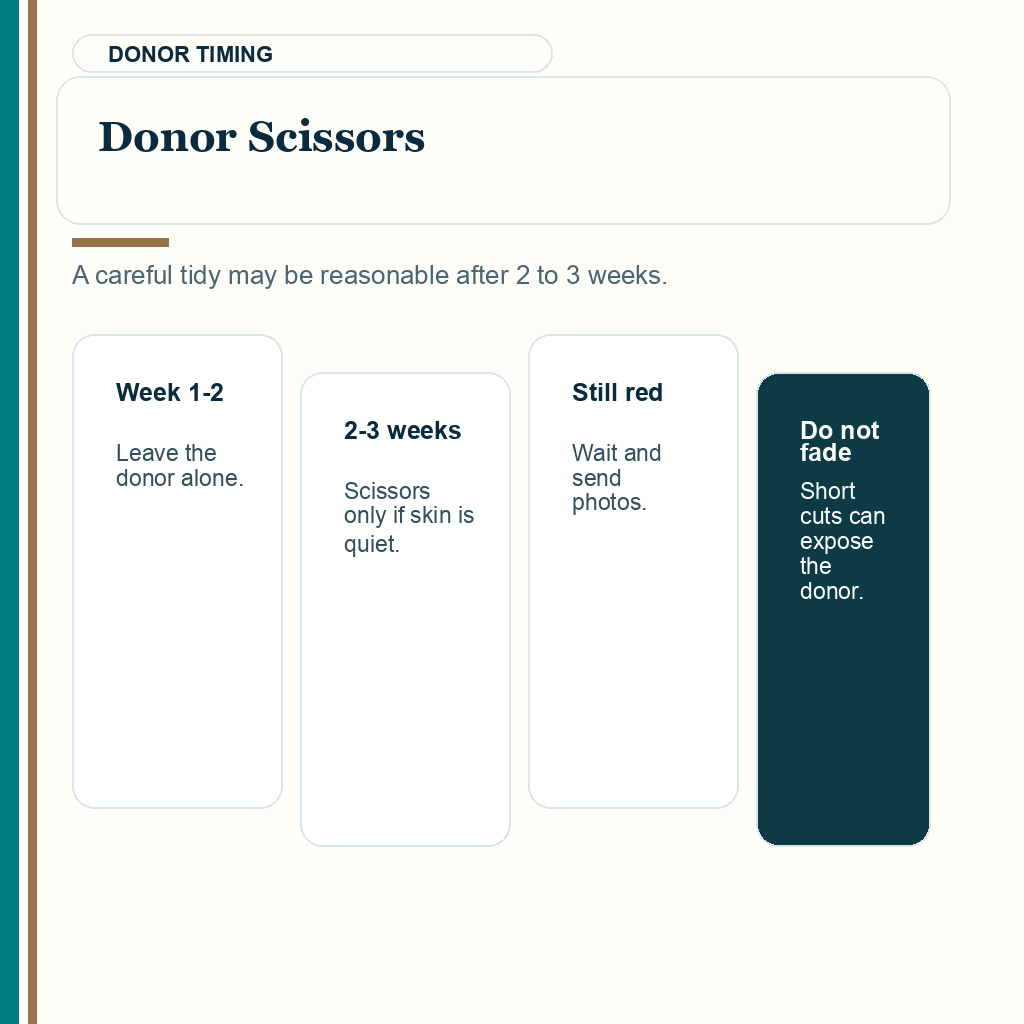
The donor area can often be cut earlier than the transplanted area, but only if it has healed well. Commonly, a careful scissor tidy after 2 to 3 weeks is reasonable. I still avoid pressure, scratching, or aggressive clipper work.
Delay the haircut if the donor area has redness, tenderness, pimples, thick scabs, open spots, or unusual pain. The date helps, but the skin has the final vote.
Many patients ask for a fade because the donor hair grows unevenly and the extraction zone feels visible. That wish is understandable, but a fade is clipper work, not just a small tidy. It requires contact, repeated passes, and a guard that may press directly over healing skin. It can also make the donor area look more exposed if the hair is cut too short. After healing, the next decision is whether short hair after FUE will reveal donor scars or thinning, not only whether clippers are safe.
It matters because donor appearance changes with length. Short hair shows more. Slightly longer hair often blends better. The same length issue matters when judging whether the donor area looks normal after FUE hair transplant.
Sometimes the best early haircut is not a haircut at all. Sometimes it is simply waiting until the donor hair grows enough to blend naturally.
When I plan surgery, I focus less on a perfect donor fade in the third week and more on donor skin that heals without irritation. Quiet healing gives a better foundation for the months ahead.
When the donor area still feels hot, sore, bumpy, or unusually sensitive, I avoid a barber trying to solve that with a fade. The right response is to let the skin calm down and, if needed, share photos for review.
The donor area can look very different depending on hair length and light. Cutting it shorter may not hide it. Sometimes a shorter cut makes the contrast stronger and creates more worry.
Scissors after surgery
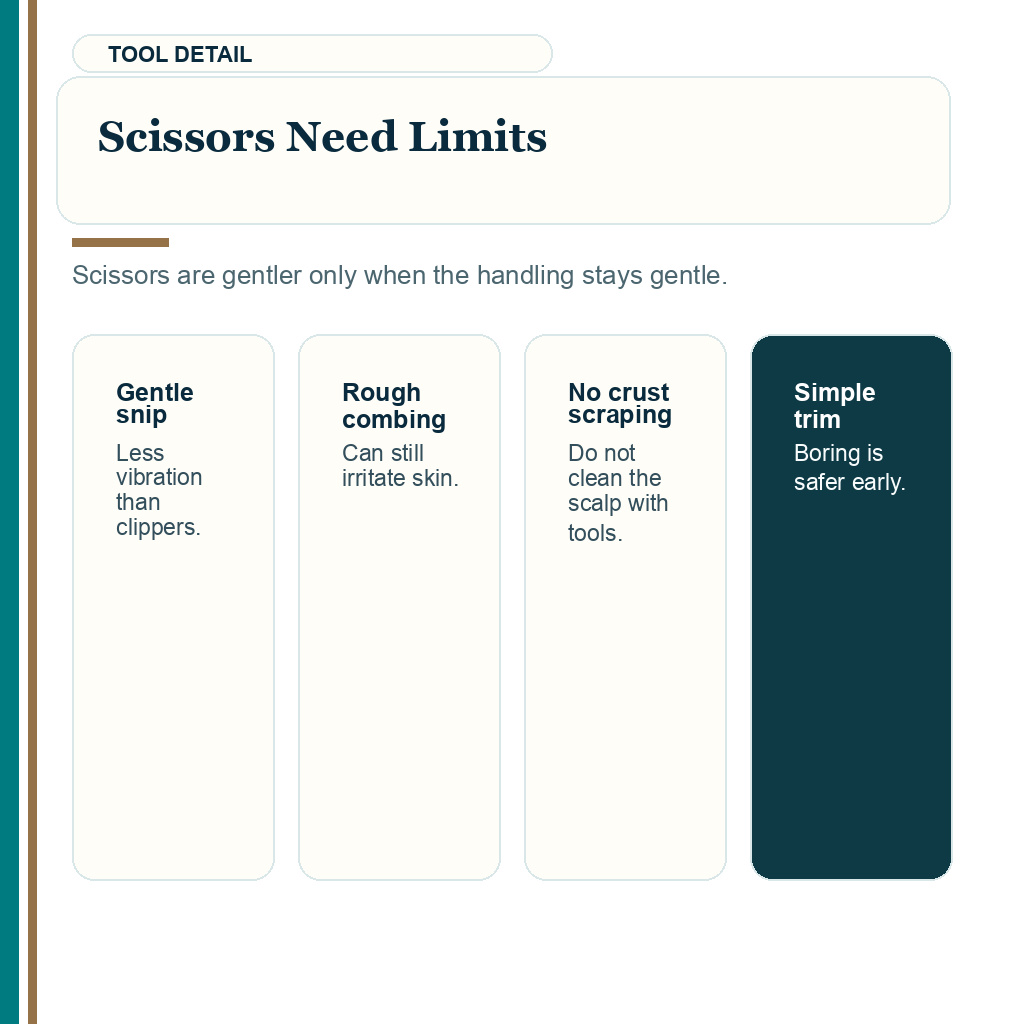
Scissors are usually safer than clippers because they can trim length without vibration and without dragging over the scalp. Still, scissors can be used badly if the barber pulls hair, combs aggressively, or presses against sensitive areas.
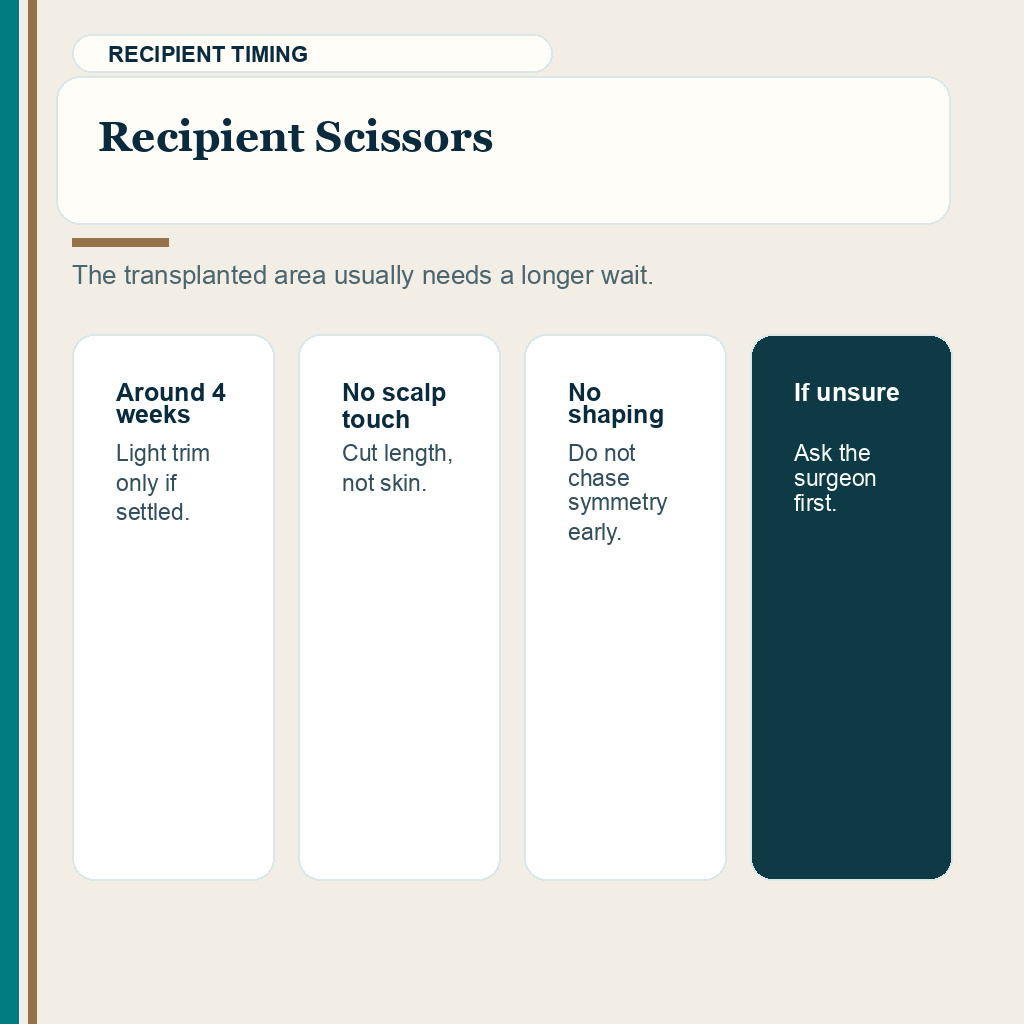
For the donor area, a gentle scissor tidy is often possible after 2 to 3 weeks if healing is normal. For the recipient area, waiting about 4 weeks is usually safer before any light scissor trimming, and even then the barber should avoid touching the scalp directly.
A scissor trim is only for cutting length. It must not scrape crusts, disturb healing skin, or try to shape the transplanted hairline too early.
Many patients become impatient because the transplanted hairs may grow briefly and then shed. They want to even everything out. That is understandable, but the early appearance is temporary.
In the first month, styling perfection is the wrong priority. The haircut plan has to pass through the vulnerable healing period without avoidable irritation.
Have your surgeon review the scalp before the haircut. Include current photos, any tenderness or irritation, and the tools the barber plans to use.
The barber also needs to avoid wetting and combing the scalp aggressively. In the early period, even a normal salon routine can be too much. One gentle snip is rarely the issue. The repeated handling around it is. If a later trim causes a barber or clipper nick after FUE, stop the pass and check the skin before continuing.
The first scissor trim should be boring. No dramatic style change, no sharp shaping, no chasing perfect symmetry. The scalp has already had a real procedure and does not need a fashion project during early healing.
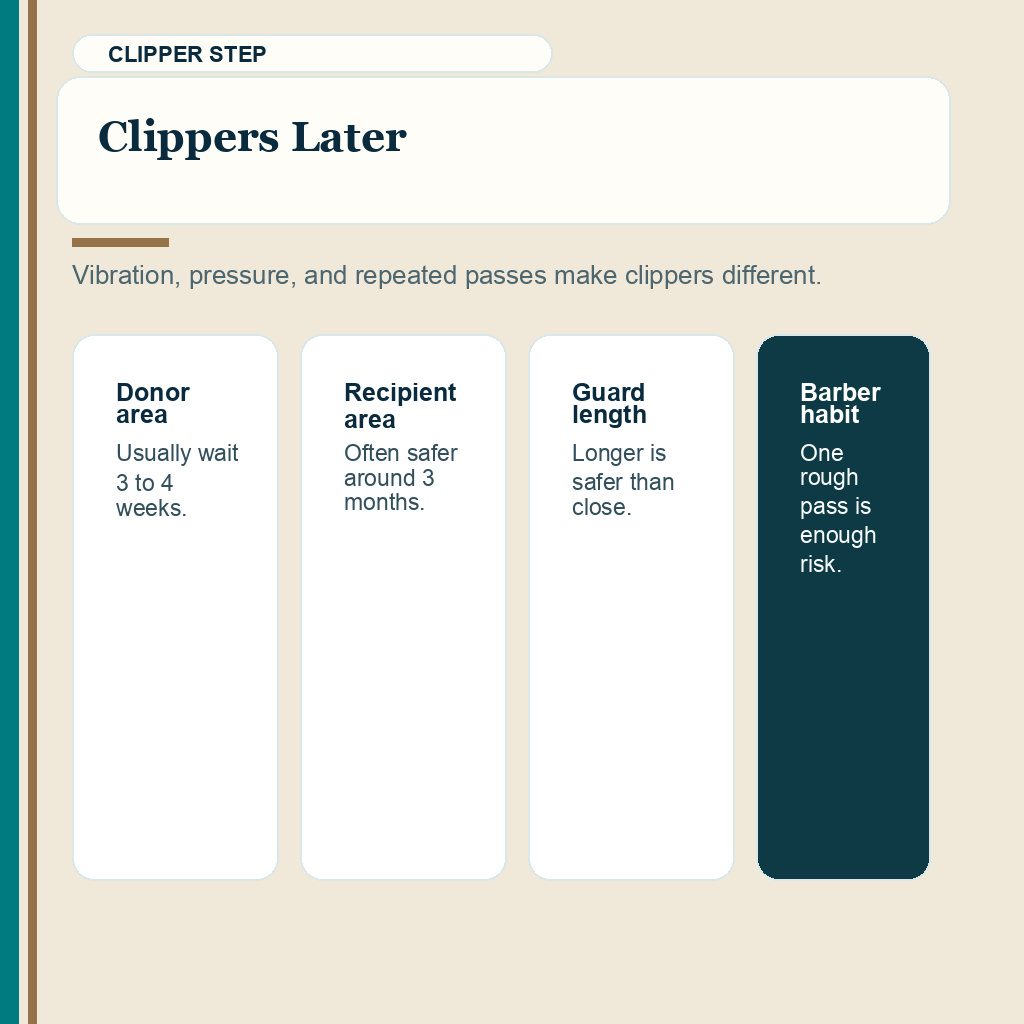
The 10 first haircut planning slides below separate the period with no haircut, donor and recipient timing, scissors, clippers, close shaving, barber instructions, delay signs, and staged planning. Swipe sideways, use the arrows one slide at a time, or choose a number below the image.

Cutting native hair while protecting grafts
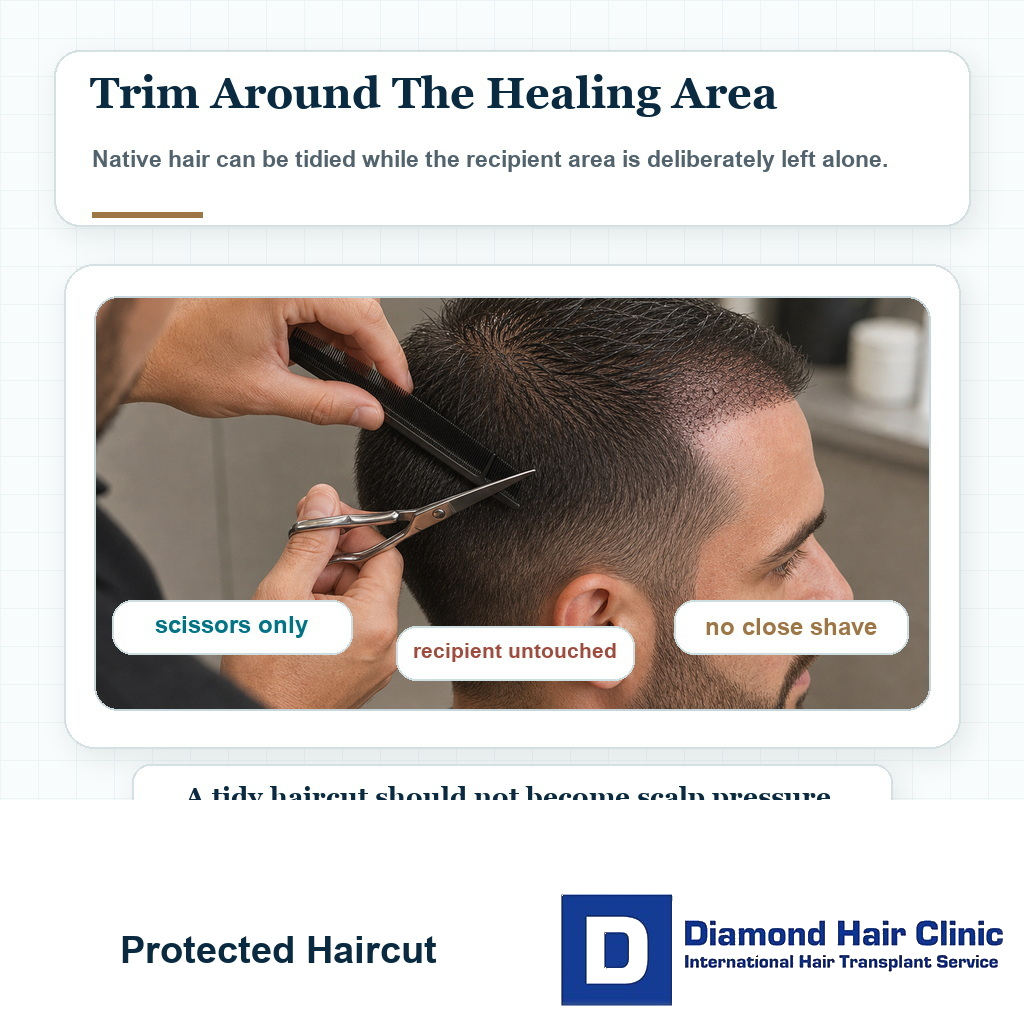
This is often the best compromise. The barber can tidy longer native hair, the sides, or the back while deliberately avoiding the recipient area until it is ready.
Long native hair can sometimes cover a frontal transplant without being cut, but it should not be dragged across crusts or used to test whether the grafts are secure. Keep it lifted away while crusts remain or the scalp is tender. Let it fall only when the clinic’s washing and crust removal stage is complete, the skin is closed and calm, and the hair can rest there without pulling, sticking, or repeated repositioning. One wash does not decide this by itself. The condition of the scalp does.
It matters because the patient may feel messy even when the transplanted area should not be touched. A careful trim around the healing zone can improve appearance without asking the grafted area to tolerate clippers, pressure, or repeated combing too early.
The instruction must be very clear. Do not comb through the recipient area aggressively. Do not pull hair close to the grafts. Do not use clippers near the new hairline just because the surrounding native hair looks uneven.
The haircut should make recovery easier, not force the whole scalp into one finished style before it is ready. A partial haircut can help when it respects the surgical zones.
Clippers after surgery
Clippers are a bigger step than scissors. On the donor area, waiting at least 3 to 4 weeks before careful clipper use is usually wiser, and only if the donor skin is quiet. On the recipient area, about 3 months is usually a safer point before clippers touch the transplanted zone.
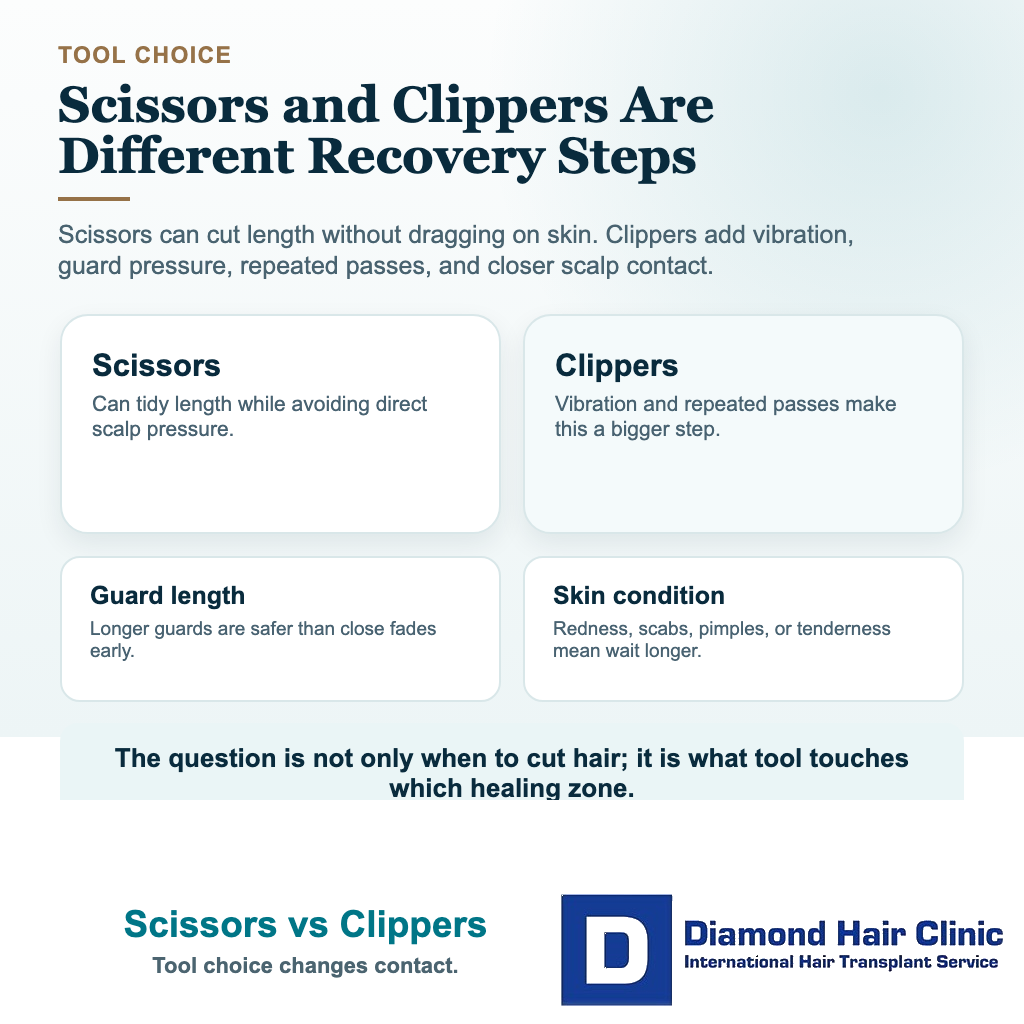
The risk is not only the cutting. Clippers vibrate. They can press on the skin. They can drag across small healing points. A barber may make repeated passes without realizing how recently surgery was done.
Guard length matters. A longer guard is safer than a very close cut in the early period. A zero guard, skin fade, or blade shave is much more aggressive and should not be treated like a normal trim.
Hygiene matters too. Barber tools touch many scalps. After surgery, especially early, the equipment should be clean and the barber should understand that the scalp is still healing.
I think about this in a similar way to wearing a helmet after a hair transplant. The issue is not the object alone. It is pressure, friction, timing, and the condition of the skin.
If the barber seems casual, choose someone else or wait. A haircut is not urgent enough to justify rough handling.
Home clippers can feel more controlled, but they can be risky if you cannot see the donor area properly or become too focused on fixing every uneven patch.
If clippers are used too early, the result may become a cycle of more cutting, more inspection, and more anxiety. That cycle is not helpful. Recovery needs steady decisions, not repeated corrections.
Close shaving should wait
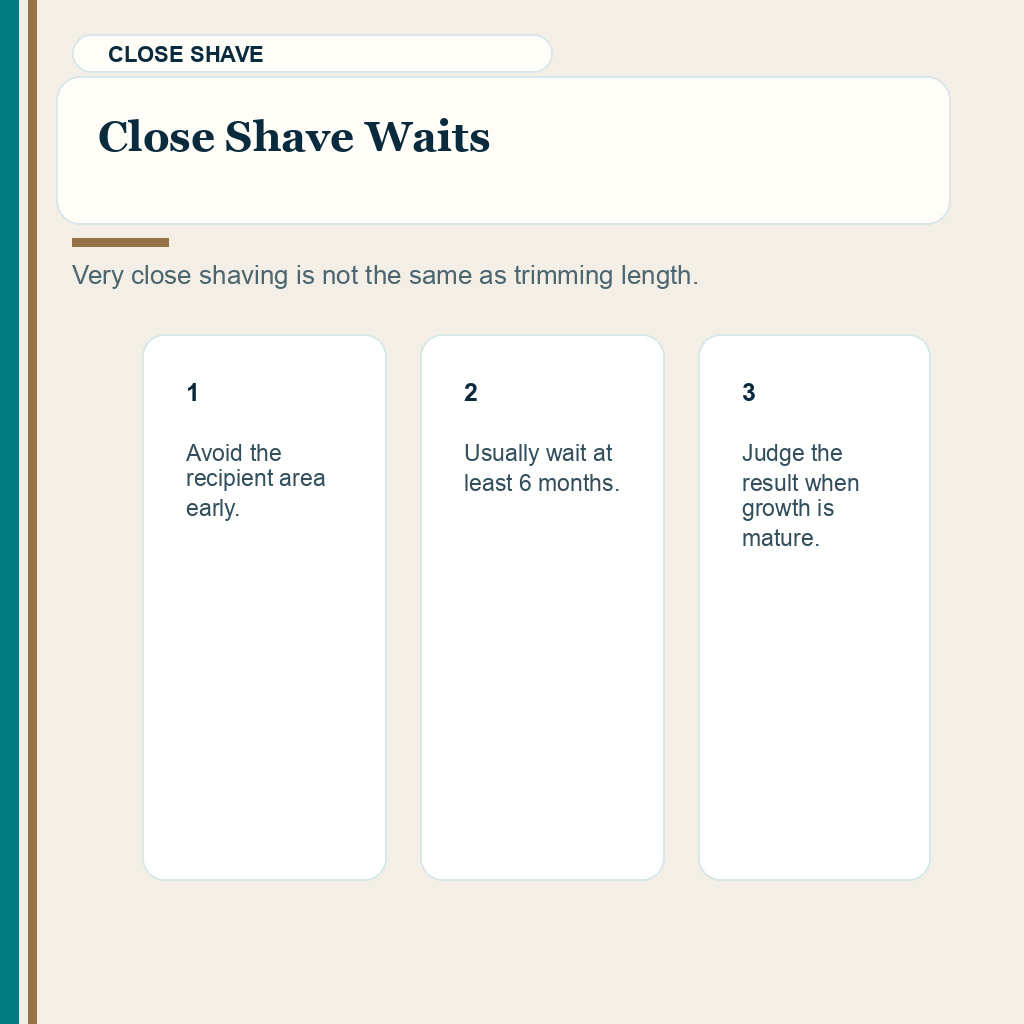
I advise patients to avoid very close shaving of the recipient area for at least 6 months, and in some cases longer. The recipient area is not just hair. It is healing skin with transplanted follicles moving through shedding, rest, and early regrowth.
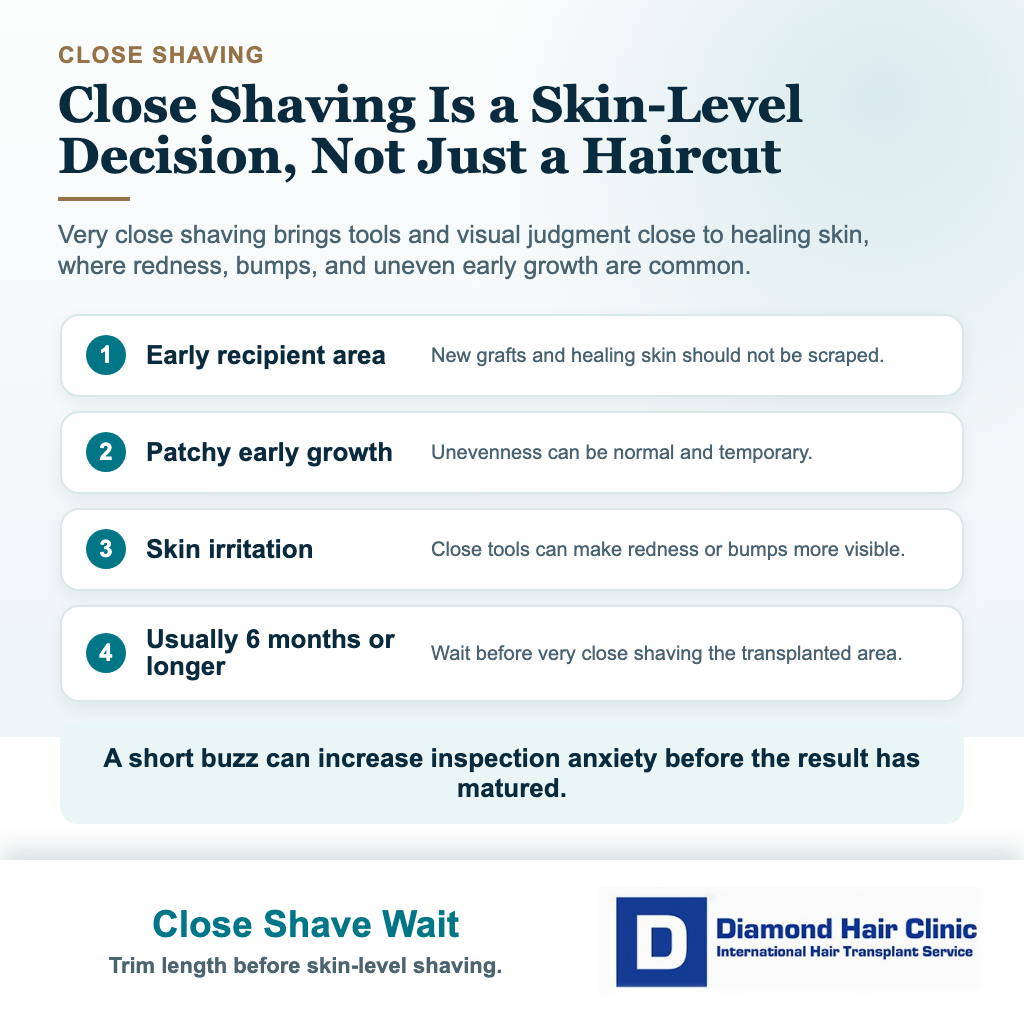
Very close shaving is not the same as trimming hair length. It brings the tool and the visual judgment much closer to the skin. It can irritate the scalp, reveal uneven early growth, and make redness or small bumps more visible.
Some patients want to shave or get a buzz cut after a hair transplant because the early result looks patchy. But patchiness in the early months is often part of the process. Removing all length may make you inspect the scalp even more closely.
At 3 to 4 months, many patients are still only beginning to see early growth. At 6 months, the result is usually more visible but still not mature. Final assessment often belongs closer to 12 to 18 months.
Early cosmetic judgment can start leading the decision before the result has had time to mature. Early growth can look weaker than the final outcome. That same judgment applies to low density at 4 months after a hair transplant.
Shaving may feel like control, but sometimes it only creates a harsher view of an unfinished result.
There is another reason I handle early shaving carefully. It can make patients compare every square centimeter of the scalp under unforgiving light. Hair transplant growth is not synchronized like a machine. Early sprouts can appear unevenly, and shaving makes that unevenness feel more dramatic.
After the scalp has healed and the result is mature, a shorter recipient haircut gives the hairs less length to overlap. It can also make the direction of the hair at the front easier to see, especially with fine, straight hair. A thinner appearance after a cut does not by itself show graft loss. Compare it at the same length and under the same light before deciding that the result has changed.
A mature transplant is judged by coverage, direction, naturalness, and how it behaves with normal hair length. It should not be judged by a harsh early shave when the follicles are still moving through their growth cycle.
Once the result is mature, transplanted hair does not have to be kept short. It can be grown into a longer style, including shoulder length, but the appearance still depends on coverage. Fine donor hair, a wide treated area, low planned density, and continued loss behind the transplant can make a long style look thin even when individual hairs continue to grow. Judge the style by the blend and visible scalp, not by the length of the longest strand.
Uneven hair after surgery
Uneven hair after surgery is very common. The donor may be short, the native hair may be longer, the transplanted hair may shed, and different zones may grow at different speeds.
I do not read this automatically as poor surgery. Often, you are looking at a temporary recovery stage rather than a final appearance.
The first several weeks are especially awkward. Some patients feel they need a haircut to look less surgical. Others want to hide the transition for work or family.
A careful haircut can sometimes help, but it should not become an aggressive attempt to erase recovery. The scalp has already had surgery. It does not need a second source of irritation.
If the uneven look makes you anxious, be careful with temporary cover products too. Powders and fibers can seem like an easy fix, but the timing around hair fibers after a hair transplant also matters.
I remind patients that a neat recovery is not the same as an invisible recovery. For a short time, the scalp may simply look like it is healing. That is acceptable.
Unevenness can also happen because native hair and transplanted hair are in different phases. Native hair may grow normally while transplanted hairs shed. Later, the transplanted hairs begin returning gradually, often in a fine and immature form first.
I would not try to solve every visual imbalance with cutting. Sometimes the correct treatment for uneven hair is time. The haircut can tidy the edges, but it cannot accelerate biology.
Haircuts and donor area visibility
Sometimes, yes. A well timed haircut can help the donor area blend better, especially when the surrounding hair becomes long enough to soften contrast. But a haircut can also make the donor area more visible if it is too short or too sharp.
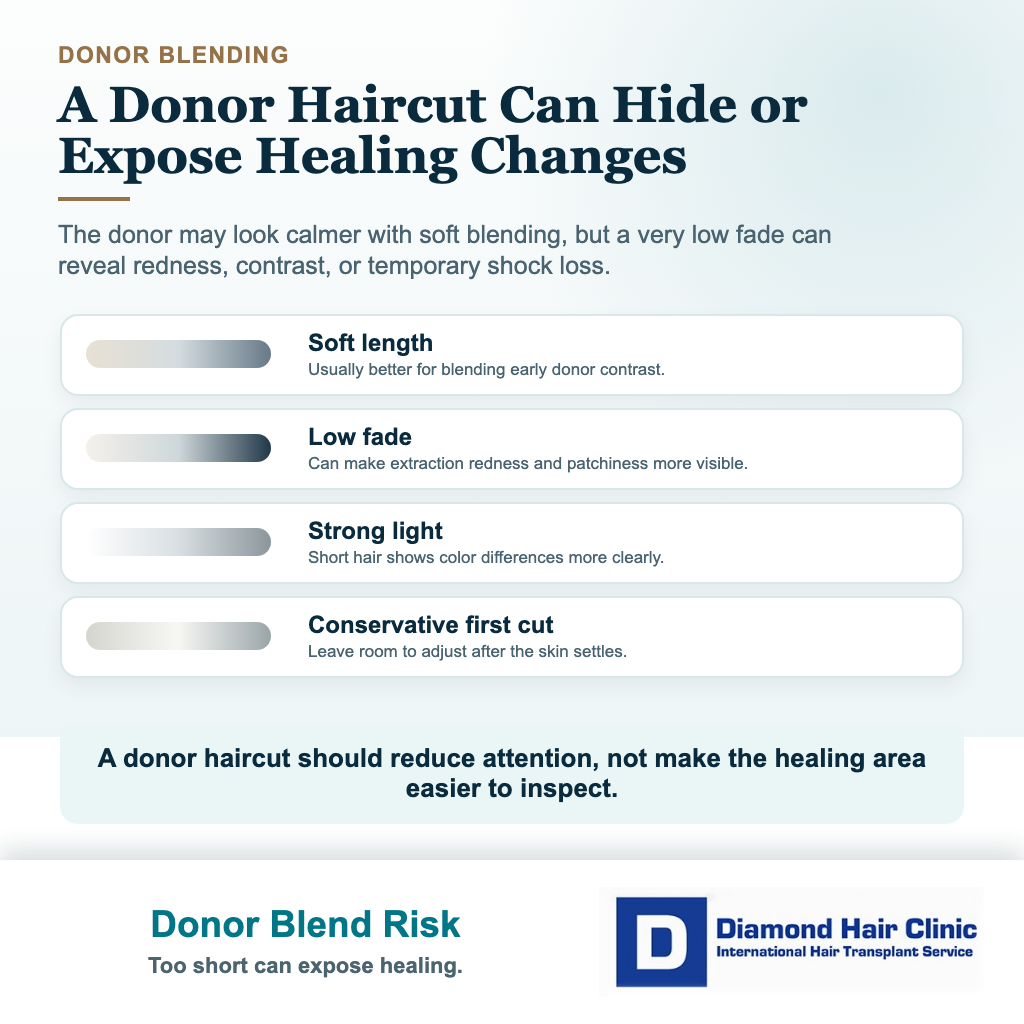
This matters especially after FUE. The extraction pattern should be spread carefully, but in the early weeks the donor area can still show redness, shorter hair, temporary shock loss, or contrast under strong light.
A conservative donor haircut is usually safer. Avoid very low fades early. Avoid cutting the donor so short that every small color difference becomes obvious.
Donor management is not only about surgery day. It is also about how the donor is allowed to heal and how the patient presents it afterward. The long term value of the hair transplant donor area matters because donor hair is limited and must be respected.
When the donor area is already weak, overharvested, or sensitive, early aggressive haircuts can create unnecessary worry. A longer blend often looks better than an overly sharp cut.
Let the donor recover before asking healing skin to give you a very sharp barber finish.
I also warn patients not to chase a flawless short donor look too early. A very short style can reveal the extraction pattern before the surrounding hair has enough length to soften it. This does not necessarily mean the donor is damaged. It may simply mean the timing and haircut are unforgiving.
If you have naturally low donor density, fine hair, or high contrast between hair and skin, haircut length matters even more. Be especially careful with close cuts in the first months.
Barber instructions
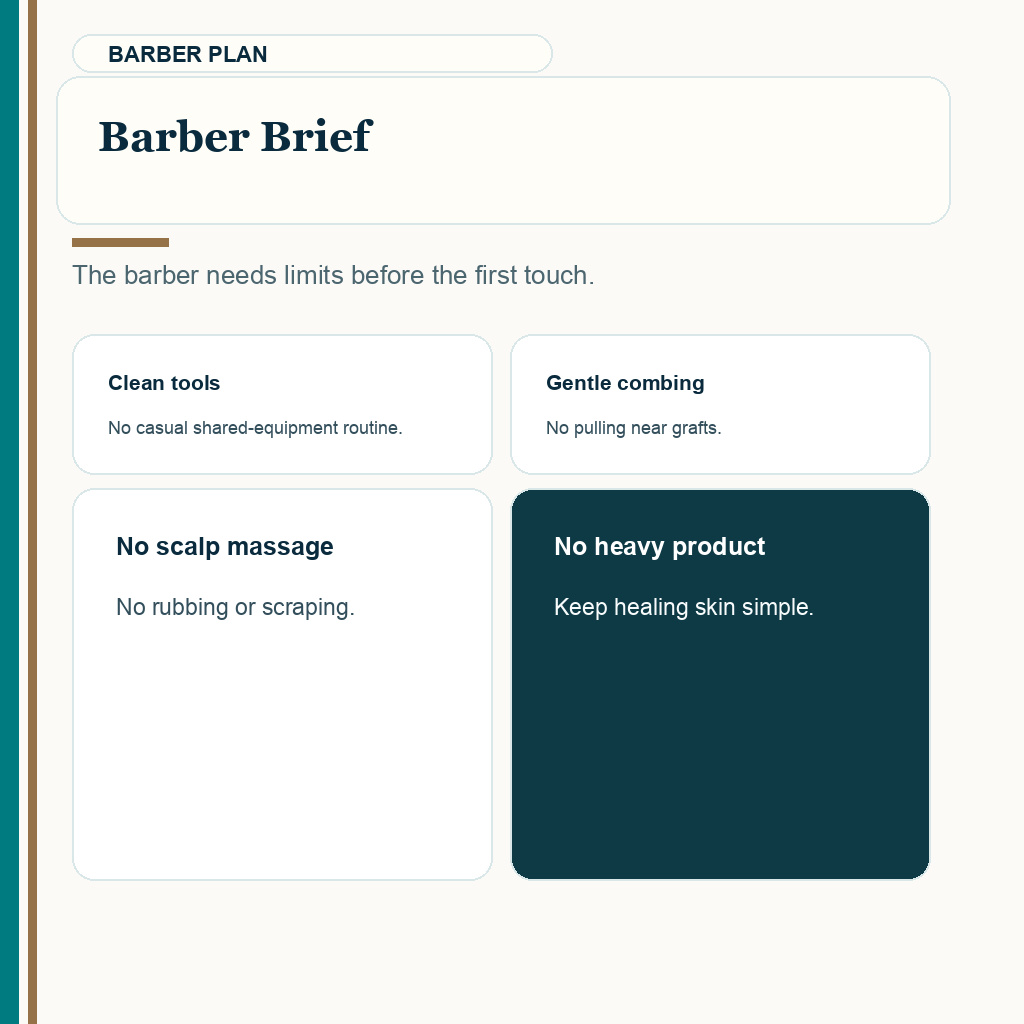
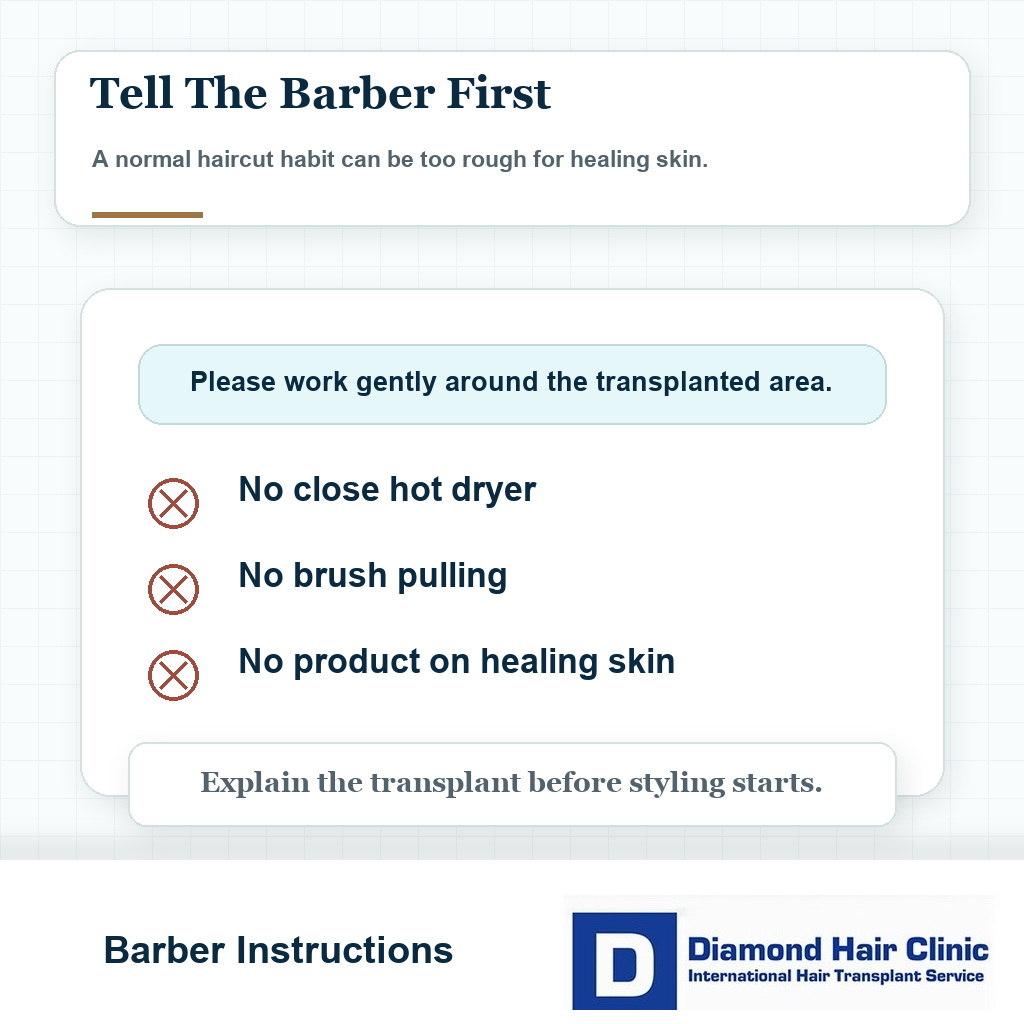
Tell your barber that you recently had a hair transplant and that the scalp must not be scratched, rubbed, pressed, or shaved closely. If you do not want to explain details, at least say the scalp is healing from a medical procedure.
Clean tools, gentle combing, no strong pulling, no close shave over the recipient area, and no product rubbed into the healing scalp all matter. Do not allow the barber to massage the scalp, scrub flakes, or remove crusts.
If the barber wants to use clippers, be specific about the area and guard length. The donor area and recipient area are not the same.
Ask them to work around the healing zones rather than blending across them by habit. A normal barber routine can include spray, combing, stretching the skin, clipper over comb work, product, and blow drying. Early after surgery, that can be too much contact even if each step feels ordinary to the barber.
Early on, avoid styling gels, sprays, fibers, heavy oils, fragrance products, and harsh shampoos unless your clinic has cleared them. The simpler the routine, the less chance of irritation.
If there are still scabs, pimples, redness, or tenderness, delay the haircut. My guidance on redness, scabs, and pimples after a hair transplant explains which early signs deserve caution.
A good barber can help. A careless barber can create unnecessary stress. Choose someone who will listen.
Keep the first appointment short. Do not combine the first haircut with coloring, strong styling, beard work that presses against the scalp, scalp massage, or long product routines. Keep the visit simple and controlled.
If you feel embarrassed telling the barber about surgery, remember that the barber is touching healing skin. This is not the moment to let privacy outweigh safety.
Haircuts and recovery anxiety
Haircuts can reduce anxiety when they are timed well. They can also increase anxiety when they are done too early or too aggressively.
Many patients look at the scalp many times per day after surgery. A haircut that exposes more scalp can make normal early thinness look worse. A short fade can make donor redness more visible. A close trim can make uneven early growth feel like failure. Later in recovery, the haircut is often about shape rather than graft safety. Remove bulk gradually so one cut does not change every comparison photo at once.
Patients should plan the first haircut around healing, not panic. If the plan is to stop worrying, a very short haircut may have the opposite effect.
The same emotional pattern appears with sleep, hats, helmets, swimming, and social plans. Patients want normal life back quickly, but recovery becomes easier when each step has the right timing.
If you are still worried about touching the scalp at night, review my guidance on sleep after a hair transplant. If you are not yet comfortable protecting the grafts during sleep, you are probably not ready for aggressive barber contact either.
Good recovery needs patience, not fear. Once you know the limits, you can live inside them without checking every hour.
I also try to give exact time frames rather than vague reassurance. Anxiety grows when a patient hears different answers from friends, barbers, and strangers online. A clear sequence helps the patient stop negotiating with themselves every day.
If the plan says no haircut for 14 days, then you know the first line. If the plan says scissors before clippers, then you know the tool order. If the plan says recipient area clippers at about 3 months, then a buzz cut in the third week is not a small shortcut.
Scissors can return before clippers touch the graft zone
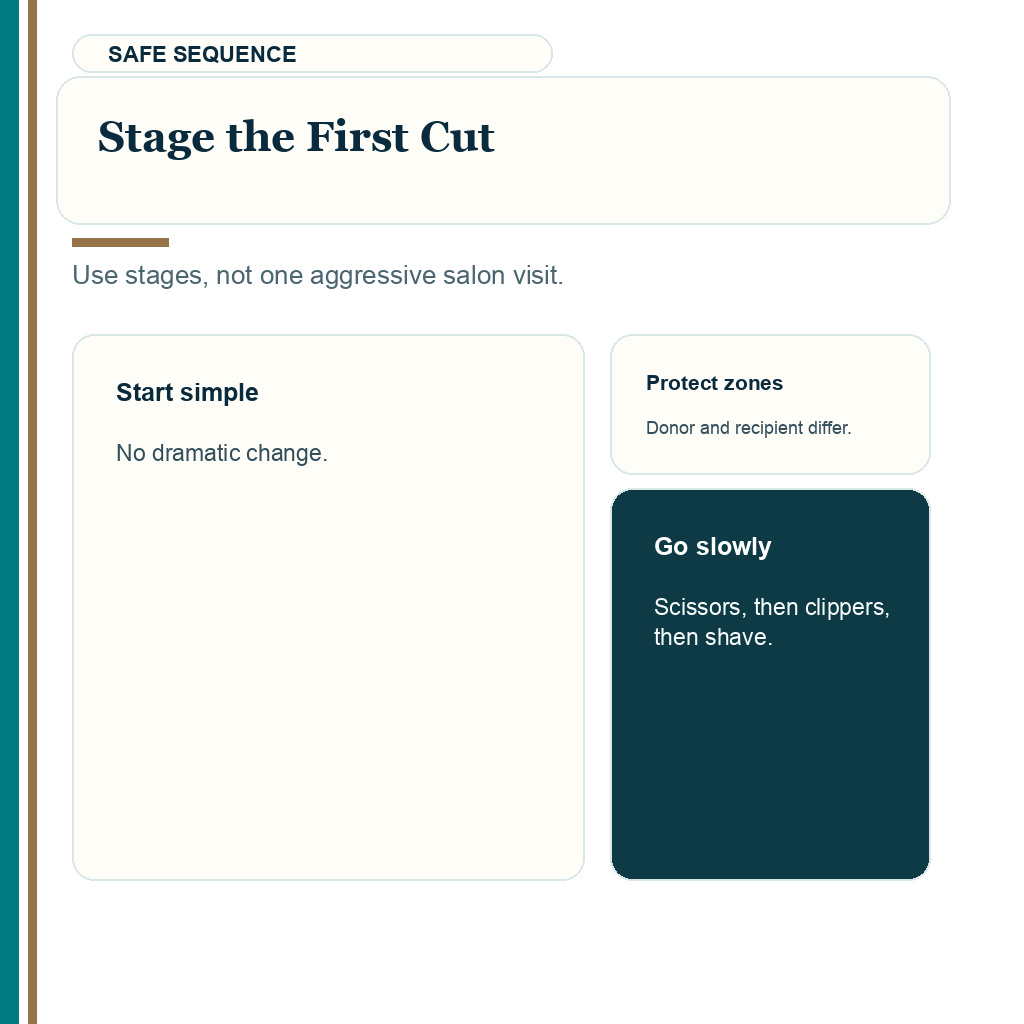
Plan the first haircut in stages. For the first 14 days, avoid haircuts. From 2 to 3 weeks, consider only a gentle donor area scissor tidy if healing is normal. Around 4 weeks, a light recipient area scissor trim may be considered if the scalp is settled. Around 3 months, clippers on the recipient area are usually safer. Very close shaving of the transplanted area should usually wait at least 6 months.
These are practical guidelines, not permission to ignore the skin. If redness, scabs, pimples, pain, folliculitis, or irritation remain, wait longer and ask your surgeon to review the scalp.
Keep the first haircut gentle, clean, and conservative. No pressure. No scraping. No close shave. No heavy styling products. No attempts to force the scalp to look normal before it is ready.
The clinic should explain these details clearly. This is not only about when you can cut hair. The question is who is guiding the recovery and how carefully the surgical plan is protected. A surgeon led plan should also explain how to protect the grafts during normal grooming, not only what happens in the operating room.
Careful planning continues after surgery too. The result is not protected by one dramatic rule. It is protected by many small decisions made at the right time.
So my answer is not only a date. It is a sequence. Protect first, tidy gently, introduce tools gradually, and do not let impatience turn a straightforward haircut into avoidable irritation.
Read this review excerpt
He was very thorough in every little detail and I never felt pressure to do anything I wasn’t sure of.