



Turkey’s Reputation Does Not Replace Clinic Standards
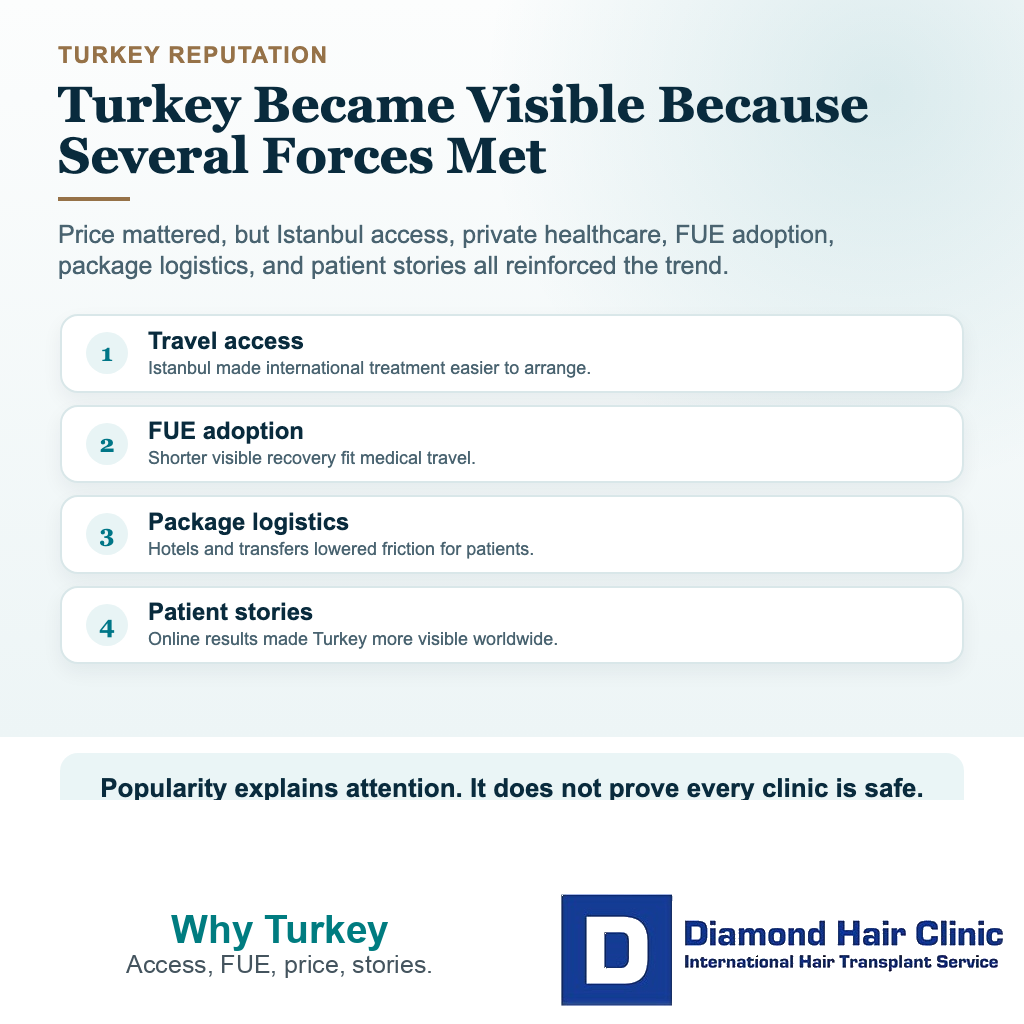
If you are asking why Turkey became known for hair transplants, the useful answer is not one thing. Price helped. Istanbul made travel easier. Private clinics adapted quickly to modern FUE hair restoration. Patient stories made the country visible. But the country’s reputation does not operate on your donor area.
Turkey can be a good place for a hair transplant when the clinic is medically serious, the surgeon is meaningfully involved, the donor area is protected, and the plan is built around the patient rather than a package sale. It can also be risky when high-volume clinic models use Turkey’s visibility to sell rushed, poorly supervised surgery.
Use Turkey’s reputation as a starting point, not as proof. A strong destination can make a careful clinic easier to reach. It can also make a weak clinic easier to market. The patient still has to separate the reputation of the destination from the responsibility of the clinic. Country comparisons are more useful after each clinic has answered the same questions about surgeon responsibility, donor planning, hairline design, follow-up, and written terms.
Price explains only part of the rise
Price helped Turkey grow, but price alone does not create a trusted medical destination. Many countries can be affordable. Turkey became different because cost, travel access, visibility, patient volume, private medical infrastructure, and Istanbul’s familiarity all came together.
Patients often begin with hair transplant cost in Turkey because the price difference can be large compared with the United States, Canada, the United Kingdom, Australia, and many parts of Europe. That difference matters, especially when a patient has received a very high quote at home.
A low price can mean two different things. It can mean an efficient medical system with lower operating costs. It can also mean too many patients per day, unclear surgeon involvement, weak donor planning, and a clinic built around volume. I look at what has been removed from the medical process to make that price possible, not just the final number on the quote.
Economic conditions also shape how patients see Turkey. Currency changes, local operating costs, and package pricing can make treatment feel financially possible. If you are comparing today’s quote with an older quote, economic changes and hair transplant cost in Turkey can explain why old prices mislead. Affordability should support a good decision, not push the patient into accepting a weak one.
These 4 slides help separate Turkey’s reputation from the standards of the clinic doing the surgery. Swipe across the image, use an arrow, or pick a number below the carousel.


Istanbul made the journey feel possible
Istanbul helped the decision feel manageable. A patient considering surgery abroad thinks about the flight, hotel, transfer, language, clinic visit, first wash, and return home. Istanbul already knew how to receive international travelers, and that made medical travel feel less unfamiliar.
The city also became a shortcut in patients’ minds. People did not only say they were going to Turkey. Many said they were going to Istanbul for hair. Once a city becomes linked to one procedure, the connection repeats through photos, stories, videos, reviews, and patient recommendations.
If a patient compares the top cities for hair transplant in Turkey, other Turkish cities can be relevant. Istanbul became the strongest symbol because travel access, clinic density, medical tourism logistics, and international awareness gathered there.
Still, Istanbul should not be romanticized. A large medical city contains excellent clinics, average clinics, and poor clinics. The airport does not design the hairline. The hotel does not protect the donor area. The city can make the journey easier, but the surgical standard still has to come from the clinic.
FUE made treatment travel easier, not simpler
Modern FUE hair transplant changed how patients imagined the operation. Because grafts are removed one by one from the donor area, many patients saw FUE as more compatible with travel than older strip surgery. There is no linear strip scar, and the early recovery can be organized around a short stay when aftercare is planned properly.
This does not make FUE simple. It still requires donor analysis, graft handling, hairline design, recipient area creation, and careful follow-up. FUE can avoid a linear scar, but poor extraction can still create visible donor thinning or small extraction scars if the donor area is overused.
Turkey grew at the same time as global demand for FUE grew. Clinics also began promoting variations such as Sapphire FUE and DHI. Those names attracted attention, but the real question remained the same. Who is planning the surgery, and how carefully is it performed?
Technique marketing can distract patients from the real surgical plan. FUE, Sapphire FUE, and DHI are not separate guarantees of a natural result. They are ways to perform or support follicular unit surgery. A poor plan remains poor even if it is described with a modern technique name.
Packages made the trip feel simple
The package model spread because it reduced uncertainty. A patient abroad is not only buying grafts. The trip also has to feel manageable. Hotel booking, airport transfer, clinic transport, translator support, first wash, medication instructions, and contact after returning home all affect the decision.
Turkey’s medical tourism culture understood this quickly. The best version of that model makes treatment easier for the patient. The worst version hides weak medical planning behind convenience. A package can help with travel, but it cannot replace a real consultation.
I separate the package into medical parts and travel support parts. Transfers and hotels can make the trip smoother, but they should not become the emotional center of the decision. The center should be diagnosis, donor capacity, hairline design, graft number, aftercare, and the person responsible for the surgery.
Read hair transplant packages in Turkey with this distinction in mind. A package can be reasonable when the medical plan is clear. It becomes dangerous when the patient knows more about the hotel than the doctor who will be responsible for surgery.
Patient stories made Turkey feel familiar
Hair transplant results are visual. Patients share photos because the change is visible and emotionally important. When many people travel to the same destination and share their experience, that destination feels less unknown to the next patient.
This familiarity can help patients find useful information, but it can also distort judgment. One excellent result can make a clinic look safer than it is. One poor result can make an entire country look worse than it is. Reviews need context, timing, photos, donor condition, graft count, aftercare route, and a clear answer about who performed the work.
When comparing clinics in Turkey, look for results in patients with a similar starting pattern of hair loss and similarly fine or coarse hair, rather than relying on a friend’s result.
Early photos need special caution. A hairline can look impressive on day one and still be too low, too straight, or too dense for the patient’s future. A donor area can be hidden by hair length. A clinic can show selected cases while avoiding repair cases, weak growth, or patients who were not good candidates.
Hair transplant reviews in Turkey need the same clinical context. Patient stories matter, but they should be read with judgment rather than emotion.
Official structure is only a background layer
Turkey’s health tourism structure also helped the field mature. The Turkey Ministry of Health and the HealthTürkiye framework show that international healthcare is treated as an organized sector, not only as private clinic advertising.
That structure matters because international patients need more than a clinic brochure. They need authorization, documentation, patient communication, complaint routes, and a system that can be traced. Regulation does not guarantee a natural hairline, but it creates a formal background that patients should know about.
For hair transplantation, I see regulation as a foundation. The operation itself still depends on the surgeon, the team, the donor plan, and the clinic model.
Do not stop at asking whether a clinic is legal. Legal status matters, but the next question is surgeon involvement and surgical accountability. The patient needs to know who will make the decision if the donor area looks weaker in person than in photographs, or if the requested hairline would be unsafe.
Turkey’s success also created volume risk
Success created volume, and volume created temptation. When a country becomes famous for one procedure, some clinics compete through quality while others compete through speed, price, and booking pressure.
The practical distinction is the clinic model, not the country label. Turkey is not the problem by itself. A clinic becomes dangerous when patient volume begins to overpower medical judgment. The warning signs include unclear doctor involvement, too many patients in one day, standardized hairlines, excessive graft promises, weak donor protection, and poor follow-up.
I criticize that model in any country. Turkey did not invent high-volume hair transplant marketing, but because Turkey became so visible, the problem became especially visible here. Review the red flags of Turkish hair mills before choosing a clinic.
The damage from this model can last for years. A patient may lose donor capacity, receive an artificial hairline, develop patchy extraction, or need a repair that is more difficult than the first surgery. Once donor hair is wasted, the patient cannot simply buy it back.
Other countries can compete, but not by copying the label
Other countries can become stronger hair transplant destinations. South Korea has a strong aesthetic medicine identity. Thailand has long experience with medical tourism. India has scale, English language medical capacity, and price competitiveness. Mexico is especially relevant for North American patients because travel is shorter.
But replacing Turkey is not only a matter of opening clinics and lowering prices. It requires years of patient familiarity, travel convenience, reliable outcomes, public visibility, and a strong association between one destination and one procedure. Turkey built that association over time.
A country can become fashionable quickly, but medical trust builds more slowly. Patients need to see repeated results, real surgeon names, clear aftercare, transparent pricing, and enough public experience to make the process understandable.
Mexico is an interesting comparison because it can reduce travel burden for patients from the United States and Canada. I discuss that separately in Turkey versus Mexico for hair transplant.
Compare clinic standards instead of countries
Compare clinic models, not only countries. A careful clinic in Turkey is different from a high-volume clinic in Turkey. The same is true in Mexico, Thailand, Korea, India, Europe, or the United States. Geography matters, but the surgical responsibility inside the clinic matters more.
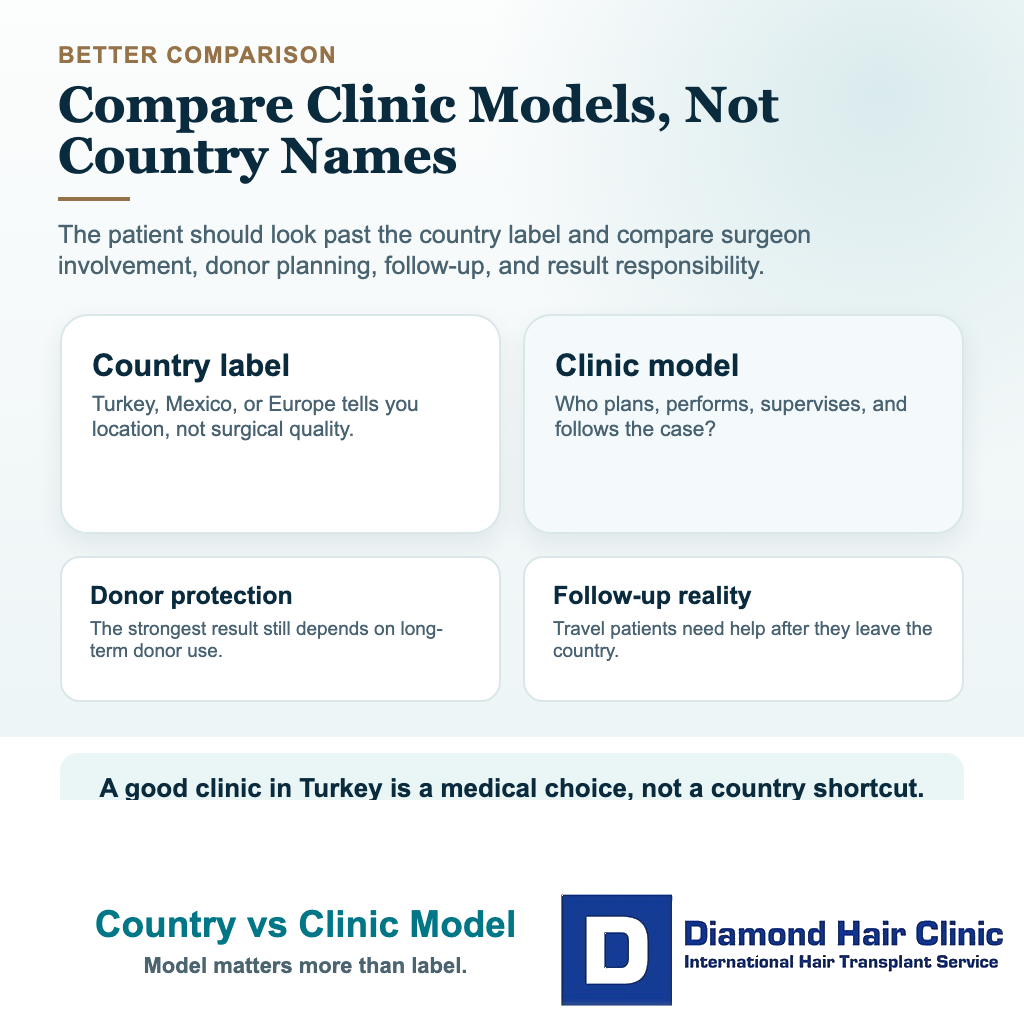
Ask who examines you, who designs the hairline, who creates the recipient area, how the donor area will be protected, how many patients are treated per day, and what the clinic would refuse to do even if you requested it.
Also ask what happens after you leave the country. Medical travel does not end when the patient boards the return flight. Early washing, swelling, scabs, donor area healing, shedding, and month by month growth all need realistic communication. The clinic should explain hair transplant aftercare before the patient commits.
How to choose a hair transplant clinic in Turkey is more useful than a country ranking because it gives the patient practical questions that actually protect the result.
Where Diamond Hair Clinic fits?
At Diamond Hair Clinic, I do not use Turkey’s reputation as a shortcut for trust. Patients should not choose us simply because we are in Istanbul. The reason should be the surgical approach.
That means one patient per day, direct surgeon involvement, careful donor management, realistic density planning, natural hairline design, and a refusal to treat graft number as a sales tool. These principles matter more than the country label.
In practice, that often means saying no to a plan that would look dramatic in a sales consultation but age poorly. It can mean using fewer grafts than the patient expected, leaving the crown for later, keeping the hairline more mature, or protecting donor hair for future loss. These decisions are not always what a patient hoped to hear, but they protect the patient.
Turkey created the environment where international hair transplantation became highly visible. The clinic still has to earn the patient’s trust case by case. That is the difference between using Turkey’s ecosystem responsibly and hiding behind it.
Turkey opens the search, the clinic earns the trust
Turkey can make the search easier because many experienced teams work here and the travel system is familiar to international patients. That advantage is only useful when it leads you to better questions, not when it becomes a shortcut.
I judge a Turkish hair transplant by concrete points that matter anywhere. Who examines you? Who designs the hairline? How is the donor area protected? How is the graft number explained? What happens after you return home?
If those answers are clear, Turkey’s reputation supports the choice. If they are hidden behind package language, discounts, or a very large graft promise, the location cannot rescue the plan. The country may start the conversation, but the clinic still has to earn your confidence.

Read this review excerpt
Probably my only concern of the whole trip was when my transport pulled up to a different hotel than I had been told but this was solved instantly and was only due to the Covid situation.