



Booking Pressure Can Signal the Wrong Surgical Environment
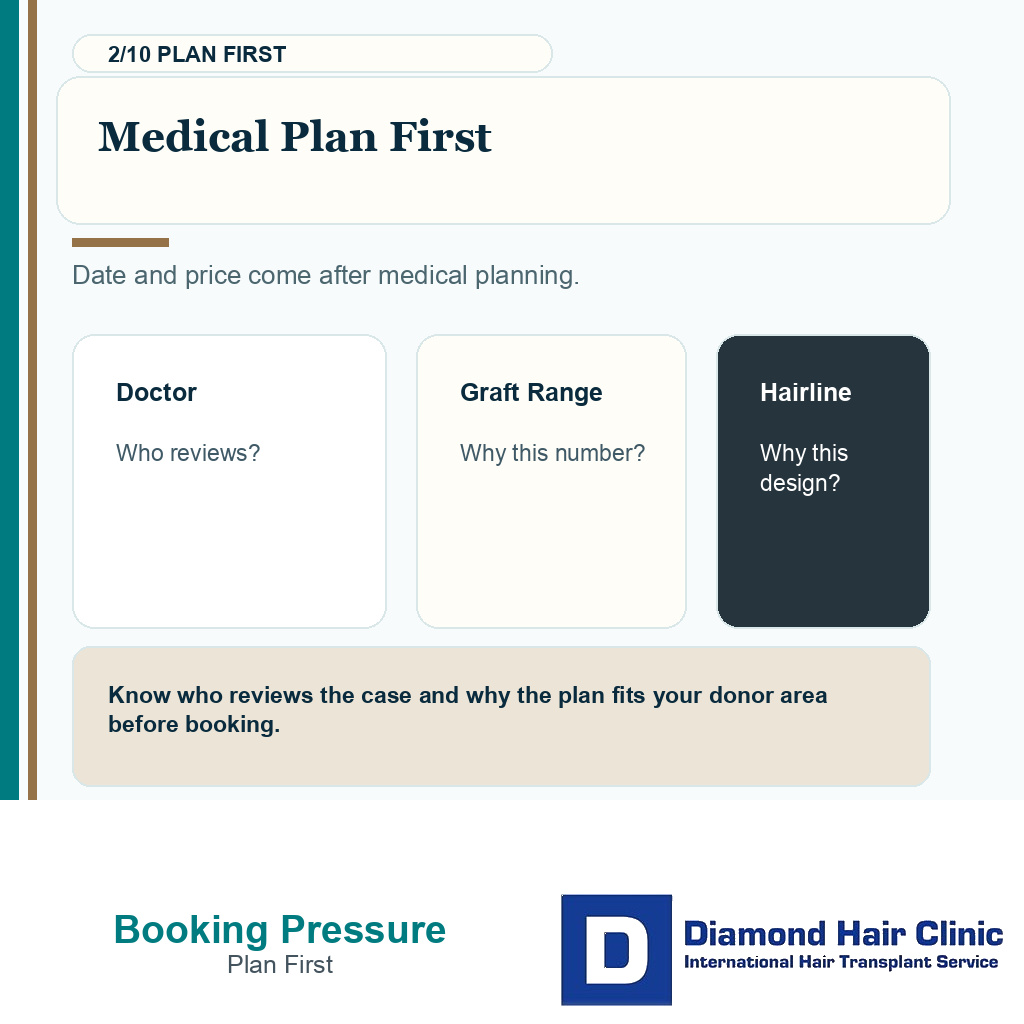
If a clinic pushes you to pay a deposit before a surgeon has reviewed your donor area, hair loss pattern, medication history, graft plan, and the surgical steps the doctor will personally handle, slow down. A deposit becomes a warning sign when it comes before medical clarity, especially while donor details are still vague. The warning is pressure before medical clarity. This is the moment to use a hair transplant deposit before booking checklist, not an urgency message. That discipline also matters close to surgery, because final hair transplant doubts should be reviewed before payment pressure decides the donor area.
Before a booking feels safe, what to settle before you book a hair transplant needs to be more than a date and price. You should know who designs the hairline, who makes surgical decisions, why the graft number fits your donor capacity, and what happens if your medical situation changes before travel. You should also know who provides hair transplant follow up after surgery, especially if swelling, bleeding, or anxiety appears after travel.
The pressure does not always feel aggressive at first. You may feel relieved that a hair transplant date is possible, anxious that you may lose it, and tired of comparing clinics. That is exactly why this stage needs protection. A good medical process gives you enough clarity to decide. It should not use your uncertainty to collect commitment.
A friend’s recommendation can create a quieter kind of pressure. You may feel that choosing another clinic would reject their help, even when they mean well. You can appreciate the introduction without owing anyone a booking.
Pressure can also appear after the deposit is paid. If answers become slower, the named doctor becomes less available, or a new slot makes you accept a graft number you have not reviewed, the medical decision is being squeezed by the sale.
Booking pressure can be a warning sign
Hair transplant surgery is not a hotel reservation. A date can move and a package can change, but once grafts are removed from the donor area, that donor capacity has been spent. A rushed booking can lock you into a hairline that is too low, a graft count that is too high, or a clinic process where the surgeon’s role is unclear. Those decisions are harder to repair than they are to prevent, especially when the pressure follows a weak donor and high graft quote disagreement. When warning signs appear after the booking, it may be safer to pause before hair transplant surgery than to protect the date. This applies strongly to facial hair surgery too, where beard transplant regret can leave visible texture or design problems after the deposit decision has passed.
The first conversation raises concern when it is mainly about available dates, limited discounts, hotel transfer, or how quickly to secure the package. Those details can be organized later. The first question should be whether surgery is appropriate, whether the donor area can support the plan, and whether the future compromise has been explained in plain language.
This overlaps with the wider problem of choosing a clinic carefully. If you are comparing Turkey, Europe, the United States, or any other destination, do not judge only the package. A best hair transplant clinic in Turkey claim should not push speed ahead of medical clarity. The important issue is the medical decision behind the package, which is why choosing a hair transplant clinic in Turkey matters before a booking date is fixed. The same decision frame appears in Turkey hair transplant without the sales lens, where the offer is tested before the deposit or travel plan takes over.
Payment pressure should follow clear information
Some clinics use a deposit to reserve a surgical date after evaluation. That is different from asking for commitment while the patient still does not understand the surgical plan. I check whether payment comes after donor limits, graft logic, hairline design, medical timing, and pause rules are clear. In my own clinic, we do not reserve surgery day with a deposit or advance payment. After the plan is accepted, purchased flight ticket details are enough for the booking process.
Before payment, you should know who will operate, how many grafts are realistic, whether the hairline design is mature enough for future hair loss, and what could still change before or after the Istanbul examination. This is the same question I test in case review before travel. The plan also has to explain the diagnosis, donor area quality, likely progression of native hair loss, and reason the proposed graft number is being used. If the clinic cannot explain those points clearly, or if it ignores why you were declined for hair transplant elsewhere, the deposit is happening too early. If the consultation depends on translation, language barriers during a hair transplant abroad should be resolved before date change and cancellation terms turn uncertainty into commitment.
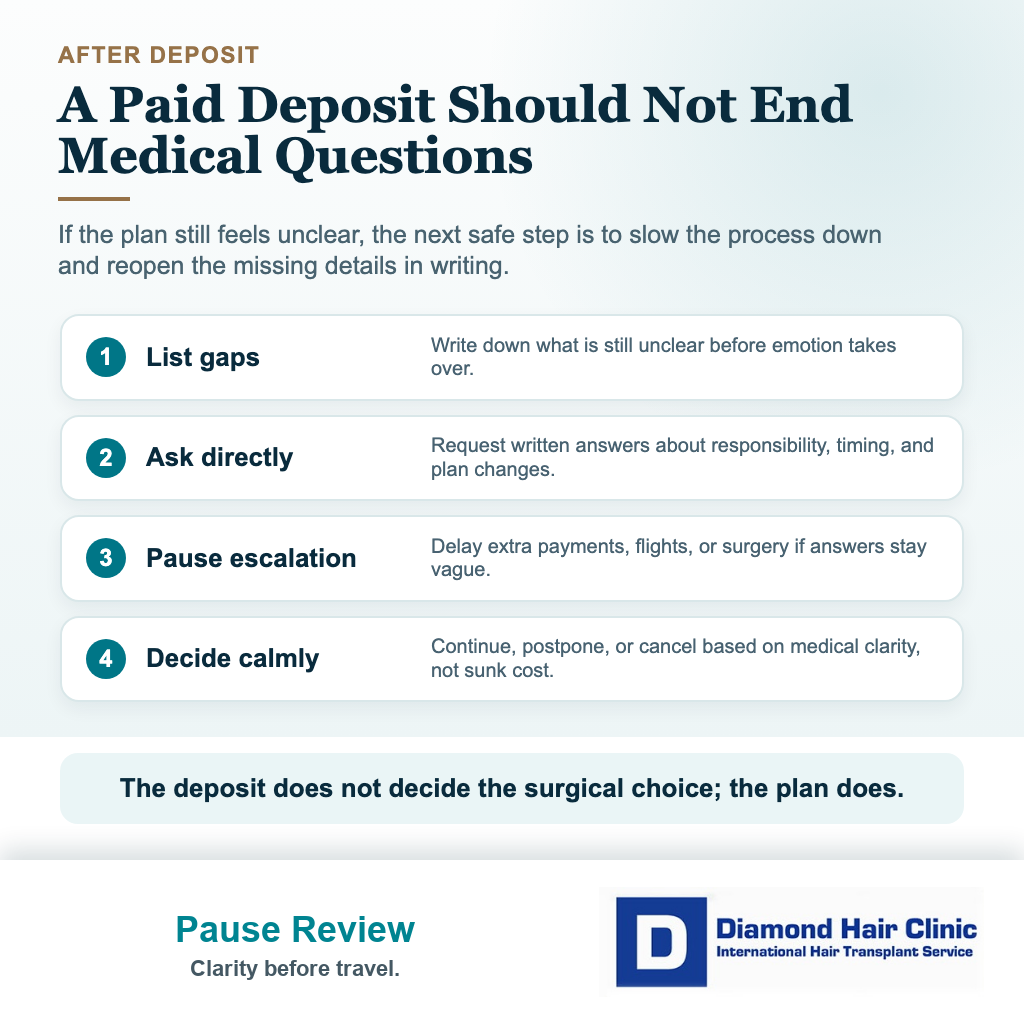
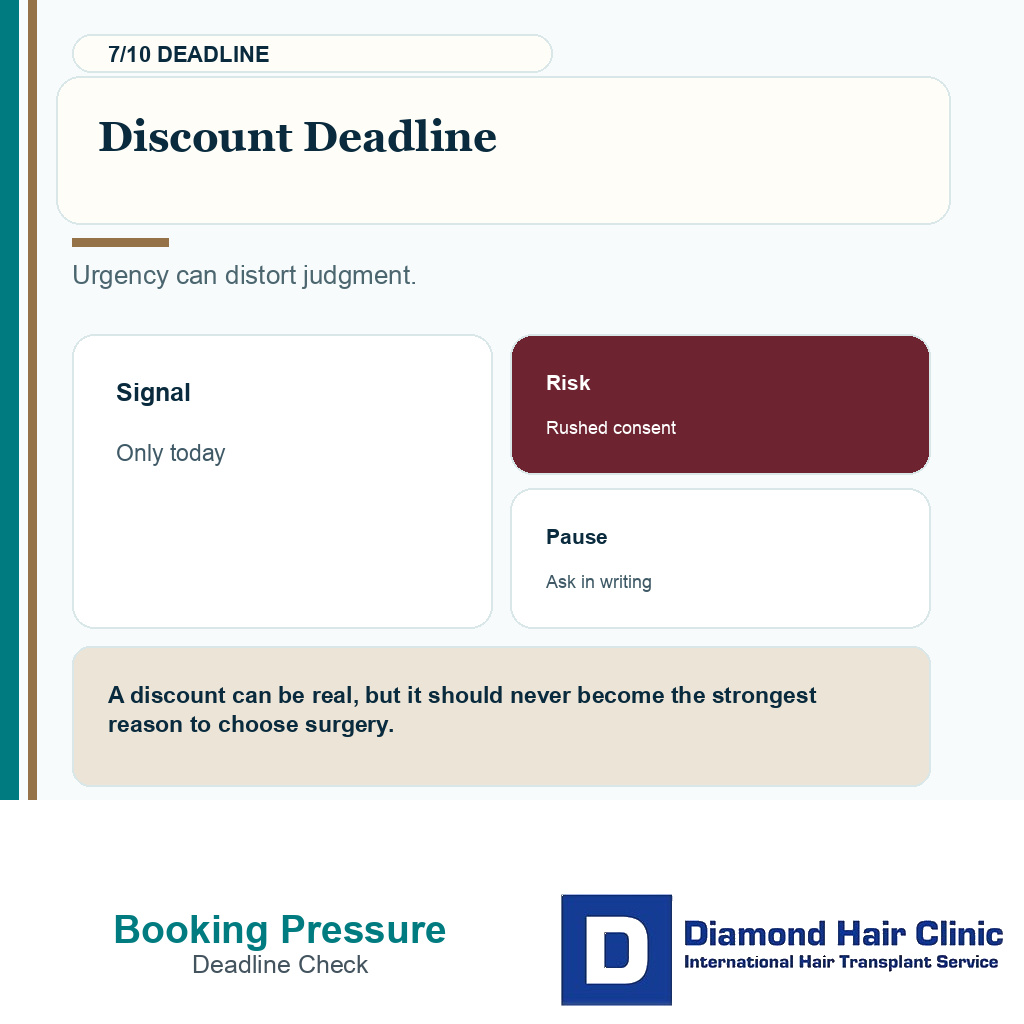
A price that is available only today should not control a surgical decision. A discount should never rush a surgical decision. You can lose a deposit and recover financially. You cannot easily recover donor grafts that were used without a careful future plan.
Let the written plan survive a quiet day. If the decision only feels possible while a discount, slot, or adviser is pushing, the pressure is part of the decision.
Written details belong before payment
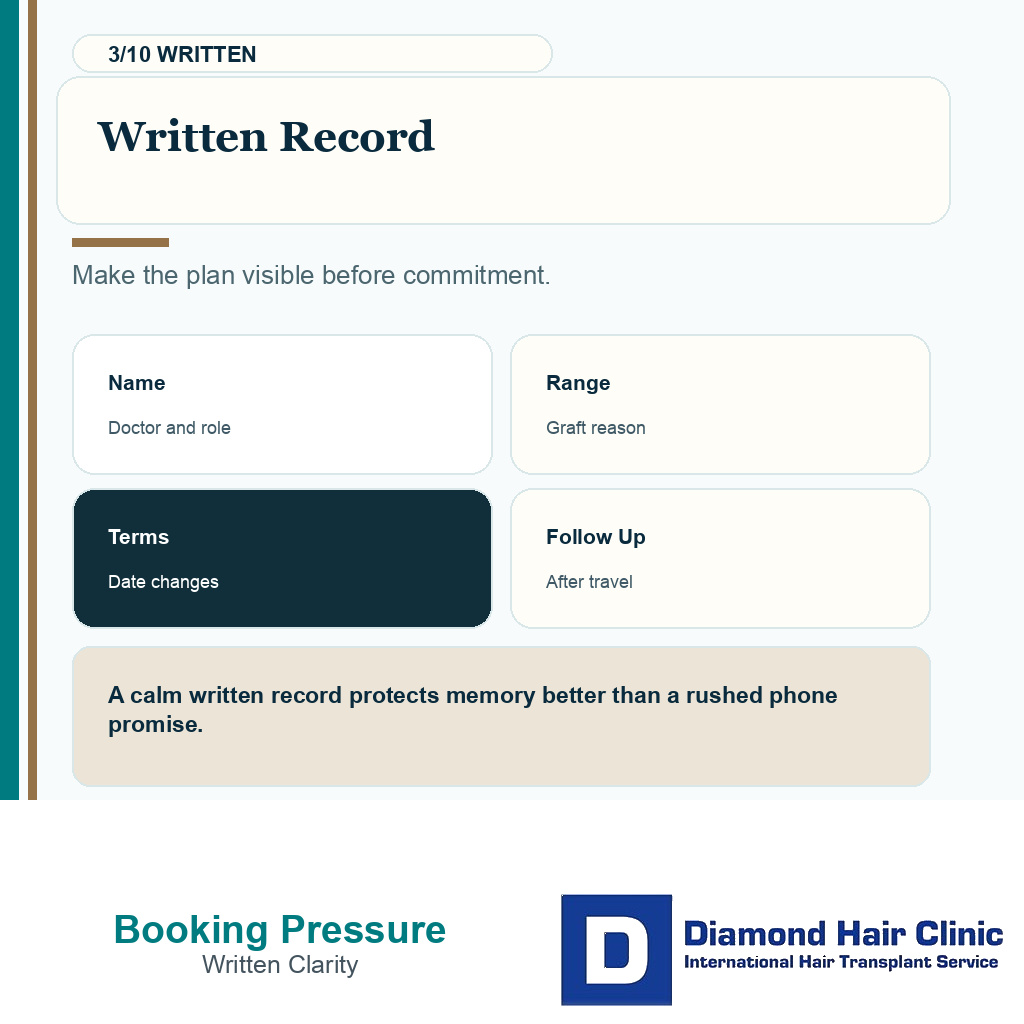
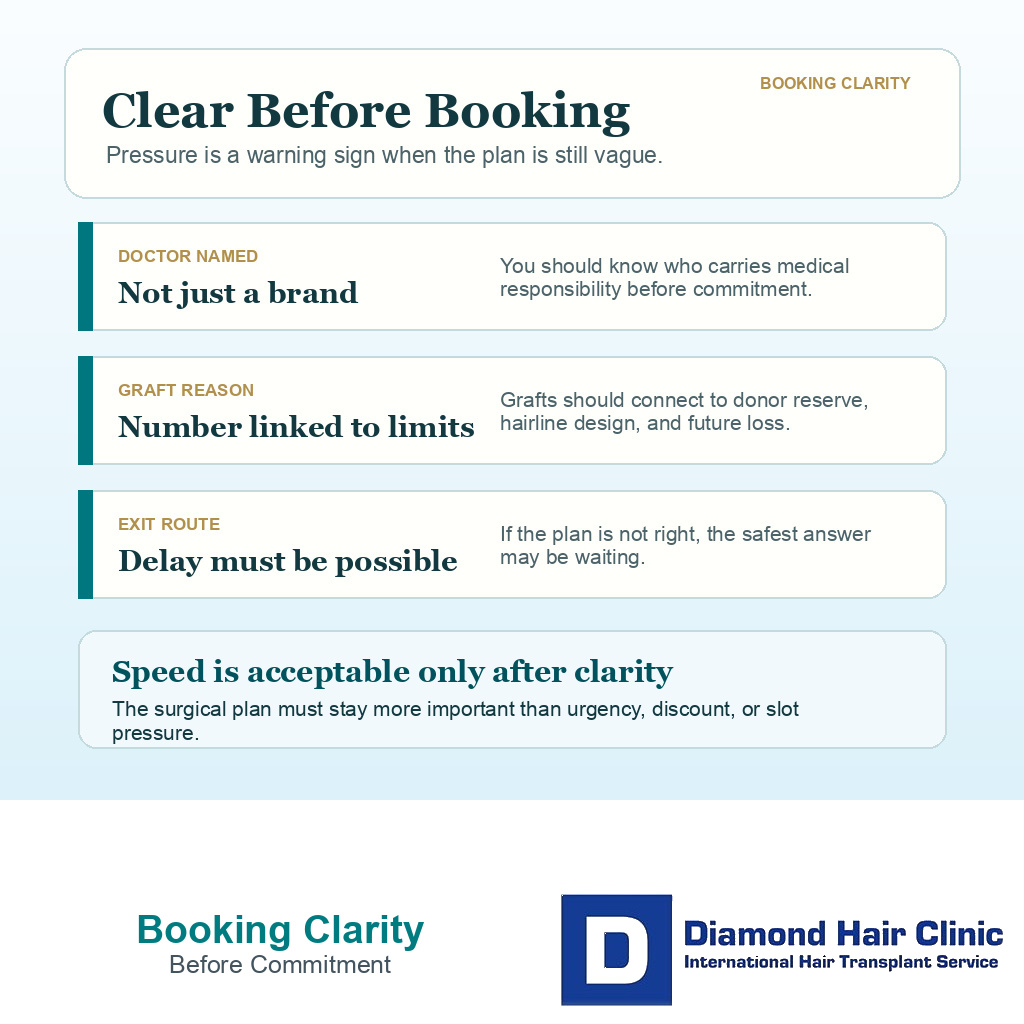
Before a deposit becomes a commitment, the written record should show more than a date and a price. It should name the doctor responsible for the plan, explain the realistic graft range, describe the hairline and donor strategy, and make clear which surgical steps the doctor will personally handle. It should also say what medical information still needs review before travel.
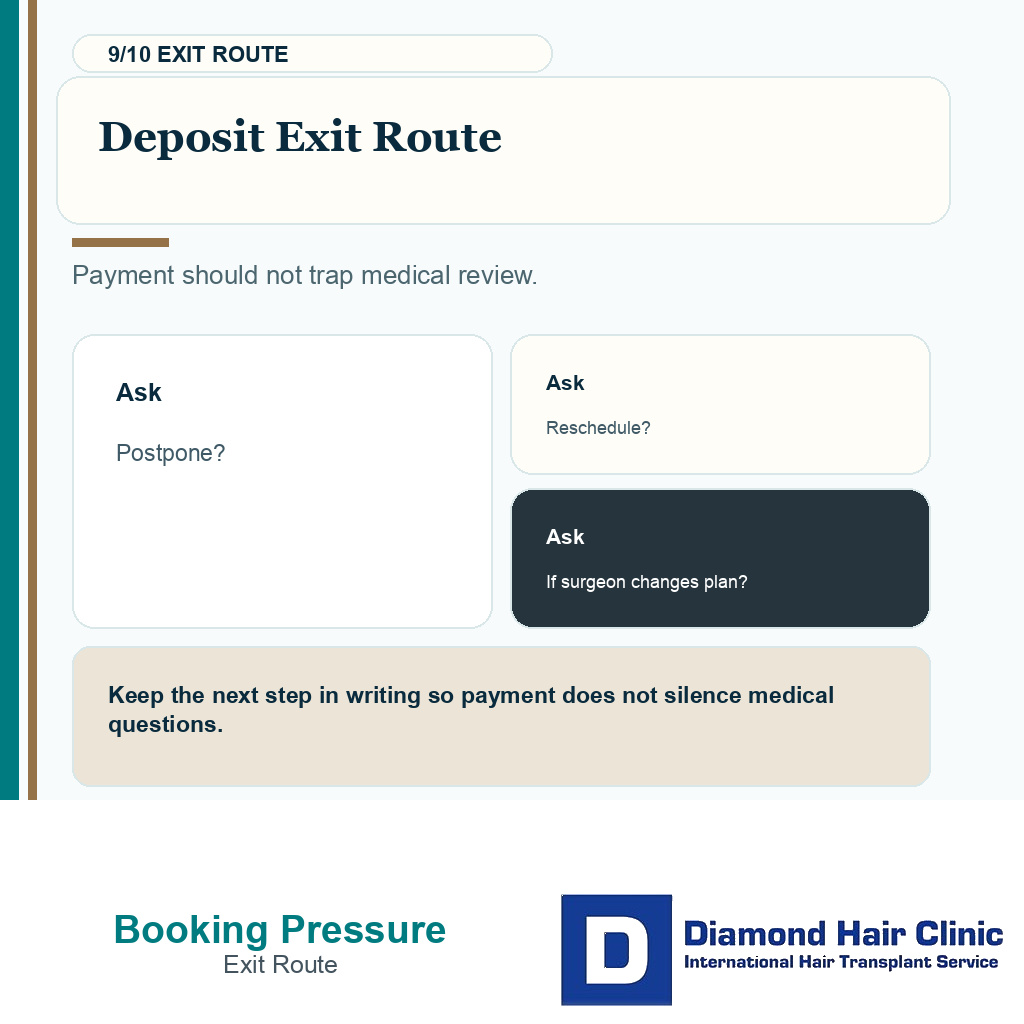
The same written record should explain what happens if surgery is postponed, if the surgeon changes the graft plan after examining you in person, or if a medical issue appears before the operation. Refund rules, date change rules, and deposit conditions are not separate from patient safety. They decide whether you can pause for the right reason without being pushed into surgery mainly because money has already been paid.
Payment terms should state the total price, deposit amount, what can be refunded, what cannot be refunded, currency, payment method, who receives the payment, whether a receipt or invoice is issued, and the deadline for date changes. Verbal reassurance is not enough when flights, hotel dates, and surgery are tied to one payment decision.
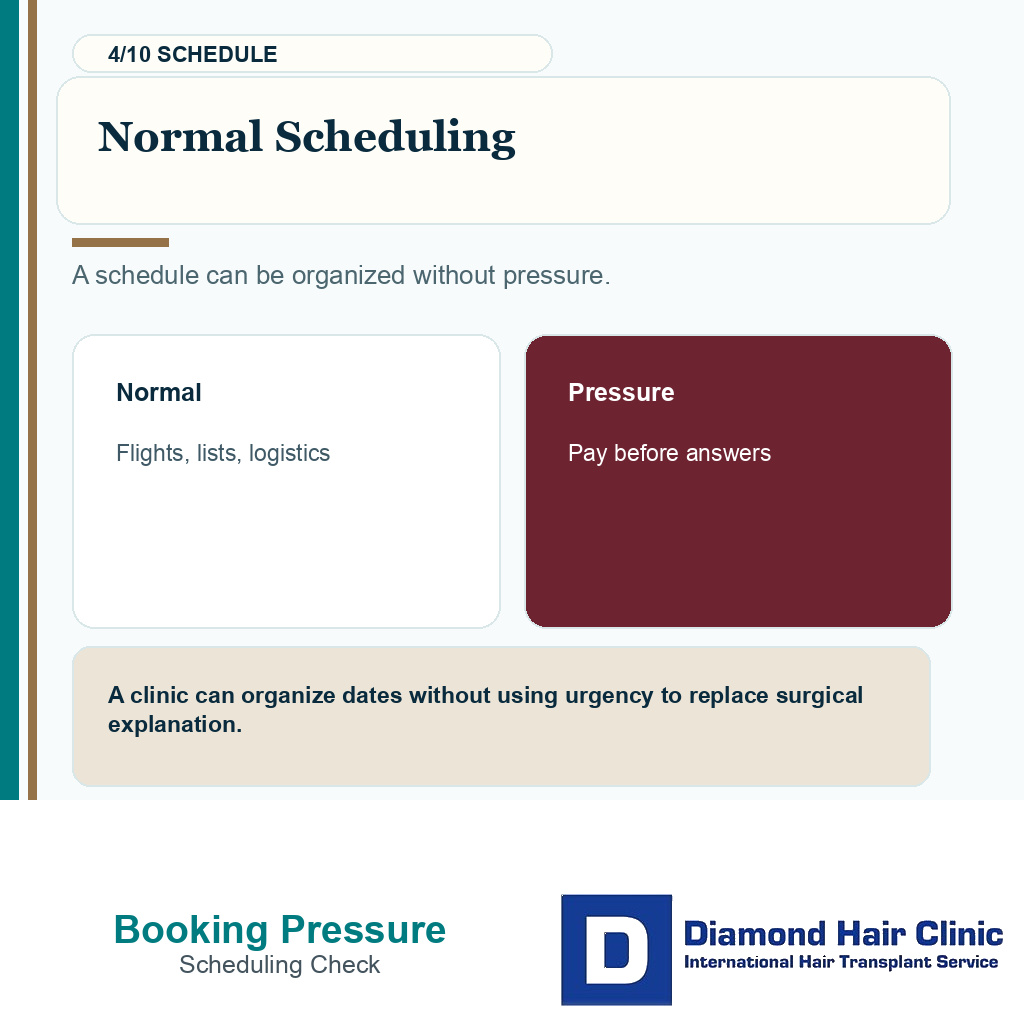
Normal scheduling is different from pressure
Some urgency is practical. Flights, hotel rooms, and surgery lists need scheduling. The problem starts when urgency replaces medical clarity.

Read this review excerpt
He was very thorough in every little detail and I never felt pressure to do anything I wasn’t sure of.
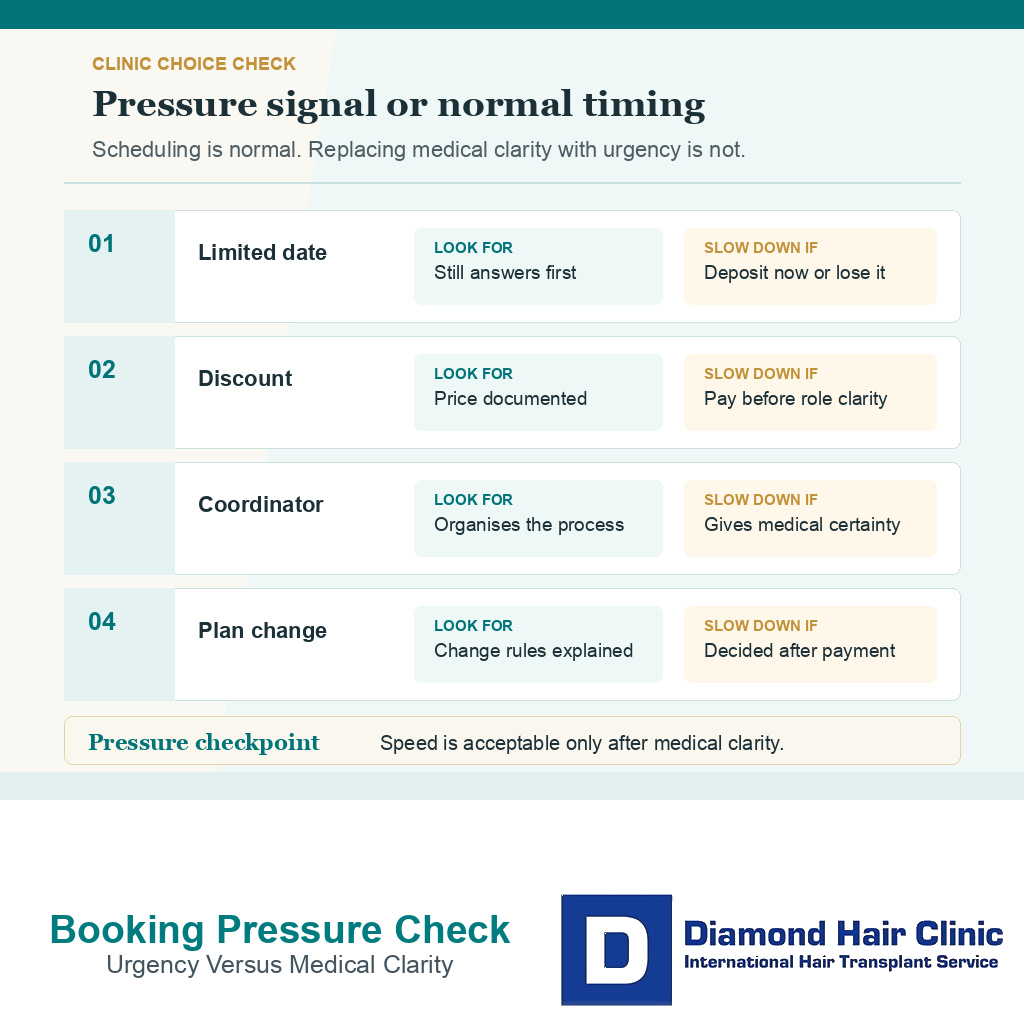
A safe clinic can still be organized and efficient. It does not use speed to make you accept missing answers.
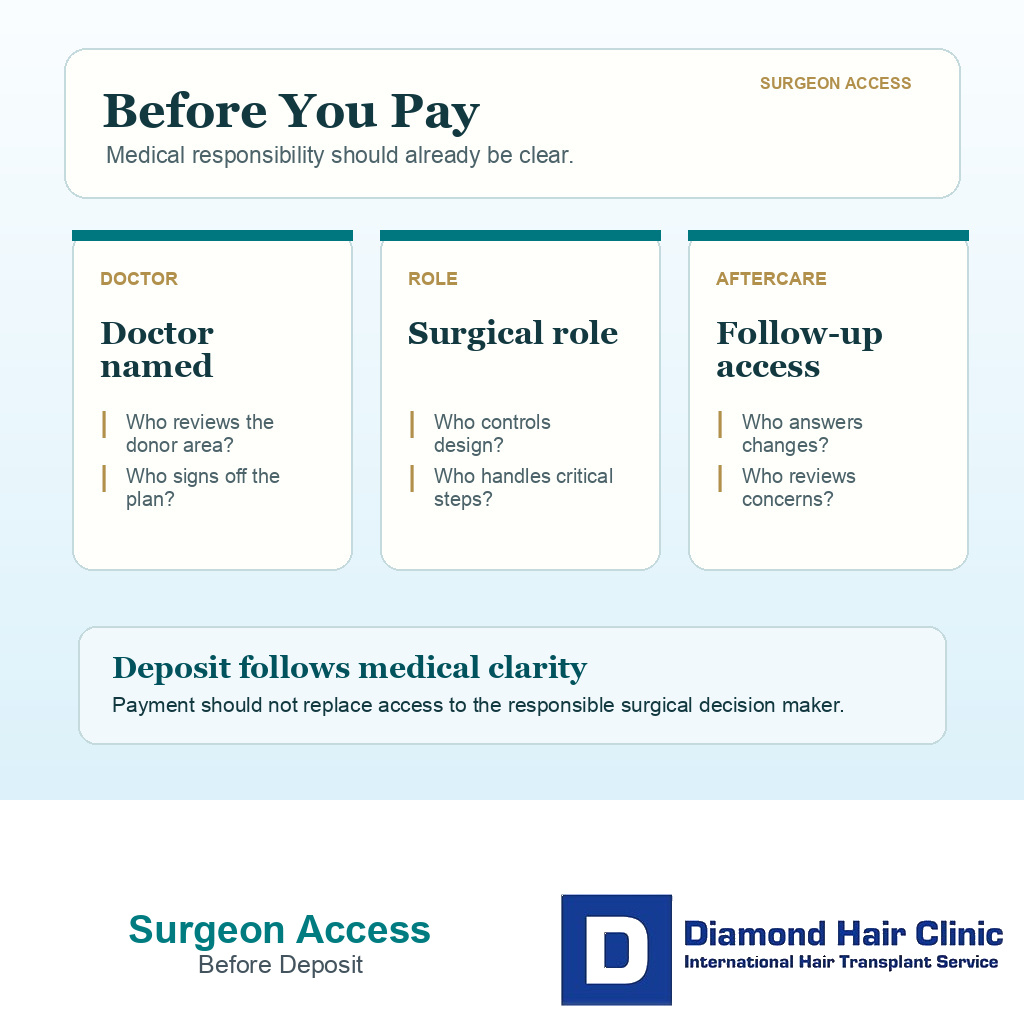
The responsible surgeon should be named before booking
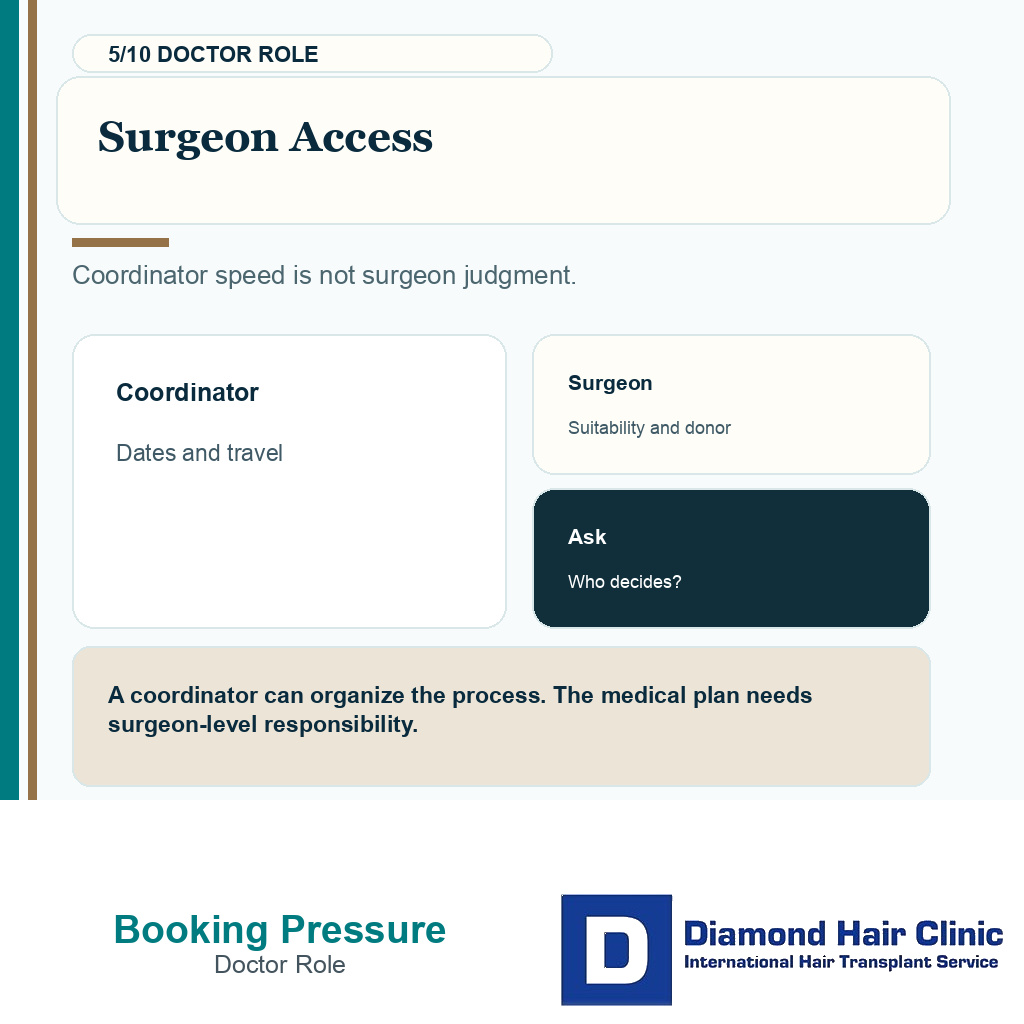
Before booking, the doctor responsible for the medical plan should be named, and the clinic should state which surgical steps that doctor performs. This includes hairline design, donor assessment, graft number planning, local anesthesia supervision, whether a sedation decision is medically justified, extraction planning, recipient area incision creation, and management of problems during or after surgery.
This does not mean every staff member has no role. Coordinators can organize photos, forms, travel, dates, and routine instructions. They should not be the person deciding whether your donor area can safely support the plan.
The exact legal rules vary by country. The simpler question is who is medically responsible for the operation in front of you. If the answer is vague, or if the doctor is mainly a brand name while unknown teams perform the important steps, you are not really judging the surgeon’s plan.
My position is that surgeon involvement is not a decorative detail. It changes the planning. It changes donor protection. It changes how the hairline is judged. Before you treat a deposit as final, make sure surgeon involvement in hair transplant surgery is clear.
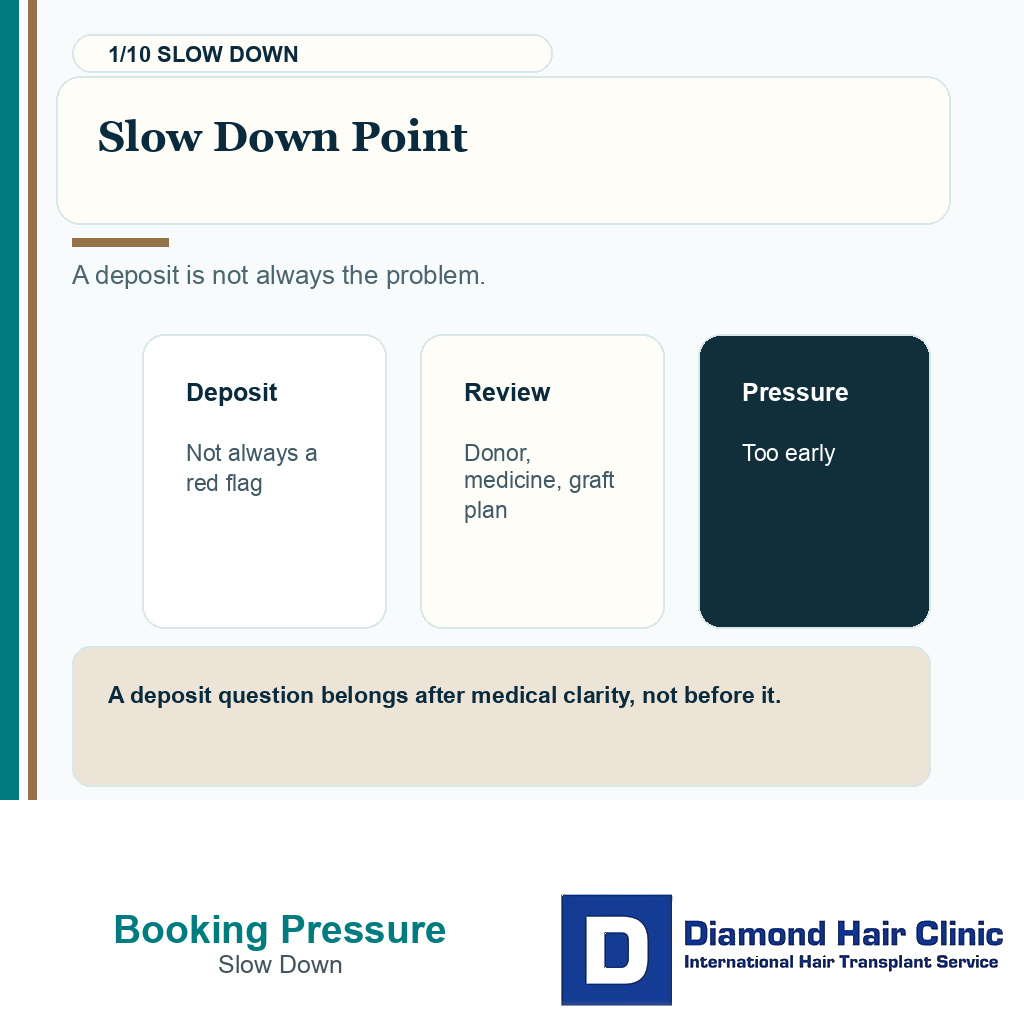
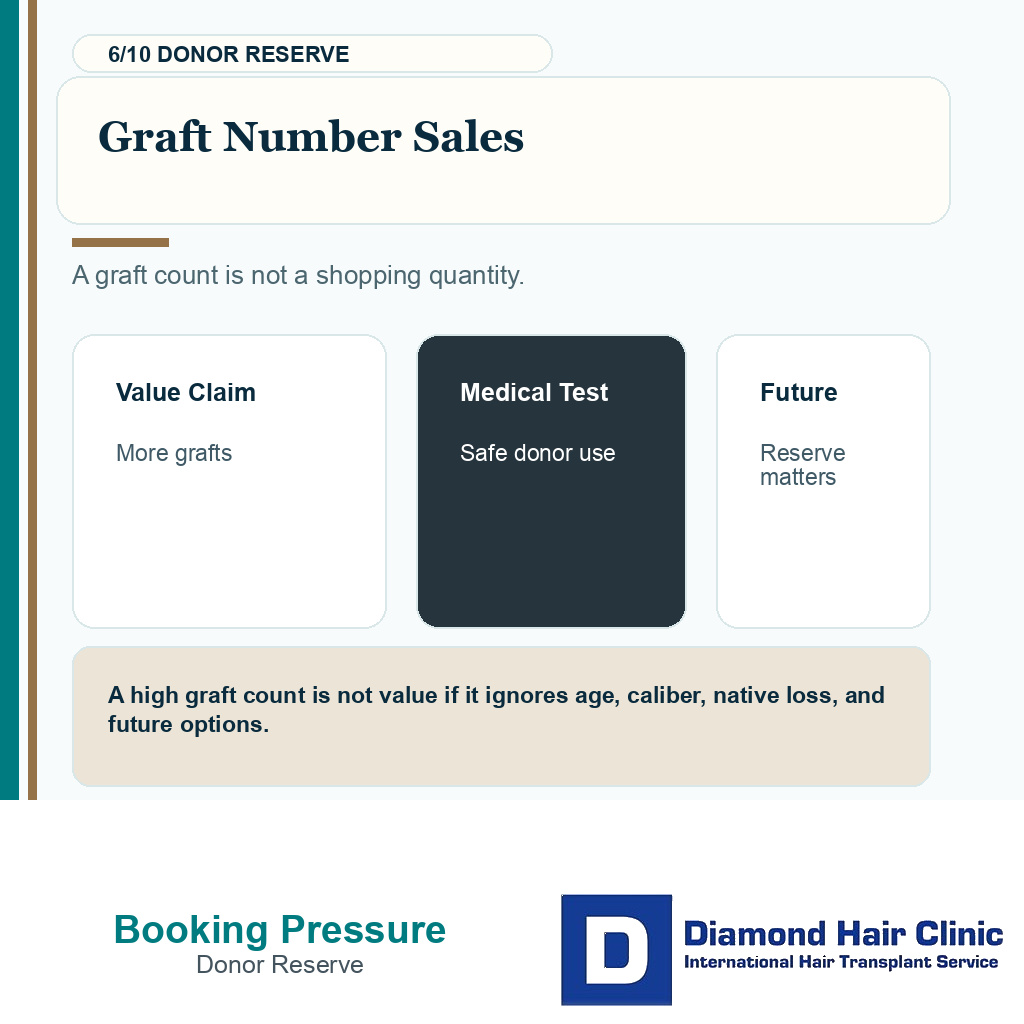
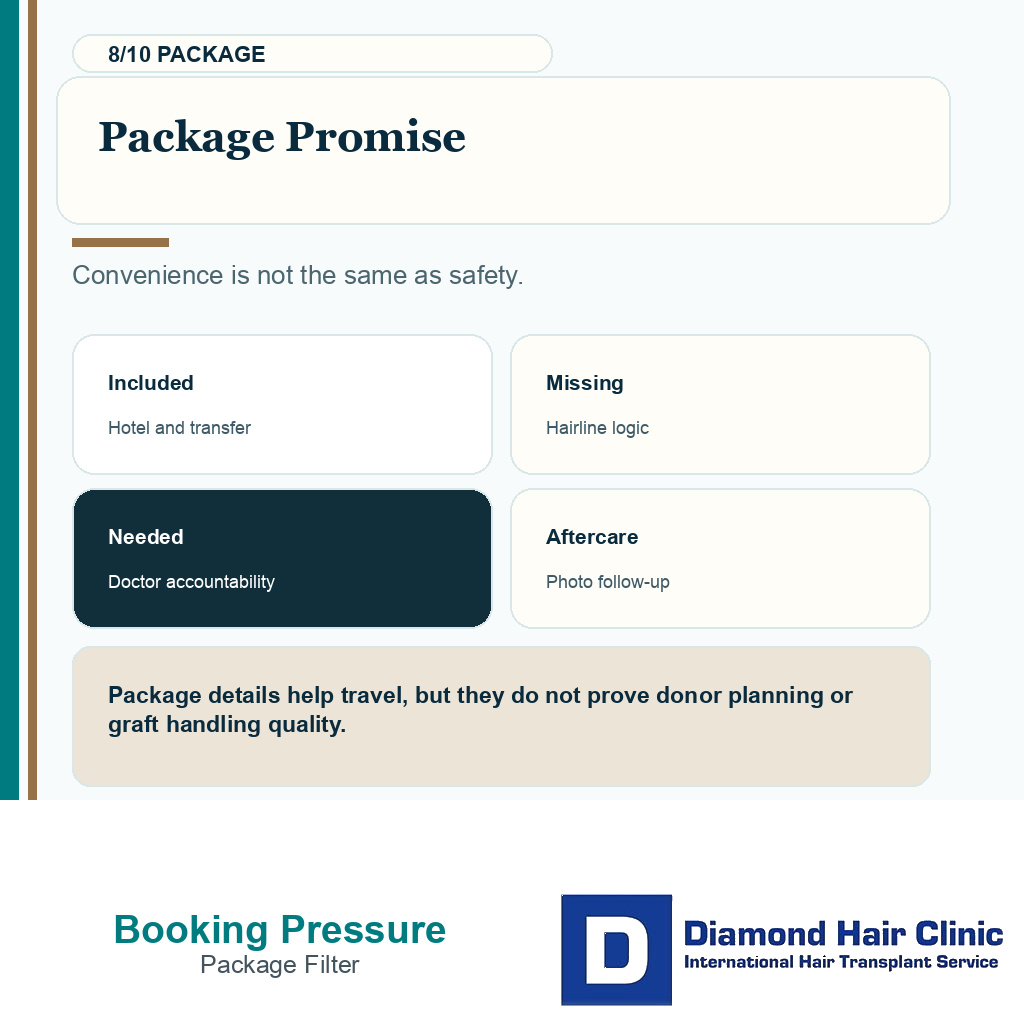
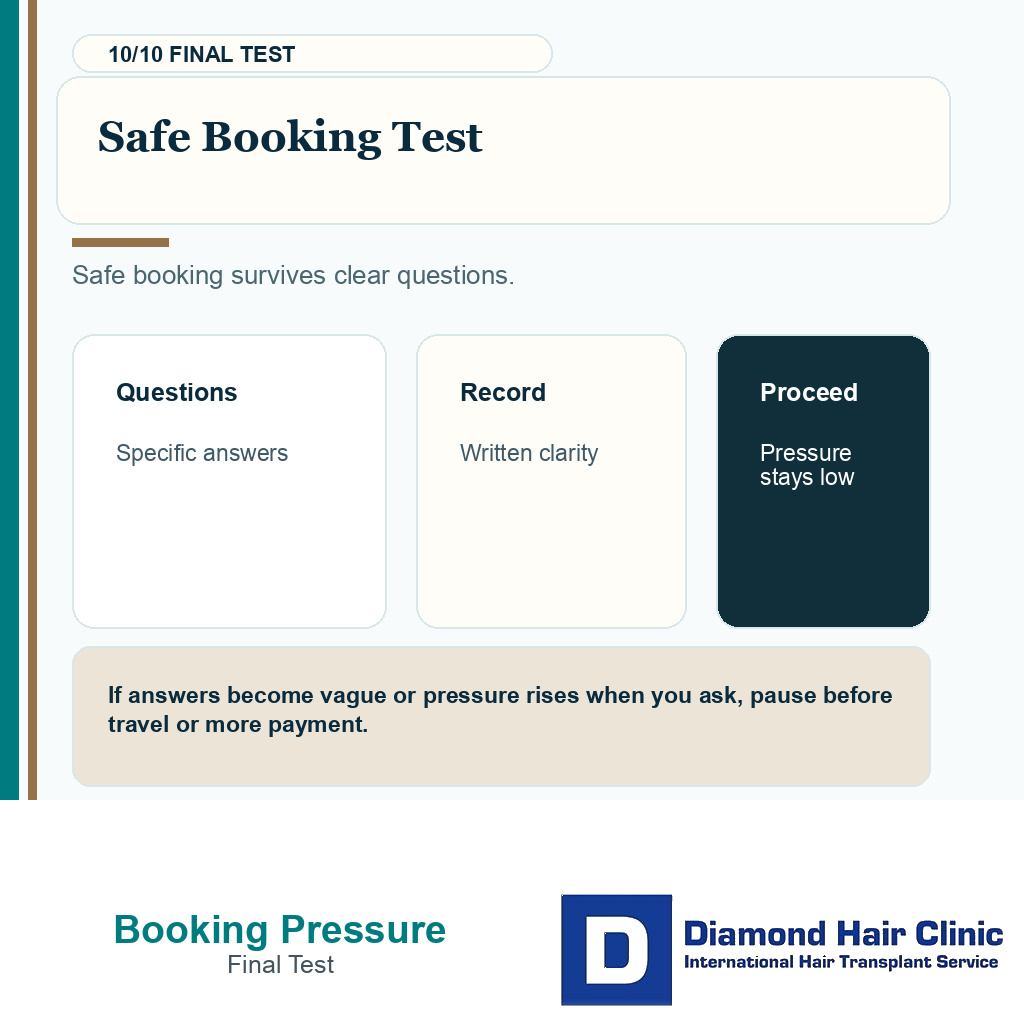
Use the 10 slides below to test whether pressure around a deposit, discount, package, graft number, or fast date is normal scheduling or a reason to pause. Swipe the carousel, use the arrows for one step at a time, or choose a number below the image to jump to that point.
Graft numbers should not become sales numbers
One of the easiest ways to create pressure is to attach a large graft number to a special package. It sounds concrete. It sounds like value. But a graft number is not a shopping quantity. It is a surgical decision based on donor capacity, recipient area size, hair caliber, hair loss progression, age, medication history, and the need to preserve options for the future.
High graft numbers are not a medical advantage when donor limits are ignored. In a young person with unstable hair loss, an aggressive number can make the first year look satisfying and still create a future problem. In someone with a weaker donor area, the same number can increase visible extraction changes. If the real need is hairline refinement, the number may be used to sell confidence rather than solve the actual problem.
A proper consultation should explain why the number is being proposed and what is being protected. Hair transplant graft count verification separates a real surgical count from a marketing promise, while how a surgeon calculates graft numbers shows why the number has to come from anatomy, not sales pressure.
Discounts and limited slots can become a problem
A discount is not suspicious by itself. A cancellation slot, seasonal price, or package arrangement can be real. The warning sign appears when price urgency arrives before the medical explanation. If you are told to pay quickly but you do not have clear answers about surgeon access, donor limits, hairline placement, graft handling, follow up, and what happens if surgery should be postponed, the order is wrong.
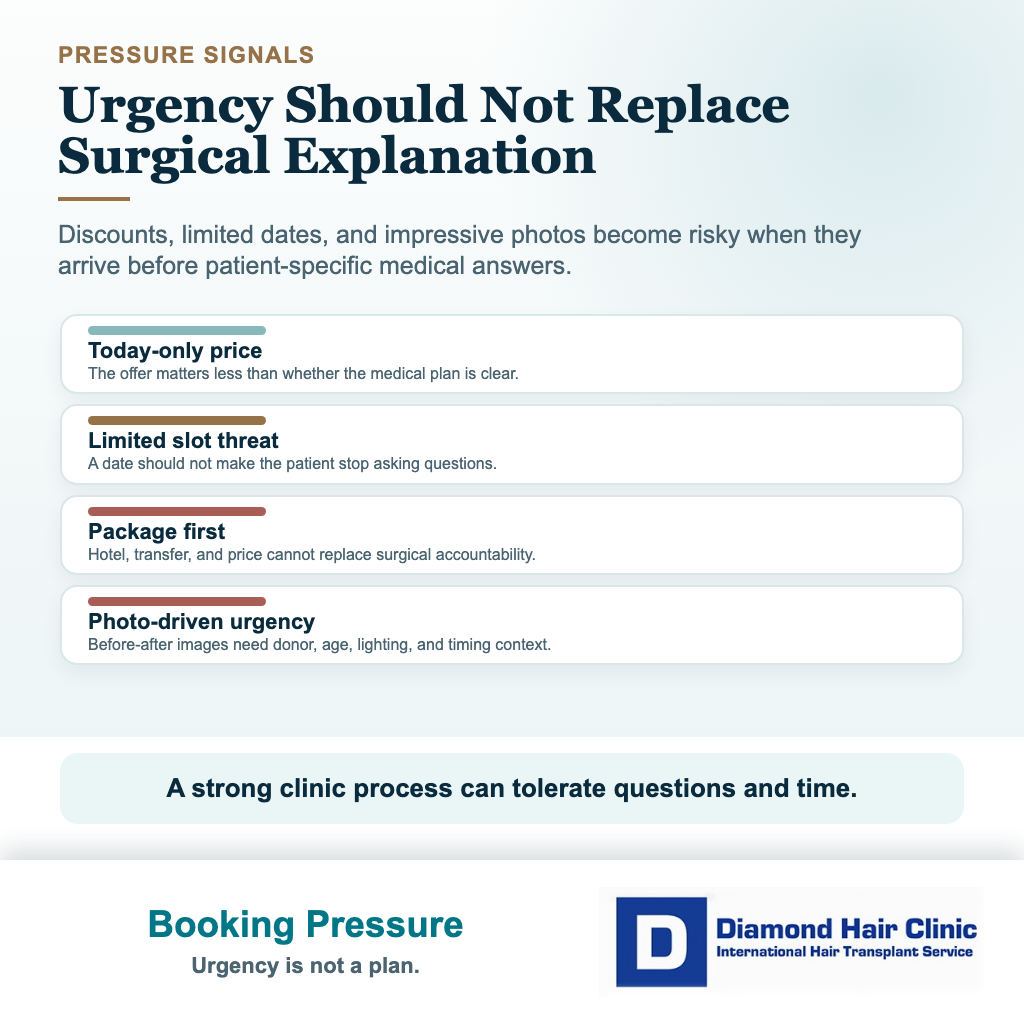
Limited slots can also create emotional pressure. You may feel that if you do not book today, you will lose the chance to fix your hair loss. That is a poor emotional state for surgery. Hair transplant planning should tolerate questions. A strong clinic process does not collapse when you ask for time to compare options, request the full written price, or ask whether the offer is truly time limited.
Red flags of Turkish hair mills include broader warning signs. The narrower booking pressure point is whether urgency appears before the surgical plan is understood. If it does, step back.
Packages should not replace surgical accountability
Hair transplant packages can make travel easier. Hotel, transfer, translation, and aftercare logistics matter, especially when you travel internationally. But a package is not a surgical plan. A package tells you what is included. It does not tell you whether the hairline is appropriate for your age, whether your donor supply can safely support that plan, whether medication belongs in the plan before surgery, or whether the doctor will be present for the important surgical decisions.
When comparing packages, separate convenience from accountability. Accommodation may be comfortable. The coordinator may answer quickly. The clinic may have many reviews. Those points still do not answer the medical question. You need to know what is being done to your scalp, by whom, and why.
Read hair transplant packages in Turkey as logistics information, not as permission to choose the easiest package. The surgical plan must remain the center of the decision.
Before and after photos need careful judgment
Before and after photos are useful, but they can also push you into a fast decision. You may see a good result, imagine the same result on your own head, and pay before asking whether your donor area, hair caliber, age, loss pattern, skin contrast, and styling habits are comparable.
Judge photos by the context around them, including same lighting, same hair length, similar angle, similar wet or dry condition, and enough time after surgery. A strong result in another person does not prove the same plan is correct for you. The more a clinic uses photos to create urgency, the more important an explanation specific to you becomes.
Hair transplant before and after photos can also create pressure when they are shown without enough medical context. Booking pressure often becomes stronger when images are used as proof before the donor area, graft number, and surgeon role are explained.
When pressure hides candidate risk?
The most concerning pressure is not only financial. It is pressure that arrives before anyone has decided whether the patient is a suitable candidate.
Young age with active loss, diffuse thinning, weak donor supply, a very low hairline request, crown coverage that needs too many grafts, unstable medical information, or poor photo quality can all change the plan. Sometimes they lower the graft number. Sometimes they delay surgery. Sometimes they make surgery the wrong choice.
If a clinic asks for payment while these questions are still unanswered, the patient is not being asked to trust a medical plan. He is being asked to trust momentum. That is the moment to slow down and ask for the surgeon’s reasoning in writing.
A paid deposit does not remove the need for review
If you already paid a deposit and now feel uncertain, do not panic, but do not treat the payment as medical proof. Write down exactly what is unclear. Who is the surgeon? Who designs the hairline? Who performs the surgical incisions? What graft number was proposed, and why? What happens if the doctor changes the plan on surgery day? What medical conditions or medications still need review?
Then ask the clinic directly and pay attention to who answers. A coordinator can explain policy, dates, and logistics. Surgical suitability, donor safety, and hairline judgment need surgeon review. Put the questions in writing and keep the answer. If the answers remain vague, or if the clinic pushes harder because you asked reasonable questions, pause before the next payment, flight, or surgery date.
Some people should cancel. Some should postpone. Some may continue after the clinic gives clear answers. The deposit itself does not decide the medical choice. The plan does. If waiting means losing a date or some money, that may still be less harmful than entering surgery with unanswered questions. Do not make a second payment, book travel that cannot be refunded, or accept a surgery day plan change just because the first deposit is already gone. Sometimes waiting for the right hair transplant surgeon protects the medical choice more than keeping a discount deadline.
Travel convenience is not medical readiness
Medical tourism can work well when you have verified the doctor, understood the surgical process, checked follow up, and accepted realistic limits. It becomes dangerous when low price and convenience replace medical evaluation.
Travel support can make a clinic feel organized, but it does not prove donor assessment, age-appropriate hairline design, or donor protection. I separate convenience from surgical readiness. The itinerary should follow the plan, including realistic stay length, safe first wash timing, and follow-up after surgery in Istanbul and after returning home.
Price only country comparison misses the real risk. Travelling abroad for a cheaper hair transplant is relevant here because lower cost is not the same as lower risk. The risk depends on the surgeon, the plan, the team, the donor management, and the follow up.
Reasonable booking follows surgical clarity
The best moment to book is not the moment you feel rushed. It is the moment the plan still makes sense after your questions have been answered. You should understand the hairline design, the donor strategy, the graft number, the doctor’s role, the aftercare path, and the realistic limits. You should also understand what would make the clinic postpone surgery.
A careful booking process does not need pressure to make you decide. It can explain why the plan is measured, why some grafts should be saved, why medication may matter, why a lower hairline may be unwise, or why waiting may keep the plan medically coherent. That type of answer may feel less exciting than a discount, but it protects the result.
A deposit should never become the reason you stop asking medical questions. Book when the surgeon’s plan is clear, the donor area has been respected, and the clinic can explain the surgery without using urgency as the main argument. If urgency is still the strongest argument, the plan is not yet strong enough.
Quote changes can become especially difficult after a patient has already travelled. The hair transplant quote change review gives a practical way to separate a real scope revision from travel pressure before grafts are removed.
Pressure is more concerning when the patient has not verified who is speaking or who is responsible for the surgical plan. The hair transplant booking message check helps separate clear planning from speed before clarity.