



Surgeon Waitlists and Booking Pressure
A long hair transplant waitlist is not proof that a surgeon is excellent, and a quick available date is not proof that a clinic is unsafe. The date only becomes meaningful when you know who evaluates you, who designs the hairline, who performs the surgical steps, how donor planning is handled, and what happens after surgery. The calendar is never the medical plan.
When I speak with someone who is comparing dates, I do not start with the calendar. I start with the operation itself. The best date is the one that still protects the patient and the surgical plan. If a cancellation date gives enough time for medical review, photos, donor assessment, travel planning, and clear consent, it may be reasonable. If it compresses all of that into panic, the date is not helping you.
Meaning of a long surgeon waitlist
A long wait can mean demand. It can also mean limited surgical days, a smaller team, careful case selection, travel scheduling, or ordinary clinic capacity. It does not prove hairline skill, graft handling, donor discipline, or transparent communication by itself.
An old consultation should not be treated as permanent clearance. If several months or years pass before the operation, refresh the photos, donor review, medical history, medication status, graft range, and payment terms before the date becomes fixed. A respected waitlist still needs a current plan.
Patients sometimes confuse popularity with surgical quality. A familiar name still needs to show the real process behind the date. That means consultation, diagnosis, donor planning, hairline design, graft number reasoning, and follow up. A waiting list is only one signal. It is not a medical assessment.
I put more weight on surgeon involvement in hair transplant surgery than on the length of the waiting list. If the surgeon’s role is unclear, the waitlist length cannot compensate for that uncertainty.
A named waitlist only matters if the named surgeon is truly involved. A brand name, coordinator, or clinic reputation is not the same as knowing who examines the donor area, designs the hairline, decides the graft range, and takes responsibility if the plan changes.
Quick date can still be safe
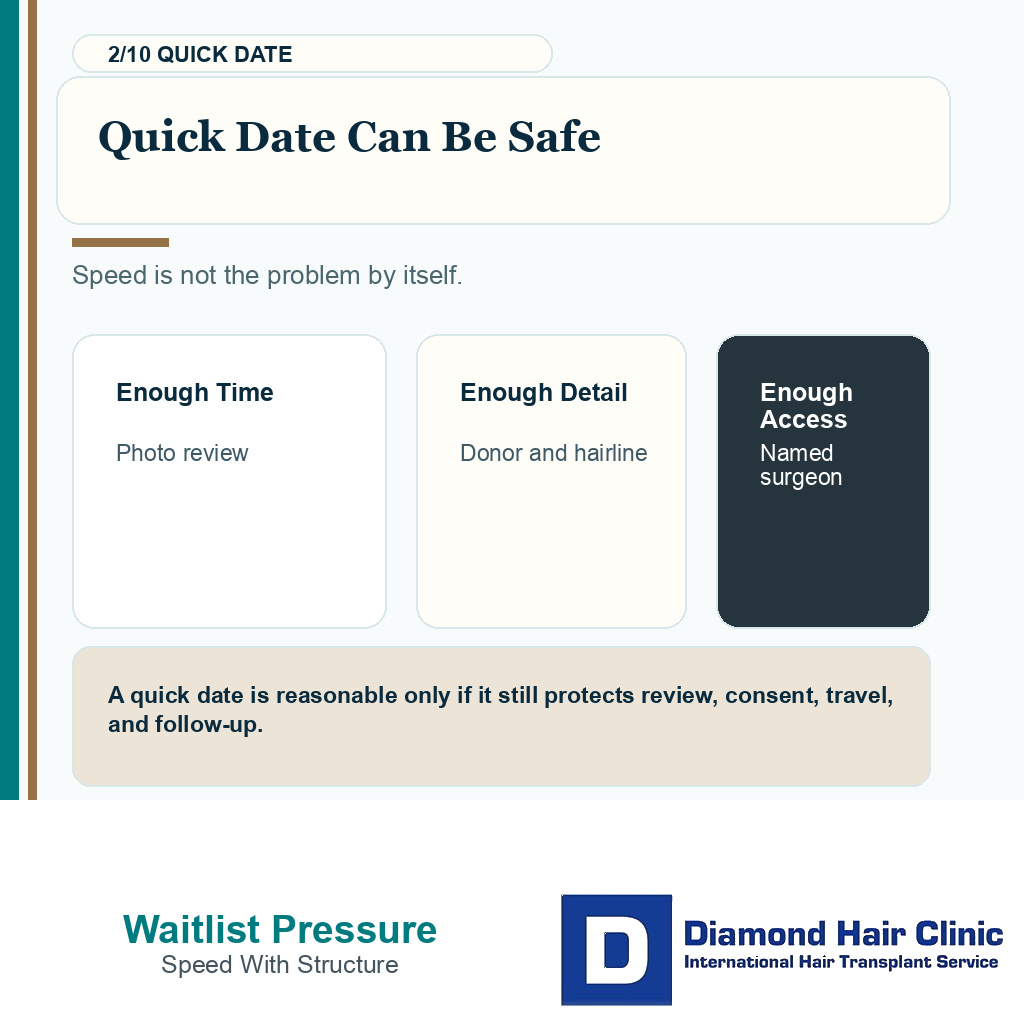
A quick date can be safe when the clinic has a genuine opening and you have already been evaluated properly. A cancellation can happen. Someone may change travel plans. A surgeon may have a limited opening that fits a prepared person. Until the medical review is finished, a cancellation slot is only an opening in the calendar. For an earlier slot, confirm the surgeon’s role is unchanged, not only the date. Premium and cancellation slots still need the same surgeon, case length, and follow up route.
The key point is preparation. A quick date is different from a rushed decision. You still need time to send clear photos, disclose medical history, review medications, understand the graft plan, and confirm who performs each step. Speed becomes risky when it replaces evaluation. If that preparation is missing, waiting before the hair transplant protects the decision more than a quick slot does.
If the clinic moves straight from an advertisement to a deposit and a flight date, I become cautious. That pattern overlaps with the pressure signs discussed in hair transplant booking pressure. A prepared person feels informed, not cornered.
Cancellation dates can create pressure
Cancellation dates feel attractive because they create urgency. You may think, “If I do not take this slot, I may lose my chance.” That emotion is understandable. Hair loss already creates impatience, and a sudden opening can feel like relief.
But a cancellation date can also shorten the thinking time that protects you. The clinic may ask for a fast deposit. Flights may be expensive. Work leave may need to be arranged quickly. You may skip careful comparison because the date feels rare.
I do not reject cancellation dates. I reject poor preparation around them. If the clinic can still explain the medical plan clearly, show who is responsible for the surgical decisions, and give you time to think, the date may be useful. A real opening should still leave room to say no. If urgency becomes the main argument, slowing down protects you.
A cancellation slot should not shorten informed consent. You still need time to review the proposed hairline, donor plan, medication and health details, travel timing, and follow up route before money and flights make the decision feel locked.
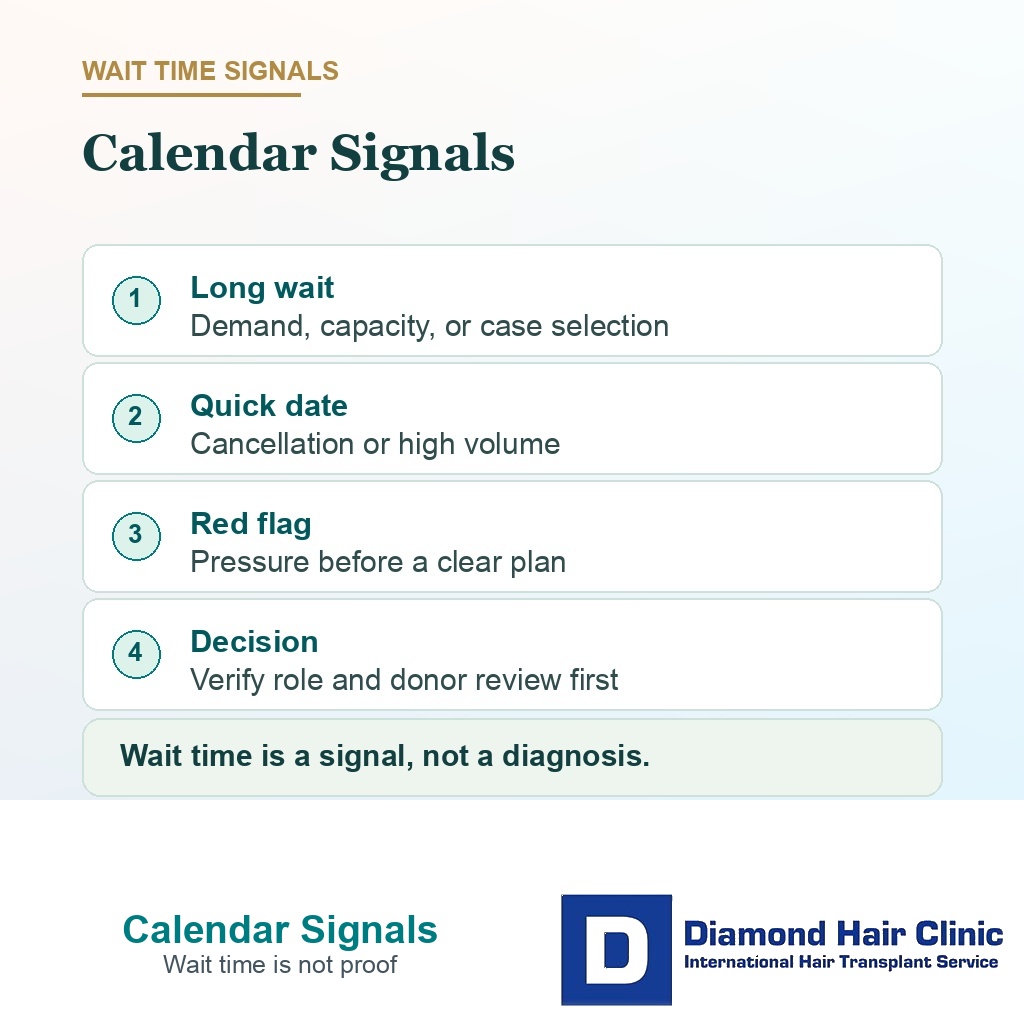
Waitlist length is a signal, not a diagnosis of surgical quality.
Checks before taking an earlier date
Before accepting an earlier date, verify who will evaluate your hair loss, who will design the hairline, who will plan the donor area, and who will be in charge if the plan changes on the day. Do not rely only on a coordinator’s confidence. Coordinators can organize communication, but the surgical plan still needs medical ownership.
Case load matters too, so confirm how many surgical cases the same surgeon is responsible for.
Treat an earlier slot as acceptable only when it gives you the same written plan you would expect from a normal booking. A rare date should not remove the hairline drawing, donor limit, consent review, or follow up route.
Repair cases need an even slower calendar decision. A quick date or a long waitlist does not prove repair skill. The useful evidence is a written repair plan, comparable repair examples, and a clear explanation of whether the first step is removal, camouflage, donor repair, or waiting.
Many people first speak to a sales or coordination team, so I separate logistics from medical ownership early. A coordinator may be helpful with logistics, but hair transplant coordinators and surgical planning are not the same responsibility. The surgical judgment still needs a medical owner.
Also verify whether the graft number is a real estimate or a selling point. A high number can sound impressive, especially when you have waited a long time, but graft numbers must fit donor capacity, future hair loss, hair caliber, and long term design. If the estimate changes dramatically without explanation, pause before booking.
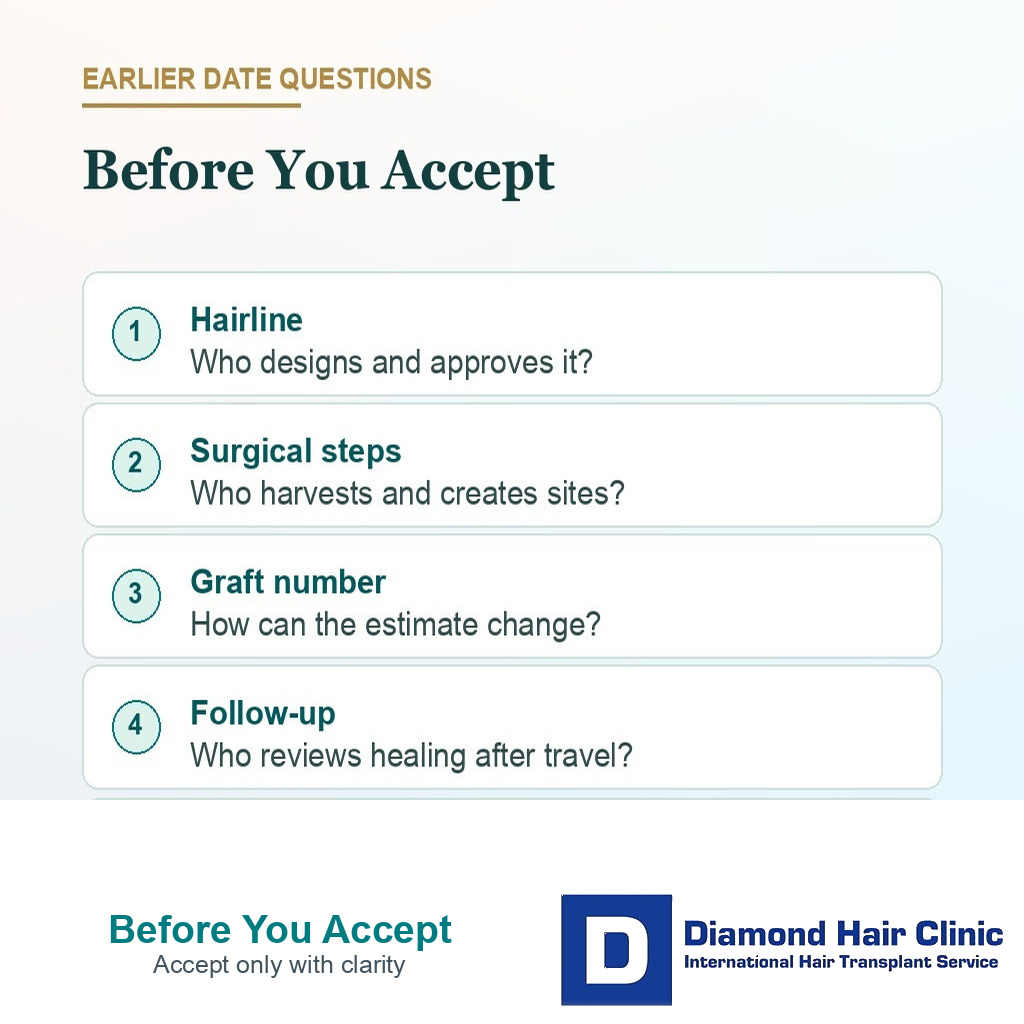
An earlier hair transplant date is useful only when the surgical answers are clear.
A short wait can be a warning sign
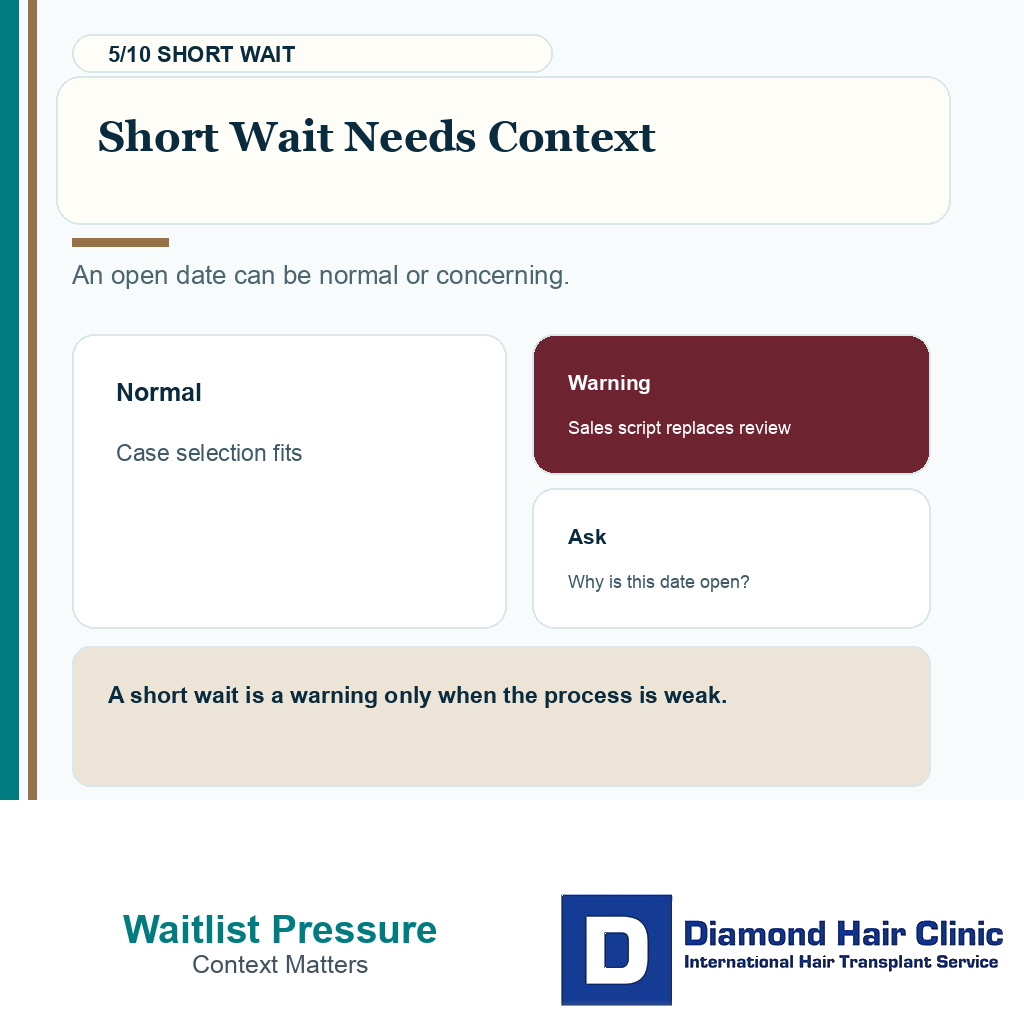
A short wait becomes concerning when the clinic cannot explain the surgeon’s role, avoids direct medical questions, promises a fixed high graft number without examining donor limits, or pushes you to pay before the plan is clear. The warning is not the date itself. The warning is the lack of medical structure around the date.
Some high volume clinics can offer fast dates because they run many people through the same system. That does not always mean every result is bad, but it changes the risk profile. You need to ask whether the surgeon is truly planning and supervising the case or whether the surgery is mostly a production process.
When comparing clinics in Turkey, choosing a hair transplant clinic in Turkey should come before calendar speed. Convenience is not the same as surgical responsibility.
Good reviews do not replace process verification
Reviews can help, but they do not remove the need to verify the process. A review tells you one person’s experience. It may not show the donor area clearly, the hairline under harsh light, the role of the surgeon, the long term plan, or what happened when follow up was needed.
Look for reviews that resemble your case. Similar age, hair loss pattern, donor quality, hair caliber, skin tone, hair curl, and repair needs matter more than a general star rating. A young person with aggressive future hair loss should not judge the plan from someone older with stable donor hair and limited frontal work.
I treat hair transplant reviews in Turkey as one evidence layer, not as permission to ignore the consultation. Reviews can raise good questions, but they cannot replace the examination and plan.
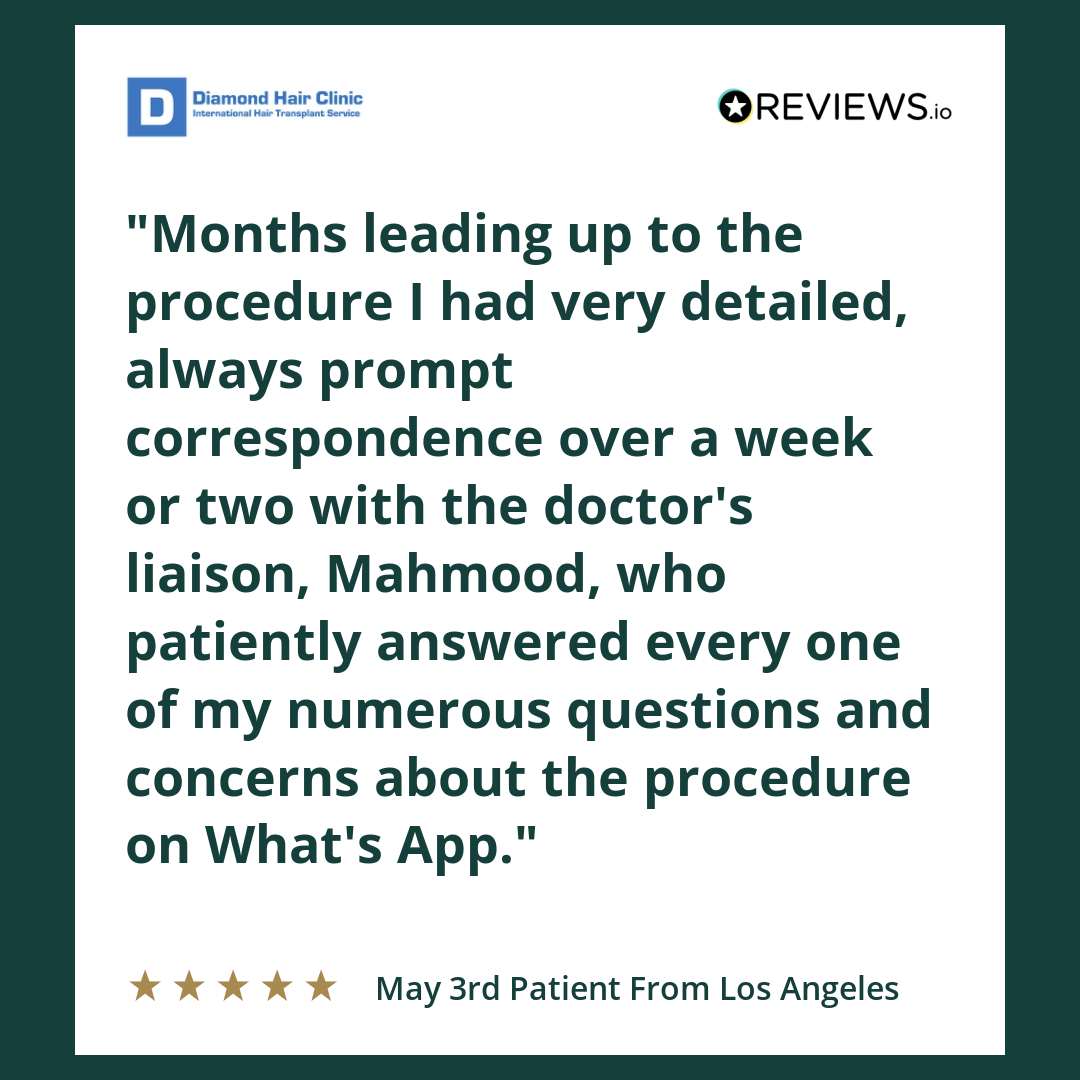
Read this review excerpt
Months leading up to the procedure I had very detailed, always prompt correspondence over a week or two with the doctor’s liaison, Mahmood, who patiently answered every one of my numerous questions and concerns about the procedure on What’s App.
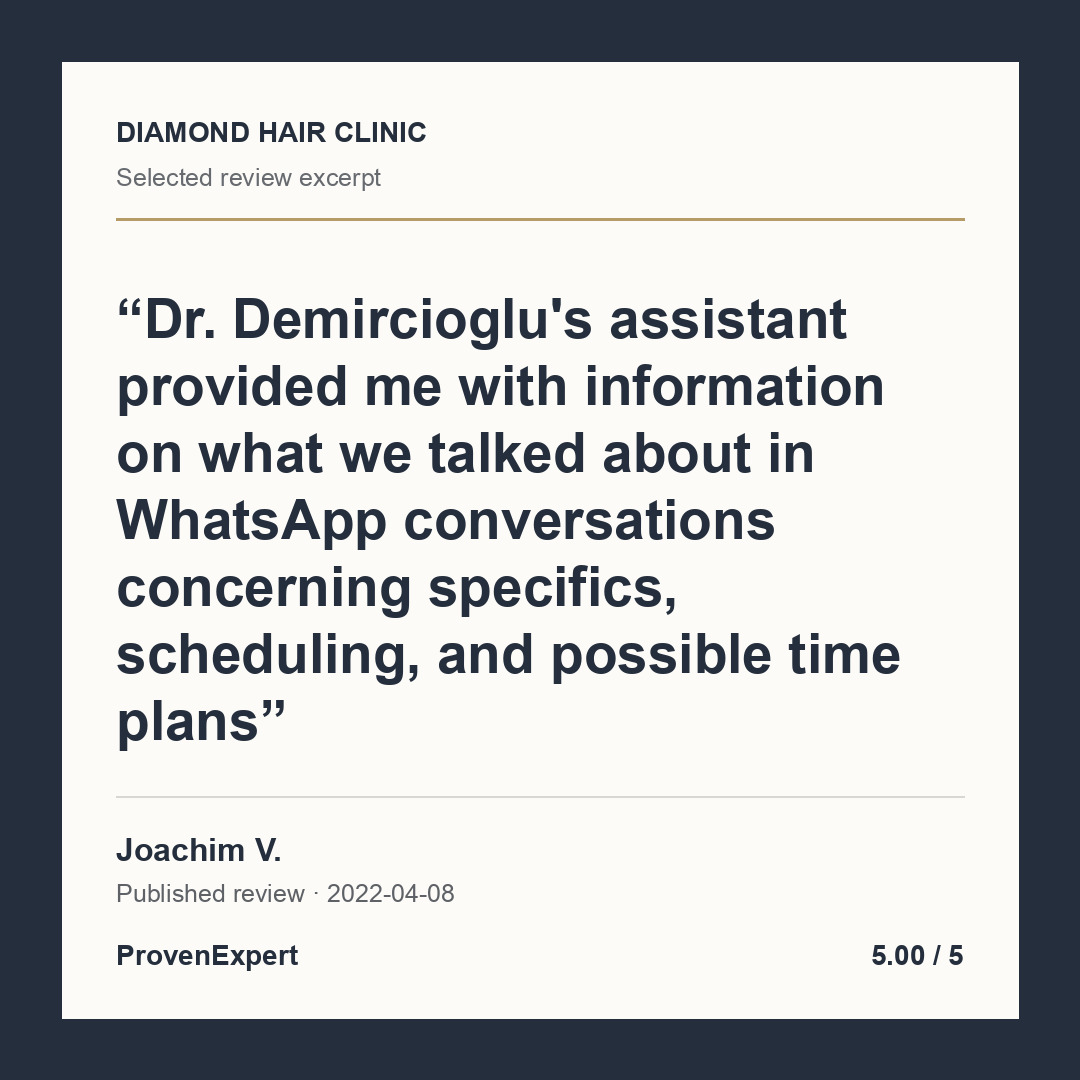
Read this review excerpt
Dr. Demircioglu's assistant provided me with information on what we talked about in WhatsApp conversations concerning specifics, scheduling, and possible time plans
Questions before paying a deposit
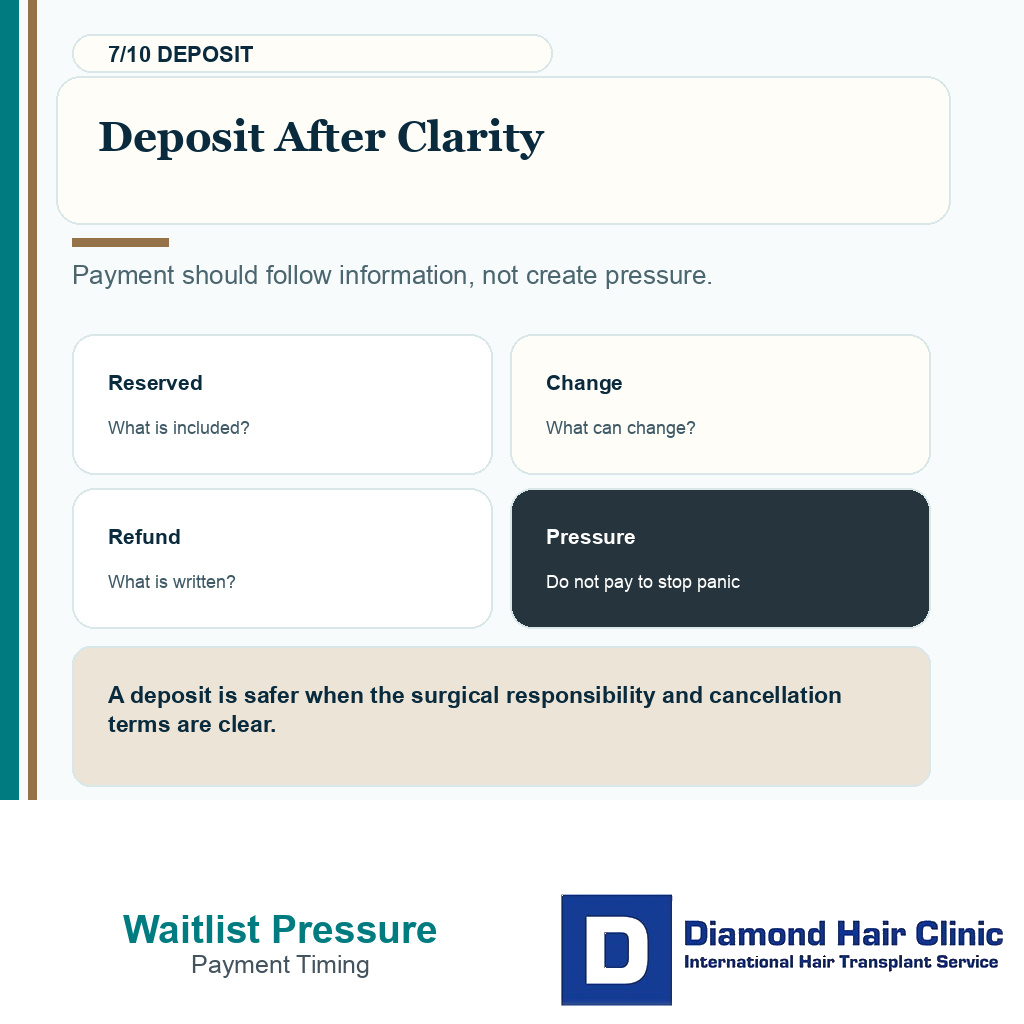
Before paying, ask what the deposit covers, whether it is refundable, what happens if the surgeon decides the plan must change, and what happens if your medical review shows surgery should be delayed. A deposit should not trap you into a procedure that is no longer medically sensible.
The price structure should show whether cost depends on graft count, package type, or a sales decision on surgery day. Package wording can hide important differences in surgeon access, graft handling, hotel logistics, and follow up. I look at hair transplant packages in Turkey by checking what is included medically, not only what is included for travel.
Payment logistics are separate from surgical quality, but they influence pressure. If you are confused about cash, cards, deposits, and policy, you may rush because money is already moving. Before travel is locked, paying for hair transplant in Turkey should be clear enough that you do not feel financially trapped.
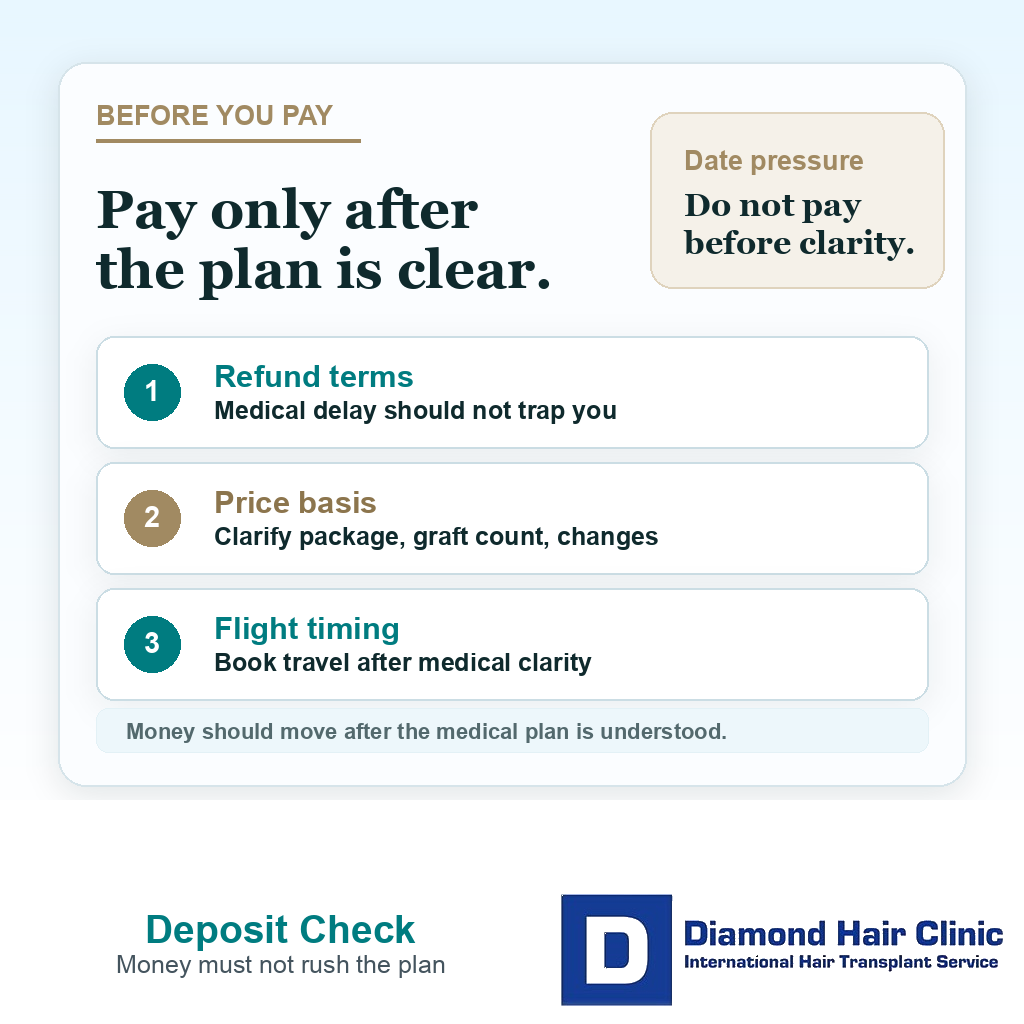
A booking deposit should follow clear medical planning, not replace it.
Travel timing and surgeon availability
Travel should not be squeezed so tightly that you arrive tired, miss medical review, or have no quiet recovery time before flying home. A cancellation date may look attractive online, but the body still needs sleep, food, hydration, and a calm surgical day.
For international travel, I look at arrival time, time zone fatigue, medication disclosure, hotel distance, companion support, and the first days after surgery. If you are traveling alone to Turkey for hair transplant, you need an even clearer plan for transport, communication, and what to do if swelling, dizziness, bleeding, or anxiety appears.
Do not let flight convenience choose the surgeon. It is better to move the date than to compress the whole decision around one cheap ticket or one open slot.
If the graft number changes
A responsible graft plan can change after face to face examination. Hair caliber, donor density, miniaturization, scalp laxity, and recipient area size may look different from photos. A small adjustment can be reasonable. The risk is a large change with weak explanation or financial pressure attached to it.
If a clinic sells the date mainly around a large graft promise, you may feel disappointed when the surgeon recommends fewer grafts. The opposite can also happen. A clinic may try to add grafts because you are already there. Both situations need medical reasoning, not sales momentum.
When the plan changes too quickly, hair transplant graft count verification becomes part of the conversation. The useful point is not only the final number. It is whether the number fits long term donor management.
A graft change on surgery day needs medical reasoning before surgical momentum begins. The explanation should happen before shaving, local anesthesia, payment pressure, or donor work. A revised number may be correct, but it should never feel like an upsell on surgery day.
The 10 slides below compare calendar timing, surgeon access, deposit clarity, travel pressure, graft number changes, and follow up so you can separate a useful waitlist from booking pressure. Swipe the carousel, use the arrows for one step at a time, or choose a number below the image to jump to that point.






Follow up matters more after fast booking
Follow up becomes more important when the booking process is fast, because less time may have been spent building a relationship with the clinic before surgery. You need to know who answers questions after returning home, how photos are reviewed, and what happens if redness, swelling, infection signs, or anxiety appears.
A fast booking with weak follow up is a poor trade. The operation does not end when you leave the clinic. Early washing, scab timing, swelling, donor discomfort, shock loss, and monthly uncertainty all create questions. Hair transplant follow up after surgery is part of the safety of the plan, especially when the booking moved quickly.
If the clinic is difficult to reach before payment, do not assume it will become easier to reach after surgery. Communication quality before booking is often a useful preview of communication after surgery.
Young patients need slower calendar decisions
Younger patients are more vulnerable to calendar pressure because they often want the problem solved quickly. But early hair loss can keep progressing. A fast date, a low hairline, and a large graft number can look attractive now and become limiting later.
Before booking, you need a plan for native hair loss, medication tolerance, donor preservation, and future sessions. If you already know you will not use finasteride, or cannot tolerate it, the design must account for the same donor and future loss limits discussed in hair transplant without finasteride.
Waiting can be part of treatment planning when the hair loss pattern is not stable enough. That kind of waiting is different from marketing scarcity. One protects you. The other pressures you.
The calendar cannot carry the surgical work
I separate impatience, clinic availability, and the medical plan. Hair loss can make a person want the earliest possible slot, but donor supply is limited and the date cannot fix an incomplete design.
An earlier appointment can be reasonable when the surgeon’s role is clear, the donor plan is conservative, the hairline fits age and future loss, the payment terms are understood, and travel recovery time is realistic. If those details are vague, I slow the booking down.
A waitlist is not proof of quality, and a cancellation slot is not proof of readiness. Choose the date only after the surgical responsibility is clear.
Read this review excerpt
I asked two questions at all the clinics: how many patients will you take in a day and how much of the work will be done by the doctor.

Read this review excerpt
Once i contacted Diamond hair clinic ,for the booking . They respond me with the professional way and provided me all the details with the availiability.