


Hair Transplant Coordinators and Surgical Planning Limits
A hair transplant coordinator should not be the person giving you the final surgical plan. A coordinator can help organize your photos, explain the appointment process, and answer practical questions, but the plan itself should come from the surgeon who understands donor management, hairline design, medical risk, and long term hair loss. If you are being asked to accept a graft number, pay a deposit, or choose a date before the surgeon has properly evaluated you, I would slow down.
A hair transplant is not only a booking. It is a permanent redistribution of limited donor hair, and every graft used today changes your future options. A cautious plan needs medical judgment, not only quick communication and a confident message.
This stage can create pre surgery anxiety because the conversation often begins through WhatsApp, email, or an online form. That is normal. The detail that matters is whether the first contact leads to real surgical assessment or whether it moves too quickly toward payment.
Safe coordinator help stays within clear limits
A good coordinator can make the process easier. They can collect clear photos, explain travel details, schedule a consultation, send clinic instructions, and help the patient understand what information the surgeon needs. These are useful tasks, especially for international patients who are comparing clinics from another country. A useful coordinator also explains why each document request has a clear purpose before sensitive files are sent.
Coordination is not diagnosis. A coordinator can organize records, translate instructions, and keep communication moving, but donor strength, hair loss stability, crown priority, hairline safety, and graft limits belong to the surgeon. Translation support during a hair transplant abroad can help the conversation, but it should not decide the medical answer.
The distinction matters because a coordinator can move information, while a surgeon has to interpret risk. If the coordinator is arranging photos, timing, travel, and communication, that can help. If the coordinator is approving the graft number, dismissing medical history, promising a low hairline, or saying the surgeon will “confirm later” after payment, the role has moved into medical planning. That is the line I would not cross. This becomes even more important when daily surgery volume makes the plan feel rushed.
There is also a difference between a coordinator relaying the surgeon’s provisional opinion and a coordinator creating the plan alone. If the message says the surgeon has reviewed the case, you still need to know what was reviewed, what remains provisional, and when the surgeon will speak directly before the final commitment.
A fast reply is still not a final surgical answer. Coordinator guidance can help with logistics, but a risk question that changes the graft number, hairline, donor plan, medical timing, or complication risk needs surgeon review. Useful coordinator replies name who checked the medical risk, not only who sent the message. When an answer changes the graft number, the reason matters. A change from surgeon review is different from a change driven by scheduling pressure, package logic, or a quick sales reply.
In consultation, I am not only asking how many grafts could be placed. I am asking whether surgery is wise at all, what should be protected, what should be delayed, and what result will still look natural years later. That judgment should happen before the patient commits, not only after the patient has already traveled and is sitting in the clinic.

Role clarity map
Separate helpful coordination from medical authority
A coordinator can make travel and communication easier. The surgical plan still needs a named medical decision maker who can explain risk, reduce the plan, or stop surgery.
Helpful route
Good coordination moves information without pretending to diagnose
Collecting photos, arranging timing, explaining travel steps, sending instructions, and making sure the surgeon receives the right information.
Coordination becomes unsafe when practical help turns into final approval, fixed graft promises, or dismissal of medical concerns.
Which parts of the answer are logistics, and which parts came from the surgeon after reviewing your case?
I want the coordinator to organize the case so the medical judgment can be better, not replaced.
A safe surgical plan begins with medical judgment
A cautious plan begins with the question of whether surgery is the right decision for this patient at this time. Some patients are technically operable but strategically not ready. This can happen in young patients with active hair loss, patients with limited donor capacity, patients who want a very low hairline, or patients who are trying to cover too much area in one operation.
Price, package, hotel, and technique name come after the medical and artistic assessment. That assessment reviews the patient’s scalp, hair loss pattern, donor area, expectations, age, medication history, and future risk.
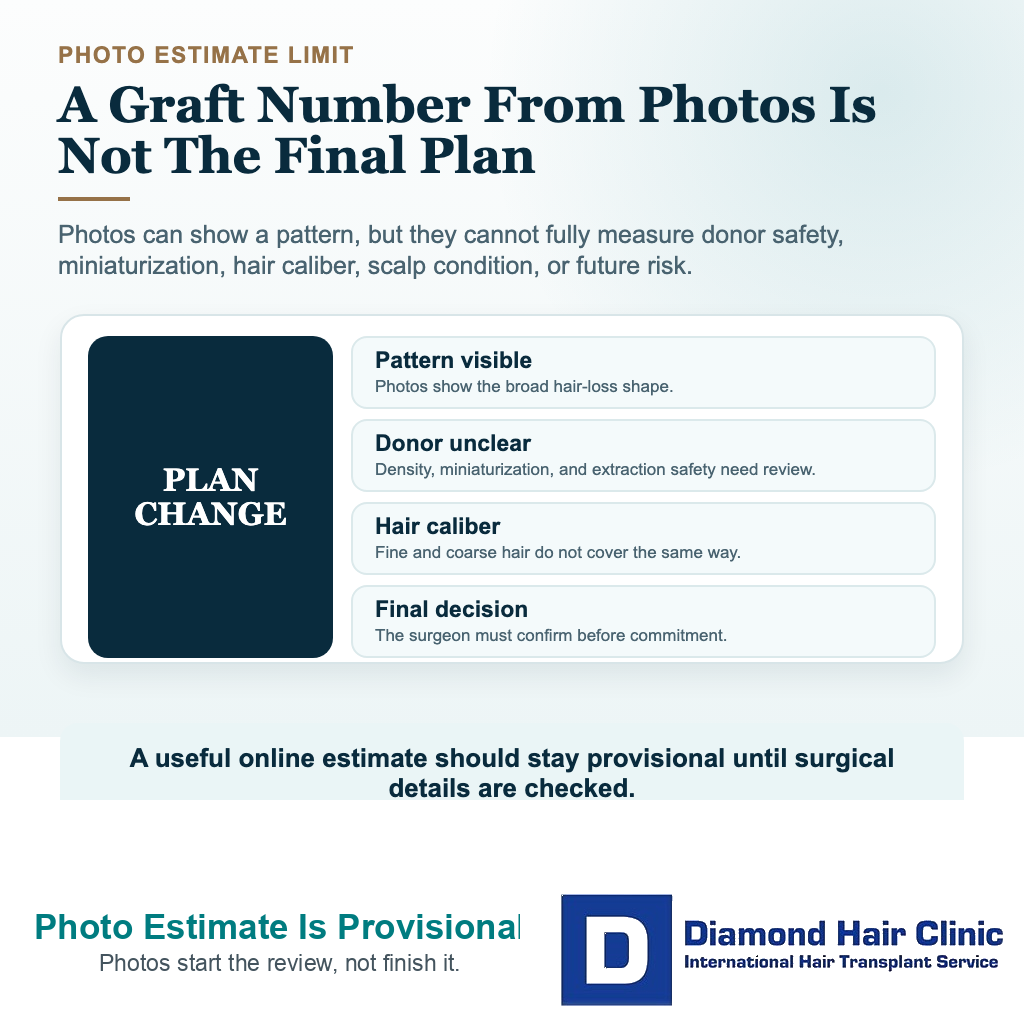
An online start can be useful if it is handled carefully. I can learn a lot from proper photos, but I still treat a hair transplant plan from photos alone as provisional. Photos may show the visible pattern, but they cannot fully show miniaturization, scalp condition, donor density, hair caliber, or how the hair behaves under different lighting. The same is true for a chatbot hair transplant consultation. It may organize information, but it must not replace medical planning.
A cautious plan should feel slightly cautious at the beginning. If the first answer you receive sounds too final, too fast, or too perfect, that is not always reassuring. Sometimes the responsible answer is not yes. Sometimes it is wait, treat the native hair first, reduce the graft number, or choose a more conservative hairline.
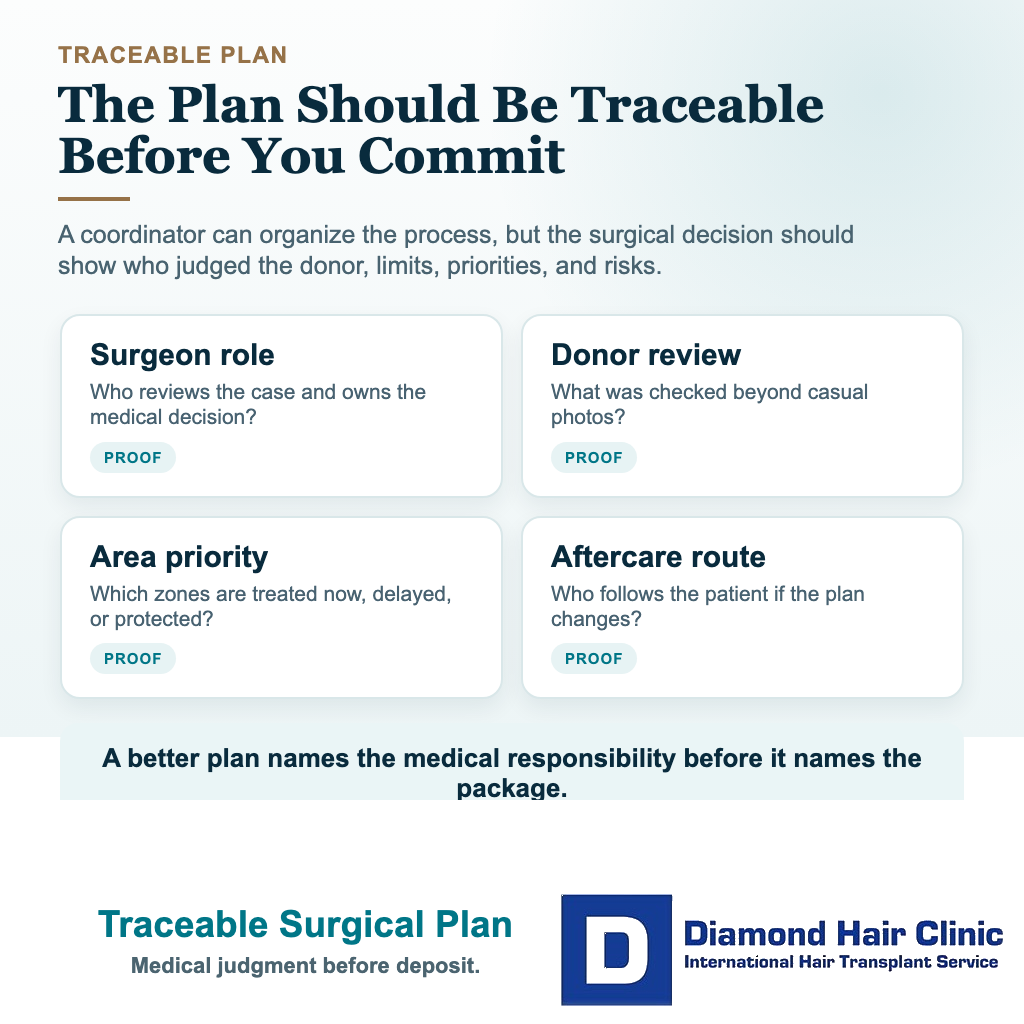
Use the 8 coordinator and surgical planning slides below to compare what a coordinator can organize, what must wait for surgeon review, why photo graft numbers stay provisional, how donor limits change the plan, when a cautious answer is safer, and which decisions should never be treated as package details. Swipe the carousel, use the arrows one step at a time, or choose a number below the image to jump to that point.
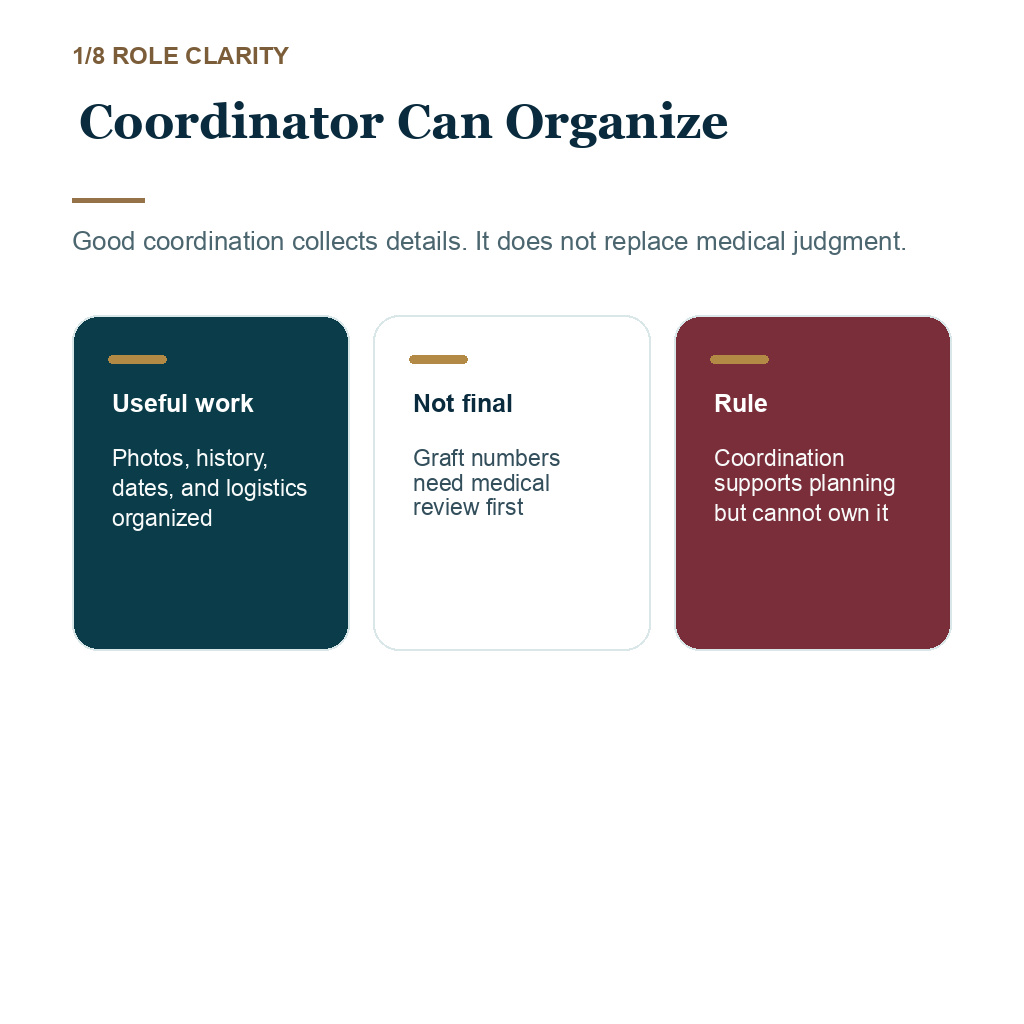
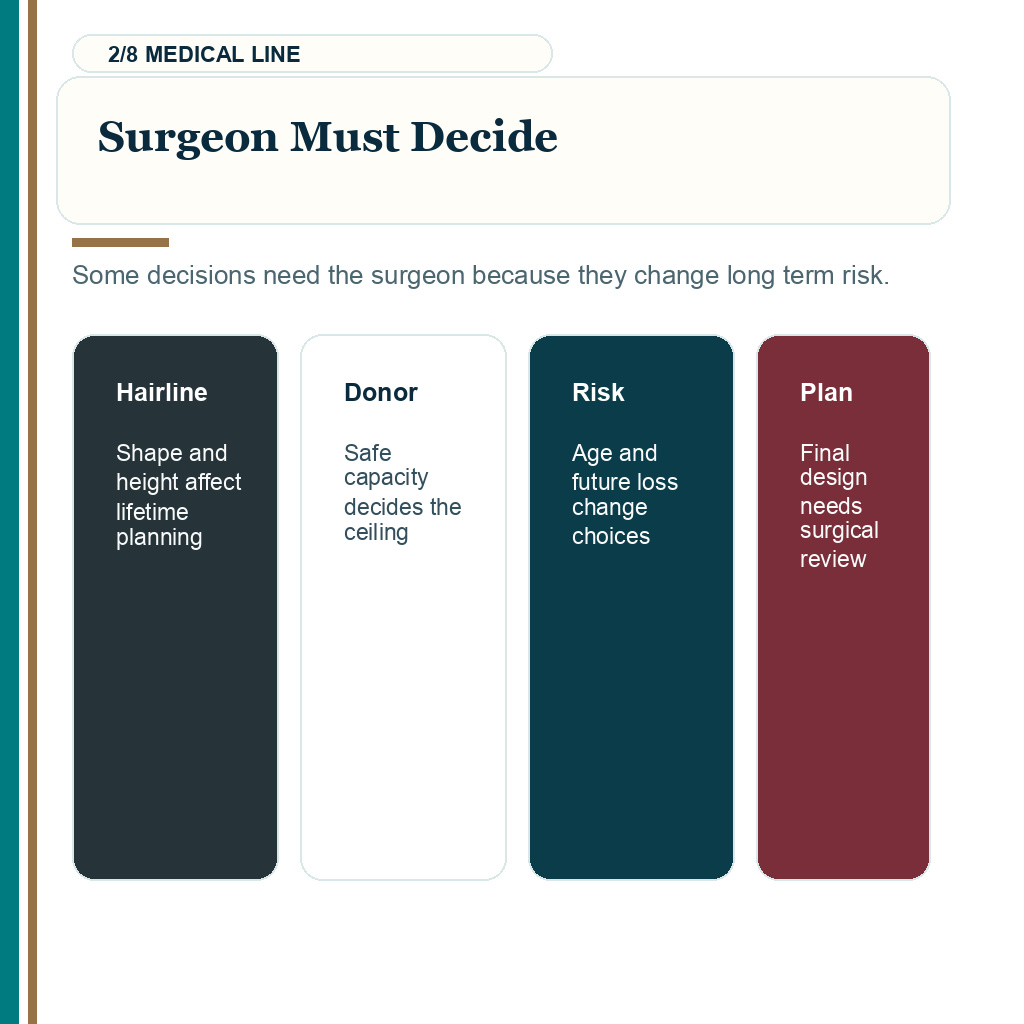
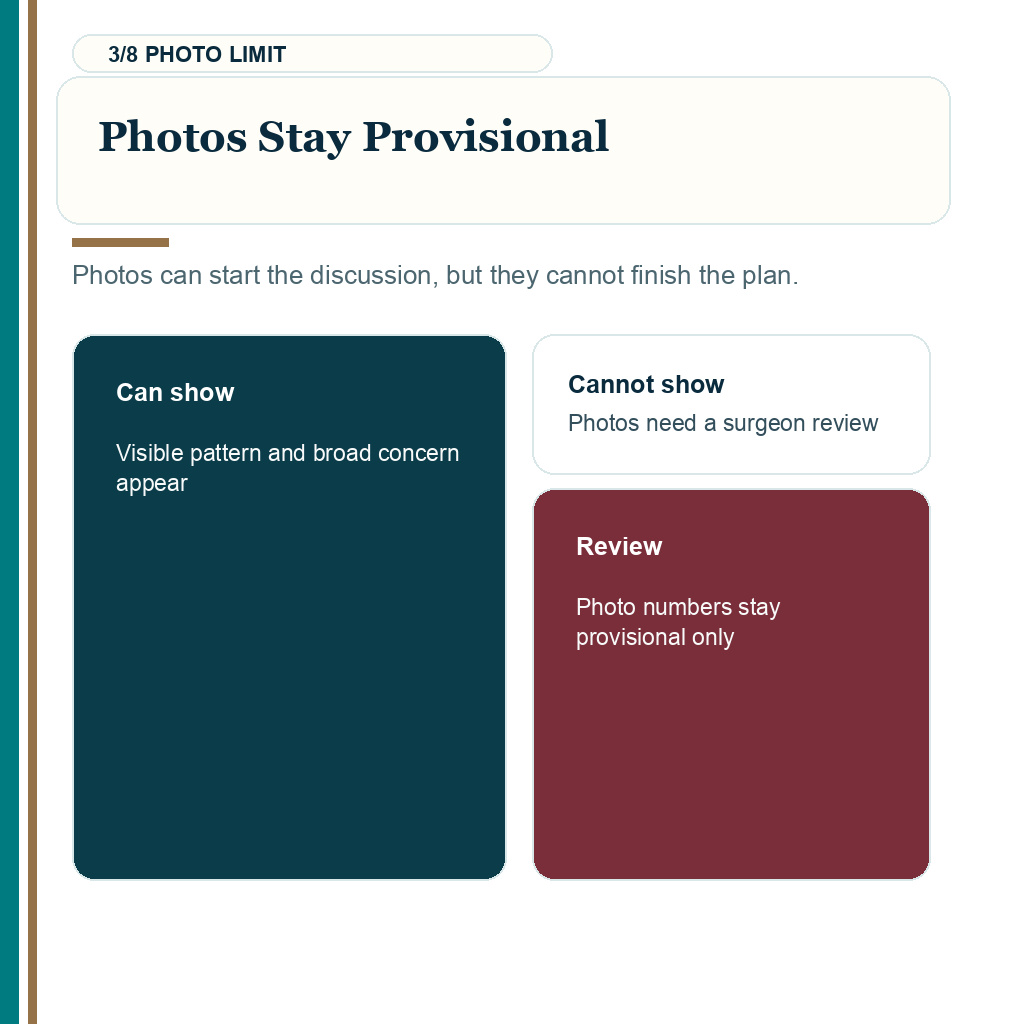
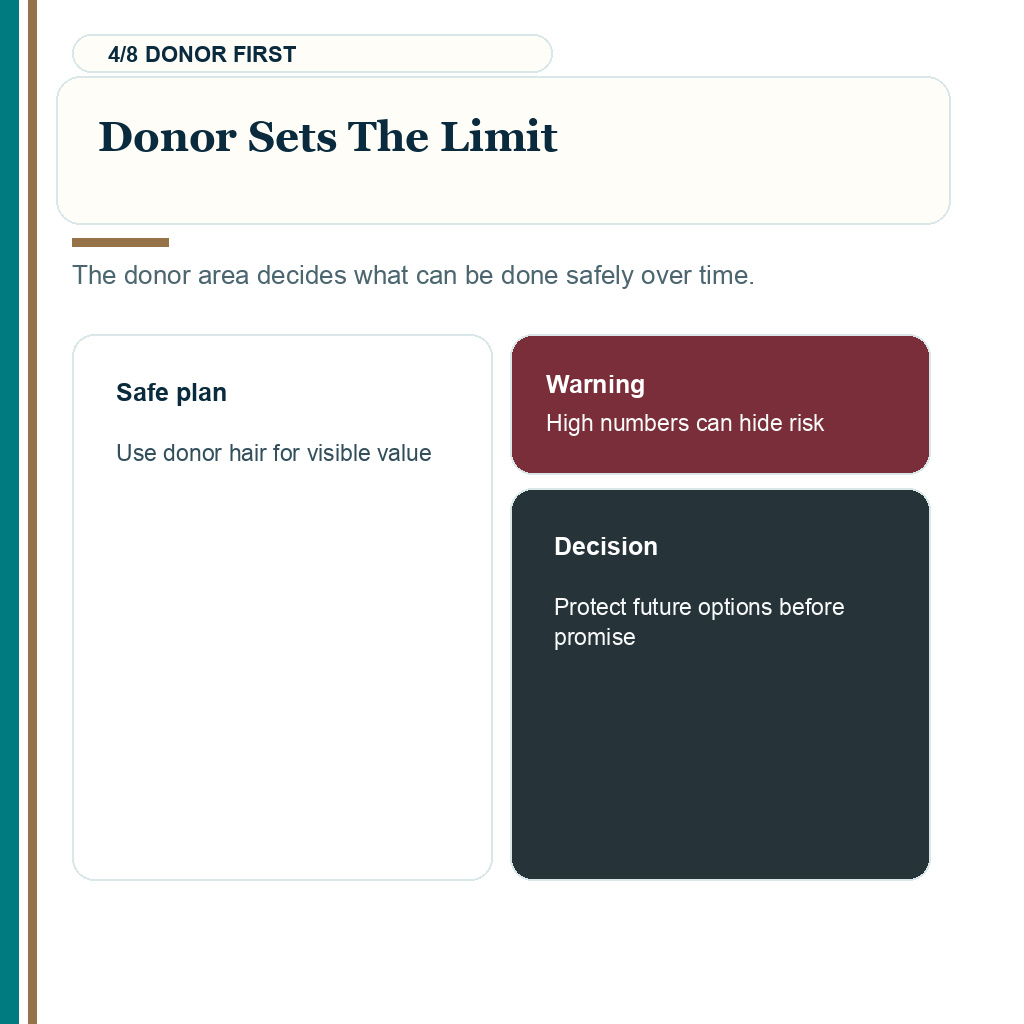
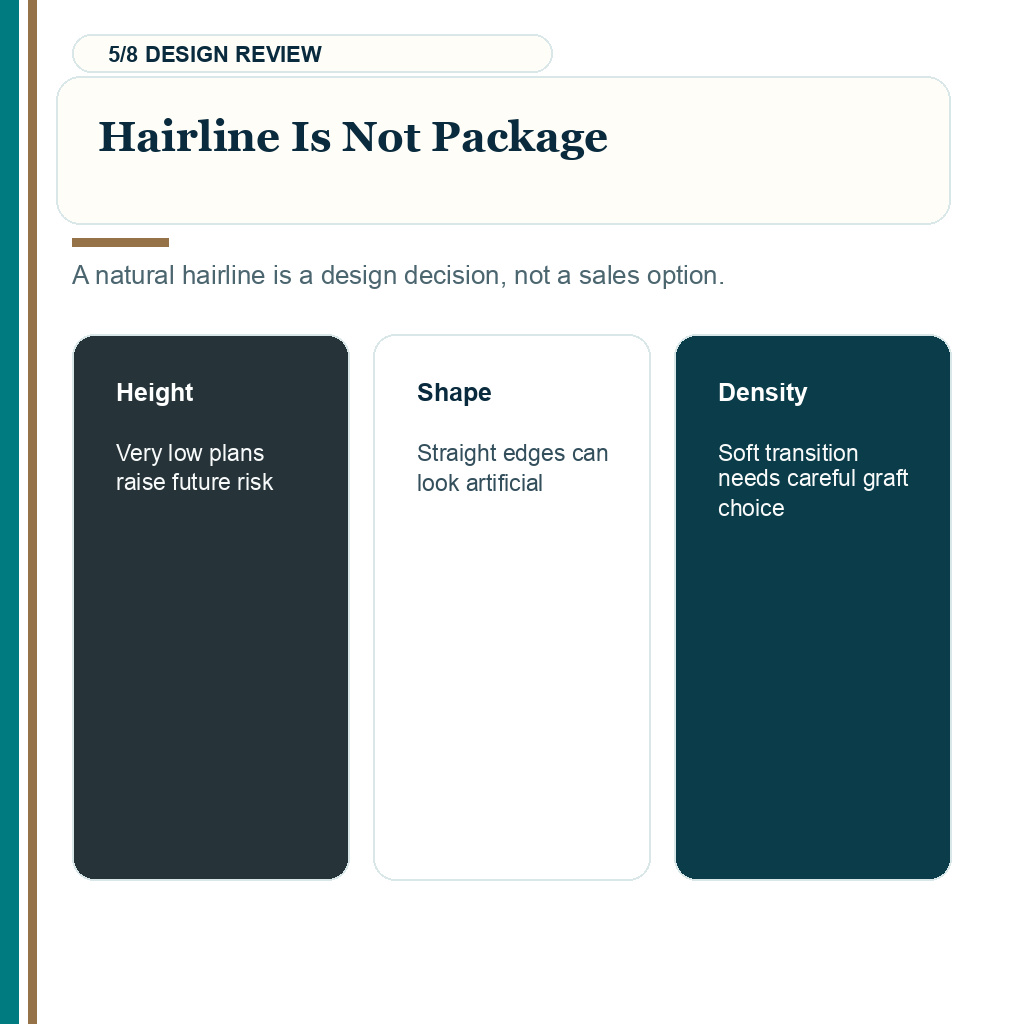
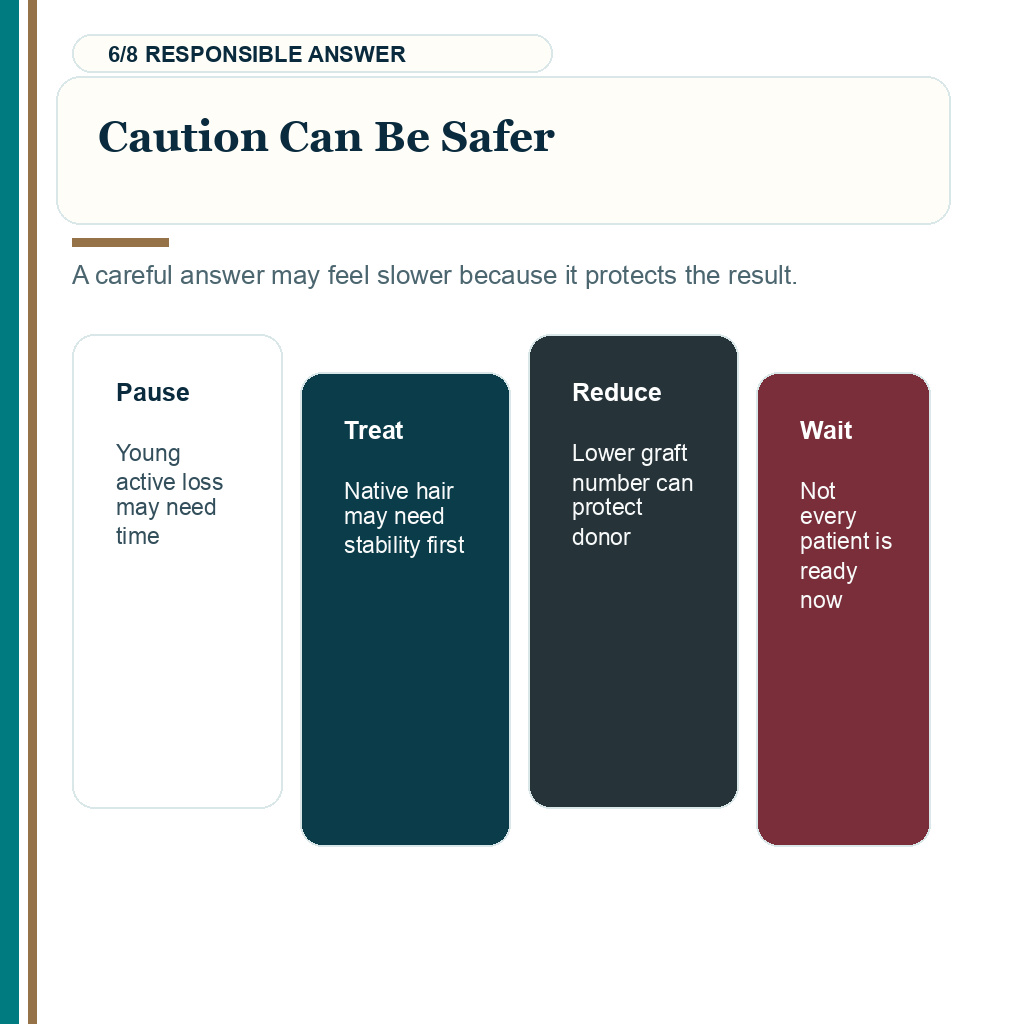

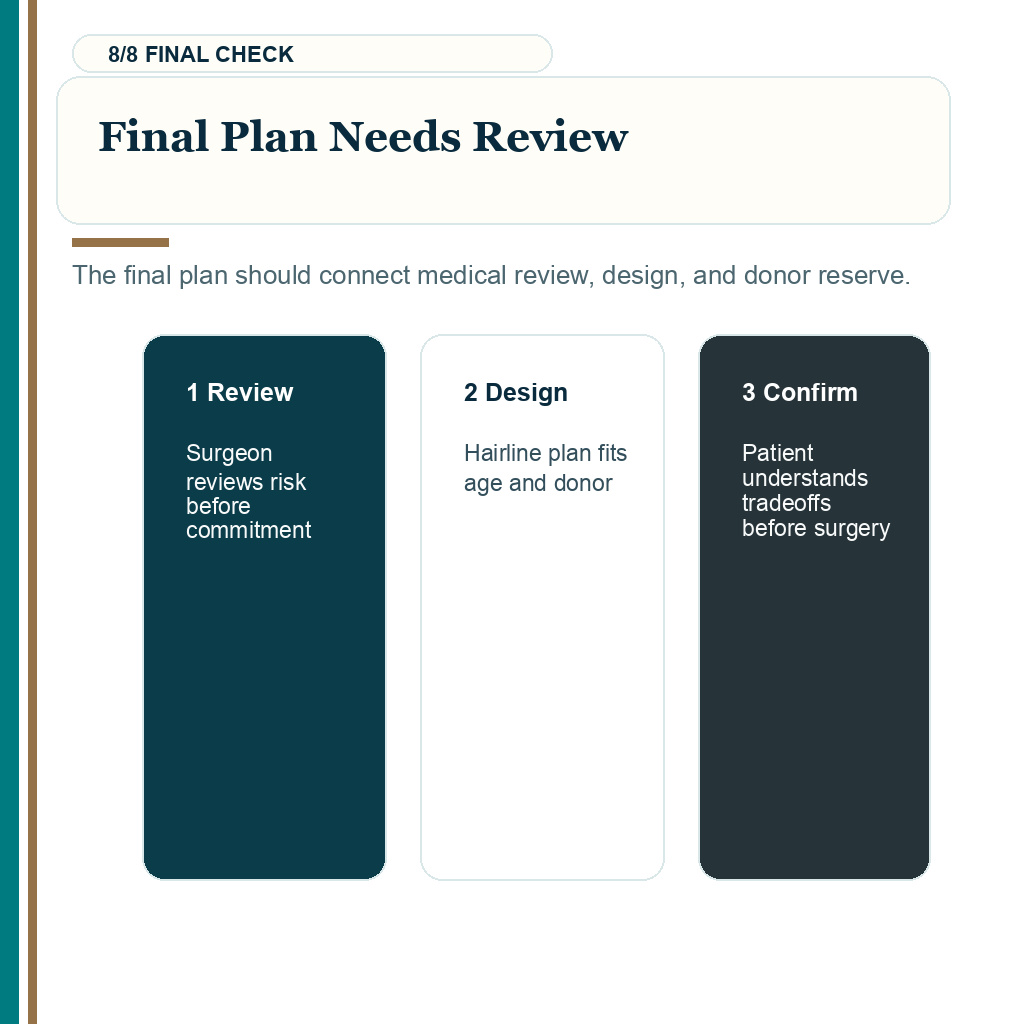
Photo estimates can mislead
A graft number from photos can be a useful starting estimate, but it should not be treated as a final surgical truth. The same number can mean very different things in two different patients. Two thousand grafts may be enough for a focused hairline correction in one patient and too little for a wider thinning pattern in another.
The graft number a clinic says it can place is only one part of the decision. What I look at first is whether that number protects the donor area and creates a natural result. A high number can sound impressive, but it can also hide poor planning if donor hair is being used too aggressively.
When a patient receives a precise number too early, they can start comparing clinics by the number instead of by the reasoning. If one clinic says 2,500 grafts and another says 4,500 grafts, the larger number is not always safer or more reliable. Different graft numbers from different clinics need to be judged by the plan behind them, not by the larger number alone.
A responsible estimate should explain the area being treated, the expected density, the donor limitations, and the reason for the number. Without that explanation, a graft number can become a sales tool instead of a surgical plan.
Surgery day plan changes need a clear reason
A plan can change on surgery day for legitimate reasons. The donor area may be weaker than expected, the hairline may need to be adjusted, the crown may need to be delayed, or the safe graft number may be lower than the first online estimate. A responsible change is not a problem by itself. The concern is when the patient only hears about it after payment, travel, and the pressure of being in the clinic.
If the surgeon changes the plan, the reason needs to be explained before the critical surgical steps begin. You need to understand what changed, why it changed, and whether postponing or reducing the operation is safer. A hair transplant graft number can change on surgery day, but the real reasoning should not appear only after the operation has already started.
For the same reason, a coordinator should not be the final authority. A coordinator can pass along an estimate, but only the surgeon can decide whether the estimate still protects the donor area when the scalp is examined properly.
Details coordinators can miss
A coordinator may miss the details that determine whether the operation will age well. They may see recession and think the answer is to fill the temples. I may see the same photos and worry about miniaturization behind the hairline, advancing crown loss, a limited donor reserve, or a hairline request that will look too low in ten years.
The donor area shows this clearly. A patient may look at the back of the head and think it is strong because it appears dense in a photo. But safe donor management depends on density, hair caliber, extraction pattern, miniaturization, previous surgery, and the patient’s likely future needs. I treat the donor area as a lifetime budget, not as a storage area that can be emptied for the first operation.
Hairline design is another example. A low or flat hairline can make a young patient feel excited during the consultation, but it may look unnatural as the face matures or as native hair continues to thin behind it. A natural plan needs proportion, direction, irregularity, single graft placement in the front, and respect for future hair loss. I never reduce hairline design in hair transplants to drawing a line on a photo.
Medical details also matter. Scalp inflammation, diffuse thinning, medication intolerance, diabetes control, blood pressure, anemia, thyroid disease, smoking, previous surgery, and unrealistic expectations can all change the plan. A coordinator may collect this information, but the surgeon must decide what it means.
Surgeon involvement before payment protects the patient
Surgeon involvement matters before payment because you need to know what kind of medical judgment you are accepting. If the named surgeon only appears after the patient has paid, traveled, and arrived for surgery, there is much less room to slow down or change direction.
Before committing, you need to understand who actually performs your hair transplant. This includes who designs the hairline, who makes the recipient area incisions, who manages extraction, who supervises graft handling, and who is responsible if the plan needs to change during surgery.
A strong clinic should be able to explain these roles clearly. It should not hide behind vague phrases like medical team, expert staff, or maximum grafts. Teamwork matters in hair transplantation, but teamwork does not remove surgical responsibility.
In my own practice, I personally create the recipient area incisions because the incision controls direction, angle, distribution, and naturalness. This is not an administrative detail. It is one of the artistic and surgical parts of the procedure that most directly shapes the final result.
Quotes and deposits that should make you slow down
A quote or deposit should make you slow down when it appears before the plan is clear. A deposit itself is not always wrong. Clinics reserve surgical time, organize staff, and protect the schedule. But a deposit becomes concerning when it is used to push the patient forward before the medical questions have been answered. Even with a cancellation slot or earlier consultation, surgery day still needs a fresh written plan.
Before paying, you should know the intended treatment area, the approximate graft range, the reason for that range, the surgeon’s role, the limits of the result, the follow up plan, and what happens if the surgeon decides on surgery day that the plan should change.
If you feel rushed because a discount expires today, because only one date is left, or because another patient might take your place, I would pause. Hair loss creates enough emotional pressure already. A clinic should not add artificial urgency to a permanent surgical decision.
This belongs with what should be clear before I book a hair transplant. Nobody should be trying to understand the real surgical limits after the deposit. The deposit should come after clarity, not before it.
Signs you are being evaluated instead of sold
You are being evaluated when the clinic asks careful questions before giving strong answers. You are being sold when the answer arrives faster than the assessment. A real evaluation may feel less exciting at first because it includes limits, uncertainty, and sometimes the possibility that surgery is not the right step yet.
A sales conversation often sounds smoother. It may focus on the package, discount, hotel, airport transfer, technique name, or a dramatic before and after result. These details may matter, but they do not prove that the surgical plan is safe.
When comparing clinics, look beyond the surface. Choosing a hair transplant clinic in Turkey depends on visible medical reasoning, including donor assessment, graft priorities, hairline logic, and follow up accountability.
Be especially careful when every concern receives an easy yes. Yes to a low hairline. Yes to full crown coverage. Yes to a large graft number. Yes to quick surgery. Yes to a promise of certainty. In surgery, a good plan often includes a carefully explained no.
Clear answers before booking surgery
Before committing, you should feel clear about responsibility, not only prepared with a list of questions. You should know whether you will speak with the surgeon, how the hairline will be designed, who creates the recipient area incisions, and why the graft range makes sense for the donor area.
A proper surgical plan explains what should not be treated yet, what remains realistic if native hair continues to thin, how decisions are handled if the plan changes on surgery day, and what follow-up support exists after the patient travels home.
An organized clinic should be able to answer calmly. If the answer becomes vague, impatient, or purely about payment, that tells the patient something about the culture of the clinic.
This also protects patients from high volume hair mill systems. The danger is not simply that a clinic is busy. The danger is that no one seems personally responsible for the surgical decisions.
Online consultation is useful when it stays provisional
An online consultation is useful when it is clear about its limits. It can help decide whether the patient is likely to be a candidate, what photos are needed, what areas need closer examination, whether medication needs review first, and whether travel for surgery makes sense.
It is also useful for international patients because it saves time and allows the surgeon to prepare better questions. A patient can send photos from the front, both temples, crown, donor area, and sides. The patient can explain age, family hair loss pattern, previous treatments, medication use, and expectations.
Save the consultation details before you compare offers. The useful record is not only the price. It is the proposed graft range, treated zones, surgeon role, team role, included aftercare, medication discussion, and what would make the plan change.
But an online consultation becomes unsafe when it pretends to replace surgical examination entirely. If the plan depends on donor density, miniaturization, scalp condition, repair surgery, diffuse thinning, or crown coverage, the answer has to stay more careful. Some patients can be guided online in a responsible way. Others should be told that the answer must stay provisional until examination.
Candidacy matters here. A patient may be excited to proceed, but a good consultation must still ask whether they are a good candidate for a hair transplant. If candidacy is assumed only because the patient wants surgery, the consultation is not doing its job.
Surgeon ownership has to be clear
A coordinator can organize communication, photos, travel, and scheduling. The surgical judgment still has to come from the surgeon who understands the donor area, hairline, graft range, and long term risk.
Book only when you can explain what will be treated, what will be left alone, who performs the critical steps, and what limitation you are accepting.
If that is not clear yet, slowing down is useful. It protects the donor area before convenience takes over.

Read this review excerpt
During the procedure itself, Dr. Mehmet and his team made sure I was comfortable and ready.