


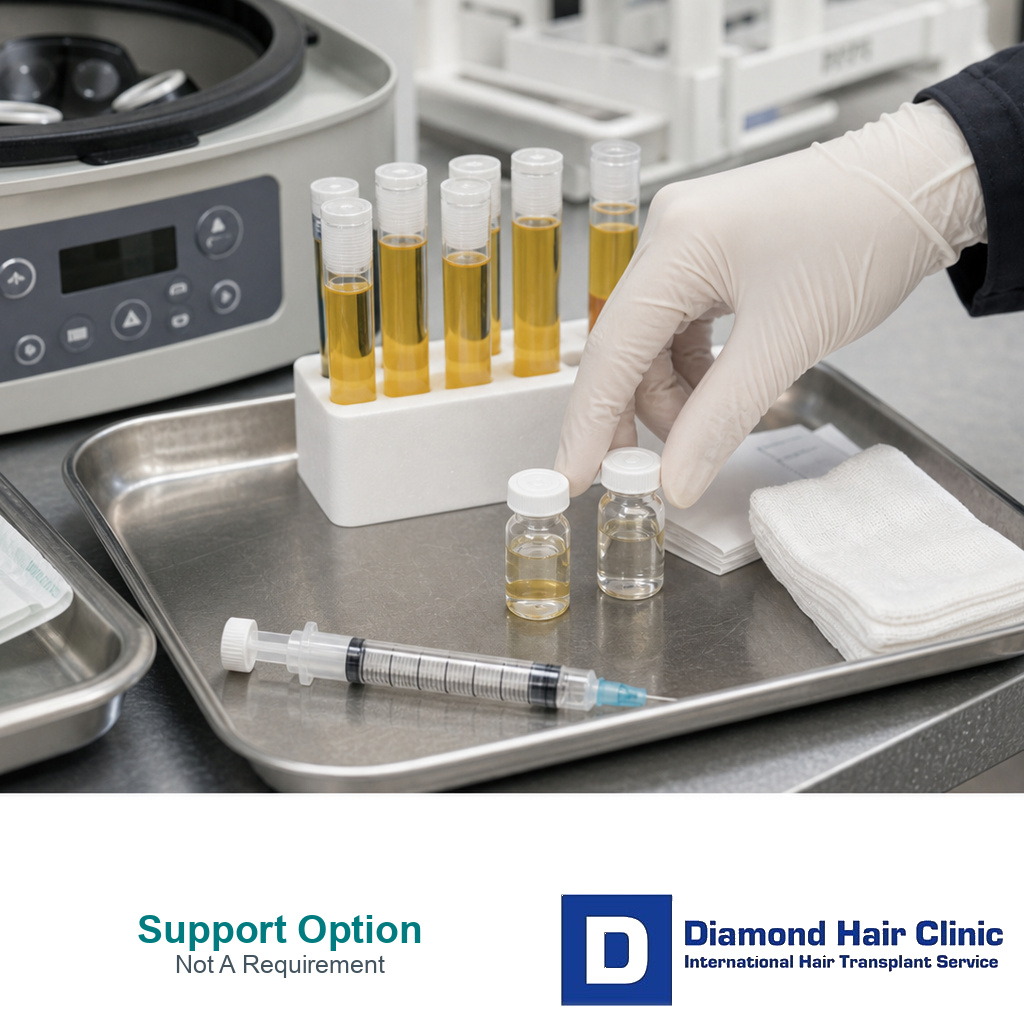
PRP and Exosomes Are Support Options, Not Requirements
PRP and exosome treatments are not routine requirements after a hair transplant. In selected patients, PRP may support weak native hair, scalp quality, or healing comfort, but it does not replace careful graft handling, recipient area planning, aftercare, and time. Exosome offers need even more caution because the exact product, source, sterility controls, and regulatory status matter.
The useful question is not whether you should buy every extra. It is what problem the treatment is meant to solve for you now. If the grafts are healing normally, the photos are still early, and the reason is only fear, I usually keep the plan simple. If there is weak native hair, scalp inflammation, a medical concern, or a product plan that can be explained in writing, then support can be discussed for that specific case.
When PRP or exosomes are offered because the result feels slow, the plan should be tied to a real finding. Early worry, one harsh photo, or a package upgrade is not the same as a clear medical reason.
Density that looks slow in the middle recovery months needs diagnosis before extra treatments are purchased. I first separate normal maturation, native hair thinning, graft distribution, scalp irritation, and the original density design before deciding whether PRP, exosome type support, or no extra treatment makes sense.
This question feels urgent after surgery because patients worry that one missed treatment could harm healing. A clinic may offer PRP, exosomes, vitamins, laser sessions, peptide based extras such as BPC 157 or TB 500, stem cell based extras, or a package of extra treatments. Some may be reasonable in selected cases. None should be used to suggest that refusing an extra treatment puts the grafts at risk.
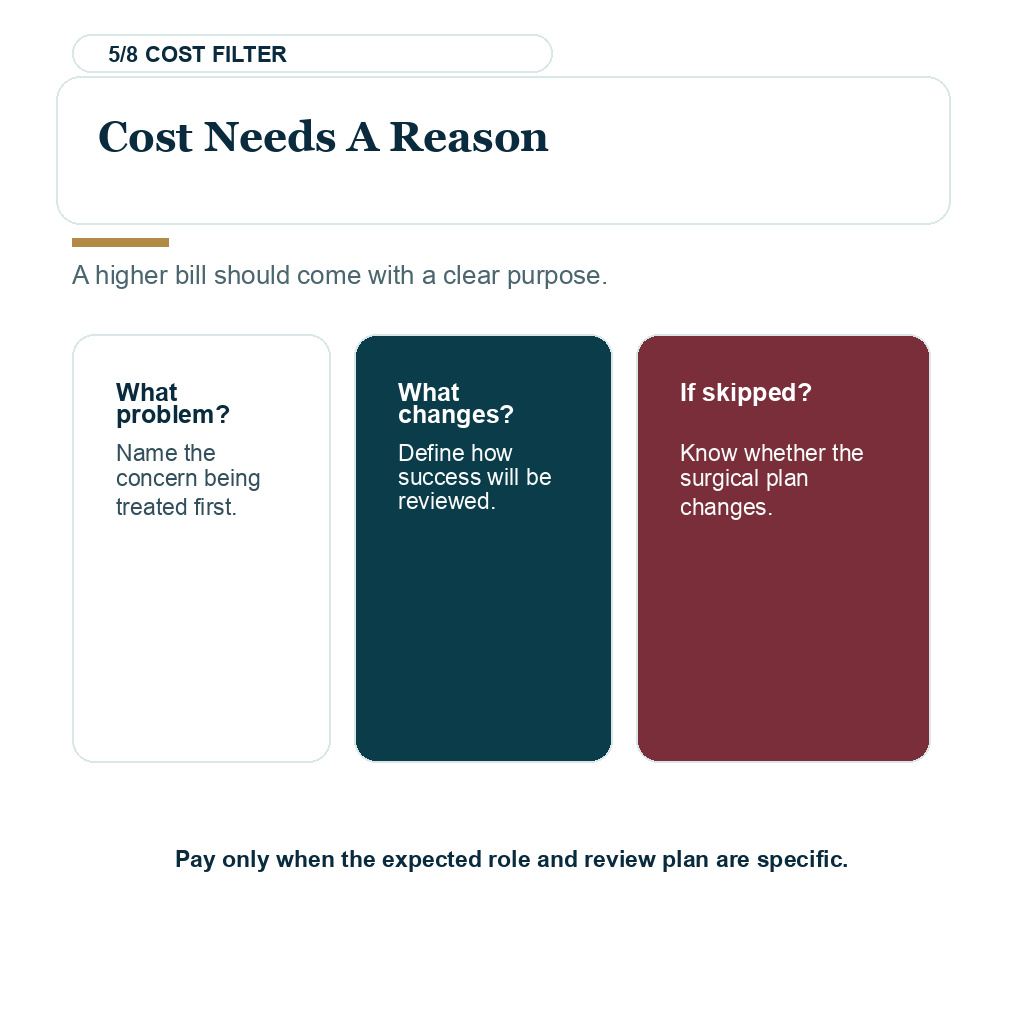
A package can include an extra treatment without making that treatment necessary. I separate availability from medical need, then define the problem it should solve, the likely outcome without it, the later review method, and the written cost before comparing it with a cheaper quote.
When a package groups PRP, exosomes, laser, or vitamins together, separate the reason for each option before agreeing. Otherwise, a later scalp reaction or slow month becomes harder to understand.
If surgery is already booked and the diagnosis, donor plan, hairline design, and medication plan are clear, I would not postpone the operation only to complete a costly course of PRP, laser sessions, or stem cell style treatment. Those treatments should have a defined native hair or scalp reason. If the reason is mainly to make the package feel safer, I keep the transplant plan separate and review support options after the scalp has settled.
Oxygen chamber offers need their own medical reason. HBOT is not a graft survival guarantee unless a doctor can explain when it may help, what outcome is realistic, and what safety screen is needed for that patient.
That fear can become expensive very quickly. A treatment should have a reason, not only a name that sounds advanced. Surgery and supportive treatments should be separated clearly. The foundation is still diagnosis, donor management, graft handling, incision quality, aftercare, and long term planning.
Extra treatment timing map after FUE
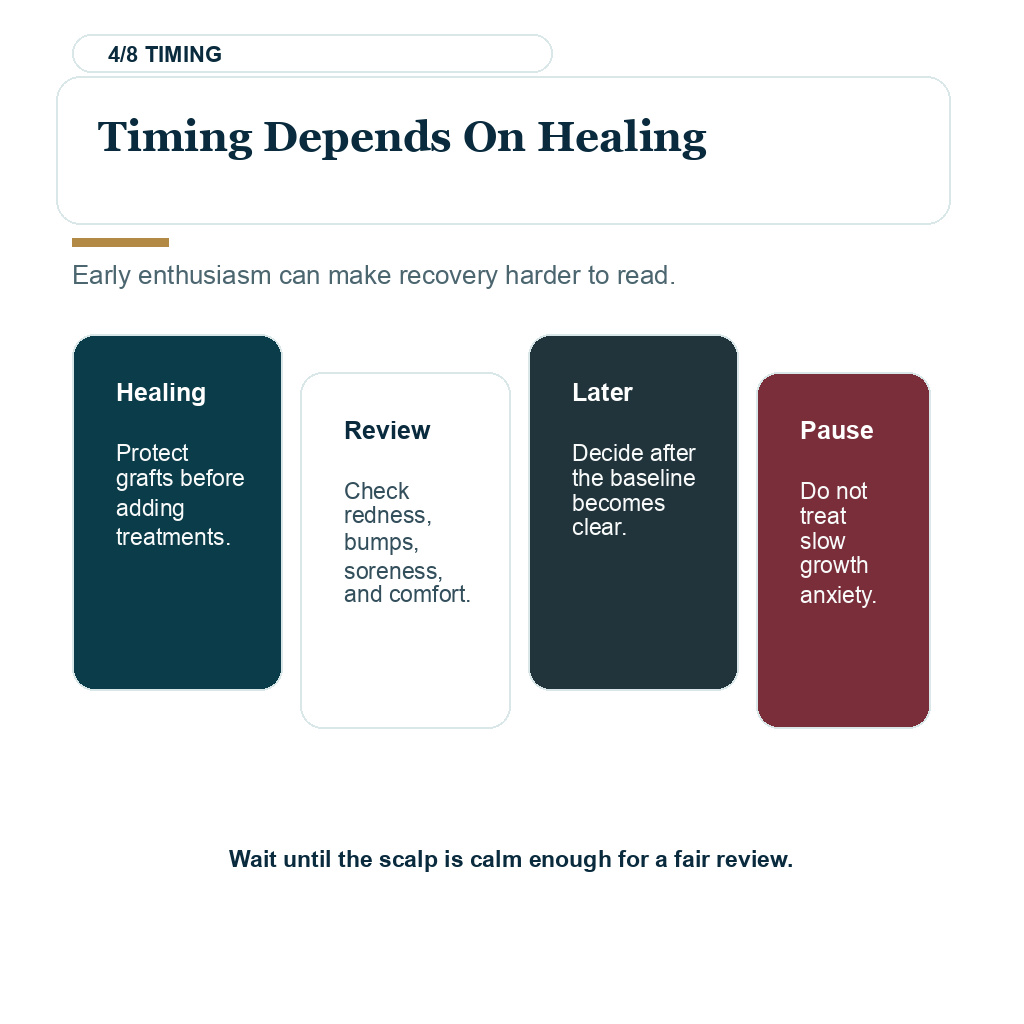
Before paying for PRP, exosomes, mesotherapy, peptides, a laser device, or any other extra treatment after FUE, separate timing from pressure. Before adding it, the answers should be clear. Is the scalp healed enough? What is it supposed to change? What irritation or confusion could it add? When would we stop or reassess? If those answers are not clear, waiting is usually safer than adding another variable.
First 10 to 14 days are for protecting the grafts, following the aftercare plan, and keeping the routine simple. PRP, exosomes, mesotherapy, rollers, home laser caps, peptides, and new scalp products should wait unless your surgeon planned a specific medical reason.
After crusts clear and the skin is closed, ask whether the scalp is calm, easy to inspect, and comfortable with normal washing. Anything that rubs, heats, presses, injects, rolls, or hides irritation should still wait. This includes a laser cap that touches the scalp.
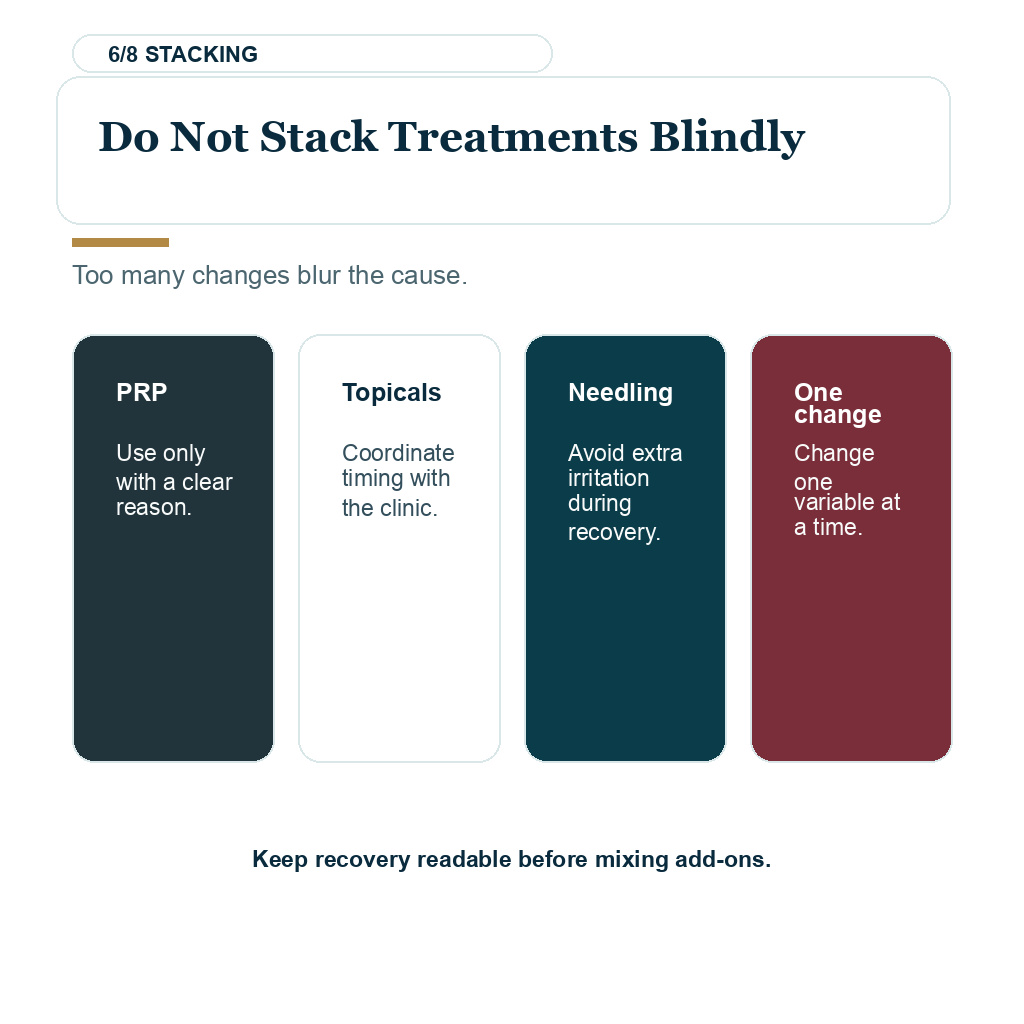
From month 1 to month 3, add one planned treatment at a time only if native hair support is needed. Discussing PRP as one planned support step is different from starting minoxidil, shampoos, oils, serums, supplements, rollers, and other extras together. When several things change at once, the scalp reaction becomes harder to read.
From month 3 to month 6, I discuss products only when the ingredient, route, purpose, cost, and stop point are clear. Be careful with vague mesotherapy kits, unclear injections, or products used because early growth anxiety is high.
At least 6 months for the recipient area is a safer minimum before microneedling is considered. Needling the grafted area should wait until the scalp has been examined and cleared.
When an exosome or stem cell claim is made, the exact product, source, sterility controls, regulatory status, intended use, and written reason for your case should be available before it influences the plan. Exosome products need product identity, regulatory status, sterility, handling details, and realistic evidence before they influence a plan.
When the result looks thin early, use consistent photos and the normal growth timeline before buying another treatment. Treating month 3 or month 4 anxiety as proof of failure can lead to unnecessary extra treatments. Review whether it is a failed transplant or too early to judge before spending more.
A clear extra treatment plan should make the problem, timing, risk, and stop point easy to explain. If those answers are vague, I usually keep the recovery routine simple and review the scalp first.
PRP is not required for graft survival
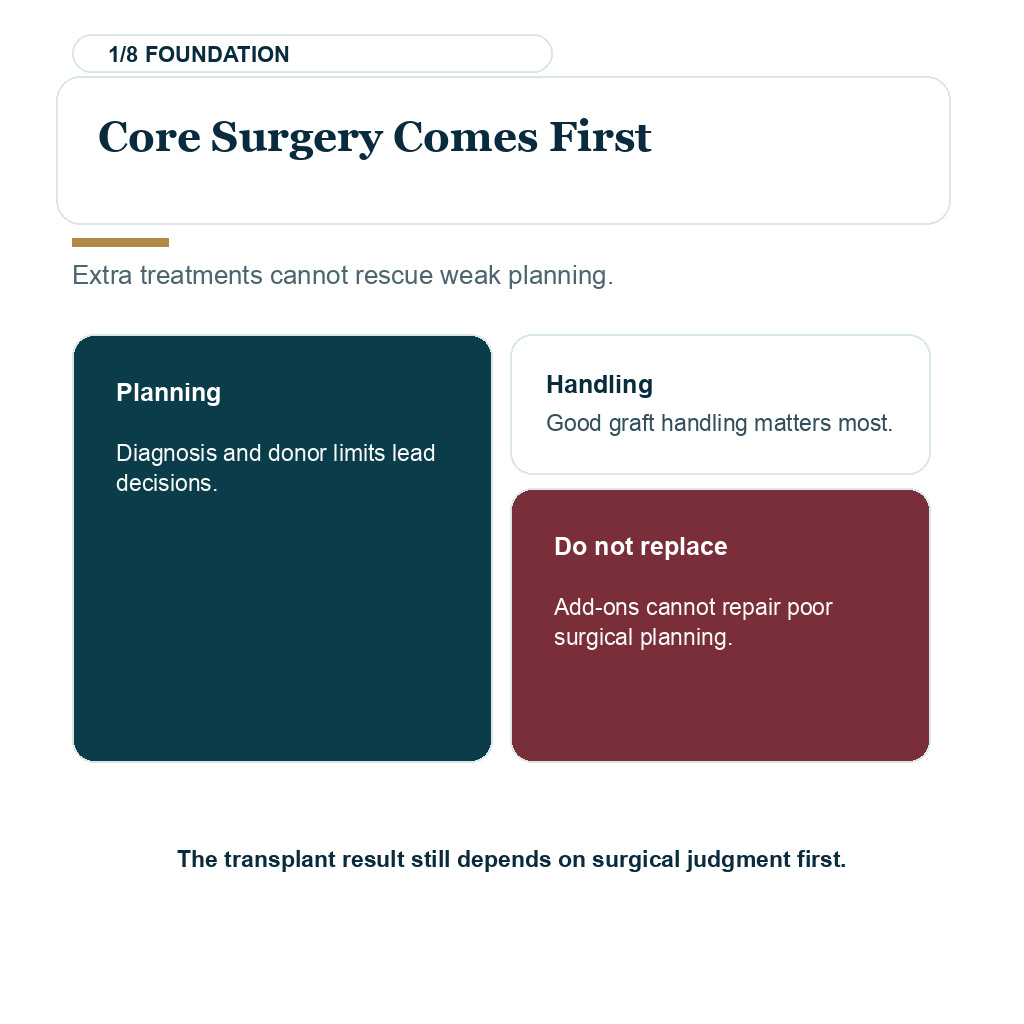
PRP is not required for graft survival in a properly planned and properly performed hair transplant. The grafts should be handled carefully, placed correctly, protected during the early healing period, and given time to grow. Those basics matter more than any extra treatment.
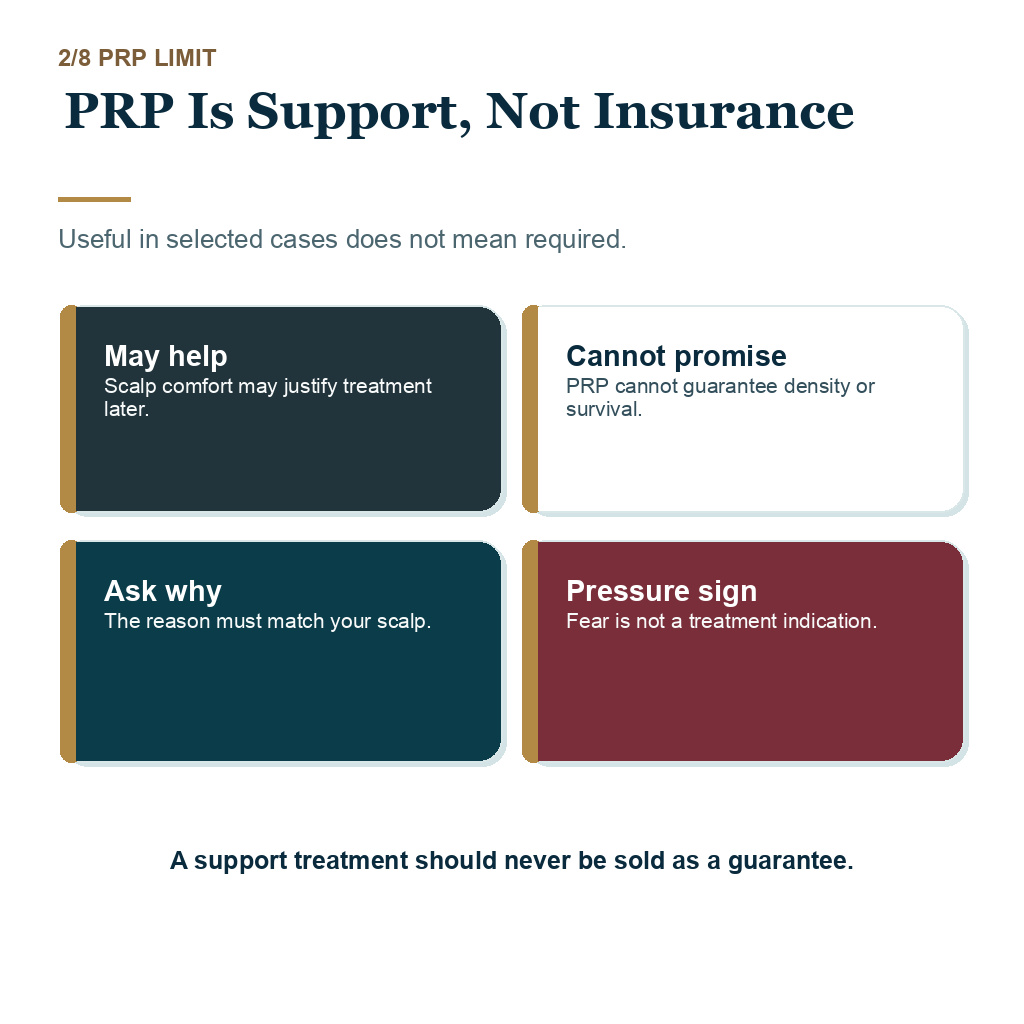
Support treatment may be considered in the right patient, but do not assume the transplant will fail unless you buy PRP sessions. That kind of pressure is not proper medical advice. If PRP is presented as the thing that makes the transplant work, the pressure itself is the warning sign because the operation should be trusted on its own planning and handling.
Adjunct injections should not carry the surgical decision in a mild temple corner case. First decide whether surgery is appropriate at all. If the recession is early, the patient is young, or the proposed line is too aggressive, an adjunct treatment does not turn that into safe hairline design.
PRP only deserves discussion when it has a specific role in your case. Weak native hair, diffuse thinning, scalp quality, or a broader medical plan may make the discussion reasonable. If thyroid disease is part of that broader picture, hair transplant with thyroid disease should be diagnosed before supportive treatments are discussed. But graft survival should never be sold as a package upgrade.
PRP support has clear limits
PRP means platelet rich plasma. It is prepared from the patient’s own blood and used with the intention of supporting scalp tissue, healing, and hair quality. I have explained what PRP treatment can realistically do separately because it should not be presented as magic.
The procedure leaves a simple treatment trail. It involves a blood draw, preparation of the sample, and a documented injection. When PRP appears in a package or bill but those steps cannot be matched to the treatment record, the record needs to be reconciled before anyone assumes what happened. The medical entry should show when the blood was taken, how the sample was processed, and when and where the prepared plasma was injected. Billing can be corrected afterward if the record confirms that the service was not delivered.
A PRP session should not be treated as a home experiment. It combines blood collection, centrifuge preparation, scalp injection, and sharps disposal. Each step needs aseptic technique, sterile equipment used once, a clean preparation area, device instructions that match the equipment, and a plan for bleeding, fainting, contamination, or infection. Having a healthcare worker nearby or buying an injector online does not replace a controlled clinical setting with a clinician responsible for the procedure. The treatment record should name the person responsible for collecting the blood, preparing the sample, giving the injections, and documenting any complication.
After a hair transplant, PRP may be discussed as a supportive treatment. That word matters. Supportive does not mean essential for every patient. It also does not mean the transplanted grafts cannot grow without it.
The transplanted grafts need careful extraction, careful placement, healthy tissue, good postoperative instructions, and enough time. This is true whether the operation is a small case or a larger FUE hair transplant session. If those parts are weak, PRP cannot correct the original surgical problem. If those parts are strong, PRP can still be considered in selected cases, but its target has to be clear. The reason may be native hair support, scalp comfort, or another defined goal.
Be careful when patients are told that PRP is the reason the transplant will work. A well planned hair transplant should not depend on a sales upgrade to survive.
There is also a psychological side. Some patients feel better when they do something active after surgery. That feeling is understandable, but feeling active is not the same as medical necessity. The decision should come from the scalp and the plan, not from anxiety.
A useful test is what would happen if the patient did nothing extra. If the likely answer is that the transplant should still heal and grow normally, PRP is optional rather than essential. If there is weak native hair, scalp inflammation, or a need for broader medical support, then the conversation becomes more specific.
Treatment and reassurance should not be mixed together. Reassurance is sometimes valuable, but patients should not be charged for reassurance while being told it is medically necessary. The role of each step needs to be named before the decision is made.
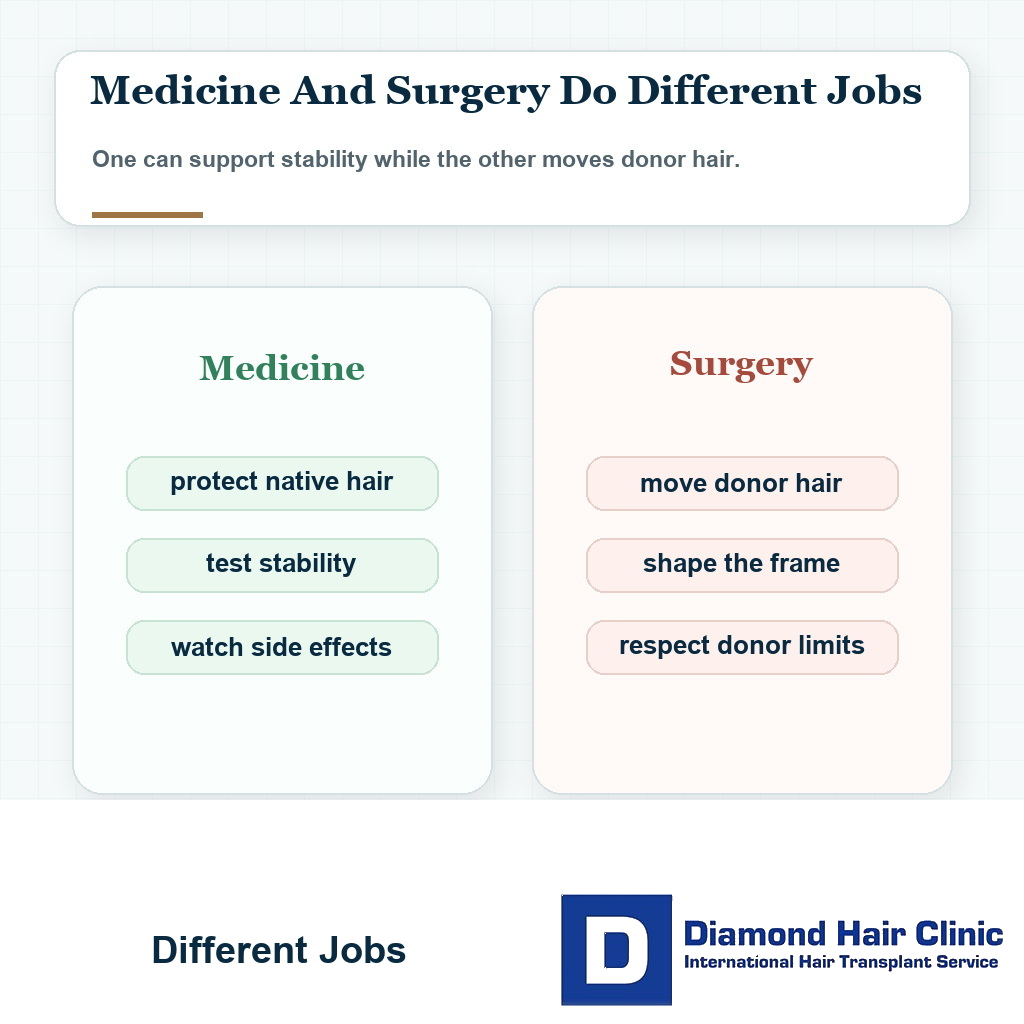
PRP may be useful after surgery only when the scalp is ready
PRP can be useful when there is a reasonable clinical goal. For example, a patient may have weak native hair, diffuse thinning, slower scalp recovery, or a plan that includes improving the surrounding hair as much as possible. In those situations, PRP may be part of a broader support strategy.
One rule does not fit every patient. A patient with strong donor hair, stable hair loss, good scalp quality, and a limited transplant may not need the same supportive plan as a younger patient with ongoing miniaturization. The biology around the transplant matters.
When PRP is part of a broader medical plan, the whole situation matters. Medication use, ongoing native hair thinning, scalp inflammation, and the actual reason for concern all change the decision. The decision depends on whether PRP is being used thoughtfully or simply added because the patient feels anxious.
I separate these problems because patients often use one phrase for several different concerns. They say growth is weak, but sometimes they mean transplanted grafts are slow. Sometimes they mean native hair behind the transplant is becoming thinner. Sometimes they mean the hair looks poor under harsh light.
A supportive treatment is only useful if we know what it is supporting. Without that diagnosis, treatment becomes guesswork with a medical name.
In a young patient with ongoing hair loss, the priority may be native hair stability. In a patient with a settled scalp and strong donor hair, the priority may simply be patience. In a patient with irritation or poor scalp condition, the priority may be controlling the scalp environment before adding anything else.
Automatic packages are the wrong starting point. They make very different patients look the same. Hair restoration is not that simple. The same treatment can be reasonable in one case and unnecessary in another.
Extra treatments are unlikely to change the result when planning is the real issue
Extra treatments are unlikely to change the result when the main problem is surgical planning. If the hairline was designed too low, grafts were spread too thinly over a large area, the donor area was overused, or the hair direction is wrong, PRP cannot redesign the transplant. The same limit applies to PRF, exosomes, mesotherapy, and light devices. Supportive treatments can be discussed, but they cannot rewrite placement logic or turn an undefined crown plan into a clear one.
If the surgery plan was weak, an extra treatment may make the patient feel active, but it may not solve the real problem.
For example, if a patient was promised full coverage with too few grafts across a large bald area, the result may look thin because the math was unrealistic. In that case, the first question is not which injection to buy. The first question is whether the plan respected the donor area and the surface area that needed coverage.
Poor timing creates the same confusion. At month 3 or month 4, disappointment can push a patient toward another treatment, but early thinness at that stage is still part of the normal uncertainty window. Before buying something new, first decide whether you are seeing true failure or normal early timing. I cover that distinction in the separate failed hair transplant or too early discussion.
Extras are also unlikely to fix unrealistic expectations. A hair transplant does not return the scalp to teenage density in every area. It creates visual improvement using a limited donor supply. If the expectation is wrong, more treatments may not make the expectation realistic.
Slow growth can be mistaken for needing more treatment
Slow growth is a common reason patients become vulnerable to extra treatment promises. A patient reaches month 4, sees thin growth, and starts thinking something must be missing. The clinic or another provider may then offer extra treatment as the solution.
Sometimes support is reasonable. Sometimes the patient only needs time. The patient needs to know the normal growth timeline before they spend more money. Month 4 is not the final result. Month 6 is still not the final result for many patients. Crown growth can take even longer to judge.
If early density worries you, remember that this stage can look disappointing without proving failure. Low density 4 months after hair transplant is often still too early to judge as a final result.
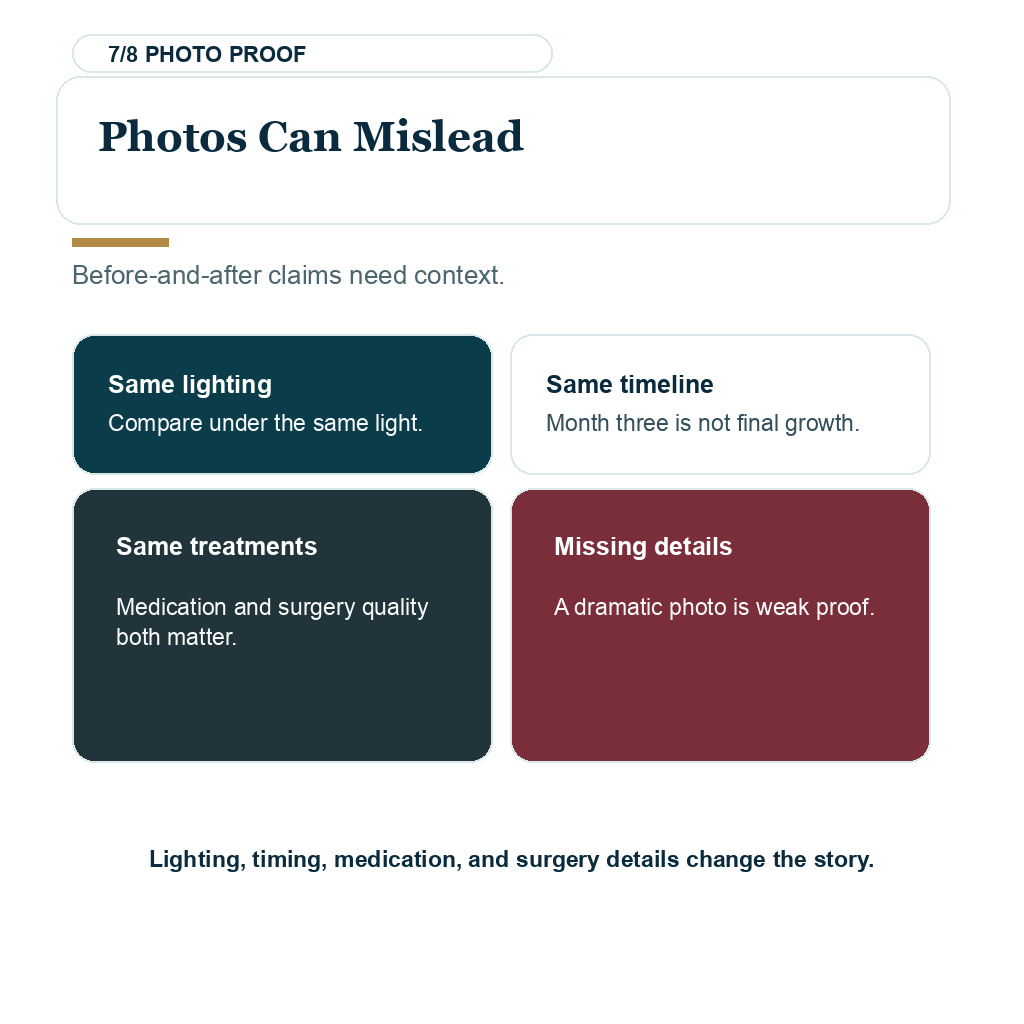
Tracking also matters. Random photos can make growth look worse than it is. Wet hair, harsh bathroom light, a shorter haircut, or a close camera angle can create a false emergency. Before making the decision you need another treatment, you need fair evidence.
Use a consistent photo routine. A practical way to track hair transplant growth is to take monthly photos in the same light, which is more useful than checking the mirror every morning.
Good documentation makes the conversation clearer. We can see whether the area is improving, stable, or truly falling behind. Without that record, fear often chooses the treatment before the scalp has been judged fairly.
Exosomes differ from PRP
PRP comes from the patient’s own blood. Exosome treatments sit in a different category because the product, source, processing, concentration, sterility controls, and regulatory status can vary widely. That difference matters. I do not treat every product using the word exosome as the same treatment. Do not accept a vague explanation just because the word sounds advanced.
Before any exosome treatment is used, there should be a clear explanation of the exact product. Its source, preparation, quality control, intended use, safety information, regulatory status in that country, and the clinical reason for recommending it all matter. If those answers are vague or cannot be given in writing, the promise is marketing, not a standard part of hair transplant aftercare.
Innovation is not the problem. Unclear products sold with certainty are the problem. In hair restoration, the treatment that sounds newest is not necessarily the treatment that protects the patient best.
How do I separate support from pressure after surgery?
After surgery, I first ask whether the concern is healing, normal early timing, native hair weakness, scalp inflammation, or a true surgical problem. Those are different problems, so one extra treatment cannot be the automatic answer to all of them.
If PRP or an exosome product is proposed, I want the reason written in plain language. The plan should say what the treatment is expected to improve, what it cannot improve, what would happen without it, and how the result will be reviewed.
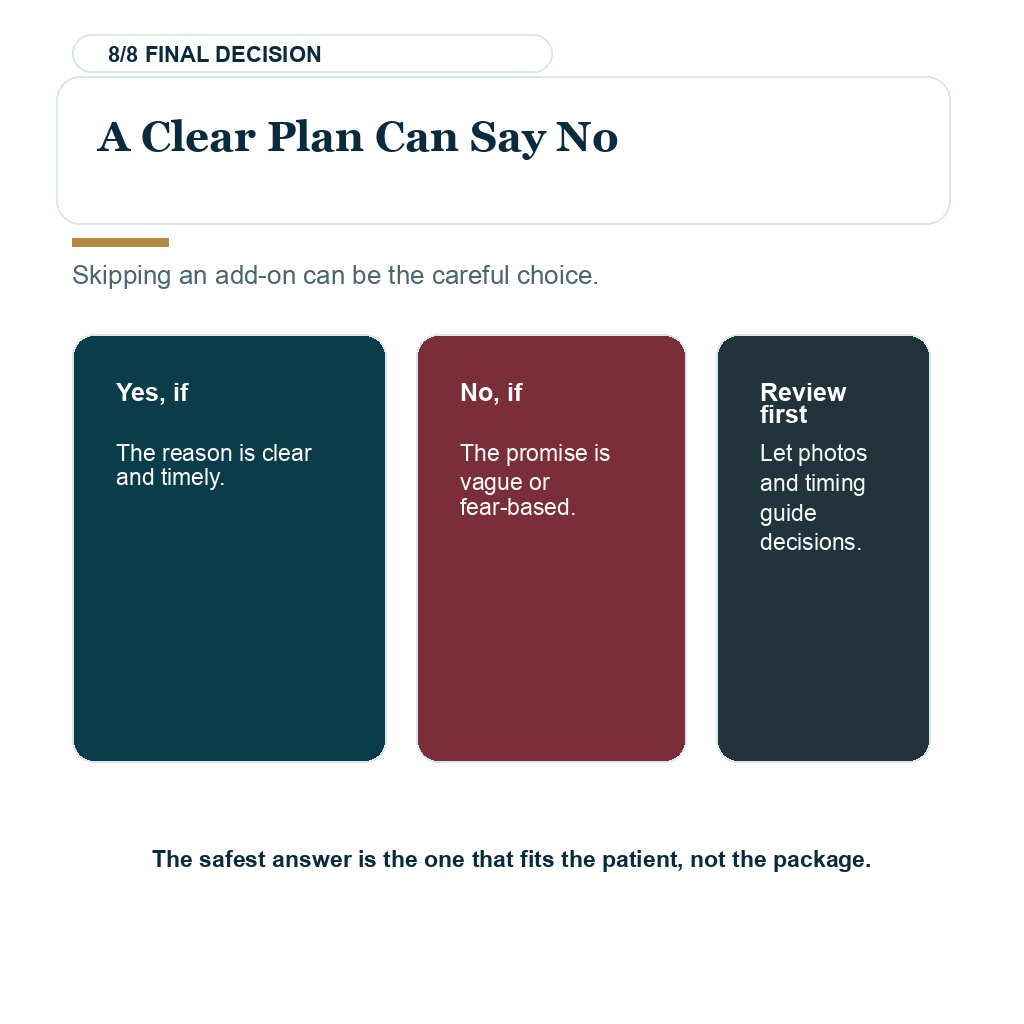
A paid extra raises concern when the patient is anxious, early in recovery, and being told that it is needed to save the result. Support can be reasonable in selected cases. Fear is not a medical indication.
Exosome promises that deserve caution
The concern is strongest when exosome treatments are presented as a breakthrough that every case needs. The word can sound impressive, but do not judge a treatment by how advanced the name feels.

The exact product, purpose, and personal reason should be clear before payment. If the explanation is vague, the promise is weak. If the explanation is only that it will improve everything, pause before paying for it.
A treatment sold as support must not become a guarantee. No injection should be promised to guarantee graft growth, fix poor surgical planning, or create density that the graft count cannot support.
Another issue is urgency. If a patient is told that the decision must be made immediately or the result will be lost, the conversation may be more commercial than medical. Clear medical advice can explain timing without using fear.
Not every new treatment is useless. The patient deserves a clear reason. When the explanation is not clear, pause until the reason is written plainly.
How the promise is framed matters. If the clinic says the treatment may support the scalp in a selected patient, that is a measured conversation. If the clinic says the treatment will save the result or guarantee growth, the promise has moved into dangerous territory.
Patients should remember that expensive wording can hide simple uncertainty. A treatment can be modern and still not be necessary for you. A treatment can be optional and still be useful in selected cases. The label matters less than the reason.
PRP alone should not decide the surgery plan
Do not choose a hair transplant clinic mainly because it offers PRP or exosome treatments. These treatments are secondary. The main decision is who evaluates you, who designs the plan, who creates the recipient area, how the donor is managed, and whether the clinic is realistic about limits.
A clinic can have many extras and still have weak surgical judgment. Another clinic may offer fewer extras but plan the surgery with more discipline. Compare the surgical plan itself, not the length of the treatment menu.
When you are choosing a hair transplant clinic in Turkey, focus on the surgical decisions that PRP or exosomes cannot rescue. Surgeon involvement, donor management, hairline design, graft handling, and follow up matter more than a long menu of treatments.
Be careful with packages that make the extras feel like proof of quality. A polished package can still hide poor planning. A discount can also make patients accept treatments they do not understand.
The clinic should explain what is necessary, what is optional, and what is not useful in your case. That clear communication protects the patient. It also protects the donor area, because the most valuable resource in hair restoration is not the package. It is the limited donor supply.
Medications and aftercare still come first
Medications and aftercare should not be pushed aside because PRP is offered. After surgery, the first responsibility is healing. The grafts need protection, washing needs to be done correctly, and the scalp needs time.
When the early period feels confusing, follow your clinic’s protocol and understand the principles of hair transplant aftercare. During the first 10 days, careful washing and avoiding trauma matter more than chasing extra treatments.
Medication decisions are a separate layer. Finasteride, dutasteride injections after hair transplant, minoxidil, and other treatments may be considered for native hair depending on the patient. They do not do the same job as PRP. They also have different risks, benefits, and timing questions. If PRP is added on top of several product changes, too many treatments after FUE can make it harder to know what helped or irritated the scalp.
The decision to start or stop minoxidil around surgery should be made carefully, because shedding or irritation can confuse the recovery picture. If minoxidil is changed at the wrong time, the patient may blame the transplant, the medication, or the lack of PRP without knowing which factor is responsible.
For medication questions after surgery, I separate the medicine decision from the PRP decision. Do not mix every treatment together and hope for the best. Each treatment should have its own reason.
If medication, PRP, and photo conditions all change at once, it becomes difficult to understand what is helping and what is only noise. A simpler plan usually gives cleaner follow up.
Aftercare is also more powerful than many patients realize. Gentle washing at the right time, avoiding trauma, protecting the scalp from unnecessary irritation, and following the clinic’s instructions are not glamorous steps, but they matter. A patient who follows the basic plan carefully is doing more good than a patient who buys extra treatments while neglecting the basics.
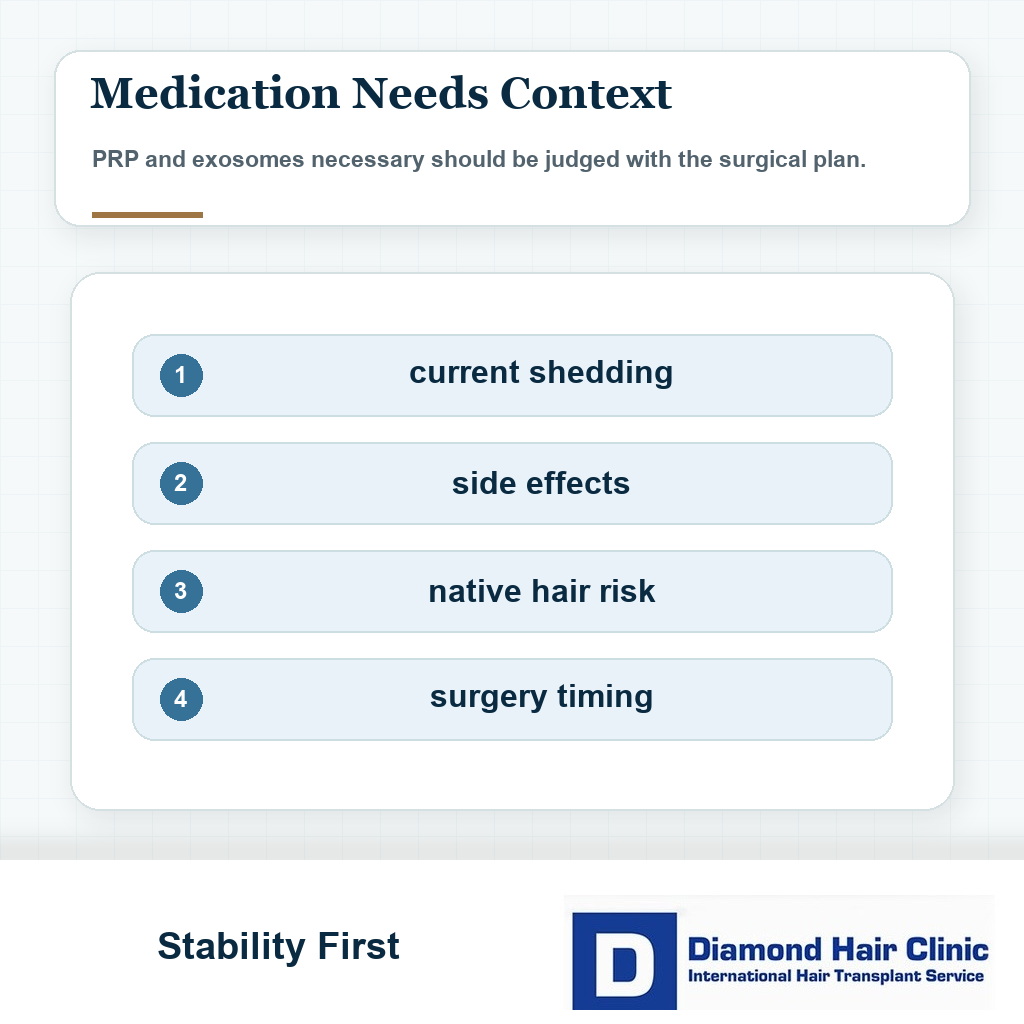
Before paying for extra treatment
For PRP, exosomes, or any extra treatment after a hair transplant, the starting point is the reason, not the price or the name of the treatment. The clinic should be able to explain what problem it is trying to solve in your case. For mesotherapy after hair transplant, the route, ingredient, and reason matter more than the label.
When the answer is graft healing, native hair support, scalp comfort, or general hair quality, that answer should be stated clearly. The patient needs to know what would likely happen without the extra treatment. Sometimes the responsible answer is that the transplant should still grow normally and the treatment is optional support.
The clinic should explain how success will be judged. A treatment that cannot be connected to a clear follow up plan can become a purchase made from anxiety. The decision should be based on your scalp, your hair loss pattern, your recovery stage, and your long term plan, not on fear that you are missing the one thing that will save the result.
These questions are not aggressive. They are normal. A careful clinic will be able to answer them clearly. If the answer becomes emotional, vague, or sales focused, that is a signal to pause.
Be careful with guarantees. A clinic may use a treatment package to make the result sound safer than surgery can be. Wording matters. That same limit applies when you are judging whether a hair transplant guarantee can be trusted.
Hair mills and high pressure clinics deserve the same skepticism. When a clinic sells urgency, upgrades, and unrealistic certainty, the patient may be buying reassurance rather than a real medical plan. This is also where the red flags of Turkish hair mills become important.
Treatment planning should make you clearer, not more pressured.
The clinic’s recommendation should still make sense when money is removed from the conversation. Sometimes the answer becomes clearer when the patient separates medical priority from package design. The most useful treatment is not always the most expensive one.
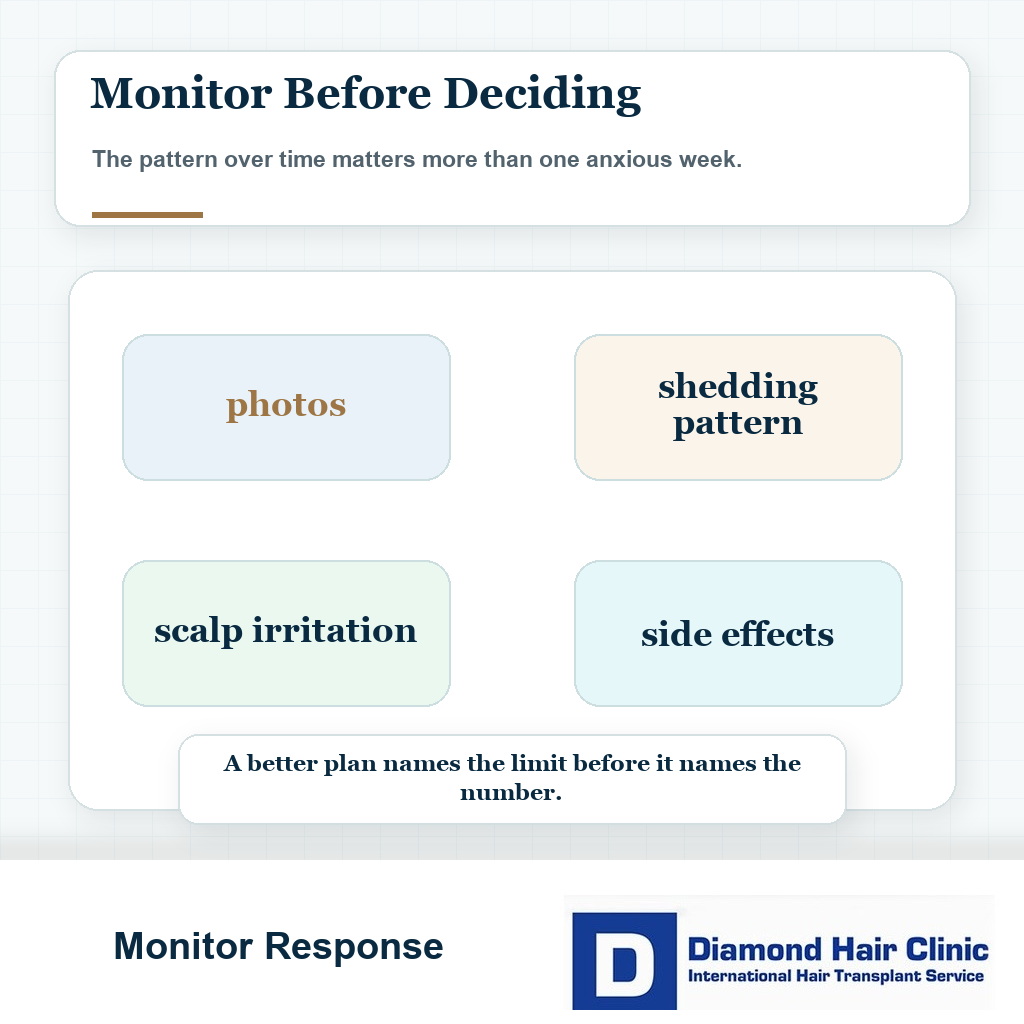
It can be too early to judge the result
It is usually too early when the patient is still in the normal shedding and early growth period. Many patients become anxious around month 3 or month 4 because the transplant looks thin, uneven, or quiet. That stage can feel disappointing, but it is not the final result.
If the patient buys extra treatments every time anxiety rises, the recovery becomes expensive and confusing. It becomes hard to know whether a change came from time, medication, PRP, scalp treatment, lighting, haircut length, or simple normal growth.
Fair documentation should come first. If the photos show steady progress, patience may be the best treatment. If the photos show a true problem later in the timeline, then the reason should be diagnosed before another treatment is sold.
Review the scalp before another purchase
When there is a real medical concern or when the recovery pattern does not make sense, clinic review belongs before another purchase. Increasing pain, spreading redness, pus, fever, black skin, strong swelling that worsens, or possible graft trauma should be reviewed medically. Those are not problems to solve by buying PRP.
Clinic review also matters if growth seems completely absent later in the process, if one area is not following the expected trend, or when the appearance may be changing because of native hair loss. The answer may be time, medication review, scalp treatment, or a surgical assessment. It should not be guessed.
Clear photos and a short timeline are more useful than emotional close-up pictures. Surgery date, graft number, treated areas, current medications, symptoms, and monthly photos help the clinic see the pattern.
If the patient is not a good candidate for more treatment, the clinic should say that. If the patient needs time, the clinic should explain why. If there is a real problem, the clinic should not hide behind reassurance.
There are also patients who should not rush into more procedures or more extras because the main issue is candidacy. When the original decision itself feels uncertain, start again with whether you were a good candidate for a hair transplant.
The better the diagnosis, the less likely you are to spend money out of panic. If the issue is mainly a thin looking result, the article about why some hair transplant results look thin may help you separate density, timing, and planning problems.
A good follow up conversation should first separate normal healing from ongoing native hair loss and from scalp disease that needs treatment. Once those possibilities are separated, the role of PRP or any extra treatment becomes much easier to judge.
If a clinic cannot separate those questions, the patient may receive the same treatment suggestion for every concern. That is not careful medicine. It is a routine answer to a specific fear.
Use the 8 PRP and exosome support slides below to separate core surgery, PRP limits, exosome claim checks, healing timing, cost reasoning, treatment stacking, photo proof, and when saying no is safer. Swipe the carousel, use the arrows one step at a time, or choose a number below the image to jump to that point.

My approach to PRP and exosomes after surgery
The balanced approach is to avoid both extremes. PRP and exosome treatments are not miracle treatments that every patient must buy. They are also not simply meaningless. The correct answer depends on the patient, the surgery, the native hair, and the reason for treatment.
If your surgery was well planned and your recovery is normal, you may not need extra treatment to make the grafts grow. If your native hair is weak, your scalp needs support, or your surgeon has a clear reason, PRP may be considered as part of a larger plan.
With exosome promises, the product and explanation matter even more. If the clinic cannot clearly explain the source, preparation, safety information, regulatory status, goal, and reason it applies to you, pause until the exact details are available. A treatment should never be sold mainly through fear.
Do not use extras to compensate for poor surgical judgment. Choose the right plan, protect the donor area, follow aftercare, track growth fairly, and review concerns at the right time.
A hair transplant is not saved by one injection. It is built from careful patient selection, donor management, natural design, precise surgery, real follow-up, and patience. Support can sometimes help around that foundation, but it should not be confused with the foundation itself. If the reason, timing, product identity, cost, stop point, and follow-up method are clear, the discussion can be useful. If those answers stay vague, it is usually safer to wait than to buy treatment from fear.

Read this review excerpt
He was very thorough in every little detail and I never felt pressure to do anything I wasn’t sure of.