



Stem Cell Claims in Hair Transplant Planning
A stem cell or regenerative extra should not be the reason you choose a clinic or proceed with surgery. Some regenerative hair loss treatments are being studied, and future techniques may become more useful if stronger evidence supports them. Still, a hair transplant result depends first on diagnosis, donor management, hairline design, graft handling, and follow up.
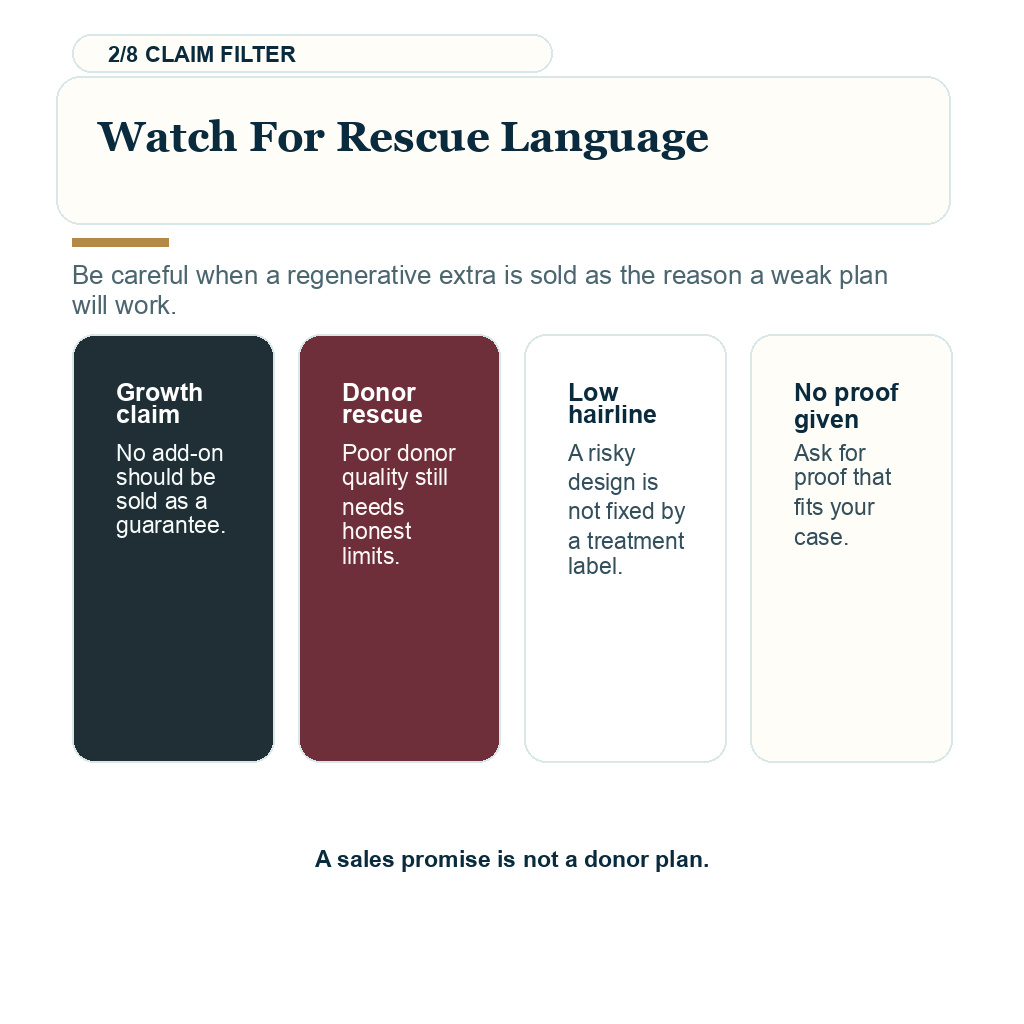
If a clinic presents a stem cell added treatment as essential, guaranteed, or able to rescue a weak surgical plan, slow down before paying. Ask exactly what is being used, where it comes from, whether it is your own tissue or a commercial product, what evidence applies to your case, what risks exist, and whether the transplant plan remains medically sound without it.
An add on has to change a real part of the plan, not only the invoice, to justify its role. If the surgical plan, donor strategy, and follow up would be the same without it, treat the add on as optional until its value is explained clearly.
That difference separates an optional supportive treatment from a sales layer. The first can be discussed directly. The second can distract you from the decisions that decide the final result.
The same evidence boundary applies to HBOT evidence limits. A treatment can sound medical and still remain optional when the claim is better growth rather than a clear wound or tissue indication.
Before surgery, treat the extra as optional
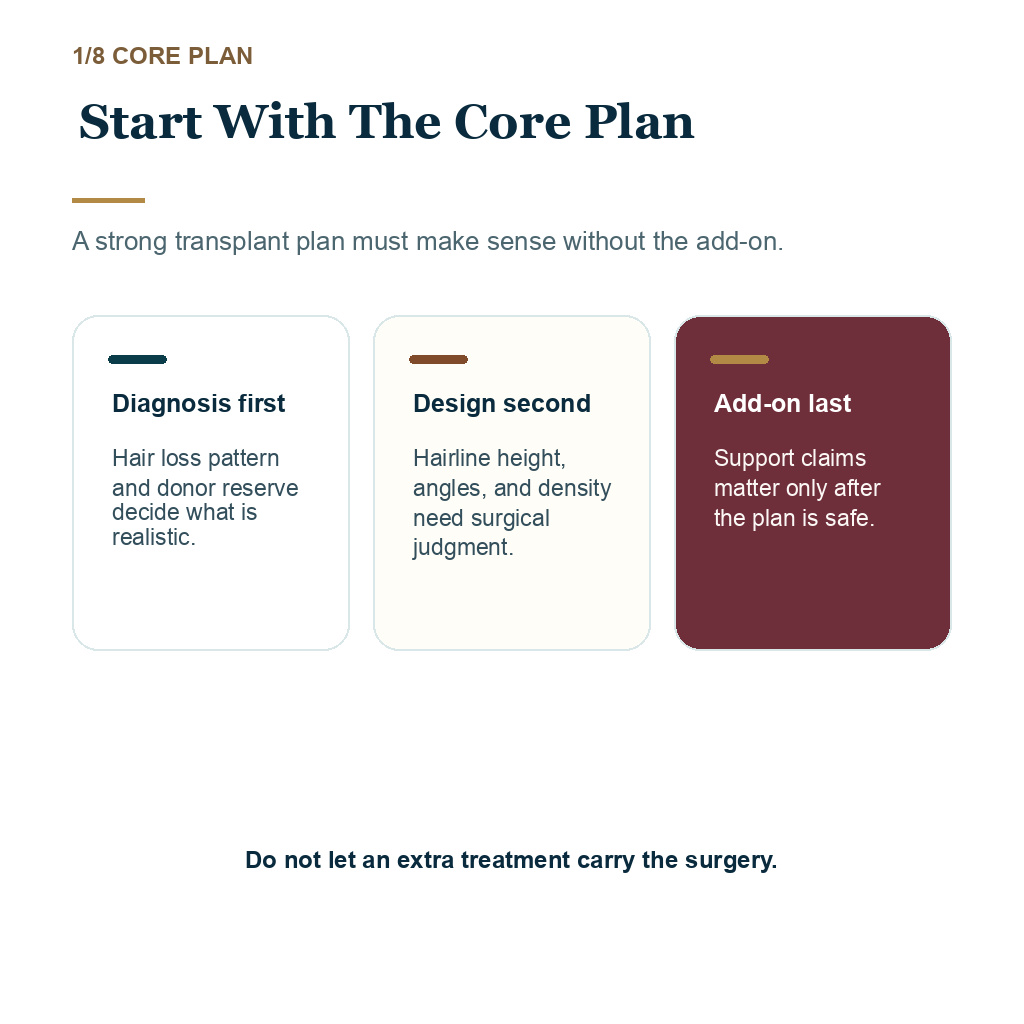
Treat it as an optional medical extra, not as the foundation of the operation. The foundation is still the surgical plan. If donor reserve is weak, the hairline is placed too low, the graft number is unrealistic, or the clinic cannot explain who performs the critical steps, no injection can make that plan safe.
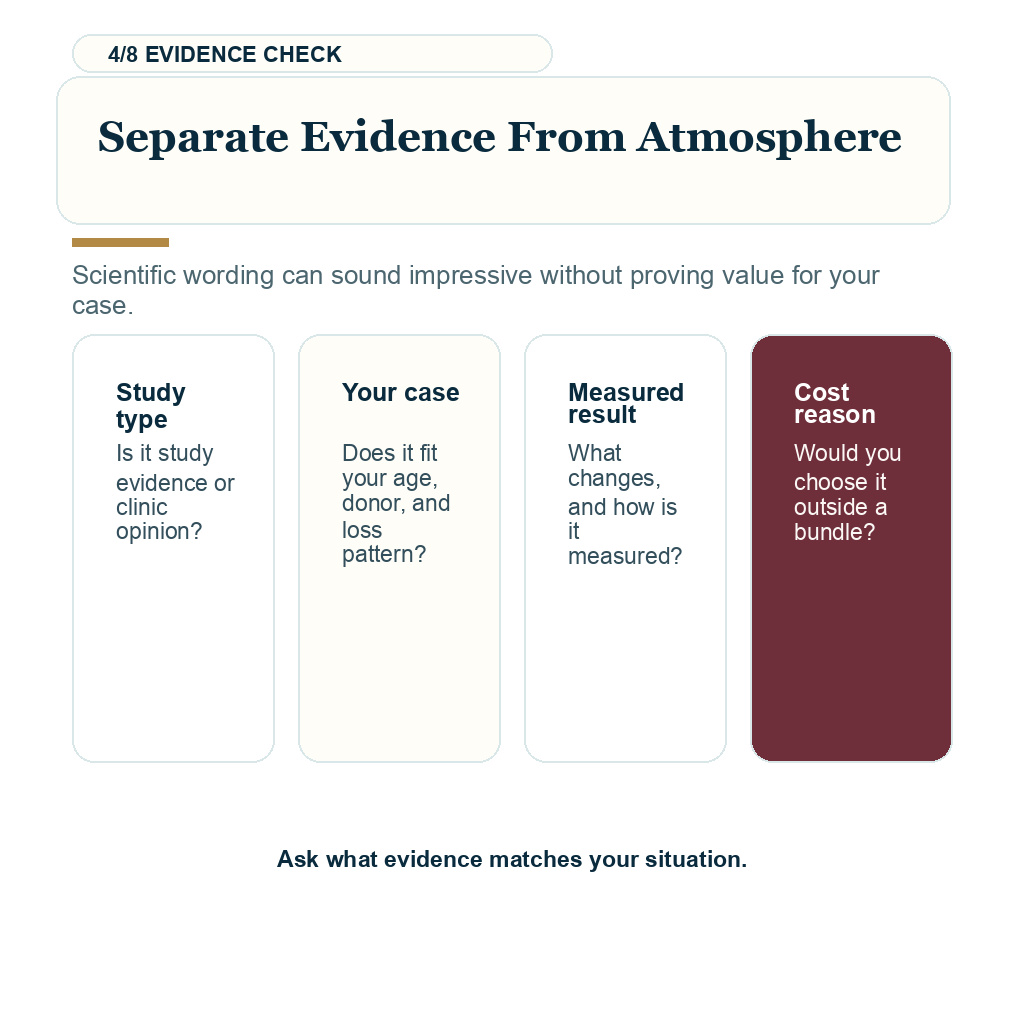
Marketing around stem cell, regenerative, exosome, growth factor, micrograft, or biologic language can make the procedure sound more advanced than an ordinary hair transplant. The wording can sound scientific, but scientific wording and real benefit are not the same thing. The treatment needs a clear indication, a clear source, sterile handling, realistic claims, and a cost that makes sense beside the actual transplant plan.
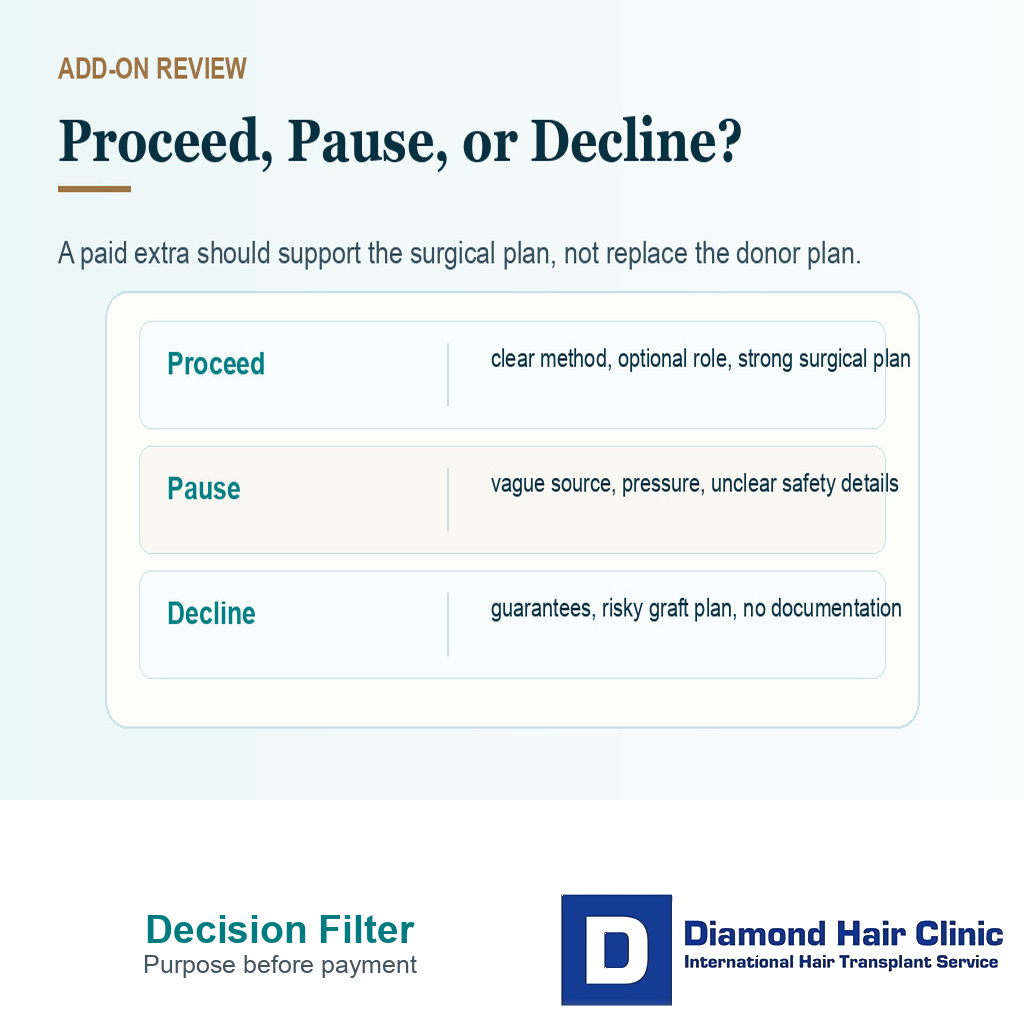
If the clinic cannot explain the extra in ordinary language, that is already useful information. No one should have to buy an expensive treatment because the terminology is confusing.
The quoted outcome should still be realistic without the extra. When the surgical plan is the same either way, the add on is a separate choice, not a reason to trust the operation.
Stem cell language can mean very different things
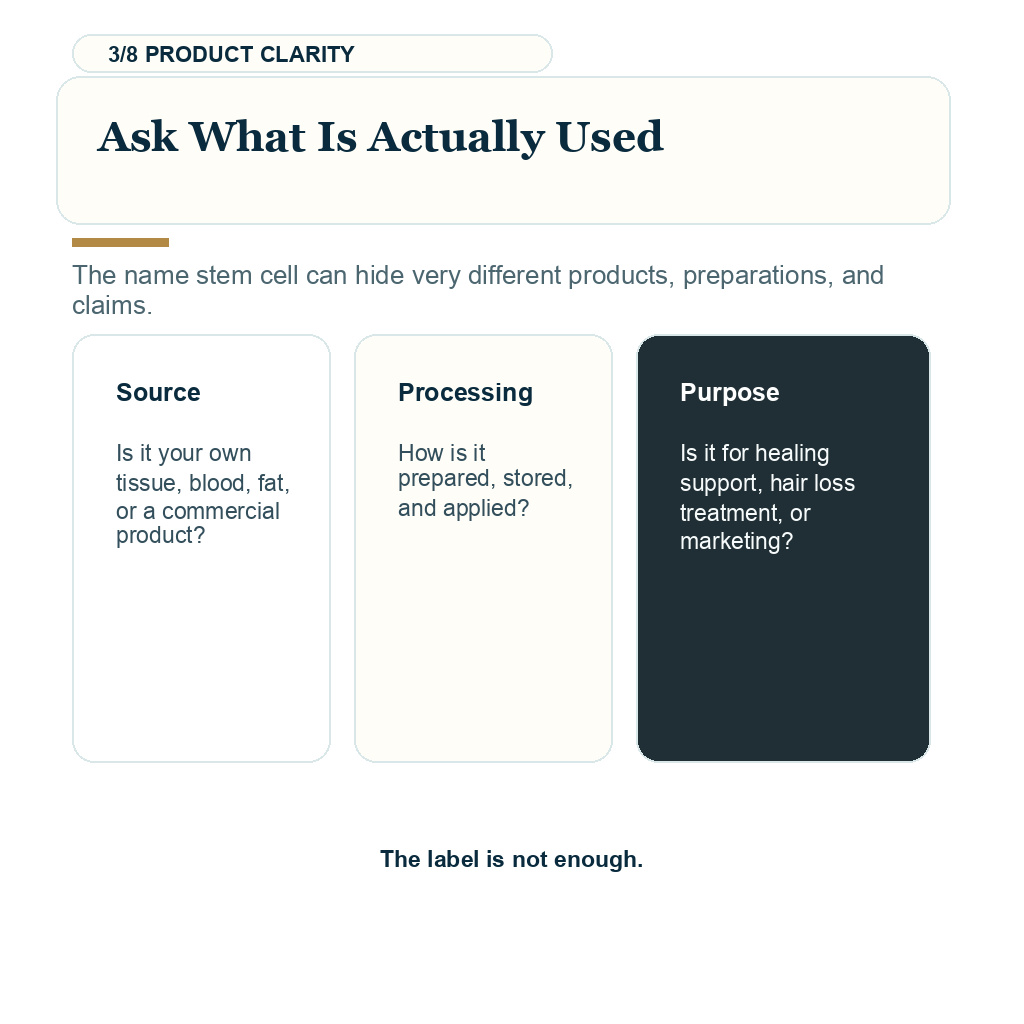
It can mean different things. One clinic may be describing a preparation from fat tissue. Another may be describing scalp micrografts. Another may use the phrase for conditioned media, exosome products, PRP mixtures, or a branded regenerative device. Sometimes you are not told clearly whether the material comes from your own tissue, a donor source, a laboratory product, or a commercial kit.
That difference is not a small technicality. Your own tissue processed for you, a product from a donor, a commercial vial, a topical serum, and an exosome product do not raise the same questions. They can differ in sterility, regulation, handling, injection route, documentation, and evidence. A clinic should be able to describe the exact treatment without hiding behind one impressive phrase.
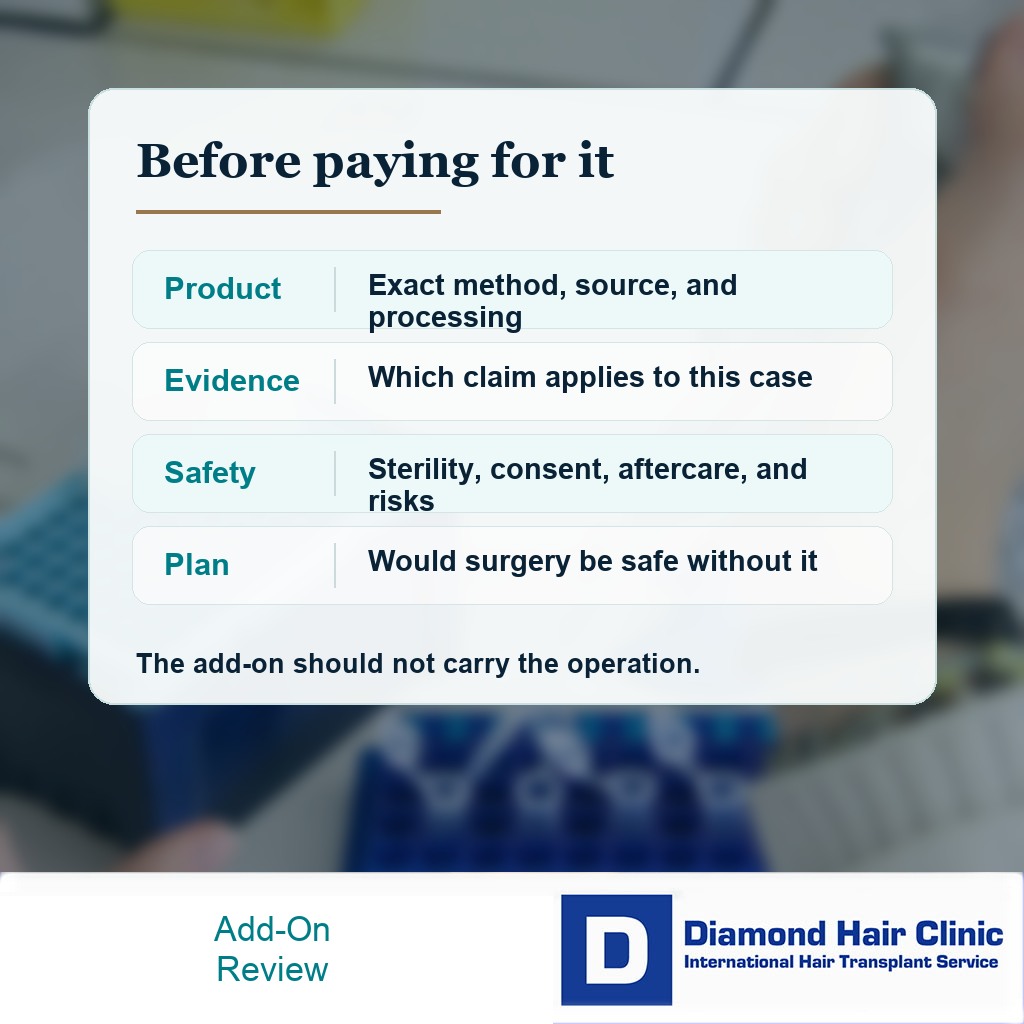
This uncertainty matters. The word stem cell is not a diagnosis, a protocol, or a guarantee. It is a broad label. Before payment, the clinic should name the product or method, the tissue source, the processing steps, who prepares it, where it is injected, the sterile controls, and the result being claimed. When tissue comes from fat, blood, or scalp, the record should also say where it is taken from, whether it is processed the same day, whether anything is stored or expanded, and whether a disposable closed kit is used.
It is also important to separate hair loss treatment from support after hair transplant surgery. A treatment that is being investigated for androgenetic alopecia is not the same as proof that it improves graft survival, density, donor healing, or final naturalness after FUE. Those are different claims.
Some clinics use names such as Hair Stem Cell Transplantation, HST, or partial follicle extraction to suggest that the donor area can regrow after part of a follicular unit is taken. I treat that as a specific surgical claim, not as a general stem cell add on. The important details are who performs the extraction, the exact method used, how donor regrowth is measured, and whether the plan still protects your donor area if the promised regrowth does not happen. A named protocol or a small study should not make you count the same donor hair twice in the plan.
Regenerative extras cannot replace surgical planning
The operation must stand on its own. If the transplanted area needs conservative graft planning, the answer is not to use an extra treatment and place more grafts than the donor area can safely provide. If the hairline needs a mature design, the answer is not to lower it too much and hope a regenerative treatment improves density later.
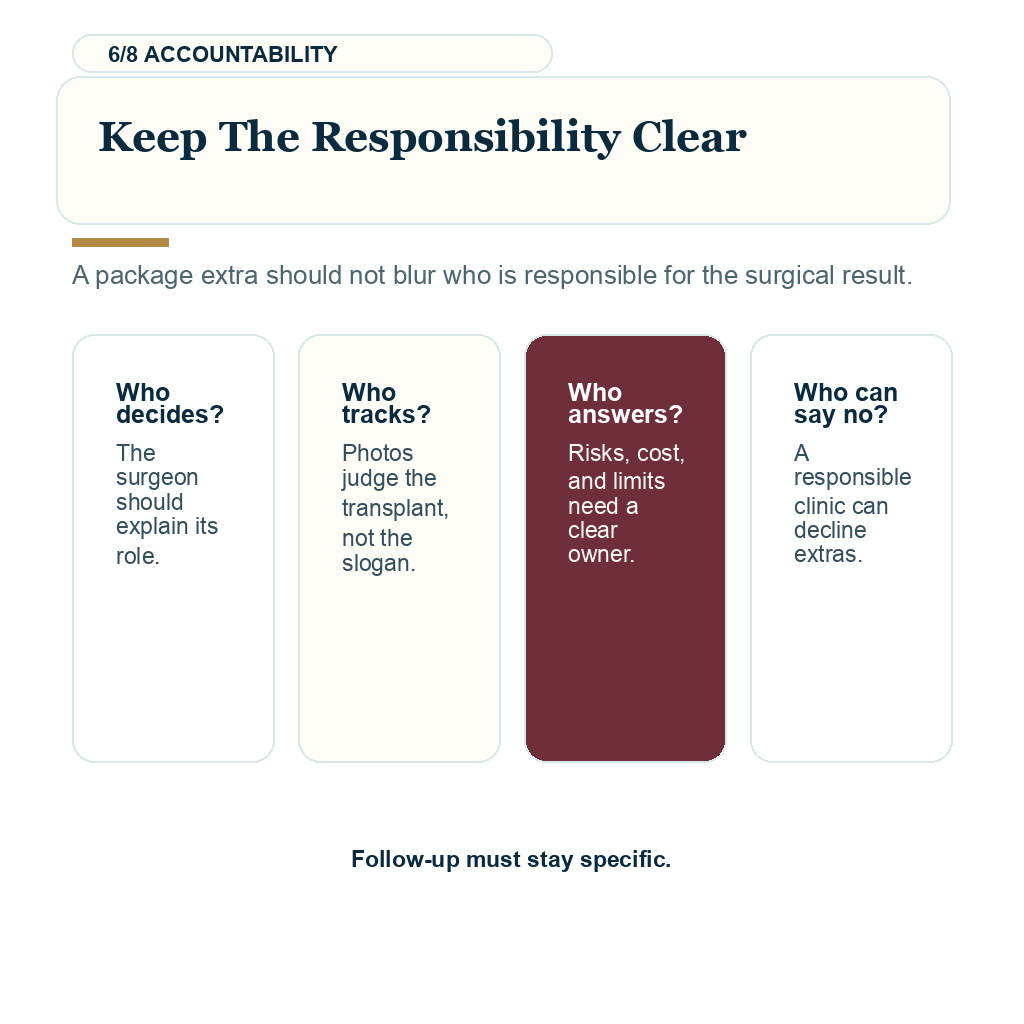
Clinic selection matters more than scientific extras. Do not choose a clinic because it offers a scientific extra while the consultation is vague about surgeon involvement in hair transplant surgery. The person making the plan matters more than a branded extra.
Technology and tools can support a good plan, but they cannot replace surgical judgment. I make the same distinction when discussing hair transplant tools and techniques. The tool is only useful when the decision behind it is sound.
Warning signs in the offer
The offer becomes concerning when the extra is used to create urgency, hide weak planning, or justify a high package price without clear medical reasoning. A responsible surgical plan should not collapse when you refuse an optional extra. Verteporfin claims need that separation too. When reading verteporfin hair transplant claims, the core plan still has to work if the extra adds no benefit.
Claims of better graft survival, faster healing, thicker hair, a stronger donor area, or guaranteed density need more than a reassuring phrase. I need to see the outcome measured, the patients studied, the comparison treatment, and the follow-up period. Side effects and limitations belong beside the reported benefit.
A paid extra should never be used to cover uncertainty about graft numbers, donor limits, or clinic responsibility. If the package includes a very high graft count, the more useful conversation is still about donor capacity and long term planning, not about adding a biological boost. Check graft count verification before you accept the logic of a large package.
Evidence must be strong before the claim changes surgical planning
Regenerative claims should not change the surgical approach until the clinic can explain the product, the route, the safety controls, the expected benefit, and why that benefit applies to this patient. A scientific label is not enough.
A stem cell or regenerative extra must not justify a lower hairline, a larger graft number, surgery on an unstable scalp, or a promise of density that the donor supply cannot support. If the operation becomes riskier because an extra has been added, the reasoning has moved in the wrong direction.
The patient also needs a written answer about cost and refusal. If declining the extra changes the promised graft number, hairline design, or growth expectation, the real medical plan was not explained plainly.
Before payment, separate the claim from the decision
Any injected or applied material should be identified clearly. The record should state whether it is autologous, meaning from your own body, or whether it comes from a commercial product or donor source. Evidence should apply to your case, not only general marketing language. The clinic should also explain whether the product is allowed for the claimed use, route, and setting in the country where the procedure is performed, and whether the use sits outside its approved purpose. A product being available for sale is not the same as proof that it improves graft survival, donor healing, or final density after a transplant.
Compare the proposed operation with and without the extra. A lower hairline or larger graft count needs its own surgical justification, not a promise that a regenerative treatment will compensate. An unstable scalp or uncontrolled medical condition still needs assessment before surgery. The extra should not be a permission slip for a riskier surgery.
Pricing should show the treatment as a separate line item. A treatment that adds a large fee should have a clear role. Even when the clinic says it is free inside the hair transplant package, the reason for including it should be clear, and refusing it should not change the surgical plan.
Written records for regenerative products
A clinic offering an injected or applied regenerative product must provide more than a brand name or brochure. The written record should identify the product or preparation, its source, whether it is autologous or from a donor, the lot or batch details when applicable, the route and area of application, who prepared it, who applied it, and the side effects or restrictions explained. The consent form and invoice should separate the extra from the transplant itself so its medical purpose and cost are clear.
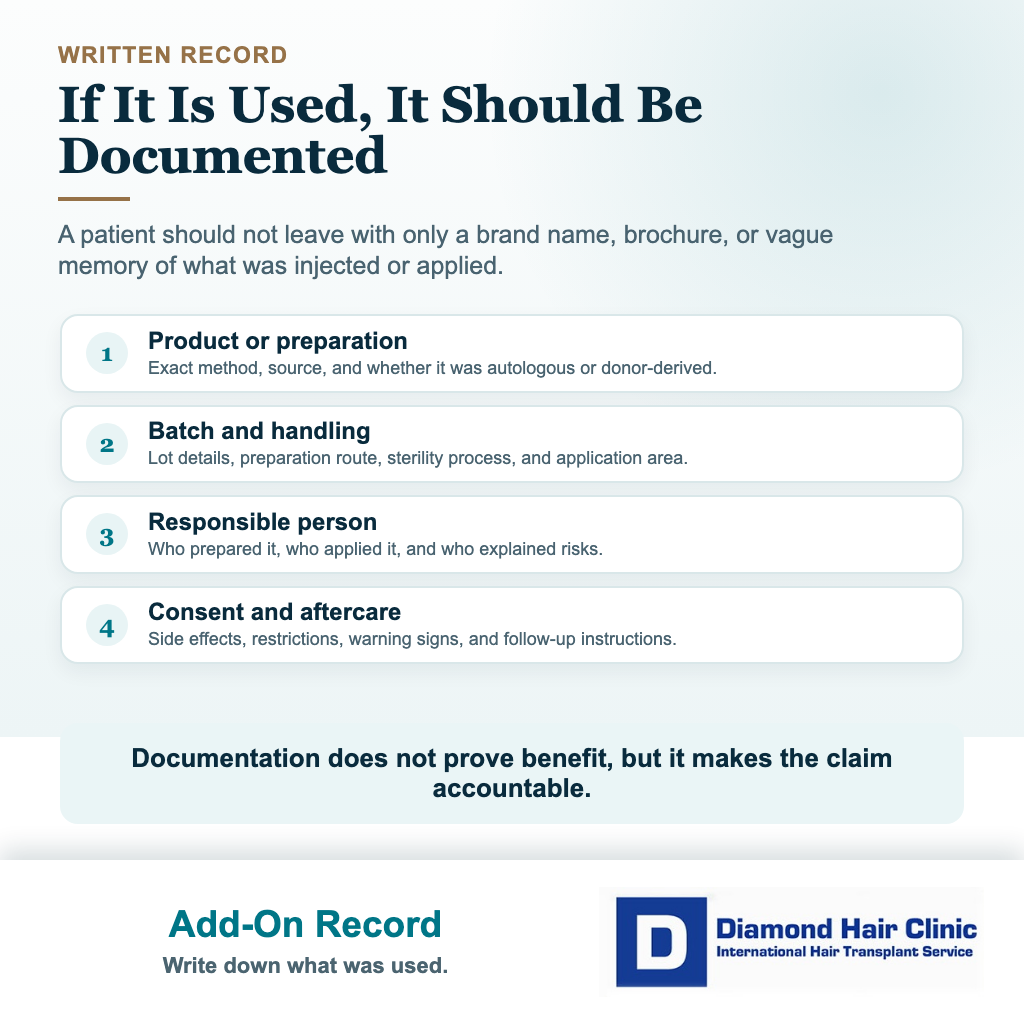
Documentation does not prove the extra will improve growth, but it makes the claim accountable. If a clinic cannot explain whether the product is approved or allowed for the claimed use in that country, cannot provide a consent form, or refuses to document what was used, decline the extra and judge the clinic carefully before proceeding with surgery.
Different names need different evidence questions
These treatments differ in what is prepared, where it comes from, and what the evidence actually measured.
PRP · Platelet rich plasma
PRP is prepared from your own blood, with platelets concentrated in plasma. The record should name the preparation system, any added substances, and the amount applied.
PRF · Platelet rich fibrin
PRF is also prepared from your own blood, but its processing and fibrin formation differ from PRP. The exact PRF type, preparation method, and whether it is applied as a liquid or clot should be stated.
Exosomes
Exosomes are tiny vesicles released by cells, not living stem cells. A product sold under this name still needs its cell or tissue origin, manufacturer, batch details, and preparation documented. The label alone does not confirm what a vial contains.
Tissue preparations
Preparations from fat tissue and scalp micrografts involve tissue and processing methods that must be identified. The starting tissue, whether it is your own or from a donor, and what is done to it belong in the written explanation.
A commercial product is not a separate biological category. Its exact contents and origin still matter. Evidence needs to match that preparation, the way it is applied, and the claimed outcome. Evidence for better graft survival or donor healing needs to measure those outcomes after transplantation.
Mesotherapy can mean many mixtures, some of which are marketed loosely. Laser caps are device based and have their own timing and expectation limits.
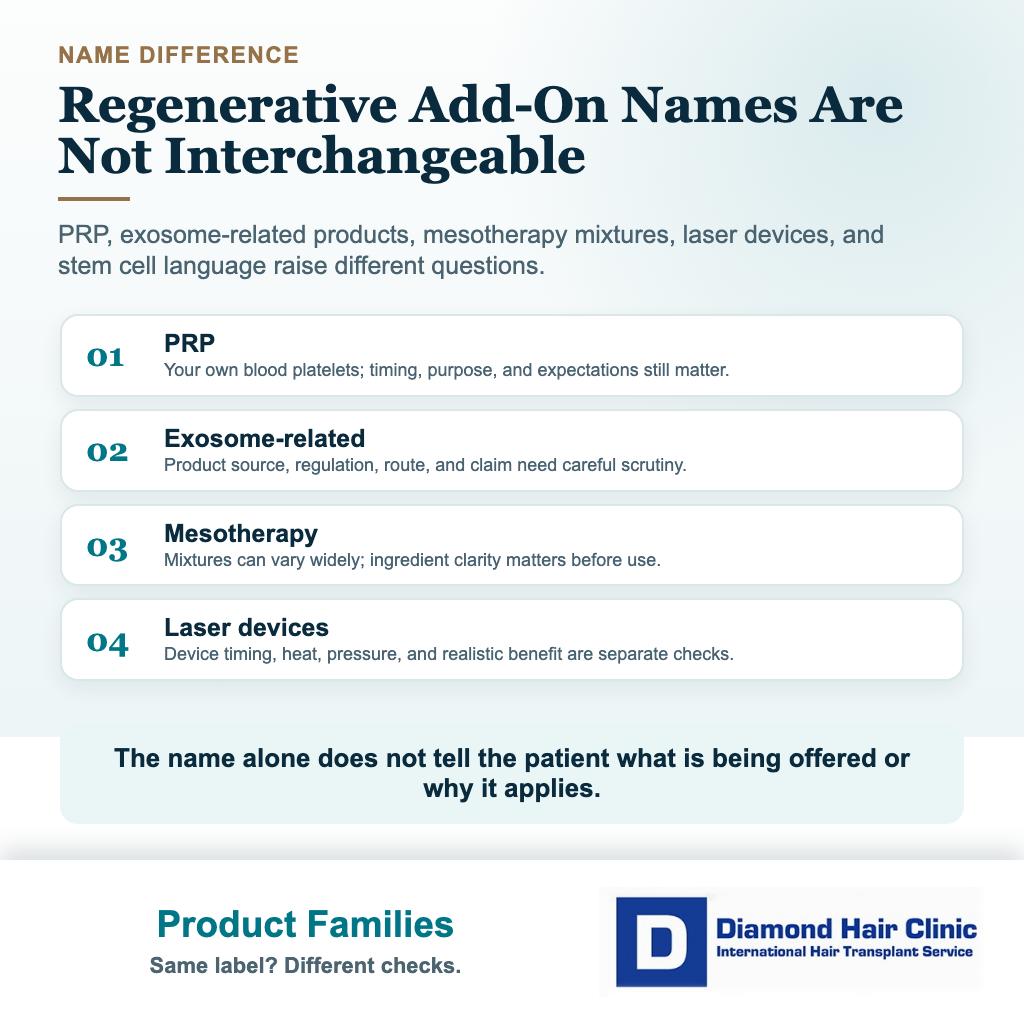
PRP and exosomes after hair transplant, mesotherapy kits after transplant surgery, laser cap use after hair transplant, and stem cell language all need scrutiny before payment. You need the exact treatment, purpose, timing, evidence, and risks before paying for any extra.
I do not object to research or future medical progress. I object to vague extra treatment language being sold as if it can bypass the hard parts of hair transplant planning.
Weak donor area and density limits need clear limits
No supportive treatment should be presented that way. A weak donor area needs conservative extraction and realistic planning. A large recipient area needs truthful coverage strategy. Fine hair, high contrast between hair and skin, advanced hair loss, and crown thinning all have limits that cannot be erased by an injection.
With limited donor capacity, I decide how to allocate the available grafts between the frontal hairline and crown. Giving the front priority may mean limiting crown coverage or treating it later. Medication suitability and the possibility of a second session also belong in that discussion. Those choices shape the long-term result. An added injection does not remove them.
When dense coverage is promised mainly because a stem cell extra is being sold, the discussion has moved away from donor math. The useful discussion protects future options.
Included package extras still deserve explanation
An included extra is still a medical treatment. It still deserves explanation. You may assume that if an extra is included, it cannot hurt and does not need attention. That assumption is not enough for any injection, processed tissue, biological product, or treatment applied to the scalp during surgery.
The extra should be optional, documented, and medically justified. Declining it should not suddenly change the graft number, hairline design, or promised growth. The plan should state aftercare changes, swelling, tenderness, infection risk, extra restrictions, who performs it, and whether it appears in the operative notes. If the explanation is vague, the package may be more focused on perceived value than on clinical need.
Guarantees need the same scrutiny. A clinic may combine a special extra with reassuring language about growth. Review hair transplant guarantees together with the clinic’s instructions if the wording sounds too certain.
Postponing surgery when the offer stays unclear
An unclear extra does not always mean the whole operation has to be postponed. In some cases, declining the extra and continuing only with a transparent surgical plan is the more careful decision. The quote and consent documents should show the transplant plan without the extra, so you can judge whether the core plan still makes sense. When the clinic cannot separate the real transplant plan from the paid extra, postponing becomes reasonable.
Do not let a deposit, discount, or limited slot message push you into a treatment you do not understand. Before committing to a hair transplant, the clinic should be able to explain the hairline design, donor limits, graft estimate, surgeon role, aftercare, and optional extras without pressure.
If the clinic uses fear, urgency, or vague advanced technology claims, compare that behavior with the red flags of Turkish hair transplant clinics. The warning sign is not only the extra. The warning sign is how the clinic uses it during the sales process.
After you have already paid
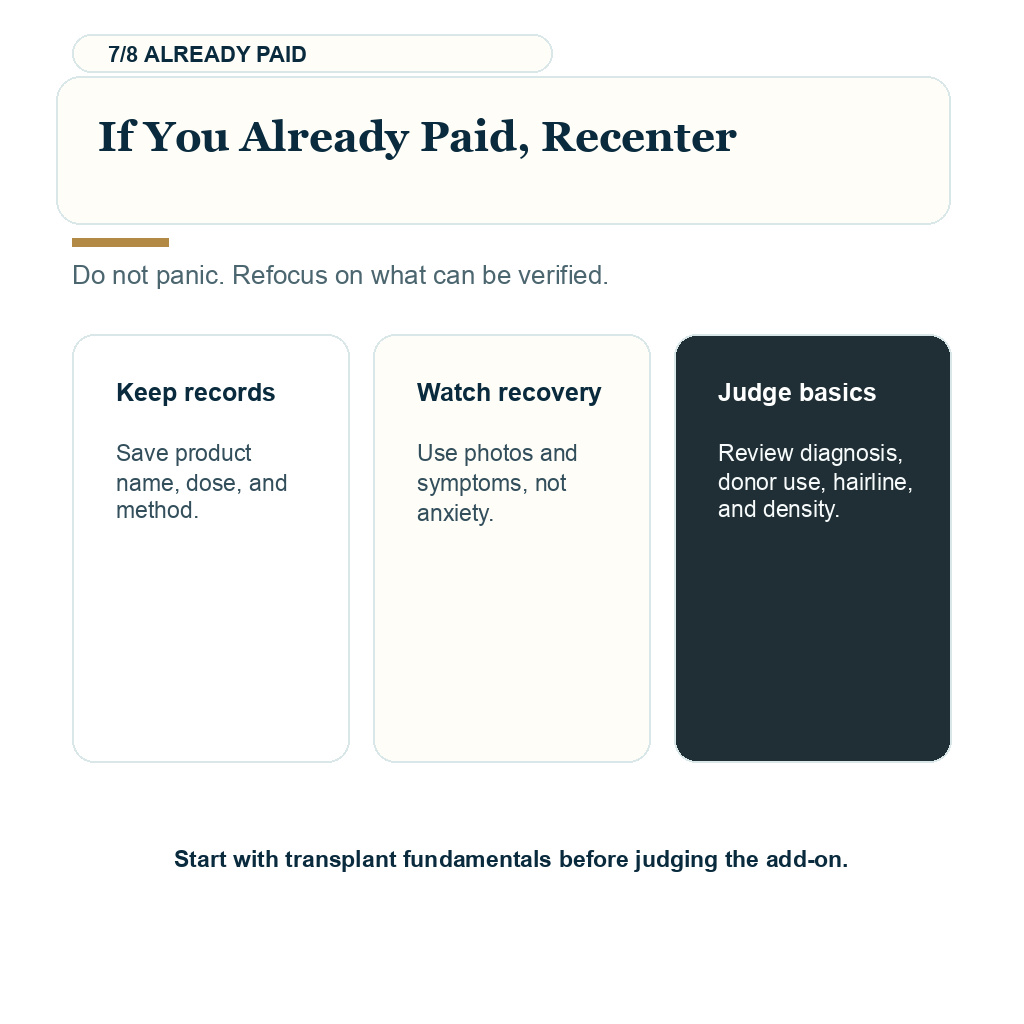
Do not panic. Start with documentation. You should know the treatment name, date, source, dose or preparation method when applicable, injection area, staff member or doctor involved, consent form, operative note, and any aftercare instructions. Swelling, fever, spreading redness, discharge, unusual pain, or a wound problem afterward should be reviewed by the clinic or a doctor promptly, and the product details should stay with your medical records.
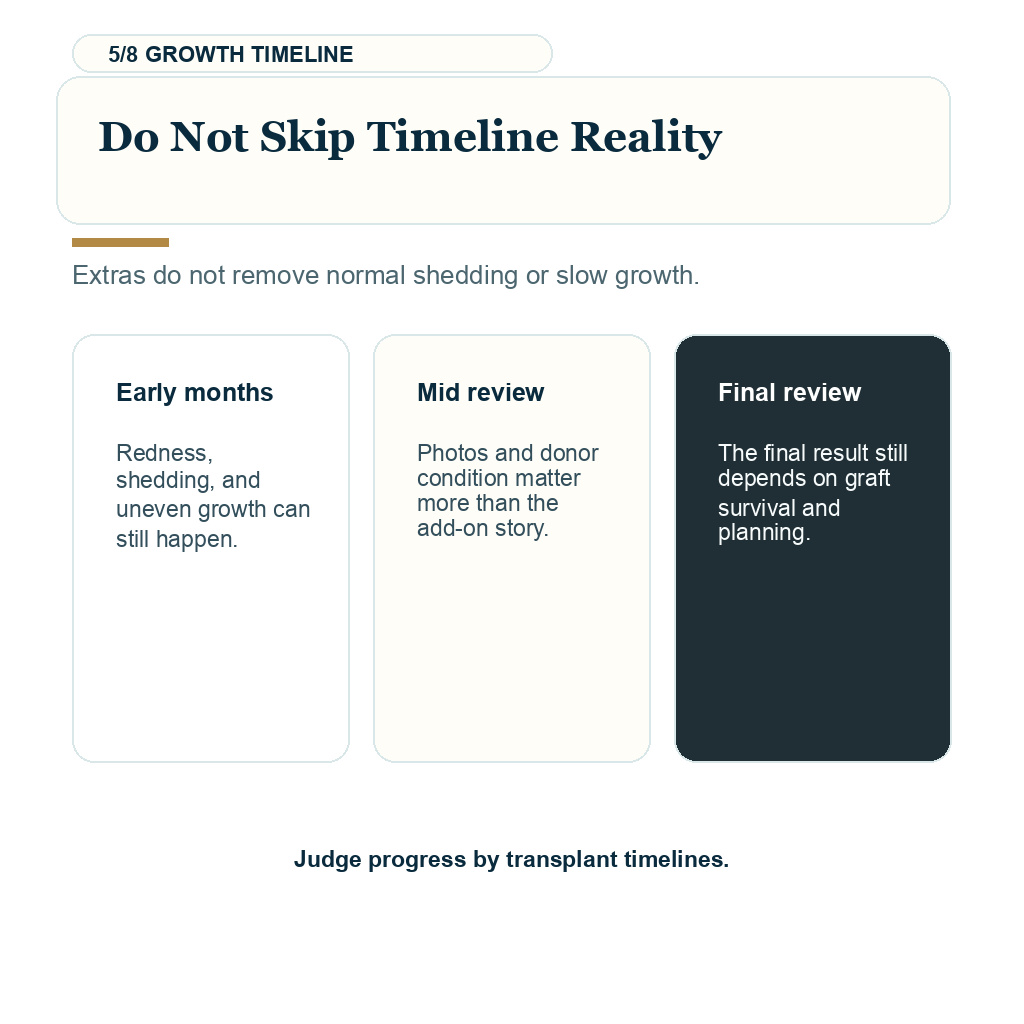
Once the surgery is done and you are waiting for growth, judge the result by normal hair transplant timelines rather than by the promise attached to the extra. Shedding, redness, early thinness, and anxiety can still happen even when extras were used. A regenerative extra does not remove the need for follow up photographs and realistic monthly assessment.
A disappointing mature result calls for a review of the original diagnosis, donor extraction, hairline design, graft direction and density, and management of continuing hair loss. Knowing that an extra treatment was used does not explain which of those factors contributed to the result.
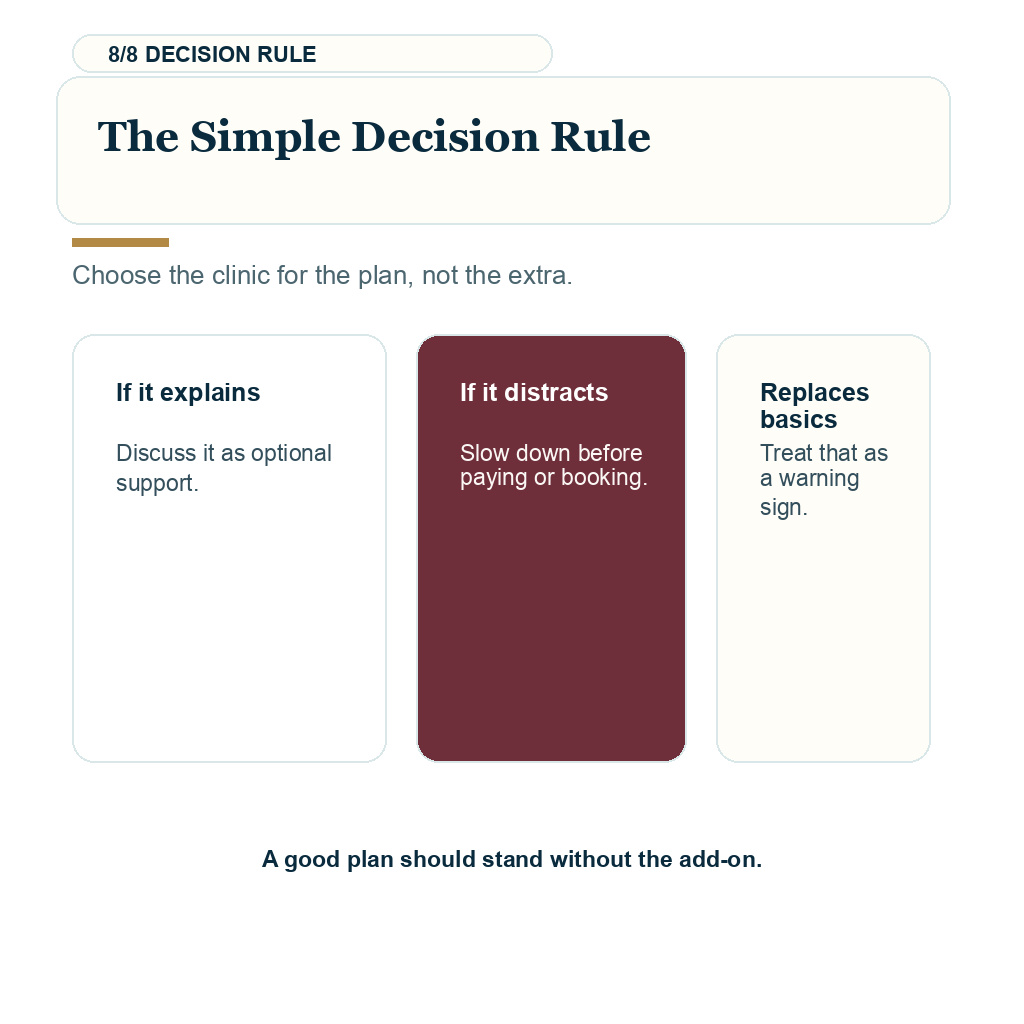
Use the 8 stem cell claim slides below to separate the core transplant plan, product identity, evidence limits, growth timeline, responsibility, and what to do if you already paid for an add on. Swipe sideways, use the arrows, or choose a number below the image.
My consultation standard for regenerative claims
During consultation, a clear explanation matters more than selling a scientific extra. If a treatment may help in a specific case, the explanation must be specific. If it is optional, I say that directly. If the evidence is limited, that needs to be clear as well. No extra treatment should be used to justify an unsafe hairline, excessive extraction, weak donor planning, or a promise that biology cannot support.
The transplant plan should be strong without the extra. The donor area should be protected. The hairline should be age appropriate. The plan has to make clear what can be improved and what cannot be promised. No supportive treatment is more important than careful surgical judgment.
For many people, the wiser decision is to spend time verifying the clinic, the surgeon’s role, the donor plan, the medication strategy, and the expected result before spending money on extras. A stem cell extra may sound impressive, but it only matters if it changes the plan in a medically responsible way. If it does not, it should not distract you from the operation that actually matters.

Read this review excerpt
He was very thorough in every little detail and I never felt pressure to do anything I wasn’t sure of.