


A Natural Hairline Is Not A Ruler Line
A common misunderstanding in this field is the idea that neatness automatically creates naturalness.

It does not. A natural male hairline is not a flat border drawn across the forehead with geometric obedience. It needs softness. It needs irregularity.
It needs a natural frontotemporal relationship. It needs to look like it belongs to the person rather than like it was stamped onto the face. It matters because many patients are impressed by the wrong visual signals. They see a line that looks sharp, clear, dense, and highly controlled, and they read that as strength. But sometimes what they are really seeing is overcontrol. Sometimes the line looks not strong, but manufactured.
So when a patient praises a result mainly because it looks “clean,” I do not always agree. Clean is not the same thing as natural. Precision matters, but precision without softness can still look surgical.
Softness Is Not Weakness
This is another subtle but important error. Some patients see a softer hairline and immediately assume it must be less powerful. They feel that a harder, stronger, more obvious line would have been better. They admire force before they learn to appreciate refinement.
This is not mature aesthetic judgment. Very often, softness is exactly what protects naturalness. A soft front edge, a measured transition zone, and a line that does not try too hard can age much better than a line that is eager to impress in the first six months.
Patients who are new to the field often admire impact. Patients who stay around the field long enough usually begin to admire naturalness. That difference matters. Because a line that tries very hard to look dramatic early can become a burden later, while a line that looks balanced, proportionate, and natural often remains satisfying for much longer.
Precision Can Still Look Artificial
Patients often admire precision. They see a very controlled implantation pattern, sometimes even a visible row pattern, and assume this must mean the work is highly skilled. To an inexperienced eye, that kind of order can look clean, advanced, and impressive.
But this is exactly where the misunderstanding begins. In a natural scalp, hair does not grow in a way that the eye reads as a pattern. It has direction, flow, and coherence, yes, but it also has subtle irregularity, minor asymmetry, variation in spacing, and a softness that prevents the hair from looking mechanically organized.
That natural irregularity is extremely important. Because once graft placement becomes too systematic, the eye may start detecting the implantation logic itself rather than simply perceiving hair. Parallel rows, overly uniform spacing, repeated angulation, and excessive neatness can all create this problem. Technically, the work may look controlled. Aesthetically, however, it may begin moving away from naturalness.
In practice, a result can be precise and still look artificial. A hairline can be too neat. A row pattern can be too visible. A distribution can be too uniform.
And once the pattern becomes detectable, the result may start looking less like naturally growing hair and more like hair that was placed by a visible method. That is one reason inexperienced patients and experienced observers often react so differently to the same case.
The inexperienced eye sees organization and says, “This looks very clean.” The more experienced eye asks a different question. Does this look naturally clean, or does it look surgically ordered? That is a very important difference. Because in hair transplantation, technical tools and discipline are essential, but discipline alone is not enough. It also has to be balanced with softness, irregularity, and a placement strategy that prevents the eye from reading the surgery too easily.
The decision should not be reduced to implanting grafts in an organized way. The plan should implant them in a way that the viewer notices the hair, not the pattern. Because once the pattern becomes easier to see than the hair itself, naturalness begins to weaken.
Age Changes Hairline Planning
A hairline should never be planned as if it exists separately from age. That may sound obvious, but many patients still think about hairlines in a very emotional and abstract way. They imagine the line they want to see in the mirror, without asking whether that line actually fits their age, facial proportions, pattern of hair loss, or how their face is likely to look years later.
At this point, poor judgment often begins. Because a hairline can feel exciting in the short term and still be a mistake in the long term. If it is placed too low, too flat, too dense in the wrong way, or without enough maturity in its shape, it may initially create a stronger frame, but over time it can start looking less natural, less stable, and less appropriate for the patient’s face.
That is the part many patients do not think about enough. They are often judging the line only by how satisfying it feels today. But a surgeon has to think further than that. He has to think about how that same line will look not only now, but also after more years of aging, after possible continued hair loss, and as the patient’s overall facial character becomes more mature.
Patients often confuse aggressiveness with ambition. I do not. A lower hairline is not necessarily a better hairline. A more aggressive frame is not necessarily a more beautiful one.
Simple measurements can start the discussion, but they should not decide the hairline by themselves. Finger widths, a centimeter target, or a line drawn on one photo can ignore temple position, forehead shape, age, donor reserve, and future loss. I treat those references as conversation aids, not as a surgical instruction to lower the hairline until the drawing is matched.
Sometimes the more mature hairline is actually the more intelligent line. Sometimes it is the line that gives the patient improvement without making the work look forced. And sometimes it is the difference between a result that looks impressive for a short time and a result that continues to look sensible, masculine, and natural for many years.
A good hairline should not be planned only around what feels exciting in the present. Patients whose main concern is a receding hairline should understand this distinction before asking for a lower or more aggressive hairline. It should also be planned around what will continue to look right in the future.
Temple Framing And Side Transitions
Many patients focus almost entirely on the central hairline, as if the middle alone is what determines whether a result looks natural. It does not. The frontotemporal relationship matters. The side framing matters.
The way the hairline moves laterally and connects to the surrounding frame matters. A central hairline may look satisfying on its own, yet the overall result can still feel off if the side transitions are weak, incomplete, or out of harmony with the rest of the face.
This is among those situations where the eye often notices the problem before the patient can explain it. He may simply feel that something looks slightly strange, slightly off, or less natural than he expected. And very often, what he is reacting to is not growth.
It is not density. It is architecture. That distinction is very important. Because a result is not judged only by the middle of the frontal line. It is judged by the way the entire frame comes together. If the central hairline looks acceptable but the temple framing and side transitions do not support it properly, the face may still read as surgically altered rather than naturally restored.
That is exactly where serious design separates itself from simplistic coverage. A clinic focused solely on putting hair at the front may increase visibility. A surgeon thinking more deeply about facial architecture is trying to create a sense of naturalness. That is a much higher standard.
Coverage And Restoration Are Different
This is a distinction that many patients do not understand clearly. Coverage means making a bald or thinning area look less empty. Restoration asks for more than that. It means rebuilding the frontal frame in a way that feels both anatomically correct and aesthetically natural.
Those are not the same thing. A surgery can create coverage and still leave the result short of true refinement. The scalp may look less bare, the patient may look improved, and the change may still make him genuinely happy. But improvement alone does not always mean the area was restored with real quality.
To restore an area properly, the surgeon has to think far beyond simply placing hair into an empty space. He has to think about line shape, transition softness, irregularity, frontotemporal logic, angulation, directional flow, and how the entire pattern will be read when the patient is seen as a whole.
That is where the standard changes. Because the real goal is not only to reduce baldness. The real goal is to create a result that looks as though it naturally belongs to the face, not one that merely fills a gap. And I think many patients believe they are buying restoration when in reality they are being sold only coverage.
Once a patient understands that difference, the way he judges results becomes more intelligent. The focus moves beyond “Is there hair there now?” toward whether the area was restored in a natural and refined way rather than simply filled.
That is a much higher standard.
Reasonable Results Can Be Misread As Failure
Now let me come to the opposite mistake. This is the patient who receives a reasonable result, sometimes even quite respectable within the real limits of his case, but still describes it as a disaster because it did not match the fantasy he carried into surgery.
I see this often. It usually begins the moment the patient stops comparing the result to his real starting point and starts comparing it to an imagined version of what he wanted hair transplantation to do for him. That is where judgment starts drifting away from reality.
A man with broad thinning, advanced loss, limited donor reserves, or difficult hair characteristics may still expect the surgery to give him something close to the visual memory of his untouched younger hair. Then, when the result looks clearly improved but still limited, he does not feel grateful for the improvement. He feels disappointed by the limit.
But the limit may not be the sign of failure. The limit may simply be the truth of the case. Let me give a few examples of the kind of thing I mean. A patient around Norwood V or VI may receive a meaningful frontal restoration. In some cases, a crown hair transplant must be delayed or limited so the frontal result does not consume too much donor reserve. In real life, he looks better. His face looks stronger. The area that frames him most has improved clearly. But then he looks at himself under harsh overhead lighting, notices that the midscalp or crown is still not dense in the way he imagined, and suddenly starts using words like failure.
But that is not necessarily failure. That may simply be a case where limited grafts were used in the area that mattered most, and where full density everywhere was never realistically available in the first place. Or think about the patient with fine hair, high scalp contrast, and a larger balding area. Even if the surgery is planned responsibly, he may still see more scalp than a man with coarse, wavy, low contrast hair would see from the same graft number. Yet instead of recognizing the biological disadvantage, he may assume the result itself must be poor.
Or consider the patient who expected a very low hairline and almost youthful density from a single session, despite having a donor that was never strong enough to support that kind of ambition safely. When he receives a more mature and realistic frame instead, he sometimes reacts as if he was given too little, when in fact he may have been protected from a worse long range decision.
This is exactly where the problem lies. Because if every result that falls short of fantasy is called a failure, then the patient is no longer judging the surgery against biology, donor limitation, Norwood pattern, and starting point. He is judging it against imagination.
And that is not a fair standard. Of course, true failed results do exist. Poor growth exists. Poor planning exists. Poor design exists. Poor donor management exists. I do not believe in pretending otherwise. But I consider patients should be careful not to use the word failure too loosely.
Because sometimes what they are calling failure is actually something else. a case with real limitations,
a case with clear improvement but not perfection,
a case where the donor was never enough to satisfy the fantasy,
or a case where the patient expected the surgery to do something surgery was never truly capable of doing.
That distinction matters a great deal. Because once the patient understands that difference, the whole evaluation becomes more intelligent. He stops asking only, “Why do I not look exactly how I looked before I lost my hair?” And he starts asking a better question.
“Given my starting point, my donor, my Norwood level, my hair characteristics, and the area that needed to be covered, was this result actually reasonable?” That is a much more mature way to judge a transplant.
Memory Of Old Hair Can Distort Judgment
This problem becomes even more complicated because memory is not neutral. Many patients think they are judging their result against reality, but very often they are judging it against a selective memory of how they used to look before hair loss became more advanced.
And memory does not behave like a clinical record. It idealizes. It smooths. It edits.
It preserves the emotional impression while losing the weaker details. So a patient may look at his result and think, “This is still not as good as my old hair.” But often, what he is comparing it to is not a true baseline. It is an older, cleaner, more flattering version of himself that has become stronger in memory than it ever was in real life.
That comparison is difficult for any surgery to win. I see this especially in men whose hair loss progressed slowly over many years. Because the change was gradual, they often still carry a younger version of their face in their mind. A man may reach surgery at 38, but emotionally, he is still comparing the result to how he looked at 28, not to how he actually looked just before the operation.
That naturally creates disappointment. One man may have spent years styling around the recession, choosing flattering angles in photos, avoiding harsh lighting, or simply getting used to seeing himself in a more forgiving way. After surgery, when he studies the new result under direct light and close attention, he may feel it falls short. But the accurate comparison is not between the surgery and an edited memory. It is between the surgery and the real before surgery situation.
Some patients remember younger hair as uniformly thick and complete, when in reality even before major loss, his density may not have been as perfect as he now imagines. Memory tends to preserve the feeling of having hair more than the exact anatomy of it.
I also see this in patients who had been hiding the problem successfully before surgery. For years, they may have worn their hair longer in the front, styled it in one specific direction, avoided getting it wet, and learned exactly how to present themselves in the mirror. Because of that, what they remember is not the true baseline. What they remember is the managed version of the baseline.
Then, after surgery, they judge the new result under much harsher conditions than they ever used for their before surgery hair. That is not a fair comparison. There is a patient who used to look acceptable only because the hair was always kept at a certain length. He remembers the overall impression, but forgets how weak the scalp looked when the hair was shorter.
There is the patient who remembers his younger crown as much fuller than it really was, because crown thinning often develops slowly and is less obvious in normal front facing mirrors. There is a patient who confuses having more native density in the past with having had a truly strong hairline design. In his mind, the whole thing becomes one simple memory. “My hair used to be great.” But when you examine old photographs carefully, what he really had may already have been recession, thinning, and weakness that memory later erased.
Another patient compares the result to old photos taken in very forgiving conditions. Softer light, more flattering angles, slightly longer hair, sometimes even a younger face, carrying the frame differently. Then he compares those old photos to a much more clinical, much more exposed after surgery evaluation. Again, the comparison becomes unfair before he even realizes it.
And sometimes the memory is not even based on photographs at all. It is based on identity. The patient is not only remembering hair. He is remembering a younger version of himself, a time when he felt fresher, more attractive, or more confident. So when he says, “I would like my old hair back,” he may actually be asking for something larger than hair. He may be asking for the return of a past version of himself.
That places a heavy emotional standard on surgery. Patients should be careful with the phrase, “I just want what I had before.” Because sometimes what they mean by before is not a precise historical reference. It is an emotional reconstruction.
And once that becomes the standard, the surgery is no longer being judged against the real problem it was meant to improve. It is being judged against a version of the past that has been softened, cleaned up, and emotionally upgraded over time. That is one reason some patients feel disappointed even after a reasonable result.
The comparison point itself has become inaccurate. One of the healthiest things a patient can do is keep returning to his actual before surgery photographs, not only to the image of himself he carries in his mind. Because photographs can sometimes be uncomfortable.
But memory is often even less fair.
Donor cost and useful coverage
The Density Misunderstanding
Many patients misjudge results because they do not really understand density. They think about density emotionally, not mathematically. Native donor density and transplant density are not the same thing. A person’s original scalp density is far beyond what can simply be recreated across a large balding area. What surgery can create is cosmetic density, meaning a natural illusion of fullness, not a full return to untouched native density everywhere.
That single reality explains a great deal of patient disappointment. Because many men still approach surgery with an unconscious fantasy. “Put me back exactly where I was before loss.” But that is not what this surgery is. This surgery is a redistribution.
This surgery is prioritized. This surgery is a visual strategy performed under donor limitations. Once a patient understands that, the review moves beyond “Can I still see scalp?” and toward whether the starting point, donor reserve, surface area, hair characteristics, and future loss pattern were planned intelligently.
That is a much more adult way to judge a result.
Before a second procedure is discussed, name the problem. Scalp that looks more visible under harsh light may reflect density, hair caliber, or styling. A heavy front edge can come from grafts carrying several hairs. Hairs leaving the scalp against the surrounding flow point to direction. A frame that simply feels off may come from hairline shape or temple transitions. These defects do not share one solution, so adding more grafts should not be the default answer.
Norwood Pattern, Graft Numbers, And Donor Capacity
A major misunderstanding in hair transplantation begins the moment the conversation turns numerical.
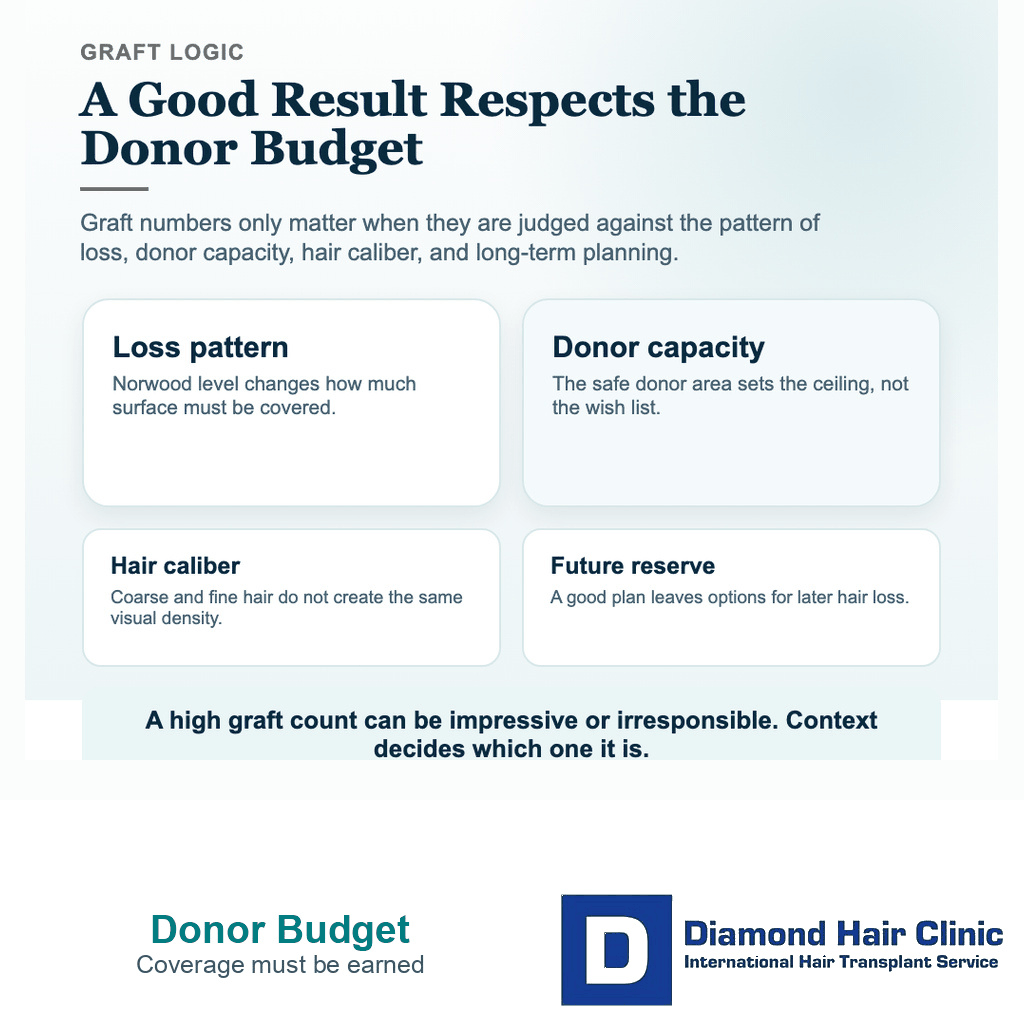
Patients often ask only one question. How many grafts can you take? But that is usually not the most useful question. I need to know how large the area is, how high the expected density should be, and how much this patient’s donor area can safely provide.
Because in real life, the donor is the limiting factor. This is exactly why the Norwood scale matters so much. Not because the label itself is magical, but because it gives a rough idea of surface area. And once the surface area becomes larger, the mathematics of the surgery changes very quickly.
A patient around Norwood III is living in a very different reality from a patient around Norwood VI or VII. If a man is around Norwood III, and the main issue is mostly frontal recession with relatively limited loss behind it, the situation is usually more favorable. The area is smaller. The demand is smaller. The donor and recipient balance is more forgiving.
In that type of case, if I am planning a restrained frontal restoration, I often think in terms of around 2,000 to 3,000 grafts, depending on the patient’s scalp size, donor density, hair caliber, and the exact hairline design. That is not a rigid rule. It is simply the kind of case where the numbers are often easier to manage.
Once a patient moves into Norwood V, the whole conversation starts changing. Because now I am usually not dealing only with a frontal problem. I am often dealing with a much broader area behind it as well. And that is exactly where many patients begin underestimating the mathematics of the surgery.
At that level, it is not difficult to require 4,000 to 5,000 grafts if the aim is to create a strong frontal frame and also carry meaningful work behind it. But the real limitation appears here. Some patients do not arrive with a donor area that can safely give that kind of number in one step without compromise.
That is where the planning stops being simple. If I feel a patient can safely provide something around 3,000 to 3,500 grafts from the scalp donor without pushing too hard, real decisions have to be made about building a stronger frontal half and accepting less density behind it.
The same judgment applies to staging, leaving the crown out of the first session, or discussing beard support in the right patient. At this point, real surgical judgment begins.
Because from this point onward, hair transplantation is no longer only about what sounds attractive on paper. It becomes a question of allocation, priority, and careful judgment. And once a patient reaches Norwood VI or VII, many fantasies start collapsing into arithmetic.
At that level, the patient may want everything at once. a strong hairline,
good frontal density,
solid midscalp coverage,
and a crown that also looks full. But the donor does not respond to what the patient wants emotionally. It only gives what it can safely give.
And that is exactly why advanced hair loss forces the surgeon to think in terms of distribution, not wishful thinking. A high Norwood patient can very easily need well over 5,000 grafts, and sometimes around 6,000 or more, if he is imagining broad coverage with satisfying density everywhere.
But many patients simply do not have a scalp donor that can safely provide that much in a comfortable and natural way. So the more useful question becomes. Where should the grafts go first? I often say that in advanced Norwood cases, the front and the crown do not live in the same mathematical reality.
The front gives the most important visual return because it frames the face. The crown can consume grafts very quickly without giving the same visual return. So if too much donor is spent too early in the crown, the patient may end up with a plan that sounded ambitious in the short term, but quietly weakened his future.
A Norwood III patient may sometimes ask for too much, but the concern is still relatively contained. A Norwood V patient is already entering the zone where distribution strategy becomes much more important. And a Norwood VI or VII patient is usually dealing with a true donor and recipient mismatch, where the important question is no longer.
The aim is not to promise that everything can be rebuilt. The aim is to use limited donor hair in the most intelligent and natural way. For graft numbers, I avoid throwing out a dramatic figure just to make the plan sound impressive.
I think the clearer way is this. First, I must understand what your Norwood pattern actually demands. Then I must understand what your donor can safely provide. And only after that can I make a serious plan.
Because in hair transplantation, the most dangerous plan is not always the one that sounds too small. Very often, it is the one that sounds too generous to be true.
Graft Count Can Mislead Patients
Another habit I see public all the time is the obsession with graft count, as if that number alone tells the whole story. It does not. A graft is not a result. It is simply a unit used inside a plan. The point is not just how many grafts can be removed. it is whether the donor area stays usable if the patient needs future planning.
And a plan can be intelligent or unintelligent, regardless of how big the number sounds. One clinic says 3,000. Another says 4,000. Another says 4,500. The patient naturally assumes the bigger number must represent the better surgery, the more generous clinic, or the stronger result.
But hair transplantation does not work that way. A bigger graft number can mean many different things. It can mean the patient had a larger balding area. It can mean the plan was more aggressive.
It can mean the donor was placed under more pressure. And sometimes, it can simply mean the number sounds better in a consultation room. I never like discussing graft counts as if they were some kind of scoreboard. What matters here is not only the graft count. I look at placement, distribution, hair type, area size, and what the donor area had to give for that number.
Let me put it more practically. I have seen a patient receive around 2,800 to 3,000 grafts into a relatively limited frontal problem, with good hair caliber, sensible hairline design, and careful distribution, and the result looked natural, balanced, and long range sensible.
I have also seen patients receive 4,000 or more grafts, yet the result still did not look especially strong, because the area was larger, the hair was finer, the design was weaker, or the donor had been pushed without enough strategic thinking. So the larger number did not always lead to a better outcome.
It only created a bigger number. There is also the patient who hears 4,500 grafts and gets excited, without asking whether that number is being used to solve a very wide Norwood V or VI problem. In that case, 4,500 grafts may not be luxurious at all. It may simply be the amount needed to create an acceptable frame while still leaving compromises elsewhere.
And there is the opposite patient, the one who feels disappointed when he hears a smaller number, not realizing that his case may not even need a dramatic graft count if the concern is relatively limited and the planning is disciplined. Because of that, raw numbers can be very misleading.
They sound objective, but they are often discussed in a very unobjective way. Patients hear the number, but they do not always ask what kind of problem that number was attached to. A man with a smaller Norwood III frontal problem and a man with a broad Norwood V pattern cannot be judged by graft count in the same simplistic way.
This also matters for hair characteristics. A patient with coarse, wavy, lower contrast hair can achieve much greater visual return from a given number of grafts than a patient with fine, straight, high contrast hair. So again, the number by itself does not tell the story.
I start by asking what the graft number was meant to solve, how it was distributed, and whether it truly matched the size of the problem. Without that explanation, the number is too easy to misunderstand.
And what did it cost the donor? Because I have seen lower graft counts used with much more elegance, much more careful judgment, and much more long range sense than larger graft counts used without enough judgment. When patients compare cases mainly through graft numbers, they are usually comparing too crudely.
And in hair transplantation, crude comparison leads to a poor understanding very quickly. A graft count should be read as part of a strategy, not as a trophy.
Same Graft Count, Different Results
This is another point that many patients misunderstand. Two patients can each receive the same number of grafts and still end up with results that look very different afterward. That does not always mean one surgery was excellent and the other poor. Sometimes the difference begins much earlier than the surgery itself.
It begins with the material. Hair caliber matters. Wave matters. Curl matters.
Hair to skin contrast matters. Donor quality matters. Surface area matters. The amount of miniaturized native hair still present in the recipient area also matters.
All of these things change what a graft number can actually achieve. I think patients often make very sloppy comparisons public. They see that two men both received 3,000 grafts, for example, and then they expect the visual outcome to be similar. But that is not how real life works.
A man with coarse, wavy hair, lower scalp contrast, and a relatively smaller area to restore may get a much stronger visual return from 3,000 grafts than a man with fine, straight hair, bright scalp contrast, and a broader area of thinning. The number is the same.
But the visual value of that number is not the same. Let me give a few simple examples. Imagine one patient with a mainly Norwood III frontal problem, good donor density, and thicker hair shafts. In a patient like that, 2,800 or 3,000 grafts may create a very satisfying change, because the area is relatively limited and the hair itself helps the illusion.
Now imagine another patient who also receives 3,000 grafts, but he has a much wider Norwood V pattern, finer hair, and stronger contrast between hair and scalp. In that second patient, the same number may create improvement, but the scalp may still remain more visible, simply because the grafts are being asked to do more difficult work.
Or take two patients with the same recession pattern, but different hair characteristics. One has coarse, slightly wavy hair. The other has fine, straight hair. Even if the surgeon places the same number of grafts with the same level of attention, the first patient may still look fuller because his hair naturally creates more coverage.
The second patient may still look thinner, not necessarily because the surgery was worse, but because the raw material is less forgiving. There is also the question of existing native hair. A patient who still has a reasonable amount of miniaturized native hair between implanted grafts may appear denser than a patient whose area was more completely empty from the start. Again, the same graft number can create a very different visual result depending on what was already there.
Scalp size matters too. Patients do not always think about this, but even if two men are both described as, for example, Norwood IV or V, one may simply have a larger head and therefore a larger area to cover. The same graft number spread over a larger canvas will not read the same way.
Patients should be very careful with simple public comparisons. They compare numbers without comparing biology. They compare photos without comparing surface area. They compare outcomes without comparing hair quality.
That is shortcut thinking. Graft count only matters after you know the size of the area, the hair caliber, the contrast with the scalp, and the native hair that remained.
The same graft number can look very different from one patient to another. Patients need to know what the grafts are being asked to accomplish, because the number has no meaning by itself.
Its meaning varies depending on who the patient is, what area is involved, and what kind of material the surgeon is working with.
Hair Characteristics Change The Final Result
This is something many patients underestimate. They often look at a result and assume the whole story is the surgeon. Of course the surgeon matters enormously. But the material matters too.
And in hair transplantation, the material is the patient’s own hair. Some hair types are naturally more forgiving. Coarse hair gives more coverage. Wavy hair often creates more visual fullness.
Lower contrast between hair and scalp usually helps the result look denser. On the other hand, fine, straight hair on lighter or more reflective scalp can expose weakness much more easily, even when the surgery itself was planned responsibly. This is not an excuse for poor work.
It is simply part of reality. A skilled surgeon can improve the odds, but he cannot make every hair type behave like every other hair type. And this is exactly why two patients can both receive respectable surgery and still look very different afterward. Let me give a few examples.
A patient with coarse, slightly wavy hair may receive a moderate graft session and still look impressively full, because his hair naturally helps create coverage. If two patients receive a similar number of grafts, the visual result can still be very different. Fine, straight hair with strong contrast against the scalp may look lighter, softer, or more transparent under the same lighting.
The surgery may be respectable in both cases. But the visual effect will not be the same. Or think about a patient with darker hair and darker scalp tone, where the contrast is lower. That kind of patient often gets more help from nature. The hair and scalp blend more easily, so the eye reads the area as fuller.
Now compare that with a patient who has fine light hair over a scalp that reflects strongly in direct light. In that case, even decent work can look less dense because the scalp announces itself much more quickly. There is also the question of shaft thickness.
Patients do not always think about this, but thicker shafts do more visual work. Two patients may both have the same graft number, yet one looks stronger simply because each hair is doing more covering. And there is the question of hair behavior. Some hairs stay flatter.
Some lift more. Some separate more easily. Some naturally create better overlap. All of this affects how the result is finally read by the eye.
Patients should be very careful when they compare themselves to someone else’s before and after photos public. Sometimes they are not only comparing surgeries. They are comparing different biological advantages. And if they do not understand that, they may judge themselves too harshly, or give too much credit to another result without recognizing how much help came from the hair itself.
The clearer way to think is this. A surgeon works with the material he is given. Good judgment can improve the outcome. Good planning can improve the outcome.
Good execution can improve the outcome. But the raw material still matters. And once patients understand that, they usually begin to look at results in a more informed way.
Crown Results Need Different Judgment
The crown is one of the areas that patients most often misunderstand. This often happens because many patients judge the crown with the same expectations they use for the frontal hairline. But those two areas are not surgically equivalent. The front gives an immediate visual return. It frames the face. Even a moderate improvement there can clearly change how a patient looks.
The crown behaves very differently. The crown is usually a less forgiving area, not simply because of vascular biology, but because of its whorl pattern, its rounded convex geometry, its direct exposure to overhead light, its tendency toward ongoing progression, and the fact that each graft often gives less visual return there than it does in the relatively flatter frontal area.
That difference matters a great deal. A patient may think, “If enough grafts are placed there, why should it not look full?” But the crown does not reward grafts in the same way the frontal zone does. The front often yields a stronger visual return with fewer grafts because it provides framing.
The crown can accommodate a large number of grafts and still show scalp, especially under direct light. That is not necessarily a sign of poor surgery. Very often, it is simply the nature of the area. Let me give a few examples.
A patient with primarily a frontal problem may receive a well planned session and experience a dramatic improvement because the area that changed is the one that most strongly affects the face. A different patient may have a similar graft number placed mainly into the crown, yet still feel underwhelmed, because even a meaningful improvement in the crown often looks less dramatic in daily life.
A crown may look acceptable in ordinary room light before surgery, but who judges it afterward under harsh bathroom lighting. In that case, the crown may feel disappointing even when the actual grafting was reasonable, because the crown is one of the first places where overhead light exposes limitations.
A patient with more advanced loss may want a strong frontal frame, good mid scalp density, and a satisfying crown in the same session. At this point, the real problem is usually not ambition, but arithmetic. The crown can consume grafts so quickly that, if the surgeon is not careful, too much donor tissue can be used in an area that provides less visual return than the front.
Crown planning always has to be more strategic. I would not reduce this to simply. Can the crown be filled? The more important questions are.
For the crown, I look at how open the area is, how much donor reserve remains, and what still needs protection for the future. Spending too many grafts there too early can weaken the more important frontal plan. Because in progressive androgenetic alopecia, the crown is often the area where patients most easily underestimate the price of coverage.
I often say that the front and the crown do not live in the same mathematical reality. The front creates framing. The crown reveals a limitation. Those are two very different surgical conversations.
A Strong Front Can Hide Donor Weakness
Many patients become so focused on the frontal result that they barely study the donor area at all. I think that is a serious mistake. Because a hair transplant should never be judged only by what was built in front. It should also be judged by what was spent behind.
Donor proof should match the way the patient wears the hair. A result that looks clean with longer sides may show uneven extraction when the donor is clipped shorter, so before and after photos need the haircut context as well as the front view.
This is an important differences between short range excitement and long range judgment. A patient may look at the mirror, see a stronger hairline, and feel very happy. That reaction is understandable. But if the donor was harvested too aggressively, too unevenly, or without enough planning for the future, then the price of that frontal improvement may be much higher than the patient realizes at first.
In other words, a result can look attractive in the recipient area and still reflect poor judgment overall. I never like evaluating a case only through the excitement created by the front. Because a strong looking frontal result can still be a weak result if it was purchased with unnecessary donor damage or with too little reserve left for the future.
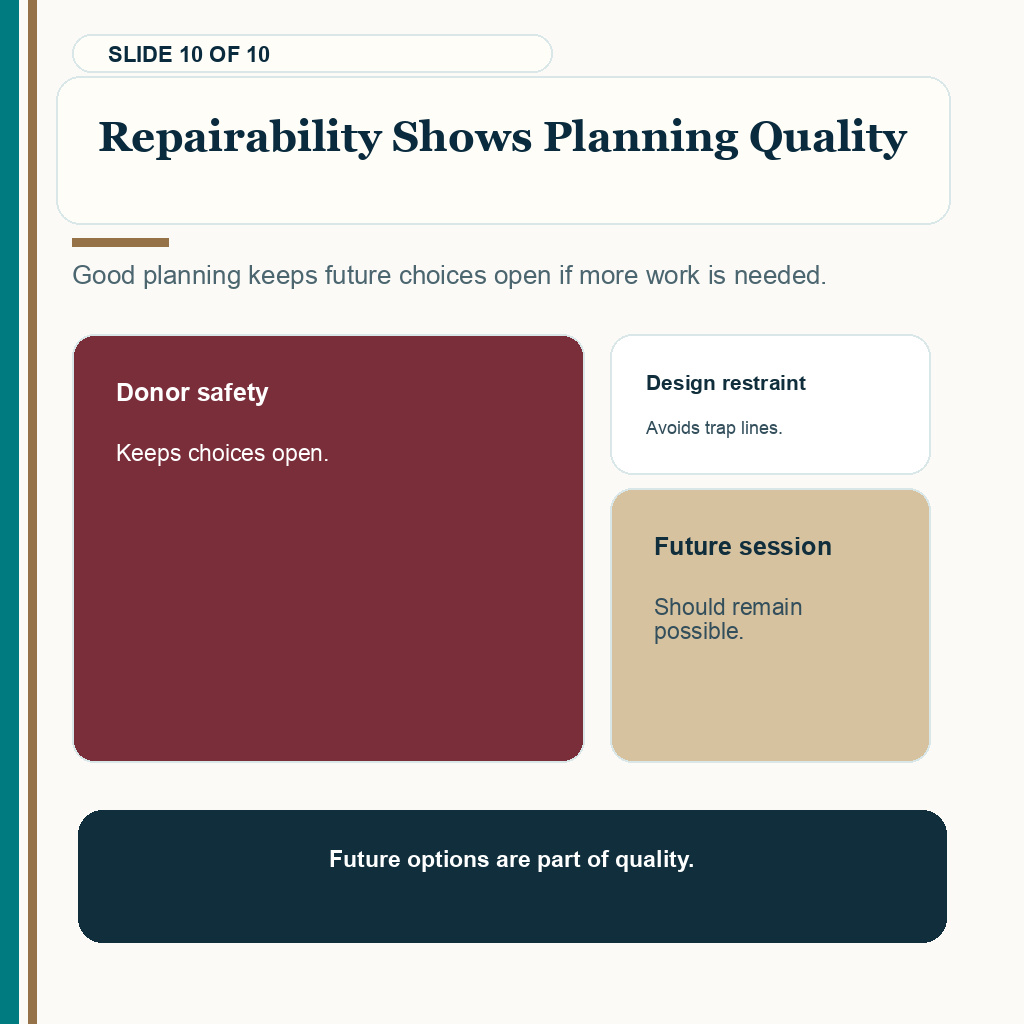
Donor reserve is not just where the grafts come from. It is the patient’s reserve, his insurance, and often his only real source of flexibility for later years. If that reserve is spent carelessly, the patient may not notice the full cost immediately. But it often becomes visible later.
Sometimes the first sign is overharvesting that starts showing when the hair is cut shorter. Sometimes it is a donor area that looks patchy, patchy, or uneven under direct light. Sometimes it is a patient who was given an exciting first session, but later discovers that there is not enough safe donor left for a second surgery, for progressive loss, or for correction of earlier weaknesses.
I think the donor must be judged with the same seriousness as the frontal result. Let me give a few examples of what I mean. A patient may receive a dense looking hairline, and at first everyone focuses on the improvement in front. But if the extractions were taken too heavily from a narrow zone, the donor may begin looking weak when the hair is worn shorter. The front looks stronger, but the back now looks obviously depleted.
A different patient may receive a large graft number and feel impressed by that number alone. But later, when the native hair continues thinning and a second procedure becomes relevant, the surgeon may have far fewer good options than expected, because too much donor was already used in the first surgery. This is different from permanent graft loss, which is a more serious concern than ordinary maturation or native thinning.
A naturally modest donor can be pushed too hard who was pushed too hard to satisfy an aggressive first session plan. For a while, the result may look exciting. But if later hair loss continues in the mid scalp or crown, the patient may realize that the original plan solved a short range emotional problem while quietly weakening the future.
That is not good planning. A donor should not be harvested as if the only goal is to make the first session look dramatic. It should be harvested in a way that keeps the area looking natural, stable, and even, while also preserving the possibility of future work if it is ever needed.
The donor area needs judgment with questions just as serious as the ones we ask about the front. Not only. Does the hairline look stronger? But also.
I judge the donor with the same seriousness as the front. It should be harvested evenly, still look natural at shorter lengths, and leave enough reserve for the future. If the price of the improvement is a damaged donor, the result is not truly strong. Because a transplant result should not only look good today.
It should also leave the patient with options tomorrow. A surgeon who improves the front while quietly damaging the donor has not created a truly strong result. He has simply moved the weakness from one area of the scalp to another.
Hair Length Changes How Results Look
Hair length changes how a transplant is read much more than many patients realize. Some results improve clearly once the hair reaches a certain length, because layering, overlap, and texture begin helping the illusion of fullness. Other results may look acceptable when the hair is kept a bit longer, but become much less convincing once it is cut shorter.
The same is true for the donor area. Some donor areas tolerate shorter wear very well. Others begin revealing the history of extraction much more quickly once the hair is clipped down. I think hair length is not a minor detail at all. It is part of how the result needs judgment.
A transplant is not experienced in only one hairstyle. It is experienced through the way the patient actually lives. One patient may be perfectly happy if the hair looks good at a medium length with some styling. Another may specifically want the freedom to wear it short.
Another may is very concerned about whether he can still have a fade. Another may be less concerned with dry styled hair and much more concerned about how the transplant looks when the hair is wet or flattened. These are not small preference details. They shape the entire meaning of the result.
Let me give a few practical examples. A patient may have a transplant that looks quite respectable once the hair reaches a certain length in the front. The added length helps soften the frontal work, improves overlap, and makes the whole area read as fuller. But when that same patient cuts the hair shorter, the density may no longer carry the same way, and the transplanted area may begin looking lighter or more exposed.
A patient can be satisfied with the recipient area, but once he shortens the donor to a guard that is closer to the scalp, the extraction pattern may become easier to notice. In that case, the surgery may still look acceptable at one length and much less comfortable at another.
Some patients say before surgery, “I would like to keep wearing my hair in a skin fade” or “I always wear the donor very short.” That patient is not asking for the same thing as the patient who is happy to keep the donor a little longer. The same surgical plan may suit one of them and disappoint the other.
Patients should be careful with very general phrases like “I just want more hair.” That is not detailed enough. It is more useful to explain how you want to wear your hair after the surgery.
Because a result that looks natural and satisfying at one length, one style, or one presentation may not look equally strong in another. And that is exactly why some results are judged too generously and others too harshly. The patient is not always judging only the transplant.
Sometimes he is also judging the way that transplant behaves at the particular length he personally cares about most. That matters a great deal. Because a result should not only be judged by whether hair grew. It should also be judged by whether it works for the real life way the patient wants to live with it.
Photos Can Distort Hair Transplant Results
Patients place enormous trust in photos, but in hair transplantation, photographs can be very deceptive when they are not taken under controlled conditions.
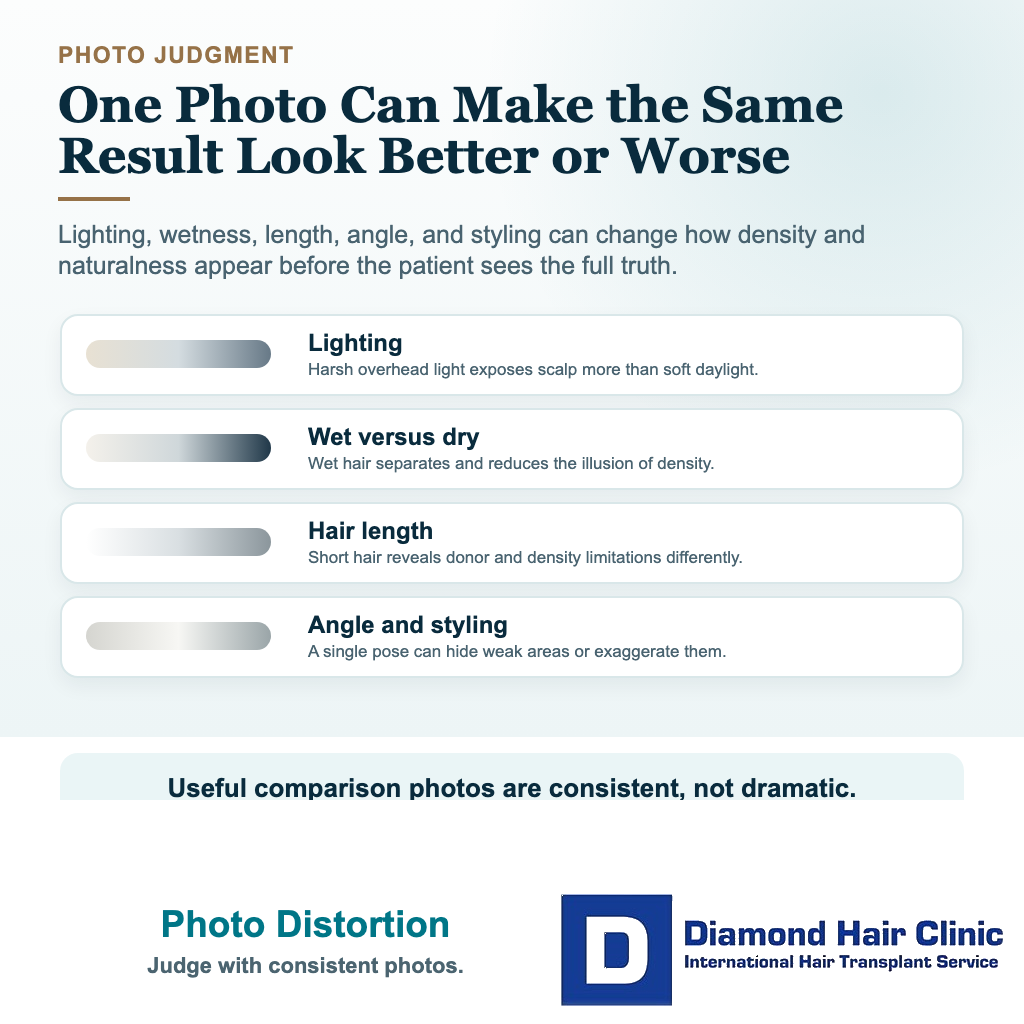
A small change can completely change the way a result is read. Change the angle, and the hairline can suddenly look lower or stronger. Change the combing direction, and the density can appear fuller. Add harsh overhead lighting, and the scalp becomes much more visible.
Wet the hair, separate it, zoom in closely, and almost any result can be made to look weaker than it appears in normal life. Reverse those conditions, and even a mediocre result can suddenly look much more flattering. I am always cautious when patients make dramatic conclusions from a few uncontrolled images.
A photograph can be useful. But a photograph can also mislead very easily in this field. And the concern is not only the photo itself. It is also the way patients compare one photo to another without realizing that they are not comparing the same situation.
A patient may show a before surgery photo taken casually at home, with softer lighting, longer hair, and a comb out style that reasonably hides weakness. Then he compares it to a after surgery photo taken under direct bathroom light, with the hair shorter, flatter, and intentionally exposed. He looks at the difference and feels disappointed.
But the comparison was unfair from the beginning. Or take the patient who studies his transplant by pulling the hairs apart with his fingers, holding the phone very close, and photographing only the weakest angle. That image may show something real, but it is still not the same as how the result reads in ordinary social life.
The opposite example matters too. A result may look quite strong in a carefully chosen clinic photo, with dry hair, favorable styling, and controlled lighting. Then the patient goes outside into daylight, or sees the result under stronger overhead light, and suddenly feels that it does not match what he thought he was getting.
Again, the concern is not always that one image is a lie and the other is truth. Very often, the concern is that different photographic conditions create different visual realities. Patients should be careful not to confuse photo performance with real life performance.
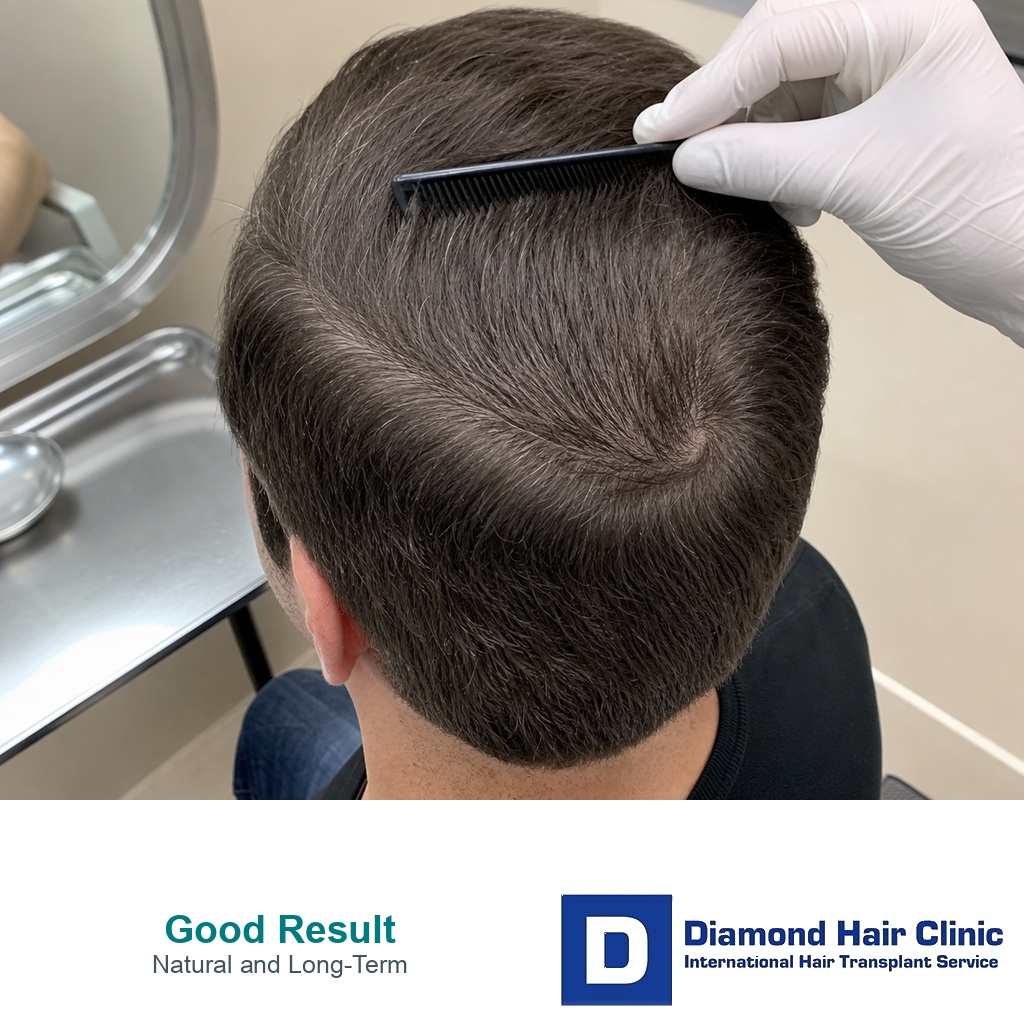
A transplant should not be judged only by how it looks in one flattering image. And it should not be condemned only because it looked weak in one harsh image, either. I would focus on this. Instead of trusting one flattering photograph, I would like to see how the result behaves in ordinary room light, daylight, different styling, flatter hair, and normal viewing distance. A result that survives normal conditions tells me much more than a close up.
A camera can exaggerate both strengths and weaknesses in hair transplantation. And if the patient does not understand that, he can very easily become overly optimistic about an average result or overly pessimistic about a reasonable one. And now there is another reason patients need to be even more careful with photos.
We are in 2026, and AI has moved incredibly fast. Editing a photo in a very natural way is no longer something difficult or highly technical. Today, with the right tools, a person can add things, remove things, clean things up, increase visual density, and make an image look much more convincing than it really is.
So when a prospective hair transplant patient looks at before and after photos public, I do not think he should automatically assume that every image is a simple, untouched clinical record. I am not saying every less discussed clinic is doing this. Of course not.
But I am saying that in today’s environment, a clinic with weak ethics, or a marketer who cares more about selling than medicine, could present AI altered or even AI generated images in a way that looks very persuasive to an untrained eye. I think patients should trust isolated photos less.
And they should trust consistency, multiple angles, donor area visibility, and the overall logic of the result much more.
Movement Matters More Than A Posed Photo
Hair is not judged only in stillness. It is judged in movement. It is judged while the patient is talking, walking, turning his head, sitting under different lighting, stepping outside in the wind, getting into a car, standing under restaurant lights, office lights, daylight, bathroom lights, and all the other ordinary situations of real life.
A transplant should never be judged only by two static photographs. A result can look quite respectable in a controlled before and after photo, yet feel much weaker once the person starts moving naturally and loses perfect control over the styling. At this point, real life becomes a stricter test than the camera.
In a still photo, the patient is usually positioned carefully. The angle is chosen. The hair is arranged. The strongest view is shown.
But in real life, hair does not stay obedient like that. It moves. It separates. It lifts.
It falls. And once that happens, the result is tested in a much clearer way. Let me give a few examples. A patient may look very good in a frontal clinic photo, with the hair combed forward and sitting exactly where it should. But once he is outside and the wind changes the direction of the hairs, the true distribution becomes easier to read.
A result can look strong when the patient looks straight into the mirror, yet feel less comfortable in normal conversation when people see him from slightly higher angles, side angles, or under overhead light. There is also the patient whose result looks acceptable as long as he keeps styling it carefully every morning, but who starts feeling exposed the moment the hair becomes flatter, slightly damp, or less controlled.
The difference matters. Because a result that works only when the patient is constantly managing it is not the same as a result that works naturally in ordinary life. I consider patients often underestimate how much head movement changes perception.
Stillness can present one picture. As the patient turns left, turns right, lowers the head, lifts the chin, or walks through natural light, the eye starts reading the result differently. This also matters for donor visibility. A donor may look acceptable in a fixed rear photo, but once the patient is moving, once the hair shifts, once the cut becomes shorter, or once different light hits the back and sides, the extraction pattern may become easier to notice.
One of the best questions a patient can ask is not simply. Does this photo look good? But rather. A strong result has to continue looking natural once life starts moving around it. The patient has to be able to go outside, tolerate wind and ordinary light, and live normally without constantly managing the presentation of the hair.
To me, that is a much clearer test than internet applause under a carefully controlled photograph. Because in the end, a hair transplant is not lived inside a before and after collage. It is lived in real life.
Dry Hair And Wet Hair Look Different
Patients often move between dry hair judgment and wet hair judgment as if those are the same test. They are not. And I think this causes a lot of unnecessary confusion. When hair is dry, it has more texture, volume, lift, and natural overlap. The strands support each other better. The scalp usually shows less. That is also how most people live in ordinary daily life. They are not walking around with their hair soaked, flattened, and separated.
Wet hair changes the situation completely. The hair becomes heavier. It collapses closer to the scalp. The strands separate more easily.
The scalp becomes easier to see. And every weakness in density, distribution, or coverage becomes more exposed. My conclusion is not that the result is bad. It simply means the test became much harsher.
At this point, many patients make a mistake. They see the result dry, feel positive, then they see it wet and suddenly panic. Or sometimes the opposite happens. They keep showing only dry, well styled photos and avoid the more revealing conditions completely. Neither approach is fully accurate on its own.
Both views can teach something. But they are not teaching the same thing. Dry hair shows how the transplant behaves in more normal, everyday conditions. Wet hair shows how much structural limitation becomes visible once volume, texture, and overlap no longer help.
Let me give a few examples. A patient may look at his dry hair in the mirror and feel quite satisfied. The frontal frame looks good, the hairline reads well, and the scalp is not visible in ordinary indoor light. Then he gets out of the shower, sees the hair flattened and separated, and suddenly feels that the whole surgery failed.
But that is not a fair conclusion. The wet hair view may be revealing something real, but it is still a stress test, not the only truth. Or think about the patient who posts only dry, styled before and after photos public. The result may look strong, but if the hair is always carefully arranged, that still does not tell the full story of how the transplant behaves when the styling help disappears.
Fine hair or stronger scalp contrast changes the wet hair test. In that kind of case, wetness can punish the result much more severely than in a patient with coarse, wavy, lower contrast hair. So again, even the wet hair test is not experienced the same way by every patient.
The psychological side is different. Some patients give dry hair too much credit. Others give wet hair too much authority. I do not think either extreme is correct.
Wet hair can reveal more scalp without proving that a transplant is fraudulent. Dry styling can make the hair look stronger without proving that the result is excellent. Dry and wet hair are different conditions, not proof by themselves that a result is excellent or poor.
Wet hair visibility is only one part of the review. Each condition shows a different limit of the result.
Because if the patient does not understand that difference, he can jump from one visual condition to one emotional conclusion much too quickly. And in hair transplantation, that usually leads to poor judgment. A result should be read across conditions, not from a single condition alone.
Because real life is not only dry hair. But it is also not only wet hair.
Natural In Daily Life And Natural Up Close
Patients often speak about naturalness as if it were one simple standard. It is not. A result can look acceptable at ordinary social distance and still feel less refined when someone looks more closely. That distinction matters.
Because some transplants pass quite well in daily life. The patient looks better. The face is framed more strongly. Nothing immediately draws attention. But that still does not always mean the work remains equally natural under closer inspection. Once the distance becomes shorter, different details start becoming visible.
The front edge may be too abrupt. The distribution may feel heavier than it should. The irregularity may look designed rather than organic. The overall line may look acceptable from a few steps away, yet less convincing in close conversation, under stronger light, or when the hair is flatter.
In practice, when a patient says, “I would like it to look natural,” I make that goal more precise. Naturalness has to be judged in ordinary daily life, close human interaction, different lighting, and movement.
Natural in daily life and invisible even to an experienced eye are different goals. A patient may have a result that looks quite good in a restaurant, in the street, or in everyday conversation, but under closer inspection the small details of the hairline may still feel less soft than they should.
Sometimes the transplant looks good in the mirror at home, but in direct daylight or closer in person interaction, the refinement does not hold in the same way. That does not always mean the result is poor. It means the level of naturalness changes depending on distance, light, and conditions.
And I think many patients do not define clearly enough which level they are actually asking for. Sometimes they mean, I want to avoid anything obvious in normal daily life. That is one level.
Sometimes they mean, I would like the hairline to hold up even in close conversation. That is a higher level.
And sometimes they mean, I would like the result to look natural even to experienced eyes. That is higher again. These are not identical goals. The word natural should always be used carefully.
Because naturalness is not one single threshold that a result either passes or fails. It is a spectrum. And the more refined the standard becomes, the more demanding the surgery becomes as well.
Hairstyle Freedom Shows Result Strength
There is another standard I think patients should use much more often. Not just. Did hair grow? Not just.
The standard is more practical than looking better in a photo. Hairstyle freedom matters because it shows whether the result is robust or fragile. He should not need to arrange every strand carefully, avoid daylight, fear wind, or keep one exact hairstyle just to protect the illusion.
This matters a great deal. Because some results look strong in still photographs, yet remain quite weak in real life. They depend on one combing direction, one hair length, one styling habit, and one favorable kind of light. As long as those conditions are protected, the result looks acceptable. But once those conditions change, the weakness begins to show.
That may still be an improvement. But it is not the same thing as real freedom. Let me give a few examples. A patient may have a transplant that looks good when the hair is always combed forward in one specific way, but once he tries to change the direction, the scalp starts becoming easier to see.
A different patient may feel satisfied as long as the hair is kept at one carefully chosen length, but if he cuts it a little shorter, the density no longer carries the same way. Another may look fine indoors, but once he is outside in natural light or mild wind, he starts adjusting the hair repeatedly because he no longer feels comfortable letting it behave naturally.
Some patients technically have more hair than before, but are still living with the same psychological burden as before, because now he is not protecting baldness, he is protecting presentation. That is not the same thing as freedom. To me, one of the strongest signs of a satisfying result is not only that the patient looks better.
It is that he has to think less about his hair. Less about angle. Less about light. Less about wind.
Less about whether the hair is sitting correctly. Less about whether the illusion is holding. I think hairstyle freedom is such an important measure of success. Because a transplant should not only create coverage.
It should also create a degree of comfort, ease, and normality in the way the patient lives with his hair afterward. That is something patients do not ask about nearly enough.
Durability as native hair changes
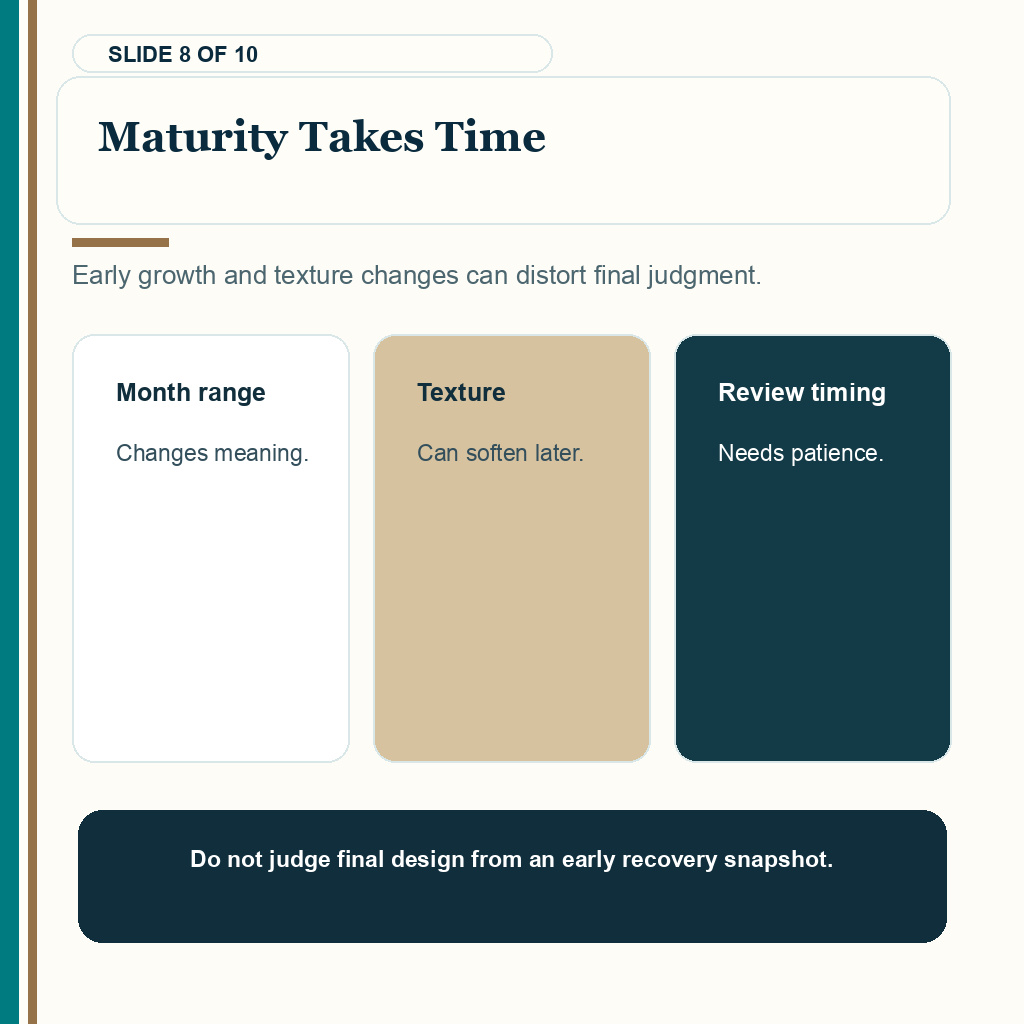
Patients Often Judge Too Early
Timing is another major source of confusion. Many patients want a clear answer far too early. They look at month four, month five, sometimes even month six, and start asking whether the surgery was a success or a failure. For that reason, result maturity takes time, and early judgment can be misleading.

But hair transplantation does not unfold according to impatience. It unfolds according to biology. And biology is often slower, less linear, and less emotionally satisfying than the patient hoped it would be. At this point, a lot of wrong judgment begins.
Because many patients think they are judging the final quality of the surgery, when in reality they are judging a result that is still developing, still maturing, and still incomplete. That is not the same thing. A patient may look at the hair at four months and feel discouraged because the density still looks weak.
Another may look at five months and become anxious because one side seems ahead of the other. Another may reach six months and feel disappointed because the result still does not match the image he already built in his mind. But none of those moments necessarily tells the full story.
They often tell only one part of it. Early judgment can become so misleading. Let me give a few examples. A patient may see early growth in the hairline and assume the overall result should already be close to finished, only to panic when the area behind it still looks less mature.
At month five, it is easy to focus too much on one weaker patch and overlook the fact that the overall frame has already improved. Another may compare himself obsessively to public results that were photographed later, without fully realizing that he is comparing his month five to somebody else’s month ten or month twelve.
Psychologically, the pattern can become difficult. Once a patient starts checking the result too often, the mind rarely stays neutral. It begins searching for proof. Proof that things are going well.
Or proof that something is wrong. That kind of repeated self monitoring usually does not create clarity. It creates anxiety. Many patients are not really judging the surgery in those early months.
They are judging the surgery mixed with impatience, fear, expectation, and daily obsessive checking. And those are not the same thing. One of the healthiest things a patient can do is to stop demanding a final answer from an unfinished process. A transplant needs judgment at the right stage, not at the first stage, when impatience sets in.
Because if the timing of the judgment is wrong, the judgment itself often becomes wrong too.
Continued Native Hair Loss Around The Transplant
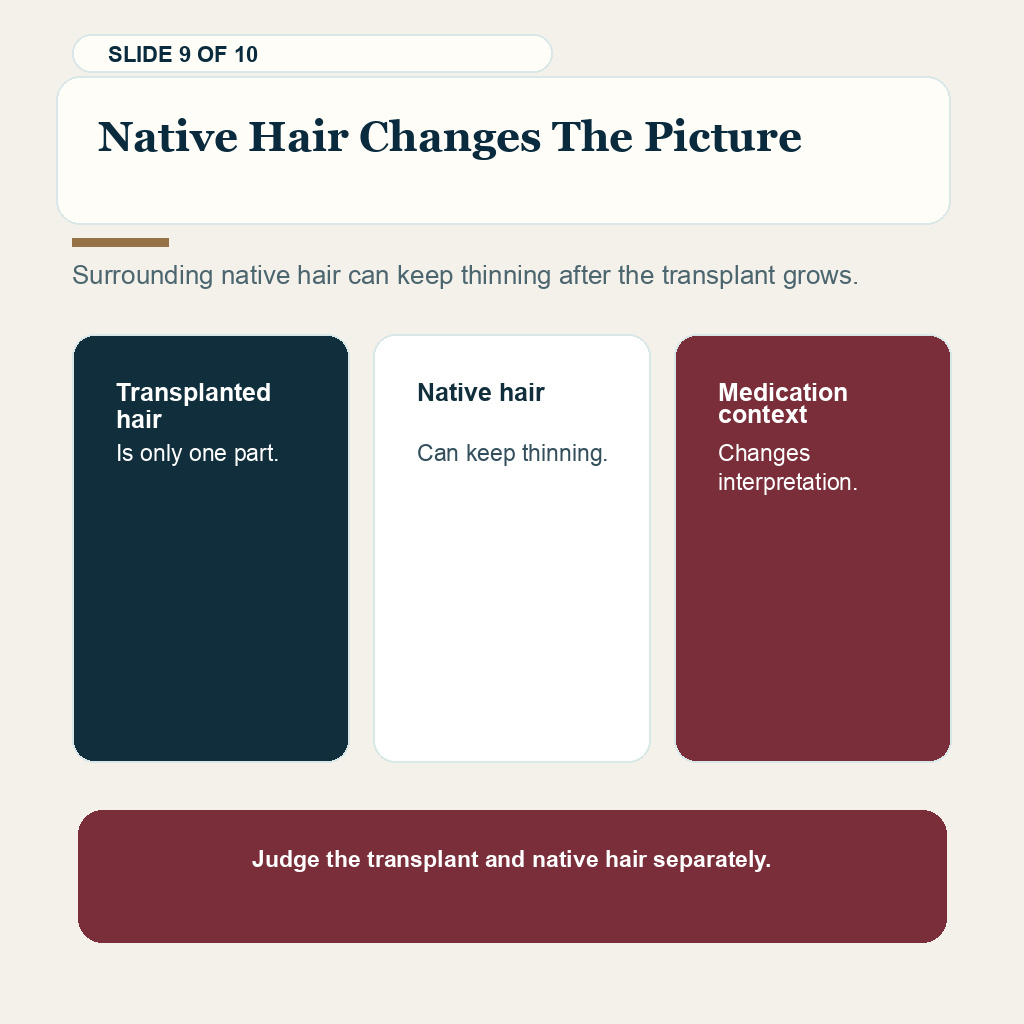
This is another source of confusion that I see quite often. Some patients look at a thin looking area after surgery and assume that every weakness they are seeing must belong to the transplant itself. But that is not always true. A transplanted area often sits next to native hair that is still vulnerable, still miniaturizing, and still changing over time. So the patient looks later and thinks, “The transplant became thin,” when part of what he is actually seeing is continued loss in the surrounding native hair.
The distinction matters. There, the issue is not necessarily that the implanted grafts failed. The issue may be that the hair around them kept changing. This happens especially in patients who still had a meaningful amount of native thinning hair in the frontal zone, mid scalp, or crown at the time of surgery. In the early period, the transplant and the remaining native hair may blend together reasonably well. But if the native hair continues weakening over the following months or years, the overall picture changes.
Then the patient feels that the transplant somehow became worse. But in reality, he may be looking at a different problem. the transplant remained,
the native hair around it declined,
and the combined image became thinner. Let me give a few examples.
A patient may receive grafts into the frontal third, but still have native hair behind the hairline that is already somewhat miniaturized. At first the whole area looks stronger because the grafts and the native hair are working together. But later, if that native hair keeps thinning, the patient may feel that the result “opened up” behind the transplanted line.
Someone else may have a decent result in the mid scalp, but if the surrounding native hair continues to weaken, he may start describing the whole area as a transplant problem, even though what really changed was the untreated hair between and around the grafts.
A partially thinning crown creates another problem. If grafts are placed into a crown that still contains vulnerable native hairs, the early appearance may be supported by both the transplanted grafts and the remaining original hair. But if the native component keeps miniaturizing, the crown can start looking thinner again, and the patient may blame the surgery for something the surgery did not create.
this helps explain why long term planning matters more than a quick first impression. Because a surgeon is not only placing grafts into the scalp. He is placing grafts into a scalp that may still be changing. And if the patient does not understand that, he may think he is judging only the transplant, when in reality he is judging a mixed picture.
transplanted hair,
native thinning hair,
lighting,
styling,
and the consequences of continued progression. Patients should be careful with statements like, “The transplant became thin.” Sometimes that is true. But sometimes the more accurate sentence would be.
“The area around the transplant kept changing.” And that is not the same thing. Because once that difference is understood, the evaluation becomes much more intelligent. The patient stops asking only, “Did the surgery fail?”
And starts asking a better question. “How much of what I am seeing now belongs to the transplant itself, and how much belongs to the native hair that continued to miniaturize around it?” That is a much clearer way to read the result.
Medication Changes Result Interpretation
A hair transplant result does not exist in isolation when the patient has progressive androgenetic alopecia. This is something many patients do not think about enough. They look at a result and assume they are looking only at the surgery. But very often, they are also looking at the effect of what happened after the surgery.
And one of the biggest factors there is medical stabilization with finasteride, dutasteride or minoxidil when appropriate for the patient. Vitamin supplements may be useful when a deficiency has been identified. Two patients can undergo superficially similar surgeries and still end up in very different places later, not only because of how the surgery was done, but because of what happened to the native hair around it afterward.
One patient protects the surrounding hair more effectively. Another does not. And over time, that difference becomes very visible. A patient who maintains more of his native support may keep a much stronger overall frame around the transplant. The result continues to look integrated, fuller, and more stable.
Native hair can continue thinning around the grafts, and later the patient may feel that the transplant itself somehow weakened. But sometimes the transplanted grafts are not the real problem. Sometimes the concern is that the supporting native hair kept disappearing.
That distinction matters a great deal. Let me give a few examples. A patient may receive grafts into the frontal third, but still have a meaningful amount of vulnerable native hair just behind the transplanted line. In the earlier phase, the entire area appears stronger because the grafts and native hair work together. But later, if the native hair continues thinning, the patient may feel that the result has opened up behind the hairline.
In another case, the patient may have a transplant that initially blends quite well into the mid scalp, but if the surrounding hair continues to miniaturize over time, the entire region may start to look weaker. Then the patient says, “The transplant lost density,” when the more accurate description may be that the environment around the transplant kept changing.
Or think about two patients with very similar surgeries and very similar early photos. One of them retains more of the native hair around the grafts and continues to look stable. The other gradually loses that support and later feels disappointed. On the surface, it may look like one surgery aged better than the other. But in reality, the difference may not be only the surgery. The difference may be the long range biological environment around it.
Patients should be careful when they compare results public. Sometimes they are not comparing only two surgeries. They are comparing two different long range management environments. One case may have had stronger stabilization around the transplant.
The other may have had an ongoing progression eating away at the frame around it. And those are not the same thing. A transplant result should not always be interpreted as if it stands alone. With many patients, it is only one part of a larger long range picture.
And if that larger picture is ignored, patients can end up giving the surgery too much blame, or too much credit, for something that was also shaped by what happened to the surrounding hair afterward.
Showcase Cases Are A Weak Comparison Point
Many patients now do their research by looking at endless galleries of top results public. That can be useful. But it also creates a very serious psychological trap. Because what they are usually comparing themselves to is not the average result.
It is not even the average good result. It is the case that photographed unusually well, the case with unusually favorable hair characteristics, the case with unusually strong contrast improvement, or the case selected precisely because it looks dramatic, complete, and impressive at first glance.
Then, without fully realizing it, the patient turns that into his benchmark. And that is where the distortion begins. Not because excellent results do not exist. Of course they do. But because the patient starts comparing his own real scalp, with his own donor limits, his own Norwood level, his own hair characteristics, his own lighting, and his own future loss pattern, to a curated highlight from somebody else’s very different case.
The comparison is unfair. Let me give a few examples. A patient with a relatively limited Norwood III pattern may be looking at the result of another Norwood III case with coarse, wavy, low contrast hair and thinking, “That is what I would like.” But his own hair may be finer, straighter, and less forgiving. The photo looks like a simple comparison. In reality, it is not.
Or a patient with a broader Norwood V pattern may compare himself to a case that looks spectacular public, without realizing that the other patient may have had a smaller area, stronger donor density, better hair caliber, or even a more favorable scalp to hair contrast. He thinks he is comparing surgeries. In truth, he may be comparing two completely different biological situations.
Some patients look only at the best photograph of another result, not the full reality of that result. One strong angle. One flattering light. One carefully styled image. Then later, when his own result is judged across normal daily conditions, he feels disappointed because he was unconsciously comparing real life to someone else’s highlight reel.
And sometimes the distortion becomes even stronger because the patient is not only comparing himself to a good result. He is comparing himself to a result that was selected precisely because it is unusually photogenic. In public result photos, patients rarely study the full range of what is normal.
They are usually studying the part that looks most exceptional. That comparison becomes emotionally powerful very quickly. But intellectually, it is sloppy. The problem does not end there.
Because patients are not influenced only by the photos they see. They are also influenced by the tone of the reactions under those photos.
Country And Doctor Labels Can Distort Reactions
This is part of the things that bothers me most when I read patient comments and public reactions under patient videos. In theory, the logic should be very simple. A patient shares a result. People look at the hairline, the density, the donor area, the direction, the softness, the overall design, and then they react to what is actually visible.
But very often, that is not what happens. Very often, the moment the patient mentions the country, the clinic, or the doctor’s name, the discussion starts changing shape. At that point, many people are no longer reacting only to the result itself. They are reacting to the reputation attached to it.
I have seen this many times. A patient gets surgery in the United States, or with a surgeon who already has a strong reputation in public communities. The result is average. Sometimes just average. Sometimes there is nothing especially impressive about it. Sometimes, as a surgeon, it is even a result that could quite clearly have been done better.
And yet the comments become softer. People become more forgiving. They become more careful with their language. They say things like, “solid result,”“give it more time,” or “looks good overall.”
Now take a similar result, or sometimes even a better one, from a clinic in Turkey, India, or from a doctor who is not part of the internet’s current circle of favored names. The tone often changes immediately. The comments become harder. The patience becomes thinner.
The criticism becomes sharper. The same people who sounded calm and generous in one case suddenly become severe in another. I do not think that is objective evaluation. I think that is bias entering the discussion.
And I do not think this happens only at the country level. I think it also happens at the level of popular names. Every public patient space slowly builds its own unofficial list of approved names. After a while, those names get repeated so often that the repetition itself starts creating authority. The atmosphere becomes. if you are going to this country, only these few doctors are acceptable.
Once that happens, the discussion stops being fresh. A kind of echo chamber forms. And inside that echo chamber, patients do not always judge results with the same transparent communication. If a patient stories a mediocre result from one of those favored doctors, people often become more protective than they should be.
If a patient stories a genuinely strong result from a doctor outside that favored circle, people can become strangely cold, dismissive, or suspicious. I have even seen cases where the result itself looked respectable, but because the name was not one of the community’s preferred names, the tone around it immediately became more negative than the work itself justified.
And I have also seen the opposite. A result that did not deserve much praise can receive a softer landing because the doctor already had status inside the group. That is the real problem. At that point, people stop looking at the surgical details and start reacting to the name attached to them.
A hair transplant result should not become stronger because it came from a fashionable doctor. And it should not become weaker because it came from a clinic outside the internet’s current favorites list. A weak result is still weak. A strong result is still strong.
But public, that clarity gets blurred all the time. I think patients should be careful not only when they look at shared results, but also when they read the comments under those results. Comments are not always neutral. Reputation affects tone.
Country affects tone. Group loyalty affects tone. And sometimes what looks like objective judgment is actually a mixture of brand bias, country bias, and public group psychology. Patients should try to do something very simple, but very important.
First, look at the result itself. Look carefully at the hairline, the corners, the transition zone, the donor area, the direction, the density, and the overall harmony. Only after that should you look at the name attached to it. Because once the name comes first, the eyes often stop seeing clearly.
And once that kind of bias enters the reading process, it affects more than just how patients judge other people’s results. Very often, it also affects where they choose to go themselves.
Comforting Answers Are Not Always Better Plans
This is something I have noticed for a long time. Some patients research heavily, but they are not truly searching for the strongest judgment. Some are moving from clinic to clinic until they finally hear the answer they were emotionally hoping to hear from the beginning.
The lower hairline they wanted. The higher graft number they wanted. The reassurance they wanted. The promise of one session for the front, the mid scalp, and the crown all at once.
Once that happens, the process stops being real research. It becomes selective listening. At that point, the patient is no longer judging which consultation handled the case most responsibly.
He is asking. Who is willing to validate the version of the plan I already want to believe in? That is a dangerous shift. Because the consultation that feels best emotionally is not always the consultation that thinks best surgically.
In fact, very often, the opposite is true. The more responsible opinion may be the one that feels slightly disappointing at first. The surgeon may say the hairline should not be lower. He may say the graft number should not be pushed higher.
He may say the crown should not be included yet. He may say the donor is not strong enough to safely chase everything in one session. And that kind of answer can feel frustrating for the patient, because it does not match the fantasy he was hoping to hear confirmed.
But that does not make it the weaker opinion. Very often, it makes it the clearer one. Let me give a few examples. A patient with more advanced loss may want a strong front, dense mid scalp work, and visible crown coverage in one operation. One clinic tells him exactly what he wants to hear. Another tells him that trying to do everything at once would spread the grafts too thin and weaken the long range plan. If the patient chooses only by which answer feels better emotionally, he may end up rewarding the less responsible consultation.
A patient with an already moderate donor may keep searching until someone agrees to an unusually low hairline. At that point, he may feel excited because he has finally found a “confident” clinic. But what he may actually have found is simply the clinic most willing to ignore careful judgment.
Or the patient who hears one surgeon say, “This should be staged,” and another say, “We can do it all in one go.” To an emotionally vulnerable patient, the second answer may sound more optimistic, more powerful, even more skilled. But sometimes it is simply less disciplined.
Patients need to monitor themselves closely throughout the research process. Because sometimes they believe they are searching for truth, when in reality they are searching for emotional relief. And emotional relief is not the same thing as good planning. The careful question is not only which consultation made him feel best.
Comfort during a consultation is not enough by itself. The better comparison is which consultation respected the biology, the donor, the limits of the case, and the long range future most seriously.
The answer that feels most comforting in the moment is not always the one that best protects the patient in the long run.
Emotional Vulnerability And Misleading Promises
Hair loss is not just a technical issue. It is also a deeply psychological one. A man who has felt older than he wants to feel, less attractive than he used to feel, more exposed in bright light, less comfortable in photos, or less confident in daily life is not entering a consultation as a cold, neutral observer.
He is entering it with an emotional burden. He wants relief. He wants certainty. He wants someone to tell him that there is a clear way back.
And that makes him easier to influence. In that state, promises sound better. Confident language sounds more convincing. Bigger graft numbers sound more generous.
Lower hairlines sound more exciting. And a simple story often feels safer than a careful one. This is exactly why some patients are drawn toward the consultation that feels best emotionally, rather than the one that is thinking most responsibly surgically. Let me give a few examples.
A patient may hear one surgeon say, “Your donor is limited, so we have to be careful.” Then he hears another say, “Yes, we can do the front, mid scalp, and crown in one session.” To an emotionally vulnerable patient, the second answer can feel more hopeful, more confident, even more competent.
But sometimes it is not more competent. Sometimes it is simply more seductive. Or take the patient who already feels distressed about his forehead and wants a very low hairline. If one clinic says, “That would not be a wise long range plan,” and another says, “Yes, we can do that,” the second answer may feel like understanding, when in reality it may just be compliance.
That is the danger. Because emotional relief during consultation is not the same thing as a good plan. A patient can feel very reassured and still be walking toward a weak decision. Patients should be careful not to confuse feeling understood with being guided correctly.
Of course, feeling understood matters. Of course, empathy matters. Of course, feeling listened to matters. But none of that replaces judgment.
The plan still has to be correct. An important signs of a serious surgeon is that he is willing to say something the patient may not enjoy hearing, if that is what the case actually requires. In this field, the answer that feels most comforting in the moment is not always the one that best protects the patient in the long run.
Selling Hope Versus Teaching Reality
There is a difference in tone that patients should pay much more attention to. Some environments are designed to keep the patient emotionally high from the first conversation onward. Everything is framed around transformation, density, youth, speed, and confidence. The message is simple and very attractive. You came with a problem, and we can give you back what you lost.
I understand why that language works. Hair loss already makes many men feel vulnerable. So when someone speaks in a way that feels reassuring, confident, and full of promise, it naturally creates relief. But relief is not the same thing as judgment. A surgeon who is thinking seriously about the long range future of the case often sounds different. He talks more about limits. More about donor management. More about what should not be done, not only what can be done. He talks about compromises. He talks about future loss. He talks about why something that sounds exciting today may look less wise five or ten years later.
He may sound less dramatic. Less cinematic. Less easy to market. But very often, he is speaking from a more stable and more responsible place.
That, to me, is the real difference. A clinic that sells hope often speaks the language of desire. A surgeon who teaches reality speaks the language of judgment. The first tells the patient what sounds good.
The second tries to tell the patient what is actually wise. And those two things are not always the same. A clinic that sells hope may focus on the lowest hairline, the highest graft number, the fastest transformation, and the promise that everything can be solved in one session.
A surgeon who is teaching reality may say something much less exciting. He may say the line should be higher. He may say the donor should be used more carefully. He may say the crown should wait.
He may say that trying to do everything at once would weaken the entire plan. To an emotionally vulnerable patient, the first voice can sound stronger. But often, the second voice is the one that is actually protecting him. I think patients should listen carefully not only to what is being promised, but to the mindset behind the promise.
Because hope matters, of course. A patient needs to feel that improvement is possible. But hope without realism becomes dangerous very quickly in hair transplantation. Once hope is separated from careful judgment, it becomes very easy to sell a plan that feels emotionally satisfying in the consultation room, but proves surgically weak later.
One of the quiet signs of a serious surgeon is this. He is still willing to disappoint the patient a little today, if that is what it takes to protect him tomorrow.
Responsible Surgeons May Sound Less Exciting
The more responsible surgeon does not always sound like the most exciting person in the consultation room. Very often, he sounds like the one who is slowing the conversation down. He is the one introducing limits where the patient was hoping for certainty. He is the one refusing to promise a density that does not fit the donor.
He is the one refusing to lower the hairline just because the patient would enjoy hearing yes. He is the one protecting future flexibility, donor reserve, and the long range naturalness of the case, even when that makes the plan sound less impressive in the moment.
I think many patients misread that kind of careful judgment. They hear “caution” and assume it means a lack of ambition. They hear “limitation” and assume it means a lack of confidence. I see it very differently.
Commonly, the more responsible surgeon sounds less exciting precisely because he is thinking more seriously. He is not reacting only to what would feel satisfying today. He is also thinking about how the result will look after more years of aging, more years of possible progression, and more years of living with the consequences of whatever is done now.
That mindset is different. A surgeon who says, “Let’s keep the line a little higher,” may sound less attractive than the one who says, “Yes, we can bring it lower.” A surgeon who says, “Your donor is not strong enough for everything in one session,” may sound less exciting than the one who says, “Yes, we can do the front, mid scalp, and crown together.”
A surgeon who says, “We need to preserve options for later,” may sound less inspiring than the one who says, “Let’s maximize it now.” But that does not make the first surgeon weaker. Very often, it makes him more responsible. Because sustainable planning in hair restoration is not built on the most thrilling promise.
It is built on realistic expectations, finite donor awareness, individualized design, and the discipline to avoid turning today’s emotional excitement into tomorrow’s structural problem. Patients should be careful with consultations that feel immediately satisfying.
Sometimes, the opinion that sounds slightly disappointing at first is exactly the opinion protecting the patient most seriously. And That is one of the quiet differences between a surgeon who is trying to be admired in the consultation room and a surgeon who is trying to make the case still look sensible years later.
The First Frontal Centimeter Can Mislead
The first frontal centimeter has enormous visual power. Commonly, it is the part of the transplant the eye notices first, and as a result, it can strongly influence how the overall result is judged. If that leading edge creates a satisfying frame, the patient may feel that the entire transplant is stronger than it actually is.
Sometimes that impression is deserved. Sometimes the front has truly been built well, and the strength of that first line is part of a genuinely strong overall result. But sometimes the impression is more deceptive than real. Because a transplant can have a pleasing front edge, yet become much weaker once the eye moves behind it.
The hairline may look good at first glance. The border may feel strong. The face may immediately look better framed. But if the density drops too suddenly behind that leading edge, or if the interior lacks the same coherence, then the result can begin to lose strength very quickly once it is seen under more ordinary conditions.
Early reactions can be misleading. A patient sees that first frontal line, feels relief, and assumes the whole transplant is working at the same level. The front edge still has to be judged together with the rest of the plan.
The first frontal centimeter can impress the eye quickly, but I always look just behind it. The density has to transition naturally, the design has to remain coherent, and the result should still feel satisfying once the eye moves backward.
Or does the overall impression depend too heavily on a single attractive leading border? Let me give a few examples. A patient may have a nicely constructed hairline, and in a posed frontal photo, that alone may create a very positive first impression. But when the hair is separated slightly, or when the head angle changes, it becomes easier to see that the density behind the line is much weaker than the front initially suggested.
A hairline can look very good from mirror distance because the first centimeter is doing so much visual work. But once the patient goes outside, once the light becomes harsher, or once the hair lies flatter, the area behind that first line may not support the same impression.
Some patients have a strong emotional reaction early because the face suddenly feels framed again. And that reaction is understandable. But later, once the excitement settles, he starts to notice that the strongest part of the result is concentrated too heavily in the first border, while the area behind it does not exhibit the same quality.
That is exactly why I handle judging a transplant only by how gratifying the very front looks in a controlled image. Because the first frontal centimeter can create a very powerful illusion of success. And sometimes that illusion is true. But sometimes it is only the entrance.
And a beautiful entrance into a weaker interior can create early excitement, only to be followed by later disappointment. The first frontal centimeter should never be judged alone. It needs judgment together with what follows behind it. Because a strong result should not only start well.
It should also continue well.
Dramatic Does Not Always Mean Best
Patients are often impressed by drama. The biggest visible change. The lowest hairline. The sharpest frontal impact.
The result that makes people say wow in the first second. I understand why. Drama is satisfying. It creates immediate emotional reward.
And in public spaces, dramatic results almost always attract more attention than quieter, more intelligent ones. But I do not think the most dramatic result is always the strongest result. In fact, some strong natural results are not the ones that shout the loudest.
They are the ones that fit the patient so naturally that the transplant no longer feels like a separate event. The man simply looks better, more balanced, more complete, without looking strangely overly restored or surgically too eager. That kind of result often receives less instant excitement.
But in real life, it usually ages better. Let me give a few examples. A patient may receive a very low, very sharp hairline that creates a dramatic impact in the first year. In photos, especially frontal photos, it may look powerful. But as the patient gets older, or as the surrounding hair continues to change, that same line may start to look too aggressive on the face.
Someone else may receive a slightly more mature, more restrained design. At first, the transformation may feel less dramatic. It may not create the same shock effect in a before and after collage. But ten steps back, in ordinary life, it may look more natural, more harmonious, and much easier to live with.
A very strong first frontal centimeter can thrill a patient and feels thrilled by the immediate change, even though the area behind it is much weaker. That kind of result can create more excitement at first than a quieter but more coherent result. But once the initial emotion settles, the more intellectually balanced case often proves stronger.
Patients are sometimes too easily seduced by visual drama. They see the boldest change and assume it must also be the most skillful. But that is not always true. Sometimes, dramatic means the line was pushed lower than it should have been.
Sometimes it means too much donor was spent in the area that gives the biggest first impression. Sometimes it means the result was designed to impress quickly rather than live naturally over time. And sometimes the more intelligent result is simply less theatrical.
It does not scream for attention. It does not try to win the room in one second. It just looks right. To me, that matters much more.
Because a hair transplant is not a competition for the strongest first impression. It is something the patient has to live with for years. The strongest result is not always the one that creates the biggest reaction. Very often, it is the one that creates the least tension between the transplant and the face.
The one that feels settled. The one that feels proportionate. The one that keeps looking natural after the excitement of the before and after moment has passed. Drama gets attention.
Naturalness lasts longer.
Repair Cases Teach Result Quality
Success stories are useful, of course. They show what is possible. They give patients hope. They help people understand what a good result can look like.
But repair cases often teach something even more important. They show where judgment failed. And that matters, because in hair transplantation, bad judgment often creates more trouble than bad intention. A repair case shows what may have looked exciting to an inexperienced patient at the beginning, but later became a burden.
It shows what happens when a hairline is too low, too straight, too sharp, or simply wrong for the face. It shows what happens when the donor is used too aggressively. It shows what happens when a result looks powerful in the first months but then becomes artificial, inflexible, or difficult to live with.
And it shows how hard it becomes once the first surgery has already spent the easiest options. I think repair cases are so educational. They remove the glamour. They remove the marketing.
They remove the excitement of the first transformation. And they force the eye to look at the consequence. Let me give a few examples. A patient may have been thrilled at first because the surgery gave him a very low, strong looking hairline. In the early period, he may even have thought he got a very aggressive and impressive result. But years later, that same line may start looking unnatural for his age, and now the surgeon trying to repair it is no longer working on a blank canvas. He is working around a mistake that has already been implanted into the face.
A patient in a similar situation may have received a large graft session and felt impressed by the number alone. But later the donor area starts showing the cost. The back and sides become weaker, less even, more exposed at shorter lengths, and the patient realizes that the first surgery did not simply solve a problem. It created a new one.
A first result can look acceptable in casual photos, but over time it became clear that the design was too mechanical, the pattern too obvious, or the distribution too unnatural. The issue is no longer only whether hair grew. The issue is that the hair grew in a way that now has to be corrected.
And correction is always harder than proper planning in the first place. That, to me, is an important lessons repair cases teach. They show that a weak decision in the first surgery does not stay politely contained inside the past. It becomes part of the patient’s future.
Repair cases strip away much of the naive first time enthusiasm. They show the real cost of a poor plan. They show how expensive it can become when a short range emotional win turns into a long range structural problem. And they remind patients of something very important.
The first surgery is not just about what can be achieved. It is also about what must not be damaged.
A Second Session Is Not Always Failure
Patients sometimes speak as if the need for a second session automatically proves that the first surgery was unsuccessful. I do not measure it that way. Some cases are large from the beginning. Some involve a broad surface area.
Some involve progressive hair loss that was never realistically going to be solved in one step. Some require the surgeon to prioritize the front first, then come back later for refinement once the first stage has matured properly. And in those situations, a second session does not necessarily mean the first one failed.
Very often, it simply reflects the architecture of the case. Let me put it more clearly. A patient with limited frontal recession and a relatively contained problem may sometimes be a true one session case. But a patient with broader Norwood V or VI loss, limited donor supply, or the need for careful long range donor management may be living in a completely different reality. In that kind of case, trying to force everything into one sitting can actually be the less intelligent plan.
Sometimes the wiser decision is to build a strong and natural frontal frame first, allow that improvement to mature, and only then decide whether another session belongs in the mid scalp, the crown, or a refinement of density. That is not failure. That is careful judgment.
That is planning. There is also the patient whose first surgery was never meant to complete everything. The goal was to establish the most important visual improvement first. If that first step was done responsibly, if it improved the patient clearly, and if it preserved the donor for the future, then the possibility of a second stage is not a weakness in itself.
In some cases, it is the sign of a more mature strategy. Let me give a few examples. A patient with a broader area of loss may receive a well planned first session focused primarily on the front and the upper mid scalp. The result already improves the face, the donor remains controlled, and later the surgeon can decide whether another session is even necessary. That is not the same thing as a failed first surgery.
A moderate donor changes the judgment. In that case, trying to do the front, mid scalp, and crown all at once may sound exciting in consultation, but it can weaken the whole case. A staged approach may actually protect the patient more intelligently.
A first result may already be respectable, but the patient may later choose a second session not because the first failed, but because he wants greater density or to expand coverage further. That is a very different situation from a repair case.
I judge a second session by looking back at the first plan. When another stage becomes relevant, I ask whether the first session used the donor wisely, improved the right areas, and preserved future options. If it used the donor wisely, improved the right areas, and preserved future options, needing another stage is not necessarily a failure.
Because in hair transplantation, one session is not always the highest standard. Sometimes the higher standard is knowing what should be done now, and what should be left for later. If the first session was strong, responsible, and strategically sound, then the existence of a second step is not necessarily a criticism.
Sometimes it is simply the natural continuation of a well planned case.
Repairability Shows Good Planning
Patients choosing a first surgery usually imagine how exciting the result will look once it grows. That is understandable. Fewer patients think seriously about repairability. In my view, repairability is part of quality because no surgery should use today’s donor supply as if the future no longer matters.
If this case ever needs refinement later, how repairable will this plan be? That question matters because hair transplantation is not only about what looks attractive on day one.
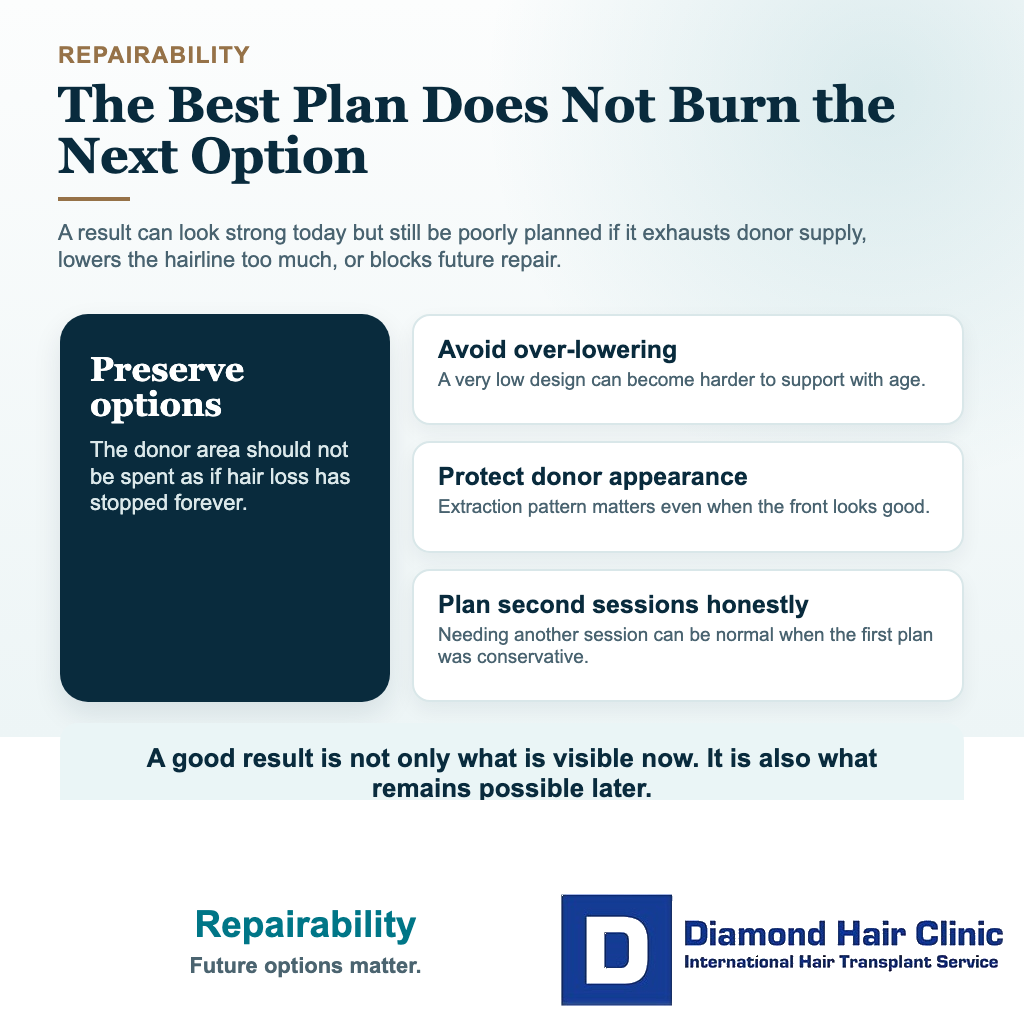
It is also about what remains possible on day one thousand. A plan that respects the donor, avoids overcommitting the hairline, and preserves flexibility may not always look like the most dramatic plan in the consultation room. It may sound more conservative. Less thrilling. Less marketable.
But that kind of careful judgment often contains a deeper intelligence. Because if the patient ever needs adjustment later, whether because of continued hair loss, changing priorities, donor limitations, or dissatisfaction with certain details, that careful first plan gives the surgeon something extremely valuable.
room to work with. The opposite is also true. A plan that looks exciting because it is very aggressive may actually be quite fragile. A very low line.
A very dense first border. A donor used too heavily. A case pushed too hard in one session. All of that may create a stronger first impression.
But it can also leave very little space for safe correction later. That is where the hidden weakness begins. Let me give a simple example. A patient may feel impressed by a first surgery because the hairline was pushed low and the frontal impact looks strong. But if that line later feels too aggressive for the face, or if further hair loss changes the surrounding balance, the surgeon coming after that first plan is no longer working with freedom. He is working on a decision that has already consumed grafts, donor, and design flexibility.
In another case, the patient may receive a slightly more careful first plan. The line is kept more mature. The donor is used more carefully. The grafts are distributed with future choices in mind. At first, that may feel less exciting. But if refinement is needed later, that patient is in a much safer position.
Repairability is a sign of good judgment. A good surgeon is not only trying to create a pleasing present. He is also trying not to trap the patient inside a narrow future. And in hair transplantation, that matters a great deal.
Because sometimes the strongest plan is not the one that tries to do the most immediately. Sometimes it is the one that still leaves the patient with options later.
Everyday Noticeability Matters More Than Applause
A result can receive a great deal of public praise and still not be the right result for the person who actually has to live with it. That is something I think Patients need to know much more clearly. Internet audiences react very quickly to visible contrast. They see a dramatic before and after.
They see a stronger hairline. They see more hair in front than before. And they respond. Amazing.
Huge transformation. Incredible result. I understand why that happens. In public, people react to what photographs dramatically.
But the patient does not live inside those reactions. He lives inside his own daily visibility. That is a very different reality. The important question is not only whether a result can impress strangers for a few seconds in a photo.
The practical standard is whether the patient can live with the result comfortably in ordinary life. Everyday noticeability matters more than applause under a post. The patient has to be able to walk into a room, stand under ordinary light, have close conversations, and go through daily life without feeling that the transplant needs constant management.
That, to me, matters much more than public applause. Let me give a few examples. A patient may post a result publicly and receive very positive comments because the frontal change looks strong in the photos. But if, in real life, he still feels uncomfortable in bright light or still worries every time the hair moves slightly, then the emotional reality of that result is not as strong as the comments make it sound.
Some strong natural results do not create dramatic public reactions because they are not especially theatrical in photographs. In daily life, the patient may simply feel relaxed and natural, no longer preoccupied with his hair. I think that kind of result may actually be more successful, even if it generates less excitement public.
A result can look powerful in one styled image while still forcing the patient to control the angle, combing, length, or lighting every day to keep it looking right. That may still be an improvement, but it is not the same thing as true ease.
And I think that is the key point. A transplant should not only create change. It should also reduce mental burden. One of the strongest signs of a satisfying result is not only that the patient looks better.
It is that he thinks about his hair less. Less about light. Less about the angle. Less about wind.
Less about whether the presentation is holding. I think everyday noticeability matters more than internet applause. Because the true test of cosmetic work is not whether strangers publicly wrote “amazing result.” The true test is the quality of the patient’s ordinary life after it.
Wrong Comparison Points Create Wrong Judgment
One important correction a patient can make in his own thinking. A hair transplant result needs judgment against the real problem that existed, not against an imagined ideal that was never realistically available in the first place. That sounds simple. But in practice, many patients do the opposite.
They do not compare the result to their true starting point. They compare it to a fantasy. And once that happens, the judgment becomes distorted from the beginning. A man may start with advanced recession, limited donor reserves, fine hair, visible miniaturization, and ongoing progressive loss. But then he looks at the result and asks, “Why do I not look like someone who never lost hair at all?”
The comparison is unfair because that standard was disconnected from reality before the surgery even began. The clearer standard is whether the surgery improved the patient in a natural, responsible, and worthwhile way within the real starting point, biological limitations, and donor capacity.
That is the mature question. Let me give a few examples. A patient with a Norwood III pattern and a decent donor may reasonably hope for a stronger and more complete frontal improvement. In that kind of case, the gap between the problem and the possible solution is smaller.
But a patient with a broader Norwood V or VI pattern is not living in the same reality. If that patient still judges himself against the image of a man who never had meaningful hair loss, he is using the wrong comparison from the start. Or take the patient with fine, straight hair and stronger scalp contrast. Even if the surgery is planned well, he may still see more scalp than another patient with coarse, wavy, lower contrast hair. If he judges his result against someone else’s more favorable biology, rather than against his own original problem, disappointment becomes almost inevitable.
A patient may begin with a very weak frontal frame, receive a respectable improvement, and still feel dissatisfied because he is unconsciously comparing the result not to his own before surgery reality, but to an untouched youthful ideal that was never truly available to him anymore.
That is where many public arguments fail as well. People are often comparing different things. One person is looking at the actual before surgery state. Another is comparing the result with the idea of perfect hair.
And those are two completely different standards. One of the healthiest questions a patient can ask is not. Is this perfect? But rather.
Given where this patient started, was this improvement intelligently achieved? Because a result does not have to recreate untouched youth to be a good result. Sometimes a result is good because it solves the problem in a natural, proportionate, and responsible way.
Patients become much better judges of hair transplantation once they stop comparing real surgery to an unreal standard.
Realistic Patients Judge Outcomes More Fairly
Realistic patients do not expect a flawless outcome. Nobody does. Their judgment is usually more intelligent because it is anchored in the starting point and the limits of the case.
Because they understand from the beginning that improvement and perfection are not the same thing. They understand that donor supply is finite. They understand that different scalp areas behave differently. They understand that the front, the mid scalp, and the crown do not give the same visual return.
And they understand that hair transplantation is not a miracle. It is a form of planning, allocation, and compromise. That changes the way they react afterward. A realistic patient can still feel disappointed in certain details, of course. But he is less likely to lose perspective completely. He is less likely to swing wildly between overpraise and overcondemnation, because he already understands that a result can be meaningful without being absolute.
This point matters. Because some patients do the opposite. They begin with fantasy, and then they continue judging through fantasy even after the surgery. If the result is decent, they may still feel let down because it did not match the image they were carrying in their head.
If the result is weak but emotionally relieving, they may still praise it too much because they need to feel that the story ended well. So the judgment becomes unstable in both directions. Too positive. Or too negative.
But not very accurate. Let me give a few examples. A realistic Norwood V patient may understand from the beginning that a strong frontal improvement with more limited work behind it can still be a good outcome if the donor was used intelligently. Another patient with the same degree of loss may still expect broad density everywhere, and when that does not happen, he may call a reasonable result a failure.
Fine hair with stronger scalp contrast creates a different limit. A realistic patient in this kind of case understands that his hair characteristics place limits on how dense the final picture can look. A less realistic patient may compare himself to someone with coarse, wavy hair and conclude that something must have gone wrong, when the real difference may simply be biology.
For me, realistic thinking is valuable not only before surgery, but also after it. It protects the patient from judging too emotionally. It helps him compare the result to the real starting point, not to fantasy. And it makes it easier for him to ask a more mature question.
Given my donor, my hair characteristics, my Norwood level, and the area that needed to be covered, was this result handled in a natural, responsible, and worthwhile way? That is the kind of question that leads to fairer judgment.
Fair Judgment Usually Comes Later
The fairest judgment of a hair transplant usually does not come at the beginning. It comes later. Immediately after surgery, the patient is not thinking in a calm and neutral way. First, there is hope. Then there is anxiety. Then impatience. Then, in some patients, temporary relief or temporary discouragement. None of those states is especially reliable.
Because of that, early judgment is often emotionally loud, but intellectually weak. At the beginning, the patient is not only looking at the result. He is reacting to the process. He is reacting to waiting.
He is reacting to uncertainty. He is reacting to the fear that something may have gone wrong, or to the hope that everything will end perfectly. That is not the same thing as truly evaluating the final outcome. The more clear evaluation usually comes later, after enough time has passed for the patient to stop reacting and start living with the result.
That is when more meaningful questions begin to answer themselves. Later, the clearer judgment is whether the result is easy to live with. It should still look natural in ordinary life, allow some hairstyle freedom, make the patient think about his hair less, and leave the donor feeling acceptable rather than exposed.
Those are much better questions than the ones patients often ask too early. Let me give a few examples. A patient may feel very encouraged at month five because the new frontal frame is finally visible. At that stage, he may think the entire result will be excellent. But later, once the emotion settles, he may realize that the first frontal centimeter was doing most of the work, while the area behind it was not as strong as he first thought.
Someone else may feel disappointed too early because the density still looks incomplete at month four or five, or because one side seems slightly behind the other. But later, once enough time has passed and the result has matured further, the same patient may realize that what looked weak at first was simply unfinished.
Some patients initially judge the result through photographs, mirror checking, and daily comparison. But as more time passes, he stops constantly examining it and starts noticing something more important. whether the hair actually feels easy in everyday life. Whether he can go outside without thinking about it so much. Whether it behaves naturally enough that it stops dominating his attention.
That later stage is often the most revealing one. The question is no longer only “Did hair grow?” I also consider how the result affects the patient’s daily life. That is a more mature standard.
The truest evaluation often begins only after the patient has had enough time to move beyond suspense. Because once the result is no longer being measured against hope, fear, or impatience, it finally starts being measured against real life. And real life is usually the most realistic judge of all.
Follow-up is part of judging a result
A good result should still make sense during follow-up. I want to see how the hairline behaves in normal light, how the donor healed, whether native hair continued to thin, and whether the patient can style the hair without hiding obvious planning mistakes.
I do not judge quality only from the most attractive final photo. The result should remain believable across time, angles, hair length, and daily life. Follow-up is what shows whether the original plan was stable, not only whether one image looked impressive.

Read this review excerpt
I have sent photos every week for this year (every day first 10 days) and Dr. Demircioglu has given feedback and instructions and answered all my questions very quickly and helpfully.
Clear Points Patients Need to Know
The simplest version is this. Many patients still judge hair transplantation too emotionally and too crudely. They become too impressed by visible change. They become too harsh with reasonable limitations.
They often do not separate growth from artistry, density from fantasy, photographs from real life, or short range excitement from long range judgment. And until patients learn to see those distinctions more clearly, many will continue misreading what they are looking at, both in their own cases and in the cases they study publicly.
A hair transplant does not need judgment like a wish being graded. It needs judgment like a surgical result, being understood. Not by how dramatic it looks in one photo. Not by how flattering the comments are underneath it.
Not by how exciting it felt in the first moment. But by whether it was planned intelligently, performed responsibly, and whether it created an improvement that still feels natural, sensible, and worthwhile once real life begins. The strongest result is not simply the one that creates more visible hair.
It is the one that creates hair that feels natural on the patient, fits the face, respects the donor, and continues to make sense long after the early excitement has passed. I also answer some very common judgment mistakes separately, including whether you can judge a hair transplant from day one photos, whether it has really failed or is simply being judged too early, and whether it should still look natural in harsh light, wind, and wet hair.
A good result should still protect the donor area
The essential points are simple. A strong transplant result is not simply a result where hair grows. It is a result that looks natural, fits the face, respects the donor, makes sense for the patient’s age and pattern of loss, and still feels right once the early excitement has passed.
Patients should not judge a transplant too quickly, too emotionally, or too superficially. They should not confuse visible change with quality. They should not confuse dramatic impact with good design. They should not confuse big graft numbers with good planning.
And they should not let photos, forum bias, or popular names do their thinking for them. The fairest way to judge a hair transplant is this. Look at the starting point. Look at the limitations.
Look at the design. Look at the donor. Look at how the result behaves in real life, not only in one flattering image. And then ask one practical question.
Given this patient’s reality, was this result planned and executed in a natural, responsible, and worthwhile way? That, to me, is the right standard.