



Afro and Very Curly Hair in FUE Surgery
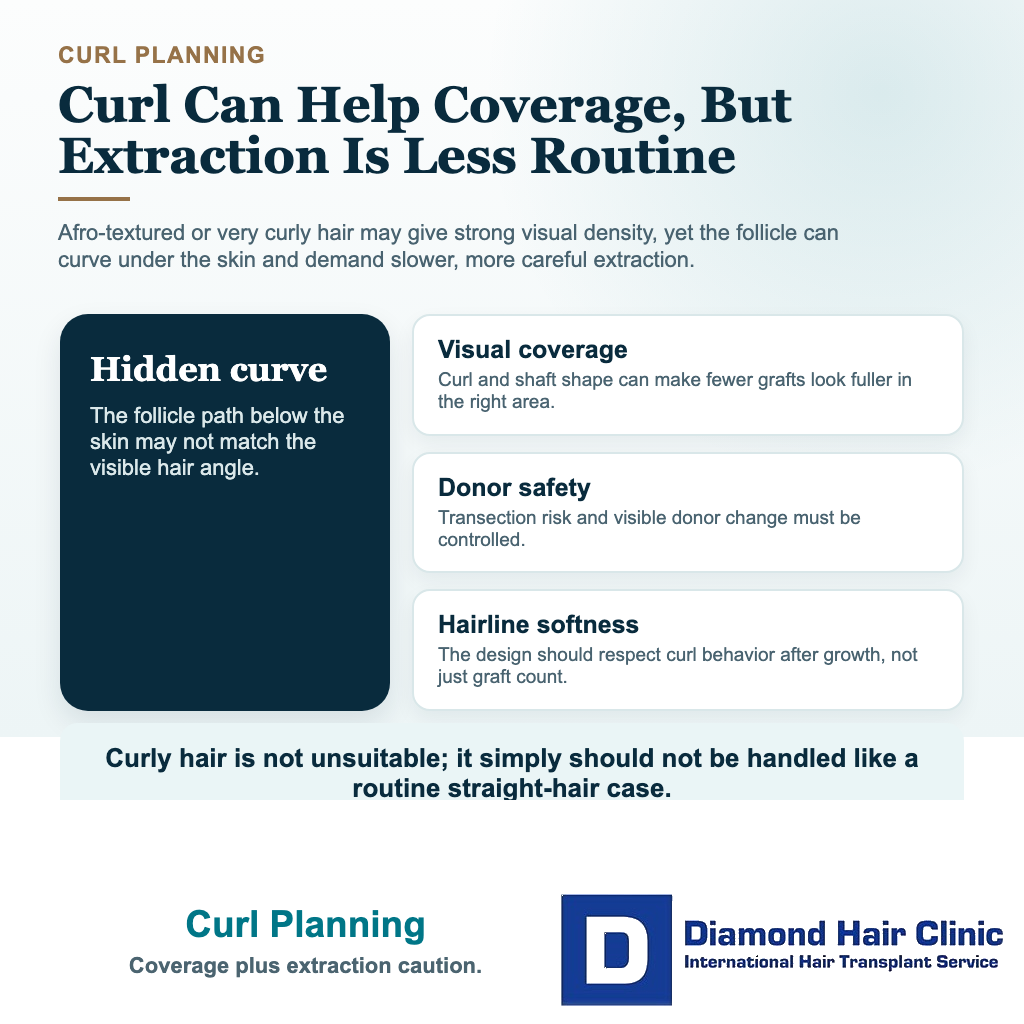
Very curly grafts can give excellent visual coverage, but extraction and placement must be slower and more deliberate. The main challenge is that the curl is not only visible above the skin. The follicle may also curve beneath the skin, so extraction must be adapted to that hidden curve.
This does not make Afro textured hair unsuitable for hair transplant surgery. It means I have to treat the case as technically specific. The extraction may need to be slower, the punch choice and angle may need adjustment, the donor pattern must be conservative, and the hairline design must respect how the curl will sit after growth. If you are comparing travel offers, the Afro hair transplant travel budget should still leave room for this curl review. The same curl pattern also matters later if the patient wants braids or cornrows after FUE without pulling on healing grafts.
Speed or a large graft number should not drive this choice. The real test is whether the surgeon can extract curved follicles intact, protect the donor area, and design a hairline that will still look natural when the curl returns. If the patient is trying to fix a weak previous result, Afro textured hair transplant repair needs the same curl, donor, hairline, and skin review before the next quote is accepted.
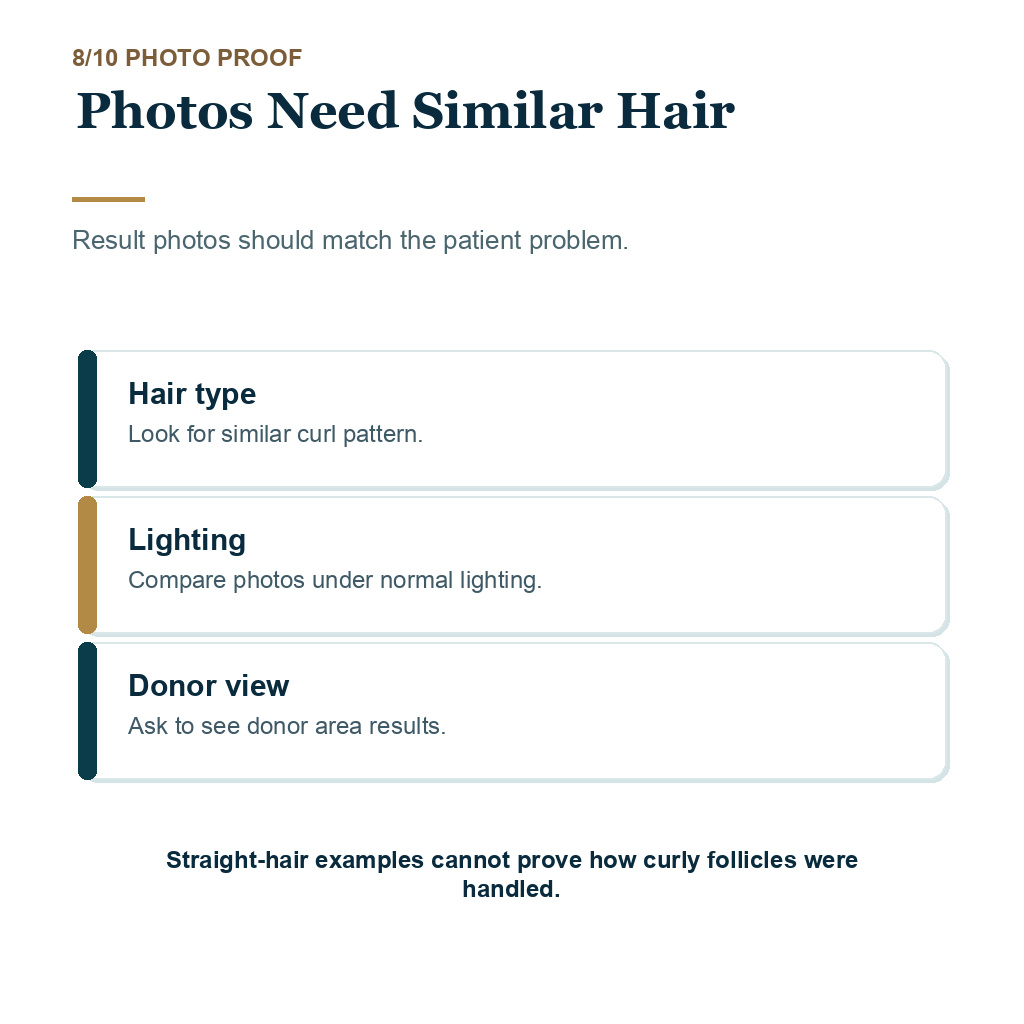
Afro FUE experience is not proven by a straight hair gallery or one dramatic front view. Comparable curl pattern, donor density, hairline design, extraction spread, texture behavior over time, and haircut length examples matter because curved follicles and donor contrast change the difficulty. Healed donor examples matter as much as the front view. With very short styles, curl direction and exit angle become visible before density has a chance to hide small mistakes. One similar curl result is a starting point, not a track record. I still want repeat cases that show donor healing, hairline behavior, and the haircut the patient actually wears.
For photo review, show the donor dry, detangled, and without heavy product, then add front, crown, side, and normal hairstyle views. Oil, shrinkage, tight styling, and camera distance can change how safe a large graft number appears. A remote quote for Afro textured or very curly hair is stronger when it explains what still has to be checked directly, not only where the patient wants more density.
Locs need their own visibility plan
When the hair is worn in locs, donor and recipient visibility can change with parting, density, and maintenance timing. Locs and dreadlocks hair transplant planning explains what to show before deciding on shaving, graft placement, or retwisting.
Very curly hair needs slower extraction
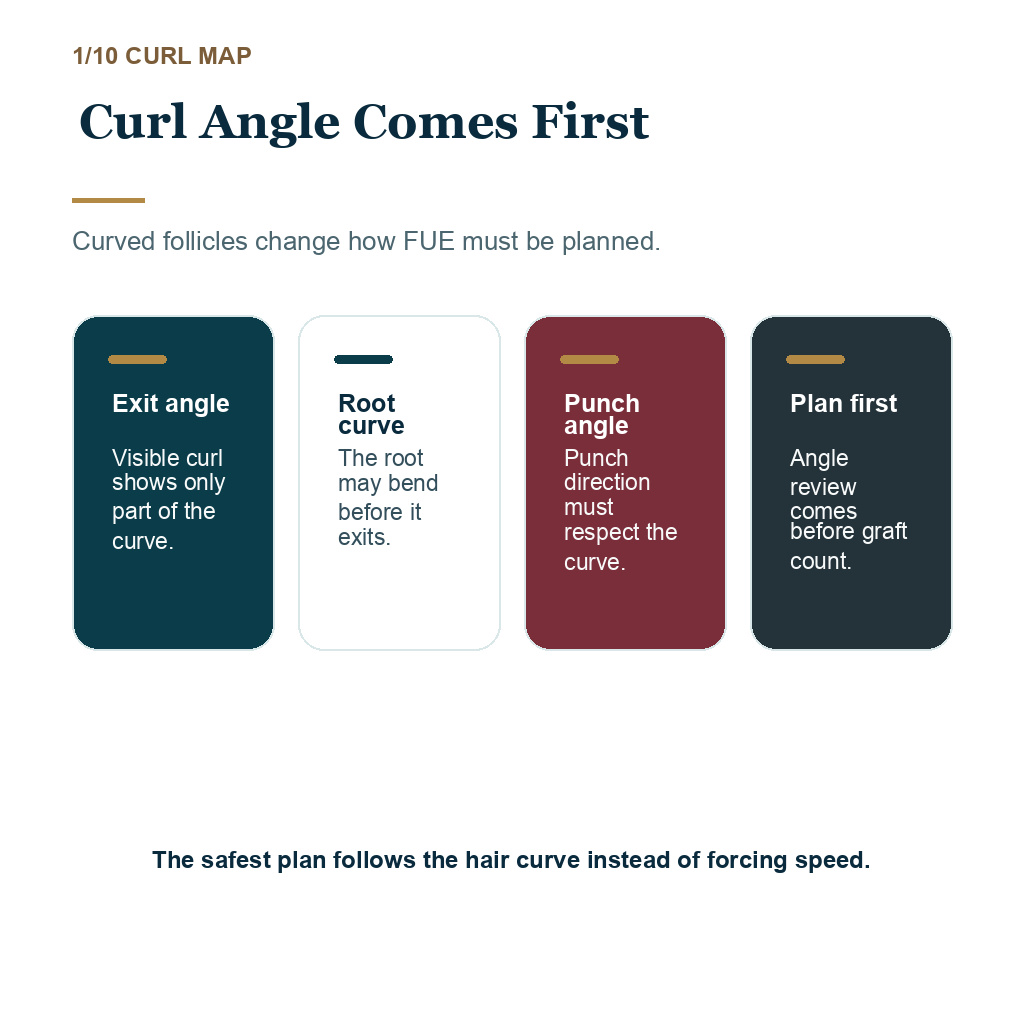
Afro textured hair is more technically demanding because the visible hair shaft does not always tell the full story. In straight hair, the follicle often follows a more predictable path beneath the skin. In tightly curled hair, the follicle can bend, curve, or change direction below the surface.
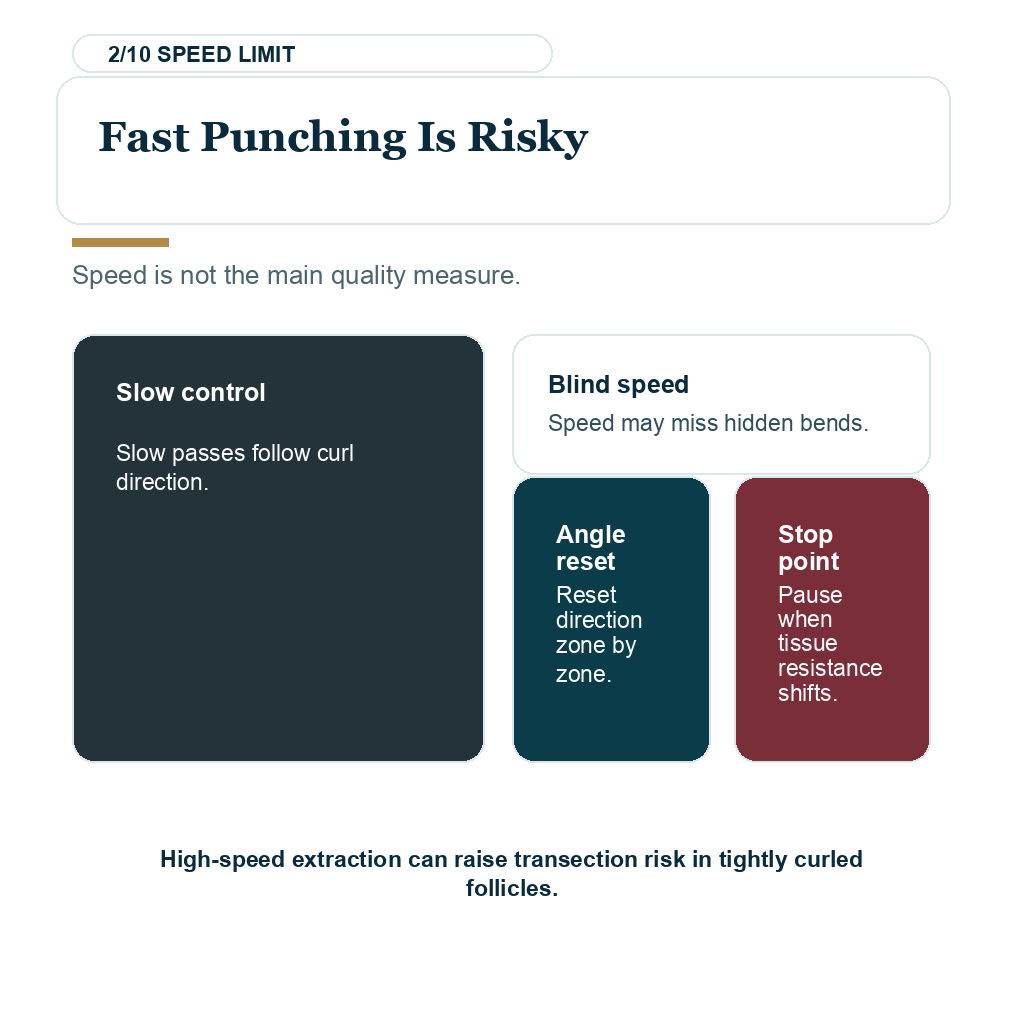
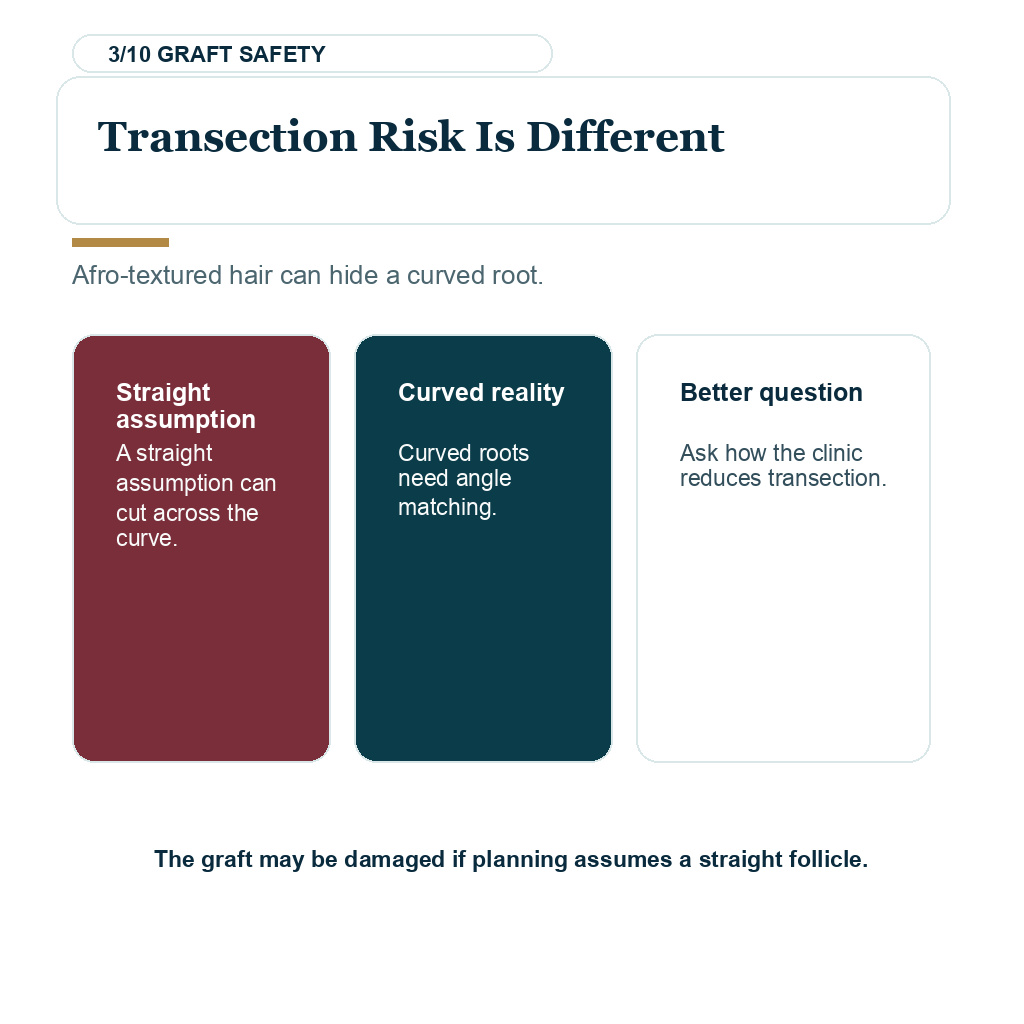
During a FUE hair transplant, each follicular unit is removed one by one. If the surgeon follows only the surface direction and ignores the hidden curve, the graft can be cut before it is safely removed. This is called transection. A transected graft may not survive, and it also wastes part of the patient’s limited donor supply. The first extractions are information. If the grafts release cleanly, the rhythm can continue. If transection appears, the plan has to slow down or change before donor hair is wasted. You should also know who has authority to reduce the graft target if the early extraction behavior shows too much risk.
The case can still be very suitable, but it should not be rushed. The technique has to follow the patient, not the other way around.
The curl beneath the skin changes extraction
The curl beneath the skin matters because extraction is a three dimensional procedure. The punch enters the skin from the outside, but the graft continues below that first visible entry point. If the follicle bends away from the expected path, a straight or rushed movement can damage it.
Surface curl, skin thickness, donor density, hair caliber, and the way the graft releases during early extraction all matter. In some patients, the curl is tight above the skin but the follicle is less difficult below it. In others, the visible curl may look moderate while the subcutaneous path is more challenging.
Labels are not enough. Afro textured hair, coiled hair, loose curls, and mixed curl patterns can behave differently. The plan should be based on the actual donor area, curl behavior, and skin visibility in front of the surgeon, not on a broad category. If central crown scarring or burning is part of the history, CCCA transplant timing has to be assessed before curl pattern or coverage advantage becomes the main question.
A loose curl result is not automatic proof that a tighter curl case will behave the same way, and a tight Afro result is not the only comparison a patient with a mixed curl pattern needs. The cases should match curl pattern, donor density, skin behavior, haircut habits, and hairline goal closely enough to make the comparison useful.
Two patients can both describe their hair as very curly, but the surgery may not feel the same in the donor area. One follicle may release cleanly with careful adjustment. Another may curve sharply under the skin and need a slower extraction rhythm. That difference matters more than the label.
I separate this into two jobs. The graft has to be removed intact, and then it has to be placed so the emerging curl sits with the native pattern. A clinic can weaken the result at either step if it treats very curly hair like a straight hair case.
Moving a scalp follicle does not make it copy the curl pattern beside it. I plan for important donor traits such as curl and caliber to remain relevant after transplantation, even though the recipient area can influence some growth behavior. If the donor texture is looser than the recipient hair, the design has to blend that difference rather than promise that the grafts will become curlier after placement.
Curly hair can improve coverage without removing limits
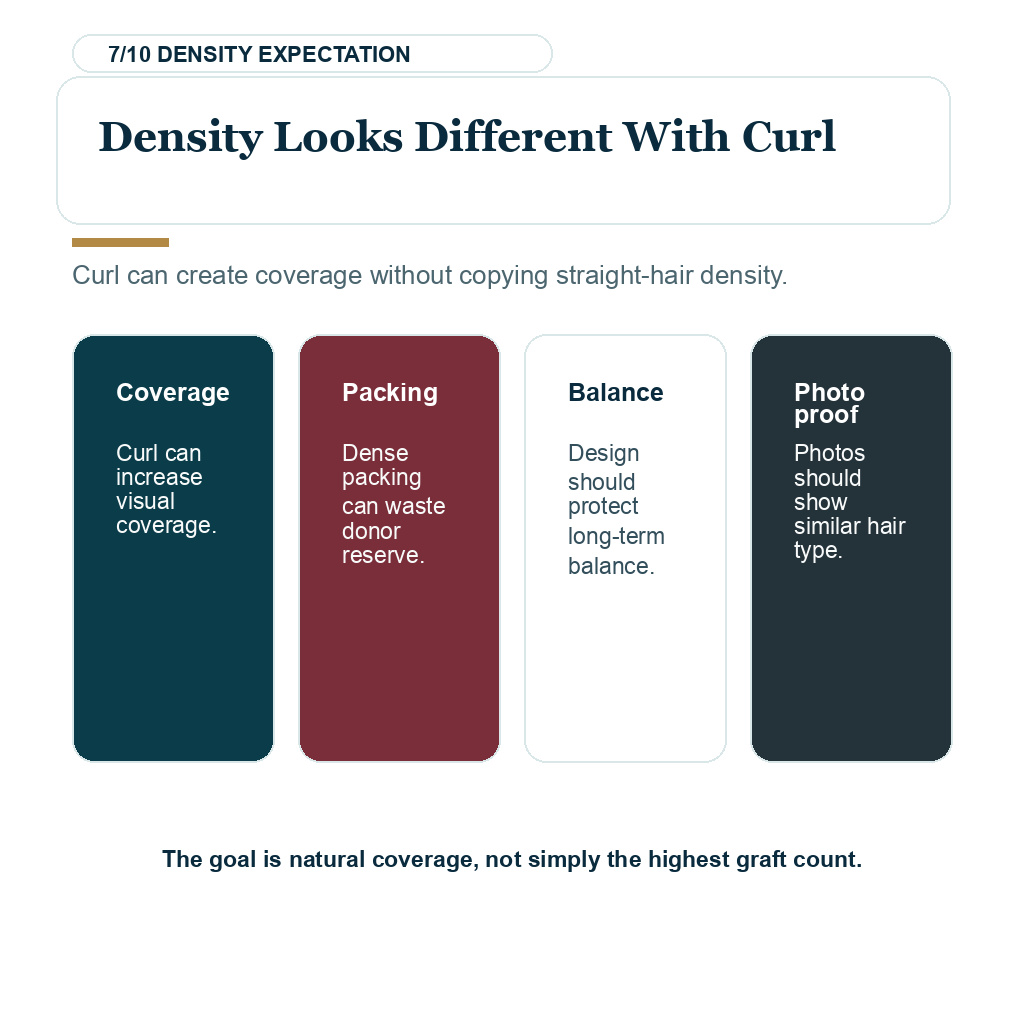
Sometimes this texture can give more visual coverage per graft because the curl bends, lifts, and reduces the way light passes through the hair. Patients with curly or coiled hair need results from hair like theirs, not only straight hair gallery photos. This can be a real advantage. But the curl does not shrink the recipient area, and it does not remove the need for a proper density plan.
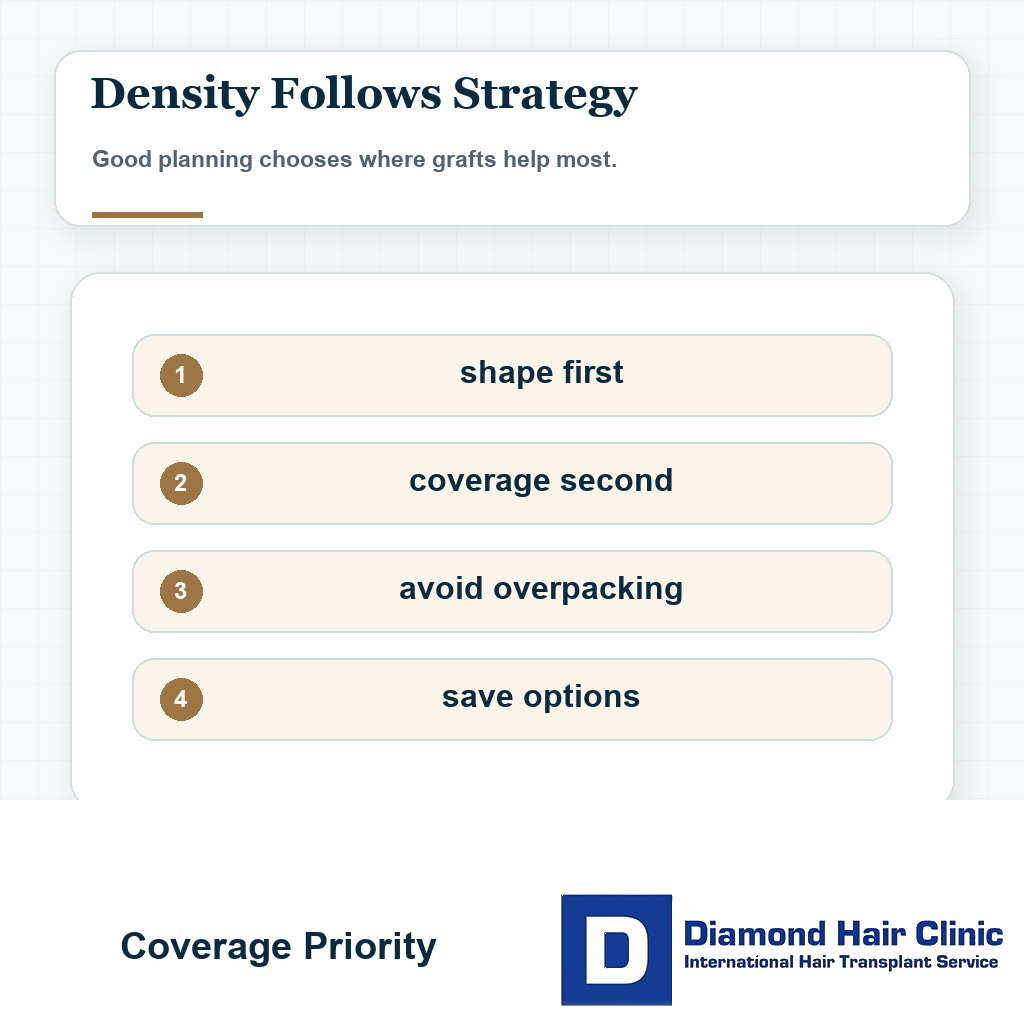
That advantage should not become a promise that every patient with curls needs a low graft number. Coverage depends on curl tightness, shaft thickness, color contrast, recipient area size, donor density, future hair loss risk, and the patient’s styling habits. Graft numbers can differ between clinics even when they are looking at the same patient.
A stronger plan does not use curl as an excuse to undertreat the area, and it does not use a high graft number to impress the patient. It uses the number that gives a natural improvement while protecting the donor area for the future.
Donor area protection matters more than speed
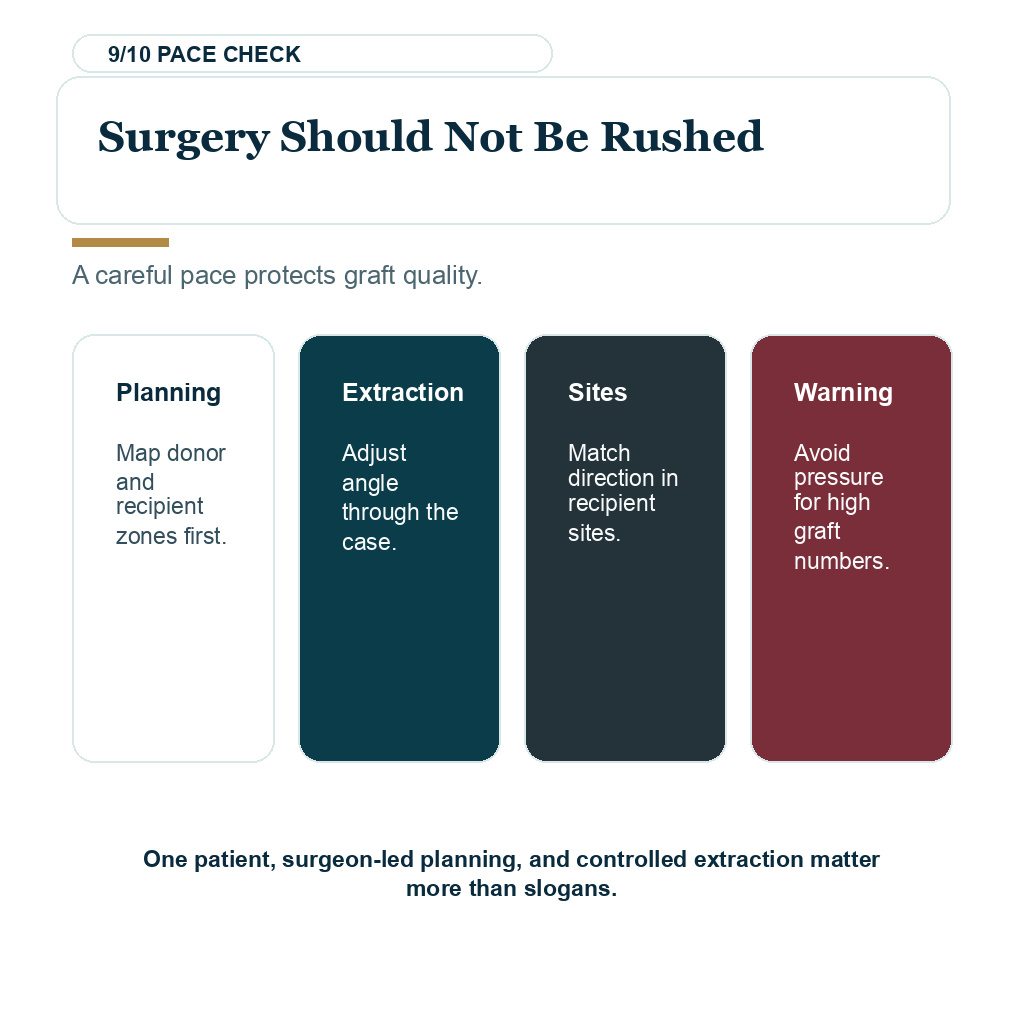
I treat the donor area as a lifetime budget. This matters in every patient, but it carries extra weight when extraction is technically more demanding. If grafts are damaged during removal, the patient loses donor capacity without receiving the full cosmetic benefit. Before a large session, I also want the clinic to explain how the first extractions will be used as a safety check. If early grafts show more transection, difficult release, or reactive skin, the plan should slow down, reduce the number, or stop rather than continue because a package number was promised.
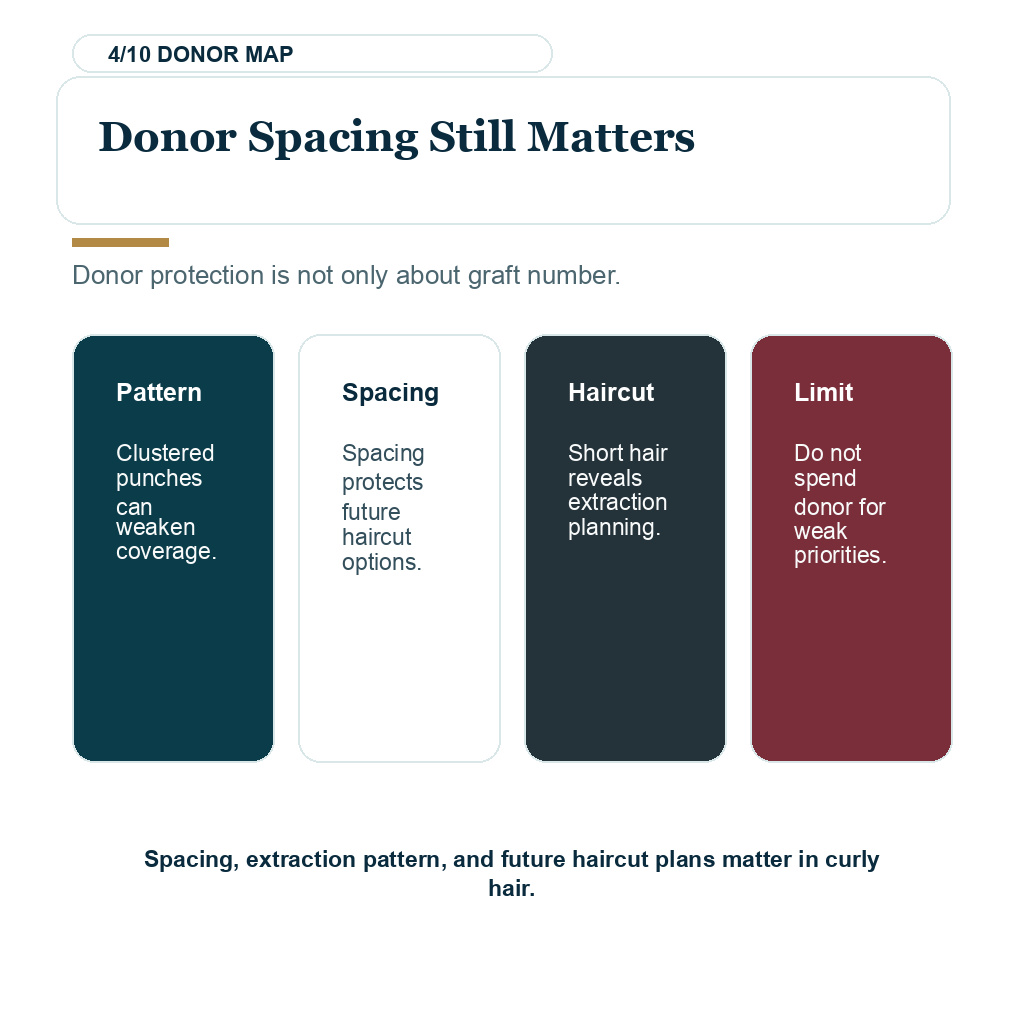
I factor in how the patient wears the hair. Many patients with Afro textured hair keep the sides short or use a fade. That means donor thinning or visible dot scarring can matter more than the surgeon expects if the plan is too aggressive. A donor area that looks acceptable with longer hair may look different with a very short haircut.
If the lower nape has chronic bumps, scarring, or acne keloidalis nuchae, that is not only a skin note. It can change where extraction should stop.
Curl can hide some visual gaps, but it cannot make the donor area unlimited. Extraction should be spread carefully, the graft number should be justified, and the donor plan should make sense for the hairstyle the patient actually prefers.
A high count or beard donor addition still has to be judged by curl direction, extraction difficulty, and where each graft type will sit. Curl may help the result look fuller, but it cannot make an aggressive operation safe by itself.
When graft quotes for very curly hair are far apart, I do not average them. The lower number may reflect donor caution, and the higher number may reflect a broader area or more risk. A safer plan explains the stopping point before extraction begins.
Curly hairlines can look natural with soft design
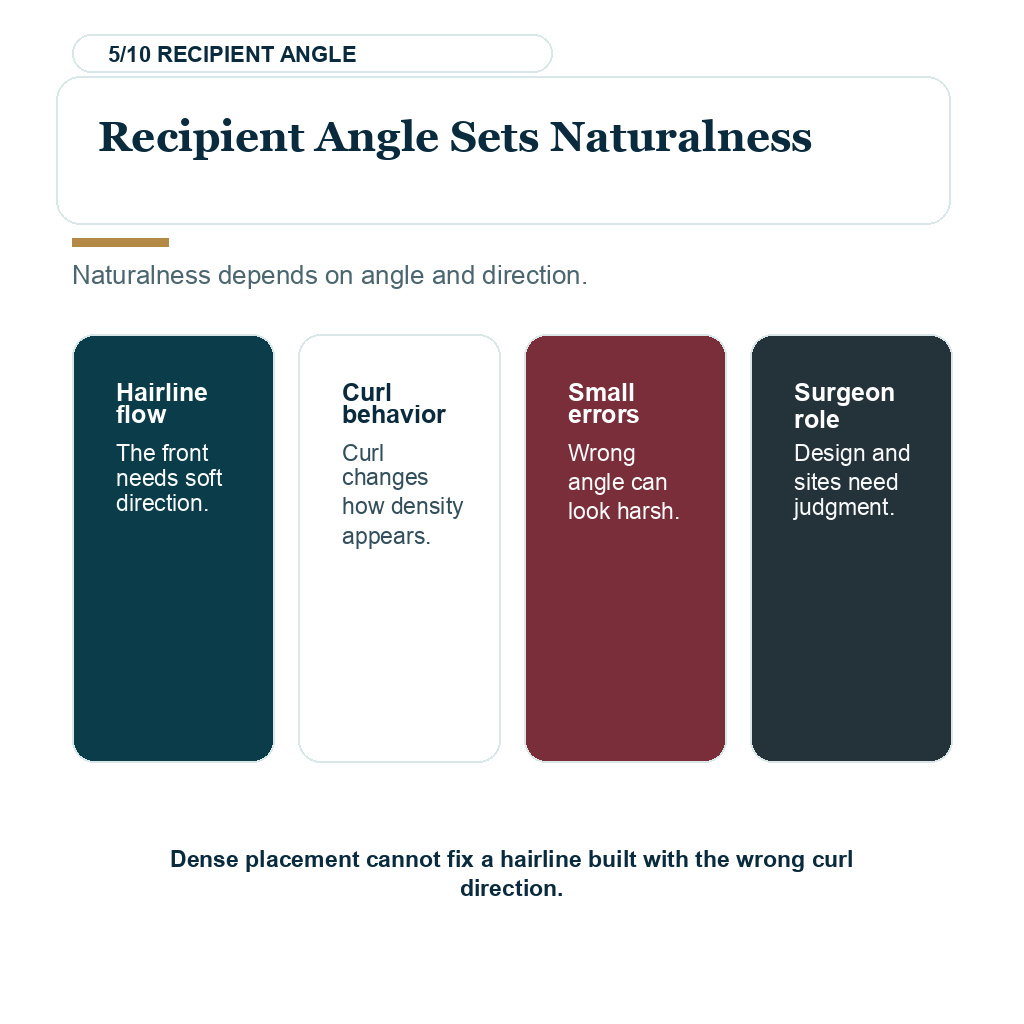
Afro textured hairlines can look very natural when the design respects curl direction, temple shape, forehead proportion, and the patient’s facial structure. The risk is drawing a hairline that looks neat on the surgical plan but too sharp after the curls grow. Compare cases with a similar curl pattern, not only the same Norwood stage.
The first rows need softness. I avoid a heavy wall of grafts at the front. Natural hairline design depends on irregularity, angle control, graft selection, and the way the hair behaves after it grows long enough to curl.
With curly hair, a small angle mistake can become more visible later. The hair may lift, bend, or fight the surrounding pattern. The real test is not only the photo taken straight after surgery. It is how the hairline behaves after the curl returns.
Sapphire FUE is only useful with the right plan
Sapphire FUE can be useful in the recipient area because precise incisions can help with angle, direction, and spacing. But the blade does not make the plan by itself. The surgeon still has to decide where the grafts should go, how dense the area should be, and how the curl will sit once the hair grows.
In Afro textured or very curly cases, patients should not choose surgery only because a tool sounds advanced. The tool is only useful when the surgical thinking behind it is correct. A poor plan with a modern tool is still a poor plan.
Extraction follows this point. This is not only about what device is used. It is whether the surgeon can adapt the extraction to the follicle curve, watch the graft quality during surgery, and slow down when the tissue is not releasing cleanly.
FUE, DHI, and FUT need a texture specific discussion
For many patients, adapted FUE remains a strong option because it avoids the linear scar of FUT hair transplant and allows careful distribution of extraction across the donor area. I still explain the difficulty because FUE in tightly curled hair is not the same as FUE in straighter, easier donor hair.
FUT is the older strip method. It may allow grafts to be dissected under direct vision after a strip is removed, which is one reason some surgeons discuss it in very curly hair. But it also leaves a linear scar and changes the donor discussion completely. I do not present it as a simple shortcut, especially for patients who like short haircuts.
DHI hair transplant is often presented as if it is a separate solution, but clinically it is a variation within FUE planning. The grafts still have to be extracted safely first. If extraction damages the grafts, the implantation label will not rescue the result.
Curly hair transplant risk comes from standard high speed work
The procedure becomes risky when the clinic treats it like a standard high speed case. The risk increases when the team has little experience with curved follicles, when extraction is delegated without proper surgical control, when the donor area is weak, or when the plan asks for too many grafts in one day.
Donor area overharvesting is not only a problem in straight hair patients. In curly hair, it can be especially disappointing because the patient may have been told that the texture would hide everything. Texture can help coverage, but it cannot hide poor donor management forever.
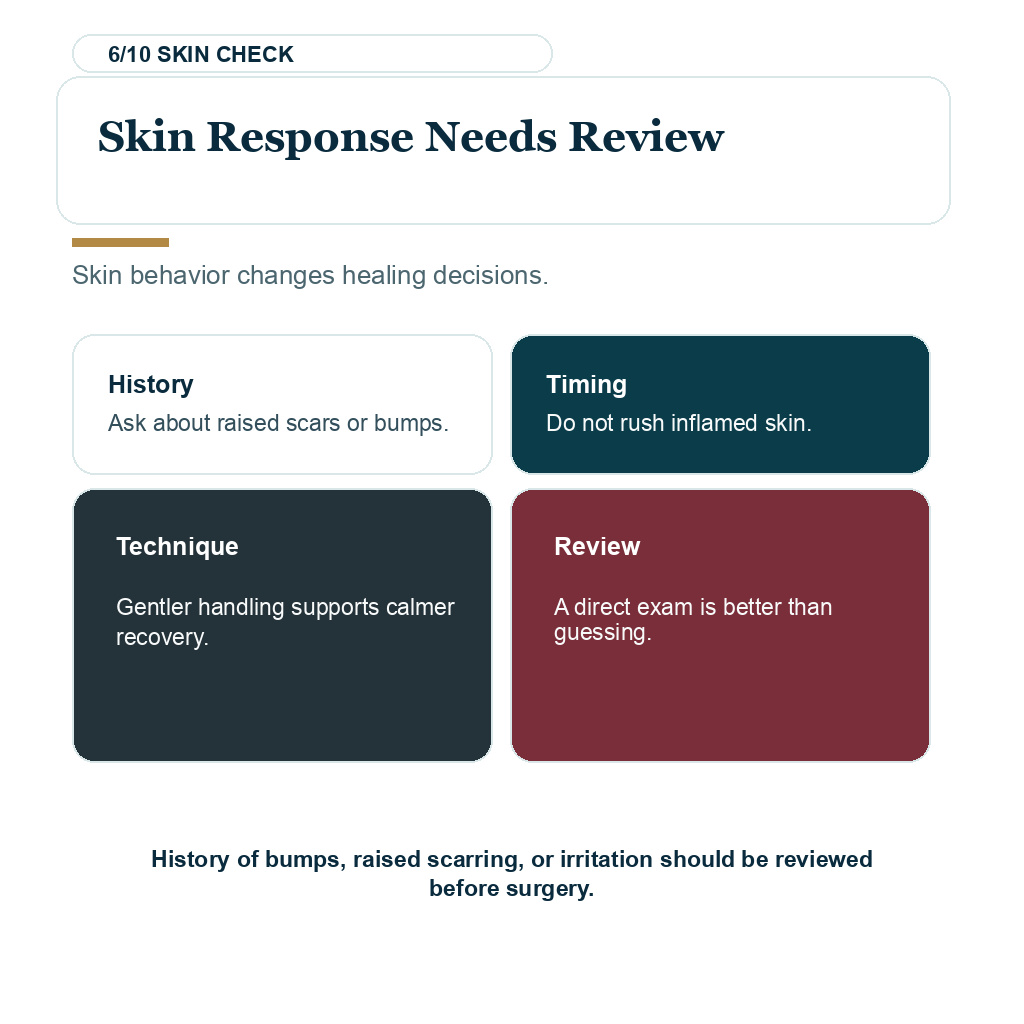
Another risk is ignoring skin behavior. Some patients are more prone to visible marks, raised or keloid type scarring, or slower healing. That does not always rule out surgery, but it should make the plan more careful, especially when grafts are being considered for a hairline advancement scar. If the recipient area looks darker during early healing, I judge dark scalp color after FUE with symptoms, photos, and timing rather than color alone.
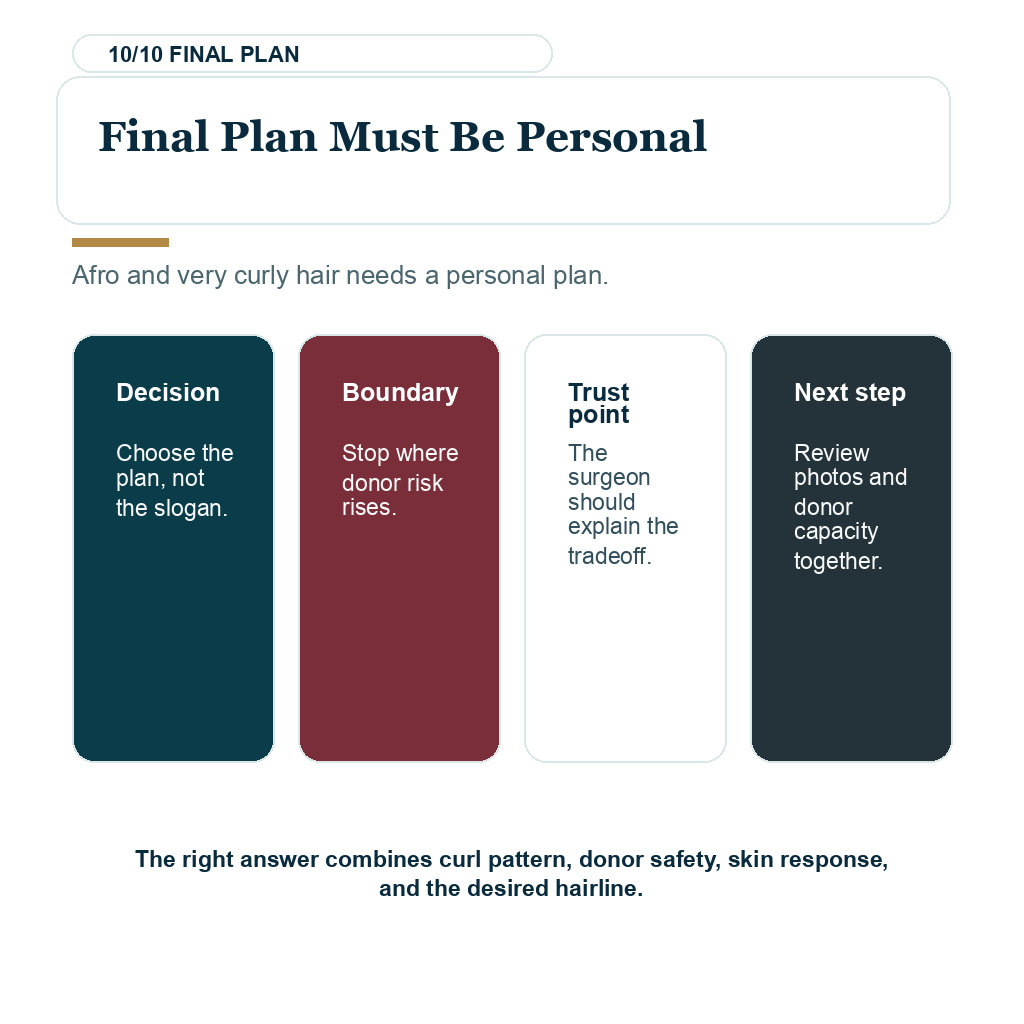
Use the 10 curl angle planning slides below to review curved follicles, extraction direction, transection risk, donor spacing, recipient angle, skin response, density expectations, photo evidence, pacing, and the final surgeon-led plan. Swipe the carousel, use the arrows one step at a time, or choose a number below the image to jump to that point.
Fine curls still need careful density planning
Curl can help coverage, but very fine hair still has limits. A patient may have a visible curl pattern without much shaft thickness. In that case, the curl gives some volume, but the hair may still need careful density planning.
Fine hair transplant planning is still relevant for patients with curls. Caliber matters. Color contrast matters. Recipient area size matters. A patient with fine curls should not be promised the same visual density as a patient with thick coarse curls.
I try to be direct about this because patients often compare themselves with results that have a different curl pattern, donor strength, and hair shaft thickness. Those comparisons can create unrealistic expectations before surgery and unnecessary anxiety during growth.
Clinic experience should be specific to this texture
The clinic should be able to explain extraction strategy, donor protection, curl direction, hairline softness, and realistic coverage in specific terms. You should also have clarity about who performs the hair transplant surgery, who performs the extractions, and who makes the recipient area incisions. In very curly FUE, the extraction step deserves its own answer because that is where hidden follicle curl can damage grafts if the pace or angle is wrong.
The conversation should feel specific to your hair. If the clinic gives the same explanation to every patient, slow down. Afro textured and very curly hair deserve an examination that includes donor curl, skin behavior, preferred haircut, hairline goal, and future hair loss risk.
When several experienced clinics say no, I treat that pattern as safety information to understand, not as a challenge to find any clinic that says yes. The reason may be donor weakness, unstable hair loss, scarring tendency, skin inflammation, curl extraction risk, or a hairline goal that would spend too much reserve. A later yes is only reassuring when it explains why those limits are manageable in this specific scalp. Compare the reasons for refusal before you keep searching, because donor reserve, curl behavior, scarring risk, inflammation, and the hairline target do not carry the same meaning.
Review cases that match your curl pattern, donor texture, and usual haircut rather than relying on dramatic straight hair transformations. With very curly hair, healed donor photographs matter as much as the front, especially if you wear fades or short sides. The clinic should also be able to explain how graft quality is checked during extraction.
I would also ask what happens if the first extractions show more curl under the skin than expected. A careful answer should explain that the surgeon may slow the pace, change the punch angle, reduce the graft target, or stop before donor damage accumulates. That answer is more useful than a fixed graft promise made before the donor behavior has been seen.
Waiting is safer when the donor plan is uncertain
Waiting is safer when the donor area is not clearly safe, when hair loss is changing quickly, when the patient is very young with an unstable pattern, or when the requested hairline is too low for long term planning. Curly hair can give strong cosmetic coverage, but it does not stop future hair loss.
Before surgery, I look at whether the patient is truly a good candidate for a hair transplant. Wanting more hair is not enough. Surgery has to age well, protect donor supply, and match the likely future pattern.
In some patients, I may recommend medical stabilization, observation, a more conservative hairline, or a smaller first step. A careful plan is not a lack of ambition. It is how I protect the patient from a result that looks good briefly and becomes difficult later.
Recovery and growth can look different with curls
In the first weeks after surgery, the recipient area may show crusting, redness, dryness, or uneven early appearance. Curly hair may eventually help coverage, but that advantage comes later. It does not remove the early healing stage.
Growth may also look different from straight hair cases. The hair needs enough length before the curl contributes to coverage. A short early sprout may look uneven or difficult to judge. That does not by itself mean the result is failing.
I also remind patients not to judge curly hair transplant work only from day one photos. Immediate placement can look tidy, but the real cosmetic question is how the hair behaves when texture, length, and styling return.
Donor patchiness also needs review that is specific to the hair texture. Curved follicles, short fades, tight curls, and skin sensitivity can make early donor photos look uneven before the final pattern is clear. I separate temporary healing from true extraction loss before calling the donor permanently damaged.
Curl pattern and donor safety set the limits
Be selective and patient. Choose a plan that explains the hidden curve of the follicle, the donor pattern, the extraction method, the hairline angle, and the long term donor strategy. If the explanation is only about how many grafts can be moved in one day, the conversation is incomplete.
Survival alone is not enough. I also judge result quality by natural direction, soft hairline design, donor safety, realistic density, and maturation that still fits the patient’s real curl pattern.
Afro textured and very curly hair can be rewarding in hair restoration because the curl can create strong visual coverage. But that reward comes only after careful surgical respect. The right plan understands both the visible curl above the skin and the hidden curve beneath it.

Read this review excerpt
Every single one of my questions was answered and they made sure I had all the details I needed to make an informed decision.