


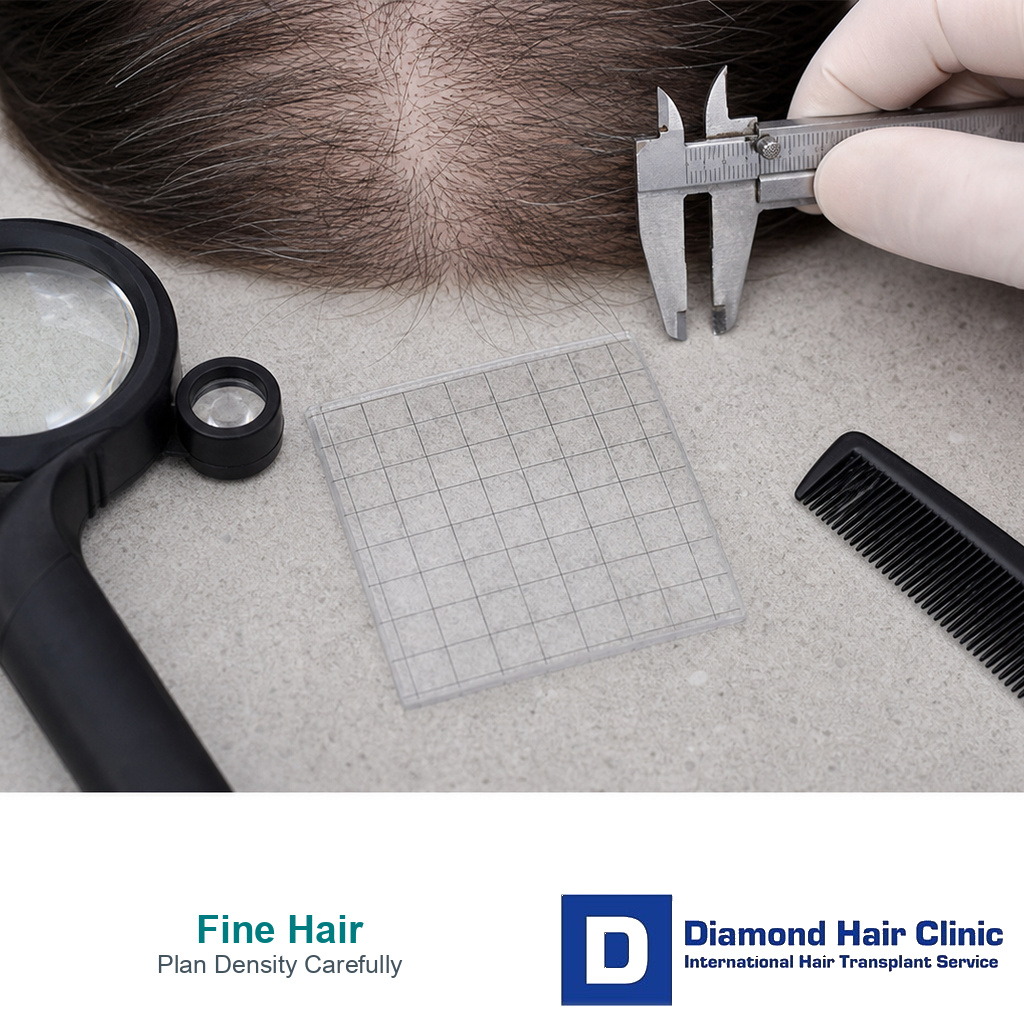
Planning Hair Transplants for Fine Hair
A hair transplant can look good when the hair shafts are fine, but the plan has to respect how fine hair behaves. Fine hair can create a soft, natural hairline when the plan respects its limits. It usually gives less visual coverage over a broad area, so the plan needs to be judged by more than the graft number.
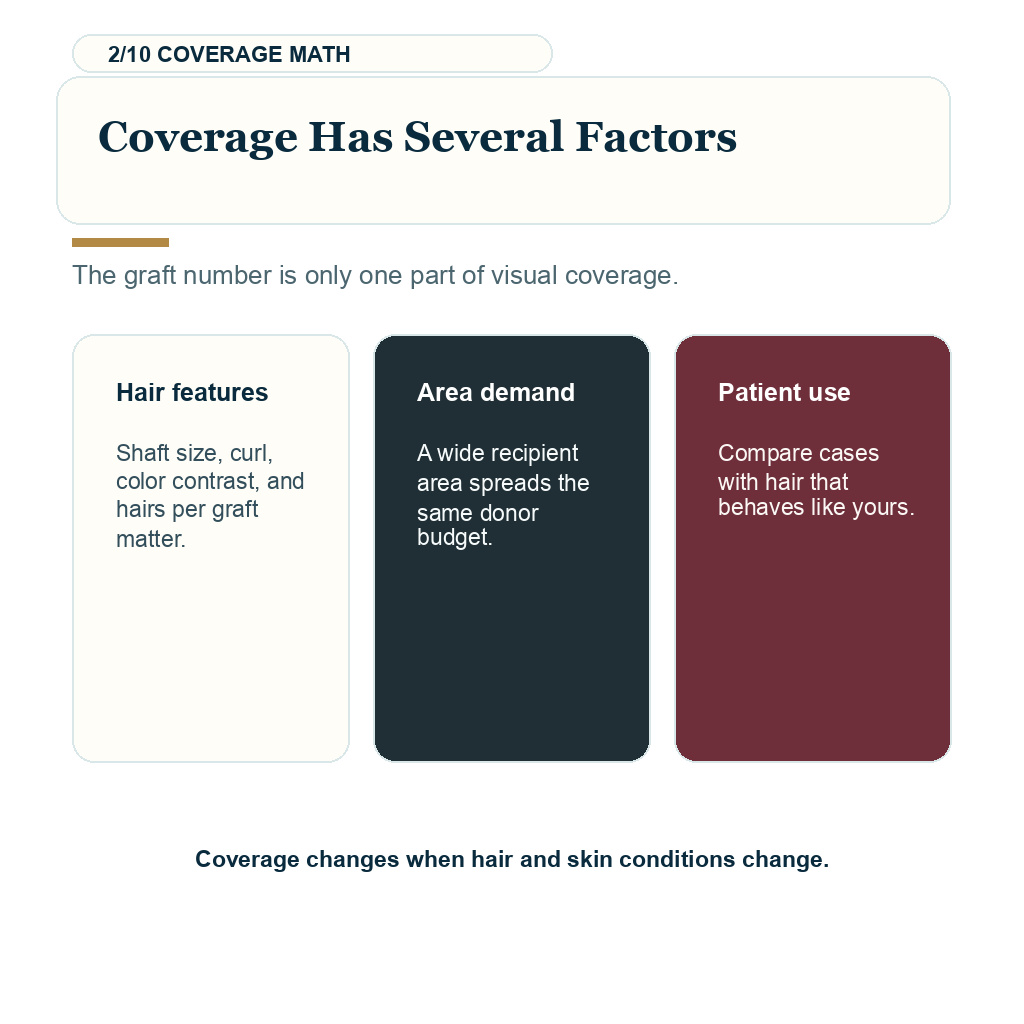
The common mistake is comparison. Someone with fine, straight hair may look at a thick, wavy result and expect the same coverage from the same number of grafts. That is not how hair transplantation works. Shaft caliber, number of hairs per graft, curl, scalp contrast, donor strength, and the size of the recipient area all change the result. Interpret comb through videos through hair caliber, not only through a dramatic still image. The same question about visual density is why blonde and red hair transplant planning has to separate color from caliber before graft numbers are chosen.
Fair comparison means looking at similar hair shaft size, curl, color contrast, haircut, and loss pattern. A graft count from thicker hair can make fine hair expectations too optimistic.
I would not frame it as only whether grafts can grow. I focus on whether the result can look natural in daily life, whether the donor area can safely support the plan, and whether you understand what fine hair can and cannot hide. The same separation matters in gray hair transplant planning, where color and caliber must not be confused.
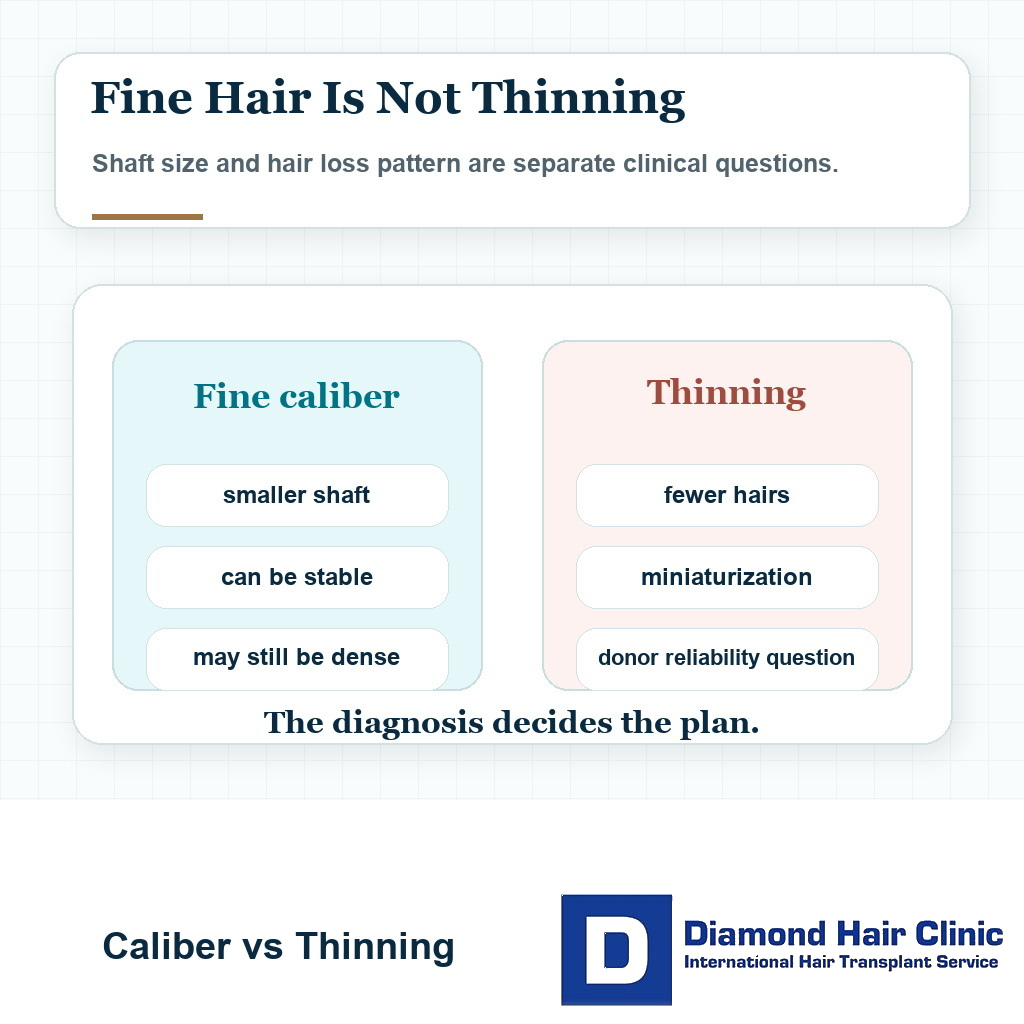
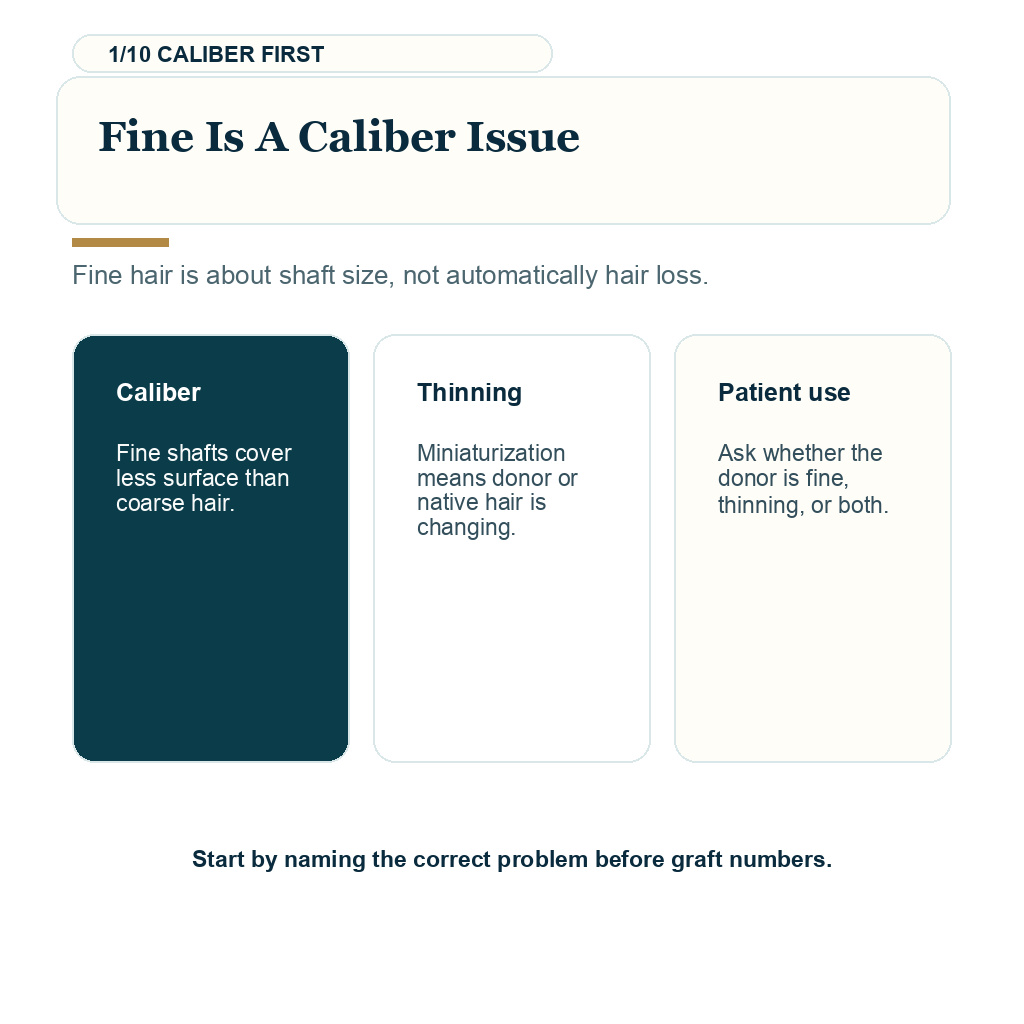
Fine hair is not the same as thinning
Hair shaft caliber and thinning are not the same thing. A smaller caliber shaft has a reduced diameter. Thinning usually means there are fewer hairs in an area, weaker density, miniaturization, or more scalp visibility. You can have delicate hair shafts with good density, or thick hair with low density.
Fine shafts do not tell me how many hairs each follicular unit contains. I assess shaft caliber and hairs per graft separately before estimating coverage.
At the same graft count and similar shaft thickness, grafts containing one hair provide fewer hairs than grafts containing two or three. Graft count alone therefore cannot describe the expected coverage.
Naturally fine hair also has to be separated from hair that has become fine because it is miniaturizing. Naturally fine but stable donor hair may still be usable, while miniaturized donor hair before transplant needs a stricter safety decision. Miniaturized donor hair is different, because it may not give the same long term reliability after transplantation. That distinction also matters in nape hair donor planning, because a fine shaft is useful only when it comes from a stable area.
This difference matters because the surgical plan changes. A patient with many stable donor hairs may still be a good candidate even if the shafts are delicate. A patient with truly low density, diffuse thinning, or a weak donor area needs a much more cautious plan.
When someone uses the word thin, I do not assume it means one thing. It may describe the hair shaft, the number of hairs, the donor strength, miniaturization, or the way the scalp shows under light. These are different problems, and they do not need the same surgical answer.
This distinction matters in female hairline planning, diffuse thinning cases, and patients with naturally delicate donor hair. The words may sound similar, but the surgical consequences are not the same.
If the diagnosis is wrong, the graft number can be wrong. Hair caliber and density have to be separated before the final design is discussed.
Hair caliber changes the visual result
Hair caliber changes the result because each smaller shaft covers less scalp. A thick shaft casts more shadow, creates more overlap, and gives a stronger impression of density. Fine hair planning should not borrow expectations from thicker hair results. Delicate hair can grow well and still allow more scalp visibility under bright light.
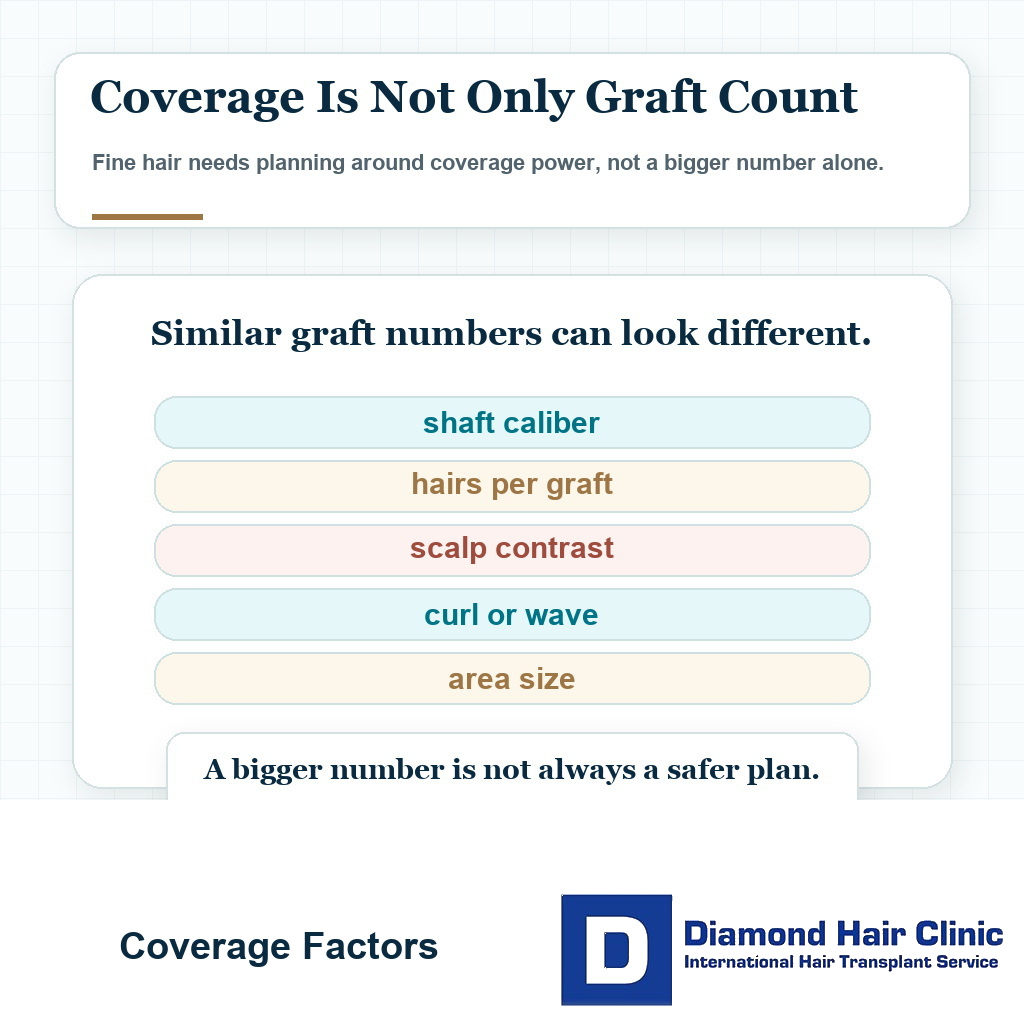
Graft count alone can mislead. Two patients may both receive 3,000 grafts, but if one has thick, wavy hair with low scalp contrast and the other has fine, straight hair with stronger scalp contrast, the visual result will not be the same.
This needs to be clear before surgery because it prevents disappointment later. Do not judge a patient with fine caliber hair by the same visual standard as a patient with thicker hair, a smaller area of loss, and stronger donor density.
This hair type also reacts differently to styling. It separates more easily, collapses more easily when wet, and can look lighter under overhead lighting. This is not always a failed transplant. It may be the normal optical behavior of the hair type.
A wet or combed back update can make fine hair look worse than daily styling. Judge the plan against the hairstyle you will actually wear, not only the most exposed photo.
That helps explain why some hair transplant results look thin. Sometimes a result looks lighter because the design was poor, but sometimes the biology of the hair simply gives less coverage than the patient expected.
The surgical answer is not to panic and pack grafts everywhere. The answer is to use the available grafts where they create the strongest visual improvement and to protect the donor area for the future.
When donor supply is limited, the choice may be a stronger change in a smaller priority area or lighter coverage across a wider scalp. Agree on that tradeoff before the graft count is final, because the same number cannot deliver both goals.
Smaller caliber hair does not only mean more grafts
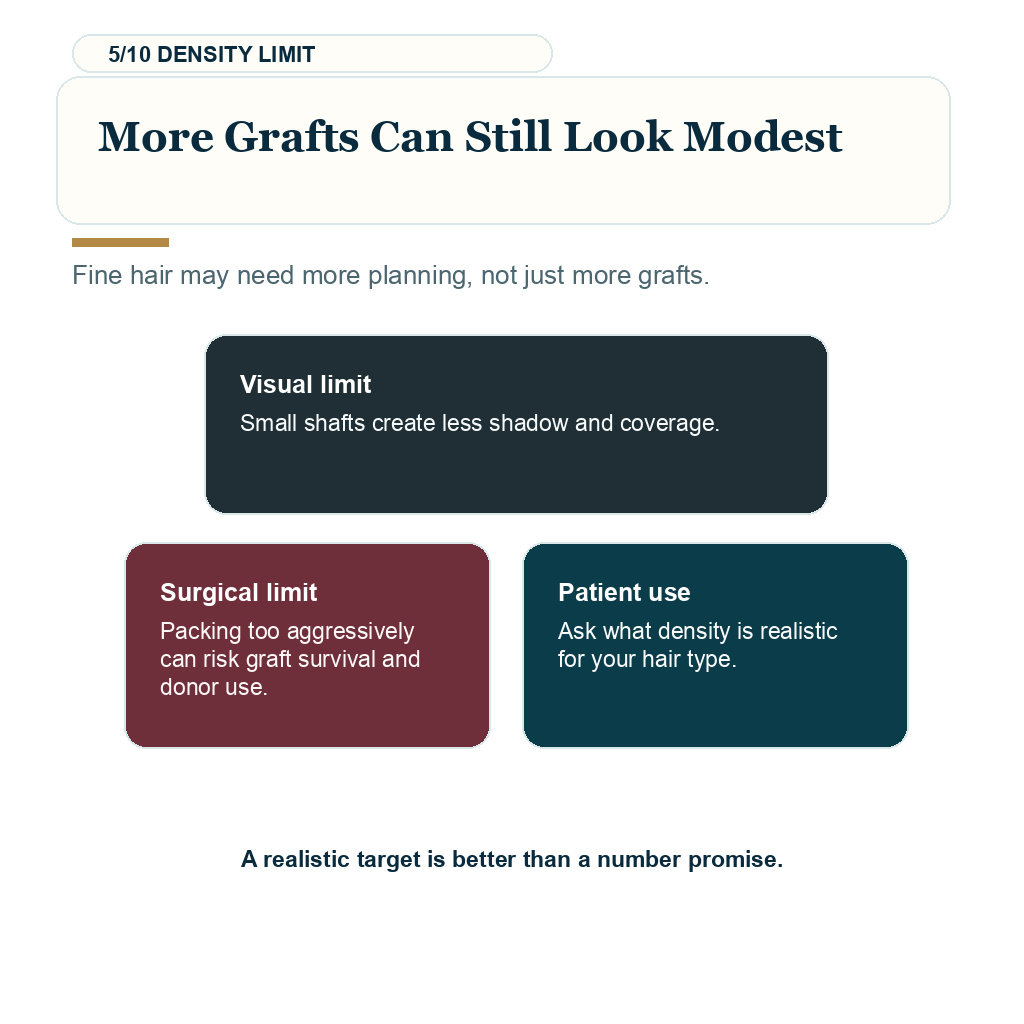
Smaller caliber hair often needs more strategic graft use, but it does not always mean a very high graft number is safer. The exact number depends on the balding area, donor strength, hair shaft thickness, contrast between hair and scalp, age, future loss risk, and the design goal.
Some patients with delicate hair shafts do need more grafts than patients with thicker hair to create a similar impression. But there is a limit. The scalp, blood supply, donor area, hair shaft strength, and future need for grafts all matter.
A clinic can easily use hair caliber as a reason to sell an aggressive number. That may sound helpful at first, but it can be dangerous if the donor area is not strong enough. A big number is not a solution if it creates donor depletion or spreads the grafts too thin across too many zones.
Two consultations can give different recommendations because they may be protecting different priorities. One clinic may quote a large number because it is trying to cover everything. Another may recommend a smaller, more controlled plan because it is prioritizing the frontal frame and preserving options. This is one reason hair transplant graft numbers differ between clinics.
When I calculate grafts for fine caliber hair, I am not trying to win a number contest. I am deciding how many grafts can be used safely and where they will create the most visible benefit.
A density number, even one that sounds reassuring such as 45 grafts per cm2, does not mean the same thing in every scalp. Fine straight hair, strong contrast, and a larger recipient area can still look lighter than thicker or wavier hair at the same graft density.
The better measure is not how many grafts sound impressive. It is whether the number fits the donor area, the recipient area, and the lifetime graft plan.
Hairline planning when the hair is fine
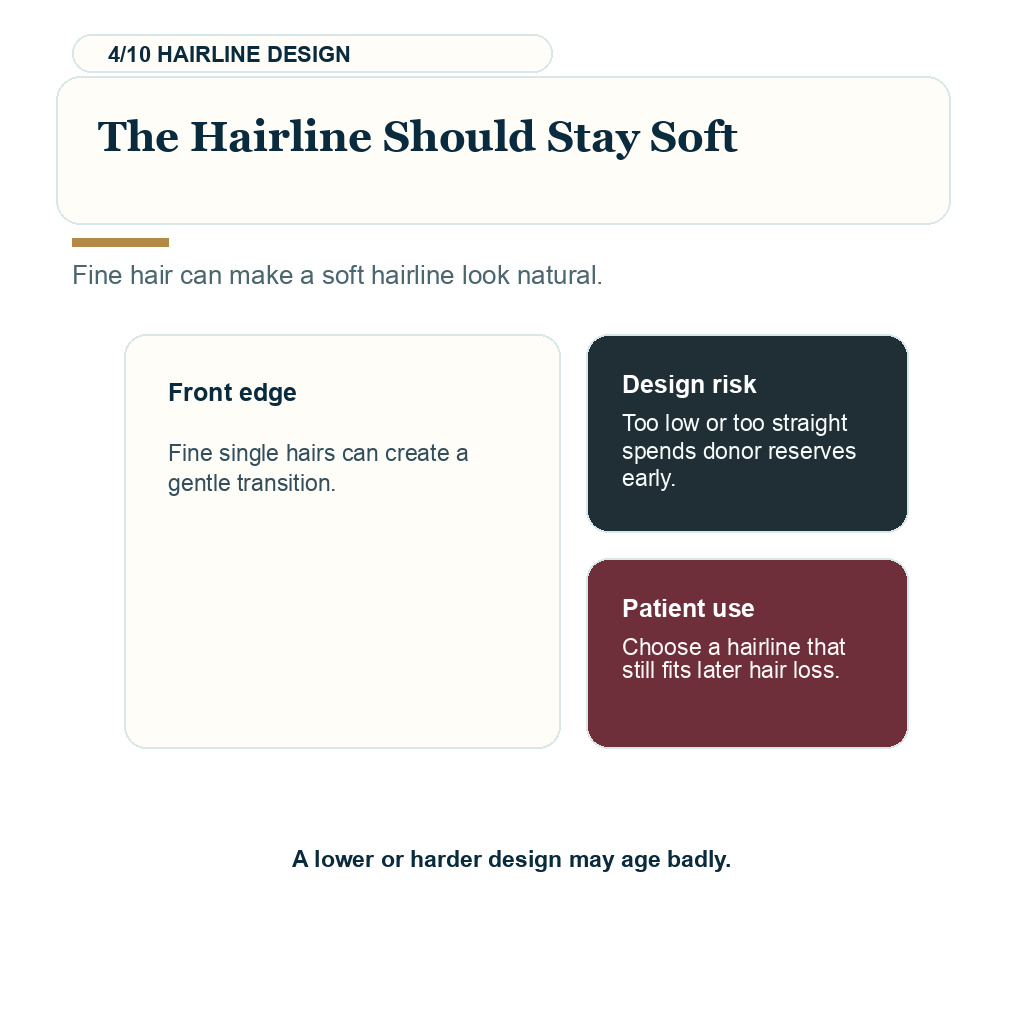
The hairline is usually the area I protect most in a patient with smaller caliber hair because it frames the face. If the hairline is too low, too straight, or too dense in the wrong way, this hair type will not hide the design mistake. It may actually make the mistake more visible.
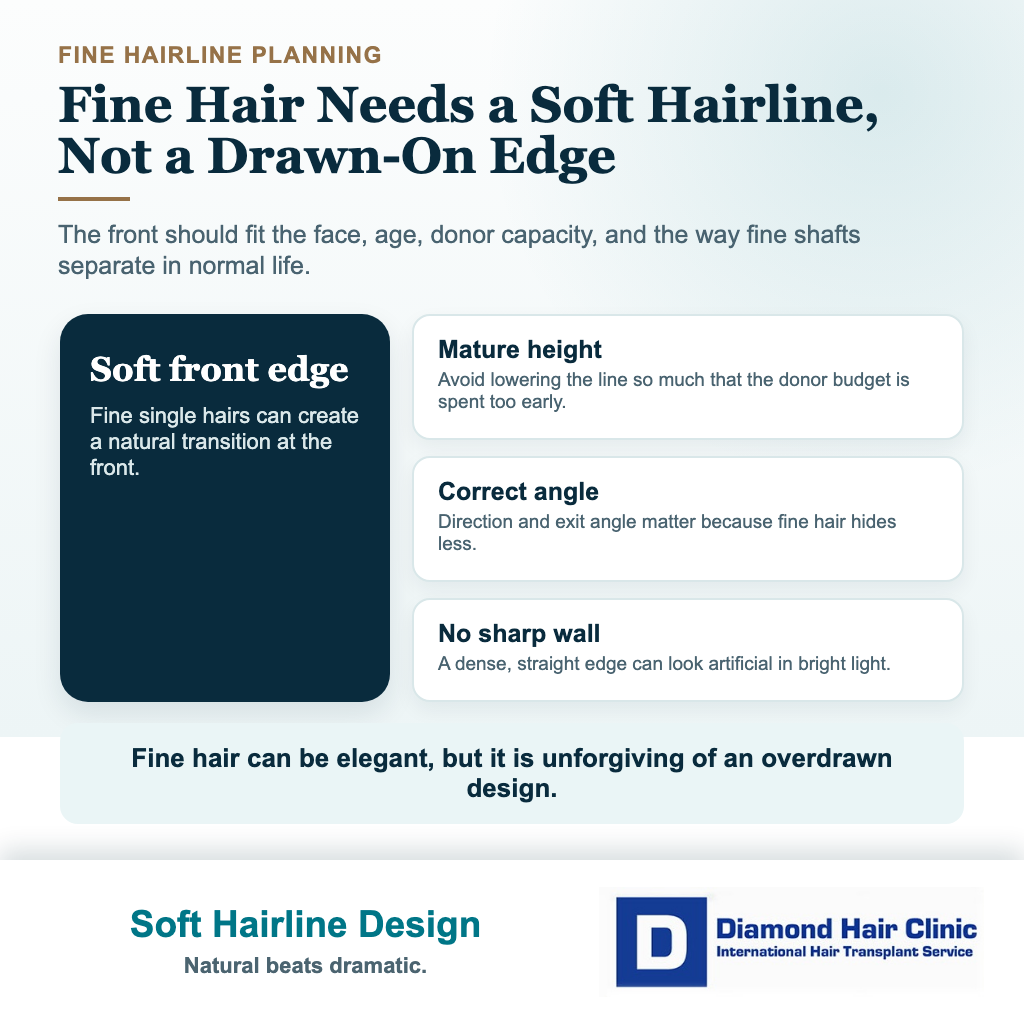
The front needs to stay soft, slightly irregular, and correctly angled when the hair is dry, wet, combed, or slightly separated. Fine single hairs can be useful at the very front because they create a softer edge. The poor decision is using the hairline to chase drama that the donor area cannot support.
Some patients think a sharp hairline is a sign of density. In a surgical plan, a sharp hairline can be a sign of poor judgment if it does not match the face, age, and donor capacity. A natural result cannot look drawn onto the forehead.
With smaller caliber hair, a mature, carefully placed hairline often gives stronger long term value than a low dramatic line. The design does not need to look weak. It needs to look natural.
The single hair grafts at the front must be selected carefully. The transition behind them must be built in a way that gives coverage without creating a hard wall. This helps explain why natural hairline design in hair transplant matters so much.
A delicate hair caliber can produce a refined result when the design respects the face and the donor limit. It becomes disappointing when the plan tries to force heavy density, a very low line, or a shape copied from a different hair type.
The temples and side transition also matter. Fine caliber hair at the front with weak temple support can make the face look framed in an incomplete way. The central line may grow, but the overall frame may still feel unfinished if the side relationship was ignored.
The front cannot be designed as a line alone. It has to be designed as part of a face. A patient with this hair type often needs more visual intelligence in the plan because there is less thickness available to hide poor architecture.
Thinner hair shafts can still give enough density
Thinner hair shafts can give enough density when the treated area is realistic and the grafts are placed with clinical judgment. Enough density does not mean the scalp disappears in every light. It means the result frames the face naturally, improves coverage, and looks appropriate in normal daily conditions.
The word enough needs context. Enough for a frontal hairline may be very different from enough for a large crown or diffuse thinning pattern. This hair type has limits, and pretending otherwise only creates frustration.
In a patient with strong donor density and a limited frontal recession, fine caliber hair can still create a satisfying transformation. In a patient with advanced loss, weak donor supply, and high scalp contrast, the same hair type may need a more conservative goal.
One photograph is not enough to answer this. The donor area, miniaturization, scalp contrast, hair direction, donor hair length, and the true size of the recipient area all have to be assessed.
The planning process is similar to the broader question of how a surgeon calculates graft number. The number only has meaning when it is connected to the area, the hair type, the density target, and the expected visual result.
Fine hair planning cannot be reduced to a needle, punch, or implantation label. A technical detail on its own cannot show whether the donor can support the area being treated or whether the result will look natural. The plan still has to account for graft selection, direction, the size of the recipient area, and the visual density that is realistic for your hair type.
Smaller caliber hair can look refined and natural. It simply needs a result that respects optical reality rather than promising impossible fullness.
Fine caliber can become a warning sign
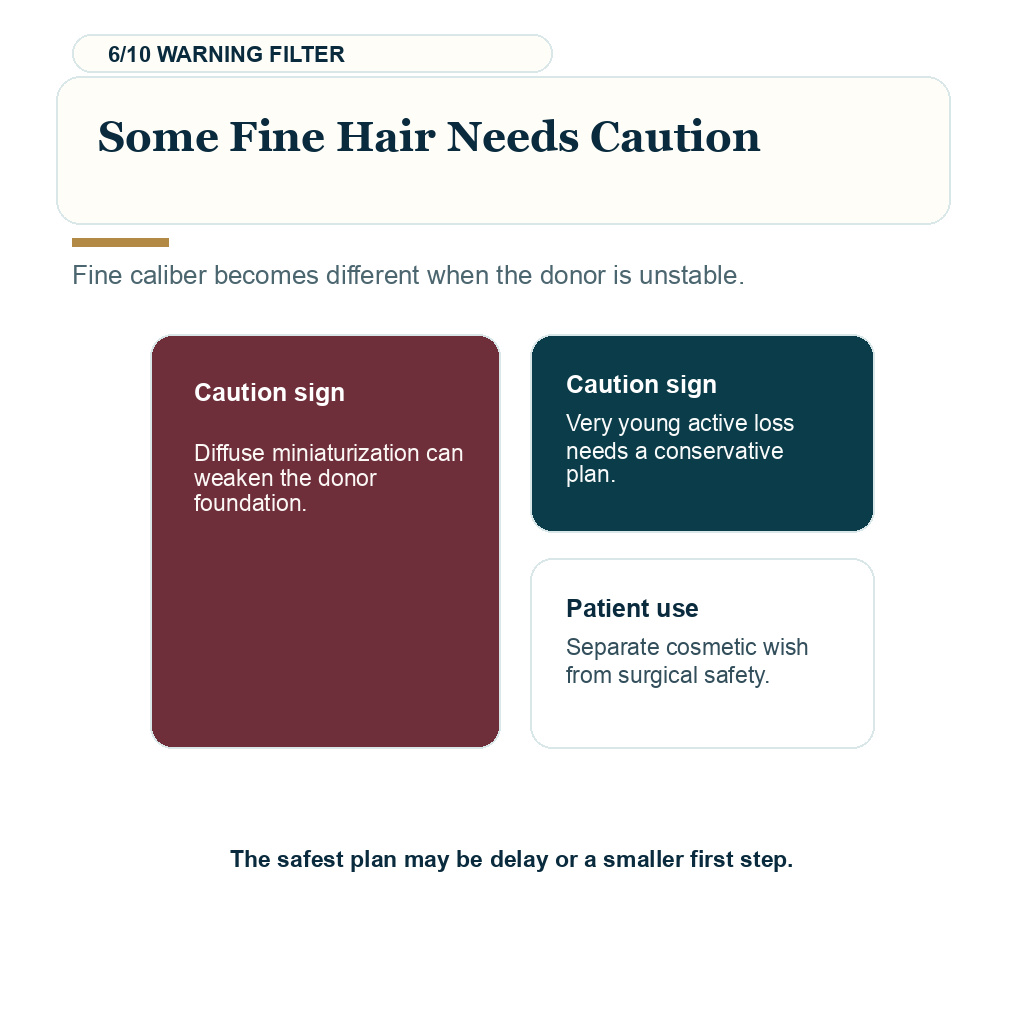
Fine caliber becomes a warning sign when it is combined with weak donor density, diffuse thinning, high contrast between hair and scalp, unstable loss, or unrealistic expectations. One factor alone does not decide the case. The combination decides the risk.
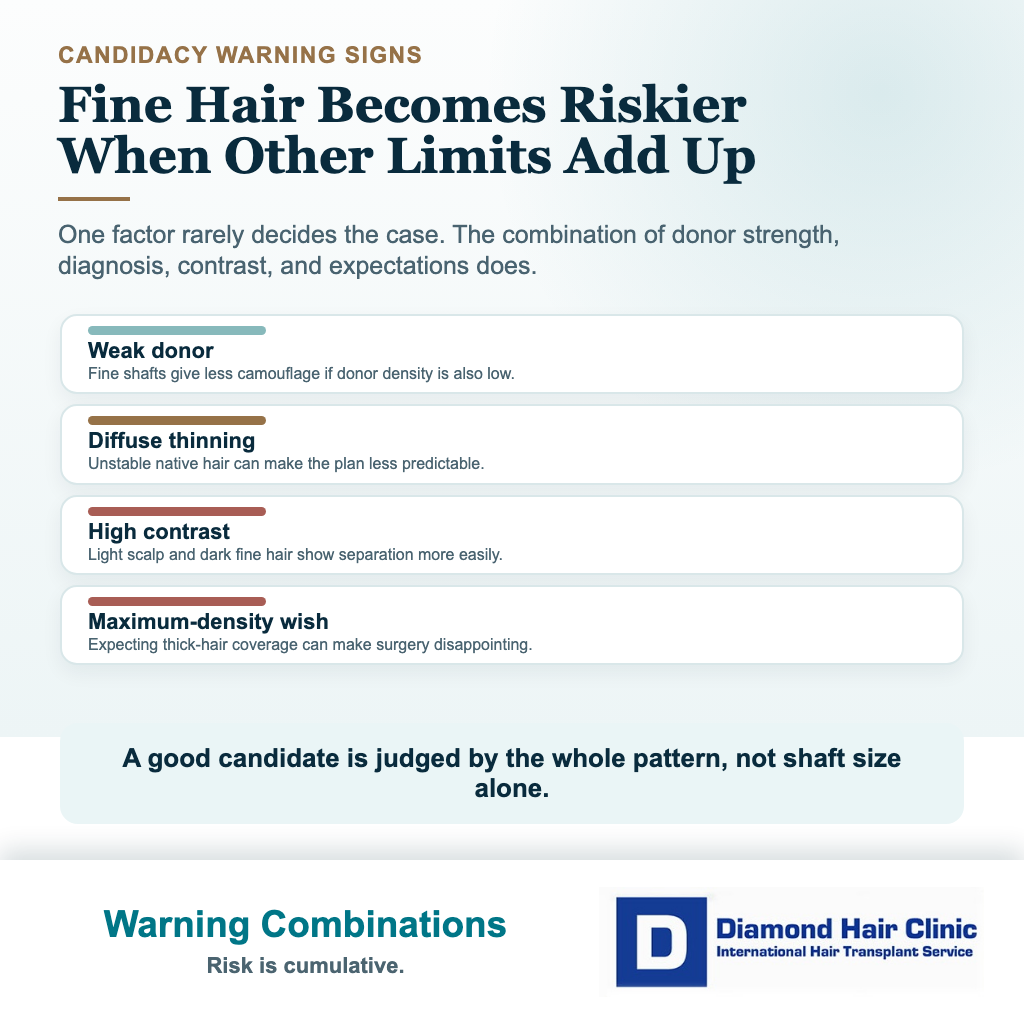
A patient with smaller caliber hair but a strong donor area may still be a good candidate. Another patient with the same shaft type, thinning donor sides, aggressive hair loss, and a desire for maximum density everywhere may be a poor candidate for surgery, at least at that moment.
The donor area is the foundation. If the donor is limited, a smaller shaft gives less coverage per graft, so every graft must be used with even more judgment. The donor area in hair transplant has to be evaluated before the final design is discussed seriously.
Smaller caliber hair can also be part of diffuse thinning. When that happens, the patient may not have a clear empty area. Instead, they may have weaker hair across a broader zone. Transplanting into that pattern needs more caution because the native hair may continue to miniaturize.
When diffuse thinning is present, the patient may first need medical stabilization, observation, or a different plan. Diffuse thinning hair transplant planning is not the same as filling an empty temple.
The weaker the donor and the wider the area, the more dangerous it becomes to chase density with smaller caliber hair. Good selection protects you more than sales language ever can.
There is another warning sign I take seriously. If someone already hates every close up photo because they inspect the scalp from a few centimeters away, surgery may improve the hair, but it may not settle the anxiety unless the expectation is reset first.
A transplant needs to improve the real cosmetic problem. It cannot become a promise that you will never see scalp again. That promise is not medically accurate for many patients with soft, low caliber hair.

Bright light and wet hair need context
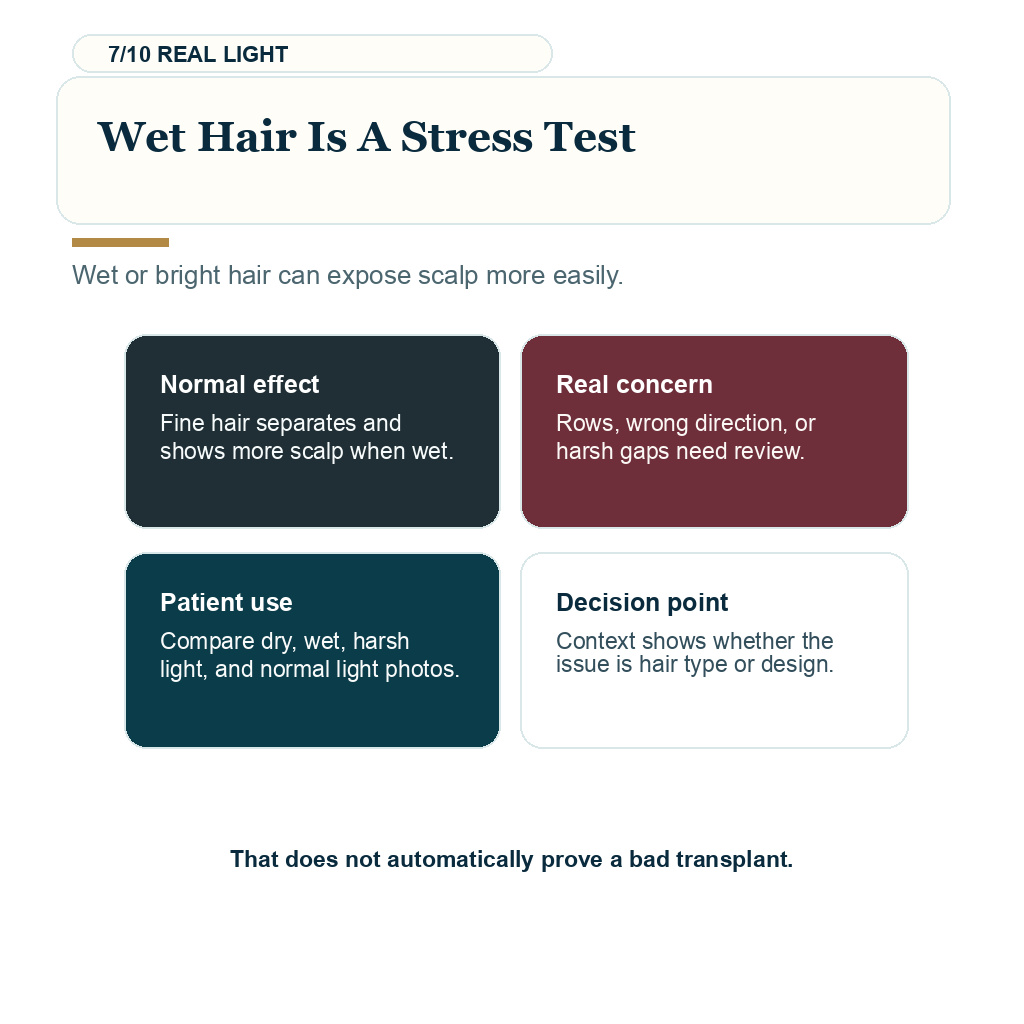
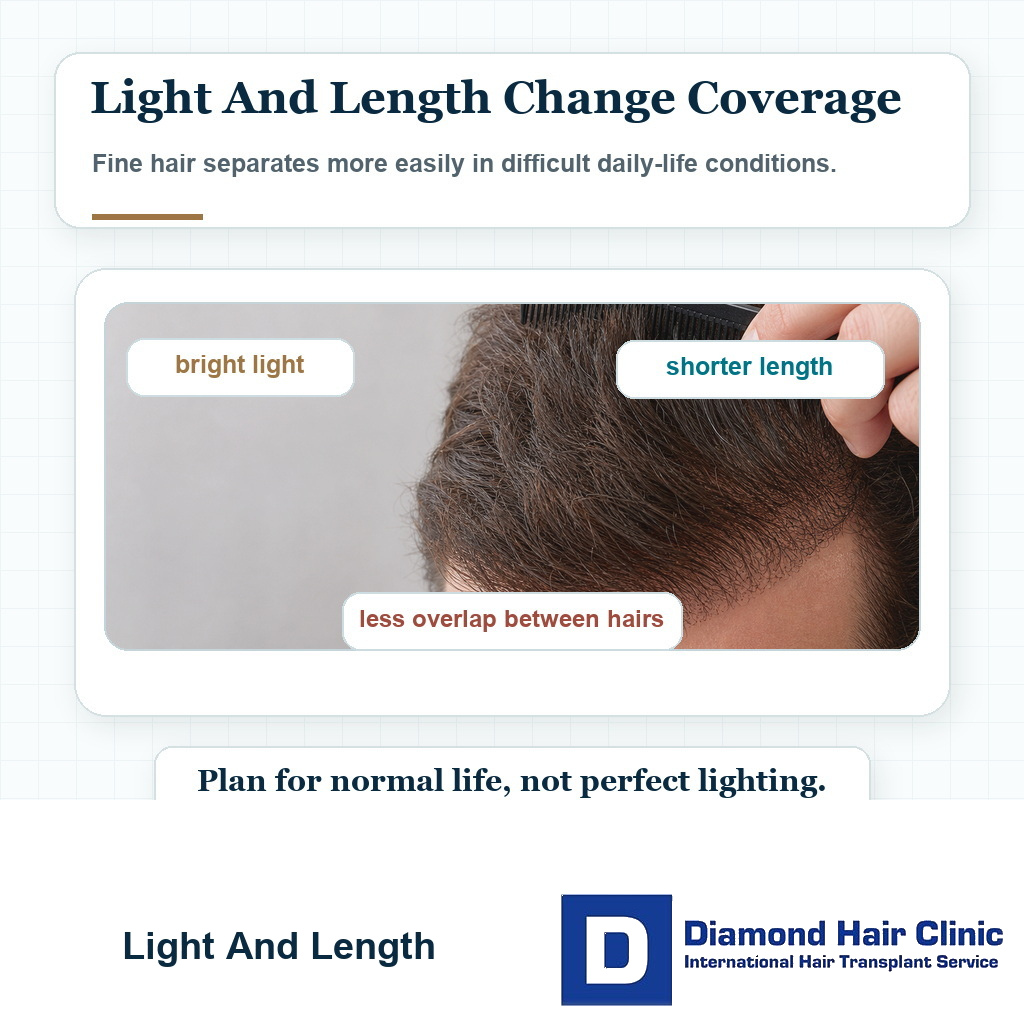
Smaller caliber hair may show more scalp in bright light, under bathroom lighting, after sweating, or when wet. That does not always mean the transplant is bad. It means the hair type has less coverage power under difficult conditions.
Every person has some scalp visibility when the hair is separated or wet. This hair type makes that visibility easier to notice. The fair question is whether the result looks natural in normal life and whether the patient was prepared for how the hair would behave.
Do not discover this only after surgery. If the hair is likely to look lighter in certain conditions, that must be clear before the operation. A truthful expectation is kinder than a promise that fails the first time you stand under bathroom light.
Harsh light can also expose design errors. If graft direction is wrong, if rows are visible, or if the hairline is too uniform, lower caliber hair may make the problem easier to see. This is different from normal scalp visibility.
Fine hair also needs fair judgment in harsh light and wet hair, especially when the shafts are delicate. A good result needs judgment in real life, not only through the harshest possible close up.
Smaller caliber hair may need thoughtful styling, appropriate length, and realistic product use after recovery. That does not make the surgery unsuccessful. It means the transplant created a foundation, and the patient’s natural hair type still behaves according to its own optical limits.
Fine hair can be frustrating to manage when it becomes oily or styling products leave it flat. Before surgery, I want to know how much daily styling you can realistically maintain. Better coverage should not be promised as freedom from washing or styling.
Once the scalp has healed and normal hair care has been cleared, match washing to oil and product buildup. Straight hair with an oily scalp may need daily shampooing. Clean the scalp gently and keep conditioner mainly on the ends of fine hair.
Short hairstyles need realistic planning
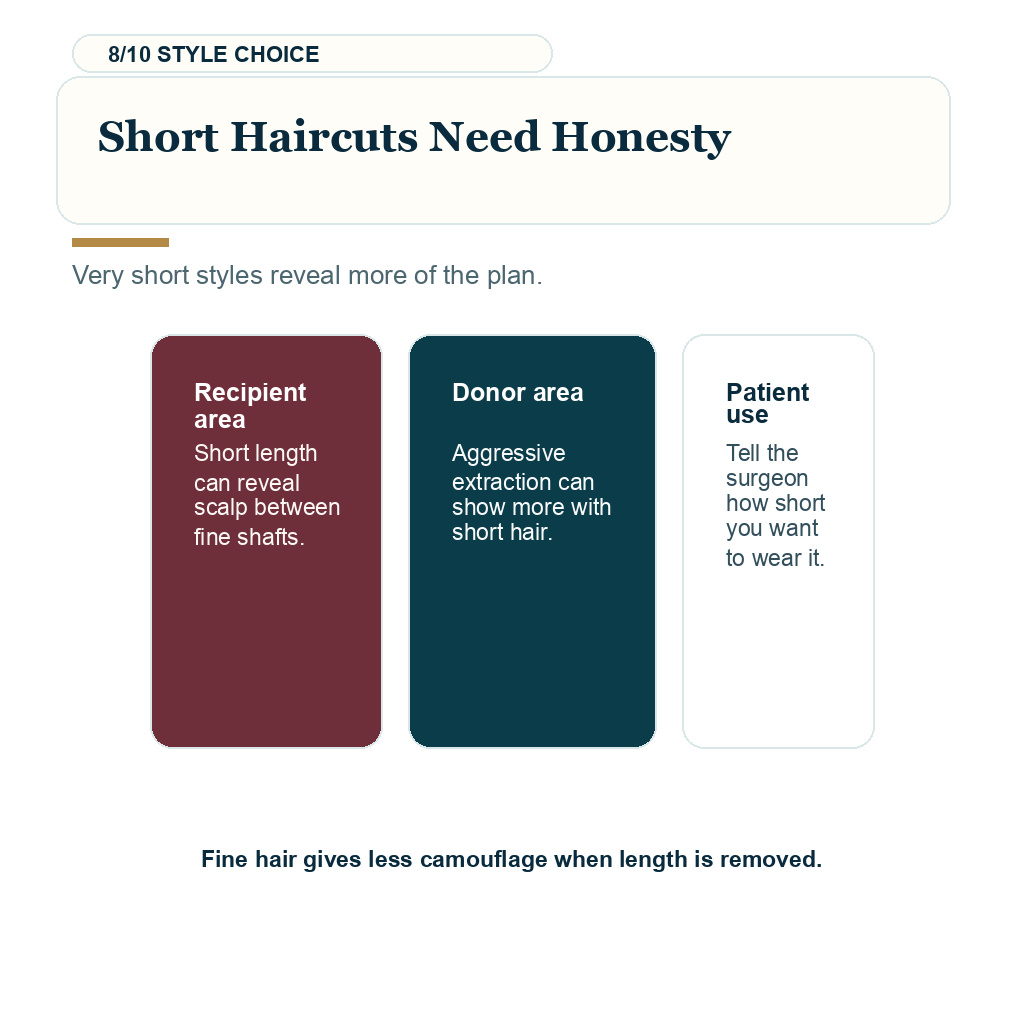
Some patients with smaller caliber hair can wear the hair short after a transplant, but a very short cut may expose more scalp, more contrast, and sometimes more donor extraction pattern than the patient expects. The question includes the recipient area and how the donor area looks when the hair is cut close.
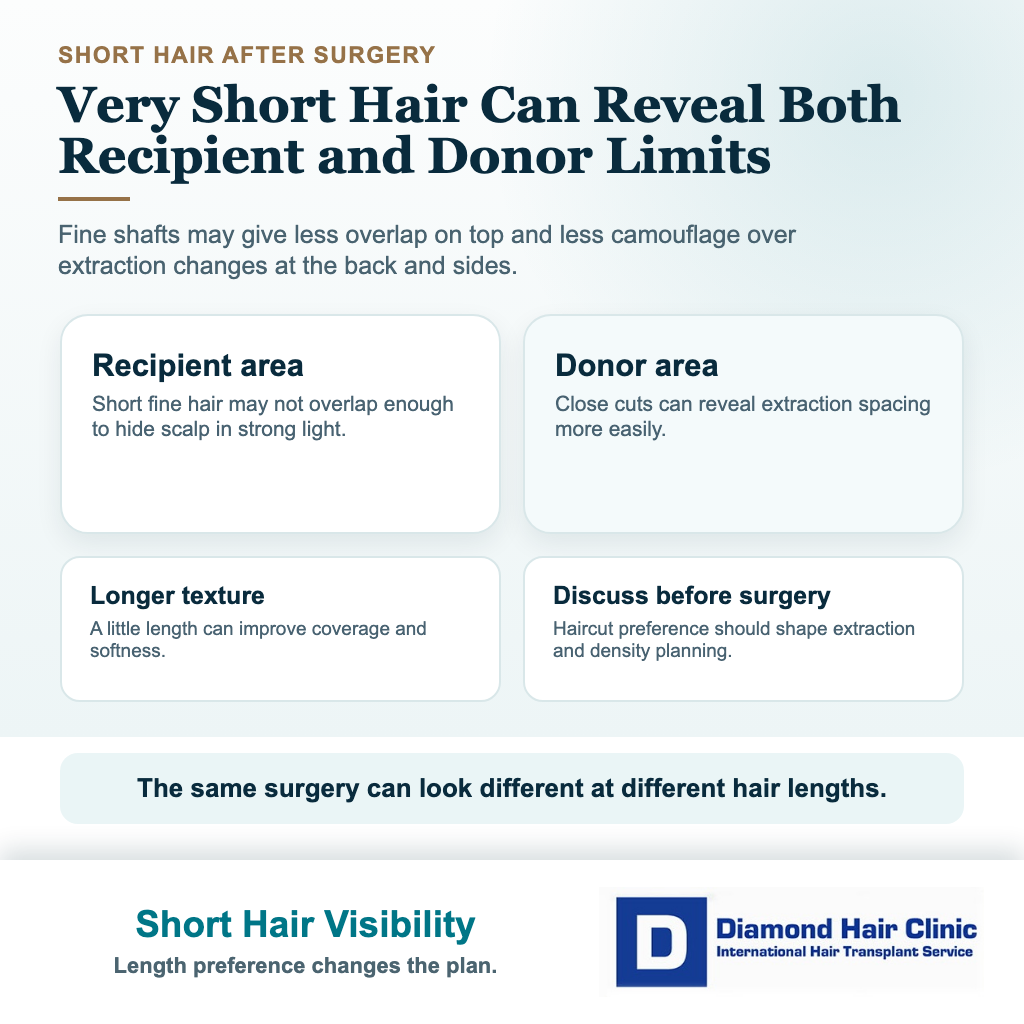
This hair type gives less camouflage in both places. In the recipient area, short delicate hair may not overlap enough to create strong coverage. In the donor area, the same low caliber hair may not hide small extraction changes as easily as thicker hair.
Haircut preference should be part of the consultation before surgery is planned. A patient who wants a longer textured style may be a very different case from someone who wants a very short fade. The same graft extraction pattern can look acceptable at one length and too visible at another.
Before accepting a high graft quote, the plan should show how the donor will be mapped and how extractions will be spread. Fine hair can make uneven donor thinning more visible at short length, so the graft total alone does not show whether the donor will still look natural with the haircut you expect to wear.
If the purpose is to shave very short after a hair transplant, I harvest more conservatively in the donor area. Do not gain a frontal frame and then feel forced to hide the donor forever. That would not be a complete success.
In the recipient area, smaller caliber hair often benefits from a little length because length allows overlap. Hair does not create coverage only by standing on the scalp. It creates coverage by laying, layering, and interrupting the reflection from the scalp.
In practice, a transplant in this hair type may look much better with a slightly longer style than with a very short cut. The surgery may be the same, but the visual effect changes because the hair has more opportunity to cover.
I do not tell every patient with delicate hair shafts that short hair is impossible. That would be too simple. The haircut must be part of the surgical conversation, because the plan needs to fit the way they actually want to live with the result.
If a clinic never asks about haircut preference, that is a missing part of the evaluation. The result is not judged only in clinic lighting. It is judged in the mirror, at work, after a shower, after a haircut, and when the patient feels unguarded in normal life.
Before and after photos can mislead fine hair patients
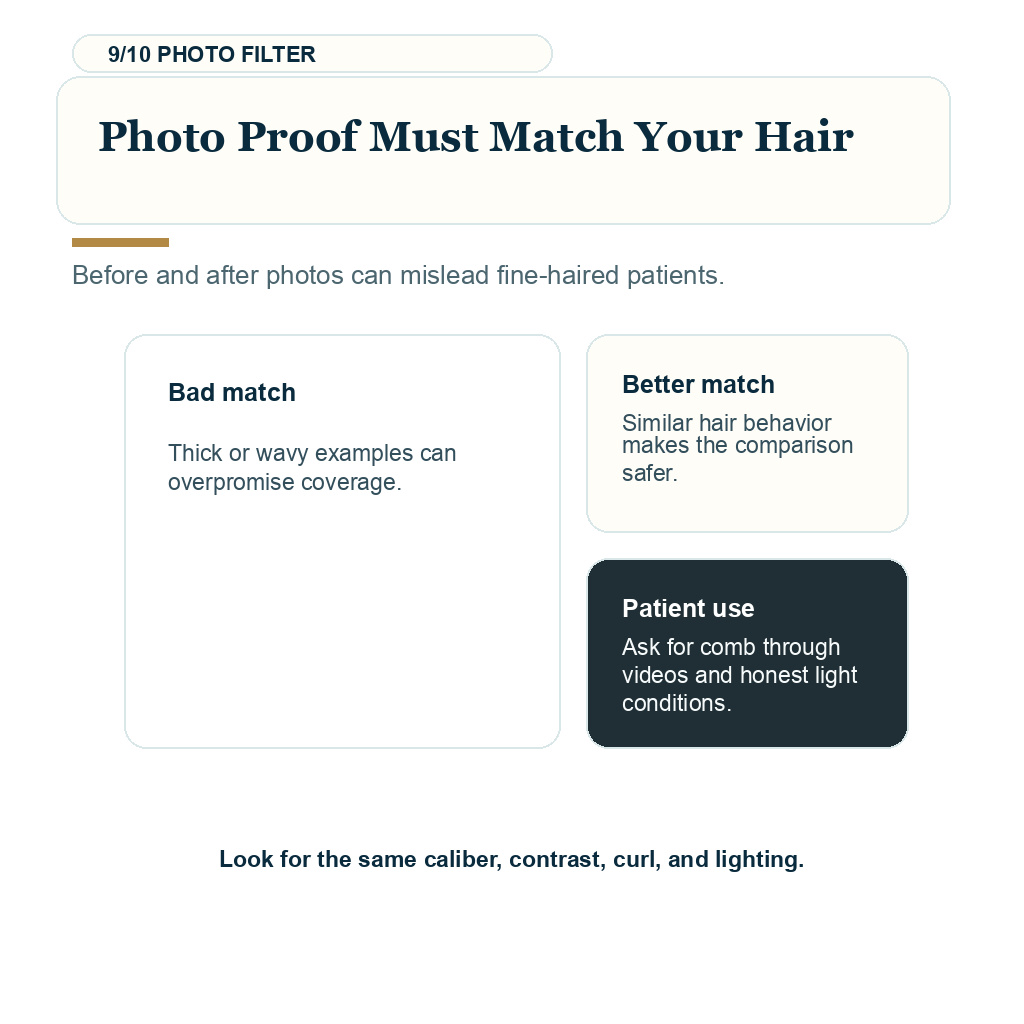
Before and after photos can mislead patients with this hair type very easily. If a patient with thinner hair shafts judges their possible result from a patient with dark, thick, wavy hair and low scalp contrast, they may expect a level of coverage their own hair type cannot provide.
Good comparison requires similar hair quality, similar hair loss pattern, similar donor strength, similar lighting, similar length, and similar styling. Without that context, the comparison becomes emotional rather than useful. This concern also applies to judging whether a hair transplant plan can be trusted from photos alone.
I slow down around spectacular photos used without context. A result can look impressive because the patient had excellent hair characteristics from the beginning. Another result can be surgically excellent but more modest because the patient had fine caliber hair and a larger area to cover.
If this describes your hair, look for cases that resemble you. Look at wet or parted views when available. Look at the donor area as well as the recipient area. Look for naturalness, not only density.
An older photo of your own hair can help me understand the hairline or style you miss. The plan still has to fit the hair and donor area you have now.
Hair transplant before and after photos should be interpreted with caution. For patients with lower caliber hair, that caution matters even more.
The wrong comparison can push you toward the wrong clinic, the wrong graft number, or the wrong emotional expectation. The right comparison helps you understand what is realistically possible in your own case.
Planning fine hair cases before surgery
With fine caliber hair, do not think only in graft numbers. The consultation needs to explain whether the visual improvement you want can be created without spending the donor area too aggressively.
The first priority is deciding which area needs treatment and why. This hair type may need a mature hairline, careful corner design, soft transition, and realistic density expectations. If the hair separates easily or looks see through under strong light, the plan must respect that from the beginning.
Then the clinic needs to explain what the proposed density is meant to achieve and what it may sacrifice. Some patients with smaller caliber hair are strong candidates. Others are not. Candidacy matters more than enthusiasm. A proper evaluation of whether you are a good candidate for hair transplant needs to include hair quality, donor capacity, expectations, diagnosis, and long term planning.
A careful consultation also shows whether the clinic is comfortable saying no. A surgeon who cannot say no may also struggle to protect you from a bad plan. That matters when dense coverage is requested across a large area with lower caliber hair.
The answer may be more grafts in some cases, but not simply and not without limits. These cases require constant judgment about graft selection, direction, and density. If the plan is treated as a simple routine, the patient may lose the benefit of a true surgical assessment.
Fine hair needs realistic density expectations
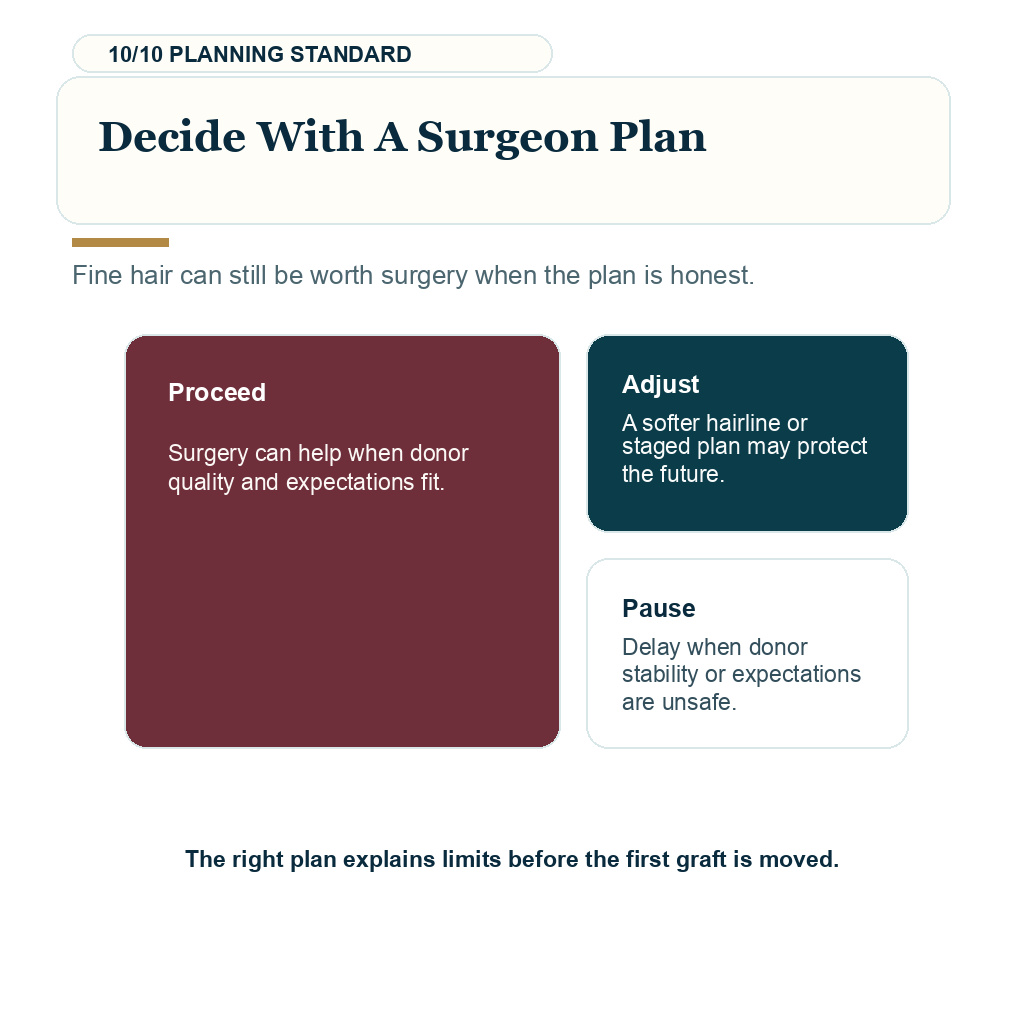
Surgery is worth considering when the expected improvement is clear, the donor area is safe, the hairline design is natural, the treated area is realistic, and you accept that smaller caliber hair will not behave like thick hair.
If the goal is a natural frontal frame, better styling control, and more comfort in normal life, fine caliber hair can often be enough. If the goal is total density across a large scalp with no visibility in harsh light, surgery may disappoint even if the grafts grow.
The best plans for this hair type are not always the most aggressive plans. They are the plans that understand where grafts matter most. They create visible improvement without spending the donor area carelessly.
The plan needs to slow down when dense packing is requested only because the patient is afraid the result will look thin. Dense packing has a place, but too many grafts in one area can create unnecessary risk if the tissue, donor, and future plan do not support it.
Once the first result has matured, a specific area that still needs more coverage can be reassessed for a second procedure. That review includes the donor area, ongoing native hair loss, and the scalp. Fine hair alone is not a reason to book two operations in advance. I would not promise a later density session at the first consultation.
If your hair shafts are fine, do not judge the decision by whether you can copy someone else’s result. Judge it by whether your own donor, hair type, loss pattern, haircut preference, and expectations can support a result that still looks natural on you in daily life.
Hair shaft size changes how density is perceived, whether the patient has fine hair, thicker straight hair, or mixed characteristics. Asian hair transplant planning separates hair shaft and contrast patterns from a generic density plan.

Read this review excerpt
He was very thorough in every little detail and I never felt pressure to do anything I wasn’t sure of.