



Can Nape Hair Be Used for a Hairline Transplant?
Yes, nape hair can sometimes be used to soften the first edge of a hairline, but I use it only in selected cases and only in small numbers. Lower neck and behind the ear border hairs are often finer, which can help the front look less heavy. The tradeoff is donor safety. This border may be less stable over time than the central safe donor area, so I judge it by long term reliability, not only by how delicate it looks today. That hair has to be likely to remain reliable years later.
Growth alone does not justify lower border grafts. The comparison is whether a few of them would improve the visible edge enough to justify using a less certain donor zone. If the benefit is small or the border looks unstable, a slightly higher or softer hairline made from more reliable scalp grafts protects the face better. Using fine border hair only makes sense when losing that softness later would not expose an artificial front edge.
When can nape hair be considered?
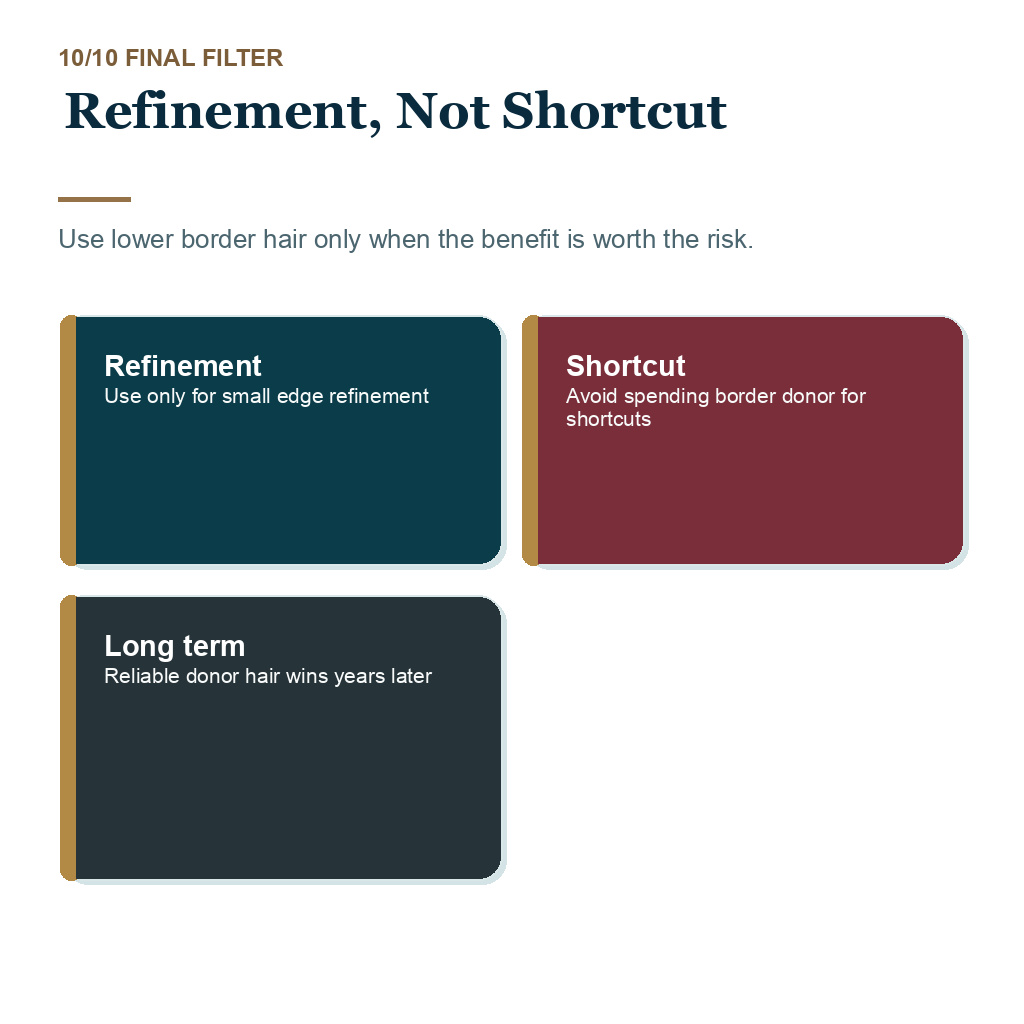
Nape hair is best treated as a small refinement source, not a shortcut around weak central donor supply.
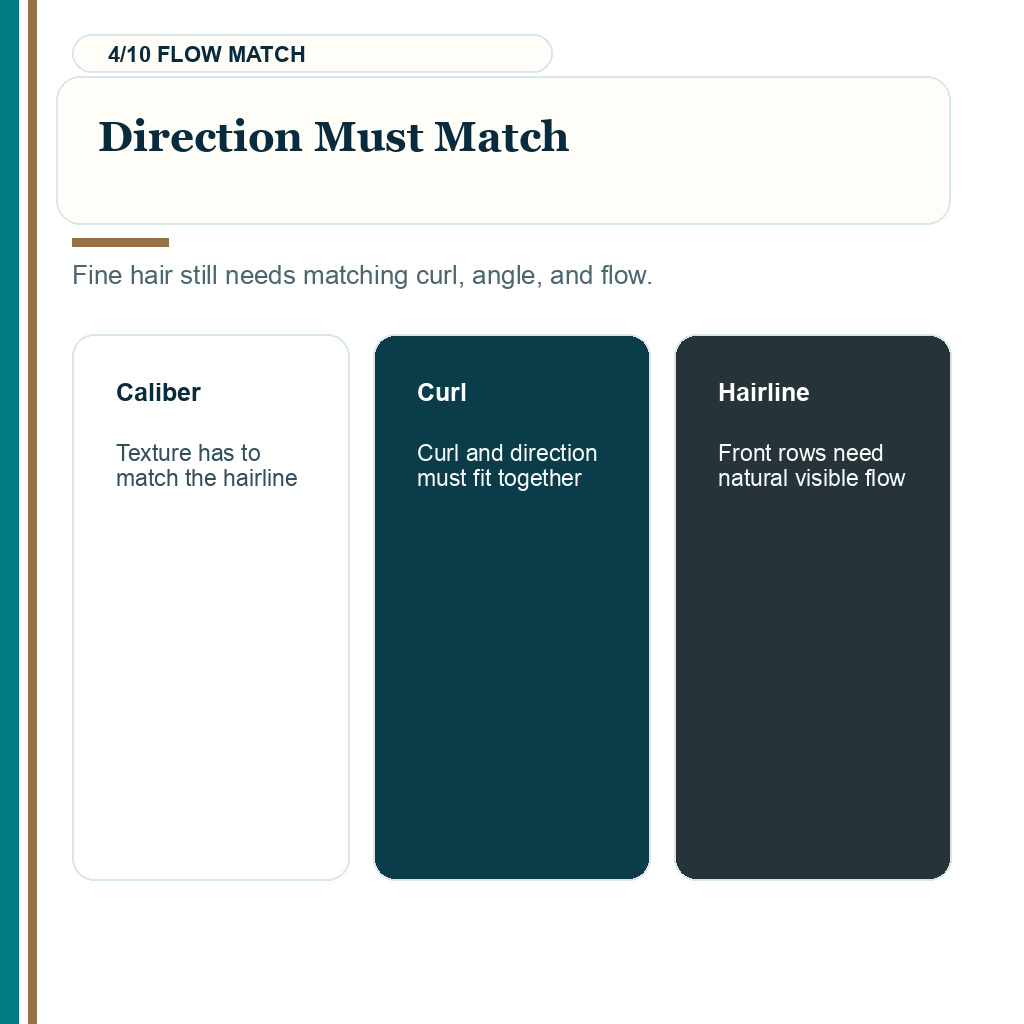
The first rows of a natural hairline need soft caliber, irregular spacing, low exit angles, and careful direction. Hairline design in a transplant is the design side of that decision. Donor selection is the other side. Both have to be right. A fine graft is not always a safe graft, and a safe graft is not always fine enough for the first visible edge.
Why does lower neck hair sound attractive?
The lower neck sounds attractive for three reasons. Some people wear fades or short back and sides haircuts and think this is hair they already remove. Some want softer hair for the front edge because they have seen harsh, pluggy, or too dark hairlines. Others want to protect the main donor area by taking from a place they consider less important. Translate words like lower neck or fade area into a safe donor map before treating that hair as spare.

Those concerns are understandable. The donor area is finite, and it is reasonable to ask how much can be taken without changing the back of the head. But hair that disappears in a fade is not spare hair by default. It still shapes the lower donor border. If extraction creates thinning, dots, or a shelf above the neck, short haircuts can show that change clearly.
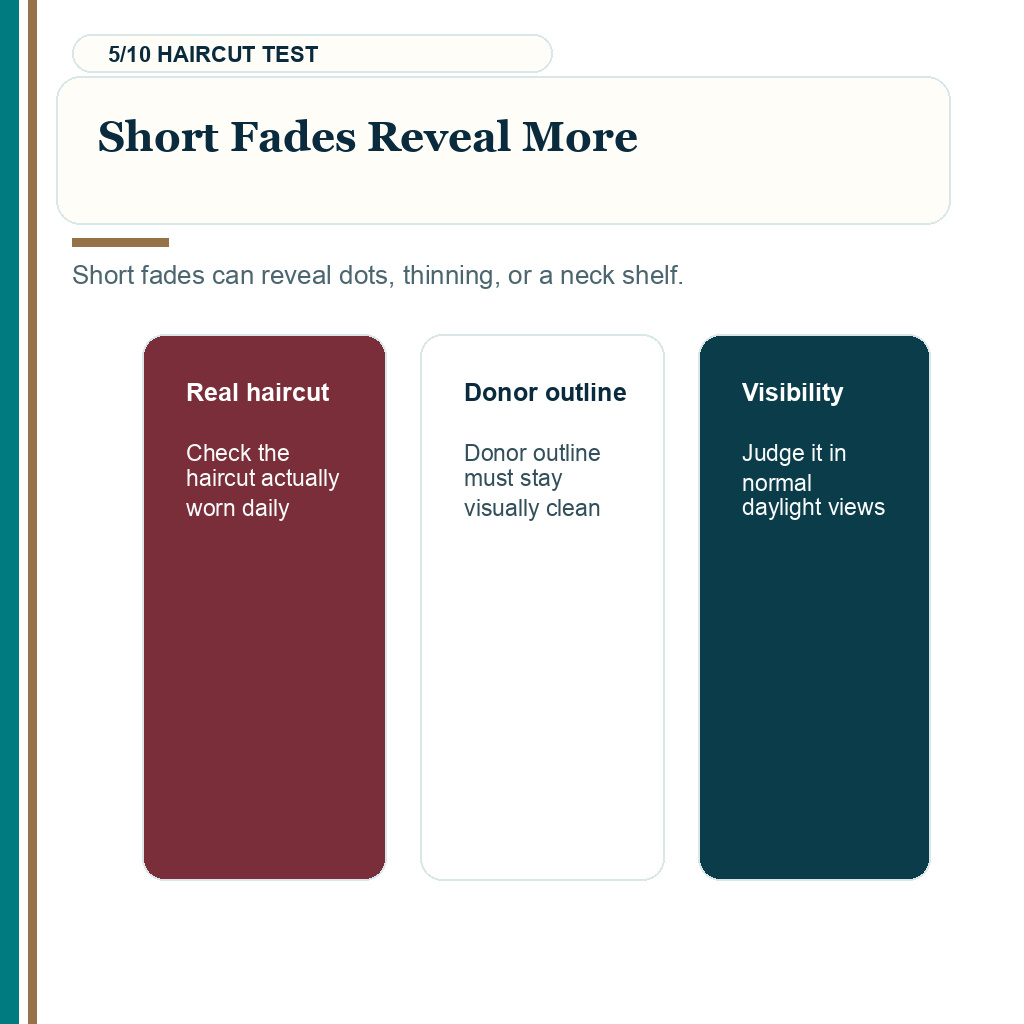
Before asking for nape grafts, show the haircut length you actually wear at the lower neck. A donor choice that looks hidden in longer photos may still matter if short fades expose the border.
If you are already considering laser hair removal on the lower neck or nape, ask before treating that area if you may ever need hairline refinement. I usually avoid nape grafts, but removing the hair permanently before donor review can take a small future option off the table.
A separate misunderstanding is early survival versus long term permanence. A graft can survive the operation and grow for a period of time, yet still be more vulnerable to future thinning if it came from an unstable zone. Survival after surgery and permanence over decades are not the same decision. If lower border hairs thin later, the first visible edge can become sparse or irregular, and repairing that edge spends more donor hair.
The nape is not the main safe donor area
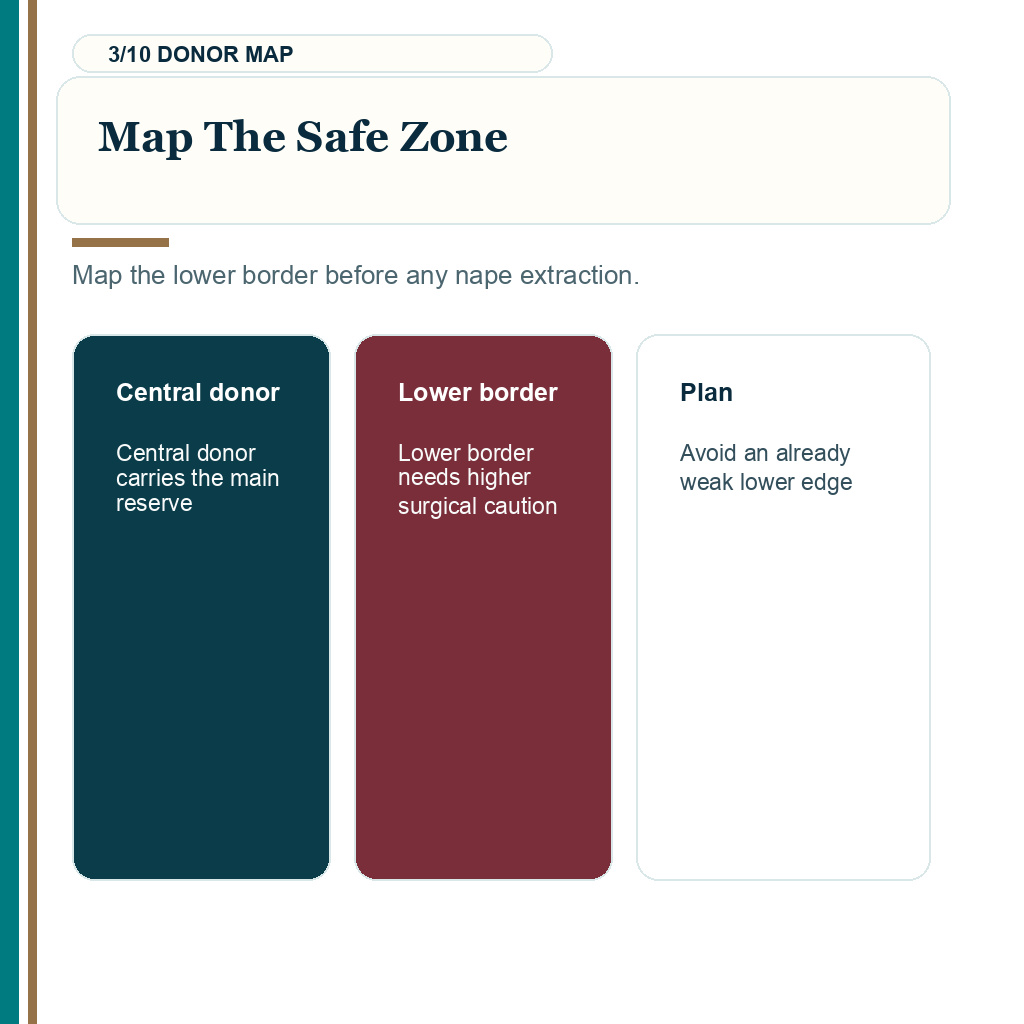
The central safe donor area is selected because its follicles are more likely to resist typical male pattern hair loss. Even inside that safer zone, density, caliber, curl, and long term stability vary from one person to another. The lower border sits beneath that core zone. In some people it remains strong. In others it thins upward with age or shows early miniaturization before the change becomes obvious.
The nape can look healthy when hair is long. It can also look strong after a fresh haircut because the contrast is reduced. A close donor examination may tell a different story. Miniaturized donor hairs, thinning at the lower border, family history, or a narrow donor band all change the risk. Retrograde alopecia and DUPA are the reason donor stability has to be checked before surgery, not assumed from appearance.

The first row donor choice has to balance softness, stability, and future hair loss risk.
I also compare nape hair with nearby central donor hair. If the lower border is clearly finer, that may help softness. If it is also sparse, mixed, or miniaturized, that softness becomes a warning. Fine because the hair is naturally delicate can be useful. Fine because the hair is already weakening is a reason to avoid it.
Fine hair is useful only if it is stable
Nape hair can be considered only when the donor examination supports it. The lower border needs to be stable, without meaningful retrograde pattern, diffuse donor thinning, or weak central scalp donor reserve. The hairline plan also needs to be modest. I am looking for a limited number of fine grafts near the front, not a second donor supply for a large design.
When it is appropriate, I use it selectively. Fine single hairs can soften a few exposed transition points. They cannot be used as an excuse to lower the hairline, close the temples too aggressively, or promise density that the main donor cannot support. Fine hair transplant planning already requires realistic density expectations. Nape hair planning needs even stricter donor judgment.
The real hairstyle matters too. If you wear very short fades, taking too low can change the donor outline. Even for a small touch up, a private shave or hidden lower border area does not make the donor choice safer. It only changes what is visible after extraction. If you wear longer hair, a small lower border harvest may be less visible, but long hair can also hide early donor weakness. The haircut you actually wear is part of the donor plan.

Nape hair can help softness only when the lower donor border is stable enough to justify using it.
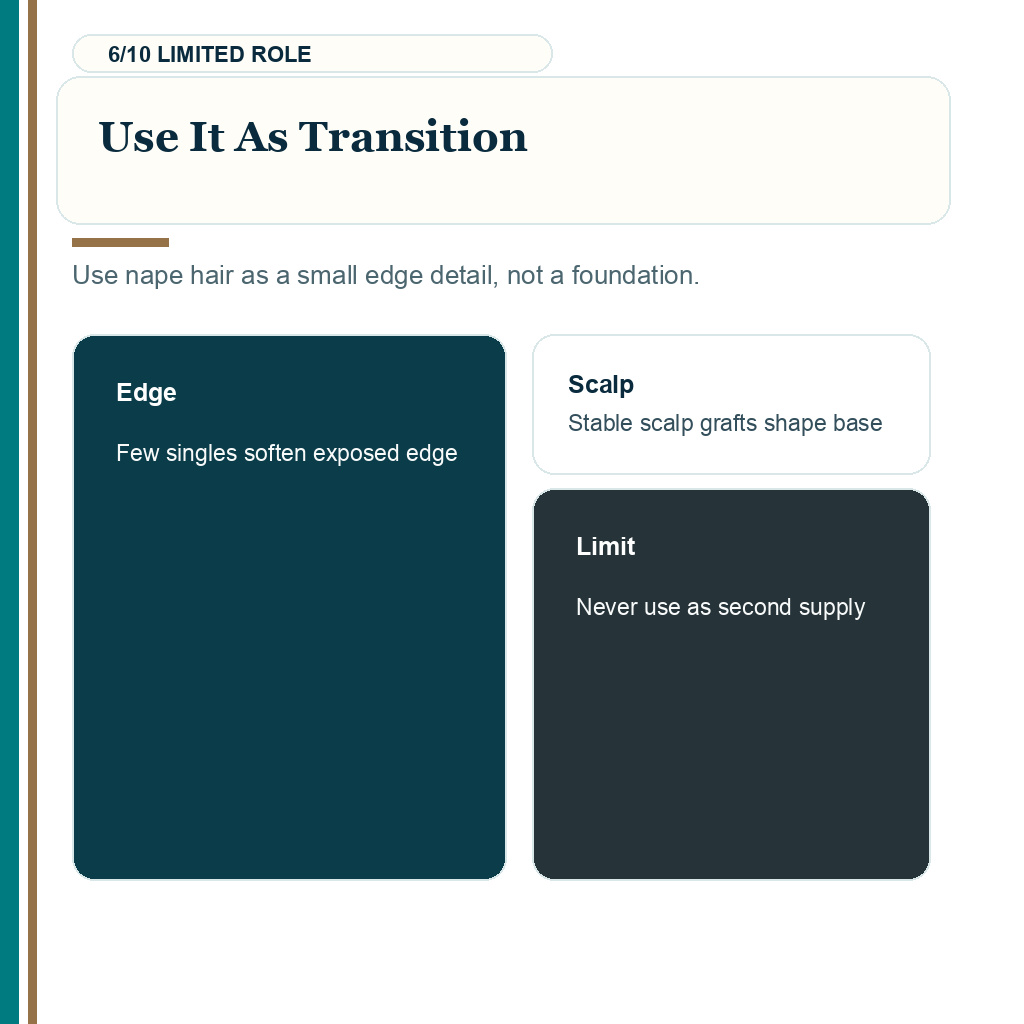
Use the 10 nape hair planning slides below to compare donor border stability, fine hair usefulness, safe zone mapping, curl and direction match, short fade visibility, limited transition use, stop signals, age risk, backup planning, and the final refinement rule. Swipe the carousel, use the arrows one step at a time, or choose a number below the image to jump to that point.


Nape grafts are a transition detail
If nape hair passes the donor stability check, it belongs as a limited transition detail rather than the foundation of the whole hairline. The most useful role is a small number of fine single hairs in exposed edge points where softness matters most. Stable scalp grafts still need to create the main structure behind that edge.

This distinction protects the result if the lower border changes later. A few carefully chosen nape grafts can soften a visible area without making the entire frontal result depend on a less certain donor zone. A hairline built mostly from borderline lower neck hair may look delicate early, but it gives less protection if that donor border thins with age. The hairline still has to look acceptable if the lower border contribution becomes weaker over time.
When is nape hair the wrong choice?
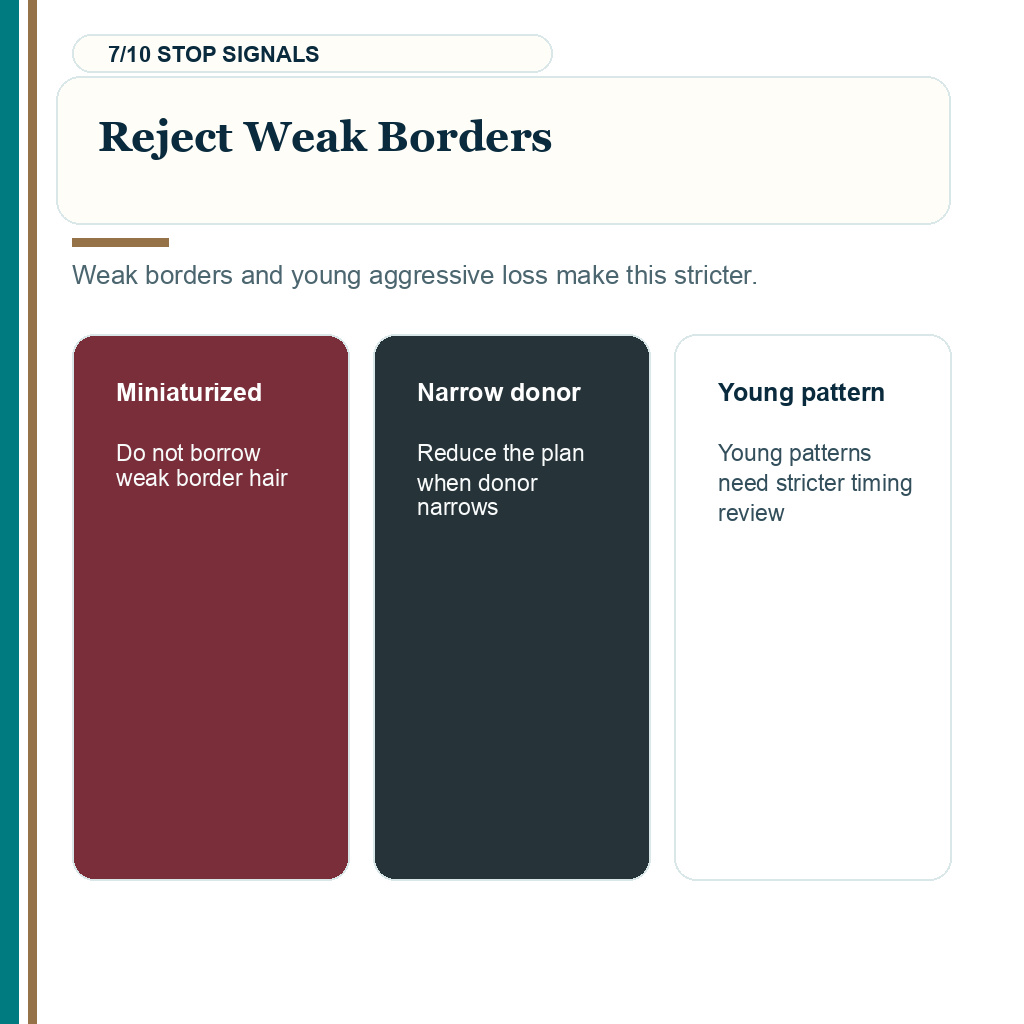
Nape hair is the wrong choice when the lower donor border already looks thin, uneven, miniaturized, or likely to recede upward. It is also a poor choice in a young person with aggressive family hair loss, visible retrograde thinning, or a large hairline design that depends on many lower border grafts. In those situations, the nape may create a short term design advantage and a future visibility problem.
A weak donor area should make the plan smaller, not more aggressive. Weak donor area hair transplant planning is especially relevant when nape hair is being considered. If the main donor is limited, adding borderline nape hair must not be used to hide that limit.
Nape hair is also risky when the clinic cannot explain exactly how many grafts will be taken from that area, where they will be placed, and what will remain for future hair loss. Vague answers are not enough. A clear plan says whether nape grafts are being used for a few soft singles, for a larger frontal zone, or simply because the planned graft number is too high.
Age makes the decision stricter
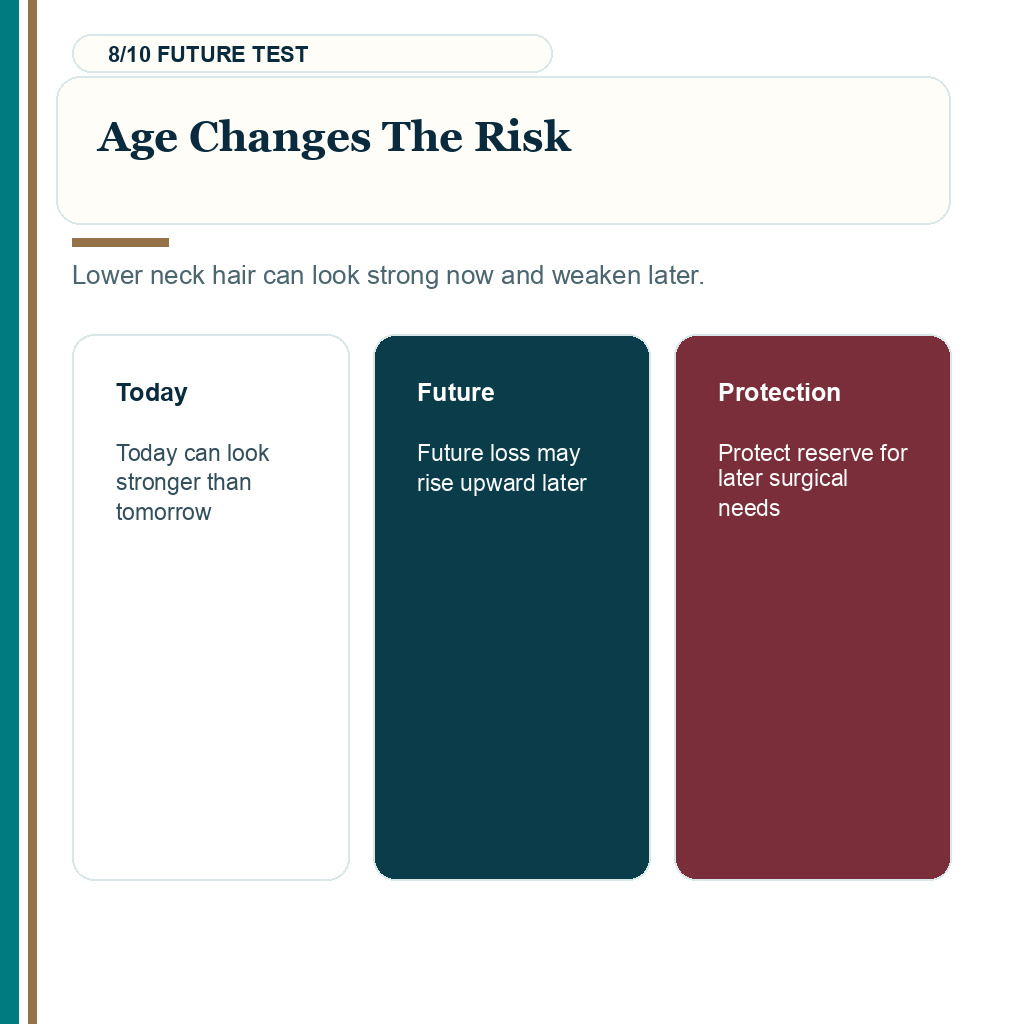
Age changes the answer because donor stability becomes clearer over time. In a young person, the final pattern of hair loss may not yet be visible. Lower neck hair can look strong at 24 and become less reliable later. If those hairs are placed in the front edge, future thinning can appear exactly where naturalness matters most.
Donor planning therefore has to include the future, not only the surgery day. Someone who may need a second or third operation should protect the most reliable donor hair first. In lifetime hair transplant graft planning, every graft choice has opportunity cost. Nape hair should never be used to make an immature hairline design look possible.
Aging makes the same donor decision stricter. A hairline should still look natural when the patient is older and when surrounding native hair changes. Natural hair transplant results with aging depend on more than today’s density. The design still has to make sense later.
The donor border must be mapped before extraction
The donor border should be assessed with close examination, short hair views, magnification when needed, and comparison to the central donor area. I look at density, caliber, miniaturization, direction, color contrast, family pattern, and whether the person normally wears a fade, a longer haircut, or a style that exposes the lower neck. I also want to see the donor border at the haircut length the person actually plans to wear, because extraction dots hidden by longer hair can be visible with a short fade.
When the decision is borderline, clinic photos need context. Wet hair, strong light, and short haircut photos can reveal donor weakness that polished clinic photos may hide. The surgeon needs to explain which part of the donor is considered stable, which part is being avoided, and why. A drawn extraction zone should have a medical reason, not only a graft number reason.
If the nape is used, I keep the number small. The lower border should not be emptied. The extraction pattern should not create a visible shelf above the neck. When there is doubt, stable scalp singles from a better area, a slightly less soft edge, or a modified design is safer than harvesting from a questionable zone.
Nape hair is not the same decision as beard or body hair
Nape hair and beard or body hair solve different problems. Beard and body hair are usually reserve sources because their texture, curl, growth cycle, and caliber can differ from scalp hair. Nape hair may match scalp hair more closely in texture, especially for the first rows. That does not make it safer. It may look more natural early and still be less reliable if the lower border is unstable.
Beard or body hair in the hairline raises a texture problem, while body hair transplant for temples shows why visible side and front zones are unforgiving. Nape hair belongs in this same careful category only when both the match and the future donor behavior make sense.
I do not choose between donor sources by asking which one can technically grow. I choose by asking which one creates the most natural result with the least future regret. Sometimes that means using nape hair sparingly. Sometimes it means avoiding it and designing a more mature hairline with stable scalp donor grafts.
What should you ask if a clinic proposes neck hair?
Clarify whether the clinic means true nape hair, lower occipital scalp hair, hair behind the ears, or another donor border. These words are often used loosely. The exact location matters. A few millimeters can change whether the grafts are inside or outside the surgeon’s safe donor plan.
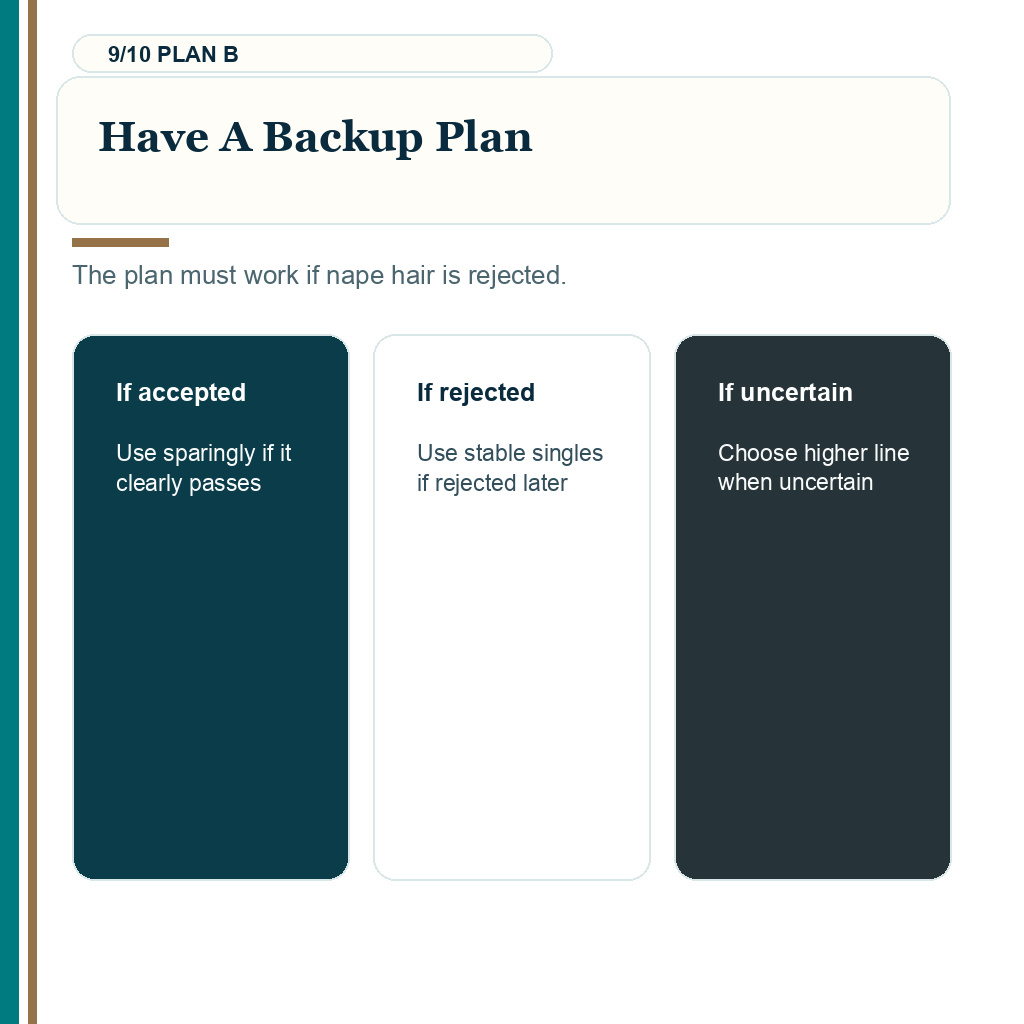
The plan should state how many grafts will be taken from the lower border, where those grafts will be placed, and what signs would make the surgeon avoid that area. It should also state whether magnification showed miniaturization and how the design changes if the lower border is rejected on surgery day. The answer should not be improvisation. The hairline should still have a workable plan with stable scalp singles, a slightly adjusted density target, or a slightly higher design.
Also ask to see results that match your case, including similar age, hair caliber, donor density, hair loss pattern, haircut length, and hairline goal. A result from an older patient with stable hair loss may not prove safety in a younger patient with early retrograde changes. A result with long hair may not prove that the donor will look clean with a short fade.
Refinement, not a shortcut
I can use lower border hair in the right case. I do not use it casually because it can make a plan look softer on paper while moving risk to the most visible part of the face. A slightly more mature hairline made from reliable grafts is usually easier to live with than a delicate plan that depends on questionable border hair.
If the lower border is strong and the need is small, nape hair can be discussed as a refinement tool. If it is weak, if the person is young, or if the design needs too many border grafts, the plan should be reduced instead. Too many grafts in one area creates the same problem from the density side. More grafts can damage the result when the plan ignores limits.
In my planning, this decision is made before extraction starts, not explained afterward. The plan has to identify which hairs are being used for the first rows, which donor areas are being protected, and how future hair loss changes the decision. The right hairline is not the lowest or softest drawing. It is the design that can stay natural as the patient ages.

Read this review excerpt
told me the quality of my donor hair and what he could take out and advised me what will the be best outcome with what donor hair I had.