The danger is not a large number by itself, but a graft number chosen without enough respect for donor reserve, skin capacity, recipient area healing, and future hair loss. A high graft count spread sensibly across a large area can be reasonable. A smaller number forced into a low, tight, fragile, or already crowded area can be risky.
The strongest graft plan starts with what the scalp can support, not the biggest advertised number. I review donor reserve, recipient area size, density per cm2, existing native hair, skin quality, bleeding, previous surgery, medical risks, and future hair loss before I accept a large total. If those details are skipped, a high graft number can leave weak growth, donor thinning, unnatural density distribution, or fewer options for repair later.
There are two separate problems. One is taking too many grafts from the donor area. The other is placing too many grafts into one recipient area. Both can harm the result, but they harm it in different ways.
The first worry to clarify
Start by separating the concern. If you have not had surgery yet, the question is whether the proposed number protects your donor area and fits the area being treated. If you already had surgery, the question is whether you are seeing normal early healing, weak growth, donor thinning, or a true complication.
A total number alone does not answer either question. The same 4,000 to 4,500 graft range can be sensible in one case and excessive in another. Two thousand grafts can be enough for one hairline and too much for a small low hairline if the skin is being overloaded.
A clinic that presents the number as the main selling point deserves a slower review. A graft count should come after diagnosis, donor assessment, hairline design, recipient area planning, and future loss planning. It should not come before them.
A safe graft number usually has a boundary. The plan should intentionally leave some areas untreated when treating every thin area at once would spend grafts that later hair loss may need. Later judgment is clearer when temple points, the crown, or another weaker zone were deliberately reserved.
When two quotes show a similar total, look at where the grafts are going. A plan that spends more in the crown, temples, or a low hairline can use the donor very differently.
Density pressure meter
Balance donor protection with graft number ambition
Graft numbers are not a score by themselves. The right number depends on hair caliber, recipient area size, future loss, donor reserves, and natural density goals.
Current sign. The same graft number is being discussed for very different baldness patterns.
How this changes the plan. Coverage pressure rises when the area is large or the hair is fine.
What matters now. The recipient measurement method and priority zones should be clear before the graft number feels meaningful.
The clinical decision. A number without a zone plan is incomplete.
Current sign. Fine hair, low contrast, straight hair, or weak caliber affects the visual density.
How this changes the plan. Some patients need different expectations even with the same graft count.
Planning detail. Discuss how hair caliber changes the density target and styling reality.
The clinical decision. Double and triple hair grafts can help density, but placement still has to look natural.
Current sign. The plan uses many grafts now or assumes future loss will not progress.
How this changes the plan. Overusing donor grafts can make later repair or crown work harder.
What matters now. Donor reserve for future loss and the case for staging should be clear before grafts are spent.
The clinical decision. A good density plan protects the donor area for the long term.
Current sign. The requested density is uniform, very low, very flat, or too aggressive for the hairline.
How this changes the plan. Natural results often need gradients and restraint rather than maximum packing everywhere.
Density detail. Check how density changes from hairline to mid scalp and crown.
The clinical decision. The best-looking number is the one that fits the design.
More grafts can sound tempting for the wrong reasons
Graft numbers are easy to compare. If one clinic offers 2,500 grafts and another clinic offers 4,500 grafts, the higher number can sound more generous. This is one reason high graft quotes work so well in sales conversations.
Hair transplantation is not a shopping bag. It is surgery on living skin using a limited donor supply. More grafts do not by themselves mean more value, more density, more natural growth, or safer donor use.
A lower number can sometimes be the more serious recommendation. It may mean the surgeon is protecting you from unnecessary trauma, an unnatural low hairline, or damage to the donor area. A larger number only makes sense when the area, tissue, donor supply, and future plan justify it.
High graft numbers are reasonable only in selected cases
A high total number is not the same as overpacking. The same number can be safe or unsafe depending on distribution.
A plan for 4,000 to 4,500 grafts spread across a broad frontal and mid scalp area is different from a smaller number pushed into a narrow low hairline. The first plan may be large but logical. The second may overload one zone and still leave the future unprotected.
The headline number alone is not enough. My review separates the treated square centimeters, planned density in each zone, native hair risk, and whether the donor area can support future needs if hair loss continues.
Reddit perspective
Concentrated extraction can turn a large count into overharvesting
This exact Reddit paragraph shows how a high graft total can become dangerous when extraction points are concentrated.
r/tressless on Reddit · Is my donor area good enough for 4,000–4,500 grafts?
The comment was visible on Reddit when last checked. Open Reddit for the current discussion context.
The surgeon, or the staff performing your donor extraction, shouldn't concentrate a small part of the donor area to yield 4000-4500 grafts. If they do, it may cause overharvesting, but using the entire donor area can significantly reduce the risk.
Even distribution may reduce risk, but it does not establish that the requested total is safe. Donor density, miniaturization, safe donor boundaries, hair caliber, and examination still set the limit.
Too many grafts can damage the donor area
Donor supply is limited. Once follicular units are removed with FUE, they do not grow back in the donor area. If too many are removed, or if extraction is poorly distributed, the back and sides can look thin, patchy, or depleted.
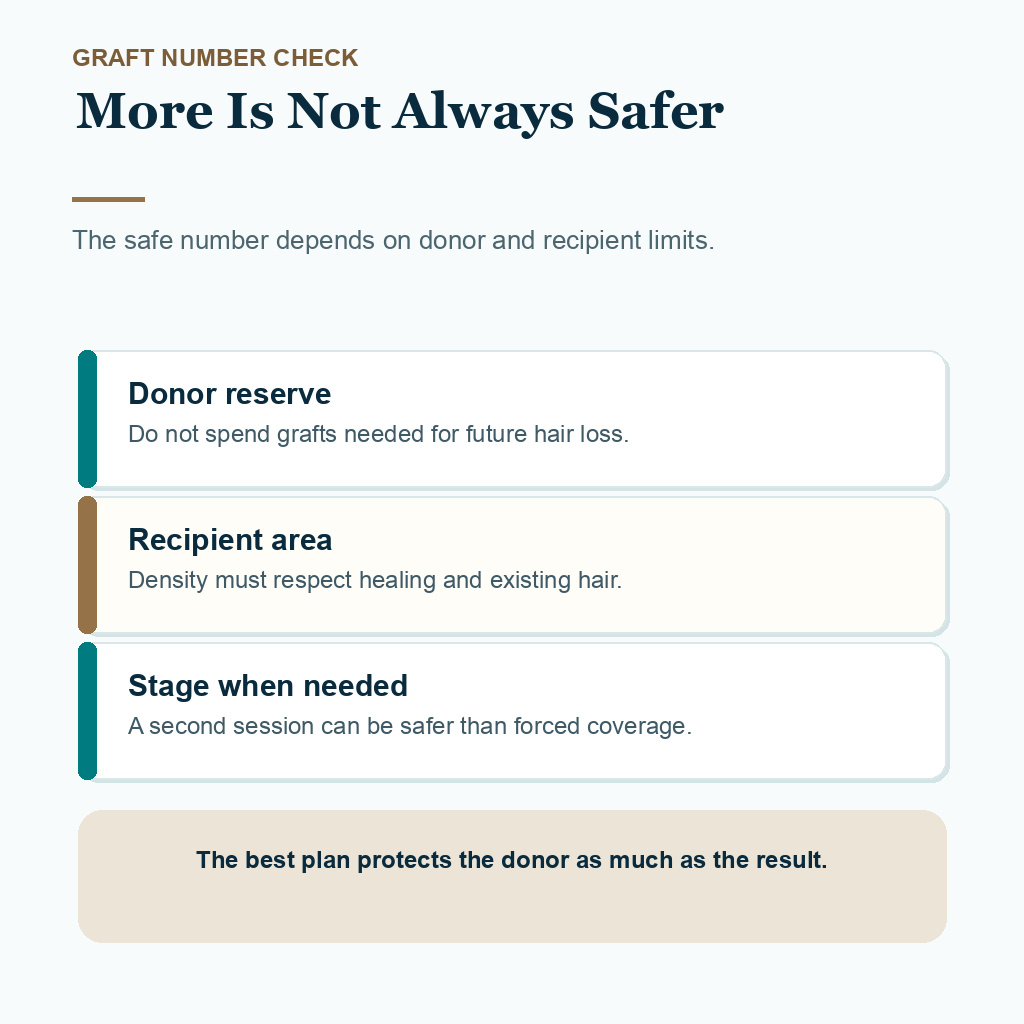
For that reason, lifetime graft planning matters. The donor area has to serve the whole future, not only the first operation. A high first graft count can reduce the ability to treat the crown, repair a weak result, or manage future hair loss.
Future cloning or donor regrowth claims should not make today’s graft number more aggressive. If the number is only safe because a future treatment might refill the donor, it is not a safe number today.
Donor reserve is not only a number on paper. It is how the donor area will look after extraction. Hair caliber, density, curl, contrast, safe donor stability, punch size, spacing, and short hairstyle goals all change how much can be taken safely.
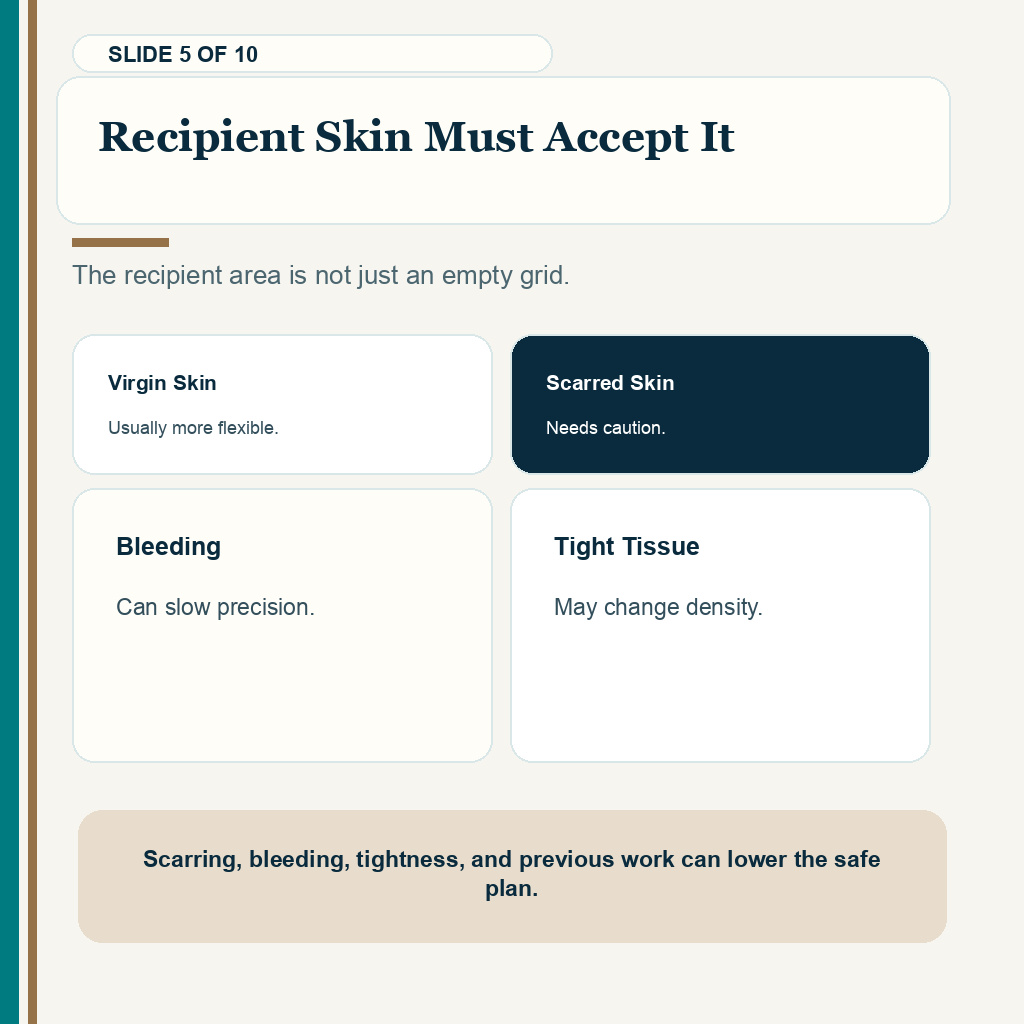
Too many grafts can damage the recipient area
The recipient area also has limits. Every incision is a small wound. The skin needs blood flow, oxygen, careful handling, and enough space for grafts to survive.
If grafts are placed too aggressively in a limited area, the tissue may be more traumatized than necessary. Incisions that are too deep, too close, or poorly angled can increase the risk of weak growth, raised or pitted texture, and in rare cases more serious skin damage.
A dense hair transplant is useful only when the skin can support it. Density is not a trophy number. It is a surgical decision.
Here I separate a high graft count from a necrosis diagnosis. A case using about 4,500 grafts can be reasonable when the area and spacing support it, and dark crust in a photo does not prove why the skin reacted. I look at recipient area size, slit density, incision depth, session length, blood supply, smoking, diabetes, hypertension, previous surgery, and infection risk before I connect a dense plan with delayed healing.
There is no single safe density number for every patient
No. I do not use one safe density number for every scalp. In many routine frontal cases, a density around 35 to 45 grafts per cm2 may be a responsible target when the skin, graft quality, donor supply, and design support it. I become more cautious when a plan tries to push beyond 50 follicular units per cm2 in one pass, especially in thin skin, scarred skin, previously operated tissue, smokers, or patients with medical healing risks.
That does not mean every number above or below those ranges is automatically right or wrong. It means density must be judged with the tissue in front of the surgeon, not copied from a clinic advertisement.
Density should never be separated from the donor area. A graft used in one zone is no longer available for another part of the plan.
Large graft number proof check
Before accepting a large graft number, check what is missing
This is not a verdict on the quoted number. It helps you see whether the plan explains the donor area, recipient area, density, distribution, and future reserve clearly enough.
1signalsReview
Ask for proof before accepting the number
One weak point is enough to ask a sharper question.
One signal is enough to slow the conversation.
The number may still be reasonable, but the missing explanation should be answered before accepting the plan.
Measured donor and recipient area assessment
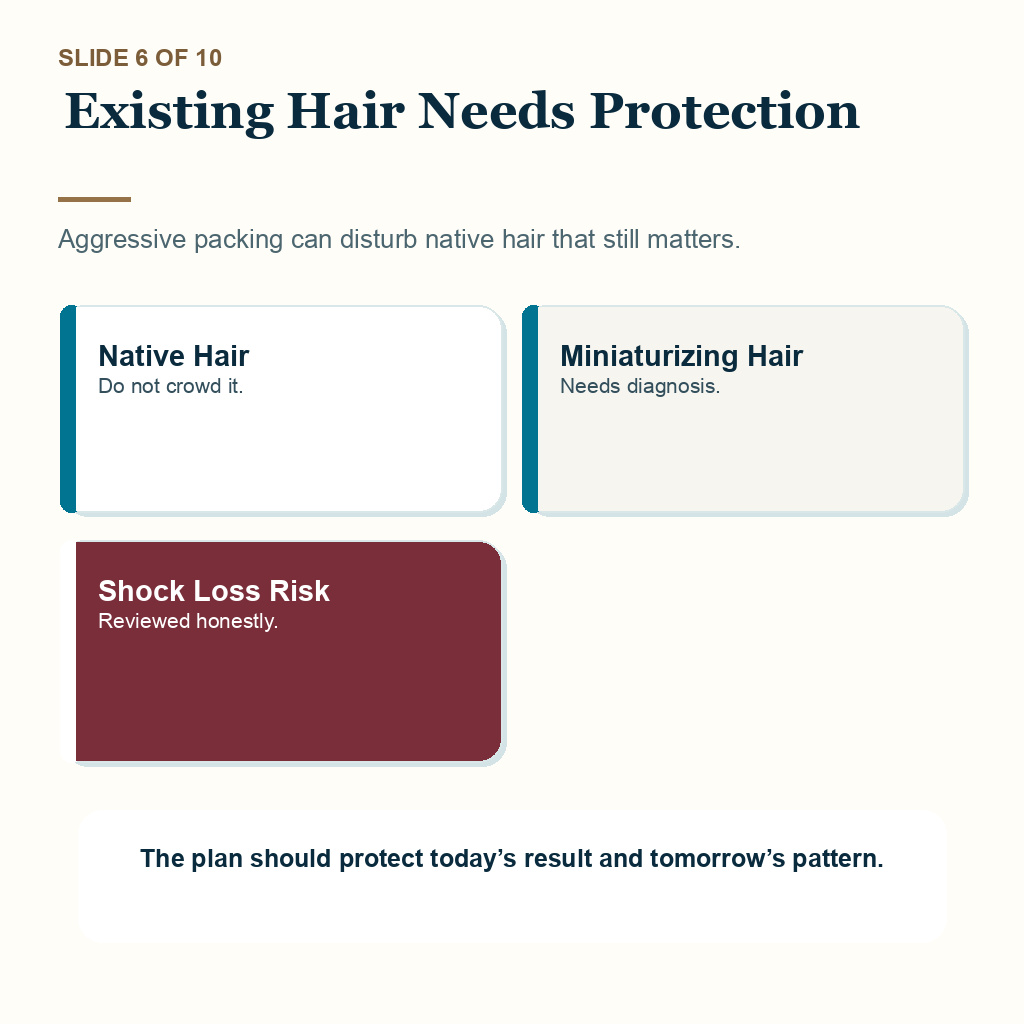
Aggressive packing can harm existing hair
Yes, it can. When grafts are placed between existing native hairs, the surgeon is not working on empty skin. The incisions must respect the angle, spacing, and weakness of the hair already there.
If native hair is strong, it usually tolerates surgery better. If it is already miniaturized, aggressive packing around it may contribute to native hair shock loss after a hair transplant. Some shock loss is temporary, but weak miniaturized hairs may not return with the same strength.
This changes the plan in diffuse thinning or a partially filled frontal area. I may choose fewer grafts, more careful spacing, medication discussion, or a staged approach instead of forcing instant density between fragile hairs.
The surgical judgment behind a safe graft number
I start with diagnosis, age, hair loss pattern, donor strength, hair caliber, contrast between hair and skin, medical history, and future risk of losing more native hair. I do not start with the preferred number.
Then I decide the priority. Hairline, mid scalp, and crown do not all give the same visual return for the same graft cost. Sometimes the frontal frame matters most. Sometimes the crown should wait. Sometimes the responsible operation is smaller than the person hoped.
The way I calculate graft numbers is not a formula copied from another case. It is a judgment about coverage, donor safety, naturalness, and future options.
Staging can be safer than forced density
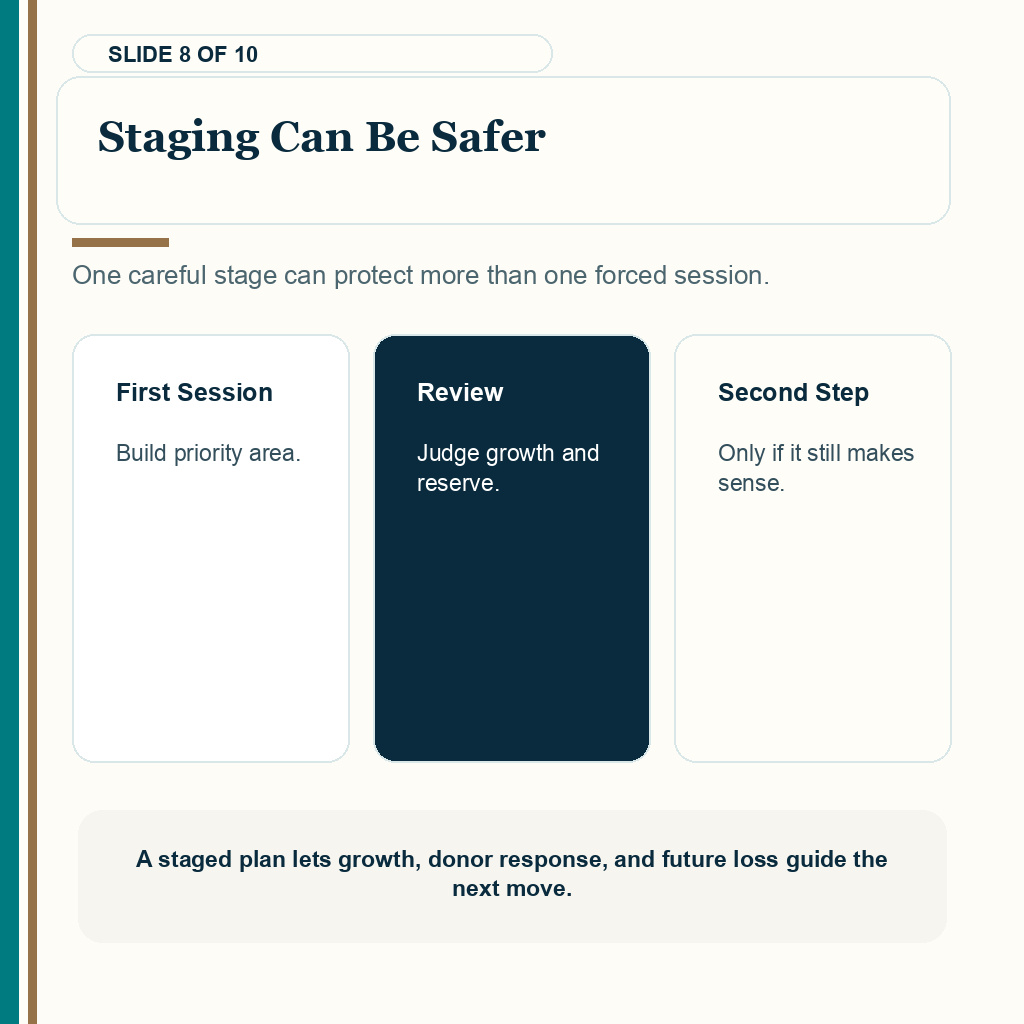
A staged plan can be safer when the area is large, the donor reserve needs protection, the crown may change, the native hair is unstable, or the skin has already been operated on.
When the bald area is broad, moving a higher number is only one part of safety. The recipient skin still needs healthy blood supply around the grafts, and very dense placement over too much surface can reduce survival instead of improving coverage. If the case needs 6,000 to 7,000 grafts over time, staging can protect both the donor area and the growth conditions.
Staging does not mean the first surgery is weak. It means the surgeon is leaving room to judge growth, scalp healing, donor response, and future hair loss before spending more grafts.
Adding density later can be reasonable when the donor remains safe and the first result has matured. Forcing too much density at the beginning can make both growth and repair harder if the tissue reacts badly.
Warning signs that matter after surgery
Most early healing changes are not dangerous. Redness, mild swelling, crusts, itching, and tenderness can be normal.
Contact the clinic quickly if you see worsening pain, spreading redness, pus, bad smell, fever, increasing swelling, dark skin discoloration, thick black crusts that do not behave like ordinary scabs, or open wounds that look deeper over time.
This needs careful wording because panic is not helpful, but delay can be harmful. Do not pick thick scabs, do not force crusts away, and do not wait silently if the skin is getting worse. Practical guidance on when to worry after a hair transplant can help, but your own clinic should review concerning changes directly.
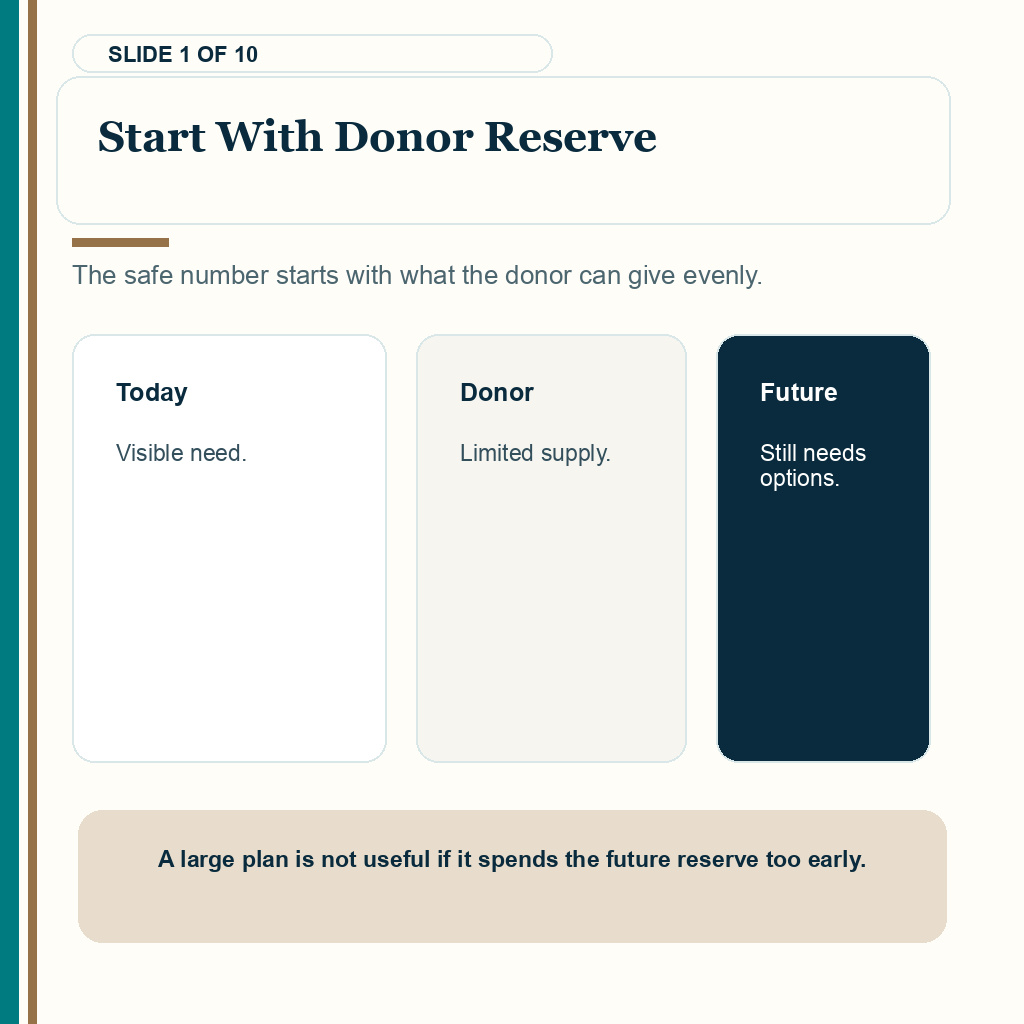
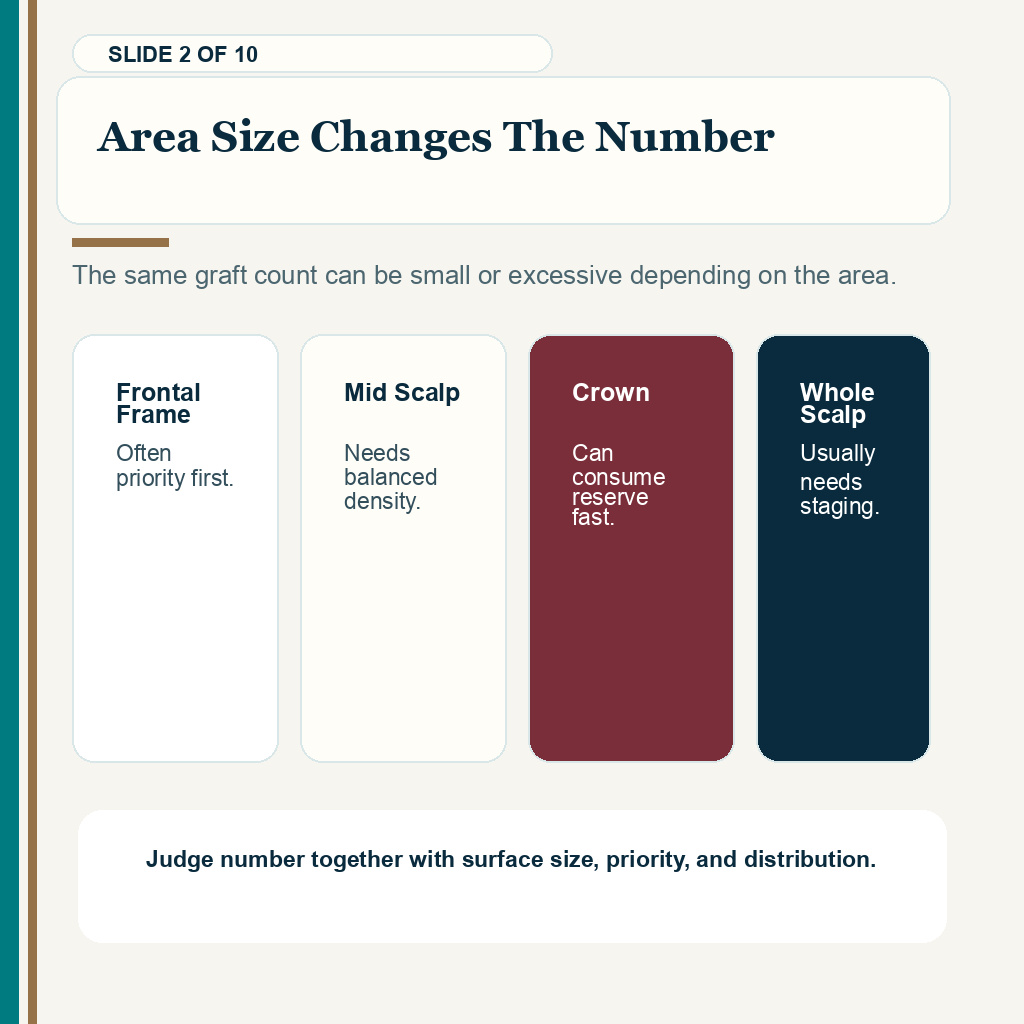
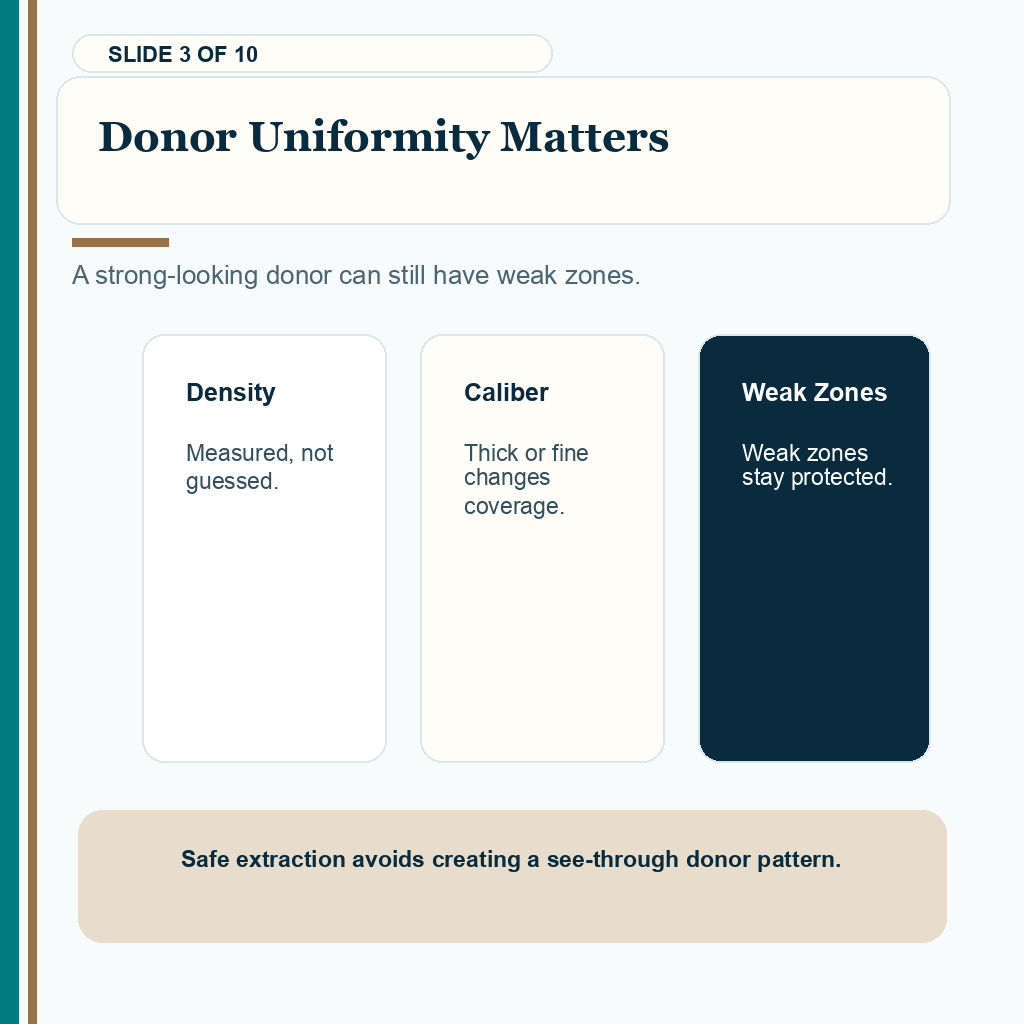
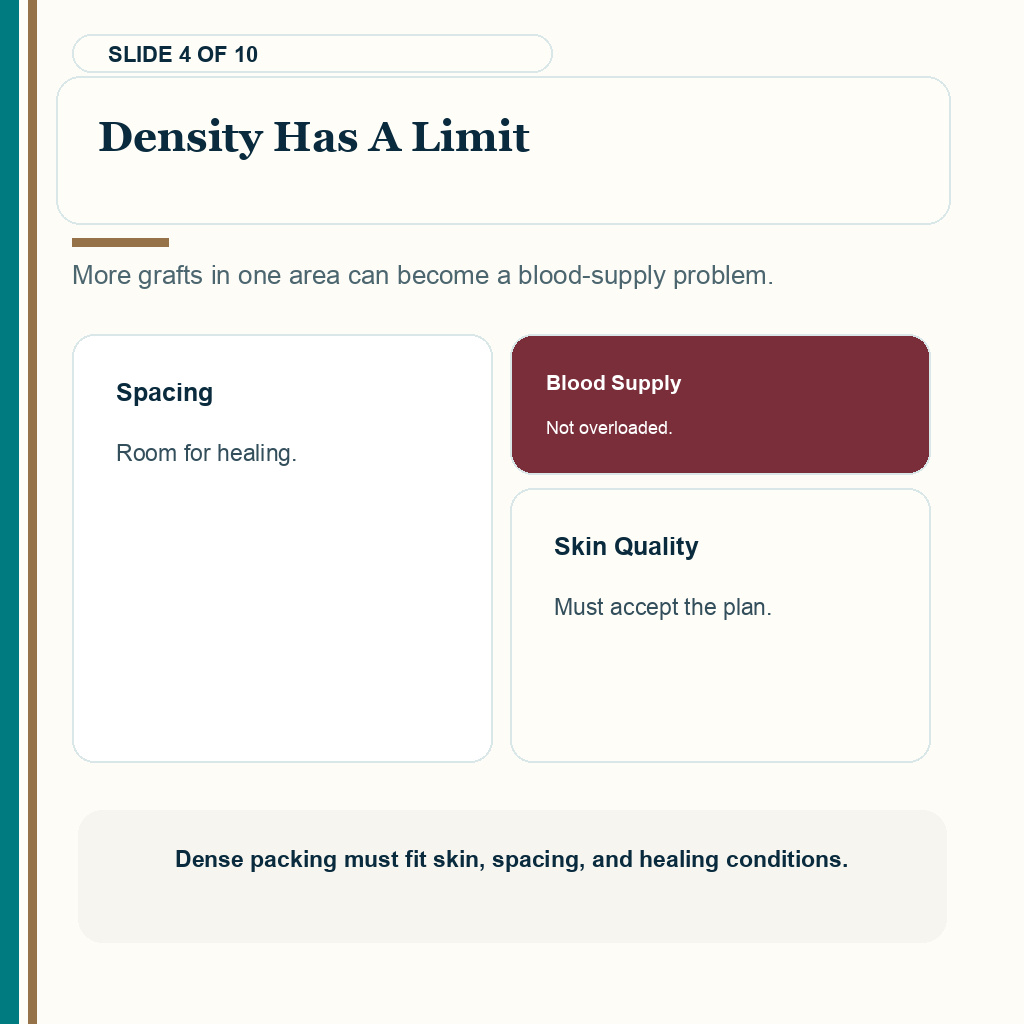
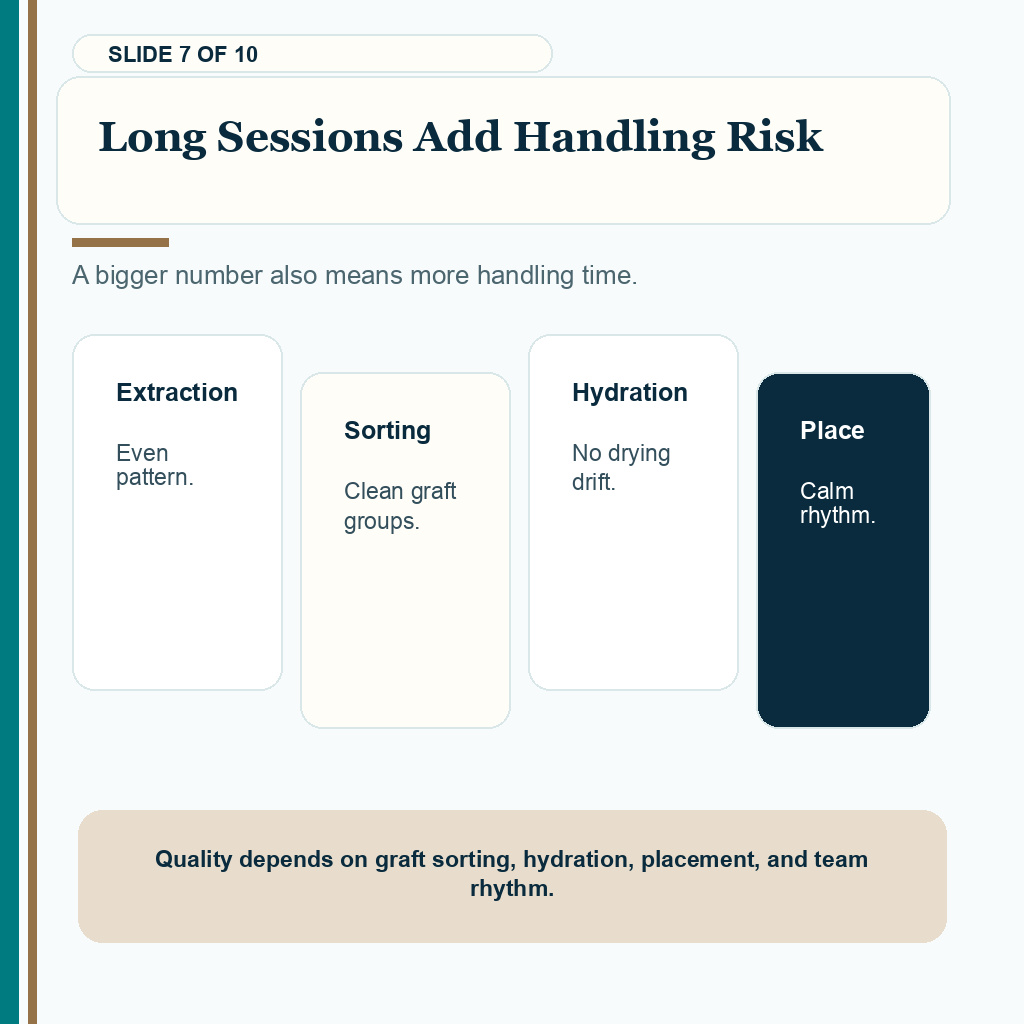
These 10 donor safety slides separate donor reserve, recipient area size, density limits, skin and blood supply, native hair protection, handling time, staging, proof, and future repair risk. Swipe sideways, use the arrows one slide at a time, or choose a number below the image.
Start with donor reserve.
Area size changes the number.
Donor uniformity matters.
Density has a limit.
The recipient area must be suitable.
Existing hair needs protection.
Long sessions add handling risk.
Staging can be safer.
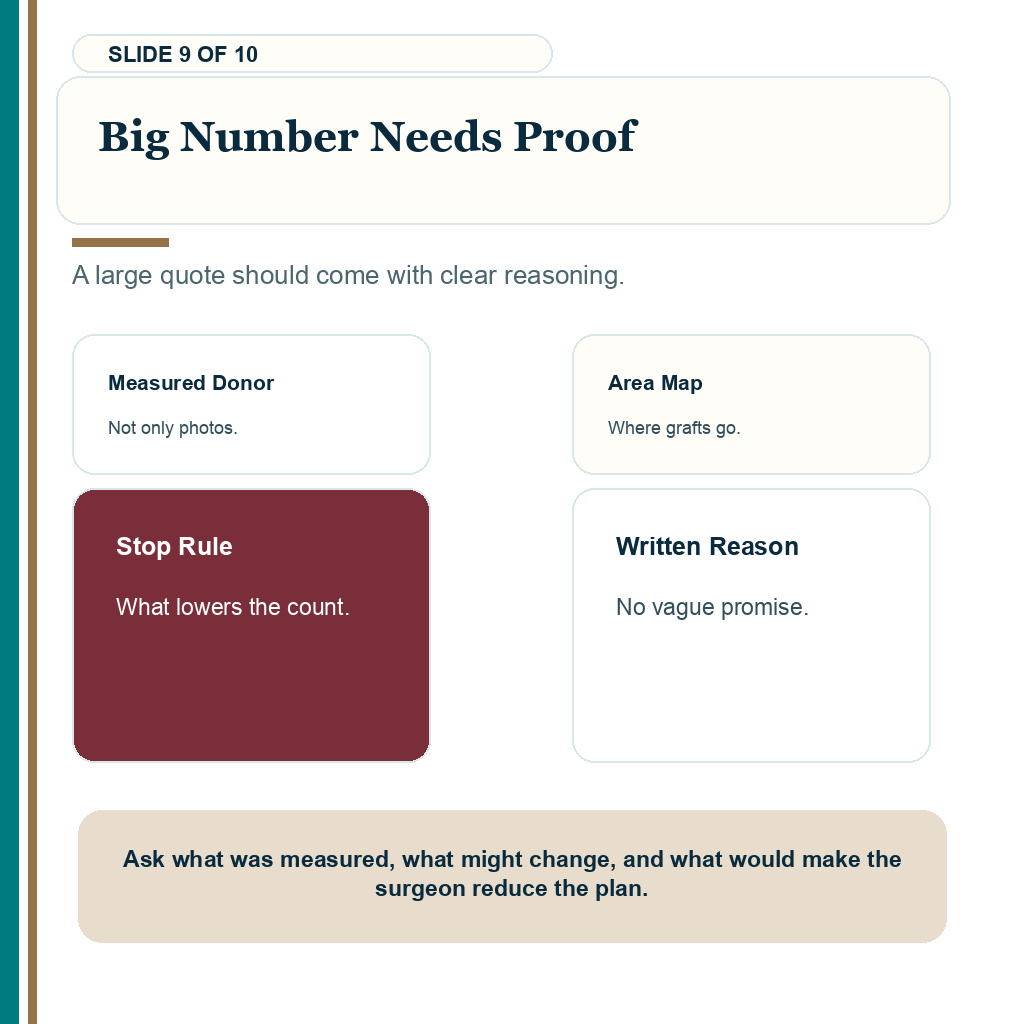
Big number needs proof.
Best number protects future.
Lowering or stopping a large graft plan
I lower a large graft plan when the donor cannot give the number evenly, when the recipient skin cannot safely receive that density, when existing hair would be placed at unnecessary risk, or when graft handling time would become too long for the quality I want.
I stop the plan when the number is being used to impress the patient rather than solve the right area. A strong hairline with preserved reserve is often safer than a large operation that spreads grafts thinly across the front, mid scalp, and crown at once.
If the safe number changes during the in person examination, I explain and write down the reason. The patient needs to know whether the change came from donor findings, recipient area size, bleeding, graft quality, or a safer decision to stage the surgery.
Before a maximum coverage promise becomes your plan
Ask for a zone by zone version of the promise before you accept it. A serious large plan should show how many grafts go to the front, mid scalp, and crown, what density each area can realistically carry, what donor reserve remains, and what would make the surgeon lower the number on the day. If the clinic cannot explain those limits, the large number is not proof of confidence.
Decision points before accepting a large graft plan
A large graft number should protect donor reserve, recipient healing, and future planning.
Review why that number is safe for your donor area, recipient area, age, future hair loss, and medical history. Then separate how many grafts go to the hairline, mid scalp, and crown, because a total number alone hides the distribution.
Clear responsibility matters. Confirm who designs the hairline, who creates the recipient area incisions, who performs extraction, and who decides whether the number should change on surgery day. Unclear responsibility is one of the biggest risks in high graft count cases.
If the answer is mainly a package, a discount, or “maximum coverage,” get a second surgical opinion before hair transplant. A serious plan should explain limits, not only promise density.
Reddit perspective
Donor reserve comes before another graft target
My answer on Reddit focused on the patient decision at the centre of too Many Grafts Can Damage a Hair Transplant Plan.
tressless on Reddit · Not happy with results. Thinking about 2nd transplant
Based on limited information available in the post, I would advise you against rushing a second hair transplant session to increase density on first hair transplant area. Every patient has a finite donor supply and those grafts need to used carefully with considering potential future hair loss. Using more grafts now could leave fewer available donor supply if hair loss progress to crown area.
The specific case details in the quote should not be transferred to another scalp. The relevant lesson is to protect finite donor supply and avoid forcing every goal into one session.
Donor reserve comes before the number
A graft count only helps when the scalp can support it and the donor area can spare it. My review covers recipient size, hair caliber, age, miniaturization, crown risk, and how the donor will look after extraction.
A smaller number can be the stronger choice when it keeps repair options open. A large number can be reasonable when the map, density goal, and donor reserve all agree. The wrong choice is a number chosen because it sounds impressive in a message.