


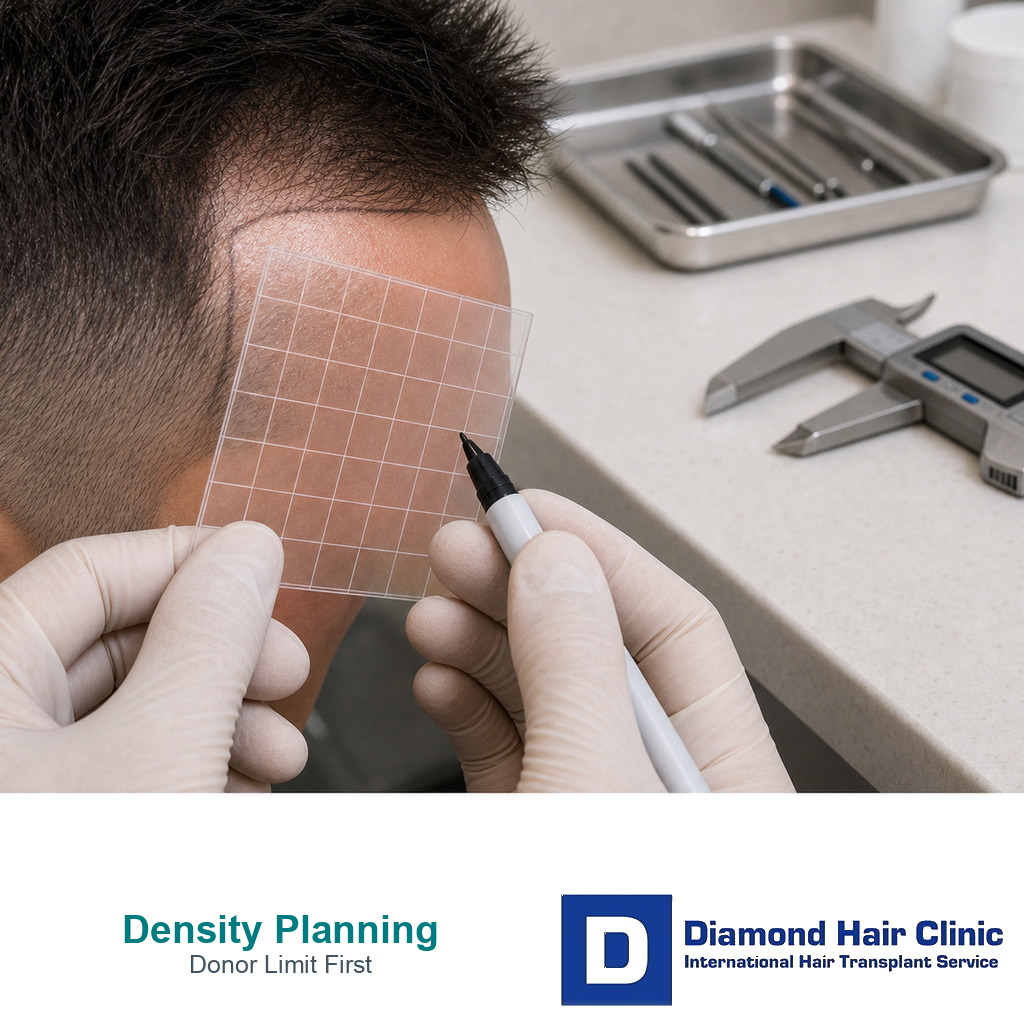
45 Grafts Per cm2 and Donor Safety
A plan around 45 grafts per cm2 is not good or bad until I know the area, hair caliber, blood supply, and donor plan.
That number only becomes useful when I know where the 45 is being used.
The same number can look strong in a compact frontal area and look thin if it is stretched across the hairline, mid scalp, and crown.
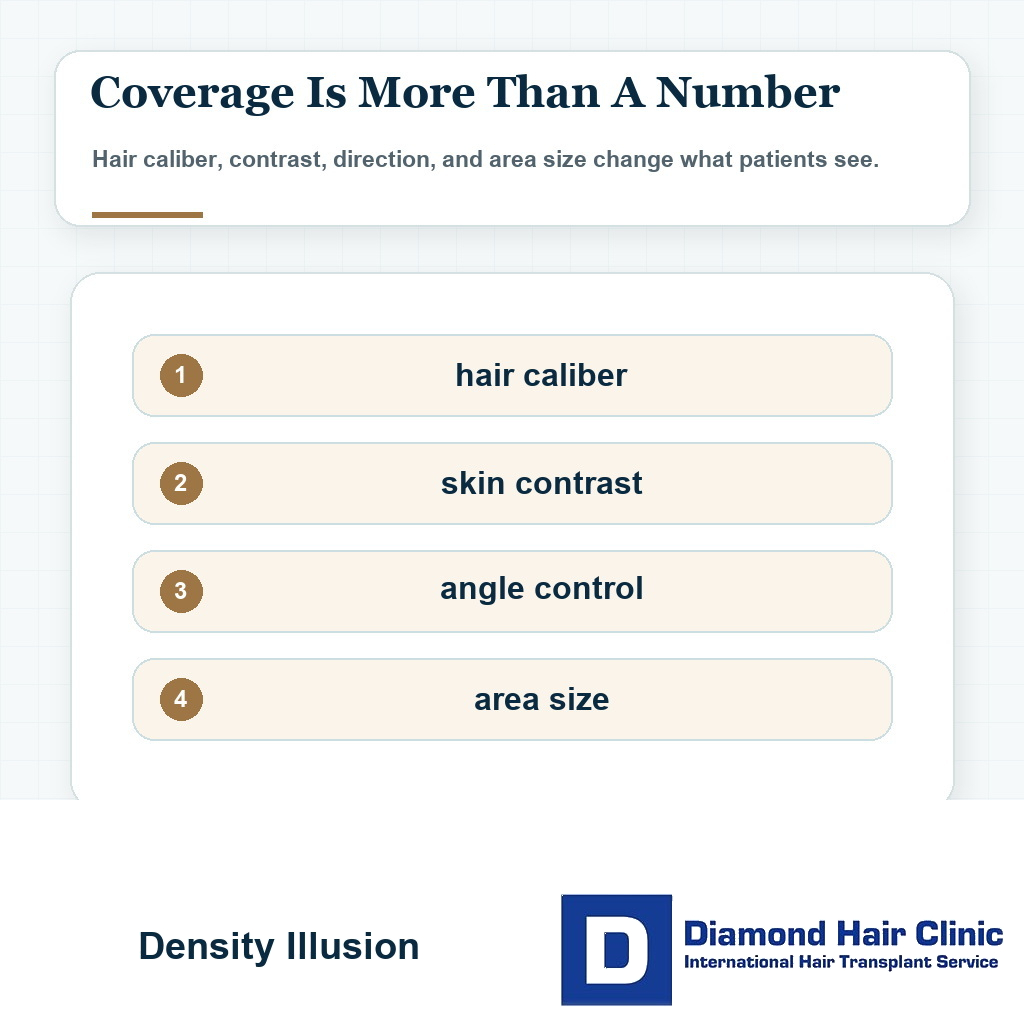
It also depends on donor strength, hair caliber, the number of hairs inside each graft, skin and hair color contrast, recipient area size, and the way the grafts are placed.
When a clinic says 45, 50, or 60 grafts per cm2, the number has to be tied to the zone. Peak hairline density, average density across the whole recipient area, and a marketing number are very different things. A responsible plan changes density from zone to zone. The first rows, the area behind them, the mid scalp, and the crown do not need identical packing.
Do not compare hairs per graft with grafts per cm2 as if they are the same measurement.
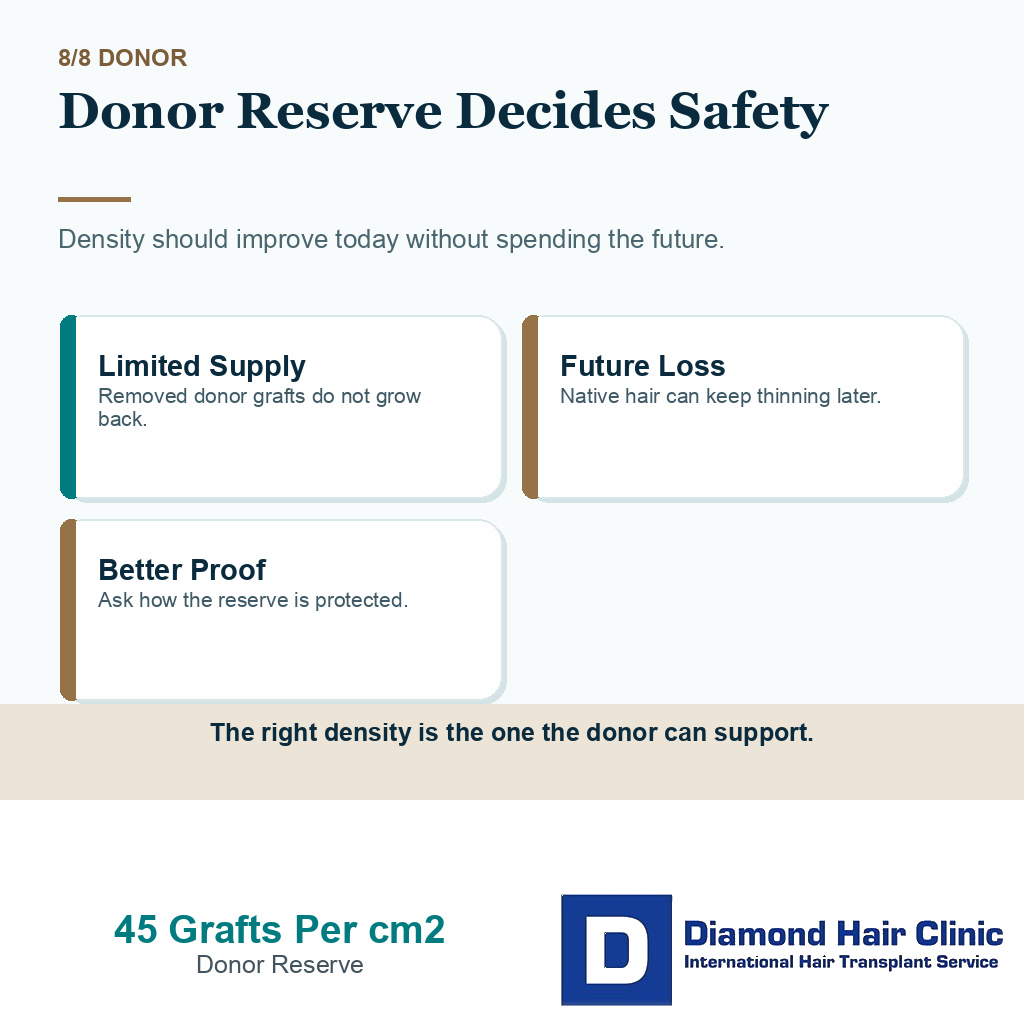
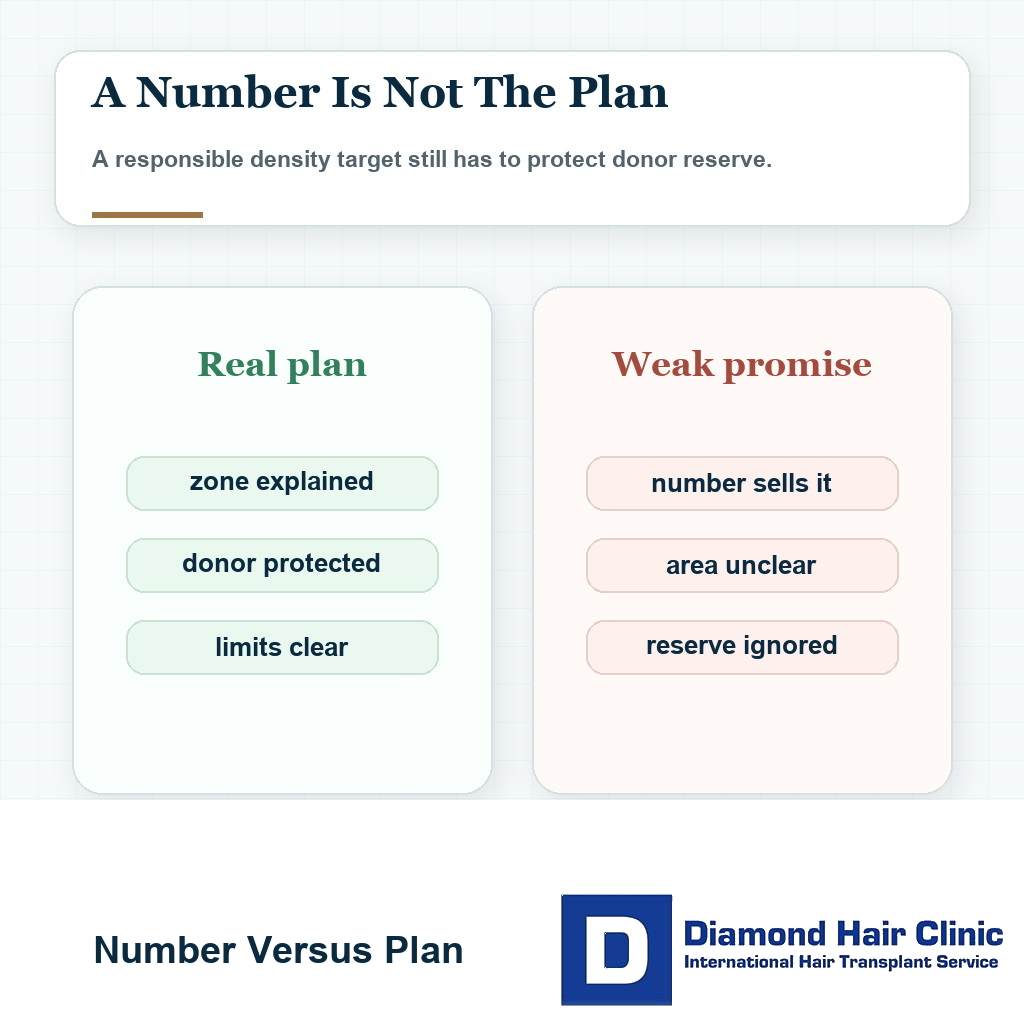
The number should serve the zone and donor reserve. It should not become the plan itself. Density has to be judged with donor area capacity, future hair loss risk, hairline position, crown demand, and long term graft reserve. A hair transplant should improve the patient today without creating a problem for the future.
A dense reference result can be the wrong target for someone with ongoing androgenetic hair loss. Lowering a naturally high, stable hairline may concentrate grafts in one compact zone. A restoration patient may need those grafts later if native hair behind the transplant continues to thin. Before I use either case as a density target, I check the diagnosis and what the patient may still lose.
The density figure is only one part of the plan
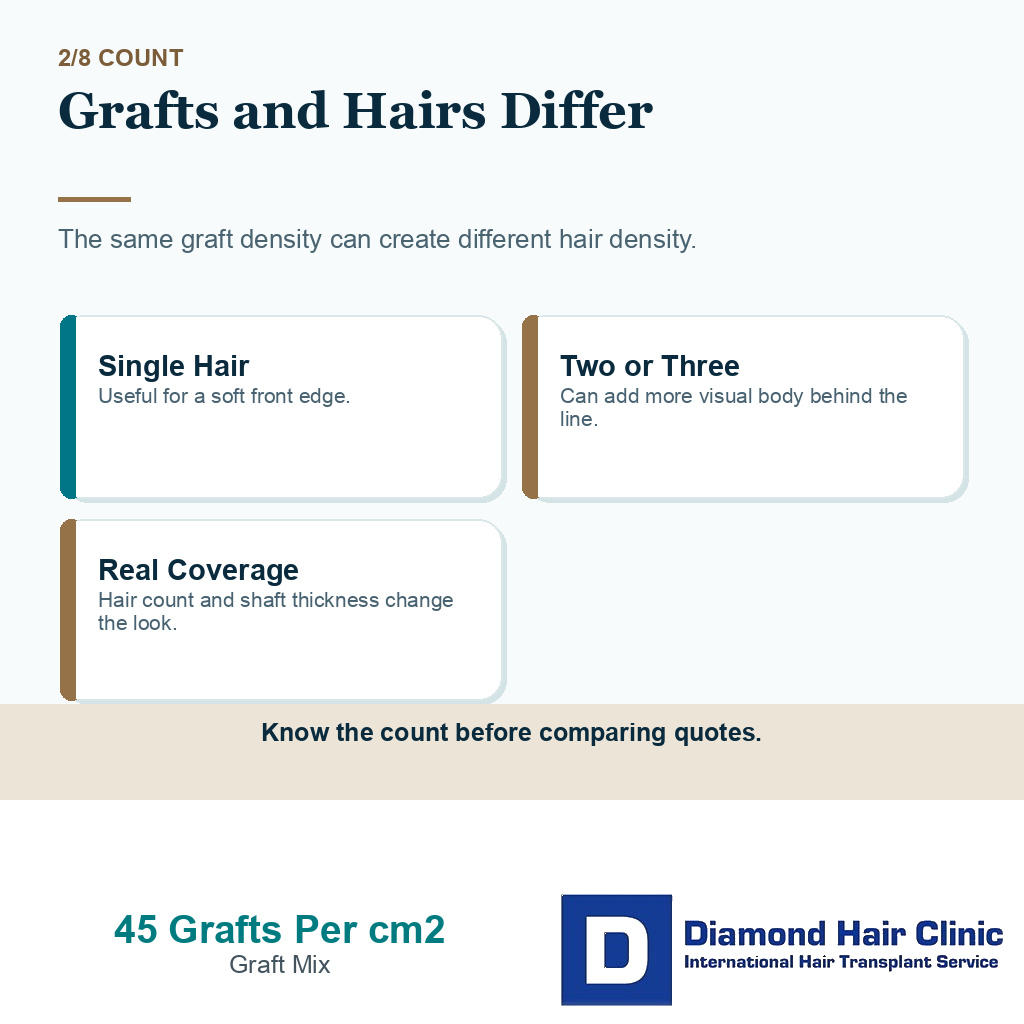
A graft is a follicular unit. It may contain one hair, two hairs, three hairs, or sometimes more. So the same density figure does not create the same visual result in every patient.
Density conversations can become confusing. Some patients hear grafts per cm2, others hear hairs per cm2, and those are not the same thing. If a clinic says 45, you need to know exactly what is being counted.
When native hair remains in the recipient zone, a density quote needs one more label. A figure of 45 may mean newly implanted grafts per cm2, or it may describe the intended combined appearance with native hair. The second claim depends partly on hair that can continue to thin, so it should not be confused with the implanted count.
First separate grafts from hairs per square centimeter. The number only means something when it is connected to hair caliber, color contrast, donor limits, and the exact zone being packed.
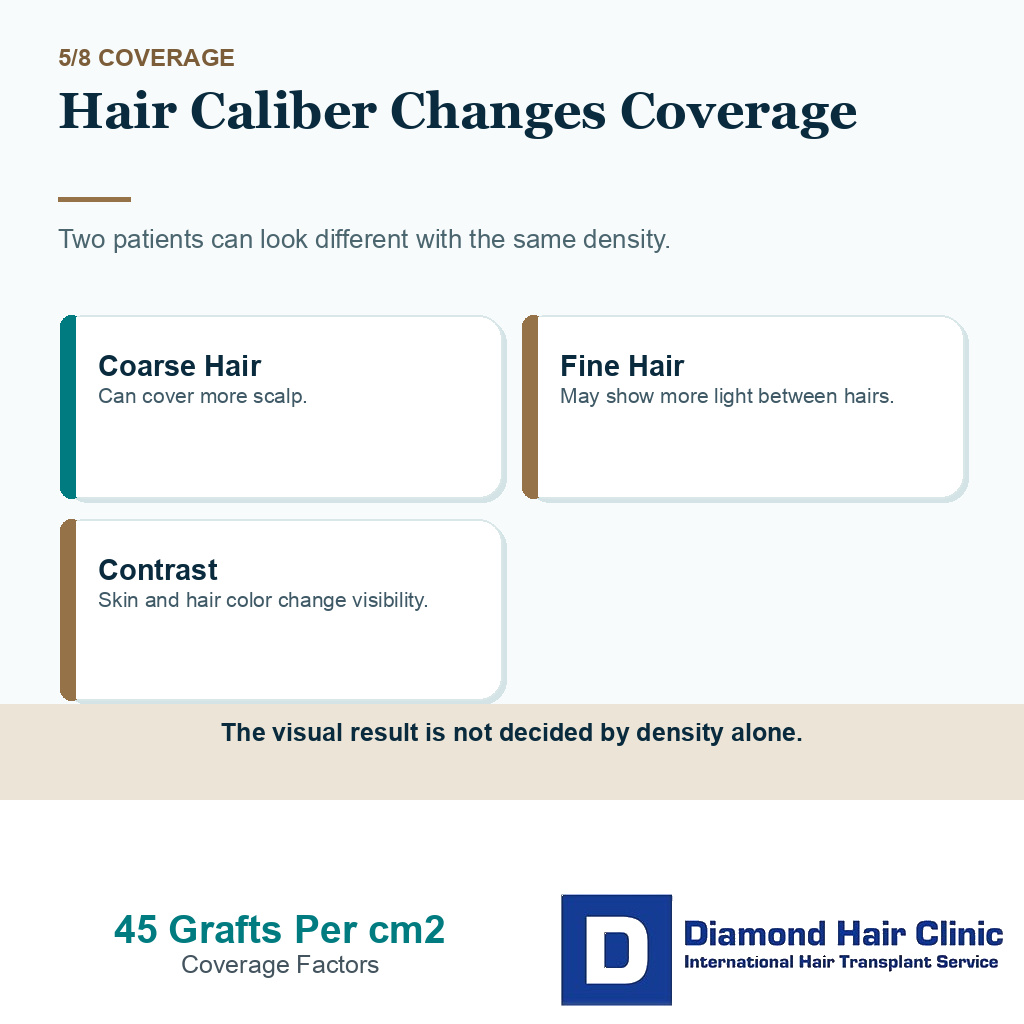
If many grafts contain two or three hairs, the same graft density can give stronger coverage. If the grafts are mostly single hair grafts, the visual effect will be different. Hair shaft thickness also matters. A patient with thick hair may get more coverage from the same graft number than a patient with very fine hair.
I separate total graft number from density when I explain how graft numbers are calculated. A patient may hear 3000 grafts and feel reassured, but if those grafts are spread over a large balding area, the final appearance may still look thin. Another patient may receive fewer grafts in a smaller area and look much fuller because the plan is concentrated. After growth matures, comb through videos and real density can help patients see how that plan behaves, but they do not replace the original measurement.
Density is not only how many grafts are used. It is where they are placed, how they are angled, and whether the donor supply is being used wisely. Surface healing also matters, especially when raised hairline texture appears after dense placement. Row like spacing needs its own review, especially before judging density from early photos. See graft rows after FUE.
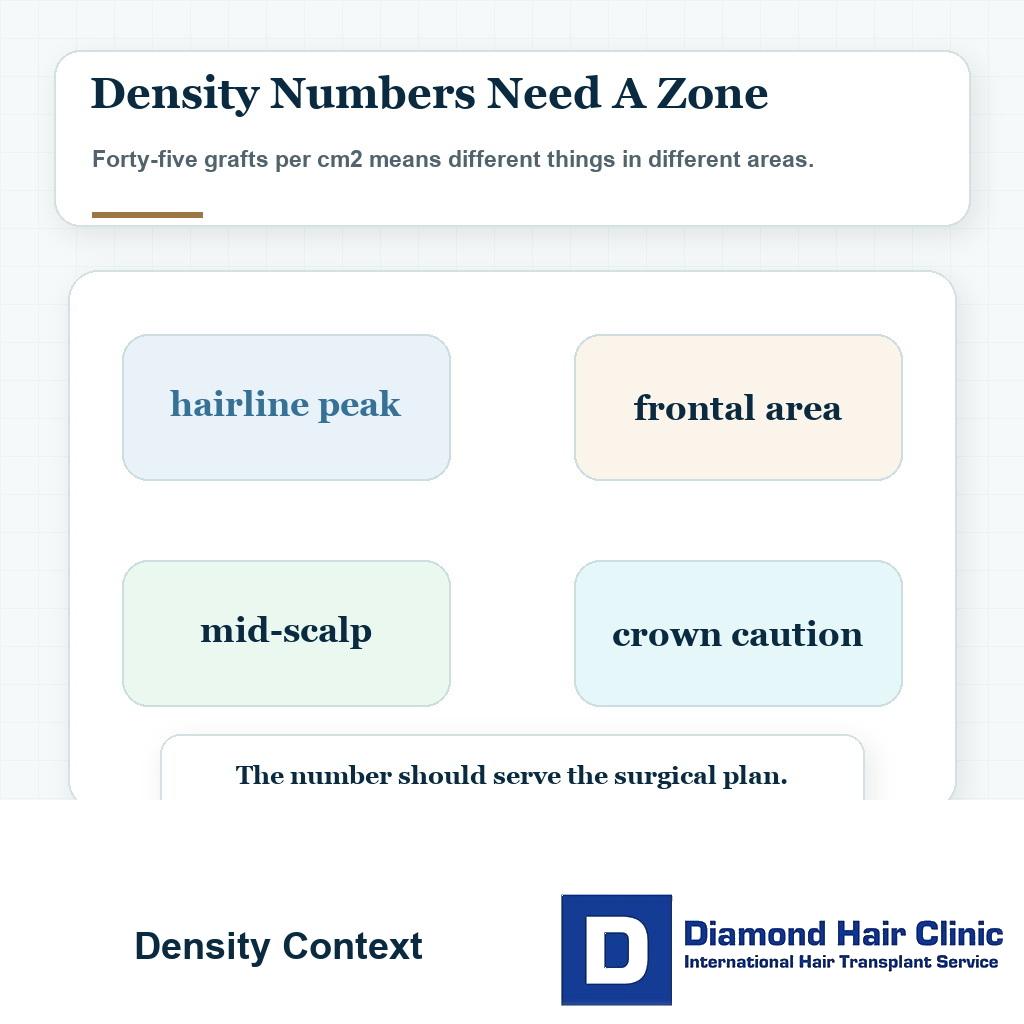
These 8 density planning slides explain the 45 grafts per cm2 number through counting method, peak versus average density, area size, hair caliber, hairline planning, crown planning, and donor reserve. Swipe sideways, use the arrows, or choose a number below the image.
Compare what two density quotes mean
Choose a difference between two example proposals. Compare the same fields on both sides before treating the quoted numbers as equivalent.
Aftercare route map45 grafts per cm² across two different areas
Example A
- Quoted average
- 45 grafts/cm²
- Measured area
- 20 cm²
- Area × stated density
- 20 × 45 = 900 grafts
Example B
- Quoted average
- 45 grafts/cm²
- Measured area
- 40 cm²
- Area × stated density
- 40 × 45 = 1,800 grafts
The density matches. The graft demand doubles. Compare the measured area as well as the number 45.
Density zone. A small frontal target carries a different meaning than spreading one number across a broad scalp.
Recipient surface. A broad thinning zone cannot be planned like a compact hairline edge.
These are examples for comparing written plans. They do not predict growth or decide which density is safe for your scalp.
Donor reserve. The plan should show what remains for the crown, mid scalp, and future thinning after the quoted density is placed.
Crown reserve. If the plan prioritizes the front, agree how much crown or mid scalp coverage may be left untreated while protecting the remaining donor area.
Density proof. A quoted density should be tied to measurements, zones, and photos, not repeated mirror checking.
Number context. Take normal distance photos, donor views, and the written graft plan before comparing density claims.
Aftercare route map
The question is usually not whether the activity is forbidden forever. It is whether the timing, pressure, sweat, water, friction, or posture can disturb early healing.
Gentle version
Current sign. The activity can be done without touching, rubbing, bending over, sweating heavily, or putting pressure on grafts.
The clinical decision. The recipient area should remain protected and easy to inspect.
Friction or pressure
Current sign. The activity involves tight fabric, headwear, pillow pressure, glasses, headphones, massage, heat, or direct contact.
The clinical decision. If the item leaves marks or requires adjustment, it is probably too early.
Sweat, heat, or water
Current sign. The activity adds sweat, steam, rain, sun, ice, dryer heat, or moisture.
The clinical decision. Comfort does not always mean the skin is ready.
Something went wrong
Current sign. There is bleeding, strong pain, visible graft movement, unusual redness, or a clear accident.
The clinical decision. Avoid rubbing, picking, or applying unapproved products while waiting for advice.
Before reading the slide series, separate the density number from the way it will be spent. A high number can still be unsafe if it ignores hair caliber, crown demand, or donor reserve.
A 45 grafts per cm2 number is a planning question, not a target to chase. Read the carousel only after you understand what the number can and cannot prove.
Peak density and average density are not the same
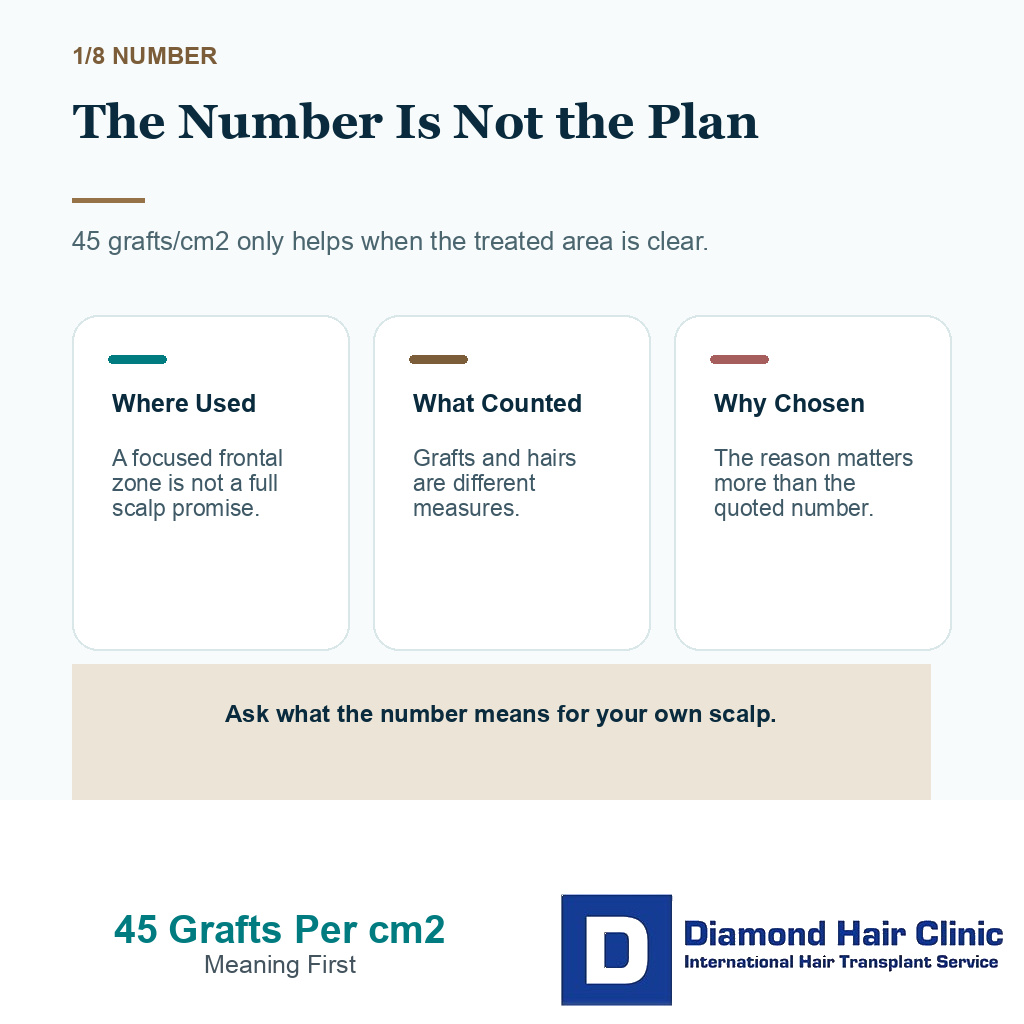
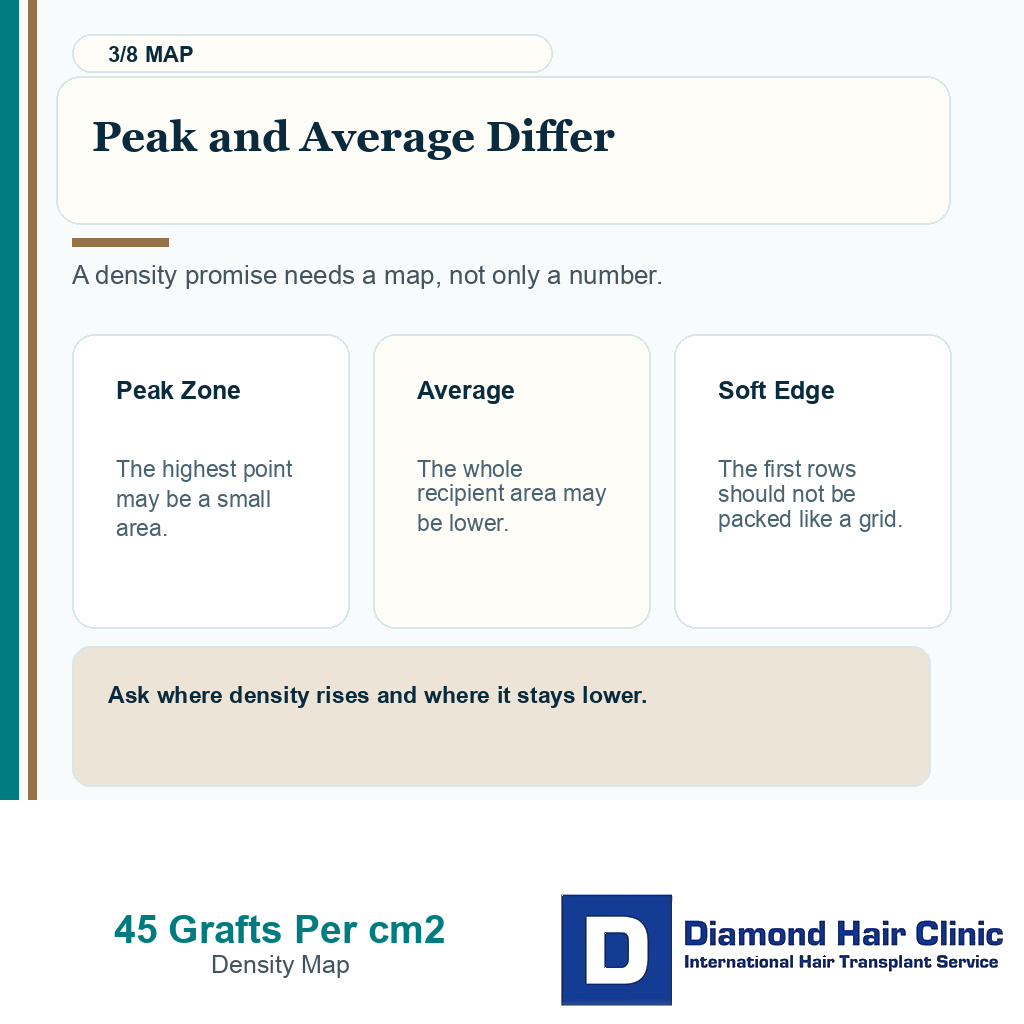
A clinic may say 45 grafts per cm2, but that number can describe different things. It may be the highest density in a small frontal zone, the average across the whole measured recipient area, or a rough target used during placement. Those are not the same promise.
For example, the first visible rows of a natural hairline should stay soft, while the area behind them may carry more visual weight. A plan can average around 45 grafts per cm2 while still having small zones that are lower or higher. That can be normal when it is designed on purpose.
A density number without a map worries me. Before comparing clinics by 45, 50, or 55, ask whether the number is a peak, an average, or a marketing shortcut. Density only becomes meaningful when it is tied to surface area, zone, graft type, hair caliber, and donor limits.
Hair count changes the visual effect
A useful way to understand a density quote is to think in hairs, not only grafts. For many patients, the average graft may contain roughly 1.8 to 2.2 hairs. At 45 grafts per cm2, that may represent about 81 to 99 hairs per cm2.
That range is not a promise. It is a way to explain why two patients with the same graft density can look different. One patient may have stronger multi hair grafts. Another may have a high percentage of single hair grafts. A third patient may have fine hair, which allows more scalp to show between hairs even when the graft count looks reasonable on paper.
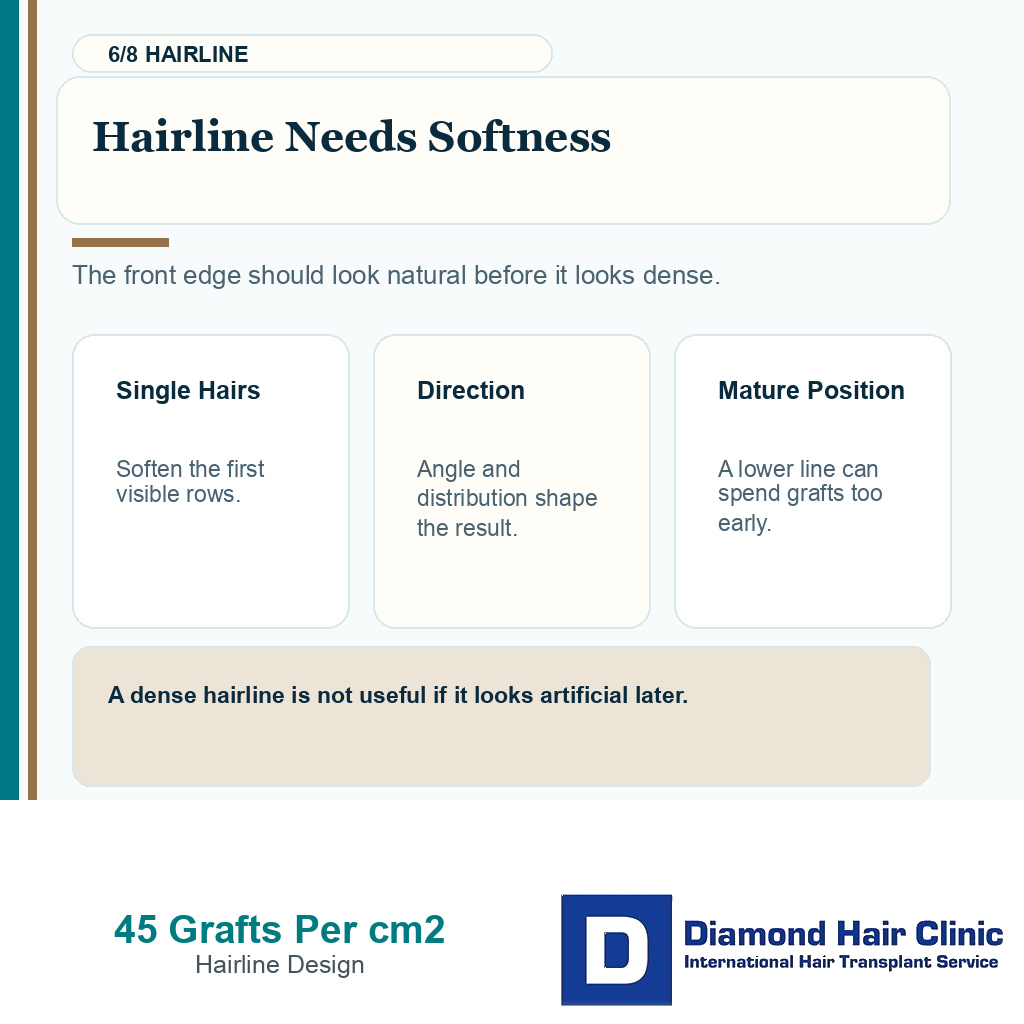
The hairline also has its own rules. The very front should be built mostly with single hair grafts to keep the transition soft. Behind that first line, stronger two hair and three hair grafts can create more body. If larger grafts are placed too aggressively at the front, the hairline may look dense but not natural.
Density is not designed like filling a grid. Some zones need softness, some can safely carry stronger grafts, and some should stay lower because the donor area must be protected.
Recipient area size changes everything
The size of the recipient area changes the whole meaning of a density plan.
If a patient hears both a high density promise and a high total range, those numbers have to be joined to the same measured map. Density in a compact frontal band is a different surgical demand from carrying that density across the front, midscalp, and crown.
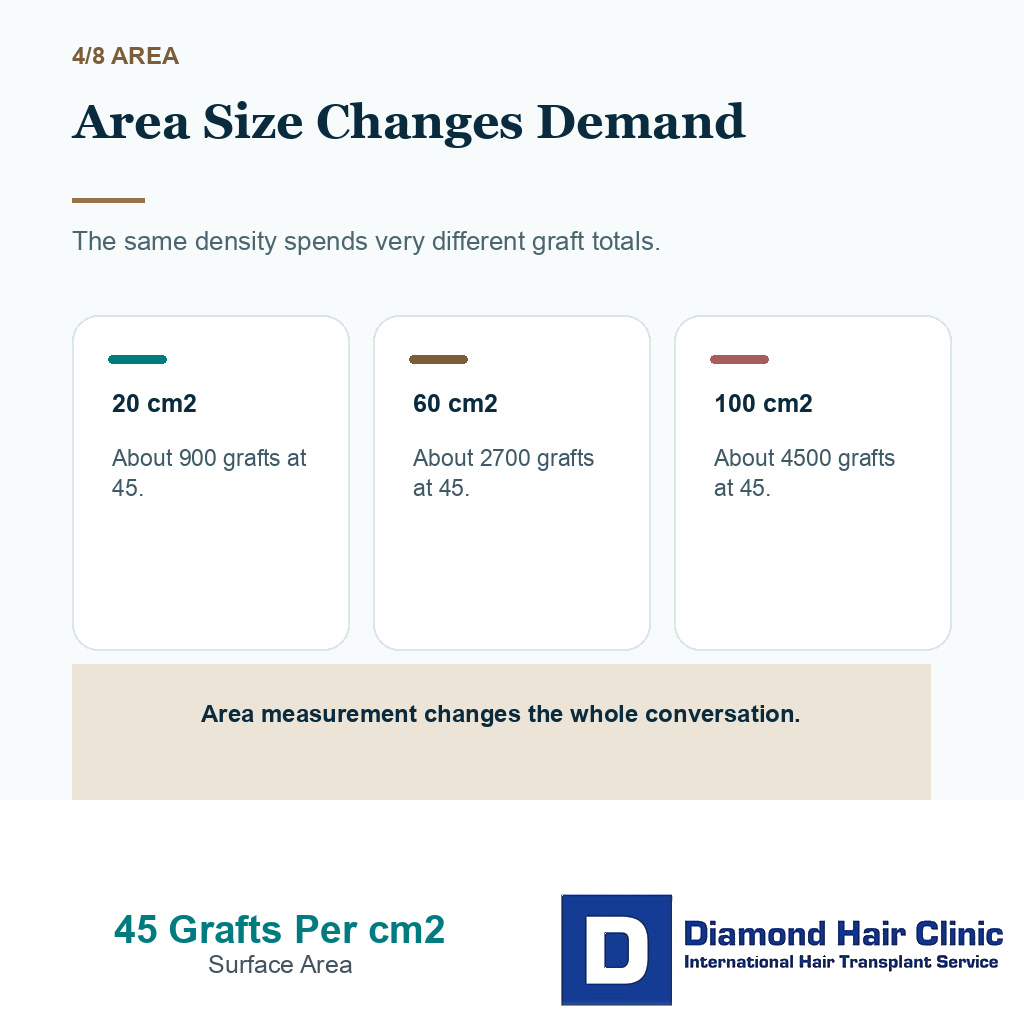
At 45 grafts per cm2, a 20 cm2 frontal area requires 900 grafts. A 40 cm2 area requires 1800 grafts. A 60 cm2 area requires 2700 grafts. A 100 cm2 area requires 4500 grafts.
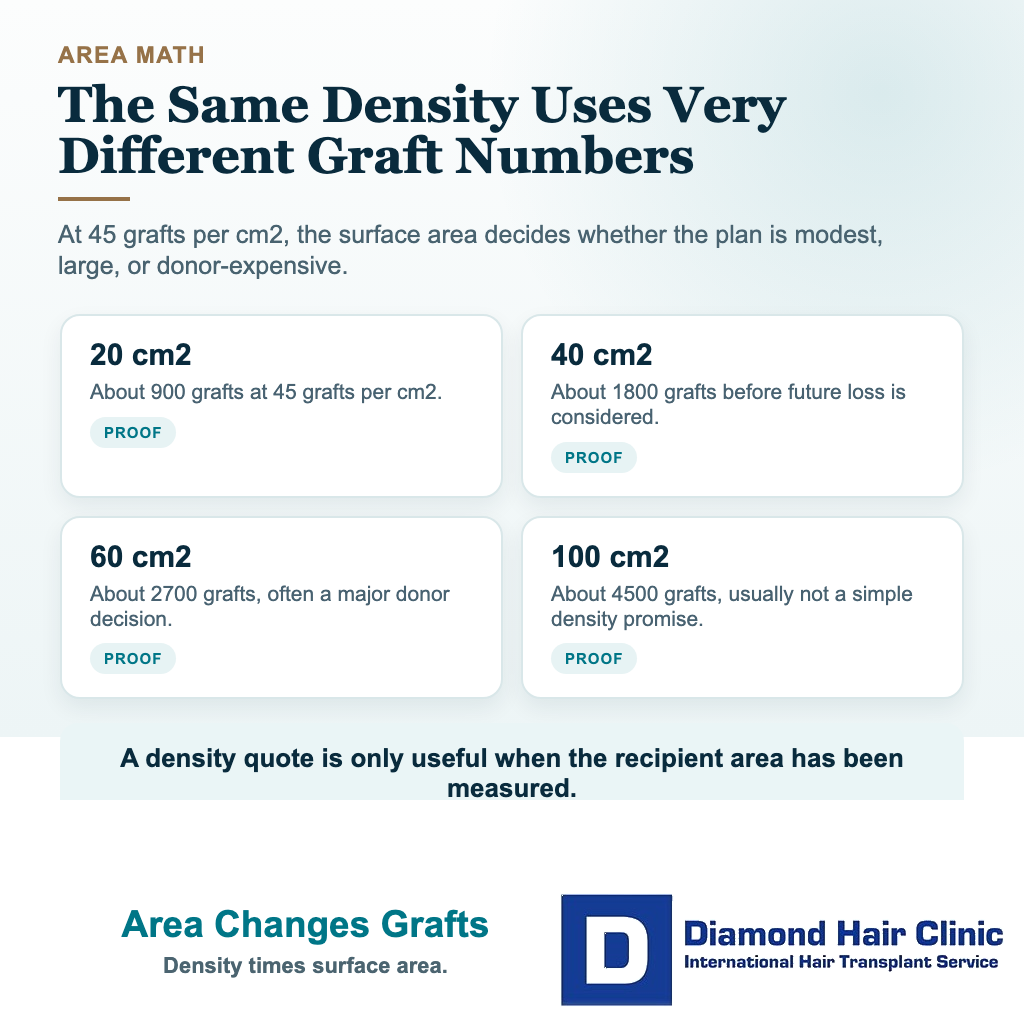
So the issue is not only whether 45 is enough. It is whether 45 describes the most visible frontal zone, the average over the whole recipient area, or a number that has not been matched to a measured surface area. A compact frontal plan is very different from spreading one density target across a large balding scalp.
Large session numbers can mislead patients here. A clinic may quote a high graft number but spread the grafts too widely. The result may look thin because the recipient area was too large for the donor supply. Another clinic may use fewer grafts but concentrate them in the frontal frame, where they create a stronger visual improvement.
The opposite problem is asking for the same density everywhere because the patient wants full coverage in one operation. I understand the wish, especially for international patients who do not want to travel twice. But if the balding area is broad, this approach can spend too much donor hair too early.
This density can look full enough in selected zones
This density can look full enough when the treated area is focused, the hair shaft is not extremely fine, the skin and hair color contrast is favorable, and the grafts are placed at natural angles. In many frontal cases, it can create a strong frame for the face without trying to copy teenage density.
A hair transplant should not try to replace every lost hair in every square centimeter. That is not realistic for most men with pattern hair loss. The aim is to create natural coverage in the areas that matter most visually, while keeping enough donor hair for future needs.
For example, thick and slightly wavy hair can give better coverage from the same density. Very fine, straight hair may show more scalp, especially under strong light or when the hair is wet. This point does not say the plan is automatically wrong. It means the expectation must be explained before surgery.
A small amount of show through under harsh light, wet hair, or very short styling does not mean the plan failed by itself. The detail that matters is whether that level of transparency was explained and whether the density matches what the donor area could safely support.
This conversation belongs before surgery. It is better to understand before surgery what that density number can and cannot deliver. Density planning should be clear before the operation, not defended after disappointment begins.
The same density can look different on two patients
The same density can look different because hair is not a uniform material. Hair caliber, curl, color, length, styling, scalp contrast, native hair stability, and even the way a patient checks the result in the mirror all affect the final impression.
Coarse hair covers more scalp. Curly or wavy hair creates more visual overlap. Fine straight hair can separate easily and expose the scalp, especially under bathroom light or camera flash. A patient who keeps the hair very short may notice more transparency than a patient who styles it with slightly more length.
Some hair transplant results look thin even when the graft number sounds acceptable. The cause may be weak growth, grafts spread over too large an area, ongoing native hair loss, or simply a result being judged under harsh light before growth has fully matured.
When density is evaluated properly, this is not only about what was promised. I would focus on what was possible without damaging the donor area or creating an unnatural pattern.
Hairline use needs soft graft selection
In the hairline, this can be a strong and responsible density if the position is mature, the donor area can support the plan, and the grafts are placed with proper direction. The hairline frames the face, so it deserves careful planning. It is also the area where mistakes are hardest to hide.
A dense hairline placed too low can look attractive in a clinic photo and still be a poor long term decision. The patient may continue losing hair behind it. If too many grafts were spent early, the surgeon may have fewer options later. Hairline design cannot be separated from density planning.
A slightly more mature hairline with good survival, soft transition, and natural direction is safer than a very low and dense line that spends the donor supply too quickly.
The best hairline is not the densest line a clinic can advertise. It is the line that looks natural, grows well, and still makes sense years later.
The incision stage matters here. In my own work, I personally create the recipient area incisions with a sapphire blade because this step determines angle, direction, depth, and distribution. In Sapphire FUE, the blade is not magic by itself. The result depends on how the surgeon uses it.
A slightly higher density is not always better
Not by itself. I understand why patients compare these numbers. If one clinic says 45 and another says 55, the higher number can sound better. But density is not a competition where the largest number always wins.
The difference between 45 and 55 in each square centimeter becomes meaningful as the area grows. In a 20 cm2 area, it means 200 extra grafts. In a 40 cm2 area, it means 400. In an 80 cm2 area, it means 800. Those grafts must come from somewhere, and the donor area is not unlimited.
So the question is what the extra grafts are buying. Are they improving the most visible frontal frame, or are they mainly making a proposal sound stronger?
There are cases where a slightly higher density is reasonable. There are also cases where chasing a higher number may make the plan less predictable or spend grafts that should be reserved for future loss. The decision depends on the patient’s donor condition, recipient area size, hairline position, hair shaft thickness, and crown demand.
Patients often receive different graft numbers from different clinics. Sometimes this happens because clinics are planning different areas. Sometimes they are accepting different levels of risk. Sometimes the number is shaped by a package approach rather than a careful surgical calculation.
A clinic promising 55 is not better by itself than a clinic planning 45. The better plan is the one that fits the patient’s scalp, donor reserve, and future pattern of hair loss.
The crown follows different rules from the hairline
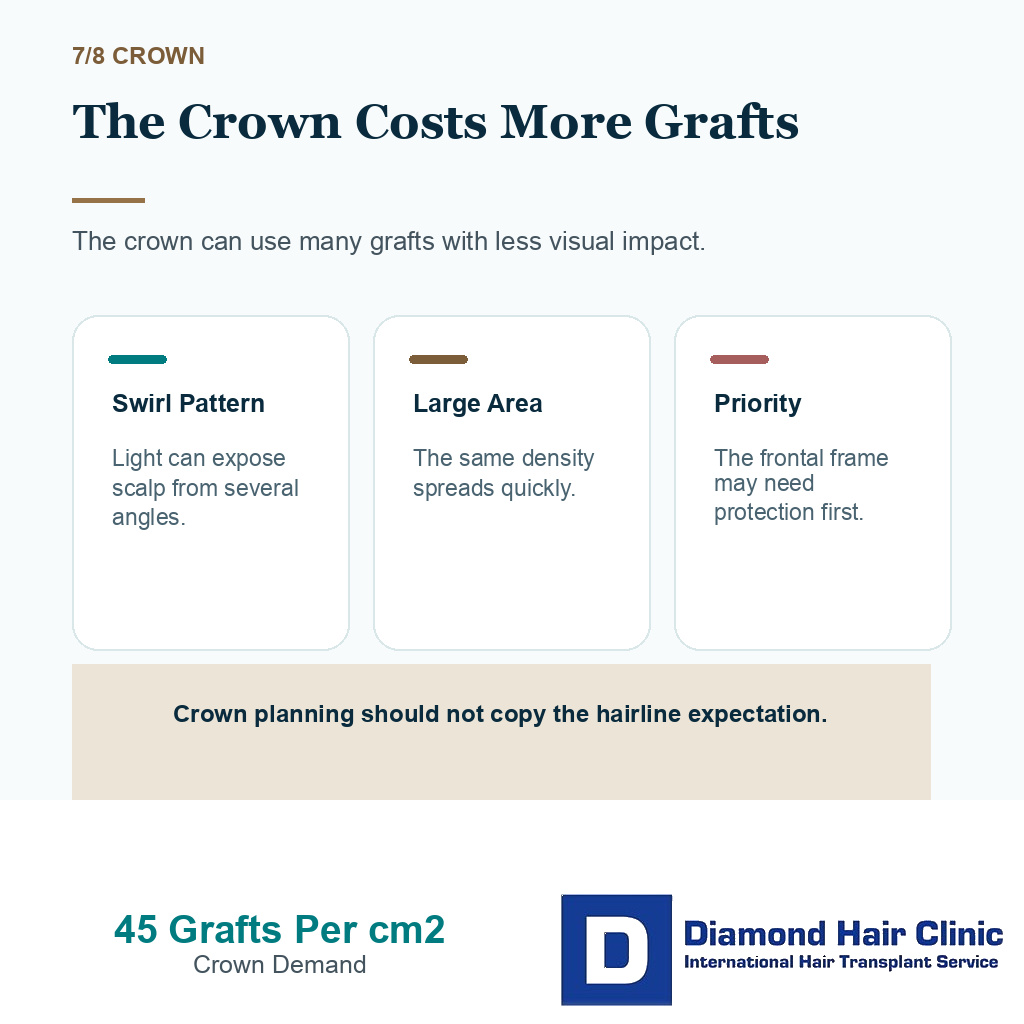
The crown is very different from the hairline. I do not plan crown density with the same expectations because the crown has a swirl pattern, a larger surface area, and a strong tendency to show scalp under direct light.
In a crown hair transplant, patients often want full coverage, but the crown can consume many grafts with less visual impact than the frontal frame. Aggressively treating the hairline, mid scalp, and crown in one session needs caution.
If donor supply is limited, deciding hairline or crown first becomes a real surgical decision. If too many grafts are spent in the crown too early, the patient may have fewer options for the front, mid scalp, or future hair loss.
A crown can improve without being packed like the hairline. That point must be clear before surgery. If a patient expects the crown to look as dense as the frontal hairline after one operation, disappointment is very possible.
Asking for more density can become risky
Asking for more density can become risky when the plan ignores blood supply, skin quality, previous surgery, graft survival, and donor limits. More grafts in a small area may sound better, but the scalp still has biological limits.
There are situations where too many grafts in one area can work against the patient. If the recipient area is packed beyond what the tissue can support, the result may not become stronger. It may become less predictable.
If high density is followed by black crusting, open skin, fluid, worsening pain, or spreading redness, that is no longer only a density discussion. The scalp needs medical review before anyone judges the cosmetic result.
The donor area has to stay part of every density conversation. A patient with a weak donor area cannot be planned like a patient with a strong donor area. The donor area has a limited lifetime supply. Once grafts are removed, they cannot be put back.
Graft numbers alone do not impress me. A responsible plan uses enough grafts to create meaningful coverage, but not so many that the patient pays for today’s density with tomorrow’s limitation.
In high volume settings, density can easily become a sales number. The patient is told a large number, the plan sounds exciting, and the risk of donor area overharvesting is not explained clearly enough. Surgery should not be planned this way.
Density promises need donor evidence
Before accepting any density promise, ask which area is being measured. A 45 graft per cm2 hairline zone is not the same as 45 grafts per cm2 averaged across the whole recipient area.
A proper explanation should tell you how many square centimeters will actually be treated, how the density changes from the first hairline rows to the area behind them, and whether the crown is being planned with the same expectation or a lower one.
If the clinic cannot explain the recipient area size, the graft number may be more of a sales estimate than a surgical calculation. You also need to understand whether future hair loss was considered before agreeing to the density plan.
You should also know who creates the recipient area incisions. This step controls angle, direction, depth, density distribution, and the natural pattern of growth. If a clinic promises high density but cannot clearly explain who performs this stage, that is a reason to pause.
The future part matters especially for younger patients and for men with a family history of advanced hair loss. A person may be a good candidate for a hair transplant and still need a conservative long term plan.
The consultation should leave the patient clearer, not just more excited. If the density promise creates pressure, urgency, or fear of missing a discount, pause before accepting it.
Clinic density promises need a full plan
When a clinic gives a density promise, I want to see how they reached it. The explanation should include donor examination, recipient area measurement, surgeon designed hairline planning, and a clear discussion about future hair loss.
If one clinic promises 45 grafts per cm2 and another promises 60, the higher number is not better by itself. It may be more aggressive. It may also be less responsible. Without the full plan, the number does not tell you enough.
A too neat explanation deserves more scrutiny. A proper plan should explain where density will be higher, where it will be lower, why the crown may need a different approach, how the donor reserve will be protected, and what surgery cannot achieve.
After a proper consultation, you should be able to explain the plan in plain language. If all you remember is the graft number, but not why that number was chosen, the consultation was not complete enough.
I warn patients about hair mill clinics for the same reason. A hair transplant should not be sold like a package where the biggest number sounds like the best deal. It needs planning around the patient’s anatomy and future.
Thin looking results need context before repair
If your result already looks thin, timing is the first thing to check. A result at 4 months is not the same as a result at 8 months or 12 months. Early density anxiety is common, but it should not be judged like a mature result.
Before calling a result thin, the scalp condition, growth stage, hair direction, graft distribution, donor appearance, lighting, and original density plan all need review. While the result is still developing, patience may be the better answer.
If the result is mature and still clearly thin, then the reason must be identified. It may be poor graft survival. It may be too few grafts for the size of the recipient area. It may be a plan that tried to cover too much scalp in one operation. It may also be ongoing native hair loss, fine hair caliber, or expectations that were not explained properly before surgery.
A thin result is not always a complete failure, but it deserves a clear assessment. The review should separate ongoing maturation, a deliberately limited first plan, and a surgery that did not deliver what was medically reasonable.
More grafts later are not always the answer
The decision to add more grafts later should usually wait until the first result is mature enough to judge. Quite often, that means around 12 months. For slower areas or crown work, waiting closer to 18 months can give a clearer answer.
A second hair transplant can be useful when there is a clear target, healthy donor reserve, stable hair loss, and a realistic goal. It is less wise when the patient is chasing perfect density everywhere or comparing himself to the best photo of another patient.
Sometimes a focused touch up is enough. Sometimes medical stabilization matters more than more grafts. Sometimes the responsible advice is to accept a natural improvement rather than spend more donor hair trying to erase every sign of thinning.
A 3000 graft plan can be excellent in one patient and insufficient in another. It has to match the surface area, donor supply, and long term strategy. Density per cm2 only has meaning inside that full calculation.
The practical meaning of a density quote
A density quote can be useful, but it is not a complete surgical plan. It can be enough in the right area, in the right patient, with the right hairline design, careful placement, and responsible donor management. It can also be too little for a large area or too aggressive for a fragile donor situation.
That density cannot be judged from the number alone. The scalp, donor area, likely future pattern of hair loss, hair caliber, crown, hairline position, and patient expectations all change what the number means.
I would not aim to give the patient the most impressive density claim. The aim is to create a result that looks natural, grows reliably, and leaves the donor area protected. The right plan should not spend the future to win the consultation today.
If you are comparing clinics, the highest graft density is a weak promise without a clear plan. The explanation should make the number understandable for your own scalp.
Density numbers need a mapped zone
A density quote is useful only when it is attached to a measured area. Ask which zones are being treated, how many square centimeters are involved, and where the donor limit changes the design.
A density number is clearer when it is tied to zones. The plan should show where density is higher, where it tapers, and which area stays lighter because every part of the scalp does not need the same packing.
The number also has to match hair caliber, color contrast, curl, existing miniaturization, and the amount of scalp that will still thin later. A compact frontal zone can tolerate a different target from a broad hairline to crown promise.
When I review a proposed 45 grafts per cm2 target, I am asking whether that density belongs in that exact location for that donor area. Without the map, the number is not surgical planning. It is just a sales figure.

Read this review excerpt
Every single one of my questions was answered and they made sure I had all the details I needed to make an informed decision.