



Hair Transplant Turkey vs Mexico Which Is Better?
Turkey is often the stronger starting point when a patient wants a mature international hair transplant system, many clinic choices, and teams experienced with FUE or Sapphire FUE. Mexico can be more practical for someone from the United States who wants shorter travel, easier return visits, or family support nearby. Neither country is automatically safe, and neither country is automatically unsafe. The clinic model matters more than the passport stamp.
Do not choose between Turkey and Mexico only by price, flight time, or social media photos. A hair transplant is surgery. Before travel, the plan has to show who designs the hairline, who examines the donor area, who makes recipient area decisions, what graft number is safe, and how follow up works after you return home.
The fair comparison is the same in both countries. Know who can change the plan on the procedure day, who responds if healing looks wrong after travel, and whether follow up means medical review or only customer service.
Both countries have good doctors and weak clinics. The country comparison matters less than the clinic itself. Donor protection, realistic graft planning, and responsibility after the operation are the real test, not the country name.
Do not let a country comparison replace a clinic comparison. A stronger choice is the clinic that explains your own donor limit, hairline tradeoff, and aftercare route before travel.
Patients compare Turkey and Mexico for cost, travel, and clinic access
Many people compare Turkey and Mexico because hair transplant prices in the United States can feel unreachable. Travel can be reasonable, but only if the saving does not weaken the medical plan.
Mexico can be attractive for United States patients because the trip may be shorter, especially near the border or with direct flights to Tijuana, Mexico City, Guadalajara, or Cancun. Turkey is attractive because Istanbul has become one of the most active global centers for hair transplant in Turkey.
A short flight is convenience, not surgical quality. It helps only when the medical plan is serious, the clinic is transparent, and the donor limits are understood before surgery.
Cost is only one part of the comparison
Turkey is often more competitive when the full package is considered, especially because Istanbul has a large medical tourism system, many international patient teams, and strong hotel and transfer infrastructure. But lower price should never be the main reason to choose surgery abroad.
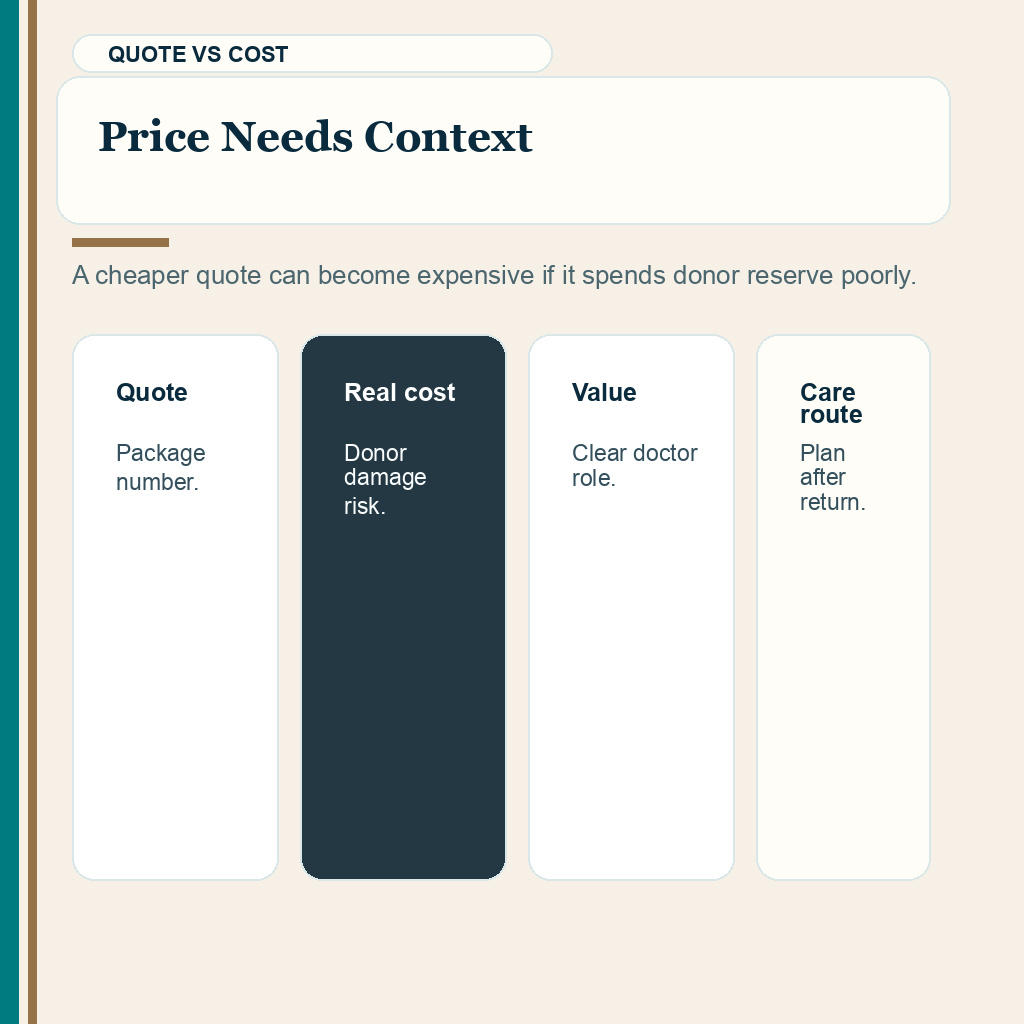
When comparing hair transplant cost in Turkey with Mexico, I separate the quote from the real cost of the decision. The quote is the package number. The real cost includes surgeon involvement, donor safety, aftercare, travel time, and what happens if healing is not straightforward.
Mexico may reduce flight cost and travel time for some American patients. Turkey may offer a more organized all inclusive trip for many international patients. The right comparison is total value. A careful quote makes clear who is medically responsible, what is included, what is not included, and what happens if recovery does not follow the easiest timeline.
Turkey makes more sense in some patient situations
Turkey makes more sense when the patient wants a clinic that handles international hair transplant patients every day, has clear travel coordination, and can show mature results from cases similar to his own. Istanbul can be especially practical when the patient needs a larger FUE or Sapphire FUE session and wants a team used to that workflow.
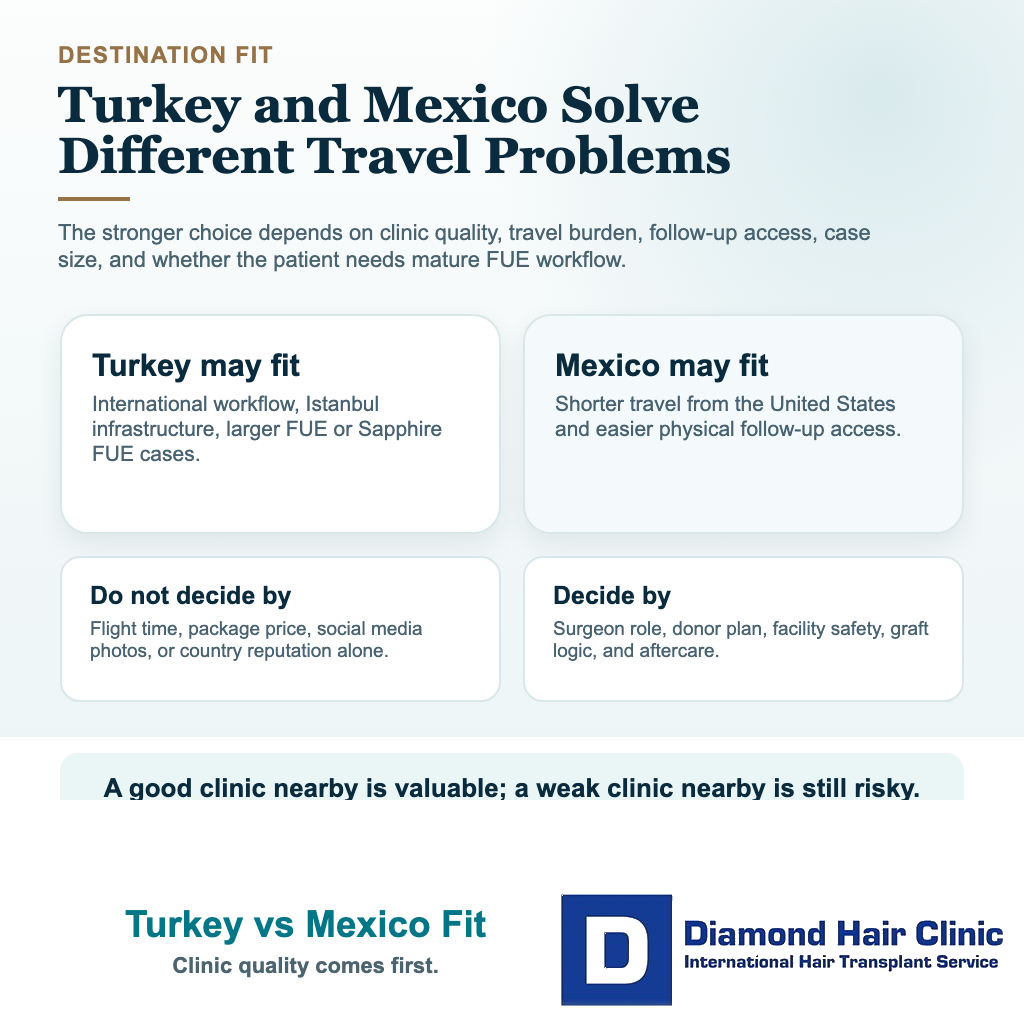
Turkey also makes sense when the clinic is transparent about the surgeon’s role, the number of patients treated per day, donor limits, and aftercare. Turkey’s large market is an advantage only when the patient uses it to find real surgical accountability, not when he chooses the loudest package.
For patients comparing many Istanbul clinics at the same time, how to choose a hair transplant clinic in Turkey gives a more detailed framework for judging the clinic, not just the country.
Mexico can be more convenient for some United States patients
For many United States patients, Mexico is more convenient geographically. A shorter flight or drive can make travel less stressful. If an in person follow up visit becomes necessary, Mexico may be easier to reach again than Istanbul.
That convenience can matter for patients with medical anxiety, limited time off work, family responsibilities, or difficulty with long flights. It can also matter if the patient strongly prefers to stay close to home while still leaving the United States for treatment.
But convenience should not hide weak planning. A nearby clinic that overharvests the donor area is not safer than a distant clinic that plans carefully. Distance matters, but responsibility matters more.
When can Mexico be the better practical choice?
Mexico may be the better practical choice when the patient has found a genuinely strong doctor, wants easier travel from the United States, and values the possibility of a simpler physical follow up visit. Shorter travel can reduce stress and make family support easier.
This can be important for patients with anxiety, health concerns, work limits, or difficulty arranging a longer trip. The key is that convenience must come after medical quality, not before it.
A strong clinic near home is valuable. A weak clinic near home is still a weak clinic, even when the travel plan looks easy.
Safety has to be judged at the clinic level
Judge safety at the clinic level first. National crime charts and old travel headlines do not tell a patient who will perform the surgery, how sterile the facility is, how many patients are treated per day, or whether the graft plan is responsible.
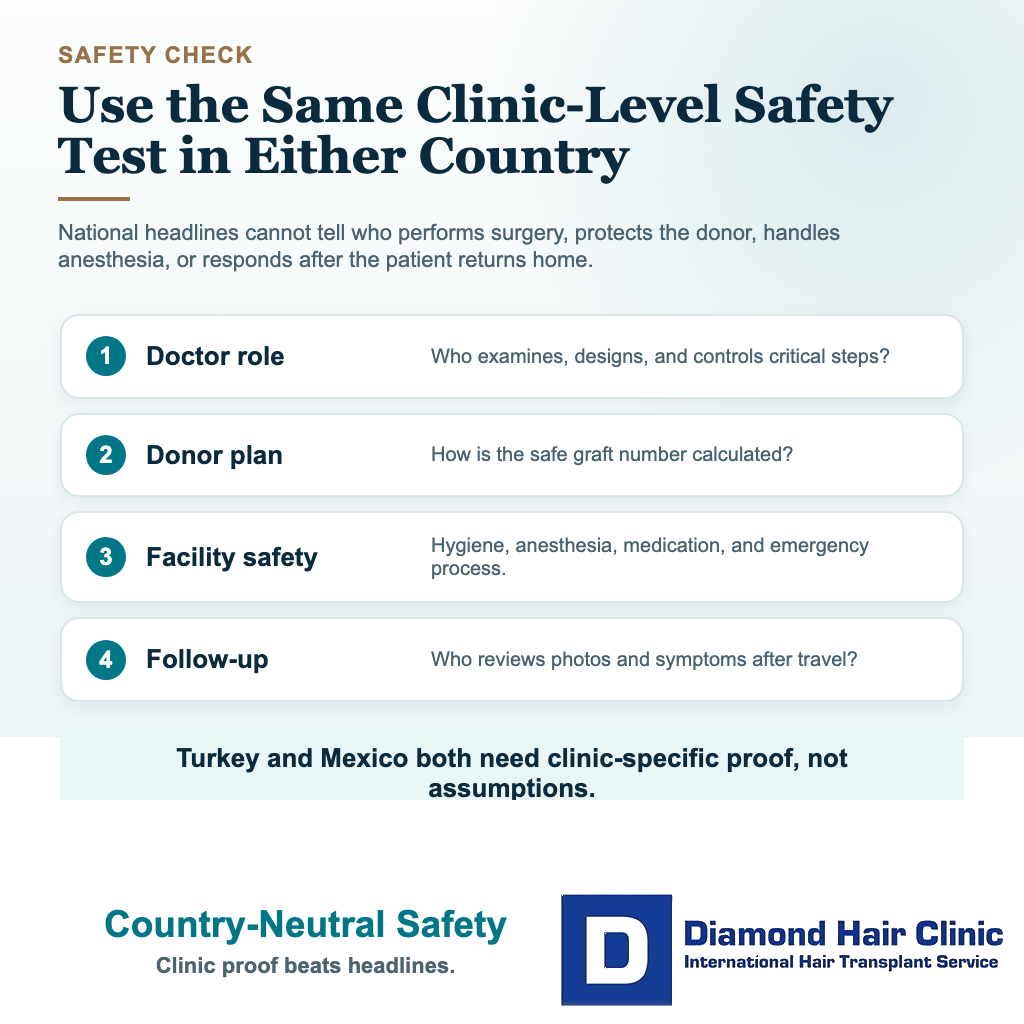
Check the medical setting, doctor credentials, anesthesia process, emergency plan, hygiene standards, medication instructions, and communication after surgery. These checks matter in Turkey, Mexico, and every other country. Patients should also check current travel advice for the exact city they plan to visit, because travel safety and surgical safety are related but not identical.
I treat regulation as a foundation, not a result guarantee. A clinic can meet basic administrative requirements and still produce an unnatural plan if the hairline, donor area, and recipient area are handled poorly. The Turkey Ministry of Health page explains the Turkey side of this principle, and that standard applies to any clinic abroad.
Country safety headlines are not enough
Separate travel safety from surgical safety. Airport transfer, hotel location, clinic transport, emergency access, and travel insurance matter, but they do not tell you whether the donor area will be overused or whether the hairline will look natural.
For hair transplantation, the lasting problems I worry about most are poor donor extraction, unnatural hairline design, weak graft handling, unclear medical responsibility, and no serious follow up. These problems can happen in any country when the clinic model is wrong.
The warning signs in hair transplant clinic red flags are written about Turkey, and the clinic quality check helps when comparing clinics in Mexico as well.
Istanbul and Tijuana serve different patient flows
Istanbul and Tijuana serve different patient flows. Istanbul receives patients from Europe, the Middle East, North America, Australia, and many other regions. Tijuana is especially convenient for patients from the western United States.
Istanbul has a very large hair transplant market. That creates advantages, such as experienced teams and established travel coordination. It also creates risk, because high volume clinics and aggressive sales models exist in the same market.
Tijuana and other Mexican cities may feel easier for American patients to access. The patient still has to ask the same questions. Who is responsible for the plan? How many patients are treated that day? What happens if the donor area is weaker than expected?
Surgeon involvement matters more than country
Surgeon involvement is more important than the country. The most important decisions are not travel decisions. They are medical decisions.
The surgeon should assess candidacy, donor capacity, hair loss pattern, hairline height, recipient area needs, graft number, and future hair loss. A coordinator can organize travel. A coordinator should not replace medical judgment.
Before choosing either destination, review who performs hair transplant surgery, especially for critical steps such as hairline planning, recipient area incisions, extraction, and supervision.
Donor management should decide the plan
The donor area is the limited reserve for this operation, possible future hair loss, and any repair need later. A clinic in any country can damage it if the extraction pattern is too dense, uneven, or poorly planned.
Compare donor plans before comparing prices. How many grafts are being proposed? Where will they be taken from? What donor density remains after surgery? What happens if the patient needs another procedure later?
The donor area often predicts whether a transplant ages well. A cheap plan that spends too much donor reserve is expensive in the long term.
FUE and Sapphire FUE depend on the clinic, not only the country
Turkey has a deep market for FUE hair transplant and Sapphire FUE. That gives patients many choices, but it also means they must separate serious surgeon-led clinics from high-volume commercial clinics.
Mexico also has capable surgeons, and some patients may find a good local or regional option there. The technique name alone does not make a transplant safer. What matters is whether the method is used with a careful diagnosis, a safe graft number, natural hairline design, and disciplined donor extraction.
A method name does not protect the patient. A careful plan protects the patient. This is true whether the clinic advertises FUE, Sapphire FUE, DHI, or another technique label.
Aftercare and follow up need a travel plan
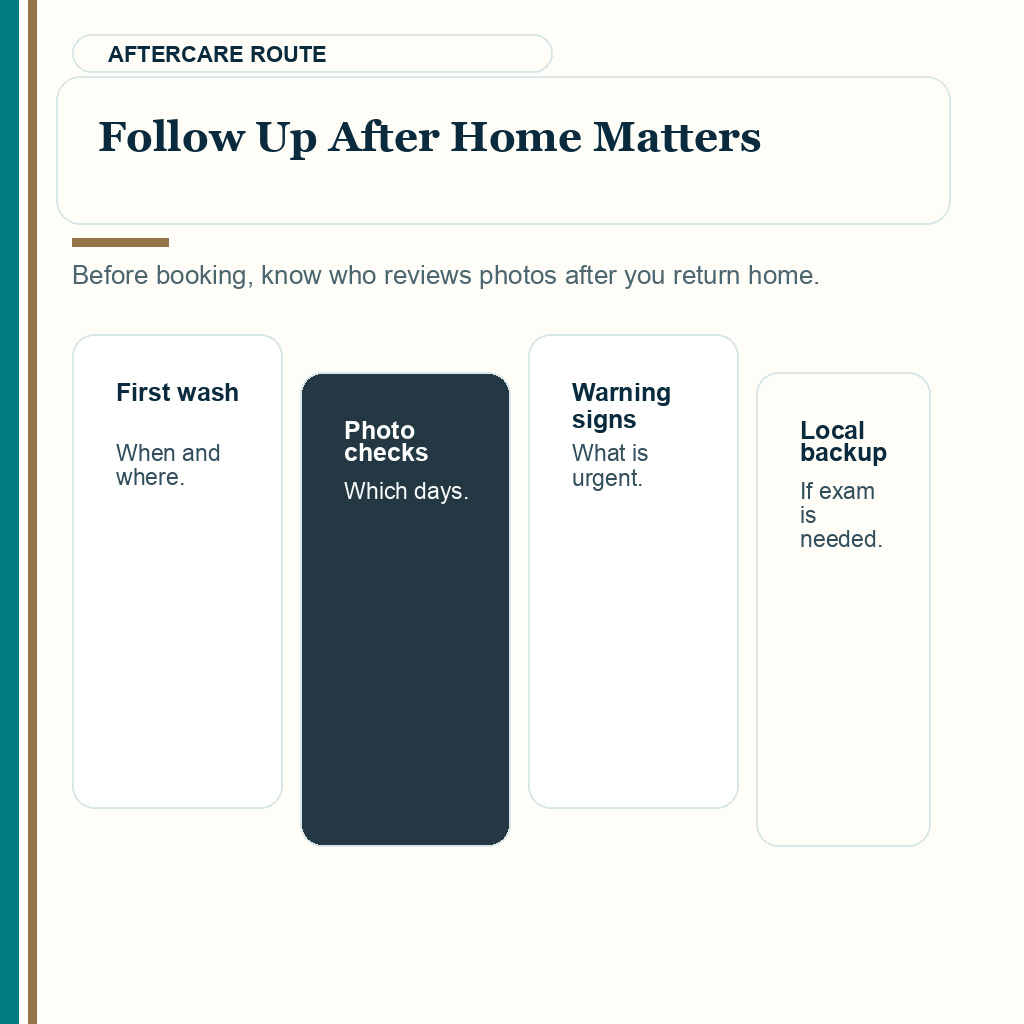
Aftercare is one of the main differences patients forget when comparing destinations. It is not enough to ask how quickly you can fly home. You need to know when the first wash happens, how swelling is handled, what photos to send, which symptoms are urgent, and who answers questions after you return.
The fair comparison continues after the flight home. Follow-up timing, urgent symptom routing, and medical authority matter more than a quick service reply.
Mexico may be easier for some United States patients if a physical visit becomes necessary. Turkey clinics that treat international patients should still provide clear remote follow up, structured instructions, and realistic guidance about when travel is comfortable.
Before booking, review hair transplant aftercare and ask how many photo checks are included after travel. Also confirm how many days are needed in Turkey and when flying after hair transplant is realistic for your itinerary.
Reviews need mature evidence, not only hospitality
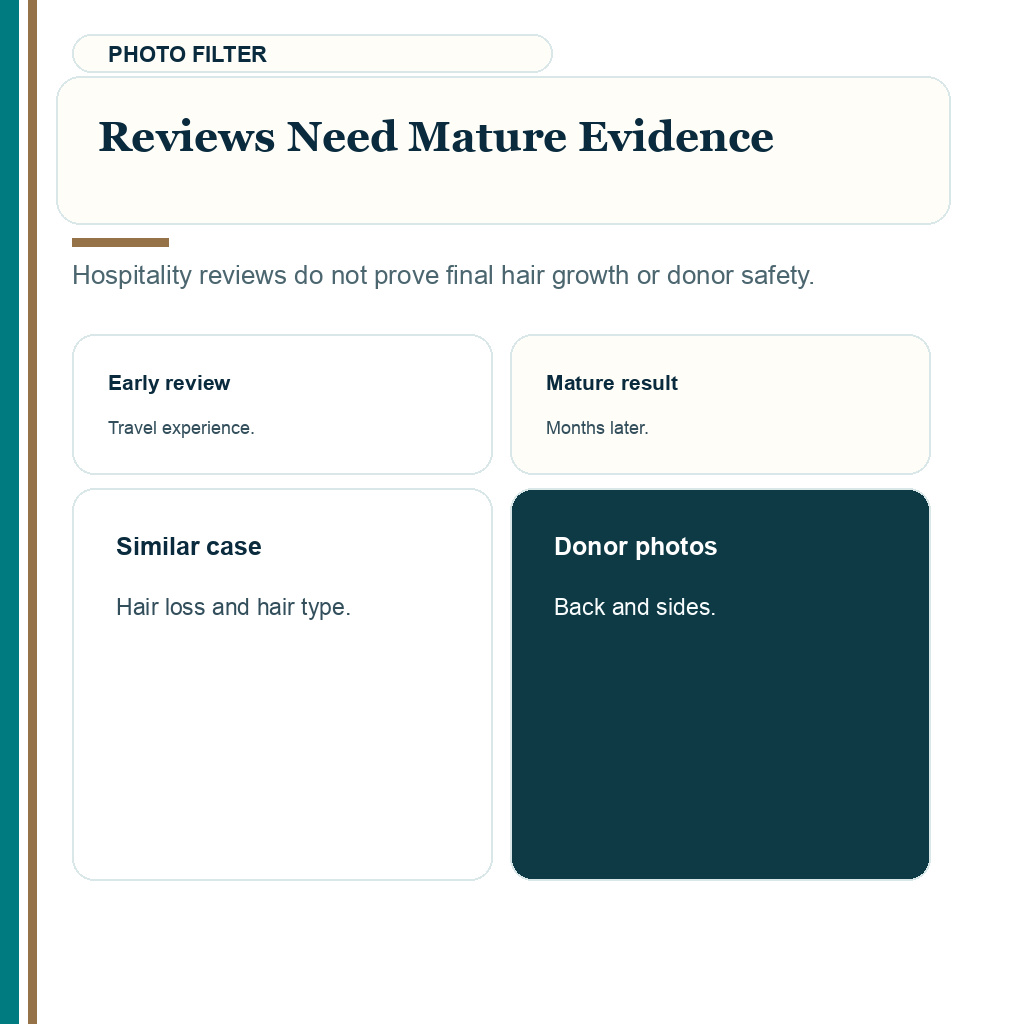
Reviews can be useful, but they are strongest when they show mature results, donor area photos, hairline close up photos, timeline, and clinic response after surgery. Early travel reviews mainly show hospitality. They do not prove final growth.
When reading reviews from Turkey or Mexico, look for patients with a similar hair loss pattern, hair type, donor strength, and graft number. A good result in a small hairline case does not prove the same clinic can handle advanced baldness.
Reviews in high-volume markets need careful reading. Hair transplant reviews in Turkey should be read for patterns, not for volume alone.
What should you ask before choosing either country?
Before surgery, candidacy, hairline design, donor examination, recipient area incisions, graft number logic, and daily case volume should all be clear.
A safe plan explains what happens if the donor area cannot support the promised graft number, how the clinic handles blood pressure, medications, smoking, scalp inflammation, previous surgery, travel timing, and follow-up after you return home.
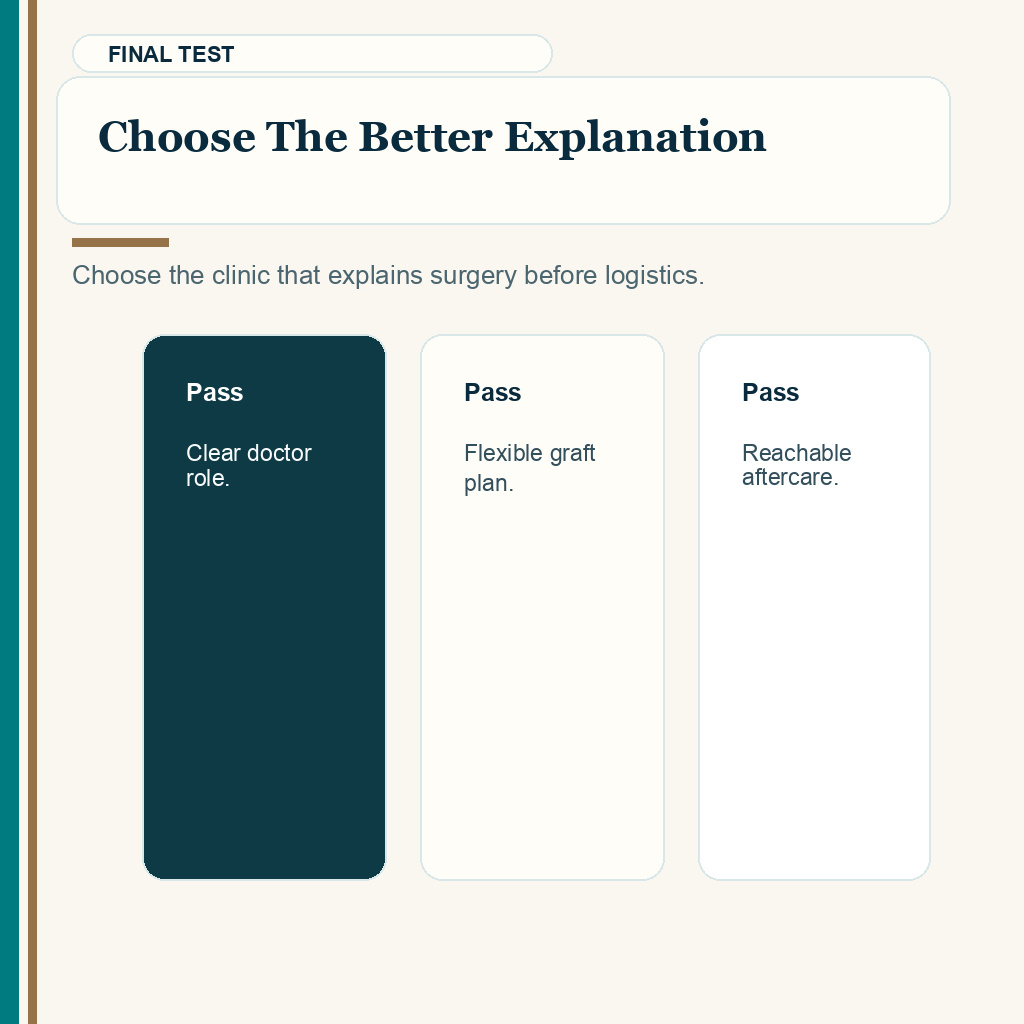
If the clinic answers only with price and hotel details, keep looking. A clinic with medical responsibility should be able to explain medical judgment before travel logistics.
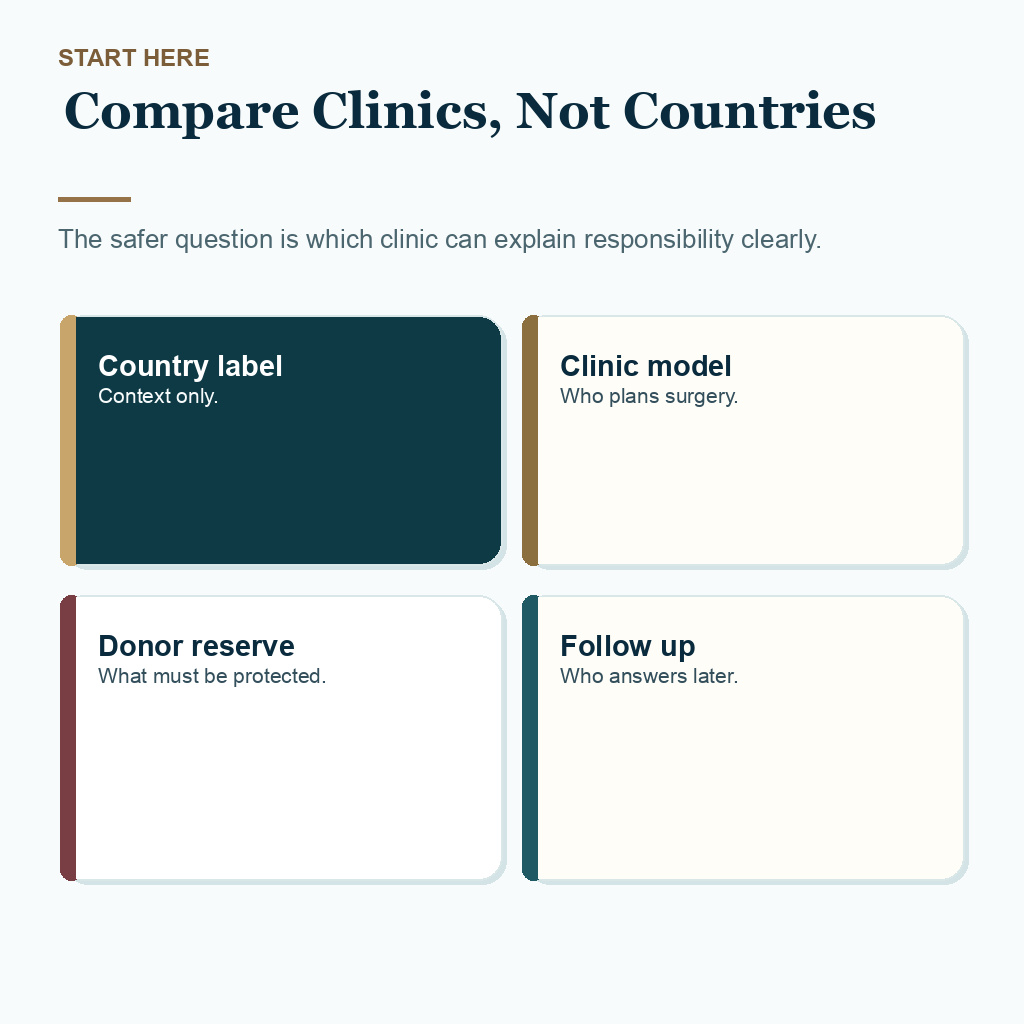
These 10 comparison slides separate clinic responsibility, travel convenience, price context, surgeon role, donor examination, method labels, mature result evidence, safety layers, follow-up after returning home, and the final clinic choice test. Swipe sideways, use the arrows one slide at a time, or choose a number below the image.




How should you choose between Turkey and Mexico?
For many international patients, Turkey is often the stronger starting point because Istanbul has more mature hair transplant infrastructure and more depth in FUE and Sapphire FUE. That is a starting point, not a guarantee. A serious Mexico clinic may be better than a weak Turkey clinic, and a serious Turkey clinic may be better than a convenient Mexico package.
The decision should come back to the clinic in front of you. Does the plan protect the donor area? Does the doctor explain the hairline and recipient area? Can the clinic change the graft number after examination? Is follow up clear after you go home?
At Diamond Hair Clinic, I use country comparisons only as context. The real work is helping the patient understand the surgical plan, the limits, and the long-term donor cost before the operation is accepted.

Read this review excerpt
Absolutely everything regarding logistics was conveyed in a clear and timely manner via WhatsApp by Dr. Mehmet’s office.