



Red Flags of Turkish Hair Transplant Clinics
Avoiding a bad hair transplant in Turkey starts with one practical point. A red flag is not only one strange detail. It is a warning sign that the clinic may not be thinking about the patient as a surgical case, but as a booking.
Turkey has excellent hair transplant surgeons and clinics with strong surgical standards. The broader Turkey question is different from the clinic model in front of the patient. Excellent work can be done here when surgery is planned carefully, but Turkey also has cheap hair mills that use the country’s popularity to sell high-volume surgery with weak medical control.
A clinic that offers less than 5000 dollars for an all inclusive hair transplant package is not always unsafe, but it should make you slow down and identify what has been removed from the medical process to make that price possible. In hair transplant surgery, the hidden cost of a cheap decision is often paid later with a damaged donor area, a fake hairline, poor growth, or a repair that is much more difficult than the first operation.
Some clinics use slogans such as Stem Cell Hair Transplant, Organic Hair Transplant, or miracle technology to create excitement. This marketing can hide surgeon involvement, graft handling, donor limits, and the number of patients moving through the clinic in one day. The patient needs to know who examines the case, who designs the hairline, who opens the channels, who extracts grafts, and who decides whether he is a good candidate for hair transplant at all.
If a clinic does not require a proper consultation before surgery, that is one of the clearest warning signs. Before accepting a case, the clinic must understand your donor area, your hair loss pattern, your age, your expectations, your medical history, and your long term plan. The same warning applies when follow-up after surgery is vague or handled only by sales messages. The facility name and address for the surgery need to be clear before you book travel. Hotel, transfer, and consultation details do not show where the operation will take place. Before booking, verify the facility’s medical authorization, its infection control standards, the emergency response available during surgery, and the doctor who carries medical responsibility at that address. When a consultation jumps straight to a graft number, the missing question is what finding would make the clinic say no. An AI clinic list can miss these responsibility gaps unless you check surgeon involvement, donor planning, and aftercare proof directly.
Before choosing a clinic
A hair transplant is cosmetic surgery, but it is still surgery. To perform it correctly, the doctor needs medical judgment, technical control, and artistic vision. If these are missing, the result can look unnatural even when the number of grafts sounds impressive.
The two most common reasons I see behind unsuccessful hair transplants are poor technique and poor artistry. Poor technique can damage grafts, create weak growth, or leave visible scarring. Poor artistry can create a low, flat, artificial hairline, which is why I always warn patients about low flat hairlines.
Good surgery is more than moving hair from one place to another. The surgeon has to place the right grafts in the right direction, at the right angle, with the right density, while protecting the donor area for the future. For that reason, the difference between FUE and DHI matters less than the judgment of the person planning and performing the operation. Crown work on its own still needs design control. The whorl direction and changing angles must be mapped, because a flat patch of grafts can look wrong even when the patient was not asking for a new hairline.
Patients often hear very attractive success numbers. More realistic language is safer. A careful hair transplant can produce excellent results, but no ethical surgeon should promise every patient the same outcome. Even a carefully planned hair transplant can underperform, so the promise should be a controlled medical process, not certainty. The quality of the donor area, the stability of hair loss, the surgical plan, the handling of grafts, and healing biology all matter.
Black market hair mills often advertise confidence, but confidence is not the same as competence. A clinic with proper medical standards is not the clinic that says yes the quickest. It is the clinic that knows when to say no.
Hair mill failure patterns
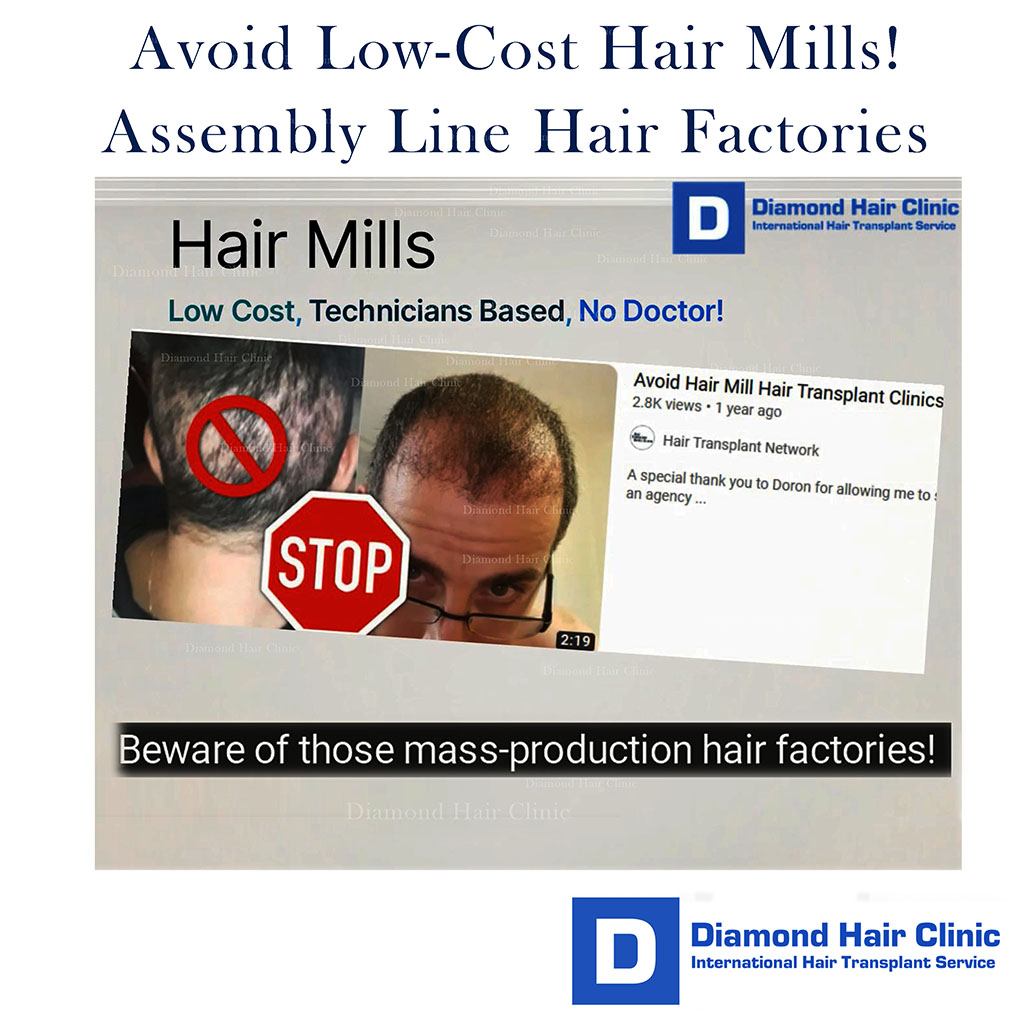
Hair mills usually operate on a quantity over quality model. They try to treat many patients in a single day, and the surgery becomes an assembly line process. The consultation is often sales driven. The doctor may appear briefly, or may not be meaningfully involved at all. The patient may not know who is making surgical decisions. For a more practical patient check, I explain how daily patient volume can weaken a hair transplant plan.
A crowded surgery day is not only a comfort issue, because it can hide who is slowing the donor work down. It can change who designs the case, who opens the channels, who checks graft handling, and how quickly the team notices when the donor plan should slow down.
It matters because a hair transplant includes thousands of tiny surgical decisions. Extraction pattern, graft selection, hairline design, channel direction, density planning, anesthesia control, and bleeding management are not minor details. They are the surgery.
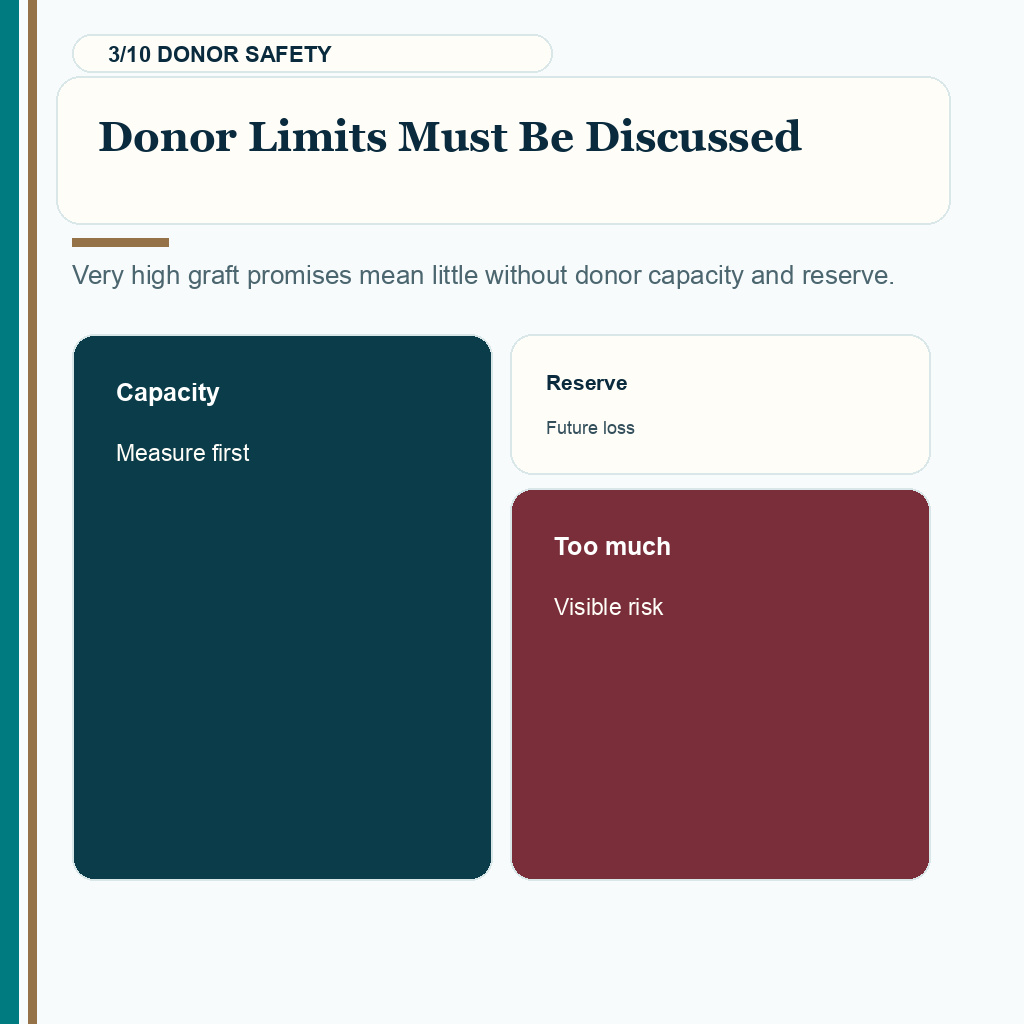
Donor reserve is especially vulnerable. Once grafts are taken, they do not grow back in the donor area. If a clinic removes too many grafts, removes them from the wrong zones, or extracts them unevenly, the patient may develop visible thinning or patchy scarring. I discuss this more deeply on the page about donor area overharvesting after hair transplant.
Another problem is accepting the wrong patient. Some men have weak donor capacity, aggressive hair loss, very young age, or unrealistic expectations. An ethical clinic should explain these limits. A hair mill may accept the patient anyway because the plan fills the surgery schedule.
Red flags need to be connected with candidacy for that reason. If a clinic accepts almost everyone, promises very high graft numbers to everyone, and never discusses donor limits, the patient is not being protected.
Major clinic red flags
The doctor is hidden or not involved
Lack of transparency is a serious warning sign. You should know the doctor’s name and surname responsible for your surgery. You should also know what the doctor personally does during the operation.
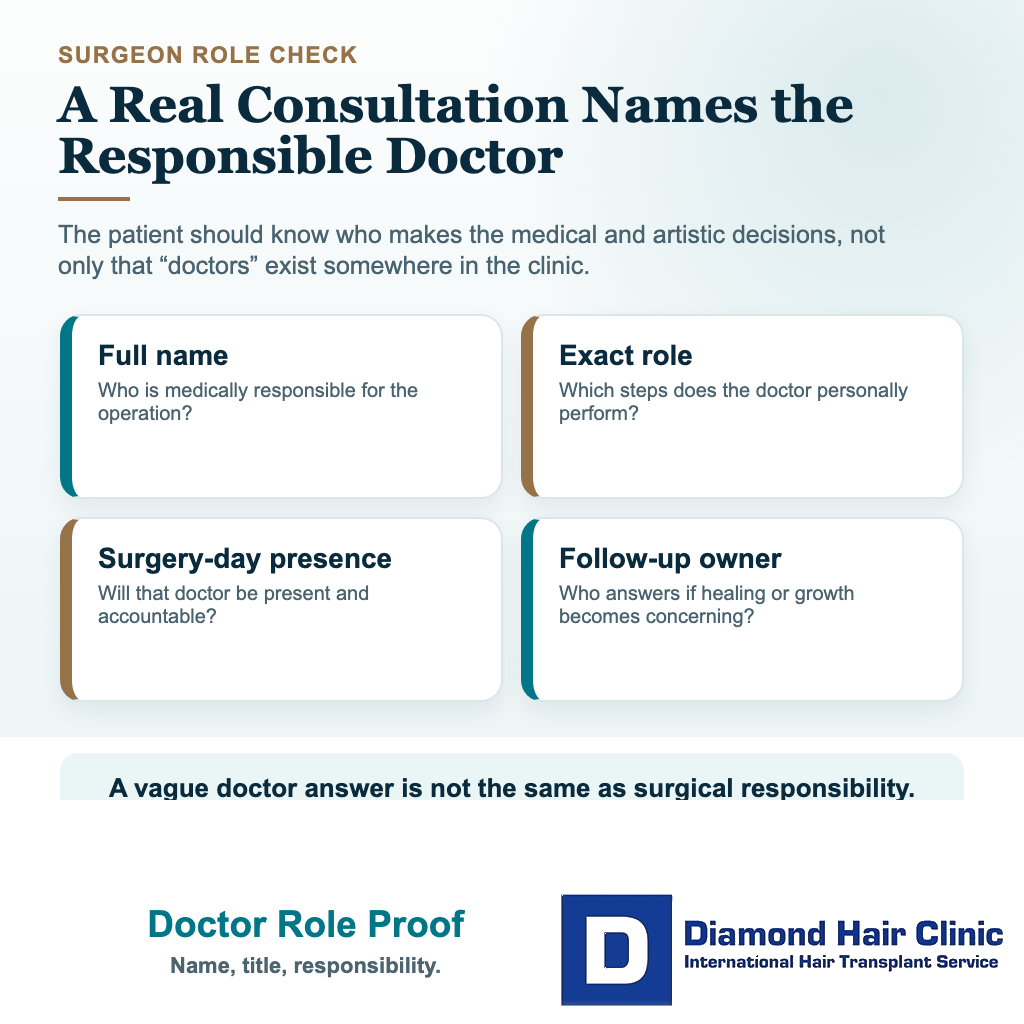
Hair transplant surgery is invasive. Incisions in the scalp determine angle, direction, density, and naturalness. If there is no surgeon in the clinic, or if the surgeon is only used for marketing while others perform the surgical parts, that is a major red flag.
For beard or mustache work, hidden responsibility is even easier to see later. A scalp result can sometimes be softened by hair length, but beard transplant regret is often judged when the face is trimmed or shaved. If the person making the recipient openings does not control angle, direction, graft choice, and border softness, the mistake can sit on visible facial skin rather than under longer hair.
If a clinic says, “Our doctors do the surgery,” that answer is still incomplete. The answer needs to include a specific name, medical title, and role. It should be clear whether that doctor designs the hairline, creates the recipient areas, supervises graft extraction, and remains responsible for the surgical plan. A vague answer is not reassuring.
The consultation is only a sales chat
A real consultation is not only a WhatsApp price quote. It should include your age, hair loss history, family history, donor area quality, medical background, medication use, previous surgery, expectations, and photos from useful angles. If the clinic gives a graft number immediately without proper evaluation, the plan is probably not a plan.
Online evaluation can be useful at the first step, and I also review patients through hair transplant planning from photos. But photo based planning has limits. A responsible doctor should explain uncertainty, not pretend that every detail is clear from a few pictures.
Be especially careful when a clinic accepts a very young patient, diffuse thinning, or hair loss that is still changing on medication from only a few photos. A photo review can start the conversation, but it should not turn uncertainty into a confident package quote before diagnosis, donor safety, and timing have been tested.
A polished story about a result can still leave responsibility unclear. The missing details often matter most, especially who designed the case, who made the medical decisions, and who handled follow up or revision concerns afterward.
When the photo consultation needs more caution
Slow down when the online answer feels certain before the doctor has enough evidence.
- The clinic accepts a very young patient without asking how fast the hair loss is changing.
- Diffuse thinning is visible, but there is no discussion of diagnosis, donor quality, or native hair stability.
- The patient is still changing medication or still losing hair, but the clinic talks as if the plan is settled.
- The graft number is quoted from a few photos before the doctor explains the limits of photo review.
- No one says what finding would make the clinic delay, reduce, or refuse surgery.
A real consultation can start online. It becomes unsafe when online uncertainty is turned into a confident sale.
Medical treatment is never discussed
Hair transplant surgery moves permanent donor hair, but it does not stop native hair loss. With many patients, especially younger men, medical treatment may be important to protect existing hair. If a clinic never discusses finasteride and minoxidil around hair transplant, that is a warning sign.
Medication is not forced on every patient. Some patients cannot use it, some do not want it, and some may not need it in the same way. But the discussion itself matters. If nobody explains the difference between transplanted hair and native hair, the patient may misunderstand the future.
Before and after photos look too perfect
Before and after photos should be consistent in lighting, angle, hair length, camera distance, and styling. If the before photo is harsh and the after photo is soft, long, styled, or filled with fibers, the comparison is not reliable. That rule also applies to social media hair transplant result marketing, where lighting and selective angles can hide missing medical details.
Fake engagement can make a weak clinic look busier than it is. Likes, followers, and repeated short comments are not proof of surgical control. They only show that the marketing needs a closer check.
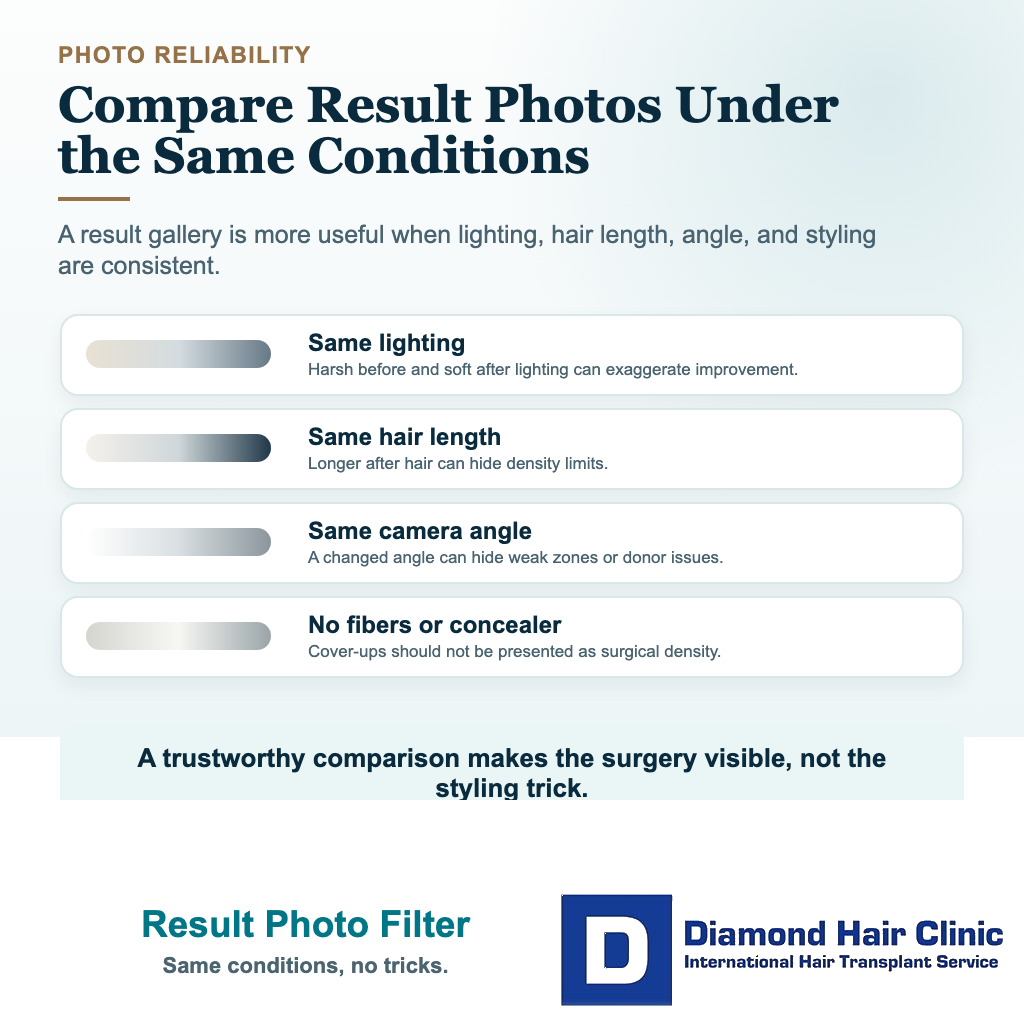
Patients should be careful with clinics that use concealer or powder after hair transplant in result photos. Hair fibers can be useful in daily life, but they should not be used to make a surgical result look denser than it really is.
One good hair mill result does not make the system safe
A hair mill can still produce a good result in some patients. The case may be straightforward, the donor hair may be strong, and the patient may happen to be treated by a capable team that day. I do not deny those results when they are real.
The warning sign is consistency. If 10 to 20 patients are moved through the same day, the clinic has to prove that doctor responsibility, donor limits, hairline decisions, graft handling, and follow-up are still controlled for each person. One success story does not answer that.
Can a hair mill still give good results?
Yes, but I would not choose a clinic from the exception. What matters is whether the same system gives you a controlled chance of a natural result, not only whether one lucky patient can show a good photo afterward.
The clinic pushes you to decide quickly
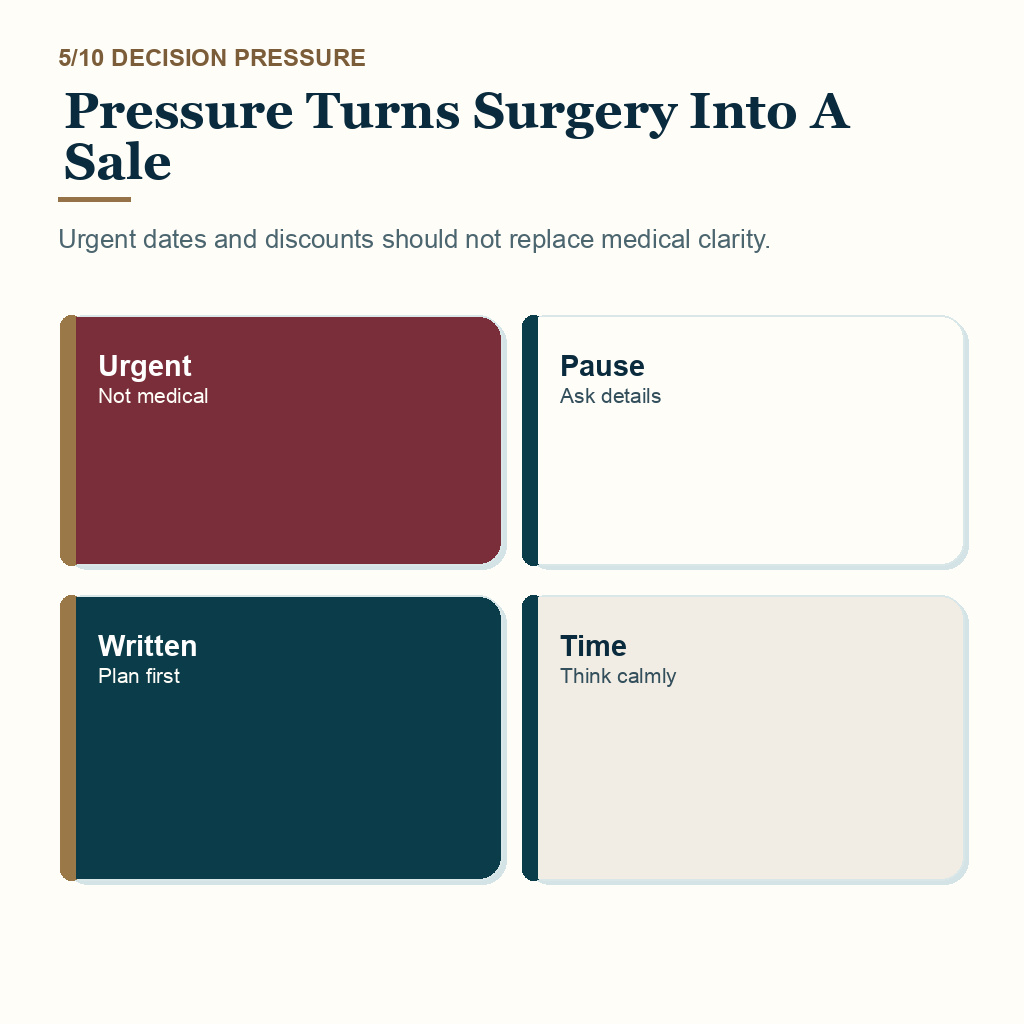
Pressure is never a good sign. A clinic may say there is a discount, a last minute gap, or a special package that expires today. This pressure style is common in sales, but surgery isn’t a holiday deal.
A patient needs time to think, compare, ask questions, and understand the risks. If the clinic becomes impatient when you ask reasonable questions, that tells you something.
The 10 red flag slides below split the warning signs into one image each. Swipe sideways, use the arrows for one slide at a time, or choose a number below the image.

Read this review excerpt
They never tried to push me into a decision or rush the process. There was no sales pitch, no urgency, just clear answers and supportive dialogue, which made the whole interaction feel very professional and genuine.

Read this review excerpt
The first and final part of the procedure was a collaborative effort between the Dr and his two technicians.



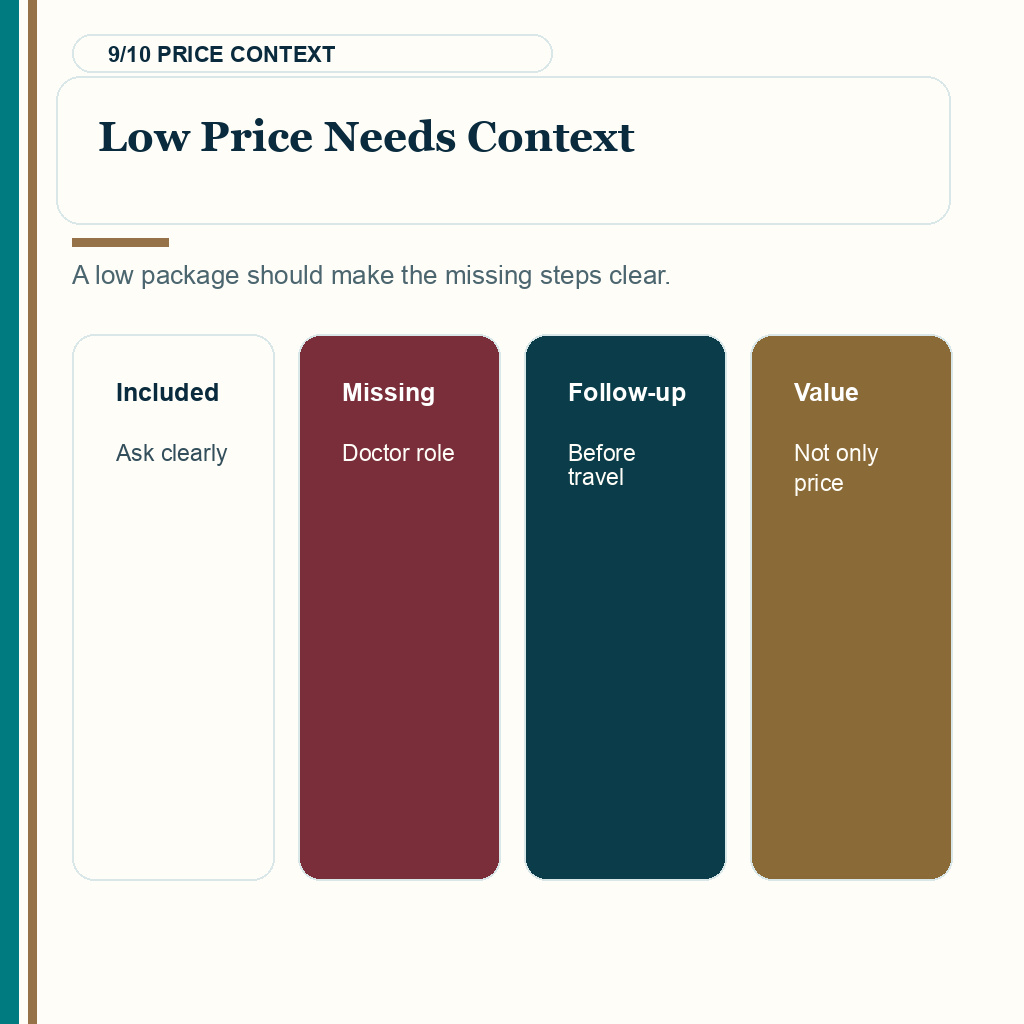
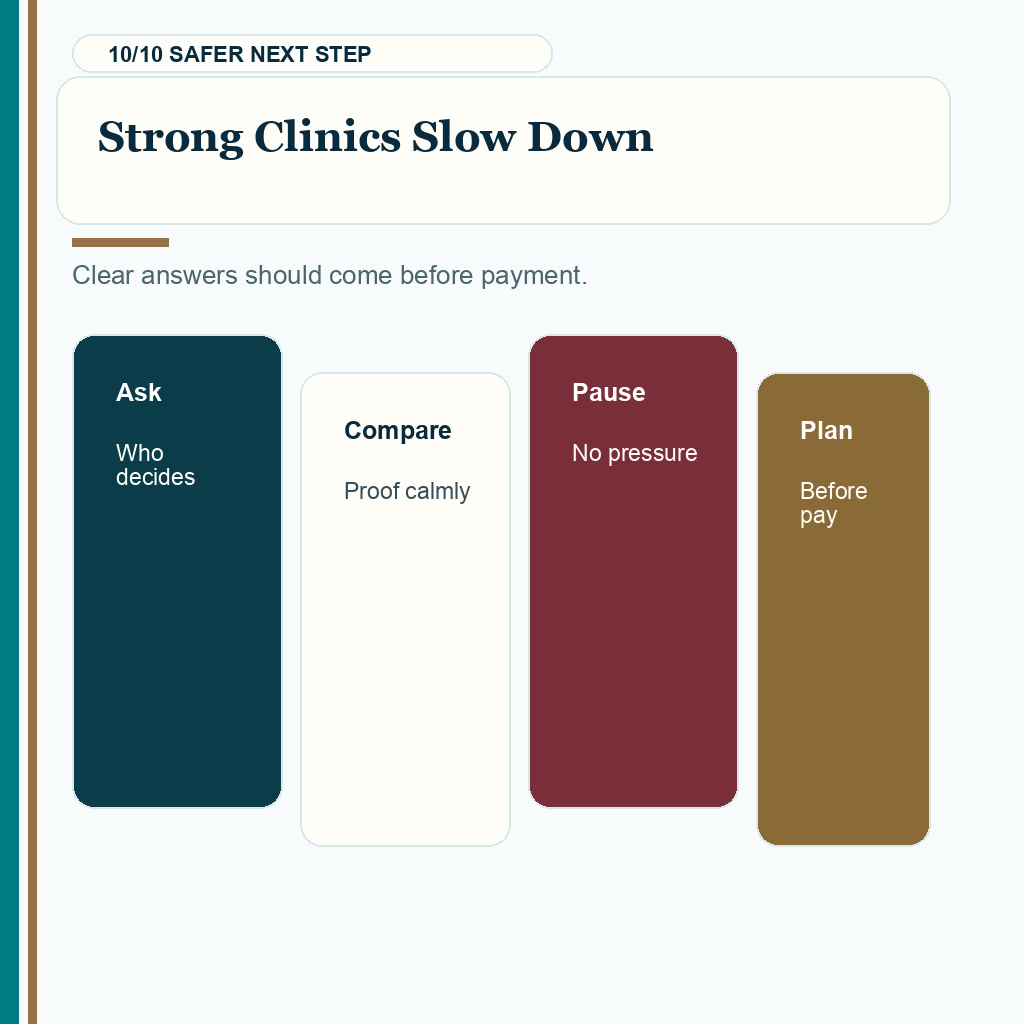
Red flag versus acceptable practice
Some clinic behaviour can be normal. A busy schedule, team support, or package organisation does not create risk by itself. The question is whether medical responsibility stays visible.
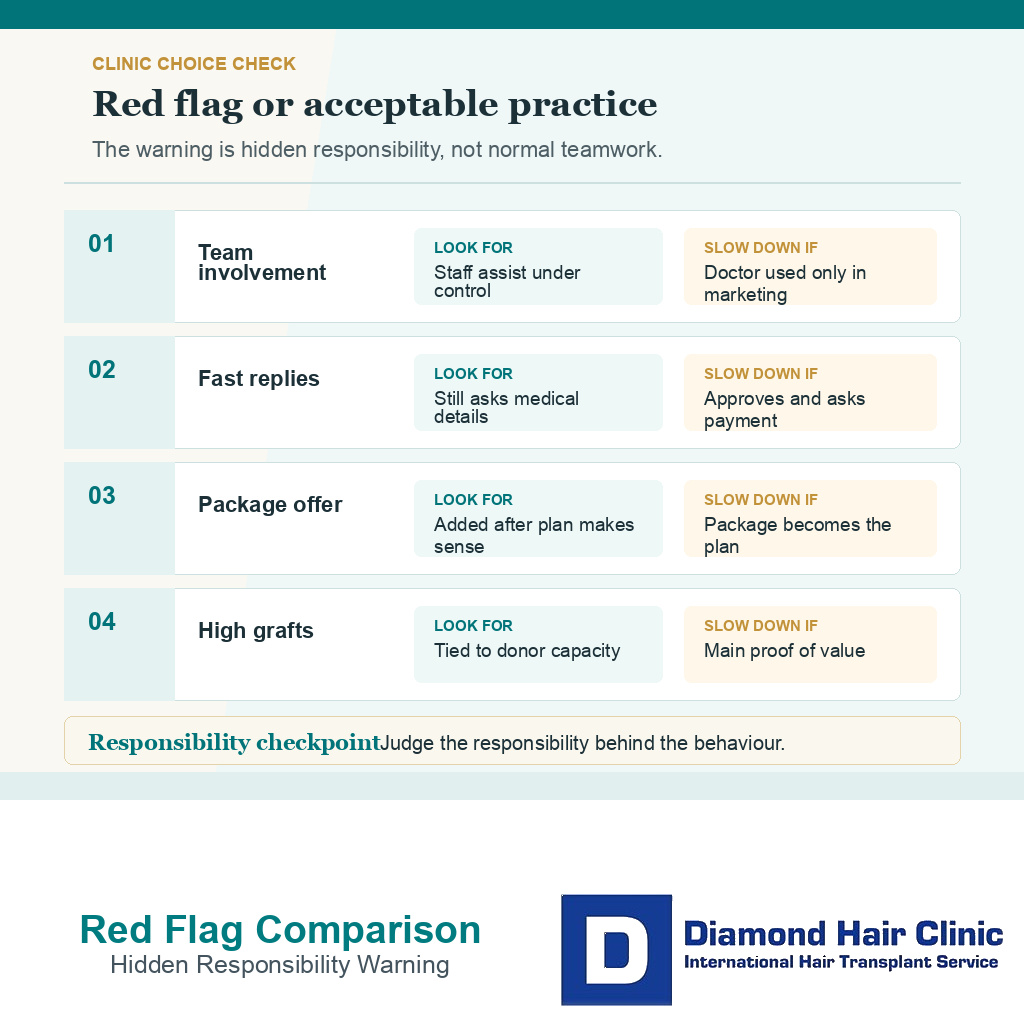
Patients need to separate normal organisation from unsafe delegation. A clinic can look organised while responsibility is hidden, and that is the real warning sign.
Better odds, not guaranteed results
In hair mill decisions, the useful comparison is not cheap versus expensive. It is success that depends on luck versus repeatable medical planning. A good result can happen in a weaker system, but the patient still has to ask whether the system protects different donors, hairlines, and future hair loss patterns with enough care for each case.
Better odds, not guaranteed results
A careful plan cannot promise growth, density, or perfect symmetry. It improves the conditions that make a natural result more likely.
More favorable conditions
Stable donor review, conservative graft use, hairline fit, careful placement, and follow-up.
Weaker conditions
Unclear donor limits, high graft promises, rushed design, weak graft handling, or poor aftercare route.
Hair mill success story versus consistent surgical planning
| Patient scenario | What it can mean | What I look for before trusting it |
|---|---|---|
| A hair mill patient gets a good result | The result may be real, especially in a favorable case with strong donor hair. | I want to see whether the clinic can repeat safe planning across different patients, not only show one successful case. |
| A careful surgeon has a weak result | Healing, graft survival, hair caliber, native hair loss, and scalp biology can still change the final appearance. | I look at case selection, consent, records, follow-up, and how the clinic reviews the cause before offering repair. |
| A low-price clinic shows beautiful photos | The photos may be genuine, but they do not show who controlled your own surgery. | I check the named surgeon role, donor limits, hairline decisions, graft handling, and follow-up route. |
| A higher price sounds more serious | Price by itself is not medical evidence. | The value is time, judgment, realistic limits, and accountability when the plan has to change. |
Common red flag phrases in Turkey
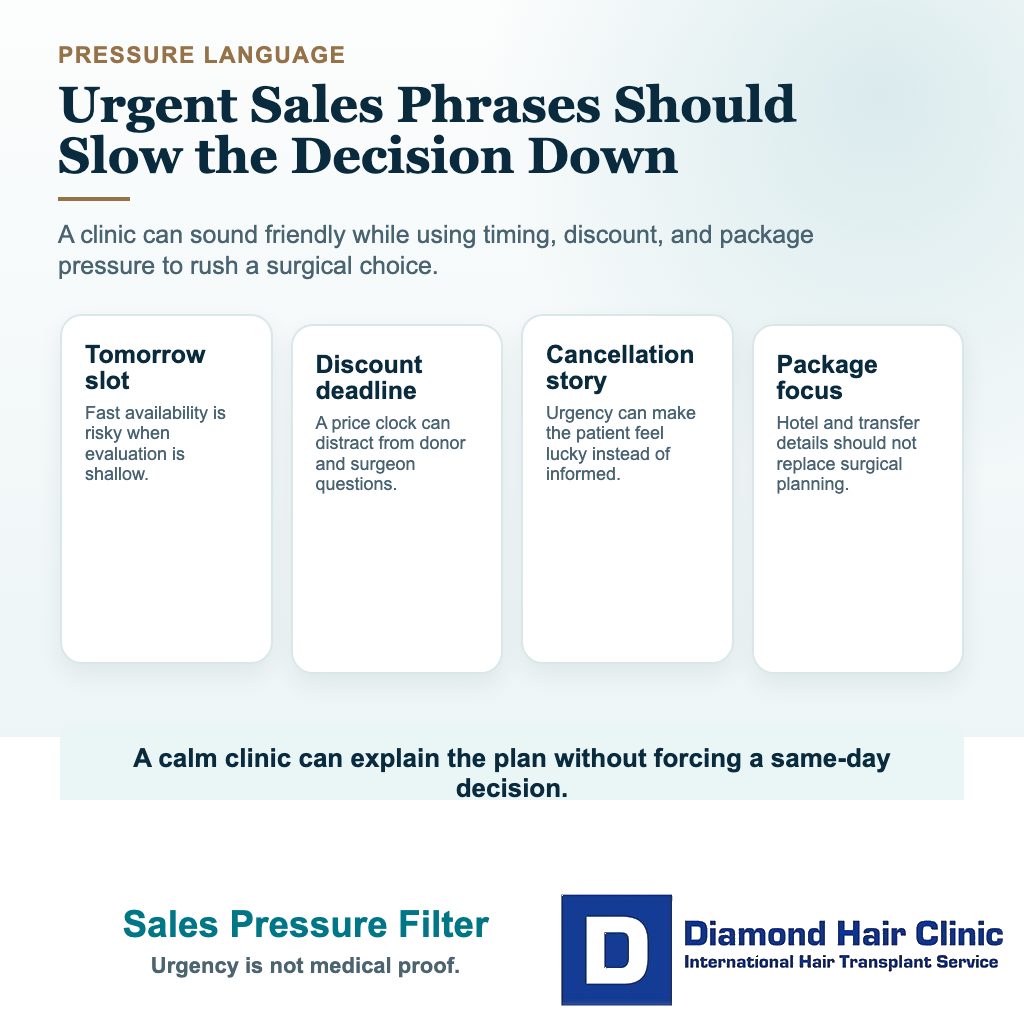
We can get you in tomorrow
A clinic that can operate on you tomorrow may simply have an open date, so this alone is not proof of danger. But if the clinic has no serious evaluation and can accept you immediately, slow down.
A surgeon-led clinic that gives each patient proper time usually has limited surgical capacity. At my clinic, I use a quality focused model because one operation deserves full attention. No one should feel like one more name in a long daily list.
We will offer you a discount
A discount is not inherently unethical, but heavy pressure to discount is a warning sign. If the main reason to choose the clinic is a temporary price drop, the patient may stop asking more important questions. Deposit urgency is one part of that pattern, so booking pressure before a hair transplant deserves attention before the patient commits.
With hair transplant surgery, the cheapest option can become the most expensive option later. Repair surgery, donor camouflage, scalp micropigmentation, and emotional stress can cost far more than choosing carefully at the beginning.
Our results are unmatched worldwide
Any clinic that claims unmatched worldwide results is exaggerating. Hair transplant surgery does not work that way. Every patient has different donor capacity, hair caliber, skin contrast, hair loss pattern, and healing response.
Realistic language matters. A medically careful clinic can demonstrate consistent results, explain limitations, and accept that some patients cannot safely achieve the density they want.
We have the latest technology and the best growth rate
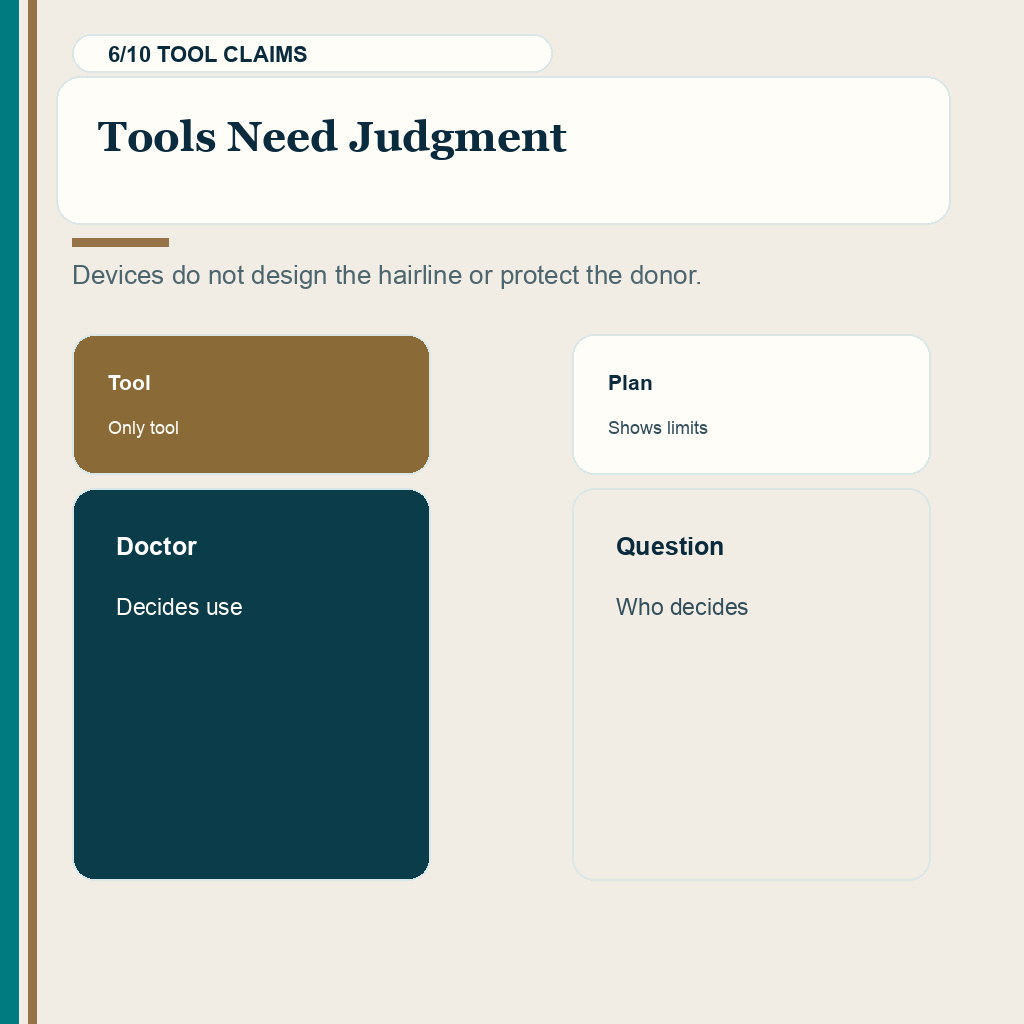
Technology can help, but technology does not replace surgical judgment. A sapphire blade, an implanter pen, a microscope, or a motorized punch is only a tool. The tool does not decide the hairline, protect the donor area, or understand the patient’s future hair loss.
If the clinic talks more about devices than the doctor’s plan, slow down. The clinic should be able to name who is making the medical and artistic decisions for you.
We just had a cancellation
The cancellation line is often used to create a sense of urgency. It may come with a lower price or a promise that you are lucky to get the date. Sometimes it is true. Many times, it is simply pressure.
Your health and appearance deserve unpressured decision making. If you are considering how to choose a hair transplant clinic in Turkey, do not let urgency replace research.
We only do surgery with our doctors
That sentence can sound reassuring, but it is incomplete. A clear answer includes the doctor’s name, medical title, exact role, the parts of the operation he personally performs, and whether the same doctor will be present during the procedure.
A clinic can still adjust the design after direct examination, but learning the decision structure only after arrival is a warning sign. Before travel, the clinic needs to name who owns the medical judgment, what could change, and when a smaller session, delay, or refusal remains the responsible answer.
The clinic should be clear about the surgeon’s identity, experience, and role. Certificates, memberships, and training history can support the conversation, but they do not replace named surgical responsibility. Hiding the doctor is never a good sign.
We promise certainty and a money back guarantee
A hair transplant clinic can stand behind its work, but it should not sell surgery as if biology can be guaranteed. Graft survival, healing, native hair loss, and patient aftercare all influence the result.
Hair transplant guarantee claims are often misunderstood. A guarantee can sound comforting, but it may also be used to hide weak planning or vague responsibility.
We give a lifetime warranty certificate
Certificates and lifetime warranty papers can look official, but they need ordinary clarity behind them. It helps to know who stands behind the certificate, what is actually included, how the clinic handles responsibility if the result is poor, and whether the paper has any real legal value. If those answers are vague, the certificate is mainly a sales object, not a medical safeguard.
Many clinics do not need these papers when they already rely on medical consultation, careful planning, and proper follow-up. A certificate should never replace medical accountability.
Our full package price is only 2000 Euro
Turkey is known for more affordable medical treatment, but a very low price should slow the decision down. It helps to know who is operating, how many patients are treated in one day, what is included, what is not included, and how the clinic handles a complication.
Some clinics attract patients with a low starting price and later add costs for extra services, products, or treatments. Financial planning for hair transplant in Turkey is worth reviewing before money or timing makes the decision feel urgent.
A premium tier is not a red flag by itself. The warning starts when the tier name replaces the actual answer about who examines the donor, designs the hairline, creates incisions, supervises graft handling, performs extraction, and follows the patient after travel.
Extra treatments such as PRP or exosomes after hair transplant should never be used as pressure tools. If a treatment is recommended, the reason should be clear before accepting it.
We can implant an unlimited number of grafts
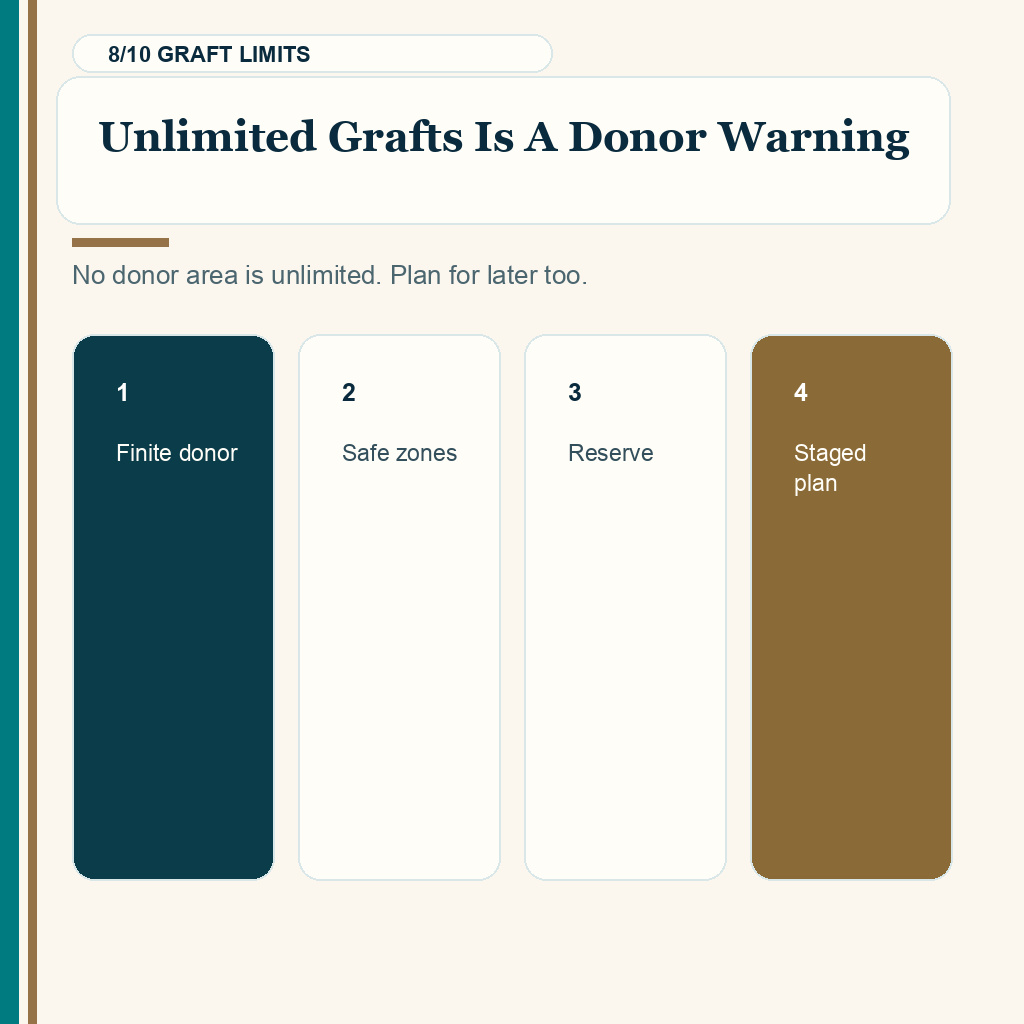
This is part of the most dangerous claims. There is no unlimited donor area. Every graft removed from donor reserve has a cost. If too many grafts are removed, the donor can look thin, patchy, or permanently damaged.
Very aggressive surgery can also increase the risk of serious complications, including poor blood supply in the recipient area. This risk is explained more directly on the page about hair transplant necrosis warning signs.
Careful planning includes donor preservation, not just maximum graft numbers. The patient may need hair for future loss, crown coverage, or repair. A clinic that spends the entire donor area in one session may leave no safe reserve.
We have been in the business for 20 years
Experience matters, but years alone do not prove quality. Some clinics have been visible for a long time while still using outdated methods, weak planning, or technician driven surgery.
Look at the quality of recent work, not just the clinic’s age. Evidence of better donor management, more natural hairline planning, and realistic patient selection matters more than how long the clinic has existed.
Cash payment context in Turkey
Cash payment by itself is not necessarily a red flag. Many Turkish hair transplant clinics prefer cash payments due to banking timing, currency fluctuations, and local business realities. This can be a normal practice.
The more important question is whether the clinic is transparent. You should know the total price, what is included, what is excluded, whether you receive proper documentation, and whether the clinic has a legitimate medical facility. Payment style should not be used to hide weak medical standards.
Multiple surgeon names and responsibility
Having more than one surgeon is not always a red flag. A larger clinic may have several qualified doctors, which is entirely acceptable if each patient knows who is responsible for the operation. A doctor name is useful when that doctor stays attached to your case review, responsibility on surgery day, and follow-up.
The problem begins when many surgeons’ names are used to make a high-volume clinic look more medical than it really is. If five surgeons are listed, the clinic needs to say which surgeon will be responsible. Ask how many patients the doctor operates on in one day. Ask whether the doctor personally performs the critical surgical steps.
Another point is turnover. If a clinic changes doctors frequently, the patient may be dealing with a business brand rather than a stable surgical practice. The website may look impressive, but responsibility on the day of surgery still needs to be clear.
Trainee involvement and package level differences in doctor participation need to be clear before arrival for surgery.
Fake promise language
Fake promises usually sound simple, fast, and emotionally attractive. They tell the patient exactly what he wants to hear. You have enough donors. You can get maximum density. You do not need medication. One session is enough. The result will be perfect. You can return home with no concern.
Many online consultation requests I see come from patients who do not have enough donor capacity for the result they want. They need a frank explanation. Some patients say I am the first doctor who has clearly told them their donor area is limited.
This is not always easy for the patient to hear, but it is better than accepting a surgery that should not be done. Hair mills often accept patients who should be rejected or delayed because the clinic wants the booking more than the long term result.
False claims that deserve caution
Dense hair transplant in a single session
High density can be possible in specific cases, but it must match the donor area, scalp blood supply, hair caliber, recipient size, and future hair loss pattern. If a clinic promises dense coverage everywhere in one session, I pause.
Overpromising density can lead to botched hair transplant results, poor growth, visible scarring, and donor depletion. In some patients, a more careful plan is staged surgery, medical stabilization, or no surgery at that time.
Zero scarring
Zero scar hair transplant does not exist. FUE creates many tiny extraction wounds. FUT creates a linear scar. Good surgery can make scarring very small and difficult to notice, but it cannot make surgery scarless.
If a clinic says there will be no scar at all, the clinic is using marketing language instead of surgical truth.
No pain
Hair transplant surgery should be manageable, but no pain is not a responsible promise. Local anesthesia can reduce pain during surgery, and most discomfort is temporary. Still, needles, swelling, soreness, and sensitivity are part of the real experience.
Careful preparation builds greater trust than pretending surgery carries no physical burden.
A natural result that no one can detect
A very natural result is possible when the hairline is age appropriate, the angles are correct, the density is planned well, and the donor hair matches the recipient’s needs. But no surgeon should promise that nobody can ever detect anything.
Transplanted hair may have a slightly different behavior, direction, or density from native hair. This should not be reduced to magic. The goal is a result that looks natural in real life and ages well.
No need for a second surgery
Some patients only need one operation. Others, especially patients with Norwood 4 to 6 hair loss, may need a second surgery for density, crown coverage, or future progression.
Even when one surgery is enough today, hair loss can continue. A responsible plan should protect future options. This is especially important in young patients and patients with a family history of advanced hair loss.
A 100 percent success rate
No clinic can promise 100 percent success. The result depends on surgical skill, graft quality, donor area, scalp blood flow, aftercare, genetics, and the patient’s healing response.
Good clinics reduce risk by planning carefully. They do not erase risk with a slogan.
Full result in three or six months
A hair transplant result takes patience. Early growth can start around a few months, but final cosmetic maturity usually takes much longer. It is safer to think in terms of 12 to 18 months, especially for crown and density judgment.
Fast results promise to take advantage of impatience. With hair transplant influencers, online excitement can distort expectations before a patient has enough medical understanding.
Slowing the decision down before surgery
Before a patient commits to surgery, the conversation should slow down. The important question is not only how many grafts are promised, but who is responsible for the diagnosis, donor plan, hairline design, recipient area creation, and follow-up.
The clinic response matters when the patient asks for details. A clinic with real medical responsibility can answer which surgical steps the doctor personally controls and can explain daily case volume, donor limits, realistic crown planning, future native hair loss, and photo consistency without becoming defensive or impatient.
Result photos need similar caution. Look for similar lighting, similar hair length, and no dependence on fibers, styling tricks, or unusual angles. Licensing matters too, and the Ministry of Health framework in Turkey is one part of that background check.
The reaction tells you a lot. Clear and specific answers are reassuring. Vague or rushed answers are warning signs, not minor communication problems.
Professional clinic versus hair mill
A professional clinic is usually built around medical responsibility. The doctor is visible, the surgical role is clear, and the patient is evaluated as an individual. The plan is based on donor capacity, hair loss pattern, age, expectations, and future risk.
A hair mill is usually built around volume. The clinic talks about packages, hotel, transfer, graft numbers, and speed. The staff may be kind and organized, but the medical responsibility can still be weak. Kind communication does not replace surgery planning.
Hair mills may also use low quality materials, rushed graft handling, or poorly trained teams. If the staff is not sufficiently trained, graft survival and donor safety can suffer.
Some hair mills introduce a senior technician as if that person is the surgeon. Search the doctor’s name and check whether the surgeon’s medical training is explained clearly. Positive reviews alone can be misleading when the clinic does not clearly show who is medically responsible.
My own model is explained through the surgeon-led, quality focused approach on the page about why choose Diamond Hair Clinic.
Read this review excerpt
Being a naturally inquisitive and detail-oriented individual, I had so many questions for Dr Mehmet Demircioglu. He has answered each and every single question to my satisfaction, with more detail than required to ensure I have all I need.
Read this review excerpt
Doctor was real nice bloke, genuine and easy going demeanour and spoke good English. We had a brief in his office and took our time, no rushing. He explained the days proceedings ahead and we discussed what my expectations were.
After a bad result
If you already had a bad hair transplant, the first step is not panic. Some early concerns are part of normal healing, especially in the first months. But if the donor area looks patchy after healing, the hairline is too low, the angles are wrong, or growth is very poor, you should get a careful medical opinion.
Do not rush into a second operation only because the first clinic offers a free correction. A repair plan requires even more caution than the first surgery because the donor area may already be reduced.
For visible donor damage, read about overharvested donor area repair and weak donor area hair transplant planning. Sometimes surgery can help. Sometimes scalp micropigmentation, longer hair length, medical support, or simply waiting for full healing is safer.
The key point is clarity. A repair surgeon should tell you what can be improved and what cannot fully return to normal.
Diamond Hair Clinic view
I am not against hair transplant in Turkey. I am a hair transplant surgeon in Istanbul, and I founded my own clinic here because I believe excellent work can be done in Turkey. What I am against is treating surgery as a volume business.
My priority as a surgeon is quality over quantity. This affects how I evaluate patients, how I plan donor use, how I design hairlines, and how I decide whether surgery is appropriate at all.
Sometimes the best medical answer is not the answer the patient hoped to hear. A patient may need to wait, use medical treatment, lower the graft goal, avoid the crown for now, or avoid surgery completely. Saying this is part of my responsibility.
If you are comparing clinics, the most complete explanation matters more than the biggest graft number or the lowest price.
Surgical responsibility is the real filter
Diamond Hair Clinic is my clinic in Istanbul, Turkey. I founded and manage it as Dr. Mehmet Demircioglu, with a focus on careful planning, natural hairline design, donor preservation, and realistic patient selection.
Memberships and titles can support trust, but they cannot replace visible surgical responsibility. The clinic still has to explain who plans the case, who performs the critical steps, and when surgery should be refused.
If you want a measured opinion about your own donor area and hairline plan, you can contact Diamond Hair Clinic and share photos for an initial evaluation.