


DHI vs FUE Hair Transplant Which Method Is Better?
For most patients, DHI is not always better than FUE, and FUE is not always better than DHI. DHI is a variation within modern FUE hair transplantation where the main difference is how the grafts are placed into the recipient area. The strongest result still depends on diagnosis, donor capacity, graft handling, hairline design, incision control, surgical experience, and aftercare.
In diffuse thinning or an active scalp condition story, the method label comes later. DHI can help selected placement problems and Sapphire FUE can help selected incision control problems, but neither one replaces diagnosis, donor safety, or a quiet scalp. The instrument only matters after the surgical reason is clear.
I usually prefer Sapphire FUE for most larger scalp cases because it gives me more deliberate control over the recipient area incisions, graft angle, direction, density distribution, and long term planning. DHI can be useful in selected smaller cases, especially when limited shaving or a focused area is important, but it should not be sold as a magic method.
Do not choose a clinic only because the advertisement says DHI, Sapphire, or FUE. The important details are surgical planning, hairline design, recipient area decisions, donor protection, and whether the method truly fits the case.
A method switch close to surgery should follow a new clinical finding, not a last minute upgrade label. Donor quality, recipient area needs, existing hair, or graft handling can justify a change. A last minute upgrade label should not make the patient feel they are buying a better result.
The practical answer on DHI and FUE
In plain terms, FUE describes how grafts are individually extracted from the donor area, while DHI describes a way of placing those grafts with an implanter pen. I do not see DHI as a completely separate surgery from FUE. It is more accurate to see it as an implantation variation.
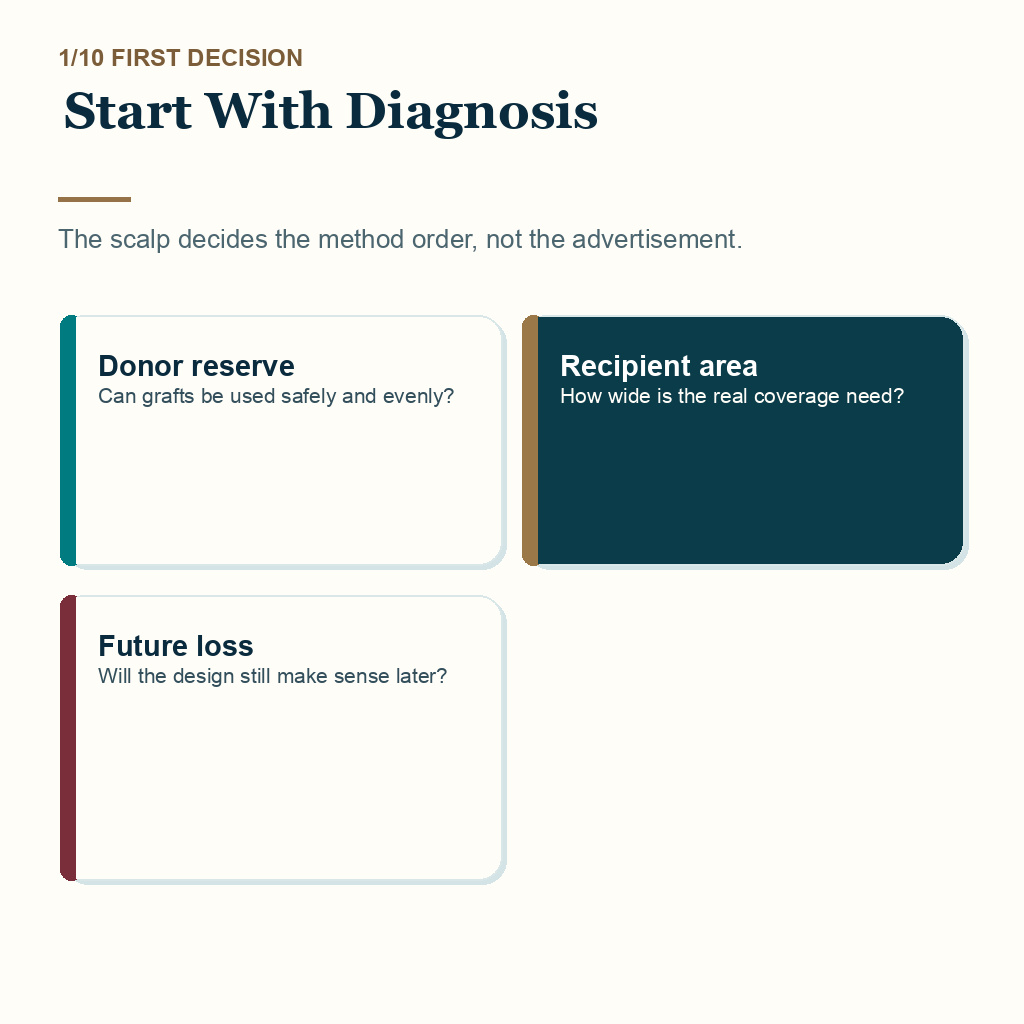
Instead of choosing a method first, I start with the scalp. What does it need? Is the hairline too low or too high? How strong is the donor area? How many grafts can be used safely? Is the crown involved? Is the patient young with future hair loss likely?
Once those questions are answered, the method becomes easier to choose. Without those answers, method comparison becomes a marketing discussion instead of a medical decision.
DHI and FUE are not completely separate surgeries
Both approaches usually begin with individual graft extraction from the donor area. The grafts are removed one by one with a punch, then they are prepared and protected before placement.
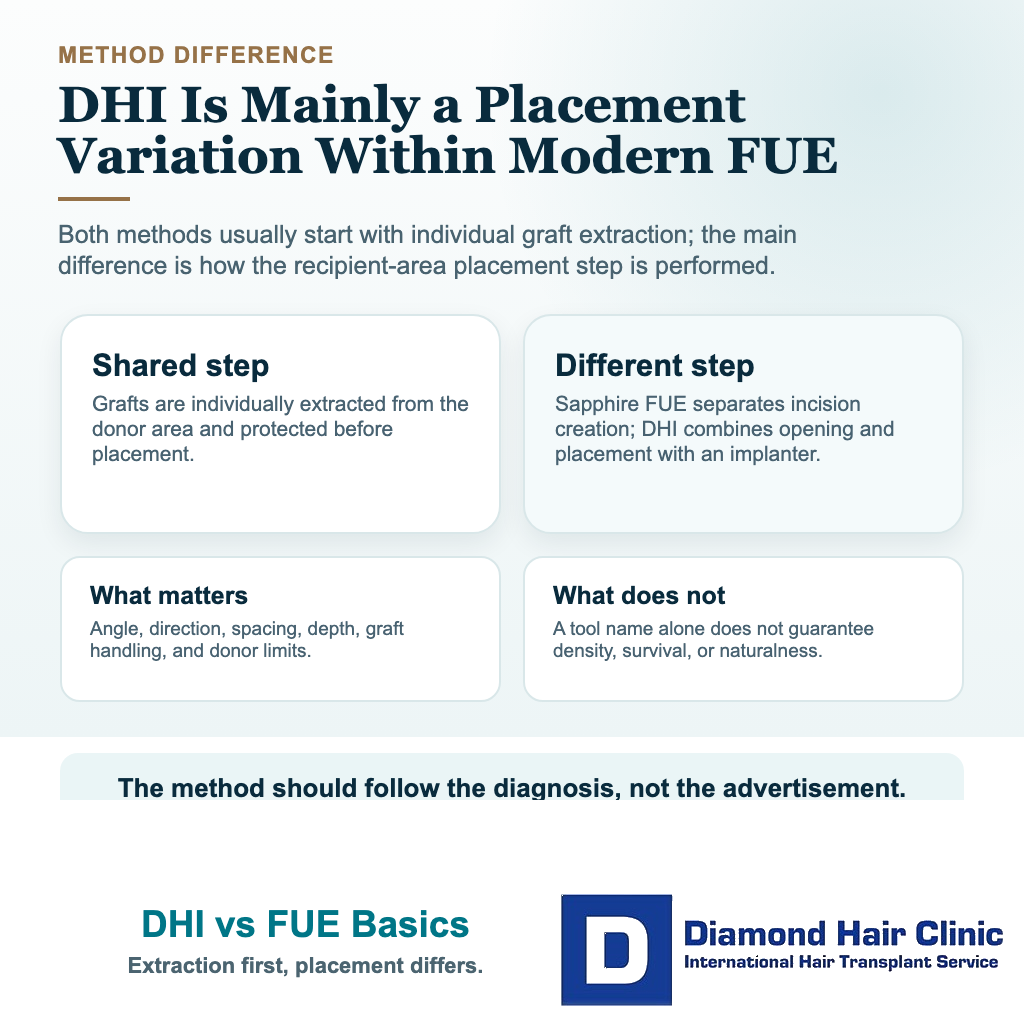
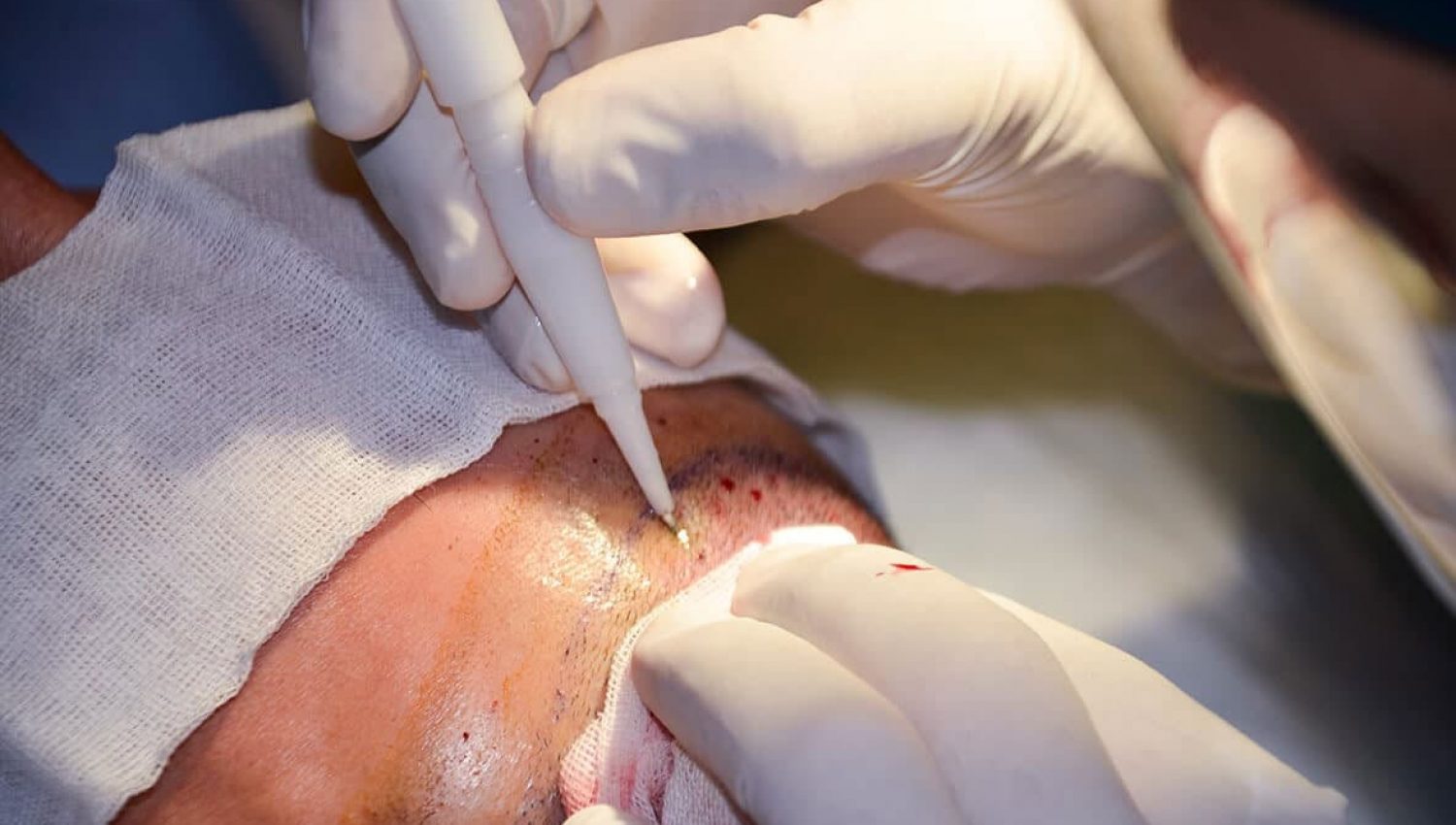
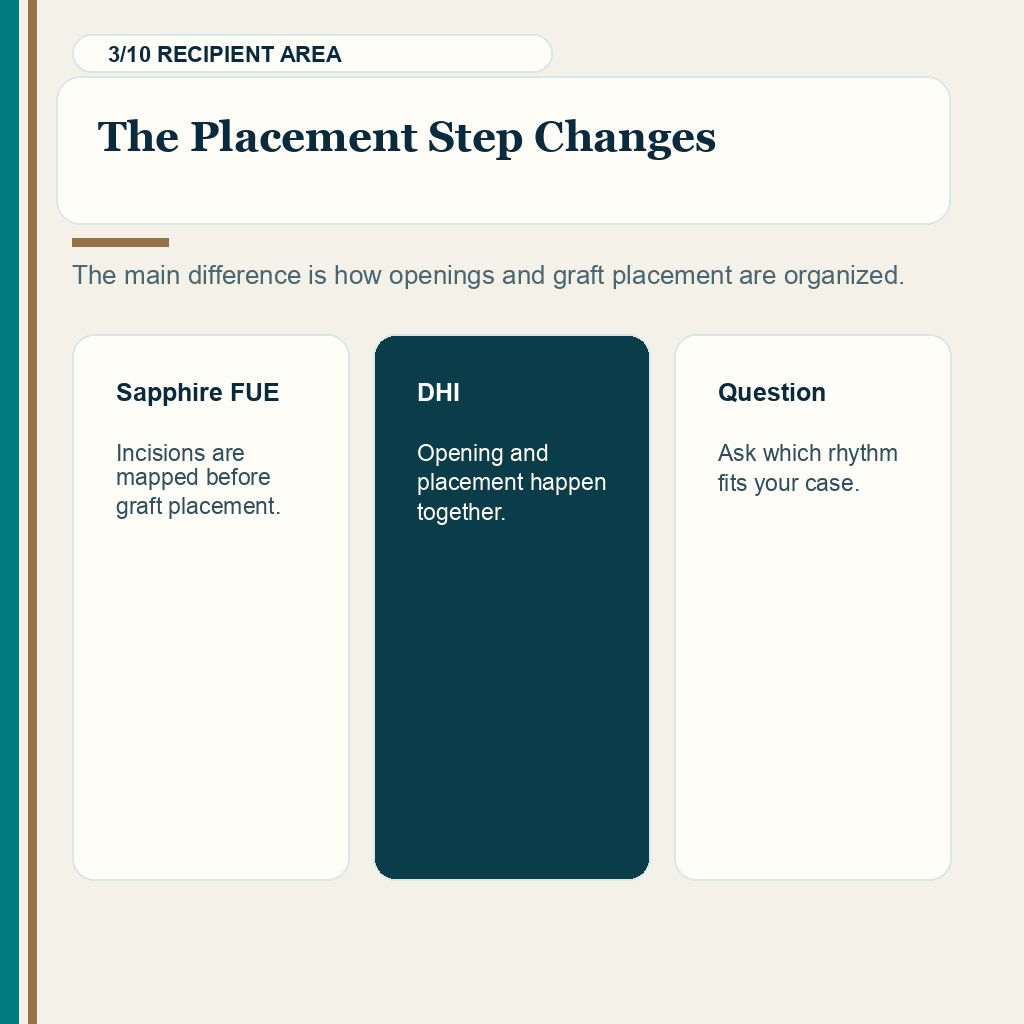
The difference appears mainly in the recipient area. In classic FUE or Sapphire FUE, the surgeon creates the recipient area incisions first, then grafts are placed into those openings. In DHI, the graft is loaded into an implanter pen and the opening and placement happen together.
That may sound like a small technical difference, but it can change the rhythm of the operation, the number of grafts that can be moved, the control over angle and direction, the team workflow, and the price. It does not remove the need for surgical judgment.
Graft extraction is similar in both methods
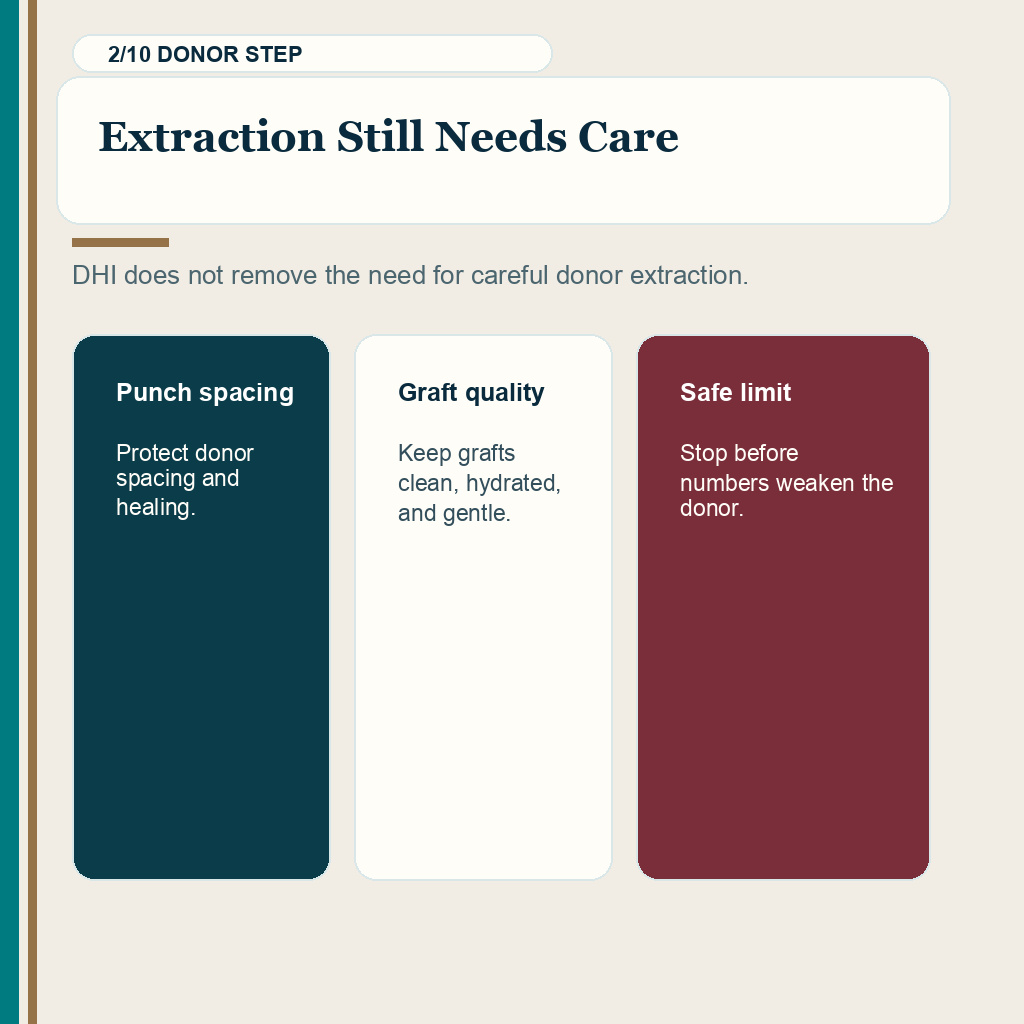
The extraction stage is very similar. In both methods, follicular units are taken from the donor area. The punch size, extraction spacing, graft quality, donor density, and surgeon judgment matter more than the label placed on the method.
A clinic can advertise DHI and still damage the donor area if extraction is too aggressive. A clinic can advertise FUE and still produce a poor result if the donor pattern is uneven or the grafts are handled roughly.
Donor management must come before method preference. If donor reserve is weak, the patient may not be suitable for a large session with either method. Hair transplant candidacy can require medication, waiting, or a smaller plan before surgery.
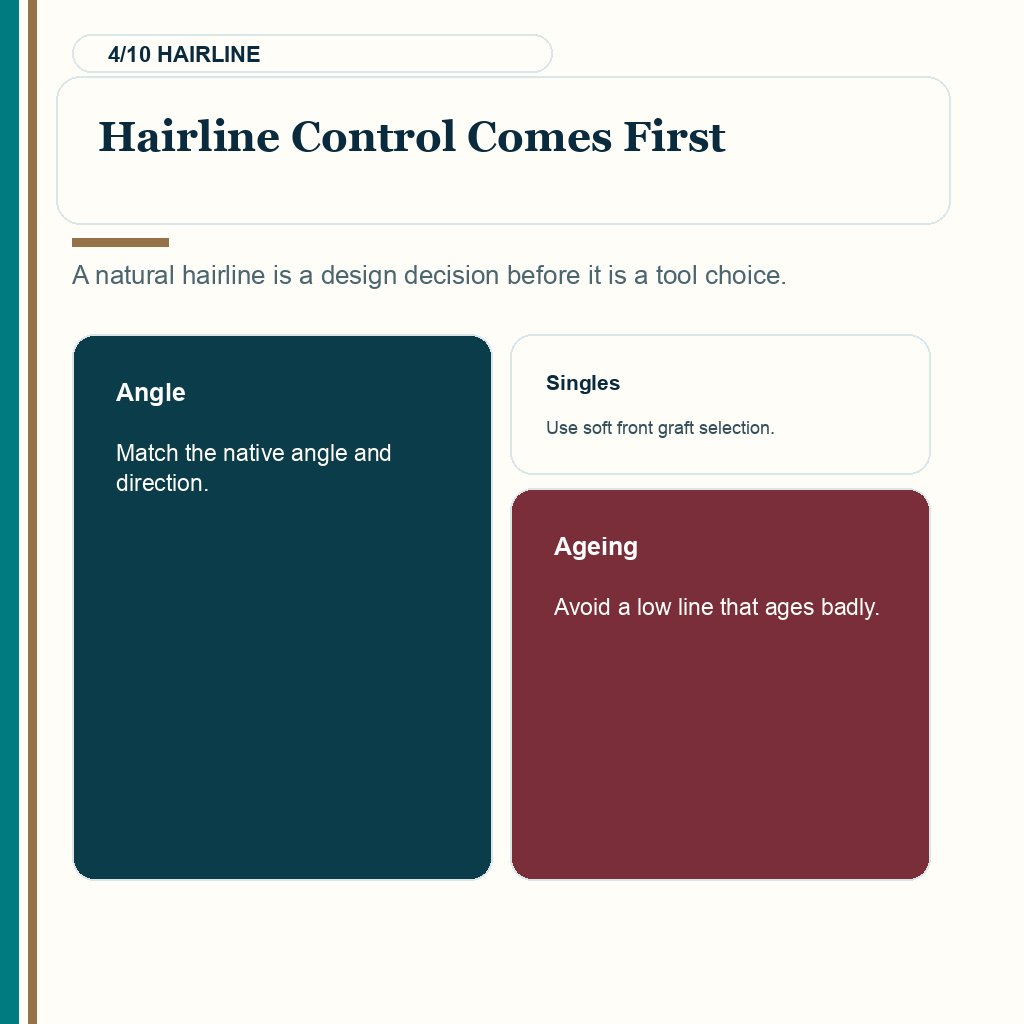
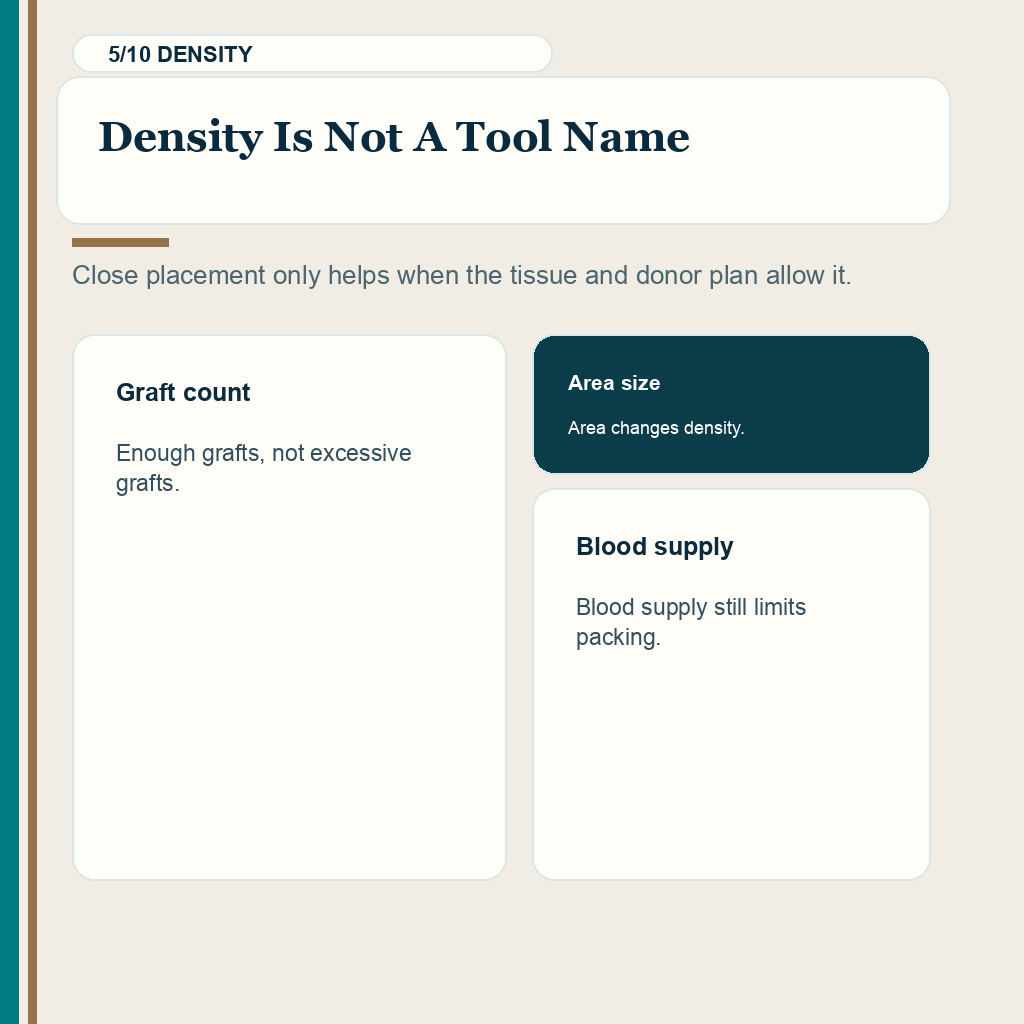
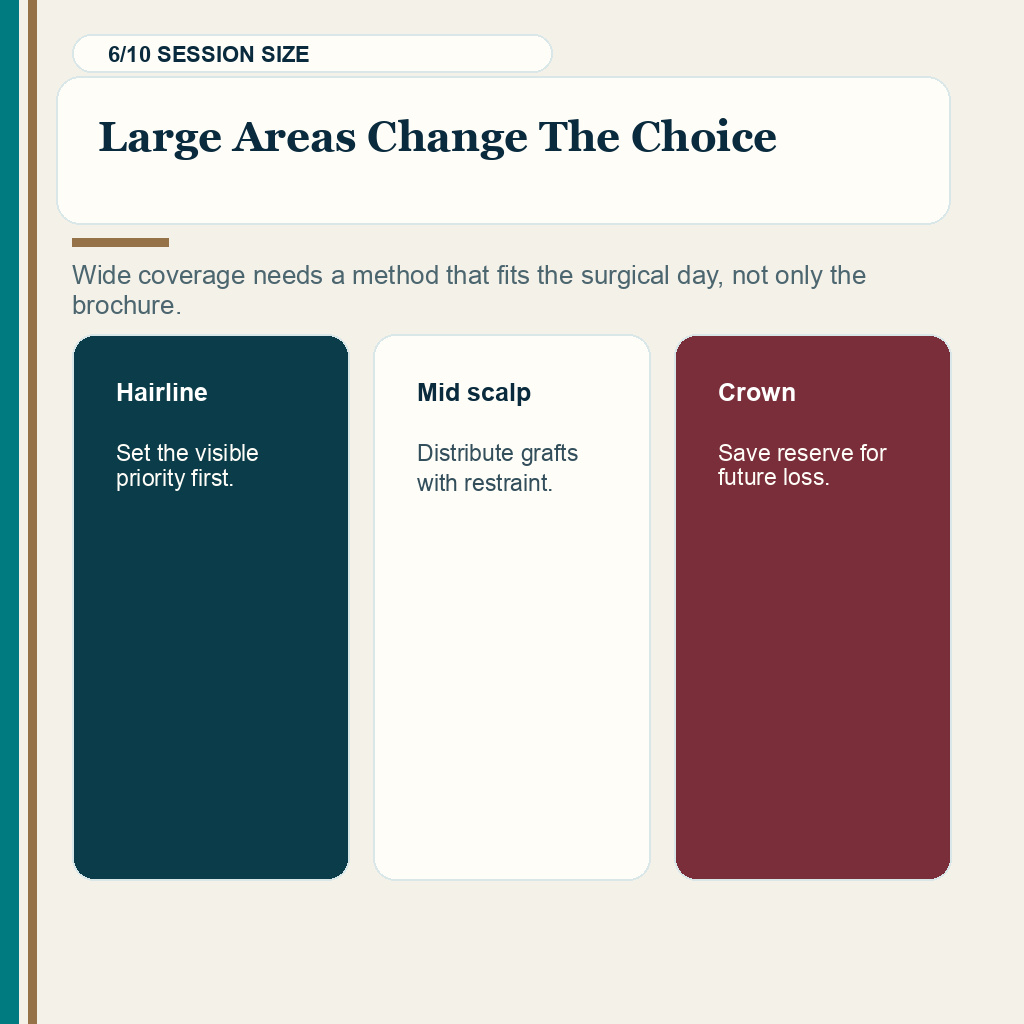
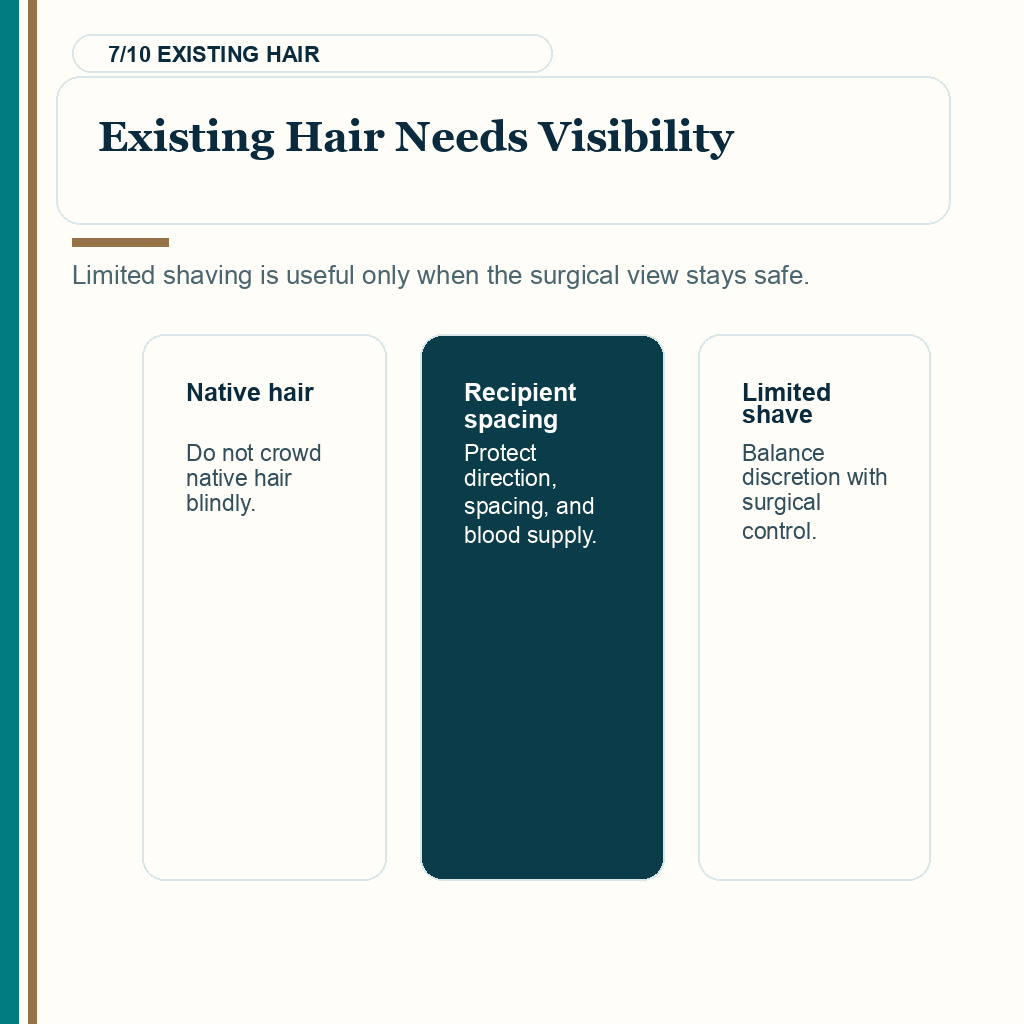
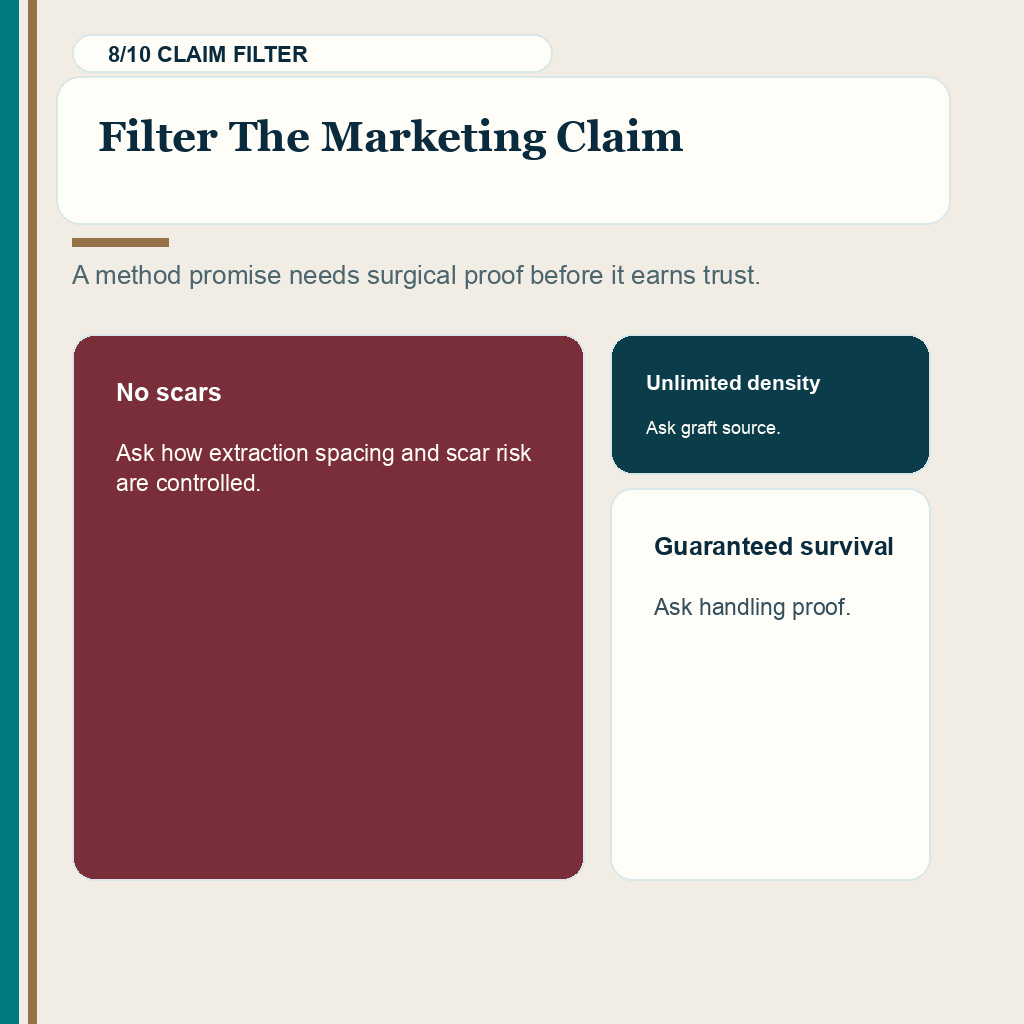
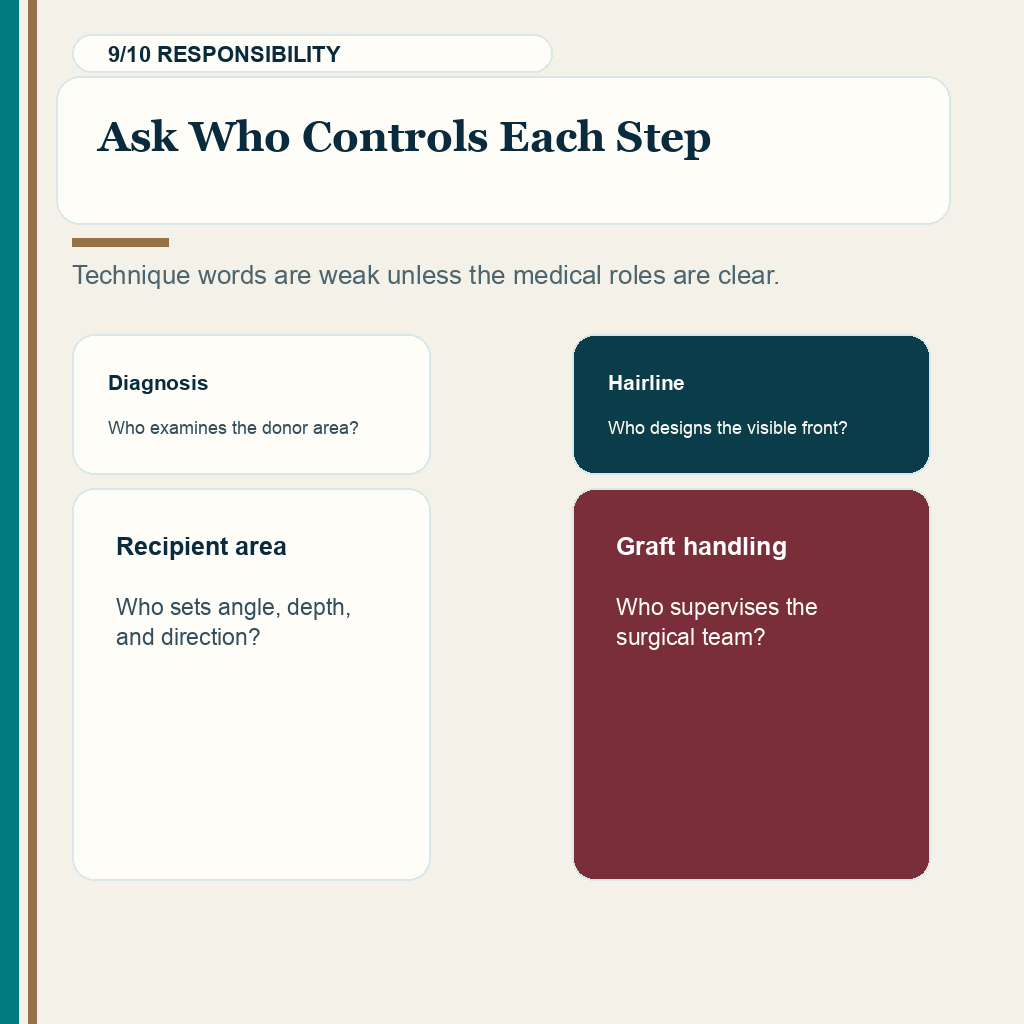
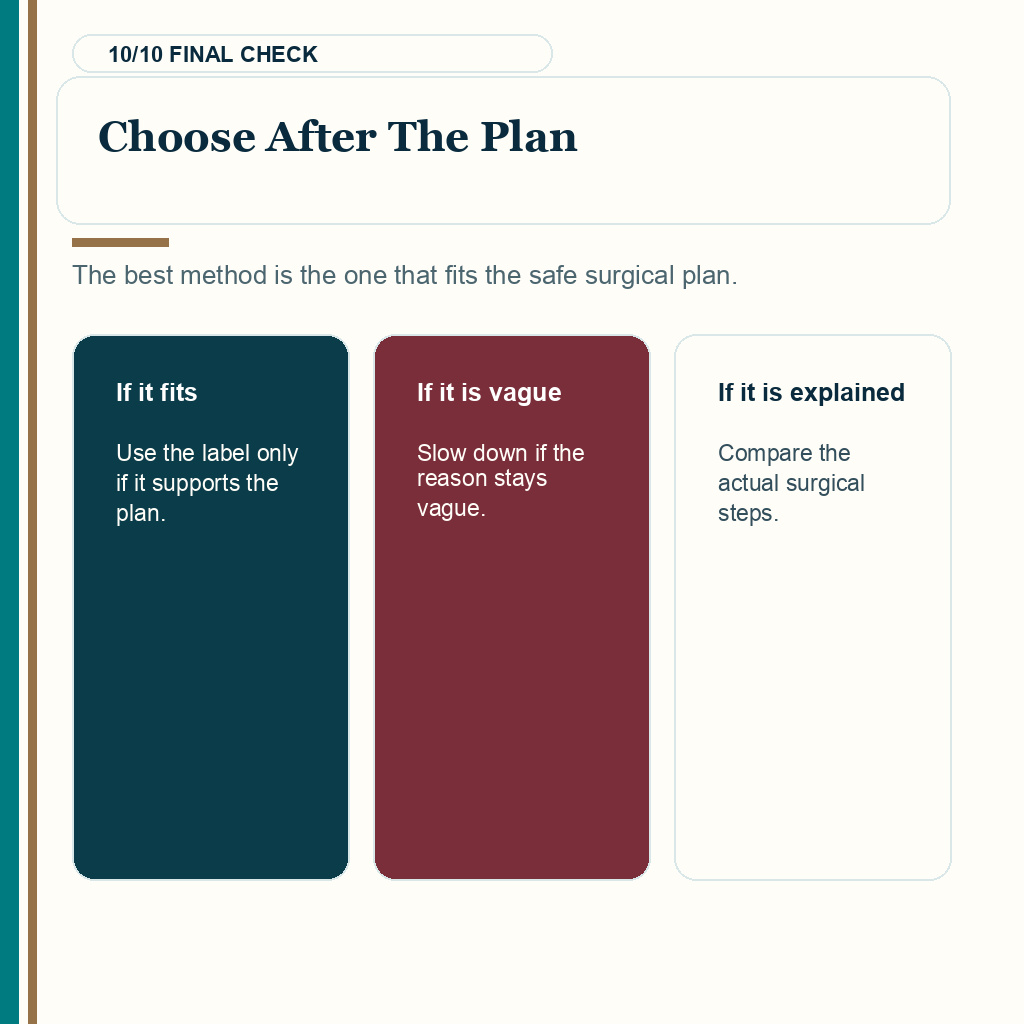
The 10 DHI vs FUE slides below split the method comparison into one planning question at a time. Swipe sideways, use the arrows for one slide at a time, or choose a number below the image.
The recipient area is where the method changes
In Sapphire FUE, I create the recipient area incisions separately. This lets me plan the direction, angle, depth, spacing, and distribution before graft placement. It also lets me design transitions between the frontal hairline, mid scalp, temples, and crown with more visual control.
In DHI, the graft is placed through the implanter pen. The opening and implantation happen in one movement. This can be useful for selected small areas, but the tool itself does not guarantee better angle, better density, or better survival.
The quality of the result still depends on whether the surgeon understands the natural pattern of the scalp. A natural result is not created by the pen or blade alone. It is created by planning and execution.
Surgeon control matters more than the label
For most larger scalp cases, I find Sapphire FUE gives stronger visual control over the recipient area. I can see the full pattern of the incisions before implantation begins. I can adjust density zones, protect existing hair, change direction around the temples, and avoid rows or mechanical looking placement.
DHI can still produce a natural result in skilled hands, especially in smaller cases. The limitation is that the implanter pen can make it harder to build a large visual map across a wide balding area. It can also slow the procedure when many grafts are required.
Control matters most in the areas that other people notice first. The hairline, temple angles, and frontal transition need careful design. The method should support that design, not force the surgeon into a simplified pattern.
Natural hairline planning
A natural hairline depends on height, irregularity, single hair graft selection, angle, density, and how the design will age. For many male patients, Sapphire FUE gives me more freedom to create a soft transition and avoid a harsh straight line.
This point does not say DHI can never create a natural hairline. It means I do not accept the claim that DHI is automatically superior for hairline design. A poorly planned DHI hairline can still look pluggy, too straight, too low, or too dense in the wrong place.
Hairline design in hair transplant surgery matters as much as the tool because the artistic part of the operation controls naturalness.
Density is not created by a tool name
DHI is often advertised as a higher density method. That claim needs caution. Density is not created by the tool alone. It is created by graft number, hair shaft thickness, recipient area size, safe spacing, blood supply, graft survival, and the way density is distributed.
A clinic can place grafts very close together and still create a weak result if the grafts do not survive well or if the design ignores future hair loss. Dense packing also has limits. The scalp needs enough blood supply, and the donor area must still be protected.
When patients worry that their result may look thin, the answer is usually not simply DHI or FUE. Thin looking hair transplant results can come from density, coverage, hair type, light, length, and expectation problems.
Larger bald areas need practical graft planning
For larger bald areas, FUE or Sapphire FUE is often more practical. Larger sessions need speed, organization, graft protection, and consistent placement across a wide recipient area. The surgeon must also decide where density matters most and where lighter coverage is more sensible.
DHI can become slower when thousands of grafts are needed. Longer surgery is not simply unsafe, but graft handling, fatigue, and workflow become more important. A clinic that promises a very high number only because the patient wants more coverage may be creating risk.
For advanced hair loss, the first session cannot solve every future problem. Donor capacity is limited. Crown coverage, frontal density, and future surgery must be balanced carefully.
Crown and mid scalp coverage
The crown and mid scalp are different from a small hairline correction. They can consume many grafts, and the visual return is not always equal to the graft number used. The crown especially has a spiral pattern and often needs a large area to be softened rather than fully filled.
I rarely judge crown planning by method name. I judge it by donor reserve, pattern of hair loss, hair caliber, whether the front has already been treated, and whether the patient may need another surgery later.
A patient considering crown work should read about crown hair transplant planning, because crown planning cannot be reduced to only whether DHI or FUE can place grafts there. The practical issue is whether the grafts should be used there now.
Graft numbers depend on donor capacity
In many DHI sessions, the practical graft number is often around 2,500 to 3,000 grafts. In larger FUE or Sapphire FUE sessions, some patients may safely reach around 4,500 to 5,000 grafts. These numbers are not promises. They depend on donor density, graft quality, scalp condition, hair type, and the patient’s long term plan.
I decide the graft number from the donor area, not from the patient’s wish list. A patient can always ask for more density. The donor area may not safely allow it.
A proper hair transplant graft calculation must consider area size, hair characteristics, donor reserves, and future hair loss.
Graft survival depends on handling, not branding
No method protects graft survival by name alone. Graft survival depends on careful extraction, minimal trauma, proper storage, hydration, temperature control, gentle placement, surgical time, and a trained team.
DHI is often promoted as gentler because the graft is placed through an implanter pen. In some cases, that can reduce handling. But if the grafts are loaded poorly, compressed in the pen, inserted at the wrong angle, or handled by an inexperienced team, the method name will not protect the result.
FUE can also be excellent when grafts are handled carefully and placed into well planned recipient area incisions. The accurate comparison is not DHI survival versus FUE survival. It is skilled surgery versus weak surgery.
Safety around existing hair
Patients with thinning but still present native hair need special planning. Both methods can be performed around existing hair, but the surgeon must avoid unnecessary trauma, poor angle, and excessive density that damages the blood supply or shocks weak native hairs.
DHI is sometimes promoted for work between existing hairs because it can place grafts through a pen. That can help in selected cases, but it does not remove the need for careful planning. Sapphire FUE can also be used safely around existing hair when the recipient area incisions are made with precision.
The risk is not only the instrument. The risk is poor case selection, unrealistic density goals, and ignoring ongoing hair loss. Native hair shock loss after hair transplant is one reason existing hair must be protected during planning.
Healing speed is often exaggerated
DHI may create less visible early bleeding in some small cases, but the difference is often exaggerated. Both methods create thousands of tiny wounds. Both require careful washing, sleeping, sun protection, activity control, and communication with the clinic.
Sapphire FUE can also heal very cleanly when the incisions are precise and the aftercare is followed. Do not assume that DHI means an easier recovery or that FUE means a difficult recovery.
The technique choice is useful only when it changes something specific in the case. The real answer is about angle control, graft handling, density planning, and who makes those decisions, not just the tool name.
The patient’s early recovery depends on surgical trauma, graft number, swelling tendency, scalp sensitivity, medications, and hair transplant aftercare. The tool is only one part of that picture.
Scarring depends mostly on extraction quality
Both DHI and FUE usually use FUE style extraction from the donor area, so neither method should leave the linear scar associated with FUT hair transplant. Tiny dot like marks can still appear when the back and sides are shaved very short, especially when extraction is dense or poorly distributed.
FUE describes how follicular units are harvested, while DHI is commonly used to describe an approach to implantation, so the labels alone do not determine an individual’s risk of scarring. Visible donor thinning or scarring can depend on factors such as extraction amount and spacing, surgical technique, and individual healing. Recipient sites can also develop healing complications, including an uneven surface. Shedding of a transplanted hair shaft alone does not show that scar tissue has formed or establish whether a graft survived. Persistent raised, indented, or ridged texture should be assessed by the treating surgeon or a dermatologist. A photo can help document the appearance, but may not be enough to determine its cause.
A donor area can look temporarily red after FUE without being damaged. When I assess whether the donor area looks normal after FUE, I separate temporary redness from true donor thinning.
Shaving and limited shave claims
DHI is often promoted for limited shaving or partially unshaven surgery. This can be helpful for some women, public facing patients, or small touch up areas. But no shave convenience should not become the main reason to choose a weaker surgical plan.
Non shaven surgery can make visibility, graft handling, cleaning, and post operative inspection more demanding. It may be appropriate in selected cases, but it is not simply safer or better.
Non shaven hair transplant risks show why discretion must be balanced with surgical visibility and aftercare.
Clinic model matters more than method name
A strong clinic model matters more than the method label. Know who examines the donor area, who designs the hairline, who makes the recipient area decisions, who supervises graft handling, and how many patients are treated that day.
High volume clinics can use method names as sales language. DHI may be presented as premium. Sapphire may be presented as advanced. FUE may be presented as standard. None of these words prove that the surgery is led directly by the surgeon.
When two clinics recommend different methods, translate the label into responsibilities on surgery day. Who extracts the grafts? Who decides the angles and density? Who supervises implantation? Who can reduce the graft number if the donor does not look safe? The clearer answer usually matters more than the method name.
Before comparing tools, review who performs hair transplant surgery and the red flags of Turkish hair transplant clinics.
What I need before the method label matters?
Before I choose between DHI, FUE, or Sapphire FUE, I need the diagnosis, donor reserve, hairline design, graft number, recipient area size, and surgery day workflow to fit each other. The label comes after those decisions.
A method name becomes a warning sign when it is used to promise no scars, unlimited density, faster healing, or a result that does not match the patient’s donor capacity. A tool can help a good plan. It cannot rescue a weak one.
The written plan should explain why the chosen method fits the case and which surgical steps the doctor personally controls. Without that, the patient is comparing advertisements, not clinical method.
Marketing claims that need caution
Be cautious when a clinic says DHI has no scars, no pain, guaranteed survival, unlimited density, or no need for planning. Be cautious when a clinic says FUE or Sapphire FUE is suitable for every patient. No responsible method should be presented as perfect.
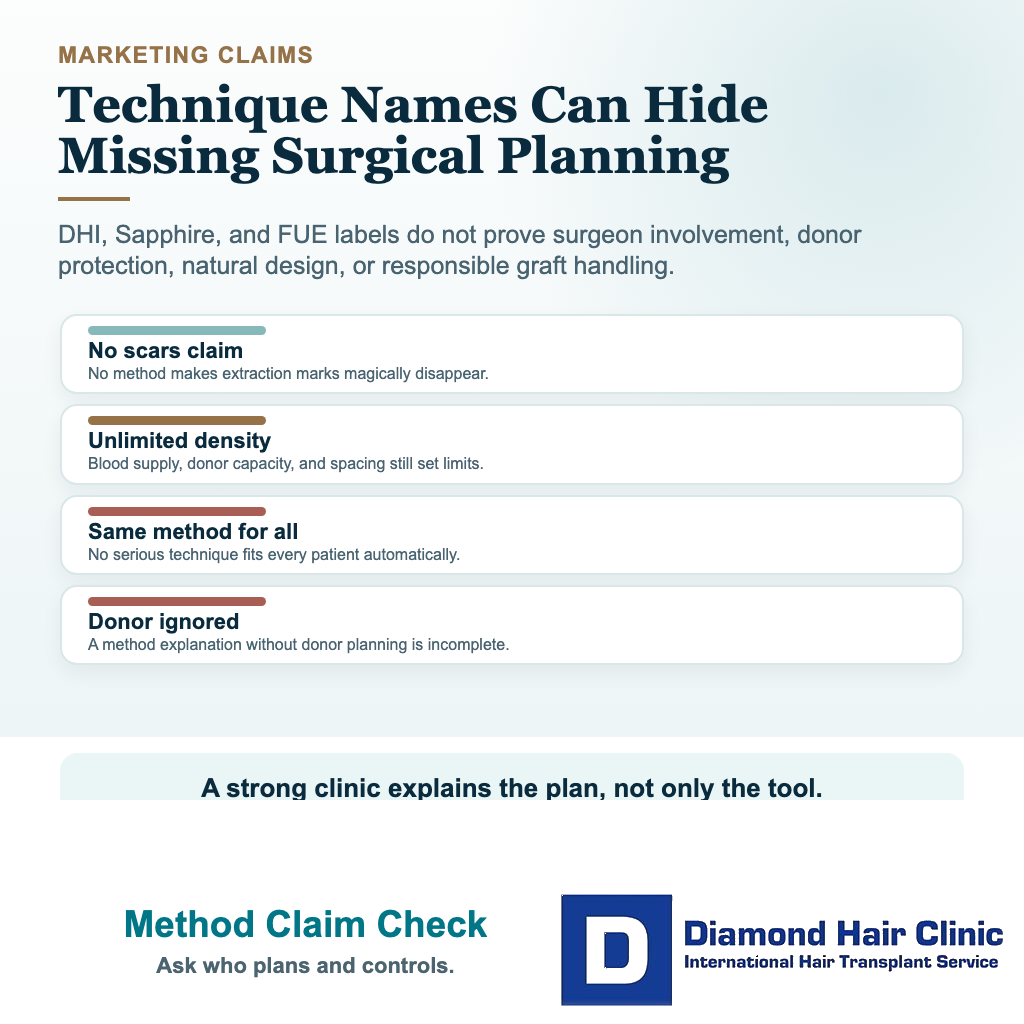
A technique explanation is incomplete when donor reserve is barely discussed. A method explanation without a donor plan is incomplete. The same is true when a clinic gives a graft number before properly assessing photos or medical history.
The right method for a patient is the one that fits the diagnosis. It should not be chosen because the clinic needs to sell a premium package.
Price belongs beside the clinic model
DHI may cost more in some clinics because the workflow can be slower and requires implanter tools. Sapphire FUE may also cost more than basic FUE when the clinic uses a lower volume led directly by the surgeon model. But price does not prove quality.
Do not pay more simply because a method sounds modern. The practical issue is what the price includes. Does it include proper consultation, surgeon involvement, donor planning, aftercare, and responsibility if the plan changes?
When reading hair transplant cost in Turkey, judge price with clinic model, safety, and medical responsibility, not only the technique label on a package.
My recommendation for most patients
For most patients who need meaningful scalp coverage, I usually recommend Sapphire FUE rather than DHI. The reason is not fashion. It is control, planning, donor protection, hairline design, and the ability to treat larger areas in a structured way.
DHI can be reasonable for selected smaller cases, but I pay close attention when it is sold as the right method for everyone. If a consultation cannot explain the treated area, graft direction, density goal, donor reserve, and who performs each step, the method label is not enough. A patient can still get a poor result when planning is weak, even if the brochure uses a modern technique name.
In my planning, the method comes after the diagnosis. I choose the method that protects donor reserve and creates a natural plan, not the method that sounds best in an advertisement.

Read this review excerpt
Every single one of my questions was answered and they made sure I had all the details I needed to make an informed decision.