


Hair Transplant Questions and Answers
I wrote this page for patients who want clear answers before they make a serious decision. A hair transplant can look natural, but it is still surgery. It uses a limited donor area. It requires planning, patience, and clear expectations. My priority as a hair transplant surgeon is always quality over quantity, because a rushed or oversized procedure can create problems that are much harder to correct later.
Many patients come to Diamond Hair Clinic after reading hundreds of opinions online. They compare graft numbers, pain, shedding, density, hats, exercise, donor healing, beard hair, medical conditions, and long-term naturalness. These concerns are connected to one another. The same donor area that gives you grafts today must still support your appearance in the future.
If two answers online seem to conflict, first check whether they are talking about the same healing stage. A rule for the first days after surgery is not the same as advice for healed skin or mature growth. Keep the real concern clear, because a general rule can sound wrong when it belongs to a different case.
My Reddit comments remain connected to their original discussions, where the same limits apply to general answers.
For broader education, I also publish patient focused articles on the Diamond Hair Clinic blog. This page is different. I use it as a practical question and answer guide, written in consultation language rather than marketing language.
Using This Hair Transplant Q And A Page
Please do not read hair transplant answers as isolated facts. The correct answer depends on your donor area, your hair loss pattern, your age, your hair texture, your medical history, your expectations, and the quality of the surgical plan. A patient with stable frontal recession and excellent donor hair may need a very different plan from a patient with diffuse thinning, crown loss, and weak donor density.
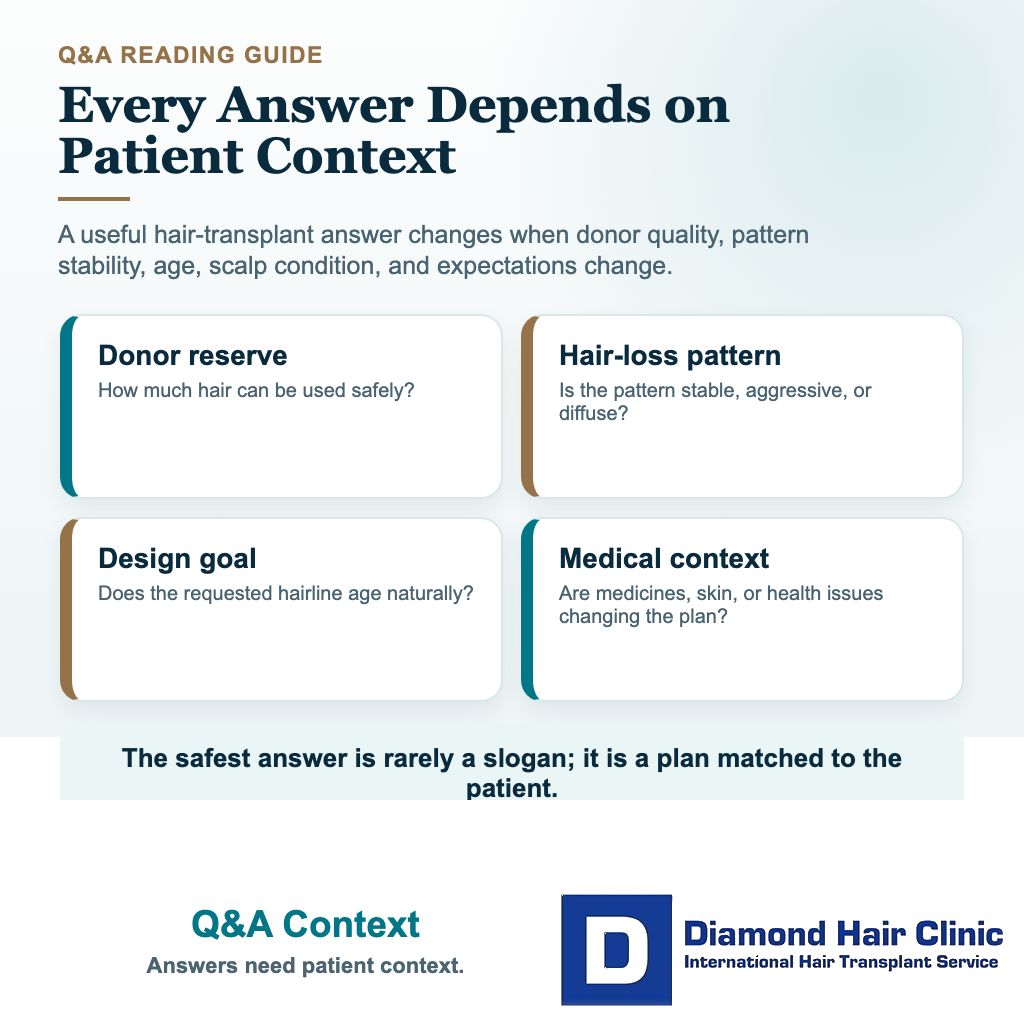
In consultation, I am not only deciding if grafts can be placed. I judge long-term aging, donor tolerance, facial fit, hairline design, and the patient’s understanding of recovery. A technically possible surgery is not always a wise surgery.
Donor discipline is the main theme. A hair transplant should use the right grafts in the right place, at the right density, with respect for the future.
If one answer on this page seems to conflict with another, the reason is usually patient biology. The correct plan changes when donor density, age, crown involvement, medical history, hair texture, previous surgery, or expectations change. Use this page as a starting point for better questions, not as a replacement for a personal surgical assessment.
Hair Transplantation Basics
A hair transplant is a surgical redistribution of hair. I take follicular units from a donor area, usually the back and sides of the scalp, and place them into areas where the hair has thinned or disappeared. These transplanted follicles usually keep many of the characteristics of the donor area, which is why they can continue to grow for many years in their new location.
This explanation keeps expectations realistic. A hair transplant does not create unlimited new hair. It moves hair from one limited area to another. For that reason, the donor area matters so much. If we waste donor grafts, we cannot simply order more later. A good plan protects both the result you want now and the options you may need later.
Modern hair transplantation usually places naturally occurring follicular units rather than old fashioned plug like groups. Good modern work can look very natural. But naturalness does not come from the tool alone. It comes from hairline design, angle control, graft selection, donor management, and the surgeon’s judgment.
Donor Planning From The First Consultation
The donor area is not only the place where grafts are taken. It is the foundation of the whole operation. I study its density, hair caliber, color contrast, curl, miniaturization, and healing risk. A patient may have a large looking donor area at first glance, but if the hair is fine or the safe zone is narrow, the plan must be more restrained.
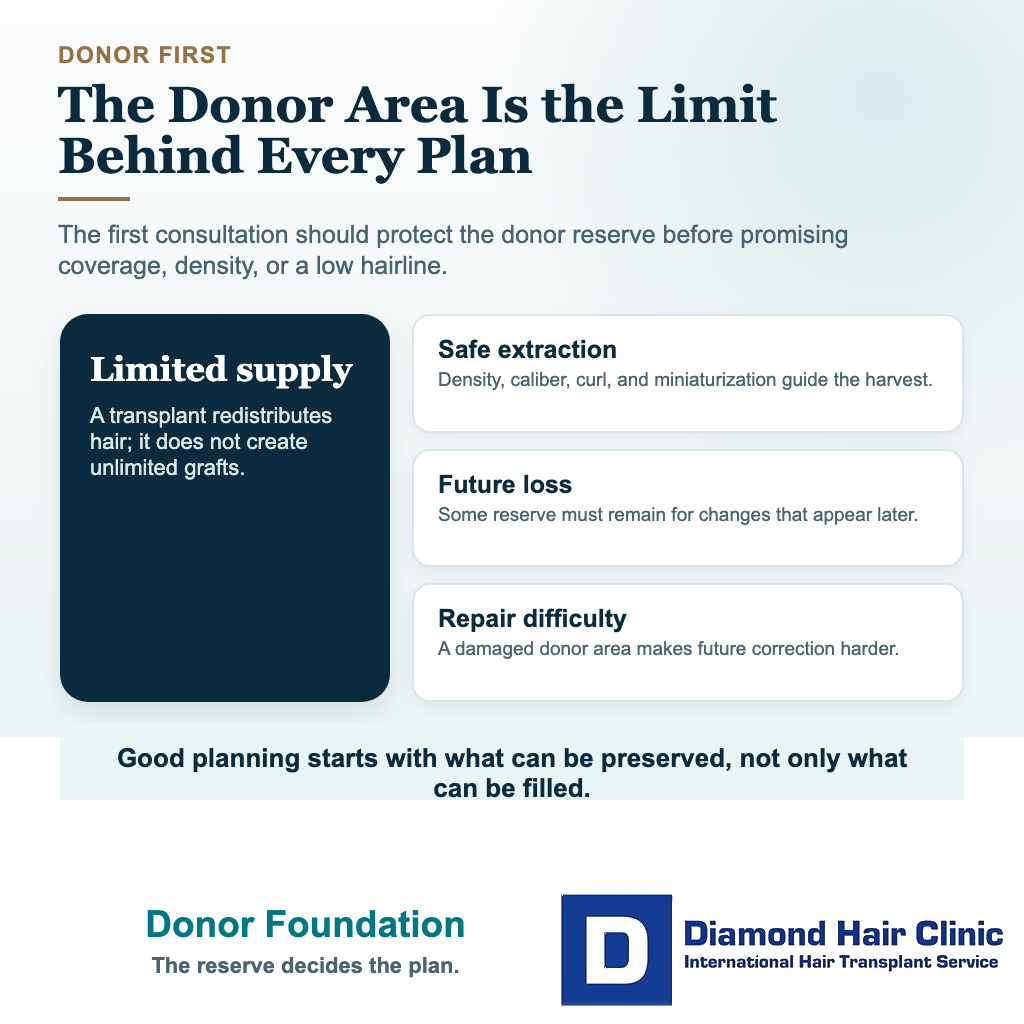
This helps explain why I pay close attention to aggressive promises. If a clinic promises to cover every thinning area in one session without respecting the donor, the patient may pay the price later with visible donor thinning, low growth, or an unnatural distribution. Donor preservation is part of the aesthetic result.
FUE, FUT, Sapphire FUE, And DHI
FUE hair transplant means that follicular units are extracted one by one from the donor area. It avoids a linear strip scar, but it still leaves tiny extraction marks. A responsible FUE plan spreads the harvest carefully and avoids taking too much from one zone.
FUT hair transplant removes a strip of scalp from the donor area and separates it into follicular units under magnification. It can be useful in selected cases, especially when donor management over a lifetime is the main goal, but it creates a linear scar and is not the technique I use for every patient.
Sapphire FUE describes the use of sapphire blades for recipient area creation in an FUE procedure. The blade is a tool, not a guarantee. The important question is whether the recipient areas are made at the correct angle, direction, depth, and density for your hair.
DHI hair transplant is often marketed as if it is a completely separate method. In reality, it usually describes implantation with an implanter pen after graft extraction. The instrument can be useful, but the result still depends on graft handling, planning, and surgeon control.
Natural Result Factors
A natural result begins with a natural plan. The hairline should not be too low, too straight, or too dense in a way that does not match the donor supply. The transition zone should use finer grafts. The angles should follow the natural direction of growth. The density should be strong enough to satisfy the eye but not so aggressive that it endangers the donor.
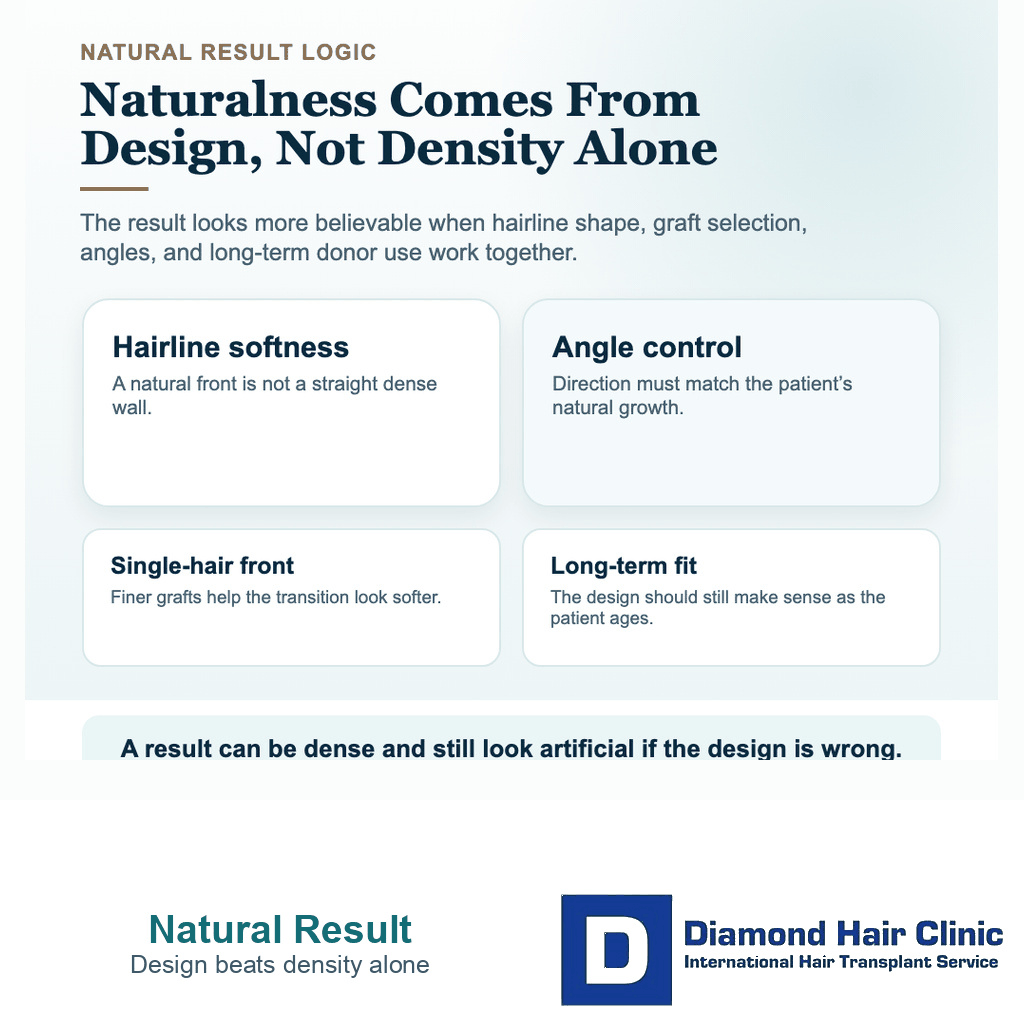
A separate discussion of hairline design in hair transplant explains why a good hairline is not a drawn line. It is a soft frame for the face. It must look natural today and still make sense as the patient gets older.
I watch future hair loss for the same reason. If we create a youthful hairline for a young patient whose crown and mid scalp may continue thinning, the result can look isolated later. A strong result should not only look natural in the first year. It should remain logical over time.
Cost, Value, And Repair Risk
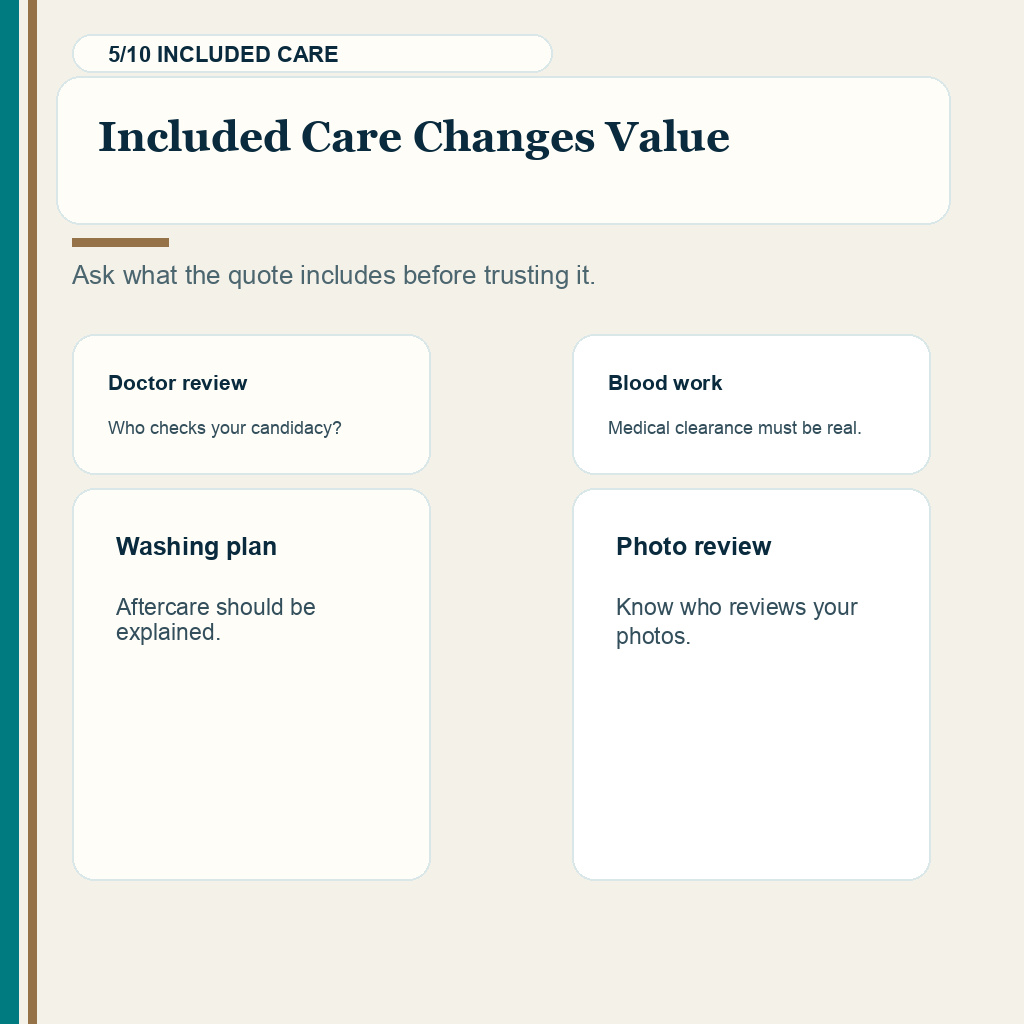
The cost of a hair transplant depends on the clinic model, the surgeon’s involvement, the graft plan, the complexity of the case, the country, and the level of follow-up. Some clinics price mostly around graft numbers. I do not think price should be reduced to graft count alone, because two operations with the same number of grafts can be very different in quality.
A careful case may use fewer grafts than a rushed case and still look better. A high graft number can sound attractive, but overharvesting or poor placement can leave the patient with less value, not more. If you are comparing Turkey with other countries, hair transplant cost in Turkey only makes sense inside the full plan. Look at who designs it, how the donor is protected, what follow-up exists, and what repair risk you are accepting, not only the advertised price.
For many international patients, travel, hotel, medication, transfers, aftercare, and revision risk also matter. A cheap first surgery can become expensive if it creates a repair case. A transparent plan is safer than a dramatic sales number for that reason.
Cheap Quotes Can Become Expensive
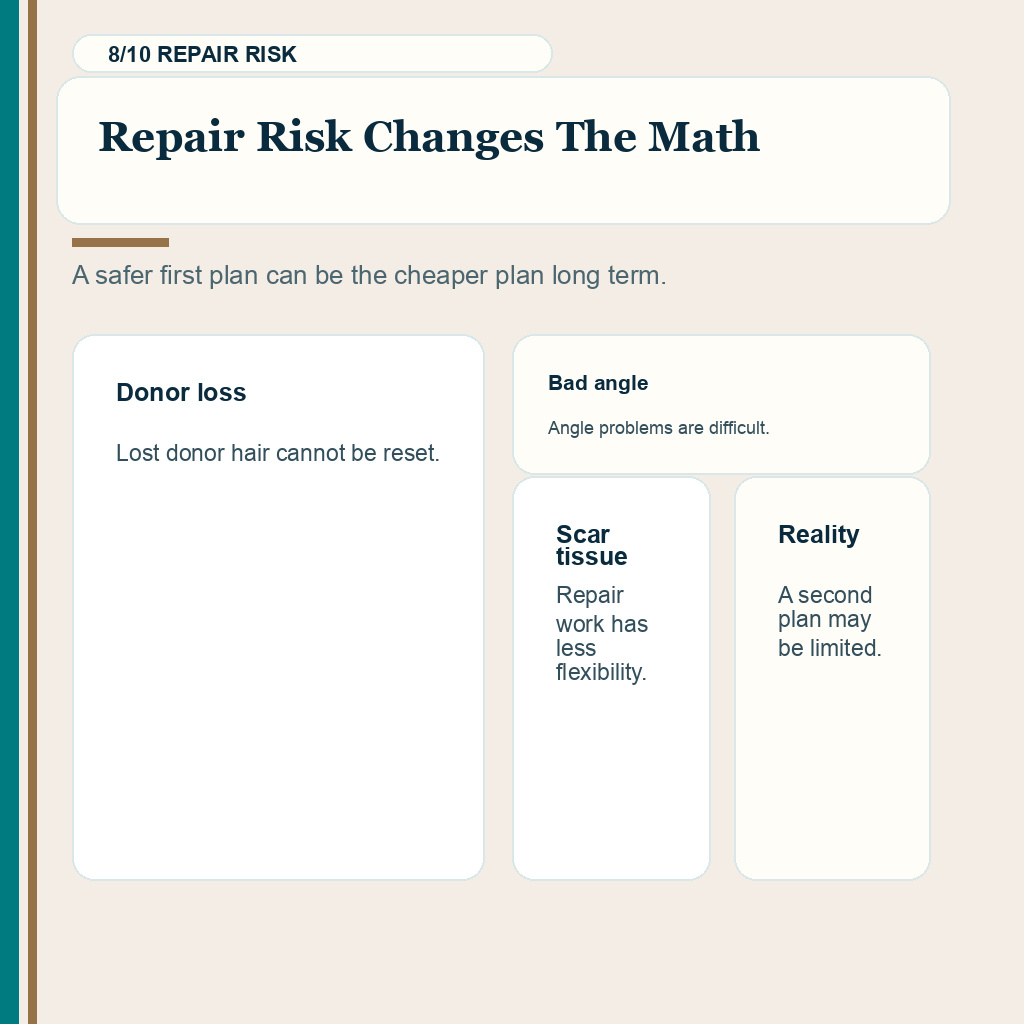
The cheapest quote often becomes expensive when it encourages the wrong decision. If a clinic promises extreme density, a very low hairline, or a very high graft count without careful donor analysis, the patient may need repair work later. Repair surgery is usually more limited, more difficult, and more emotionally stressful than doing the first surgery properly.
There are also indirect costs. A poor result can affect confidence, social comfort, photos, work life, and future hairstyle options. I never want a patient to choose surgery because the price felt urgent. If the budget is not ready, waiting is safer than accepting a plan that damages the donor area.
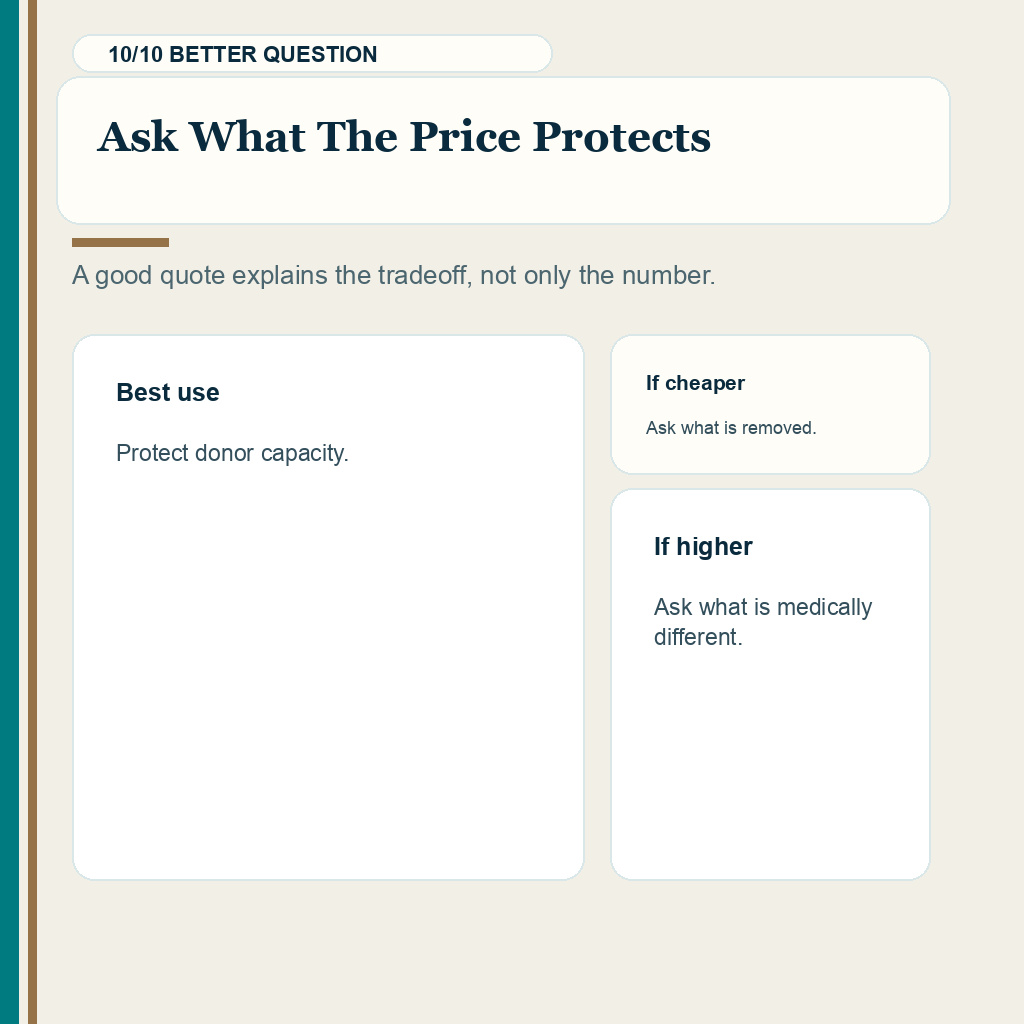
If budget timing is the real problem, it is safer to delay than accept a plan that spends the donor badly. Compare the plan, not only the package.
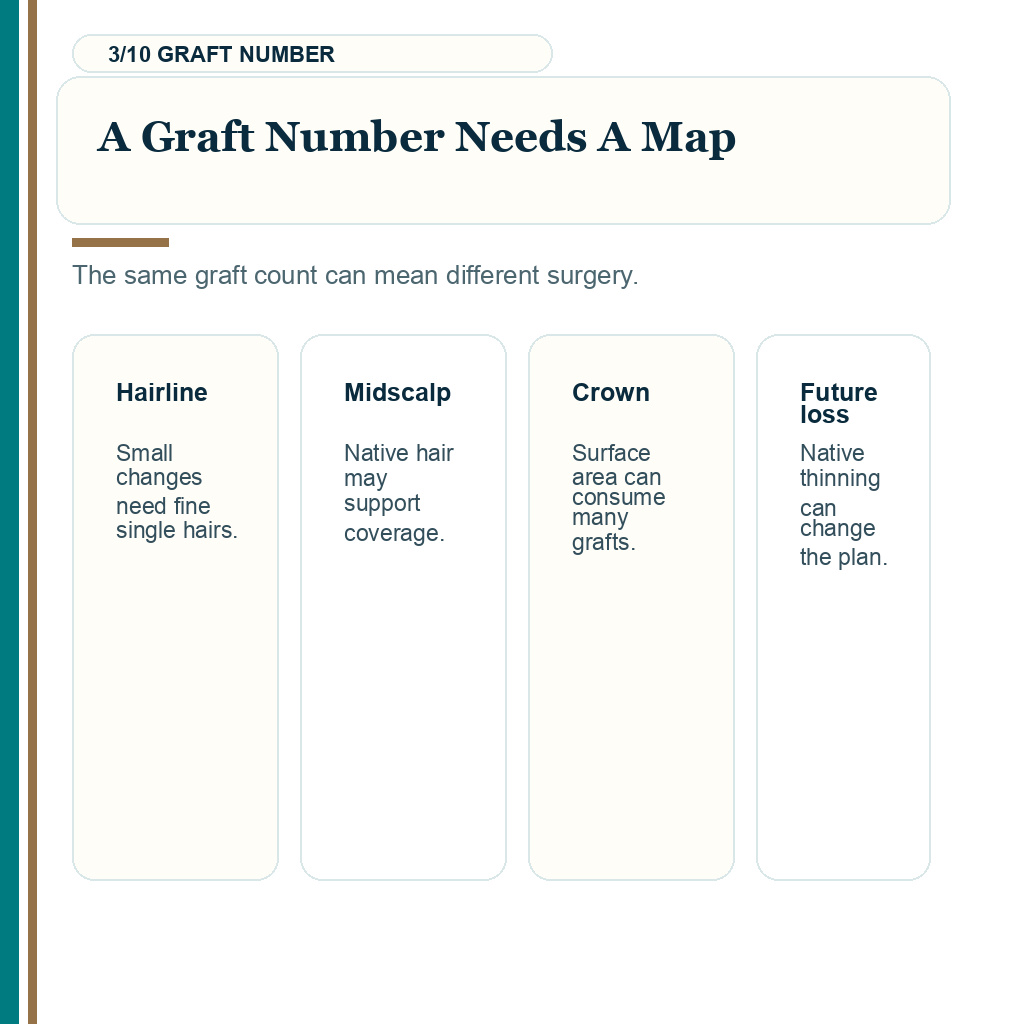
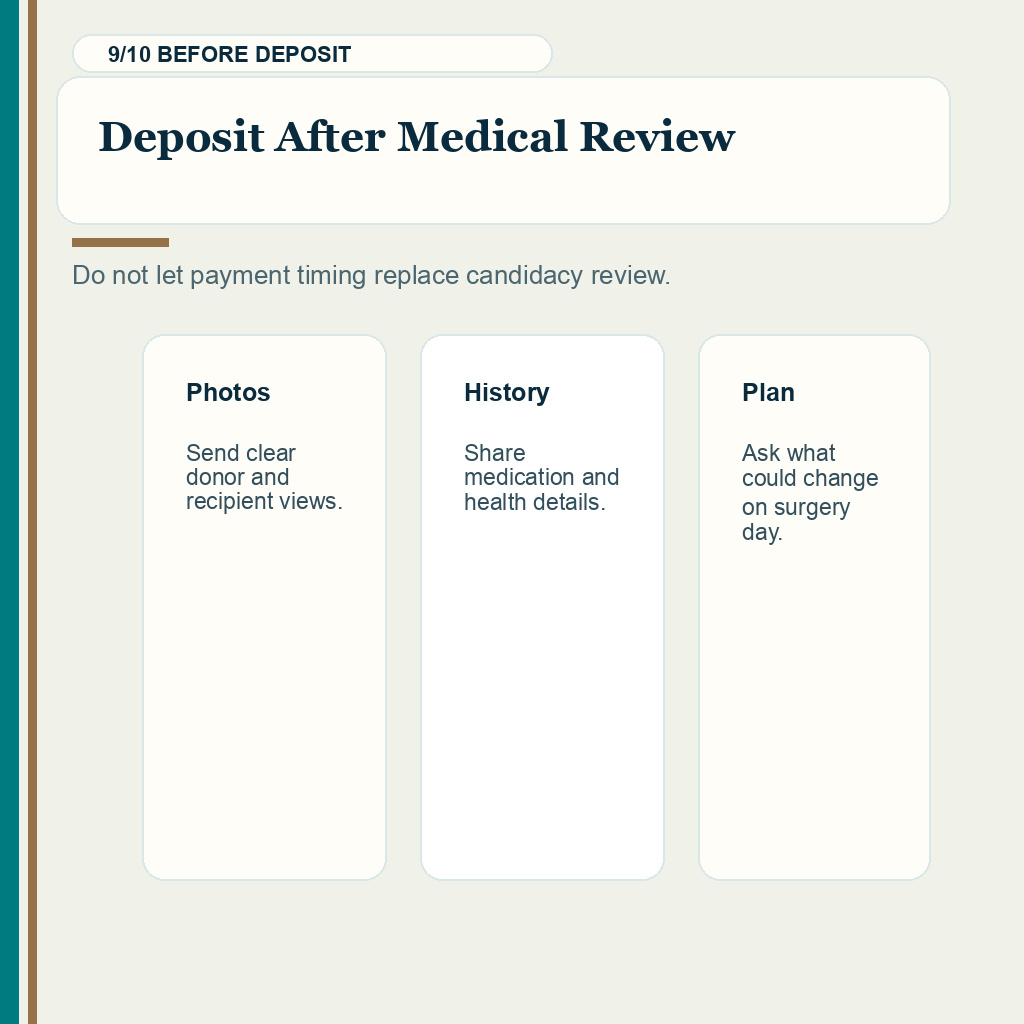
These 10 cost and planning slides turn common hair transplant questions into safer comparison points. Swipe the carousel, use the arrows for one slide at a time, or choose a number below the image to jump to that point.





Growth Cycle After Surgery
After a hair transplant, the transplanted hairs usually shed before they grow. This surprises many patients, even when they were warned in advance. The follicle remains under the skin, but the visible hair shaft often falls out during the early healing phase. This is part of the normal growth cycle after surgery.
In the first weeks, the scalp heals. Around the second to eighth week, shedding can occur. Around the third or fourth month, early new growth may begin, but it is often thin, uneven, and weak at first. Around six months, many patients see a visible change. Around twelve months, the result is much more mature. The crown can take longer, sometimes up to eighteen months.

I always tell patients not to judge too early. Month three can be emotionally difficult because the patient has already done the surgery but cannot yet see the real reward. A structured way to track hair transplant growth is helpful because it gives the patient a steadier reference. Photos should be taken under similar light and with similar hair length, not under random harsh bathroom lighting every day.
Shedding Versus Graft Loss
Shedding and graft loss are not the same. A shed hair shaft is usually expected. A lost graft in the early days may look different because it can include tissue and sometimes bleeding. Once the grafts are secure, the visible hair can shed while the follicle continues its recovery below the surface.
Many patients panic when scabs fall with small hairs inside them. In most cases, this is not a disaster. My page about whether scabs mean lost grafts after hair transplant explains this difference. What matters here is to follow washing instructions and avoid scratching or picking.
Hair Loss After A Transplant
You can still lose hair after a hair transplant. This is a central answer on this page. Transplanted hair usually behaves more like donor hair, but your native hair can continue thinning if your underlying hair loss is still active. This can create the impression that the transplant failed when the real problem is progression around the transplanted zone.
I separate transplanted hair from native hair during every consultation because this distinction protects the plan. If a patient has strong miniaturization behind the hairline, I need to plan for that. Sometimes medication such as finasteride or minoxidil can help stabilize native hair. Sometimes the patient cannot or does not want to use medication. Either way, the surgical plan must be clear about future loss.
If you want a deeper explanation, I have a dedicated article about whether hair loss can continue after a hair transplant. My answer is yes. The right response is planning, not fear.
Native Hair Shock Loss
Native hair shock loss means that some existing hair near the transplanted area sheds after surgery. This can happen because the scalp has experienced trauma, inflammation, anesthesia, incisions, and temporary stress. In many patients it is temporary, but weak miniaturized hairs are more vulnerable.
I discuss this in more detail on my page about native hair shock loss after hair transplant. The practical lesson is that the surgeon should not ignore weak native hair. If the area is unstable, the plan should be more careful, and medical stabilization may be discussed before or after surgery.
Receding Hairline Correction
A hair transplant can improve a receding hairline, but the strongest result is not always the lowest hairline. The aim is to create a frame that looks natural for the face, age, donor supply, and future hair loss pattern. A mature natural hairline can look far better than an aggressive young hairline that does not belong to the patient.
Hairline correction is one of the most visible parts of hair transplant surgery. A few millimeters can change the expression of the face. I design the hairline with attention to temple recession, forehead shape, facial proportion, hair caliber, and donor capacity. I also avoid making the front too dense if the donor cannot support the rest of the plan.
Patients often bring photos of celebrities or old photos of themselves. These can help the conversation, but they should not control the surgery. The best hairline is not copied. It is designed for the individual patient.
Young Patients And Hairline Timing
Sometimes, yes. If a young patient has fast progressive hair loss, a very low hairline request, and uncertain donor stability, waiting can be the more responsible decision. Do not read this as surgery is impossible forever. It means we need to understand the pattern before spending donor grafts.
I know waiting is frustrating, especially for young men who feel their appearance changing quickly. Protecting a patient from a poor long term result matters more than operating simply because he feels emotionally ready. A surgeon must be able to say no when the plan is not safe.
Long Term Maintenance After Surgery
Long-term maintenance starts with the understanding that the transplant is part of a hair restoration plan, not the end of hair loss biology. You need to protect the scalp, follow the early washing instructions, avoid trauma in the first days, and then monitor the native hair over the following months and years.
In the early phase, the most important rule is to be gentle. Do not scratch. Do not pick scabs. Do not expose the scalp to harsh sun. Avoid heavy sweating until your surgeon allows it. Sleep in the recommended position. Keep the recipient area clean without being aggressive. My broader hair transplant aftercare guide covers many of these daily details.
In the long term, the review shifts to native hair stability, crown progression, medication suitability, donor health, and whether the result still suits the patient’s age. A second procedure may help some patients, while others protect the existing result by avoiding a chase for perfect density.
Medication After A Hair Transplant
Some patients do not use medication, and some are not good candidates for every medication. But I discuss the subject, especially when native hair is miniaturizing. Finasteride, dutasteride, minoxidil, and other supportive options may help some patients keep more of their native hair. They do not replace good surgery, and they should not be used casually without medical judgment.
Patients who are unsure about this topic can read my articles about finasteride before or after hair transplant, oral minoxidil before or after hair transplant, and whether trying medication before a hair transplant makes sense. The decision should be matched to the patient’s pattern, risk profile, and long-term plan.
Results That Weaken Later
There are two different situations that patients often group together. The first is true poor graft growth, where the transplanted follicles do not survive or do not grow well. The second is a result that looked good at first but later appears weaker because surrounding native hair continued to thin. These are not the same problem, and they require different thinking.
True poor growth can happen because of graft trauma, poor handling, dehydration, infection, aggressive placement, smoking, medical issues, or an unsuitable surgical plan. It can also happen when the recipient area has scarring or poor blood supply. Surgical discipline matters here. Grafts are living tissue, not decoration.
A successful transplant can also look less satisfying later if hair loss progresses behind it. This is not exactly failure, but it can be disappointing if the patient was not prepared. I try to prevent this by explaining the future pattern before surgery, not after the patient becomes worried.
Thin Result Assessment
First, check the timing. At four months, low density is usually too early to judge. At six months, many patients are still improving. At twelve months, the front is usually much more mature, while the crown may still continue. My page about low density at four months explains why that fear is so common.
If the result is mature and still thin, diagnosis comes first. I separate low graft survival, poor distribution, hair caliber, ongoing native thinning, lighting, and styling before discussing another surgery. A second surgery may help some patients, but only if the donor area can safely support it. More grafts are not always the answer to a thin result.
Lifestyle Choices And Healing
Lifestyle does not usually change the genetic destiny of transplanted grafts in a simple way, but it can affect healing, inflammation, scalp health, and native hair. Smoking is one of the clearest concerns because it can reduce blood flow and interfere with wound healing. I take this seriously, especially in the early recovery period.
I have a detailed article about smoking after hair transplant because patients often underestimate the risk. My advice is direct but measured. If you are going to invest in surgery, protect the healing environment. This includes avoiding smoking, following medication instructions, sleeping properly, and not returning too early to heavy exercise or harsh sun.
Hair product choices can also matter. Harsh products, repeated irritation, tight hairstyles, and untreated scalp inflammation can make recovery less comfortable. If you are worried about product safety, my article about harmful ingredients in hair products may help you think more clearly.
Nutrition After Surgery
Nutrition matters for general healing and hair health, but it cannot rescue a poor surgical plan. Patients should eat well, avoid crash diets, correct important deficiencies when present, and recover in a stable physical condition. Iron deficiency, thyroid disease, and other medical issues should be taken seriously because they can affect shedding and hair quality.
If a patient has known thyroid disease or low ferritin, I discuss it before surgery. You can read more on my pages about thyroid problems and hair transplant and low ferritin anemia and hair transplant.
Age And Hair Transplant Success
Age matters because hair loss is a moving process. A twenty three year old with aggressive hair loss may not be ready for the same plan as a forty five year old with stable frontal recession. Younger patients often want the most youthful hairline. My responsibility is to protect a hairline that can still look natural as the rest of the hair changes.
Older patients can be excellent candidates when the donor area is strong, health is appropriate, and expectations are realistic. Sometimes older patients are actually easier to plan because the hair loss pattern is clearer. But age alone does not decide candidacy. The donor area, scalp health, medical history, and goals matter more.
I often tell patients that I do not reduce this to simply whether they are old enough. The decision depends on whether the plan respects the likely future. This is especially important when a patient wants dense frontal work but already has early crown thinning.
Natural Ageing After A Transplant
It can, if the design is mature and the grafts are used wisely. I wrote a full article about whether a hair transplant will look natural as you get older because this question is more important than many patients realize. A result that looks dramatic in the first year but strange later is not a good result.
Natural aging requires restraint. The hairline should not fight the face. The donor should not be exhausted. The result should blend with future changes. A hair transplant is successful when it looks like it belongs to the patient, not like it was forced onto him.
Medical Conditions And Hair Loss
Sometimes, but only after the condition is diagnosed and stable. A hair transplant is not the first answer for every type of hair loss. Pattern hair loss is very different from alopecia areata, scarring alopecia, thyroid related shedding, iron deficiency, traction hair loss, or medication related shedding. If the cause is active and untreated, surgery can be the wrong step.
Before accepting a medical hair loss case, I need to understand the diagnosis, the stability of the disease, the quality of the donor area, and the condition of the recipient area. Some patients need blood tests, dermatology treatment, scalp evaluation, or more time before surgery. This is not delay for the sake of delay. It is protection.
Scarring areas can sometimes be transplanted, but they are less predictable than healthy scalp. Blood supply, scar thickness, and the cause of the scar matter. Cautious planning and sometimes staged work are safer than promising a dense result in one attempt.
Options When Surgery Is Not Suitable
If surgery is not suitable now, the plan may include medical treatment, scalp treatment, waiting, better diagnosis, or a non surgical camouflage option. In some cases, scalp micropigmentation can help the visual impression, although it does not create hair. In other cases, medication may delay surgery or reduce the number of grafts needed later.
I do not see a rejected surgery as a failed consultation. Sometimes the most valuable consultation is the one that prevents a patient from making a poor decision. I do not aim to operate on everyone. The aim is to guide each patient toward the safest realistic path.
Consultation Setup At Diamond Hair Clinic
You can contact Diamond Hair Clinic through the contact form or by WhatsApp at +90 546 840 41 75. Clear photos are very helpful. I usually need front, both temples, top, crown, donor area from the back, and donor area from both sides.
Good consultation photos should be taken in bright natural light, without hair fibers, heavy styling products, or filters. Wet hair photos can also be useful in some cases because they reveal thinning more. If the patient is already using medication, I check what it is, how long it has been used, and whether there were side effects.
During consultation, I do not only estimate graft numbers. I look at whether surgery makes sense. I ask what the patient expects, how much coverage is realistic, whether the donor is strong enough, and whether one session is enough. When this remains uncertain, I make that clear.
Useful Consultation Photos
The best photos are simple and clear. Stand near a window or under bright neutral light. Take one photo from the front with the hair pulled back, one from each temple, one from the top, one from the crown, and several donor area photos. If you have long hair, separate it enough to show the scalp. If you hide the real thinning, the plan will also be less accurate.
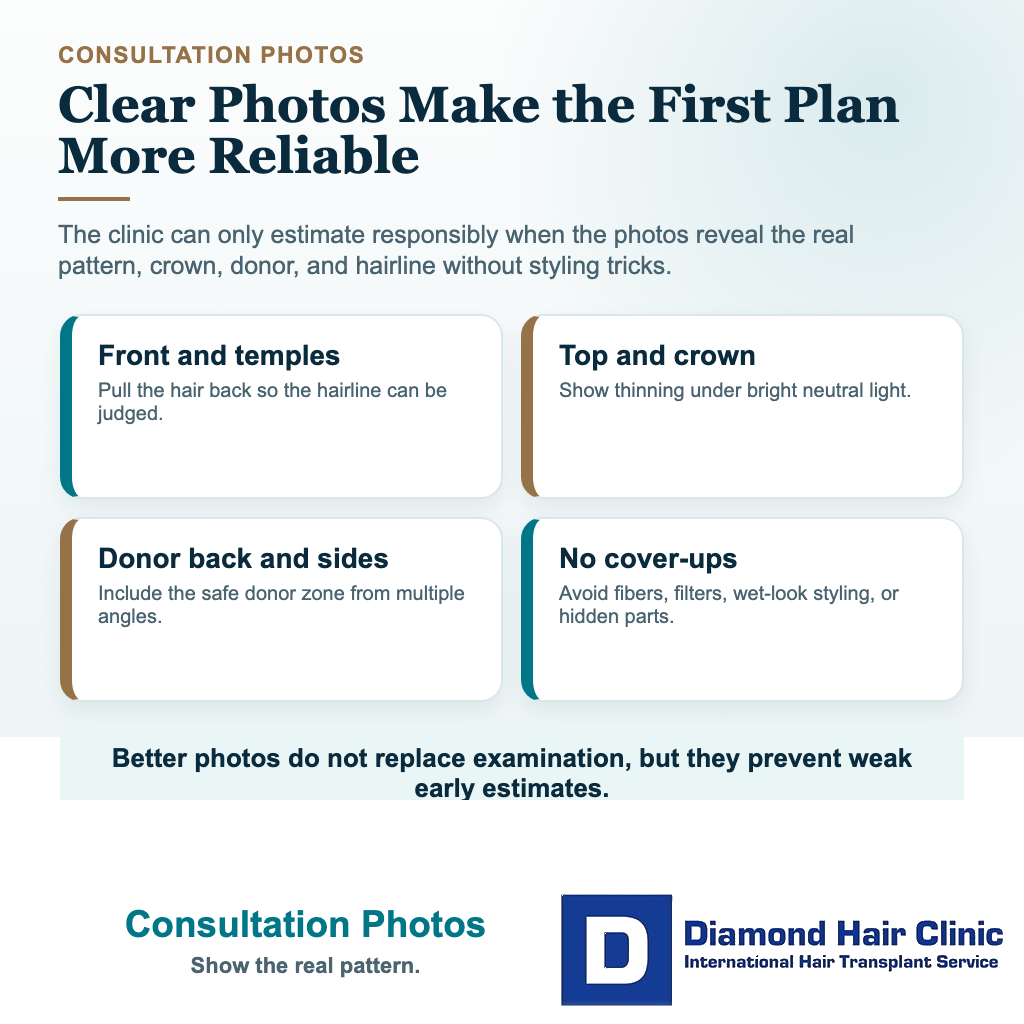
I also like to see old photos when possible. They help me understand progression. A photo from five or ten years earlier can show whether the hairline changed slowly or rapidly. It matters because hair restoration is not only about today’s picture.
Hats After A Hair Transplant
But not immediately in a careless way. The early grafts need protection from pressure, friction, and accidental movement. If a hat rubs the recipient area during the first days, it can create unnecessary risk. If it is loose, clean, and allowed by your surgeon after the first healing phase, it can be useful for privacy and sun protection.
I usually want patients to be especially careful during the first week. The exact timing depends on the technique, the graft placement, swelling, scabbing, and the type of hat. A tight cap is different from a loose medical hat. A helmet is a separate subject because it creates pressure and friction. I discuss that in my article about wearing a helmet after hair transplant.
The safest rule is to ask your own surgeon before using anything that touches the grafts. Comfort is not enough. The hat must also avoid rubbing the implanted zone.
Safer Hat Choice After Surgery
A hat has to be loose, clean, soft, and easy to place without dragging across the grafts. It should not compress the recipient area, catch scabs, or keep the scalp sweating for long periods. If you need to hide the transplant in public, plan your schedule around healing rather than forcing the scalp to tolerate pressure too early.
Many patients ask when they will look normal enough to be outside without a hat. That depends on redness, scabbing, swelling, hair length, skin tone, and the size of the session. My article about when you may look normal in public after a hair transplant may help with realistic timing.
Natural Looking Density
Natural looking density is possible, but it is not the same as original teenage density. The eye does not require every lost hair to be replaced. It needs intelligent coverage, proper distribution, suitable hairline softness, and enough contrast reduction between scalp and hair. Hair caliber, curl, color contrast, and styling all affect the visual result.
In this part of the decision, quality over quantity becomes very practical. If I use too many grafts in the front, I may weaken the donor area and leave too little for the mid scalp or crown. If I spread grafts too thinly everywhere, the result may look weak. The plan must choose priorities. For some patients, framing the face well gives the strongest visual improvement.
For a deeper discussion, read my page about hair transplant result quality. Good density is not just a number. It is a relationship between the donor, the recipient area, the face, the hair characteristics, and time.
More Grafts Are Not Always Better
More grafts are better only when they are needed, safely available, and placed with purpose. A high graft number can be dangerous if it is taken from the wrong donor zones or concentrated too aggressively. I have written about whether too many grafts in one area can damage a hair transplant because this mistake is common in overambitious planning.
Graft number planning includes surface area, desired density, existing hair, donor capacity, future loss, and the patient’s hairstyle goals. You can read more about that judgment in my article on how a surgeon calculates graft numbers.
Donor Hair And Regrowth
The extracted donor follicles do not grow back in the donor area. This is a very important point. When a follicular unit is removed, that specific unit has been moved. The surrounding hair can grow and cover the extraction sites, and the donor area can look normal when the harvest is done carefully, but the removed follicles are no longer there.
Overharvesting is serious because removed donor follicles do not return. If too many grafts are taken, or if they are taken from a small zone, the donor can look patchy, thin, or moth eaten. Good FUE should respect spacing, safe donor boundaries, punch size, hair direction, and total donor reserve.
Temporary donor shedding can also happen after surgery. This is different from the removed follicles not regrowing. Donor shock loss may recover over time, but true overharvesting does not simply reverse. If you see donor thinning, the timing, pattern, and surgical details matter.
Donor Area Protection
The donor is protected before surgery by choosing a safe graft number. It is protected during surgery by careful extraction. It is protected after surgery by gentle handling, avoiding trauma, and giving the scalp time to heal. It is also protected by not asking one session to solve every possible future problem.
Patients sometimes ask for 5000 or 7000 grafts because they think the number itself proves strength. In reality, the donor area decides what is safe. I have written about whether 5000 grafts is too much for one session and whether 7000 grafts over two days can be safe. These questions need individual donor analysis, not a slogan.
Hair Texture And Results
Hair texture changes the visual power of each graft. Thick hair covers more scalp than fine hair. Curly or wavy hair can create more visual volume than straight hair. Dark hair on light skin may need more careful density planning because scalp contrast is higher. Light hair on light skin may look fuller with fewer grafts because the contrast is softer.
Two patients with the same graft number can look very different because hair texture changes visual coverage. A patient with coarse wavy hair may achieve strong coverage with fewer grafts than a patient with fine straight hair. Do not read this as one patient is better. It means the plan must fit the hair.
Texture also affects how the grafts should be placed. Angles, direction, and curl orientation matter. If curly grafts are placed without respecting their natural behavior, the result can look irregular. If fine hair is placed with unrealistic density expectations, the patient may feel disappointed even when the grafts grow.
Wiry Or Coarse Early Texture
Some patients notice that transplanted hair feels wiry, coarse, or uneven during the early growth phase. This can happen while the hair shaft is maturing. The first growth is often not the final texture. Over time, many transplanted hairs become softer and more manageable.
I explain this in more detail in my article about wiry or coarse transplanted hair. The useful detail is patience, gentle hair handling, and realistic timing. Early texture changes do not always mean a bad result.
Afro Hair And FUE Planning
FUE can be suitable for Afro and tightly curled hair types, but it requires specific experience and caution. Curly hair often continues to curve under the skin. This can make extraction more technically demanding and can increase the risk of transection if the surgeon does not respect the follicle’s path.
Afro textured hair can provide excellent visual coverage because the curl creates volume, but the surgical plan must be precise. Donor extraction, graft handling, recipient area angles, and hairline design all need adjustment. The same routine used for straight hair is not always appropriate.
I discuss this more fully in my article about Afro curly hair transplant. The main message is to choose a surgeon who understands the hair type, not only a clinic that performs many operations.
Graft Survival And Growth
In real surgery, I do not promise that every single graft will survive. High survival is the goal, but biology is not mathematics. Graft survival depends on extraction quality, hydration, time outside the body, handling, recipient area creation, bleeding control, infection prevention, patient healing, and aftercare.
Focus on a high quality process rather than a perfect sounding promise. Grafts must be treated gently. They should not dry out. They should not be crushed. Recipient areas should not be too dense for the blood supply. Early instructions matter especially during the first days.
Result assessment has to cover hairline growth, planned density, donor healing, ongoing native thinning, and the timing of the review. That is more useful than a simple percentage claim.
Factors That Reduce Graft Survival
Graft survival can be reduced by rough handling, dehydration, excessive time outside the body, poor recipient area creation, infection, smoking, severe scratching, picking, trauma, or an unsuitable recipient area. Some risk factors are surgical. Some are patient related. Good medical judgment requires both sides.
Fewer well handled grafts are better than a larger number that is rushed. Hair transplantation rewards discipline. The operation may look simple from the outside, but every graft is living tissue.
Pain And Anesthesia
Most patients tolerate the procedure well because the scalp is numbed with local anesthesia. The most uncomfortable part is usually the anesthetic injections at the beginning. After the area is numb, patients often feel pressure, movement, or vibration rather than sharp pain.
Patients should not be told that there is no discomfort at all. That would not be accurate. At the same time, they should not imagine something more frightening than reality. A controlled surgical environment, careful anesthesia, and patient communication make a big difference.
If you are especially worried about this subject, read my detailed explanation of how painful anesthetic injections are in hair transplant. Fear usually decreases when the patient understands what will happen and when.
Scalp Sensation After Surgery
After surgery, patients can feel tightness, tenderness, numbness, itching, or mild burning. The donor area may feel sore for a few days. The recipient area may feel tight as scabs form. These sensations usually improve gradually. Severe pain, spreading redness, pus, fever, or worsening swelling should be reported to the clinic.
Numbness can last longer in some patients. It usually improves over time as the nerves recover. The recovery experience is not identical for everyone, which is why follow-up matters.
Procedure Time
Most hair transplant procedures take several hours. The exact duration depends on the graft number, donor characteristics, technique, team workflow, and complexity of the recipient design. A smaller session may be finished more quickly. A larger session can take most of the day.
Rushing hair transplant surgery deserves caution. Speed is not the main measure of quality. The grafts must be extracted carefully, stored properly, and implanted with attention to angle and direction. The patient also needs breaks, monitoring, and comfort.
Very large graft counts in one day need a safety and quality decision, not only a time estimate. If a case requires too much speed to finish, I reconsider the plan.
One Session Limits
Sometimes one session is enough. Sometimes it is not. If the bald area is large and the donor is limited, one session may need to focus on the frontal frame and mid scalp rather than attempting full dense coverage everywhere. The crown often requires careful judgment because it can consume many grafts while giving a smaller visual return than the frontal area.
If a patient needs a second session, I explain that early. A staged plan can be more realistic and safer than pretending one procedure can solve every area at high density.
Healing Timeline
The first visible healing phase usually takes about ten to fourteen days. During this time, redness, swelling, scabs, and tenderness gradually improve. Many patients can return to desk work earlier, but social visibility depends on hair length, skin response, graft number, and personal comfort.
Healing and growth are different. The skin may look much better after two weeks, while the hair result still needs months. This difference is important. A patient can be healed enough for daily life but still be far from the final cosmetic result.
For early concerns such as redness, scabs, pimples, and warning signs, my article about when to worry after a hair transplant gives more detail. In general, mild redness and scabbing can be normal, but worsening pain, pus, fever, or aggressive swelling should not be ignored.
Return To Normal Daily Life
Light daily activity can often resume quickly, but normal life has different meanings for different patients. Office work, video calls, gym training, swimming, helmets, direct sun, and social events all have different timelines. I separate these activities instead of giving one vague answer.
For specific daily life questions, you can read my pages about exercise after hair transplant, swimming after hair transplant, sleeping normally after hair transplant, and flying after hair transplant.
Summer Surgery Timing
You can have a hair transplant in summer, but you need to respect heat, sweating, sun exposure, and travel comfort. The operation itself is performed in a controlled clinical environment. The challenge is usually the recovery period after you leave the clinic.
Summer patients must be careful with direct sun. Freshly treated scalp can be sensitive, and sunburn should not be near healing grafts. Heavy sweating can also make the scalp uncomfortable and may increase irritation if hygiene is poor. Do not read this as summer surgery is forbidden. It means the patient must plan carefully.
I discuss this topic more fully in my article about hair transplant in summer or winter. The best season is the one that allows the patient to follow aftercare properly.
Summer Patient Planning
Plan shade, rest, loose clothing, gentle washing, and a realistic return to outdoor activity. Avoid beach holidays, tanning, heavy workouts, and long sun exposure in the early phase. If you are traveling to Istanbul, think about your hotel, transport, and how you will rest after surgery.
The patient who follows instructions in summer can heal well. The patient who treats the transplant as a holiday activity may create unnecessary risk.
Beard Versus Scalp Transplants
Beard transplants are different from scalp hair transplants in design, angle, density, and healing. Beard hair grows in a very visible area of the face. The angles are often flatter and more directional. Poor placement can be obvious because people look directly at the face.
The donor source also matters. In many beard transplant cases, scalp hair is used to create or improve facial hair. Scalp hair and beard hair are not identical, so the surgeon must plan carefully to create a natural texture and direction. The decision should not be reduced to coverage. The goal is a beard pattern that looks like it belongs to the face.
Beard transplant recovery can include redness, swelling, crusting, and temporary shedding. Patients must avoid picking and must follow shaving instructions carefully. The face is a socially sensitive area, so I discuss timing and expectations clearly before surgery.
Body And Beard Hair As Donor Sources
Body or beard hair can sometimes be used as an additional donor source for selected scalp cases, but it is not a perfect replacement for scalp donor hair. Beard hair can be thicker and more wiry. Chest hair can have a different growth cycle and texture. These grafts must be used carefully and usually work better as support than as the main source for a soft hairline.
I explain the limitations in my article about body hair as a donor source for hair transplant. The decision should be based on donor need, hair match, and realistic expectations.
Women And Hair Transplant Planning
Women can have hair transplant surgery, but female hair loss must be diagnosed carefully. Some women have a pattern that can be improved with transplantation. Others have diffuse thinning across the scalp, active shedding, PCOS related hormonal hair loss, iron deficiency, thyroid disease, traction loss, or scarring conditions that need medical evaluation first.
The donor area is especially important in female patients. If the donor itself is miniaturizing, surgery may not be safe or predictable. A transplant depends on moving strong hair. If the donor hair is not stable, the result can be disappointing even if the surgery is technically performed well.
Hairline lowering, temple work, scar repair, and selected density improvements can be good options for some women. But I pay close attention to treating every female hair loss case as a simple transplant case. The first responsibility is diagnosis. The second is a realistic plan.
Diffuse Thinning Caution
Diffuse thinning can be difficult because the hair is weak over a broad area. If grafts are placed between many miniaturized native hairs, the risk of shock loss and visual disappointment can be higher. The patient may also continue thinning after surgery if the underlying process is active.
I have a separate page about whether diffuse thinning can be fixed with a hair transplant. In some cases, surgery is possible. In others, medication, diagnosis, or waiting is safer. What matters here is not to force a transplant into a pattern that does not support it.
High Foreheads And Temple Reconstruction
A hair transplant can lower a naturally high forehead in the right patient, and it can also improve temple recession. But this type of work requires restraint. Lowering a hairline too much can make the face look unnatural and can consume grafts that may be needed later. Temple points are also delicate because their angle, softness, and direction are very visible.
High forehead planning starts by separating true hair loss, a naturally high hairline, facial proportion, and mixed cases. I review age, donor capacity, forehead muscle movement, hair caliber, and the long term fit of the proposed new line.
You can read more about this in my article on whether a hair transplant can lower a naturally high forehead. The decision should not be reduced to to move the line down. The aim is to create a frame that looks like it always belonged there.
Temple Overcorrection Risk
Temples are easy to overdo because patients often remember a very youthful shape and want it back completely. But adult male temples naturally change. If the temple points are rebuilt too aggressively, the result can look artificial from the side. It can also trap the surgeon into a hairline that needs too many grafts to maintain.
Soft temple planning is usually safer. The transition should look natural in motion, in profile, and with different hairstyles. A small improvement in the right place can look better than a dramatic correction that calls attention to itself.
Events And Weddings After Surgery
Timing matters. A hair transplant is not a quick cosmetic touch for an event next month. The first weeks can include redness, scabs, swelling, shedding, and awkward hair length. The real growth takes months. If the event is important, the surgery needs planning far enough ahead that the healing phase and the ugly duckling phase do not become a source of stress.
For a wedding, important photos, public presentation, or professional filming, generous timing is safer. The result usually looks much better after many months, and the patient feels less pressured when the schedule is not tight. If the date is close, it may be better to wait rather than create anxiety around recovery.
I wrote a dedicated article about how long before a wedding you should have a hair transplant. The timing logic also applies to other important events. Do not plan surgery around hope. Plan it around biology.
Event Timing Can Be Too Close
If an event sits too close to surgery, postponing the operation, using temporary styling, or focusing on medical stabilization may be better. I understand that patients want to look their best for important moments, but surgery creates a recovery timeline that cannot be negotiated by excitement.
A good plan should reduce stress, not create it. If you are calculating days instead of months, it is worth slowing down and asking whether the timing serves you.
Eyebrows And Other Transplant Areas
Hair transplantation can be used beyond the scalp in selected cases. Eyebrows, beard areas, scars, and some body areas can sometimes be improved with transplanted hair. But each area has its own design rules. Eyebrows are especially delicate because the direction is flat, the pattern is fine, and even small mistakes can be visible.
An eyebrow transplant is not just a smaller scalp transplant. The grafts must be selected carefully and placed with very precise angles. The patient also needs to understand that transplanted scalp hair in the eyebrow may need trimming because it can keep growing longer than native eyebrow hair.
Scars can also sometimes be improved, but scar tissue behaves differently from normal scalp. Growth can be less predictable, and the plan may need staging. The surgeon should evaluate the blood supply, scar thickness, and whether the scar is stable before promising coverage.
Design In Small Areas
Small areas leave little room for error. In the scalp, surrounding hair may hide small irregularities. In eyebrows, beard borders, and facial work, the direction and density are seen at close distance. The design must match the person’s natural anatomy and expression.
I approach these cases cautiously for that reason. I do not aim to fill every millimeter. The aim is to restore a natural pattern that does not look transplanted.
Choosing The Surgeon
Before surgery, the responsibility should be clear. The patient needs to understand how the hairline will be designed, how recipient areas will be created, how grafts will be extracted, how the donor area will be protected, and what graft number is truly safe. If I believe the patient is not a good candidate, that answer should be given before the booking becomes real.
A consultation should not feel like a sales call. The surgeon should be able to explain the limits of your case. If every answer is designed to make you say yes immediately, be careful. Good medicine sometimes slows the patient down.
I wrote about waiting for the right hair transplant surgeon because the choice of surgeon affects not only the first result but also your future options. A hair transplant is visible. It should not be rushed.
Warning Signs In A Hair Transplant Offer
Be careful with guaranteed density, unlimited graft promises, pressure discounts, unclear surgeon involvement, and plans that ignore donor limits. Also be careful if the clinic dismisses your medical history or does not ask for proper photos. Promises made before examining the donor area and scalp condition are not careful planning.
A good plan should make sense even after the excitement fades. It should explain priorities, limits, recovery, risks, and future hair loss. If the plan only says a large number and a low price, it is not enough.
Realistic Graft Numbers
This is a common question, and it is also one of the easiest questions to answer badly. A graft number without context is almost meaningless. Area size, hair caliber, color contrast, curl, donor density, future hair loss risk, and the patient’s priority all change what that number means. The same number can be enough for one patient and clearly insufficient for another.
A graft number given only to satisfy curiosity does not help enough. A number such as 3000 grafts only means something when the plan explains where those grafts will go, what density they can realistically create, what area will be left for a future session, and how the donor area will look after extraction. A graft plan should be a map, not a marketing line.
Patients often compare offers and feel confused because one clinic recommends 2500 grafts while another recommends 4500. The gap may come from different density targets, a more aggressive clinic model, unclear photos, or a plan that tries to cover too much at once. When graft numbers differ between clinics, the larger offer does not make the plan safer by itself. I want to know what area the number covers, what density is realistic, and what donor reserve remains for the future.
Small Graft Numbers With Focused Goals
In the right case. A small number of grafts can improve the hairline corners, soften a recession pattern, repair a scar, or strengthen a limited area. For some patients, 1000 grafts may be enough to make a meaningful refinement. For others, even 3000 grafts may not be enough if the bald area is large and the hair is fine.
The question should not be whether a number sounds impressive. The question should be whether the number matches the goal. A restrained plan can be powerful when it is focused. An aggressive plan can still look weak if it tries to cover too much surface without enough density.
The 3000 Graft Question
Often, 3000 grafts can create a strong change in the frontal area or a moderate change across a larger zone. But it is not a magic number. It depends on the patient’s baldness pattern, hair characteristics, and expectation. A patient who wants a natural frontal frame may be very happy with 3000 grafts. A patient who expects dense coverage from hairline to crown may be disappointed.
I wrote separately about whether 3000 grafts are enough for a hair transplant because patients search this number constantly. My answer is always individual. The donor area should decide what is safe, and the recipient area should decide what is useful.
Crown Versus Hairline Planning
The crown can be more demanding than patients expect. It has a swirl pattern, a larger surface area than it first appears, and a tendency to continue thinning over time. It can consume many grafts while giving less immediate visual impact than the frontal hairline. This does not mean the crown should be ignored. It means the crown needs careful planning.
For a patient with both frontal loss and crown thinning, I usually discuss priorities. The frontal frame often changes the face more strongly. The crown matters too, especially from above and behind, but it may need a staged plan. If the donor area is limited, trying to fully cover the crown too early can weaken the entire strategy.
You can read more on my page about crown hair transplant. I also have a separate discussion about whether to address the hairline or crown first, because the best order depends on the patient, not on a universal rule.
Crown Growth Can Feel Slower
Crown growth can feel slower because the visual pattern is different. The swirl spreads hairs in several directions, and the area is often judged under overhead light. Even when the grafts are growing, the crown may not look dense until the hair gains length and caliber. Patients also tend to inspect the crown harshly because it is difficult to see without mirrors and photos.
If the crown still has native hair, shock loss can also confuse the picture. Some existing hair may shed temporarily after surgery. This can make the early months look worse before they look better. I remind patients that the crown often needs patience and consistent photos rather than daily inspection.
Photo Based Planning
Photos can be very useful, especially for international patients, but they are not the same as an in person examination. Clear photos help me estimate the pattern, the surface area, the donor condition, and the likely graft range. They also help me decide whether the patient seems suitable for consultation. But photos can hide miniaturization, donor weakness, scalp disease, and density problems.
I treat photo planning as a careful first assessment, not as a final surgical promise. If the photos are poor, wet, filtered, or taken under flattering light only, the plan can become inaccurate. Clear photos protect the patient. If the thinning looks worse in photos than the patient expected, that is useful information, not a problem.
I explain the limits and value of this process in my article about whether a hair transplant plan can be made from photos. A good remote consultation should still be cautious and transparent.
Before And After Photo Reliability
Before and after photos can be helpful, but they can also mislead. Lighting, hair length, styling products, camera angle, wetness, and combing direction can change the appearance dramatically. A result that looks dense in soft light may look different under harsh overhead light. A true comparison should show similar conditions.
In result reviews, I pay attention to the hairline, donor area, density distribution, and whether the case looks natural from more than one angle. A single beautiful photo is not the same as a full evaluation. My article about whether you can trust hair transplant before and after photos goes deeper into this subject.
The First Two Weeks
The first two weeks are mostly about healing and protection. The scalp may look red, swollen, crusted, and uneven. This is normal within reason. The focus should be gentle washing, proper sleeping position, avoiding impact, and not touching the grafts unnecessarily. This is not the time to judge density.
The first few nights can feel awkward because patients may need to sleep with the head elevated. Swelling can move downward before it disappears. The donor area can feel tight or sore. Itching can appear as healing progresses. These experiences are usually manageable when the patient understands what is happening.
If a patient touches or scratches the grafts too early, anxiety often follows. I explain the timing in my article about when you can touch grafts after a hair transplant. The simplest advice is to respect the early healing period and avoid testing the grafts with your fingers.
Scab Removal Timing
Scabs usually soften and come off gradually with the washing routine. They should not be picked aggressively. If scabs stay too long, they can make patients nervous, but forceful removal is not the answer. Follow the clinic’s washing instructions and contact the clinic if something looks unusual.
Some patients see small hairs inside the scabs and fear that they lost grafts. Most of the time, this is only the shed hair shaft. Real graft loss in the early period usually looks different and may be associated with bleeding. When in doubt, send photos to your clinic rather than guessing.
Exercise, Alcohol, And Sex During Recovery
These questions matter because recovery is lived in normal life, not in a medical textbook. Exercise, alcohol, and sex can affect sweating, blood pressure, scalp friction, swelling, and accidental contact. The right timing depends on the healing phase and the intensity of the activity.
I usually want patients to avoid heavy exercise early. Light walking is different from weight training, running, football, or intense cycling. Heavy sweating and pressure can make the scalp uncomfortable and may increase the chance of accidental trauma. Alcohol can also worsen swelling, affect sleep, and interfere with medication instructions in the early phase.
Because each activity has its own risk, I keep the advice separate. Intimacy has its own timing questions, so I keep sex after hair transplant separate from gym training or alcohol. The main principle is the same. Give the grafts and scalp a protected start.
Daily Friction In Early Recovery
Patients often think only about obvious injuries, but small friction can also matter early. Pulling a tight shirt over the scalp, bumping the head in a car, wearing a tight cap, hugging someone carelessly, or sleeping face down can all create worry. Patients should not become fearful of every movement, but I do want them to move thoughtfully in the first days.
After the early phase, normal life returns gradually. The purpose of restrictions is not to make recovery difficult. It is to protect a result that took planning, surgery, and donor grafts to create.
Medications In Hair Transplant Planning
Medications can be helpful when native hair is miniaturizing, but they need medical review. Some patients benefit from finasteride, dutasteride, minoxidil, or other supportive approaches. Some patients cannot tolerate certain medications. Some patients prefer not to use them. The surgical plan must work with the patient’s real situation.
Medication should never be used as an excuse for poor surgery. A transplant still needs careful design and good graft handling. Even so, ongoing hair loss cannot be ignored. If a patient has a strong transplant but continues losing native hair behind it, the cosmetic result can change. Medication may reduce that risk in suitable patients.
Stopping medication after surgery needs the right distinction. I explain this in my article about what happens if you stop finasteride after a hair transplant. Transplanted hair and native hair do not behave exactly the same way.
Minoxidil Shedding And Timing
Minoxidil can cause shedding in some patients when starting, stopping, or changing the routine. If this overlaps with the transplant growth cycle, it can create anxiety. The patient may not know whether the shedding is from surgery, medication, native hair loss, or all of them together.
Timing matters here. The clinic should know exactly what the patient is using before surgery. If medication changes are needed, they need review rather than improvisation. A hair transplant during a minoxidil shed should be assessed carefully.
Thin Appearance Under Some Lighting
Lighting can change how a hair transplant looks. Harsh overhead light, wet hair, short hair, strong scalp contrast, and camera flash can make even a good result look thinner. Soft natural light and longer hair can make the same result look fuller. I do not evaluate a transplant from one dramatic photo for that reason.
Another real issue is the difference between coverage and original density. A transplant can create the appearance of fullness, but it usually does not restore the exact density of youth across every area. The result depends on how the grafts are distributed and how well the hair characteristics work with the plan.
If a patient says the result looks thin, I review the timing, lighting, hair length, area involved, and whether native hair continued thinning. I also have to compare similar photos over time. My article about why some hair transplant results look thin explains this in more detail.
Judging Progress Without Panic
Judge progress with consistency. Take photos in the same place, under similar light, with similar hair length and similar angles. Do not compare your wet hair under a bathroom light to another person’s styled hair under soft clinic lighting. That comparison will only create anxiety.
Also remember that different areas mature at different speeds. The front may look stronger before the crown. One side may seem slower for a while. Texture may be wiry before it softens. These differences can be normal, but they should still be followed with steady documentation. If something truly looks unusual, send clear photos and ask your surgeon rather than guessing alone.
Second Hair Transplant Decisions
A second hair transplant can be very useful when the donor area is still healthy, the first result is stable, and the new goal is realistic. It may improve the crown, increase density, refine the hairline, or address areas that were intentionally left for later. A staged plan can be excellent when it was part of the strategy from the beginning.
But a second surgery is not necessarily the answer to every dissatisfaction. If the donor area is weak, if the first surgery overharvested, if the patient is chasing impossible density, or if native hair is still rapidly thinning, more surgery can make the situation worse. The second decision must be even more careful than the first because the donor reserve is smaller.
I discuss this in detail in my article about whether a second hair transplant is worth it. The key question is not whether more grafts can be taken. The key question is whether more grafts should be taken.
After A Poor First Transplant
Repair cases require patience and realism. I need to evaluate the donor area, the old hairline, graft direction, scarring, pluggy areas, low density, and the patient’s emotional expectations. Sometimes repair is possible. Sometimes improvement is possible but perfection is not. Sometimes the donor area is too depleted for a major correction.
The hardest part of repair is that the patient often wants a fast emotional solution. I understand that. But repair surgery must be cautious. The remaining donor grafts are precious, and they must be used where they can make the biggest difference.
Softening Old Pluggy Or Unnatural Work
Old pluggy work can sometimes be softened, but the repair plan depends on the donor reserve, the position of the old grafts, scarring, and how unnatural the direction looks. Sometimes I can place finer grafts in front of or between old grafts to create a softer transition. Sometimes old grafts need to be removed, redistributed, or camouflaged. Sometimes the safest improvement is modest because the donor has already been used heavily.
Repair patients often feel embarrassed, but I do not see it that way. Many of them made decisions years ago with the information or options they had at that time. My job is to look clearly at what is possible now. The most important step is not to repeat the same mistake with another aggressive plan.
Traveling To Turkey For Surgery
Traveling to Turkey for a hair transplant can be a good idea when the clinic is medically serious, the surgeon is involved, the plan is restrained, and follow-up is organized. Turkey has experienced surgeons and many international patients. It also has clinics that compete mainly on volume and price. Patients must understand the difference.
A good travel plan should include enough time for consultation, surgery, early washing, and initial follow-up. It should not feel like a rushed shopping trip. The patient needs to know who is responsible for the operation, what technique will be used, how many grafts are planned, what aftercare is included, and how communication will continue after returning home.
If you are comparing countries or clinic models, my pages about hair transplant in Turkey, traveling abroad for a cheaper hair transplant, and how to choose a hair transplant clinic in Turkey may help you make a more grounded decision.
International Patient Preparation
International patients should prepare clear photos, medical history, medication details, travel dates, realistic time away from work, and a plan for the first week after returning home. They should also understand that remote follow-up depends on good communication and good photos. If something looks unusual, sending clear photos early is better than waiting in silence.
I also recommend planning the return to work realistically. Some patients can work remotely soon after surgery. Others need more privacy because of swelling, redness, shaving, or scabs. My article about time off work after a hair transplant can help with that planning.
Cases Where Surgery Is Not The Right Advice
I may advise against surgery when the donor area is weak, the hair loss is too unstable, the patient expects impossible density, the medical condition is not controlled, the scalp disease is active, or the requested hairline would damage the future plan. I may also advise waiting when medication or diagnosis should come first.
This is not negative. It is responsible. Refusal should not be interpreted as lack of interest. Sometimes the best surgical judgment is to protect the patient from a result that would not serve him well. At Diamond Hair Clinic, I will not perform a surgery I do not believe in.
If you are wondering about candidacy, my page on whether you are a good candidate for a hair transplant may help you prepare for consultation. But the final answer still requires individual evaluation.
Good answers depend on seeing the whole case
A useful hair transplant answer needs more than one isolated question. Age, hair loss pattern, donor strength, previous surgery, medication tolerance, health history, and expectations all change the advice.
Use general answers to prepare for consultation, not to replace it. The same graft number, hairline, or recovery timeline can be reasonable for one patient and wrong for another.
The useful point is what the surgeon can prove after examining your donor area and goals. That is where broad information becomes a personal surgical decision.

Read this review excerpt
Every single one of my questions was answered and they made sure I had all the details I needed to make an informed decision.