


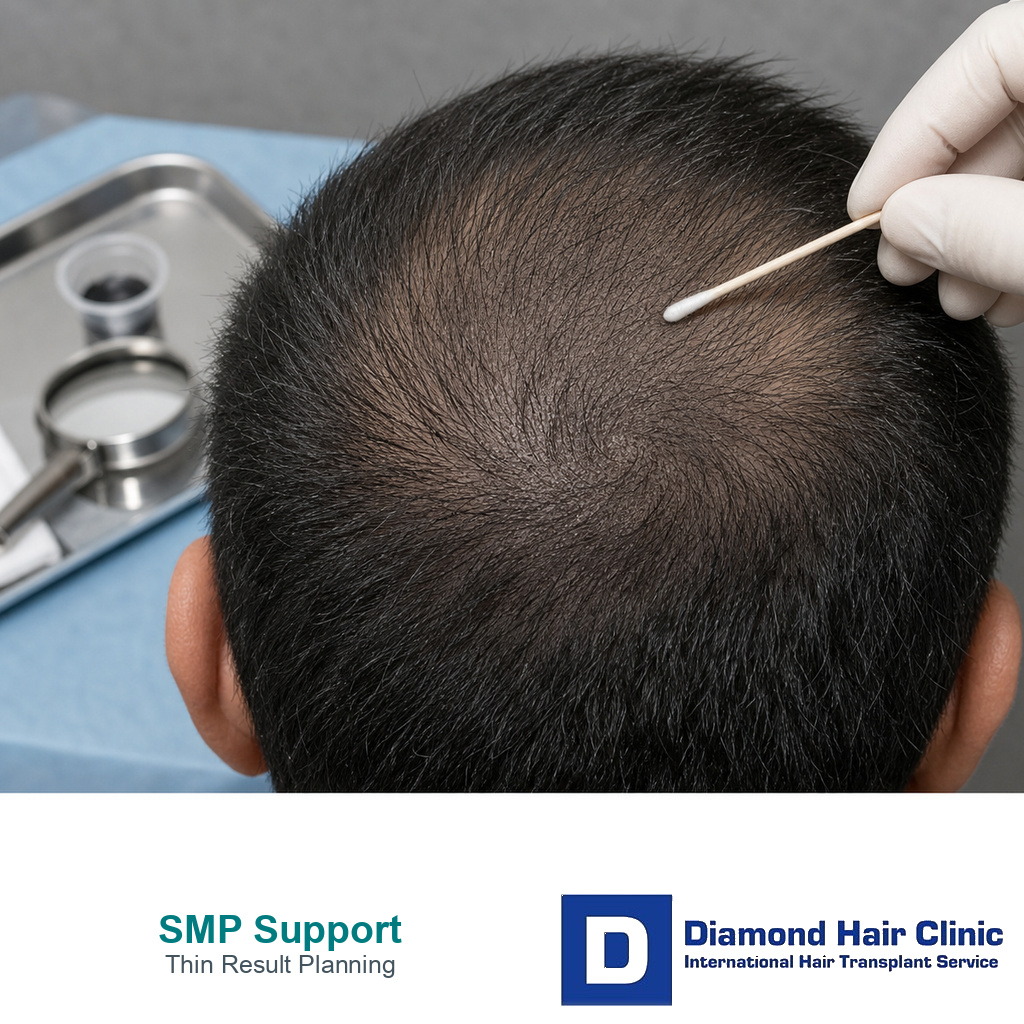
Scalp Micropigmentation for a Thin Hair Transplant
Scalp micropigmentation can make a thin hair transplant look fuller in selected cases, but it cannot fix the transplant itself. The useful distinction is this. If light scalp showing between existing hairs is the main concern, SMP may help the background look fuller. If the weak point is poor growth, wrong graft direction, a pluggy hairline, active inflammation, or an immature result, pigment can darken the scalp while the real weakness remains.
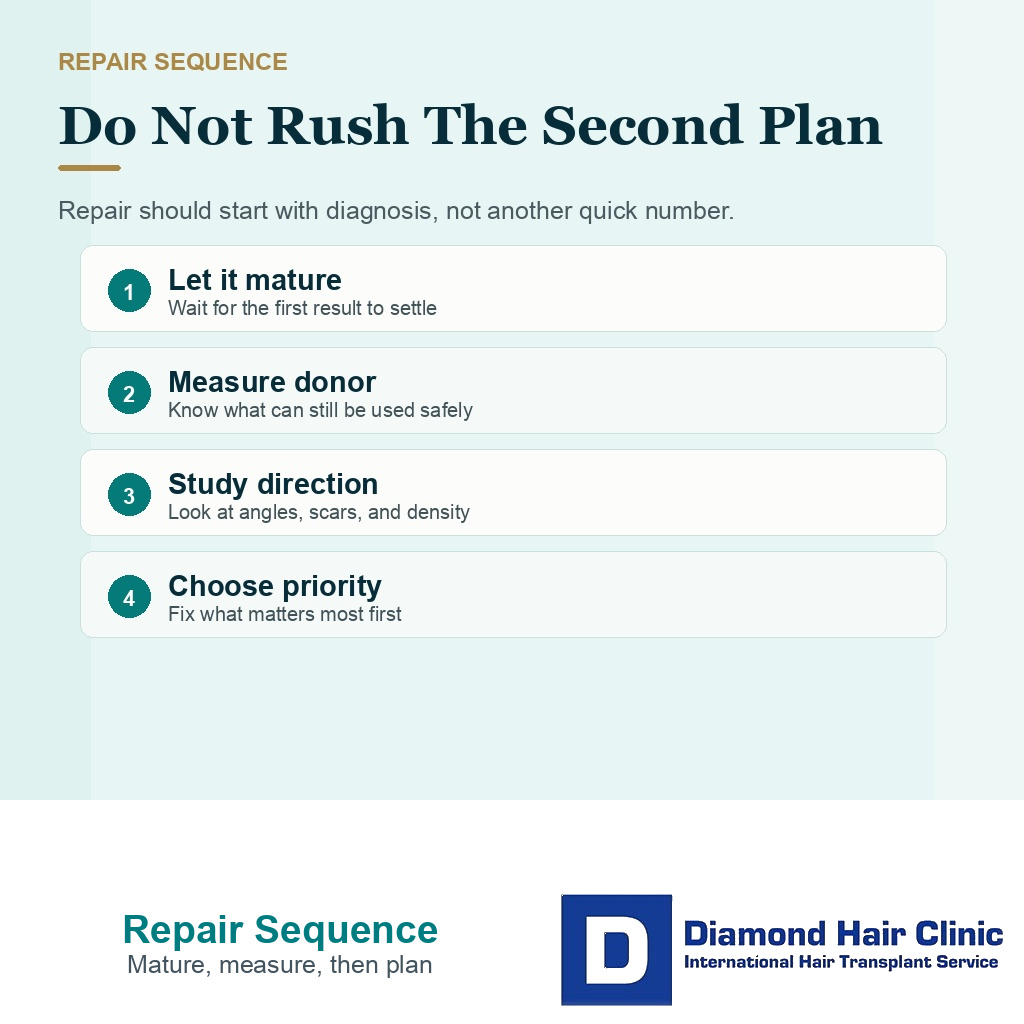
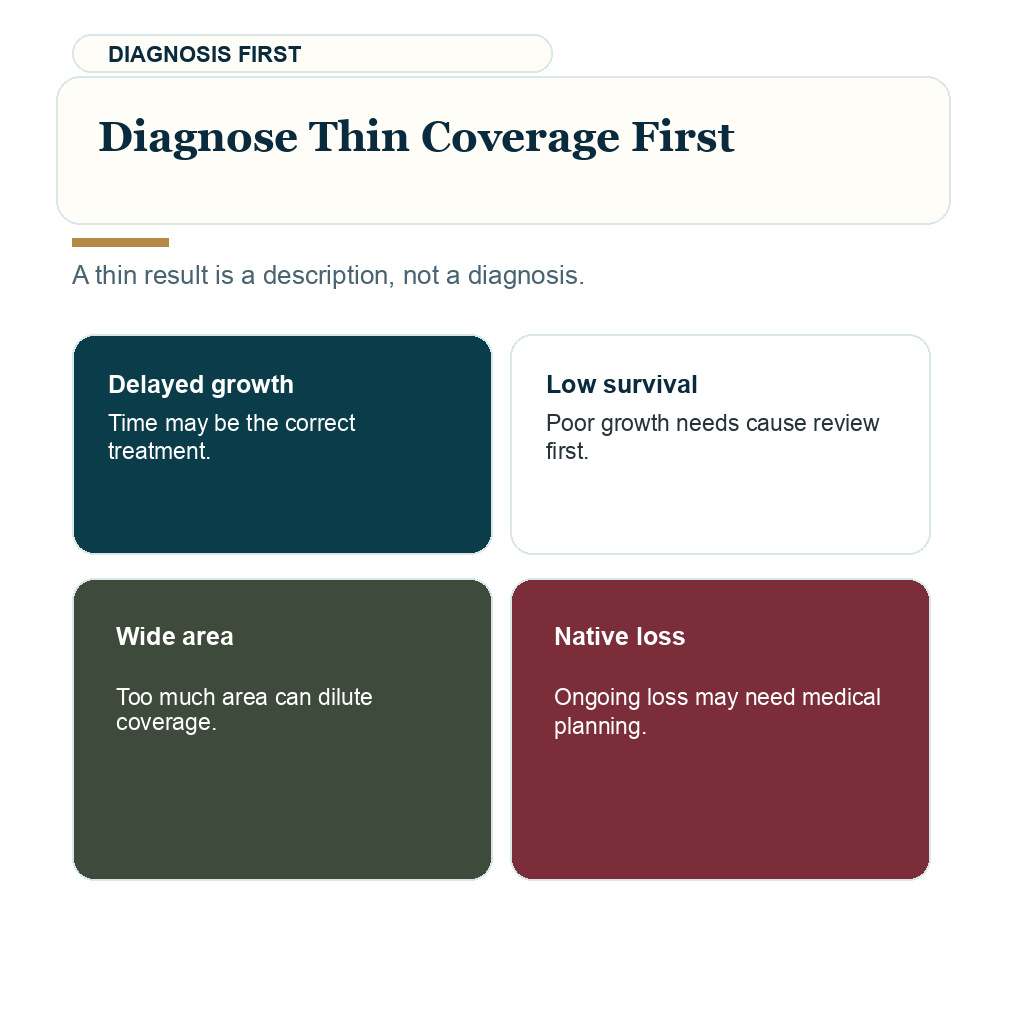
Before choosing SMP, the first step is to know why the transplant looks thin. A maturing result may only need time. A stable but see through result may need contrast reduction. A result with an overused donor area, wrong hairline planning, or continuing native hair loss may need repair planning or medical treatment before pigment is discussed. That diagnosis decides whether SMP is useful camouflage or the wrong treatment.
In many frontal and mid scalp cases, it is usually safer to wait at least 12 months before judging the final result. In crown cases, the decision may wait up to 18 months because crown growth and visual coverage can mature more slowly. SMP can be useful, but it should be a planned camouflage tool, not a decision made from one unhappy photograph of an unfinished result.
Useful SMP situations after a thin transplant
SMP can genuinely help when the main issue is contrast. If the transplanted hairs are present but the scalp looks too light between them, pigment can create the impression of a fuller background. This is most helpful when the hairstyle is short, the hair color is dark enough to blend with pigment, and the scalp surface is smooth. If pigment was placed before surgery, hair transplant after scalp micropigmentation needs a different planning conversation.
It may also help when a patient has limited donor supply and a second transplant would not be wise. If the goal is appearance of density without spending more grafts, compare the alternatives before pigment is chosen. In that case, pigment must not be presented as hair. It can make the result look less see through under normal conditions, but expectations still need to stay realistic.
Before SMP is chosen, I separate pigment planning from the question of why some hair transplant results look thin. A thin result can come from a wide recipient area, fine hair caliber, low graft survival, harsh lighting, wet hair, poor planning, or ongoing native hair loss. Pigment only helps some of these causes.
The visual change SMP can create
SMP changes the color impression of the scalp. It places small pigment dots in the skin so the scalp looks less pale between hairs. In the right patient, this can reduce shine, soften gaps, and make the visual transition between hair and scalp less obvious.
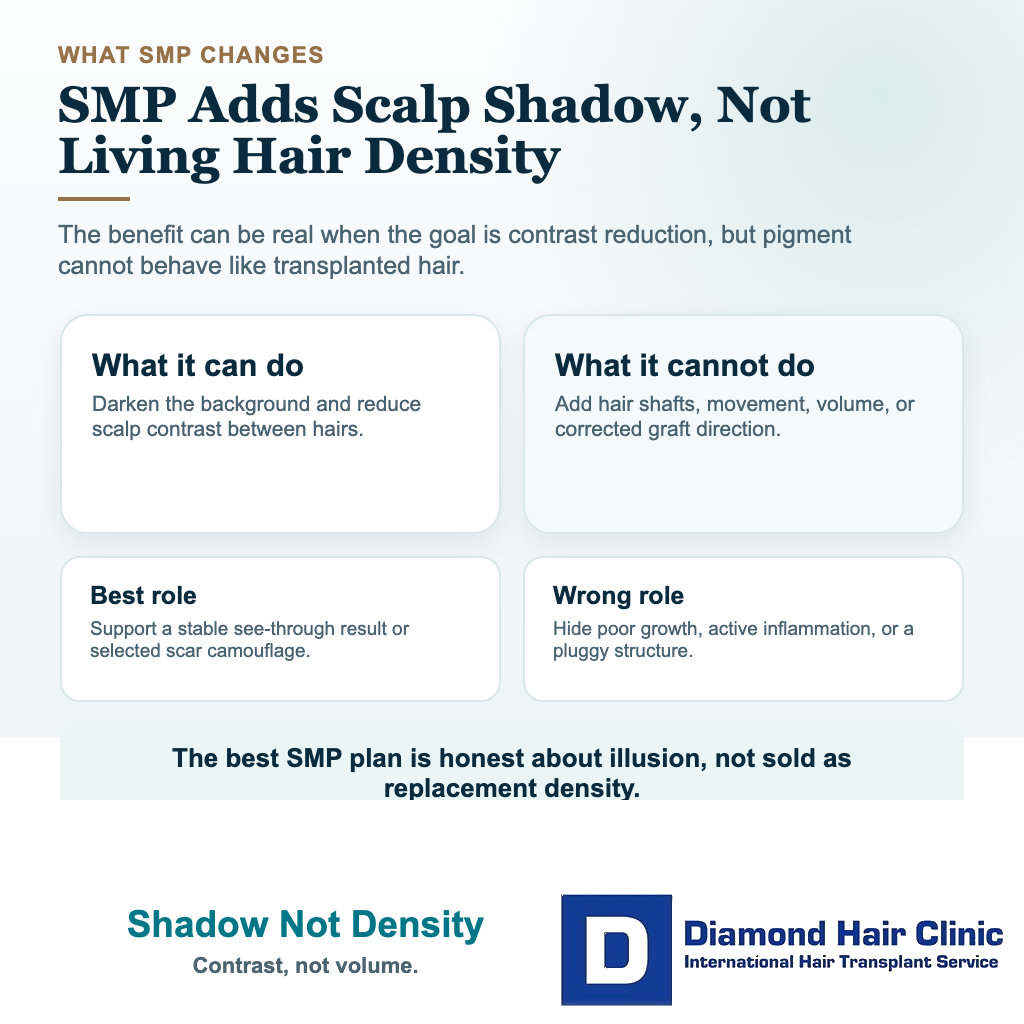
The limitation is clear. SMP does not add hair shafts. It does not add volume. It does not move when the hair moves. It does not create the soft layering that real transplanted hair can create when it is placed at the correct angle and density.
SMP is best understood as a shadow, not as density. That is not a criticism. A well matched shadow can be useful. But if a patient expects pigment to behave like living hair, they may be disappointed even when the technical pigment work is good.
Think about how the pigment will look if the hair above it keeps thinning. A good SMP choice should still make sense with your future haircut, future donor options, and the possibility that another procedure is not the right answer.
Before pigment, choose the haircut length you are willing to keep. SMP that works only at one clipper length can become another maintenance commitment, not a rescue.
Diagnosing the thin result before pigment
A thin hair transplant is not one diagnosis. It is a description of what the patient sees in the mirror. Before choosing SMP, the assessment has to decide whether the issue is delayed growth, low graft survival, excessive coverage with too few grafts, poor hair caliber, native hair loss, poor hairline design, or donor limitations.
If the result is still developing, pigment may be premature. If the hairline was built with thick grafts in the front, SMP will not make it softer. If the graft direction is wrong, pigment will not correct the way hair exits the skin. If the donor area was overused, SMP may reduce contrast, but it cannot replace follicles that were removed.
A proper diagnosis protects the patient from buying the wrong solution. Sometimes waiting is enough. Sometimes medical treatment matters more. Sometimes hair transplant repair is needed. Sometimes SMP is reasonable. The order matters because each choice can affect the next one.
Waiting long enough before choosing SMP
For most frontal and mid scalp results, it is usually safer to wait until at least 12 months after surgery before making a final cosmetic decision. Some patients still improve after that point, but 12 months is usually a fairer time to judge than month 4 or month 6.
The crown often deserves more patience. Crown growth can look slow, uneven, or discouraging for longer, and the swirl pattern makes density harder to read. In crown cases, the decision may wait up to 18 months before the result is judged thin enough for extra camouflage or another plan.
If a patient is worried early, consistent photos are more useful than daily mirror judgment. Tracking hair transplant growth with the same light, same distance, and same hair length matters. SMP should not be chosen because one photo taken under harsh light caused panic.
These 10 SMP planning slides separate result maturity, contrast, scalp stability, repair sequence, hair length, color match, proof review, and regret risk before pigment is chosen. Swipe sideways, use the arrows one slide at a time, or choose a number below the image.




Cases where SMP is the wrong answer after a transplant
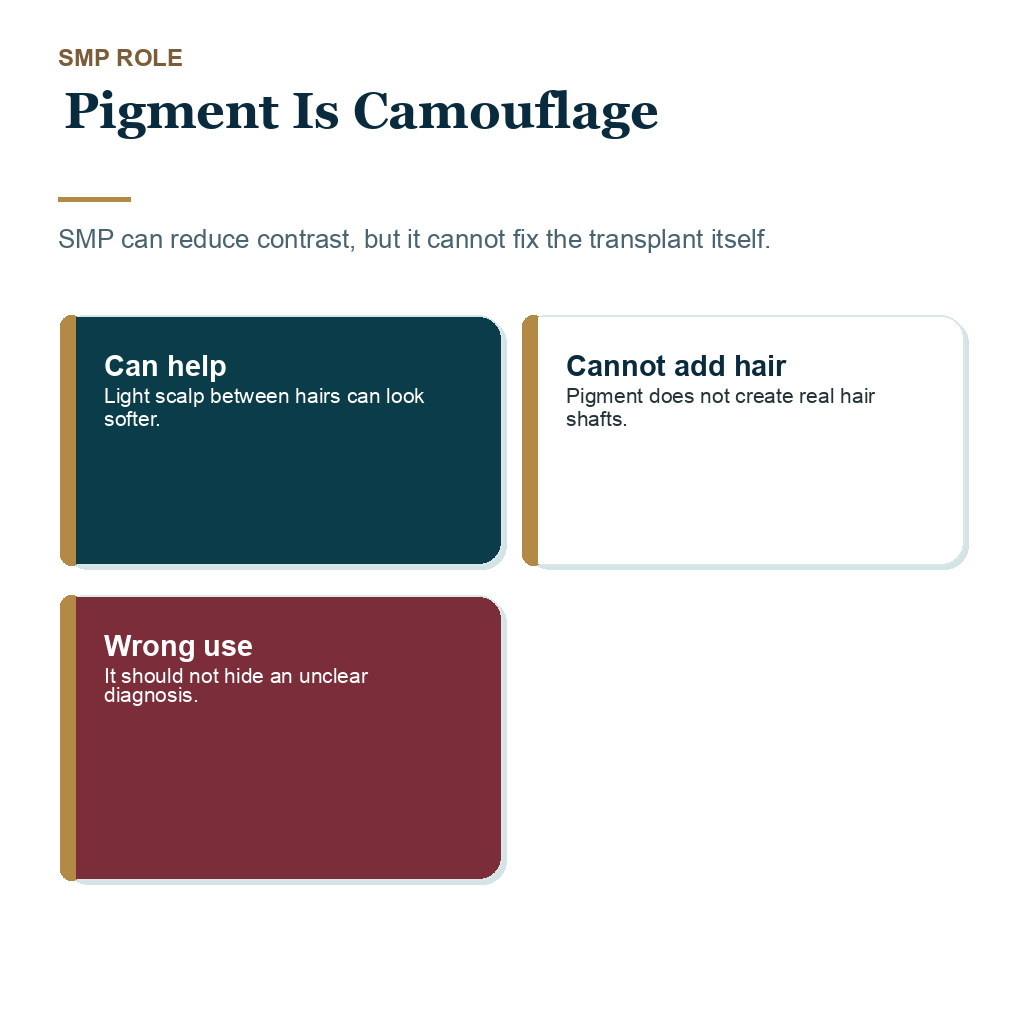
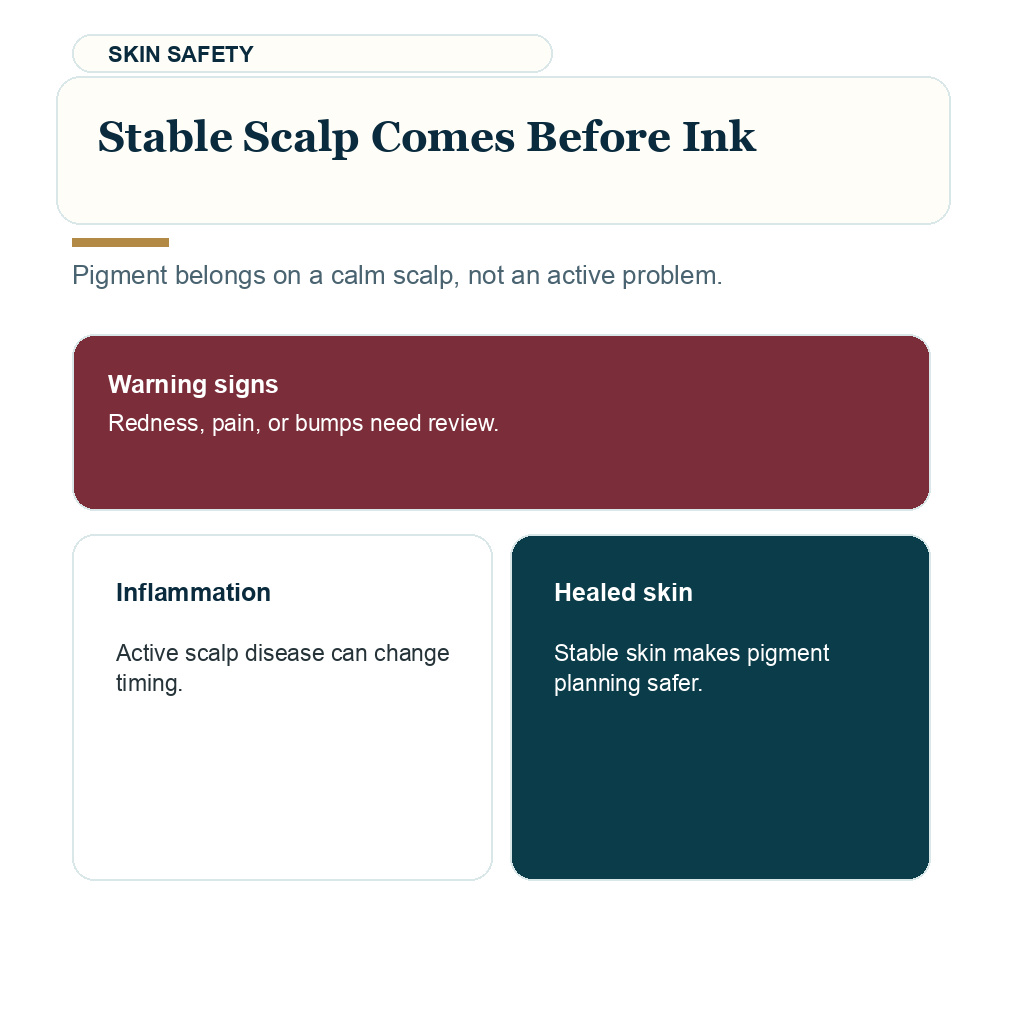
SMP is the wrong answer when the patient needs a medical or surgical diagnosis first. If there is persistent redness, pain, scalp inflammation, pimples, tenderness, or uncertainty about growth, pigment should wait. The skin should be stable before anyone adds pigment to it.
It is also the wrong answer when the patient expects pigment to correct structural transplant problems. A pluggy hairline, wrong graft direction, poor angle, row like placement, or an unnatural hairline position cannot be corrected by darkening the scalp. In some cases, pigment may even draw more attention to the shape of the problem.
SMP should also be approached carefully when the patient keeps longer hair and expects a dense hair transplant look. Under longer hair, the result depends on how hair separates, how the scalp reflects light, and whether pigment can still blend naturally when the hair moves.
Rushed SMP can make transplant regret worse
It can. When a patient is disappointed after a thin transplant, the natural reaction is to search for a fast way to feel normal again. That feeling is understandable. But a rushed camouflage decision can sometimes make the patient feel even more trapped.
If pigment is placed too dark, too sharp, too low in the hairline, or before the transplant result is mature, the patient may now have two problems instead of one. They still have the original thin result, and they also have pigment that may not match their preferred hairstyle or future repair plan.
Hair transplant regret after surgery needs serious attention because the next move is not always another procedure. Sometimes pausing, identifying the exact cause of the disappointment, and waiting until the patient can think clearly protects the case better than rushing into camouflage.
A good camouflage decision reduces daily worry instead of creating a new detail the patient checks every morning. If the plan only feels acceptable in one lighting condition or one haircut length, it is not stable enough for me to recommend quickly.
SMP with longer hair is less predictable
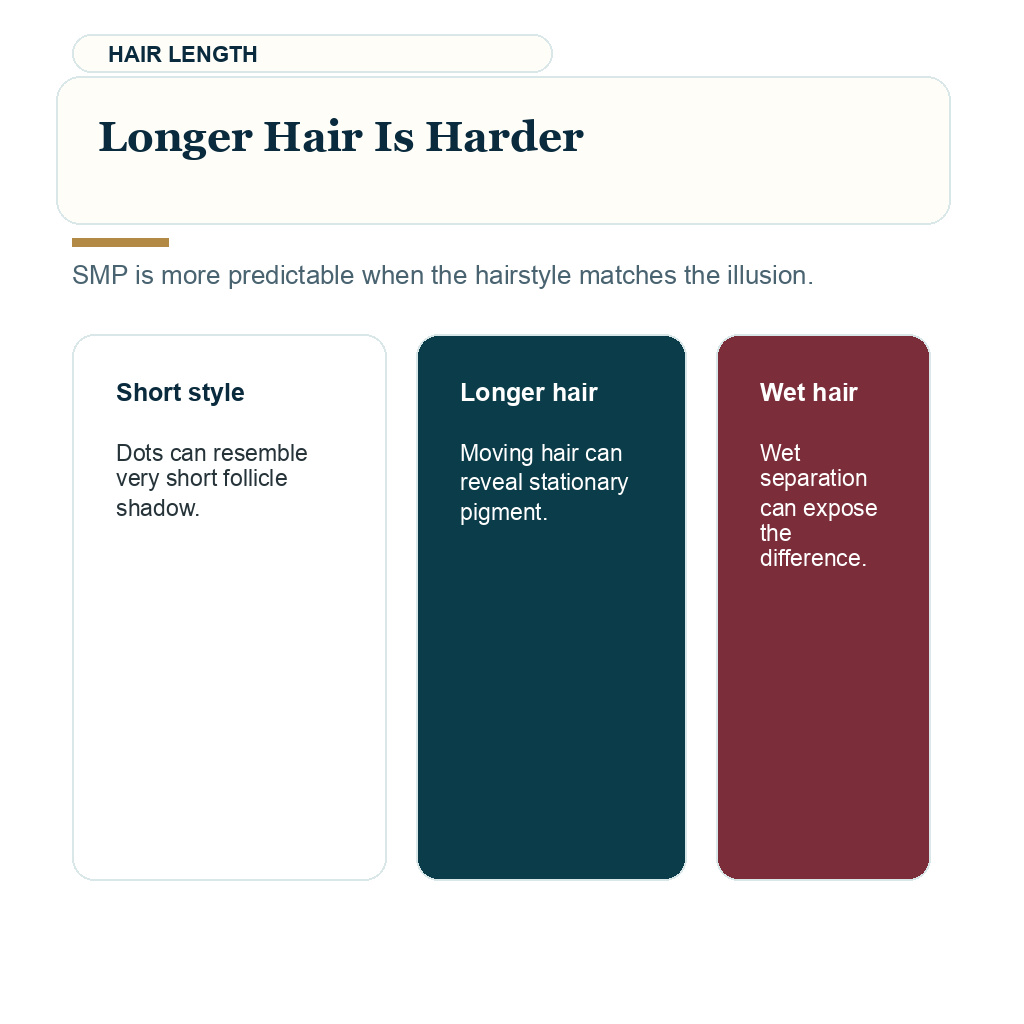
Sometimes it can improve the appearance, but it is less predictable in longer hair. The reason is that long hair creates movement, separation, and directional shadows. Pigment stays still. If the hair parts or becomes wet, the difference between real hair and pigment can become easier to see.
SMP usually works best when the patient keeps the hair short enough for the pigment dots to resemble the shadow of very short follicles. Shaving your head after a hair transplant is a separate short hair planning decision. SMP can also help some patients with moderate length hair when the goal is subtle contrast reduction, not dramatic density.
If the patient wants to keep longer hair, the decision needs more caution. Hair caliber, skin and hair color contrast, the size of the thin area, the direction of the transplanted hair, and whether styling can already improve the result all matter. Pigment should support the appearance, not create a darker patch that looks separate from the hair.
Hair length, color, and skin contrast matter
SMP is a visual illusion, so contrast matters. Dark hair on light skin can make thin areas more visible. In that case, careful pigment may reduce the contrast. Light hair on light skin may need a much softer approach because dark pigment can look artificial.
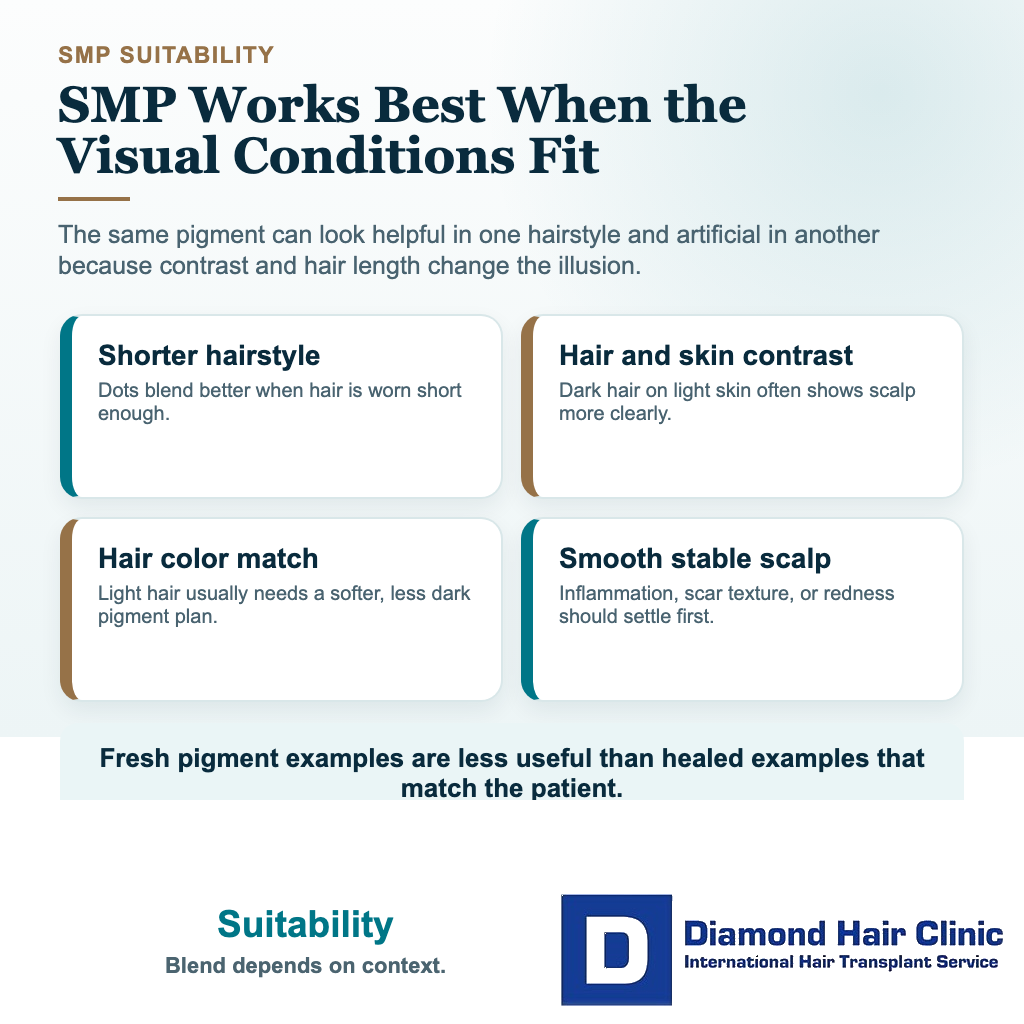
Hair length also changes the answer. A shaved or very short style allows pigment dots to blend with the idea of short follicles. Longer hair asks pigment to imitate background density, which is much harder. Wet hair and bright light can also reveal the difference between scalp shadow and real hair volume.
The aim should not be to make the scalp simply darker. The result should remain natural under ordinary life conditions. A close range photo is not enough. The result should still look soft in daylight, in a mirror, under office lighting, and when the hair is not perfectly styled.
SMP for FUE dots and donor thinning
SMP can sometimes help reduce the visibility of FUE dot scars or a mildly thin donor area. This can be useful for patients who keep the donor hair short and notice pale dots or uneven contrast. The pigment can make the donor area look more uniform from a normal viewing distance.
But there is a hard limit. SMP cannot restore donor follicles. If too many grafts were removed, the donor may still look depleted, especially under very short hair or strong light. Pigment may reduce the contrast, but it cannot give back the natural hair mass that was lost.
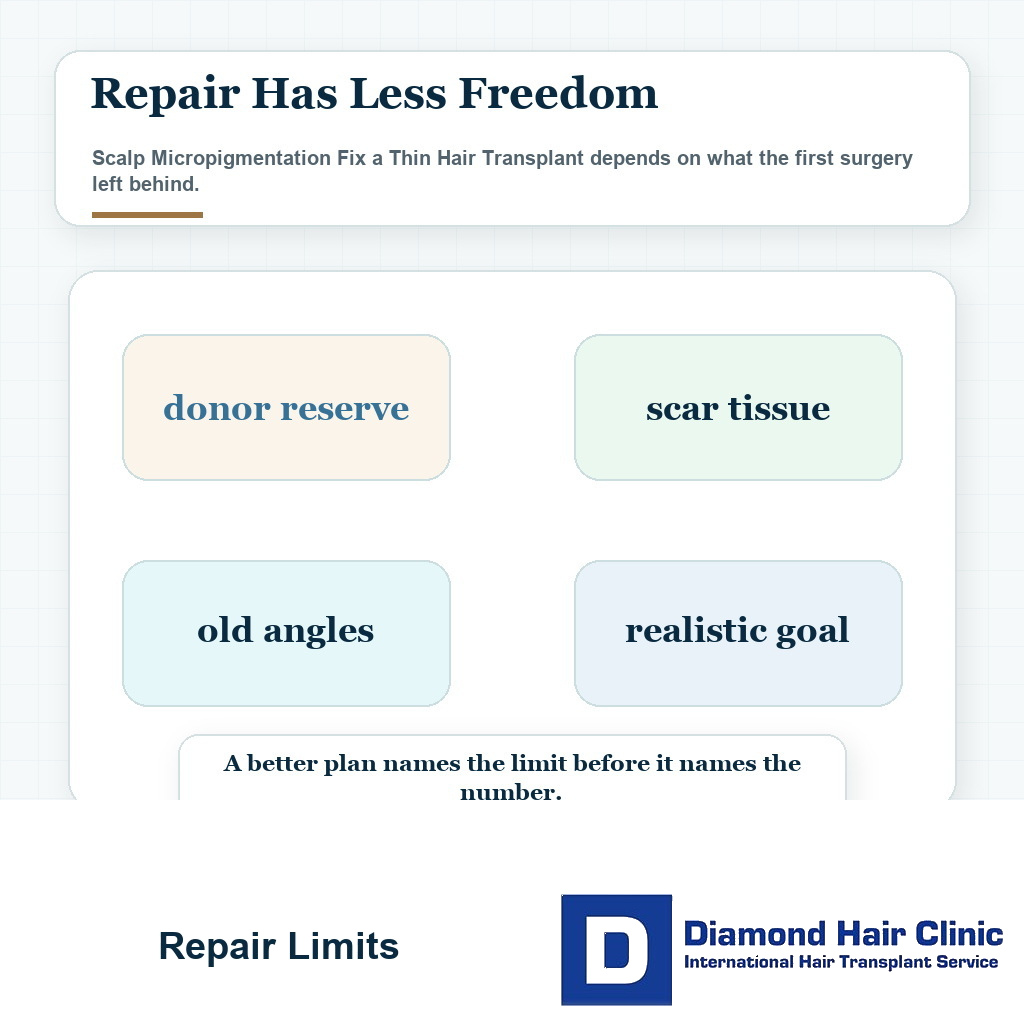
Donor protection matters here because donor reserve is a limited lifetime resource. When overharvested donor area repair is already part of the conversation, SMP may help camouflage, but it should never be used as an excuse for aggressive extraction.
SMP for an old FUT scar
SMP may help an old FUT line scar when the scar is flat, pale, and surrounded by enough hair to blend with pigment. It can reduce the contrast between the scar and the surrounding scalp, especially when the hair is kept at a length that gives some coverage.
But scar tissue can behave differently from normal scalp. Pigment may heal differently inside a scar. A wide or raised scar is harder to disguise than a fine, flat one. A patient who wants a very short haircut must understand that a line scar may still be visible, even after pigment.
In some FUT scar cases, especially when planning FUE after FUT, SMP should be compared with placing FUE grafts into or around the scar. FUE grafts and FUT scar repair require a separate decision. Sometimes pigment is enough. Sometimes real hair is more useful. Sometimes a combination is considered, but the scar must be examined first.
Pluggy hairlines and wrong graft angles need a different plan
If the hairline is pluggy, too straight, too low, or built with thick grafts in the front, SMP is usually not the main solution. Pigment can darken the background, but it cannot make large grafts become fine single hair grafts. It cannot change the position of the hairline or make wrong angles grow in a better direction.
In these cases, the patient may need a repair plan that includes graft removal, softer rebuilding, laser or electrolysis in selected cases, or a more conservative redesign. SMP may still have a role later, but it should not be used to decorate an unnatural structure.
Hairline design matters before the first surgery. If the original hairline was planned with poor judgment, camouflage becomes harder later. Pluggy hairline repair may need surgical correction rather than pigment alone.
Choosing between SMP and another transplant
I compare donor reserve, the size of the thin area, hair caliber, hairstyle, age, future hair loss pattern, and the emotional goal. If the donor is healthy and the thin area is limited, another transplant may create a more natural improvement than pigment.
When the donor is weak, the area is large, or the patient mainly needs contrast reduction, SMP may be safer than chasing density with more grafts. The useful choice is not the one that sounds most impressive. It is the one that improves the patient’s normal life without creating a larger future problem.
If the donor supply is limited, the conversation becomes similar to the guidance on a weak donor area. More surgery is not always better. Sometimes the most disciplined plan is to use pigment carefully and protect the remaining donor.
The order of SMP and repair surgery matters
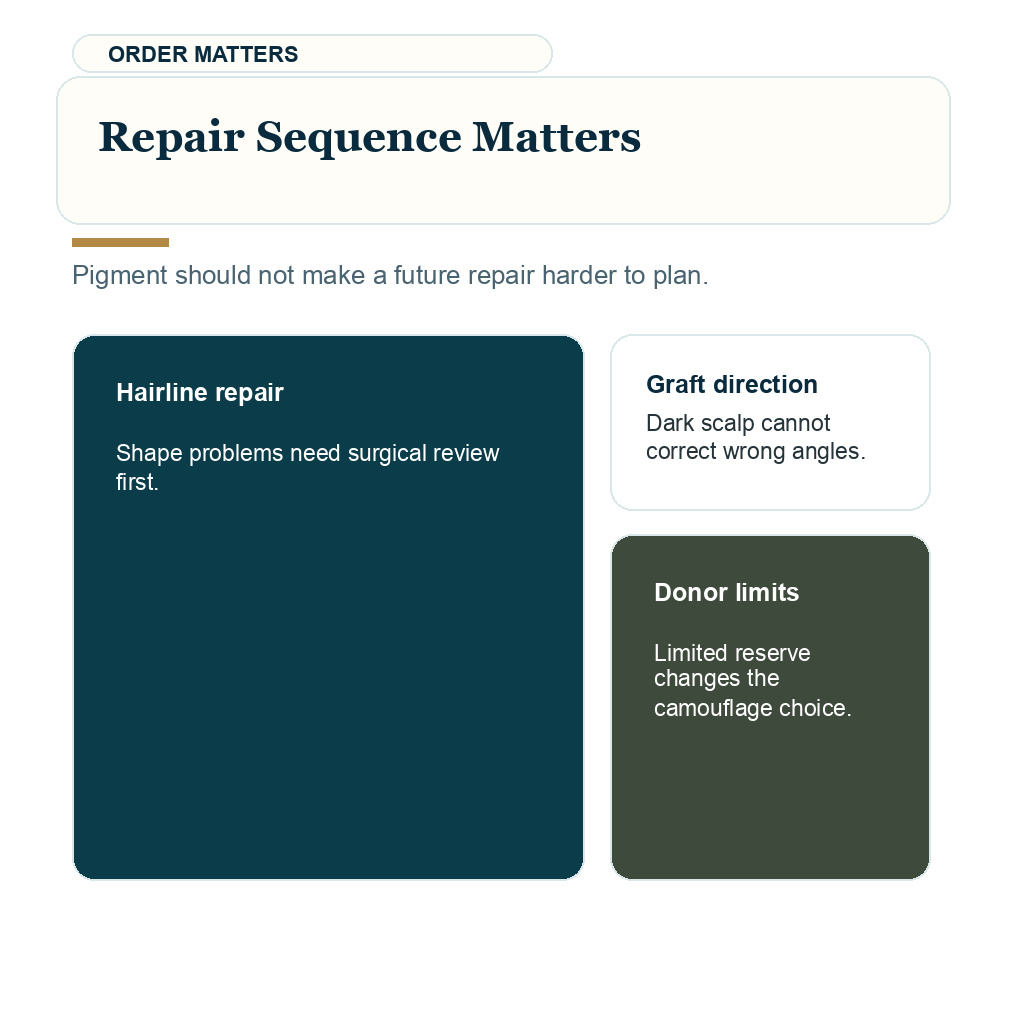
The order matters because future surgery can change the scalp again. If a patient places pigment first and later needs more grafts, incisions, healing, shedding, and skin changes can affect how the pigment looks. The repair surgeon also needs to see the true pattern of hair, scalp, and scars before planning.
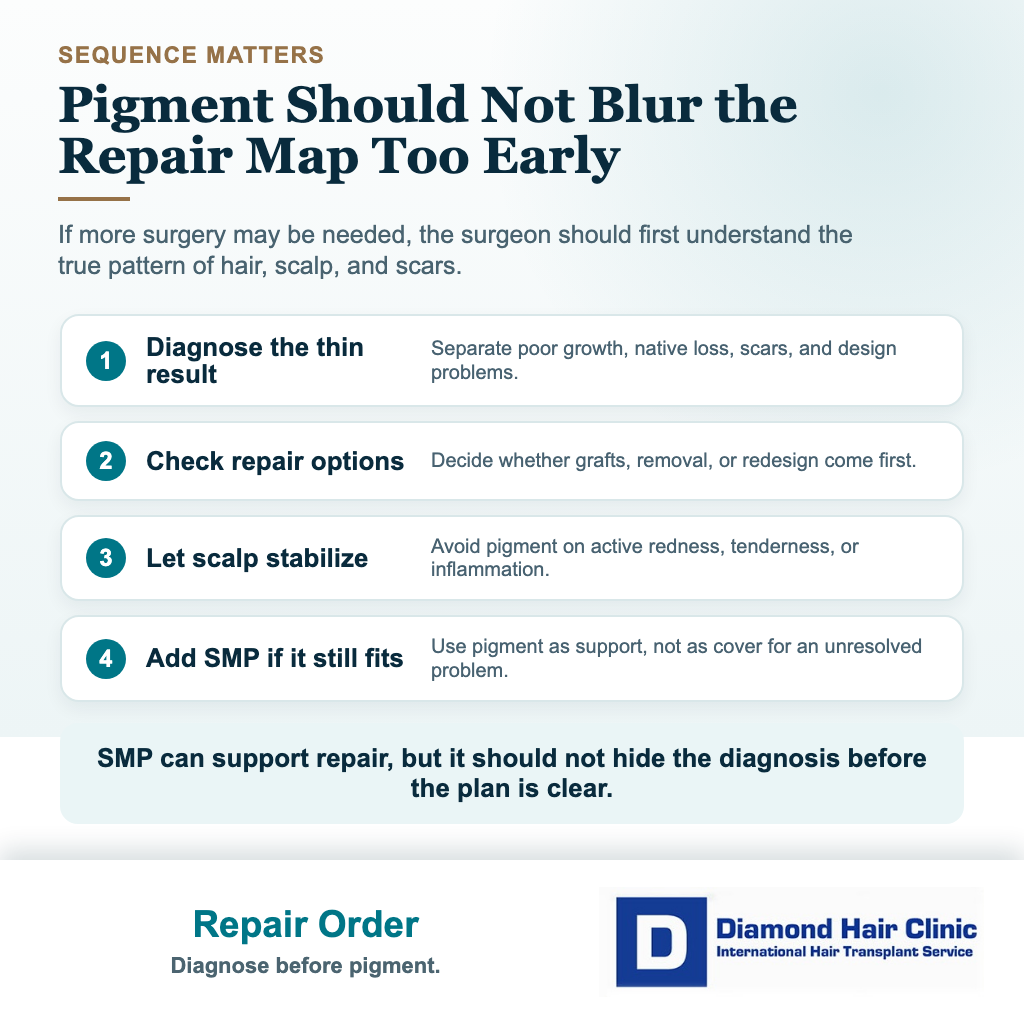
For example, pigment placed across a weak hairline can blur the map. It may become harder for the patient to see where real hair is missing and harder for the surgeon to separate true density from the tattooed background. That does not make repair impossible, but it can make planning less clean.
When another transplant may still be needed, it is usually cleaner to decide the surgical plan first. SMP can then be used later as support if it still makes sense. This avoids placing pigment into an area that may be surgically changed soon afterward.
There are exceptions. If surgery is not possible or not wise, SMP may become the main camouflage option. But when surgery remains on the table, it helps to know the sequence before committing to pigment.
Healing that should happen before SMP
The scalp needs to be fully healed, settled, and stable before SMP. Pigment should not be placed over active redness, inflammation, repeated folliculitis, tenderness, or areas that are still changing. A history of keloid type scarring, unusual tattoo reactions, or unstable scalp disease needs review before pigment is treated as routine. Growth also needs to be mature enough that the plan is not based on an unfinished transplant.
After a transplant, the skin and follicles go through several visible changes. Scabs, redness, shedding, early thin growth, and delayed maturation can all affect how the scalp looks. A patient who chooses pigment too early may be treating a moving target.
Good hair transplant aftercare protects the early result. Later decisions like SMP should respect that healing process. If the scalp has not settled, waiting is safer than creating a cosmetic layer over a problem that still needs medical attention.
What I need before pigment is added?
Before pigment is added, I want to know why the transplant looks thin. A result that is still maturing, a low graft count, weak donor reserve, poor graft growth, wrong hair angle, scar tissue, and ongoing native hair loss are not the same problem.
SMP can be useful when the hair length, color contrast, skin tone, scar texture, and future repair plan all fit the idea. It is weaker when the patient wants long hair to look dense, when the hairline shape is wrong, or when pigment would hide a problem that still needs diagnosis.
The order matters. If another transplant or scar repair may be needed, I want to decide that before pigment changes the visual map. Good camouflage should make the final plan easier to live with, not harder to correct.
Judging SMP before committing
Before choosing SMP, the result needs to be mature enough to judge. Then donor reserve, the realistic possibility of another transplant, and the way pigment would look at the hair length the patient actually wants to wear all need review. A plan that works only for one photograph is not enough.
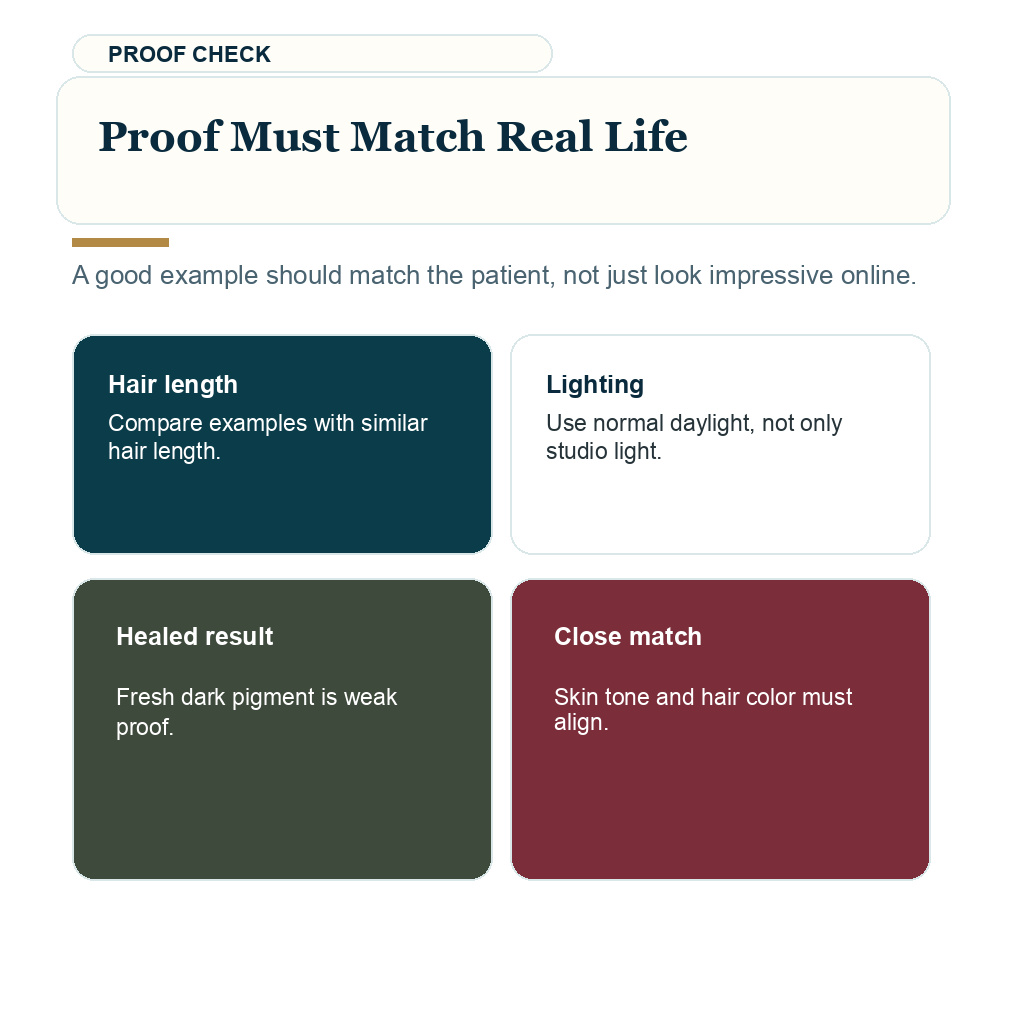
Healed examples should match the patient’s situation. Fresh pigment can look darker, sharper, and more impressive than the final settled result. A shaved look is not the same as longer hair camouflage. A fine FUT scar is not the same as an overharvested donor area. Dark hair on light skin is not the same as light hair on fair skin. Examples should be close to your hair color, skin tone, scar type, and hairstyle.
The provider should also explain color matching, fading, touch ups, and the risk of pigment looking too dark or too sharp. Conservative pigment work is safer. A result that is slightly soft can often be adjusted. A result that is too dark may become much harder to live with.
Before any touch up, document the healed result before new pigment is added. Use normal viewing distance and close views under similar light, skin shine, and haircut length, then keep that record for later comparisons. A fresh after photo cannot show whether the older layer had softened evenly or whether more pigment was actually needed.
SMP and transplant surgery can work together
SMP and a transplant can work together in carefully chosen patients. A transplant creates hair and structure. SMP can reduce scalp contrast when density is limited. Used carefully, the two can support each other.
This matters in crown cases, limited donor cases, and some repair cases. The crown often needs many grafts to look dense because of the spiral pattern and the way light hits the scalp. A crown hair transplant must be planned with donor economy in mind, and SMP may sometimes support the visual result when more grafts would be unwise.
Still, the combination must not become an excuse for weak surgery. A plan is not acceptable if a clinic promises poor density and then sells SMP as the automatic solution. The transplant plan needs to be sound first. Pigment can be an additional option, not a cover for careless planning.
Limits SMP should never overpromise
SMP should never promise real density where there is no hair. It can improve contrast, but it cannot create movement, texture, or living hair fibers. It cannot make a failed transplant into a successful transplant by itself.
Pigment can make visible scalp look darker, but it does not protect that skin from UV and it does not make a mole or rough patch less important. If the thin area remains exposed outdoors, the patient still needs sun protection. If a spot is changing, pigment should wait until the skin question is clear.
It should also never promise that every scar will disappear. Some scars respond well. Some remain visible because of texture, width, color, or the way surrounding hair is cut. Realistic expectations protect the patient from a second disappointment.
Be more careful when SMP is presented as a quick fix for every thin result. A patient who already feels disappointed after surgery needs clearer judgment, not another rushed promise. The detail that matters is whether SMP will still look natural in the patient’s real life.
Name the thinness before adding pigment
Before SMP is added to a thin transplant, I want the diagnosis clear. Is the transplant still maturing? Is the issue low density, ongoing native loss, poor growth, donor limitation, contrast, scar visibility, or a mix of several factors?
That answer decides whether the plan should be time, medical treatment, repair surgery, SMP, or a combination. If SMP is chosen for the right reason, it can soften contrast, help some scars blend better, and support a thin but stable result.
If pigment is chosen too quickly, it can become another layer of camouflage over a problem that still needs treatment. SMP can improve the shadow behind hair, but it cannot replace the hair itself.
The question is not whether one photo looks darker. It is whether the pigment solves the specific problem without making future repair or daily appearance harder.

Read this review excerpt
We also had a levelled conversation about my hairline and results I could expect based on my donor density area.