


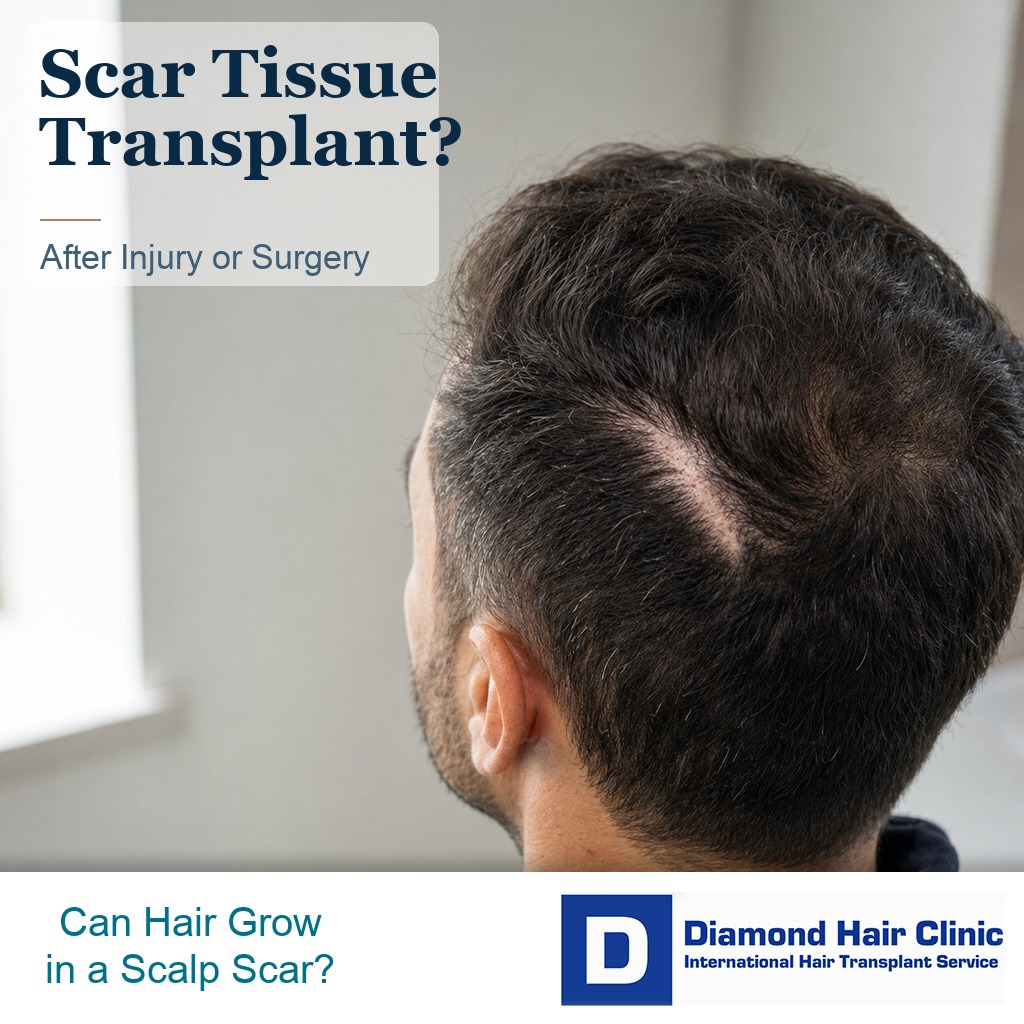
Can Transplanted Hair Grow in Scar Tissue?
Yes, hair can sometimes be transplanted into scar tissue after an injury, burn, hairline lowering surgery, old strip surgery, or another scalp operation. It is less predictable than transplanting into healthy scalp, so I do not judge it from the empty patch alone. A facelift scar near the sideburn needs careful review, with extra attention to hair direction and the facial frame.
The key question is whether the scar has enough blood supply, softness, maturity, and surrounding hair to make grafting worth the donor cost. A scar that looks small in a photo can still be tight, thick, or poorly mobile when examined.
In a close photo, scar grafting can look simpler than it is. I also need to see the scar with the hair at the length you normally wear, because camouflage depends on the hair around it.
A flat, mature, soft scar may respond well to careful grafting at lower density. A raised, tight, painful, red, unstable, or very wide scar may need waiting, dermatology treatment, scar revision, scalp micropigmentation, or no surgery at all. A scar after tinea has a similar surgical limit. Hair transplant after tinea capitis depends on scalp calmness and scar quality, not just an empty patch. The first session may be a test of how the scar behaves, not a promise to erase the whole mark.
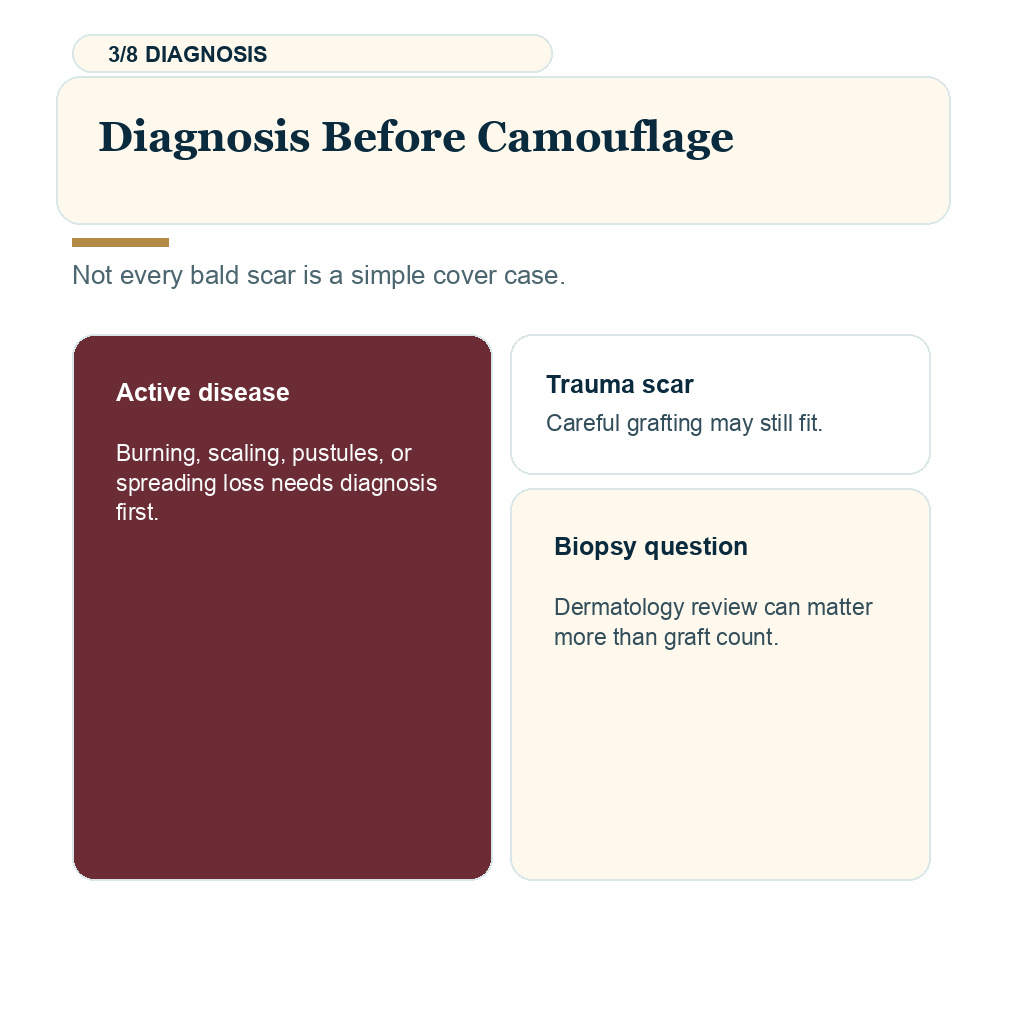
I also separate a stable physical scar from an active scarring condition. An old injury scar may be a camouflage question. Lichen planopilaris, discoid lupus, dissecting cellulitis, CCCA before hair transplant, or another active inflammatory process is diagnosis planning first, not simple scar camouflage. This scrutiny also applies to beard transplant planning for facial scar areas, because visibility with a close shave and hair direction make small mistakes harder to hide.
Scar tissue can accept grafts only in selected cases
Scar tissue can grow transplanted hair in selected cases. The graft is not trying to wake up an old follicle inside the scar. It is a living follicular unit moved from the donor area into a new place, and it needs the recipient area to heal around it.
The difficulty is that scar tissue is not normal skin. It may be firmer, thinner, less flexible, and less vascular than the surrounding scalp. That means the grafts may not receive the same support they would receive in an untouched recipient area.
I describe scar cases as camouflage, not erasure. A good result can soften the contrast between the scar and surrounding hair. It should not be sold as making the skin exactly like it was before the injury. The same distinction matters when SMP is considered after a thin transplant result. Pigment can soften contrast, but it cannot make scar tissue normal skin.
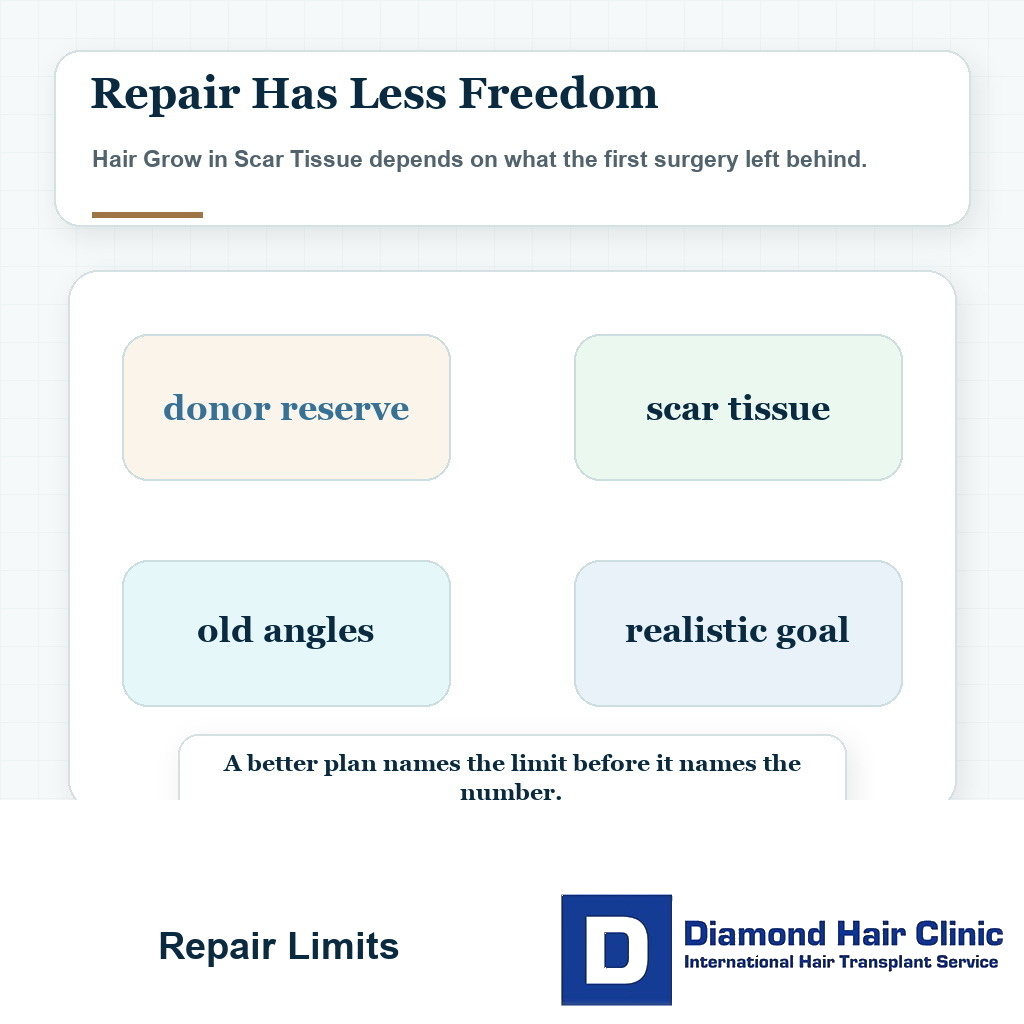
What makes scar tissue different from normal scalp?
Healthy scalp has a natural blood supply, flexible tissue, and a predictable skin layer for creating recipient incisions. Scar tissue can have less circulation and more fibrous texture. Some scars feel flat and soft. Others feel tight, shiny, thick, or tethered to the deeper tissue.
When I plan a standard FUE hair transplant, I can usually predict the recipient area more confidently. In a scar, the plan has to be more conservative because the tissue may not nourish every graft equally. The edge of a scar near healthy scalp can behave differently from the tight center of a wide scar.
High density is not the first aim in this tissue. Survival, natural direction, and a softer visual break come first. If the scar accepts the first session well, a second small session can sometimes improve coverage later.
When should a scar be left to mature before surgery?
Finding a bare patch after a long operation does not confirm that the skin has scarred. Pressure alopecia after surgery needs assessment of the skin and hair loss before scar grafting is discussed. Painful or broken skin should be examined without waiting for hair to return.
A new scar should usually be left alone until it has matured. For some patients, that means waiting at least 6 to 12 months before making the decision whether grafting is sensible. Some scars need longer, especially after burns, wider surgery, infection, or repeated revision.
Early redness, firmness, itching, and color change can improve with time. If surgery is done while the tissue is still changing, the surgeon may be judging the wrong scar. You may spend donor grafts on an area that would have become less visible with proper healing.
Symptoms matter because they can show that the scar is not quiet yet. Pain, spreading redness, repeated crusting, tenderness, thickening, or a scar that is still rising should delay the decision. A settled scar gives the grafts a fairer environment.
After a wound complication such as infection, delayed closure, or necrosis warning signs after a hair transplant, I am even more cautious. The question is not only whether hair can hide the mark. I need to know whether the skin has closed, softened, and developed enough blood supply to accept grafts safely.
Photographs help, but they do not replace touch and close examination. A scar can look acceptable in a picture and still feel tight, thick, or poorly mobile under the fingers. That physical quality changes graft angle, density, spacing, and whether surgery is reasonable at all.

Which scars are usually better candidates?
Better candidates are usually flat, pale, mature, soft scars with stable surrounding hair. A small scar from a childhood injury, a narrow surgical scar, or a stable hairline lowering scar may be more suitable than a thick raised scar or a large burn scar with tight skin.
For a child, I would not move straight from a scar photograph to a transplant booking. The child’s reconstructive team first needs to confirm that the scar is stable, donor hair is adequate, the procedure and anesthesia are appropriate, and transplantation is preferable to another reconstructive option. Published pediatric evidence comes from small retrospective series, so it cannot predict the result for one child.
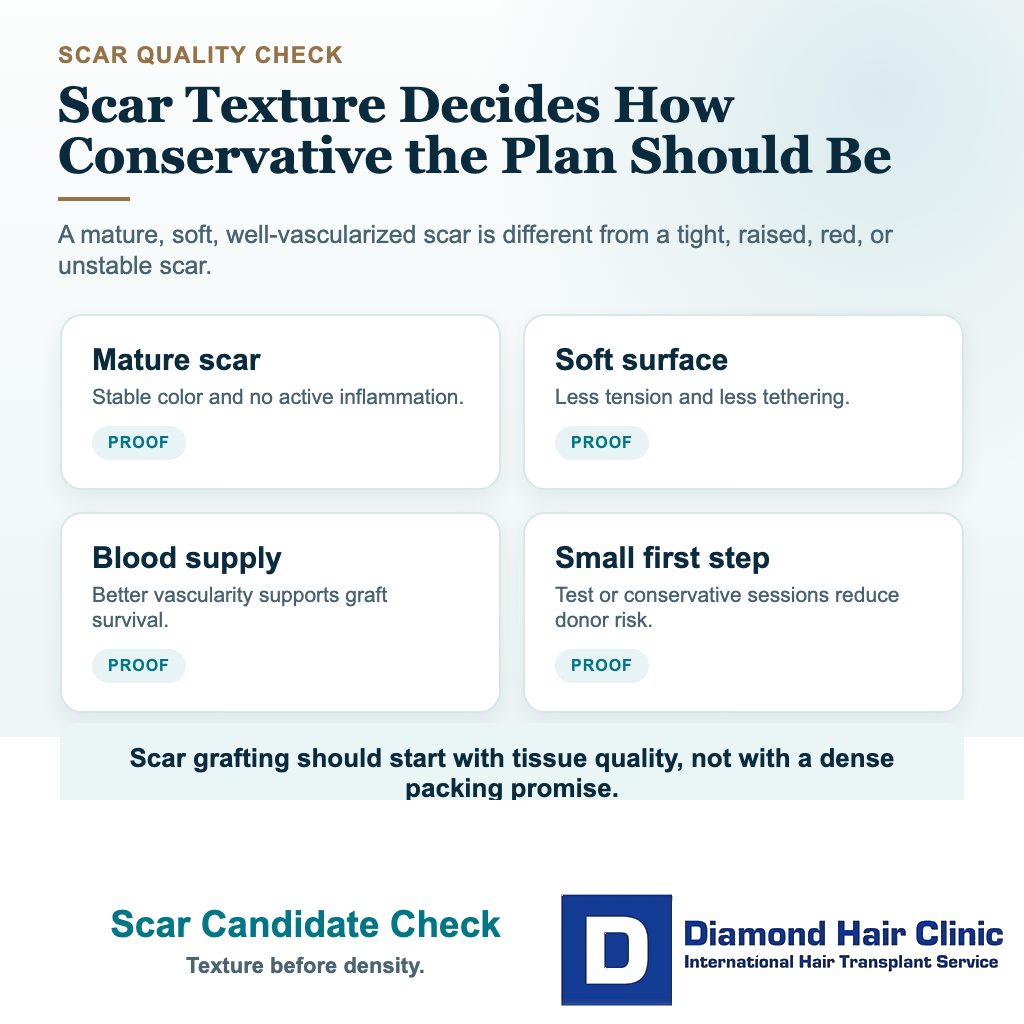
I check the hair around the scar. If the surrounding hair is strong and the scar is small, a modest number of grafts can sometimes create a good blending effect. If the surrounding hair is weak, diffuse, or miniaturizing, the scar may still show because the whole region lacks coverage.
Scar location matters as well. A hairline scar needs very fine direction control because the front edge is visible in normal conversation. A crown or mid scalp scar may be more forgiving from the front, but it can still show if the surrounding hair is thin or if the patient keeps the hair very short.
This overlaps with general candidacy. A person may be a good candidate for camouflaging one small scar but not a good candidate for a large density operation. Scar cases need the same careful lens used when deciding whether someone is really a good candidate for a hair transplant.
When is grafting into a scar a poor idea?
Grafting into a scar is a poor idea when the scar is active, raised, unstable, infected, very tight, or medically unexplained. It is also a poor idea when the patient expects normal density in one session. Scar tissue can improve, but it does not behave like untouched scalp.
A history of thick scars or keloids changes the decision. In that case, I would not treat the scar as only a cosmetic gap. I first think about skin behavior, because new surgical trauma may create new scar problems. With this history, hair transplant and keloid scar risk should be reviewed before assuming FUE is safe for the skin.
Active inflammatory scarring diseases are a different situation again. A physical scar from an old injury is not the same as lichen planopilaris, discoid lupus, or another process that is still destroying follicles. If the diagnosis is uncertain, clarify the diagnosis before planning surgery, especially in cases that resemble scarring alopecia or lichen planopilaris.
If there is ongoing itching, scaling, burning, redness, pustules, spreading hair loss, or a patch that looks like a scar that has not been diagnosed, I would not treat it as a simple camouflage case. Dermatology review, and sometimes biopsy, may be more important than choosing a graft number.
Use the 8 scar tissue transplant slides below to separate scar maturity, blood supply, diagnosis, density limits, conservative test sessions, SMP or scar revision options, donor cost, and promises that should make you pause. Swipe the carousel, use the arrows one step at a time, or choose a number below the image to jump to that point.
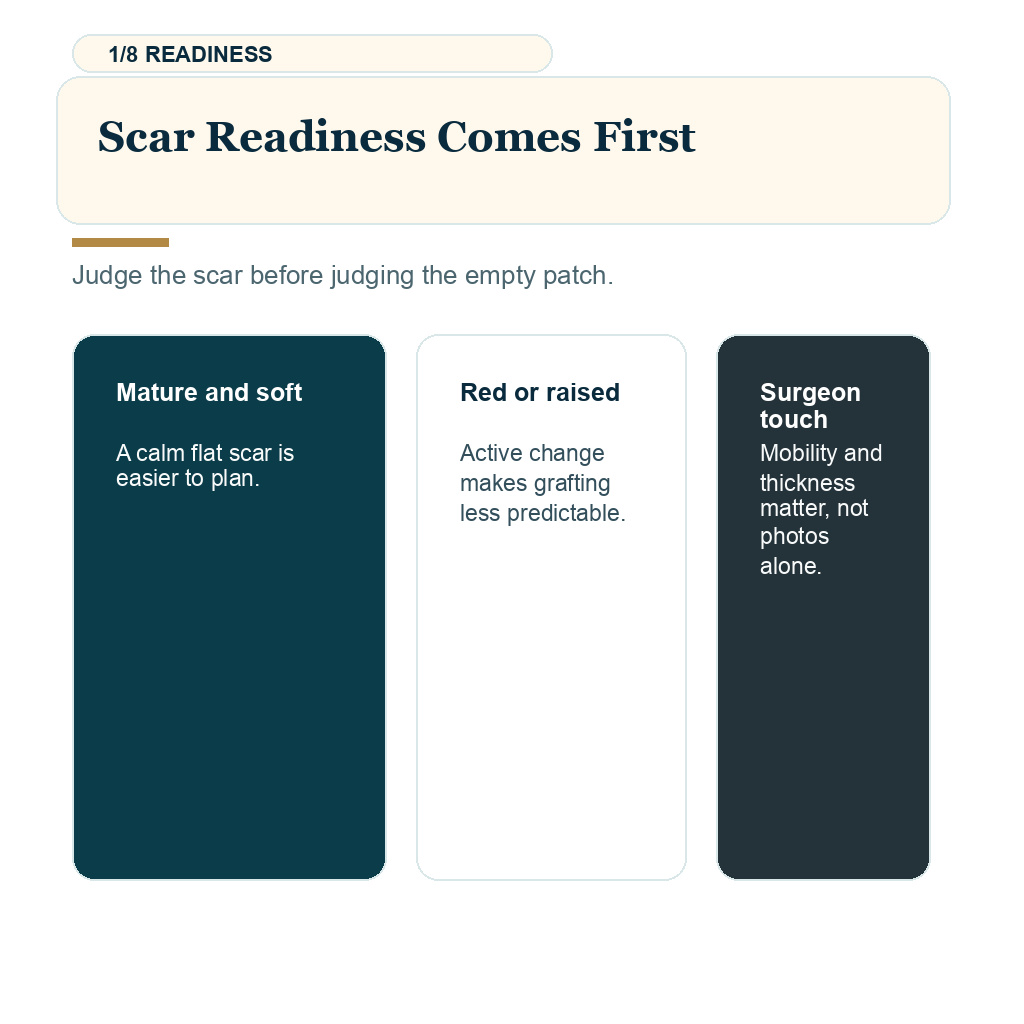




The first session should usually be small and conservative
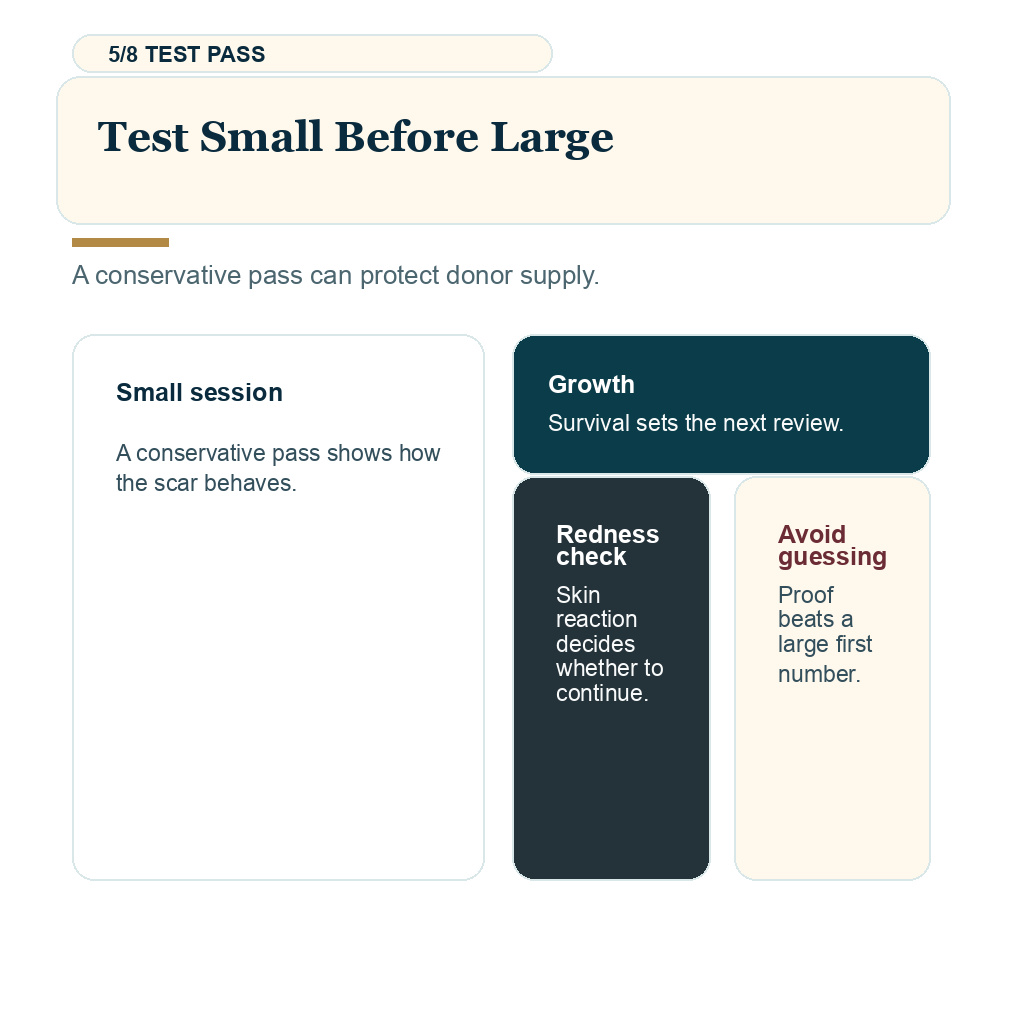
In many scar cases, yes. A smaller first session protects the patient from spending too much donor hair before we know how the scar responds. It also allows the surgeon to place grafts with lower density and less tissue stress. The first small area is useful because it shows how that scar responds before a larger session is planned.
A staged plan lets the first session teach us something about the scar. If the scar accepts the grafts and the growth is healthy, a later session can add more softness. If growth is limited, the patient has not lost a large part of the donor reserve on an unpredictable area.
The opposite approach is risky. A clinic may promise to fill the whole scar densely in one operation, but dense packing into poor scar tissue can reduce survival and make revision harder. Careful planning may feel less dramatic, but it is often the more responsible plan.
Some patients dislike the idea of staging because they want the scar handled once and finished. I understand that feeling. But if the tissue is uncertain, a staged plan can be the difference between a controlled improvement and a repair that consumes donor hair too quickly.
A test session can be safer before larger grafting
In uncertain scar tissue, I sometimes think of the first session as both treatment and information. A smaller area at lower density can show how the scar accepts grafts, how the skin reacts, how the hair direction looks, and whether the coverage improves enough to justify using more donor grafts later.
Wider scars and tighter scar centers need a staged read. Burn scars, mixed texture scars, scars after hairline lowering surgery, and scars where the center feels tighter than the edges may need the first growth pattern to guide whether more work is safe.
I would usually judge this patiently, often around 9 to 12 months after the first scar session, because scar work can mature slowly. Good hair transplant growth tracking matters here. If the first session grows poorly, placing more grafts into the same tissue may only spend donor hair without solving the visibility problem.
A weak first scar result is not, by itself, a reason to place more grafts. I would compare scar softness, color, thickness, tension, haircut goal, and whether scar revision or SMP could solve the visible problem with less donor cost. Sometimes the safest lesson from the first pass is to stop spending grafts in that tissue.
Can density in scar tissue match normal scalp hair?
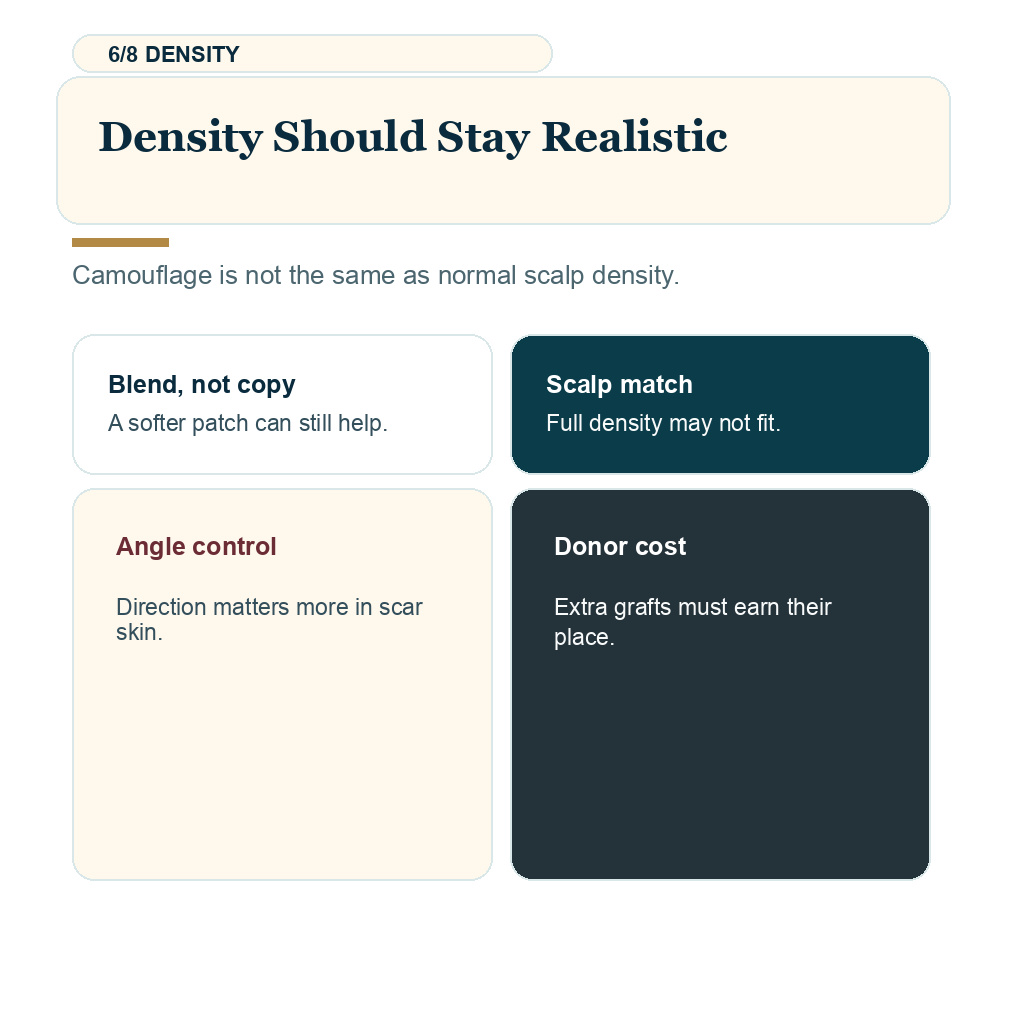
Usually, no. The aim is normally visual improvement, not identical density. If the scar is small and the surrounding hair is favorable, the improvement can be very satisfying. But do not expect the scar to behave like normal scalp skin.
This matters most for short hairstyles. A transplanted scar may look much better when the hair is grown a little longer, but still show a density or color difference under a very short buzz cut. It is better to explain that before surgery than let the patient discover it after using precious grafts. Define the haircut you need the scar to tolerate, because a scar softened for medium length hair may still show under a very short guard.
Density also depends on the hair used. Thick hair can cover better than very fine hair, but coarse hair can look unnatural if the angle is wrong. Scar work requires not only graft survival but also direction control, spacing, and patience.
What do I need to decide before spending donor grafts?
Scar grafting is not only a question of whether hair can grow there. I first decide whether the scar is quiet, whether the skin can tolerate recipient area incisions, whether nearby hair can hide lower density, and whether the donor supply is better saved for pattern hair loss.
I become more cautious when the scar is raised, painful, red, tethered, very wide, recently changing, or linked to an active diagnosis such as scarring alopecia. A patient with a strong tendency toward thick scars or keloids may need dermatology review, scar treatment, SMP, or no surgery instead of more incisions.
The written plan should name the scar target, the first session density, the donor source, and what result would count as enough improvement. In selected old strip cases, the planning overlaps with FUE after FUT, but the scar itself still has to earn each graft.
Choosing between FUE, SMP, and scar revision
FUE into the scar, scalp micropigmentation, and scar revision solve different problems. FUE adds real hair. SMP adds the illusion of shadow. Scar revision tries to change the scar itself before camouflage.
When I review a scar result, I need to know what was done to the skin as well as how many grafts were placed. A final photograph after scar revision, grafting and SMP cannot show what grafting alone achieved. The useful comparison includes the scar before treatment, the sequence of procedures and the healed result at the hair length you plan to keep.
If the scar is narrow, flat, and surrounded by enough hair, grafting may be reasonable. If the scar is pale and the patient wears the hair very short, scalp micropigmentation after a thin hair transplant or scar repair can sometimes reduce contrast, but pigment does not create hair volume. If the scar is wide, raised, or poorly positioned, revision may need to be discussed before grafting.
Beard hair is a separate repair source, not a simple substitute for scalp grafts. In selected scar cases it can help when preserving scalp donor matters, but its caliber, texture, growth length, and extraction site affect the blend. The choice between beard grafts, scalp FUE, SMP, scar revision, and longer hair coverage has to solve the visible scar without creating a new donor problem.
Burn scars, larger surgical scars, and a scalp that has been treated with radiation deserve special planning. Sometimes hair transplantation is only one part of reconstruction, and sometimes it should come after other scar management. You should not be pushed into a hair transplant if the scar itself first needs medical, reconstructive, or maturity review.
An old FUT strip scar is a special category. The principles are similar, but the donor history changes the calculation because the scar sits inside the donor area itself. That situation is covered separately in the article about when FUE grafts can repair a FUT scar.
Donor supply changes the decision
Every scar repair spends donor grafts. That sounds obvious, but it is the part many patients underestimate. If the patient also has male pattern hair loss, crown thinning, a weak donor area, or a possible future need for another transplant, the scar must compete with other priorities.
I examine the donor area in hair transplant planning before I decide how much can reasonably be used for scar camouflage. A small scar may be worth treating. A large scar may consume grafts that the patient will later need for the frontal scalp, mid scalp, or crown.
There is also the risk of creating a second problem while trying to solve the first one. If too many grafts are removed from the donor area for a cosmetic scar repair, the patient can be left with donor thinning or extraction marks. Patients who already have donor damage should understand the limits of overharvested donor area repair before accepting another operation.
Recipient area technique matters more in scar tissue
Scar tissue leaves less margin for rough technique. The recipient incisions must respect the scar thickness, blood supply, direction of nearby hair, and the amount of trauma the tissue can tolerate.
In my recipient area planning, I use Sapphire FUE because incision control and direction matter deeply to naturalness. In scar tissue, that control becomes even more important because the skin may be less forgiving.
The tool is not the whole answer. A good blade cannot rescue a poor plan. The surgeon still has to decide whether to graft into the scar, around the scar, stage the work, lower the density, or avoid surgery.
Which scar treatment promises should make you pause?
Be careful if a clinic promises to erase the scar completely, match normal density in one session, or guarantee growth in scar tissue before examining the scar in person. Scar cases should be reviewed with more caution than routine pattern hair loss.
Another concern is a clinic jumping straight to a graft number. A graft number has little meaning if nobody has checked scar maturity, skin thickness, blood supply, surrounding hair, donor reserve, and your hairstyle goal. You need to hear the limits before hearing the promise.
Previous bad surgery or traumatic scarring can make patients emotionally tired. That is exactly when rushed sales language becomes dangerous. If the scar came from a poor operation, first understand the broader principles of bad hair transplant repair before trusting a quick repair promise.
Scar grafting depends on the scar itself
Start scar planning with tissue behavior, not only the size of the bald patch. Two scars that measure the same can accept grafts differently when color, softness, tension, and blood supply are different.
When the scar is small, stable, flat, and surrounded by useful hair, a conservative grafting session may soften visibility. When donor supply is limited, the scar is large, or the skin is still changing, smaller staging, SMP, scar revision, or no surgery may be more responsible.
The target is improvement, not identical scalp skin. A transplant can make selected scars less visible, but scarred skin should never be sold as normal scalp with a guarantee.
Read this review excerpt
We also had a levelled conversation about my hairline and results I could expect based on my donor density area.