



Scarring Alopecia, Lichen Planopilaris, and Transplant Candidacy
Hair transplant surgery is usually not advisable while the disease is active. With scarring alopecia or lichen planopilaris, this is not only about whether hair can be placed into an empty area. The first concern is whether the inflammatory process has truly become quiet enough for new grafts to have a fair environment to survive.
If there is redness, burning, itching, scale, pain, tenderness, expanding hair loss, or signs that follicles are still being destroyed, this is not a routine hair transplant case. In patients whose case fits, surgery may be discussed only after the diagnosis is clear, the condition has been medically controlled, donor supply is safe, and the expectations are conservative. A biopsy report or dermatologist letter helps show whether the diagnosis is quiet enough to discuss surgery.
A hair transplant can move follicles, but it cannot switch off an active scarring alopecia process. This has to be understood before graft numbers, hairline design, or coverage are discussed.
How is this different from ordinary hair loss?
Ordinary male pattern hair loss weakens follicles over time, but the skin usually remains able to receive grafts. Scarring alopecia is different because inflammation can destroy the follicle structure itself and leave scarred tissue where the hair used to grow.
Lichen planopilaris is not the same surgical problem as routine recession, diffuse thinning, or crown thinning. A transplant can move healthy follicles, but it cannot guarantee safety if the same disease process is still active in the recipient area.
The distinction matters because patients often see a bald patch and assume it only needs filling. A scarred patch after infection, including cases where tinea capitis and hair transplant planning overlap, still needs diagnosis and stability before grafting is discussed.
In surgical terms, a bald patch from scarring alopecia is not simply an empty space waiting for grafts. It may be a damaged field with reduced blood supply, altered skin quality, and an inflammatory process that can wake up again.
Folliculitis decalvans creates the same need to stop the disease activity and keep it stable, so folliculitis decalvans hair transplant timing should be separated from simple folliculitis before grafting is discussed.
Scarring alopecia should also not be confused with alopecia areata and hair transplant planning. Both can involve immune activity, but scarring disease can permanently remove the follicular openings. That makes the surgical judgment more cautious. Central centrifugal cicatricial alopecia has its own timing problem, so CCCA hair transplant planning needs a separate scarring alopecia review.
Frontal fibrosing alopecia can look like a receding hairline
It can, so this diagnosis needs careful handling. A patient may see an ordinary receding hairline, while the scalp tells a different story. If the front hairline looks smooth, shiny, scarred, red, irritated, or if there is eyebrow thinning, burning, itching, tenderness, or loss of normal follicle openings, I do not treat it like routine male pattern hair loss.
Frontal fibrosing alopecia can create recession in the frontal hairline and temples, but the biology is not the same as a normal male pattern recession. A typical receding hairline is mainly a problem of miniaturization. Frontal fibrosing alopecia is a scarring process. That difference changes the whole surgical conversation.
A hair transplant can rebuild a hairline only when the skin can support the grafts. If frontal fibrosing alopecia or another scarring process is the real diagnosis, the first question is not how low the hairline should be. The first question is whether the disease is controlled enough for any surgical plan to be reasonable.
For that reason, natural hairline design is not only an artistic decision. In these cases, the surgeon must respect the skin, the diagnosis, the donor reserve, and the future risk of relapse.
What proof is needed before surgery?
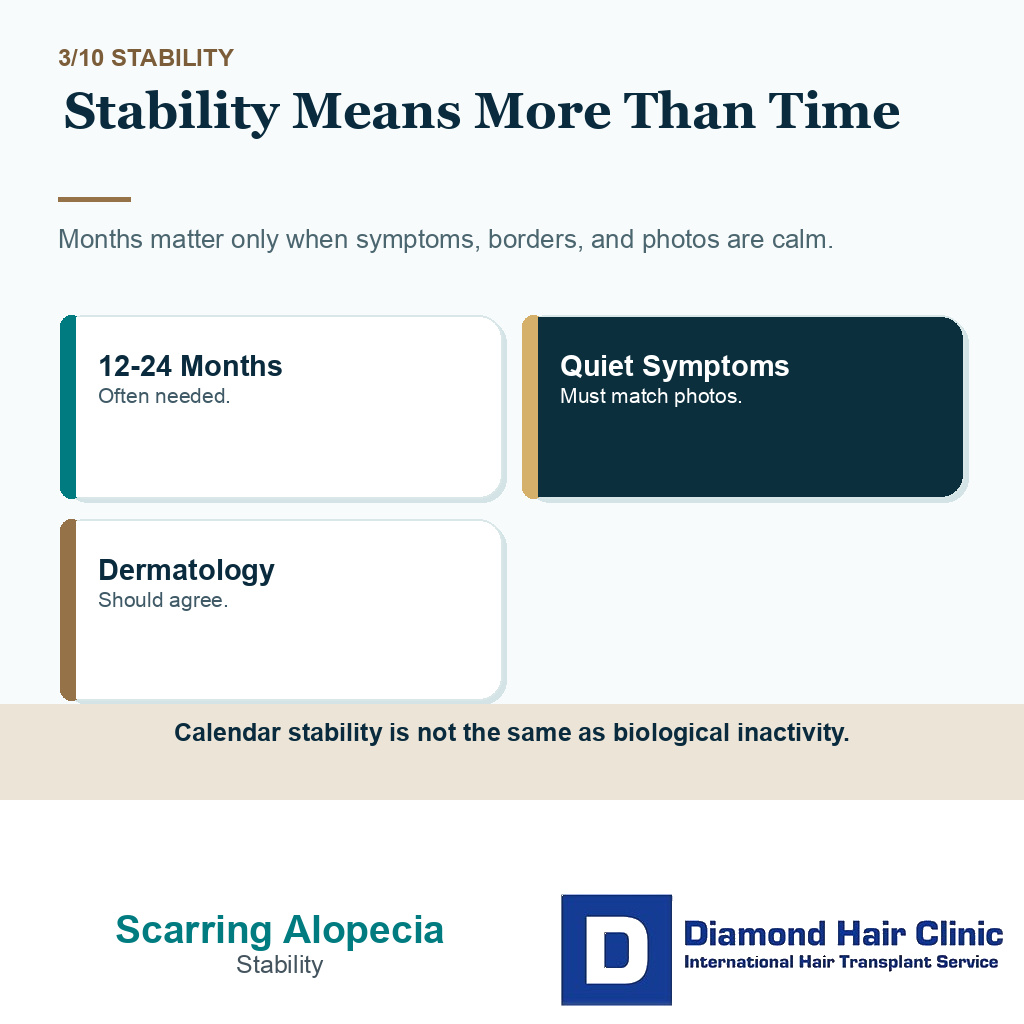
Before surgery is considered, the diagnosis must be correct and the disease must be quiet. For many of these cases, I think in terms of 12 to 24 months of stability, and sometimes longer, not a few calm weeks. Even then, time alone is not enough.
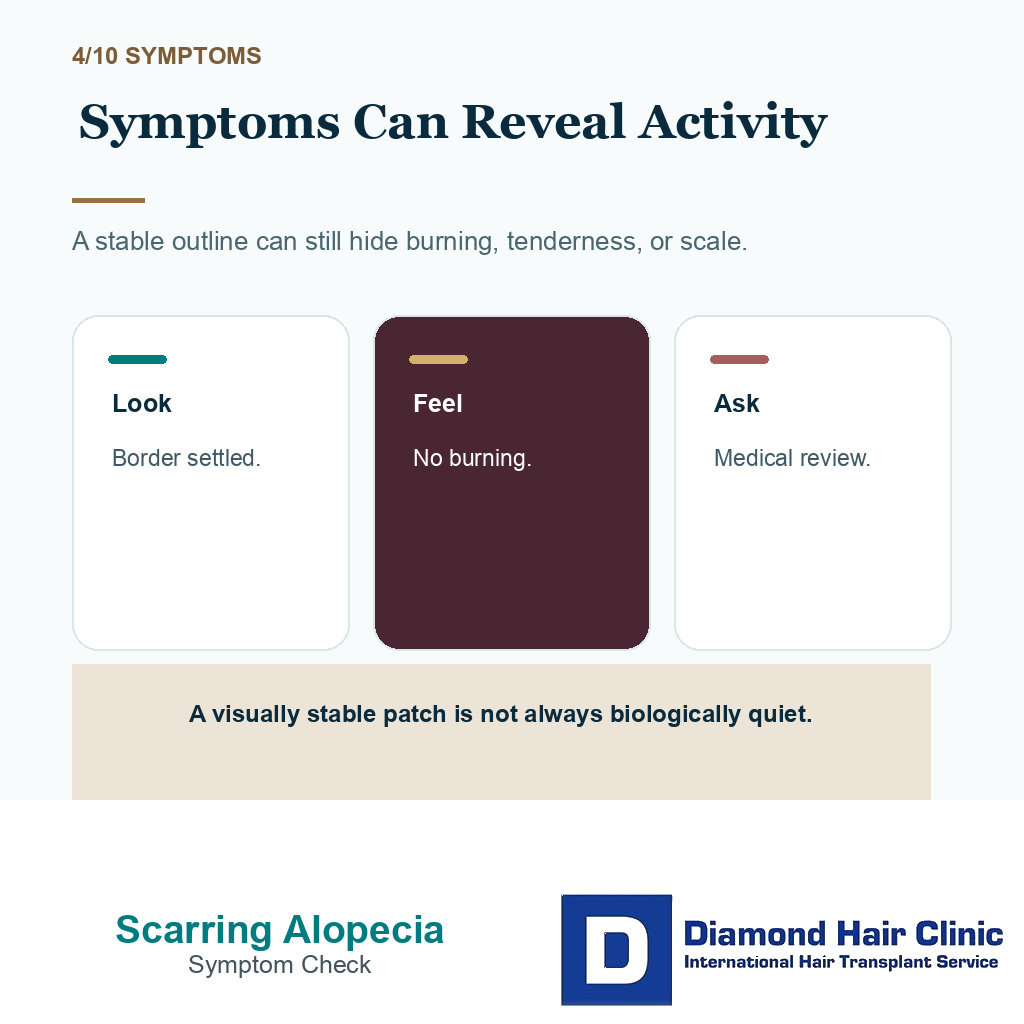
I also look for a quiet scalp in ordinary life, not only at one appointment. Burning, itching, scale, tenderness, or spreading edges mean the diagnosis still controls the surgical timing.
The number of months is not an automatic pass. It only helps when the symptoms are quiet, the border is settled, the photographs are stable, the dermatologist is comfortable, and the medication plan makes sense. Calendar stability and biological inactivity are not always the same thing. If treatment has just changed or symptoms only recently settled, I usually prefer more observation before surgery is discussed. For lichen planopilaris, the dermatologist’s note should describe quiet symptoms and stable borders, not only the length of time since the last flare.
The scalp should show no recent patch expansion, no active symptoms, no surrounding redness, no scale around hair shafts, no pain, no burning, and no new areas appearing elsewhere.
The treating dermatologist should be part of the decision when the patient has lichen planopilaris, frontal fibrosing alopecia, central centrifugal cicatricial alopecia, or discoid lupus.
This also applies to dissecting cellulitis or another scarring diagnosis.
A broader autoimmune disease can also change scalp planning and wound healing judgment.
If the diagnosis is uncertain, guessing is unsafe. Sometimes trichoscopy, scalp photographs over time, blood work, medication history, or biopsy information changes the plan completely. A patient may believe the weak point is ordinary thinning, while the scalp shows warning signs that the real issue is inflammatory. When the uncertainty is specifically tissue level, I explain why a scalp biopsy before hair transplant may be the safer pause.
In that wider assessment, blood tests before a hair transplant can help, but blood tests cannot diagnose every scalp disease. The scalp itself must be examined carefully. If the skin is sending warning signs, a normal blood test does not make the operation safe.
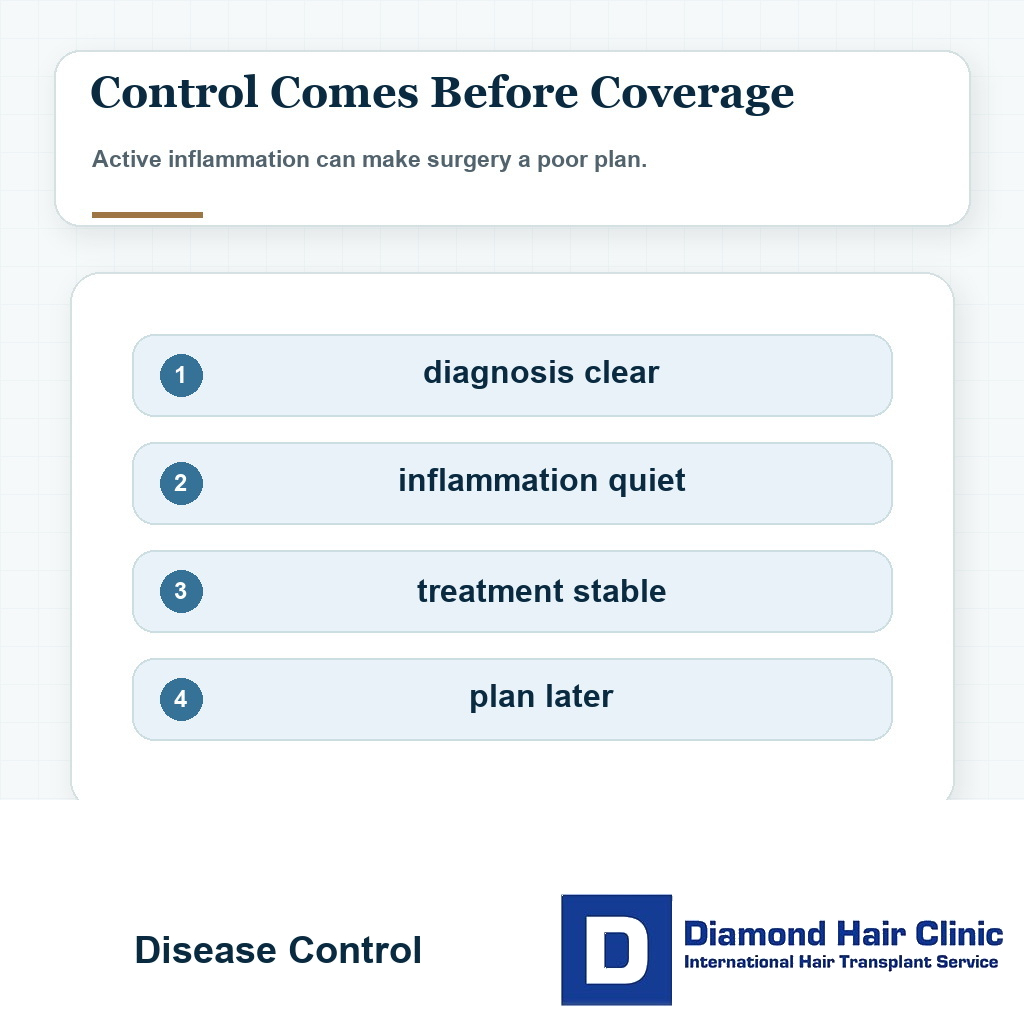
Stable history does not always mean inactive disease
A patch can look almost unchanged in photographs while the patient still has burning, tenderness, scale, redness, or subtle inflammation around the remaining hairs. I do not call that inactive just because the outline has not moved dramatically.
Before surgery, a hopeful impression is not enough. The symptoms should be quiet, the border should be settled, the photographs should be stable, and the treating dermatologist should be comfortable that the disease is controlled. If only one of those conditions is true, the case belongs in medical observation rather than surgical planning. Quiet skin today still needs a flare plan before surgery is treated as safe.
When several clinics refuse a scarring alopecia case, I do not read that as a simple sales obstacle. It can mean the disease activity, diagnosis, donor choice, or recipient skin should be reviewed more carefully before surgery is discussed.
That distinction protects the patient. A scalp that is only visually stable may still be biologically active. If grafts are placed into that environment too early, donor hair may be spent before the recipient area is ready to support it.
Trichoscopy or biopsy can change the hair transplant plan
Surface appearance alone can be misleading. A scalp may look like ordinary thinning in a photograph, but under closer examination there may be inflammation around follicles, loss of follicular openings, scarring, scale, or active disease at the edge of the patch.
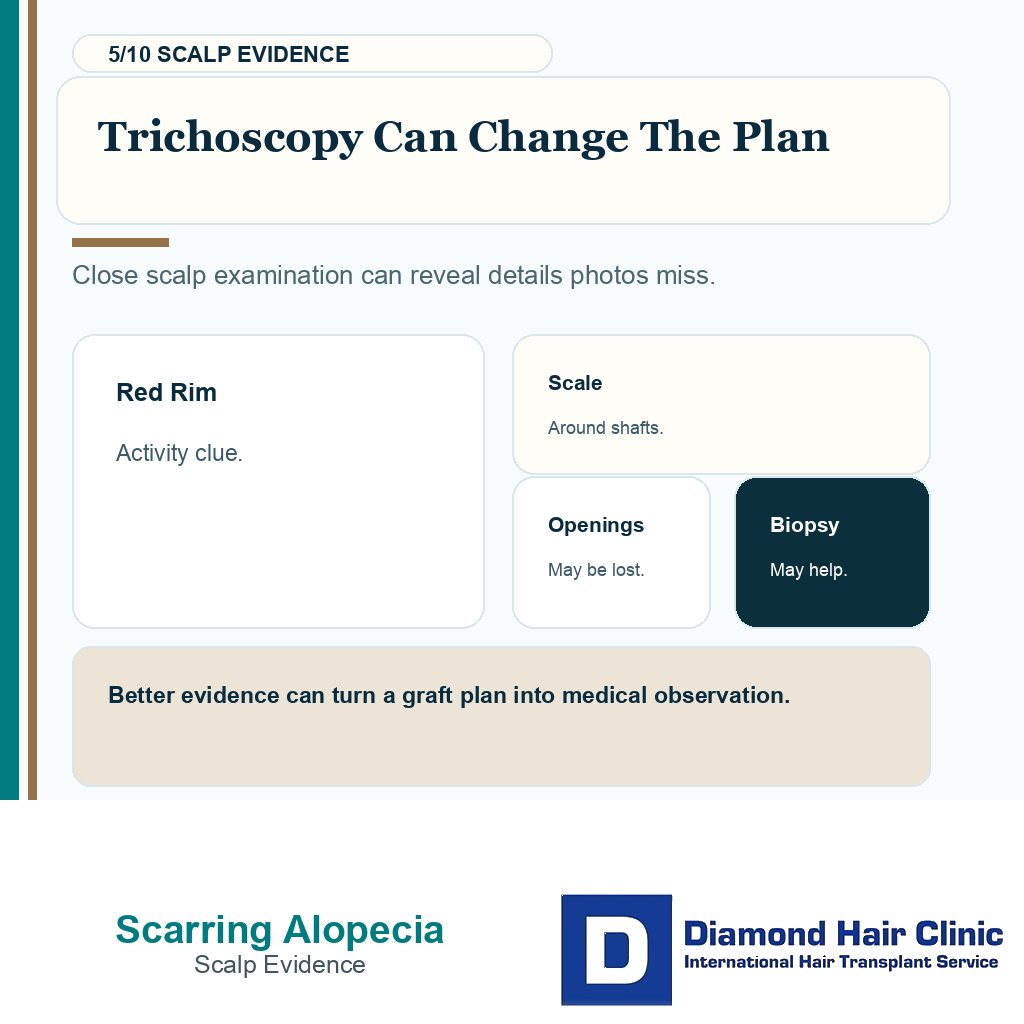
Trichoscopy can show details that are not visible in normal photographs. It may reveal perifollicular redness, scale around the hair shafts, empty follicular openings, white scarred areas, or other signs that the skin is not behaving like a normal recipient area.
In selected cases, a biopsy can help. But even biopsy must be planned correctly. Taking tissue from a completely smooth, inactive center may not answer the question. The more useful information often comes from the active border where remaining hairs, redness, scale, and symptoms may still be present.
If lichen planopilaris or another scarring process is possible, guessing is the wrong approach. Sometimes the correct answer is not a smaller graft number. Sometimes the correct answer is no surgery until the diagnosis is medically controlled.
Active inflammation can make surgery unsafe
Active lichen planopilaris can make surgery unsafe because it may attack follicles in the area where new grafts are placed. Transplanted hair is not necessarily protected. It is still hair living inside skin that must accept it, heal around it, and support it with blood supply.
Surgery also creates controlled trauma. In a quiet scalp, that trauma is usually part of normal healing. In an actively inflamed scalp, it may be the wrong test. The disease activity should not be discovered only after donor grafts have already been spent.
If the inflammatory activity is still present, a transplant can become frustrating for both the patient and the surgeon. The surgery may look technically clean in the early period, yet the grafts may grow poorly, thin later, or sit inside a scalp that continues to scar. That is not a failure solved by simply adding more grafts.
Burning, soreness, itching, tightness, or a crawling sensation in the thinning area deserves caution. These symptoms do not prove lichen planopilaris by themselves, but they should slow the surgical decision. A transplant should not be used to cover up an active diagnosis that still needs medical control.
I separate this from a controlled inflammatory scalp condition such as stable scalp psoriasis before a hair transplant, where surgery may be possible when the skin is settled. With lichen planopilaris or another scarring process, I worry not only about irritation. I worry about permanent follicle loss and future graft survival.
Judging whether donor supply is safe
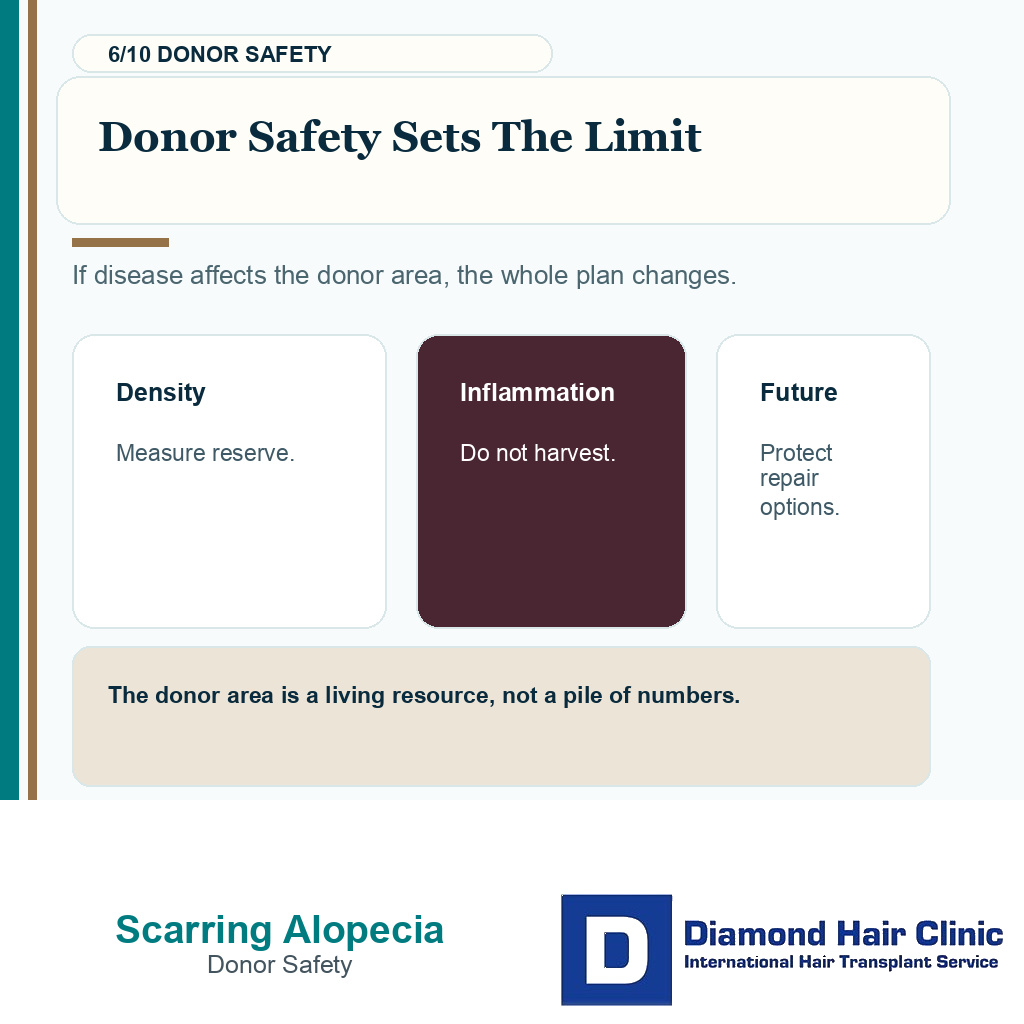
The donor area sets the surgical limit of the patient. If scarring alopecia affects the donor area, the operation becomes much more risky. Even if the visible problem is on top, I still examine the back and sides carefully because donor weakness can change the whole plan.
Hair density, hair caliber, follicular unit pattern, miniaturization, skin quality, and any signs of inflammation all matter. If the donor has patches, redness, scale, pain, or unusual thinning, grafts should not be removed before the reason is understood. Taking grafts from an unsafe donor can create permanent regret.
Donor area planning matters even more in medically complex cases. Donor supply is not just a source of numbers. It is a living resource that must remain stable for years.
Beard or body hair can look like a solution when the scalp donor is questionable. Sometimes alternative donor sources can help repair selected areas, but they do not remove the need for disease control. If the recipient area is still active, changing the donor source does not solve the main problem.
In these patients, donor protection becomes even more important. Overharvesting is already a serious problem in ordinary hair transplant planning. In a medically complex case, poor donor judgment can make future repair much harder. Donor area overharvesting explains why graft numbers should never be treated like an unlimited resource.
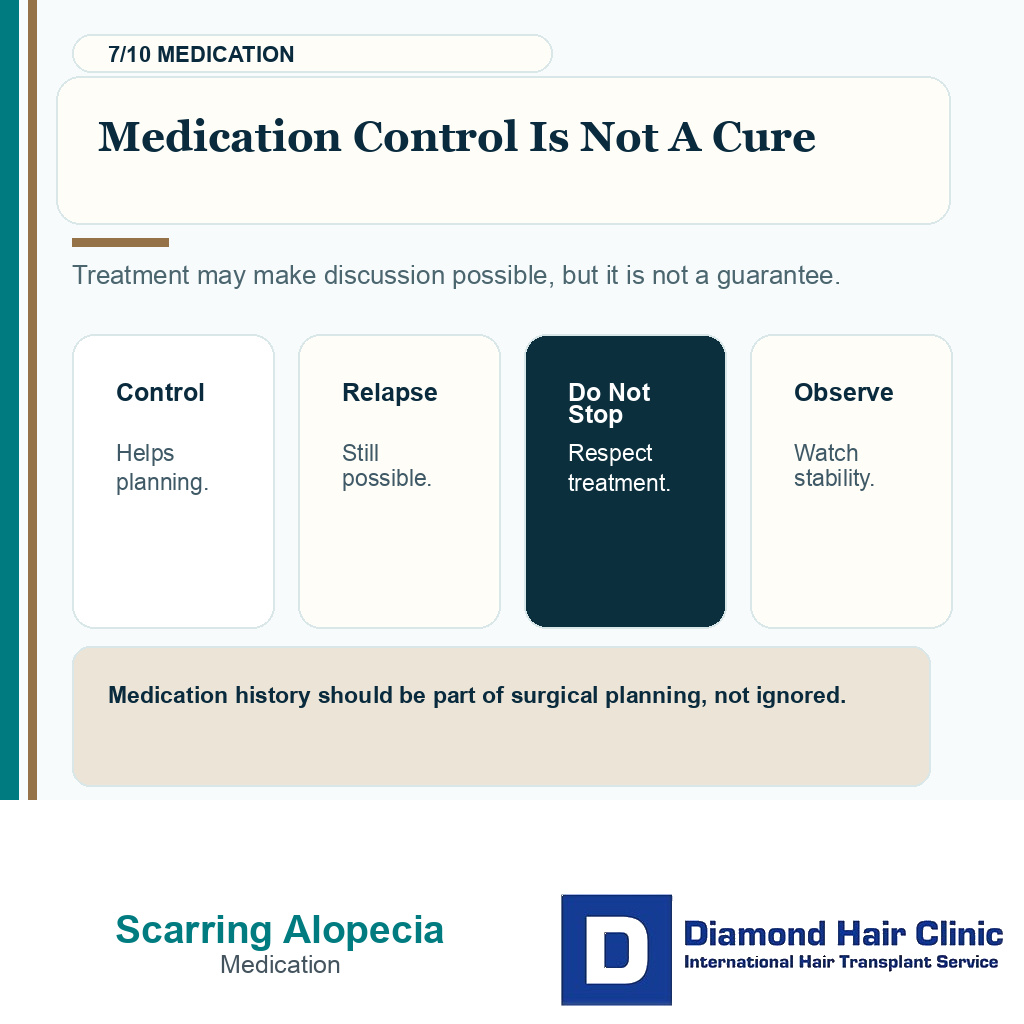
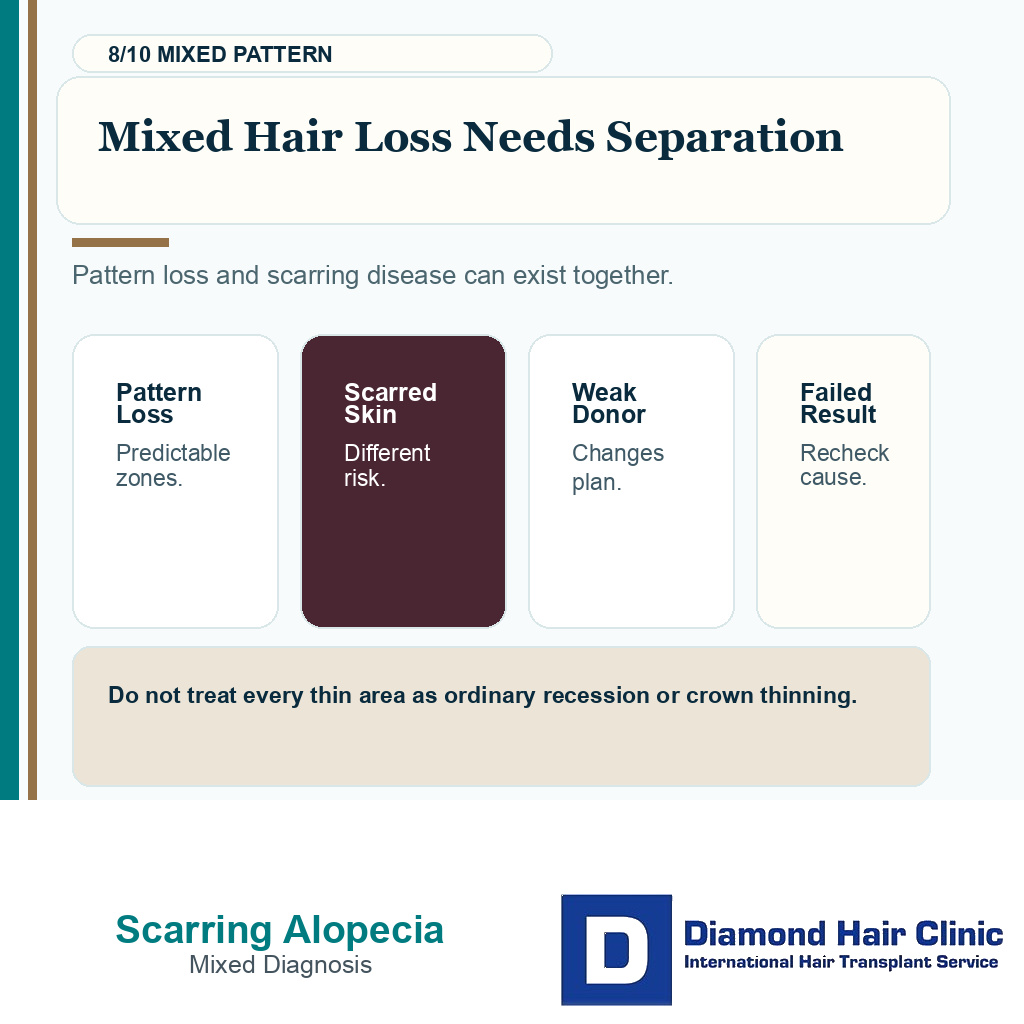
Use the 10 candidacy slides below to separate diagnosis, disease control, donor safety, and transplant timing. Swipe the carousel, use the arrows for one step at a time, or choose a number below the image to jump to that point.




Can medication make surgery possible later?
Medication may make surgery possible later in patients whose case fits, but it is not a simple bridge to a guaranteed transplant. The first purpose of medical treatment is to calm the disease and protect the remaining hair. Surgery comes only after the scalp has shown that it can stay quiet.
A scalp can be quiet because treatment is controlling the disease. That is still valuable, but it is not the same as being cured. Medication should not be stopped casually just to “prove” eligibility for surgery, because a flare can make the whole transplant plan less safe.
In ordinary planning, medication before a hair transplant may help stabilize native hair and make the surgical decision clearer. With scarring alopecia, medication has an even more serious role because it may be controlling the process that would otherwise damage grafts.
Do not stop or change medications on your own to make surgery look possible. If a dermatologist is controlling lichen planopilaris with a treatment plan, I need to respect that medical history. The review must confirm whether the disease is truly quiet and whether stopping medication would increase the risk of relapse.
Sometimes the safest advice is to delay surgery and continue medical observation, especially when more than one clinic has said no. That can feel disappointing, but it is not passive. A careful delay can prevent a patient from spending donor grafts on skin that is not ready, and it can protect the chance of a more natural result later.
What if the diagnosis is mixed with pattern hair loss?
This can happen. A patient may have male pattern hair loss and also a scarring alopecia process in part of the scalp. The weak point is treating everything as ordinary thinning and placing grafts into areas where the underlying disease is not controlled.
In a mixed case, the patterns have to be separated. The examination should look at the shape of the hairline recession, whether crown thinning is predictable, whether shiny patches have lost follicular openings, whether redness surrounds remaining hairs, and whether donor supply is strong enough. These details matter more than the patient simply saying he wants density.
Here, the thinking overlaps with diffuse thinning and hair transplant planning. Surgery between weak native hairs can already be delicate. When scarring disease is also possible, the margin for error becomes smaller.
Dermatology confirmation may be needed before surgery, especially if the patient has symptoms, patchy loss, unusual scalp texture, or a result from a previous transplant that failed without a clear reason. A failed result is not always poor technique. Sometimes the scalp diagnosis was missed.
Lichen planopilaris may explain a poor result
Sometimes, yes. Not every weak result is caused by poor technique. A transplant may be performed into a scalp that was already inflamed, scarred, or medically unstable, but the diagnosis was not clear at the time. In other cases, the condition may become more obvious after surgery.
A repair operation should not be rushed just because the first transplant failed. Before using more donor grafts, the cause must be assessed. It may be poor planning, poor graft handling, overharvesting, continued androgenetic hair loss, or an inflammatory scalp disease that attacked the grafts or the surrounding native hair.
A second operation should not be used to repeat the same mistake. If lichen planopilaris, frontal fibrosing alopecia, or another scarring diagnosis is possible, the scalp must be assessed medically before another surgical plan is made.
This matters when a patient is considering whether a second hair transplant is worth it. A repair plan should not begin with graft numbers. It should begin with diagnosis, donor safety, skin quality, and the reason the first result did not meet expectations.
Comparing this with other scalp conditions
Not every scalp problem has the same meaning. Seborrheic dermatitis, psoriasis, folliculitis, alopecia areata, and scarring forms of alopecia can all worry patients, but they do not create the same surgical risk. The problem has to be defined before surgery can be judged responsibly.
For example, a patient with stable seborrheic dermatitis before a hair transplant may need scalp control and careful aftercare, but the diagnosis does not always mean the follicles are being permanently destroyed. A patient with active lichen planopilaris is a different conversation.
This also matters for folliculitis before a hair transplant. Active pustules, pain, or repeated inflammation need treatment before surgery, but the surgical question is not identical to a lymphocytic scarring process. The exact diagnosis changes the risk.
Quick online labels and consultations based only on a few photos are not enough. Two scalps can look similar in poor lighting and behave very differently under examination. A serious plan starts by naming the problem accurately.
Judging clinic promises in this situation
A clinic that treats this diagnosis as only a density problem is missing the real risk. If the answer comes too quickly, if the graft number is offered before the diagnosis is reviewed, or if the clinic ignores symptoms such as burning and itching, that is the moment to slow the process down.
A rushed consultation may say that any bald area can simply be filled. A stronger consultation explains why the skin quality, disease activity, donor safety, and medication history matter. It also explains that a technically possible operation may still be unwise for the patient.
When deciding whether someone is a good candidate for a hair transplant, the issue is not only whether there is enough hair to move. It is whether moving that hair will serve the patient over time. In this diagnosis, that judgment is more serious because the recipient area may not behave like ordinary skin.
Marketing photos can be especially misleading here. A single early result may look encouraging, but the real test is whether the grafts remain stable while the disease stays quiet. The patient needs a plan that protects against disappointment later, not only a promise that looks attractive today.
Conservative density goals in scarred scalp
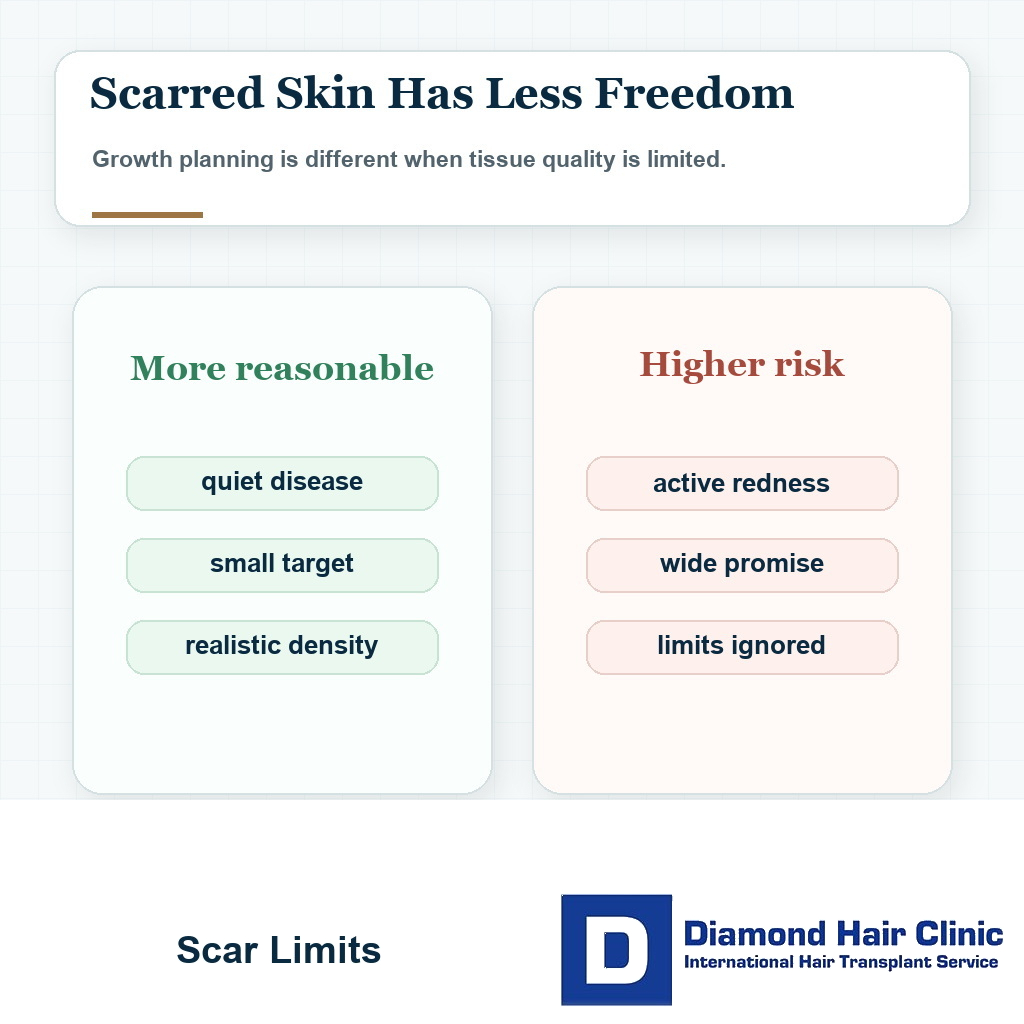
In ordinary male pattern hair loss, the skin usually receives grafts in a more predictable way. In scarred scalp, the recipient area may have altered blood supply, reduced elasticity, fibrosis, and a history of inflammation. That changes the surgical logic.
Aggressive dense packing should be avoided in these cases. A cautious plan may mean fewer grafts, lower density, a small test session, or staged surgery. The plan should not win a graft number argument. The aim is to learn whether the scalp can support transplanted follicles without spending too much of the patient’s donor area too early.
Natural improvement may be possible in selected stable cases, but the density goal must respect the skin. If the scalp is scarred, tight, shiny, poorly vascularized, or medically uncertain, trying to force high density can create more risk than benefit.
Do not compare these cases with standard before and after photos of androgenetic hair loss. A good result may mean a limited but stable improvement, not the same density that might be planned in a healthy frontal zone. Hair transplant result quality explains the broader principle, because the strongest plan is not always the one with the highest graft count.
Small test session can be wiser than a full transplant
In selected scarred areas, a small test session may be wiser than a full transplant. That is not hesitation for its own sake. Scarred skin can behave differently, and a cautious first step may reveal how the area accepts grafts.
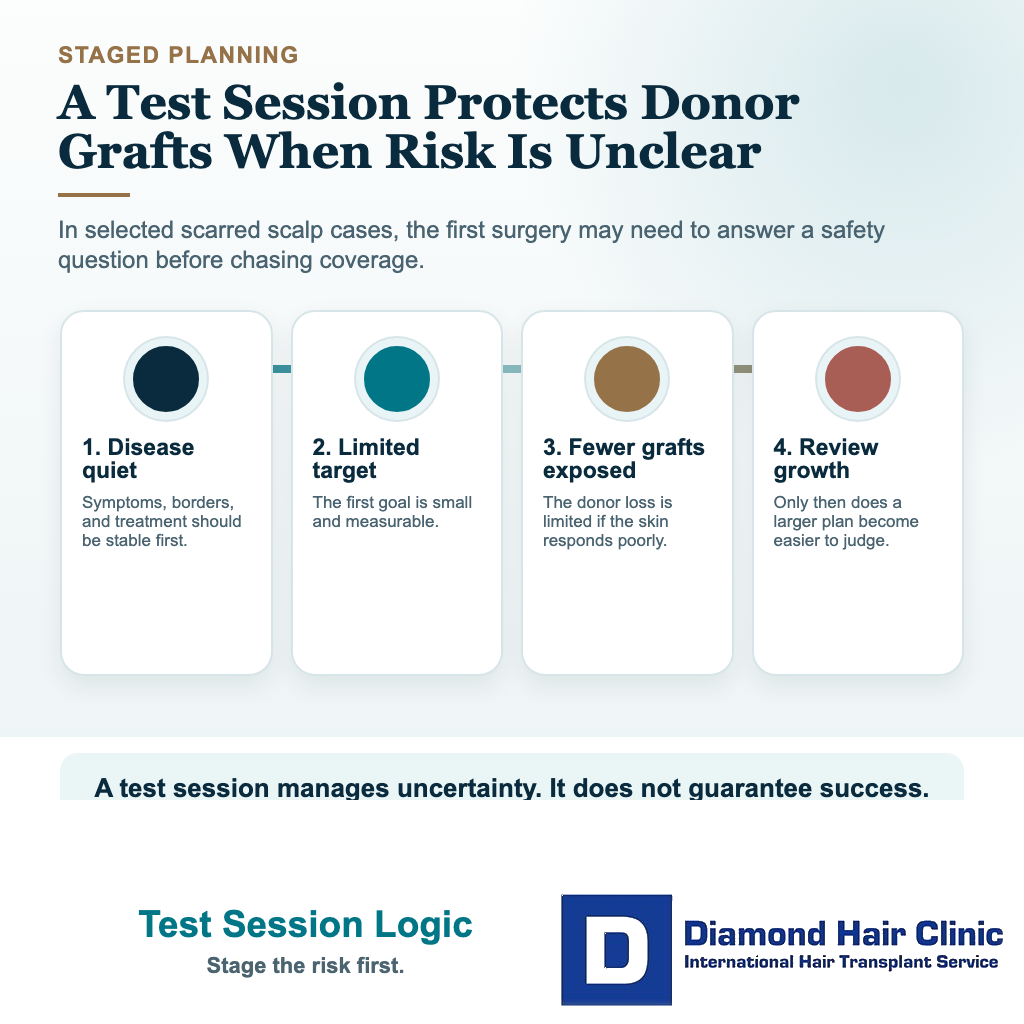
I would only consider this when the disease appears stable, the patient understands the uncertainty, donor supply is safe, and the cosmetic goal is limited. A small session can be useful when the skin quality is questionable or when the patient has a history that makes aggressive graft placement unwise.
Medication and time also matter here. If medical treatment may still change the decision, then delaying a hair transplant with medication can be a safer path than rushing into a large session.
A test session is not a trick to guarantee success. It is a surgical risk management tool. If the scalp does not respond well, the patient has lost fewer grafts than he would have lost in a large operation. If it responds well, the next step can be planned more intelligently.
Warning signs after surgery with this history
If a patient with a history of scarring alopecia has already had a hair transplant, the scalp needs closer watching than in an ordinary case. Some redness, scabbing, itching, and temporary tenderness can happen after any hair transplant. But worsening burning, spreading redness, persistent pain, unusual scale, pustules, shiny scar changes, or new expanding patches should not be ignored.
The difficulty is that early healing changes and disease activity can sometimes confuse the patient. A little redness after surgery is not necessarily lichen planopilaris. But a worsening inflammatory pattern deserves attention, especially in someone with a known or suspected scarring diagnosis.
Common healing signs should be separated from warning signs such as redness, scabs, and pimples after a hair transplant that need assessment. In a patient with scarring alopecia history, that judgment has to be stricter.
Do not diagnose yourself from anxiety, but do not ignore repeated warning signs either. A careful comparison of photographs over time, direct surgeon communication, and dermatology review can be much safer than waiting alone or assuming everything is normal.

Written proof I need before travel
For scarring alopecia or lichen planopilaris, the written review before travel should not start with the graft number. It should name the diagnosis, disease activity, symptom history, medication stability, dermatologist input, donor safety, and whether a small test session is wiser than a full operation.
A recent quiet period is not enough proof by itself. The scalp has to show that the border is settled, symptoms are quiet, and the recipient skin can accept grafts without turning the operation into another trigger.
If the review cannot explain why the disease is controlled and why the donor supply is safe, travel should wait. A cautious pause protects the patient better than a confident quote built on uncertain skin.
Start with medical suitability, not a graft number
If you have a scarring diagnosis, lichen planopilaris, frontal fibrosing alopecia, or an uncertain scalp diagnosis, the first step should not be a graft estimate. The first step should be understanding whether your scalp is medically suitable for surgery.
You can send clear scalp and donor area photos, but photos may not be enough. Dermatology assessment, trichoscopy, biopsy, medical control, or waiting may still be needed before any surgical decision is made.
This belongs before committing to a hair transplant. Booking surgery before the diagnosis is clear can create pressure in the wrong direction. I want diagnosis first, disease stability second, and surgical planning third.
In this diagnosis, a careful no can be more protective than a fast yes. Slowing the process is better than spending a patient’s donor grafts on scalp skin that is not ready.
The disease must be quiet enough for grafts
With scarring alopecia or lichen planopilaris, empty space is not the only question. I need to know whether the inflammation is controlled, whether the donor area is suitable, and whether the skin can accept grafts without turning surgery into another trigger.
A biopsy report, dermatology letter, trichoscopy findings, medicine history, symptom pattern, and stable photographs can matter more than a graft estimate. If the disease is active or the diagnosis is still uncertain, pausing is better than spending donor hair on skin that is not ready.
Even in a quiet case, the goal should stay conservative. A limited improvement may be reasonable for the right patient, but controlled disease does not guarantee growth, and it does not remove the need for careful follow-up.

Read this review excerpt
We also had a levelled conversation about my hairline and results I could expect based on my donor density area.