Try medication first, or plan surgery now
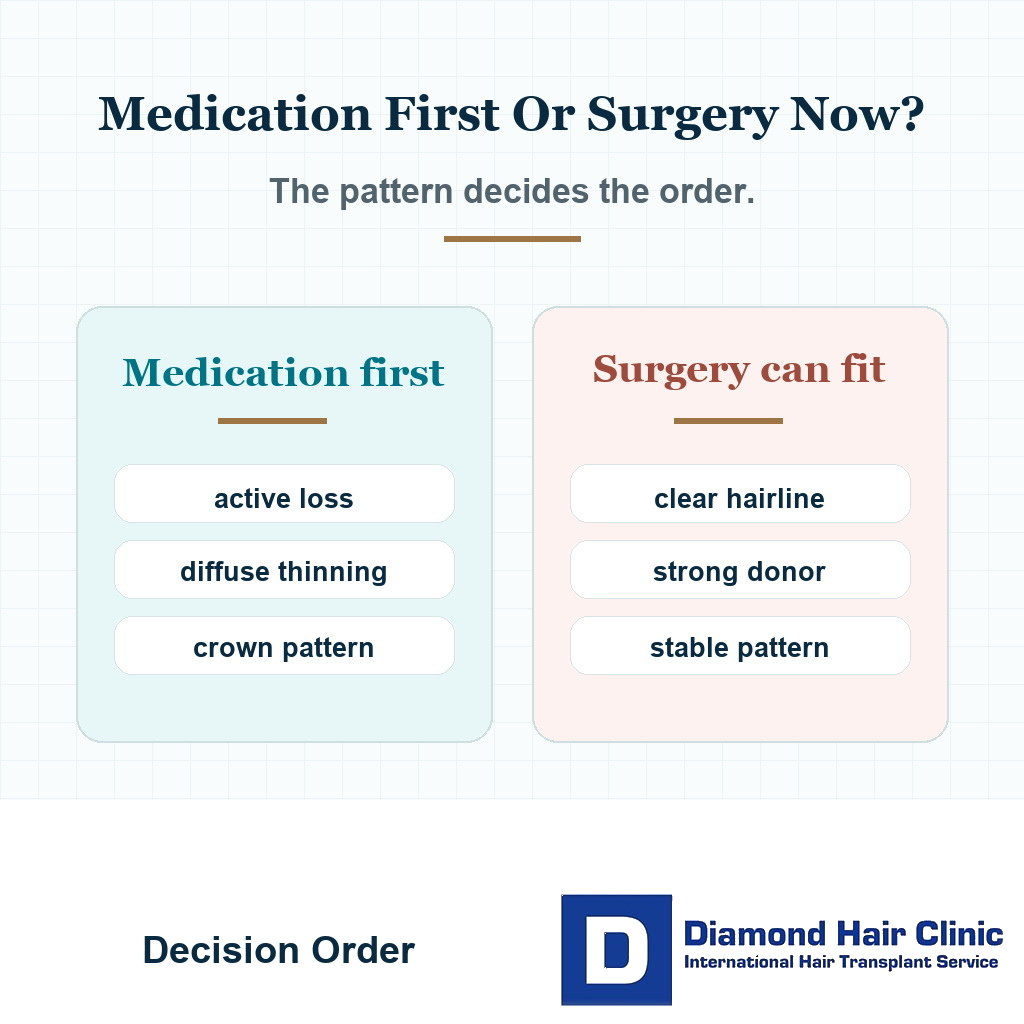
Medication is worth trying before surgery when it may change the surgical plan. If your hair loss is active, diffuse, mainly in the crown, or you are still very young, I consider medication and observation carefully before using donor grafts. If the hairline loss is clear, the donor area is strong, and waiting is unlikely to change the plan, surgery may still be reasonable without forcing a long delay. When the question is what to carry on the operation day, medicines should still fit a small packing plan for a long FUE surgery day rather than being taken quietly without review. For medicine names on FUE surgery day, keep the name, dose, and purpose written instead of trying to remember them from the chair.
Medication matters when it can change the surgical decision, not because it is good or bad in a general sense. If the medication itself is not tolerable, finasteride side effects before transplant planning need to be part of that decision.
The way the medicine is actually taken belongs in the medication history. A tablet split into quarters, a cut piece placed inside an empty capsule, a crushed tablet, or a recent tablet to capsule switch can change how reliable the history is, even when the drug name sounds unchanged.
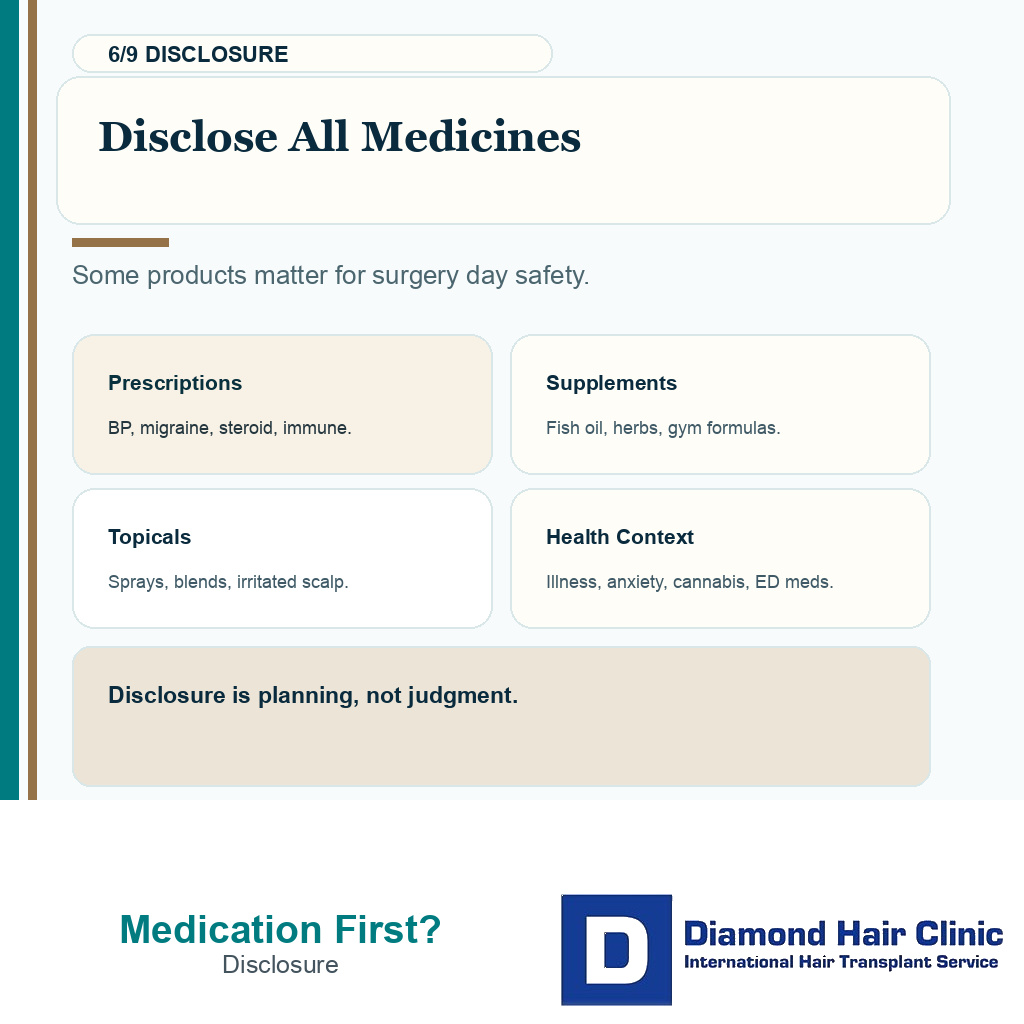
If you use saw palmetto, vitamins, fish oil, gym formulas, herbal products, or other supplements, I treat that as disclosure, not as proof that hair loss is stable. The useful question is whether the product can affect bleeding, blood pressure, lab review, comfort on surgery day, or expectations. So supplement disclosure before surgery belongs in the plan.
Hair loss is visible every day, and waiting can feel like doing nothing. Some medication questions, though, are broader medical planning questions. If finasteride or dutasteride intersects with trying for a baby, semen testing, or sperm banking, fatherhood planning with finasteride or dutasteride before hair transplant should be reviewed before the surgical design is fixed. For women, pregnancy, IVF, breastfeeding, and hair transplant medication timing need the same early review.
Other medicines matter because they can change general surgical safety rather than hair growth. If a medicine affects urination, dizziness, or blood pressure, bathroom breaks during FUE should be planned before surgery rather than handled urgently in the chair. Prescription steroids, immune medicines, blood pressure medicine, ADHD medication, migraine medicine, cannabis use, recent vaccination, or erectile dysfunction medication can affect timing, blood pressure, anesthesia review, bleeding tendency, healing, or follow-up instructions. I do not need a dramatic story. I need a truthful list before the surgical design is fixed. If you are HIV negative and take PrEP or Truvada before FUE, name the medicine, dose, prescriber, and timing before surgery rather than stopping or hiding it.
In surgical planning, waiting can be active work. It can show whether the native hair is still changing quickly, whether the crown may improve, whether the donor area should be protected more carefully, and whether the first operation should be smaller than you first imagined. When finasteride and minoxidil start together, the waiting period also shows which change is actually shaping the photos.
Medication and surgery do different jobs. Medication tries to support and stabilize hair that is still alive. A hair transplant moves donor hair into an area where hair has already been lost or where coverage is too weak.
Medication cannot make a poor surgical plan good, and surgery cannot stop active native hair loss. If treatment has already been tried and the loss is still active, still losing hair on medication before a hair transplant becomes a timing problem of its own. I look at the pattern, age, donor area, medical tolerance, and how urgent the cosmetic problem truly is before deciding whether surgery should move ahead.
The biggest mistake is thinking that a hair transplant freezes hair loss. It does not. A transplant can improve the hairline, temples, middle scalp, or crown, but the native hair around the transplant can continue to thin if the underlying hair loss remains active.
The medication question should be asked early. It should not appear only after the operation, when it suddenly becomes clear that transplanted hairs and native hairs can have different futures. That includes short term products too, such as decongestants before FUE, because a cold tablet can change blood pressure, symptoms, and anesthesia day review. The same early disclosure applies to hay fever tablets, nasal sprays, and cold and allergy blends, which I cover in allergy medicine before FUE. If reflux tablets are part of your usual list, review heartburn medicine before hair transplant before the surgery day instead of leaving it off the form.
When this decision is handled properly, surgery becomes more precise. When it is ignored, even a technically clean transplant can become harder to maintain visually as the surrounding hair changes.
The reason many patients want surgery before medication
Many people want to skip medication because surgery feels more decisive. A transplant has a date, a hairline drawing, a graft number, and a visible promise of change.
Medication feels less certain. It may need months before you know whether it is helping. Side effects, daily tablets, topical irritation, cost, and treatment fatigue are real concerns, especially if you have already tried products and feel tired of applying them. If the product is topical finasteride, timing also depends on the condition of the scalp.
When the list includes online blends, research chemicals, compounded sprays, retinoid blends, or acne creams, I want the full topical history before I trust the medication baseline. The separate concern around online hair loss topicals before FUE is not only the ingredient name. It is scalp irritation, timing, dose, and whether the product has made the picture harder to read. If the routine is an oral online tablet rather than a topical, I use a separate online hair loss pills before FUE proof trail so prescription source, dose, and refill dates are not guessed from memory.
I respect that caution. No one should be dismissed simply because medication worries them. But the trade has to be understood before the hairline is designed.
Being off finasteride and minoxidil changes the consultation, but it does not create one fixed rule. A treatment trial may change the map before donor grafts are spent, especially when loss is still moving.
If native hair is thinning quickly and all medical support is refused, the surgical plan often has to become more conservative. The hairline may need to stay higher, the crown may need to wait, and the graft number may need to be used more carefully.
The scalp in front of me today is only part of the decision. The plan also has to make sense for the scalp you may have in five, ten, or twenty years.
When someone chooses a hair transplant without finasteride, I do not reduce the answer to a fixed rule about whether surgery is impossible. The question is how much future uncertainty the plan is accepting.
Some patients can have a good transplant without certain medications. Others become much riskier candidates if they avoid medical stabilization. The difference is not ideology. It is diagnosis, age, donor strength, and how much native hair is still at risk.
Another reason people rush is fear that waiting will make the operation harder. Sometimes that fear is understandable. Other times, waiting under proper treatment gives better information and saves grafts rather than wasting time.
A rushed operation can feel emotionally satisfying for a few weeks. A well timed operation is usually better for the next decade.
Medication can change the surgical plan
Medication can slow ongoing miniaturization in suitable cases. It can sometimes thicken weak native hairs, improve the appearance of the crown, and make the future pattern easier to understand.

Medication cannot rebuild every lost hairline. A mature recession with empty temple corners may not fully return with medication. A slick bald area usually needs surgery if you want visible hair there.
The value of medication before surgery is often not dramatic regrowth. It is clarity.
After an appropriate treatment period, if the hair stabilizes, surgery can be planned with more useful information. The pattern shows which hairs are worth protecting, which areas still need grafts, and which zones should be delayed.
Regrowth is useful, but it is not the same as a stable surgical map. If treatment has brought thin hairs back into an area that looked empty, I do not plan that area as if it were bare skin. I first separate stable native hair, hair that may still be improving, weak miniaturized hair that could shed after surgical stress, and gaps that are truly empty.
When a patient says treatment helped only a little, I separate three outcomes. It may have stabilized the loss, improved hair quality without changing the hairline, or shown that the visible gap is now mainly a surgical problem.
FUE can add grafts between existing hairs in selected zones, but it cannot replace a whole thinning area as one block. I avoid spreading grafts across every low density space before the medication response has settled.
Medication can also reduce emotional pressure. If the crown thickens even modestly, the desire to cover every area in one session may become less urgent. That can protect the donor area.
From a donor management point of view, this matters. Every graft used today is a graft that cannot be used later. If medication reduces the urgency of crown work or diffuse thinning, the surgical plan may become safer.
The donor area in hair transplant is part of this decision too. Medication does not create a new donor supply, but it can sometimes help us use the existing supply more intelligently.
Medication is not a small side topic. Often, it is part of the surgical planning conversation.
Medication can also clarify tolerance. If side effects are a serious fear, it is better to discuss that before surgery than to build a surgical plan that quietly assumes medication will be used afterward.
A treatment plan based on assumptions is weak. A plan based on what you can realistically follow is much stronger.
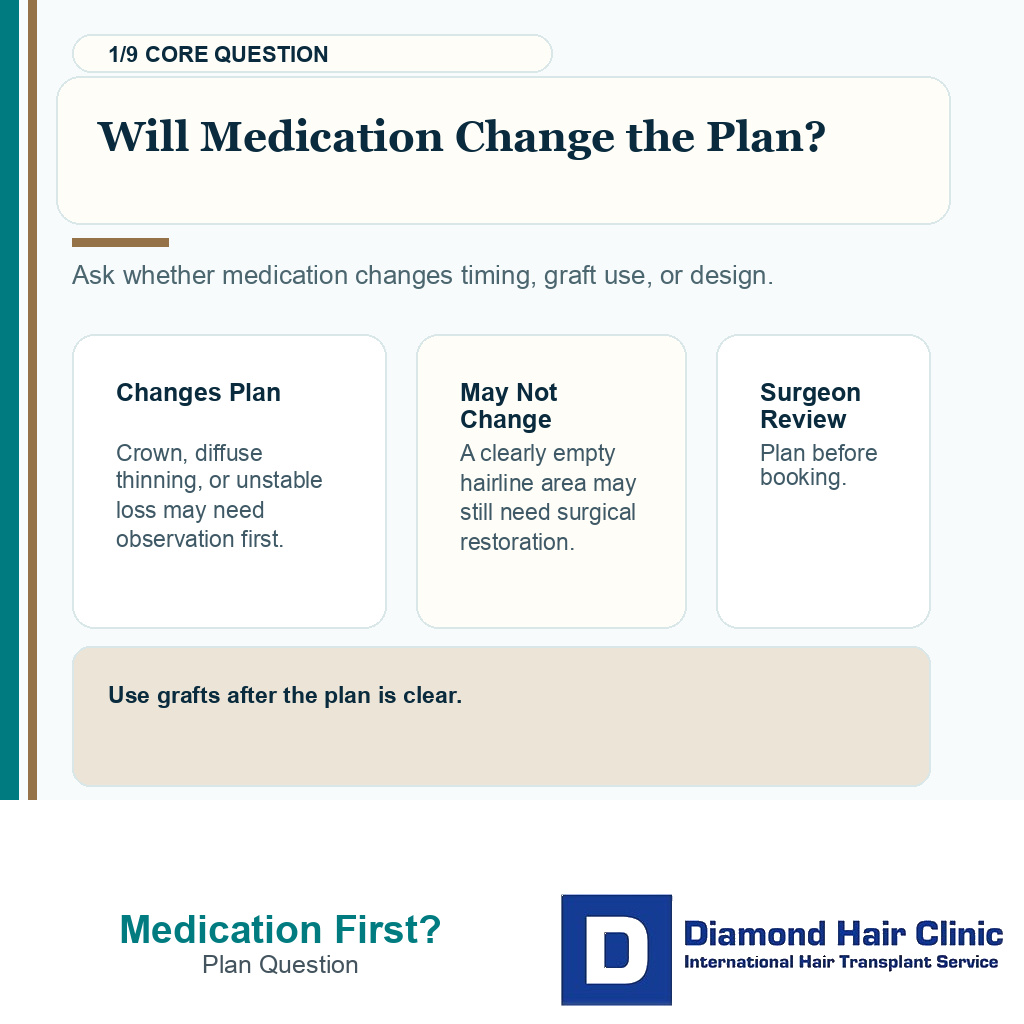
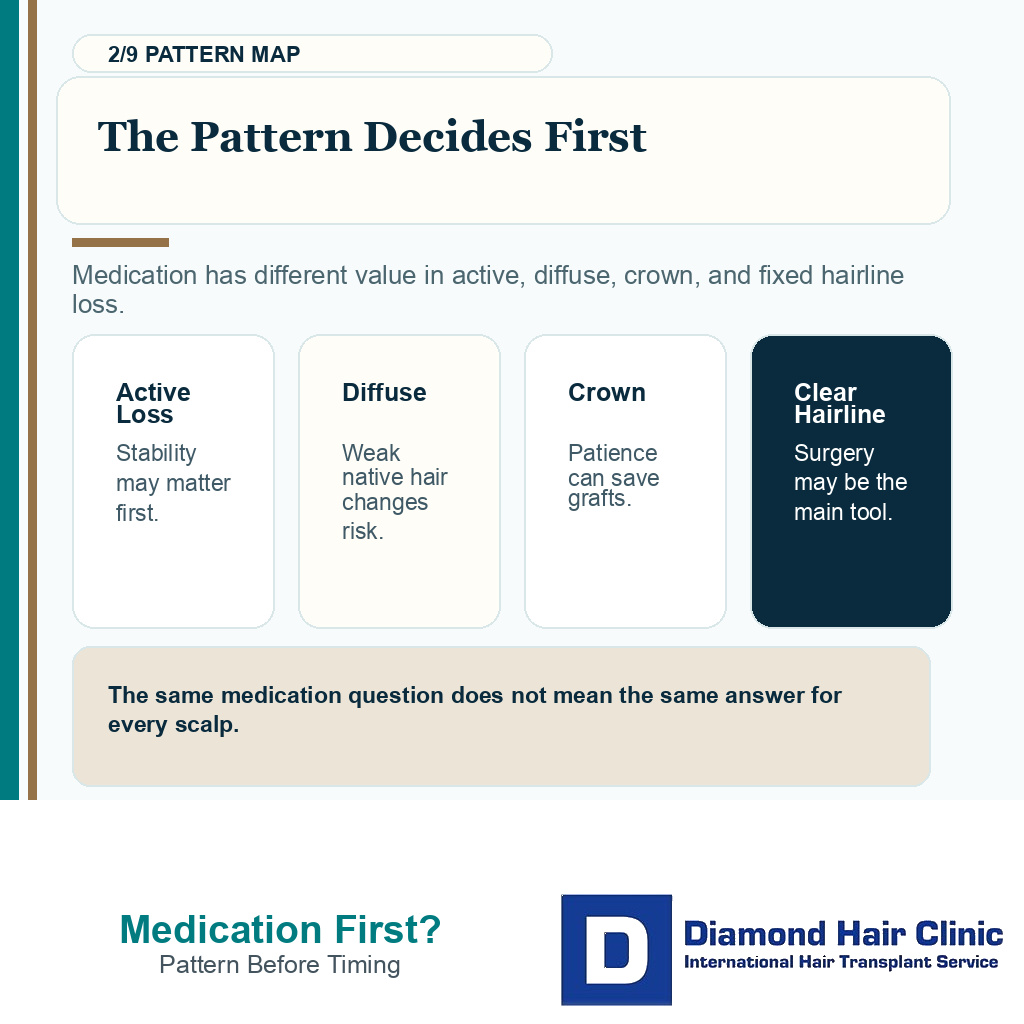
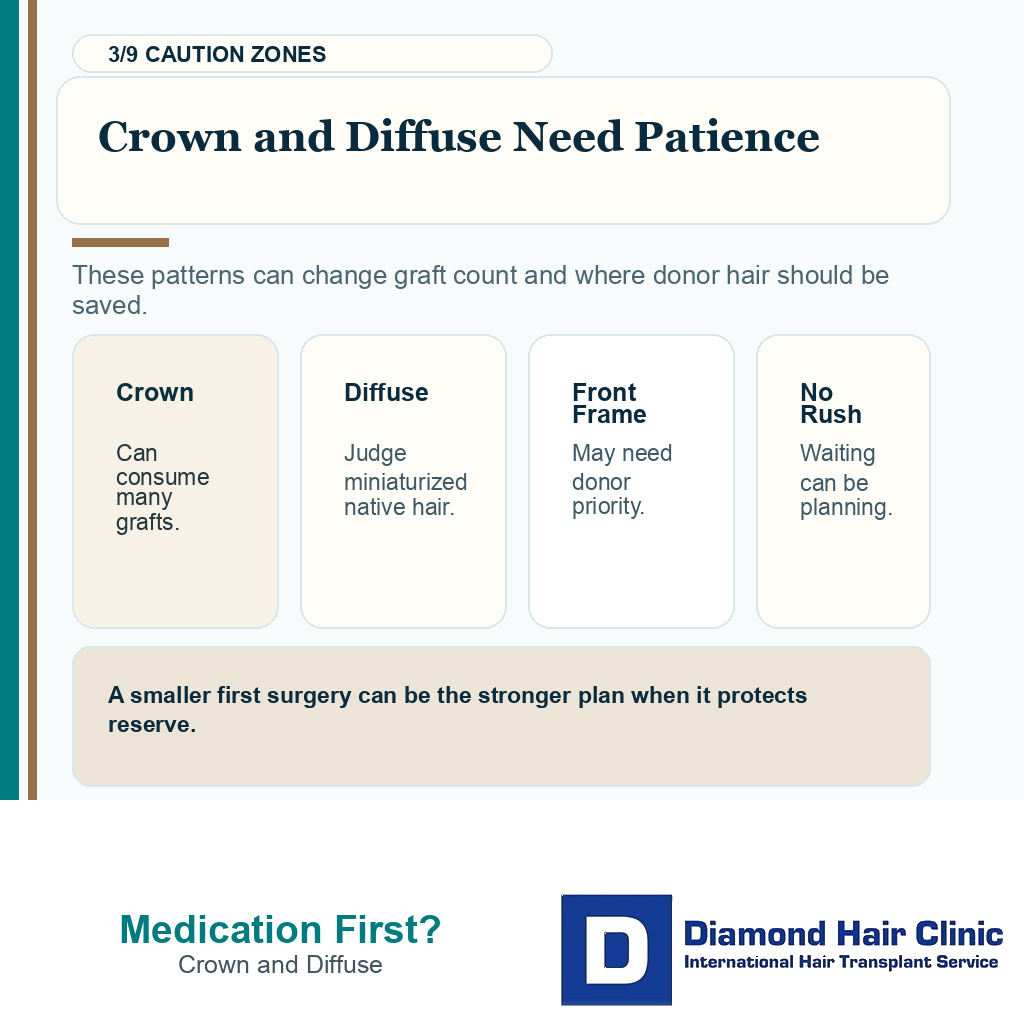
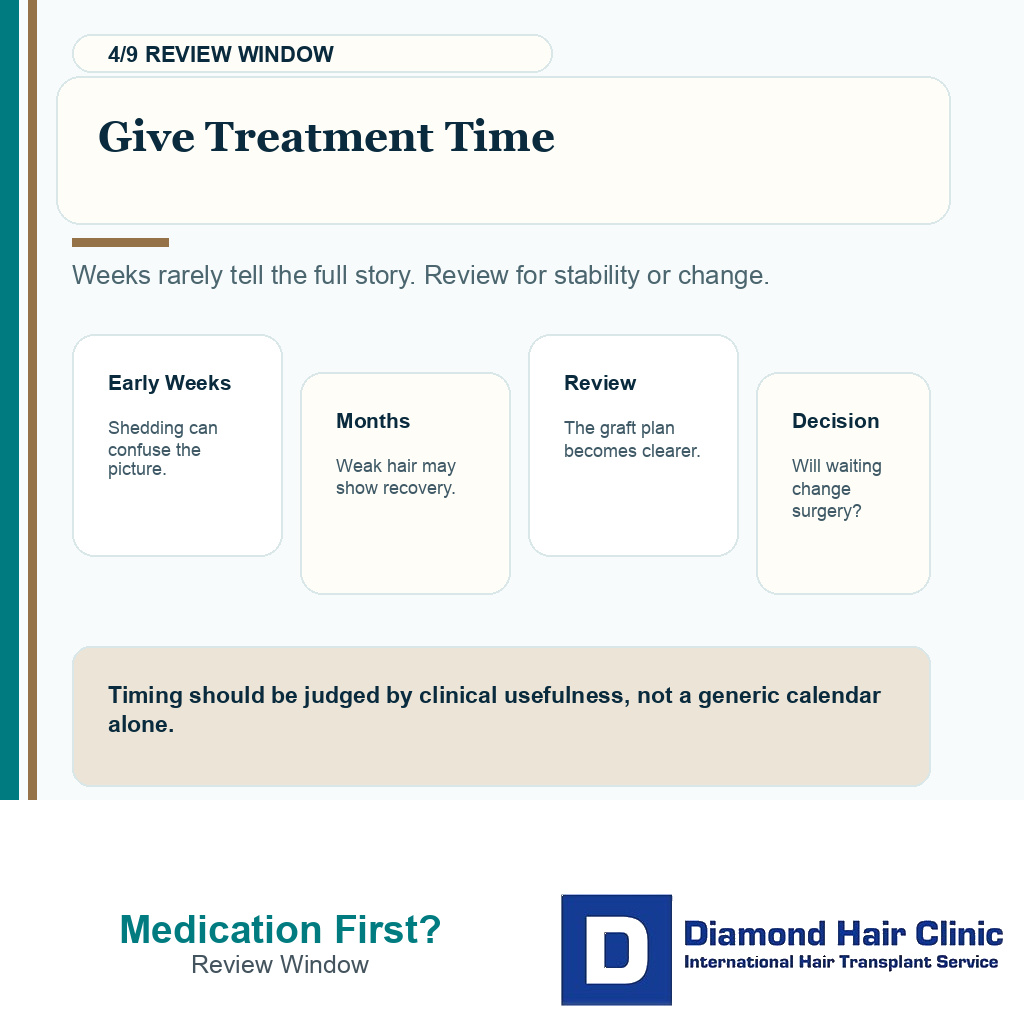
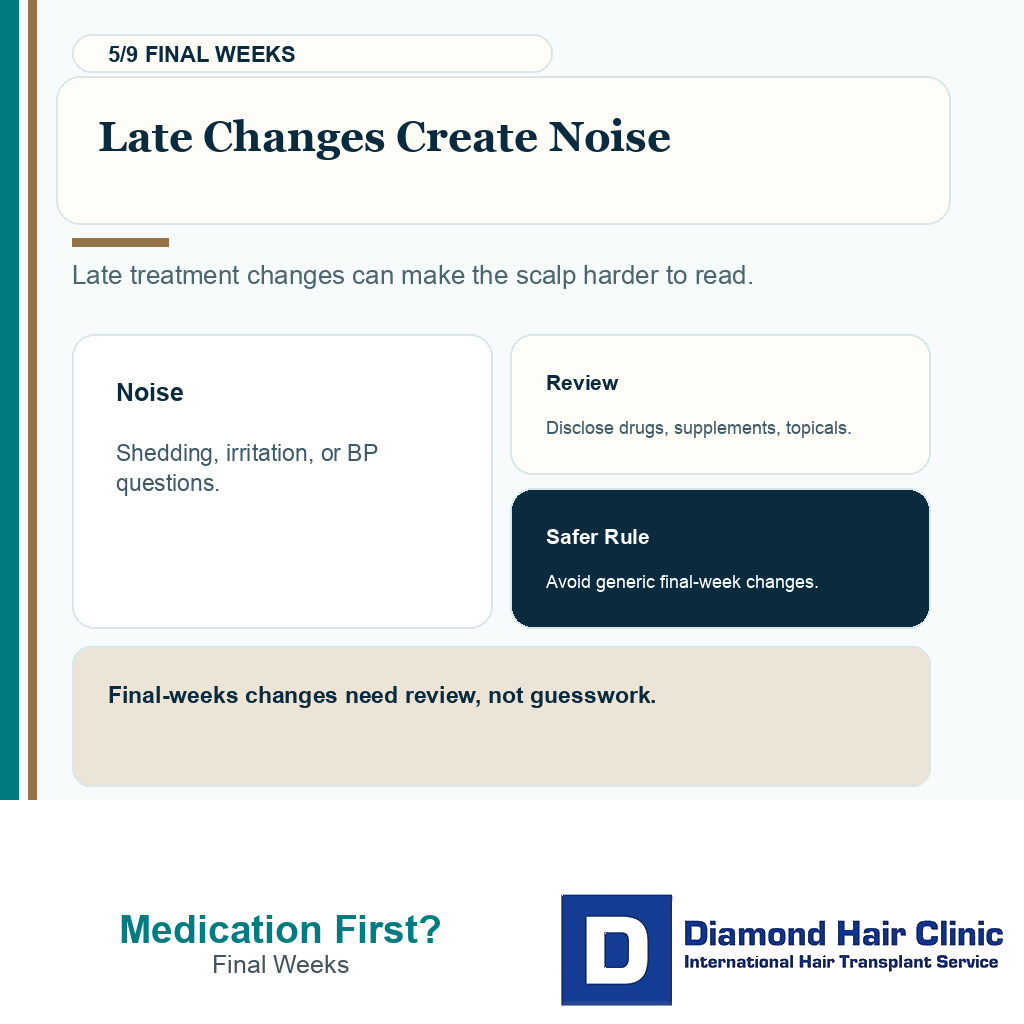
Use the 9 planning slides below to see when medication may change the surgical plan, when waiting can help, and when surgery can still be reasonable. Swipe the carousel, use the arrows for one step at a time, or choose a number below the image to jump to that point.


The time medication needs before it can change the plan
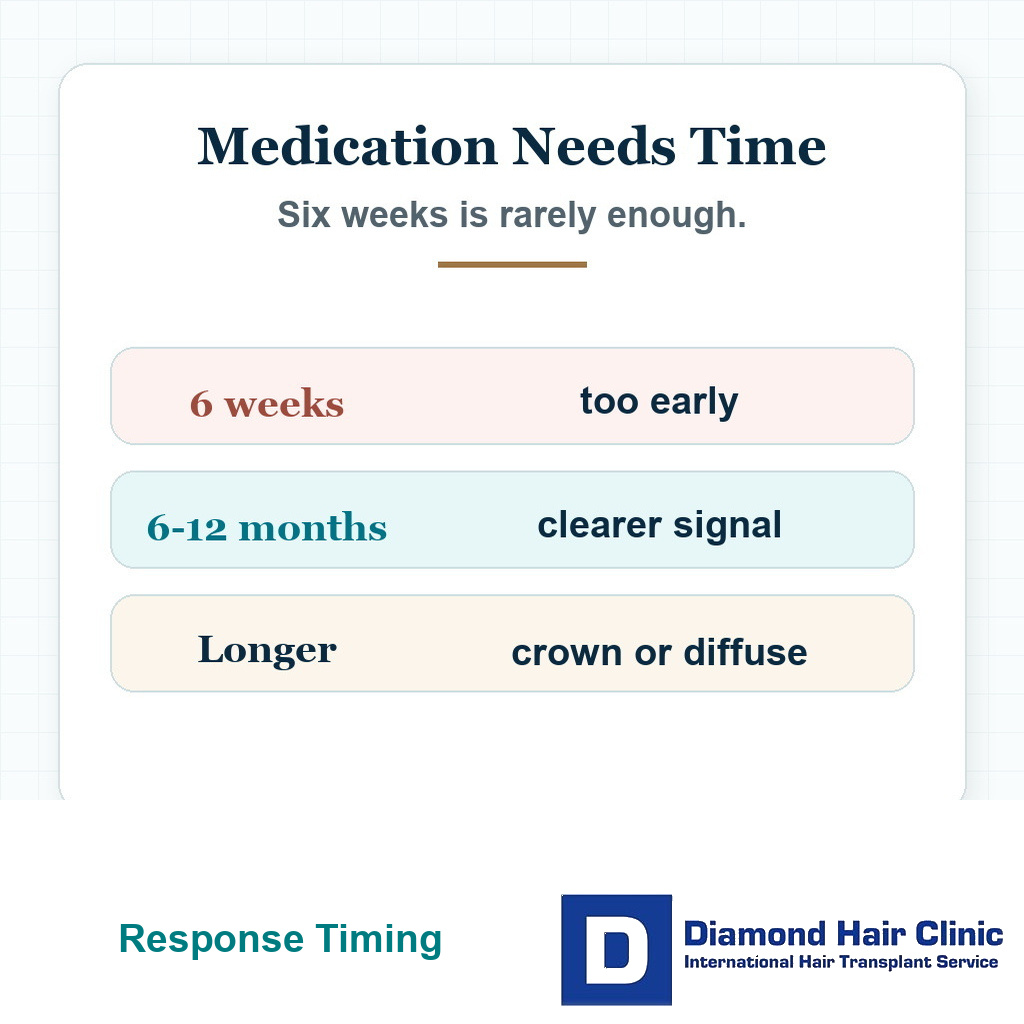
A few weeks is rarely enough to judge medication response. Hair grows slowly, and the scalp does not reveal its full pattern immediately.
When finasteride, dutasteride, minoxidil, or a combination plan is being used under medical guidance, the plan needs enough time to show whether temporary shedding settles, whether miniaturized hair improves, and whether the loss pattern becomes more stable.
Six weeks usually tells me very little. For many patients, 6 to 12 months gives a more useful picture, and crown or diffuse thinning may need longer before the plan is clear.
If you have already used finasteride for years, a request to try dutasteride or add minoxidil should not be treated as a generic rule. The first question is what problem the surgeon is trying to solve. Is the crown still moving, is there diffuse miniaturization, is the hairline plan aggressive, or is the medication history unclear?
Changing medication only makes sense when it has a clear reason, a prescribing doctor, a side effect plan, and a review point. If the empty hairline already needs surgical rebuilding, waiting should support a safer design, not turn into a refusal with no clear end point.
If hair looks worse after changing from finasteride to dutasteride, tablet strength is only one part of the decision. I need enough stable time, photos, and side effect review before I can judge whether surgery is being planned around ongoing hair loss rather than a settled medication response.
Not everyone needs to wait one full year before surgery. If the hairline recession is clear, the donor area is strong, the age and pattern are suitable, and the role of medication is understood, surgery may still be reasonable earlier.
The practical detail is not the calendar alone. It is whether the waiting period will change the plan.
If medication is likely to change the crown, improve the middle scalp, or reveal whether the hair loss is aggressive, waiting can be valuable. If the area is already clearly lost and the rest of the pattern is stable, waiting may not change much.
Topical minoxidil around the operation period is a separate timing issue, and stopping minoxidil before a hair transplant needs its own timing decision.
Discuss medication timing with the treating doctor. Stopping, starting, or changing treatment without guidance can create unnecessary shedding, confusion, and anxiety. This is especially important for prescription drugs, supplements, blood thinners, and anything that can affect bleeding or blood pressure.
Make a separate note for recent changes, not only current medicines. A tablet stopped last week, a new supplement, a switched brand, or a missed dose can explain a confusing baseline better than the medication list alone.
One reason this becomes confusing is that early shedding from treatment can look frightening. If you do not expect that possibility, you may stop too early and never learn whether the medication could have helped.
In practice, follow up matters. You should not be left alone to interpret every hair in the sink as failure or success.
Starting new medication just before surgery needs caution
Sometimes, but late decisions need caution. Starting a new medication only a few weeks before surgery can create early shedding, side effects, or uncertainty at the same time we are trying to read the real hair loss pattern.
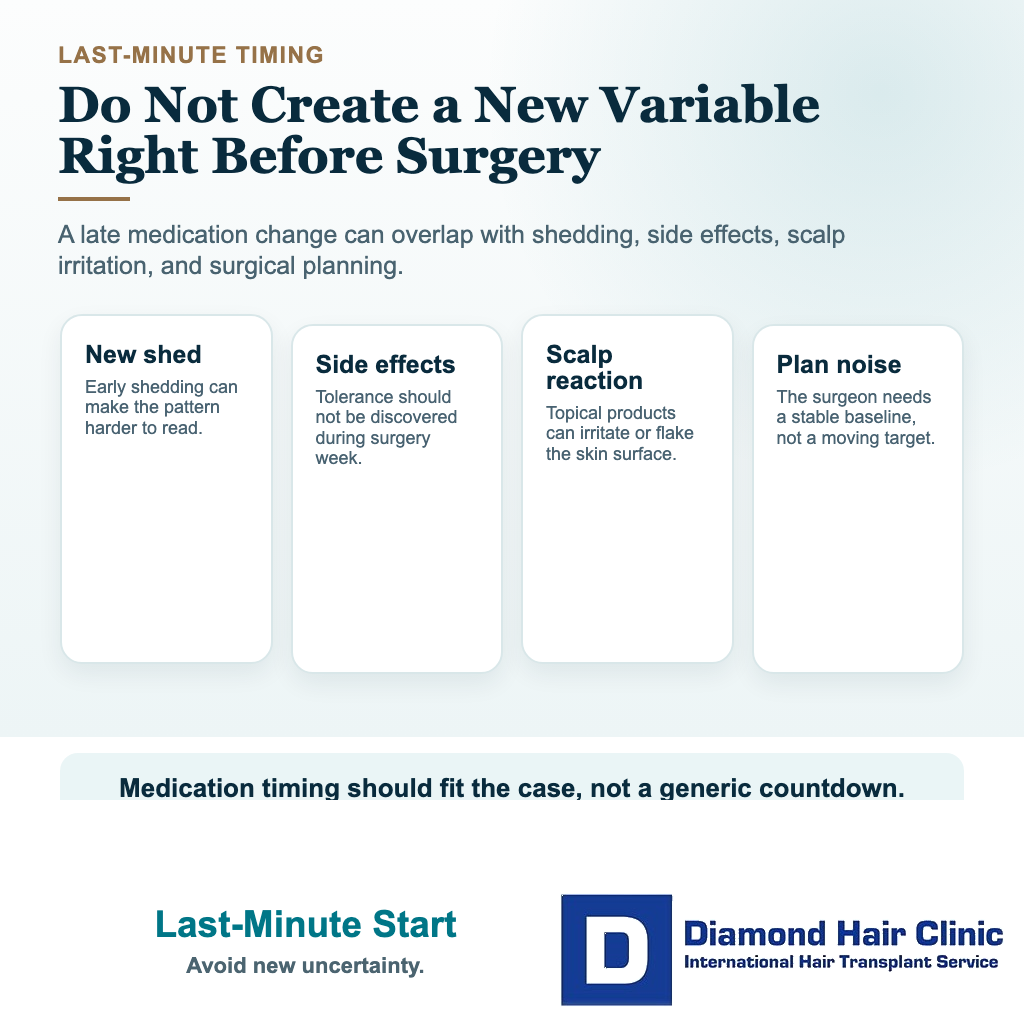
If surgery is already close and the surgical area is clearly empty, starting immediately before the operation may not change the graft plan very much. If there is diffuse thinning, crown thinning, or active miniaturization, a planned treatment period can be more useful.
Finasteride, dutasteride, topical minoxidil, oral minoxidil, supplements such as biotin before FUE, and other medicines do not all have the same surgical meaning. Some are mainly about protecting native hair. Some may need timing adjustments around surgery. Some matter because of general medical safety.
I also do not want a patient to accept a surgical design that depends on a medication plan he has not yet tolerated or is unlikely to continue. If the donor use, hairline height, or crown coverage only makes sense on the assumption that treatment will work perfectly, the plan needs to slow down. Planning a hair transplant without finasteride should be direct, not hidden inside optimism about medicines started at the last minute.
Do not start or stop medication in the final weeks before surgery only because you read a generic timeline. The timing should fit your scalp, your medical history, your medication tolerance, and the operation being planned. If the question is kratom use before surgery, disclose the pattern rather than stopping suddenly or hiding it.
Surgery can still be the better answer in selected cases
Surgery may still be the better answer when the cosmetic problem is structural. By structural, I mean an area where the hair is clearly gone, or where the hairline shape cannot be restored by thickening existing miniaturized hair.
Empty temple corners may still need hairline reconstruction even if medication is useful. A naturally high forehead with clear recession may not receive the facial framing you want from medication alone.
In these cases, medication can support the surrounding hair, but surgery creates the new shape. The surgeon still has to design the hairline carefully, choose the right grafts, control the direction, and protect the donor reserve.
Some stable scar related cases or traction related cases are different when the loss has not progressed for a long time. If there is no active disease and the donor is suitable, medication may not be the main solution.
But even when surgery is the main answer, medication can still influence the long term plan. It may protect the native hair behind the transplanted zone. It may reduce the chance that the transplant becomes isolated later.
Younger patients need this caution most. The desire to fix the hairline quickly can be strong, but the surrounding hair may still be changing. If the surgeon ignores that, the result may look good in the beginning and strange later.
You need to know whether you are too young for a hair transplant before treating surgery as an ordinary cosmetic appointment. Age is not the only factor, but it changes how I think about risk.
A good operation has to do more than fill an empty area. The placement should still make sense as you continue to age.
There is another side to this. Some people wait too long for medication to do something it cannot do. If the hairline has been empty for years, continuing to wait for full restoration may create frustration without changing the surgical need.
Then, the responsible answer may be measured surgery with realistic support for the native hair, not endless delay.
Diffuse thinning needs a different decision
Diffuse thinning before FUE is one of the situations where medication before surgery can be especially important. The scalp may still contain many weak native hairs between the areas you want to fill.
If those hairs are miniaturized and unstable, transplanting between them needs careful judgment. The recipient area must be able to accept grafts without damaging native hair or creating an unnatural pattern.
Medication may reveal whether the weak hair can recover enough to reduce the need for surgery. It may also show whether the loss is still active and whether native hair is likely to keep thinning after the transplant.
Not every person with diffuse thinning needs to avoid surgery. Some can benefit from a careful plan. But the risk profile is different from a clear empty temple or a stable frontal recession.
In diffuse cases, the natural wish is density everywhere. But the donor area cannot safely chase every weak area at once.
If medication improves some areas, grafts can be prioritized more intelligently. If it does not help and the pattern remains unstable, I may choose a smaller plan, use a more conservative density target, or delay the operation.
A diffuse thinning hair transplant requires more than counting grafts. I have to judge the native hair that is still present, not only the areas between it that look empty.
When diffuse thinning is handled poorly, the result may look thin even after many grafts. The weakness may not be the number alone. It may be that the biology, spacing, and distribution were not respected.
Diffuse thinning combined with a desire for very dense packing needs extra caution. You may see a thin area and naturally want density, but blood supply, existing hair, and future loss all have to be considered.
If medication can strengthen part of the native hair first, the transplant does not have to fight every weakness at once.

Crown planning often needs more patience
The crown is one of the most tempting areas to treat too early. Thinning from above or in photos can feel very exposed, but crown planning needs careful judgment.
The crown can consume a large number of grafts because the swirl pattern spreads in a circular way. Even a moderate looking crown can require many grafts for strong visual coverage.
If you are young or still losing hair in the front and middle scalp, spending too many grafts in the crown can create problems later. The frontal area may need those grafts more in the future.
Medication can be especially useful in crown planning because the crown sometimes responds better than the frontal hairline. If the crown thickens enough, surgery may be delayed, reduced, or planned for a later stage.
Medication will not fix every crown. But if there is still meaningful miniaturized hair in the crown, using a large number of grafts there too early deserves careful thought.
If you are considering crown surgery, I judge crown hair transplant differently from the frontal hairline.
The crown is not only a bald spot to fill. It is a long term donor strategy decision.
If medication can buy time in the crown, that time may protect your future options.
The crown also teaches an important lesson about expectations. A modest improvement there may be more satisfying than expected, especially if the front is strong. But chasing a perfectly dense crown can consume the donor area very quickly.
I usually protect the front and frame first unless the pattern and donor supply clearly support a crown plan. Medication can help decide whether that crown plan should happen now, later, or not at all.
Planning when finasteride is not possible
Some people cannot tolerate finasteride. Some are afraid of possible side effects. Some simply do not want to take it. I do not believe they should be mocked, pressured, or dismissed.
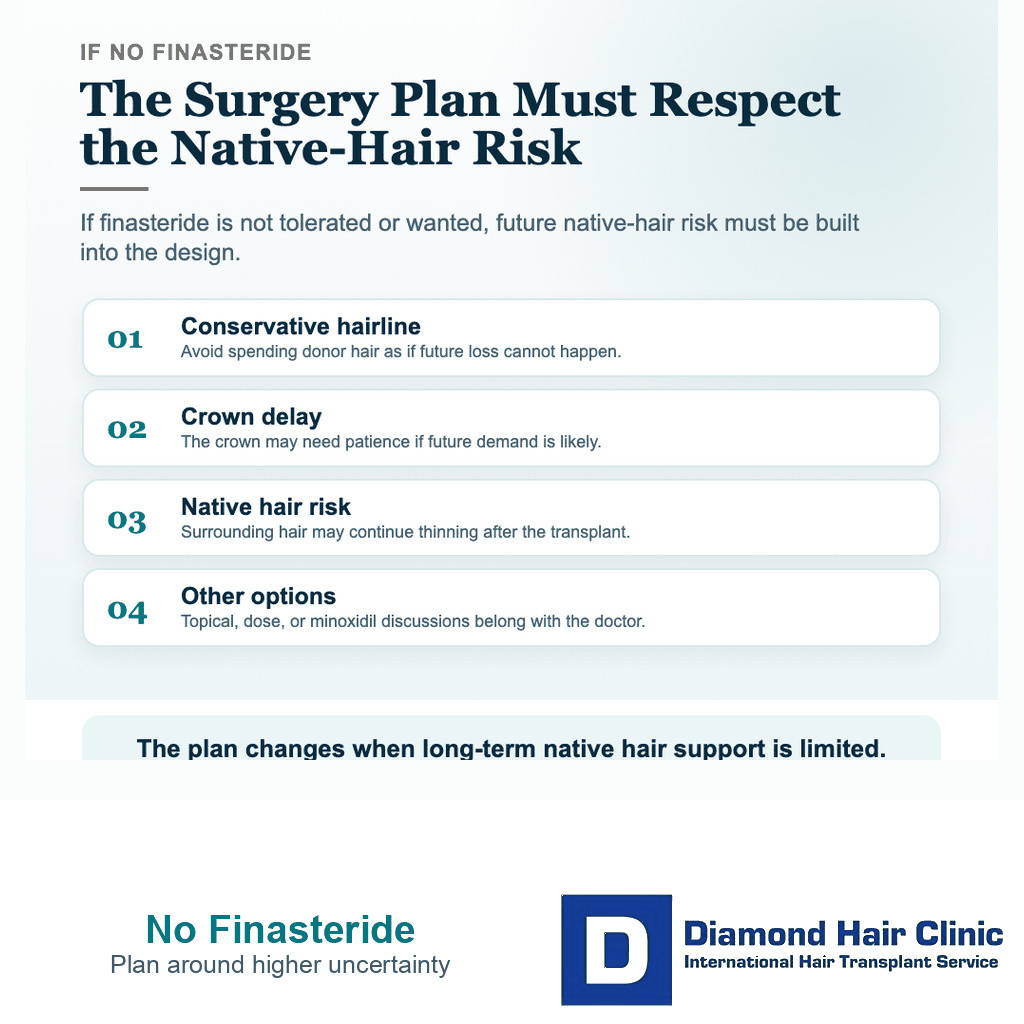
But the surgical plan must respect the reality of that choice. If you will not use a DHT blocking medication, the risk of future native hair loss may be higher for many men. That does not simply forbid surgery, but it changes the design.
That may mean a more conservative hairline, avoiding aggressive density in a zone that could need support later, delaying crown work, or accepting that future surgery could be needed if native hair continues to thin.
Other options may be discussed with the appropriate doctor, including topical approaches, different dosing strategies, minoxidil, or other supportive treatments. Finasteride before or after a hair transplant involves timing, tolerance, and native hair risk. None of these decisions should be made casually from fear, pressure, or online panic.
It is also important to understand what medication can and cannot do. Minoxidil can support growth and thickness in some people, but it does not address androgen sensitivity in the same way as finasteride or dutasteride. Finasteride and dutasteride may help slow the process in suitable male patients, but not everyone tolerates them or wants them.
This should be an individualized conversation. You should not accept a medication you fear without understanding it. You also should not reject all medical support without understanding the surgical consequence.
The broader page on medications after hair transplant may help you understand why this conversation often continues after surgery. The point is not selling pills. It is protecting native hair around the transplant.
You have the right to say no. My responsibility is to explain what that no means for the surgical plan.
Fear should be handled with a doctor, not with silence. If you had a side effect before, have anxiety about medication, or have another medical condition, the answer should be individualized. A history such as cancer treatment or scalp radiation also needs stable medical context before surgery, because skin healing and the reason for treatment can change the answer.
The worst approach is pretending the issue does not exist and then planning an aggressive transplant as if the native hair will remain unchanged forever.
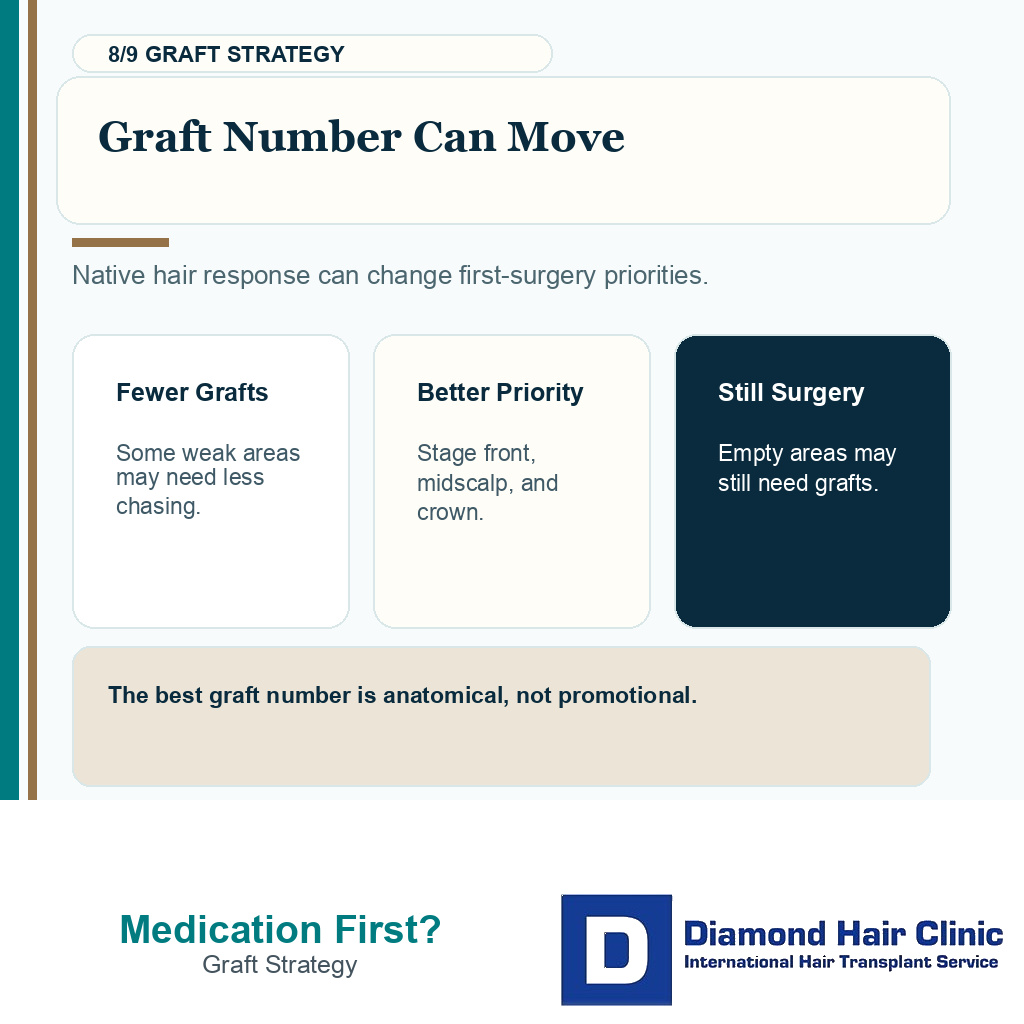
Medication can change the graft number in some plans
Medication can change the graft number in several ways. If the crown improves, fewer grafts may be needed there. If the middle scalp thickens, the plan may focus more on the hairline. If the native hair stabilizes, the operation may become more predictable.
Sometimes medication does not reduce the graft number much, especially when the frontal loss is already established. Even then, it can protect the hair behind the transplanted area.
A final graft number should not be decided too early from a few photos when medication has just started. A photo shows the current appearance. It does not always show what the hair may look like after several months of stabilization.
A smaller surgery is not necessarily weaker. If medication protects native hair and grafts are used where they matter most, a smaller and more strategic operation can sometimes look better than a larger rushed one.
Many people think the strongest plan is the one with the highest graft number. A good plan uses the right number of grafts for the right reason.
Medication planning belongs next to graft planning. Calculating the graft number for a hair transplant must come from anatomy, not from marketing. If the quote depends on a new medication plan working perfectly, I treat the number as provisional rather than final.
If medication changes the anatomy, the surgical number may change too. That is not indecision. It is good planning.
Two people with similar photos can receive different recommendations. One may already be stable on treatment. Another may still be losing hair quickly. One may have thick donor hair. Another may have fine hair and less coverage per graft.
A graft number without context is not a plan. It is only a number.
Choosing between medication first and surgery now
The decision starts with the pattern. If the hair loss is early, unstable, diffuse, or mostly mainly in the crown, medical stabilization becomes more important before surgery.
If you are young, the margin for error is smaller. A young patient may have many decades of future hair loss ahead. The first surgery should not spend donor hair as if the future does not exist.
If the hairline loss is clear, the donor area is strong, expectations are realistic, and the future has been discussed, surgery may be reasonable. Even then, medication may still be part of protecting the surrounding native hair.
If medication cannot be tolerated, I do not reject the case by that fact alone. The plan changes. The uncertainty has to be explained, and the design usually becomes more careful with the donor area.
The practical distinction matters. Medication first is useful when it can change the decision. Surgery now is reasonable when the area truly needs surgical restoration and waiting is unlikely to improve the plan enough to matter.
There is no pride in rushing. There is also no virtue in delaying forever. The right decision protects the donor area, respects the biology, and gives you a natural result that can age well.
The priority is not operating as soon as possible. The priority is operating when the plan is clear enough, medically safe enough, and realistic enough to age well.
If a few months of medical stabilization can protect years of surgical options, I consider that time well spent.

Read this review excerpt
Every single one of my questions was answered and they made sure I had all the details I needed to make an informed decision.