


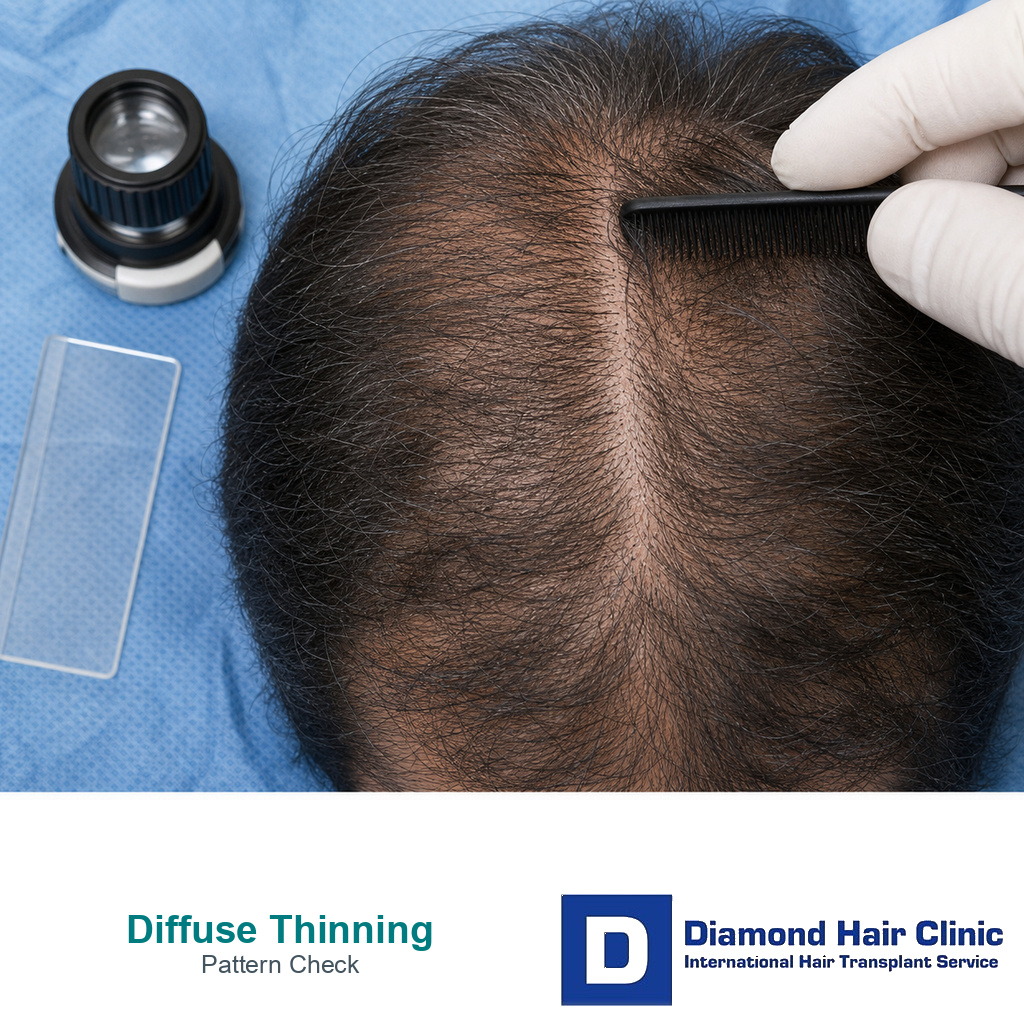
Can Diffuse Thinning Be Fixed With a Hair Transplant?
Sometimes, but not every type of diffuse thinning is safe to transplant. I do not start by asking how many grafts can be added. I first check whether the thinning is stable, whether the donor supply is truly safe, and whether the hair that is still present can be protected.
Method choice comes after the diffuse diagnosis. DHI or FUE can change the placement workflow, but donor stability, native hair strength, scalp health, and treatment history decide whether grafts belong between existing hairs.
Diffuse thinning is different from a clear bald temple or a clean receding hairline. The scalp may look thin, but it is often still full of living native hairs. Some of those hairs are useful. Some are miniaturizing. Some may improve with treatment, and some may continue to weaken. If we do not separate these groups before surgery, a transplant can spend donor grafts without solving the real problem.
A diffuse case should not become a density shopping trip. The plan starts by separating hairs strong enough to keep, hairs that may improve with treatment, and zones that truly need grafts.
Different Norwood labels often reflect different judgments. One surgeon may be describing the hair that is still present today, while another may be planning around the loss pattern that is likely to appear later. For transplant planning, the future pattern usually matters more than the label itself.
Diffuse thinning cases should start with diagnosis. A transplant may help selected patients with stable diffuse patterned loss. Stable thinning on the top or frontal frame is not the same as diffuse thinning that reaches the donor, nape, or sides. In women, medical, hormonal, and donor stability have to be reviewed before density or hairline goals lead the plan. It may be a poor choice when the hair loss is active, medical, inflammatory, related to shedding, or when the donor area shows retrograde alopecia or DUPA. In those cases, the medical answer may be treatment, observation, a smaller plan, or being declined for hair transplant for now.
How do I evaluate diffuse thinning before surgery?
When I see diffuse thinning, I do not treat the photos as a graft request before diagnosis and donor safety are clearer. I first try to separate male pattern recession, donor miniaturization, diffuse unpatterned thinning, temporary shedding, medical causes, and scalp disease. These situations can look similar in photos, but they do not carry the same surgical risk.
If the thinning is unstable, donor hair is miniaturizing, or the diagnosis is not clear, I do not want the patient to travel for a fixed graft number or a fixed calendar date. An important event, deposit, or clinic slot should not override medication response, donor safety, and zone priority. The safer step may be medication, blood work, scalp treatment, better photos, an in person examination, or waiting until the pattern is clearer.
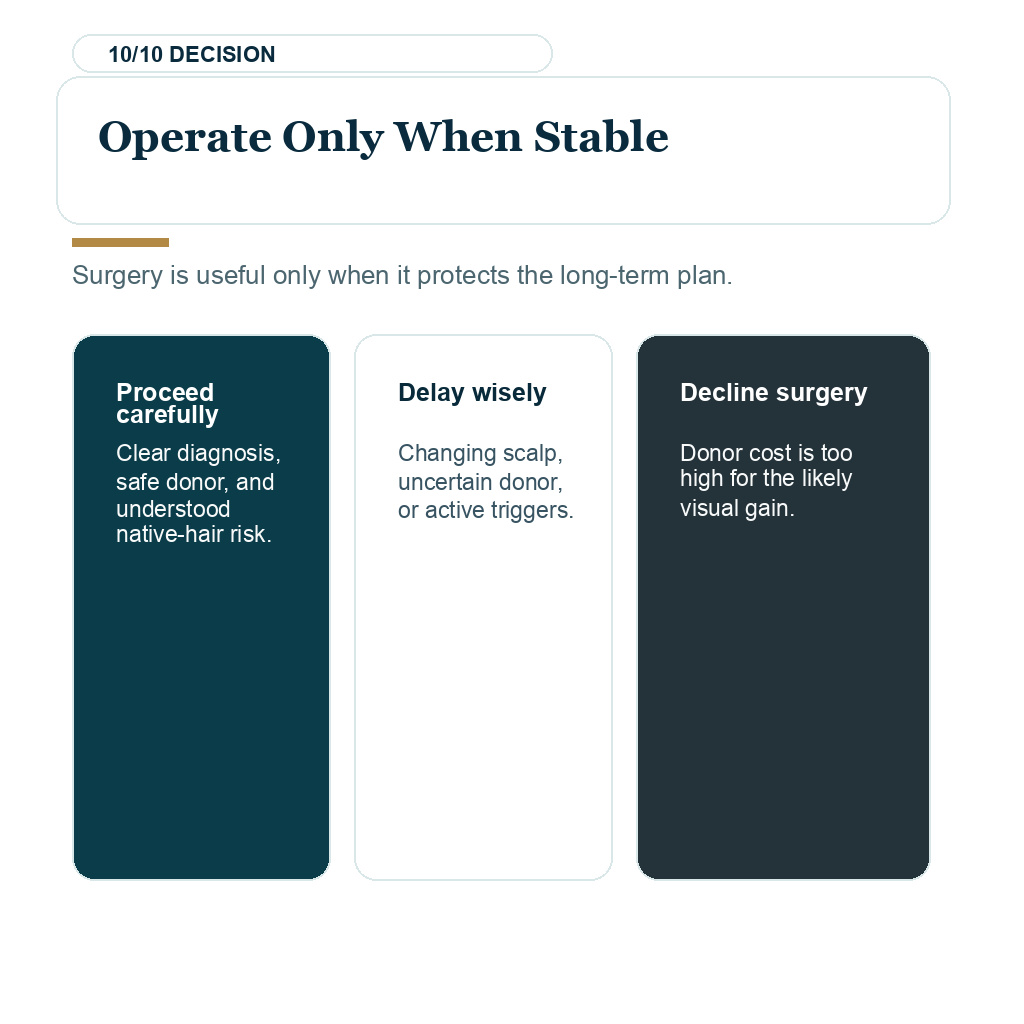
Before surgery is accepted, the written plan should say what diagnosis is being treated, which area has priority, what donor limit was seen, and what would make me reduce, delay, or refuse the operation. Diffuse thinning is a page where saying no can protect the patient more than agreeing quickly.
When should diffuse thinning stop the surgery plan?
Some diffuse thinning cases should not be converted into a graft count. I stop when the diagnosis is unclear, the donor shows miniaturization, shedding is still active, inflammation or scarring is suspected, or the patient wants density spread across a surface the donor cannot support.
The question I ask is not only whether grafts can be placed. I ask whether the native hair will survive the trauma, whether the grafts will still look useful if nearby hair thins, and whether the donor hair itself is stable enough to move.
Patients traveling from abroad need that answer before travel. If the safer path is blood work, scalp treatment, medication, better photo tracking, or an in person diagnosis before committing to surgery, the plan should say that plainly.
Diffuse thinning is harder to plan safely
In a clear recession case, the surgeon can usually see where the empty scalp begins. In diffuse thinning, the weak area and the useful native hair are mixed together. That makes the operation more delicate. The aim is to improve coverage without damaging the hair the patient still has.
Diffuse thinning becomes risky at this point. If the visible scalp is treated as an empty surface, the plan can become too aggressive. Dense placement between weak native hairs can increase trauma, shock loss, and disappointment. A careful plan asks whether the existing hair is strong enough to tolerate surgery and whether the result will still make sense if some native hair continues to thin.
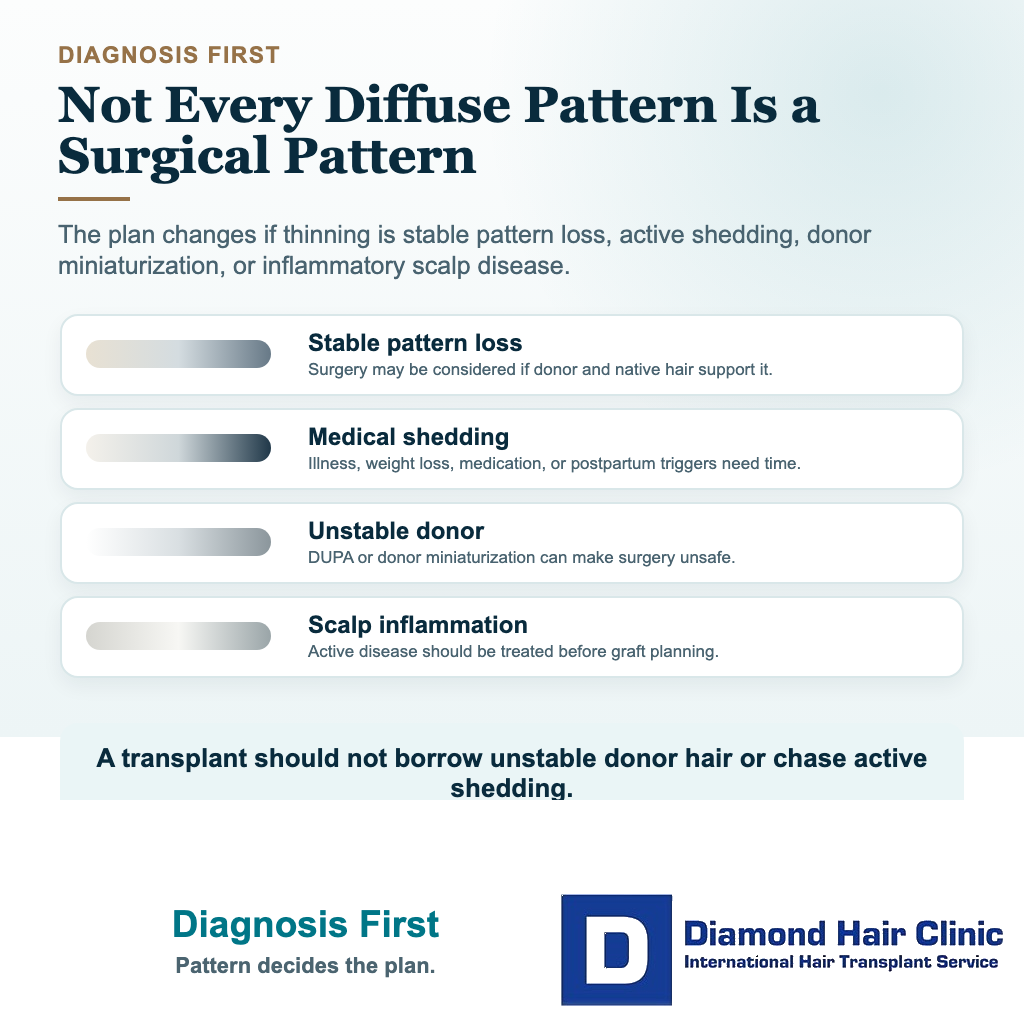
Diagnosis comes before a graft plan
Diffuse thinning is not one diagnosis. It can be diffuse patterned androgenetic alopecia, telogen effluvium, thyroid shedding, postpartum shedding, nutritional loss, inflammatory scalp disease, medication related shedding, female pattern hair loss, donor miniaturization, DUPA, retrograde thinning, or more than one issue at the same time.
These conditions do not all have the same surgical answer. A stable patterned case may be suitable for careful FUE planning. A moving shedding problem may need time and medical workup before surgery. A donor area with diffuse miniaturization may make surgery unsafe because transplanted hair is only as reliable as the donor it comes from.
When the diagnosis is unclear, I pause the operation rather than guess. Magnification, donor assessment, medical history, blood work when relevant, and sometimes a scalp biopsy before a hair transplant can protect the patient from using grafts in the wrong situation.
Diffuse thinning behaves differently from a receding hairline
A receding hairline usually gives a clearer border. The hairline can be designed, the frontal zone can be measured, and density can be planned around a visible edge. Diffuse thinning removes some of that clarity.
The patient may ask for density everywhere because every area looks a little weak. But spreading grafts thinly across the whole scalp often gives a weak visual result and spends donor reserve quickly. I then ask which area gives the most useful improvement while protecting the long-term plan.
For many patients, that means the frontal frame receives priority and the crown or mid scalp is watched, treated medically, or planned later. For others, surgery should wait because the pattern is still changing too quickly.
Native hairs change the surgical risk
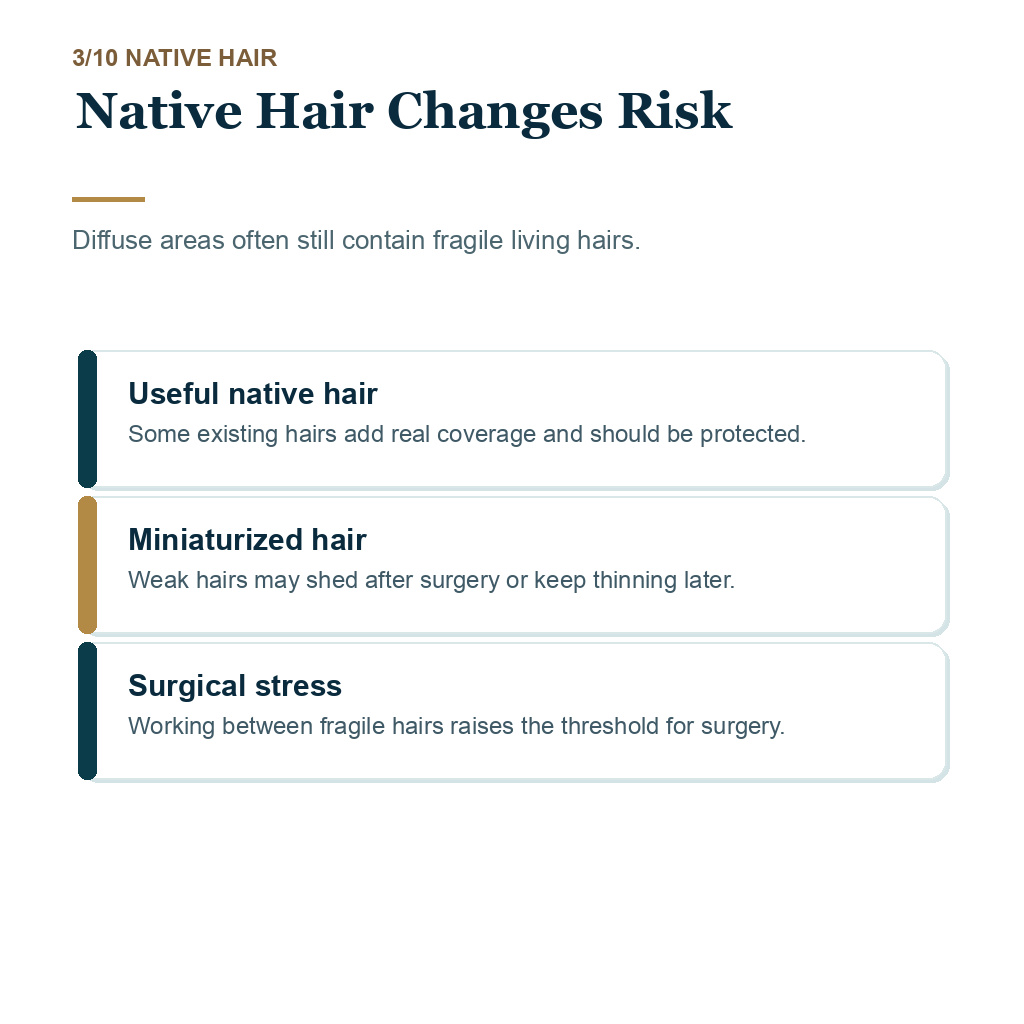
Native hairs are not background detail. They are part of the final result. In diffuse thinning, the surgeon works between these hairs, so angle, depth, spacing, incision control, blood supply, and trauma all matter more.
Strong native hair usually tolerates surgery better. Very miniaturized hair is less predictable. A transplant may grow, but if the surrounding weak hair continues to disappear, the result can still look thinner than expected. That is not always failed graft growth. Sometimes it is a transplant placed into a scalp that was biologically unstable.
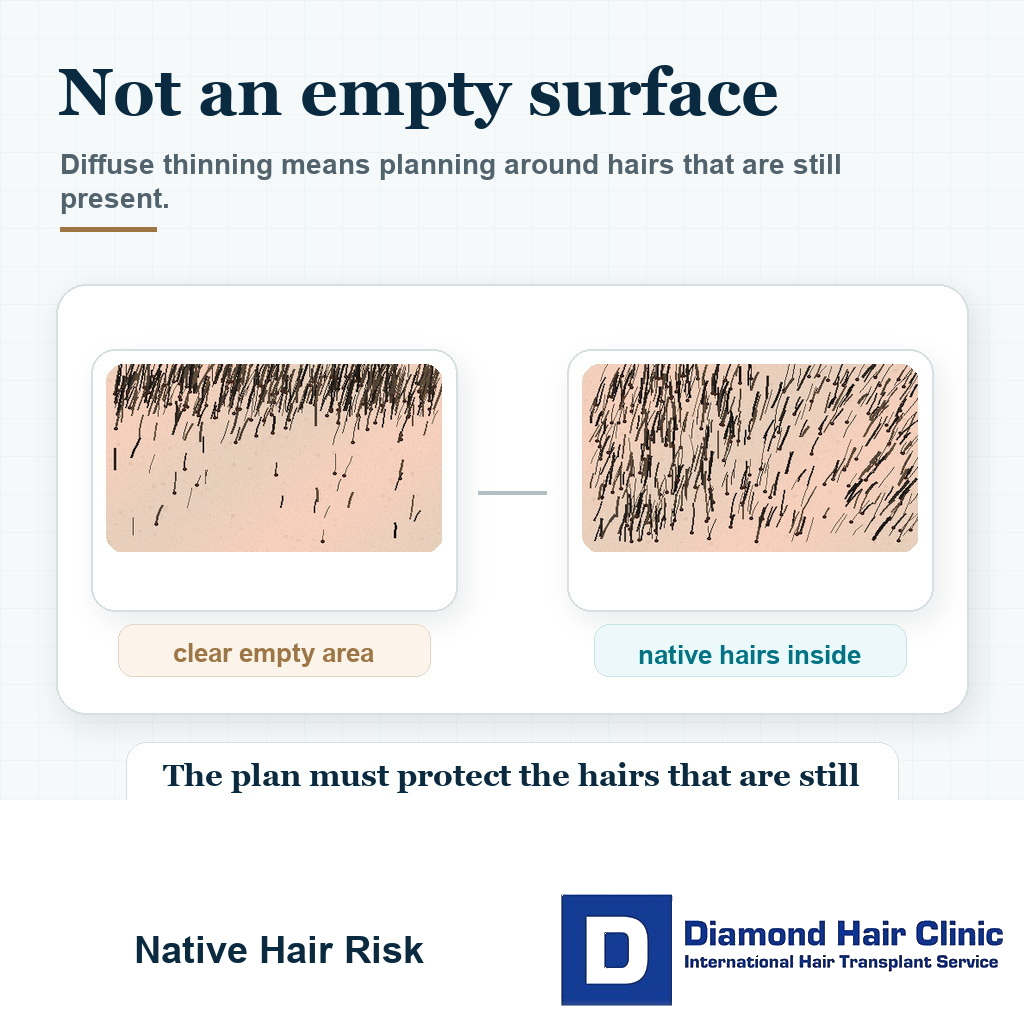
Shock loss risk matters in diffuse thinning
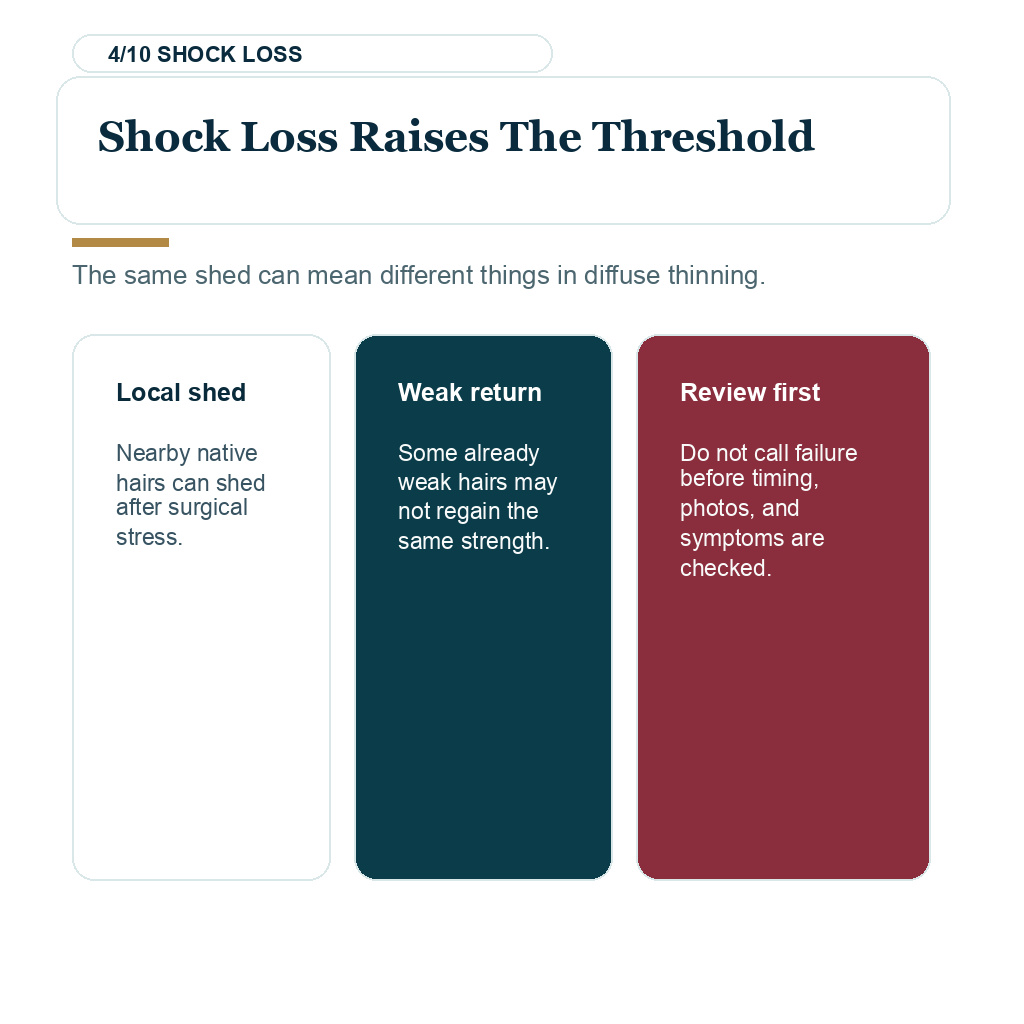
Shock loss means nearby existing hairs can shed after the stress of surgery. In diffuse thinning, there may be many fragile native hairs inside the recipient area. Some hairs recover. Hairs that were already close to disappearing may not return as strongly.
I explain native hair shock loss after a hair transplant before surgery, not after the patient becomes anxious. The clinical difference is simple. Transplanting into empty scalp is not the same as transplanting between weak living hairs. The second situation needs a higher threshold for surgery.
If the native hair is too unstable, I reduce the plan, delay surgery, or discuss treatment first rather than create a result that depends on weak hairs surviving perfectly.
The donor area can make surgery unsafe
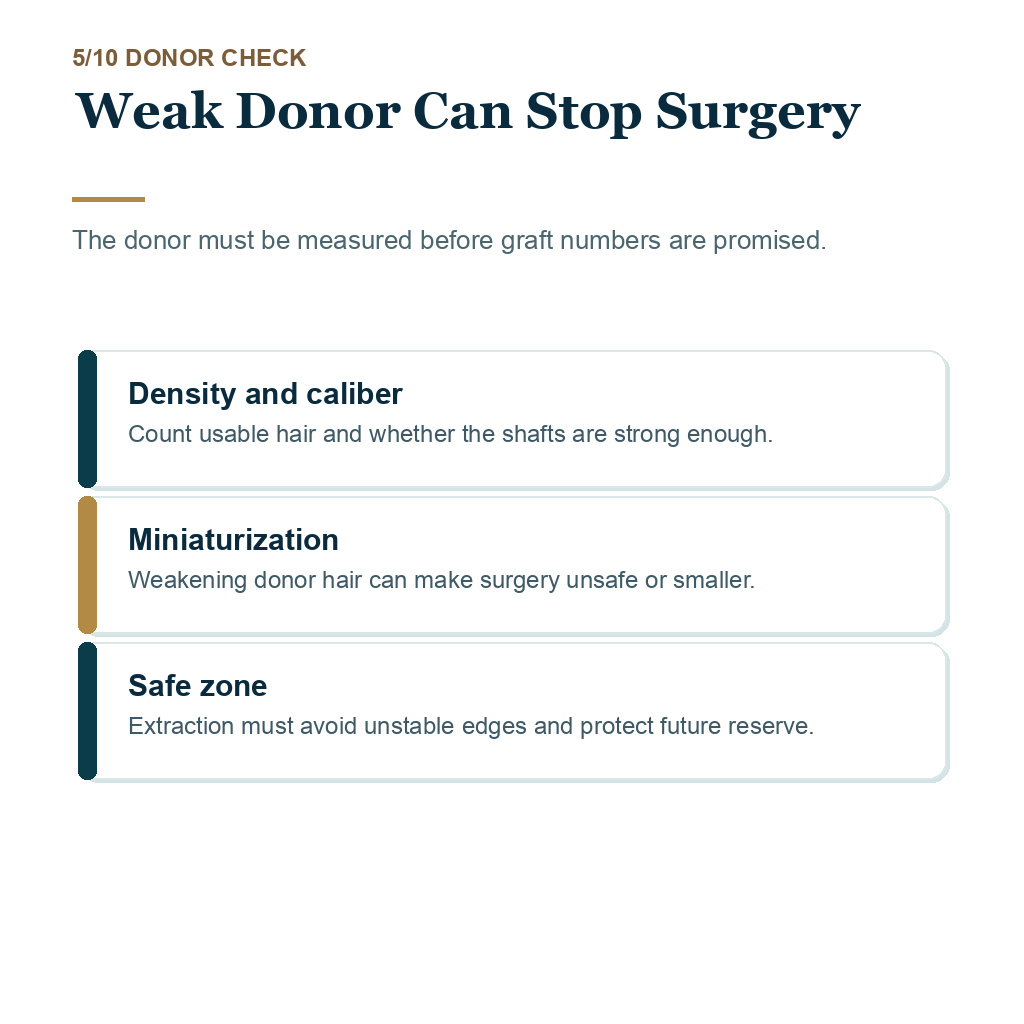
Donor supply limits the whole operation. In diffuse thinning, I do not assume the donor is safe just because it is at the back of the head. The donor must be checked for density, caliber, miniaturization, retrograde thinning, scars, and whether the safe zone is wide enough for the plan.
Donor miniaturization before hair transplant changes the surgical calculation. If the donor hair is also weakening, the patient may lose transplanted density later or show donor thinning after extraction. Surgery does not create new hair. It moves a limited reserve.
A strong donor does not mean unlimited surgery. A weak or unstable donor can mean a smaller operation, a longer observation period, or no surgery. That may be disappointing, but it is safer than using grafts aggressively and making future repair harder.
Before we talk about graft numbers, the planning order matters. I first separate diagnosis and stability, then native hair risk, shock loss, donor miniaturization, safe zone limits, graft budgeting, crown caution, clinic red flags, and finally whether surgery should happen at all.

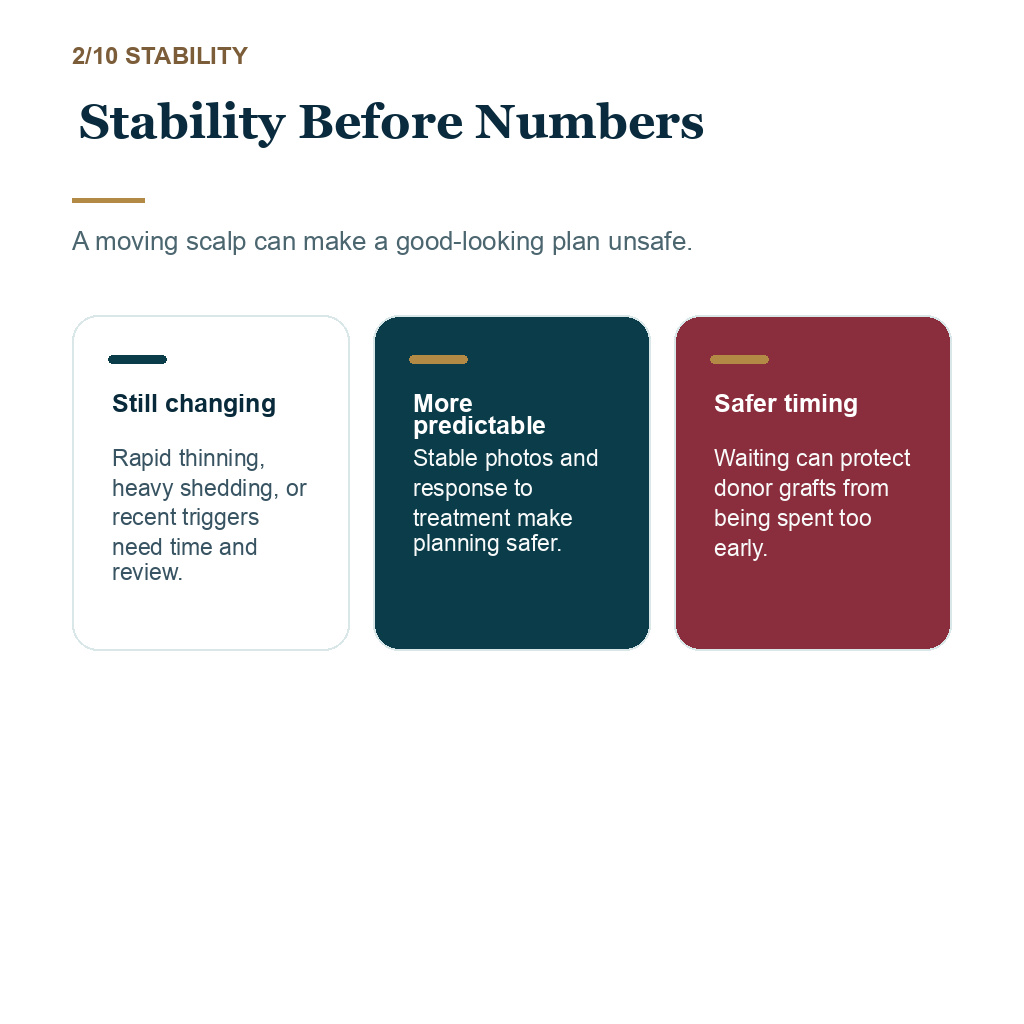

Stabilization should come before graft numbers
Often, yes. If the thinning is still moving, the graft number is not the most useful first answer. Stabilization can show whether shedding is slowing, whether miniaturized hairs respond, and whether the area that worries the patient today is still changing.
If medication has only recently been started or the photos are still changing, I do not use a graft number to create confidence. I want the plan to say what must become stable first, what will be reviewed again, and which thinning areas should not be filled until the native hair picture is clearer.
Stabilization does not mean every patient must take the same medication. It means the surgical decision should be made on a scalp that is becoming predictable. Some patients discuss medication before a hair transplant. Some need medical investigation first. Some need better photos, magnified donor checks, or time.
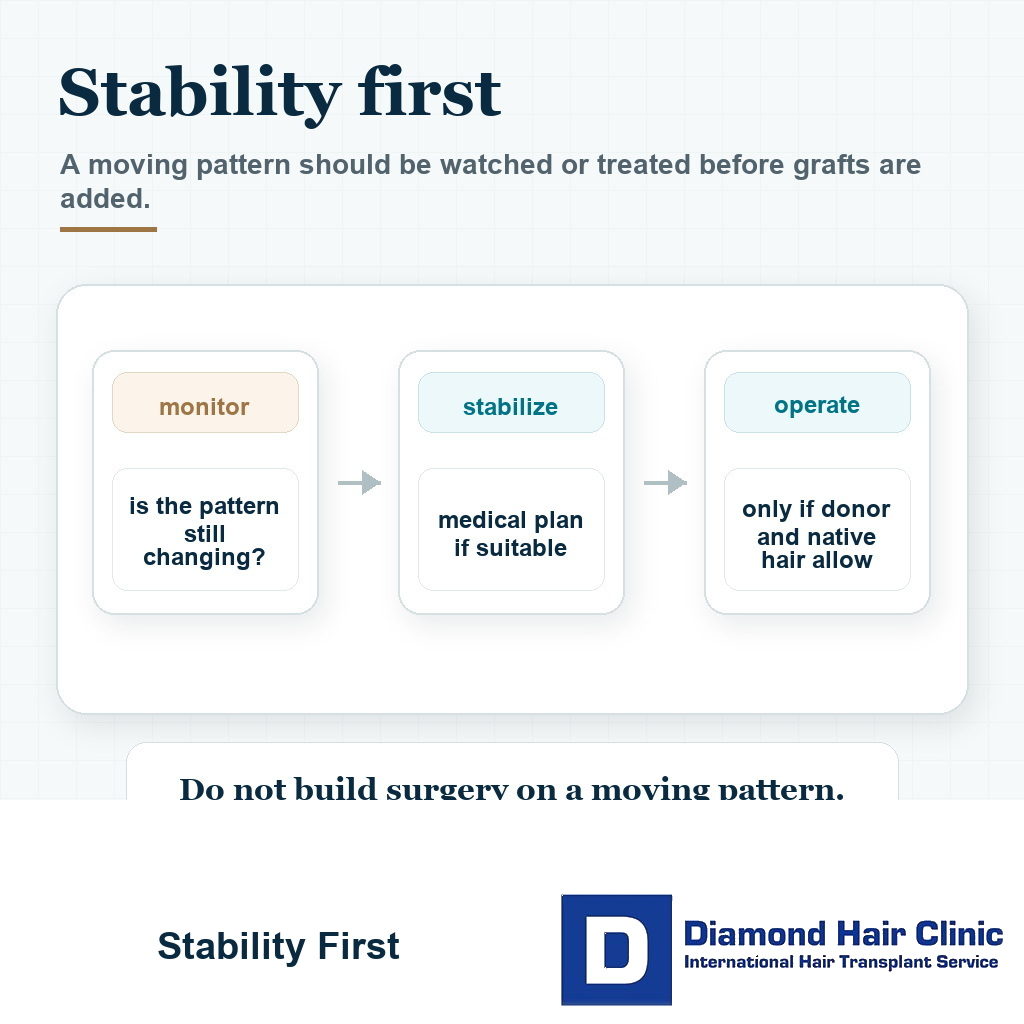
A delay is not a failure when it prevents a poor operation. The wrong surgery done early is more expensive than waiting for a clearer diagnosis.
Graft numbers need conservative planning
Diffuse thinning cannot be planned from one photo and a wish for more density. I look at the treated zones, native hair strength, donor density, hair caliber, contrast between hair and scalp, age, family pattern, medical treatment, and future loss risk.
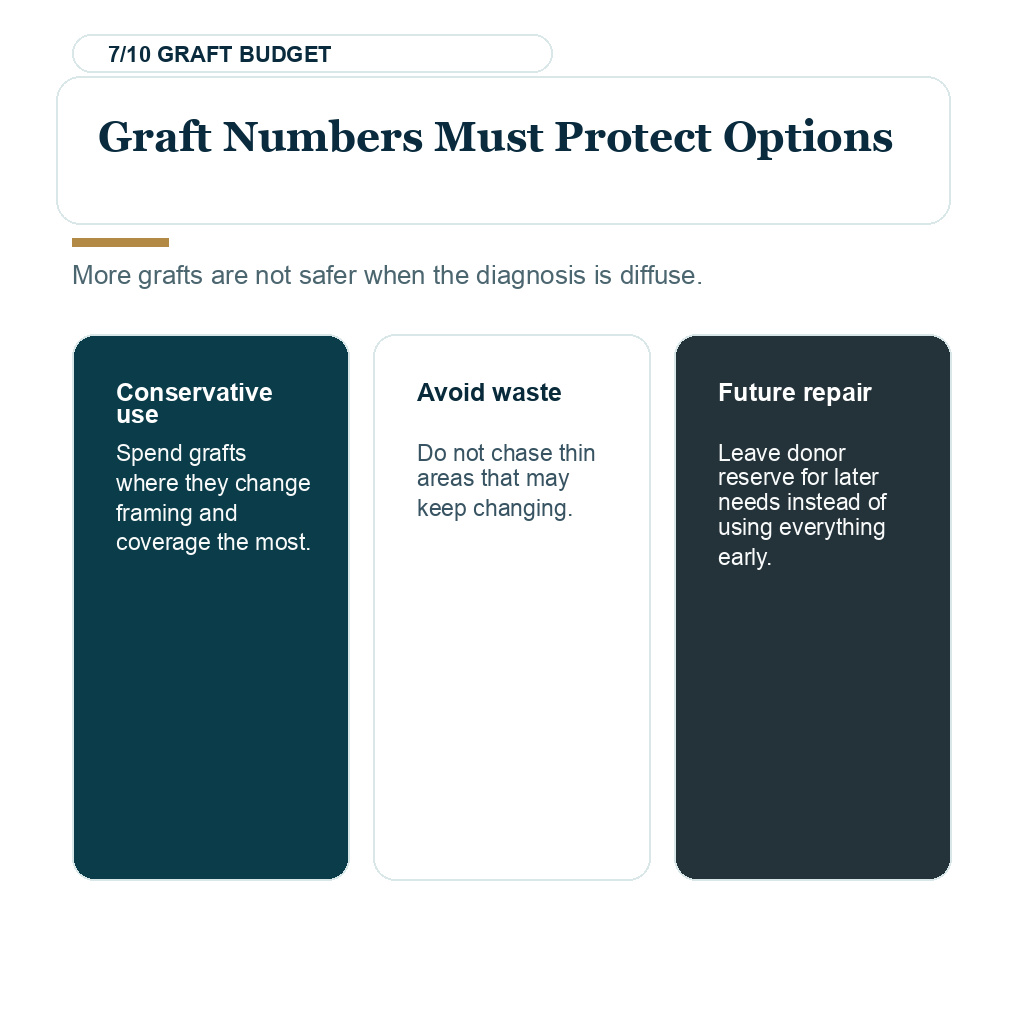
Calculating graft numbers in diffuse thinning is not only about filling an area. The number has to protect what remains. A high number can sound reassuring, but it may be the wrong answer if the donor cannot support it or if the grafts are spread too widely.
Too many grafts in a diffuse thinning case can waste donor hair, increase trauma between native hairs, and leave every region looking only slightly improved. Sometimes fewer grafts placed in the right priority zone create a better long-term result than a large number used without discipline.
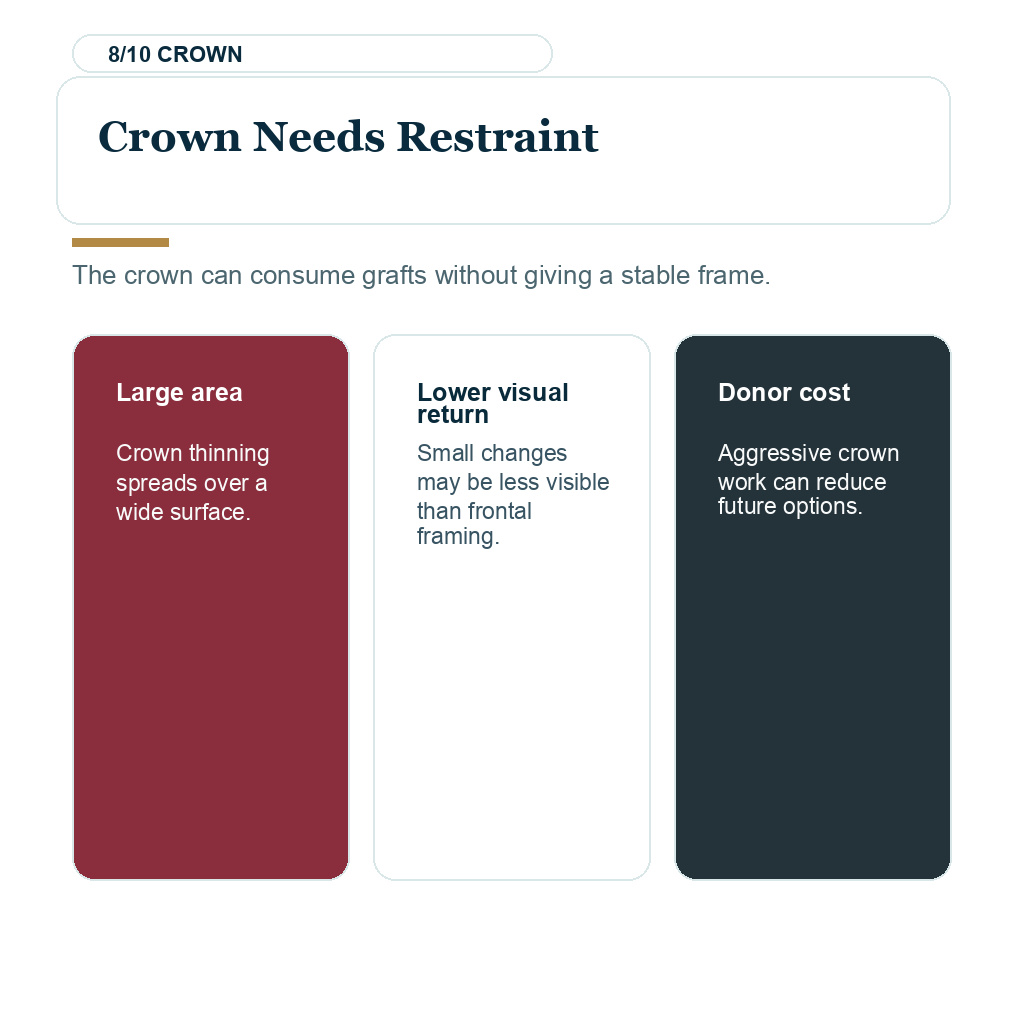
Crown diffuse thinning is especially difficult
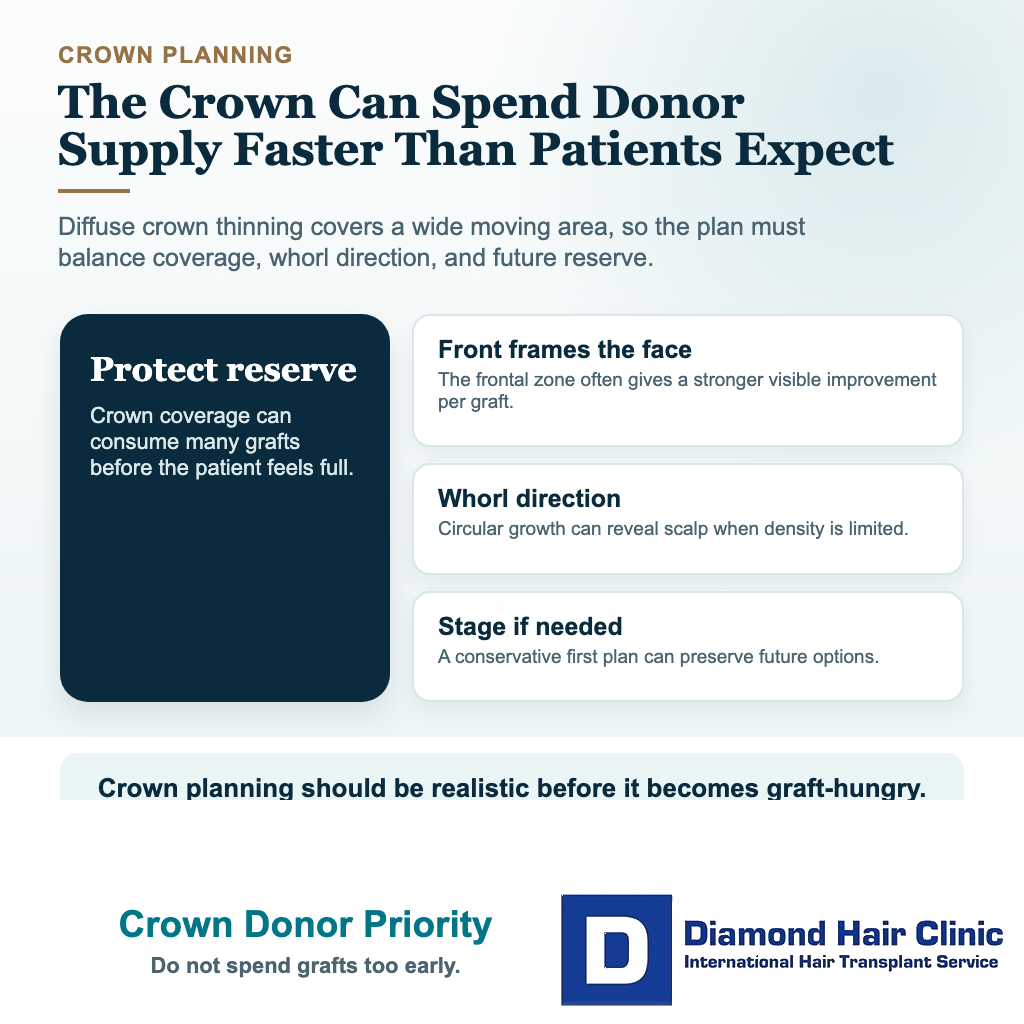
The crown has a wide surface, a circular growth pattern, and a tendency to show scalp even when grafts survive well. Diffuse thinning makes that harder because the crown may look broadly weak rather than clearly bald.
A patient may want the crown to look as full as the front, but the donor supply may not allow that safely. In daily life, the frontal frame often gives the strongest visual improvement. The crown can consume many grafts for a softer change.
That does not mean a crown hair transplant is never right. It means the crown has to be weighed against the hairline, mid scalp, donor reserve, age, medication plan, and future thinning.
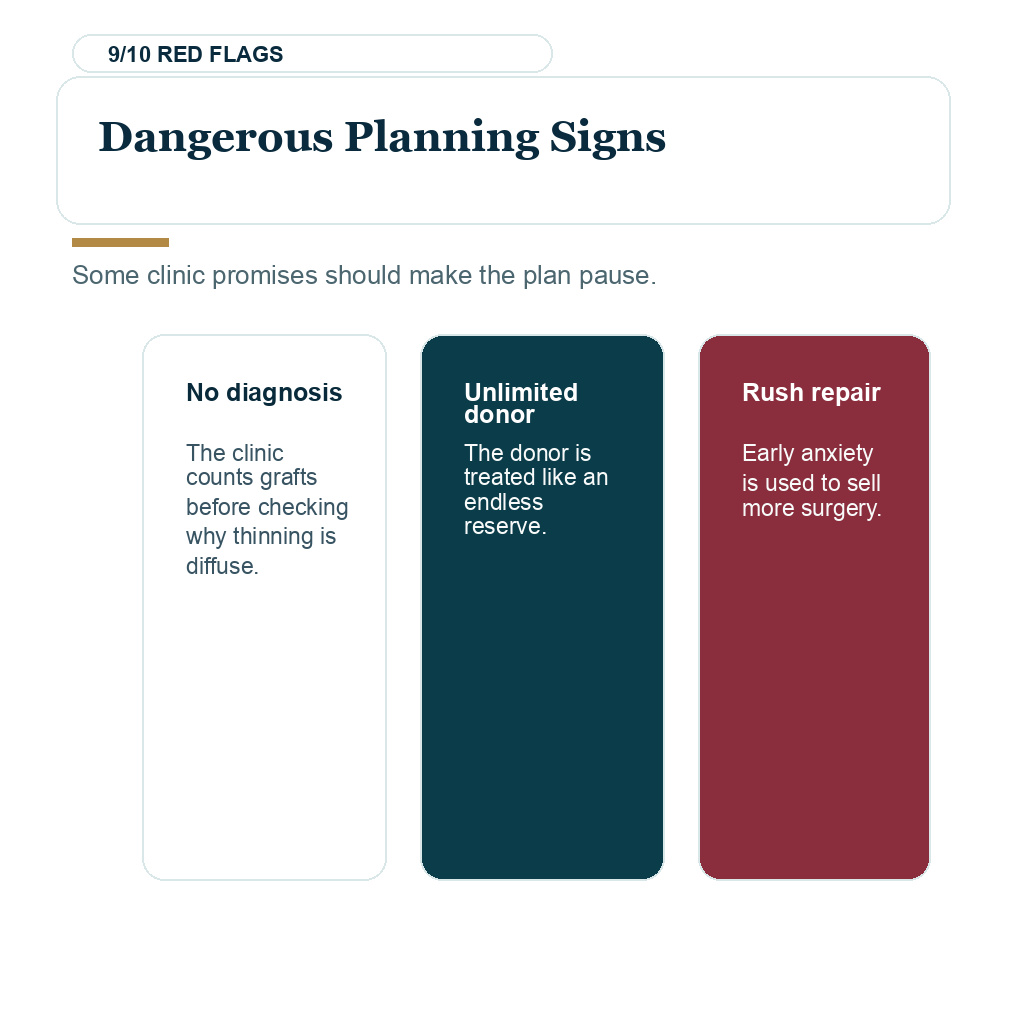
Dangerous planning mistakes to avoid
The most dangerous mistake is treating diffuse thinning like an empty bald scalp. A clinic may promise a large graft number without examining donor quality, miniaturization, medical history, and the living native hairs inside the recipient area.
Another mistake is using a technique name as if it solves the diagnosis. Sapphire FUE, DHI, or any instrument can only help when the plan is medically sound. The tool does not make an unstable donor stable. It does not make active shedding stop. It does not turn a diffuse medical problem into a simple density case.
If a clinic sells the biggest number, ignores donor miniaturization, avoids diagnosis, or gives every diffuse thinning patient the same plan, that belongs among the red flags of Turkish hair transplant clinics.
Diffuse thinning needs a stable map first
Diffuse thinning is not judged only by how much scalp shows today. The diagnosis, donor stability, miniaturization pattern, medication response, and future loss risk all change the value of surgery.
Grafts can help selected patients when the target area is clear and native hair is strong enough to support the plan. They can disappoint when they are placed into a moving pattern without control.
Before surgery, the map has to show what is stable, what is still changing, and where donor hair is worth spending.

Read this review excerpt
told me the quality of my donor hair and what he could take out and advised me what will the be best outcome with what donor hair I had.