


Chemotherapy Recovery and Hair Transplant Planning
Finishing chemotherapy is not the same as being ready for elective hair transplant surgery. Before I plan surgery, the oncology team must be comfortable with elective surgery, the hair loss pattern must be stable, and enough time must have passed to see what has truly recovered and what is likely to remain. For serious surgical planning, I usually wait at least 12 months after the main treatment phase has ended, and sometimes longer if the hair is still changing or ongoing medication still affects the plan.
Medical clearance starts the discussion, but it does not decide the graft number by itself. I still need to see whether the donor has recovered, whether shedding has settled, and whether ongoing treatment changes healing or future hair loss.
This is not only about whether hair can be moved. It is whether the donor area is healthy enough to use, whether the scalp can heal safely, and whether surgery is truly the right answer for the type of hair loss you now have. If the donor hair is also thin, patchy, weak, or medically unstable, waiting is safer than using grafts in a plan that cannot help. Photos from before treatment, during recovery, and after regrowth settles can prevent the surgery from targeting hair that may still be returning.
Many cancer survivors feel a very understandable urgency. Hair loss during treatment is not only cosmetic. It can affect privacy, identity, and the feeling of finally looking like yourself again. I understand that very well. That urgency deserves respect, but it should not rush the decision. That vulnerability deserves extra caution before any clinic discusses surgery, especially while the hair pattern, donor area, scalp quality, and medical safety are still unclear.
After cancer treatment, the facility name is not the safety plan. The booking record should identify who reviews oncology clearance and current blood work, who distinguishes persistent effects of treatment from another diagnosis, who examines the donor, and where urgent medical care would be handled. A hospital label does not replace surgeon ownership, and a private clinic is not appropriate unless those responsibilities are explicit.
Waiting usually protects the patient
Waiting is necessary because hair after treatment can change for a long time. Many patients see early regrowth within a few months, but the hair may be finer, curlier, weaker, patchier, or slower than before. Early fuzz or a change in texture can be encouraging, but it is not yet a final transplant map.
A recovering scalp is a moving target. If the hair is still improving, the patient may look worse than they will look naturally in another few months. In that case, surgery can create unnecessary surgical trauma and use donor grafts before we know what the body can recover on its own.
Several months after treatment can still be early. Hair growth is biological, not mechanical. The calendar matters, but the scalp matters more. Some patients recover quickly. Some recover slowly. Some have partial regrowth that continues to improve. Some have persistent thinning. Surgery should wait until we know which situation we are dealing with.
This explains why proper medical checks before a hair transplant are part of this discussion. The hair question cannot be separated from the health question. Blood counts, medication history, immune status, nutrition, and oncology follow up all matter.
Waiting is not dismissal. It is a way to protect you from a premature operation. A patient who has already gone through treatment deserves a careful plan, not another rushed medical experience.
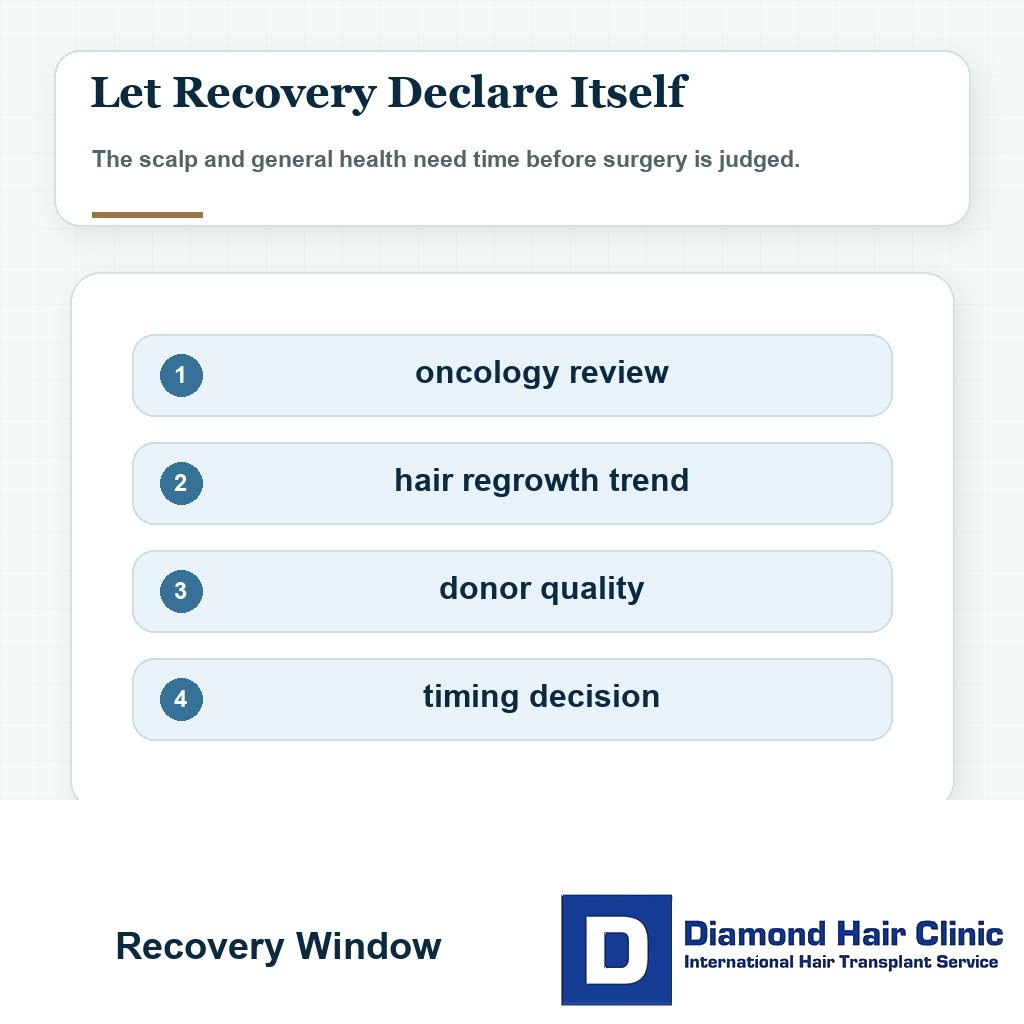
Permanent hair loss takes time to confirm
The answer comes from time, photographs, scalp quality, hair shaft strength, and whether there are signs of new growth. A single consultation photo is not enough. I need to see whether the hair is improving, stable, or still declining.
If fine new hairs are visible, if density is slowly improving, or if the hairline and crown are still changing month by month, the case is not ready for a fixed graft plan. Surgery may still be possible later, but operating too early can waste grafts on an area that has not declared its final condition.
If the same thin or empty areas have remained stable for a long period, and the rest of the scalp has recovered as much as it is likely to recover, surgery becomes more reasonable. Even then, I still ask whether the pattern is truly caused by treatment, or whether another hair loss condition is present.
Photos from different months are more useful than one bright clinic photo. I need to see the hair under normal room light, daylight, wet condition if possible, and from the back and sides. This helps me understand whether the scalp is still recovering or whether the remaining thinning has become stable enough to discuss surgery.
Hope alone cannot make this decision. It has to come from pattern, stability, donor quality, scalp health, and medical clearance.
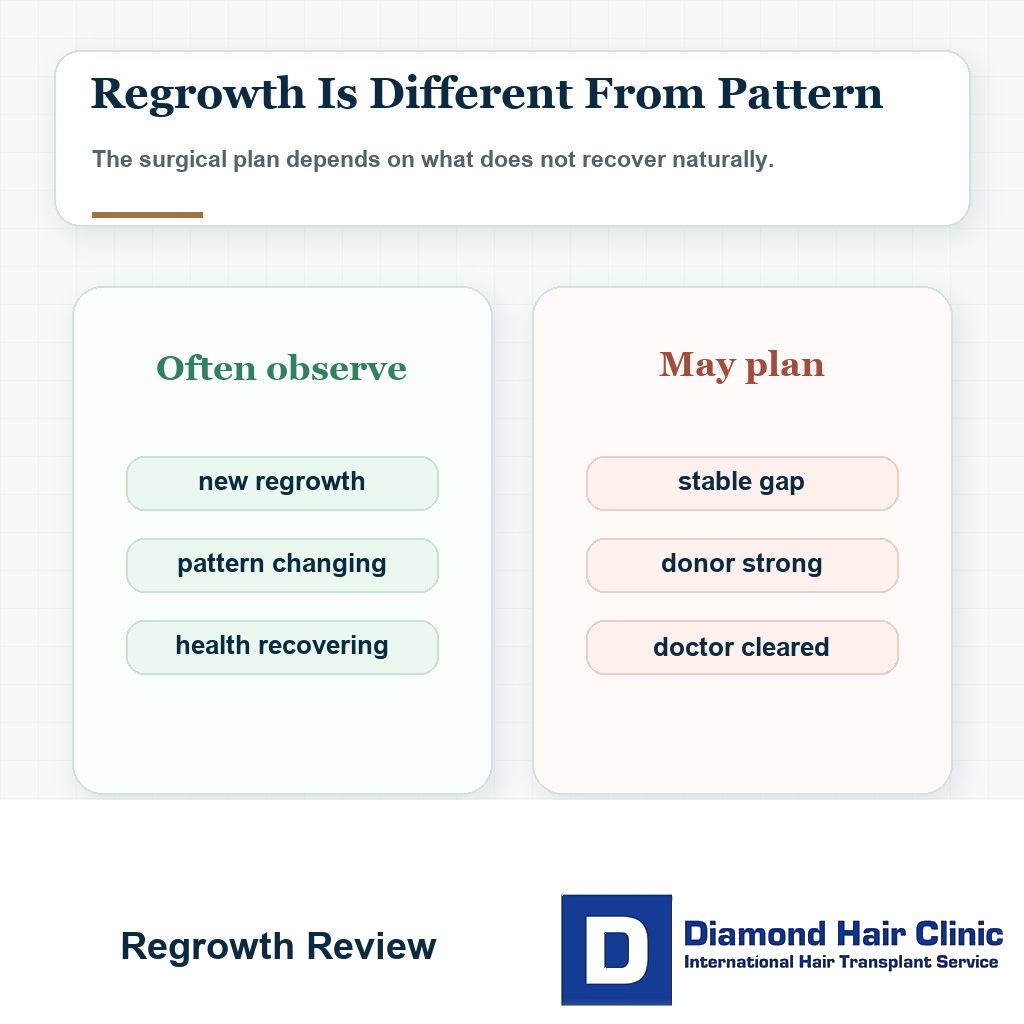
Incomplete regrowth needs diagnosis first
Persistent alopecia after chemotherapy is the medical phrase used when regrowth remains incomplete after chemotherapy. It is often discussed when hair has still not recovered properly six months or more after treatment, but that timing alone does not decide surgery. In practical language, it is the situation where the patient expects the hair to return but the density remains thin, weak, patchy, or visibly reduced for longer than expected.
That label is not permission to operate at the first possible moment. It tells me the problem deserves a proper evaluation. Surgery still needs longer stability, usable donor hair, healthy scalp skin, and medical clearance.
That point does not mean the patient automatically needs surgery. It also does not mean every thin area is permanently empty. Some follicles may still be weak rather than gone. Some patients have slow regrowth. Some have a mixture of change related to treatment and genetic hair loss. The word permanent should not be used too early.
In consultation, I separate three different possibilities. The first is temporary regrowth after treatment that needs time. The second is persistent thinning related to treatment, where some recovery has happened but not enough. The third is another hair loss condition that was revealed or accelerated around the same time.
A hair transplant only helps when there is a stable area that can benefit from transferred grafts. It cannot repair every weak follicle or correct an active medical cause of shedding. If the diagnosis is unclear, surgery can become the wrong answer to a real problem.
I may ask the patient to wait, repeat photos, check blood work, speak with a dermatologist, or confirm details with the oncology team before I consider surgery. This may feel slow, but it is safer than using donor grafts before the situation is clear.
Treatment type changes the transplant plan
The type of cancer treatment can change timing, regrowth, donor quality, and surgical risk. I do not treat every patient after treatment as the same case.
Persistent hair loss has also been reported after busulfan treatment, including conditioning before a stem cell transplant. The exact treatment record matters when I assess incomplete regrowth.
Some chemotherapy drugs are more strongly associated with intense shedding or slower recovery. Taxane treatments such as docetaxel and paclitaxel are often discussed in this context. Anthracycline treatment, combined treatment protocols, stem cell transplant preparation, endocrine therapy, targeted therapy, immunotherapy, and radiation history can also change the wider assessment.
You do not need to understand every medical detail. But the treatment history matters. A patient who had only systemic treatment is not the same as a patient who also had scalp radiation. A patient who is no longer taking cancer treatment medication is not the same as a patient on ongoing endocrine therapy. A patient whose hair is still improving is not the same as a patient whose scalp has been unchanged for a long period.
The surgical plan is not built only around the date of the last treatment session. It is built around the full recovery picture. That includes the treatment type, the scalp condition, the donor area, the medications, the blood work, and the direction of the hair over time.
Without this information, I cannot responsibly give a serious graft number. A number without diagnosis is not planning. It is guessing.
Ongoing cancer medication changes the timeline
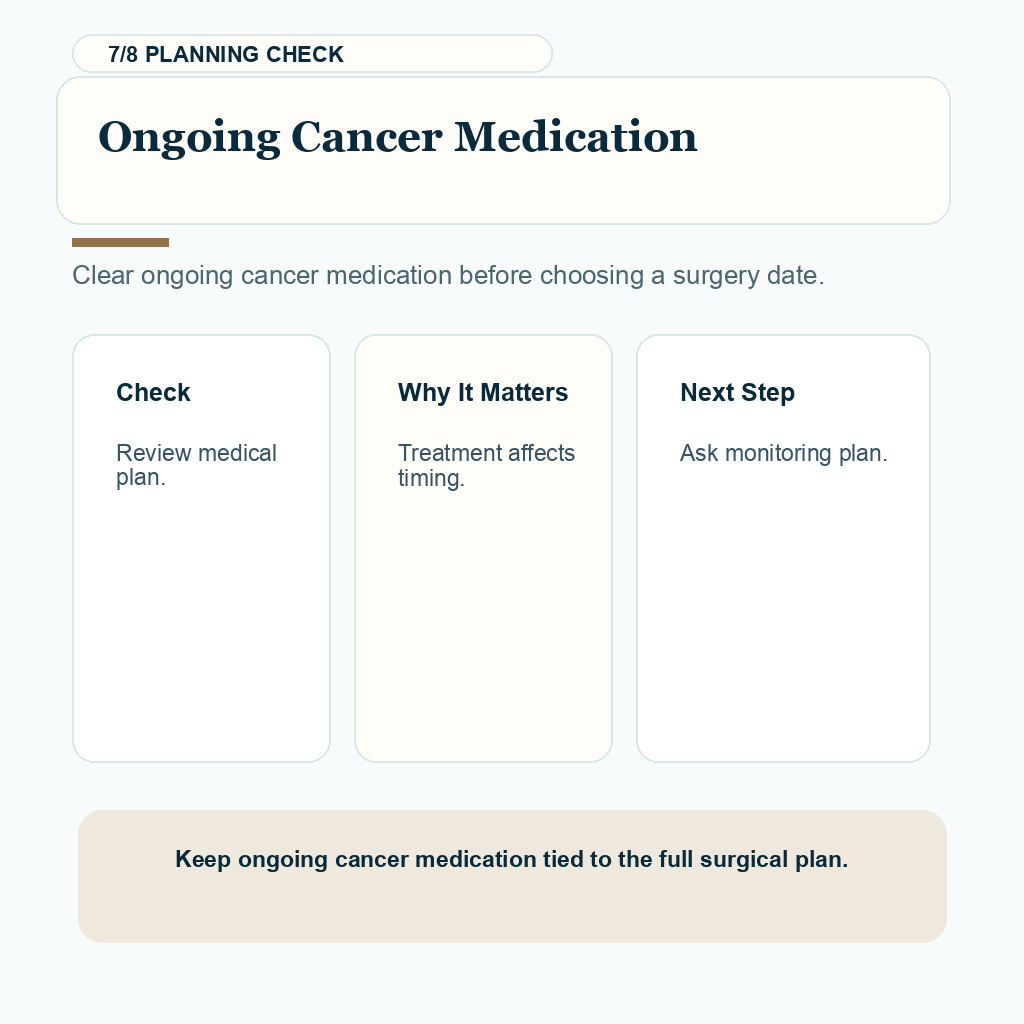
If you are still taking endocrine therapy, targeted therapy, immunotherapy, or another medicine related to cancer treatment, the chemotherapy end date is not the only timeline. I need to ask whether the medicine can affect hair density, healing, bleeding, immunity, or general recovery, and whether your treating physician is comfortable with elective surgery.
Sometimes surgery can still be considered while ongoing medication remains part of the cancer treatment plan. Sometimes the better answer is to wait or adjust expectations. I do not stop or change cancer medication for a hair transplant. The oncology team must own that decision, and hair restoration has to stay inside the medical boundaries that keep the patient safe.
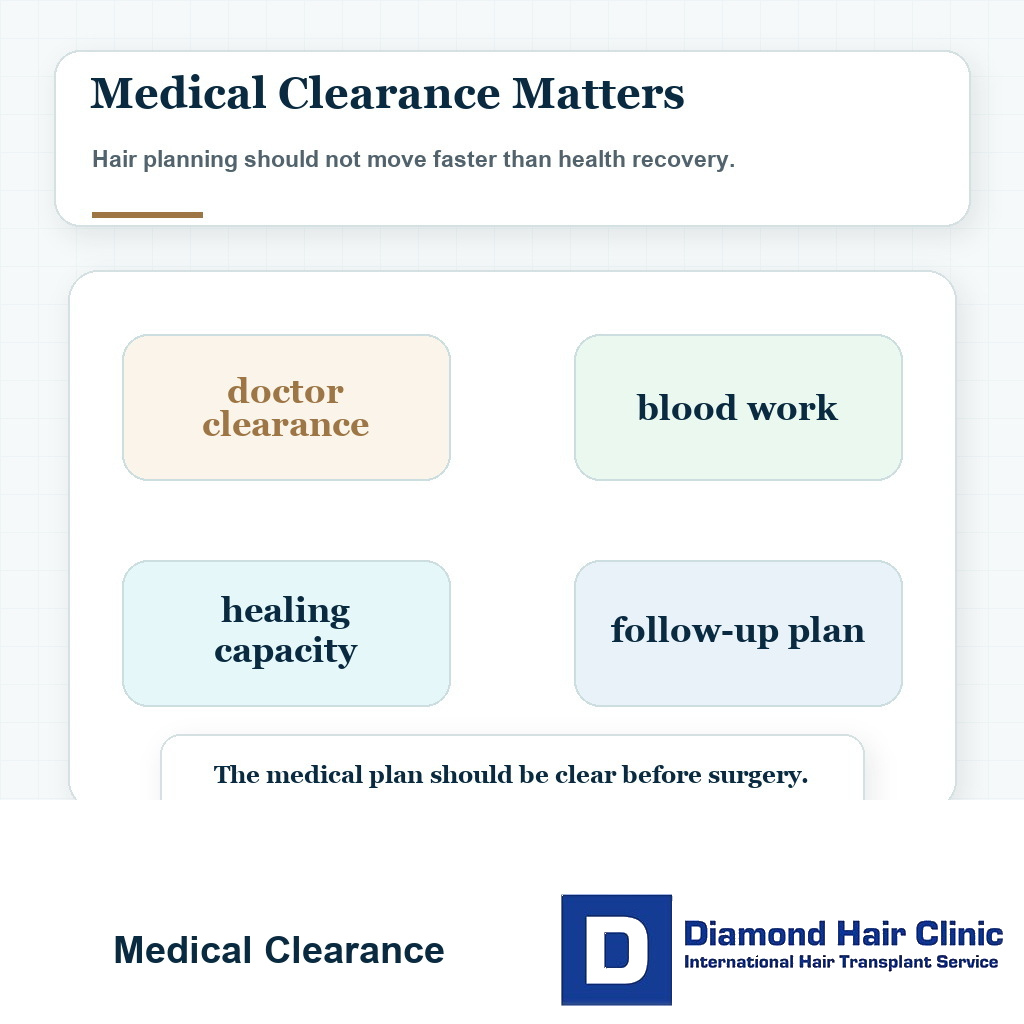
Medical clearance before surgery
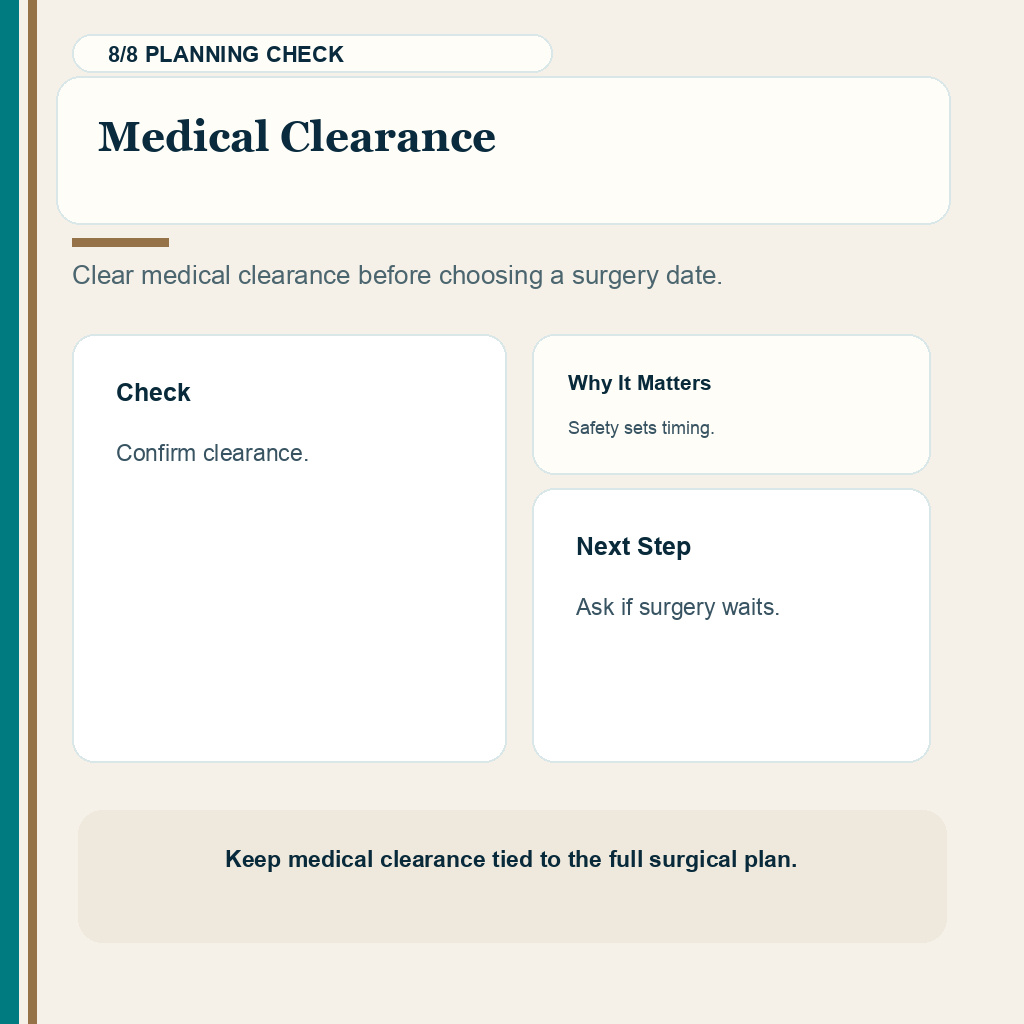
Your cancer treatment team should know that you are considering elective hair transplant surgery. If the oncologist or treating physician is not comfortable with surgery yet, I do not try to bypass that judgment. Hair restoration should never compete with cancer follow up.
Oncology clearance is not the same as transplant suitability. It means elective surgery may be medically acceptable. The hair transplant decision still has to pass a second check based on scalp stability, donor strength, diagnosis, and whether the goal can be planned.
Medical clearance matters most when the patient had recent treatment, radiation, stem cell transplant, immune suppression, ongoing medication, anemia, slow healing, infection risk, or blood count problems. These details can change whether surgery is safe, whether it should be delayed, or whether the session should be smaller.
The full list matters because medication before a hair transplant can affect bleeding, immunity, healing, blood pressure, infection risk, or the body’s response to a long surgical day. It should be reviewed before surgery is planned.
I separate pressure from a settled plan before surgery is discussed. Many cancer survivors feel pressure to reclaim their appearance quickly. I understand that feeling, but surgery is safer when the medical picture is clear and the patient has had enough time to think beyond the first emotional urgency.
If the medical picture is not ready, I postpone surgery rather than create unnecessary risk. A hair transplant is elective. Cancer follow up is not elective. That order must be respected.
Information to send before asking about surgery
If you are asking about surgery after cancer treatment, the consultation should not begin with only a few photos and the question of how many grafts. A more complete picture is necessary.
The first details that matter are the type of cancer treatment, the dates chemotherapy started and ended, and the drug names if you know them. I also need a clear answer on whether radiation was used, which area was treated, whether stem cell transplant preparation or immune suppression was part of treatment, and whether you are still taking cancer treatment medication.
Medical context matters just as much as hair photos. Oncology clearance, current medicines and supplements, and recent blood work all belong in the review. Photos from before treatment and clear scalp photos from several months apart afterward help me see whether regrowth is still moving or whether the remaining thinning has become stable.
Current photos should show the front, top, crown, temples, donor area, and sides. Scalp symptoms such as itching, burning, tenderness, redness, scaling, or patchy shedding also matter. This information helps me separate slow regrowth from permanent loss, change related to treatment from genetic hair loss, and a safe surgical case from a case that needs more time.
There is no reason to feel embarrassed about sending detailed information. In this situation, detail protects you. The more precise the medical history, the safer and clearer the surgical answer becomes.
Donor strength after cancer treatment
The donor area is the foundation of the operation. If the back and sides of the scalp have returned to strong, stable hair, surgery may be realistic. If the donor area is thin, patchy, miniaturized, or also affected by change related to treatment, the operation becomes much more limited.
I cannot create a strong result from weak donor hair. Moving fragile hair from one weak area to another weak area is not real restoration. It may only transfer the problem and leave the donor area looking worse.
The donor area has to be examined carefully before graft numbers are discussed. Density, hair caliber, miniaturization, texture, contrast, and whether the donor is actually safer than the area we want to restore all matter.
After cancer treatment, this assessment becomes even more important. In typical male pattern hair loss, the donor area is usually more stable than the thinning areas. In after treatment hair loss, I cannot assume that. Treatment can affect hair more widely, including areas patients usually think of as safe.
When donor quality is poor, my answer may be conservative. A smaller framing improvement may be safer than trying to cover the whole scalp. In some patients, surgery may not be appropriate at all because the donor capacity is not strong enough for the goal.
If the donor area is weak, the real limitation is often weak donor area hair transplant planning.


Medication may help before donor grafts are used
Medication can sometimes help before surgery, especially when follicles are weak but not permanently lost. The purpose is not to delay surgery forever. It is to avoid spending donor grafts on a problem that might still improve with medical treatment and time.
In patients whose case fits, treatments such as minoxidil may be considered under medical supervision. Oral minoxidil before hair transplant should be considered only after reviewing the patient’s wider medical history, because a cancer survivor should not start medication casually.
Some common hair loss medications may not be appropriate for every cancer survivor, especially when the cancer history or ongoing medication creates a hormonal or systemic concern. Do not copy an ordinary hair loss plan from the internet and apply it blindly after cancer treatment.
Nutrition and systemic health can also matter. Low iron stores, anemia, thyroid imbalance, vitamin deficiencies, stress on the body, and other medical problems can make hair after treatment look worse or slow recovery. Low ferritin and anemia before hair transplant and thyroid problems before hair transplant may need to be checked before donor grafts are used.
If medical support improves the hair, surgery may become smaller or unnecessary. If it does not improve the hair and the pattern remains stable, we can consider surgery from a clearer position.
In selected cases, supportive treatments such as PRP treatment for hair loss may also be discussed, but only carefully. A cancer survivor should not be pushed into expensive extra treatments before the diagnosis, donor quality, and oncology clearance are clear.
Radiation changes the surgical plan
Radiation changes the plan because the skin and blood supply in the treated area may be different from normal scalp. Systemic treatment affects the whole body, while radiation affects the treated field more directly. If the scalp itself was irradiated, planning becomes more cautious. For that narrow question about recipient area skin, hair transplant after scalp radiation deserves its own review.
Hair may grow back thinner after radiation, or it may not return in the treated area if the dose was high enough. The skin may also be tighter, more sensitive, less elastic, or less forgiving. A transplant into that kind of skin is not the same as a transplant into healthy scalp.
For me, an irradiated scalp behaves more like a compromised recipient area. That point does not mean surgery is impossible, but it changes the expectation. I do not promise normal density in compromised skin. I may plan lower density, staged surgery, or a very small test approach if the case is appropriate.
The recipient area must be able to accept incisions, receive grafts, heal without avoidable delay, and support graft survival. If the skin quality is poor, if circulation seems weak, or if the area is medically complex, the better answer may be not to operate.
This should be clear before booking a hair transplant. A clinic that treats hair loss after radiation like ordinary genetic hair loss is oversimplifying the problem.
Previous hair transplant before cancer treatment
A different concern appears when the patient already had a hair transplant before cancer treatment and now wants to know whether the treatment damaged the transplanted hair permanently.
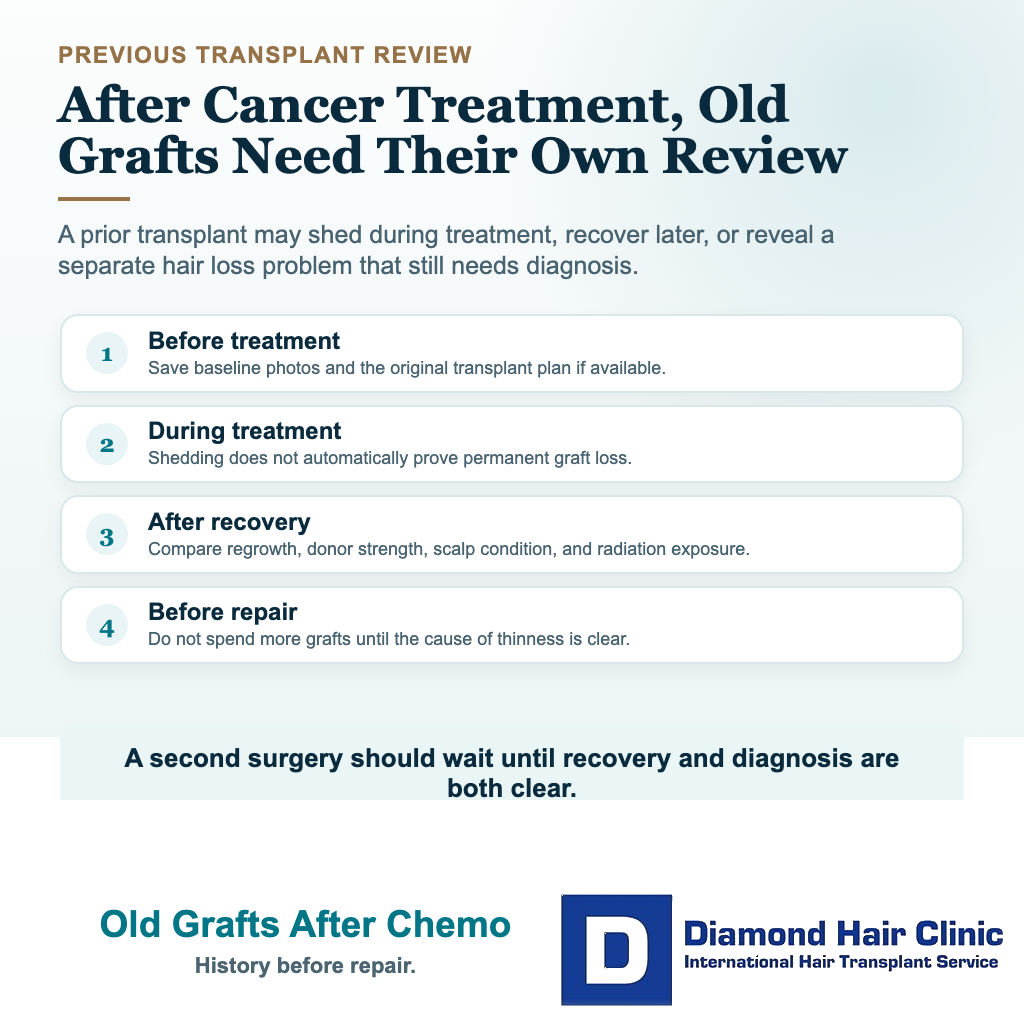
Transplanted hair can shed during treatment because chemotherapy can affect actively growing hair follicles across the scalp. A transplanted follicle is not protected just because it was moved from the donor area. If the follicle recovers after treatment, the transplanted hair may grow again. But I cannot guarantee that in every patient.
The final outcome depends on the treatment type, dose, timing, radiation exposure, scalp condition, donor hair biology, and whether another hair loss process is also present. I do not judge the final result immediately after treatment. I first need to see how much regrowth happens naturally and whether the hair stabilizes.
If the previous transplant was good and the donor area remains strong, correction may be possible later. If the donor area has become weak or the scalp is unstable, a second surgery may be limited or unwise.
The old transplanted area, the current donor area, and the untreated native hair should be evaluated together. The question is no longer only what treatment did. The question is what can safely be improved now.
Genetic hair loss can overlap with treatment history
One of the common mistakes is blaming every change on treatment. Cancer treatment may reveal, accelerate, or make more visible a pattern that was already developing. A patient can have shedding related to treatment and also have male or female pattern hair loss.
Patterned recession, crown thinning, diffuse miniaturization, or a family history that matches androgenetic hair loss changes the surgical plan. I cannot plan only for the treatment story. I must plan for the future hair loss pattern as well.
Diffuse thinning and hair transplant planning require a guarded review. If the whole scalp is thin, including areas that should act as donor, surgery may be risky or limited.
A good plan separates what can be improved surgically from what must be managed medically. If that distinction is not made, the patient may receive a transplant that grows but still looks thin because the surrounding native hair keeps weakening.
Scalp shine under bright light, thinning mainly on the top, widening part lines, or crown visibility after treatment can come from treatment recovery, genetic hair loss, or a mixture of both. The plan must respect that uncertainty.
Women and men may need different assessment
Women and men both need careful evaluation, but the patterns can look different. Women may have diffuse thinning, temple thinning, hairline softening, part line widening, or eyebrow loss after treatment. Men may show a more typical pattern that resembles genetic hair loss, even if the timing began after cancer treatment.
For women, donor quality and hairline softness need special planning. A transplant can help a stable localized area, but diffuse female thinning can be difficult to treat surgically if the donor area is also affected. The consultation must be clear about this.
If the concern is the frontal frame, female hairline hair transplant planning should not create a harsh line. The plan should restore a natural frame only when the donor and diagnosis support it.
For men, age, family history, crown involvement, donor strength, and medication suitability all matter. The emotional story may begin with cancer treatment, but the surgical plan still has to respect future hair loss.
I also remind patients that the crown can be a difficult area after treatment, especially if donor supply is limited. The crown can consume many grafts while giving less visual framing than the front. A cancer survivor deserves an intelligent plan, not an aggressive graft number used to create hope.
Eyebrow loss needs a separate plan
Eyebrow loss after treatment is a separate discussion. Many patients are deeply bothered by eyebrow thinning because the eyebrows frame the face and affect facial expression. However, I still need to see whether the eyebrow hair continues to recover before I discuss surgery.
Eyebrow transplantation is more delicate than many patients realize. The hairs must be placed with very fine angle control, because eyebrow hair does not grow like scalp hair. If the brow loss is still changing, if the skin is irritated, or if the medical picture is not stable, surgery should wait.
If the eyebrow loss remains stable for long enough and the patient is medically cleared, eyebrow transplantation may be discussed separately from scalp hair transplantation. The donor source, direction, density, and grooming expectations must be explained very clearly.
I do not combine every possible restoration into one emotional decision. The scalp may be the priority, the eyebrows may matter more, or both areas may need a later reassessment after recovery is clearer.
Clinic promises can mislead cancer survivors
Cancer survivors are vulnerable to oversimplified promises because they have already lost something deeply personal. A clinic may say that grafts can be added wherever hair is missing. That is not enough.
A careful consultation should ask about treatment dates, remission status, oncology clearance, radiation field, donor quality, blood tests, current medication, scalp symptoms, and whether the hair is still changing. If the conversation goes straight to graft numbers, that is a warning sign.
I also worry when a clinic shows only dramatic results from ordinary pattern hair loss and presents them as proof for after treatment cases. These are not always the same problem. A cancer survivor needs diagnosis first, not marketing pressure.
In this situation, my priority is to protect the patient medically, protect the donor area surgically, and avoid an operation that looks hopeful in a message but weak in real life.
A large graft number can sound comforting, but it can become risky when the donor area is limited or if the scalp is not ready. Planning should favor healing capacity, natural appearance, and a result that still makes sense years later.
Waiting can be safer than surgery
Waiting is better if treatment ended recently, if your oncology team has not cleared elective surgery, if the hair is still improving, if the donor area is weak enough to make surgery unsafe, or if blood tests suggest your body is not ready for a long procedure.
Active inflammation, tenderness, infection risk, poor skin quality after radiation, or uncertainty about the diagnosis can change the decision. A hair transplant should not be used to cover an active medical problem.
Waiting may also be wiser when the emotional pressure is very high. After cancer treatment, the desire to feel normal again is completely understandable. But if surgery is chosen from panic, the patient may accept promises that would look weaker after more time and clearer medical information.
Sometimes the most responsible surgical decision is to delay until the medical picture, hair pattern, donor area, and expectations are all clear. That is not a lack of compassion. It is surgical judgment.
I decline surgery rather than push a cancer survivor into an operation that does not respect the patient’s health or future donor supply.
Signs that need dermatology or oncology review first
There are situations where the case should not move directly toward surgery. I first ask for review from the oncology team, dermatologist, or treating physician.
Active worsening, scalp redness, scaling, burning, pain, crusting, inflammation, or patchy bald areas that may suggest alopecia areata or scarring alopecia make me cautious. I also wait if the donor area is thinning in the same way as the top, because the donor may not be reliable enough for surgery.
Medical stability matters as much as the scalp pattern. If the patient is still immunosuppressed or medically fragile, if blood counts or general blood work are not stable, if radiation was applied directly to the scalp, or if medication may affect healing, bleeding, or immunity, I need more medical clarity first.
I also wait if the hair loss pattern does not match ordinary surgical planning or if the patient has not yet received clearance for elective surgery. These signs do not always mean surgery will never be possible. They mean the case needs more medical clarity before surgery is discussed seriously.
In hair transplantation, diagnosis is not a formality. It decides whether surgery is helpful, premature, or potentially harmful.
Surgery plan if you are suitable
If a patient is medically cleared, the hair loss is stable, the donor area is strong enough, and the scalp is healthy, then surgery can be discussed. Even then, the plan should usually be conservative and precise.
In many after treatment cases, I do not begin with the most aggressive possible coverage. The area that gives the strongest visual improvement with the safest use of grafts usually comes first. Often that means the frontal frame, hairline softness, or a limited area of stable thinning rather than trying to cover the entire scalp in one session.
The incision plan must respect scalp quality. The density should not be forced beyond what the recipient area can support. If radiation was involved, or if the skin is less forgiving, I may reduce density, stage the operation, or avoid surgery in that area.
Aftercare matters here as well. The plan should not focus only on the operation day. The scalp must heal, the grafts must settle, and the instructions need to be followed carefully. I keep hair transplant aftercare structured rather than improvised, especially when the medical history is complex.
If surgery is performed, the goal is a natural and responsible improvement, not a rushed attempt to erase the cancer experience in one day. I understand the emotional wish, but the scalp and donor area still have limits.
Aftercare changes after cancer treatment
The basic healing principles after a hair transplant are similar, but I watch recovery more closely in a patient with a cancer treatment history. The washing routine needs to be followed carefully, the recipient area should be protected from friction, and unusual redness, pain, swelling, discharge, or delayed healing should be reported early.
In my usual practice, I explain the washing routine personally and follow the patient closely after surgery. This matters even more when the medical history is complex. Small healing concerns should be seen early, not guessed about later.
A cancer survivor may also be more anxious during recovery, and I understand why. Shedding, redness, temporary shock loss, or slow early growth can feel emotionally heavier after cancer treatment. Clear follow up helps the patient separate normal healing from something that deserves attention.
Growth expectations should also be realistic. A hair transplant result is not immediate. The operation is one day, but visible growth takes months. Final maturation takes longer. A patient who has already waited through cancer treatment may find this difficult, but it is part of the biology of hair restoration.
The safest aftercare is structured and directly supervised. It should feel uneventful, not experimental, and it should not depend on the patient guessing from internet discussions.
Chemotherapy recovery must be stable enough for grafts
I begin with health, then diagnosis, then donor quality, and only then graft numbers. If those steps are reversed, the plan becomes fragile.
Bring your oncology history, medication list, treatment dates, blood work if available, and clear photographs over time. The more precise the information, the safer the decision becomes. A surgeon should not be guessing from one emotional message and a few photos.
If surgery is appropriate, the plan should be conservative, medically cleared, and clear about coverage. If surgery is not appropriate yet, the plan should explain what needs to improve before it becomes safer.
In consultation, I say this plainly. A hair transplant after cancer treatment is not impossible, but it should not be planned from emotion alone. Your health comes first, the donor area comes second, and the cosmetic plan comes only after both are clear.

Read this review excerpt
Upon arriving home, I sent 4 photos (of each side of head) after every washing process to doctor for checking where I was given personal advice for how to take care of my healing head.