


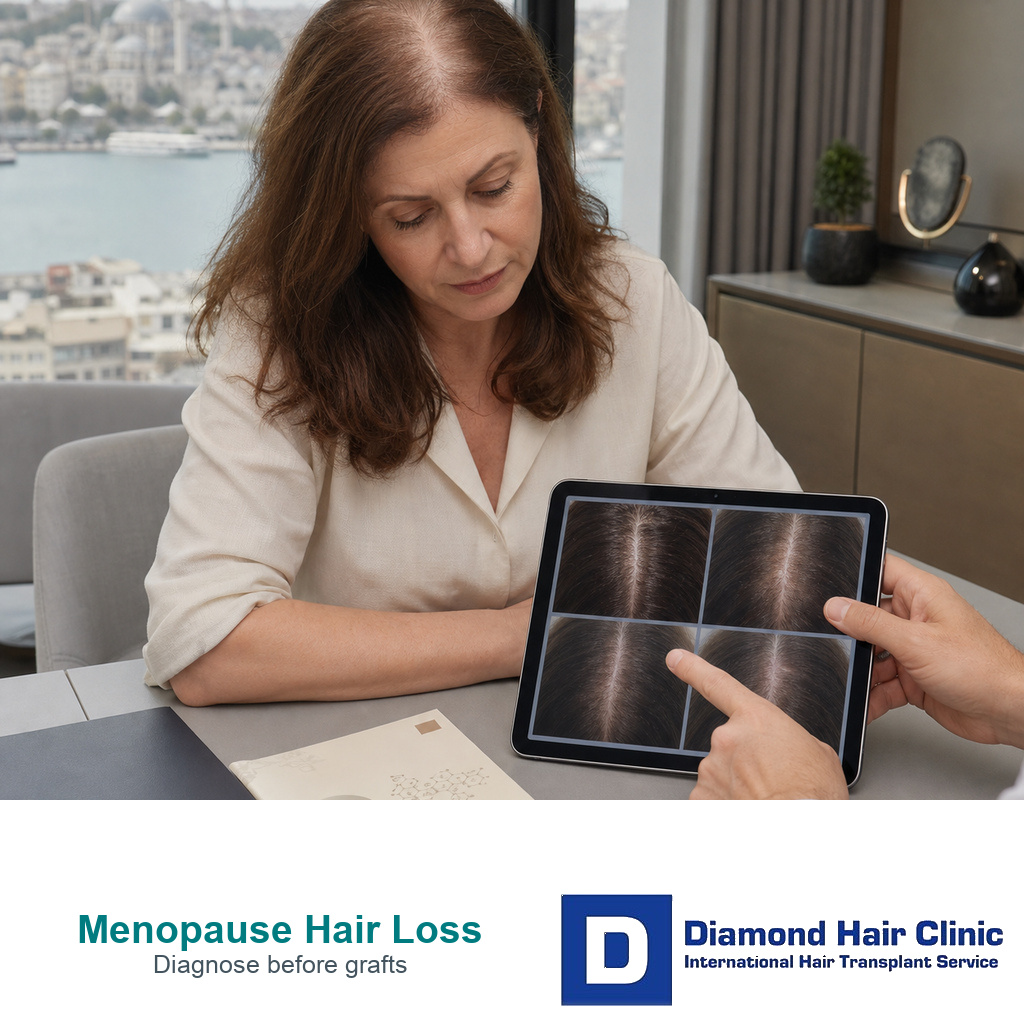
Menopause Hair Loss and Hair Transplant Planning
A hair transplant can help some women after menopause, but only when the hair loss has a clear diagnosis, donor supply is dependable, and the target is localized enough for grafts to make a real cosmetic difference. Menopause can reveal female pattern hair loss, but it can also overlap with temporary shedding, low ferritin, thyroid disease, scalp inflammation, medication changes, or treatment started for menopause symptoms.
So I do not begin with a graft number. I first ask whether this is a stable surgical problem or an active diffuse thinning problem that needs diagnosis first. Menopause alone does not make a woman a hair transplant candidate, and age alone should not rule her out. The hair around the thinning area and the donor hair at the back and sides must be stable enough for a plan that will still make sense later.
If the diagnosis is clear and donor supply is strong, surgery may help a visible frontal gap, a widened hairline, or a localized area that will not respond enough to treatment alone. If the whole scalp is thinning, including the donor area, transplant surgery can create disappointment because we would be moving weaker hair into another weak area. The decision should be deliberate, not driven by one alarming photo or one rushed graft estimate.
Menopause changes the hair transplant question
Menopause changes the transplant question because hormonal change, density change with age, and medical triggers can appear at the same time. The front and mid scalp may look less dense, the part may widen, and styling may become harder. That does not prove the follicles are gone. It means the scalp needs diagnosis before a surgical promise is made.
Female hair loss is often less straightforward than male hair loss. A man may arrive with a defined receding hairline and a strong donor area. A woman may arrive with a thinner part, preserved frontal edge, shedding waves, and fear that the whole scalp is changing. I treat hair loss around menopause as a diagnosis problem first and a transplant problem second.
For women, hair transplant candidacy depends on diagnosis, donor safety, and stability. Around menopause, that judgment becomes even more important because age, hormones, medication history, iron levels, thyroid status, and donor quality may all be part of the picture. For women outside menopause as well, birth control changes and FUE planning can affect whether the thinning is stable enough for grafts.
Is this female pattern hair loss or temporary shedding?
Female pattern hair loss is usually a gradual miniaturization problem. The hairs become finer, the part looks wider, and density through the top slowly reduces. Temporary shedding is different. It often follows a trigger such as illness, weight loss, surgery, a medication change, poor sleep, iron deficiency, thyroid instability, or a major stress period. The difficult part is that both can happen in the same woman.
The distinction is practical. A part that has widened slowly over years may become a surgical discussion after the donor is checked. Sudden heavy shedding over weeks or months is different. If the shedding is still accelerating, graft planning waits because the future baseline is not clear yet.
I also ask how the hair behaves, not only how the scalp looks in one image. More hair in the shower, a thinner ponytail, short miniaturized hairs, scalp soreness, redness, itching, or a changing donor area all point to different decisions. The transplant plan is safer when the diagnosis explains the change, not only the photograph.
When thinning is diffuse, diffuse thinning and hair transplant surgery need stricter planning. Diffuse thinning is not always untreatable, but it is harder to plan surgically because the donor area may not be as stable as it appears in a quick photo.
Medical checks come before graft numbers
Female pattern hair loss can occur even without a known family history.
Before grafts are discussed, I need a medical and scalp review that explains the pattern. I look at the part line, frontal edge, crown, donor density, miniaturization, scalp inflammation, shedding triggers, family history, medication history, and medical conditions that commonly affect hair. The practical question is whether there is a stable area worth rebuilding, or whether the whole scalp is still changing.
Thyroid disease is one example. If thyroid levels are unstable, the patient may be shedding for a reason surgery cannot fix, so hair transplant with thyroid disease requires stability before grafts are planned. Iron deficiency and anemia can create a similar issue, which is why low ferritin and anemia before hair transplant surgery should be handled before a surgical plan is trusted.
When test results are abnormal, I do not turn them into a quick approval or refusal for surgery. The decision depends on corrected results, a slower shedding trend, and a visible pattern that still needs grafts after treatment has had time to work. Otherwise we may plan surgery around a temporary low point.
In women, I also ask about PCOS, postpartum history, menopause treatment, rapid dieting, scalp symptoms, medications, and how long the shedding has been active. A woman who has PCOS related hair loss may have a different pattern and treatment discussion from a woman whose thinning began after menopause. A woman who has recently had postpartum hair loss needs a different timing discussion again. When antiandrogen treatment is part of the history, spironolactone and female FUE planning should be reviewed before grafts are used.
Around menopause, I also look carefully for frontal recession with eyebrow thinning, redness, scaling, burning, itching, loss of follicular openings, or smooth shiny skin. Those signs can point toward scarring alopecias such as frontal fibrosing alopecia, where dermatologic diagnosis and medical control come before any graft plan. If the hairline skin is actively inflamed or already losing follicular openings, transplanting into that area can fail for the wrong reason. The disease, not the graft technique, may be the main problem.
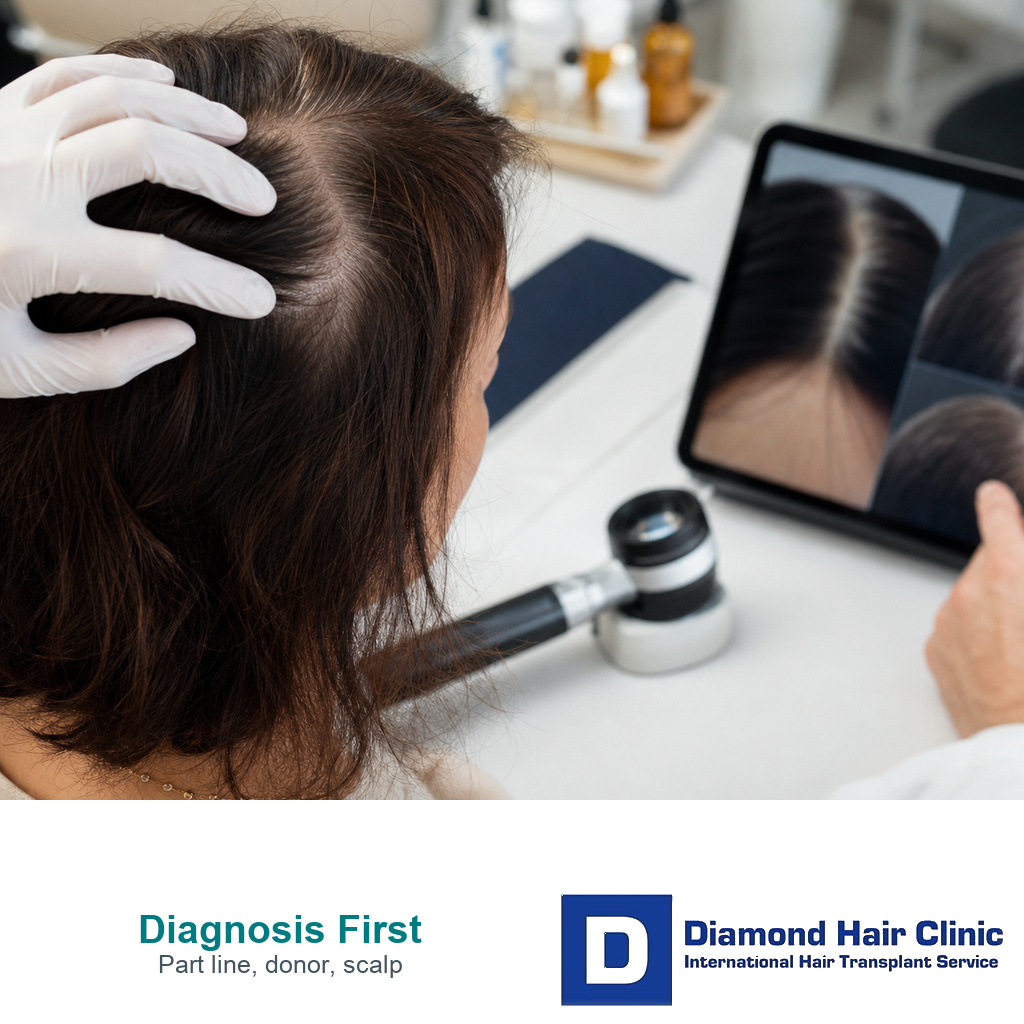
A close scalp review helps separate surgical thinning from active diffuse shedding.
Hair transplant may help after menopause
A hair transplant can help after menopause when the loss is localized enough, donor supply is strong enough, and the goal is realistic. For example, a woman may have a stable widened frontal part, a weak frontal hairline, or a visible thinning zone that affects styling. If the surrounding hair is stable and donor hair is reliable, surgery may improve framing and coverage.
The result must still respect female hairline design. I do not simply lower the hairline or fill every thin area aggressively. In female hairline transplant design, the edge needs softness, irregularity, correct angle, and careful graft selection so it does not look planted.
The strongest surgical cases are not always the most emotionally urgent cases. They are the cases where the diagnosis is settled, the limits are understood, and the donor area can support the plan. I review the same part line, frontal zone, crown, and donor area over time rather than rely on one anxious photo session. Surgery works best when it solves a defined shape or density problem, not when it is used as a substitute for diagnosis.
Surgery is the wrong first step when the pattern is unclear
Surgery is the wrong first step when shedding is active, donor hair is miniaturizing, the diagnosis is unclear, scalp inflammation is untreated, or the expectation is to restore dense hair across the whole top of the scalp. It is also too early when a treatment has just started or changed and there has not been enough time to see the response. Moving grafts while the underlying pattern is still unclear can create new disappointment because the hair loss keeps changing around the transplant.
A graft number without donor reasoning is not enough. In women with diffuse thinning, the donor region can be affected too. If weak donor hair is transplanted, the result may be thin, unstable, or visually underwhelming even if the operation was technically tidy.
Delaying surgery is better than creating a result that looks acceptable for one year and then becomes difficult to maintain. A postponed transplant is not a failure when the reason is medical clarity. It is often the more responsible decision.

The more reliable transplant decision comes after pattern, donor, medical triggers, and expectations are checked together.
HRT and menopause treatment during candidacy review
Hormone replacement therapy, antiandrogen treatment, minoxidil, or another menopause treatment may change the hair loss picture, but none of them decide transplant candidacy by themselves. HRT is a menopause treatment decision with its own risks and benefits. It is not a hair transplant clearance tool. A treatment may reduce shedding in one woman and make little difference in another, and some medicines are unsuitable because of side effects or medical history.
Bring the timeline of menopause symptoms, shedding, medicines, and any treatment you already tried. A transplant decision is clearer when hormone stage, pattern hair loss, and temporary shedding are not mixed together. Old photos from before menopause, before medication changes, and during the heaviest shedding can prevent a temporary low point from becoming an unnecessary graft plan.
I do not start, stop, or change HRT to make a transplant easier to approve. That decision belongs with the doctor managing menopause care. My role is narrower. I judge whether the hair loss pattern has become stable enough for grafts after the medical plan is understood.
Minoxidil may enter the plan during this stage, but response takes time to evaluate, and a few anxious weeks are not enough to decide whether it helped. Minoxidil after a hair transplant can support some patients after surgery, while oral minoxidil before or after hair transplant surgery needs individualized dosing and side effect review. The medicine discussion belongs with the patient’s own doctor, especially when blood pressure, heart rhythm, facial hair growth, or fluid retention may be relevant.
Female hairline planning after menopause
The female hairline should not be planned as a solid border. It should be a soft transition that fits the face, age, hair caliber, density behind the hairline, and future thinning risk. After menopause, the native hair behind the front may be less dense than before, so the transition needs even more care.
If the goal is to close a visible frontal gap, I still ask how the hairline will look when the hair is wet, parted, pulled back, or photographed under harsh light. I also check whether the mid scalp behind the hairline can support the new front. A strong edge with weak hair behind it can look artificial in daily life.
Lowering the hairline can be the wrong answer when the part line, temples, and crown are also changing. The target has to match the diagnosis, not only the forehead height.
For many women, the better surgical goal is not a dramatic new line. It is better framing, softer density, and more styling options while keeping the result easy to live with as the hair ages.
Donor area thinning can limit surgery
If the back and sides are also thinning, surgery becomes much more limited. Donor supply is the limit. If the supply is weak or miniaturizing, transplanting more grafts does not solve the problem. It only moves vulnerable hair.
After menopause, I check donor miniaturization under magnification because long hair can hide weakness at the back and sides. I assess density, hair shaft thickness, miniaturization, safe zone borders, and whether the donor hair appears dependable enough for long term use.
If the donor is not strong enough, the responsible answer may be treatment, camouflage, styling changes, or no surgery. That answer can be disappointing, but it is better than spending limited grafts on a result that cannot meet the expectation.
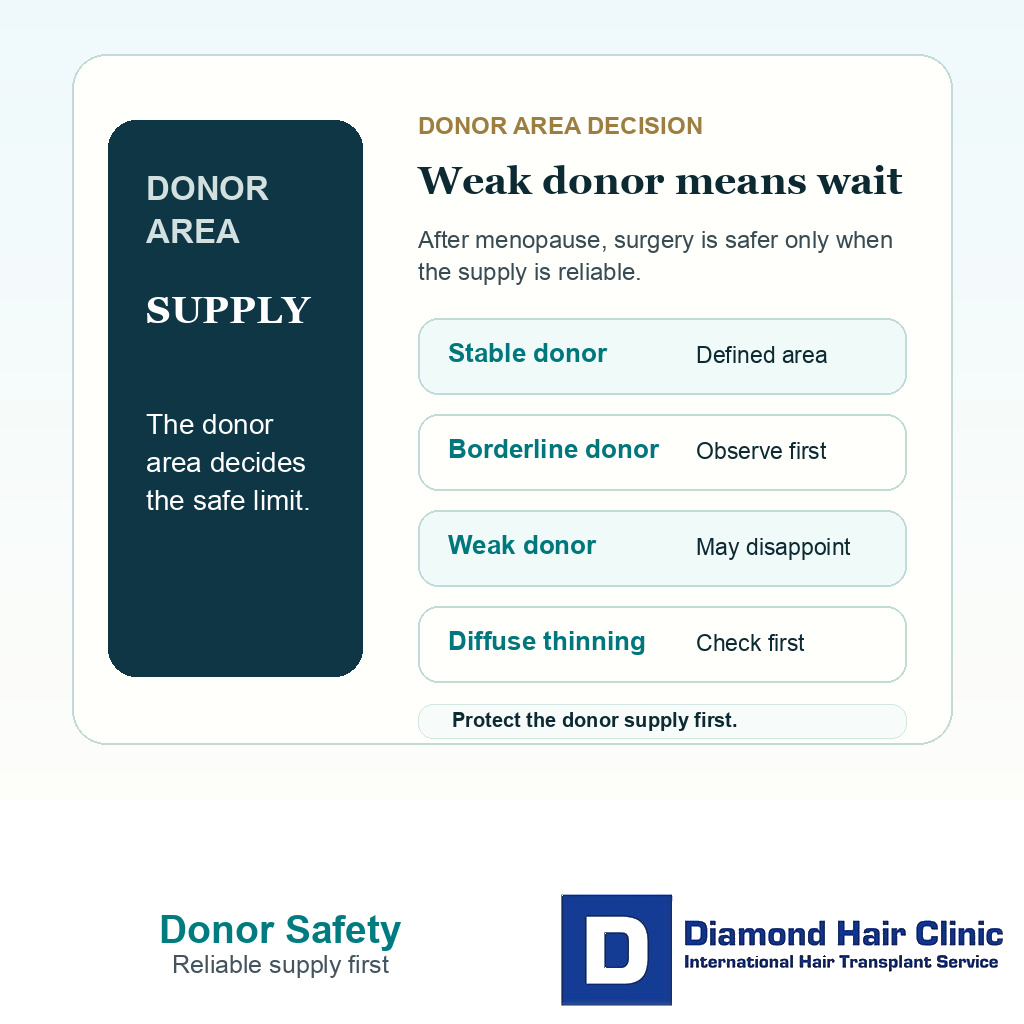
If donor supply is weak or miniaturizing, moving more grafts can make the result less reliable rather than safer.
Photos alone do not decide the menopause hair loss plan
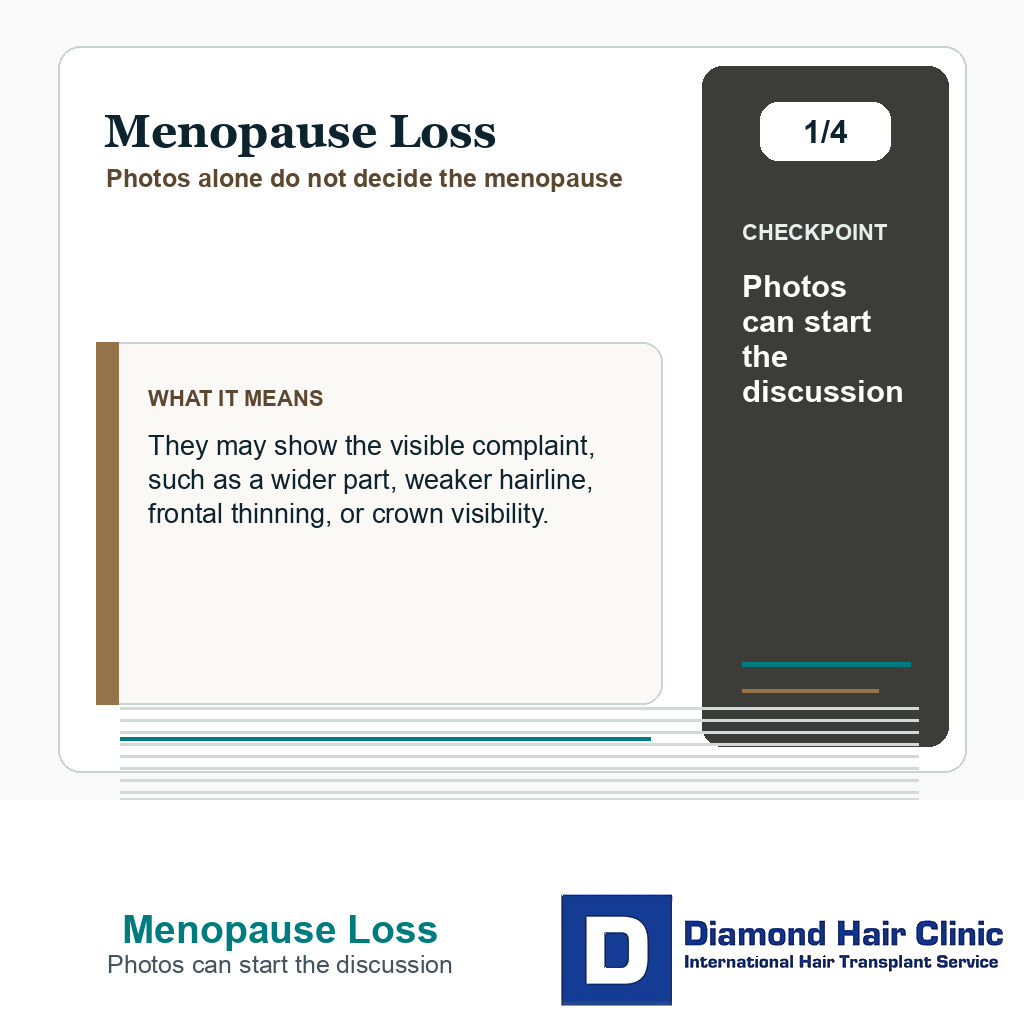
Photos can start the discussion, but they should not finish it. They may show the visible complaint, such as a wider part, weaker hairline, frontal thinning, or crown visibility. They do not reliably show donor miniaturization, scalp inflammation, hair shaft diameter, follicular openings, or whether shedding is still active.
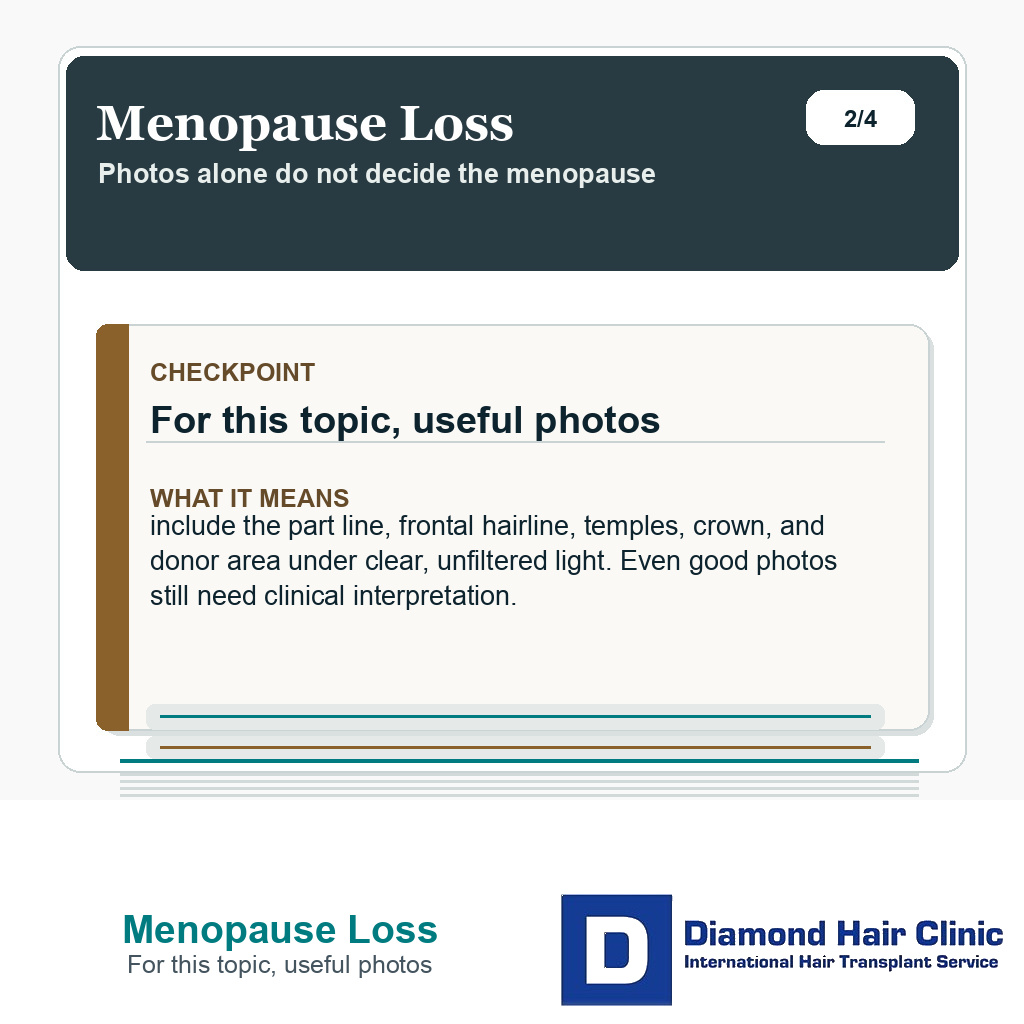
For this topic, useful photos include the part line, frontal hairline, temples, crown, and donor area under clear, unfiltered light. Even good photos still need clinical interpretation. Magnified assessment, and sometimes blood tests or biopsy, may change the decision completely.
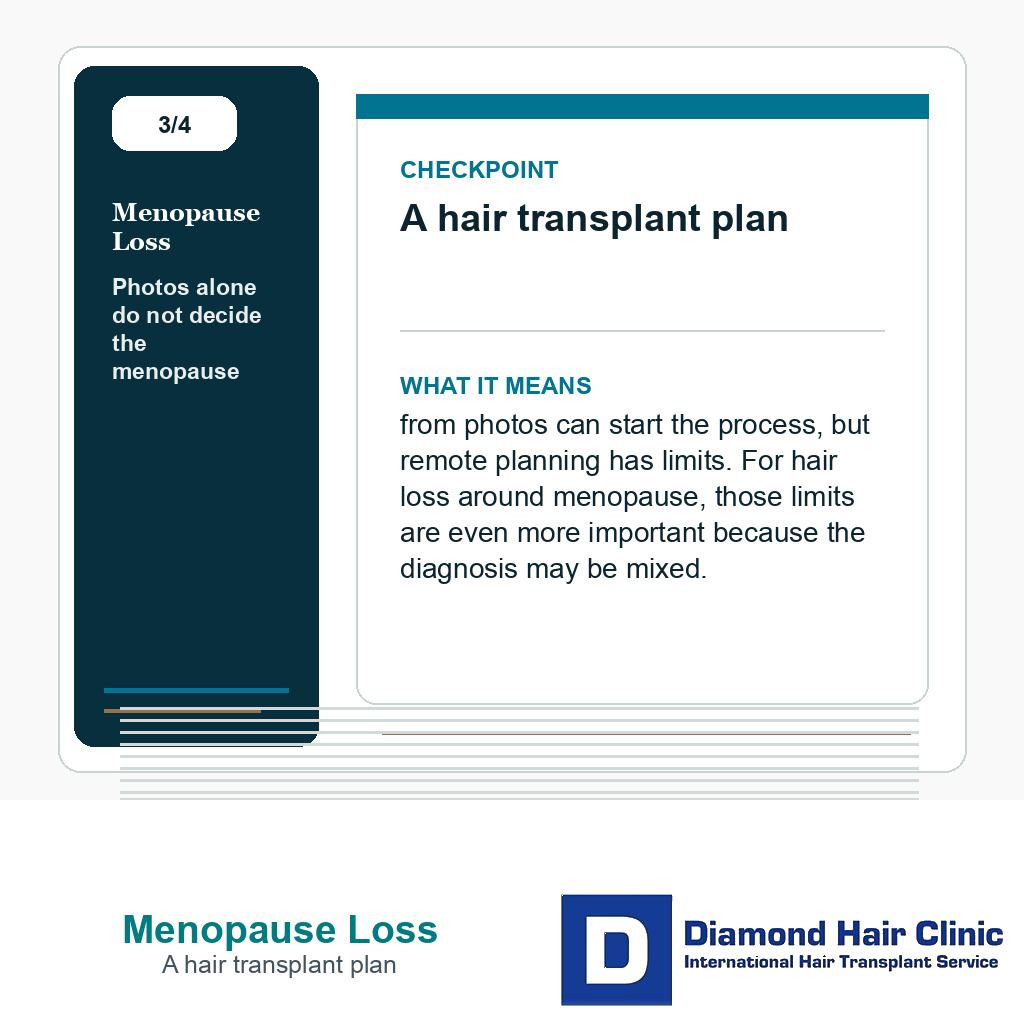
A hair transplant plan from photos can start the process, but remote planning has limits. For hair loss around menopause, those limits are even more important because the diagnosis may be mixed. A photo review can decide whether a consultation is worth pursuing. It should not become a final surgical promise.
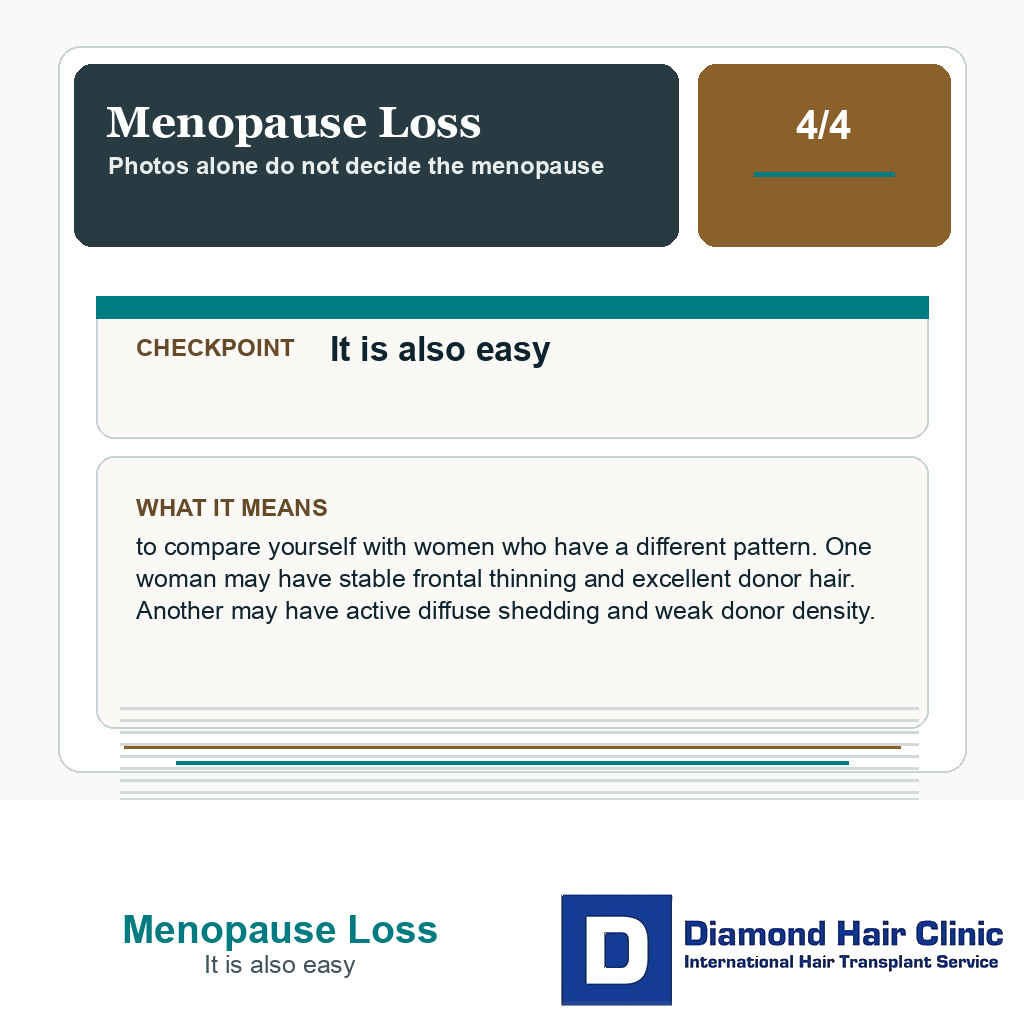
It is also easy to compare yourself with women who have a different pattern. One woman may have stable frontal thinning and excellent donor hair. Another may have active diffuse shedding and weak donor density. Their photos may look similar when you are anxious, but the surgical decision is not the same.
Menopause planning needs diagnosis first, and these 4 slides connect shedding pattern, hormones, donor reserve, and surgery timing. Swipe sideways, use the arrows, or choose a number below the image.
Realistic improvement matters more than old density
The expected result should be improvement, not a return to the scalp density of a different age. Hair transplant surgery redistributes hair. It does not create unlimited density, reverse every hormonal change, or guarantee that native hair will remain the same.
A good result may mean a softer hairline, better frontal framing, a less visible part in a targeted zone, or easier styling. It may still need medical treatment, gentle styling habits, and realistic lighting expectations. Comparing only to ideal photos can create the wrong expectation. Hair transplant results like yours are useful only when donor quality, hair caliber, age, and thinning pattern are similar enough to compare.
The clearest plan states both what surgery can improve and what it cannot control. In hair loss around menopause, that clarity matters more than a high graft number.
What I need before travel after menopause?
Before a woman travels for surgery after menopause, I want to know whether the pattern is female pattern loss, temporary shedding, medication related shedding, scalp inflammation, or a mixture. Age alone does not approve or reject surgery. The pattern does.
I also want the donor supply judged without the camouflage of long hair. If the back and sides are miniaturizing, a larger graft number can create a weaker result instead of a stronger one. If medical treatment has just changed, the scalp needs time before grafts are spent.
For a woman whose diagnosis, donor finding, target area, medication context, or uncertainty is still unsettled, flying for surgery is premature. Local medical review or observation may be more appropriate until the cause and stability are clearer.
Diagnosis and donor stability come before graft numbers
I decide in a sequence, not from a single photo or graft number. First I identify the type of hair loss and the shedding timeline. Then I check whether donor supply is reliable. After that, I decide whether medical treatment, scalp treatment, dermatology review, or observation should come before surgery. Only then does the cosmetic plan make sense.
If the diagnosis is female pattern hair loss with a stable donor area and a defined target, a hair transplant may help. If the thinning is active, diffuse, medically driven, inflamed, or still changing quickly, treatment and observation should come before grafts.
A woman after menopause does not need a sales pitch or a refusal based only on age. She needs to know whether the pattern is surgical, whether donor supply is dependable, and which parts of the change may still need medical treatment. Once diagnosis, stability, donor area, and expectation agree, the transplant decision becomes much safer.
Read this review excerpt
He was very thorough in every little detail and I never felt pressure to do anything I wasn’t sure of.