



PCOS Hair Loss and When Grafts Should Wait
A hair transplant can be considered with PCOS only when the hair loss has settled, donor supply is healthy, and there is a clear area that surgery can improve. If shedding is active or thinning is diffuse, grafts should wait.
PCOS alone is not the surgical diagnosis. The hair loss still needs proper diagnosis before surgery is considered, and I need to know whether the loss is androgen related, diffuse, traction related, telogen shedding, or another condition. When hormones are changing, the donor area looks weak, or thinning is spreading across the whole scalp, diagnosis and stability come before grafts.
A transplant can move healthy follicles into a thin area. It cannot control androgen activity, stop future miniaturization, or replace the need to understand why your hair is thinning.
I separate the PCOS diagnosis from the surgical target. PCOS may explain why hair is thinning, but it does not prove that the scalp is ready for surgery. I still need a stable area that can genuinely benefit from moved grafts. Controlled PCOS is not always the same as hair loss ready for transplant. Cycles, skin symptoms, weight, or blood work may improve while shedding still needs time to settle. In another woman, PCOS may be present but the surgical target is localized and stable.
In a woman with PCOS, I am not asking only how many grafts can be placed. I check whether the loss is stable, whether donor supply is safe, whether medical treatment has had enough time, and whether surgery will make the patient look more natural without spending grafts too early.
For PCOS, the consultation should include the treatment timeline, cycle changes, recent shedding pattern, and whether the thinning is localized or diffuse. Surgery is easier to judge when the hormonal story and the surgical target are not mixed together. Part line, temple, crown, and donor photos under the same lighting make that story easier to judge than a single hairline photo.
Bring older hairline and part photos from quieter periods, not only the worst shed week. A stable comparison makes surgery planning safer than one anxious photo.
PCOS hair loss needs a stable surgical target
PCOS hair loss is ready for surgical discussion when the diagnosis is clear, the pattern is suitable, and the hair loss has become reasonably stable. The key distinction is whether there is a defined area that can be improved, or whether the whole scalp is losing density in a way that makes surgery less predictable.
That distinction matters in women because female thinning often does not behave like a classic male hairline recession. Many women notice a widening part, reduced ponytail volume, thinner frontal density, or a see through crown. If the donor area at the back and sides is also miniaturizing, there may not be a safe reserve of permanent hair to move.
I first separate a possible female hairline transplant from diffuse medical thinning. A woman with a naturally high forehead and strong donor hair may be a very different case from a woman with active shedding related to PCOS across the scalp.
Surgery may be technically possible while the hair loss pattern is still too active for graft planning.
Stability needs months, not hopeful weeks
Stability has to be measured in months, not in a few hopeful weeks. In many PCOS cases, 6 to 12 months of steadier shedding, a stable medical plan, and no rapid widening of the part line gives a safer basis for surgical discussion. If that plan includes anti androgen medication, the separate guide to spironolactone before FUE explains why dose response, side effects, and pregnancy plans affect timing.
No single waiting period fits every woman with PCOS. A localized, stable hairline problem with strong donor hair is different from recent heavy shedding across the scalp. But if hormonal treatment, minoxidil, anti androgen medication, contraception, weight changes, fertility treatment, or IVF timing before hair transplant are all changing together, the surgical picture is not stable enough. When contraception is used for PCOS symptoms or cycle control, birth control and FUE planning also need the change date, shedding trend, and pregnancy intention.
Surgery should not be delayed unnecessarily. The concern is using donor grafts while the diagnosis is still moving. Good photos over time, shedding history, blood work review, and coordination with the doctor managing PCOS can make the eventual surgical decision much safer.
Diagnosis matters more than graft numbers
A graft number can sound reassuring, but in PCOS it can also mislead the patient. If a clinic says, “You need 2,000 grafts,” before understanding the diagnosis, the number has very little value. It may describe a package more than a surgical plan.

Before I discuss grafts seriously, I need a clear picture of the miniaturization pattern, donor density, shedding history, menstrual or hormonal stability, medications, previous blood tests, and other possible causes. PCOS can be part of the picture, but it may not be the only reason for hair loss. I also do not treat female pattern hair loss as automatic proof of androgen excess. The scalp pattern still has to be examined on its own.
Candidacy matters here. A patient can read about being a good candidate for a hair transplant, but PCOS adds a more specific question. Will the transplanted hair sit inside a stable plan, or will the surrounding native hair keep thinning so quickly that the result looks weak later?
When the diagnosis is wrong, the operation may still look technically clean on the day of surgery. The problem appears later, when the patient realizes that donor grafts were used in an unstable situation.
Waiting can protect the donor area
I wait before using grafts if the shedding is sudden, heavy, or still changing month by month. The same applies when PCOS was recently diagnosed, medication has just started, weight or metabolic changes are active, or the patient is still trying to understand whether the hair loss is related to androgen activity, nutritional, thyroid related, stress related, postpartum related shedding, or a mixture.
Waiting does not mean doing nothing. In many women, waiting is part of protecting the donor area. It gives time to see whether treatment reduces shedding, whether the part line stabilizes, and whether the surgical target becomes clearer.
Another medical issue can change the timing. If the history suggests thyroid imbalance, I do not rush past that possibility. A separate discussion about thyroid problems and hair transplantation explains why unstable endocrine issues can confuse the timing of surgery.
Iron deficiency or anemia can create the same timing problem. If blood values are low, the patient may be shedding for reasons that a transplant cannot correct. I consider low ferritin or anemia before a hair transplant when the history or blood work points in that direction.
In a stable case, I do not need the patient to wait forever. But I do need enough evidence that surgery is treating the right problem.
Diffuse thinning from PCOS needs caution
A transplant is usually strongest when there is a defined area to improve. Diffuse thinning is more difficult because the surgeon must place grafts between existing hairs, avoid shock to weak native hair, and still create enough visible change to justify using donor grafts.
With PCOS, some women have a pattern that can be helped surgically. For example, a stable frontal area, a thin hairline, or a localized part line weakness may be improved if donor supply is strong. Other women have generalized miniaturization across the top, sides, and donor region. In that case, surgery may give less improvement than the patient hopes.
I do not promise density that the donor area cannot provide. If the whole scalp is thinning, adding grafts to one area may not solve the patient’s real concern. It may also spend grafts that would be needed later.
Unclear female hair loss deserves a smaller, more cautious plan, not aggressive surgery. A technically possible operation can still be the wrong strategy.
Donor area judgment in women with PCOS
Donor reliability is the foundation of the plan. In a woman with PCOS, I look carefully at whether the back and sides of the scalp are truly strong, or whether there is miniaturization there too. If the donor hair is not stable, the transplant becomes much less predictable.
Patients sometimes think donor hair is safe simply because it is at the back of the scalp. That is not always true in diffuse female hair loss. The donor area must be examined, not assumed.
I check hair caliber, curl, color contrast, density, and how much coverage the patient expects. Fine, straight, dark hair on light scalp can look thinner than thicker or wavier hair even with the same graft number. This changes the surgical plan.
Donor management matters because PCOS hair loss may continue over time. I try not to use too many grafts for a short term improvement if the patient may need grafts later. A natural result is not only about today’s hairline. It is also about preserving options.
Minoxidil and hormonal treatment need a plan
Medical treatment does not replace surgery when there is a true surgical target, but it can change whether surgery is wise now. When PCOS is driving hair loss, treatment may help stabilize the surrounding native hair, reduce active shedding, and make the surgical target easier to judge.
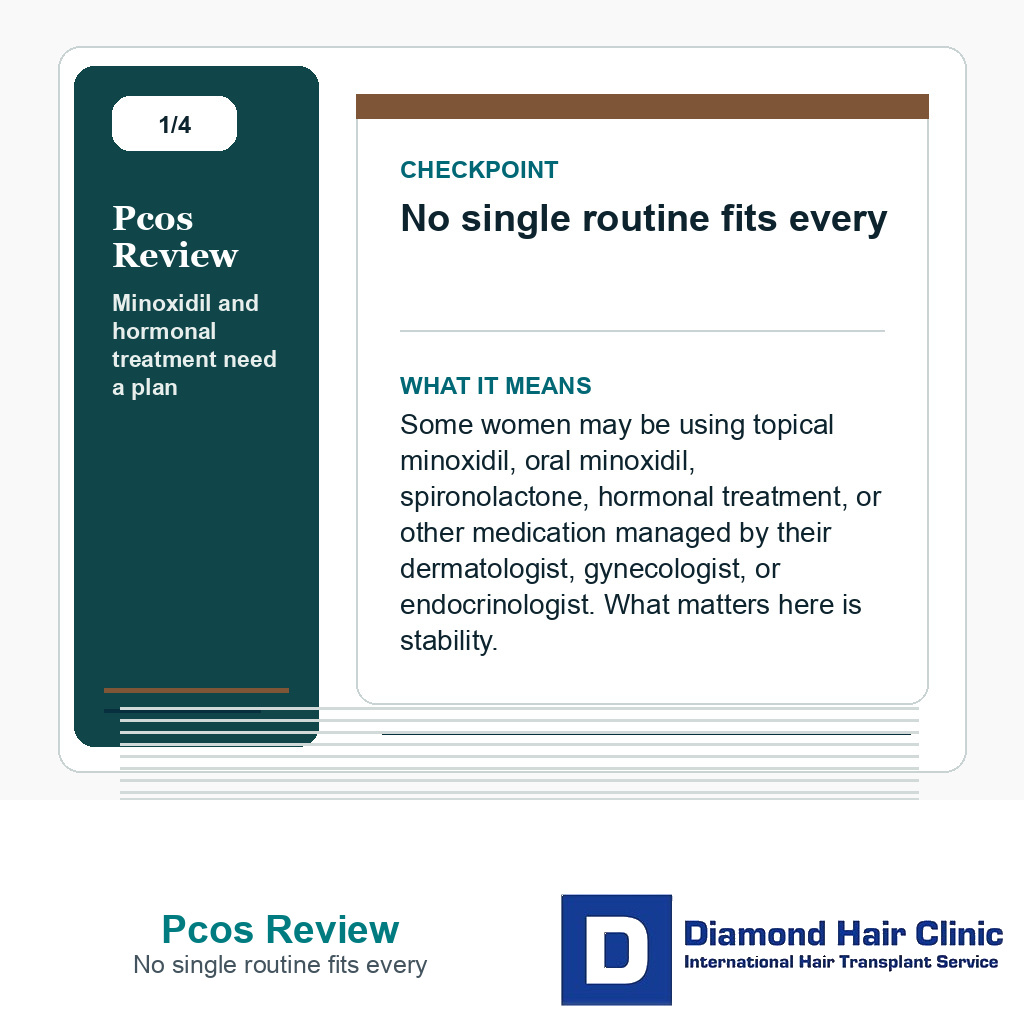
No single routine fits every patient. Some women may be using topical minoxidil, oral minoxidil, spironolactone, hormonal treatment, or other medication managed by their dermatologist, gynecologist, or endocrinologist. What matters here is stability. If several treatments are being changed close to surgery, nobody knows what caused shedding, irritation, improvement, or side effects.
This matters most when the patient is trying to conceive, pregnant, breastfeeding, changing hormonal contraception, starting an anti androgen, or changing a metabolic treatment plan. Those decisions should be coordinated with the doctor managing the PCOS before donor grafts are used.
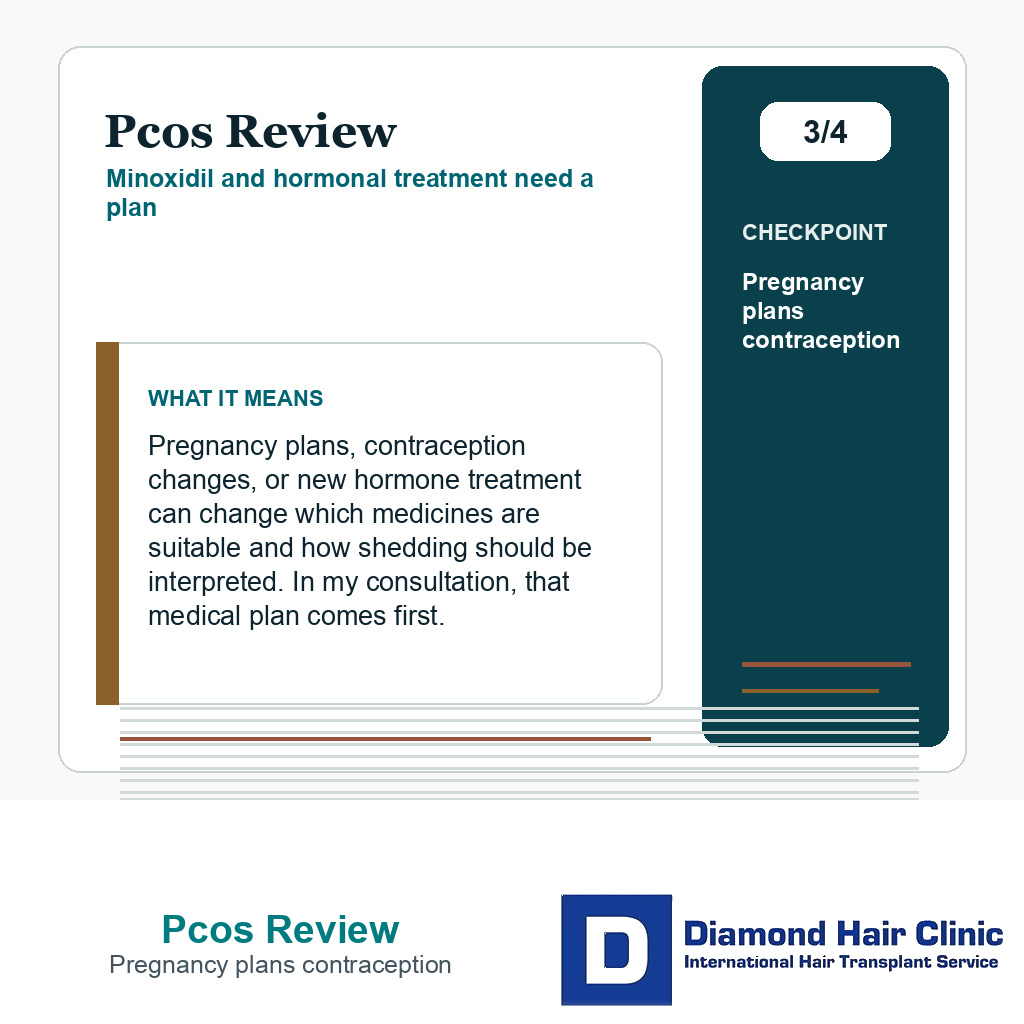
This is not only a scheduling detail. Pregnancy plans, contraception changes, or new hormone treatment can change which medicines are suitable and how shedding should be interpreted. In my consultation, that medical plan comes first. Operating during a moving hormonal period makes the outcome difficult to interpret and difficult to protect.
For some patients, trying medication before surgery is the more responsible first step. For others, especially when the hairline problem is stable and donor hair is strong, medication may support the long term plan but not remove the need for surgery.
If minoxidil is part of the plan, timing matters. Panic starting or panic stopping treatment around surgery can create more confusion than clarity, which is why I discuss minoxidil after a hair transplant separately.
With PCOS, these 4 slides keep graft planning tied to hormonal stability, pregnancy plans, medicine changes, donor strength, and minoxidil timing. Swipe sideways, use the arrows, or choose a number below the image.


Hairline and part line planning should stay conservative
In a woman with PCOS, the hairline or part line plan should be conservative and personal. I do not copy a male pattern plan and I do not lower the hairline aggressively unless the face, donor capacity, and future hair loss risk all support it.
A female hairline should frame the face softly. It should not look like a dense wall of grafts. If the patient already has fine native hair, the transplanted density must blend with what will remain after future hair loss is considered.
For part line or middle scalp thinning, the judgment is different. The goal may be to reduce scalp visibility under normal light, not to create the density of teenage hair. It is better to say that clearly before surgery than let the patient discover it after grafts have already been used.
When PCOS is involved, I consider whether the patient’s main concern is hairline shape, visible scalp, overall volume, or fear that the hair loss is still moving. These are not the same problem, and they should not receive the same surgical plan.
Other diagnoses that should not be missed
PCOS can explain thinning related to androgen activity, but it should not become a label that hides everything else. Female pattern hair loss can overlap with PCOS, and it can also appear when androgen tests are not clearly high. A woman can have PCOS and still have traction injury, alopecia areata, scarring alopecia, low ferritin, thyroid disease, medication related shedding, or telogen effluvium.
For example, tight hairstyles and extensions can create a very different surgical question. A patient with edge loss from pulling should understand how traction alopecia can be treated with a hair transplant only after the pulling has stopped and the area is stable.
Patchy autoimmune hair loss is another situation. If the concern is alopecia areata and hair transplant safety, the surgical decision changes because the immune process can be unpredictable.
Inflammatory scarring conditions need even more caution. With scarring alopecia or lichen planopilaris, the scalp environment may not be safe for grafts unless the disease is quiet and expectations are conservative.
Fast online assessments are especially risky for women with complex hair loss. A good plan starts with the right diagnosis.
PCOS transplant promises that deserve caution
A clinic that makes PCOS sound easy should raise concern. If that answer is only a graft number, a discount, or a dramatic before and after image, the patient has not been properly protected.
The consultation should cover the hair loss history, medical diagnosis, current treatment, donor strength, future progression, and what surgery can realistically improve. You should understand why surgery is recommended now, or why waiting may better protect your donor grafts.
Full density promises in one session deserve special caution when diffuse thinning is present. In PCOS, the surrounding native hair may still be vulnerable. If the plan ignores that, the result can look good in selected photos but disappoint the patient in daily life.
A careful consultation should leave the patient clearer and less pressured, not pushed to reserve a date quickly.
PRP and exosomes cannot replace diagnosis
No extra treatment replaces diagnosis, donor assessment, and surgical judgment. PRP or exosome treatments may be discussed in specific cases, but they should not be sold as a guarantee that PCOS hair loss will stop, that diffuse thinning will become a clear surgical target, or that a weak graft plan will become strong.
Some women want every possible support because the emotional pressure is heavy. I understand that. But adding more treatments does not replace knowing what problem we are treating. First we decide whether surgery is appropriate, whether donor supply is safe, and whether the native hair is stable enough. Then we can discuss whether supportive treatments have a clear purpose.
PRP and exosomes after a hair transplant need diagnosis first. They may have a place in a thoughtful plan, but they do not correct poor diagnosis or unrealistic graft use.
Realistic results when PCOS is controlled
If PCOS is well managed, the hair loss pattern is stable, and donor supply is strong, a transplant can improve selected areas in a natural way. The most realistic goal is usually better framing, reduced scalp visibility in a specific zone, or a softer and more balanced hairline, not a promise that overall volume will return everywhere.
The plan should not create unlimited density. Hair transplantation redistributes donor hair. It does not create new total hair, and it does not make progressive hair loss disappear. This matters especially for women with reduced overall volume.
A good result should look natural under normal light, match the patient’s face, and avoid using more grafts than the case can justify. A modest but stable improvement is often better than an aggressive plan that looks attractive in theory and weakens future options.
When expectations are clear, the patient can make a steadier decision. She can understand what surgery may improve, what medical treatment must continue to protect, and what no clinic should promise.
When I keep grafts off the table in PCOS?
In PCOS, I keep grafts off the table when the shedding is still changing, the diagnosis is mixed with another cause, treatment has just started, or the proposed target is not clearly surgical. A part line that looks worrying in one photo may still be a medical stability problem rather than a graft placement problem.
I also slow down when the back and sides show miniaturization, because that means the graft source may not behave like dependable permanent hair. A patient with PCOS needs a plan that protects the donor supply and the native hair around the recipient area.
The written plan should explain whether surgery is being used for a stable hairline, a localized part line weakness, or a defined scar or traction area. If the answer is diffuse volume everywhere, I usually want more diagnosis and treatment stability before surgery is discussed.
Hormone stability sets the graft threshold
In consultation, I start with the pattern. Is the loss localized enough for surgery, or is it diffuse and still active? Then I examine the donor area, miniaturization, scalp health, medical history, medications, photographs over time, and the patient’s expectations.
If donor supply is strong, the loss is stable, and the target area is clear, I may discuss surgery as part of a long term plan. If shedding is active, hormones are changing, diagnosis is uncertain, or donor supply is not safe, waiting and strengthening the medical evaluation first is usually the better decision.
My answer to a woman with PCOS is therefore a responsible sequence. Diagnose correctly, stabilize what can be stabilized, protect the donor area, then decide whether surgery will genuinely improve the patient’s life.
A hair transplant with PCOS can be a good decision in the right patient. It can also be a poor decision if it is rushed before the hair loss pattern is understood.

Read this review excerpt
told me the quality of my donor hair and what he could take out and advised me what will the be best outcome with what donor hair I had.