


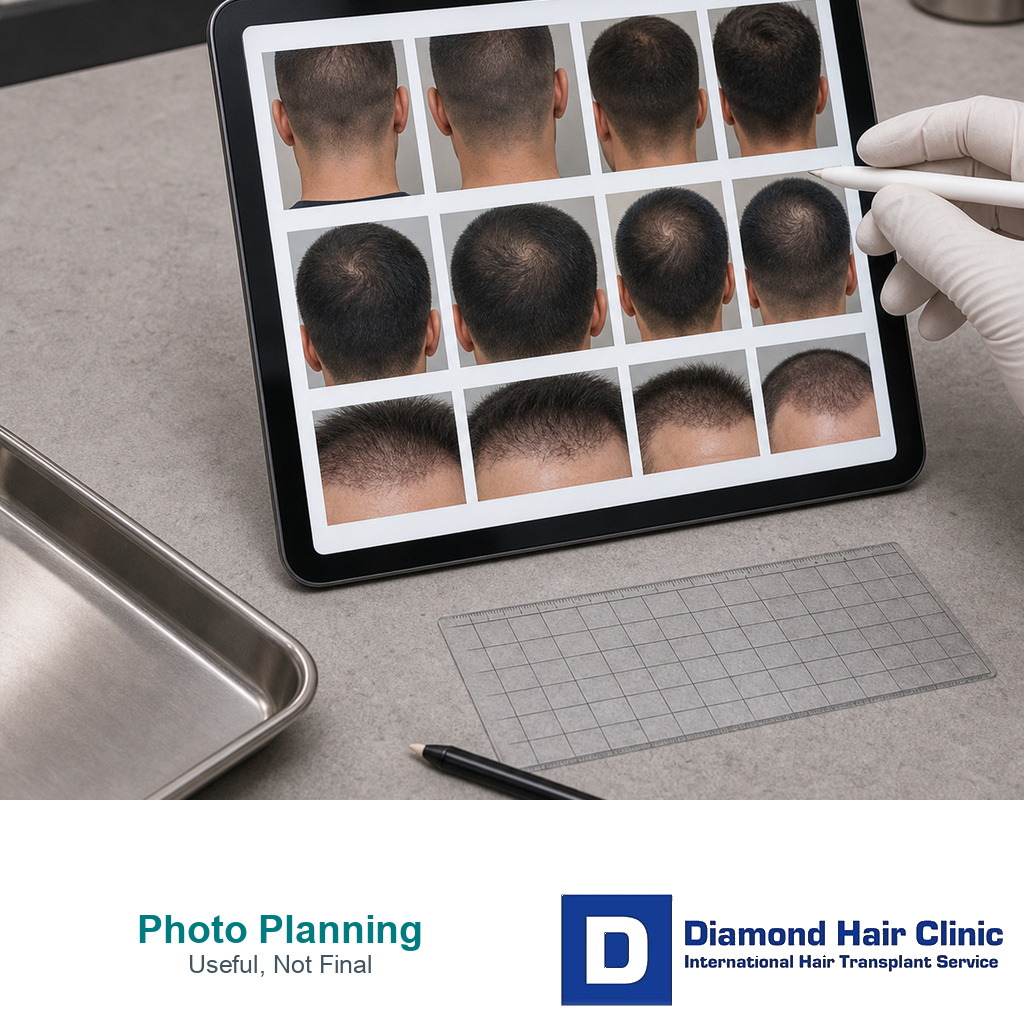
Hair Transplant Planning From Photos Alone
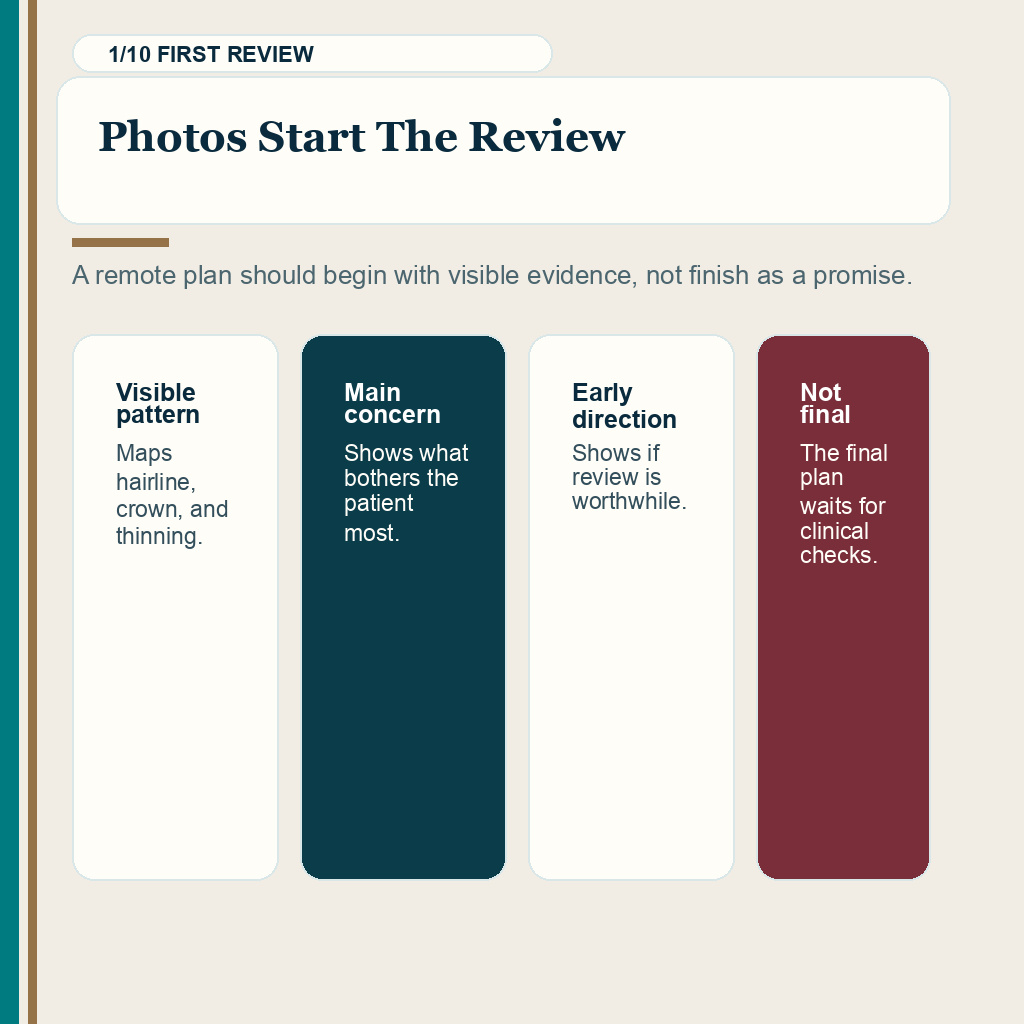
A hair transplant plan can begin from photos, but photos should not be treated as the final surgical plan. Do not cut or shave your hair just for the first photo assessment. Send it at the length you normally wear, with clear front, top, crown, side, and donor views. Parted, wet, or shorter views may be useful after I review the first set. Photos can help me understand the visible pattern of hair loss, the general shape of the hairline, the condition of the crown, the patient’s main concern, and whether the plan may need to be staged. That same comparison is why I ask patients to look for results from patients with similar hair characteristics before relying on a gallery. A polished online result can start the same conversation, but social media hair transplant results should not become the whole plan before the donor area, hair caliber, and future loss risk have been checked. Photos are even more limited when the question is menopause hair loss and hair transplant candidacy, because the donor and diagnosis still need clinical review.
The limits of photos are just as important as what they reveal. They cannot fully show donor quality, miniaturization, scalp condition, hair caliber, graft survival potential, or whether the requested result is safe for the future. This is especially true with a deeper inflammatory scalp condition such as dissecting cellulitis, because photos may not show whether the skin is quiet enough for surgery. Hair pulling related patches create the same problem because broken hairs, scalp texture, and stability all need closer assessment. Hair color can create another blind spot, especially when gray or white donor hair is difficult to judge from casual images. A scalp mole in the planned transplant area is another detail that may need direct skin examination.
Practical guide
Travel follows
the medical decision
A remote photo plan is only one part of safe travel planning. Use the route that matches what you need to understand before arranging flights, payment, or follow-up.
A photo based plan should stay provisional until the scalp or facial hair area is examined properly. This matters even more when a patient wants to plan a hair transplant before a wedding or asks for mustache hair transplant planning from close up photos, because the deadline can make a photo based estimate feel more certain than it really is. This does not make online consultation useless. It simply means that photos should start the medical assessment, not finish it. Drawn hairlines in photos are only proposed designs until the donor area and density goal are checked. If that examination changes the number, I explain what the photos could not show.
Photos of a wide bald area should make the answer broader, not more certain. I may give a first stage range, then decide after donor review whether a second stage is safer than stretching the first operation too far.
It is natural for patients to want a clear answer before traveling, paying a deposit, taking time away from work, or arranging a trip to Istanbul. Many patients send photos and expect a fixed graft number, a final price, and a definite surgery plan. The practical order is to review the deposit decision before booking, because the danger begins when a clinic turns a few photos into certainty about the outcome or a rushed surgery date.
A useful plan leaves the patient clearer, not just more eager to book. A photo review should not turn an early impression into certainty. It should clarify what may be possible, what may be risky, what still needs examination, and whether medical checks such as blood tests are still needed before surgery. If the remaining unknowns are important, pausing before hair transplant surgery is better than pretending a photo estimate is final. That clarity is also needed before trusting a robotic hair transplant claim, because the machine name cannot replace candidacy and donor review.
Reading a remote photo set before travel
With an international photo review, I do not look only at the area that bothers the patient most. I first separate the visible complaint from the surgical limit. The hairline may be the emotional concern, but the donor area, crown pattern, mid scalp thinning, age, medication history, and previous surgery history decide how much can be done safely. This is especially important in Norwood 4 or 5 hair transplant planning, because photos can understate the donor and crown tradeoff.
The photo set should be taken on the same day, in clear light, without filters, fibers, concealer, wet styling, or extreme angles. I need front, top, crown, both temple, both side, and donor area views. Donor photos are usually better when another person takes them from the back and both sides, because mirror photos often hide miniaturization and old extraction marks. For hairline worries, front and top view photos should be read separately because one judges face balance and the other judges curve, direction, and spread.
When nobody is available to help, secure the phone on a stable stand and use its timer instead of stretching your arm toward the scalp. Keep the camera distance, lighting and hair condition consistent across the set so a change in framing does not look like a change in density.
For each side profile, place the camera near ear level and square the lens to that side of the head. A high, low, or diagonal view can change the apparent forehead curve and temple angle before the hairline is even discussed.
To protect your identity, blur the eyes instead of cropping the photo down to the forehead. Keep the full forehead and temples, nose tip, mouth, jawline, and chin in the frame, then send a relaxed front view and one square side view from each side. With those landmarks visible, the surgeon can judge facial proportion, temple connection, and whether the proposed line belongs to your face. Cropping down to the forehead can show recession, but it cannot support a responsible hairline design on its own.
If there was previous surgery, scalp injury, skin disease, medication use, or a visible scar, I want that information before travel. A photo review becomes weaker when the most important limitation is kept outside the frame.
A useful remote review usually has two answers. One answer is what seems possible if the donor area confirms well in person. The other answer is what would make me reduce, delay, or refuse the plan after examination. Both answers belong in the case review before travel, before flights or payment make the decision feel fixed. The review should include the reason the number might go down after donor examination. When two photo quotes are far apart, each number also shows a different decision about what will be left untreated or saved for a later session.
A remote plan also has to explain what is still provisional. If I cannot judge donor capacity, miniaturization, scalp condition, or hair caliber well enough from the photos, I say that directly rather than turning the photo review into a final promise.
What can photos show before surgery?
Clear photos are useful because they show whether the main concern is the hairline, temples, mid scalp, crown, or a combination of areas. They can also show whether the patient is asking for a small refinement or a more advanced reconstruction. If fibers or scalp concealer are being used, send a clean set as well because hair fibers before a hair transplant can make photo estimates too optimistic. When a patient is also comparing a hair system with surgery, I want photos without fibers or scalp makeup, so the plan is not built around disguised density.
Start by understanding the pattern. Frontal hair loss, crown involvement, weakness behind the frontal area, and the difference between a naturally high forehead and progressive male pattern hair loss all change the plan.
These questions matter because the visible complaint is not always the real surgical problem. A patient may send me close photos of the temples because that is what bothers them in the mirror. A careful review may show that the mid scalp is thinning as well. If that is ignored, the surgery may create a front that looks stronger for a short time while the area behind it continues to weaken.
Photos can also help me start a conversation about expectations. Some patients want a modest natural improvement. Some want a very low, very dense, very youthful hairline. Some do not realize how much donor hair would be required to reach what they are imagining.
The first value of photos is not that they give a final answer. Their value is that they show which parts of the case still need medical judgment. AI hair transplant planning has a similar limit. The output is useful only when it keeps the final plan tied to surgeon review rather than fixed certainty.
Photos are the beginning of an assessment. They can help show whether a patient may be a good candidate for a hair transplant, but they do not replace clinical judgment. A patient is not only a picture of hair loss. Age, donor area, hair caliber, family history, previous treatments, and the long term pattern all matter.
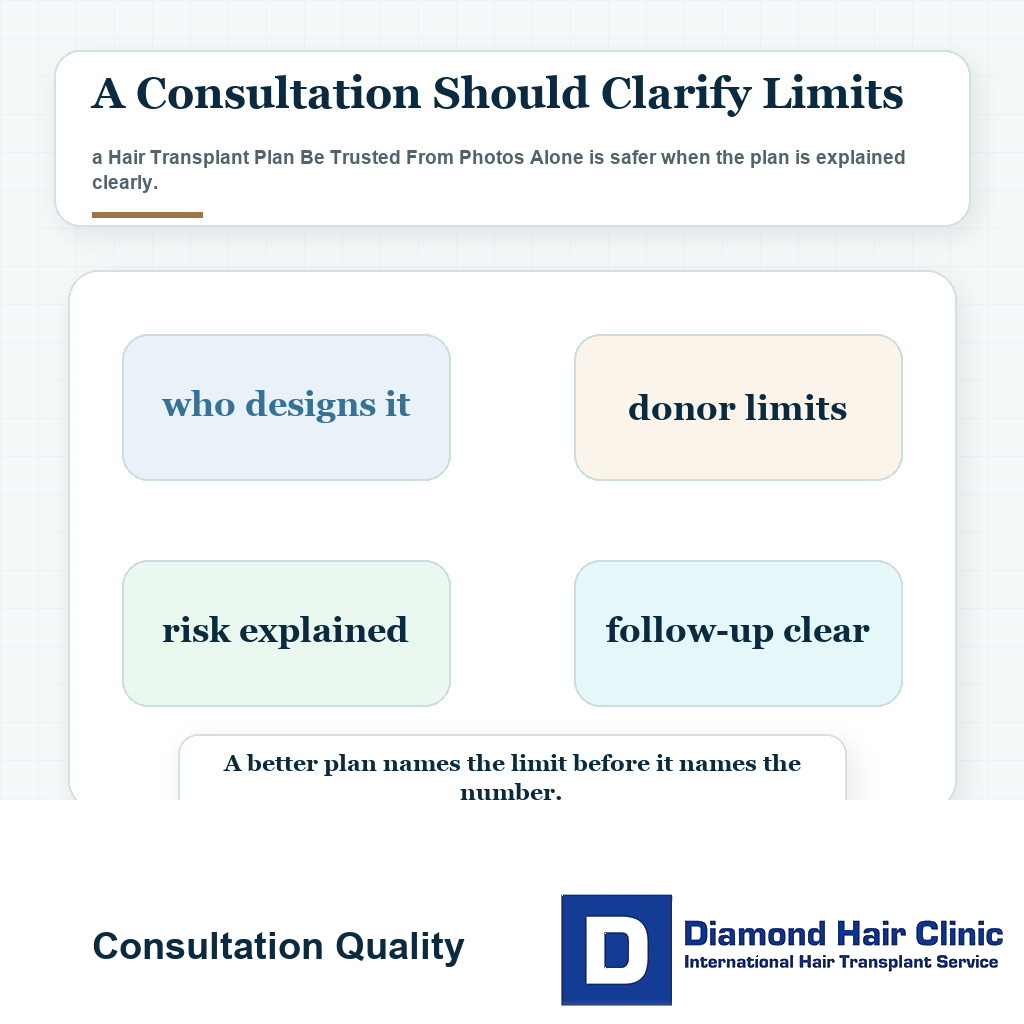
Photos that make consultation more useful
If a patient wants a more useful remote consultation, the photos should be clear and taken in good light. Send photos from the front, both temples, both sides, the top, the crown, and the donor area at the back and sides of the scalp, especially before making a major pre surgery haircut change.
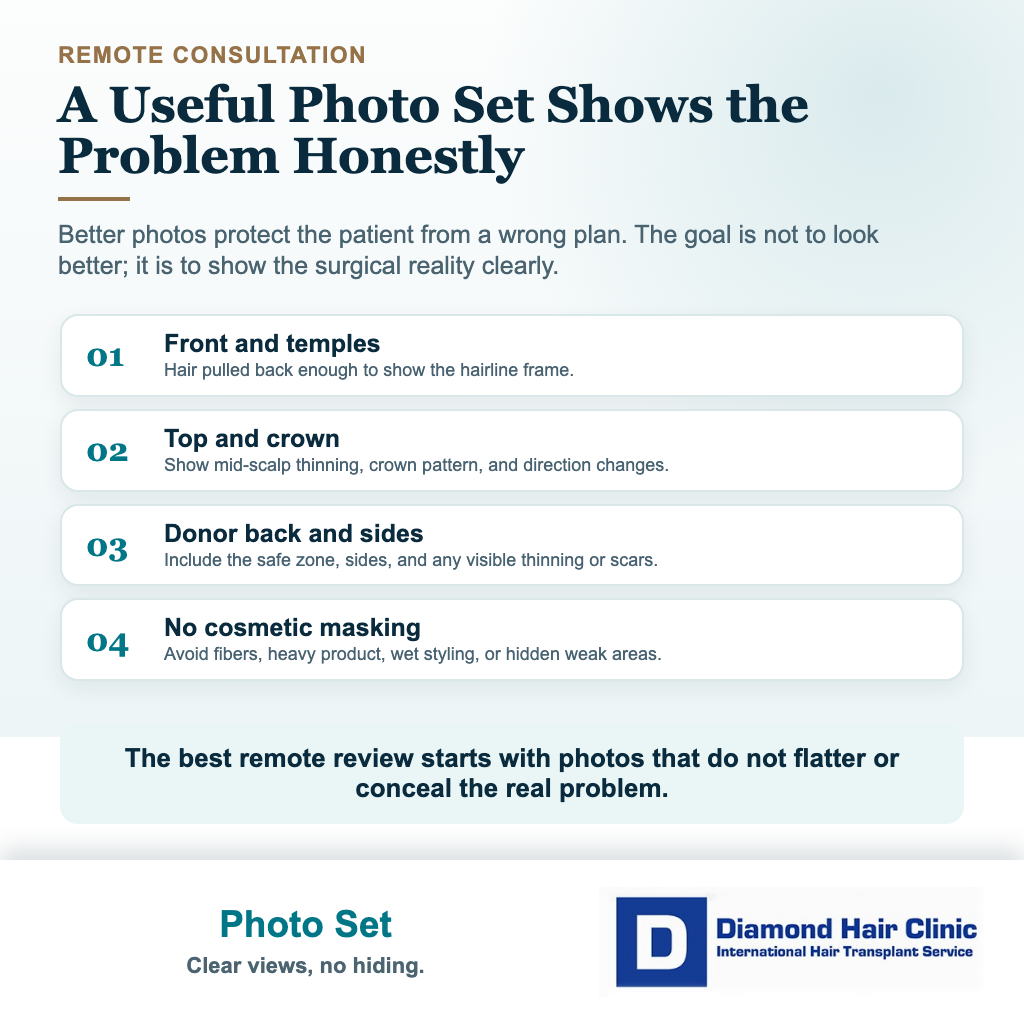
The hair should not be heavily styled, covered with fibers, wet with product, or arranged to hide the weak areas. The purpose is not to make the patient feel exposed. Clear photos protect the patient from a wrong plan.
If you draw a proposed hairline on a photo, send the unmarked original alongside it. I need to see your current hairline and temples clearly as well as the change you have in mind.
Include the angles that feel least flattering. The back and sides, crown, and lifted hair often change a remote quote more than another close hairline photo.
A photo with the hair pulled back can be very useful for judging the hairline and temples. A photo from above can show whether the mid scalp is also thinning. Crown photos should be taken from more than one angle because the crown can look very different depending on lighting, hair direction, and the natural swirl pattern.
Donor photos should include the back and both sides because donor hair is not one flat block. The area above the ears, the lower donor border, and the central back of the scalp may not all have the same strength. A front photo can explain the wish, but the donor views decide whether the wish can become a responsible graft plan. If only one attractive donor photo is sent, the consultation may miss real limitations.
Send age, family hair loss history, previous treatments, medication use, previous hair transplant history if there is one, and the main goal. Without this information, even good photos can lead to an incomplete assessment.
Read this review excerpt
“The breadth and depth of questions that he asked, the number of photos that he looked for, not only of my current condition but of what my hair looked like previous to hair loss, all filled me with reassurance.”
For an earlier transplant, include the operation report and any dated photos of the donor and treated areas taken just after that surgery. Keep them separate from your current photos, and tell us which records are unavailable.
If you are asking whether your donor area is suitable, include the timing of recent hair loss and any medication changes in the same message. A full looking donor photo is more useful when I can also see whether the pattern is stable, whether the crown is changing, and whether a planned surgery date is creating pressure before the case is fully understood.
The better the information, the clearer the remote consultation can be. A useful photo consultation is not just a scalp check. It also needs the story behind the photos.
Keep the exact image set, the notes you included, the submission date, and any confirmation message. If the clinic does not confirm that the files arrived, do not assume a surgeon reviewed them. Follow up through the clinic’s stated contact route and resend the same numbered images if needed, so a later answer can be traced to the material that was actually submitted.
What can photos not show clearly enough?
Photos often hide the details that decide whether surgery is wise. Lighting can make hair look thicker or thinner. Wet hair can reveal weakness that dry styled hair hides. A short haircut can make the donor area look clean even when the density is not strong. A dark room can hide miniaturization. A bright bathroom mirror can exaggerate it.
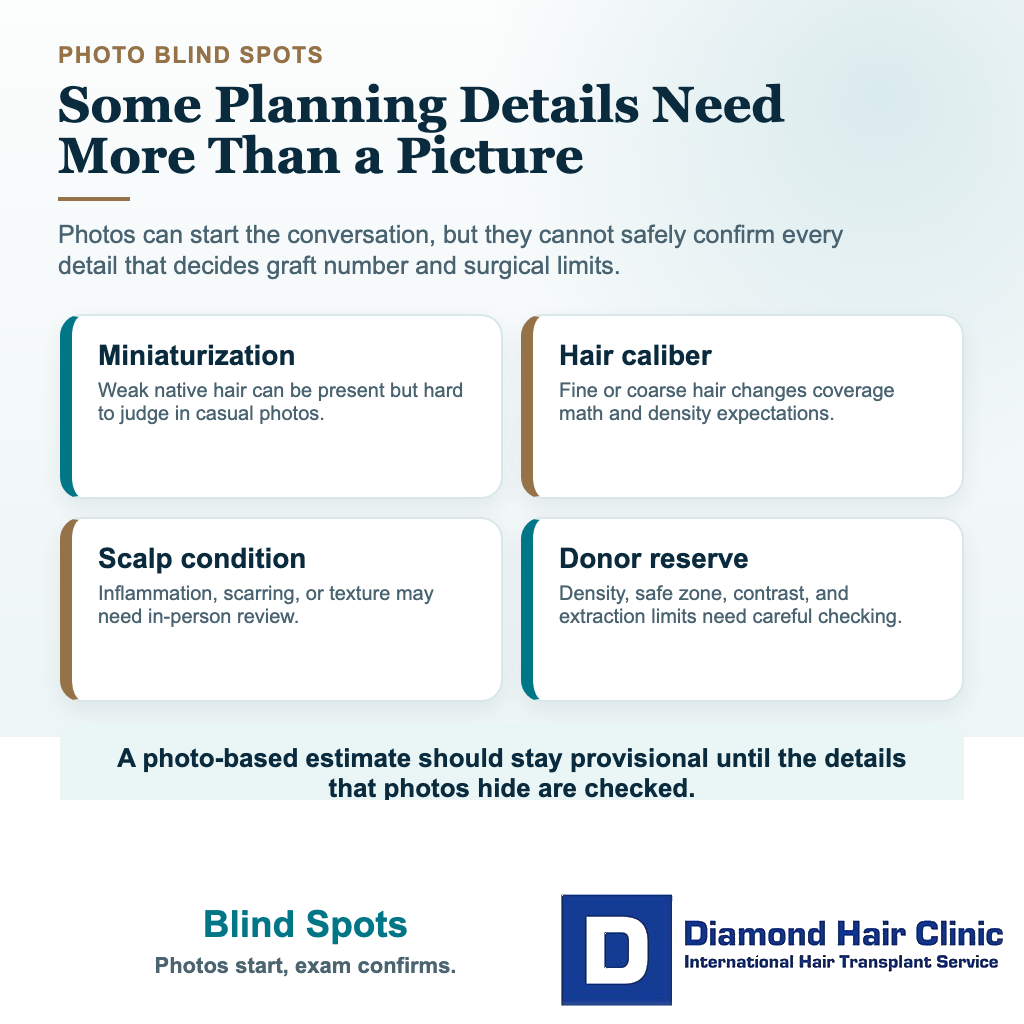
Photos often miss miniaturization. Miniaturized hair is hair that is still present but has become thinner, weaker, and less reliable. It matters because transplanting among weak native hair is not the same as transplanting into a completely bald area.
If the existing hair is unstable, surgery may need to be smaller or delayed, and medical treatment may need to be discussed first. In some patients, it is safer to confirm whether the surrounding hair can be stabilized before using grafts in that area.
Photos also do not show scalp quality well enough. The scalp has to be checked for oiliness, inflammation, scarring, irritation, or another condition. A patient may think they have ordinary male pattern hair loss, but sometimes the story is more complex. A condition such as alopecia areata, or any wrong diagnosis, can turn a technically possible surgery into a poor decision.
Another limitation is hair caliber. Thick hair gives more visual coverage than fine hair, even with the same number of grafts. Curly hair behaves differently from straight hair. High contrast between dark hair and light skin makes thinning easier to see. These details affect planning, but they are often distorted by camera angle, flash, styling products, and image compression.
The missing detail is direct examination. The donor area needs to be seen in real life, the direction of hair growth needs to be examined, and the proposed recipient area must be checked for fragile native hair.
Donor photos are more useful when the donor hair has enough length to show density, spacing, and direction. If the donor is clipped very short, the remote review may need updated photos after some growth or a face to face examination before the donor assessment is treated as reliable.
A remote consultation can be helpful, but it cannot give the same certainty as a proper surgical evaluation.
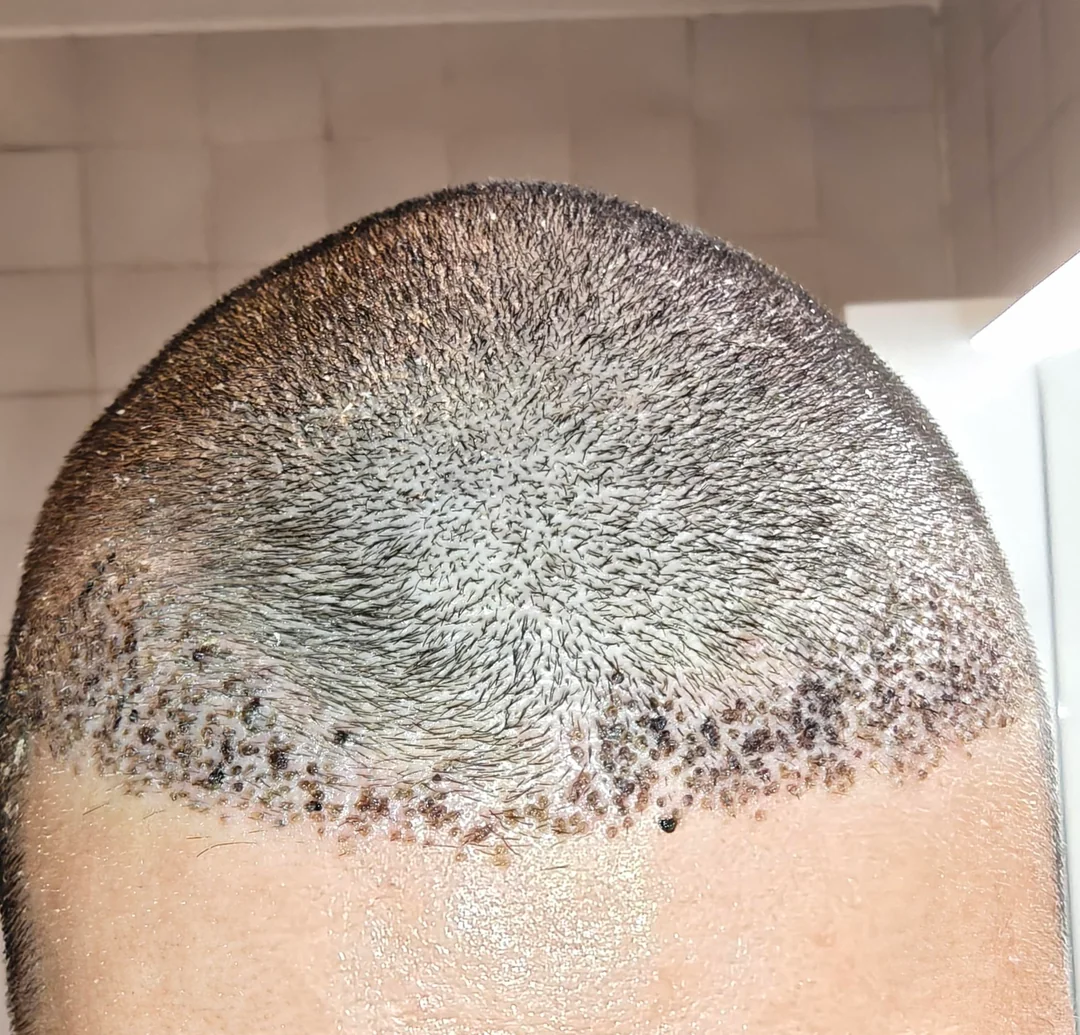
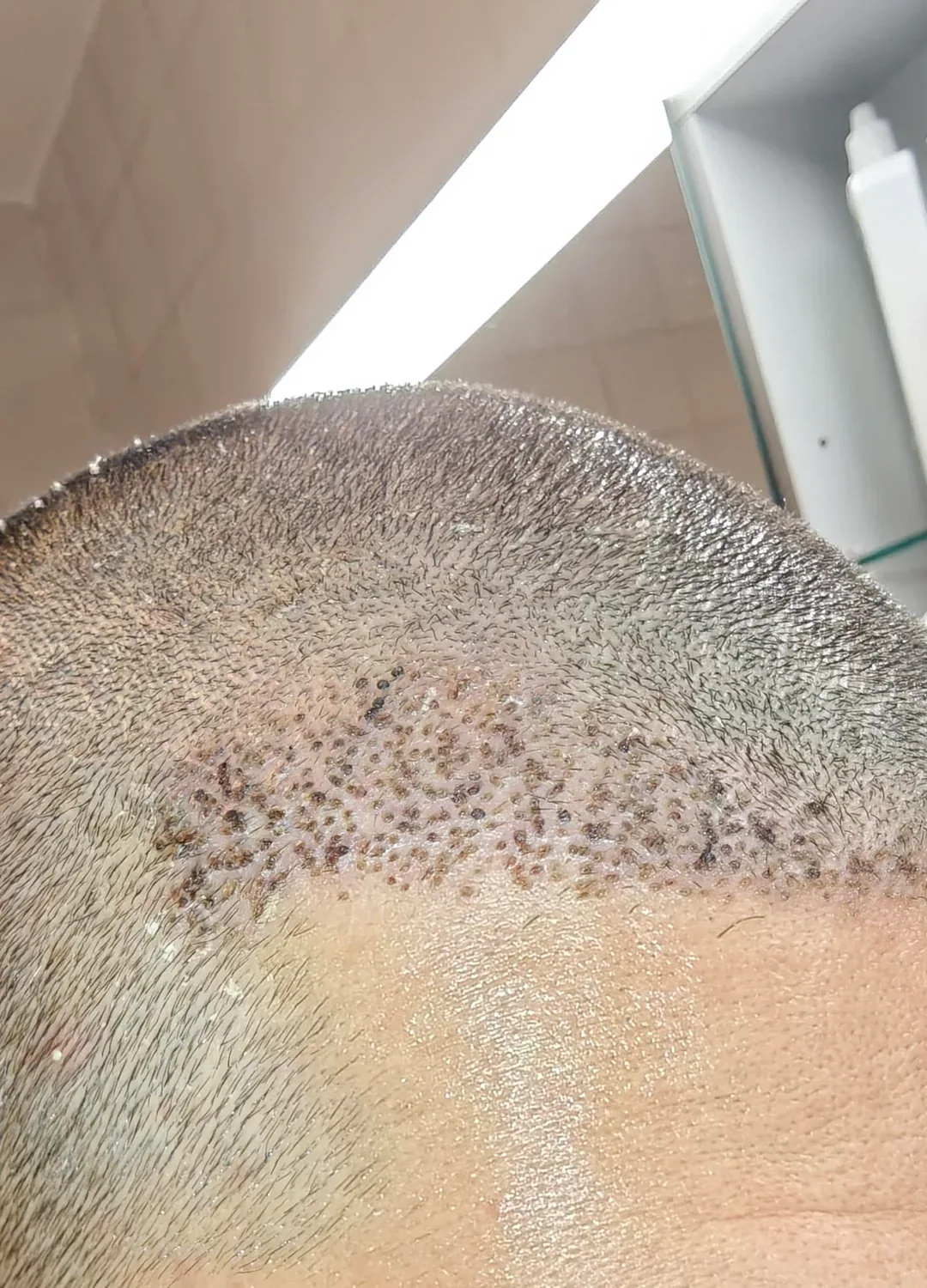
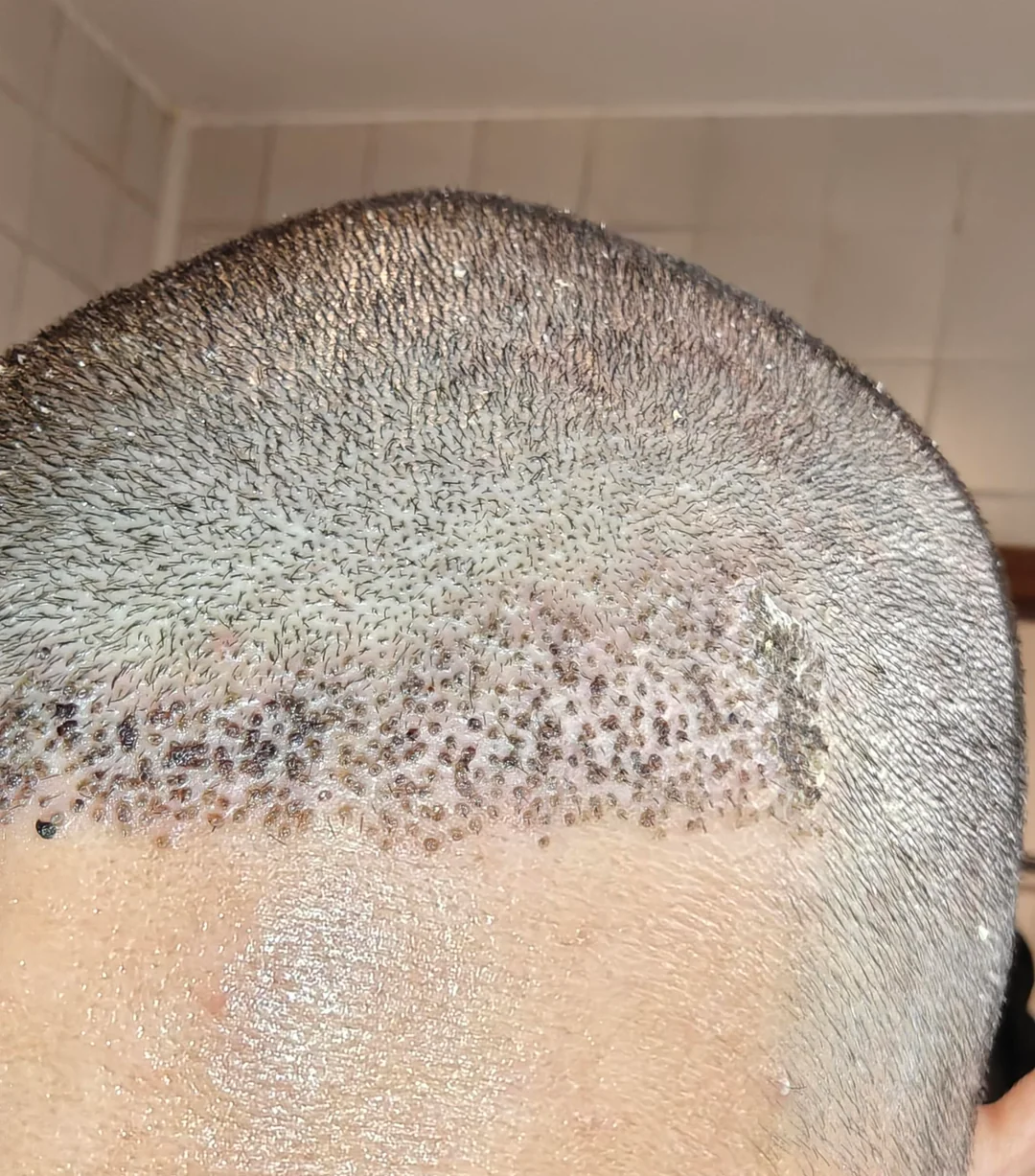
Plans based on photos should stay provisional
A hair transplant plan from photos alone should stay provisional because surgery uses a limited resource. Donor hair does not behave like a product that can simply be replaced if the first plan is wrong. Once grafts are removed, they are spent from the patient’s lifetime graft supply. Once a hairline is placed too low, repair can be difficult. Once too many grafts are used in one direction, future planning becomes smaller.
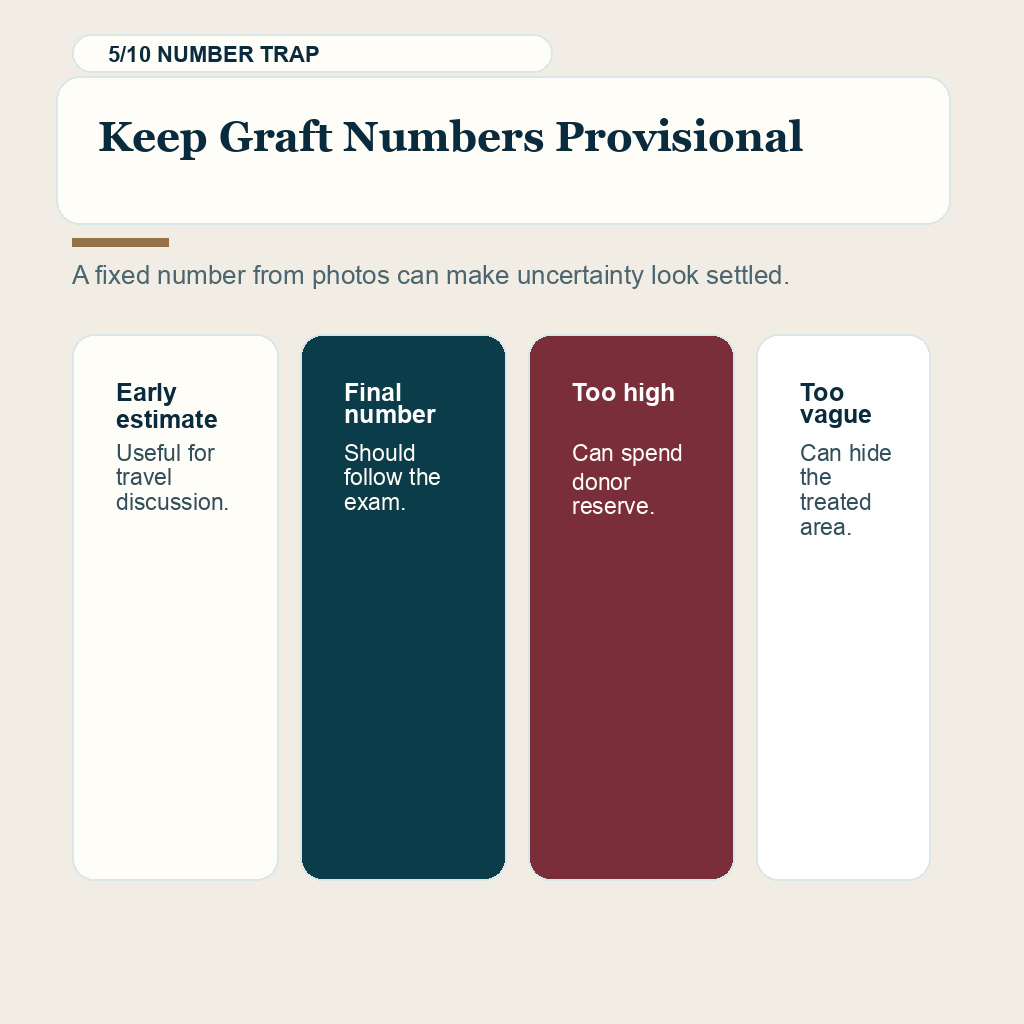
A remote graft estimate should not be treated as a promise. It may be a reasonable early estimate, but it is still an estimate. The final plan should depend on donor quality, safe extraction limits, recipient area size, hair shaft thickness, hair loss stability, and the patient’s long term needs.
Patients often ask why one clinic says one number and another clinic says something very different. The answer is not always that one clinic is right and the other is wrong. Sometimes they are simply using different assumptions. One clinic may plan only the hairline. Another may include the mid scalp. Another may try to cover the crown. Another may be selling a large package. When graft numbers differ between clinics, compare what each number is trying to cover.
From photos, it is easy to say a number that sounds confident. It is harder to explain why the number may need to change after examination. But that clarity protects the patient.
If I estimate a range remotely, the patient still needs to understand that the range must be confirmed before surgery. Certainty should come from evaluation, not from sales pressure.
A provisional plan is not a poor plan. It is a careful plan. It tells the patient what seems possible while leaving room for the truth that can only be seen when the scalp is examined closely. That is the difference between a consultation that respects surgery and a quote that treats surgery like a package.
Graft numbers from photos can be misleading
Graft numbers look precise, so patients naturally trust them. A clinic may say 2,500 grafts, 3,500 grafts, or 4,500 grafts, and the patient feels they have received a serious medical plan. But a number without reasoning is not enough.
When people argue over graft counts from photos, the disagreement is often about missing information rather than arithmetic. A clear photo can show the visible gap, but it cannot measure donor reserve, miniaturization, hair shaft, scalp condition, or future pattern on its own.
A remote graft number has two sides. One side is the visible area that needs coverage. The other is the donor capacity that must pay for that coverage. Photos usually show the first side more clearly than the second.
The right graft number depends on the size of the area, the desired density, the hairline design, the crown pattern, donor strength, hair caliber, and the need to protect grafts for later years. If these details are not discussed, the number may be more of a sales figure than a surgical plan.
Calculating graft numbers is not only about how many grafts can be placed. The real decision is how many grafts can be used without weakening the donor area or closing off future options. That difference changes the whole plan.
More grafts can sometimes improve coverage, but more grafts can also create unnecessary trauma, donor thinning, poor future options, or an unnatural design if the plan is not disciplined.
Photos can make this confusion worse. If the hair is styled forward, the area may look smaller. If the hair is wet or pulled back, the area may look larger. If the crown is not photographed properly, it may be ignored. If donor reserve is not shown clearly, a large graft number may be offered without knowing whether the donor can safely support it.
The number has to match the goal. A small temple correction is planned differently from advanced hair loss. A crown case is not a frontal hairline case, and a young patient with ongoing loss needs a different reserve strategy from an older patient with a stable pattern.
The same number can be reasonable in one case and irresponsible in another. The logic behind the number matters more than the number alone. If a patient only remembers the number, they may shop for the biggest one. If they understand the reasoning, they can judge the plan more intelligently.
Donor area judgment before surgery
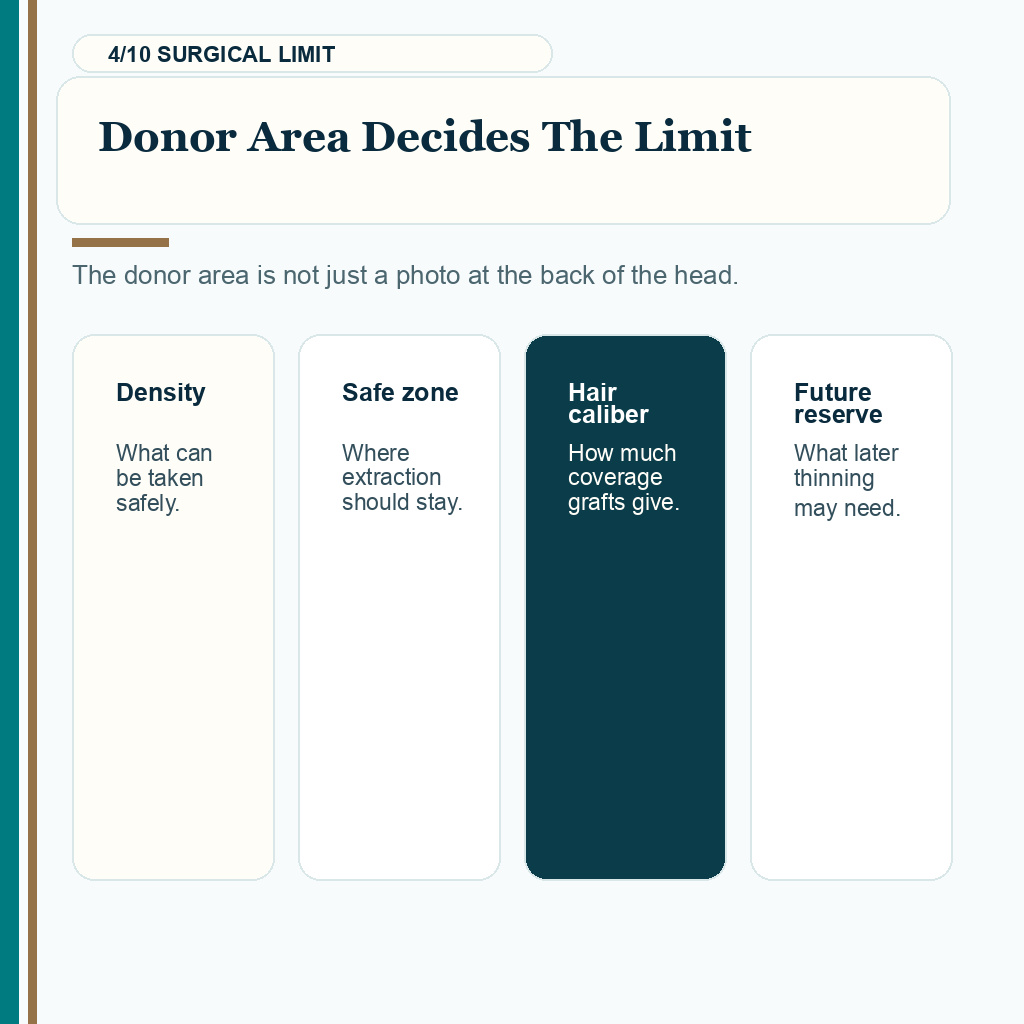
Donor hair is a limited surgical resource. It must provide hair for the current surgery, possible future hair loss, and sometimes repair work if a previous surgery was poor.
Photos can sometimes show obvious weakness, such as thinning above the ears, a narrow safe zone, retrograde loss, scars, or visible patchiness. But many donor concerns are more subtle. A donor area can look acceptable in a photo and still be limited when examined closely.
Before surgery, density, hair caliber, safe extraction zones, contrast, hair direction, scalp condition, and donor stability all need evaluation. Donor reserve is not just the back of the head. It is the foundation of the whole operation.
A strong donor area does not mean unlimited surgery. It only means the surgeon has more room to plan carefully. Even in a strong donor, extraction should be distributed intelligently. In a weak donor, the plan may need to be smaller, more conservative, or postponed.
Remote planning can be dangerous when it becomes too certain. A patient may receive a high graft quote without anyone truly studying the donor area. They may feel encouraged because the clinic sounds sure of itself. But certainty does not protect the donor. Planning protects the donor.
Telling a patient that donor capacity is limited is kinder than pretending everything can be covered. This can be disappointing in the beginning, but it is kinder than using grafts aggressively and leaving the patient with visible donor depletion later.
Photos can start the review, but this slide sequence shows how to use them without treating them as the final surgical plan. Swipe sideways, use the arrows one slide at a time, or choose a number below the image.
Long donor hair can make a weak reserve look safer
Remote photos are weakest when the donor hair is long enough to cover the scalp. A full looking back view can hide low density, miniaturization, or an extraction pattern that would become visible after surgery. Stronger photo planning uses short donor photos with the scalp visible, side views, crown views, and medical context before a graft number is treated as serious. If the donor only looks strong when it is long and layered, the plan should stay provisional. The front view explains the goal, but donor views are needed before the graft number can be responsible.



Hairline planning needs more than a photo drawing
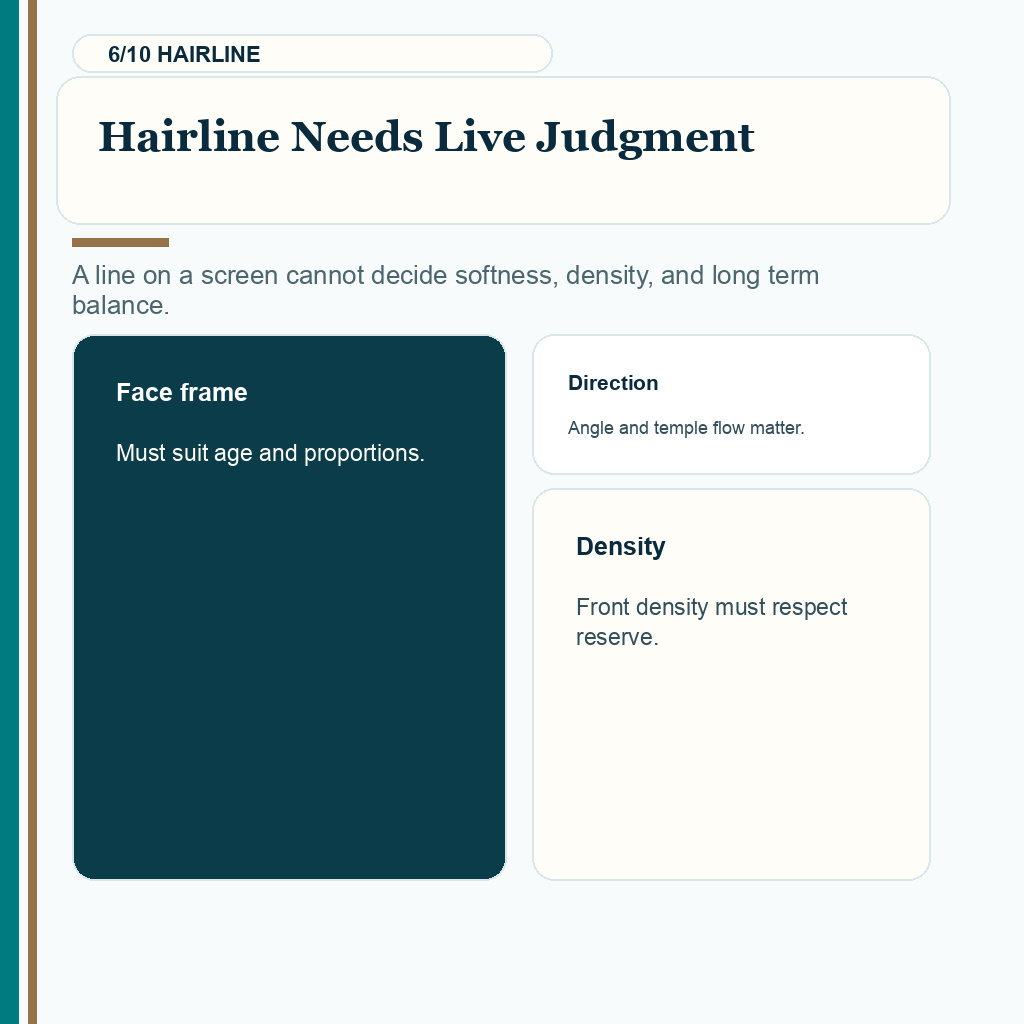
A hairline drawn on a photo can look attractive, but it can also be misleading. A line on a screen does not show where hairline lowering should stop near the forehead muscle, how the temples frame the face, how dense the hair needs to be, or how the design will age.
Natural hairline design is not only about placing the line lower. Proportion, age, facial structure, future loss, hair direction, temple recession, and density transition all matter. The frontal rows must look soft. The angle of growth must be correct. The hairline should belong to the patient’s face, not to a generic template.
A very low line drawn across the forehead needs caution. The desire is understandable. Hair loss can make a patient feel older than they are. But a teenage hairline on an adult face can look unnatural, and it may consume grafts that are needed later.
A hairline discussion should go beyond the first mirror reaction. The drawn line may look nice today, but I also judge how it may age if native hair behind it continues to thin.
Photos can show the requested shape, but they cannot replace real design. In person, facial movement, forehead muscle activity, temple structure, hair angle, and the way the patient’s hair behaves without perfect styling can be assessed. These details shape the final design.
A natural hairline should not only photograph well. It should live well. It should look natural under daylight, in wind, with wet hair, and when the patient is not thinking about their hair at all.
When is an online consultation still useful?
An online consultation can be very useful as a screening step, not as the final surgical decision. It can help determine whether surgery may be worth exploring, whether the patient needs better photos, whether the hair loss pattern looks stable, and whether the expectations seem realistic. It can also save a patient from traveling when the basic situation already suggests that surgery is not wise.
Remote review matters when the patient is traveling from abroad. Many patients cannot visit Istanbul only to hear that they are not ready for surgery. A careful remote review can prevent unnecessary travel, unnecessary deposits, and unrealistic hope.
The concern begins when the online consultation becomes too certain too quickly. If a clinic gives a fixed high graft number after a few casual photos, promises full coverage, pressures the patient to book, and avoids discussing limitations, that is a warning sign. That is not careful planning. That is a sales process wearing medical language.
A useful online consultation explains what can be seen and what cannot be confirmed yet. It asks for proper photos, age, family hair loss pattern, previous treatments, medication tolerance, expectations, and medical history, including issues such as high blood pressure.
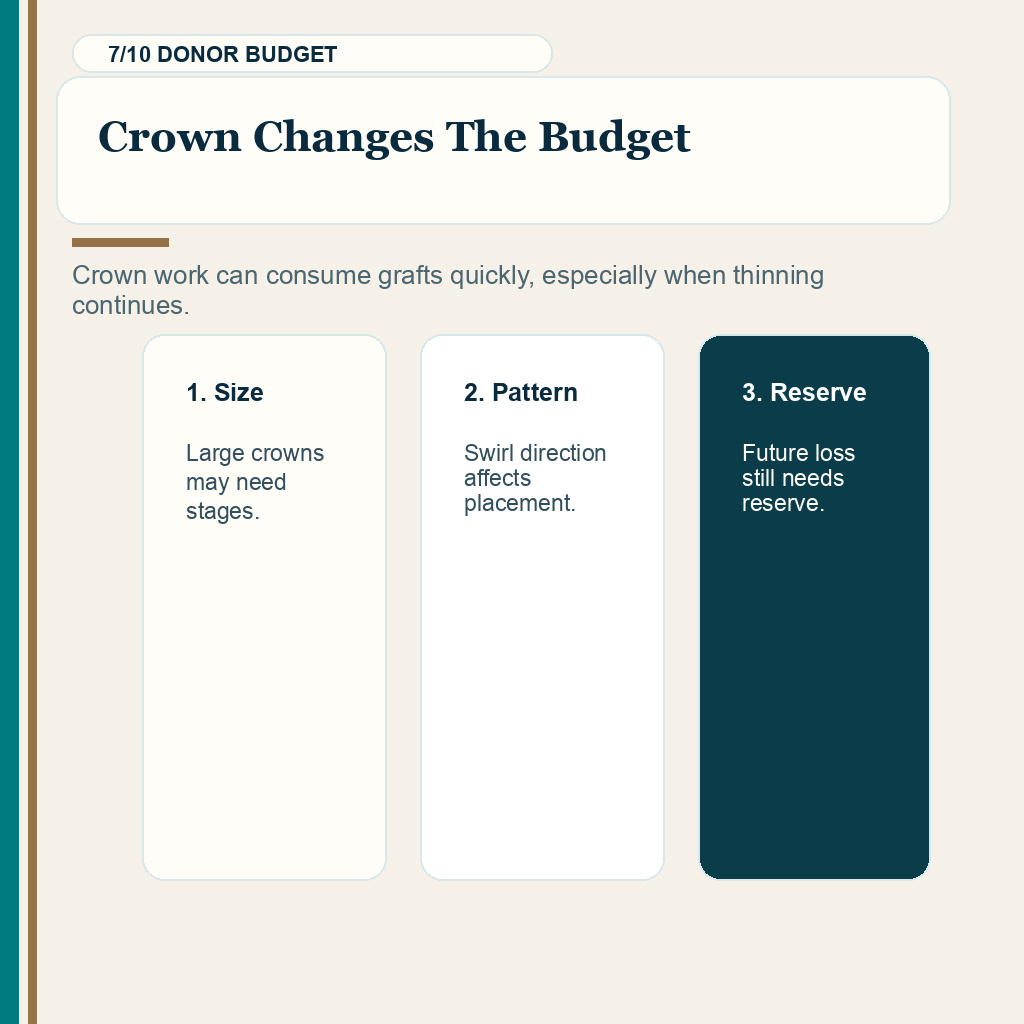
If crown coverage is part of the concern, the conversation should also include the limits of a crown hair transplant, because the crown can use many grafts and still look thinner than the patient expects.
Some patients may need medical treatment before surgery. Others may need a smaller first session. Some may be better served by waiting. A remote consultation is useful when it helps the patient understand these possibilities before becoming emotionally committed to a date.
So yes, photos and online consultation can help. They should start the decision, not finish it.
Read this review excerpt
“Dr. Mehmet reviewed my photos and then I was provided with all the information I needed to move forward.”
Who should confirm the plan before surgery?
The operative plan should be confirmed by the surgeon who is responsible for the medical and artistic decisions of the operation. A coordinator can collect photos, organize travel details, explain logistics, and help the patient communicate, but should not decide the hairline design, donor limits, recipient area density, or stopping point.
It matters because many weak plans sound very organized before surgery. A patient may receive a graft number, a hotel plan, a surgery date, and a price, but still not know who will make the surgical decisions. That is not enough. The plan needs to make clear who performs the hair transplant surgery and who controls the steps that determine the result.
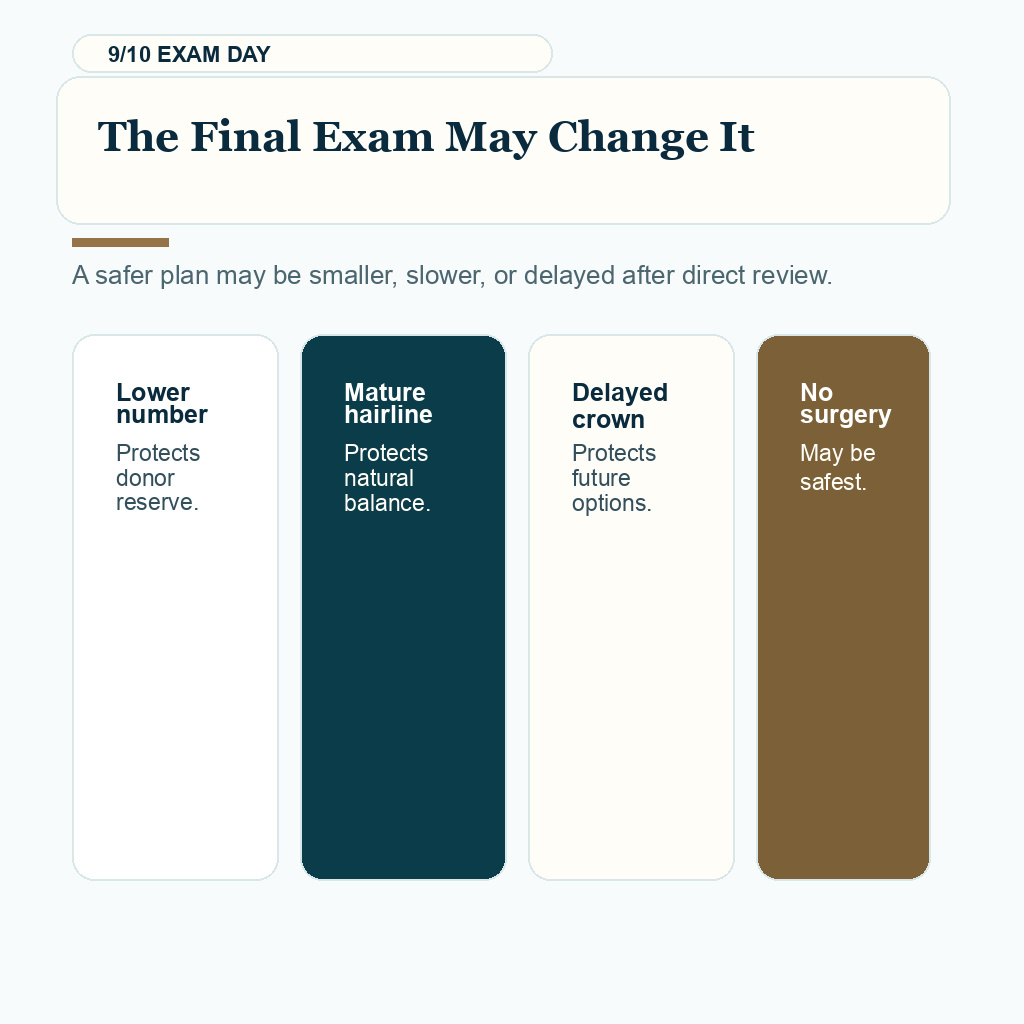
If the final examination changes the plan, the explanation should come from surgical judgment, not from sales pressure. A lower graft number, a more mature hairline, or a decision to delay crown work can feel disappointing, but those changes may protect the patient. The useful detail is whether the change makes the result safer and more natural in the long term plan.
Warning signs of a weak plan based on photos
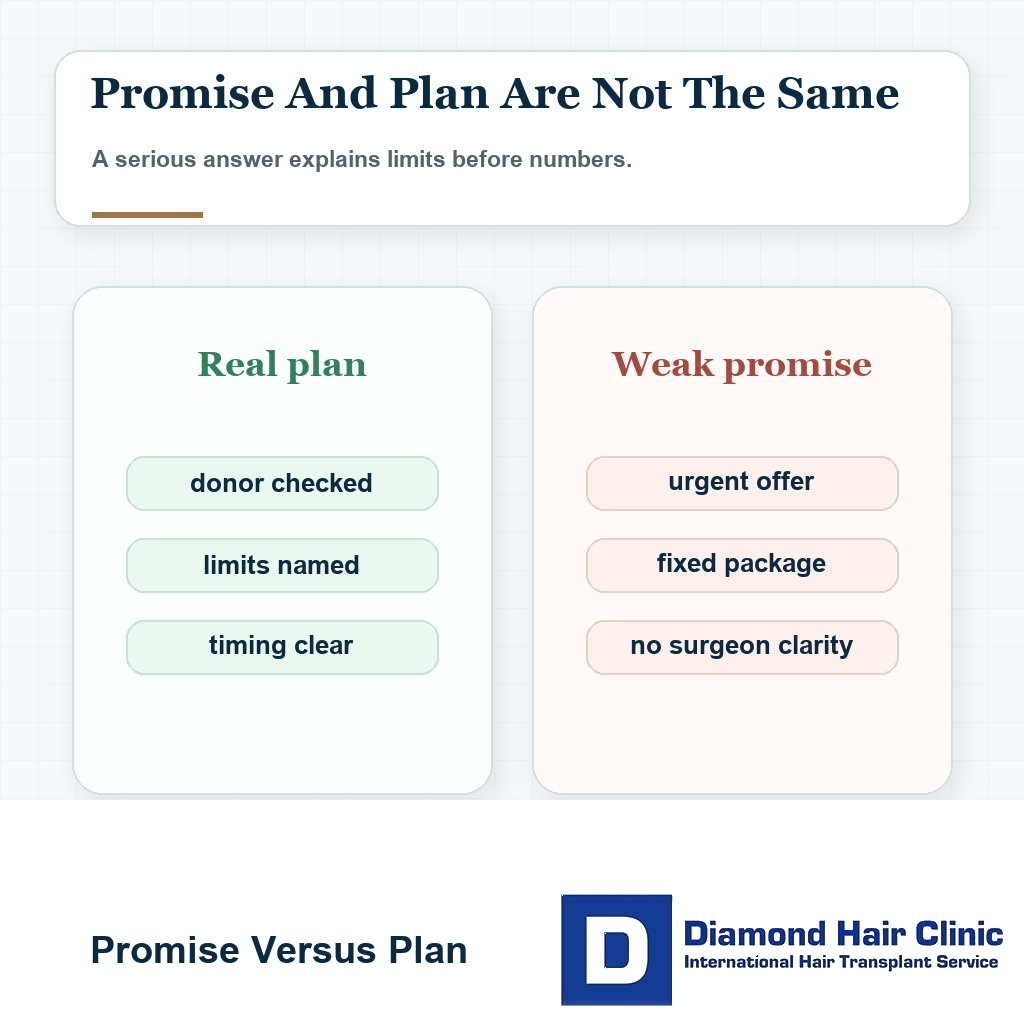
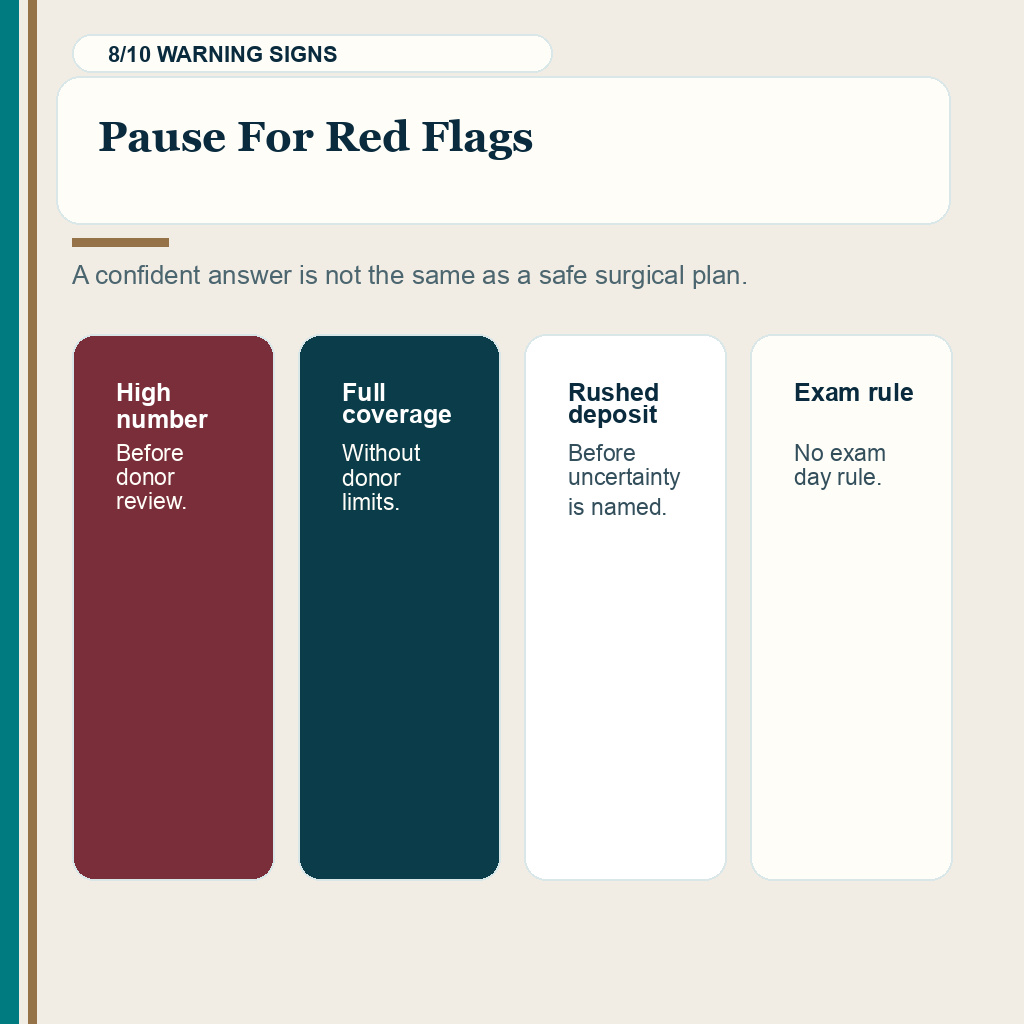
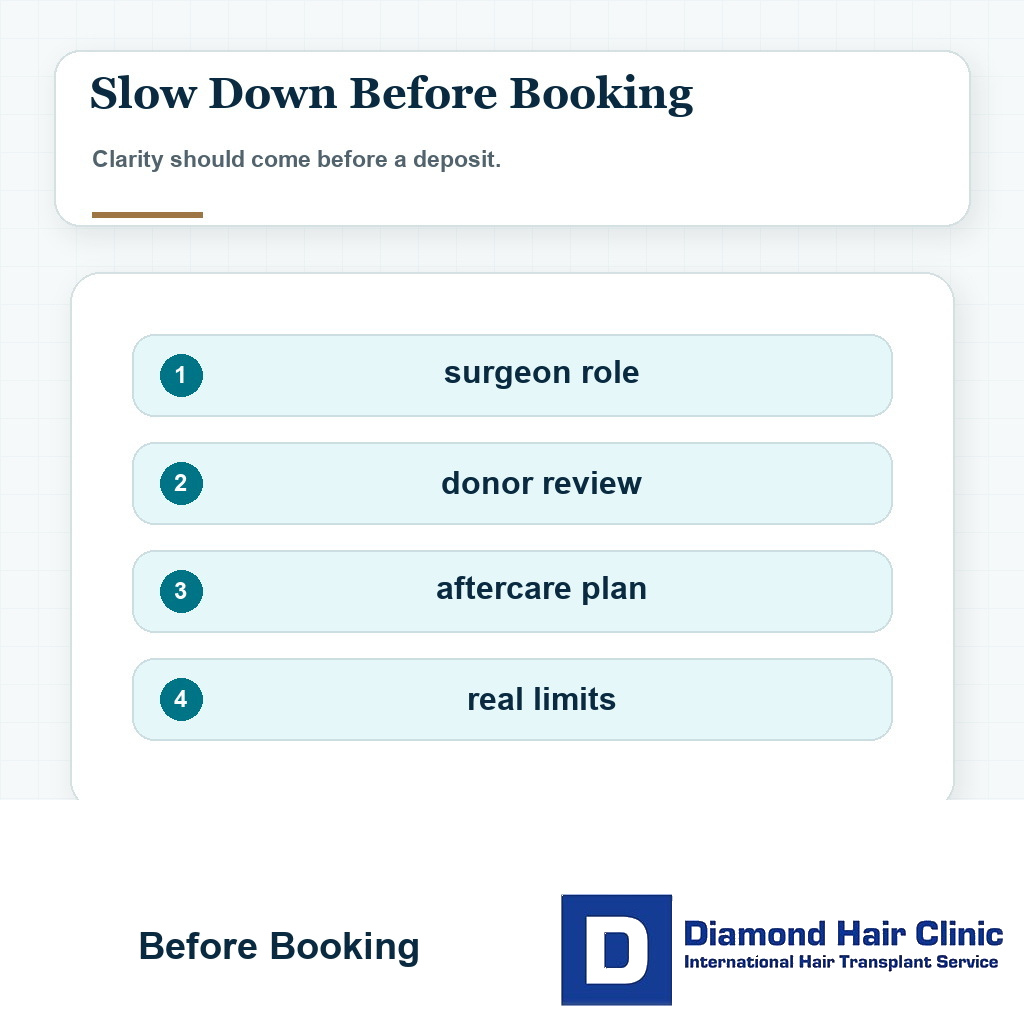
Pause if a clinic gives a fixed high graft number from a few casual photos, promises full coverage without discussing donor limits, ignores the crown or mid scalp, or pushes the patient to book quickly before the plan has been properly explained.
Be cautious if the clinic does not ask about age, family hair loss history, medication use, previous surgery, donor area photos, or expectations. These details are not small details. They can change the whole surgical plan.
A poor remote plan usually sounds very confident but explains very little. A stronger consultation may sound less dramatic, but it will explain what can be seen, what cannot be confirmed yet, and what must be checked before surgery.
Another concern is when the clinic treats uncertainty as weakness. In hair transplantation, uncertainty is sometimes appropriate. When the image set leaves gaps, the responsible response is to request better photos, explain the limits, or reserve the operative plan for the in person examination.
This matters for patients considering surgery abroad. In Turkey, many patients compare packages, hotels, transfers, and graft numbers before they understand the surgical plan. The red flags of Turkish hair transplant clinics matter here because a confident message can still hide weak medical planning.
Treating a remote plan as final before examination
Before trusting a plan made from photos, treat it as provisional guidance. An ethical clinic should explain which parts must wait for examination. If photos are presented as complete certainty, the risk is being hidden.
The donor area should be described with more attention than a quick look at the back of the head. The plan should check for weakness, retrograde thinning, scarring, fine hair caliber, or a limit that should make the surgery smaller. The surgeon should confirm those limits in person before graft numbers are settled.
The graft number should be tied to actual areas, not left as a vague total. The plan needs to say whether it covers only the hairline, the frontal third, the mid scalp, the crown, or a staged combination. Many misunderstandings happen because one number is heard as full coverage.
Diffuse thinning has to be considered when the hair still looks present but weak across a wider area. Transplanting into diffuse thinning needs more caution than simply filling a bald temple, because weak native hair can change the value of the graft plan.
Medication before a hair transplant may need to be part of the plan. Treatment decisions differ, and some patients cannot or do not want to use certain medicines, but active loss still matters. If ongoing loss is ignored, surgery may solve one visible area while the surrounding native hair continues to weaken.
The surgical choice should belong to the person medically responsible for the operation. A clinic name, package name, or technique name does not tell the patient enough. If the donor or hairline plan changes on surgery day, the reason and the responsible surgeon need to be clear.
If the final examination changes the plan
Sometimes the final examination confirms the remote plan. Sometimes it changes it. A change after examination can be protective when it reflects donor quality, scalp findings, or a more realistic hairline design.
The graft number may need to be reduced if donor reserve is weaker than expected. The hairline may need to be adjusted if the requested position is too low or too aggressive. The crown may need to be delayed if using too many grafts there would weaken the frontal result.
In some patients, surgery may even need to be postponed if the scalp condition, donor quality, or hair loss pattern is not suitable. This is disappointing for a patient who already arranged travel, but it is still better than performing a surgery that should not be done.
The purpose of the final examination is not to protect the first estimate. It is to protect the patient.
A careful plan should be flexible enough to change when the real scalp gives better information than the photos. A clinic that refuses to adjust the plan after seeing better evidence is not being consistent. It may simply be protecting the sale.
When is waiting for in person assessment wiser?
It is wiser to wait, or to be declined for hair transplant for now, when the plan depends on details that photos cannot show clearly. This includes weak donor area, possible diffuse thinning, young age, unstable hair loss, previous surgery, scar tissue, scalp disease, unrealistic hairline requests, or advanced baldness where graft distribution must be very strategic.
It is also wiser to wait if two or three clinics gave very different plans and none explained the difference. A second opinion before a hair transplant can protect the donor area before committing. Confusion is not always a bad sign. Sometimes confusion is the signal that the case needs a more careful review.
If a patient is being pushed toward a large surgery quickly, pause as well. Urgency is not a medical argument. A limited time discount does not make the donor stronger. A package offer does not make a low hairline safer. A busy clinic calendar does not prove that the plan is right.
Patients researching Turkey often compare price, hotel, transfer, graft number, and social media results. Those details matter in practical terms, but they do not replace surgical judgment. If you are trying to choose a hair transplant clinic in Turkey, pay attention to how the clinic handles uncertainty. A careful clinic will not be afraid to tell you what cannot be promised from photos.
Waiting does not always mean delaying surgery for years. Sometimes it means waiting until the surgeon examines you properly. Sometimes it means taking better photos. Sometimes it means stabilizing hair loss first. Sometimes it means accepting a smaller first surgery instead of trying to solve every area at once.
Speed can feel comforting before surgery and expensive after surgery. In hair transplantation, a careful pause can protect the donor area, the hairline, and the long term plan.
Photos cannot show the whole donor reserve
Photos can start a serious conversation, but they cannot measure everything that decides surgery. Donor density, miniaturization, scalp disease, hair caliber, laxity, and crown risk all need examination before a remote plan becomes final.
The useful plan names the first treated zone, the donor limit, what will be left for later, and what may change after seeing the scalp in person. A large number from a screen is weaker than a smaller plan that explains its limits.
Be cautious when the message sounds complete too early. The date, package, and graft count matter less than whether the plan still makes sense after the donor area and long term hair loss pattern are checked.