


Mustache Hair Transplant Planning
A mustache hair transplant can help a thin or patchy upper lip, but only when the design is conservative and the hair direction is planned carefully. The upper lip is a small area, yet it is one of the most visible parts of the face during speech, shaving, smiling, and close conversation. A few grafts placed at the wrong angle can be more noticeable than a thin mustache. During speech and trimming, a design that looked fine in a still photo can seem too sharp. On a shaved upper lip, angle and border mistakes have nowhere to hide.
Graft count comes after shape and restraint. A number can sound reassuring, but on the upper lip a smaller conservative plan may age better than a dense line that feels too sharp later. I first look at whether the area truly needs surgery, whether the donor hair will behave like facial hair, whether the border should be softened rather than fully drawn, and whether the shape will still work when facial style changes years later. For selected facial hair cases, neck beard hair for beard transplant donor planning can be more relevant than scalp hair because trimming behavior and texture match are judged at close distance.
This article is for someone considering surgery for weak upper lip hair, uneven mustache growth, small gaps, scars, or a mustache that does not connect well with the rest of the beard. It is not a recommendation that every thin mustache should be transplanted. If your main worry is a sharp border in close photos, the design should also be judged while the upper lip moves in normal conversation.
Situations where a mustache transplant makes sense
A mustache transplant may make sense when the upper lip hair is clearly sparse, stable, and bothersome enough that a carefully planned surgical result would improve the face without forcing a style that looks artificial. It can also be considered for selected scarred areas where follicles no longer grow because of trauma, burns, surgery, or old skin damage.
The case is stronger when there is enough surrounding facial hair to blend with the new grafts. If the upper lip is the only weak area, the plan needs more conservatism because the transplanted hair will not be hidden inside a full beard. It will become the design.
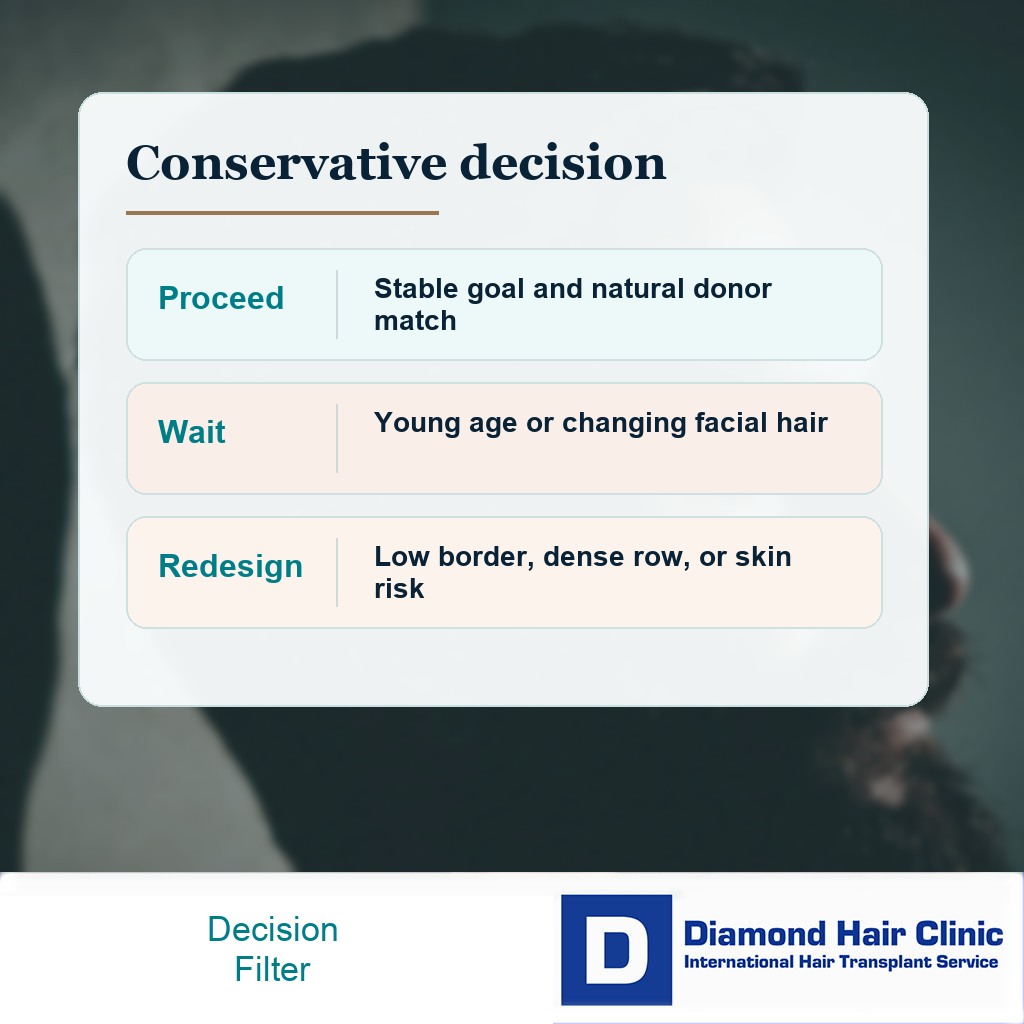
A conservative mustache transplant decision protects future style options and repair options.
If you are also thinking about broader facial hair surgery, the main beard transplant guide gives the wider context. A mustache plan should fit the cheek, goatee, jawline, and sideburn pattern. Treating the upper lip as an isolated strip can create a shape that looks disconnected from the rest of the face.
Direction matters more on the upper lip
Direction matters because upper lip hair does not grow like a row of bristles. It follows a facial pattern. The middle, corners, and border near the lip can each behave differently. The philtrum columns, Cupid’s bow, the wet and dry lip border, and the corners all need a slightly different plan. If grafts are placed too upright, too flat in the wrong direction, or in a repeated row, the mustache can look brushed on or mechanically planted.
The exit angle is part of the result, not a technical detail hidden from the patient. When someone speaks or turns the head, light catches the mustache from the side. Wrong hair direction can show even when the density is acceptable. A small facial hair case still needs the same seriousness as a larger scalp case.
Technique names can distract from this point. FUE, implanter tools, and blade choices matter only when they serve the design. If you are comparing clinics, look at whether hair transplant tools and techniques support angle control, graft handling, and design, not only the name of the instrument.
Density should follow the natural pattern
Density should be planned around the natural upper lip pattern, not around the biggest graft number that can fit into the skin. The face tolerates less visual error than the scalp. A dense row at the border can look harsh. Grafts with one hair are usually safer for the visible edge and small gaps, while thicker grafts need more caution in central or heavier zones. A softer transition often looks more natural, especially when the patient trims the mustache short.
I separate three goals before planning. One case may only need a small gap softened. Another may need a more even shadow across the upper lip. A different case may genuinely suit a heavier style. Those are not the same operation, because a soft transition and a thick defined border use grafts differently.
A mustache plan needs to explain the treated area, the intended density, and why the graft number fits the face. The same design logic matters when patients try to verify graft counts in scalp surgery. A number on its own does not explain the plan.
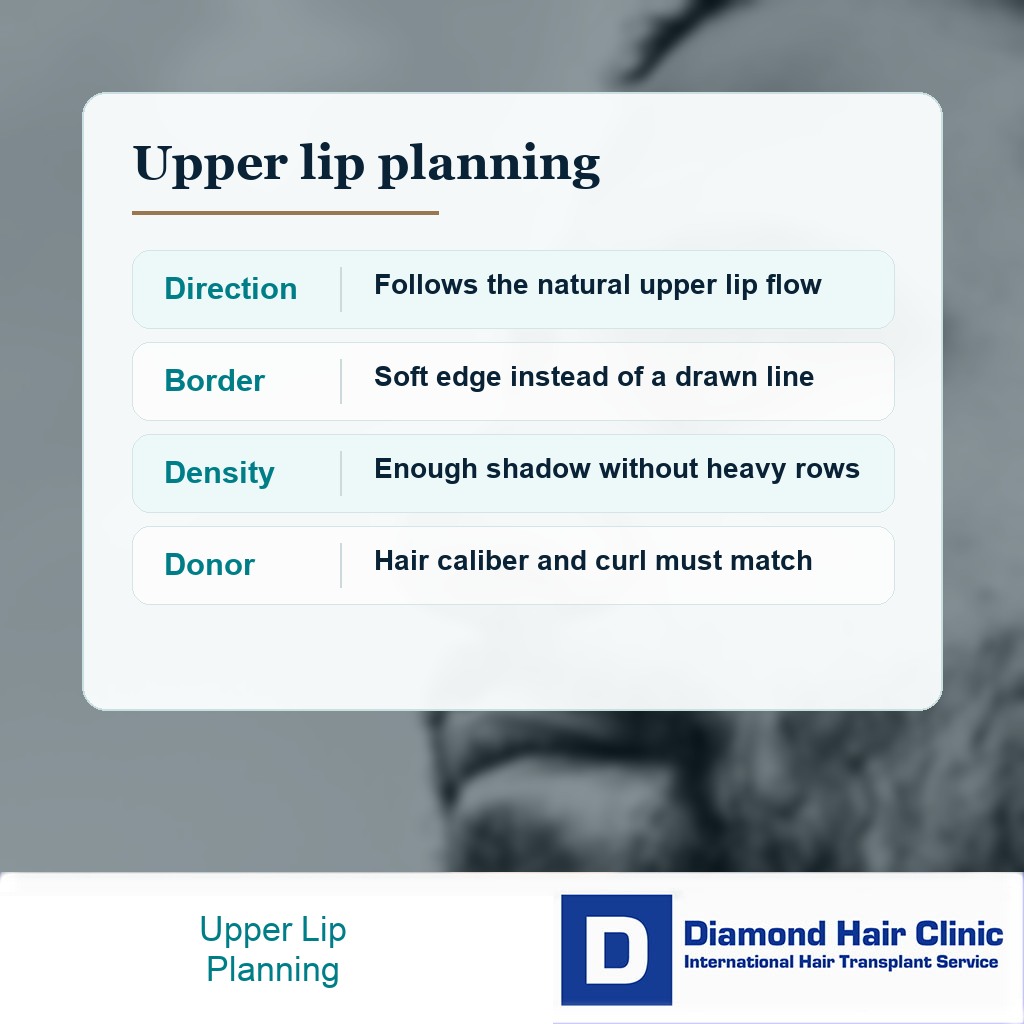
Mustache planning should connect direction, border softness, density, and donor match.
Short trimming exposes small mistakes
A very short mustache leaves less room to hide angle errors, caliber mismatch, thick grafts, or a border that was placed too sharply. A plan that looks acceptable at several millimeters can look different when trimmed close. If you normally keep the upper lip short, judge the design at that length, not only in longer photos where density and direction are easier to disguise. Tell the surgeon whether you shave daily, use a razor to create a sharp outline, trim with a guard, or leave stubble, because each habit exposes different mistakes. The design should still look acceptable when you switch between close trimming and letting it grow.
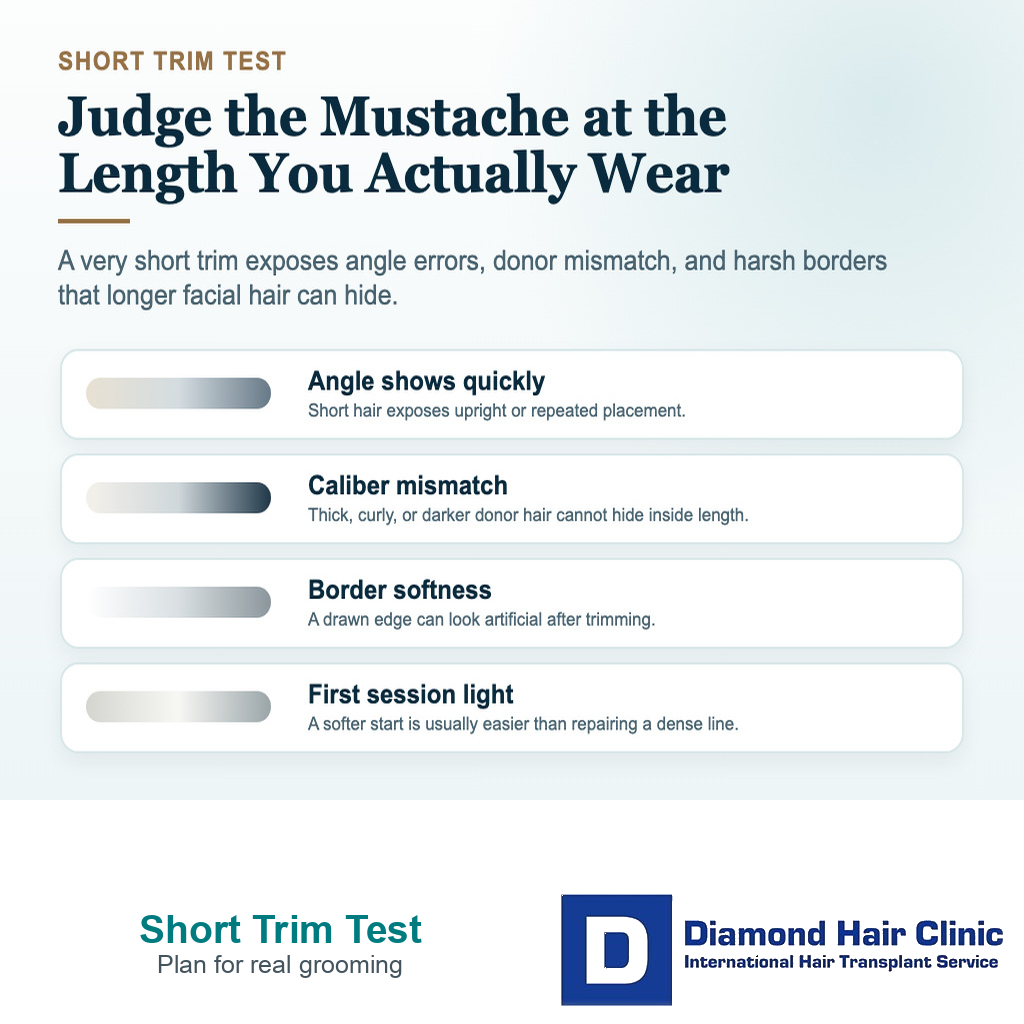
A softer first session can be the better plan. A mustache that looks slightly light but natural is easier to live with than one that looks dense, low, and planted every time it is trimmed. Before grafts are used, the consultation should separate a stronger shadow from a repaired gap, scar camouflage, or a full style.
Donor hair has to match the upper lip
The donor choice depends on hair caliber, curl, color, density, growth behavior, and long-term needs. Scalp hair is often used for facial hair transplantation, but it may not always match the character of mustache hair. Using beard hair for facial hair may match better in selected cases, yet supply can be limited and the donor area must be protected. The grafts also need sorting. A thick graft containing several hairs may be acceptable inside a beard but look too heavy on the upper lip edge.
Donor match includes behavior, not only color. Thick, coarse, curly, or differently colored hair can create a visible mismatch on the upper lip. Scalp hair may also grow longer than native mustache hair, so regular trimming may become part of the result. That can be manageable, but it needs to be clear before surgery.
Beard and chest hair as donor sources matters in scalp cases. The mustache decision reverses part of that thinking. Here, the donor must serve a facial design seen from very close distance, not simply increase the available graft supply.
Young patients may need more time before surgery
If you are still young, be careful before deciding that your mustache is permanently weak. Facial hair can continue to change after the teenage years, and family pattern, ethnicity, hormones, medication history, and grooming choices can all affect how a mustache appears.
In the early twenties, comparison with older men or edited photos can make a weak mustache feel urgent. Surgery should not be used to chase a style before the natural facial hair pattern is better understood. If a medical or dermatologic option is being considered for facial hair, it needs a qualified clinician rather than casual use on facial skin.
Candidacy for a hair transplant is not only about wanting more hair. It depends on timing, skin behavior, donor use, expectations, and whether the result can be planned naturally without spending grafts too early.
Skin history can change the plan
The upper lip is active skin. It moves with speech, shaving, eating, smiling, mask friction, and daily grooming. If the patient has active acne, folliculitis, painful bumps, keloid tendency, raised scars, recurrent cold sores, recent waxing, laser hair removal, strong topical irritation, or frequent irritation after shaving, surgery may need to wait or the plan may need to change.
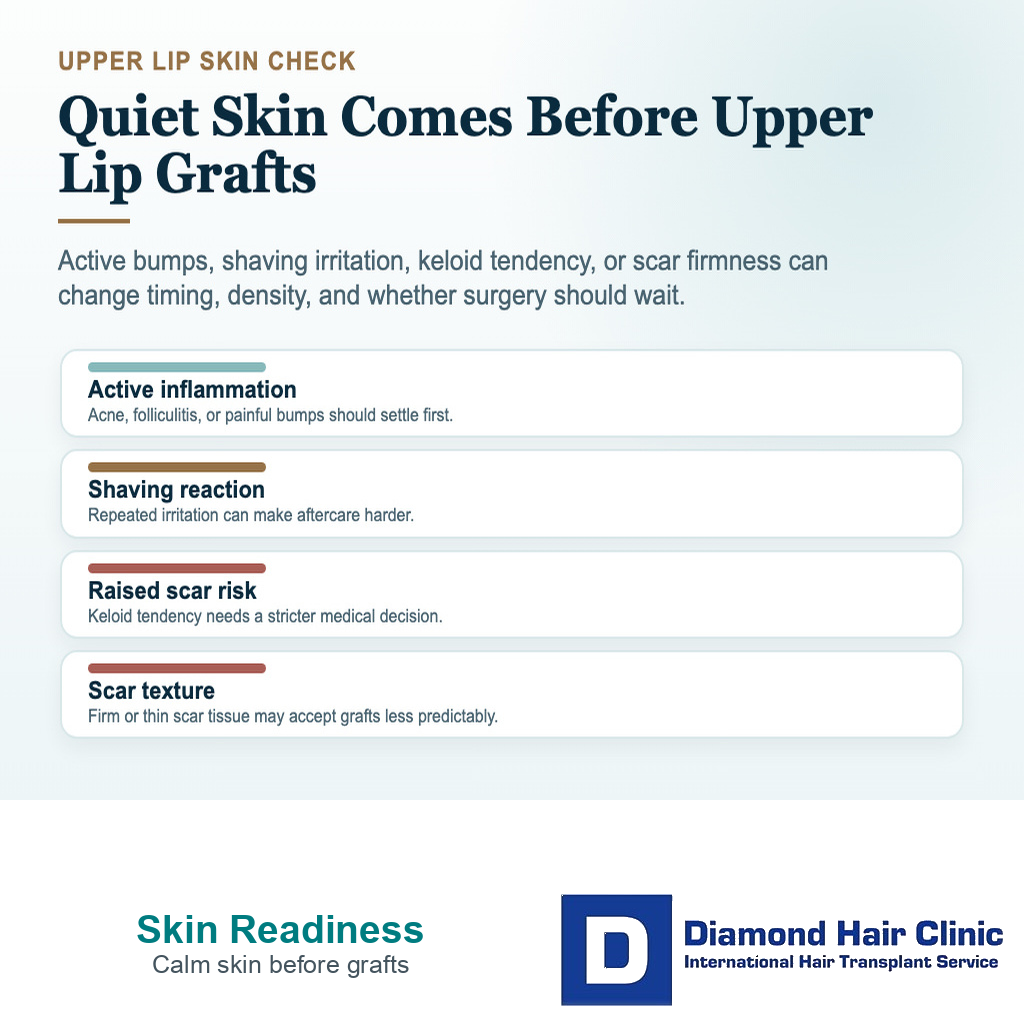
A scarred mustache gap can sometimes be treated, but scar tissue is different from normal skin. Blood supply, thickness, firmness, and healing behavior may be less predictable. Facial scar work such as beard transplant for acne scars, where the goal is often to soften a visible patch rather than create an aggressive new line.
The skin should be settled enough to receive grafts safely. If inflammation is active, adding hundreds of tiny wounds to the upper lip can make aftercare harder and may increase the chance of visible irritation. Waiting for the skin to settle can be part of good planning, not a failure to act.
Aggressive design can be difficult to repair
An aggressive mustache design can be too low, too straight, too dense, too dark, or too disconnected from the rest of the face. The stronger look may feel attractive at first, then become difficult to trim, difficult to hide, or too obvious in daily life.
Repairing a mustache transplant is not as simple as erasing a drawing. Grafts can sometimes be removed, thinned, or revised, but each correction has limits. The face may scar, the remaining pattern may still look uneven, and the patient may need more than one step to soften the problem.
If you are already unhappy after previous surgery, the principles in bad hair transplant repair are relevant. The first step is not another rushed procedure. The first step is identifying whether the main issue involves direction, density, border placement, donor mismatch, scarring, expectation, or the wider problem of beard transplant regret and repair limits.
Photos before travel should show the real pattern
Photos can start the discussion, but they cannot fully show skin texture, exact hair angle, scar behavior, donor quality, or how the mustache moves with expression. A front photo alone is not enough. Side views, relaxed expression, smile, close upper lip images, and trimmed versus longer facial hair can all change the plan. Take at least one set without pencil, tint, fibers, filters, or sharp outline styling so the real gaps and borders are visible. The upper lip should keep the small irregularities that make a mustache look grown, not drawn.
A remote estimate should stay provisional until I can examine you in person. I use that boundary for a hair transplant plan from photos. The photo review can identify whether the idea is reasonable, but it should not become a hard promise about density, graft number, or final border design.
If a clinic promises a strong mustache from one photo without discussing direction, donor match, skin history, and long-term style, slow down. A small area can still produce a large visible mistake.
Mustache planning depends on direction and density, and these 3 slides connect design, graft angle, and whether the donor hair fits the area. Swipe sideways, use the arrows, or choose a number below the image.
Careful consultation should decide more than graft count
A careful consultation needs to decide whether surgery is suitable, whether waiting is better, what donor hair should be used, where the border should sit, how dense the first session should be, and how the mustache should connect with the beard or goatee. It should also explain aftercare, shaving timing, swelling, scabbing, food and drink friction, mask friction, and when the patient can judge growth. The first week matters because crusts on the upper lip are visible and tempting to pick, but rough cleaning can disturb healing.
Surgeon involvement matters because the plan is a facial design decision. A coordinator can collect photos, but the medical decision should include donor protection, skin assessment, recipient angle planning, and realistic expectation setting. I use that standard for surgeon involvement in hair transplant surgery.
Ask to see healed mustache results at the trimming length you normally wear, with the lip relaxed and smiling. Good scalp coverage or a distant beard photograph does not show the upper lip border in that detail.
If the plan is intentionally conservative, a small extra graft session may be safer later than forcing high density immediately. It is easier to add carefully than to repair a mustache that was made too heavy or too low.
The upper lip gives little cover for overdesign
A mustache transplant is worth discussing when the gap is stable, the surrounding pattern is understood, the donor hair can blend, and the design still makes sense when the mustache is trimmed short.
The upper lip is unforgiving. Hair direction, density, exit angle, skin texture, and face shape are all visible at close range. A dense pattern that looks attractive in an example photo can look artificial if it does not belong to the person’s own face.
At very short length, the border has to survive close social distance. Longer hair can soften a line that would look too sharp as stubble. In some consultations, I choose a softer design or delay surgery because the upper lip does not hide a harsh border well. A natural mustache result should work in ordinary conversation, under bright light, and in close photographs, not only in the drawing made before surgery.
Read this review excerpt
He was very thorough in every little detail and I never felt pressure to do anything I wasn’t sure of.