


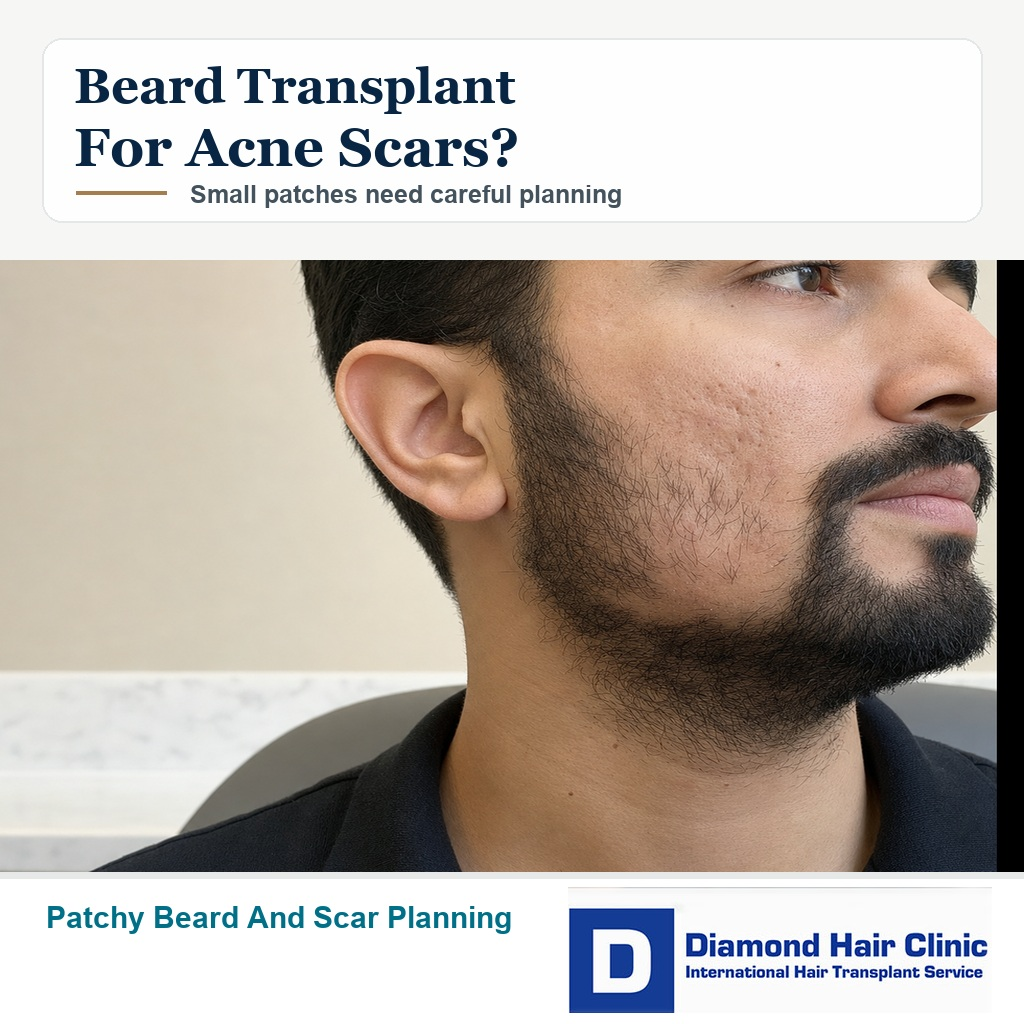
Can a Beard Transplant Cover Acne Scars?
A beard transplant may sometimes soften small acne scars or patchy beard areas, but only when the skin is stable, the scar is flat enough, and the goal is conservative camouflage. If the area is raised, painful, actively inflamed, prone to keloid scarring, or very obvious when the beard is shaved clean, I do not treat it like a quick cosmetic correction. The face gives very little room for error. A few badly angled grafts can be more noticeable than the original patch.
For a small jawline or cheek gap, placing hair there is only one part of the decision. I look at direction, blending with the surrounding beard, and how natural the area will look when the beard is trimmed short. The important decision is not how many grafts can fit into the scar, but whether the beard will look better at the length you actually wear. It is whether the face will look better after they grow.
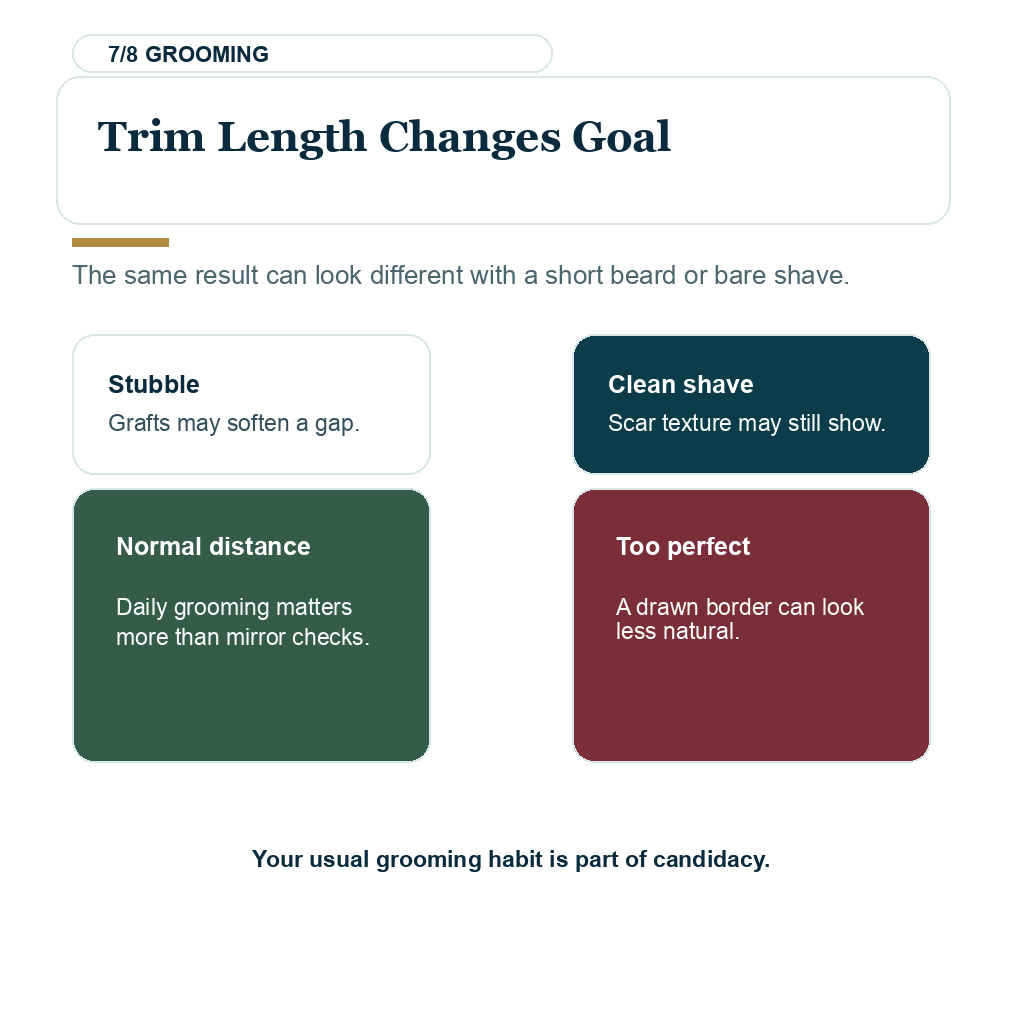
Judge the scar with short stubble and with the skin shaved clean. A patch that looks acceptable with a few days of growth may still be too visible if your real goal is a clean shave.
Decide from the beard length you actually plan to keep. A scar that blends under stubble may still bother you if you shave the cheek clean.
Scarred beard patches worth considering
A beard transplant is most reasonable when the patch is small, stable, emotionally bothersome, and surrounded by enough natural beard hair to blend the new grafts. Someone who already grows a strong beard but has one or two empty areas from old acne scarring is a different case from someone asking for a full new beard pattern.
When I examine this type of case, I first separate two situations. One is a true scarred gap where hair no longer grows because the follicles were damaged. The other is normal genetic patchiness where the beard is simply sparse in that zone. Both may be treated with a beard transplant, but the plan is different because scarred skin does not behave like untouched beard skin.
A small scarred patch may need only a modest number of grafts. That sounds easier, but it can actually be more demanding because every hair is visible. On the cheek, jawline, or upper lip, a wrong angle, too much density, or a pluggy pattern can draw attention each time the face turns into the light.
The case is stronger when you are not chasing a perfect beard. The best reason to operate is to soften a clear gap so it blends better with the rest of the beard. The weakest reason is to turn normal beard variation into a perfectly drawn beard line.
Reasons surgery should wait
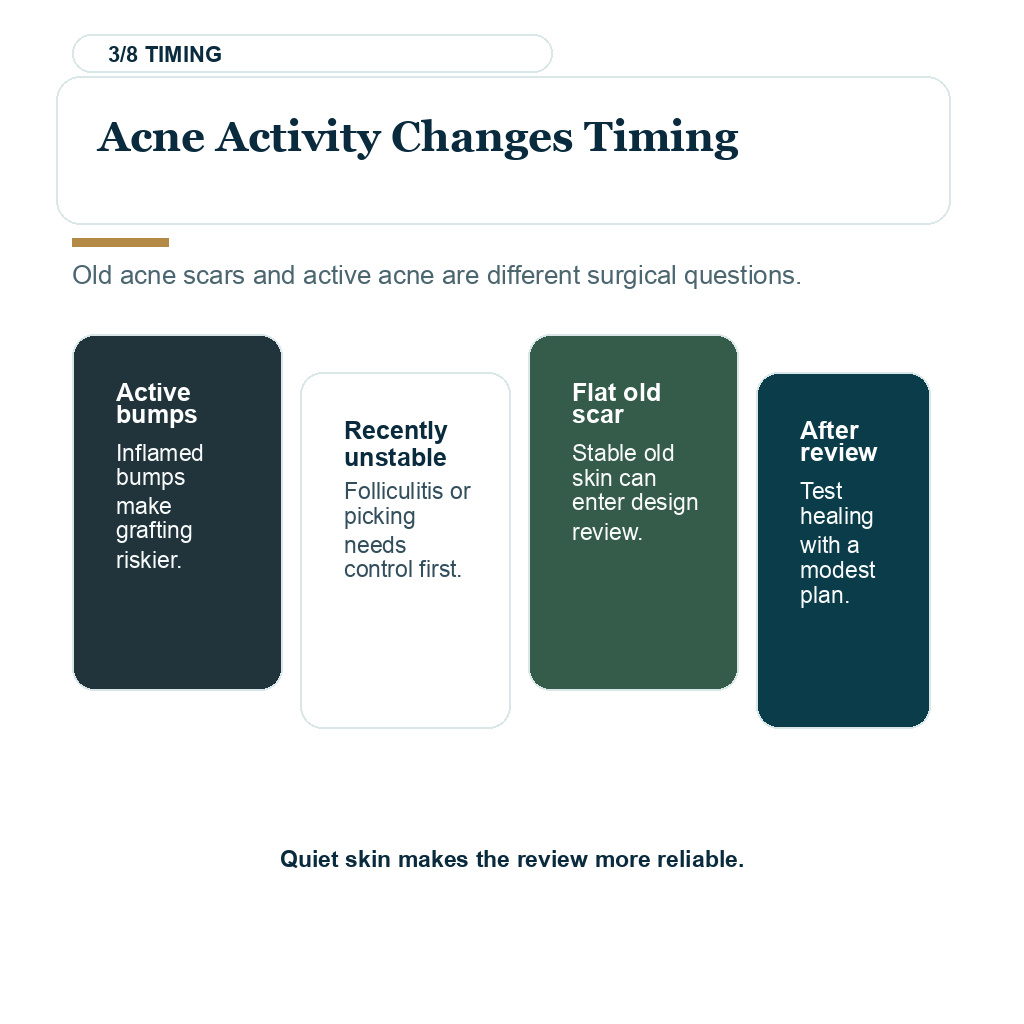
If the skin still has active acne, painful bumps, drainage, repeated folliculitis, or new inflamed lesions, surgery should wait. Placing grafts into an irritated area adds new trauma to skin that is already reacting.
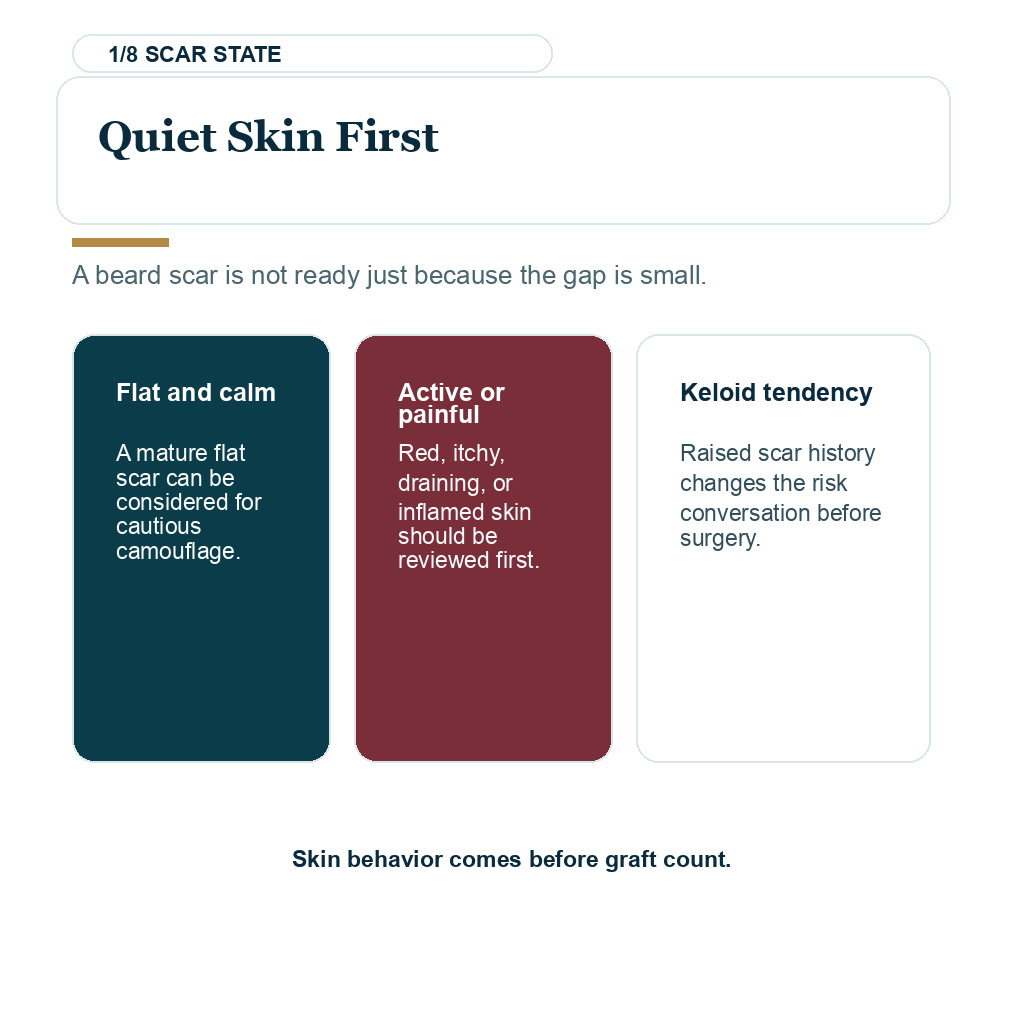
Old acne scars are different from active acne. A flat, quiet, mature acne scar may be considered for careful graft placement. A red, thick, itchy, painful, growing, or unstable scar needs medical review before anyone talks about graft numbers. If there is any history of abnormal scarring, keloid scar history becomes part of the beard plan.
You may only see a small patch. I also look at skin behavior. Raised scars after acne, piercings, shaving cuts, or previous procedures matter before hundreds of tiny new wounds are created. A small beard transplant still creates controlled injury in visible facial skin. If you are already anxious about facial texture or reversibility, beard transplant regret explains why bumps, border design, and removal limits deserve a separate decision.
Inflammation also changes aftercare. Scratching, picking, shaving too early, or treating every bump aggressively can disturb the area. If the skin has a repeated pustule problem, I connect that concern with the principles behind folliculitis before a hair transplant, because active follicle inflammation and fresh grafts are not a good combination.
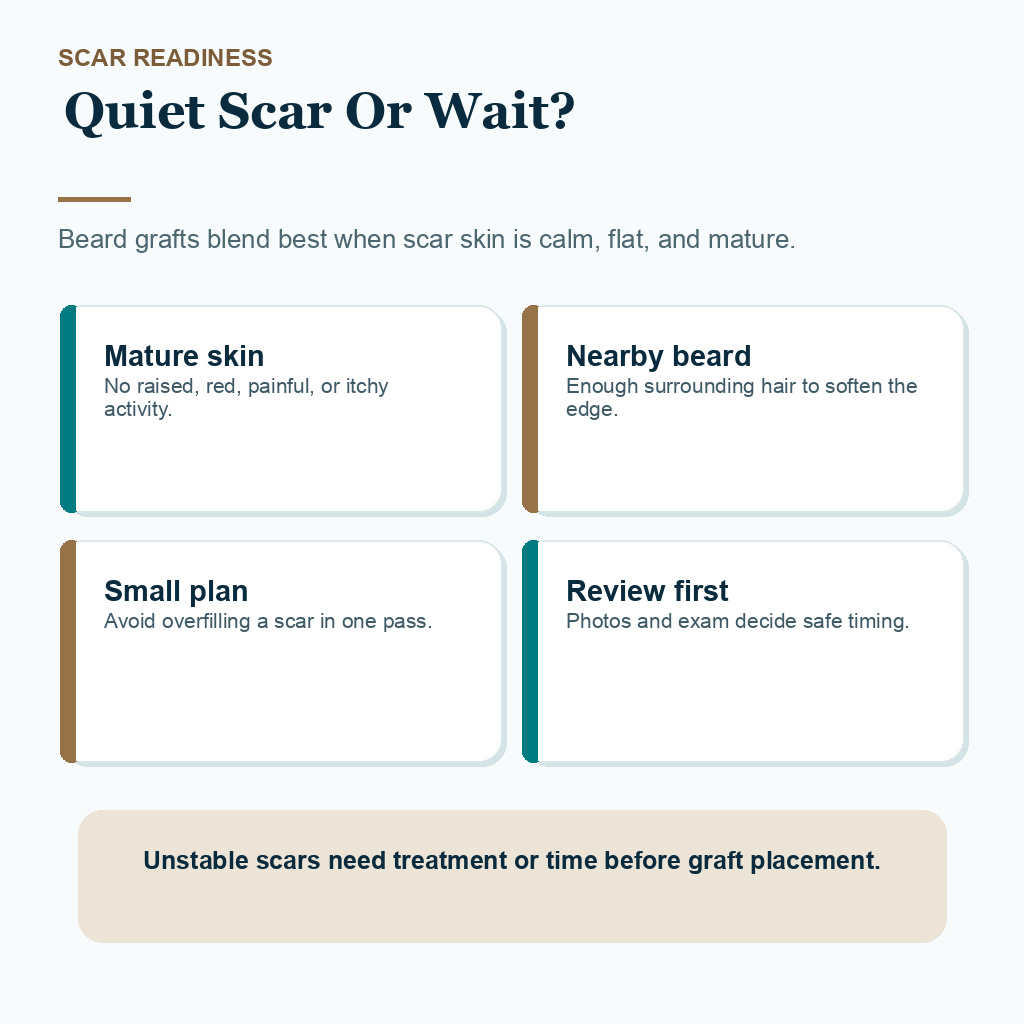
A quiet flat scar may be considered differently from raised, painful, or inflamed facial skin.
Facial scar tissue is less predictable
Scar tissue can have less predictable blood supply, different thickness, and a firmer texture than normal skin. Grafts can still grow there, but the plan has to be more careful than a normal beard density procedure.
The face also moves. Speaking, chewing, smiling, shaving, mask friction, and pillow pressure all touch the area. A scar on the jawline may be small, but it sits in a highly visible place that moves a lot. I do not plan it the same way as a hidden scalp area.
The broader principle is similar to transplanting hair into scar tissue. The tissue must be mature enough, soft enough, and vascular enough to give the grafts a reasonable chance. In facial scars, I also have to judge beard direction, shaving habit, skin color contrast, and whether the scar itself will still remain visible between hairs.
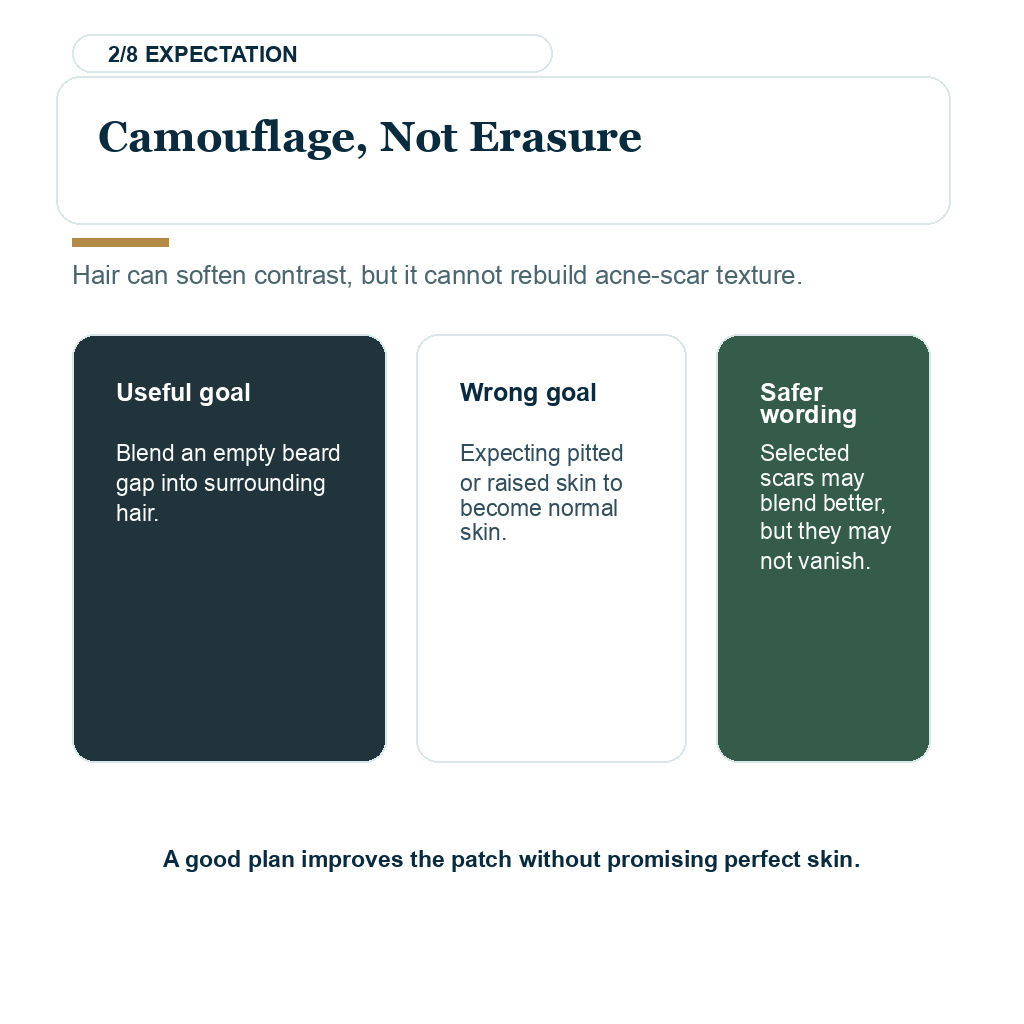
The realistic aim is camouflage, not erasing the scar. If you expect the skin to become normal skin again, surgery will disappoint you even if some grafts grow. I want the area to have softer contrast, not a new facial texture promised by surgery.
Should the first session be staged?
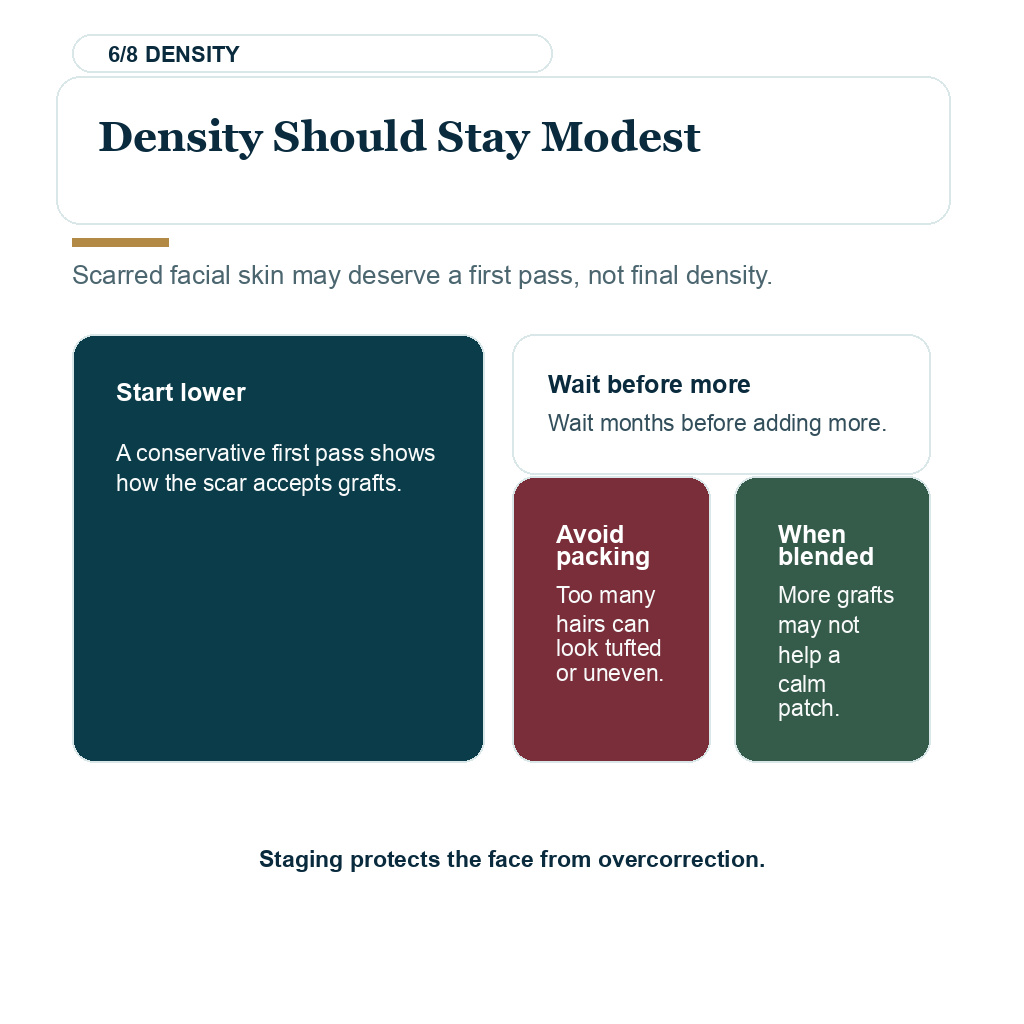
For scarred facial skin, a smaller first pass can sometimes be wiser than trying to reach the final density in one session. I may prefer conservative placement, then wait to see how the skin heals and how the hairs grow before making the decision whether more grafts are useful.
Firm, shiny, pitted, color changed, or very closely shaved scars need more caution. You may need to live with the first growth for 6 to 9 months, and sometimes closer to 9 to 12 months, before the second decision is responsible.
That waiting period is not wasted time. It shows whether the scar actually accepts the grafts in a way that deserves more density.
A staged plan may sound slower, but it protects the face. If the first density already blends well, adding more grafts may only increase texture, shadowing, or direction problems. On the cheek or jawline, careful moderation can be what keeps the result natural.
Realistic improvements in scarred beard patches
In the right case, surgery can improve a gap, make a scar less obvious through surrounding hair, connect an interrupted jawline, and reduce the visual break between dense and sparse beard zones. It can help someone who feels forced to keep a longer beard only to hide one damaged area.
It cannot make raised skin flat. It cannot remove pitted acne texture. It cannot guarantee that a scarred area will accept every graft like normal skin. It also cannot guarantee that you will like the area when shaved clean after surgery, because transplanted beard hairs, tiny insertion marks, and scar texture may still be visible under very close shaving.
The distinction matters. Short stubble or a trimmed beard can often be softened with carefully placed grafts. Bare skin shaving with no visible scar texture is a different expectation, and a beard transplant may not be the right first answer.
If the scar only bothers you when you inspect it from a few centimeters away, surgery may be a larger intervention than the problem deserves. If the patch interrupts the beard at normal social distance and affects how you groom every day, a careful small plan may be reasonable.
I also consider age and future style. Someone who wants a permanent beard and normally keeps stubble or a short beard may tolerate small textural differences better than someone who frequently shaves clean. The decision depends as much on grooming behavior as it does on graft count.
Can beard grafts in acne scars look natural?
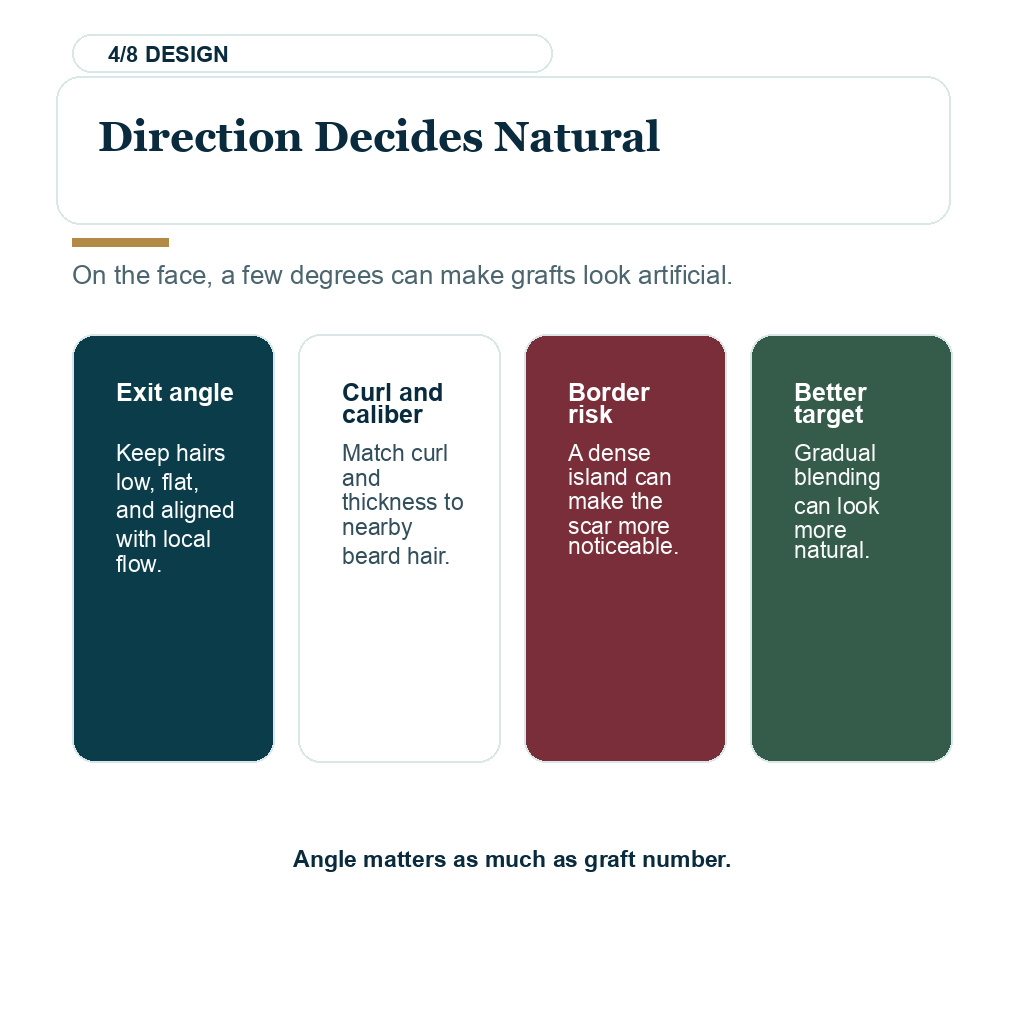
It can look natural when the scar is suitable, the density is not overdone, and the hairs are placed with the same flat, low, facial direction as the surrounding beard. Beard hair does not grow like scalp hair. It exits the skin at a shallow angle and changes direction across the cheek, jawline, and chin.
This is the part of the operation that many people underestimate. They ask how many grafts they need, but I am looking at angle, curl, exit direction, hair caliber, scar firmness, and the border between the scar and normal beard. The difference between natural and artificial may be only a few degrees of direction.
Wrong hair direction after a hair transplant can be difficult to hide. On the face, direction errors are even more exposed. A hair that points outward, stands upright, or crosses the natural beard flow can be visible every morning.
Overpacking is another mistake. If too many grafts are forced into a small scar, the area may look tufted or uneven. A dense artificial island can look worse than a small gap. Natural beard restoration needs gradual blending, not a heavy block of hair, because pluggy transplant work is much harder to soften after the first surgery.
Donor hair choice for a small beard patch
For beard reconstruction, donor choice matters. Hair from the back of the scalp or lower occipital area may be used when its thickness, color, and behavior fit your beard. In some cases, existing neck beard hair may match better, but that area also has to be used carefully because visible thinning under the chin can bother you later. For acne scar camouflage, neck beard hair donor planning should weigh facial texture match against visible thinning or dotting under the chin.
Donor hair should never be treated as an unlimited supply, even for a small facial patch. Removing too much beard or neck hair to fill another beard area can create a new patch where there was no problem before. This is the same donor logic behind careful beard and body hair donor planning, even though the purpose here is facial beard coverage rather than scalp restoration.
Hair caliber also has to match. Very thick grafts placed into a fine cheek beard can look coarse. Very fine grafts placed into a strong jawline beard may disappear visually. If the surrounding beard is curly, the curl direction has to be respected. If the scar is small, fewer grafts placed with more precision may be better than a larger number that looks impressive on paper.
Someone with limited scalp donor reserves should be careful about using scalp grafts for a beard patch if scalp surgery may be needed later. Facial confidence matters, but donor management still matters. A small cosmetic decision should not weaken future planning.
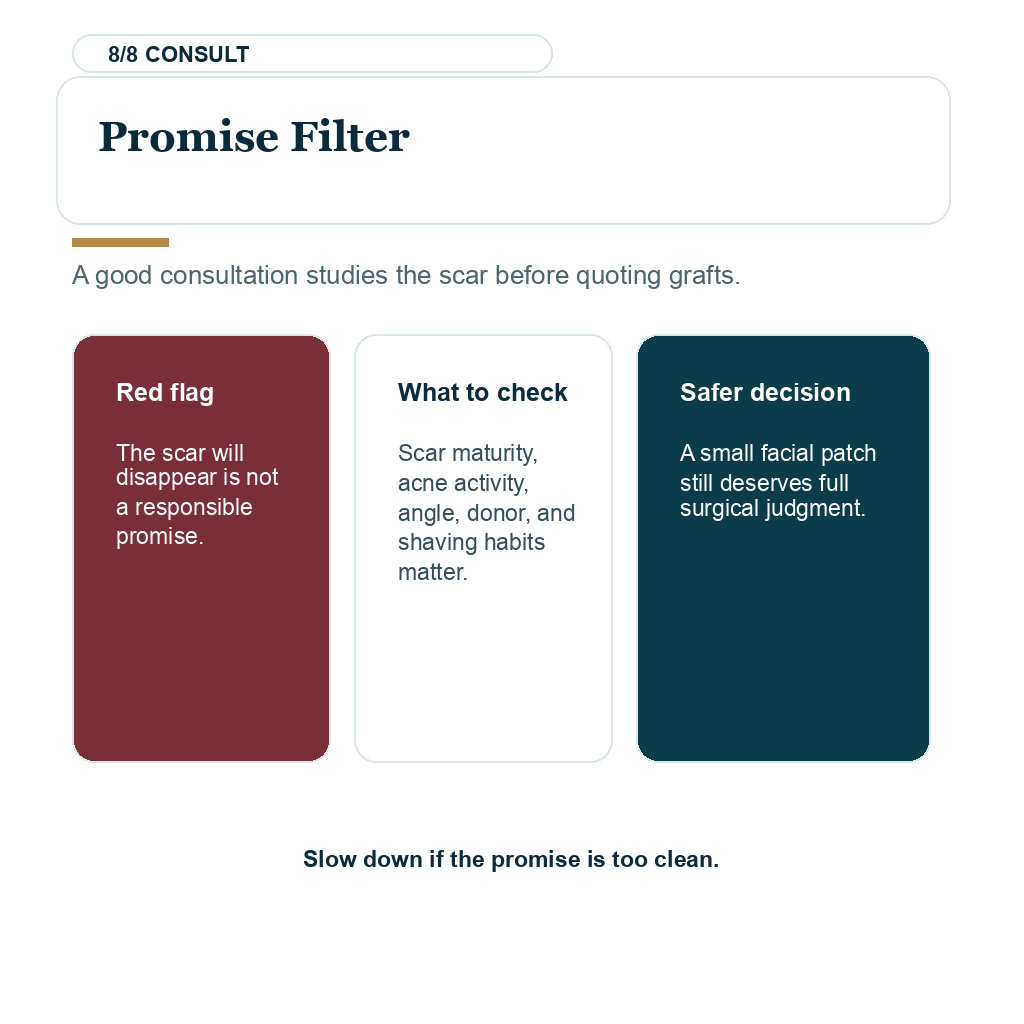
Use the 8 beard scar camouflage slides below to separate quiet skin, active acne, raised scar risk, realistic camouflage, hair direction, donor choice, trim length, density restraint, and clinic promise quality. Swipe the carousel, use the arrows one step at a time, or choose a number below the image to jump to that point.

Clinic promises that should make you cautious
A risky promise often sounds too clean. The clinic may say the scar will disappear, the beard will look full, the procedure is tiny, or the face will heal without visible marks. Treat that kind of certainty with caution.
A meaningful consultation should examine the scar, not just count the empty space. It should include scar maturity, acne activity, keloid tendency, graft angle, donor choice, shaving habits, and what the area may look like under bright light. If the consultation moves straight to a price and date, you have not received enough medical thinking.
Technique names can also mislead. FUE, DHI, sapphire blades, or any tool label cannot compensate for poor recipient design. The real issue is how the recipient area is designed and how the grafts are handled. In practice, hair transplant tools and techniques matter less than the judgment behind them.
On the face, the margin for error is small. A poor beard transplant may need removal, laser work, camouflage, or repair. Repair is possible in selected cases, but it is rarely as clean as doing the first plan well.
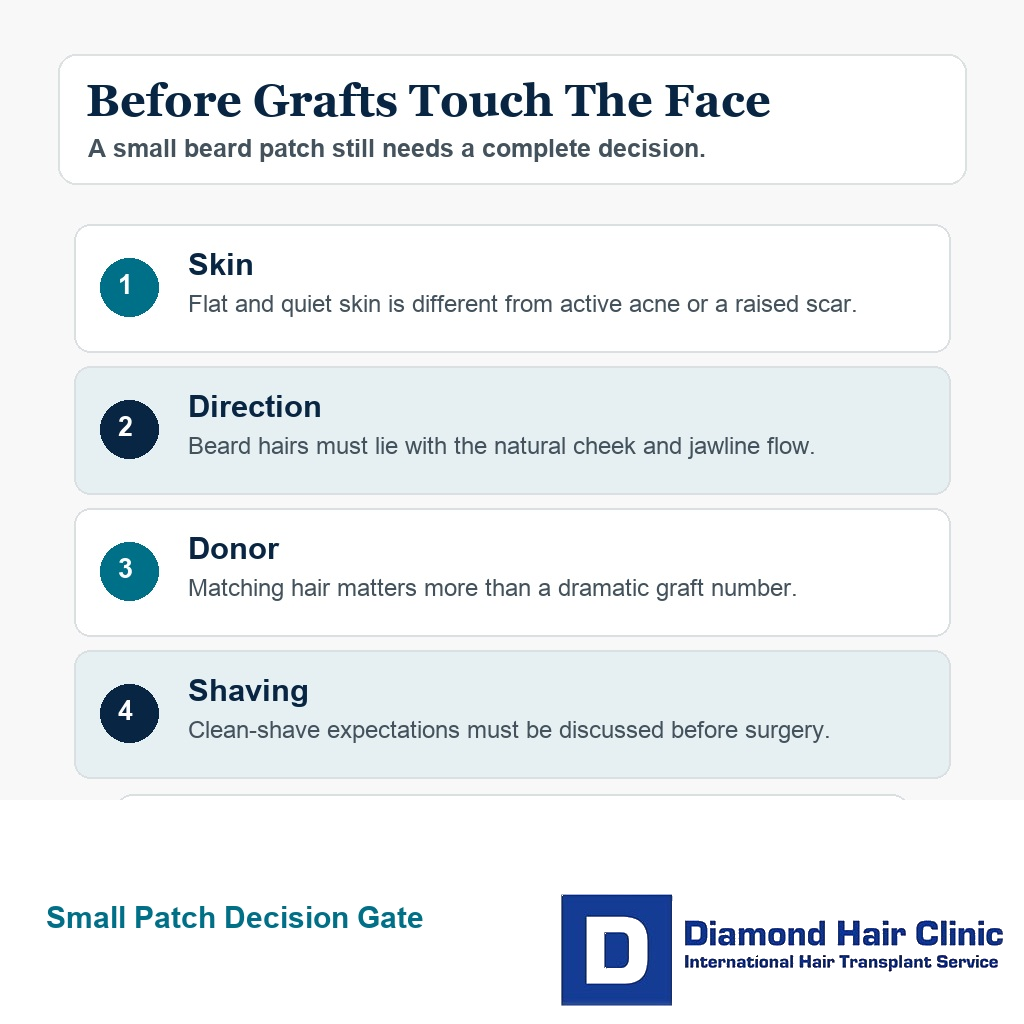
A small facial patch still needs a full surgical decision, not only a quick graft estimate.
Is dermatology or doing nothing sometimes better?
If the scar is active, raised, painful, itchy, red, or changing, dermatology treatment comes before beard transplantation. I need to understand the medical behavior of the skin before grafts are used. Treating the skin first is not a delay for the sake of delay. It protects the face from a worse cosmetic problem.
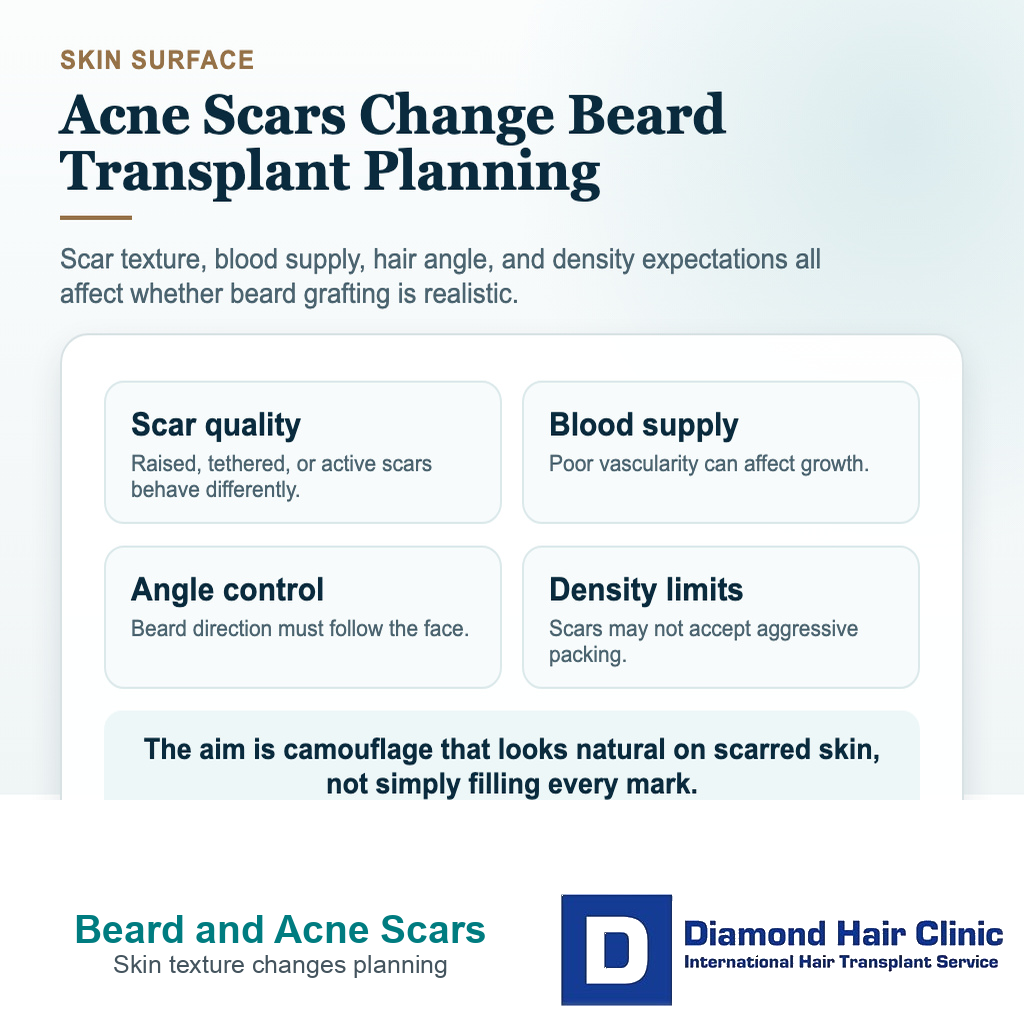
If the scar is flat and quiet but the texture is the main issue, a hair transplant may not be the first answer. Acne scar treatments, resurfacing, subcision, or other dermatology options may be more appropriate depending on the scar type. Hair can hide color contrast or an empty patch, but it does not rebuild skin texture.
If the area is small and only visible under strong personal inspection, doing nothing may be the most sensible choice. A natural beard has variation. Some asymmetry can look more normal than a face that has been filled too perfectly.
If the patch is genuinely visible, stable, and surrounded by beard hair, surgery becomes more reasonable. Even then, the plan should stay conservative. Expect improvement, not disappearance. A second small session can sometimes be considered later if the first response is good.
Which checks matter before accepting a plan?
First, the diagnosis has to be correct. A scar from old acne is different from active acne, alopecia areata, folliculitis, eczema, lichen planopilaris, or another inflammatory condition. If the diagnosis is wrong, the surgical plan can fail for the wrong reason.
Then I check the scar by touch and by close inspection. Flat, mature, soft skin is more encouraging than thick, hard, shiny, painful, or unstable skin. I also ask how you usually wear the beard. A short trimmed beard may be easier to satisfy than bare skin shaving every few days.
After that, I look at donor hair. The donor hair must match the surrounding beard well enough. It also has to be taken without creating a second cosmetic concern. Do not trade one small empty patch for another visible donor problem.
The last part is expectation. If you understand camouflage, you may be a good candidate. If you want the scar removed, the skin made perfect, or a guaranteed full beard from a tiny procedure, you are not ready for surgery. That distinction is part of being a good candidate for a hair transplant, even when the operation is small.
Small beard patches still need graft restraint
If you have one or two small beard gaps from old acne scars, a beard transplant may be worth discussing, but only after examining the scar, the surrounding beard pattern, the donor hair, and your shaving habits. The strongest plans are usually modest. They aim to blend the patch, not to create a dense artificial block.
If the skin is active, raised, painful, or keloid prone, slow down and clarify the medical side first. If the scar is flat and quiet, and the patch affects your daily grooming, a carefully placed small transplant may be reasonable.
Choose the surgeon with the same seriousness you would use for scalp surgery. Facial hair transplantation is not a casual extra procedure. If you are considering treatment abroad, be especially careful about who designs and performs the work, not only the package price. The same standards used when choosing a hair transplant clinic in Turkey apply here as well.
Avoid rushing a small patch. A small area can still create a lasting result, good or bad. When the skin is suitable, the design is conservative, and the graft direction is precise, a beard transplant can soften a scarred patch in a natural way. When those conditions are missing, leaving the patch alone may be the wiser decision.

Read this review excerpt
told me the quality of my donor hair and what he could take out and advised me what will the be best outcome with what donor hair I had.