







Verification before surgery
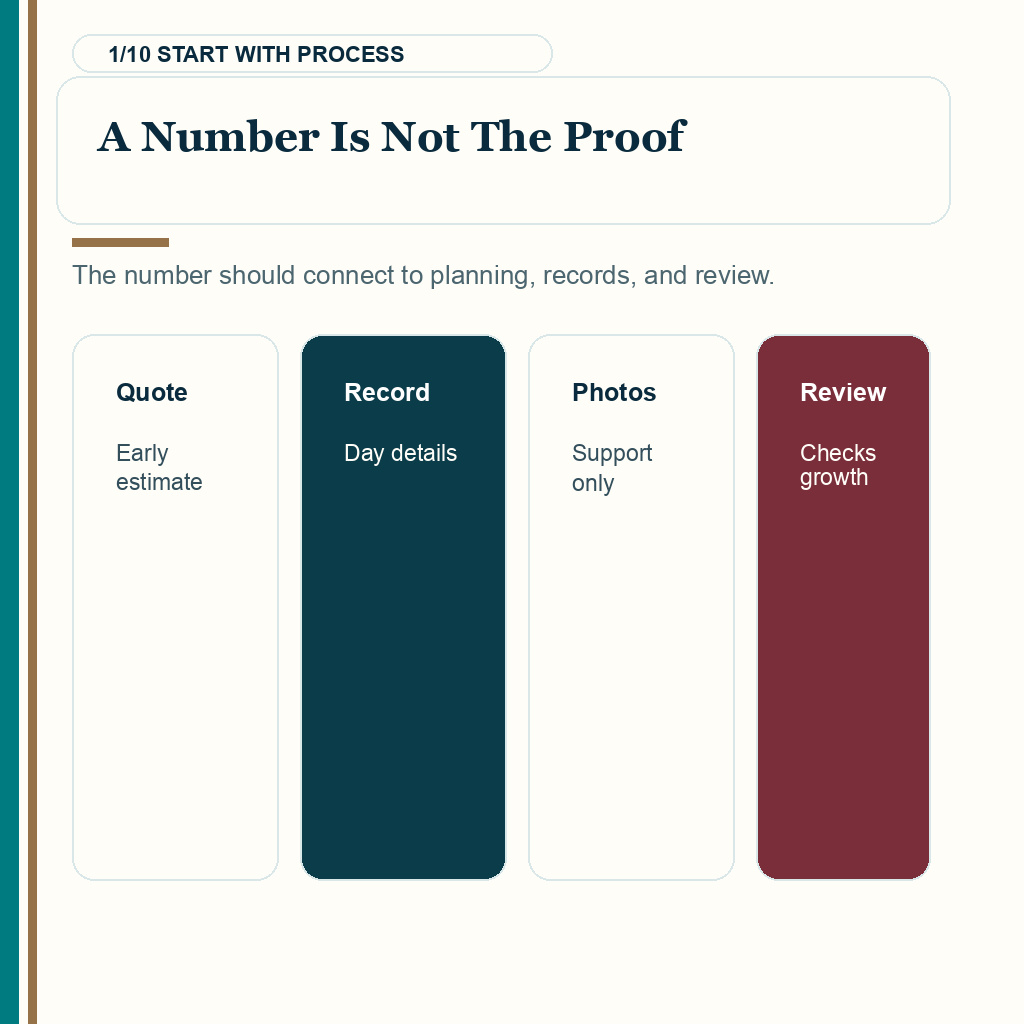
Before surgery, you should be able to verify the logic of the plan. The clinic should be able to explain which area will be treated, why that area is being prioritized, what density is realistic, how the donor area was judged, and what might change after shaving and in person examination. This is true for large scalp plans and for a mustache transplant, where a small number can still create a visible design problem. A number sent after looking at a few photos may be an early estimate, but it should not be treated as the final truth.
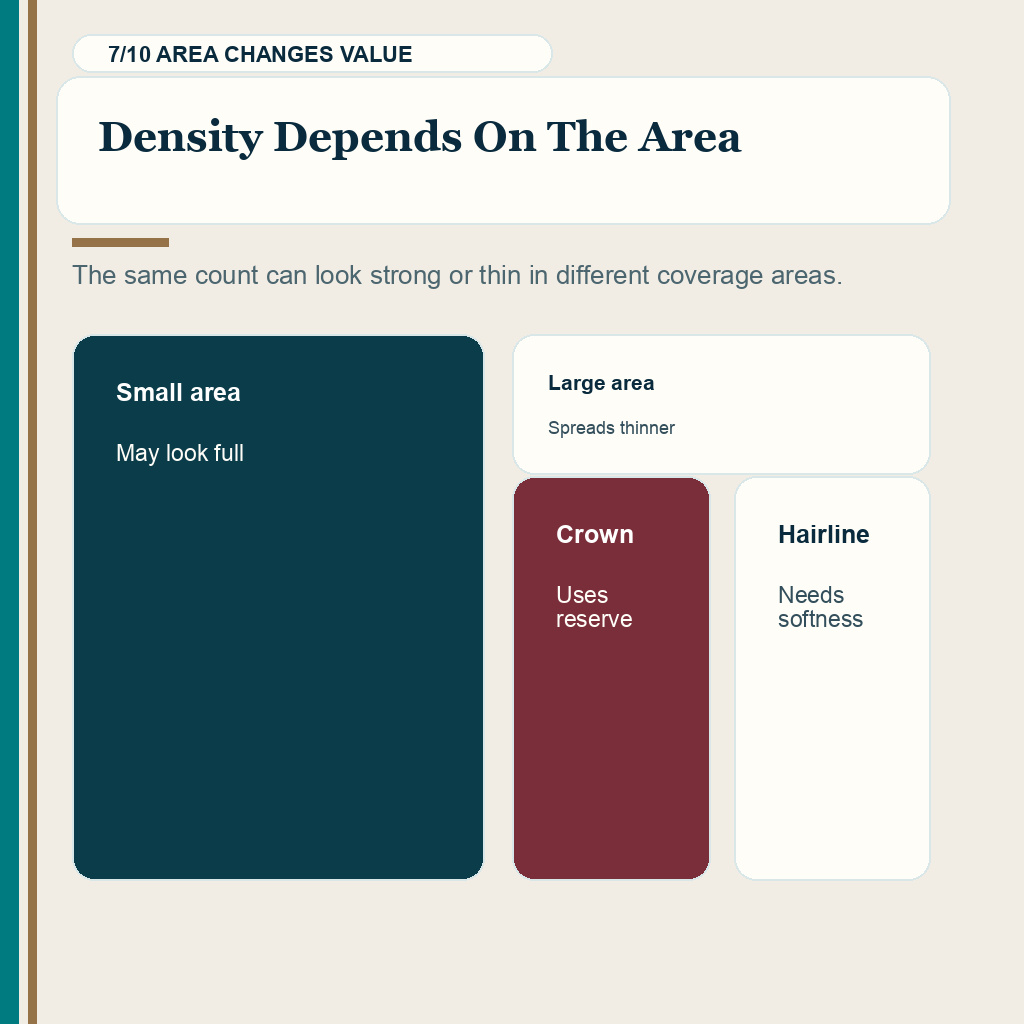
A stronger before surgery explanation names the zones, not only the total. For example, the hairline, frontal forelock, mid scalp, temples, and crown do not need the same density or the same graft type. If the clinic can show the approximate treated surface area and explain the planned density range for each priority zone, the count becomes easier to judge.
Photos can help a surgeon form an initial impression, but they cannot fully show miniaturization, scalp laxity, hair caliber, donor density, scarring tendency, or the exact surface area that needs coverage. A photo quote becomes risky when it turns into a hard promise without explaining what must still be checked in person. A proper hair transplant plan from photos should remain provisional until the scalp and donor area are examined directly.
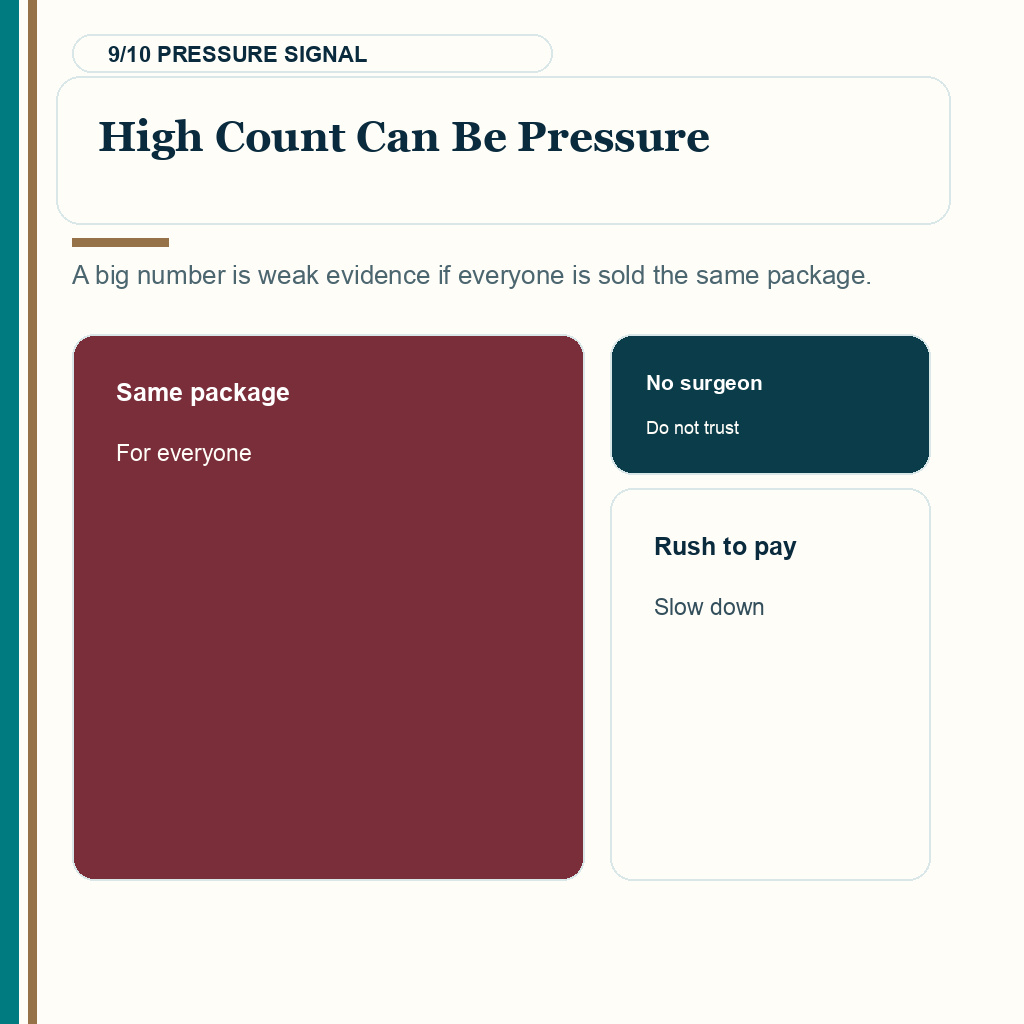
You can also verify who is making the decision. If a coordinator sells a package number but the surgeon has not assessed the donor area, designed the hairline, or explained the long term plan, the graft count is weak evidence. For graft count trust, who performs your hair transplant surgery matters as much as the number itself. This is also why deposit clarity before booking matters when a graft number is being sold as part of a package.

Graft count trust improves when the plan, surgery notes, and follow up review are documented clearly.
Surgery day documentation
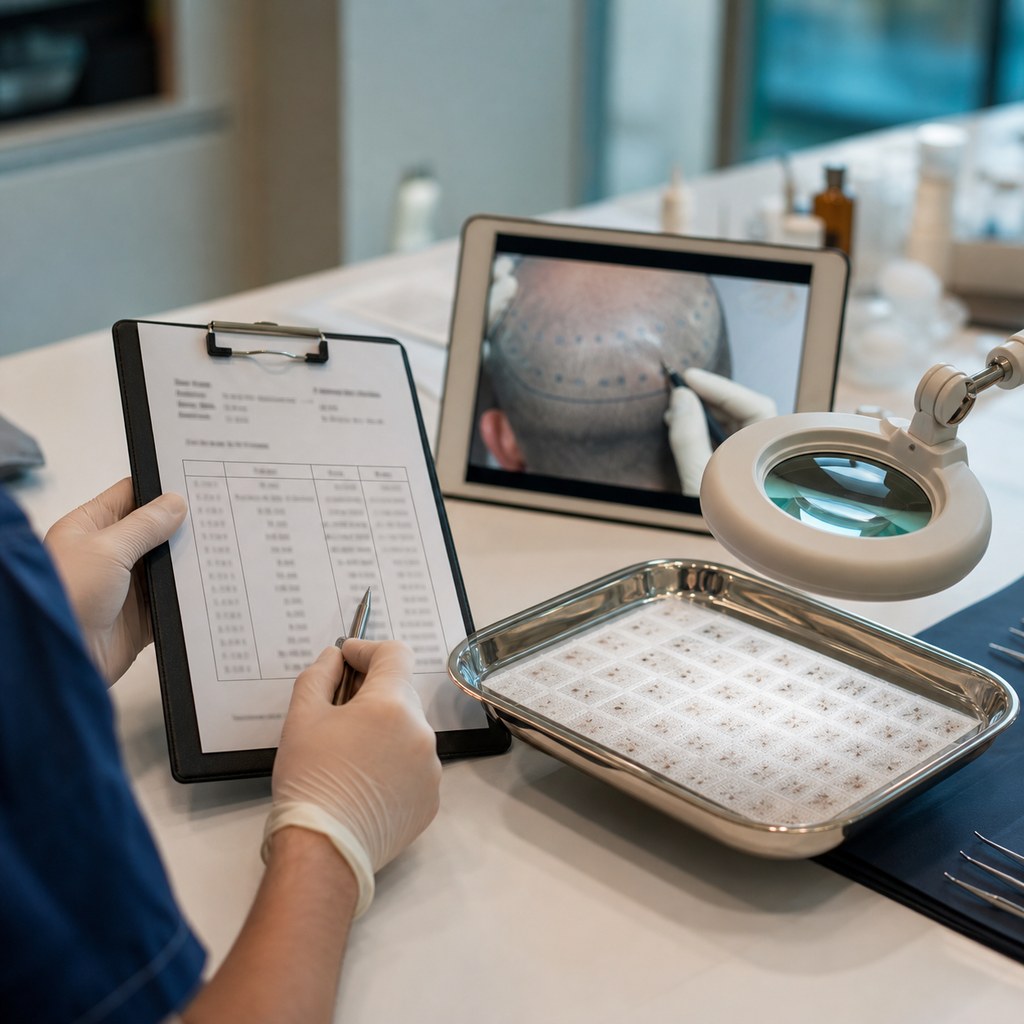
On surgery day, the count should not feel mysterious. A clinic can record the harvested grafts, the final placed count, and the number of single hair, double hair, and multi hair follicular units. That breakdown matters because one graft and multi hair grafts do not create the same visual effect. You cannot verify that every number on the paper is true by reading the paper alone, but having no record leaves too much guesswork.
Any number shown on an extraction device or counter needs a label that states what the device actually records. It should not be presented as the final graft count unless the operation record reconciles it with the grafts prepared and placed. Transection needs its own definition and denominator in the record. Subtracting the placed count from an unlabelled device reading does not establish a transection rate.
Two transection percentages from the same sample
Transection means a follicle has been cut during harvesting. A rate may count individual follicles or whole grafts containing a cut follicle. Those are different measurements.
For a simple hypothetical example, imagine 100 extracted grafts, each containing two follicles. That gives 200 follicles in total. In 10 of those grafts, one follicle has been cut and the other remains intact. The other 90 grafts have no cut follicles.
Grafts containing a cut follicle
10 affected grafts out of 100 extracted grafts
10%
Individual follicles cut
10 cut follicles out of 200 follicles
5%
Both percentages describe the same sample. The smaller figure does not mean that a different surgeon caused less damage. Neither figure predicts final growth. Some affected grafts still contain intact follicles.
A useful report names the unit counted, includes the numerator and denominator, and states whether the count covers a sample or the whole extraction. Comparisons also need the same definition of damage and comparable case conditions. These invented numbers explain the calculation. They are not a target or an acceptable damage threshold.
The record should not blur harvested grafts with placed grafts. If a small number of grafts are trimmed, judged unsuitable, or not implanted, the final placed count needs to be stated plainly. The stronger transparency signal is whether that record is supported by clear surgery photos shared without pressure or repeated asking, including donor area photos, recipient area photos, and intraoperative documentation that show whether the promised plan was actually executed. If price or package terms are tied to graft count, you should also know before surgery how a lower safe final count or a medically justified increase would be handled.
The number may also adjust for medical reasons. Shaving can reveal a larger or smaller area than expected. The donor area may be weaker than the photos suggested. Existing native hair may need more protection. If the graft number changes, the reason should be explained before the work continues. A limited, medically explained adjustment is very different from a surprise upsell, stem cell extra treatment, or vague change after payment. That difference matters during day of surgery graft number changes.
The documentation should also separate graft count from hair count when possible. A high number of single hair grafts used at the front can be correct for a natural hairline, while stronger multi hair grafts may be better used behind it for visual density. If a clinic talks only about the total count and never explains hairline design, graft quality, direction, and donor management, you are missing the surgical meaning of the number.
The most useful surgery note reconciles the estimate, harvested count, placed count, unusable or discarded grafts if any, and the single-, double-, and multi hair breakdown. It should also say where the grafts were placed. A total number without zone allocation can still leave the patient confused about why the front, temples, or crown look the way they do.
Mixed source counts need the same clarity. The record should separate scalp, beard, and chest grafts by donor source and recipient zone. Five thousand total grafts is a different surgical story when soft hairline grafts come from the scalp and beard grafts are used only behind them.
When I do not accept the quoted number
A quoted graft number should not become final if the donor supply, miniaturization, bleeding risk, hairline request, or recipient area size does not support it. The number has to serve the surgical plan, not protect the package.
If the examination shows that the plan is too aggressive, I reduce the number, stage the operation, or stop the case. A smaller count can disappoint a patient, but using grafts that should have stayed in reserve can make future repair harder.
The written record needs to explain the change in plain language. It should show the original estimate, the safer final range, the treated zones, and the reason the patient was not promised more than the donor and tissue could support.
A lower final count can be safer than the package number
This should be settled before surgery. If a clinic sells a fixed package, you should know what happens if the donor area, graft quality, bleeding, density plan, or recipient area size makes a lower count medically safer on the day. A surgeon should not force extra grafts just to satisfy a package number.
I use a flat price model to keep this decision medical. The price does not rise or fall according to the final graft number, so graft safety does not become a negotiation about the invoice. If the safe number changes, you should understand the surgical reason rather than wondering whether the clinic is trying to sell more grafts.
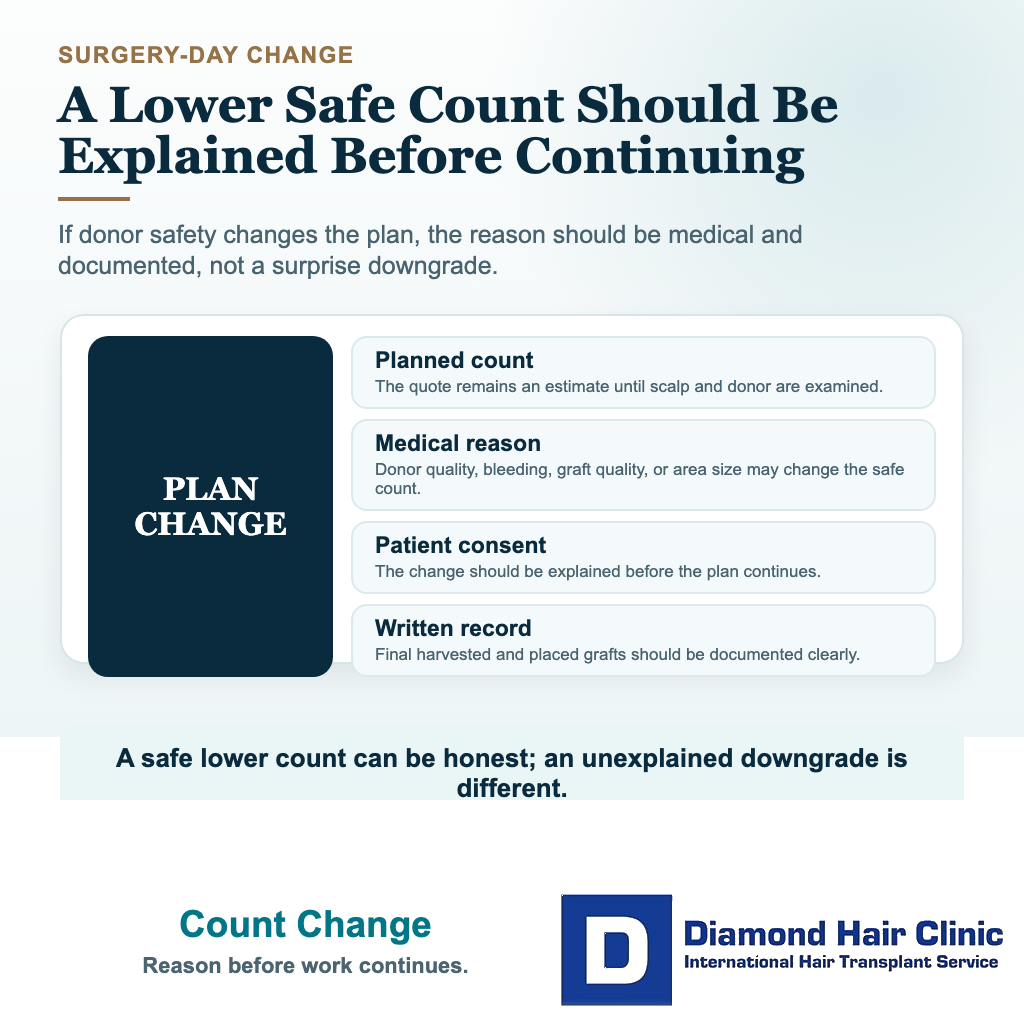
A lower final count can be acceptable when it protects the donor area and still matches the agreed priority. It becomes a problem when the clinic never explained the possibility, never documents the reason, or uses a large advertised number to win the booking and then gives a vague explanation afterward. You deserve a clear surgical reason, not a surprise downgrade.
Count reconciliation belongs in the written terms before the deposit. It should cover a lower safe final count, a medically justified increase, and who approves a change. A package minimum is a commercial term, not a reason to remove more grafts than the measured recipient need and future donor reserve justify.
Photos cannot prove every graft after surgery
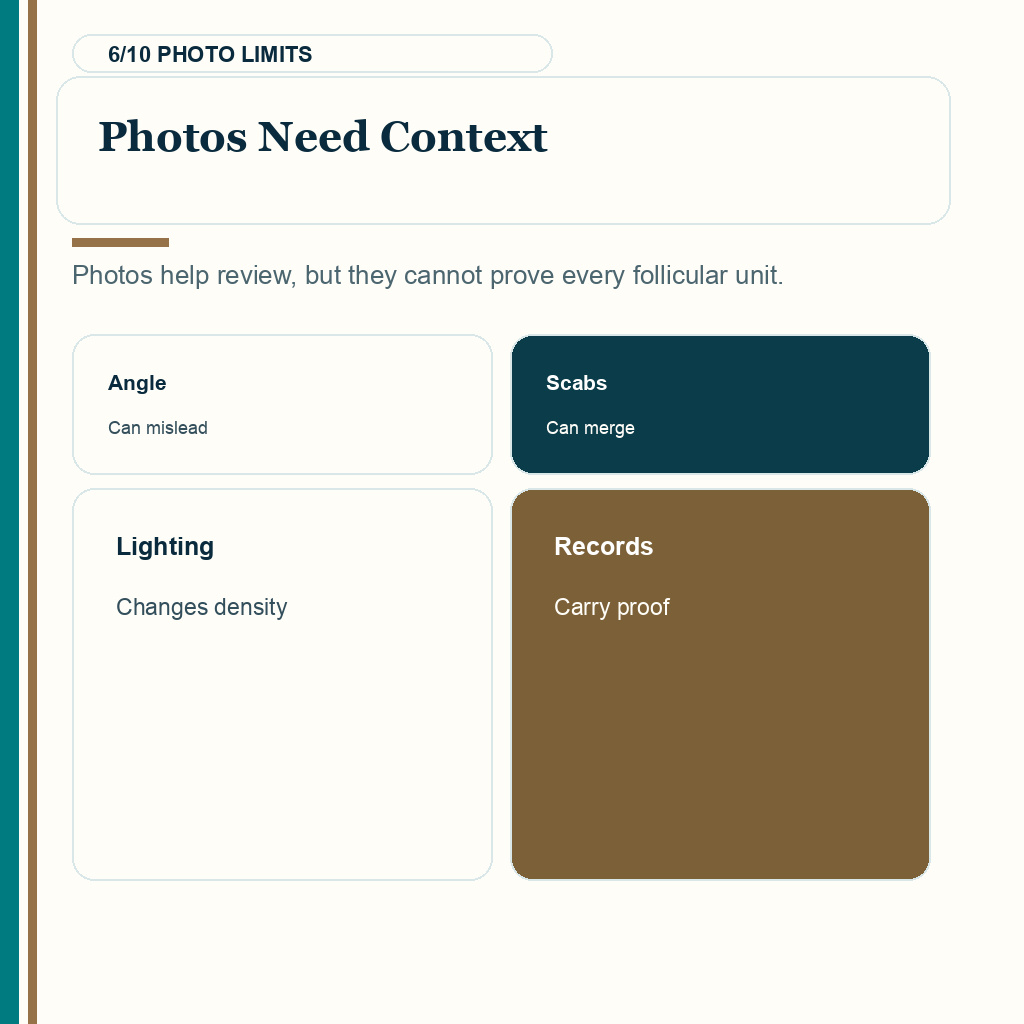
After surgery, many people try to count scabs, dots, or marked up photos. Some use apps or manual counting tools because they want something objective. These can sometimes start a discussion, but they should not be treated as proof. Scabs can merge. Some grafts may be hidden by crusting or blood. Some sites contain single hair grafts and others contain multi hair grafts. A photo taken from the wrong angle can make an area look denser or thinner than it is.
Early appearance also does not prove final growth. A dense looking first week can shed. A thin looking month three can still thicken later. A result that looks weak at month eight may be due to limited graft numbers, poor survival, native hair miniaturization, harsh lighting, wet hair, or an expectation that was never realistic for the donor supply. If the concern is timing rather than count, compare the result with the normal growth curve and warning signs. Being still thin after 7 months needs that kind of review.
Photos are useful for follow up, but they do not replace surgical records. Their best role is not to help you count dots after anxiety begins. Their best role is to show that the clinic documented the surgery while it was happening. If you send me photos and ask whether the clinic really placed the promised number, I can sometimes say the number looks plausible or implausible for the treated area. I cannot reliably count every follicular unit from the surface image alone.
If you are seeking a second opinion after a weak result, send the operative note, any graft breakdown, donor and recipient photos from surgery day, and a consistent photo timeline. Without those records, the review can still comment on design, donor condition, and growth pattern, but it cannot prove the exact missing number.
After a very large FUE session, the donor record is as important as the recipient result. A useful record shows the planned range, the final graft count, where grafts were taken, how the extraction was spread, and what donor reserve was left. Those details make a late donor concern easier to review without reducing the whole discussion to one number.
Low or high numbers can raise questions
A low number is not misleading by itself. If you have a small area, strong native hair, donor limitations, or a need to protect future hair loss, a conservative plan can be wise. But the surgeon should be able to explain why the limited count is enough and what it will not achieve. If you expect thick coverage over a large area and the count is very low, the expectation must be corrected before surgery.
A high number is not better by itself either. Very large sessions can be reasonable for the right candidate, but they can also create overharvesting, poor graft handling, long out of body time, and unrealistic coverage promises. With too many grafts in one area, density can become damaging when it is forced. For very large plans, you should also understand why a 5,000 graft session or a 7,000 graft plan over two days needs donor safety review, not just excitement.
The most suspicious number is often the one disconnected from anatomy. If everyone is offered the same package, or if the clinic promises a maximum number without measuring the recipient area and donor capacity, the number may be built for selling rather than planning. Graft count should come after examination and design, not before them.

A transparent graft count still needs good graft handling, direction, density planning, donor preservation, and a reason for every zone.
Donor safety matters more than the biggest number
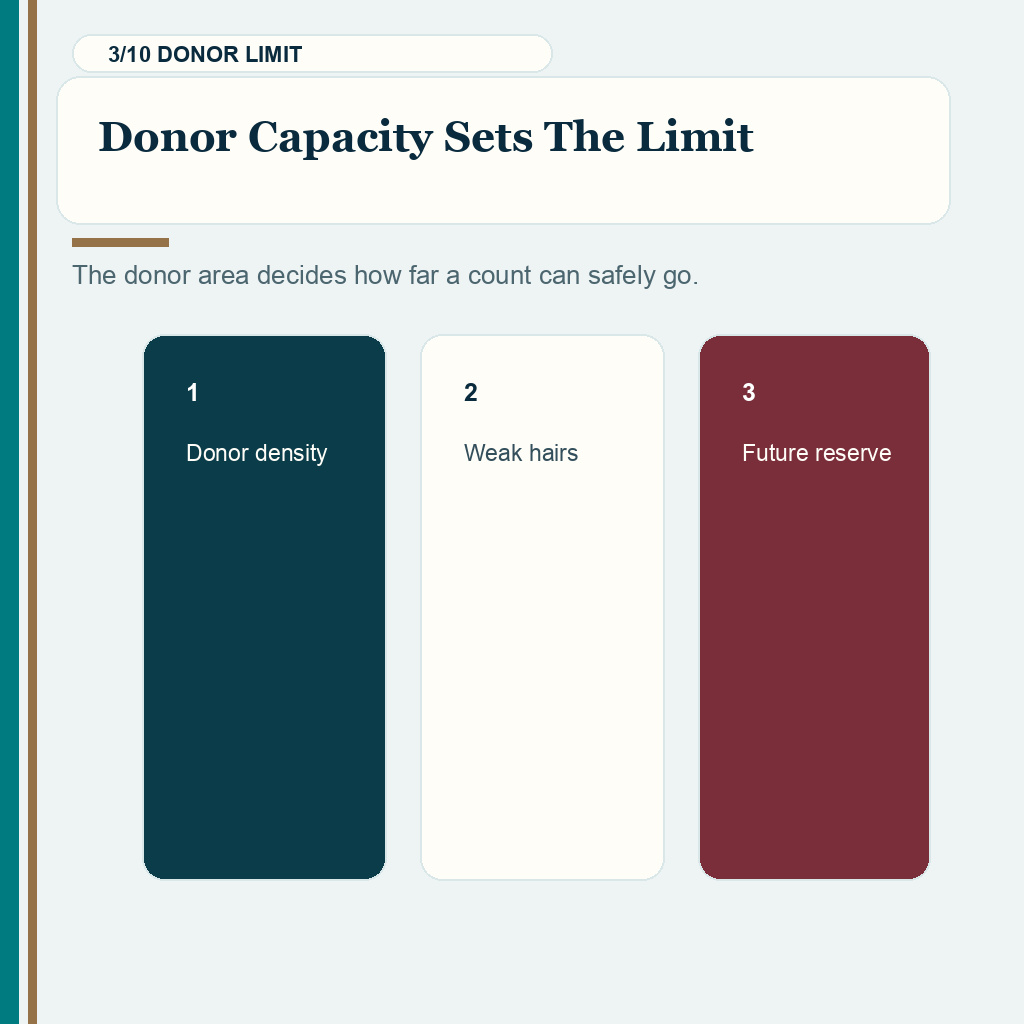
Donor supply is a limited lifetime resource. Selected transplanted grafts may be reused in repair, but each graft harvested still comes from a limited original supply. More grafts can feel like better value, but the real value is using the donor supply wisely. A large number placed into the wrong area can leave you with a thin result, a damaged donor area, and fewer options if hair loss progresses.
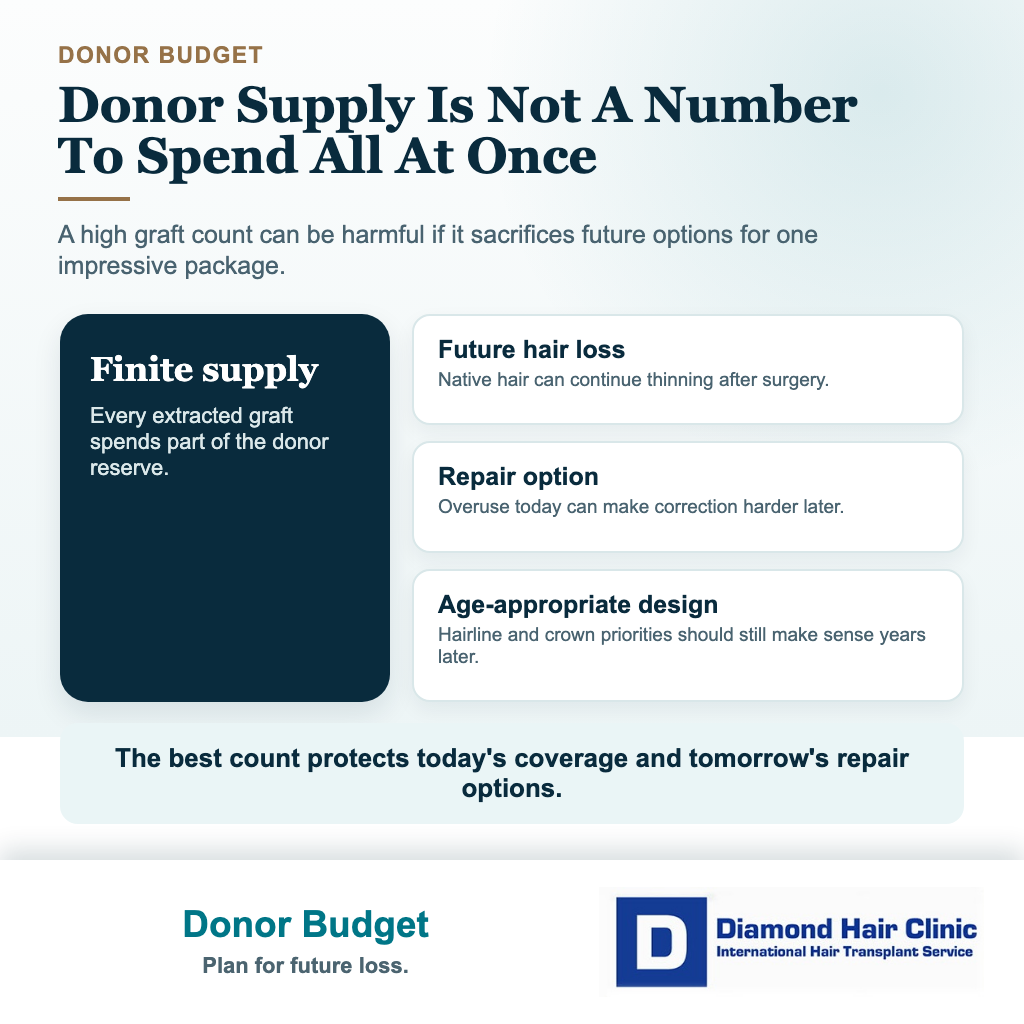
You need to understand the donor budget before chasing a number. The plan has to protect the present result and the future repair option. If the hairline is lowered aggressively at a young age, the count may look attractive on paper but age poorly. If the crown is treated too heavily before the front is stable, you may spend too much donor supply where coverage is hardest. This donor budget problem is central to lifetime hair transplant grafts.
Overharvesting is also a visible risk. A clinic can claim a big number, but you pay later if the donor area becomes patchy, depleted, or difficult to wear short. When a plan sounds unusually large, the donor area matters before the count impresses me. With donor area overharvesting, the back of the scalp must be protected as carefully as the visible hairline.
Questions before accepting a graft number
A defensible graft number shows how the area was measured, the planned density, the donor assessment, who designs the hairline, who extracts and places the grafts, how the final count is documented, and how a change on the operation day is handled. These details separate a surgical plan from a price package.
Also ask for the planned split by zone. A 3,000 graft plan concentrated in the frontal third is a different promise from 3,000 grafts spread thinly across the front, mid scalp, and crown. When the zone split is clear, the patient can understand the likely visual result instead of judging the plan from the total count alone.
The clinic should also record grafts carrying one hair, two hairs, or several hairs in understandable language. If the counting process cannot be explained without returning to marketing photographs and discounts, slow down. Settle the written record before paying a deposit or arranging travel.
Guarantees should be handled carefully. A clinic can promise careful evaluation, sterile conditions, clear records, follow up, and medical accountability. No clinic can responsibly guarantee that every graft will survive, that native hair will stop thinning, or that the final density will match a filtered photo. If a promise makes you stop asking about the plan, it is not protecting you. Hair transplant guarantees can hide that risk when they replace a real surgical explanation.
Judging graft count transparency
I judge graft count transparency by whether the number remains connected to you. The plan should make sense for your age, donor area, hair type, hairline design, current thinning pattern, and likely future loss. A higher graft number can help only when the donor area can safely provide it, the grafts are handled well, and the density is planned sensibly for the area being treated. The count should not be used to impress you before the surgeon has explained the limitation. If the donor is disputed, review the weak donor and high graft quote problem before trusting the count.
By the end of the consultation, you need a realistic understanding of what the number can and cannot achieve. If the plan is 2,000 grafts for a small frontal correction, you should know why that can be enough. If the plan is 4,000 grafts across the front and crown, you should know where the density will be limited. If the plan is staged, you should know what the first session is meant to accomplish and what is being saved for later.
The realistic answer is not that every graft can be independently proven by you after surgery. The useful answer is that the quote, surgical record, photos, and follow up should tell the same story. That kind of process makes deception less likely, makes the plan easier to understand, and gives you records that can be reviewed later if the result does not match the expectation.
When I change or refuse a graft number
I change a graft number when the scalp examination tells a different story from the first photos. Donor density, miniaturization, safe zone width, hair caliber, crown demand, old extraction marks, and hairline position can all move the number up or down.
I refuse a number when it would damage the donor, spread grafts too thinly, chase a low hairline, or pretend that the crown can be solved without future planning. A lower number is not a weaker plan if it keeps the donor usable and the result believable.
The written record needs to show the final placed count, the treated areas, any planned change, and the reason behind it. If a patient pays for a package, the medical record still has to follow the safe plan, not the marketing number.
Basis for trusting a graft number
A graft count should help explain the operation. It should not replace judgment. If the number is documented, medically justified, and connected to donor safety, it can guide the plan well. If the number is vague, identical for everyone, or used mainly as a sales promise, it should make you pause.
My review of a hair transplant plan does not start with whether the number is high enough. I ask whether the number is realistic for the area, safe for the donor, natural for the hairline, clear about density, and useful for your future. If the result later looks thinner than the promised number, the review still has to be clinical. The cause may be too few grafts for the area, weak survival, ongoing native hair loss, harsh lighting, styling, or a result that is still maturing. The best verification happens before surgery begins, when the plan, documentation, photos, and accountability are all clear.

Read this review excerpt
told me the quality of my donor hair and what he could take out and advised me what will the be best outcome with what donor hair I had.