


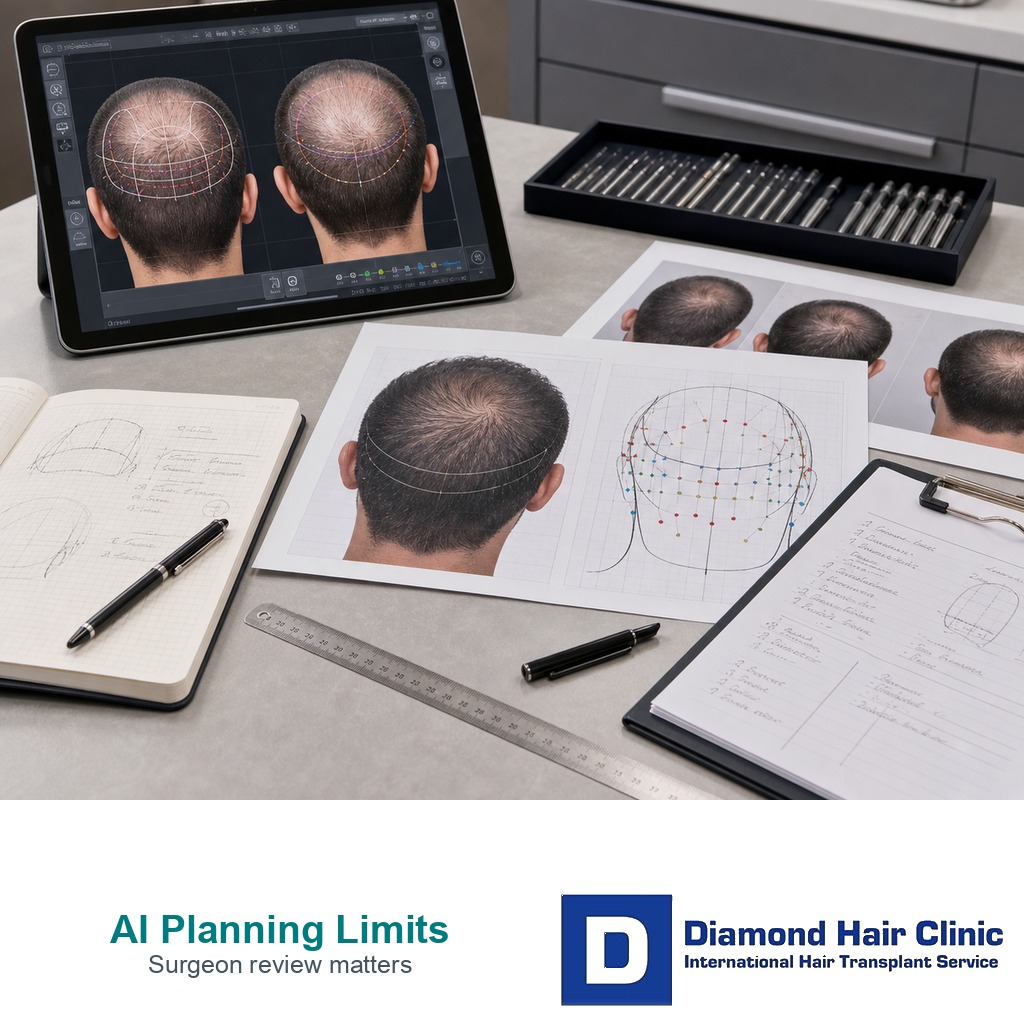



Photos and AI tools can still miss clinical details
Photos can show visible thinning, recession, crown exposure, hairline shape, and sometimes the general quality of a result. They cannot reliably show everything that decides whether surgery is wise. A photo may hide miniaturization in the donor area, early diffuse thinning, inflammatory scalp disease, low hair caliber, previous extraction damage, or the amount of future hair loss still likely to happen. AI also cannot know whether the photo was cropped, filtered, taken after styling product, or chosen because it supports the answer you wanted.
Lighting changes the answer too. Wet hair, dry hair, styling product, camera distance, harsh bathroom light, and a short haircut can make the same scalp look very different. I advise patients to judge hair transplant before and after photos with context, not emotion. AI has the same problem. It can treat a picture as convincing without knowing what the picture is hiding.
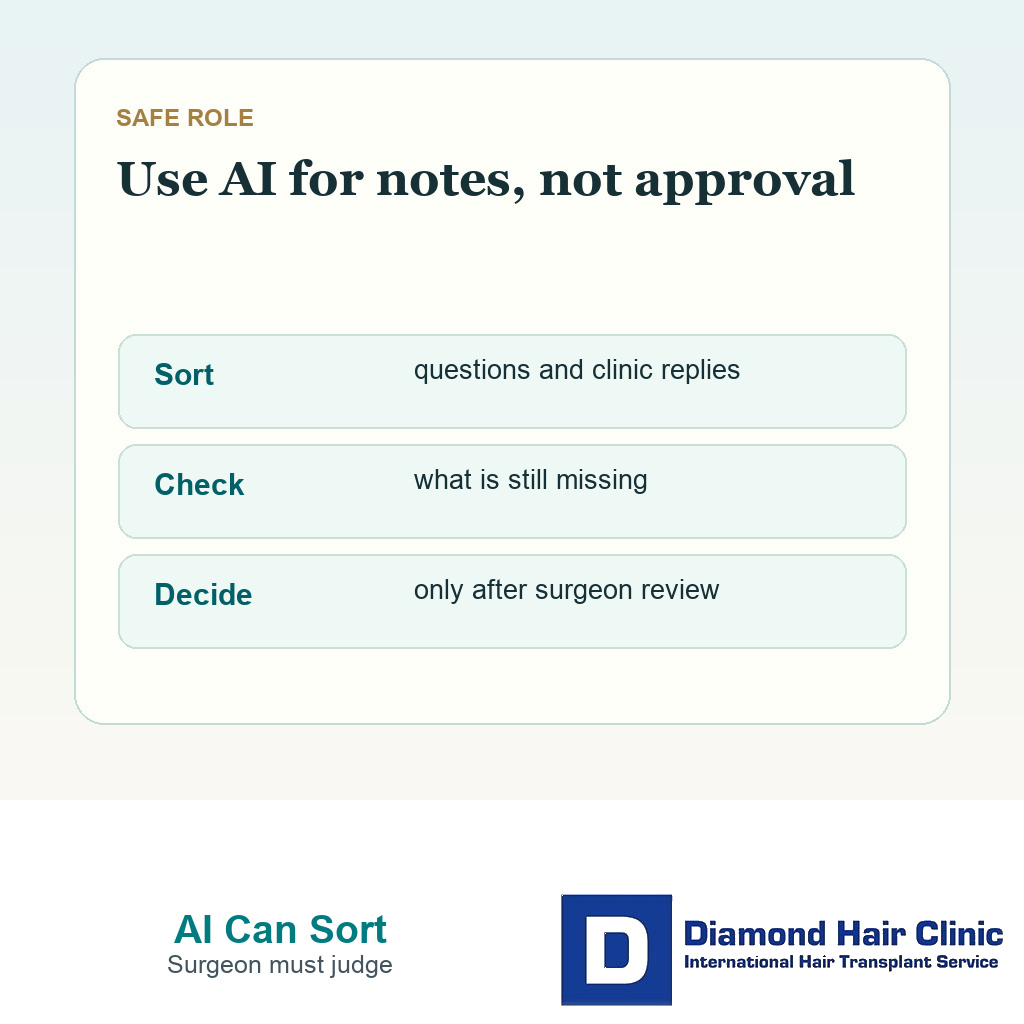
Use AI to organize questions, not to approve surgery.
AI graft estimates can sound too certain
An AI graft estimate can sound precise because it gives a number. That precision can be misleading. A graft number is not chosen only by looking at the bald area. It depends on hair shaft thickness, curl, skin contrast, donor density, safe extraction zones, miniaturization, hairline position, crown size, and how much hair loss may continue in the future.
I avoid comparing clinic offers only by the highest number. The question is not, “Who promised more grafts?” The question is, “What number protects this donor area and this lifetime pattern?” A real hair transplant graft count verification discussion includes the process behind the number, not only the number itself.
AI may estimate from surface area, but it cannot feel density, inspect miniaturization under magnification, judge the safe donor zone, or test real hair direction. It also cannot verify age, family pattern, medication response, previous extraction quality, previous surgery, or tolerance for future thinning unless those details are supplied and medically checked. A wrong high estimate can push you toward overharvesting. A wrong low estimate can make a realistic plan seem inadequate.
A screen preview is not the same as hairline design
AI can draw a hairline that looks attractive on a screen. That does not mean it is surgically wise. A natural hairline is not just a smooth border across the forehead. It needs age appropriate height, temple balance, small irregularities, correct graft angles, softer single hair grafts at the front, and enough donor reserve for later loss.
When I plan hairline design in a hair transplant, I am not trying to win a screenshot. I am trying to create a front that still makes sense when the patient is older, when the mid scalp changes, and when the donor supply must be protected. A screen preview can make a young face look more dramatic by lowering the hairline. It cannot decide whether that line spends grafts the patient may need later.
Younger men need extra caution here. A very low, very straight AI generated hairline may look satisfying for a few seconds, but transplanted hair may remain while native hair continues to recede behind it. That can leave you with an isolated front that is difficult to repair.
Donor area and future loss still need surgeon judgment
The donor area is the budget of the whole operation. Once grafts are taken, they do not grow back in the donor zone. A safe plan has to estimate how much can be used now, how much should be saved, and whether the donor area itself is strong enough. This cannot be settled from one photo of the back of the head or from a graft number produced on a screen.
A measured donor area assessment looks at density, caliber, miniaturization, scars, previous extraction, hair direction, and the borders of the safe donor zone. Future hair loss also matters. Active thinning behind the hairline needs a different plan from stable frontal recession. AI can describe those concepts, but it cannot perform the examination.
I stay cautious when an AI tool gives a confident plan from a photo set. It has not felt the scalp, measured density, checked medical history, or decided what should be protected for the next decade. Donor planning is where a polished answer often becomes much less certain.
Information to prepare before a real consultation
If you use AI before speaking to a clinic, use it to prepare a better consultation file. Send clear front, side, top, crown, and donor photos in stable lighting. Add your age, hair loss history, family pattern, medication use, previous surgery, scalp disease history, and what result you are hoping for. If you already received a quote, include the graft number, hairline drawing, and who supposedly reviewed the plan.
This information helps a surgeon judge whether you are a good candidate for a hair transplant. It also keeps the discussion realistic. If you ask for a dense frontal hairline, crown coverage, and long term donor protection, you may learn that all three cannot be maximized in one session.
I also like comparison photos when they are relevant. The best examples are results from hair like yours, not just the most impressive gallery images. Texture, color contrast, age, donor strength, and loss pattern change what can be copied safely.
The point where AI advice becomes dangerous
AI advice becomes dangerous when it makes you skip a medical step. A fluent answer can still be incomplete, outdated, or based on a photo that hides the real problem. If you accept surgery because a chatbot said the hairline looks fine, that is unsafe. If you dismiss scalp inflammation because an image answer sounds reassuring, that is unsafe. If you think a high graft number is correct because a simulator produced a dense after image, that is unsafe.
There is a practical difference between using AI as a note tool and treating a public chatbot, simulator, or clinic software as a medical planning system. Before any tool influences a surgical decision, its purpose, limits, role, data handling, validation for this use, and clinical responsibility need to be clear.
Privacy matters too. A close scalp photo, face photo, medical history, medication list, or clinic document can identify you. If you use AI, keep the data minimal and avoid uploading documents that include private identity details unless you understand the platform. Remove passport images, phone numbers, addresses, flight details, and clinic invoices when they are not needed for the question.
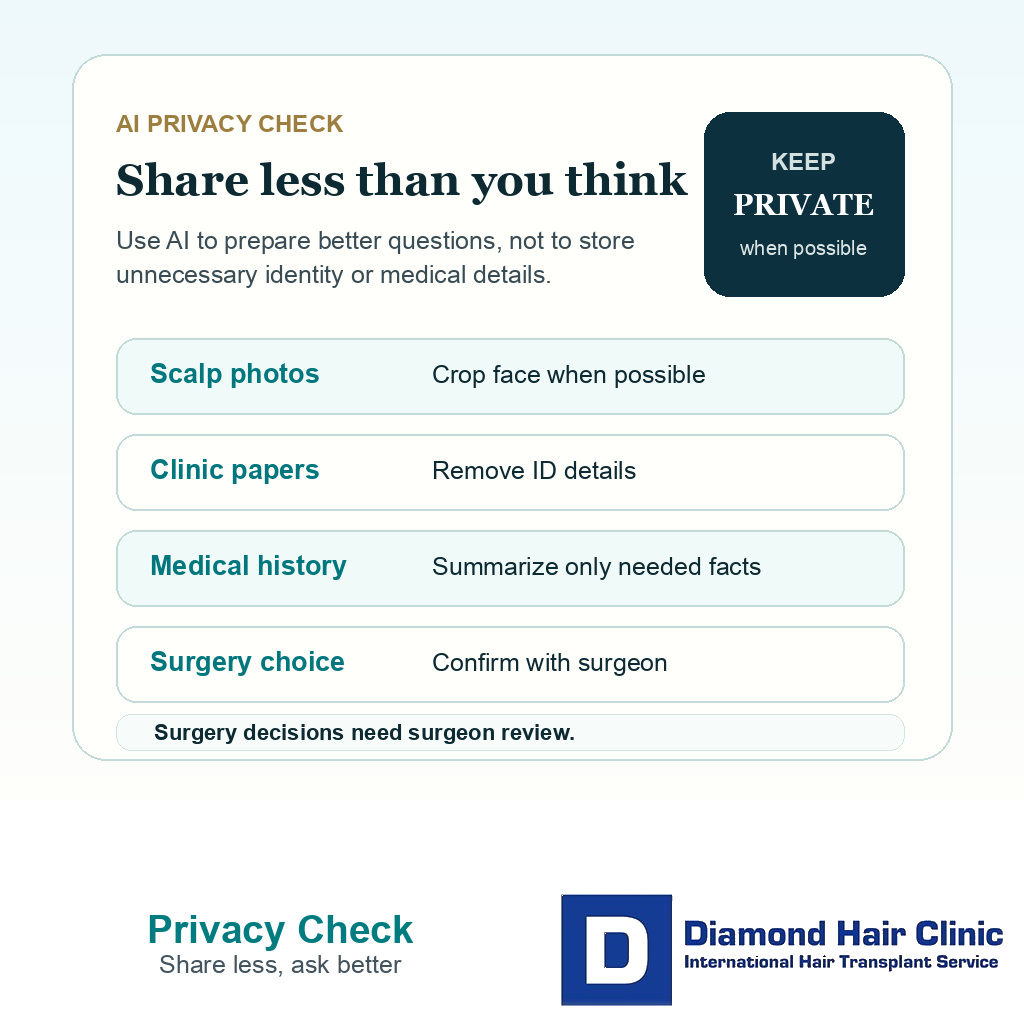
Use AI to organize questions, but avoid uploading more private information than the question needs.
The other risk is emotional. AI can give immediate reassurance, and immediate reassurance is attractive when hair loss has been painful for years. But confidence without responsibility is not medical judgment. If the answer would change whether you travel, pay, lower your hairline, or accept surgery, it needs a surgeon, not only a screen.
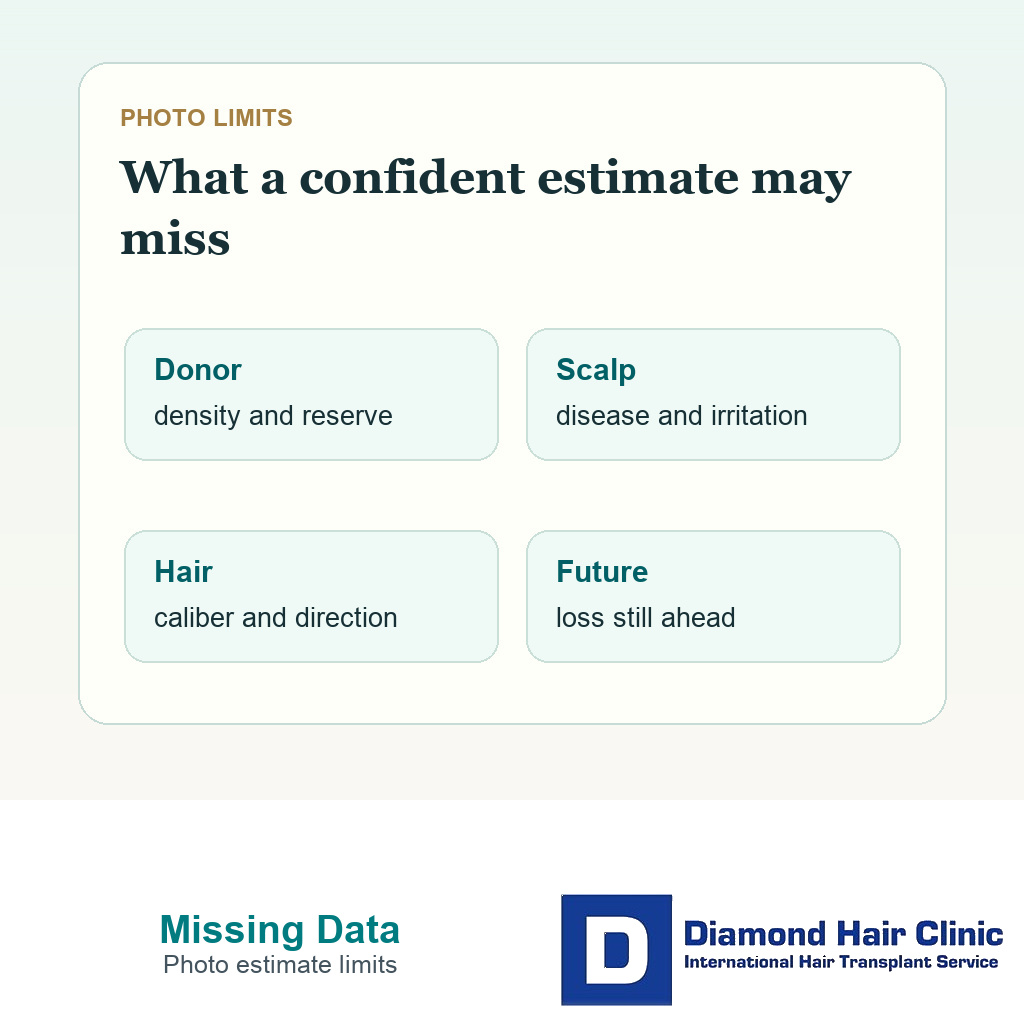
A confident estimate is weak if the missing clinical data is ignored.
AI advice should be compared with clinic promises
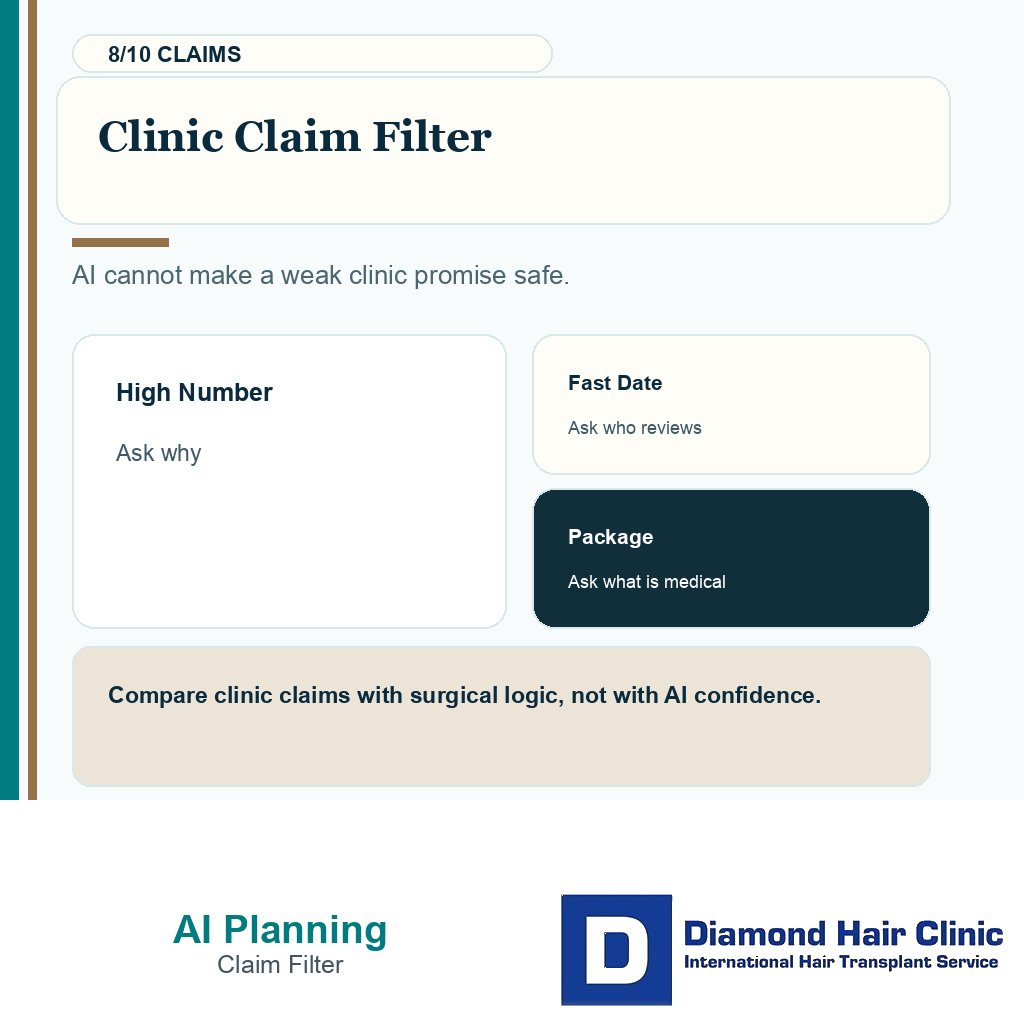
Sometimes AI and clinic marketing create the same problem from different directions. Both can make a complex surgical decision feel easier than it really is. A chatbot may say the plan looks reasonable. A clinic coordinator may say the surgeon will confirm later. A simulator may show dense coverage. A clinic may sell a large graft package. None of those answers replaces the medical explanation.
A useful clinic answer should explain who reviewed your photos, what remains provisional, how the donor area will be examined, why the graft range fits the area, and what would make the surgeon reduce, stage, or postpone the plan. A hair transplant coordinator can help organize communication, but the final plan should not belong to a sales role or a chatbot.
Technology claims need their own proof standard. Robotic hair transplant ARTAS claims show this clearly. A device can assist a step, but it cannot decide the whole strategy. AI belongs behind the donor exam, not above it. It may support thinking, but it should not own the judgment.
AI suggestions stop at the donor exam
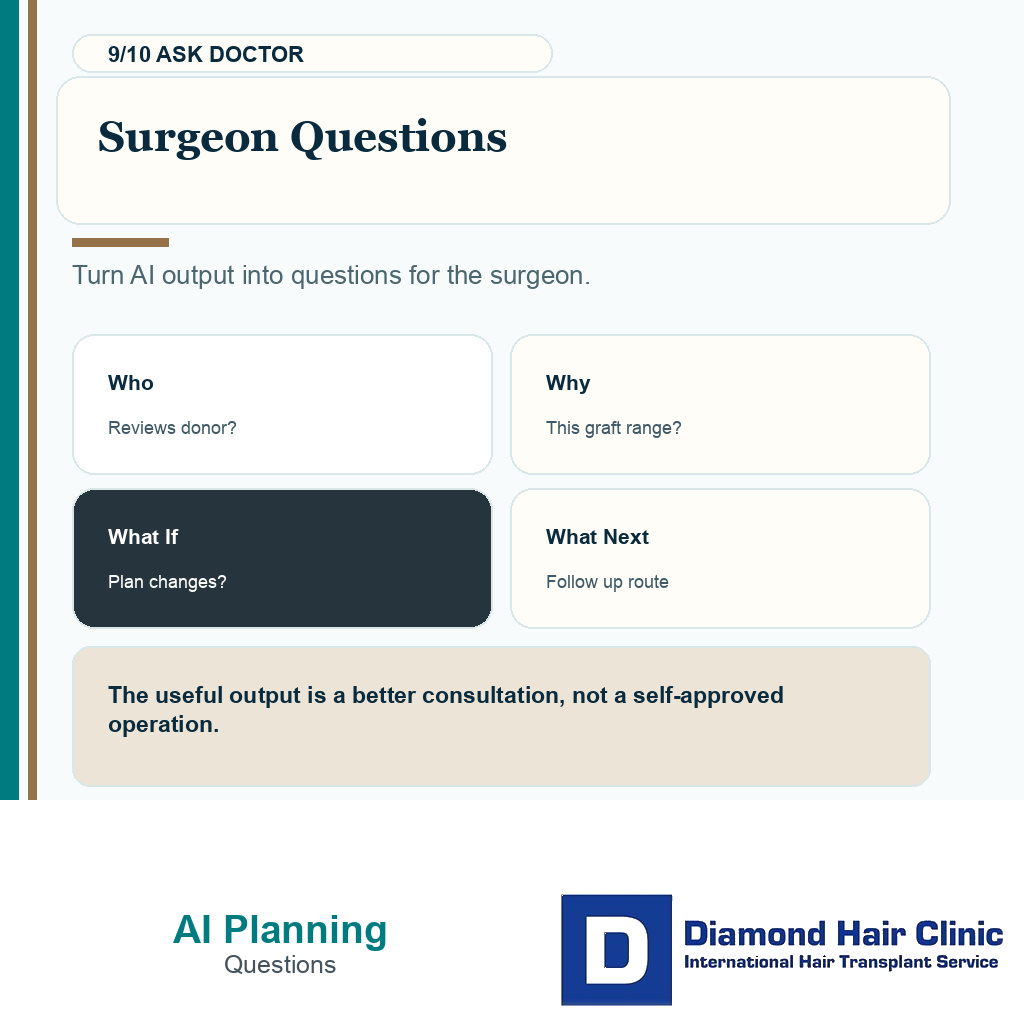
If AI gave you advice, bring it as a question list, not as a challenge. Ask which parts are correct, which parts are incomplete, and which parts would change after donor examination, magnification, medical history, and a direct hairline discussion. It helps to show the exact prompt, the photo set used, and the answer, because a different prompt or cropped photo can produce a different level of confidence. Ask who will examine the donor area, who will design the hairline, who will decide the graft number, and who remains responsible if the direct examination changes the plan.
When AI advice and a clinic quote disagree, confidence is not evidence. The clinic plan still has to name the measurements behind the graft range, the limits AI could not see, and the examination findings that would change the design.
Surgeon involvement in hair transplant surgery becomes practical here. A surgeon should be able to explain why a plan is safe, not only approve what the patient already wants. If the clinic avoids those questions, or if the AI answer and the clinic answer both leave you uncertain, a second opinion before hair transplant surgery is a reasonable step.
A useful consultation explains where the AI answer may be right, where it may be incomplete, and where the donor exam changes the plan. If the right medical answer is no surgery, that should be said clearly.
Use AI for questions, not authority
AI can be useful before consultation when it helps you organize photos, compare explanations, or notice which questions you still need to ask. I am happy to see that background because it shows what has influenced your expectations.
It stops being useful when the output starts acting like a surgeon. A simulated hairline, chatbot graft number, or copied treatment plan cannot examine donor miniaturization, scalp condition, hair direction, medical history, or the way a design will age on your face.
Bring the AI summary if it helps you speak clearly. Then let the accountable part happen in consultation, where the diagnosis, donor assessment, hairline design, graft distribution, and long-term plan are made by someone responsible for the recommendation.

Read this review excerpt
Every single one of my questions was answered and they made sure I had all the details I needed to make an informed decision.